Iran believes it has fundamentally altered the balance of power with the United States and now has a narrow opportunity to convert its position into lasting strategic and economic gains, Johns Hopkins University Professor Vali Nasr argued in an interview on Switzerland with Tom Switzer.
Speaking alongside University of Chicago political scientist John Mearsheimer, Nasr said Washington has struggled to accept how dramatically its position has changed following the prolonged war on Iran, particularly as Tehran retains leverage over the Strait of Hormuz. The interview was conducted by host Tom Switzer, who introduced Nasr as a leading Iran expert and Mearsheimer as a political scientist.
“There’s a consensus that they have defeated the superpower, at least put it on its heels,” Nasr said of the view inside Iran, arguing that Tehran sees little reason to moderate its position while it holds the advantage.
Iran sees narrow window to press advantage
Nasr rejected arguments circulating in Washington that Tehran is “overplaying its hand,” saying such assessments reflected disbelief at the extent to which the balance had shifted.
“In reality, Iran is not overplaying its hands. It’s just playing its hand,” he said.
According to Nasr, Iranian policymakers believe they have a limited period in which to secure the maximum possible strategic advantage.
“They think they have a narrow window to get the maximum amount of strategic advantage from having turned the table on the US,” he said, adding that Iranian leaders would consider it a major mistake not to press their advantage while Washington remains on the defensive.
That calculation extends to sanctions relief, frozen Iranian assets, compensation, and Iran’s position in the Strait of Hormuz. Nasr described Tehran’s approach as accepting immediate economic hardship in exchange for potentially much greater long-term gains.
Mearsheimer: US has ‘no choice’
Mearsheimer offered an even sharper assessment, arguing that Washington no longer possesses an effective means of forcing Tehran to abandon its position over the Strait.
Asked why US President Donald Trump would accept an arrangement under which Iran exercises substantial control over passage through Hormuz, Mearsheimer replied, “It’s very simple, Tom. He has no choice. He lost the war. This is a devastating defeat for the United States.”
He added that Trump “has no cards here,” arguing that Washington’s principal threat — further military escalation — had become increasingly difficult to carry out.
According to Mearsheimer, the United States faces both depleted munitions stocks and resistance from Gulf allies fearful that another escalation would trigger Iranian attacks on oil infrastructure, desalination facilities, and other critical installations.
Weapons shortages expose limits of US campaign
Nasr similarly argued that Washington’s weapons shortages had sharply reduced its ability to continue the campaign.
“It’s clear that the US doesn’t have the munitions, either offensive munitions or defensive munitions to keep bombing Iran,” he said, arguing that another month of fighting ultimately left Iran stronger and Washington weaker.
Mearsheimer said US military leaders had warned Trump before the war about limited stocks and the dangers of a prolonged confrontation. He argued that a major factor behind the end of the 40-day air campaign was that Washington was “running out of munitions.”
Nasr said the implications reach beyond West Asia, arguing that China and Russia would draw conclusions from the United States’ difficulty rapidly replacing sophisticated weapons during a prolonged war.
He cited Trump’s withdrawal from the 2015 nuclear agreement in 2018, attacks launched while negotiations were underway, and what Tehran viewed as Washington’s failure to uphold subsequent understandings.
Trump has created “such distrust about himself with Iranians” that even accepting Tehran’s terms might no longer be enough without guarantees that Washington would implement an agreement, Nasr said.
That distrust, he argued, explains why Iran wants concessions delivered upfront rather than postponed to future negotiations.
The earlier June 17 memorandum had envisaged reopening the Strait, lifting oil sanctions, and establishing a ceasefire that also covered Lebanon, while wider sanctions, reparations, and frozen assets would be addressed later.
Nasr said Tehran concluded that Washington subsequently undermined that arrangement, including its provisions related to Lebanon, reinforcing the view that Iran should secure tangible benefits before relinquishing leverage.
Mearsheimer described the result as a “humiliating defeat” for Washington before adding, “I believe it’s an even bigger defeat for Israel.”
He argued that Israeli officials were reluctant to acknowledge “the extent to which Iran has defeated not just the United States, but Israel,” predicting that both “Israel” and its supporters in Washington would seek to undo any agreement favorable to Tehran in the future.
Nasr later argued that Israeli Prime Minister Benjamin Netanyahu had “overreached in Lebanon and Iran,” describing them as wars “Israel” could not win and saying “Israel” had been “strategically defeated”.
For Nasr, the larger consequence is a regional order increasingly different from the one Washington sought to impose. Iran, he argued, now sees an opportunity not simply to end the current confrontation, but to use the outcome to reduce the US military threat around its borders, ease its economic isolation and consolidate its position as a major regional power.
The Strait of Hormuz cannot be reopened through diplomacy while Washington continues to use military pressure against Tehran, the Iranian Foreign Ministry has said.
Iran closed Hormuz in response to a US-Israeli military campaign launched in late February. Washington subsequently imposed a naval blockade on Iranian ports, escalating a standoff over a strategic waterway that has historically carried around a quarter of the world’s seaborne oil trade.
Iranian Foreign Ministry spokesman Esmail Baghaei said on Monday that diplomacy is “certainly” part of the “struggle to safeguard our national interests,” but added that “when dealing with a side that insists on the use of force, a maritime blockade is not a diplomatic action that we can lift through diplomacy.”
“Certainly, you have to use authority and military power, along with diplomacy, to prevent the United States’ aggression, and that is what is being done,” Baghaei told a press briefing.
Tehran has set out a series of conditions for reopening the strait, including compensation for war damage, the lifting of sanctions, and the release of frozen Iranian funds, as well as a permanent end to hostilities against Iran and its regional allies.
The IRGC has also said that reopening Hormuz will depend on Washington fully accepting Tehran’s conditions.
US President Donald Trump said that Washington was in no rush to reach an agreement, telling Axios that Washington was “low-keying” negotiations while allowing economic pressure on Tehran to build.
“We are only semi-negotiating with them. We are just watching Iran with its huge inflation and the fact they have no money,” Trump said, adding “It’s like a chess game.”
The talks follow weeks of disagreement over a 14-point memorandum of understanding that established a temporary ceasefire and provided for the gradual lifting of the US blockade of Iranian ports and the restoration of commercial traffic through Hormuz. Fighting resumed last month after the sides failed to agree on how the deal should be implemented.
Iran and Oman, meanwhile, are discussing arrangements for future shipping through the strait, although Tehran has stressed that any agreement with Muscat would not in itself mean the waterway would reopen.
The disruption to traffic through Hormuz has put sustained pressure on global energy markets. Oil prices rose nearly 3% on Monday amid uncertainty over negotiations, with international benchmark Brent reaching $85 a barrel and US WTI hitting $80.
According to a Wall Street Journal report citing US officials, President Trump has been privately weighing the possibility of declaring victory against Iran and ending the war without securing a nuclear deal.
Trump reportedly has floated to senior aides that if the US can keep Iran’s nuclear program in check and traffic resumes through the Strait of Hormuz, he would be willing to extend the ceasefire “indefinitely” and effectively declare the conflict over.
In recent meetings, Trump has expressed confidence that Iran is “likely unable to revive its nuclear work” after Operation Midnight Hammer caused heavy damage to Iran’s nuclear infrastructure in June 2025. He believes US intelligence capabilities would catch any Iranian attempts to rebuild, and that the threat of further American strikes would “serve as an enduring deterrent.”
Trump’s key condition for ending the war is that Iran agrees to fully reopening the Strait of Hormuz to international shipping. In exchange, officials expect Trump would lift the US naval blockade on Iranian ports.
According to the Wall Street Journal, a White House official said that the U.S. has “completed all of its military objectives against Iran,” and the president’s focus is now on “securing the flow of the world’s energy through the Strait of Hormuz.” The reporting suggests Trump is patient and expected to ride out the latest diplomatic snarl, especially so long as gas prices remain where they are.
Let’s assume that this WSJ report is accurate (a big assumption). President Trump is still living in a fantasy world. Despite his recent outbursts about bombing Iran’s nuclear sites, he now seems content to revert to his original declaration from June 2025 that Iran’s nuclear program has been obliterated. Count me skeptical. However, if Trump is willing to make that assumption then it removes one item from the negotiation list… Until recently the US, via Pakistani mediators, was pressing Iran to discuss the Iranian nuclear program before addressing the lifting of the blockade and sanctions, and the unfreezing of assets. Iran, for its part, has insisted on the reverse position: i.e., lift the blockade and sanctions, unfreeze the assets and accept Iran’s sovereignty over the Persian Gulf.
If Trump’s decision to declare victory and end the war hinges on Iran, “fully reopening the Strait of Hormuz to international shipping,” then prospects for a deal are slim. Iran will only agree to allowing ships to transit the Strait of Hormuz in accordance with the Persian Gulf Strait Authority guidelines it issued on April 22nd. In early May, the Supreme National Security Council and other Iranian bodies publicly confirmed the PGSA’s formation and role. It began administering a permit-based system requiring vessels to submit a detailed “Vessel Information Declaration” (covering ownership, insurance, crew, cargo, etc.) before receiving clearance. Fees for “specialized services” were part of the planned mechanism. Iran is not going to back down on this point.
The WSJ article hints at the major focus of concern for Trump: the domestic price of gas. I have repeatedly pointed out on several recent podcasts that there is a global shortage of diesel and aviation fuel and that the price effects of this shortage will become more profound with each passing week. Also, as I discussed in a recent article, the damage to the oil and gas infrastructure in the Persian Gulf and the departure of maintenance/repair personnel from the Persian Gulf Arab nations, along with the destruction of warehouses that held replacement parts needed to repair damage to the oil and gas terminals, the shortage of diesel and aviation fuel will persist for several months, if not longer.
Trump’s attention at present appears to be focused more on the November mid-term elections than on pursuing a new missile and bombing campaign on Iran. Although Iran has fired on at least five ships trying to transit the Omani channel in the Strait of Hormuz without submitting to the PGSA protocol, Donald Trump has not ordered any new strikes on Iranian targets despite his previous vow to attack Iran for each such incident.
I think that there is growing concern within the Trump administration about the potential for a global economic crisis if the Persian Gulf remains shuttered, especially if this continues as is into September. And this is likely the main factor pushing Trump to do a repeat of the end of Operation Rough Rider… i.e., Declare victory and leave.
US Senator Chris Murphy has delivered a scathing assessment of the ongoing war on Iran, declaring that President Donald Trump “has lost this war” and warning that every day the fighting continues, the United States grows weaker while Iran grows stronger.
In an interview on NBC News, the Democratic senator from Connecticut argued that the administration is facing a dire strategic reality, urging an immediate end to the hostilities even if it means accepting highly unfavorable terms.
Murphy highlighted that the cost to reopen the Strait of Hormuz increases daily, noting that a proposed deal currently on the table would effectively pay Iran $100 billion a year to reopen the critical waterway.
“What a victory for Iran,” Murphy remarked. “At the end of this war, they get paid to reopen the Strait, they get paid to rebuild their military, they get paid to rebuild their support for proxies in the region.”
Acknowledging the unfavorable terms, the senator stated he is willing to accept a flawed agreement simply to stop the bleeding.
“I am prepared to support a bad deal to end this war and reopen the Strait, because the only deal that is available at this point in time is a terrible, bad deal,” he said.
The senator stressed the severe domestic economic consequences of the conflict, pointing out that ordinary Americans are bearing the brunt of the administration’s military adventurism.
“People here in the United States get screwed, as prices go up, and up, and up,” Murphy said. He noted that seven in ten Americans want the war to end, adding that “families are being bankrupted, as we speak.”
Highlighting the immediate impact on daily life, Murphy pointed out that as children return to school, “filling up lunchboxes this year is going to cost them $4,000 more than it did last year. That is mostly because of this war.”
A depleted arsenal and global vulnerability
Beyond the economic fallout, Murphy warned of the severe toll the war has taken on US military readiness. The prolonged engagement has drastically depleted America’s defensive capabilities, leaving the country vulnerable to other global adversaries.
“We have used up almost all of our interceptors, the majority of our Tomahawks,” he revealed. He cautioned that this depletion has “put the United States in a dangerous position,” arguing that the military’s overextension has “allowed Russia and China to imagine things that they couldn’t have imagined early on because of our inability to defend ourselves and our allies.”
While Democrats have repeatedly attempted to curb Trump’s war powers, efforts that have been consistently blocked by Republican majorities in Congress, Murphy drew a strict line on future military funding.
“I am not going to support funding to keep this war going,” he declared, adding that he does not expect his Democratic colleagues to fund “a continuation of a war that is destroying American credibility and destroying American families.”
However, the senator offered a conditional path forward for post-war military recovery.
“If the war comes to an end, if the president ends this war, then, yes, of course, I and my colleagues will be ready to provide the funding to replenish the stores of munitions that have been spent,” Murphy concluded. “But the priority is ending this war.”
Although Donald Trump insists that the Strait of Hormuz is open, it ain’t. There are no direct talks between Iran and US representatives. In fact, it looks like Pakistan’s attempt at mediation is going nowhere. Iran has been talking with Oman, but those talks — despite claims of progress — appear to have stalled.
Iran updated its demands that the US must accept if it wants the Strait of Hormuz back in full operation:
‘Until America corrects its behavior, the Strait of Hormuz will not be opened.
Correcting behavior means:
Never threaten Iran with any language nor insult the sanctities of this nation.
End the war and aggression against Iran and its allies in Lebanon, Palestine, Yemen, and Iraq permanently.
Lift the naval blockade and withdraw U.S. naval and air forces from the area surrounding Iran.
Pay the damages for the two aggressive wars imposed against Iran.
Lift the cruel and illegal sanctions against the Iranian nation.
Release the frozen and stolen assets of the Iranian people unconditionally.
These are the demands of the Iranian people who have been relentlessly present in the squares and streets for 160 days.
Some in the West are treating these demands like they are something new. They are not. Let me remind you that in early April 2026 (around April 6), Iran delivered a 10-point proposal (sometimes called a peace plan or counter-proposal) to the United States. It was conveyed via Pakistan, which was mediating. This responded to an earlier U.S. 15-point proposal. Iranian state media and subsequent reporting summarized the key elements; no complete official English text of every point was universally published at the time, but consistent accounts of the main demands included the following:
A permanent/non-aggression guarantee that Iran (and related fronts) would not be attacked again.
Continued Iranian coordination/control or a secure transit protocol for the Strait of Hormuz (with some versions mentioning fees or arrangements involving Oman).
Ending hostilities against Iran’s regional allies/“Axis of Resistance” (including in Lebanon).
Full or broad U.S./Western sanctions relief (primary and secondary).
Termination of relevant UN Security Council and IAEA resolutions.
Release of frozen Iranian assets.
Compensation or reconstruction funding for war damage.
Related security and non-interference provisions.
Iran is holding firm to its demands. I remain skeptical that Donald Trump will agree to these terms. In fact, Trump reportedly has decided to launch a new campaign of bombing and missile strikes, despite warnings from the Chairman of the Joint Chiefs of Staff that US missile inventories are running dangerously low. Folks at CENTCOM who thought they would have a long weekend reportedly have been called back to work to finish planning the new round of strikes.
I think that US Treasury Secretary Scott Bessent is a good barometer for what Trump is thinking. On Thursday, August 7 he announced fresh Treasury/OFAC sanctions targeting Iran’s use of digital assets, posting that the regime relies on digital asset exchanges to launder billions of dollars, maintain covert access to international financial systems, and support the Islamic Revolutionary Guard Corps. He said:
With its economy in freefall and inflation in the triple digits, the regime is desperate for cash, Treasury will hunt down and dismantle the illicit financial networks that keep the regime afloat” whether in dollars, rials, or crypto.
He cast this as evidence his “Economic Fury” campaign is working. If this is what Bessent is telling Trump then it is likely that Trump is considering a CENTCOM plan for another intensive bombing campaign, despite that Cooper having reportedly advised the White House and Pentagon in late July to halt the bombing campaign around the Strait of Hormuz. His argument was essentially that the campaign had hit a wall of diminishing returns. He told administration officials that most of the military’s designated targets in the Strait of Hormuz region had already been struck, leaving relatively few remaining objectives. Despite that warning, CNN and the Jerusalem Post reported that CENTCOM has developed a plan for one or two weeks of heavy bombardment intended to destroy Iran’s remaining missile capabilities. This sits alongside CENTCOM’s unusual, crowdsourcing-style email asking troops for “new creative and unconventional ways” to pressure Iran — a sign the command is casting about for options.
Lots of mixed signals. I cannot rule out the possibility of Trump ordering a new surprise attack in hopes that it will force Iran to capitulate.
As the 2026 midterm elections near, polls show American voters’ top priority is the economy, including concerns that the unpopular U.S. war in Iran appears to be driving up prices at home.
Might these voter concerns give Republican hawks pause?
Apparently not.
“If we can’t handle four dollar oil for a period of months in order to disarm Iran of a nuclear weapon then we are not a superpower anymore,” former George W. Bush speechwriter Marc Thiessen told Fox News last week.
One of the biggest pro-Israel lawmakers in Congress had a similar message. “As much as it stinks to pay an extra dollar for a gallon of gas… think about the damage of a nuclear bomb going off in Washington, or New York, or Miami,” Rep. Randy Fine (R-Fla.) said Monday on News Nation.
Surely some of these Republicans would recognize that fear of inflation combined with growing opposition to the war could hurt their party come November — that maybe an adjustment in language and tone is in order?
Sen. Tom Cotton (R-Ark.) gets it. Sort of. He wants to keep prices down for Americans but thinks the only way to do that is to bomb the hell out of Iran for “two to three weeks” to get the Hormuz Strait open. He says the Iranians cannot be trusted to broker a deal without military force, so why not keep doing what hasn’t worked yet over the last five months?
Others are leaning hard into the notion that higher prices are just “fake news” — no doubt in hopes that repeating that enough will just make the problem go away.
The Iran war “has had basically no impact on food prices in the US,” declaredThe Daily Wire’s Ben Shapiro on Wednesday, seemingly responding to what writer Sohrab Ahmari is calling the “great American burrito debate” on social media over the current cost of food and how that might relate to the current cost of war.
Ahmari’s essay notes that, to Cotton’s point about Hormuz and prices, “even though the United States is the world’s chief net energy exporter, the supply squeeze in the Strait of Hormuz puts inflationary pressure on gas prices in America. And it’s not just gas prices which are affected, but those in many other sectors, too — from transportation to agriculture to restaurants and hospitality.”
In addition to rising prices, new data released Friday showed that 23,000 jobs were lost in July, an unexpected number for economists. All eyes are on the new inflation figures to be released this upcoming week. In May, it rose to 4.2%, the highest since 2023 and relaxed in June to 3.5%.
Never to be left out, regime change maven and Fox News host Mark Levin on Sunday urged Donald Trump to attack Kharg Island to bring Iranians “to their knees” and not to worry about sparking “a worldwide depression and so on. It won’t happen!”
Trump seemed to share the same reality-detached hopefulness, proclaiming on Monday that, “Now, US is the King of OIL!” The president shared a chart showing U.S. “oil exports [surging] to historic high!” He is likely hoping that his audience won’t read up on the subject and find that it doesn’t matter how much the U.S. produces; it won’t affect current gas prices at the pump today.
One time MAGA-darling turned Trump critic, former Republican Congresswoman Marjorie Taylor Greene, wasn’t having it. She called out the president on what Americans are actually experiencing.
“The national price of gas is $4.10 and diesel is $5.36. Your illegal senseless war on Iran is crushing the very people that voted to end foreign wars, lower inflation, and lower the price of gas,” Greene said on X.
Trump even went so far as to suggest that greedy energy companies might be to blame, saying at the Oval Office this week that Chevron and Exxon Mobil are making “too much money,” amid the war. “I don’t like it… They ought to give some of that back to the public,” he said, according to C-SPAN
The Independent’s Eric Garcia couldn’t help but notice that Trump sounded like Democrats complaining about “greedflation” under President Joe Biden.
None of this appears to be fooling voters, including Republicans.
On Tuesday, CNN pollster Harry Enten rattled off some of Donald Trump’s approval numbers among moderate Republicans. “On Iran, he’s six points underwater within his own party. Within his own party! You think that’s low? (He’s) about 17 points underwater on inflation.”
“Inflation was the name of the game with the economy back in 2024,” Enten noted. “If I am a Republican running for Congress in those swing districts, I need those moderate Republicans, and they are leaving Donald Trump, and they may be leaving those Republican candidates as well.”
The New York Timessuggested on Tuesday that the war was undermining Trump’s presidency. “The war in Iran, along with a cycle of threats and walk-backs, has upended President Trump’s domestic agenda at a dire political moment. Americans are facing rising gas prices.”
It went on to cite the most recent Quinnipiac University poll, which found that 60% of voters opposed military action against Iran, “a slight uptick since May.” Furthermore, a recent CNN/SSRS poll found that 74% of Americans — including about 43% of Republicans — said the war was not “worth the cost in terms of the financial burden or American casualties,” the paper noted.
While some hawks are doing mental gymnastics to say war costs and domestic affordability are unrelated, other conservatives have told them to knock it off and course correct.
The Daily’s Wire’s Matt Walsh shared an X post on Monday that at the time of this writing had 4.4 million views and climbing.
“Grocery prices are insane. They’re still rising. Addressing this problem should be the number one priority of every elected leader,” Walsh wrote. “End the stupid foreign wars and focus on this issue.”
In response, Charlie Kirk Show producer Andrew Kolvet tried to downplay current inflation as “hangover from Covid and Biden-era inflation,” but also quoted one of his TPUSA college students bemoaning that, “a burrito shouldn’t cost $20.”
The forever-hawkish Marc Thiessen was back again, completely dismissive. “Cry me a river. The burritos in the college cafeteria are included in your meal plan.”
Add to that Rep. Dan Crenshaw (R-Texas) who recently lost his primary by double digits. “Stop whining, get a job, eat Ramen like the rest of us did in college, on a budget with 4 roommates. The market does not care what you think something should cost,” he posted. To which conservative commentator Ryan Girdusky responded: “Can’t understand why you lost your re-election.”
Hence the foreign policy-inflation-driven-burrito-cost debate that is probably still raging on X and that Ahmari insists “the neocons are losing.” He might be right.
No matter how much hawks doth protest, there are costs to any war, often including affordability.
Iran war defenders pretending otherwise is just something reality won’t afford them.
Jack Hunter is the former political editor of Rare.us. Jack has written regularly for Modern Age, Washington Examiner, The Daily Caller, The American Conservative, Spectator USA and has appeared in Politico Magazine and The Daily Beast. Hunter is the co-author of the The Tea Party Goes to Washington by Sen. Rand Paul.
Former US negotiator Aaron David Miller has acknowledged that the United States is “on the verge of suffering a really significant strategic defeat” if it is forced to accept Iran’s growing leverage and control over the Strait of Hormuz, one of the world’s most critical shipping lanes.
Speaking in an interview with Australia’s ABC network, Miller warned that emerging arrangements could compel Washington to give Iran the ability to control who and what passes through the waterway. Such an outcome, he emphasized, would constitute a major setback not only for the United States but also for its allied Arab states in the Persian Gulf.
Miller made the remarks while discussing reported negotiations between Iran and Oman on mechanisms to guarantee the safe passage of vessels through the Strait. Although he cautioned that it is still too early to declare a final deal, he made clear that any arrangement strengthening Tehran’s hand would represent a profound strategic loss for Washington.
“The (Persian) Gulf states need to decide whether or not they can acquiesce or even support such an accord. And then, once a text is made public, the administration is going to have to weigh in to see whether or not they’re able to accept. But, again, my confidence level here is not entirely as high these days,” he said.
Miller further observed that while the Persian Gulf states as a group hold limited influence over Trump, Saudi Arabia and the UAE wield considerable leverage thanks to the extensive business interests of the Trump family in the region.
He pointed out that the Trump administration, members of the president’s family, including son-in-law Jared Kushner, as well as Steve Witkoff and others have already benefited from hundreds of millions of dollars in investments linked to projects in the Persian Gulf, he added.
“Affinity Partners, which is Jared Kushner’s $2 billion hedge fund, was bankrolled by Mohammed bin Salman, the future king of Saudi Arabia,” Miller noted.
Miller warned that any US strike on Iran’s energy infrastructure would provoke a severe Iranian response with far-reaching consequences for global energy markets.
The full extent of the damage Iran could inflict on Persian Gulf oil facilities has not yet been seen, he said, and such an escalation could “drive oil prices well north of anything we’ve seen.”
US pro-Israel lobbyists are considering spending millions on propaganda to boost the popularity of pro-Israel Republican Mike Rogers against Democrat Abdul El-Sayed in Michigan’s Senate race.
The American Israel Public Affairs Committee (AIPAC) and other special-interest groups have already wasted tens of millions of dollars in a failed attempt to stop El-Sayed during Michigan’s Democratic Senate primary.
On Wednesday, El-Sayed defeated his rival Haley Stevens, who enjoyed overwhelming backing from AIPAC as well as the Democratic Party establishment.
Stevens, who openly described herself as a “proud pro-Israel Democrat,” had received substantial campaign funding from AIPAC in return for her support of the Israeli regime.
To secure the nomination, El-Sayed not only overcame Stevens, a four-term Democratic congresswoman, but also the full weight of pro-Israel groups and Michigan’s Democratic power brokers, including Governor Gretchen Whitmer, who had endorsed Stevens.
AIPAC reportedly spent $32 million trying to promote her.
El-Sayed’s victory stunned the US political system. If he wins the Senate seat, he will become the first Muslim to serve in the US Senate. Immediately after the primary, US President Donald Trump rushed to label him a “Communist loser who hates Jews and Israel.”
“[I]f we come through this, when we come through this, Inshallah, we’ll have taken $70 million on the chin and kept fighting back,” El-Sayed said after his win, referring to the massive spending deployed against him.
Senator Bernie Sanders called the result the “most extraordinary victory” in modern US politics.
The win carries special weight because El-Sayed prevailed in a statewide race in a swing state that voted for Trump less than two years ago, despite the flood of money and establishment endorsements lined up against him.
Pennsylvania progressive Representative Chris Rabb said the victory sends a clear message to the Democratic establishment: “The things that used to work are old and arcane and do not reach the types of people that will come out who won’t vote for normal traditional Democrats.” Rabb added that El-Sayed’s ability to expand the party’s voter base will help defeat Rogers in November.
El-Sayed’s campaign slogan is direct: “Money out of politics. Money in your pockets. Medicare for All.” He has consistently argued that taxpayers’ money currently wasted on wars should instead be used to support communities across the United States and Michigan.
His victory demonstrates that when a candidate runs on a clear anti-war platform and is prepared to confront special-interest groups like AIPAC, American voters will support them, said Michigan Democratic Representative Alabas Farhat.
El-Sayed, a former public health official, will now face Republican former congressman Mike Rogers, a close Trump ally, in the November midterm elections. AIPAC’s heavy involvement and the growing unpopularity of the Israeli regime among Americans over wars in West Asia have become central issues in the race.
“AIPAC can try dumping millions of dollars into propaganda, but at the end of the day, American voters don’t want our tax dollars to go toward bombing families abroad. We want to fund healthcare, not warfare,” said Iman Abid, political director of the US Campaign for Palestinian Rights Action.
Sally Howell, a history professor at the University of Michigan-Dearborn who has pioneered research on Arab-American and Muslim-American communities, described El-Sayed’s win as “genuine change” for Michigan.
“It tells us that voters are very frustrated with the establishment – the establishment in Washington and the establishment in the Democratic Party,” she said. “They want leaders who are going to bring change, not more of the same.”
Undeterred, AIPAC has already announced it will escalate its efforts and push for significantly higher campaign spending in a desperate bid to defeat El-Sayed in November.
“Our members remain determined to ensure that voters reject Dr El-Sayed and his radical anti-Israel agenda in November,” the group declared in a statement on Wednesday.
Yet social media commentator Russell Ellis, known as Jolly Good Ginger, observed that the more AIPAC pours into pro-Israel propaganda, the fewer votes it is likely to win. American voters across the country are showing they are fed up with the Israeli regime and its powerful lobby.
A leading British broadsheet has declared that the United States and ‘Israel’ have effectively lost their strategic confrontation with the Islamic Republic, asserting that Tehran has emerged from the prolonged standoff with its regional influence not merely intact, but substantially fortified.
In a pointed analysis, The Telegraph argues that the maximum-pressure campaign championed by former President Donald Trump and Israeli Prime Minister Benjamin Netanyahu to either topple or incapacitate Iran’s regime is concluding in a clear reversal of fortunes. The newspaper points to a prospective Omani-brokered arrangement concerning the strategic Strait of Hormuz as tangible evidence that Tehran has outlasted the offensive and consolidated its geopolitical foothold.
More critically, the publication frames this moment as a potential historical inflection point, signaling an accelerating decline in U.S. global supremacy. “Peace agreements ultimately reflect the results of battles on the ground,” the paper observed, adding that Washington’s efforts to reshape those battlefield realities have demonstrably fallen short. In a stark concluding assessment, The Telegraph suggested that the protracted confrontation with Iran may one day be recorded among history’s most profound strategic miscalculations.
Echoing that somber prognosis, the Financial Times has cautioned that a renewed escalation under Trump does not portend a decisive U.S. victory. Instead, the newspaper warns that intensifying hostilities are likely to cast a long shadow over his second term, imposing heavy economic, political, and diplomatic costs on an administration already navigating treacherous waters.
With high-stakes midterm congressional elections looming in the autumn, the FT suggests the White House faces a precarious balancing act one where the perceived geopolitical dividends of confrontation are becoming increasingly overshadowed by domestic blowback and deepening international isolation.
Taken together, the dual assessments from both publications paint a portrait of a conflict whose outcomes, far from securing American interests, may instead accelerate a structural shift in global power dynamics a transition for which Washington appears ill-prepared to counter.
British trade union leaders have urged UK Prime Minister Andy Burnham to stop rendering support to the United States and Israel in their illegal war on Iran, demanding he reverse his decision to allow the use of UK bases for aggression against Iran.
In an open letter to the PM run by the media on Friday, leaders of ten British trade unions, representing more than 2.3 million workers, urged Burnham to stop rendering support to the illegal US-Israeli war on Iran, and instead focus on the nation’s cost of living crisis.
“[T]he US and Israel’s devastating, illegal war on Iran is deepening the cost of living crisis faced by our members and the British public,” the open letter to Burnham stated, pointing out in continuation that the disruption caused by the war is worsening the cost of living crisis in the UK.
“Disruption to the world’s food and energy supplies is hurting communities here in Britain and having a catastrophic impact in the global south,” it said.
British trade union leaders said they were encouraged by the new Labour government’s focus on the cost of living crisis, but voiced deep concern over any authorization granted to the US to use its bases against Iran.
“We are encouraged by the new government’s focus on the cost of living and the measures it is taking to make life more affordable. However, we are deeply concerned that the same government has authorized US air strikes to be conducted from bases on British territories as part of the war against Iran,” the representative of the large group of British laborers said in the letter to the UK Labour Party prime minister.
They called on Burnham to put pressure on US President Donald Trump to bring the US-Israeli war on Iran to a quick end.
Burnham, right after he took office last month, allowed the use of RAF Fairford in Gloucestershire and the Indian Ocean territory of Diego Garcia to assist the US in the illegal war of aggression against Iran.
On July 21, Burnham approved the continued use of British military bases by the United States for military aggression against Iran, maintaining a policy established under his predecessor, Keir Starmer.
Burnham’s approval of ongoing contribution to American aggression against the Islamic Republic came after another hostile decision by the British government to designate the Islamic Revolution Guards Corps (IRGC) under Britain’s so-called “State Threats legislation.”
Late last month, Iran’s Foreign Minister Abbas Araghchi warned the UK against contributing support to the aggressors waging war against the Islamic Republic.
Iran’s top diplomat issued the warning in a direct telephone call to his British counterpart Ed Miliband on July 31.
A Review of Conspiracy Theories and Other Dangerous Ideas by Cass Sunstein (based on an earlier paper co-authored with Adrian Vermeule); In Defense of Troublemakers: The Power of Dissent in Life and Business by Charlan Nemeth; and Conspiracy Theories and the People Who Believe Them, edited by Joseph E. Uscinski
On January 25 2018 YouTube unleashed the latest salvo in the war on conspiracy theories, saying “we’ll begin reducing recommendations of borderline content and content that could misinform users in harmful ways—such as videos promoting a phony miracle cure for a serious illness, claiming the earth is flat, or making blatantly false claims about historic events like 9/11.”
At first glance that sounds reasonable. Nobody wants YouTube or anyone else to recommend bad information. And almost everyone agrees that phony miracle cures, flat earthism, and blatantly false claims about 9/11 and other historical events are undesirable.
But if we stop and seriously consider those words, we notice a couple of problems. First, the word “recommend” is not just misleading but mendacious. YouTube obviously doesn’t really recommend anything. When it says it does, it is lying. … continue
This site is provided as a research and reference tool. Although we make every reasonable effort to ensure that the information and data provided at this site are useful, accurate, and current, we cannot guarantee that the information and data provided here will be error-free. By using this site, you assume all responsibility for and risk arising from your use of and reliance upon the contents of this site.
This site and the information available through it do not, and are not intended to constitute legal advice. Should you require legal advice, you should consult your own attorney.
Nothing within this site or linked to by this site constitutes investment advice or medical advice.
Materials accessible from or added to this site by third parties, such as comments posted, are strictly the responsibility of the third party who added such materials or made them accessible and we neither endorse nor undertake to control, monitor, edit or assume responsibility for any such third-party material.
The posting of stories, commentaries, reports, documents and links (embedded or otherwise) on this site does not in any way, shape or form, implied or otherwise, necessarily express or suggest endorsement or support of any of such posted material or parts therein.
The word “alleged” is deemed to occur before the word “fraud.” Since the rule of law still applies. To peasants, at least.
Fair Use
This site contains copyrighted material the use of which has not always been specifically authorized by the copyright owner. We are making such material available in our efforts to advance understanding of environmental, political, human rights, economic, democracy, scientific, and social justice issues, etc. We believe this constitutes a ‘fair use’ of any such copyrighted material as provided for in section 107 of the US Copyright Law. In accordance with Title 17 U.S.C. Section 107, the material on this site is distributed without profit to those who have expressed a prior interest in receiving the included information for research and educational purposes. For more info go to: http://www.law.cornell.edu/uscode/17/107.shtml. If you wish to use copyrighted material from this site for purposes of your own that go beyond ‘fair use’, you must obtain permission from the copyright owner.
DMCA Contact
This is information for anyone that wishes to challenge our “fair use” of copyrighted material.
If you are a legal copyright holder or a designated agent for such and you believe that content residing on or accessible through our website infringes a copyright and falls outside the boundaries of “Fair Use”, please send a notice of infringement by contacting atheonews@gmail.com.
We will respond and take necessary action immediately.
If notice is given of an alleged copyright violation we will act expeditiously to remove or disable access to the material(s) in question.
All 3rd party material posted on this website is copyright the respective owners / authors. Aletho News makes no claim of copyright on such material.

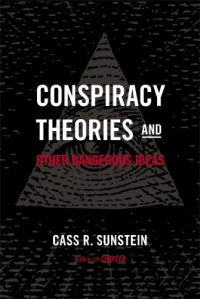 A Review of Conspiracy Theories and Other Dangerous Ideas by Cass Sunstein (based on an earlier paper co-authored with Adrian Vermeule); In Defense of Troublemakers: The Power of Dissent in Life and Business by Charlan Nemeth; and Conspiracy Theories and the People Who Believe Them, edited by Joseph E. Uscinski

