NY Congressman Eliot Engel (second from left) is lead sponsor on recent anti-Iran bills. Engel, who is the top Democrat on the House Foreign Affairs Committee, has traveled to Israel often and is one of its most fervent defenders. (Photo is from his Congressional website.)
Ever since Iran’s increasingly despotic Shah was overthrown by a popular revolution in 1979, Israel has targeted Iran for attack because of the country’s support for Palestinian rights. (The Shah had been put in place by a 1953 UK-US engineered coup against the country’s Prime Minister, Mohammad Mosaddegh.)
The Israeli ambassador to the U.S. said recently that Iran is Israel’s number one concern, and an Iranian newspaper reported: “Iran is the primary target of the Mossad’s actions, which number in the hundreds and thousands each year.”
The Israel lobby has accordingly worked for U.S. policies against Iran, including disseminating advertisements that demonize Iran; an example is this 2010 full-page advertisement in the New York Times :

The list on the left is of the groups that sponsored the ad, as evidenced by their icons at the bottom of the ad.
Now Congress has obliged Israel and its lobby by passing four more bills against Iran. Below is a report on the latest legislation. (Photographs and some additional information in Italics have been added.)
Despite a purely partisan Republican push to alter the terms of the Iran nuclear deal, an overwhelming majority of US lawmakers from both parties continues to advance legislation to counter Iranian behavior throughout the Middle East.
The House passed four bills today and Wednesday taking aim at Iran’s ballistic missile program and its support for Hezbollah, the Lebanese Shiite paramilitary group fighting alongside Iranian forces on behalf of the Bashar al-Assad regime in Syria. In addition, Iran hawks in Congress continue to press the Donald Trump administration to ban US aircraft sales to Iran and designate the Islamic Revolutionary Guard Corps (IRGC) as a foreign terrorist organization.

Lebanese resistance group Hezbollah has opposed Israeli invasions and occupation. Photo is of a Beirut suburb bombed by Israel in 2006.
“The whole thing with the [nuclear deal] that irked me throughout was that during the course of the negotiations … we were told consistently that this was only about nuclear weapons,” Rep. Eliot Engel, D-N.Y., the top Democrat on the House Foreign Affairs Committee, told Al-Monitor. “We couldn’t raise terrorism, we couldn’t raise ballistic missiles. We couldn’t raise all the other things against Iran and it frustrated me to no end.”
“I think those of us who really feel that Iran is a major cause of instability in the Middle East need to make sure that Iran is sanctioned,” Engel added.
[U.S. intelligence agencies have found no evidence that Iran is developing nuclear weapons.]
In July, Congress passed the first round of sanctions on Iran since the 2015 nuclear accord. The Iran Ballistic Missiles and Sanctions Enforcement Act, which the House passed 423-2 today, would further expand sanctions on Iran’s ballistic missile program. The Senate must now vote on the additional sanctions package before it can head to Trump’s desk.
Engel, the lead cosponsor of both Iran sanctions packages, has described today’s bill as “pretty similar” to the July sanctions package. The new version, however, would affect entities and individuals supporting Iran’s ballistic missile program even if they don’t have assets in the United States.
The House also passed three bills targeting Hezbollah on Wednesday. The US government considers Hezbollah a terrorist group and US lawmakers overwhelmingly regard it as an Iranian proxy.

House Majority Leader Kevin McCarthy (R-CA) at the ‘National Leadership Assembly for Israel’ event organized by the Conference of Presidents of Major American Jewish Organizations. (National Press Club July 28, 2014 in Washington, DC.)
“They’re giving the money to Hezbollah to kill individuals and fund terrorism around the world,” House Majority Leader Kevin McCarthy, R-Calif., said on Fox News before Wednesday’s votes. “And we’re putting an end to that, continuing to put the sanctions and the pressure on.”
The primary Hezbollah sanctions bill, the Hezbollah International Financing Prevention Amendments Act, introduced by House Foreign Affairs Committee Chairman Ed Royce, R-Calif., passed the House unanimously on Wednesday. It is designed to cut Hezbollah’s funding streams from foreign states such as Iran while cracking down on the group’s alleged racketeering activities abroad. The Jerusalem Post reported in September that Iran now gives Hezbollah roughly $800 million a year, an unprecedented level of funding.

Congressmen Ed Royce (L) and Eliot Engel (R) with Israeli Prime Minister Benjamin Netanyahu.
Companion legislation passed the Senate unanimously earlier this month. The House version, however, contains some extra provisions that single out Iran and Russia for their support of Hezbollah.
Specifically, the House version amends a 2010 Iran sanctions package to include Iran’s support for Hezbollah and directs the administration to sanction government entities that are already on the State Department’s state sponsor of terrorism list if they support Hezbollah. Iran, Syria and Sudan are currently the only three countries on that list.
Engel, the lead cosponsor of the Royce bill, told Al-Monitor that he’s optimistic its Iran provisions will survive reconciliation with the Senate version.
“I think ultimately they won’t disappear because I think both sides of the aisle understand that Iran’s a threat and even those who want to keep the [Iran deal] don’t want to take the pressure off Iran,” said Engel. “When we do things and wrap it up for the year, I think the Iran sanctions have to be in there.”
The House also unanimously passed legislation from Rep. Mike Gallagher, R-Wis., to impose overlapping sanctions on foreign states and individuals for providing support to Hezbollah due to its alleged use of human shields. The sanctions in both Hezbollah bills would target the same individuals and entities, but its supporters say the Gallagher bill still has value.
“The purpose of these bills, especially the reporting part, is to highlight the various harmful actions which Congress wants to expose with regard to Hezbollah,” said Joseph Gebeily, the president of the Lebanese Information Center, a think tank critical of Hezbollah.
Gebeily added that the Gallagher bill “puts more focus on the United Nations Security Council’s responsibility in disarming Hezbollah and preventing its military operations in Lebanon.” The bill requires the US ambassador to the United Nations to “secure support for a resolution that would impose multilateral sanctions against Hezbollah for its use of civilians as human shields.”
Lastly, a resolution offered by Rep. Ted Deutch, R-Fla., to urge the European Union to designate the political wing of Hezbollah as a terrorist organization passed the House unanimously. While the EU considers Hezbollah’s paramilitary wing to be a terrorist group, US lawmakers have repeatedly voiced their frustration that it does not extend that designation to Hezbollah parliamentarians and Cabinet officials in Lebanon.

Congressional Representatives Ilyana Ros-Lehtinen and Ted Deutch with Israeli Prime Minister Netanyahu. Deutch’s website says: “Congressman Ted Deutch is a passionate supporter of Israel whose advocacy for a strong U.S.-Israel relationship stretches back to his youth. Ted spent his summers at Zionist summer camp, worked as a student activist in high school and college, and served in leadership roles on several local and national Jewish organizations throughout his professional career. Today, Ted serves as Ranking Member of the House Foreign Affairs Committee’s influential Middle East and North Africa Subcommittee, where he continues to champion Israel’s security during a time of great volatility in the Middle East.”
And House lawmakers aren’t done.
House Homeland Security Committee Chairman Michael McCaul, R-Texas, continues to push for adoption of his bill urging the State Department to designate the IRGC as a foreign terrorist organization. Sen. Ted Cruz, R-Texas, has a companion bill in the Senate.

US Rep. Michael McCaul (sixth from left) led a 2015 bipartisan Congressional delegation to meet with Israeli Prime Minister Benjamin Netanyahu.
Trump himself designated the IRGC as a terrorist-supporting entity when he declined to certify the nuclear deal earlier this month, but the move falls short of what some in Congress are asking for.
“There’s not really an expansion of sanctions on the IRGC,” said Kenneth Katzman, an Iran sanctions expert at the Congressional Research Service. Trump’s executive order “has a slight travel restriction, obviously, but how many IRGC people … are going to realistically get visas to come to the United States?”
McCaul agrees more could be done.
“The president, when he sanctioned the IRGC, went a long ways in terms of getting the idea of it,” he told Al-Monitor. “However, they didn’t designate it as a foreign terrorist organization. So I’d like to complete that.”
McCaul told Al-Monitor that his bill is currently held up by staff on the House Judiciary Committee who believe that designating terrorist organizations should remain strictly within the purview of the administration.
“Maybe we’ll work with leadership to put it to the floor anyway,” he said.
Iran hawks in the House are also fighting to preserve legislation that would that would bar US aircraft manufacturers, such as Boeing and Airbus, from selling civilian airliners to Iran. Rep. Peter Roskam, R-Ill., included the language in a spending package in September.

Congressman Peter Roskam speaks at AIPAC fundraiser in Chicago, 2013. (Video here.) Roskam co-chairs the House Republican Israel Caucus and is a member of the bipartisan Israel Allies Caucus.
The 2015 nuclear deal paves the way for such sales, but Roskam and others fear that Iran could use the civilian airliners to transport troops to fight on behalf of the Syrian regime. The Senate version of the appropriations bill, however, does not contain such language.
October 27, 2017
Posted by aletho |
Ethnic Cleansing, Racism, Zionism, Timeless or most popular, Wars for Israel | Hezbollah, Israel, Sanctions against Iran, United States, Zionism |
Leave a comment
The US project to create a rift between Iraq and Iran backfired just a couple of days of its launch from Riyadh on October 22 by US Secretary of State Rex Tillerson. Washington effectively sought out Saudi Arabia to project itself as counterweight to Iran in the Iraqi theatre, predicated on the presumption that Riyadh’s offer to extend funding to ‘rebuild’ post-ISIS Iraq will be found irresistible by Baghdad. Washington fancied that Iraqi Prime Minister Haider al-Abadi is looking for ways to push back at Tehran, as his dependency on Iran’s military support is diminishing with the defeat of ISIS.
Tillerson travelled to Riyadh over the weekend to be present as a special guest at the first inaugural meeting of the so-called Saudi Arabia-Iraq Coordination Council. Things seemed to go well and Tillerson’s remarks to the media exuded optimism. At a press conference in Riyadh, he said that the Saudi largesse will “strengthen Iraq as an independent and whole country… (and) this will be in some ways counter some of the unproductive influences of Iran inside of Iraq.” Tillerson then came to the point:
- Certainly, Iranian militias that are in Iraq, now that the fight against Daesh and ISIS is coming to a close, those militias need to go home. Any foreign fighters in Iraq need to go home and allow the Iraqi people to regain control of areas that had been overtaken by ISIS and Daesh that have now been liberated, allow the Iraqi people to rebuild their lives with the help of their neighbors. And I think this agreement that has been put in place between the Kingdom of Saudi Arabia and Iraq is a crucial element to assisting the Iraqi people to do that. (Transcript)
The reference was to the Shi’ite militia groups funded, trained and deployed by Iran’s Revolutionary Guards Corps, which literally bore the brunt of the fight against the ISIS in the recent years. Washington is particularly incensed over the lead role by the Shi’ite paramilitary groups in seizing Kirkuk recently from the Kurdish Peshmerga who are US allies. (See my blog Kirkuk bells also toll for US strategy in Syria.)
Evidently, Tillerson crossed the red line. The point is, these Shi’ite groups, collectively known as Popular Mobilisation Forces and several tens of thousands strong, are probably going to be designated as part of the Iraqi armed forces. Abadi’s office in Baghdad came out in no time with a stinging rebuke – “No party has the right to interfere in Iraqi matters” – and called the Shi’ite paramilitary groups “patriots.” The next day, when Tillerson showed up in Baghdad for a meeting with Abadi, the latter was fairly explicit. Abadi said the Popular Mobilisation Forces form “part of the Iraqi institutions” and they will be the “hope of country and the region.” (Reuters )
Later, in an interview with the American press, Abadi retorted: “We would like to work with you (US)… But please don’t bring your trouble inside Iraq. You can sort it anywhere else.” Abadi then began suggesting a US troop withdrawal from Iraq. He said that US air power won’t be needed anymore and Iraq’s requirements will be henceforth on intelligence sharing and help to train Iraqi forces. The way things are shaping up between Washington and Tehran, continued US military presence in Iraq may become problematic in a near future.
Meanwhile, having gambled on the independence referendum only to lose oil-rich Kirkuk, Iraqi Kurdish leader Massoud Barzani is suing for ceasefire and talks with Baghdad. The US is urging Abadi to respond to Barzani’s overture and engage with him in discussions. The Trump administration has secured strong Congressional support for its demands on Abadi. Signaling the seriousness of the demands, On Wednesday, House Speaker Paul Ryan, House Intelligence Committee Chairman Devin Nunes, House Foreign Affairs Committee Chairman Ed Royce, and House Armed Services Committee Chairman Mac Thornberry issued the following statement to pressure Baghdad:
- Ongoing clashes between forces aligned with the Iraqi government and Kurdistan Regional Government are undermining hard-fought gains in the fight against ISIS, and threatening to plunge Iraq into a new wave of sectarian violence. The bloodshed must stop immediately. We support a united Iraq under the federal government in Baghdad, and we support the Kurdistan Regional Government.
- To that end, we welcome today’s reports that the Kurds are offering to suspend results of their recent referendum in return for a ceasefire and negotiations with the central government. Baghdad should accept this offer and enter into meaningful discussions that address long-term Kurdish concerns about autonomy, share of the national budget, and oil revenues. Meanwhile, it is critical that the Iraqi government heed Secretary Tillerson’s concern about the role and activities of Iranian-backed Shia militias. We are very concerned about Iranian involvement in recent operations. These forces have been responsible for horrible abuses, including the deaths of Americans. They have no place in a peaceful, united, and stable Iraq.
But Abadi is parrying. He visited Ankara on Wednesday to consult President Recep Erdogan. (Rudaw ) The latest reports suggest that the Iraqi forces with the support of the Shi’ite forces might go for the jugular veins of the Iraqi Kurds. Baghdad will want to drive home the advantage that the Kurds are not cohesive and are split 3-ways with the PUK (which was led by late Talabani) inclined to cooperate with Baghdad and Tehran, thereby isolating Barzani who is reduced now increasingly as a US-Israeli proxy. (Turkey has also become hostile toward Barzani following his push for the Kurdish independence referndum.) The Russian news agency Sputnik reported today as ‘breaking news’ that Iraqi troops and Shi’ite militias had been pulling heavy artillery and tanks close to Peshmerga positions near Zummar and shelling their positions. (Sputnik ) If a flare-up ensues in coming days, the US will be in a tight spot, apart from the breakdown of ties between Washington and Baghdad.
The US’ problem, quintessentially, is that its intentions are suspect in all three key regional capitals confronting the Kurdish question – Ankara, Baghdad, Tehran. At a recent meeting with US ambassador Douglas Sliman, Iraqi Vice-President Nouri al-Maliki said with brutal frankness, “We will not allow the creation of a second Israel in northern Iraq.”
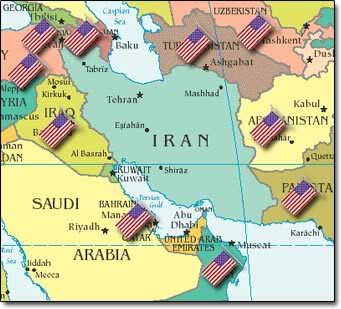 Last week’s events underscore three things. One, the US does not intend to end its military presence in Iraq (and Syria), although the pretext of the war against the ISIS is no longer there. Two, US is planning to turn Iraq into a major theatre of confrontation with Iran.
A US control of Iraq puts it in a position to pile pressure on Iran from different directions — interfering with Iranian supply routes to Syria and Lebanon; playing itself back to regain a role in the Syrian settlement; having a say in Iraq’s rising oil production and staging covert cross-border operations to destabilize the Iranian regime. Indeed, with the open-ended US military presence already in place in Afghanistan, the intention is to squash with a similar western neighbor under American tutelage.
Three, fundamentally, it becomes all too obvious that the US-Saudi alliance in regional politics is very much alive and kicking, and any reports to the contrary are greatly exaggerated. The US’ return to the centre stage in Iraq to challenge Iran’s regional influence will give much verve to the US alliance with Saudi Arabia.
Interestingly, the Saudi establishment daily Asharq Al-Awsat reported last week that the Pentagon plans to boost deployments to the Middle East specifically to counter Iran. The report cited General Joseph Votel, commander of the US Central Command, as saying, “The United States wants to help the Arab countries deal with Iranian threats. The Pentagon is working to achieve that desire and ensure its effective implementation. That includes the establishment of US military battalions sent as missions to the region and be designed specifically to provide advice and assistance.”
October 26, 2017
Posted by aletho |
Wars for Israel | Iran, Iraq, Kirkuk, Kurds, Middle East, Saudi Arabia, Turkiye |
Leave a comment
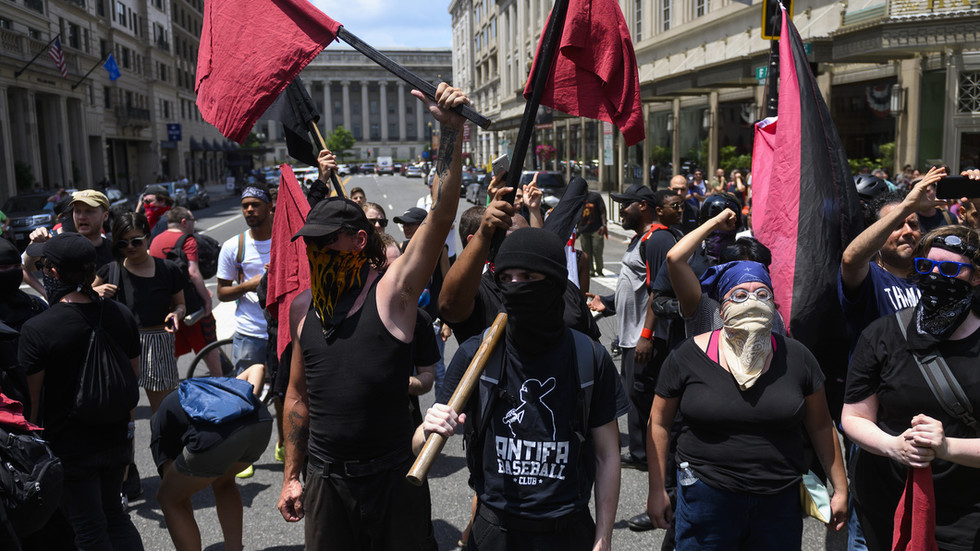
An historic opportunity is being missed. The disastrous 2016 presidential election could and should have been a wakeup call. A corrupt political system that gave voters a choice between two terrible candidates is not democracy.
This should have been the signal to face reality. The U.S. political system is totally rotten, contemptuous of the people, serving the corporations and lobbies that pay to keep them in office. The time had come to organize a genuine alternative, an independent movement to liberate the electoral system from the grip of billionaires, to demand a transition from a war economy to an economy dedicated to improving the lives of the people who live here. What is needed is a movement for the pacification of America, at home and abroad.
That is a big order. Yet this approach could meet with wide support, especially if vigorous young people organized to stimulate popular debate, between real live people, from door to door if necessary, creating a mass movement for genuine democracy, equality and peace. This is as revolutionary a program as possible in the present circumstances. A moribund left should be coming back to life to take the lead in building such a movement.
Quite the opposite is happening.
Provoking a new Civil War?
The first step toward preventing such a constructive movement was a false interpretation of the meaning of the Trump victory, massively promoted by mainstream media. This was essentially the Clintonite excuse for Hillary’s loss. Trump’s victory, according to this line, was the product of a convergence between Russian interference and the votes of “misogynists, racists, homophobes, xenophobes, and white supremacists”. The influence of all those bad people indicated the rise of “fascism” in America, with Trump in the role of “fascist” leader.
In this way, criticism of the system that produced Trump vanished in favor of demonization of Trump the individual, making it that much easier for the Clintonites to solidify their control of the Democratic Party, by manipulating their own leftist opposition.
The events of Charlottesville resembled a multiple provocation, with pro- and anti-statue sides provoking each other, providing a stage for Antifa to gain national prominence as saviors. Significantly, Charlottesville riots provoked Trump into making comments which were seized upon by all his enemies to brand him definitively as “racist” and “fascist”. This gave the disoriented “left” a clear cause: fight “fascist Trump” and domestic “fascists”. This is more immediate than organizing to demand that the United States end its threats against Iran and North Korea, its open and covert project to reshape the Middle East to ensure Israel’s regional dominance, or its nuclear buildup targeting Russia. Not to mention its support for genuine Nazis in Ukraine. Yet that trillion dollar policy of global militarization contributes more to violence and injustice even in the United States than the remnants of thoroughly discredited lost causes.
The Left and Antifa
All those who are sincerely on the left, who are in favor of greater social and economic equality for all, who oppose the endless aggressive foreign wars and the resulting militarization of the American police and the American mentality, must realize that, since the Clintonian takeover of the Democratic Party, the ruling oligarchic establishment disguises itself as “the left”, uses “left” arguments to justify itself, and largely succeeds in manipulating genuine leftists for its own purposes. This has caused such confusion that it is quite unclear what “left” means any more.
The Clintonian left substituted Identity Politics for the progressive goal of economic and social equality, by ostentatiously coopting women, blacks and Latinos into the visible elite, the better to ignore the needs of the majority. The Clintonian left introduced the concept of “humanitarian war” to describe its relentless destruction of recalcitrant nations, seducing much of the left into supporting U.S. imperialism as a fight for democracy against “dictators”.
Antifa contributes to this confusion by giving precedence to the suppression of “bad” ideas rather than to the development of good ones through uninhibited debate. Antifa attacks on dissidents tend to enforce the dominant neoliberal doctrine that also raises the specter of fascism as pretext for aggression against countries targeted for regime change.
Antifa’s excuses
Antifa has several favorite arguments to justify itself to those who criticize its use of force and intimidation to silence its adversaries.
1. Its violence is justified by the implicit violence of its enemies who if left alone plan to exterminate whole groups of people.
This is demonstrably untrue, as Antifa is notoriously generous in distributing the fascist label. Most of the people Antifa targets are not fascists and there is no evidence that even “racists” are planning to carry out genocide.
2. Antifa is engaged in other political activity.
That is completely beside the point. Nobody is criticizing that “other political activity”. It is the violence and the censorship which are the hallmarks of the Antifa brand, and the target of criticism. Let them drop the violence and the censorship and get on with their other activities. Then nobody will object.
3. Antifa defends threatened communities.
But that is certainly not all they are doing. Nor is that what its critics are objecting to. Actual defense of a truly threatened community is best done openly by respected members of the community itself, rather than by self-styled Zorros who arrive in disguise. The problem is the definition of the terms. For Antifa, the victim community can be a whole category of people, such as LGBTQI, and the threat may be a controversial speaker at a university who could say something to hurt their feelings. And what community was being defended by Linwood Kaine, younger son of the Democratic Party Vice Presidential candidate, Senator Tim Kaine, when he was arrested in St Paul, Minnesota, last March 4 on suspicion of felony second-degree riot for attempting to break up a pro-Trump rally at the State Capitol? Although Kaine, dressed in black from head to toe, resisted arrest, the matter ended there. What downtrodden community was the young Kaine defending other than the Clintonite Democrats? His own privilege as a family member of the Washington political elite?
4. Antifa claims that it is in favor of free speech in general, but racists and fascists are an exception, because you can’t reason with them, and hate speech is not speech but action.
This amounts to an astounding intellectual surrender to the enemy. It is an admission of being unable to win a free argument. The fact is that speech is indeed speech, and should be countered by speech. You should welcome the chance to debate in public in order to expose the weaknesses of their position. If indeed “you can’t reason with them”, then they will shut down the discussion and you don’t have to. If they resort to physical attack against you, then you have the moral victory. Otherwise, you’re giving it to them.
5. Antifa insists that the Constitutional right to free speech applies only to the State. That is, only the government is banned from depriving citizens of the right to free speech and assembly. Among citizens, anything goes.
This is a remarkable bit of sophistry. Bullying and intimidation are okay if done by an unofficial group. In keeping with neoliberalism, Antifa is out to privatize censorship, by taking over the job itself.
Verbal Violence
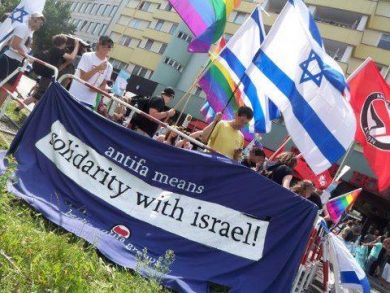 The verbal violence of Antifa is worse than their physical violence insofar as it is more effective. The physical violence is usually of minor consequence, at most temporarily preventing something that will happen later. It is the verbal violence that succeeds most in preventing free discussion of controversial issues.
Alarmed by the proliferation of pro-Antifa articles on CounterPunch, I ventured to write a critique, Antifa in Theory and Practice. My criticism was not personal; I did not mention the authors of those pro-Antifa CounterPunch articles and my mention of author Mark Bray was respectful. The result was a torrent of vituperation on CounterPunch’s FaceBook page, as well as in a hostile email exchange with star Antifa champion Yoav Litvin. This culminated with a hit piece by Amitai Ben-Abba published on CounterPunch itself. Note that both Litvin and Ben-Abba are Israelis, but pro-Palestinian, which provides the two with impeccable left credentials.
These reactions provided a perfect illustration of Antifa discussion techniques. It is a sort of food fight, where you just throw everything you can pick up at the adversary, regardless of logic or relevance. On the FaceBook page, Litvin, on the basis of my past carefully objective articles on French politics, accused me of “shilling for Marine Le Pen”. Irrelevant and inaccurate.
In his hit piece Ben-Abba dragged in this totally off-topic assertion:
“Much in the same way that her early ’00s pseudo-historical denial of the massacre in Srebrenica worked to embolden Serbian nationalists, her present analysis can embolden white supremacists.”
Need I point out that I never denied the “massacre” but refuse to label it “genocide”, nor did Serbian nationalists ever need my humble opinion in order to be “emboldened” – especially since the war was over by then.
I happily grant that there are issues raised in my initial article that deserve debate, such as immigration or whether or not the “fascism” of the early twentieth century still exists today. Indeed my whole point was that such issues deserve debate. That’s not what I got. Ben-Abba came up with this imaginary allusion to the immigration issue:
“‘antifa’ is a broader umbrella term that allows formerly unaffiliated folks (like the sans-papiers migrant baker who makes Johnstone’s croissants) to participate in defense of their communities against neo-fascist intimidation.”
Very funny: I am exploiting some poor undocumented baker and preventing him from being defended. Aside from the fact that I very rarely to eat a croissant, the bakers in my neighborhood are all fully documented, and moreover this largely immigrant neighborhood is the scene of frequent peaceful street demonstrations by African sans-papiers clearly not intimidated by neo-fascists. They obviously do not need Antifa to protect them. This fantasy of omnipresent neo-fascism is as necessary to Antifa as the fantasy of omnipresent anti-Semitism is to Israel.
Antifa rhetoric specializes in non sequitur. If you agree with some conservative or libertarian that it was wrong to destroy Libya, then you are not only guilty of association with a pre-fascist, you are a supporter of dictators and thus probably a fascist yourself. This has been happening in France for years and it’s just getting started in the United States.
The Antifa specialty is labeling anti-war activists and writers as “red-brown”, red for left and brown for fascist. You may pretend to be on the left, but if we can find the slightest association between you and someone on the right, then you are a “red-brown” and deserve to be quarantined.
By claiming to defend helpless minorities from a rising fascist peril, Antifa arrogates to itself the right to decide who is, or might be, “fascist”.
Whatever they think they are doing, whatever they claim to be doing, the one thing they really are doing is to tie the left into such sectarian intolerance that any broad inclusive single-issue anti-war movement becomes impossible. Indeed, it is precisely the imminent danger of nuclear World War III that leads some of us to call for a non-exclusive single issue anti-war movement – thus setting ourselves up as “red-brown”.
That is why Antifa – unwittingly let us say – is running interference for the war party.
It is most unfortunate to see CounterPunch become a platform for Antifa. It didn’t have to. The site is quite able to reject articles, as it has systematically rejected contentions about 9/11 or as it rejected David Cobb’s and Caitlin Johnstone’s (no relative) right to respond. It could have taken a principled stand against calls for violence and censorship. It did not do so. It is one thing to encourage debate and quite another to sponsor mud wrestling.
Diana Johnstone is the author of Fools’ Crusade: Yugoslavia, NATO, and Western Delusions. Her new book is Queen of Chaos: the Misadventures of Hillary Clinton. She can be reached at diana.johnstone@wanadoo.fr
October 25, 2017
Posted by aletho |
Mainstream Media, Warmongering, Militarism, Timeless or most popular, Wars for Israel | Antifa, United States, Zionism |
Leave a comment
Speaking at a press conference with Saudi Foreign Minister Adel Jubeir in Riyadh on October 22, US State Secretary Rex Tillerson said, “Iranian militias that are in Iraq, now that the fight against Daesh and ISIS is coming to a close, those militias need to go home. The foreign fighters in Iraq need to go home and allow the Iraqi people to regain control.” A senior US official clarified that Tillerson’s invitation to “go home” was specifically directed at the Shiite-dominated Popular Mobilization Forces (PMF) militia and Iran’s Quds Force, which has been providing material support, training, and operational leadership for them. The secretary added that the United States hopes “European companies, countries, and others around the world” will join in isolating Iran’s Islamic Revolutionary Guard Corps (IRGC), which oversees the Quds Force. He said the IRGC is working to “foment instability in the region and create destruction in the region.”
Iraqi Prime Minister Haider al-Abadi rejected a call by Washington for Iranian-backed fighters to leave Iraq at a meeting with US Secretary of State Rex Tillerson in Baghdad on October 23. The PM insisted that the force consists solely of Iraqi nationals who “fought terrorism” and made sacrifices that contributed to the victory over the Islamic State terrorist group. Calling it “part of the Iraqi institutions,” he said PMF fighters “should be encouraged because they will be the hope of country and the region”, according to a statement by his media office.
Tillerson’s visit to Baghdad came a few days after the Iraqi army, backed by the Shia-majority PMF (the Hashed al-Shaabi), claimed control of all of oil-rich Kirkuk province. The 60,000-strong PMF was cobbled together from Iranian-backed militias in 2014 after the Islamic State militants took over large parts of northern Iraq. Trained and armed by Iran, the Iraqi Hashed al-Shaabi fought side by side with Iraqi government army against the militants. They are paid by the Iraqi government and officially report to the Prime Minister. The Iraqi parliament has voted to integrate the militia into state forces. Critics allege that visits by Iran’s Major General Qassem Soleimani, a commander of Iran’s Revolutionary Guards who advises the PMF, reflect Tehran’s influence in the country.
Tillerson’s statement is not only a flagrant meddling in the other country’s internal affairs. It’s the statement made by the official of the country, which illegally invaded Iraq in 2003. It is still deeply involved in the country’s politics.
The State Secretary did not say the PMF had to “go home” when they were taking part in the US-backed operation to free Mosul from Islamic State! The Shia, Christians and Assyrians bore the brunt of the fighting. Now the Shia militias have become expandable. For Shia Muslims Tehran is the stronghold of their faith the same way Vatican is the stronghold of Catholicism. The Shia, Sunni and Kurds are all Iraqis and there are all home in Iraq.
The details of the alleged deal reached between the Patriotic Union of Kurdistan (PUK) and the Iraqi Popular Mobilization Units (PMU) on October 16 have been released recently. The released info argues that PUK-linked Peshmerga units were to surrender control of the contested territories to the PMU. Reports based on it have been widely spread by media outlets linked to the Kurdistan Democratic Party (KDP) and its leader, Masoud Barzani. The agreement was supposedly signed by the son of the leader of PUK, Pavel Talabani, and states that the contentious areas are to be surrendered to the PMU. So, it was an oil deal which presupposed that the Iraqi government would fund the Kurdish administration and the militias while receiving its share of oil revenues. The deal went through on the condition of Kurdistan preserving its status as part of Iraq. It was a deal between the two sides and Iran had nothing to do with it. The US couldn’t influence the deal. Iran has no reason to intervene if Kurdistan remains part of Iraq.
Tillerson appears to support Israel’s position. Tel Aviv is concerned over Tehran’s alleged plans of securing a corridor from its border, through Iraq and all the way to the Mediterranean and providing it unhindered land access to its allies in Syria and Lebanon for the first time. The shared concern makes the US keep its al-Tanf base in southern Syria and hinder the movement of Syrian government forces to the Iraqi border. But in Iraq the Shia PMF are not creating any “corridors” from Iran to Syria. They report to Iraqi PM and operate upon the orders.
Under the circumstances, the US behaves like a bull in china shop, openly intervening into the other state’s internal affairs. It makes Baghdad resist the pressure and look for other partners. On October 23, Russian Foreign Minister Sergei Lavrov and his Iraqi counterpart Ibrahim al-Jaafari met in Moscow to discuss the situation in the semi-autonomous Kurdistan region. The visit coincided with the meeting of Iraqi-Russian intergovernmental commission on Trade, Economic, and Scientific and Technical Cooperation in Moscow on October 23-25, which discussed joint oil projects with Russian Rosneft in Iraqi Kurdistan. Ibrahim al-Jaafari said Baghdad is looking forward to a visit of President Vladimir Putin to Iraq. He called Russia a strategic partner. In July, 2017, Russia and Iraq inked a big arms deal.
Mr. Tillerson was given a chilly reception in Iraq. Baghdad stands up to the challenge rejecting the US policy of outright interference into its internal affairs. The US pressure brought about the opposite result. The presumption that the US has overwhelming power to influence other countries’ policies is no longer valid. But with old instincts dying hard, hubris continues to inspire poor foreign policy decisions in Washington.
October 25, 2017
Posted by aletho |
Timeless or most popular, Wars for Israel | Iraq, Israel, United States, Zionism |
Leave a comment
As forces of the so-called Islamic State terrorist group are pushed across Syria and Iraq, one can clearly see Israel’s shifting position regarding the situation in Syria, which can be explained by Tel-Aviv’s desire to reorder the Middle East.
It’s clear that Israel has finally realized that it’s been betting on the wrong side in Syria and is now risks losing all. It goes without saying that once defeated, Israel’s leadership will be in no position to demand anything from anyone. This includes failing to establish a security zone within the Golan Heights, as well as failed ambitions over controlling the Iraqi-Syrian border which now will likely not come to fruition. In fact, the panic mode that the Netanyahu administration has been in for a while reflects the dramatic changes that are taking place in Syria and across the region. After Israel’s betting on the losing party for so long, Tel-Aviv has no other choice but to pursue damage control in a desperate bid to save its Jordanian and Kurdish proxies. Its new strategy states that it must draw Iraq and Syria away from Iran and integrate them into the Israeli-American-Saudi alliance.
Over the last six years of conflict in Syria, Israel would try to avoid any direct military confrontation. Only recently Israeli aircraft and artillery have started launching strikes inside Syrian territory. Among their targets included Hezbollah, which is fighting on the side of the Syrian government, but also military facilities of the Syrian Arab Army as well. In particular, the recent bombardment of Israeli artillery targeting Syrian army positions in the Golan Heights, according to Israeli media reports, destroyed three Syrian artillery positions.
Israel has always been deeply involved in the Syrian conflict. Repeated statements by Israeli officials that “Tel-Aviv pursues a policy of non-interference in the Syrian civil war” have been circulating within Western media sources for years. However, in a recent series of explanations given by Israel’s Prime Minister Benjamin Netanyahu to European officials, he would acknowledge that Tel-Aviv destroyed dozens of Iranian convoys fighting in the Syrian Arab Republic against ISIS hordes. On June 18, the Wall Street Journal reported that Israel and Saudi Arabia were allies from the very beginning of the Syrian conflict, as Israel supplied the Syrian rebels operating alongside its borders with money, food, fuel and even drugs. The Wall Street Journal has also added that Israel might be sponsoring a total of four rebel groups operating inside Syria. These groups would use the cash provided to them to pay mercenaries and buy ammunition. These revelations, according to Zero Hedge, can also explain why ISIS terrorists would never attack Israeli citizens or launch operations deep inside Israel’s territory despite their close proximity.
According to Telegram’s Directorate 4 channel, militants have recently released a video of one of their gangs using anti-aircraft ammunition delivered from Israel while engaged in a deadly firefight against Syrian government troops in the vicinity of Daraa. It is noted that this was not the first time that media sources received confirmation that Israel has been supplying weapons to miltiants depicted by the West as “radical Islmasists.” In addition, it’s been repeatedly reported that Israel has been providing medical aid to militants wounded in Syria.
In mid-October it was reported that Syrian troops discovered four warehouses filled with US and Israeli-made weapons in the liberated Syrian city of Mayadin.
Tel Aviv’s sympathy for ISIS was confirmed last May by the editor of Politico, Bryan Bender, who visited Israel just before US President Donald Trump’s visit, discovering that Israeli military forces did not want the US to fulfill its promise to crush the Islamic State in Iraq and Syria .
Regarding the policy of Israel, a number of regional politicians and experts have noted an abrupt increase in its attempts to provoke the so-called redrawing of the Middle East map, which will inevitably result in the weakening of some countries across the region. This was stated, in particular, at the press conference given by Iranian Interior Minister Abdolreza Rahmani Fazli in early October. Fazli would emphasize Israel’s support for the referendum of independence in Iraqi Kurdistan, for the sole purpose of weakening Tel-Aviv’s opponents in the Middle East.
The consistent political support for an Iraqi Kurdistan provided by Israel has recently been emphasized by the commander of the elite paramilitary Peshmerga unit known as Black Tiger, General Sirwan Barzani, the nephew of long-time leader of the Iraqi Kurds – Masoud Barzani. Israelis have been freely visiting Iraqi Kurdistan with their national passports, although such a paper would make anyone an unwelcome visitor across the Arab world. Israeli companies are beginning to unofficially operate in Erbil, while the Kurds are seeking the support of the Israeli lobby in the US in hopes that it would support Kurdistan’s independence. Last year, the Kurdish authorities announced the opening of a “representative office for relations with Jews”, which can be viewed as a nascent diplomatic mission.
Of course, there’s intelligence cooperation to be found between Israel and Iraqi Kurdistan. Simply, the “common enemy” has now changed – instead of targeting the hated Sunni regime of Saddam Hussein, those services are now targeting the government of the now Shia Arab majority along with Iran which supports it. There is no doubt that through Kurdistan, Israeli special services have been enjoying ready access to the territories of Iran and Iraq, which in the event of a major war would be a crucial factor.
However, the Kurds are not cooperating with Israel openly because they are afraid of the wrath of Iran and the Arab world that it may trigger.
Israel’s goals in supporting Iraqi Kurds are truly multifaceted. One of them, according to the former Israeli intelligence officer Alexander Grinberg, is to resist Iran’s influence while maintaining leverage against Turkey. Especially given the fact that commercial relations between Turkey and Israel began to develop rapidly and both Ankara and Tel-Aviv share a number of positions on the Iranian issue, in spite of the fact that Erdogan is an impulsive leader with anti-Semitic and dictatorial habits, while according to the opinion prevailing in Israel today, it’s Turkey that is the main supporter of Hamas, not Qatar.
In a bid to preserve its role as a major Middle Eastern power in the eyes of America’s elite, Israel has offered Washington a plan that may allow it to push Iran both from Syria and the regional scene. The plan was drafted under the supervision of Israel’s Minister of Transportation and Intelligence, Yisrael Katz, and approved by the country’s top political leadership. According to the Katz Plan, Washington must recognize the Golan Heights occupied by Israel since the Six-Day War of 1967 as Israel’s sovereign territory. Such a recognition will grant Israel a number of advantages, especially in the matter of striking the positions of Hezbollah within Syrian territory, particularly those found in the immediate vicinity of the disputed heights. Also in the Katz plan, special emphasis is placed on preventing the permanent military basing of Iranians in Syria. In this regard, the US is recommended to tighten sanctions against Tehran on the pretext that Iran is “supporting terrorism.”
Tel-Aviv is also aware of the growing role that Russia is playing in the Middle East, so it wants to get Moscow on board with its plan of pushing pro-Iranian forces out of Syria. In order to achieve this goal Tel Aviv has been unprecedentedly active in approaching Moscow along with its “allied” Arab leaders: Jordan’s King Abdullah II and Abu Dhabi’s Crown Prince Sheikh Mohammed bin Zayed al-Nahyan. In exchange for reviewing its relations with Iran, Russia, which has already established two permanent military bases in Syrian territory, is promised to receive a whole set of “preferences”, including the tacit acceptance of Russian jurisdiction over Crimea by the West, the lifting of Western sanctions, the restoration of Russia’s membership in the G8, and guarantees on the preservation of Moscow’s air and naval bases in the Syrian provinces of Latakia and Tartus. There is another “benefit” for Russia in the form of keeping President Bashar Assad in power in Damascus indefinitely, as well as supplying Riyadh with Russian arms and the list goes on and on.
October 25, 2017
Posted by aletho |
Timeless or most popular, War Crimes, Wars for Israel | Iran, Iraq, Israel, Jordan, Middle East, Russia, Saudi Arabia, Syria, United States, Zionism |
Leave a comment
The Trump administration is accelerating on a collision course with its European allies over the Iran nuclear deal. Washington is essentially demanding the EU joins in backdoor sanctions against Iran – or face financial penalties. In short: browbeating, arm-twisting, and bribery.
In a sign of the times, the Europeans are resisting American pressure. With huge investments already lined up between EU countries and Iran, the Trump administration is being viewed with contempt for daring to bully European economic interests.
In a classic backfire, Washington’s browbeating of European allies is pushing them to reorient their strategic interests toward China, Russia and a multilateral global order in which US power diminishes even further.
Earlier this week, US Secretary of State Rex Tillerson gave an extraordinarily explicit warning to Europe over Iran. At a news conference in the Saudi capital, Riyadh, Tillerson said European companies are “at great risk” if they invest in Iran owing to the Trump administration possibly re-imposing sanctions on Tehran in the coming months.
Trump’s dangling of sanctions follows his “decertification” earlier this month of the international nuclear accord signed with Iran and five other world powers: Russia, China, Britain, France, and Germany. Known formally as the Joint Comprehensive Plan of Action (JCPOA), the July 2015 deal promised to lift trade sanctions on Iran in exchange for the latter’s restriction on its nuclear energy program to prevent any weaponization.
Washington’s repudiation of the JCPOA is not shared by the Europeans, Russia nor China. The UN nuclear watchdog, the International Atomic Energy Agency, has also confirmed that Iran is in full compliance with the terms of the accord. EU leaders and diplomats have adamantly said they have no intention of abandoning the agreement or renegotiating it. China and Russia likewise concur.
From the early days of Trump’s presidency, he has been griping about the Iran deal, calling it the “worst ever.” He and others in Washington claim Iran is using sanctions relief to finance support for Syrian ally Bashar Assad, Lebanon’s Hezbollah movement and clandestine terror operations in the Middle East. Washington’s claims are invariably vague and unsubstantiated. Tehran has dismissed Trump’s accusations as ignorant.
Evidently, the Europeans do not have the same pejorative view of Iran as a “global sponsor of terrorism” as the Americans. Neither does China or Russia. Even before Trump decertified the JCPOA – a move which could trigger a full-blown cancellation after a Congressional review requested by the president – there was already talk about Washington and Europe clashing. “Europe and the USA on collision course,” ran a headline in Deutsche Welle in August.
Now, after Tillerson’s pointed warning to the Europeans to “stay out of Iran,” the US is ramping up the clash. Bloomberg headlined last week: “Trump’s Iran policy is a headache for EU business.” The report noted, however, that: “America’s U-turn on nuclear accord won’t spike existing [European investment] deals.”
Since the signing of the JCPOA two years ago, European investment and trade with Iran have burgeoned. For example, French oil major Total earlier this year finalized a 20-year oil and gas project worth around €5 billion, along with a Chinese firm.
That followed the announcement of multi-million euro investment plans by car manufacturers Renault and PSA (Peugeot and Citroen) to expand factories in Iran. This month, only days after Trump announced he was decertifying the JCPOA, a Norwegian-led consortium signed a €3 billion project with Iran to build solar panels for the international market. “Norway is fully committed to the JCPOA,” said the Norwegian ambassador to Iran.
Germany and France have both seen exports to Iran rapidly multiply. The German chamber of commerce expects total bilateral commerce to double in the next two years. Next month, the EU’s foreign policy chief Federica Mogherini is to travel to Washington where she will reiterate the bloc’s resolute support for the nuclear accord. Last week, Mogherini made the case that Europe must now take global leadership. She didn’t mention Trump by name, but it was clear she was rebuking Washington’s isolationist policy.
Germany’s Foreign Minister Sigmar Gabriel has also berated Washington’s bullying tactics over Iran. Gabriel said Trump was inevitably pushing Europe toward consolidating economic interests with China and Russia.
Following Tillerson’s lecturing to the EU earlier this week about not investing in Iran, the New York Times reported: “European diplomats have said they would defend their companies against such sanctions, potentially setting up an epic battle between close allies and two of the largest commercial markets on the planet.”
This is the ineluctable thing. The Europeans have already committed enormous amounts of capital to developing trade and industry with Iran – a country that ranks in the global top five for oil and gas reserves. With a population of 80 million and a high standard of education, Iran promises to be a lucrative growth area. Even under decades of US-led sanctions, the country scored impressive achievements in development, innovation, and engineering.
Unlike the Europeans, the US has negligible commercial ties with Iran. It is therefore easy for Washington to threaten sanctions against that country. Washington has little to lose. Not so the Europeans. For the Trump administration to say that investments are “at risk” is therefore seen as an outrageous infringement on Europe’s future economic plans.
As France’s Finance Minister Bruno Le Maire told American officials ahead of Trump’s expected knock-back to the Iran deal: “The US must not appoint itself as a global policeman.” The irony is that Washington’s overweening attitude toward its European “allies” is likely to hasten the global dynamic it most fears. That is the decline of American economic power and the rise of a multipolar global order.
Former US President Jimmy Carter acknowledged the shift when referring to North Korea this week and the need for diplomacy. He said the US was “no longer dominant” and that “Russia was coming back, and China and India were coming forward.”
The once-mighty American dollar is increasingly challenged in its status as the world’s top reserve currency. China is moving to a gold-backed yuan payments system for its imports and exports. Russia is stockpiling gold reserves, in another move which is seen as Moscow making preparations for a break with the US-dominated financial order.
Washington still retains tremendous control over international banking and finance. It has veto power at the International Monetary Fund, and it dominates the SWIFT banking system for payments.
Nevertheless, nothing remains forever. China and Russia are making strides toward economic life without the dollar. The Europeans already have a reserve currency with the euro. If push comes to shove, the EU could conduct its business with Iran and let the Americans go hang. With China and Russia already forging ahead on a new multipolar global order, the Europeans might soon realize that their best interests are served from breaking away from Washington’s shadow.
It is increasingly apparent especially under Trump that American interests are colliding with those of European “allies.” In the end, it comes down to the exigency of self-interest. Europe is finding it simply can’t afford America’s stupid arrogance. Washington’s hectoring of allies is digging its own grave as a global power.
October 24, 2017
Posted by aletho |
Economics, Timeless or most popular, Wars for Israel | European Union, Hezbollah, JCPOA, Sanctions against Iran, United States |
Leave a comment
The rout of the Kurds in the northern Iraqi city of Kirkuk this week constitutes a major setback for the overall American strategies toward Iraq and Syria. The prospect of an unceremonious US retreat from Syria haunts the Trump administration in immediate terms, and it is all the more galling because Tehran is calibrating it.
Clearly, Iran has pushed the envelope, furious over US President Donald Trump’s provocative threats of sanctions against the Islamic Revolutionary Guards Corps (IRGC). Tehran had warned that US position in the entire Middle East will become increasingly untenable if Trump moved against the IRGC. The capture of Kirkuk by the Baghdad government was a de facto military operation by the Shi’ite militia known as the Hashd al-Shaabi, which was trained and equipped by the IRGC. The western reports suggest that the charismatic commander of the IRGC’s secretive Quds Force, General Qassem Soleimani personally masterminded the military operation – and even prepared the political ground for it.
The US had tried to prevail upon the Iraqi Prime Minister Haider al-Abadi not to move against the Kurds who were its allies. Kirkuk is estimated to hold at least 8000 million barrels of subterranean oil. The oil revenue is critical for the survival of any independent Kurdish state. Evidently, Abadi didn’t listen due to the emergent threat posed by the Kurds’ recent independence referendum. Equally, Iran wanted to finish off the spectre of an independent Kurdistan in the region spearheaded by Massoud Barzani (who enjoys the backing of US and Israel.)
Indeed, the defeat in Kirkuk destroys the Iraqi Kurds’ dream of an independent state and derails the longstanding US-Israeli project to create a base with strategic location. Equally, the liberation of Kirkuk, which is populated by the Kurds, Arabs and Turkmen by the Iran-supported Shi’te militia highlights the strategic convergence between Baghdad, Tehran and Ankara in preventing the creation of an independent Kurdistan in the region.
However, the defeat of Barzani in Kirkuk has far wider ramifications – for Iraq as well as the Syrian conflict, apart from the US’ influence in the Middle East as a whole. At its most obvious level, Iran is thwarting the US plans to balkanize Iraq. Iraq’s unity is no longer under serious threat. Control of the vast oil reserves in Kirkuk will also bolster the Iraqi economy. Baghdad can be expected to reassert its authority over the country. The federal government has taken over the border crossings with Turkey and Syria.
The US attempt in the coming period will be to woo Abadi and encourage him to whittle down Iran’s influence in Iraq. The US Secretary of State Rex Tillerson arrived in Riyadh on Saturday on a hastily arranged trip with the hope of getting Saudi King Salman to take a hand in persuading Abadi to keep Tehran’s influence on Iraq at bay and to mediate between Abadi and Barzani. The US and Saudi Arabia’s best hope lies in creating differences between Baghdad and Tehran by leveraging Abadi. But the chances of such a ploy working seem remote.
The fact that the US watched the defeat of the Kurds in Kirkuk passively tarnishes the overall American image, especially among Syrian Kurds. This casts shadows on the Syrian situation. The US has been routing the military supplies for Syrian Kurds in Raqqa via Erbil, Massoud’s stronghold (in the face of Turkey’s virulent opposition.) This supply route is no longer under Barzani’s control and the disruption will affect the US’ operations in Raqqa. The US-led Syrian Kurdish militia claims to have liberated Raqqa, but a real consolidation needs the decimation of the residual ISIS fighters present in the region and it may take months.
More importantly, a ‘trust deficit’ between Syrian Kurds and Washington at this juncture will be calamitous. Raqqa is Arab territory and the Kurdish militia’s supply lines are already overstretched. The disruption in American supplies means that it may now be a mater of time before Syrian Kurds seek some modus vivendi with the Syrian regime. If American military supplies dry up, Syrian Kurds will also come under pressure from Turkey in the swathe of northern Syria bordering Turkey, which form their traditional homelands. Turkey never liked a Kurdish entity taking shape across their border.
Interestingly, the commander of the Syrian Kurdish militia Sipan Hamo visited Moscow last weekend. The Russians indeed find themselves in an enviable position to drive a hard bargain over the Kurds’ sorrows. Russia is in a unique position to mediate between Syrian Kurds on one side and Ankara and Damascus on the other. But then, what is it that the Kurds can offer Russia in return? Last Thursday, Rosneft signed a big oil deal with Barzani’s government in northern Iraq. To be sure, the old Kurdish saying has some merit – ‘The Kurds have no friends but the mountains.’ (Guardian )
The main impact of last week’s dramatic events is that the US now has no conceivable reason to continue with a military intervention in eastern Syria. The likelihood is that Syrian Kurds will sooner or later hand over Raqqa also to the government forces. Clearly, the Syrian regime’s march to victory is from now onward relentless and irreversible. That is to say, the best-laid plans of the US and its regional allies to balkanize Syria have also gone awry.
Maybe, there will be a federal system in future Iraq and Syria. But last week’s events have ensured that the two countries’ territorial unity and integrity will no longer be under serious threat. Of course, that has also been at the core of the Iranian strategy.
October 22, 2017
Posted by aletho |
Wars for Israel | Iran, Israel, Kurds, Middle East, Saudi Arabia, Syria, Turkiye, United States |
Leave a comment
US President Donald Trump’s new strategy on Iran has “no support inside the United States” other than by pro-war neoconservatives and the Israel lobby, says an American analyst.
“President Trump’s position on canceling the Iran deal, at least on the United States’ side, has no support in the United States either by the public, obviously by the Democratic Party; even it lacks support by members of the Republican Party,” Rodney Martin, radio host and former congressional staffer, said on Saturday.
“It only has support by the rabid pro-war neocons and by the rabid Zionist pro-Israel lobby and of course by Prime Minister [Benjamin] Netanyahu in Tel Aviv,” he added.
Trump announced last week that he would not continue certifying the 2015 nuclear deal with Iran dubbed the Joint Comprehensive Plan of Action (JCPOA).
The US president has come under widespread criticism at home and abroad, with America’s European allies reaffirming their commitment to the nuclear accord.
The majority of Americans also believe Trump should not pull the US out of the international agreement, according to a new poll.
Overall, two in three Americans oppose withdrawing from the JCPOA, a CNN poll has found. Eight in 10 Democrats and two in three Independents have the same opinion. Even in Trump’s own party, Republicans are evenly split, with 48 percent desiring to remain and 47 percent to withdraw.
Martin pointed to the Israeli influence over Trump’s decision regarding the Iran deal.
“We all know that Netanyahu took the atrocious step by coming to the United States and lobbying the US Congress against the deal,” he pointed out.
The analyst said Trump is “throwing Netanyahu a bone” by refusing to certify the JCPOA in order to compensate for his failure to deliver on his promise to move the US embassy to Jerusalem al-Quds.
Trump is “every bit as controlled by the Israeli lobby” as his predecessors, Martin said, adding, “so it doesn’t matter what the public and the experts believe, President Trump is going to do what this very small, dangerous cabal tells him to do.”
October 22, 2017
Posted by aletho |
Economics, Ethnic Cleansing, Racism, Zionism, Wars for Israel | Israel, Middle East, Sanctions against Iran, United States, Zionism |
Leave a comment
Christopher Bollyn, 2017, 146 pages.
 Christopher Bollyn is that rarest of mediaticians, a real-live investigative journalist, formerly of the American Free Press, now altogether free, as befits a researcher-writer of irreducible integrity. For the last decade and a half, Bollyn has made September 11th and its murderous military aftermath his own special beat, going where few 9/11 analysts have dared to venture.
Bollyn’s great contention, expounded in scores of articles and two previous books (Solving 9/11: The Deception that Changed the World ), is that it was not Bin Laden and Al Qaeda who carried out the world’s greatest terror attack, but none other than Ben Netanyahu and El Mossad, so as to foment an endless war against Israel’s perceived enemies in the Middle East.
Even more than David Ray Griffin, the widely acknowledged dean of 9/11 studies, Bollyn deserves a Pulitzer Prize, for not only naming the unnamable, but for substantiating his charge in definitive, documented detail. Mazel tov to anyone who would lightly dismiss his case.
As for those who would single-handedly rebut Bollyn’s thesis with the knee-jerk cry of “anti-Semitism,” let them be forewarned that Bollyn gets serious back-up in a scathing introduction by Dr. Alan Sabrosky, a retired senior administrator at the U.S. Army War College (West Point), who went on record long ago that 9/11 was a Mossad operation. Sabrosky is Jewish himself.
That someone of Sabrosky’s stature and heritage has not yet been invited on network television to deliver his bombshell accusation is just one more proof of the media-wide clampdown on 9/11 truth. While Bollyn may be snubbed by the MSM merely for being a self-published non-entity, the only way for Zionist propagandists to deal with Sabrosky is to pretend that he doesn’t exist. Thus far it has worked.
It’s interesting to note that Sabrosky’s greatest scorn is not for the Israeli terrorist perpetrators, but for homegrown Israeli fifth-columnists, “the mostly Jewish Neo-conservatives, many of whom [are] dual Israeli citizens and all more or less openly professing “dual loyalty” to Israel and the United States – a form of political bigamy that is every bit as dishonest as marital bigamy, and which only thinly disguises the controlling allegiance all hold to Israel, their oaths notwithstanding.”
Bollyn expands on this point for the length of his book, claiming that the War on Terror has been a greater curse on the world than 9/11 itself, costing trillions of American dollars and millions of Muslim lives, with no end in sight. More damning is that all this was foreseen. What has come to pass is indeed the very fulfillment of an objective set out decades ago:
As I explain in my Solving 9/11 books, the false-flag terror of 9/11 was an Israeli idea from the beginning, first articulated by a former head of the Mossad in the 1970’s. At the same time that [Mossad chief] Isser Harel was predicting how Arab terrorists would attack the tallest towers in New York City, Benjamin Netanyahu was holding an international conference of Western leaders in Jerusalem (1979) to promote a global war against terrorism. Both concepts are products of Israeli strategic planners.
What a perp-line Bollyn brings before his readers, digging up well-hidden background information on every possible suspect, Israeli and American, in this criminal cause. A veritable A-list of dual nationals could be compiled just from the officials of recent presidential administrations. Each could be subpoenaed before a real 9/11 commission, rather than evade mention, as was ensured by dual national, Philip Zelikow, in the official whitewash “report.”
Questioning could start with Netanyahu’s long-time friend, Larry Silverstein, who obtained the World Trade Center just weeks beforehand, arranged for dubious, new security, and doubled the insurance. “Lucky Larry” is best known for being the fortuitous owner of WTC 7, which wasn’t hit by a plane, but still managed to collapse neatly in 6.5 seconds later that afternoon. That this staggering fact is still largely unknown sixteen years later speaks more cogently than any of Bollyn’s arguments to a deliberate media and government cover-up.
In some of his research, Bollyn acquits himself like archival historian, tracing certain 9/11 “strategic planners” back to “a small group of veteran Zionist criminals who have employed terrorism as a tool since the 1940s.” Talk about chickens coming home to roost! One of the shadier Zionist operatives is Netanyahu’s own father, Benzion, an American academic who co-hosted that fateful Jerusalem conference with his son, and whose influence upon him may not have stopped with his death at age 102.
Here’s another intriguing item gleaned from Bollyn’s inquiry: For those who remember the film or book, Charlie Wilson’s War, it turns out the celebrated Congressman who enlisted massive funding for anti-Western mujahideen “freedom fighters” in Afghanistan was a Zionist stooge:
Wilson’s Israeli handler was Zvi Rafiah, Mossad station chief in Washington, who had known Wilson since 1973 and who used his congressional office as if it were his own. As George Crile described in his book, Charlie Wilson’s War, “Rafiah had always acted as if he owned Wilson’s office. One of the staffers kept a list of the people he needed to lobby. He would use the phones, give projects to the staff, and call on Charlie to intervene whenever he needed him.”
Imagine gung-ho patriot, Tom Hanks, being played for a schmuck. The unwitting sabotage of more enlightened resistance to the Soviet occupation of Afghanistan led to a more deadly subterfuge—the formation of a perfect patsy for the pre-meditated crime of 9/11:
Thousands of non-Afghan fighters joined [the anti-Western militia] Hezb-i-Islami, including thousands of Arabs, known as Afghan Arabs. Osama bin Laden is the most famous of the Afghan Arabs. Having trained a cadre of 4,000 anti-Western Islamic fighters, Israeli military intelligence and C.I.A. had a database of names to populate the Islamic anti-Western antithesis needed for the War on Terror construct. This database was known as Al Qaeda.
It comes as no surprise to learn in the chapter “9/11 and the War in Syria” that the United States, Saudi Arabia, and Israel conjointly support the most savage of the anti-Western militias there. The only purpose of all these parties is to terrorize and destroy the country. This is not foreign policy, but state-sponsored sociopathy.
In the chapter titled “Who Makes the Terrorist Videos?” we learn that the person releasing most ISIS videos, which have duly invoked air strikes on Syria, happens to be an Israeli intelligence agent named Rita Katz, living in Bethesda, Maryland. How much more transparent can the Zionist psy-op known as the “War on Terror” get?
Most memorable image from Bollyn’s book: “The War on Terror and 9/11 are like two sides of a counterfeit coin. If the American public had a good understanding of the false-flag deception of 9/11, then the fraudulent nature of the wars fought in its name would be equally obvious.” Amen.
A brief review cannot do justice to the depth of research contained in Bollyn’s concise exposé. It is his attention to detail, instanced above, which undergirds every aspect of his overarching thesis of Zionist complicity, and provides substantive evidence to his book-lengthed “J’accuse!”
Attention must be paid—or else. As Bollyn observes, the magnitude of such a fraud as 9/11 can’t stay hidden forever. Too many people know already. Either the truth of 9/11 will prevail, or its perpetrators, who have nothing to lose, may arrange something far worse.
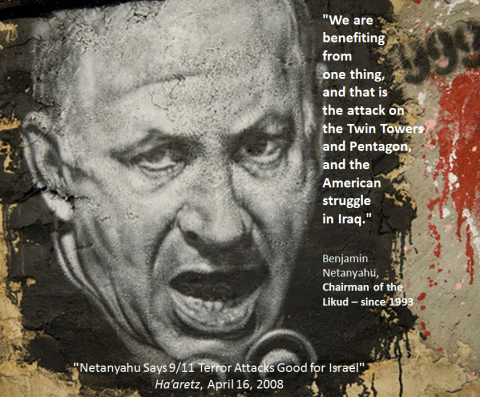 Bollyn is fully apprised of the danger in the combustible combination of the current leaders of Israel and the United States. It could be déjà vu over again: “Ronald Reagan and Menachem Begin led to the Israeli invasion of Lebanon in 1982, and George W. Bush and Ariel Sharon led to 9/11 and the War on Terror in 2001.” Foreboding abounds when President Trump calls Prime Minister Netanyahu a close, personal friend. Will the talented Mr. Netanyahu and the Artful Dealer of America arrange a mutually acceptable war? We may soon have our answer.
While it strains credulity to the breaking point, Bollyn’s most daringly original suggestion is that 9/11 and its propaganda-induced “War on Terror” can be traced in part to a consanguineous conspiracy—a family plot, if you will—conceived and crafted over many years by Netanyahu & Son, and abetted by select American traitors when all the pieces were at last in place. Should their guilt ever become known, the name “Netanyahu” will live in infamy. Move over, Macbeth!
It seems only fitting, then, to let 9/11 mastermind, Benjamin Netanyahu, have the penultimate word in this review. One can almost picture him winking to his future accomplices when he proclaimed decades earlier: “It is perfectly possible to determine who the terrorists are and who stands behind them. If governments have failed to do this, it is more often not for lack of knowledge, but for lack of courage and moral clarity.” (Terrorism: How the West Can Win, 1986)
If Netanyahu soon gets his way—and unleashes yet another false-flagged, media-hyped, Israeli-concocted “war on terror”—it will not be for lack of courage and moral clarity by people such as Christopher Bollyn. May the Lord preserve him and all other truth-tellers.
October 21, 2017
Posted by aletho |
Book Review, Ethnic Cleansing, Racism, Zionism, False Flag Terrorism, Timeless or most popular, Wars for Israel | 9/11, Benjamin Netanyahu, Israel, Larry Silverstein, Middle East, Philip Zelikow, United States, Zionism |
Leave a comment
Israeli Prime Minister Benjamin Netanyahu is lobbying world powers to support the independence of the semi-autonomous Kurdistan region from the rest of the Iraqi territory, as Kurdish Peshmerga forces are losing ground to Iraqi army forces in the country’s oil-rich northern province of Kirkuk.
Israeli officials, requesting anonymity, said Netanyahu raised the Kurdish plans for independence with German Chancellor Angela Merkel last week, and with Russian President Vladimir Putin on Wednesday.
The 67-year-old Chairman of the Likud party also made a reference to the issue in his contacts with French authorities.
An Israeli official, who declined to be named, stated that the Tel Aviv regime has security interests in Kurdistan.
“This (territory) is a foothold. It’s a strategic place. It would be best if someone gave them weaponry, and whatever else, which we cannot give, obviously,” the official said without providing further detail.
Israel has maintained military, intelligence and business ties with Iraqi Kurds since 1960s.
“The issue at present is … to prevent an attack on the Kurds, extermination of the Kurds and any harm to them, their autonomy and region, something that Turkey and Iran and … other powers in Iraq and part of the Iraqi government want,” Israeli Intelligence Minister, Israel Katz, alleged in an interview with Tel Aviv radio station 102 FM on Friday.
“The prime minister is certainly engaging the United States, Russia, Germany and France to stop the Kurds from being harmed,” Katz said.
On Friday, Iraqi government forces wrested control of a strategic sub-district of Kirkuk province following clashes with Peshmerga forces.
“Iraqi Federal Police and Counter-Terrorism Service (CTS) forces, along with fighters from Popular Mobilization Units – commonly known by the name Hashd al-Sha’abi, have secured Kirkuk’s northern Altun Kupri sub-district,” the Iraqi Defense Ministry said in a statement.
Iraqi Army Captain Jabbar Hasan said Iraqi federal forces had given Peshmerga forces 24 hours to vacate their strongholds in Altunkopru, and withdraw to areas controlled by the Kurdistan Regional Government (KRG).
Peshmerga forces, however, had rejected the ultimatum, Hasan said.
The referendum on secession of the Kurdistan region was held on September 25 despite strong opposition from the central government in Baghdad, the international community, and Iraq’s neighboring countries, especially Turkey and Iran.
Following the vote, Baghdad imposed a ban on direct international flights to the Kurdish region and called for a halt to its independent crude oil sales.
On October 12, an Iraqi government spokesman said Baghdad had set a series of conditions that the KRG needed to meet before any talks on the resolution of the referendum crisis could start.
“The KRG must first commit to Iraq’s unity. The local authorities in the [Kurdistan] region… must accept the sovereign authority of the federal government on… oil exports, [as well as] security and border protection, including land and air entry points,” the unnamed Iraqi official added.
Iraqi Prime Minister Haider al-Abadi has already demanded the annulment of the referendum.
During a recent press conference in Paris, Abadi said his government did not seek confrontation with Iraqi Kurds, but reiterated Baghdad’s position that the vote was illegal and that problems should be solved within the framework of Iraq’s constitution.
October 21, 2017
Posted by aletho |
Ethnic Cleansing, Racism, Zionism, Wars for Israel | Iraq, Israel, United States, Zionism |
Leave a comment
An undercover reporter secretly records how the Israeli Embassy directs local groups
One month ago, I initiated here at Unz.com a discussion of the role of American Jews in the crafting of United States foreign policy. I observed that a politically powerful and well-funded cabal consisting of both Jewish individuals and organizations has been effective at engaging the U.S. in a series of wars in the Middle East and North Africa that benefit only Israel and are, in fact, damaging to actual American interests. This misdirection of policy has not taken place because of some misguided belief that Israeli and U.S. national security interests are identical, which is a canard that is frequently floated in the mainstream media. It is instead a deliberate program that studiously misrepresents facts-on-the ground relating to Israel and its neighbors and creates casus belli involving the United States even when no threat to American vital interests exists. It punishes critics by damaging both their careers and reputations while its cynical manipulation of the media and gross corruption of the national political process has already produced the disastrous war against Iraq, the destruction of Libya and the ongoing chaos in Syria. It now threatens to initiate a catastrophic war with Iran.
To be sure, my observations are neither new nor unique. Former Congressmen Paul Findley indicted the careful crafting of a pro-Israel narrative by American Jews in his seminal book They Dare to Speak Out: People and Institutions Confront Israel’s Lobby, written in 1989. Professors John Mearsheimer and Stephen Walt’s groundbreaking book The Israel Lobby and U.S. Foreign Policy said much the same thing nine years ago and discussions of Jewish power do emerge occasionally, even in the mainstream media. In the Jewish media Jewish power is openly discussed and is generally applauded as a well-deserved reward bestowed both by God and by mankind due to the significant accomplishments attributed to Jews throughout history.
There is undeniably a complicated web of relationships and networks that define Israel’s friends. The expression “Israel Lobby” itself has considerable currency, so much so that the expression “The Lobby” is widely used and understood to represent the most powerful foreign policy advocacy group in Washington without needing to include the “Israel” part. That the monstrous Benjamin Netanyahu receives 26 standing ovations from Congress and a wealthy Israel has a guaranteed income from the U.S. Treasury derives directly from the power and money of an easily identifiable cluster of groups and oligarchs – Paul Singer, Sheldon Adelson, Bernard Marcus, Haim Saban – who in turn fund a plethora of foundations and institutes whose principal function is to keep the cash and political support flowing in Israel’s direction. No American national interest, apart from the completely phony contention that Israel is some kind of valuable ally, would justify the taxpayers’ largesse. In reality, Israel is a liability to the United States and always has been.
And I do understand at the same time that a clear majority of American Jews, leaning strongly towards the liberal side of the political spectrum, are supportive of the nuclear agreement with Iran and do not favor a new Middle Eastern war involving that country. I also believe that many American Jews are likely appalled by Israeli behavior, but, unfortunately, there is a tendency on their part to look the other way and neither protest such actions nor support groups like Jewish Voice for Peace that are themselves openly critical of Israel. This de facto gives Israel a free pass and validates its assertion that it represents all Jews since no one important in the diaspora community apart from minority groups which can safely be ignored is pushing back against that claim.
That many groups and well-positioned individuals work hand-in-hand with the Israeli government to advance Israeli interests should not be in dispute after all these years of watching it in action. Several high level Jewish officials, including Richard Perle, associated with the George W. Bush Pentagon, had questionable relationships with Israeli Embassy officials and were only able to receive security clearances after political pressure was applied to “godfather” approvals for them. Former Congressman Tom Lantos and Senator Frank Lautenberg were, respectively, referred to as Israel’s Congressman and Senator, while current Senate Minority Leader Chuck Schumer has described himself as Israel’s “shomer” or guardian in the U.S. Senate.
A recent regulatory decision from the United Kingdom relates to a bit of investigative journalism that sought to reveal precisely how the promotion of Israel by some local diaspora Jews operates, to include how critics are targeted and criticized as well as what is done to destroy their careers and reputations.
 Last year, al-Jazeera Media Network used an undercover reporter to infiltrate some U.K. pro-Israel groups that were working closely with the Israeli Embassy to counter criticisms coming from British citizens regarding the treatment of the Palestinians. In particular, the Embassy and its friends were seeking to counter the growing Boycott, Divestment and Sanctions movement (BDS), which has become increasingly effective in Europe. The four-part documentary released late in 2016 that al-Jazeera produced is well worth watching as it consists mostly of secretly filmed meetings and discussions.
The documentary reveals that local Jewish groups, particularly at universities and within the political parties, do indeed work closely with the Israeli Embassy to promote policies supported by the government of Prime Minister Benjamin Netanyahu. It also confirms that tagging someone as an anti-Semite has become the principal offensive weapon used to stifle any discussion, particularly in a country like Britain which embraces concepts like the criminalization of “hate speech.” At one point, two British Jews discussed whether “being made to feel uncomfortable” by people asking what Israel intends to do with the Palestinians is anti-Semitic. They agreed that it might be.
The documentary also describes how the Embassy and local groups working together targeted government officials who were not considered to be friendly to Israel to “be taken down,” removed from office or otherwise discredited. One government official in particular who was to be attacked was Foreign Office Minister Sir Alan Duncan.
Britain, unlike the U.S., has a powerful regulatory agency that oversees communications, to include the media. It is referred to as Ofcom. When the al-Jazeera documentary was broadcast, Israeli Embassy political officer Shai Masot, who reportedly was a Ministry of Strategic Affairs official working under cover, was forced to resign and the Israeli Ambassador offered an apology. Masot was filmed discussing British politicians who might be “taken down” before speaking with a government official who plotted a “a little scandal” to bring about the downfall of Duncan. Labour Party leader Jeremy Corbyn, who is the first head of a political party in Britain to express pro-Palestinian views, had called for an investigation of Masot after the recording of the “take down” demand relating to Duncan was revealed. Several Jewish groups (the Jewish Labour Movement, the Union of Jewish Students and We Believe in Israel) then counterattacked with a complaint that the documentary had violated British broadcast regulations, including the specific charge that the undercover investigation was anti-Semitic in nature.
On October 9th, Ofcom ruled in favor of al-Jazeera, stating that its investigation had done nothing improper, but it should be noted that the media outlet had to jump through numerous hoops to arrive at the successful conclusion. It had to turn over all its raw footage and communications to the investigators, undergoing what one source described as an “editorial colonoscopy,” to prove that its documentary was “factually accurate” and that it had not “unfairly edited” or “with bias” prepared its story. One of plaintiffs, who had called for critics of Israel to “die in a hole” and had personally offered to “take down” a Labour Party official, responded bitterly. She said that the Ofcom judgment would serve as a “precedent for the infringement of privacy of any Jewish person involved in public life.”
The United States does not yet have a government agency to regulate news stories, though that may be coming, but the British tale has an interesting post script. Al-Jazeera also had a second undercover reporter inserted in the Israel Lobby in the United States, apparently a British intern named James Anthony Kleinfeld, who had volunteered his services to The Israel Project, which is involved in promoting Israel’s global image. He also had contact with at least ten other Jewish organizations and with officials at the Israeli Embassy,
Now that the British account of “The Lobby” has cleared a regulatory hurdle the American version will reportedly soon be released. Al-Jazeera’s head of investigative reporting Clayton Swisher commented “With this U.K. verdict and vindication past us, we can soon reveal how the Israel lobby in America works through the eyes of an undercover reporter. I hear the U.S. is having problems with foreign interference these days, so I see no reason why the U.S. establishment won’t take our findings in America as seriously as the British did, unless of course Israel is somehow off limits from that debate.”
Americans who follow such matters already know that groups like the American Israel Public Affairs Committee (AIPAC) swarm over Capitol Hill and have accomplices in nearly every media outlet. Back in 2005-6 AIPAC Officials Steve Rosen and Keith Weissman were actually tried under the Espionage Act of 1918 in a case involving obtaining classified intelligence from government official Lawrence Franklin to pass on to the Israeli Embassy. Rosen had once boasted that, representing AIPAC and Israel, he could get the signatures of 70 senators on a napkin agreeing to anything if he sought to do so. The charges against the two men were, unfortunately, eventually dropped “because court rulings had made the case unwinnable and the trial would disclose classified information.”
And Israeli interference in U.S. government and elections is also a given. Endorsement of Mitt Romney in the 2012 presidential election by the Netanyahu government was more-or-less carried out in the open. And ask Congressmen like Paul Findley, Pete McCloskey, William Fulbright, Charles Percy and, most recently, Cynthia McKinney, what happens to your career when you appear to be critical of Israel. And the point is that while Israel calls the shots in terms of what it wants, it is a cabal of diaspora American Jews who actually pull the trigger. With that in mind, it will be very interesting to watch the al-Jazeera documentary on The Lobby in America.
October 17, 2017
Posted by aletho |
Ethnic Cleansing, Racism, Zionism, Full Spectrum Dominance, Timeless or most popular, Wars for Israel | AIPAC, Israel, Palestine, UK, United States, Zionism |
Leave a comment
With his declaration Friday that the Iran nuclear deal is not in the national interest, President Donald Trump may have put us on the road to war with Iran.
Indeed, it is easier to see the collisions that are coming than to see how we get off this road before the shooting starts.
After “de-certifying” the nuclear agreement, signed by all five permanent members of the Security Council, Trump gave Congress 60 days to reimpose the sanctions that it lifted when Teheran signed.
If Congress does not reimpose those sanctions and kill the deal, Trump threatens to kill it himself.
Why? Did Iran violate the terms of the agreement? Almost no one argues that — not the UN nuclear inspectors, not our NATO allies, not even Trump’s national security team.
Iran shipped all its 20 percent enriched uranium out of the country, shut down most of its centrifuges, and allowed intrusive inspections of all nuclear facilities. Even before the deal, 17 U.S. intelligence agencies said they could find no evidence of an Iranian nuclear bomb program.
Indeed, if Iran wanted a bomb, Iran would have had a bomb.
She remains a non-nuclear-weapons state for a simple reason: Iran’s vital national interests dictate that she remain so.
As the largest Shiite nation with 80 million people, among the most advanced in the Mideast, Iran is predestined to become the preeminent power in the Persian Gulf. But on one condition: She avoid the great war with the United States that Saddam Hussein failed to avoid.
Iran shut down any bomb program it had because it does not want to share Iraq’s fate of being smashed and broken apart into Persians, Azeris, Arabs, Kurds and Baluch, as Iraq was broken apart by the Americans into Sunni, Shiite, Turkmen, Yazidis and Kurds.
Tehran does not want war with us. It is the War Party in Washington and its Middle East allies — Bibi Netanyahu and the Saudi royals — who hunger to have the United States come over and smash Iran.
Thus, the Congressional battle to kill, or not to kill, the Iran nuclear deal shapes up as decisive in the Trump presidency.
Yet, even earlier collisions with Iran may be at hand.
In Syria’s east, U.S.-backed and Kurd-led Syrian Democratic Forces are about to take Raqqa. But as we are annihilating ISIS in its capital, the Syrian army is driving to capture Deir Ezzor, capital of the province that sits astride the road from Baghdad to Damascus.
Its capture by Bashar Assad’s army would ensure that the road from Baghdad to Damascus to Hezbollah in Lebanon remains open.
If the U.S. intends to use the SDF to seize the border area, we could find ourselves in a battle with the Syrian army, Shiite militia, the Iranians, and perhaps even the Russians.
Are we up for that?
In Iraq, the national army is moving on oil-rich Kirkuk province and its capital city. The Kurds captured Kirkuk after the Iraqi army fled from the ISIS invasion. Why is a U.S.-trained Iraqi army moving against a U.S.-trained Kurdish army?
The Kurdistan Regional Government voted last month to secede. This raised alarms in Turkey and Iran, as well as Baghdad. An independent Kurdistan could serve as a magnet to Kurds in both those countries.
Baghdad’s army is moving on Kirkuk to prevent its amputation from Iraq in any civil war of secession by the Kurds.
Where does Iran stand in all of this?
In the war against ISIS, they were de facto allies. For ISIS, like al-Qaida, is Sunni and hates Shiites as much as it hates Christians. But if the U.S. intends to use the SDF to capture the Iraqi-Syrian border, Syria, Iran, Hezbollah and Russia could all be aligned against us.
Are we ready for such a clash?
We Americans are coming face to face with some new realities.
The people who are going to decide the future of the Middle East are the people who live there. And among these people, the future will be determined by those most willing to fight, bleed and die for years and in considerable numbers to realize that future.
We Americans, however, are not going to send another army to occupy another country, as we did Kuwait in 1991, Afghanistan in 2001, and Iraq in 2003.
Bashar Assad, his army and air force backed by Vladimir Putin’s air power, the Islamic Revolutionary Guard Corps of Iran, and Hezbollah won the Syrian civil war because they were more willing to fight and die to win it. And, truth be told, all had far larger stakes there than did we.
We do not live there. Few Americans are aware of what is going on there. Even fewer care.
Our erstwhile allies in the Middle East naturally want us to fight their 21st-century wars, as the Brits got us to help fight their 20th-century wars.
But Donald Trump was not elected to do that. Or so at least some of us thought.
Coyright 2017 Creators.com.
October 17, 2017
Posted by aletho |
Ethnic Cleansing, Racism, Zionism, Militarism, Wars for Israel | Iran, Iraq, Israel, Middle East, Syria, United States, Zionism |
Leave a comment