The United States has presented its new nuclear agreement with Saudi Arabia as a gift: reactors, technology, investment, prestige, and the radiant promise of a peaceful atomic future. Washington is forever giving gifts of this kind. Curiously, they tend to arrive fitted with surveillance equipment, political conditions, and a discreetly concealed choke chain.
This is not merely a civil nuclear agreement. It is a disciplinary instrument aimed at Mohammed bin Salman — a strategic summons issued to a crown prince who has recently behaved less like an obedient client and more like the ruler of an indispensable state.
Its message is simple: Saudi Arabia may diversify its economy, its diplomatic partners, and even its wardrobe of alliances, but it may not diversify the source of its ultimate protection. That franchise still belongs to Washington.
The agreement therefore concerns nuclear energy only in the same sense that a prison contract concerns architecture. Its deeper purpose is to reconstruct American authority over a kingdom that has begun imagining life beyond the imperial security nursery.
Riyadh has committed three increasingly intolerable offenses.
First, it has moved too close to Pakistan. The Saudi–Pakistani relationship is hardly new: money, soldiers, intelligence cooperation, religious patronage, and strategic ambiguity have bound the two states for decades.
What has changed is the context. As confidence in American protection has weakened, Pakistan has ceased to look merely like a useful military subcontractor and begun to resemble a possible component of an alternative security architecture.
That possibility is especially sensitive because Pakistan is nuclear-armed. No formal Saudi–Pakistani nuclear arrangement has been acknowledged, and neither capital needs one publicly declared. Strategic ambiguity is useful precisely because it performs deterrence without submitting an invoice to the International Atomic Energy Agency. A defense pact, carefully suggestive official language, and decades of intimate military cooperation can generate considerable anxiety without anyone having to unveil a warhead in Riyadh.
Washington’s nuclear offer is designed to interrupt that imagination. It tells the Saudis: there will be no Pakistani shortcut to strategic autonomy. If the kingdom wants reactors, fuel-cycle expertise, advanced technology, and the political symbolism of nuclear modernity, those ambitions must pass through American gates. The atomic future may be Saudi, but the key to the laboratory must remain in Washington.
Second, Mohammed bin Salman has shown insufficient enthusiasm for the campaign against Iran. Riyadh has no sentimental attachment to Tehran; states do not exchange friendship bracelets. But it has learned, after years of expensive confrontation, that permanent hostility to Iran is a ruinous American luxury financed by Gulf vulnerability. Saudi–Iranian accommodation is not ideological reconciliation. It is an insurance policy against being drafted into someone else’s war.
This is precisely what makes it objectionable to Washington and Israel. An autonomous Saudi Arabia might decline to become the logistics platform, financier, diplomatic choir, and eventual target of a regional war against Iran. It might decide that oil facilities, desalination plants, investment plans, and glittering megaprojects are poorly served by turning the Gulf into a missile exchange. Such ingratitude cannot be encouraged.
The nuclear deal places Washington back at the center of Saudi strategic planning. Technology creates dependency; dependency creates leverage; leverage restores obedience.
The reactor is not merely an energy source. It is a thirty-year listening device embedded in the kingdom’s national-security imagination.
Third, Riyadh has refused to normalize relations with Israel on Washington’s preferred terms. Saudi leaders continue to tie normalization to a credible pathway toward Palestinian statehood — an inconvenient demand in an imperial order that prefers Palestinians as humanitarian statistics rather than political subjects. Trump’s subsequent insistence that the nuclear arrangement depends on Saudi entry into the Abraham Accords merely stripped the agreement of its ceremonial clothing.
The bargain is now indecently clear: Washington will help construct Saudi Arabia’s nuclear future if Riyadh helps rehabilitate Israel’s regional standing. Nuclear cooperation becomes diplomatic blackmail. The kingdom is invited to purchase strategic reassurance with Palestine. This is less a treaty than a geopolitical obedience course: sit beside Israel, distrust Iran, step away from Pakistan, and receive your reactor.
China and Russia are the other uninvited guests at the signing ceremony. Saudi Arabia is not merely another energy producer; it is the central Arab power in OPEC, a financial heavyweight, and a pivotal actor in the emerging multipolar order. Its relations with Beijing and Moscow challenge Washington not because Riyadh has become anti-American, but because it has become insufficiently exclusive.
Empire does not require affection. It requires the absence of alternatives.
A Saudi nuclear program built with Chinese or Russian assistance would deepen technological, financial, and strategic relationships that Washington can no longer confidently control. American companies want the contracts, certainly, but the larger concern is architectural: whoever builds the reactors helps shape the dependencies surrounding them.
Nuclear cooperation produces decades of training, maintenance, fuel arrangements, regulatory influence, security coordination, and elite access. Washington is not selling machinery. It is purchasing strategic occupancy.
The irony is exquisite. The United States portrays the agreement as evidence of restored strength, yet its generosity reveals its weakness. A hegemon secure in its position does not need to offer extraordinary concessions to retain an old client. It does so when the client has discovered competing suppliers, alternative protectors, and the invigorating sensation of being courted.
Nor does the agreement simplify nuclear diplomacy with Iran. Washington has spent years treating Iranian enrichment as uniquely sinister while now constructing a far more permissive vocabulary for Saudi ambitions. The distinction will be explained through the usual theological machinery of empire: allies possess peaceful atoms; adversaries enrich malicious ones. Centrifuges, apparently, acquire moral character from the flag hanging above them.
The result is a nonproliferation doctrine so intellectually elastic that it can be folded into a campaign brochure.
Mohammed bin Salman may believe Saudi Arabia has accumulated enough leverage to escape the old hierarchy. Washington’s answer is this agreement: not quite a reward, not quite a threat, but an elegant combination of both. America will protect the kingdom — from Iran, from uncertainty, and above all from the dangerous temptation to protect itself through arrangements Washington cannot supervise.
The reactor, then, is the bait. Israel is the condition. Pakistan is the warning. China and Russia are the targets.
And the leash, freshly polished and marketed as partnership, remains unmistakably American.
UN experts have called for an independent investigation into the bombing of a primary school in the southern Iranian city of Minab that killed 168 children and teachers, saying the attack highlights serious violations of international law during war of aggression by the United States and Israel.
In a statement released on Friday, the experts said the school was struck twice during school hours on Feb. 28, 2026, and that there was no indication it was being used for military purposes.
“The school was clearly identifiable as a civilian educational facility and that they had received no information indicating it was being used for military purposes,” the statement read.
Five months later, they said, neither the United States nor Israel had made public the findings of any investigation into the deadly attack, raising questions about the transparency of any inquiry.
“Five months following the school bombing in Minab, the US and Israel have not made any findings public, raising valid questions regarding the impartiality, effectiveness and transparency of any investigation that may be underway,” the experts said. “Justice delayed is justice denied.”
The experts further stated that the Minab school attack illustrated as a broader failure by the United States and Israel to protect civilians during armed conflict, particularly women and children.
“Characterizing civilian deaths as a mistake does not diminish States’ obligations under international humanitarian law and international human rights law, nor does it preclude individual criminal responsibility where violations have occurred,” they said.
“Victims and their families are entitled to truth, justice and effective reparations.”
They voiced grave concern over serious violations of international law arising from US and Israeli war of aggression in Iran since Feb. 28, 2026.
The independent experts called for prompt, independent, impartial and transparent investigations into civilian casualties and damage to civilian infrastructure, including attacks on schools, hospitals and other protected sites.
“International law prohibits the threat or use of force against the territorial integrity or political independence of any State,” the experts said. “The prohibition of the threat or use of force is a cornerstone of the international legal order.”
The US-Israeli war of aggression against Iran between Feb. 28 and early April killed at least 3,375 civilians, including nearly 500 women, and wounded more than 33,000 others, noted the experts.
The experts also said they had received credible reports that Iranian civilians may have been exposed to internationally prohibited and banned hazardous substances, with potentially serious health consequences, particularly for women, girls and pregnant women.
The experts also expressed concern over the latest round of US aggression against Iran despite a memorandum of understanding (MoU) intended to end the war.
The experts urged United States to adhere to the principles of distinction and precaution under international humanitarian law and to protect civilians and civilian infrastructure on land and at sea. They also warned against attacks on civilian population centers, desalination plants and electricity networks.
The US-Israeli acts of aggression in June 2025 and again since February 2026 have deliberately targeted civilians, civilian infrastructure and critical facilities in violation of international law and international humanitarian law.
After weeks of sporadic incidents, the US military launched a fresh wave of large-scale attacks on Iranian soil two weeks ago, targeting military and civilian sites mainly in southern provinces. The attacks have so far destroyed several infrastructure sites, such as bridges and water desalination plants, and killed over 50 Iranians.
Senior Iranian officials have warned that ongoing US attacks threaten regional stability, freedom of navigation, and the security of the Persian Gulf and the Strait of Hormuz.
While the US president continues to lie to his people about imagined victories over Iran in West Asia, the arguments fall flat amongst the vast majority of Americans who see through his tired rhetoric. Unlike past military blunders, Washington has not and will not be able to pull the wool over its people’s eyes.
Some analysts have attempted to compare Donald Trump’s failure to effectively combat Iran with defeats and strategic mistakes that ruined the reputations of past presidents; this one is very different.
To go through all US wars of aggression is simply too steep a task to take on in a single article, but there are a few different comparisons that are going around which deserve to be analyzed: they are the Iraq War, the Vietnam War, and even Operation Eagle Claw.
All the above-noted comparisons are very much different in their nature from the large-scale air campaign, turned stop-start battles that the Trump administration has engaged in. If we first look at the Vietnam War comparison, this is often said as a figure of speech – “it is so and so’s Vietnam” – which is the way in which some analysts have chosen to apply Vietnam to what we see today.
Although there is something to be said about how the US is being bogged down in the Iran War, it is a totally different ball game to what occurred in Vietnam. At the beginning stages of the escalation, in October of 1965, a Gallup poll recorded a 64% public approval rating of US intervention in Vietnam, which by 1970 had shifted to around 55% of the US public stating that they sought a return of the troops.
At the time, the US had sold its population the need to fight Communism and that the Vietnam War was necessary, as the fall of South Vietnam to a Communist government would lead to a slippery slope whereby governments across Asia would fall to the ideology. The Communist boogeyman captured the imaginations of those living in the West, who opposed the Soviet Union and Chairman Mao’s China.
In Trump’s case, the approval rating for the Iran war was never there. Ipsos polling data from the beginning of the war suggested that 58% of Americans opposed a war with Iran, with only 38% expressing approval. Two weeks into the conflict, Pew Research polling data then revealed that 61% of the country disapproved of the war. Now, even Trump’s own cult-like fan base is turning on the war, with Politico polling data suggesting that little more than a third of MAGA supporters believe the economic costs of the Iran war have been worth it.
In the Vietnam War case, public opinion at its worst was more favourable than it was at the beginning of the war on Iran. When it came to the disastrous 2003 Iraq invasion, a Gallup News poll recorded a 72% approval rating for the war, with only 25% of Americans opposing it.
Then there is the comparison with Operation Eagle Claw, which refers to the disastrous mission that was ordered by former US President Jimmy Carter – aimed at seizing back American citizens held by the Islamic Republic at the time. The reference is now being made to Jimmy Carter and his failed operation, resulting in the deaths of 8 US service members, because of President Trump’s own comments about the Carter administration.
In the event of a ground invasion that seeks to seize Iranian territory – Kharg Island being the most publicly discussed target to occupy – the US president will almost inevitably be in a position where a number of American soldiers could be captured.
All of the above-noted cases have a shared difference that separates them from what the Trump administration is doing today, that being that they were not operations launched solely for a foreign country’s interests.
Although the Israelis certainly played a role in pushing the US toward launching the Iraq War, it was a conflict that did assert Washington’s dominance over the region, further bringing the Arab Gulf States under their control, and was evidently winnable. The consequences of the invasion were not immediate; the American public believed in the new “Islamic enemy” that had replaced the Red Scare narrative sold to populations across the collective West during the Cold War.
The Vietnam War also had the Gulf of Tonkin incident false flag that helped justify the war, while Iraq had the September 11 attacks. The Iran War didn’t even bother to use any incident as an excuse; it was rushed and sloppy.
This time, Iran has managed to use the closure of the Strait of Hormuz as leverage against the US, while Yemen’s Ansar Allah is now tightening the noose by imposing a counter-blockade on Saudi Arabia in the Red Sea. If the Yemeni Armed Forces choose to do so, they can totally block the Bab al-Mandab Strait also, choking off two of the world’s most important trade routes. Iran has demonstrated its ability to continuously pound US military bases and embarrass the US Navy’s attempts to coordinate the passage of ships out of the Gulf.
The US’ military industrial complex is also getting slapped around, as Iran has managed to shoot down at least one F-15 fighter jet, even locking on and striking an F-35 that was forced to do an emergency landing.
US allies in the Gulf, which have pledged to invest trillions in the American economy, are taking an economic beating, with the possibility that some could even be rendered uninhabitable if the war escalates. From power projection to the sale of weapons, seizure of resources, and an image of victory, there is nothing to gain.
Only the Israelis are set to gain anything from this deeply unpopular war. They seek to use the United States military to do their dirty work of degrading Iranian infrastructure and dealing an economic blow to the Islamic Republic. This is because Tel Aviv understands that the job cannot be performed by them alone and that as long as they can take the punishment dished out against them, they are willing to continue using the Trump administration to do their bidding.
Never before has a war of this nature been fought by the United States, where it loses in every category, with the conflict being fought solely for the purpose of fulfilling the expansionist desires of a foreign rogue regime. Donald Trump is not Jimmy Carter or George Bush Jr.; he will be remembered as the president who launched an offensive war of aggression on behalf of a genocidal regime that couldn’t care less how the US and the rest of the world are impacted, as long as they continue to get propped up to forward their goals of creating a regional empire premised on a supremacist ideology.
The excitement over the US-Saudi nuclear deal has proved to be short-lived. Apparently, the US President Donald Trump himself poured cold water into it by adding a caveat on Thursday that in order for the deal to be advanced, Saudi Arabia must first join the Abraham Accords. That is, as things stand, may seem like asking for the moon.
However, it’s all but certain that Trump allowed the Saudi deal to be signed after consulting Israeli Prime Minister Benjamin Netanyahu as a last throw of dice to pin down Saudi Arabia as a participant / collaborator alongside Israel (and the UAE) for an all-out war against Iran that might at some point entail ground operations, which is not possible without first getting Riyadh on his side firmly, irrevocably.
If Saudi Arabia dissociates from Tump’s upcoming war and disallows the US to use the Saudi bases or work out the logistics accordingly, Pentagon generals will be hard-pressed to conduct the war. In political terms too, the Saudi stance will influence other regional oligarchies in the Persian Gulf in their own attitudes towards Iran, which is astride the Arab street like a colossus. The timing of the July 15 meeting of Trump with the visit of the pro-American prime minister of Iraq Ali al-Zaidi also needs to be factored in here. Simply put, Iraq has become a frontline in the US-Iran conflict.
Saudis won’t like the prospect of Iran emerging as a towering regional power. On its part, Iran is also closely watching the Saudi mood swings stemming out of its compulsions not to annoy Trump who is in a position to to play a helpful role in the event of the succession issue coming to the fore in Riyadh at any time. Of course, this is apart from the profound petrodollar linkages critical to both protagonists.
Meanwhile, the recent Pakistani advisory to Tehran to steer clear of targeting Saudi Arabia, the Houthi threat to Saudi Arabia and the potential closure of Strait of Bab el-Mandeb are tell-tale signs of latent tensions between Tehran and Riyadh, although both sides are maintaining a semblance of normalcy.
Most certainly, Trump’s remark on Thursday making the nuclear deal conditional on the Saudis normalising relations with Israel has thrown the deal as such into question barely 24 hours after it was signed. Is it a U-turn or is the episode just another confusing rollout that has become the trademark of Trump’s presidency? The truth could be somewhere in between.
According to an AP report, the White House press secretary Karoline Leavitt told reporters in a briefing yesterday that Trump has said if the Saudis don’t join the Abraham Accords, “the deal is off.” When asked why the condition wasn’t mentioned Wednesday when the Energy Department announced that the deal was signed, Leavitt said it was because Trump “is always the final dealmaker.”
My own reading is that Trump is backtracking according to a script. He could have taken credit for the condition on Abraham Accords, had it been a part of the deal. But it is within his ingenuity to try to increase his leverage with the Saudis by adding the caveat openly: that might even improve the deal in certain respects such as enrichment or verification clauses, for instance.
The Saudis appear to have been taken by surprise on Wednesday when US Energy Secretary Chris Wright signed the decades-long, multibillion-dollar deal with his Saudi counterpart, Prince Abdulaziz bin Salman, Saudi Arabia’s Minister of Energy but that doesn’t have to be taken at face value. The deal reportedly includes a “123 Agreement” and an accompanying “bilateral safeguards agreement,” and the two agreed to a two-year study to see whether enrichment is necessary. This seems like kicking the can down the road. Interestingly, Netanyahu’s office said Saudis joining of the Abraham Accords “would be an historic leap forward for peace in the Middle East.”
On the whole, Trump has a deal here. The caveat of Abraham Accords may serve to delay the agreement from coming to fruition unless and until the Saudis jettison their bottomline [a Palestinian state] linking normalisation with Israel. On the other hand, Trump has the leverage insofar as the Saudis now have to address whether they want to normalise relations with Israel.
Indeed, the Saudis too are getting an optimal deal here, which doesn’t expressly block reprocessing and enrichment and doesn’t allow for the International Atomic Energy Agency to do its inspections. The Saudis have apparently got away with not having a customary additional protocol, which would have ensured there is no cheating, and it will stay a peaceful programme. On Truth Social, Trump maintained on Thursday that “there will be no enrichment of material,” but added that the US is “not opposed to Civil (Non-Enriched) Nuclear Facilities.” Conceivably, the US may have control of a Saudi enrichment facility and keep a military / security presence.
The Congress will be able to review the deal in a 90-day window. Lawmakers do not need to approve it, but they could oppose it, although that is unlikely. (See a Congressional Research Report Prospects for U.S.-Saudi Nuclear Energy Cooperation, March 11, 2026) All in all, the chances are of the agreement “staying in place and nothing substantive happening until Saudis agree to something” regarding Israel, as [per] Bryan Clark, a senior fellow at the Hudson Institute, an influential pro-Trump DC-based think tank.
The most bizarre coincidence of the entire sequence of developments since Wednesday is the shadow this deal could potentially cast on the US-Iran agreement that is on the horizon. But that is only hypothetical. If Trump intends to launch an all-out war with Iran, there will be no more negotiations to be had on a nuclear deal.
Saudis, being stakeholders, may no longer resist Trump’s entreaties to collaborate with the war effort going forward, whose objective would be to destroy Iran comprehensively with all the military might at Washington’s command. The Saudi Crown Prince Mohammed bin Salman has said in the past that if Iran obtained a nuclear weapon, the kingdom would have to follow suit.
In such a scenario, there will be no conceivable reason for Israel at the present juncture to try to kill the US-Saudi deal that is struggling to be born.
Former Indian Foreign Secretary Kanwal Sibal says the US attack on the Iranian frigate IRIS Dena near Sri Lanka demonstrated Washington’s disregard for India’s sensitivities, warning that the war with Iran has expanded beyond West Asia into India’s immediate maritime neighborhood.
“The sinking of the Iranian frigate IRIS Dena by a US submarine in the Indian Ocean has brought the widening conflict with Iran into India’s immediate maritime neighborhood. This is no longer a distant West Asian crisis,” Sibal wrote on X on Friday.
Sibal said the circumstances gave the incident both moral and diplomatic significance for New Delhi.
“That fact gives the episode a moral and diplomatic dimension that cannot simply be ignored. The United States has shown scant regard for Indian sensitivities in carrying out this action so close to our shores,” he said.
Warning that the consequences extend beyond the immediate attack, Sibal said the war between major powers will inevitably spread beyond West Asia into regions vital to India’s interests.
“The larger issue is the progressive spread of the conflict beyond West Asia. Escalation between major powers does not remain geographically contained. It inevitably spills into regions that are vital to India’s security and economic interests,” he wrote.
He added: “Stability in the Indian Ocean, freedom of navigation, and uninterrupted energy flows are not abstract concerns for India. They are core national interests. Any sustained disruption in these waters will have direct and serious consequences for us.”
Sibal said New Delhi now faces the challenge of preserving its strategic autonomy while balancing ties with both Washington and Tehran.
“India now faces the difficult task of preserving its strategic autonomy while managing relations with both Washington and Tehran. Conflicts between other powers that reach our maritime neighborhood leave us with fewer good options and greater exposure,” he wrote.
“The central question is how India protects its interests when the wars of others begin to unfold in its own extended neighborhood. This is no longer a hypothetical problem. It has arrived.”
Sibal also criticized the Indian government following the sinking of the IRIS Dena, writing that, “If India had not invited the Iranian warship to participate in the exercise, it would not have been in that area.”
Referring to the Milan 2026 multinational naval exercise, he said, “Participating ships were not allowed to carry any ammunition,” adding that the Iranian frigate “was unarmed at the time.”
He also said that “the US submarine attack appears to have been planned in advance because Washington was aware of the Iranian warship’s participation in the exercise.”
The IRIS Dena was returning from the Milan 2026 multinational naval exercise, hosted by the Indian Navy with the participation of 72 countries, when it was attacked by a US submarine in the Indian Ocean near Sri Lanka.
Sri Lankan authorities said 32 Iranian sailors were rescued, while the fate of 140 others remained unknown. Iranian media reported that 80 sailors were killed in the attack.
Iran’s Islamic Revolution Guard Corps (IRGC) announced on Friday that its forces have destroyed the remaining building of an Amazon company data center and a large ammunition depot at a US base, as part of ongoing operations against American military assets in the region.
In a statement, the IRGC said its fighters, in the 27th wave of Operation Nasr 2, targeted the remaining structure of an Amazon data center, which plays a primary role in completing intelligence for the US military.
“The fighters of Islam, in the 27th wave of Operation Nasr 2, in completion of their previous operation against the data intelligence center of the American company Amazon, which plays the main role in completing the intelligence of the US child-killing army, targeted and destroyed the remaining building of this center,” the IRGC said in a statement.
The IRGC added that “punitive operations” by its fighters are continuing.
Heavy drones strike Ali al-Salem Base
In a separate statement, the IRGC reported that its forces targeted a US base in the region. The statement said that one hour earlier, also as part of the 27th wave of Operation Nasr 2, fighters launched ultra-heavy and advanced destructive drones to target a very large ammunition depot at the US base of Ali Al-Salem.
“A very large ammunition depot in the Ali Al-Salem US base was targeted and completely destroyed with successive explosions,” the IRGC said.
The statement added that barracks housing personnel at the same base were also attacked, with six large structures destroyed and three others sustaining significant damage, while several troops were killed and wounded in the strikes.
US hiding true casualties
Regarding US casualty figures, the IRGC stated that the American military has suffered hundreds of deaths and a significantly higher number of wounded during the five-month war. The statement said the daily evacuation of large numbers of wounded via ambulance aircraft to an American hospital in Germany is clear evidence of high casualties.
The US military, which has suffered hundreds of fatalities and many more wounded during the past five months of the war, is lying to its own people by claiming it has sustained fewer than 20 deaths.
The IRGC cited the daily evacuation of large numbers of wounded by medical evacuation aircraft to a US hospital in Germany as clear evidence of the scale of its casualties.
It is the responsibility of the American media to investigate the realities of this war, the heavy casualties suffered by the US military, the extensive damage it has incurred, and the true financial costs that have been concealed from the public, the IRGC’s statement read. It added that the media outlets are responsible for exposing the real figures and the methods of censorship employed by the “deceptive rulers”.
US attacks 16 cities in Iran in 13th consecutive night of aggression
The United States launched a new wave of attacks on Iran, marking the 13th consecutive night of US attacks, according to US Central Command (CENTCOM). The campaign, which Washington said aims to target Iranian military capabilities and threats to commercial shipping, began at 6:45 pm Eastern Time.
Iranian media reported explosions in multiple locations throughout the country. Local officials confirmed strikes in Bandar Abbas, Jask Port, Konarak Port, Ahvaz, Omidiyeh, Andimeshk, Khorramabad, Anarak, Nain, Borujerd, Taft, Shirkuh, Firuzabad, near Khondab in Markazi Province, and on Qeshm Island. Al Mayadeen’s correspondent reported that the US attacked 16 Iranian cities in total.
In Hormozgan Province, the deputy governor for political and security affairs said several civilians were injured during the attack on Bandar Abbas Port. IRNA reported power outages affecting parts of the port following the strikes, with provincial emergency officials later stating electricity would be restored within an hour. Iranian state television reported that air defenses were activated in Tehran as explosions were heard elsewhere.
The Khuzestan Province Council reported that four people were killed and five others were injured in attacks targeting the vicinity of Ahvaz.
Iran’s Islamic Revolution Guard Corps (IRGC) announced that its forces intercepted and destroyed a US Tomahawk cruise missile over Kahnuj in Kerman Province. According to Fars News Agency, the IRGC commander in Kahnuj said the missile was detected and destroyed while still in the city’s airspace.
The United States Army has been forced by Iran’s resolute resistance to procure outdated PAC-2 Patriot missiles for the first time in decades, as its vaunted air defense stockpiles were severely depleted during its war of aggression against Tehran.
Raytheon RTX received a $441.6 million contract modification on April 30 for the production of Patriot Guidance Enhanced Missile-Tactical (GEM-T) interceptors, essentially upgraded versions of the older PAC-2 series, to support what Washington called Operation Epic Fury, twz.com reported on Thursday.
The rush order, funded by special fiscal 2026 appropriations outside normal budgeting, demands completion by September 30 and marks the first domestic US purchase of these missiles in over 30 years. Work is underway solely at Raytheon’s Chambersburg, Pennsylvania facility, the only US production line for the system.
The move comes after American forces expended an estimated 1,060 to 1,430 Patriot interceptors between late February and early April 2026 in a desperate attempt to counter Iran’s precision missile and drone strikes.
What began as a reckless imperialist assault aimed at crippling Iran’s defensive capabilities quickly exposed the fragility of US and allied air defenses.
Iranian forces, employing a sophisticated mix of ballistic missiles, cruise missiles, and low-cost drones, overwhelmed the expensive Western systems, forcing repeated high-cost intercepts that drained inventories at an unsustainable rate.
PAC-2 GEM-T missiles rely on blast-fragmentation warheads designed primarily for tactical ballistic missiles and aircraft. They are widely acknowledged as less capable than the more advanced PAC-3 variants, which use hit-to-kill technology for greater precision against modern threats. Yet the US Army has no choice: production of newer interceptors cannot keep pace with consumption, and existing PAC-3 stocks have been further strained by transfers to the Kiev regime, the Zionist entity, and Gulf monarchies.
This desperation underscores the strategic failure of Washington’s aggression. Iran’s resilient missile industry and asymmetric capabilities turned the tables, compelling the Pentagon to scramble for whatever interceptors it can obtain, even decades-old designs that were phased out of primary US inventories long ago.
Analysts note that each PAC-2 costs significantly less than a PAC-3 but offers diminished performance, highlighting how Iran’s cost-effective saturation tactics rendered America’s multi-million-dollar defenses economically and operationally bankrupt.
The contract’s urgency, with full funding obligated immediately and a compressed five-month delivery window, reveals the depth of the crisis.
US officials have long touted the Patriot as the “gold standard” of air defense, yet the reality of confronting a determined and technologically sovereign nation like Iran has laid bare its limitations.
Stockpiles were already pressured by prolonged support for proxy conflicts, but the direct confrontation with Iran’s armed forces accelerated the depletion beyond recovery through standard channels.
As the Islamic Republic continues to strengthen its deterrent posture, this procurement serves as an admission of vulnerability.
The United States, despite its vast military-industrial complex, finds itself recycling outdated hardware while Iran demonstrates the superiority of indigenous innovation and national resolve. The war machine that sought to impose its will has instead been forced to dig into the past, a telling indicator that aggression against Iran carries unsustainable costs.
R. James “Jim” Woolsey, a major Iraq and GWOT promoter and neoconservative Democrat, passed away Tuesday at 84.
Woolsey served briefly as CIA director but rose to much greater prominence as a consistent promoter on television and in the Wall Street Journal’s op-ed pages of both the Iraq War and the broader Global War on Terror, which he sometimes referred to as “World War IV.”
Indeed, immediately after the 9/11 attacks, Woolsey was ubiquitous in arguing that Iraqi President Saddam Hussein not only was linked to al-Qaeda but may very well have approved or helped plan the plot himself.
After being forced out of his CIA director role by President Bill Clinton in 1994, Woolsey moved increasingly to the right, as noted in a generally respectful obituary published by the New York Times Wednesday, joining with the Washington-based Likudist neoconservatives led by the “Dark Prince” himself, Richard Perle of the American Enterprise Institute (AEI).
Woolsey, an engaging if rather glib speaker who never seemed to run out of words, became a key part of what George Mason University anthropologist Janine Wedel identified as the “Neocon Core” in the years running up to and following the Iraq War and the GWOT. That included the promotion of confrontation with Syria and Iran as well as other states deemed hostile to Israel, and, hence, in their view, to the United States, as well.
That 11-member core, according to Wedel, included men who would hold key posts under President George W. Bush, among them Bush’s future deputy defense secretary Paul Wolfowitz; his undersecretary of defense, Douglas Feith; his director for Near East policy on the National Security Council, Elliott Abrams; and Vice President Dick Cheney’s chief of staff and national security adviser, I. Lewis “Scooter” Libby.
All of these men served on a variety of overlapping boards of major Washington-based organizations and think tanks that aligned themselves with Israel’s right-wing Likud Party. Together, these groups acted as a remarkably effective media echo chamber after 9/11 and in the run-up to the Iraq invasion, particularly in spreading mis- or disinformation about Saddam’s alleged development of nuclear and other weapons of mass destruction programs and ties to al-Qaeda.
Subscribe now to our weekly round-up and don’t miss a beat with your favorite RS contributors and reporters, as well as staff analysis, opinion, and news promoting a positive, non-partisan vision of U.S. foreign policy.
Woolsey was involved in nearly all of the veritable galaxy of neoconservative front groups created to advocate for policies like invading Iraq. He held positions on the advisory and other boards of CSP, WINEP, and the Committee for the Liberation of Iraq. He also served as the chair of the Leadership Council of the Foundation for Defense of Democracies (FDD), which, for most of the past 20 years, effectively replaced AEI as the most prominent pro-Israel Washington think tank promoting war with Iran. Woolsey was also a co-founder of United Against a Nuclear Iran (UANI), an advocacy group closely tied to Israeli intelligence that has promoted comprehensive economic sanctions against Tehran since its founding in 2008.
Although Woolsey was not a signatory of PNAC’s 1997 charter, which was signed by a number of top Bush Jr. policymakers, including Cheney and Defense Secretary Donald Rumsfeld, he did sign on to nine of the group’s open letters, including an April 2002 statement that called for the administration “to accelerate plans for removing Saddam Hussein from power” and asserted that “Israel’s fight against terrorism is our fight.”
Woolsey also served as a member of the Pentagon’s Defense Policy Board, a civilian advisory body during the Bush administration initially chaired and organized by Perle. Just days after 9/11, Perle convened the Board and invited Ahmed Chalabi, head of the previously CIA-backed opposition Iraqi National Congress (INC) and a long-time Perle collaborator, to participate in its deliberations about Iraq as a possible target for U.S. military action and regime change. As a result of that meeting, Wolfowitz dispatched Woolsey — who, like Perle, had already declared on network television news that Hussein was likely to have been behind the attacks on the Twin Towers and the Pentagon — to gather evidence about Saddam’s alleged (but non-existent) ties to al-Qaeda and a previous 1993 bombing in the parking garage of the World Trade Center.
His mission — about which neither the State Department nor the CIA (which had several years before severed ties with Chalabi due to their assessment that he was completely unreliable) were informed — ended without acquiring the desired intelligence. Still, Woolsey, backed by the administration and the neoconservative network and echo chamber of which he had become an important part, continued to claim that Saddam and al-Qaeda worked together.
Chalabi’s INC nonetheless became the key source of disinformation about Iraq’s alleged weapons of mass destruction that was seized upon and promoted to the mass media by the Pentagon, the White House, and the neoconservative echo chamber, including Woolsey himself.
Jim Lobe is a Contributing Editor of Responsible Statecraft. He formerly served as chief of the Washington bureau of Inter Press Service from 1980 to 1985 and again from 1989 to 2015.
Iran’s foreign ministry has strongly condemned the British government’s decision to allow the US to use UK military bases and facilities to prepare and facilitate military strikes against Iran, declaring the move a violation of the UN Charter and international law.
“British policymakers, fully aware that US military strikes against Iran – which began with the participation of the Zionist regime and are still ongoing – constitute a clear act of aggression and a gross violation of the fundamental principles of the UN Charter and peremptory norms of international law, have decided to join these actions,” the ministry said in a statement Thursday.
The decision, the ministry said, is “clearly contrary to the fundamental principles and rules of the Charter of the United Nations and international law” and, under paragraph (f) of Article 3 of UN General Assembly Resolution 3314 on the Definition of Aggression, “constitutes an act of aggression against the Islamic Republic of Iran”.
The foreign ministry sharply criticized Britain’s role as a permanent member of the UN Security Council.
“The UK government, both as a state and as a permanent member of the UN Security Council, instead of fulfilling its legal and moral responsibilities to condemn the military aggression and war crimes of the United States and the Zionist regime against Iran, has stepped onto the path of aligning with the aggressors and has degraded its position to that of an accomplice in their war against the Iranian nation.”
“This decision,” the ministry added, “further undermines London’s claims about supporting the rule of law, human rights, and international peace and security.”
The statement drew explicit parallels with Britain’s long history of intervention in Iranian affairs.
It listed “the coup of August 19, 1953; full-scale support for Saddam Hussein’s regime during the imposed war; the imposition of illegal sanctions under the pretext of the nuclear issue; complicity with the United States in the so-called ‘snapback’ mechanism; and the designation of the Islamic Revolution Guards Corps (IRGC).”
“The Islamic Republic of Iran is determined to defend its national sovereignty, territorial integrity, national interests, and national security against any aggression,” the ministry emphasized.
“Any party that in any way participates in the military aggression against Iran will be responsible for the consequences and repercussions of its own decision.”
According to a report from Bloomberg, the new British prime minister has agreed to allow the United States to use UK territory to continue its aggressive strikes against Iran.
The report said Andy Burnham has permitted the US to use British military bases for “defensive strikes” against Iran – meaning that UK bases such as RAF Fairford and the Diego Garcia naval base in the Indian Ocean will likely be used in the current round of US aggressive strikes.
The report added that former prime minister Keir Starmer, in his final hours at 10 Downing Street, chaired a government meeting on Britain’s policy following seven days of renewed US bombardment of Iran.
Sources revealed that ministers at the meeting decided to continue the existing policy of using UK bases to counter missiles from Iran and facilities used to target the Strait of Hormuz.
Burnham was briefed on the decision and appears to have agreed to it, despite the risk of angering anti-war Labour Party supporters, the report said.
Some Labour MPs, as well as members of the Green Party and Liberal Democrats, have argued that US use of the bases makes Britain complicit in war crimes.
A senior Iranian military source has warned that any attack by the United States on Iranian bridges or power plants will face a devastating response targeting multiple infrastructure and energy facilities across the region where America has interests.
The warning came after US President Donald Trump threatened to destroy one Iranian bridge or power plant for each Iranian attack on a ship in the Strait of Hormuz.
“From this point forward, any time the Islamic Republic of Iran shoots at a ship in the Strait of Hormuz, whether it be by Missile, Rocket, Drone, or any other device or weapon, the United States will bomb and destroy ONE BRIDGE OR POWER PLANT,” Trump wrote on social media.
In response, the Iranian military source told Tasnim News Agency that Tehran has an “iron will” in exercising its sovereignty over the strategic waterway and will never allow the Strait to once again become a threat against Iran.
The military source said vessels transiting the Strait of Hormuz will only be safe if they coordinate with Iran and operate under Iran’s arrangements.
“If the Americans target a bridge or power plant in Iran, Iran will in turn strike infrastructure and bridges in the region, including energy facilities in which America has interests.”
The source said the Americans should have become fully convinced over the past ten days that Iran can strike wherever it deems necessary, warning that any gamble by Trump would once again lead to his humiliation.
Trump escalates threats as war costs mount
Trump’s latest threat came as the war enters its fifth month, with the Pentagon confirming that the conflict has already cost Washington $37.5 billion.
The United States has launched 11 consecutive nights of strikes against Iran, targeting military sites to “further degrade Iran’s ability to threaten commercial shipping in the Strait of Hormuz.”
Fighting over the Strait has led to the collapse of a preliminary deal between the United States and Iran, and Tehran has re-imposed its blockade on the strategic waterway for oil and gas shipments, firing on vessels that seek to transit without coordination.
The blockade has rattled markets and sent oil prices climbing, adding to the pressure on Trump to find an off-ramp to a war that has hit Americans’ pocketbooks heading into closely-fought midterm elections.
Brent Crude, the global benchmark, briefly topped $95 a barrel for the first time in six weeks on Wednesday.
Despite the pressure, Trump has so far resisted calls for a swift end to the war.
“We’re not finished at all… we’re not leaving right now,” he said on Tuesday.
The threats came as Tehran continued offensive operations against American assets in the US-allied Persian Gulf states.
The Iranian military said it targeted assets in Kuwait and Bahrain, including air defence systems, radar installations and administrative buildings. Iran’s IRGC also said it had targeted US bases in Jordan.
A Review of Conspiracy Theories and Other Dangerous Ideas by Cass Sunstein (based on an earlier paper co-authored with Adrian Vermeule); In Defense of Troublemakers: The Power of Dissent in Life and Business by Charlan Nemeth; and Conspiracy Theories and the People Who Believe Them, edited by Joseph E. Uscinski
On January 25 2018 YouTube unleashed the latest salvo in the war on conspiracy theories, saying “we’ll begin reducing recommendations of borderline content and content that could misinform users in harmful ways—such as videos promoting a phony miracle cure for a serious illness, claiming the earth is flat, or making blatantly false claims about historic events like 9/11.”
At first glance that sounds reasonable. Nobody wants YouTube or anyone else to recommend bad information. And almost everyone agrees that phony miracle cures, flat earthism, and blatantly false claims about 9/11 and other historical events are undesirable.
But if we stop and seriously consider those words, we notice a couple of problems. First, the word “recommend” is not just misleading but mendacious. YouTube obviously doesn’t really recommend anything. When it says it does, it is lying. … continue
This site is provided as a research and reference tool. Although we make every reasonable effort to ensure that the information and data provided at this site are useful, accurate, and current, we cannot guarantee that the information and data provided here will be error-free. By using this site, you assume all responsibility for and risk arising from your use of and reliance upon the contents of this site.
This site and the information available through it do not, and are not intended to constitute legal advice. Should you require legal advice, you should consult your own attorney.
Nothing within this site or linked to by this site constitutes investment advice or medical advice.
Materials accessible from or added to this site by third parties, such as comments posted, are strictly the responsibility of the third party who added such materials or made them accessible and we neither endorse nor undertake to control, monitor, edit or assume responsibility for any such third-party material.
The posting of stories, commentaries, reports, documents and links (embedded or otherwise) on this site does not in any way, shape or form, implied or otherwise, necessarily express or suggest endorsement or support of any of such posted material or parts therein.
The word “alleged” is deemed to occur before the word “fraud.” Since the rule of law still applies. To peasants, at least.
Fair Use
This site contains copyrighted material the use of which has not always been specifically authorized by the copyright owner. We are making such material available in our efforts to advance understanding of environmental, political, human rights, economic, democracy, scientific, and social justice issues, etc. We believe this constitutes a ‘fair use’ of any such copyrighted material as provided for in section 107 of the US Copyright Law. In accordance with Title 17 U.S.C. Section 107, the material on this site is distributed without profit to those who have expressed a prior interest in receiving the included information for research and educational purposes. For more info go to: http://www.law.cornell.edu/uscode/17/107.shtml. If you wish to use copyrighted material from this site for purposes of your own that go beyond ‘fair use’, you must obtain permission from the copyright owner.
DMCA Contact
This is information for anyone that wishes to challenge our “fair use” of copyrighted material.
If you are a legal copyright holder or a designated agent for such and you believe that content residing on or accessible through our website infringes a copyright and falls outside the boundaries of “Fair Use”, please send a notice of infringement by contacting atheonews@gmail.com.
We will respond and take necessary action immediately.
If notice is given of an alleged copyright violation we will act expeditiously to remove or disable access to the material(s) in question.
All 3rd party material posted on this website is copyright the respective owners / authors. Aletho News makes no claim of copyright on such material.
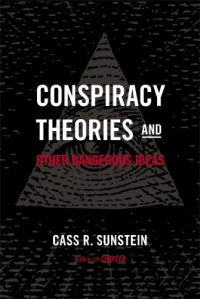 A Review of Conspiracy Theories and Other Dangerous Ideas by Cass Sunstein (based on an earlier paper co-authored with Adrian Vermeule); In Defense of Troublemakers: The Power of Dissent in Life and Business by Charlan Nemeth; and Conspiracy Theories and the People Who Believe Them, edited by Joseph E. Uscinski

