Lavrov: Last-Minute Changes Ruined Nuclear Deal
Al-Manar | November 15, 2013
Russian Foreign Minister Sergei Lavrov said amendments made by a member of the six world powers to a US-proposed draft proposal during the recent Iran nuclear talks in the Swiss city of Geneva spoiled efforts to reach a deal.
Lavrov, who is on a visit to Egypt, said on Thursday that Iran and six world powers were close to reaching an agreement on a deal during their talks in Geneva, but last-minute amendments to the draft document blocked a deal, AP reported.
He expressed hope that representatives of the six countries will not abandon “agreements that already have been shaped” and strike a pact with Iran during next week’s talks.
A member of the Iranian delegation in nuclear talks with six world powers says Tehran did not block an agreement in last week’s negotiations in Geneva.
“The Islamic Republic of Iran did not prevent a final deal in Geneva,” Iran’s Deputy Foreign Minister for European and American Affairs Majid Takht-e Ravanchi said Friday. “We do not want to go into the details of the issues…, but it is clear who ultimately blocked a final agreement,” he added.
On November 7, Iran and the six world powers – the US, France, Britain, Russia, China and Germany – kicked off intense discussions in Geneva which stretched into a third day. The two sides did not reach an agreement, but stressed that significant progress had been made and expressed optimism about the prospect of a possible deal in the future.
French Foreign Minister Laurent Fabius said in a November 9 interview that “Israel’s concerns” must be taken into consideration in the course of the negotiations, adding that there is “no certainty” whether Iran and six powers will reach an agreement at the current stage.
Obama’s Refusal to Respect Iran’s Sovereign and Treaty Rights Continues to Thwart Diplomacy, Leaving America on the Self-Defeating Path to War
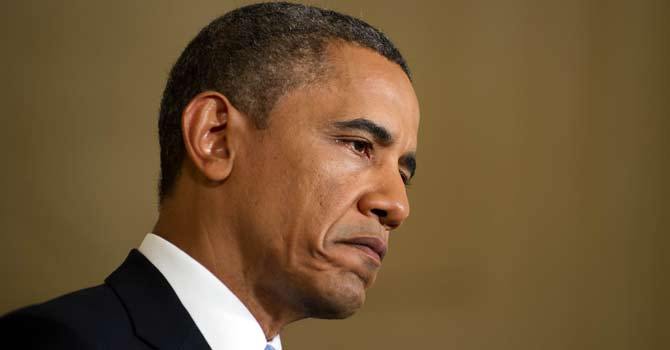
By Flynt Leverett and Hillary Mann Leverett | Going to Tehran | November 12th, 2013
Notwithstanding France’s simultaneously arrogant and craven grandstanding over Iran’s Arak heavy water reactor, the main reason for the failure of last week’s nuclear talks between the Islamic Republic and the P5+1 was the Obama administration’s imperious refusal to acknowledge Tehran’s right to enrich uranium under international safeguards. On this point, we want to highlight a recent post by Dan Joyner on Arms Control Law, titled, “Scope, Meaning and Juridical Implication of the NPT Article IV(1) Inalienable Right.”
Dan opens with a favorable reference to our recent post on the issue, see here; he then focuses on how to interpret the NPT Article IV(1) right to peaceful nuclear energy—a subject he has already written about at some length. He usefully inserts an excerpt from his excellent 2011 book, Interpreting the Nuclear Nonproliferation Treaty, Interpreting the Nuclear Nonproliferation Treaty Pages 79-84. This excerpt lays out Dan’s argument that the right to peaceful use of nuclear technology should be interpreted as “a full, free-standing right of all NNWS [non-nuclear-weapon states] party to the treaty, and not as a contingent right, contrary to the interpretation of some NWS [nuclear-weapon states].” After elaborating this basic point, Dan continues:
“The question of the scope of this right is one that continues to be debated. I have looked to the Lotus principle in international law (see the excerpt from my book) to show that the lawfulness of NNWS’, and in fact all states’, indigenous nuclear fuel cycle activities can be shown to derive from the absence of any prohibition of these activities in international law. This observation will, I have argued, serve to legally justify the full nuclear fuel cycle of activities within a NNWS, subject only to the positive requirements of Articles II and III of the NPT—i.e. no manufacture of nuclear explosive devices, and the conclusion of a safeguards agreement with the IAEA.
The question of just what exactly is the nature and scope of the right recognized in Article IV(1) of the NPT, and what are its juridical implications (e.g. in tension with the UN Security Council’s order in Resolution 1696 for Iran to cease uranium enrichment), is a subject that I have been thinking/researching about recently… These questions actually raise some very deep issues of international law, and analyzing them properly requires serious work… But let me say this here.
Article IV(1) of the NPT states that “Nothing in this Treaty shall be interpreted as affecting the inalienable right of all the Parties to the Treaty to develop research, production and use of nuclear energy for peaceful purposes without discrimination and in conformity with Articles I and II of this Treaty.” In my view, the recognition by over 190 states parties to the NPT that all states have such an inalienable right, which I interpret to include all elements of the full nuclear fuel cycle including uranium enrichment, strongly suggests that the right to peaceful nuclear energy research, production and use is one of the fundamental rights of states in international law. In my view, both fundamental and acquired rights of states should be understood to create in third parties, both states and international organizations, a legal obligation to respect those rights.
This means that other states and international organizations are under an international legal obligation not to act in serious prejudice of states’ rights. In the case of fundamental rights, this reciprocal obligation is of a jus cogens order, meaning that all states and international organizations are under a jus cogens order legal obligation not to act to seriously prejudice the fundamental rights of other states. When states or international organization do act in serious prejudice of a state’s fundamental rights, that action is an internationally wrongful act, and implicates the international responsibility of the acting state or international organization.
According to this analysis, UN Security Council Resolution 1696, which commands Iran to cease uranium enrichment, constitutes a violation of international law, at least as to this particular command, and is void of legal effect (See Article 25 of the UN Charter).
Note that the often heard rebuttal to this argument, which references Article 103 of the UN Charter, is in fact erroneous and inapplicable. Article 103 of the UN Charter provides that “In the event of a conflict between the obligations of the Members of the United Nations under the present Charter and their obligations under any other international agreement, their obligations under the present Charter shall prevail.” My analysis, which is based on the recognition of a fundamental right of states in international law, and the juridical implication of an obligation in other states and international organizations to respect that right, is unaffected and unanswered by this provision, which merely recognizes that in the case of a conflict between UN member states’ international legal obligations under the Charter, and their obligations deriving from other sources, the Charter obligations trump. It does not speak to the legal obligations of the Security Council as an organ of an international organization. Nor does it speak at all to conflicts between the obligations of the UN Charter, and the rights of states in international law. So again, Article 103 of the UN Charter is inapposite and inapplicable to this question.”
Dan’s work on these issues is both breathtakingly clear and, as far as we are concerned, definitive. (For more of his analysis on the illegality of Security Council resolutions calling on Iran to suspend uranium enrichment, we refer everyone to his brilliant article, “The Security Council as Legal Hegemon,” published last year in the Georgetown Journal of International Law, see here.)
More immediately, Dan’s work underscores an important reality: the Obama administration’s hegemonically abusive refusal to recognize Iran’s right to safeguarded enrichment is not just diplomatically and strategically counter-productive—it is illegal.
Related article
Russia: Iran Not to Blame for Geneva Talks Failure
Al-Manar | November 12, 2013
Russia said the Islamic Republic of Iran was not to blame for the failed outcome of nuclear talks in Geneva last week, hinting at cracks in what had previously appeared to be a relatively united international front on the issue.
A source in the Russian Foreign Ministry said Tuesday that the account of the talks given by US Secretary of State John Kerry this week was an oversimplification of events, according to Ria Novosti.
“The draft of the joint document readied by the Americans was agreeable to the Iranians, but as decisions at the negotiations in this format are adopted by consensus, it was unfortunately not possible to come to a final agreement. This was not the fault of the Iranians,” the source said.
Kerry on Monday accused Tehran of backing away from a deal to limit its nuclear program in exchange for relief from sanctions that have stifled its economy. He said though that a deal could be reached in the coming months.
Tehran has pointed the finger at France for the failure to reach consensus in Geneva.
French Foreign Minister Laurent Fabius told French media during the talks on Saturday morning that his delegation did not agree with the draft under discussion.
“There are some points on which we are not satisfied,” Fabius was quoted as saying by Agence France-Presse news agency. AFP quoted Fabius as citing the “extremely prolific” Arak nuclear reactor and the issue of uranium enrichment.
Related article
- Russia Says Iran Not to Blame for Geneva Talks Failure (themoscowtimes.com)
Sen. Graham: Israel ‘apoplectic’ about US approach on Iran
Press TV – November 11, 2013
US Senator Lindsey Graham has warned about a possible easing of economic sanctions against Iran, saying Israel is “apoplectic” about the Obama administration’s approach.
Graham, a hawkish Republican from South Carolina who has repeatedly called for military strikes on Iran, said Sunday that lifting sanctions would send the wrong message to Israel and other US allies in the region.
“The Israelis are apoplectic about what we’re doing,” he said on CNN’s “State of the Union.” “I’ve never been more worried about the Obama administration’s approach to the Middle East than I am now.”
The White House offered a “very modest sanctions relief” as Iran and the six major world powers– the US, Britain France, China, Russia and Germany– engaged in talks over Iran’s nuclear energy program in Geneva, Switzerland over the weekend.
The talks ended inconclusively on Sunday when France rejected a list of demands on Iran, saying they were too generous to result in an easing of sanctions. More negotiating sessions are scheduled for November 20.
Sen. Graham said the sanctions should be kept in place, and coupled with the threat of military force, to compel Iran to stop its uranium enrichment activities.
“If it ends with anything less, the world will regret this,” Graham said. “My fear is that we’re going to end up creating a North Korea kind of situation in the Middle East.”
Senate leaders showed bipartisan support Sunday for tougher sanctions on Iran.
Senator Robert Menendez, chairman of the Senate Foreign Relations Committee and a key architect of anti-Iran sanctions, called on Congress to consider new economic sanctions against Iran.
“I think that the possibility of moving ahead with new sanctions, including wording it in such a way that if there is a deal that is acceptable that those sanctions could cease upon such a deal, is possible,” Menendez said Sunday on ABC’s “This Week.”
The US lawmakers’ outburst happened after Israeli Prime Minister Benjamin Netanyahu denounced a possible agreement with Iran as a “historic blunder.”
There is no Palestinian issue for Syrian rebels
By Nadezhda Kevorkova | RT | November 10, 2013
The Palestinian issue has been uniting all Muslims for 65 years. Syrian rebels succeeded in their mission – they made the world forget about the Palestinian issue.
The militants pulled Palestinians out of refugee camps; they are killing them or using these people as human shields. And the media are silent about it, while the Syrian opposition keeps screaming about the “oppressive Assad regime.”
It’s been a year since Syrian rebels raided the largest Palestinian refugee camp in Syria – Yarmouk, near Damascus. Up until recently it was the duty of Israeli soldiers to persecute Palestinians, now this is done by Syrian rebels with their Muslim slogans. The media are not saying anything about it.
What is the life of Palestinians like, now that the Syrian conflict made them refugees again?
‘Nobody is helping us – neither Europe, nor the UN’
Abu-Badr, head of Beirut’s Bourj al-Barajneh refugee camp People’s Committee, gathered representatives of all Palestinian parties. They all keep regular contacts with camps in Syria.
A year after Palestinian camps and Palestinians were attacked, the heads of these organizations are saying that the Syrian war is a staged conflict, and its goal is to distract everybody from the Palestinian problem.
A total of 760,000 Palestinian refugees lived in Syria before the war, and about 550,000 in Lebanon. Palestinians had equal rights in Syria, and virtually no rights in Lebanon. For example, they were not allowed to work in 72 professional capacities.
Abu-Badr says, “There are over 1,000 Palestinian families from Syria in our camp. Nobody is helping us – not Europe, not the UN. The Red Cross came twice. The refugees are renting housing on their own.”
To rent a place to live is a big problem for a Palestinian, especially at the camp. And to pay rent, they have to find a job, which is extremely difficult in Lebanon.
He says that according to the authorities, there are about 120,000 Palestinian refugees from Syria living south of Tripoli. So every tenth refugee is a Palestinian.
Turkey and Jordan don’t accept Palestinians.
Kafar is a young mother of two. She used to live in Syria’s Yarmouk with her family. Now she is struggling to survive in Bourj al-Barajneh in Lebanon.
She fled Yarmouk at the end of 2012, when the rebels took over the camp and made it their foothold to carry out attacks on Damascus.
Yarmouk is one of the largest Palestinian camps in Syria. Before the war it had 150,000 residents, which was almost one-quarter of all Palestinian refugees in Syria. The camp is very close to the Damascus city limits, and there were subdivisions where regular Syrians lived.
Refugee camps are extraterritorial places. Police and army are not allowed there, the residents don’t have citizenship, they don’t vote and don’t serve in the army. Camps are self-governed by representatives of all Palestinian political parties. Unlike all other countries, Syria allowed refugees to leave camps and enjoy all rights and freedoms.
A Syrian family named Lakud brought the fighters to Yarmouk. Palestinians didn’t support the rebels then, and they are not supporting them now. Some parts of the camp are still controlled by the opposition.
A human shield for militants
Kafar recalls: “The entire camp left in a snap back then, when armed militants entered it. They were inside, shooting bullets into the air – they always act the same way. They ordered the residents to leave having placed their orders on different websites and having sent emails. Nobody stayed there.”
In December 2012, some started trying to come back. There are even a few families that decided to stay in the camp, hoping it would get better soon. Kafar says all the houses have been looted – they have taken everything, including electrical wires.
She says the militants were shooting those Palestinians who went out to take part in demonstrations. They wouldn’t let people return to their homes, but in case they did come back home, they couldn’t leave their houses again.
“If the militants went away, we would come back. Sometimes we can contact those inside the camp. They tell us about the blockade – they feel like they live in a cage, they lack food. There is no escape – they are kept as a human shield for the militants,” Kafar says.
She tells us about her relative who went to find her children, but ended up as a hostage in the camp.
“The militants won’t let you come in, but if one has entered – he would be kept there by force. They have established checkpoints. They deprive the people of food and beat the women who try to sneak inside, bringing something to their relatives to eat,” Kafar says.
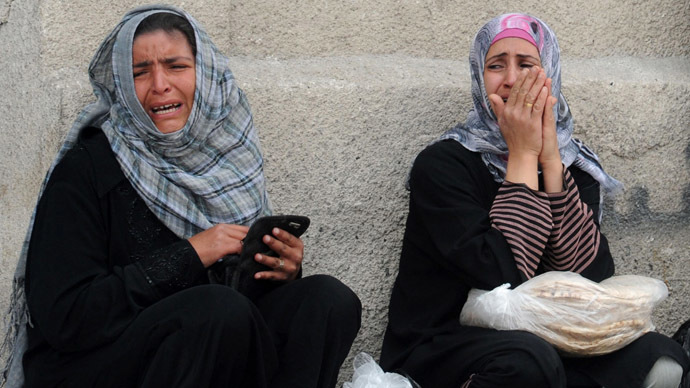
A handout picture released by the Syrian Arab News Agency (SANA) on May 15, 2013, shows protestors crying after unidentified armed groups opened fire on demonstrators as they marched in the Syrian capital Damascus in support of the right to return of Palestinian refugees who fled their homes or were expelled during various conflicts. (AFP/SANA)
Hitting a woman in public is considered absolutely unlawful among Muslims. But Kafar says that the militants in Yarmouk have their own vision of everything.
“We are not afraid of war, but they won’t even feed the people. The al-Nusra militants are tall, wear long beards and look like foreigners. Probably, there are Syrians among them but none of my relatives have ever seen one,” Kafar says.
One blanket for five
Palestinians from Syria in Lebanon are in even more dire straits.
“They humiliate us – we are constantly being insulted,” the woman tells us.
She is showing us around her tiny apartment with two rooms and a kitchen. The ceiling leaks when it rains.
“The rent is $300. If I don’t find money by Sunday, we’ll have to leave for Syria.”
Apart from the rent, they pay $70 for water.
Her father-in-law was killed. Her mother-in-law returned to Syria and now lives with their relatives there.
“I’ll go to Syria and wait there until I can come back home. Staying here is humiliating,” Kafar says.
Her husband takes up any job he can, be it a laborer, carrier or loader.
They have no warm clothes – all their belongings were stolen in Yarmouk. This family doesn’t belong to any group. They got help from different organizations such as Hamas, the Popular Front or some voluntary organizations. But it can hardly be called help – it is more like a mere pittance.
“They gave us one blanket for five people. But we are living creatures,” Kafar says, showing us a thin grey synthetic blanket. She thinks it looks like a cloth that is used to wrap a dead body when burying it.
The family has no money to buy food. They sometimes receive help from neighbors, who share their food with them. I saw them bring some bread and crisps.
‘In Syria, Palestinians are treated better than brothers’
Kafar complains about how the refugee work is organized.
“They distribute some humanitarian aid, but the process is humiliating to us every step of the way. There is fighting in Syria, but Palestinians are respected there. And here they call us Syrian dogs.”
“We had a good life under Assad, not lacking anything. We will go back and live in Syria, even if we have to live in tents. Syrians treat us as equal, they help us,” says Kafar.
In the last year they received help twice – from Hamas and from people from Qatar – about $300 per family, which is less than one dollar a day. But not everybody gets even these payments. There are lists of those who suffer the most in these camps.
She tells us how the process of distributing this aid works.
“A family gets a check for $150 from Qatar. But there wasn’t enough for everybody on the list. So people are humiliated even more. The place where these checks are given is near Beirut, you have to take a taxi to get there and spend half of the money on the ride. They give food stamps for certain food items, which can only be bought in one supermarket. And this store is also far away.”
“You can’t buy meat with these food stamps. Do they think children can go for a year without meat?” the woman asks.
“We are convinced that Syria will welcome us back. They loved us there, treated us like brothers, even better than brothers. We lived better than Syrians themselves,” Kafar says.
She knows that the Lebanese have closed the border for Palestinian refugees. So they can’t go anywhere.
“They accepted us in Syria. When we lost everything, they took care of us. They asked us what we needed. Six blankets? Food? They gave us everything. They didn’t blame us, even though life was difficult for everyone.”
She thinks her family made a mistake when it moved to Lebanon. “We were told life would be good here. Now we regret the decision.”
Her husband came six months earlier, he thought they would be safe here while there is fighting.
‘There is no Palestinian issue for Syrian rebels’
“We Palestinians have played no part in Syria’s distress. We didn’t participate in street protests, and our people did not join the rebels,” says Kafar. She admits to having heard that some Palestinians have, in fact, taken up arms against the Syrian government. But she is certain that is a rare exception.
“Those people must have been seduced by money, or befuddled with drugs, and with false promises. Only the poorest and the most destitute of the Palestinians have gone to fight for money, and it took them 18 months to get that desperate.
“Such people have nothing to eat, so they join the rebels hoping to make some money to sustain their families, and then desert at the first opportunity.”
“We cannot admit to supporting the regime, for fear of being killed on the spot. Those rebels do not consider the Palestinian issue to be of primary importance. There is no Palestinian issue for the rebels at all,” says Kafar.
Every night, the inhabitants of Bourj al-Barajneh go to sleep fearing that al-Nusra militants may descend on the Palestinian refugee camp and start asserting their rule, the way they did at Yarmouk. There is talk that al-Nusra men were spotted recently inside Nahr al-Barrid, another Palestinian camp. Since then, the People’s Committee instituted vigilante patrols across the entire camp.
“Our people control every in and out,” Kafar tells us. “They keep watch at night to make sure no strangers come upon us as we sleep. That’s how it happened in Yarmouk.”
The Syrian army has also set up checkpoints guarding the entrance to each camp.
‘They butchered a family to make the others serve as a human shield’
Yarmouk was not the only Palestinian camp captured and cleared of refugees by insurgents. Moreover, no one can assess the number of Palestinians killed in the process.
A Palestinian woman named Gusun was forced to flee camp Duma near Damascus on September 23, 2012, together with her husband, their three kids, and her husband’s brother.
“There were plenty of olive groves next to our camp. We lived in peace for a long time, until the fighting drew close to our camp. Then, rebels started taking shelter in our camp, hiding in our houses during firefights, and shooting through our windows. And we found ourselves between the hammer and the anvil. So one day, we slipped out at five in the morning and ran away through the olive grove,” Gursun tells me.
“The rebels had killed many people in our camp unflinchingly. They butchered a married couple who were my husband’s kin – they cut their throats, so that the other Palestinians would stay in the camp and serve as their human shield, while the government was commanding us to flee.”
Gusun went back to check on Duma some four months ago.
“I found my home thoroughly looted, its roof smashed,” she recalls. “And the FSA and al-Nusra are still entrenched in the camp.”
“Once their men spotted me at Duma, they came up and questioned me to make sure I was from that camp. They let me go, but they kept watching me. Later, when I went out to a grocery store, I noticed a car tailing me. Then I got scared and ran away from the camp,” says Gusun.
“The rebels I saw were tall and fair-skinned. There are some who don’t speak Arabic, and there are some who do. People have also told me there are black rebels, but I have never seen one. Some rebels wear black vests, some wear masks, some wear short pants, and others wear normal trousers. There are many fair-skinned men among them, those are foreigners.
“When we walked around the camp, we would try not to look them in the face, for fear that they might do us harm,” Gusun says.
‘Palestinians, get out of Syria’
The world’s mainstream media, who have closely followed the insurgency and its war on Assad, have proven squeamish when it comes to covering the way rebels treat Palestinians. In the spring of 2011, they would refute news reports that opposition activists wave Israeli flags and chant anti-Palestinian slogans at their rallies.
This stands to reason: two years ago, the Palestinian issue was still the No. 1 concern for the Muslim world, and an anti-Palestinian stance would have done serious harm to the rebels’ reputation. All the more so as Egyptian revolutionaries at Tahrir Square had been pronouncedly pro-Palestinian, despising Hosni Mubarak for his support for the Israeli blockade of the Gaza Strip.
The women at Bourj al-Barajneh are perplexed at the world’s ignorance of how Syrian insurgents really feel about Palestinians.
“At the onset of the revolution, slogans were like, ‘Carrots belong with carrots and cabbage with cabbage, and this is no land for Palestinians’,” says Gusun, who is shocked that no media have ever reported that the Syrian rebels had initially been against the Palestinians.
“Under these slogans, the armed rebels marched along the streets, angered by the local Palestinians’ reluctance to turn against the regime,” says Gusun.
“In about a year and a half, some Palestinians were in this way or another made to join the rebels. But that didn’t change much the rebels’ opinion of the Palestinians,” remarks Gusun, adding that even now the Palestinians on the side of the rebels are few and far between.
She can’t understand the reason why the Lebanese are treating Palestinians like that. After all, Syria did give shelter to 1 million Lebanese and Palestinian refugees after the 2006 Israeli attack.
“During the 2006 war we welcomed the Palestinians like family. But now we are being treated as outsiders.”
At that time, all the refugees from Lebanon found home, food and clothes straight on arrival.
Gusun was lucky to have found a job, and so was her husband. “I had to work as a cleaning lady. I’d never done anything like that before. But we had to survive somehow. The UN gives only $30 once every four months.’
It was crucial for the sponsors of the anti-Syrian campaign to shift the focus of one and a half billion Muslims from Palestine to the war against Assad. And their mission almost succeeded.
The issue of Palestine used to bring everyone together: Communists and atheists, the Sunni and the Shia, Christians and Muslims, left- and right-wingers, anti-globalists and nationalists. Now the war in Syria has torn them all apart.
Fast forward two years, there are no more rallies against the occupation of Jerusalem, no ships trying to break through the Gaza Strip and the West Bank blockade. In the meantime, this blockade has grown even tougher after the military coup in Egypt, with the abuse of Palestinians in the West Bank escalating into ethnic cleansing.
The sponsors of the war repeatedly tried to get Palestinians to back intervention into Syria. But their efforts failed: from Hamas to the Palestinian Islamic Jihad to the Popular Front to Fatah, not a single Palestinian organization has ever supported the campaign.
Nadezhda Kevorkova is a war correspondent who has covered the events of the Arab Spring, military and religious conflicts around the world, and the anti-globalization movement.
Israel to lobby US against possible Iran nuclear deal

Press TV – November 10, 2013
As the prospect of a nuclear deal between Iran and the group of six major world powers grows stronger, Israel strives to lobby the US Congress to prevent any possible agreement.
“Before the talks resume, we will lobby dozens of members of the US Congress to whom I will personally explain during a visit beginning on Tuesday that Israel’s security is in jeopardy,” Israeli’s Economy Minister Naftali Bennett said on Sunday.
The remarks come after Iran and the five permanent members of the UN Security Council – Britain, France, China, Russia and the US – plus Germany concluded three days of intense negotiations over Tehran’s nuclear energy program early on Sunday.
Iran and the six world powers have agreed to continue negotiations on November 20 in Geneva, Switzerland.
Although an agreement was not reached in the nuclear negotiations, both sides said significant progress had been made and expressed optimism about the prospect of achieving a deal.
British Foreign Secretary William Hague said in an interview with the BBC later on Sunday that, “On the question of will it happen (a deal will be reached) in the next few weeks, there is a good chance of that.”
“A deal is on the table and it can be done. But it is a formidably difficult negotiation, I can’t say exactly when it will conclude,” he added.
Israeli ministers, however, have voiced strong opposition to any possible deal between Iran and the world powers, with Minister of Military Affairs Moshe Ya’alon describing an agreement with Iran as a historic mistake.
Israeli Prime Minister Benjamin Netanyahu also rejected a possible nuclear agreement with Iran as “a very bad deal” before meeting US Secretary of State John Kerry on Friday in Tel Aviv.
Netanyahu’s office had also launched a Twitter campaign against the Islamic Republic in which several photographs including the one of the Iranian students marking the 34th anniversary of the 1979 takeover of the former US embassy in Tehran were shown. The images were re-tweeted by a few Israeli officials.
Related articles
Time to Ignore Netanyahu the Rejectionist
By Ludwig Watzal | Palestine Chronicle | November 10, 2013
Benyamin Netanyahu’s hyperventilated fury didn’t surprise anybody. Even before the first outlines of a possible long-term agreement between Iran and the West on Iran’s nuclear program were publicized, Israel’s Prime Minister categorically rejected any such agreement. This irrational behavior disqualifies him as a serious partner to other heads of state. His extremism goes even so far as to promote further sanctions against Iran. Netanyahu wants Iran to capitulate and abolish its entire nuclear industry. He announced that Israel does not feel bound by the agreement. Netanyahu arrogates Israel the right to override decisions by UN Security Council members.
That Western leaders should consult the leader of a tiny country before they act shows the imagined power they attribute to Netanyahu. To seek advice from Netanyahu shows how intimidated Western politicians are. By now, they should be aware of his hostility to peace, be it with Iran or the Palestinians. How submissively the United States acts, is shown by the phone call between Obama and Netanyahu and by Secretary of State Kerry’s visit to Jerusalem, as if they needed Netanyahu’s blessing for the negotiations with Iran. The best political strategy would be to ignore him.
What infuriated Netanyahu and made him go wild was John Kerry’s statement made in Bethlehem: “We consider now and have always considered the settlements to be illegitimate.” The US has finally returned to its erstwhile stance that all Israeli settlements are contrary to international law, after they have gone astray under Bill Clinton and George W. Bush junior. Netanyahu appears increasingly isolated with regard to the Iran deal. He appears willing to do anything to derail a possible agreement between the US and Iran. His last weapons are the political bull terriers of the American Israeli Public Affairs Committee, better known as AIPAC, and their supporters in the US Congress. But Netanyahu is increasingly a political nuisance, not only for the Obama administration but also for other powers. For the last 25 years it has been his mantra to warn that a nuclear armed Iran is just around the corner.
Netanyahu and the war party in the US will do everything in their power to prevent an agreement between Iran and the West. Netanyahu exerts not only great influence on the US Congress via AIPAC, but does so personally, as his last speech before both Houses in May 2012 has shown, during which US lawmakers outdid themselves in celebrating his reactionary speech. AIPAC could try to arrange again another such ridiculous circus. That doesn’t mean that Netanyahu would make it this time, knowing that he would jeopardize the recently improved relations with the Obama administration.
The political charade, which Netanyahu performs, has nothing to do with the imaginary Iranian nuclear threat. The Israeli political establishment knows this and fears that it would lose its hegemony over the entire Middle East and Northern Africa if Iran would go nuclear. The late Israel Shahak has pointed out in his book “Open Secrets. Israeli Nuclear and Foreign Policies”, that Israel’s main goal is to maintain its hegemony from India to Mauritania.
The political interests of the Western powers and Israel are not the same. The West has suffered heavy economic losses by bowing to Israeli interests; especially US soldier had to pay a high price in Iraq. Netanyahu can perhaps bamboozle the U.S. government again, but Israel’s relationship with Europe is on a downward slide. Europe, and especially Germany, can look back on an enduring friendship with Iran. This friendship should not be damaged by unregenerate politicians. Germany would do well to normalize its relations and reestablish its traditionally excellent relations with Iran, regardless of the outcome of the US-Iran negotiations.
By now, the US and the other Western countries should have understood that Netanyahu as well as former Israeli governments have been torpedoing every chance for a peace agreement with the Palestinians, because their colonial hunger for land has not yet been satisfied. The so-called peace negotiations, which are once again taking place, is likely to go nowhere because the Netanyahu government is not willing to make any real concessions that fall short of total surrender by the Palestinians.
Related article
US, France playing good cop-bad cop in Iran talks
RT | November 9, 2013
America and France are playing ‘good cop-bad cop’ in the P5 + 1 talks with Iran over its nuclear program, so that Washington’s position would sound more reasonable, Robert Harneis, a journalist and political analyst has told RT.
Six major world powers and Iran are holding negotiations in Geneva over Tehran’s highly-disputed nuclear program.
RT: France seems to be the most skeptical of the negotiating nations about the outcome of the talks. What’s behind its skepticism?
Robert Harneis: It is always a little difficult to understand the position of the French here. They seem to take an extreme position all the time. There are a number of reasons for this. The first is that they are playing ‘good cop-bad cop’ with the Americans. Obama is suddenly being much more reasonable in his attitude with the Iranians, and the French are out there on the flank saying “Oh, you mustn’t agree too easily, Israel must be protected,” and so on. In a sense that’s, if you like, playing the game of the Americans so that they can sound more reasonable, the French sound more unreasonable.
There is another factor, which is that everybody knows the enormous pressure of the Israeli lobby in America. It’s not quite so well-known that it’s pretty considerable in France as well.
RT: The French Foreign Minister said Israel’s position must be taken into consideration. Why such concern for Israel when even Washington called Netanyahu’s condemnation of the deal ‘premature’?
RH: Yes, it’s interesting, isn’t it, that Mr. Netanyahu has said that the deal had been concluded. Everybody else is saying it hasn’t. At any rate, the position of the French, I think, is to say things that the Americans don’t want to say at the moment. I think that’s at the bottom of it, because frankly this posturing by the French President and the French Foreign Minister makes France look pretty ridiculous on the domestic front. There is a great deal of mockery of Laurent Fabius and his very aggressive statements internally in France.
RT: We’re used to the US being one of Tehran’s harshest opponents. Do you feel that Washington’s stance is genuinely changing?
RH: Well, one would like to hope – let’s put it this way – that this is a real diplomatic revolution. The Americans ever since 1979, when the embassy drama took place in Iran, have had this slightly ridiculous, slightly vengeful obsession about dealing with the Iranian nuclear threat.
As far as anybody can tell and as far as the American security services themselves say, there is no Iranian nuclear threat. The Israelis, on the other hand, have 300 nuclear weapons. So the situation is a trifle absurd as it often is with western foreign policies.
And there are signs Obama is trying to put American foreign policy on a more sensible track. Why not have sensible relations with Iran – this is being asked in the US after all. For years, with the threat of the Soviet Union, they had no difficulty negotiating with [Mikhail] Gorbachev and men a lot more difficult than him. So, why can’t we negotiate with Iranians? Why do we have to take this ridiculous attitude that they cannot have what France, Britain, the US have – which is nuclear protection. And the Iranians say they don’t want it anyway.
So, it’s a difficult one to quite work out. But it could be that there is a real revolution taking place and the Americans are going to change their stance because they need to do business with Iran really.
RT: Finally, what are your personal predictions? Will the sides involved manage to overcome their disagreements and strike a deal in the near future?
RH: Well, if I had to take my reputation as profit on the line, I would say that there is going to be a deal. Because they are, after all, talking only about a six-month deal, as far as we can understand it. A suspended sentence, so to speak. With the problems of gas pipelines from Iran to Europe, which Europe needs badly for its Nabucco pipeline – which has no gas without the Iranians – I think there is a very strong probability. And they’d just love to get in there and have all the contracts for rebuilding Iran. So, I hope it’s a real revolution.
Kerry Opposes Draft Plan on Iran in Geneva – Source
RIA Novosti | November 9, 2013
GENEVA – US State Secretary John Kerry opposed a draft deal on Iran’s nuclear program during high-profile talks in Geneva, a source at the negotiations told RIA Novosti on Saturday.
Kerry held a snap meeting late Friday with representatives of Iran and the 5+1 group of international negotiators, which includes lower-ranking US diplomats.
Iran and the 5+1, which also comprises Russia, Britain, China, France and Germany, earlier drafted a step-by-step deal to lift sanctions against Tehran in exchange for a partial freeze of the Iranian nuclear program.
Kerry was to discuss the matter further on Saturday with EU foreign policy chief Catherine Ashton and his Russian counterpart Sergei Lavrov.
The talks in Geneva were expected to break the lengthy stalemate on Iran’s nuclear program, whose peaceful nature is questioned by Western powers and Israel.
But the head of the French Foreign Ministry, Laurent Fabius, said Saturday that the Geneva talks may not end in a deal.
Iranian diplomats said earlier Tehran was ready for another round of talks in case the ongoing meeting yields no result.
Iran proposed last month to stop enriching uranium to 20 percent in exchange for lifting of sanctions starting with its banking industry and oil exports.
Related articles
UNESCO rescinds US and Israel’s voting rights
Al-Akhbar | November 8, 2013
UNESCO has suspended the voting rights of Israel and the United States, two years after they stopped paying dues to the UN’s cultural arm in protest over its granting full membership to the Palestinians, a UNESCO source told Reuters.
Both countries decided to cancel their funding in October 2011. The American decision was blamed on US laws that prohibit funding to any UN agency that implies recognition of Palestinian demands for their own state.
The US missed a Friday deadline to provide an official justification of its non-payment and a plan to pay back its missed dues, the UNESCO source said, automatically triggering the suspension of voting rights.
Neither the United States nor Israel “presented the necessary documentation this morning to avoid losing their right to vote,” a source told AFP on condition of anonymity.
Two separate diplomatic sources also confirmed the deadline had been missed, triggering the suspension of voting rights.
There was no immediate comment at the office of the US envoy to the UN agency.
UNESCO designates World Heritage sites, promotes global education and supports press freedom among other tasks.
The withdrawal of US funding – which to date amounts to about $240 million or some 22 percent of UNESCO’s budget – has plunged the United Nations Educational Scientific and Cultural Organization into a financial crisis, forcing it to cut programs and slash spending.
With the US and Israel withdrawing their contributions UNESCO’s budget fell from $653 million to $507 million.
The reduced budget means some 300 people at UNESCO are in danger of losing their jobs. In 2012 the UN agency employed 1,200 people at its headquarters in Paris and 900 around the world.
UNESCO’s Director-General Irina Bokova, who was re-elected in October, raised $75 million in a bid to deal with the agency’s financial crisis.
“The list of countries that will lose their voting rights will be announced probably tomorrow (Saturday) in a plenary session,” the same UNESCO source said.
The loss of voting rights for two member countries comes as Washington tries to keep US-brokered peace negotiations between Israel and Palestinians afloat.
Both parties have signaled the lack of progress in the talks, revived in July after a three-year hiatus but stymied over Israeli plans to continue building illegal settlements in the occupied West Bank and East Jerusalem.
The Palestinians have so far failed in their bid to become a full member of the UN, but their UNESCO membership is seen as a potential first step towards UN recognition of statehood. In November 2012, the UN General Assembly granted Palestine non-member state status in a landslide vote.
(Reuters, AFP, Al-Akhbar)
Featured Video

New positive ivermectin evidence
or go to
Aletho News Archives – Video-Images
From the Archives
Fanatical Followers of the Covid Regime: A Jim Jones-Style Cult?
By Professor Roger Watson and Dr. Niall McCrae | The Daily Sceptic | November 15, 2021
As scholars at leading British universities over recent decades, we witnessed the replacement of critical thinking and debate by narrative: facts are discrimination and scientific method is imperialism; truth, instead, is derived from ‘progressive’ values. This educational trend may be a major contributory factor to the ease in which society has been inculcated to the Covid ‘new normal’ of masking, testing, and repeated doses of vaccines for a disease of similar risk to severe influenza.
One doesn’t need much critical reasoning to observe the flawed logic of some vaccination enthusiasts, such as people who respond to experiencing any side effects, however debilitating, by saying “at least I know it’s working”, or, after contracting the disease despite their promised inoculation (over 90% effective, according to initial drug company claims), “I’d have been worse off without the jab.” … continue
Blog Roll
 Aletho News
- EU Council Advances Chat Control 2.0 Scanning Proposal
- Ex-Greek MEP files complaint against Israeli spyware firm over alleged Pegasus surveillance
- Troubling ideas throughout the Torah, Talmud, Mishneh Torah and Tanya
- ‘Grave, alarming’: Iran mission on Trump’s UNGA ‘annihilation’ threats
- Najaf airport to reopen to Iranian flights within 24 hours: Ambassador
- From ‘How Will This End For Iran’ to ‘When America Walks Away’: A tale of two Economist covers
- Tehran blasts ‘baseless’ speculation linking Iran to alleged bomb plot at UK air base
- The Rise And… Rise Of ‘Color Revolutions’
- The Coming GOP Bloodbath?
- Arctic Scare Stories Melt Away
- If Americans Knew
- Netanyahu Asked UAE Leader to Deny Report on Oct. 7 Warning in Secret Visit, Sources Say
- CNN Chief Int’l Correspondent Clarissa Ward on Journalists in Gaza
- Democratic Party Consultants Surround Troy Jackson with Pro-Israel Donors
- Christian Leader Responds To Netanyahu’s Claims Regarding Palestinian Christians
- In Gaza, ‘Whoever Survives the Bombing Won’t Survive the Rubble’
- Israel kills more Palestinians, amid push to resettle Gaza – Daily Update
- Israel forces Gazans to live in constant peril – Daily Update
- Deconstructing Netanyahu’s pants-on-fire UN rant – Daily Update
- Trump betrayed voters with his campaign lies and prioritized a foreign country once he took office
- Netanyahu calls Israel’s war in Gaza ‘opposite of genocide’ in UN speech to near-empty hall
- No Tricks Zone
- New Study: Earth And Venus Surface Warmth Largely Explained By Convection And Lapse Rate, Not CO2 Or Radiation
- 2025 Nature Paper Claiming Worsening Global Drought Gets RETRACTED …Heavily Flawed
- New Study: ‘Global Drought Shows No Detectable Recent Acceleration Under Climate Warming’
- Economic Masterminds: German Socialists Suggest Taxing Productivity Gains Stemming From Using AI
- The South China Sea Has Not Been Cooperating With The Climate Change Narrative
- Energy Crisis: Germany Enters Heating Season With Historically Low Gas Reserve Fill Levels
- New Study: The Antarctic Ice Sheet Gained Mass From 2020-2024 Due To Staggering Snow And Ice Accumulation
- Study: Ocean Heating Rates From Thousands Of Years Ago ‘Dwarf’ Modern Ocean Heating Rates
- Climate Extremists Target, Attack Large-Scale Power Grid Infrastructure In Germany!
- New Study: Antarctic Ice Melt Has Contributed Less Than 1 Centimeter To Sea Level Rise In The Last 30 Years

