Israel; Asset or Liability?
By Chas Freeman | July 20, 2010
Is Israel a strategic asset or liability for the United States? Interesting question. We must thank the Nixon Center for asking it. In my view, there are many reasons for Americans to wish the Jewish state well. Under current circumstances, strategic advantage for the United States is not one of them. If we were to reverse the question, however, and to ask whether the United States is a strategic asset or liability for Israel, there would be no doubt about the answer.
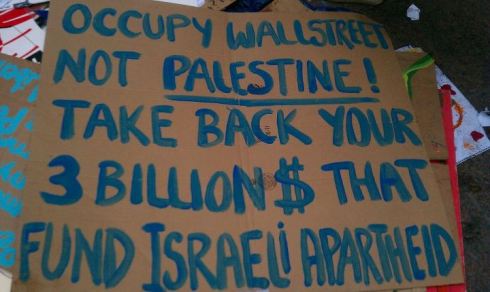
American taxpayers fund between 20 and 25 percent of Israel’s defense budget (depending on how you calculate this). Twenty-six percent of the $3 billion in military aid we grant to the Jewish state each year is spent in Israel on Israeli defense products. Uniquely, Israeli companies are treated like American companies for purposes of U.S. defense procurement. Thanks to congressional earmarks, we also often pay half the costs of special Israeli research and development projects, even when – as in the case of defense against very short-range unguided missiles — the technology being developed is essentially irrelevant to our own military requirements. In short, in many ways, American taxpayers fund jobs in Israel’s military industries that could have gone to our own workers and companies. Meanwhile, Israel gets pretty much whatever it wants in terms of our top-of-the-line weapons systems, and we pick up the tab.
Identifiable U.S. government subsidies to Israel total over $140 billion since 1949. This makes Israel by far the largest recipient of American giveaways since World War II. The total would be much higher if aid to Egypt, Jordan, Lebanon, and support for Palestinians in refugee camps and the occupied territories were included. These programs have complex purposes but are justified in large measure in terms of their contribution to the security of the Jewish state.
Per capita income in Israel is now about $37,000 — on a par with the UK. Israel is nonetheless the largest recipient of U.S. foreign assistance, accounting for well over a fifth of it. Annual U.S. government transfers run at well over $500 per Israeli, not counting the costs of tax breaks for private donations and loans that aren’t available to any other foreign country.
These military and economic benefits are not the end of the story. The American government also works hard to shield Israel from the international political and legal consequences of its policies and actions in the occupied territories, against its neighbors, or – most recently – on the high seas. The nearly 40 vetoes the United States has cast to protect Israel in the UN Security Council are the tip of iceberg. We have blocked a vastly larger number of potentially damaging reactions to Israeli behavior by the international community. The political costs to the United States internationally of having to spend our political capital in this way are huge.
Where Israel has no diplomatic relations, U.S. diplomats routinely make its case for it. As I know from personal experience (having been thanked by the then Government of Israel for my successful efforts on Israel’s behalf in Africa), the U.S. government has been a consistent promoter and often the funder of various forms of Israeli programs of cooperation with other countries. It matters also that America – along with a very few other countries – has remained morally committed to the Jewish experiment with a state in the Middle East. Many more Jews live in America than in Israel. Resolute American support should be an important offset to the disquiet about current trends that has led over 20 percent of Israelis to emigrate, many of them to the United States, where Jews enjoy unprecedented security and prosperity.
Clearly, Israel gets a great deal from us. Yet it’s pretty much taboo in the United States to ask what’s in it for Americans. I can’t imagine why. Still, the question I’ve been asked to address today is just that: what’s in it — and not in it — for us to do all these things for Israel.
We need to begin by recognizing that our relationship with Israel has never been driven by strategic reasoning. It began with President Truman overruling his strategic and military advisers in deference to personal sentiment and political expediency. We had an arms embargo on Israel until Lyndon Johnson dropped it in 1964 in explicit return for Jewish financial support for his campaign against Barry Goldwater. In 1973, for reasons peculiar to the Cold War, we had to come to the rescue of Israel as it battled Egypt. The resulting Arab oil embargo cost us dearly. And then there’s all the time we’ve put into the perpetually ineffectual and now long defunct “peace process.”
Still the US-Israel relationship has had strategic consequences… Some substantial portion of the many lives and the trillions of dollars we have so far expended in our escalating conflict with the Islamic world must be apportioned to the costs of our relationship with Israel.
It’s useful to recall what we generally expect allies and strategic partners to do for us. In Europe, Asia, and elsewhere in the Middle East, they provide bases and support the projection of American power beyond their borders. They join us on the battlefield in places like Kuwait and Afghanistan or underwrite the costs of our military operations. They help recruit others to our coalitions. They coordinate their foreign aid with ours. Many defray the costs of our use of their facilities with “host nation support” that reduces the costs of our military operations from and through their territory. They store weapons for our troops’, rather than their own troops’ use. They pay cash for the weapons we transfer to them.
Israel does none of these things and shows no interest in doing them. Perhaps it can’t. It is so estranged from everyone else in the Middle East that no neighboring country will accept flight plans that originate in or transit it. Israel is therefore useless in terms of support for American power projection. It has no allies other than us. It has developed no friends. Israeli participation in our military operations would preclude the cooperation of many others. Meanwhile, Israel has become accustomed to living on the American military dole. The notion that Israeli taxpayers might help defray the expense of U.S. military or foreign assistance operations, even those undertaken at Israel’s behest, would be greeted with astonishment in Israel and incredulity on Capitol Hill.
Military aid to Israel is sometimes justified by the notion of Israel as a test bed for new weapons systems and operational concepts. But no one can identify a program of military R & D in Israel that was initially proposed y our men and women in uniform. All originated with Israel or members of Congress acting on its behalf. Moreover, what Israel makes it sells not just to the United States but to China, India, and other major arms markets. It feels no obligation to take U.S. interests into account when it transfers weapons and technology to third countries and does so only under duress.
Meanwhile, it’s been decades since Israel’s air force faced another in the air. It has come to specialize in bombing civilian infrastructure and militias with no air defenses. There is not much for the U.S. Air Force to learn from that. Similarly, the Israeli navy confronts no real naval threat. Its experience in interdicting infiltrators, fishermen, and humanitarian aid flotillas is not a model for the U.S. Navy to study. Israel’s army, however, has had lessons to impart. Now in its fifth decade of occupation duty, it has developed techniques of pacification, interrogation, assassination, and drone attack that inspired U.S. operations in Fallujah, Abu Ghraib, Somalia, Yemen, and Waziristan. Recently, Israel has begun to deploy various forms of remote-controlled robotic guns. These enable operatives at far-away video screens summarily to execute anyone they view as suspicious. Such risk-free means of culling hostile populations could conceivably come in handy in some future American military operation, but I hope not. I have a lot of trouble squaring the philosophy they embody with the values Americans traditionally aspired to exemplify.
It is sometimes said that, to its credit, Israel does not ask the United States to fight its battles for it; it just wants the money and weapons to fight them on its own. Leave aside the question of whether Israel’s battles are or should also be America’s. It is no longer true that Israel does not ask us to fight for it. The fact that prominent American apologists for Israel were the most energetic promoters of the U.S. invasion of Iraq does not, of course, prove that Israel was the instigator of that grievous misadventure. But the very same people are now urging an American military assault on Iran explicitly to protect Israel and to preserve its nuclear monopoly in the Middle East. Their advocacy is fully coordinated with the Government of Israel. No one in the region wants a nuclear-armed Iran, but Israel is the only country pressing Americans to go to war over this.
Finally, the need to protect Israel from mounting international indignation about its behavior continues to do grave damage to our global and regional standing. It has severely impaired our ties with the world’s 1.6 billion Muslims. These costs to our international influence, credibility, and leadership are, I think, far more serious than the economic and other burdens of the relationship.
Against this background, it’s remarkable that something as fatuous as the notion of Israel as a strategic asset could have become the unchallengeable conventional wisdom in the United States. Perhaps it’s just that as someone once said: “people … will more easily fall victim to a big lie than a small one.” Be that as it may, the United States and Israel have a lot invested in our relationship. Basing our cooperation on a thesis and narratives that will not withstand scrutiny is dangerous. It is especially risky in the context of current fiscal pressures in the United States. These seem certain soon to force major revisions of both current levels of American defense spending and global strategy, in the Middle East as well as elsewhere. They also place federally-funded programs in Israel in direct competition with similar programs here at home. To flourish over the long term, Israel’s relations with the United States need to be grounded in reality, not myth, and in peace, not war.
The State and Local Bases of Zionist Power in America
By James Petras – September 1, 2010
Netanyahu –Speaking in New York to the Conference of Presidents of Major American Jewish Organizations
Introduction
Any serious effort to understand the extraordinary influence of the Zionist power configuration over US foreign policy must examine the presence of key operatives in strategic positions in the government and local Zionist organizations affiliated with mainstream Jewish organizations and religious orders. There are at least 52 major American Jewish organizations actively engaged in promoting Israel’s foreign policy, economic and technological agenda in the US (see the appendix).
The grassroots membership ranges from several hundred thousand militants in the Jewish Federations of North America (JFNA) to one hundred thousand wealthy contributors, activists and power brokers in the American Israel Public Affairs Committee (AIPAC). In addition scores of propaganda mills, dubbed think tanks, have been established by million dollar grants from billionaire Zionists including the Brookings Institute (Haim Saban) and the Hudson Institute among others. Scores of Zionist funded political action committees (PAC) have intervened in all national and regional elections, controlling nominations and influencing election outcomes. Publishing houses, including university presses have been literally taken over by Zionist zealots, the most egregious example being Yale University, which publishes the most unbalanced tracts parroting Zionist parodies of Jewish history (Financial Times book review section August 28/29 2010). New heavily funded Zionist projects designed to capture young Jews and turn them into instruments of Israeli foreign policy includes “Taglit-Birthright” which has spent over $250 million dollars over the past decade sending over a quarter-million Jews (between 18-26) to Israel for 10 days of intense brainwashing (Boston Globe August 26, 2010). Jewish billionaires and the Israeli state foot the bill. The students are subject to a heavy dose of Israeli style militarism as they are accompanied by Israeli soldiers as part of their indoctrination; at no point do they visit the West Bank, Gaza or East Jerusalem (Boston Globe August 26, 2010). They are urged to become dual citizens and even encouraged to serve in the Israeli armed forces. In summary the 52 member organizations of the Presidents of the Major American Jewish Organizations which we discuss are only the tip of the iceberg of the Zionist Power Configuration: taken together with the PACs, the propaganda mills, the commercial and University presses and mass media we have a matrix of power for understanding the tremendous influence they have on US foreign and domestic policy as it affects Israel and US Zionism.
While all their activity is dedicated first and foremost in ensuring that US Middle East policy serves Israel’s colonial expansion in Palestine and war aims in the Middle East, what B’nai B’rth euphemistically calls a “focus on Israel and its place in the world”, many groups ‘specialize’ in different spheres of activity. For example, the “Friends of the Israel Defense Force” is primarily concerned in their own words “to look after the IDF”, in other words provide financial resources and promote US volunteers for a foreign army (an illegal activity except when it involves Israel). Hillel is the student arm of the Zionist power configuration claiming a presence in 500 colleges and universities, all affiliates defending each and every human rights abuse of the Israeli state and organizing all expenses paid junkets for Jewish student recruits to travel to Israel where they are heavily propagandized and encouraged to ‘migrate’ or become ‘dual citizens’.
Method: Studying Zionist Power:
There are several approaches for measuring the power of the combined Zionist organizations and influential occupants of strategic positions in government and the economy. These include (a) reputational approach (b) self claims (c) decision-making analysis (d) structural inferences. Most of these approaches provide some clues about Zionist potential power. For example, newspaper pundits and journalists frequently rely on Washington insiders, congressional staff and notables to conclude that AIPAC has the reputation for being one of the most powerful lobbies in Washington. This approach points to the need to empirically examine the operations of AIPAC in influencing Congressional votes, nomination of candidates, defeating incumbents who do not unconditionally support the Israeli line. In other words analyzing the Congressional and Executive decision- making process is one key to measuring Zionist power. But it is not the only one. Zionist power is a product of a historical context, where media ownership and wealth concentration and other institutional levers of power come into play and shape the current decision-making framework. Cumulative power over time and across institutions creates a heavy bias in the political outcomes favorable to Israel’s organized agents in America. Once again the mere presence of Jews or Zionists in positions of economic, cultural and political power does not tell us how they will use their resources and whether they will have the desired effect. Structural analysis, the location of Zionists in the class structure, is necessary but not sufficient for understanding Zionist power. One has to proceed and analyze the content of decisions made and not made regarding the agenda of Israel’s backers operating in the USA. The 52 major Zionists organizations are very open about their claims to power, their pursuit of Israel’s agenda and their subservience to each and every Israeli regime.
Those who deny Zionist power over US Mid East foreign policy are left-Zionists namely Noam Chomsky and his acolytes. They never analyze the legislative process, executive decision-making, the structures and activity of the million member Zionist grassroots and the appointments and background of key policy makers deciding strategic policies in the Middle East. Instead they resort to superficial generalizations and political demagogy, imputing policy to “Big Oil” and the “military-industrial complex” or “US imperialism”, devoid of empirical content and historical context about real existing policy making regarding the Middle East.
The Making of Zionist Power in the US Government
To understand US submission to Israeli war policies in the Middle East one has to look beyond the role of lobbies pressuring Congress and the role of political action committees and wealthy Zionist campaign contributions. A much neglected but absolutely essential building block of Zionist power over US foreign economic, diplomatic and military policy is the Zionist presence in key policy positions, including the Departments of Treasury and State, the Pentagon, the National Security Council and the White House.
Operating within the top policy-making positions, Zionist officials have consistently pursued policies in line with Israel’s militarist policies, aimed at undermining and eliminating any country critical of the Jewish States’ colonial occupation of Palestine, its regional nuclear monopoly, its expansion of Jews only settlements and above all its strident efforts to remain the dominant power in the Arab East. The Zionist policymakers in Government are in constant consultation with the Israeli state, ensuring coordination with the Israeli military (IDF) command, its Foreign Office and secret police (MOSSAD) and compliance with the Jewish State’s political line. Over the past 24 months not a single Zionist policymaker has voiced any criticism of Israel’s most heinous crimes, ranging from the savaging of Gaza to the massacre of the humanitarian flotilla and the expansion of new settlements in Jerusalem and the West Bank. A record of loyalty to a foreign power which even exceeds the subservience of the Stalinist and Nazi fellow travelers in Washington during the 1930’s and 1940’s.
Zionist policymakers in strategic positions depend on the political backing and work closely with their counterparts in the “lobbies” (AIPAC) in Congress and in the national and local Jewish Zionist organizations. Many of the leading Zionist policymakers rose to power through a deliberate strategy of infiltrating the government to shape policy promoting Israel’s interest over and above the interests of the US populace. While a degree of cohesion resulting from a common allegiance to Tel Aviv can account for suspected nepotism and selection, it is also the case that the powerful Jewish lobbies can play a role in creating key positions in Government and ensuring that one of their own will occupy that position and pursue Israel’s agenda.
Stuart Levey: Israel’s Foremost Operative in the US Government
In 2004, AIPAC successfully pressured the Bush Administration to create the office of Undersecretary for Terrorism and Financial Intelligence (UTFI) and to name its protégé Princeton graduate Stuart Levey to that position. Before, but especially after his appointment, Levey was in close collaboration with the Israeli state and was known as an over the top Zionist zealot with unbounded energy and blind worship of the Israeli state.
Levey coordinates his campaign with Zionist leaders in Congress. He secures sanctions legislation in line with his campaigns. His policies clearly violate international law and national sovereignty, pressing the limits of extra territorial enforcement of his administrative fiats against a civilian economy. His violation of economic sovereignty parallels Obama’s announcement that US Special Forces would operate in violation of political sovereignty on four continents. For all intents and purposes, Levey makes US policy toward Iran. At each point he designs the escalation of sanctions, and then passes it on to the White House, which shoves it down the throats of the Security Council. Once new sanctions approved by Levey and staff are in place they are there to enforce them: identifying violators and implementing penalties. Treasury has become an outpost of Tel Aviv. Not a single leftist, liberal or social democratic publication highlights the role of Levey or even the terrible economic pain this Old Testament fanatic is inflicting on 75 million Iranian civilian workers and consumers. Indeed like Israel’s Judeo-fascist rabbis who preach a “final solution” for Israel’s enemies, Levey announces new and harsher “punishment” against the Iranian people (Stuart Levey, “Iran’s New Deceptions at Sea Must be Punished” FT 8/16/2010, p. 9). Perhaps at the appropriate moment the Jewish State will name a major avenue through the West Bank for his extraordinary services to this most unholy racist state.
Within the confines of his Zionist ideological blinders, Levey applied his intelligence to the singular task of turning his office into the major foreign policy venue for setting US policy toward Iran. Levey more than any other appointed official in government or elected legislator, formulates and implements policies which profoundly influence US, European Union and UN economic relations with Iran. Levey elaborated the sanctions policies, which Washington imposed on the EU and the Security Council. Levey, organizes the entire staff under his control at Treasury to investigate trade and investment policies of all the world’s major manufacturing, banking, shipping, petroleum and trading corporations. He then criss-crosses the US and successfully pressures pension funds, investment houses, oil companies and economic institutions to disinvest from any companies dealing with Iran’s civilian economy. He has gone global, threatening sanctions and blackballing dissident companies in Europe, Asia, the Middle East and North America which refuse to surrender economic opportunities. They all understood Levey operated at the behest of Israel, services Levey has proudly performed.
The Strategic Role of Local Power
The Israel Lobby Archive recently released declassified documents of the American Zionist Council (AZC) subpoenaed during a US Senate investigation between 1962-63. The documents reveal how the Israeli state through its American Jewish conduits – the mainstream Zionist organizations – penetrated the US mass media and propagated its political line, unbeknown to the American public. Stories written by a host of Jewish Zionist journalists and academics were solicited and planted in national media such as The Readers Digest, The Atlantic Monthly, Washington Post among others, including regional and local newspapers and radio stations (Israel Lobby Archive, August 18, 2010). While the national Zionist organizations procured the journalists and academic writers and editors, it was the local affiliates who carried the message and implemented the line. The level of infiltration the Senate subpoenaed Zionist documents in the 1960’s reveal has multiplied a hundred fold over the past 50 years in terms of financing, paid functionaries and committed militants and above all in structural power and coercive capability.
While the national leaders in close consultation with Israeli officials receive instructions on which issues are of high priority, the implementation follows a vertical route to regional and local leaders, politicians, and notables who in turn target the local media and religious, academic and other opinion leaders. When national leaders ensure publication of pro Israeli propaganda, the locals reproduce and circulate it to local media and non-Zionist influentials on their “periphery”. Letter campaigns orchestrated at the top are implemented by thousands of militant Zionist doctors, lawyers and businesspeople. They praise pro-Israel scribes and attack critics; they pressure newspapers , publishing houses and magazines not to publish dissidents. The national and local leaders promote hostile reviews of books not promoting the Israeli line, influence library decisions to pack their shelves with pro Israeli books and censor and exclude more balanced or critical histories. Local militants in co-ordination with Israeli consuls saturate the public with thousands of public meetings and speakers targeting Christian churches, academic audiences and civic groups; at the same time local Zionist militants and, especially millionaire influentials, pressure local venues (university administrators, church authorities and civic associations) to dis-invite any critic of Israel and their supporters from speaking. In the last resort, local Zionists demand that a pro-Israel propagandist be given equal time, something unheard of when an Israel apologist is scheduled to speak.
Local Zionist organizations make yeoman efforts to recruit mayors, governors, local celebrities, publishers, church people and promising young ethnic and minority leaders by offering them all expenses paid propaganda junkets to Israel and then to write or give interviews parroting what they were fed by Israeli officials. Local leaders mobilize thousands of militant activist Zionists to attack anti-Zionist Jews in public and private. They demand they be excluded from any media roundtables on the Middle East.
Local Zionist functionaries form rapid response committees to visit and threaten any local publisher and editorial staff publishing editorials or articles questioning the Israeli party line. Local leaders police (“monitor”) all local meetings, speaker invitations, as well as the speeches of public commentators, religious leaders and academics to detect any “anti-Zionist overtones’ (which they label “covert anti-Semitism”). Most of the major Jewish religious orders are lined up as the clerical backbone of local Israeli fund-raising, including the financing of new “Jews only” settlements in the Palestinian West Bank.
Local functionaries are in the forefront of campaigns to deny independent Middle East specialists and public policy academics, appointments, tenure or promotion, independently of the quality of their scholarship. On the other hand, academic hacks who toe the pro-Israel line, by publishing books with blanket attacks on Israeli critics among Christians and Muslims and countries like Turkey, Iran or whoever is a target of Israeli policy, are promoted, lauded and put on the best seller list. Any book or writer critical of Zionist Power or Israel is put on a local and national ‘index’ and subject to an inquisition by slander from a stable of Jewish Torquemadas.
Conclusion
The power of Israel in the US does not reside only in the influence and leadership of powerful Washington based “pro-Israel lobbies”, like AIPAC. Without the hundreds of thousands of militant locally based dentists, podiatrists, stockbrokers, real estate brokers, professors and others, the “lobby” would be unable to sustain and implement its policy among hundreds of millions of Americans outside the major metropolises. As we have seen from the Senate declassified documents, over a half-century ago, local Zionist organizations began a systematic campaign of penetration, control and intimidation that has reached its pinnacle in the first decade of the 21st century. It is no accident or mere coincidence that University officials in Northern Minnesota or upstate New York are targeted to exclude speakers or fire faculty members critical of Israel. Local Zionists have computerized data banks operating with an index of prohibited speakers, as the Zionists themselves admit and flaunt in contrast to “liberal” Zionists who are prone to label as “anti-Semitic” or “conspiracy theorists” writers who cite official Zionist documents demonstrating their systematic perversion of our democratic freedoms.
Over the decades, the distinction between Zionist power exercised by a “lobby” outside the government and operatives “inside” the government has virtually vanished. As we have seen, in our case study, AIPAC secured the undersecretary position in Treasury, dictated the appointment of a key Zionist operative (Stuart Levey) and accompanies his global crusade to sanction Iran into starvation and destitution. The planting of operatives within key Middle East positions in government is not the simple result of individual career choices. The ascent of so many pro-Israel Zionists to government posts is part of their mission to serve Israel’s interest at least for a few years of their careers. Their presence in government precludes any Senate or Congressional investigations of Zionist organizations acting as agents of a foreign power as took place in the 1960’s.
As the major Zionist organizations and influentials have accumulated power and abused the exercise of power on behalf of an increasingly bloody racist state, which flaunts its dominance over US institutions, public opposition is growing. The Boycott, Divestment and Sanctions campaign is gaining strength even in the US (see Harvard divestment in Israeli companies). US public support for Israel, by all measures, has dropped below 50%, while polls in Western Europe show a marked increase in hostility to Israel’s ultra-rightist regime. Anti-Zionist Jews are growing in influence especially among young Jews who are appalled by the Israeli slaughter in Gaza and assault on the humanitarian flotilla. Equally important the presence of anti-Zionist Jews on panels and forums has given courage to many otherwise intimidated non-Jews who heretofore were fearful of being labeled “anti-Semitic”.
The Zionist power configuration rests on a declining population base: most young Jews marry outside the confines of the ethno-religious Jewish-Israeli nexus and many of them are not likely to form the bases for rabid campaigns on behalf of a racist state. The Zionist leadership’s high intensity and heavily endowed effort to fence in young people of Jewish ancestry via private schools, subsidized “summer programs” in Israel etc. are as much out of fear and recognition of the drift away from clerical chauvinism as it is an attempt to recruit a new generation of Israel First militants.
The danger is that the US Zionist support for the ultra-rightist and racist regime in Israel is leading them to join forces with the far right in the US. Today Jewish and Christian Manhattan rednecks are fomenting mass Islamic hatred (the so called “Mosque controversy”) as a distraction from the economic crises and rising unemployment. Zionist promotion of mass Islamophobia, so near to Wall Street, where many of their fat cats who profit from plundering the assets of America operate, is a dangerous game. If the same enraged masses turn their eyes upward toward the wealthy and powerful instead of downward to blacks and Muslims, some unpleasant and unanticipated surprises might rebound against, not only Israel’s operatives, but all those wrongly identified as related to a misconstrued Jewish Motherland.
Appendix
Conference of Presidents of Major American Jewish Organizations
Member Organizations
- Ameinu
- American Friends of Likud
- American Gathering/Federation of Jewish Holocaust Survivors
- America-Israel Friendship League
- American Israel Public Affairs Committee
- American Jewish Committee
- American Jewish Congress
- American Jewish Joint Distribution Committee
- American Sephardi Federation
- American Zionist Movement
- Americans for Peace Now
- AMIT
- Anti-Defamation League
- Association of Reform Zionists of America
- B’nai B’rith International
- Bnai Zion
- Central Conference of American Rabbis
- Committee for Accuracy in Middle East Reporting in America
- Development Corporation for Israel/State of Israel Bonds
- Emunah of America
- Friends of Israel Defense Forces
- Hadassah, Women’s Zionist Organization of America
- Hebrew Immigrant Aid Society
- Hillel: The Foundation for Jewish Campus Life
- Jewish Community Centers Association
- Jewish Council for Public Affairs
- The Jewish Federations of North America
- Jewish Institute for National Security Affairs
- Jewish Labor Committee
- Jewish National Fund
- Jewish Reconstructionist Federation
- Jewish War Veterans of the USA
- Jewish Women International
- MERCAZ USA, Zionist Organization of the Conservative Movement
- NA’AMAT USA
- MCSK” Advocates on behalf of Jews in Russia, Ukraine, the Baltic States & Eurasia
- National Council of Jewish Women
- National Council of Young Israel
- ORT America
- Rabbinical Assembly
- Rabbinical Council of America
- Religious Zionists of America
- Union for Reform Judaism
- Union of Orthodox Jewish Congregations of America
- United Synagogue of Conservative Judaism
- WIZO
- Women’s League for Conservative Judaism
- Women of Reform Judaism
- Workmen’s Circle
- World ORT
- World Zionist Executive, US
- Zionist Organization of America
The Zionist Power Configuration Defeats Big Oil, the Military Industrial Complex, the White House and the Pentagon
Bush’s Twenty-Billion Dollar Arms Sale to Saudi Arabia
By James Petras – 12/01/07
The debate on which forces determine US Middle East policy has cut across the usual political spectrum: On one side most neo-conservative and progressive writers, academics and journalists argue that the military-industrial complex and Big Oil interests are the most influential forces shaping US policy. On the other, a small group of conservative and leftist writers and a few academics have identified what some call the Israel or Zionist Lobby and others refer to the Zionist Power Configuration (ZPC) as the prevailing influence in deciding US strategic policies in the Middle East.
While the debate rages over who and what interests got us into the Iraq war and the escalating confrontation with Iran, there is no better test of conflicting positions than the proposed US sale of $20 billion dollars of military equipment to Saudi Arabia.
The Pentagon led by Secretary of Defense Robert Gates agreed to the sale; it was backed by President Bush, Vice President Cheney and at least tacitly by the entire executive branch, including the National Security Council. All of the biggest US, European and Asian multi-national petroleum companies, refiners and importers were in favor of upgrading the military defensive capacity of the world’s biggest oil producer, since hundreds of billions in commercial and financial profits are transacted there every year. The US Middle East Command (CENTCOM) with major air bases and strategic logistic support systems in Saudi Arabia could not but support Saudi acquisition of a defensive high-tech air reconnaissance system.
Saudi Arabia is the most reliable and biggest single supplier of petroleum to the US world-wide. Saudi Arabia has been a staunch ally of the US – more like a client state — in all the US military and surrogate wars and interventions from the co-financing of anti-Soviet Muslim fundamentalist in Afghanistan, the attack on Yugoslavia and support of break-away Bosnia and Kosovo, to the two Gulf Wars and present confrontation with Iran, to its opposition of each and every Arab nationalist or leftist regime over the past 60 years. From the perspective of US imperial interests, dominance and influence in Asia, the Balkans and especially the Middle East, one would think that a military sale worth $20 billion dollars to the Saudi monarchy would be automatically and overwhelmingly approved by the US Congress.
This is especially the case because a $20 billion dollar sale will generate thousands of new jobs and will lessen the huge trade deficit. At the recent OPEC meeting, the Saudis strongly opposed dumping hundreds of billions of depreciating dollars they currently hold as foreign reserves – or even discussing the matter.
There is no greater contrast from the point of view of costs-benefit in comparing Saudi Arabia to Israel. The latter is subsidized by the US, which has given over $120 billion dollars over the last 30 years while it competes, as the second largest arms exporter, with the US-military industrial complex thus costing American jobs and supplies absolutely no strategic materials to the US economy. Indeed Israel has direct access to the most up-to-date US funded military technology, which it then sells to its clients. This is in stark contrast to Saudi Arabia’s servile relation with the US. Israel has constantly demanded and received US support and financing for its wars, its illegal colonization of Palestinian land and has unwavering US support for its repudiation of international law and numerous violations of United Nations mandates. While Saudi Arabia supports the US economy and is a strategic supplier of petroleum, Israel drains the US economy and secures its petroleum from it. Beginning in early 2007, the entire Zionist power configuration (ZPC) mobilized to block the US arms and military technology sales to Saudi Arabia. Zionist pressure was so intense and its control over Congress was so evident to the White House and Pentagon that Defense Secretary Gates did not even try to counter the ZPC’s campaign in the US Congress. Instead he went straight to the ZPC’s control center in Israel and not with empty hands. He pleaded with Israel to call of its American attack dogs in exchange for a ‘donation’ of over $30 billion dollars in US military handouts to Israel over the next ten years. Olmert accepted Gates offer: The US had paid the price but still the ZPC did not turn over their hostage Congress. President Bush and Secretary Gates were convinced that Israel would muzzle the Presidents of the Major American Jewish Organizations to allow the Saudi sale to go through. This did not happen. Why should it? President Bush could not withdraw the well-publicized pay-off to Israel; it was already in the legislative books. He could not retaliate – the ZPC-controlled Congress would oppose any and all counter measures.
So Bush and Gates went ahead and sent the bill to Congress authorizing the $20 billion sales to Saudi Arabia, a trillion dollar economy with a two-bit military wholly dependent on its US military protector.
Immediately the ZPC rounded up its automatic 190 members of the House of Representatives to sign a letter opposing the sale. The ZPC formulated the position embodied in the letter and oversaw its draft with the collaboration of its co-religionists in Congress. Zionist Congress members Shelley Berkeley and Anthony Weiner teamed up with Michael Ferguson. The Zion-Cons claimed justifiably that they could mobilize over three quarters of the Congress on any issue affecting Israel’s ‘security’. Zionist lawmakers claimed, “the sale would undermine Israel’s superiority in the region”. Every major independent military think tank would dispute this argument since Israel is the only nuclear power in the region, has the biggest and most technologically sophisticated air force and missile system, while Saudi Arabia and all the Gulf States have trouble even controlling local ground level bomb throwers.
There are two likely outcomes both demonstrating categorically that it is the ZPC that dictates US policies in the Middle East:
The military sales will not fly.
The military sale will be approved on conditions that Israel is privy to all its details and can modify or omit any part of the agreement.
The ZPC was even able to strong arm the Congress-people who have made a lifelong career out of aggressively promoting the interests of Big Oil (BO) and the Military Industrial Complex (MIC) to switch sides and vote against the sale of weapons to Saudi Arabia – BO’s strategic partner and the MIC’s best overseas customer. Congress members from BO states like Texas and states with large military industries like California endorsed the ZPC letter prejudicing their constituents and big campaign financers. The feeble ‘lobbying’ by BO and the MIC in favor of the White House were crushed by the ZPC Congressional juggernaut.
The major trade unions of the AFL-CIO, like the steel workers, machinists, oil and chemical workers, electrical workers – whose members’ jobs were at stake, did not protest, let alone challenge the ZPC, demonstrating the high degree of Zionist influence over the trade union bosses. The obvious point is that the Congress and the ZFL-CIO are both Zionist colonized institutions.
The issue is not whether the US should or should not sell arms to Saudi Arabia (I oppose all arms sales and the MIC and BO around the world). The fundamental issue is whether we, the citizens, the elected representatives and the trade unionists in the United States, can be free of foreign colonization to decide the issue. The issue is whether we are or can be a free and independent nation or a subject of a tiny powerful elite acting for a foreign power.
The narrative on the US proposed multi-billion dollar arms sales to a wealthy third rate military power demonstrates once again that Israeli interests have priority over US trade, jobs and geopolitical interests. Secondly the narrative confirms that the Israeli state dictates US political relations in the Middle East through its US conduit – the ZPC. Finally it refutes the Zionist geo-politicians and ‘oil’ and ‘military experts’ who cover up for the ZPC by falsely blaming Big Oil for policies they oppose because it prejudices their strategic partnership.
By blackmail and deceit, the Israelis got their additional $30 billion dollars over the next ten years and they double-crossed ‘their’ president by unleashing their Fifth Column to block his military sales to the Saudis. And if Bush dares a complaint, he will be added to the list of ‘anti-Semites’ – the only honorable list in his entire 8 years in office.
The Left and Iraq: Snatching Defeat from the Jaws of Victory
M.Idrees | Pulse Media | August 30, 2010
Alexander Cockburn’s comments about the left’s inability to acknowledge US defeat in Iraq and the bogus ‘war for oil’ thesis are perceptive–a must read. But in Tariq Ali and Seumas Milne he has chosen the wrong avatars for the Left’s curious belief in the invincibility of ‘empire’. Tariq is a good friend and I have had this conversation with him several times. I know for a fact that he rejects the reductionist ‘war for oil’ argument. (He made his position clear in the Q&A after his recent London Review of Books lecture.) Milne sometimes hews to the establishment left line, but has shown far more independence and courage than some other left luminaries. I’d rather Cockburn had directed his criticism at Noam Chomsky, who best exemplifies the tendencies Cockburn excoriates, and whose odd positions on the Middle East have proven invulnerable to contrary evidence.
“The US isn’t withdrawing from Iraq at all – it’s rebranding the occupation… What is abundantly clear is that the US , whose embassy in Baghdad is now the size of Vatican City , has no intention of letting go of Iraq any time soon.” So declared Seumas Milne of The Guardian on August 4.
Milne is not alone among writers on the left arguing that even though most Americans think it’s all over, They say that Uncle Sam still effectively occupies Iraq, still rules the roost there. They gesture at 50,000 US troops in 94 military bases, “advising” and training the Iraqi army, “providing security” and carrying out “counter-terrorism” missions. Outside US government forces there is what Jeremy Scahill calls the “coming surge” of contractors in Iraq , swelling up from the present 100,000. Hillary Clinton wants to increase the number of military contractors working for the state department alone from 2,700 to 7,000. Of these contractors 11,000 are armed mercenaries, mostly “third country nationals, typically from the developing world. “The advantage of an outsourced occupation,” Milne writes, “ is clearly that someone other than US soldiers can do the dying to maintain control of Iraq.
“Can Iraq now be regarded as a tolerably secure outpost of the American system in the Middle East ?” Tariq Ali asked in the New Left Review earlier this year. He answered himself judiciously,“They have reason to exult, and reason to doubt.”, but the thrust of his analysis depicts Iraq as still the pawn of the American Empire., with a “predominantly Shia army—some 250,000 strong—… trained and armed to the teeth to deal with any resurgence of the resistance,” all this with “ the blessing of the saintly Sistani’s smile”
The bottom line, as drawn by Milne and Ali is oil . Milne gestures to the “dozen 20-year contracts to run Iraq’s biggest oil fields that were handed out last year to foreign companies”.
Is it really true that though the US troop presence has dropped by 120,000 in less than a year, Iraq is as much under Uncle Sam’s imperial jackboot as it was in, say, 2004, even though now no US troops patrol the streets? If Iraq’s political affairs are under US control, how come the U.S. Embassy—deployed in its Vatican City-size compound, (mostly as vacant as a foreclosed subdivision in Riverside, California and planned in the same phase of megalomania) cannot knock Iraqi heads together and bid them form a government? Those 50,000 troops broiling in their costly bases are scarcely a decisive factor in Iraq’s internal affairs; nor are the private contractors.
Is a Shi’a-dominated government really to America’s taste and nothing more than its pawn? It was Sistani who forced the elections of 2005, calling Bush on his pledge of free elections, thus downsizing the excessive representation of the Sunni – who boycotted the election anyway. And if all this was a devious ploy to break “the Iraqi resistance” how come the United States constantly invokes the menace of Iran and decries its influence in Iraq?
The “Iraqi resistance” invoked in worshipful tones by Tariq Ali, as opposed to his ironic “saintly” reserved for Sistani, means, in his perspective, the Sunni. But if the Sunni ever had a strategy beyond a strictly sectarian agenda, it was scarcely advanced by blowing up Shi’a pilgrims and their shrines and setting off bombs in market places. If Moqtada al Sadr has been side-lined by the US and its supposed creature, Sistani, why has he been described as the “kingmaker” since his success in the parliamentary election this past March.?
As for the contractors, those sinister Third World mercenaries should not be oversold, unless the Shiites are supposed to quail before ill-paid Peruvians, Ugandan cops and the like., who will now be supposedly handing down orders to the Iraqi government. This takes a very imperial, and contemptuous attitude towards the capabilities of the Iraqi people.
If this really was a “war for oil,” it scarcely went well for the United States.
Run your eye down the list of contracts the Iraqi government awarded in June and December 2009. Prominent is Russia’s Lukoil, which, in partnership with Norway’s Statoil, won the rights to West Qurna Phase Two, a 12.9 billion–barrel supergiant oilfield. Other successful bidders for fixed-term contracts included Russia’s Gazprom and Malaysia’s Petronas. Only two US-based oil companies came away with contracts: ExxonMobil partnered with Royal Dutch Shell on a contract for West Qurna Phase One (8.7 billion barrels in reserves); and Occidental shares a contract in the Zubair field (4 billion barrels), in company with Italy’s ENI and South Korea’s Kogas. The huge Rumaila field (17 billion barrels) yielded a contract for BP and the China National Petroleum Company, and Royal Dutch Shell split the 12.6 billion–barrel Majnoon field with Petronas, 60-40.
Throughout the two auctions there were frequent bleats from the oil companies at the harsh terms imposed by the auctioneers representing Iraq, as this vignette from Reuters about the bidding on the northern Najmah field suggests: “Sonangol also won the nearby 900-million-barrel Najmah oilfield in Nineveh.… Again, the Angolan firm had to cut its price and accept a fee of $6 per barrel, less than the $8.50 it had sought. ‘We are expecting a little bit higher. Can you go a little bit higher?’ Sonangol’s exploration manager Paulino Jeronimo asked Iraqi Oil Minister Hussain al-Shahristani to spontaneous applause from other oil executives. Shahristani said, ‘No.’”
So either the all powerful US government was unable to fix the auctions to its liking, or the all powerful US-based oil companies mostly decided the profit margins weren’t sufficiently tempting. Either way, “the war for oil” doesn’t look in very good shape.
Milne advances the odd idea that with the (entirely imaginary) US “control” of Iraqi oil “the global oil price could be slashed and the grip of recalcitrant Opec states broken.” In fact, the last thing the majors want is to cut world oil prices.” Ask BP.
Milne and Ali are being naive and credulous in taking at face value US officials declaring that they are not wholly withdrawing and they will still be in business in Iraq for the foreseeable future. The reason for saying this is that they don’t want to see their influence go wholly to zilch. They therefore have to maintain — and are dutifully echoed on the left – that their power in Iraq is only a little affected by reduction of troop numbers from 150,000 to less than a quarter of that number.
The US line on this is in one sense sensible: In Iran many Iranians saw the hidden hand of Britain behind developments long after the Brits’ real power had faded almost to nothing. In the case of the US in Iraq it is easy to sell this when the right and left agree [that the] US is too powerful to have suffered a defeat.
The American right tried to snatch victory from the jaws of defeat by claiming that “the surge” – a PR ploy by General David Petraeus to mask US withdrawal – was a military success, rather than the Sunni abandoning “national resistance” and throwing in their lot with the Americans. The left – or the substantial slice of it hewing to the Milne/Ali line – snatches defeat from the jaws of a victory over America’s plans for Iraq by proclaiming that America has successfully established what Milne calls “a new form of outsourced semi-colonial regime to maintain its grip on the country and region.” Iraq is in ruins – always the default consequence of American imperial endeavors. The left should report this, but also hammer home the message that in terms of its proclaimed objectives the US onslaught on Iraq was a strategic and military disaster. That’s the lesson to bring home.
PA on the edge as opposition to talks with apartheid “Israel” widens
By Khalid Amayreh in occupied Palestine | Palestine Information Center | August 28, 2010
Security forces loyal to the Western-backed Palestinian Authority (PA) on Friday stormed the southern West Bank town of Dura, assaulting civilians and laying siege to two large Mosques.
The forces, which were riding brand-new vehicles “donated” by the United States, and carrying the official trademark of the Palestine Liberation Organization (PLO) prevented people from accessing the Grand Mosque in town Center, before storming the mosque in order to prevent Sheikh Nayef Rajoub, a popular Islamic leader, from giving the traditional pre-sermon dars or homily.
Rajoub, a former Minister of Wakf and Islamic Affairs, is one of the most popular Islamic leaders in the West Bank. His popularity however, has been a source of anxiety to the Fatah-controlled government whose Wakf Minister, Muhammed al Habbash, last week issued an order barring Rajoub from preaching or giving Islamic lectures at the Mosques.
Rajoub rejected the order, calling it “incompatible with Islam.”
According to eyewitnesses, the troops behaved provocatively, offending Muslim sensibilities. They entered the mosque with their boots on, which is considered offensive and nearly sacrilegious throughout the Muslim world.
Seeking to avert a more violent showdown, Rajoub moved to another mosque, the Mosque of al Mujahed, where he started preaching about the virtues of the Holy Month of Ramadan.
However, hundreds of PA troops, including many in plain-clothes, pursued the Sheikh to the Mujahed Mosque, causing a commotion.
Once again, the troops desecrated the mosque by entering it with their boots-on. Another potentially violent showdown between the troops and the angry worshipers was narrowly averted when some local dignitaries convinced the Sheikh to stop preaching.
Eyewitnesses reported that heavily armed troops savagely beat worshipers, including one of Rajoub’s brothers.
The storming of the town of Dura and assault on the mosques has infuriated local citizens who called PA troops “servants of Israel” and “Dayton soldiers.”
“Even the Israeli soldiers wouldn’t behave like this. What happened today proves that the PA and Israel are two sides of the same coin,” said Adib Sharah, a student.
One worshiper called the troops “Israeli collaborators who beat and persecute their own people on Israel’s behalf.”
Following the end of the congregational prayers, the PA security forces carried out a widespread campaign of arrest in the town and surrounding areas.
Local sources put the number of detainees at 40-50 people, mostly young Islamist activists who shielded Rajoub from attacks by the troops.
Speaking to the PIC Friday night, Rajoub lambasted the PA behavior as an “expression of moral and political bankruptcy.”
“Instead of fighting the Israeli occupation and enabling Muslims to access the Aqsa Mosque, the PA is storming and desecrating mosques here in this town. And they are doing this to obtain a certificate of good conduct from the enemy.”
He argued that no force on earth could prevent a Muslim scholar from communicating and preaching the message of Islam.
Rajoub, who has a Master Degree in Sharia, said the PA minister of Wakf, al Habbash, had no right to bar Ulema or Muslim scholars from carrying out their basic function.
During the 2006 elections, Rajoub received more votes than any other candidate in the Hebron District.
However, due to his popularity, the Israeli occupation authority targeted him with harsh persecution, throwing him in jail for nearly 50 months on concocted charges, such as supporting a militant organization.
He was released from Israeli detention only two months ago
Rajoub is still very popular which worries the PA which is trying to restrict his activities.
The latest events in Dura come amid accusations by Palestinian Islamic leaders that the PA is effectively fighting Islam in order to please Israel and the United States.
Some Palestinian and Arab experts are convinced that American and Israeli satisfaction with the PA depends largely on the extent to which the PA is willing to impose restrictions on Islamic activism in occupied Palestine.
On Wednesday, PA security forces violently thwarted a meeting in Ramallah organized by liberal and leftist intellectuals who were planning to hold a press conference to declare their opposition to what they view as a capitulation by the Ramallah leadership to American and Israeli dictates.
The violent repression of dissent, which has been stepped up in recent days and weeks, is being viewed as a bad omen by most Palestinians.
Palestinians are worried that the PA might resort to harsh tactics to impose an unpopular “peace deal” with Israel that would effectively liquidate the Palestinian cause by selling out or sacrificing such paramount Palestinian rights as Jerusalem and the right of return for million of Palestinian refugees uprooted from their homes and villages in what is now Israel.
Jordan presses ahead with energy programme despite US disapproval
Ammon News | August 25, 2010
AMMAN // Jordan’s civilian nuclear programme is gaining momentum, even as negotiations with Washington stall over a nuclear agreement that would allow US firms to transfer nuclear know-how, equipment and fuel to this nation of 6.4 million people.
The main impetus driving Jordan’s civilian nuclear programme is the growing demand for energy. Jordanian officials say nuclear power would reduce Jordan’s dependence on imported oil and serve as a long-term alternative for electricity generation, water desalination and energy security. It could also allow Jordan to export electricity to neighbouring countries.
Three years ago, Jordan imported 96 per cent of its energy at a cost of US$3.2 billion (Dh11.75bn), or 24 per cent of imports and 20 per cent of GDP. In the first half of 2009, the cost of crude-oil imports increased by 132 per cent, and by the end of the year they were costing the country US$4 bn. Last year, despite a drop in oil prices, energy costs consumed 11.8 per cent of Jordan’s GDP, according to the ministry of energy.
Jordanian officials say they cannot afford to pause efforts to meet the country’s energy needs. Preparations are under way for a plant set to be located 11 kilometres east of the Aqaba coastline along the Red Sea in southern Jordan and expected to generate 750 to 1,100 megawatts of electricity starting in 2019.
“We are pressing ahead with our programme. The commission has entered into a competitive dialogue with three technology providers we have short-listed as the most preferred bidders to build the country’s first power plant in 2013,” Khalid Touqan, chairman of the Jordan Atomic Energy Commission (JAEC), said. “We will eventually decide on the most preferred technology by the end of March next year.”
Companies from Canada and Russia, as well as a Franco-Japanese consortium, are bidding to oversee construction of as many as four nuclear power plants in Jordan in the next three decades, Mr Touqan said.
Already, Jordan has signed nuclear co-operation deals with eight countries – including France, the UK, China and Russia – and is aiming to sign similar deals with Japan, the Czech Republic and Romania by the end of the year, Mr Touqan said. These agreements involve technical exchange, employee training, nuclear-fuel disposal, nuclear safety, public education and advice on regulatory frameworks.
Last month, South Korea also loaned $70 million for the construction of a $130m, five-megawatt research reactor at the Jordan University of Science and Technology.
Ironically, what has complicated Jordan’s drive for nuclear energy and its close ties with Washington are major deposits of uranium discovered on its soil.
Officials here now believe the country has the potential to fuel nuclear power plants using its own resources, as well as export uranium ore, following the discovery of 65,000 tonnes of uranium in central Jordan. Uranium extracted from phosphate deposits could boost that total to 110,000 tonnes, representing nearly two per cent of the global total, according the World Nuclear Association.
Jordan has signed an exploration agreement with the French company Areva. The commission, along with the Chinese mining company Sino Uranium and the British-Australian company Rio Tinto, are currently exploring uranium deposits in the northern and southern parts of Jordan, Mr Touqan said.
“We knew that we had uranium since the Eighties, but not in commercial amounts,” he added. “Field work is showing promising results.”
Washington’s concern that a nuclear-armed Iran may prompt other countries in the region to develop nuclear weapons, has prompted it to prod one of its key Mideast allies to forgo uranium enrichment altogether, much as the UAE did when it signed a pact with the US in January 2009. But resource-scarce Jordan does not want to give up its rights under the Non-Proliferation Treaty (NPT), which it signed in 1974.
It is not economically feasible for Jordan to build an enrichment plant now, but as regional demand for uranium grows, that may change, said a Jordanian official close to the negotiations.
A US State Department official, who spoke to The National on condition of anonymity, said his country supports civilian uses of nuclear energy in Jordan and elsewhere in the Middle East.
“We continue to conduct negotiations with Jordan on a possible agreement for nuclear co-operation”, the official said. “We are working with our partners to develop the infrastructure necessary to meet the highest provided international standards for safety, security, and non-proliferation of such programmes.”
But the Jordanian official, who also agreed to be quoted only on condition of anonymity, said that although Jordan has no plans to process and enrich uranium, it does not want to give up its right to do so.
“Under the NPT, we are allowed to enrich uranium by up to 20 per cent for peaceful means. We only need four per cent enrichment to power the plants,” he said.
An additional protocol the country signed with the IAEA in 1998 allows unannounced inspections of any nuclear facility in Jordan.
“This makes us not only transparent, but committed to the highest levels of the requirements of non-proliferation,” the official said.
By Suha Philip Ma’ayeh, Foreign Correspondent/ The National
Peres: “Iran threatens to use nuclear weapons”
Press TV – August 25, 2010
In a gaffe during a meeting aimed at garnering international support for tougher action against Iran, Israeli President Shimon Peres has claimed that Tehran “threatens to use nuclear weapons.”
“Iran jeopardizes Israel and the rest of the world, as it threatens to use nuclear weapons,” Shimon Peres said on Wednesday in a meeting with Director General of the International Atomic Energy Agency (IAEA) Yukiya Amano, Ha’aretz reported.
His comments come while the IAEA has confirmed that Tehran does not possess nuclear weapons and Leader of the Islamic Revolution Ayatollah Seyyed Ali Khamenei has said, “Nuclear weapons have no place in our defense paradigm.”
Widely believed to be the sole possessor of a nuclear arsenal in the region, for the past four decades, Israel has constantly refused to reject or confirm its status as a nuclear power under a US-backed policy of “nuclear ambiguity.”
In May 2009, Israel rejected a UN call to join the nuclear Non-Proliferation Treaty (NPT), which would require Tel Aviv to declare and relinquish its nuclear arsenal.
The White House, however, says that US President Barack Obama has vowed to shield Israel from being “singled out,” over its “nuclear ambiguity” stance.
Under the allegation that Iran is a threat to its existence, Israel has threatened to destroy the country’s nuclear facilities.
Iran, however, as a signatory to the NPT and a member of the IAEA has opened its nuclear facilities to intrusive inspections and round-the-clock supervision by the nuclear watchdog.
The IAEA has repeatedly reported that it has found no evidence of any diversion of nuclear materials from civilian to military applications in Iran.
On Vaïsse’s ‘Neoconservatism’ and Taboo
Review of Justin Vaïsse, Neoconservatism: The Biography of a Movement (Cambridge, Mass.: Harvard University Press, 2010), 366 p.
By Stephen J. Sniegoski | Pulse Media | August 24, 2010
The mainstream media acclaim Neoconservatism: The Biography of a Movement as the best book on neoconservatism—the definitive account—and portray its author, Justin Vaïsse, a French specialist on American foreign policy and a senior fellow at the Brookings Institution, as a veritable Alexis de Tocqueville for his masterly insights. The mainstream’s high praise of this book, however, would seem to be due in large part to its minimization of two taboo issues—neoconservatism’s Jewish nature and its focus on Israel. Where the book breaks through what was heretofore largely blacked-out in the mainstream media is its discussion of the major role played by the neoconservatives in bringing about the war on Iraq.
The black-out had essentially placed the entire idea that the neoconservatives played a central role in bringing about the US attack on Iraq in 2003 beyond the pale of public discussion. In its most extreme form, this approach denied the very existence of neoconservatives. More moderate variants accepted the neocons’ existence but denied their influence on US policy. Instead the war on Iraq was alleged to have been essentially planned by President George W. Bush and/or Dick Cheney; or, for the anti-war Left, the war was brought on by the greedy oil interests or by unnamed nebulous corporatists (presumably gentile). Even to dwell on the neoconservatives could be taken as a sign of being “anti-Semitic.”
Vaïsse, however, candidly writes “that neoconservatism played an important role in launching the war in Iraq,” pointing out that the “neoconservatives had been advocating the overthrow of Saddam Hussein, though not necessarily through direct American intervention, since 1997.” (p. 13) He goes on to show how the neocons, both inside and outside the Bush administration, promoted the bogus intelligence that was able to generate public support for the war.
Vaïsse does offer a faux qualification to his emphasis on the neocons’ role by observing that “the decision to intervene militarily in Iraq cannot be ascribed solely to the influence of neoconservatives. This book seeks to put the intellectual history of the neoconservative movement in perspective so as to avoid errors of distortion.” (p. 13) Vaïsse presumably wants to differentiate his book from those still taboo ones, perhaps like mine, which mentioned the role of the neocons some time ago. But Vaïsse essentially slays a strawman since he does not cite any works that actually attribute the attack on Iraq “solely to the influence of neoconservatives,” and I am not aware of any works making such a claim. I should add here that although reviewers praise Vaïsse’s book as “definitive,” he refrains from mentioning (much less refuting) those works (again mine being one of these) that provided an account of the neocons’ primary role in shaping the Bush II foreign policy on Iraq (which Vaïsse duplicates in a briefer form) and offered substantial proof for the truth of the still tabooed topics.
Vaïsse downplays the significance of Israel and the overall Jewish nature of neoconservatism. At least, that is how the mainstream readers interpret his writing, and that would seem to be the author’s intent since his general interpretations of neoconservatism reflect this minimization. However, if read closely, one can find that interspersed within this book is considerable information, including the author’s direct statements, indicating otherwise.
In minimizing the Jewish nature of neoconservatism, Vaïsse writes that the idea that “neoconservatism is ‘in essence’ a Jewish movement” is “unconvincing,” though acknowledging that the perception that neoconservatism is Jewish is “based on the observation that a majority of neoconservatives are Jews.” (p. 273) He maintains, however, that “many of the most prominent neoconservatives are not Jewish, and the overwhelming majority of American Jews are not neoconservatives.” (p. 273) Now it is obviously true that most American Jews are not neoconservatives, but that no more proves that neoconservatism is not fundamentally Jewish than the fact that most Muslims are not members of Al-Qaida would prove that Al-Qaida is not Islamic, or that most Poles and Polish Americans are not members of the Polish National Catholic Church would prove the latter is not essentially Polish.
Now although there are gentile neocons, it is not apparent that Vaïsse has actually demonstrated that “many of the most prominent neoconservatives are not Jewish.” For example, Vaïsse places Patrick Moynihan into this category. In neoconservatism’s early years, Moynihan did espouse ideas held by the neocons, but he was a significant individual before the neocons supported him, and their backing would simply reflect, in large part, their need to attach themselves to influential allies who held views consonant with their own. Moynihan’s positions would diverge from those of the neocons in the 1980s.
Henry Jackson, whom Vaïsse describes at length, was an unreconstructed hard-line Cold War warrior and devotee of Israel, who certainly staffed his office with younger neoconservatives, but cannot be called a bona fide neoconservative any more than Dick Cheney, whom Vaïsse explicitly describes as a neoconservative ally as opposed to an actual neoconservative (p. 149), but who likewise served as a neocon patron. And it would seem that Cheney was more deserving of the neocon designation since he actually adopted the neocon agenda, whereas Jackson’s already existing positions converged with those of the neocons.
Vaïsse refers to Admiral Zumwalt as “yet another example of a non-Jewish neoconservative” (p. 108) because of his support for both hard-line Cold War policies and for Israel. But Zumwalt is not conventionally known as a neoconservative. He did not have long-term intimate connections with the neoconservative network, and was simply a significant person in his own right whose views converged with those of the neoconservatives. Zumwalt was associated with the neocons far less than Dick Cheney, who, as just pointed out, is described by Vaïsse as a neoconservative ally, rather than a true neoconservative. (p. 149)
It is quite apparent that most major figures in the neoconservative movement such as Richard Perle, Paul Wolfowitz, Douglas Feith, Michael Ledeen, Norman Podhoretz, Irving Kristol, and Bill Kristol have been Jewish along with most of their associates. And those generally identified as neoconservatives are distinguished by more than just their ideas; they have formed and sustained close working and personal connections between themselves over a long period of time. Neoconservatism essentially involves a network of people which has been perpetuated by becoming institutionalized in a number of influential think tanks and organizations. These close ties help to explain the neocons’ great power, which far exceeds their rather limited numbers.
Social anthropologist Janine R. Wedel, the author of Shadow Elite: How the World’s New Power Brokers Undermine Democracy, Government, and the Free Market, describes the successful neocon network as a “flex group,” which she defines as an informal faction adept at “playing multiple and overlapping roles and conflating state and private interests. These players keep appearing in different incarnations, ensuring continuity even as their operating environments change.” (Quoted in The Transparent Cabal, p. 29) Vaïsse makes reference to this network when he writes of “a definite clannishness to the neoconservative movement” (p. 206), but nonetheless when looking for prominent gentile neocons includes people outside of this network who simply have collaborated with the neocons, though in a few places he does make a distinction–for example, when he differentiates “hard-core neoconservatives” from “pragmatic hawks such as Nitze and Kampelman.” (p. 195)
While claiming the existence of important gentile neoconservatives, Vaïsse acknowledges that Jews make up the majority of its membership, but then goes on to downplay the significance of this fact, maintaining that there is nothing extraordinary about such Jewish overrepresentation because “Jews are disproportionately represented in almost all left and liberal political movements in the United States, as well as among intellectuals.” (p. 273) Although Jews may be represented in many groups in numbers exceeding their proportion of the American population, it is not apparent that most intellectual movements have been, or are, so overwhelmingly Jewish as neoconservatism. Moreover, it should be pointed out that if anyone unsympathetic to Jewish interests were to allege such extensive Jewish predominance, he or she would almost certainly be branded as an “anti-Semite,” not only by the Jewish establishment but by the same mainstream liberals who now applaud Vaïsse’s work.
But it is not solely the numbers involved that leads one to consider neoconservatism a Jewish movement, but rather the fact that it promotes Jewish interests, though the very fact that the group is predominately Jewish would seem to indicate that it would be biased toward Jewish interests. Certainly, it is unlikely that groups dominated by Arabs or African-Americans would have such a deep commitment to the Jewish state (which will be discussed next). In fact, the conventional view in contemporary America is that the composition of a group does affect its outlook and thus provides the rationale for demanding diversity in all governmental organizations in the United States. One wonders why Jewish dominance would be any different than white dominance or male dominance?
But more than this prima facie presumption, however, there is definite evidence of the Jewish orientation of the neoconservative agenda. For example, the original flagship of the neoconservative movement was Commentary magazine, which was put out by the American Jewish Committee, and was edited for many years by Norman Podhoretz. The American Jewish Committee pronounced as its mission: “To safeguard the welfare and security of Jews in the United States, in Israel, and throughout the world.” (Quoted in The Transparent Cabal, p. 26). And as Murray Friedman, the author of The Neoconservative Revolution: Jewish Intellectuals and the Shaping of Public Policy, notes: “A central element in Podhoretz’s evolving views, which would soon become his and many of the neocons’ governing principle was the question, ‘Is It Good for the Jews,’ the title of a February 1972 ‘Commentary’ piece.” (Quoted in The Transparent Cabal, p. 27)
Another significant component of the neocon nexus is the Jewish Institute for National Security Affairs (JINSA), which was set up in 1976 to put “the U.S.-Israel strategic relationship first.” In the late 1980s, JINSA widened its focus to U.S. defense and foreign policy in general, without dropping its focus on Israel. JINSA’s advisory board has included such notable neocons and neocon allies as Stephen Bryen, Douglas Feith, Michael Ledeen, Joshua Muravchik, Richard Perle, Kenneth Timmerman, John Bolton, R. James Woolsey and Dick Cheney. While the existence of Bolton, Cheney, Woolsey would show the support of some gentiles for Jewish interests, the very name of the organization indicates its ethno-religious orientation.
The origins of neoconservatism sprang from American Jews dismayed about the turn of American liberalism and the world Left, with which most Jewish intellectuals historically had been aligned, to positions perceived as contrary to Jewish interests—support for racial quotas (which might threaten Jewish predominance in many important fields), animosity to Israel (as a racist, colonialist state), and growing anti-Semitism in the Soviet Union and other Communist Eastern European states. Vaïsse goes over these Jewish concerns (pp. 58-64), without, in the end, giving them much importance in his overall assessment of neoconservative motivation.
It would seem that Vaïsse attempts to denigrate the idea of a connection between neoconservatism and Jews by writing that “only the white-supremacist extremist right (Kevin McDonald [sic] in Occidental Quarterly, for example) pushes this ethnic logic to its conclusion by considering neoconservatism as one possible expression of Jewishness.” (p. 273). Designating MacDonald (correct spelling) a “white supremacist” would presumably serve to make this type of thinking anathema in the mainstream, and it neatly avoids dealing with the very extensive data showing very strong Jewish identities and commitment to Israel of the key neocons. Considering the alacrity with which Vaïsse makes his racial supremacy charge, it is ironic—but understandable given the requisite intellectual double standards in the American mainstream—that he fails to make any effort to show how the neoconservatives’ preachment of global democracy meshes with support for the ethnically-based state of Israel, which could be classified as a Jewish-supremacist state.
Also, considering the mainstream hosannas about Vaïsse’s alleged definitive account of neoconservatism, it is ironic that he fails to mention the Jews who have pointed out the Jewish nature of neoconservatism, which would militate against the observation’s stigma of anti-Semitism. For example, Vaïsse does not refer to the aforementioned Murray Friedman or Gal Beckerman, who wrote in the noted Jewish newspaper Forward in January 2006: “[I]t is a fact that as a political philosophy, neoconservatism was born among the children of Jewish immigrants and is now largely the intellectual domain of those immigrants’ grandchildren.” In fact, Beckerman went so far as to maintain that “[i]f there is an intellectual movement in America to whose invention Jews can lay sole claim, neoconservatism is it.” (Quoted in The Transparent Cabal, p. 26)
Vaïsse also neglects the work of Jewish-American historian Paul Gottfried who has written extensively on the neoconservatives for three decades in numerous books and articles, and who clearly recognizes the Jewish nature of the movement. Gottfried, who wrote the introduction for my book, The Transparent Cabal, states that “the term ‘neoconservative’ is now too closely identified with the personal and ethnic concerns of its Jewish celebrities. . . . It is increasingly useless to depend on out-group surrogates to repackage a movement so clearly rooted in a particular ethnicity – and even subethnicity (Eastern European Jews).” (Quoted in Transparent Cabal, pp. 28-29)
It should be added that none of these three Jewish authors can in any sense be called “self-hating” Jews, the derogatory moniker used by pro-Zionists to delegitimize any criticism by Jews of Israel or other Jewish interests. Even Gottfried, who is highly critical of neoconservatives, is friendly towards Israel.
And now the issue of Israel, the significance of which to the neocons Vaïsse explicitly plays down. However, while maintaining that “Zionism is not the right key to understanding them [neoconservatives],” he acknowledges that “The Jewish state . . . had been important to neoconservatives as far back as the 1960s. As the Middle East became central to America’s geopolitical concerns, unconditional support for Israel became increasingly decisive in their approach to international affairs. Seeing the Middle East through ‘Israeli lenses’ led to a distortion of perspective that caused them to underestimate the importance of the Palestinian quest for nationhood in the region’s troubles and to mistake the nature of America’s enemies.” ( pp. 264-65) And he would also write that “in their intellectual and political approach to the Middle East, the close alliance with Israel often led them to identify the Jewish’s [sic] state’s struggle with that of the United States: the same enemy (Islamic terrorists), the same tactics (preventative war, unilateralism, ‘show of force’) and the same cause (‘they hate us for what we are’). This perspective was not analytically sound. Although it was normal for America to worry about the fate of a close ally, this undue identification with Israel and the tendency to see things through an Israeli prism undoubtedly helped to create an inaccurate picture of the region and led to unrealistic policy recommendations.” (p. 265)
Vaïsse’s references to the neocons’ “unconditional support” for Israel, identifying Israel’s “struggle with that of the United States,” “seeing the Middle East through ‘Israeli lenses’,” are about identical to what I maintain in my book. In fact, I had a sense of déjà vu when he referred to “Israeli lenses,” since I had used the term “lens” in the same way a number of times in my book, pointing out, for example, that “the neoconservatives viewed American foreign policy in the Middle East through the lens of Israeli interest.” (The Transparent Cabal, p. 7)
Vaïsse, however, does not illustrate to any degree the neocons’ extensive personal connections to Israel, though he acknowledges that some were strong Zionists, writing that “It is of course true that many third-age neoconservatives (such as Richard Perle, David Wurmser, Douglas Feith, and Elliott Abrams) were close to Israel’s Likud party, but their hard Zionist positions, which were not shared by all neoconservatives, cannot by themselves explain the neoconservative worldview.” (p. 274) Now the individuals he cites have been quite significant in neoconservatism since the 1990s—with Perle and Abrams being so even earlier—so their “hard Zionist positions” would certainly imply the significance of this allegiance in neoconservatism. In fact, Vaïsse fails to bring out their close connections to rightwing Israeli government officials with Perle, Wurmser, and Feith being involved in the 1996 “Clean Break” report, which advised then-incoming Israeli Prime Minister Benjamin Netanyahu to pursue pre-emptive attacks on Israel’s enemies in ways quite analogous to what the neocons would later propose for the Bush II administration.
It should also be added that Perle, Feith, Bryen, Wolfowitz, and Ledeen have been suspected and sometimes investigated for allegedly providing classified material to agents of the Israeli government. Whether or not they were actually breaking United States laws (and the laws seem to be more relaxed if the foreign state involved is Israel), these episodes clearly illustrated their close connections to the government of Israel.
And the former are not the only neocons to evince “hard Zionist positions.” For example, as I point out in The Transparent Cabal, Norman Podhoretz, who as the long-time editor of Commentary had the power to determine what issues and individuals would be placed in the neoconservative spotlight, identified with the Jewish state to such an extent that, as Murray Friedman writes in The Neoconservative Revolution, “Commentary articles now [1970s] came to emphasize threats to Jews and the safety and security of the Jewish state. By the 1980s, nearly half of Podhoretz’s writings on international affairs centered on Israel and these dangers.” (Quoted in The Transparent Cabal, p. 27) Moreover, at the onset of the Gulf War of 1991, Podhoretz “went to live with his daughter in her home in Jerusalem in order to show his solidarity with Israel, which Saddam had threatened to attack by missiles, and did so to a limited extent.” (The Transparent Cabal, pp. 27-28)
Moreover, Vaïsse neglects to show that the neocons, once they were able to gain dominance in conservative organizations, purged those traditional conservatives who were critical of Israel and American policies that seemed to be guided by Israeli interests. Though referring to the neocon “takeover of the American Enterprise Institute” (p. 206), Vaïsse, with more than a modicum of understatement, writes of “increasing neoconservative influence over a number of key institutions in the new [conservative] establishment . . . in other words, a competition for money” and alludes to how this “fueled this bitterness” of some traditional conservatives (p. 208), but fails to mention that the neocons were able to totally marginalize any conservatives who opposed their Israelocentric Middle East agenda—opposition which they branded as “anti-Semitic” —by depriving them of their former sources of institutional support.
It should be noted that there had been a fairly sizeable number of Jewish individuals in the conservative movement for years without arousing the ire of their conservative brethren. What incensed the traditional conservatives therefore was not the neoconservatives’ Jewishness, but rather the latter’s successful efforts to make support for Israel and a pro-Israel Middle East agenda for the United States a litmus test for acceptance by the now neocon-dominated conservative institutions. Vaïsse, however, distorts this episode by implying that the neocons’ traditional conservative opponents were the aggressors and that “a hint of anti-Semitism lay behind these attacks,” and cites long-time conservative icon Russell Kirk, one of the mildest of men, as one of these attackers. (p. 208)
Another factor ignored by Vaïsse is the connection of Israel to the US attack on Iraq. Israeli officials, including Prime Minister Ariel Sharon and Benjamin Netanyahu, promoted war on Iraq during the period of the war’s build-up. And the Israeli government provided some of the bogus intelligence trumpeted by the neocons to generate support for the war. Furthermore, the very idea of using military force to eliminate Saddam Hussein’s regime would seem to have originated in Israel with Likudnik Oded Yinon’s 1982 work, “A Strategy for Israel in the Nineteen Eighties,” which called for an overall Israeli war agenda of fragmenting its enemies into small, ethno-sectarian statelets for the purpose of enhancing its own national security. Iraq was designated as the first target.
In short, support for Israel looms very large in neoconservative thinking, but if Vaïsse simply means that the neocons’ identification with Israel does not explain the “neoconservative worldview” in its entirety, this is something with which I concur in my book, The Transparent Cabal. For example, I write: “Undoubtedly, the overall neoconservative viewpoint does not revolve solely around the security needs of Israel, and the same is true even of the neocons’ positions on foreign policy and national-security policy. To state that neoconservatives viewed American foreign policy in the Middle East through the lens of Israeli interest – and that this was the basis of the neocon Middle East war agenda – is not to say that their support for Israel has been the be-all and end-all of their foreign policy ideas, which encompass the entire world.” (The Transparent Cabal, p. 7)
But the neocons have had their greatest impact on American policy in regard to the Middle East, and this is the fundamental concern at the present time. Consequently, what Vaïsse refers to as the neoconservatives’ “unconditional support” for Israel that has led to “unrealistic policy recommendations” is currently far more significant than their positions on Lyndon B. Johnson’s Great Society programs or arms limitations agreements with the Soviet Union during the 1970s and 1980s.
However, Vaïsse’s points about the neoconservatives’ “unconditional support” for Israel occupy but a small portion of the book and are thus overwhelmed by a lengthy discussion of the earlier years of neoconservatism, where concern for Israel, though existent, did not loom paramount. Only 50 pages of the book’s narrative of 279 pages cover the neoconservatives’ activities from the post-Cold War 1990s to the present—the time in which their focus on Israel becomes most apparent.
Vaïsse also obfuscates the focus on Israel in his “Epilogue: Interpreting Neoconservatism”—a part that, being at the end of the book, most readers will likely remember and that most reviewers are apt to actually read closely rather than skim. There he portrays the neocons in the area of foreign policy as fundamentally motivated by a mixture of nationalism and universalist democratic ideals, as opposed to an attachment to Israel. “One can see neoconservatism,” he contends, “as a avatar of American messianism, as the expression of an underlying nationalism that has been present since the country was born, a reincarnation of Wilsonianism in a new, more martial form. Owing to American exceptionalism (‘a city on a hill’), the United States has swung from protection to projection, from isolationism (synonymous with preserving the American model) to imperialism (synonymous with extending the model around the world). See [sic] in this light, neoconservatism is above all a sign of the resurgence of this nationalist—but also universalist—faith, on the model of French Jacobin nationalism, an off-shoot of the French Revolution of 1789, which was mixed with a universalist credo.” (p. 278)
Undoubtedly, this type of nationalistic, democratic messianism has existed and still exists in United States, but there would seem to be no reason for this attitude to be connected with what Vaïsse describes earlier in the book as the neocons’ “unconditional support” for Israel. True nationalists—who would be focused solely on what is good for their own country—would not be in favor of “unconditional support” for any foreign country since changing circumstances would mean that such support would not always be in the national interest. In his famous Farewell Address, George Washington expressed this nationalist belief in his admonition to his fellow citizens to eschew a “passionate attachment” to a foreign country, which is exactly what “unconditional support” for Israel constitutes. And as has been widely recognized by Middle East experts in the United States government since the time of Israel’s creation, American support for the Jewish state makes positive relations with the Arab world, which are of crucial importance to the United States because of the region’s oil resources, more difficult.
In regard to exporting democracy, it is not apparent that some major neocon prescriptions, such as bombing Iran, even have that intent. As most experts contend, any United States attack on Iran would unify that country behind the Islamic regime and perhaps lead to revolts by radical Islamic groups throughout the Gulf against pro-Western governments. Moreover, America’s war on Iraq and identification with Israel have made it less popular in the Middle East and the rest the world—the effect of which is to increase the difficulty of extending the American democratic model. It would seem quite obvious that if the goal were to export America’s form of democracy elsewhere in the world, supporting the policies of the Jewish state and making war against its enemies would not be the way to achieve it.
Regarding Israel itself, it would seem that if democracy were the neoconservatives’ watchword, they would work to eliminate Israel’s undemocratic control over the Palestinians on the West Bank and try to make the country itself more inclusive—and not a state explicitly privileging Jews over non-Jews. The neoconservatives would either promote a one-state democratic solution for what had once been the British Palestine Mandate (Israel, Gaza, and the West Bank) or else demand that Israel allow the Palestinians to have a fully sovereign, viable state on all of the West Bank and Gaza. Israeli governments, in contrast, have regarded a one-state solution as anathema and have never offered the Palestinians more than a faux state of non-contiguous bantustans within which Israel would maintain security zones and control vital resources such as water. Similarly, instead of taking anything approaching a pro-democracy stance, the neoconservatives do just the opposite, backing the Israeli Likudnik Right, which takes an especially hostile position toward the Palestinians with its fundamental goal being the maintenance of the exclusivist Jewish nature of the state of Israel.
In making these criticisms, I do not want to leave the impression that there is nothing of value in this book. Vaïsse does a good job of describing some intricacies of the earlier years of neoconservatism (1960s, 1970s and 1980s). Although he does not seem to provide anything to change the broad outlines of the conventional history of neoconservatism, he does add a number of poignant details. For students of neoconology, he must be credited for puncturing as mythical the widespread claim that socialist Michael Harrington coined the term “neoconservative.” (p. 71-76) Vaïsse also makes an interesting point as to how some neocons were still trying to shape the Democratic Party after most migrated to Reagan at the beginning of the 1980s. And he notes that ultimately, after the end of the Cold War, one segment of the Democratic Party, the “neoliberals,” would adopt much of the neoconservatives’ interventionist foreign policy agenda.
As mentioned earlier, Vaïsse must be credited for accurately pointing out that the neoconservatives were the major factor in bringing about the United States’ attack on Iraq in 2003. He notes that the neoconservatives laid the plans for attacking Iraq prior to the September 11, 2001, terrorist attacks and that those attacks created a climate of fear and anger which enabled the neocons, with their war agenda, to gain the upper hand in the Bush administration. He observes that the neocons, both within and outside the Bush administration, provided the propaganda that generated the public and elite support for the war and that even President George W. Bush was persuaded by them. And he shows that Bush, despite his neoconservative rhetoric, generally moved away from the neoconservative war policy during his second term, though adopting the neocons’ “surge” policy as opposed to the establishment-oriented Baker-Hamilton report on Iraq. Finally, despite America’s failure in Iraq and the nonexistence of actual neoconservatives in the Obama administration, Vaïsse makes the cogent observation that neoconservatism itself has not died, but remains “a potent force in Washington, only waiting for a more favorable political environment in which to exert its influence on American foreign policy again.” (p. 266)
While Vaïsse deserves credit for showing the neocons’ influence during the Bush administration, he only encapsulates what is often said about the neoconservatives outside the restrictive confines of the mainstream media. And I should add that my extensive documentation of this subject in The Transparent Cabal far exceeds what Vaïsse provides in a small portion of his book.
Where Vaïsse achieves some degree of originality is in his typology—his classification of neoconservatism according to somewhat overlapping chronological periods, which he terms “ages,” with each having a distinct agenda, political activities, and people (though he is not the first to make such distinctions). The neoconservatives of the first age, which began in 1965, were concerned about the rise of the New Left, campus violence, the counterculture, affirmative action and the overall leftward drift of American liberalism. Their focus was largely on domestic policy. They criticized the unintended negative consequences of Lyndon Johnson’s War on Poverty, and while they opposed the radical state-imposed egalitarianism sought by the New Left, they were supporters of the traditional liberal welfare state and remained loyal to the Democratic Party.
I should add that in my view this first age, which consisted of many individuals who did not hold the hard-line foreign policy views that would come to characterize neoconservatism, did not represent full-fledged neoconservatism. Thus, I would describe the individuals of this early period as proto-neoconservatives, with actual neoconservatism not really emerging until the start of the 1970s, as foreign policy became a fundamental concern.
Vaïsse dates 1972 as the beginning of the second age, which he views as a reaction to the nomination of George McGovern as candidate of the Democratic Party. The McGovern movement embodied the anti-war, especially anti-Cold War, ethos that took hold of American liberalism during the Vietnam era. The primary focus of the second age would be on foreign policy, as the neocons supported hard-line Cold War policies against the Soviet Union, in opposition to both what they considered to be the “isolationism” and “appeasement” of the McGovernite Democrats, as well as the Kissingerian détente of the Nixon-Ford administrations. They made strenuous efforts to reclaim the Democratic party for Cold War liberalism, but when President Jimmy Carter seemed to be continuing in the path of the McGovernites, the neocons reluctantly gravitated to Reagan in 1980, gaining positions in his administration, where they helped to craft his hard-line Cold War positions.
Like the second age, the third age, which Vaïsse has beginning in 1995, would also focus on foreign policy. With the Cold War over, the neocons would emphasize the need for global democracy and focus on the transformation of the Middle East. Their more expansive global ambitions reflected the fact that the United States had become the world’s sole superpower. It was during this age that the neocons would achieve their greatest impact, gaining influential positions in the Bush II administration, where they would act as the driving force for the war on Iraq.
Although an interesting typology, I don’t think the ages are as separate as Vaïsse often makes them appear, or at least as how his mainstream reviewers seem to interpret his position. In many respects the ages blend together. Vaïsse sometimes acknowledges this blending when he writes of the convergence between the first and second ages (p. 207 ), and when he acknowledges strong similarities between the second and third ages. (p. 221) Moreover, full-fledged neoconservatives from one age, such as Norman Podhoretz, supported the issues that loomed largest in the succeeding ages. (Norman Podhoretz was involved in all three ages.) The change in ages, therefore, did not represent so much a change in the neoconservative core membership, but rather the change represented the need to address new issues as a result of different circumstances, which did lead to changes in the neocons’ allies.
What Vaïsse fails to bring out clearly is the fact that Jewish interests loomed large in all of his three ages. In the first age, New Left demands for group equality and their efforts to bring chaos to the universities seemed to threaten the higher status of Jews. In the second age, neocons were concerned about liberal Democrats identifying with Third World attacks on Israel, seeking retrenchment of US military involvement that might weaken support for Israel, and advocating a friendlier policy toward the Soviet Union, which was now seen as anti-Israel and anti-Semitic. In the third age, the neoconservatives’ promotion of a “democratic” reconfiguration of the Middle East would involve the weakening of Israel’s enemies.
What is one to make of Vaïsse’s work? A positive way of looking at it would be to describe it as the best type of work that can be produced and still receive mainstream attention. For Vaïsse does point out that the neocons were the driving force for the war on Iraq. And he certainly does criticize their war-oriented activities. That he plays down the Jewish nature of neoconservatism and the movement’s focus on Israel could be interpreted as the necessary price to pay for this positive reception; in fact, as a senior fellow at the Brookings Institution, it is questionable if Vaïsse could have produced a work with an accurate discussion of the taboo subjects. For Brookings includes the Saban Center for Middle East Policy, which was created in 2002 largely by the funding ($13 million) of Haim Saban, who has pledged additional financial support. Saban happens to be a staunch Zionist, who has been quoted as saying: “I’m a one-issue guy and my issue is Israel.”
Another way of looking at Vaïsse’s book would be to classify it in the genre of damage control or what Harry Elmer Barnes, a leading revisionist of the history of World War I and World War II, referred to as a “smother-out.” This approach would allow a partial revelation of the truth, as the complete black-out lost credibility, in order to stave off more extensive revelations.
By downplaying the significance of Jewish ethnicity and the centrality of Israel, however, Vaïsse’s work fails to provide much help in understanding the current push by the overall Israel lobby and the government of Israel for war on Iran, which the neoconservatives intended to have as the next major target for the US after the invasion of Iraq. More than serving as a guide for understanding the present, however, truth is good for its own sake since presumably the purpose of history is to best describe what actually happened in the past. What Vaïsse has provided is simply a partial truth that leaves out key elements, which should be recognized by anyone who truly investigates the issue. It would be hoped that the mainstream would open up sufficiently so that this fuller, unadulterated truth would not be shunted to the margins of society. This, however, would appear to be but a forlorn hope. As the 19th century New England poet James Russell Lowell put it: “Truth forever on the scaffold, Wrong forever on the throne.”
Stephen J. Sniegoski, Ph.D. is an American historian, with a focus on American foreign policy, and the neoconservative involvement in it. His first major work on the subject, “The War on Iraq: Conceived in Israel” was published February 10, 2003, more than a month before the American attack.
Afghan base expansion aimed at Iran?
Press TV – August 24, 2010
The US Congress has given a preliminary approval to a major expansion of US airbases in Afghanistan, reflecting Washington’s wish to establish permanent bases there. US President Barack Obama has asked for $300 million to continue building three multimillion-dollar facilities in northern and southern Afghanistan.
One of the airbases is situated just north of the Afghan capital Kabul, while another airfield and a US marine base is to be set up in the southern province of Helmand. A third base is also being constructed at Mazar-e Sharif to supply US forces in the north.
The three bases — which are being built strictly for US forces rather than their Afghan counterparts — are expected to be completed in the latter half of 2011. This is despite President Barack Obama’s promise of withdrawal by July 2011.
The long-term construction indicates that Pentagon plans to be staying in Afghanistan well into the future.
“These bases are intended for long term operations that have little to do with the current insurgency inside the country,” Carl Osgood from the Executive Intelligence Review told Press TV.
“Think about the possibility of a US or Israeli strike on Iran, which seems to be temporarily off the table, but over the long term there are still people pushing for this strategy,” he added.
Despite loud objections from some anti-war lawmakers in Congress — which is now increasingly reluctant to deepen the US involvement in Afghanistan — the money for the construction of the bases is coming. The US House has already approved the funds, as has the Senate Appropriations Committee. The full Senate is also expected to pass the measure when it returns from its summer break in September.
To persuade Congress to approve the money, the Pentagon has said that it needs the capital to expand air support for NATO forces fighting against the Taliban in Afghanistan. These measures are all considered part of a multi-year US plan to rule the skies of Afghanistan with overwhelming air power, despite the growing unhappiness of the American public with the Afghan war.
Zionist occupation of US civil society and state aparatus
Why Israel deserves “singling out”
Joel Kovel | August 23, 2010
Joel Kovel relates some critical aspects of Zionist influence in the US for our consideration:
• the degree to which US foreign policy is configured to give Israel its impunity, one small instance being Obama’s recent threat to Turkey that he would cut off military contracts unless it lays off Israel for the Mavi Marmara incident; meanwhile the US reinforces Israeli military superiority with the latest in free ultra technology for its F-16 fighter fleet;
• the shameless debasement of our Congress, with hundreds of elected officials doing the bidding of a foreign power, again to whitewash the Mavi Marmara murders, thereby granting impunity once again;
• the plague of Islamophobia now raging, inflamed by fury over the “Ground-zero Mosque,” and more generally, over the terrors stirred up by 9-11. But who pauses to reflect upon that awful day and the fact that it provided the one incontrovertible instance of highly suspicious involvement by a foreign state in the havoc, namely, the most odd finding of five “moving men,” who turned out to be Mossad agents filming from New Jersey the collapse of the towers while jubilantly giving each other high fives, who were released back to their home country after 71 quiet days in FBI custody, and whose “employer” moved very hastily back to Israel, after stripping his office of all evidence? How did they know to be there, cameras primed, at that time? Why were they so happy? No point in asking. The propaganda machine has constructed mass consciousness so as to obscure any thinking about the matter, which no longer exists so far as official political culture goes. Such questions are highly impertinent. After all, one does not want to “single” Israel out. That would be anti-Semitic, wouldn’t it? This Reichstag Fire leads in another direction, that of the Islamic Threat.
• and then, more war, as in Iraq, and Afghanistan, and now the latest looming danger, the Persian menace. That this mainly exists in the mind of the Zionist Power Structure, here and in Israel, is anything but reassuring, given the authority of that mind. Suppose, then, that the exquisitely positioned pundits and opinion-makers get their wish of precipitating us into a bombing war with Iran, Israel’s #1 existential threat, and Iran bombs back. This could be a new Board Game: there goes the global economy; and there looms, as ever, our friend and ally’s “Samson Option” using its nuclear arsenal that nobody is to know about, but that has, in the meantime, totally wrecked any efforts to bring nuclear proliferation under control thanks to universal knowledge of the bad faith of the United States for its complicity over the years under the influence of a certain “lobby” . . .
In sum, if you care about the baleful influence of the United States in the world you cannot set Israel aside as an isolated issue. This is the precise opposite of “singling Israel out.” It is, rather, a demand to integrate Israel within the manifold of imperial/economic/military power, and taking the steps necessary to bring this power under rational control.
Israel, Big Money and Obama
By MARGARET KIMBERLEY | August 18, 2010
“Barack Obama has established a strong record as a true friend of Israel, a stalwart defender of Israel’s security, and an effective advocate of strengthening the steadfast U.S.-Israel relationship, publicly stating that Israel’s right to exist as a Jewish state should never be challenged.”
– Lester Crown
Lester Crown is a Chicagoan with a net worth of four billion dollars. He owns a large stake in and is a former president and board chairman of defense contractor General Dynamics. He also has held large holdings in Hilton Hotels, Maytag (now Whirlpool), and the Chicago Bulls and New York Yankees.
Crown was an early supporter of Barack Obama’s candidacy first for the U.S. Senate, and then for president. He is one of the first and one of his most prodigious fundraisers. As the Obama presidential campaign website says, the candidate “… systematically built a sophisticated, and in many ways quite conventional, money machine.” The Crowns were an integral part of that machinery. One of Lester Crown’s children, James Crown, personally bundled $500,000 in campaign contributions for Obama and served as chairman of the Illinois fund raising effort. Lester Crown and his wife Renee hosted a fundraiser for Obama in 2007 at their home. The event invitation made it clear; their support for Obama was due to his support of Israel, its “right to exist“ and his willingness to strike militarily against Iran.
Every American president has wealthy individuals and families dedicated to getting them elected. The reliance of candidates for public office on the largesse of the rich may be common and expected, but it is nonetheless extremely dangerous. This corruption insures access for the rich, which guarantees that their interests are at the top of any president’s agenda, usually at the expense of what is good for everyone else.
For Lester Crown the top issue on his agenda is Israel. As he has said himself, “While my involvement in politics is motivated by a variety of issues, there is one issue that is fundamental: My deep commitment to Israel and to a strong U.S.-Israel relationship that strengthens both Israel’s security and its efforts to seek peace.”
According to a recently published article in The Atlantic, Israeli general Amos Yadlin traveled to Chicago in an effort to enlist Crown’s help in convincing the administration to attack Iran. White House visitor logs show that Crown did in fact visit the White House in April of this year to meet with Obama adviser Valerie Jarrett. The Israeli newspaper Haaretz reported that Prime Minister Benjamin Netanyahu applied “hidden pressure” on Obama which came “from Chicago.”
When asked about this report, Crown denied only that Yadlin traveled to Chicago. He confirmed that the two spoke and were in agreement about wanting the United States to attack Iran. “ ‘I support the president,” Crown said. ‘But I wish [administration officials] were a little more outgoing in the way they have talked. I would feel more comfortable if I knew that they had the will to use military force, as a last resort. You cannot threaten someone as a bluff. There has to be a will to do it.’ ”
Lester Crown’s opinions are not like anyone else’s two cents. He is a defense contractor, meaning he has a personal interest in maintaining the state of permanent war for the United States. He is also a very wealthy man who worked hard to get Barack Obama elected. Crown’s October 1, 2007 fundraiser was directed primarily at Jewish contributors who may have been insufficiently convinced of Obama‘s support for maintaining the status quo in America‘s relations with Israel. The event invitation read in part, “The purpose of the evening is to show Barack how appreciative we are of his steadfast, honest and proud support of Israel.”
Those are the words out of Crown’s own mouth. No one should be squeamish about questioning his actions and his motives and the very fact that a private citizen conducts foreign policy in secret. Lester Crown was not elected to any office, he was not appointed to pursue foreign policy on behalf of the government, he hasn‘t been confirmed by the United States Senate. If congress had even a small amount of courage, Crown would be subpoenaed to testify about his communications with Yadlin and with the president and his advisors.
The story of a presidential campaign contributor’s contacts with a general of a foreign nation’s military ought to be front page news. Sadly, that lack of coverage is not surprising. The corporate controlled media would reveal too much about themselves if they told us the truth about the little bit of democracy we have left. No one becomes a serious presidential contender without first passing muster with the Lester Crowns of the world. All of which means that American style democracy is little more than a sham. Iowans and New Hampshirites don’t determine who will be president. The Crowns and their ilk are the ones who get to choose before anyone pulls a lever in a voting booth.
The story of Lester Crown’s foray into foreign policy will not make headlines as it should. Congress will not question him under oath. Only individuals who are interested enough and savvy enough will know a little of the tale of how a nation’s people gave up their rights so the rich might have their way. The issue at hand for Lester Crown is Israel, but the CEOs and board chairmen of other industries hold sway in their spheres as much as Lester Crown does in his.
There will always be people of great wealth who influence what happens to people in the rest of world. Today Israel, tomorrow big pharma, and big oil the day after that. BP poisons the Gulf of Mexico with impunity and Lester Crown wants to commit a crime of his own. The only crime worse than an attack on Iran is acquiescence in the face of corporate control of our lives.
Margaret Kimberley is a columnist for the Black Agenda Report. Ms. Kimberley lives in New York City, and can be reached via e-Mail at Margaret.Kimberley(at)BlackAgandaReport.Com.