Russia expands its partners as special military operation progresses
Contrary to what Westerners predicted, Moscow is gradually looking like an attractive alternative for emerging countries.
By Lucas Leiroz | February 24, 2023
One year after the start of the special military operation, little seems to have changed in the Russian diplomatic landscape. NATO’s members and allies continue to condemn Moscow’s actions, while virtually the rest of the world remains neutral – in addition to a number of states openly supporting the operation. The Russian Federation is not isolated in the global society and all measures aimed at making it a “pariah” have had the reverse effect, making the collective West itself a “bad partner”.
Since the beginning of the special military operation for the demilitarization and de-Nazification of Ukraine, on February 24, 2022, Russia has maintained a team of great partners, guaranteeing strong diplomatic support. Countries with a more openly pro-Russian geopolitical position, such as North Korea, Belarus and Syria, support the operation and vote against anti-Russian resolutions at the UN, while countries with a more neutral position, such as China and India, abstain from voting and demonstrate tacit support for Moscow through economic cooperation.
Throughout 2022, the West tried to coerce emerging countries to adopt hostile policies against Russia, but this proved ineffective. Anti-Russian sanctions have become an exclusive practice of NATO allied countries, with no adherence to such measures among emerging nations. Even governments of emerging countries that act with ambiguity and try to maintain good ties with the West continue to insist on a neutral foreign policy, without actively joining one of the sides in the conflict. This is the case of Brazil, for example, which voted against Moscow in UN resolutions, but continues to refuse to comply with requests from the West to supply weapons to Kiev.
Indeed, this conclusion contrasts with what many Western biased analysts predicted last year. Many experts stated that as the conflict progressed, it was most likely that Russia would naturally become more isolated on the international arena. There was a bet on the propaganda capacity of the Western media to promote the narrative that Moscow would be blamed for the global security crisis, but apparently this type of discourse is no longer able to convince most state officials around the world.
Countries that remained neutral or pro-Russian were able to see over the course of one year what happened to states that, unlike them, adhered to the Western-Ukrainian axis. Among almost all NATO member countries or allies, the scenario arising from observance to the irresponsible policy of sanctions against Moscow was the same: economic crisis, energy instability, food insecurity and government unpopularity.
Europe entered a deep social crisis, with its development rates declining significantly. But the European states did not even consider banning sanctions against Russia, maintaining a posture of subservience to the US. In addition, there were some episodes of direct violence against European countries, such as the sabotage against the Nord Stream gas pipelines, which showed how relations between the US and its allies are maintained through coercion and fear.
Of course, this just made joining the anti-Russian side even less attractive for most countries. It is now evident to the emerging world that the US allied countries have been severely harmed due to their decision to side with Kiev in the conflict, although they continued to be absolutely submissive. This resulted, contrary to what optimistic Westerners predicted, in a growth in the number of neutral and pro-Russian countries.
For example, comparing the vote on the anti-Russian resolution of March 24, 2022, with the resolution of February 23, 2023, it is possible to see that the number of countries voting against the withdrawal of Russian troops increased from five to seven, as well as that abstentions increased from 32 to 38. In practice, this means that, as time passes, more countries are adopting neutral or pro-Russian attitudes.
If this has been the scenario so far, it is unlikely that this will change anytime soon. Countries that chose to maintain friendly ties with Russia at the beginning of the special military operation tend to continue to maintain them, regardless of what happens on the frontlines and of what the West does to try to persuade them. Neutrality has proven to be a more interesting, strategic and pragmatic path for most states, and that will certainly not change.
In fact, with the recent visit of China’s top diplomat to Moscow and the reaffirmation of the unlimited cooperation ties between both countries, this scenario seems increasingly clear to the whole world: Russia friendly countries will continue to cooperate with Moscow. The Western strategy of relying on coercion and propaganda to prevent Russia from having allies has absolutely failed. As the operation continues, Russia gains more allies and deepens ties with the already-existing partners. The best the West can do is to prioritize diplomacy and accept the reality that Russia cannot be isolated.
Lucas Leiroz is a researcher in Social Sciences at the Federal Rural University of Rio de Janeiro; geopolitical consultant.
Tel Aviv furious after Israeli delegation booted from African Union summit
The Cradle | February 18, 2023
Government officials in Tel Aviv have expressed their dismay after the Israeli delegation was kicked out of the African Union (AU) summit in the Ethiopian capital Addis Ababa on 18 February, allegedly at the request of Algeria and South Africa.
“Israel views seriously the incident in which the deputy for Africa, Ambassador Sharon Bar-Li, was removed from the African Union hall despite her status as an accredited observer with access badges,” said foreign ministry spokesperson Lior Hayat.
Hayat blamed Iran for the delegation’s expulsion, lamenting that “the African Union has been taken hostage by a small number of extremist countries such as Algeria and South Africa, driven by hatred and controlled by Iran.”
An AU official who spoke with AFP said that the Israeli official who was escorted out by security was not invited to attend the meeting, as the non-transferable invitation was issued to Israel’s ambassador to the AU, Aleli Admasu.
“It is regrettable that the individual in question would abuse such a courtesy,” the official said.
South African President Cyril Ramaphosa’s spokesman Vincent Magwenya, meanwhile, told AFP that Israel “must substantiate their claim” about Pretoria’s alleged involvement in the incident.
Israel’s accreditation to the 55-member bloc has become a contentious issue for many member states.
The 2021 decision by African Union Commission chief Moussa Faki Mahamat triggered a rare dispute within a body that values consensus, with powerful member states who have suffered from apartheid and colonization, notably South Africa, loudly protesting the move.
Algeria also protested the move, arguing that it contradicted AU statements of support for the Palestinian territories.
Last year’s AU summit suspended a debate on whether to withdraw Israel’s accreditation and established a committee to address the issue.
Following Tel Aviv’s accreditation in 2021, the Palestinian resistance group Hamas strongly condemned the decision, describing it as “shocking and reprehensible.”
“The decision would legitimize the presence of the occupying Israeli regime on our lands and would give it more chances to press ahead with its plans to deny Palestinians their rights and to continue its brutal crimes against them,” the movement said in a statement.
They also called on African states, which it said “still suffer from the yoke of colonialism and racism,” to “expel” Israel from the pan-African bloc and to slap it with sanctions “until it acquiesces in truth and justice.”
Russia makes claim over West’s ‘hybrid war’
RT | February 15, 2023
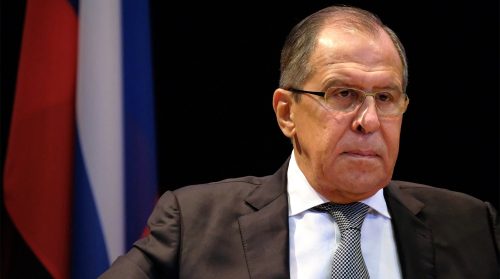
The West is attempting to use the Ukraine conflict to portray Russia as a “rogue state” in the eyes of the world, Foreign Minister Sergey Lavrov said on Wednesday. He stressed that the strategy has not been successful.
“The US and its satellite states are waging an all-encompassing hybrid war that they have long been preparing for, and are using Ukrainian radical nationalists as a battering ram against us,” Lavrov said in a speech in the lower house of the Russian parliament, the State Duma.
“They are not even trying to hide the goal of this war: it is not only to defeat our country on the battlefield and destroy our economy, but also to surround us with a ‘sanitary cordon’ and turn us into a type of a rogue state.”
The statement came the same day that European Commission President Ursula von der Leyen unveiled proposals for a new sanctions package against Russia, including additional export bans and measures to prevent the bypassing of restrictions.
Lavrov said that the West’s efforts to isolate Russia have failed because Moscow continues to develop relations with partners in other areas of the globe. He added that nations that have refused to back the “unprecedented” sanctions make up the majority of the world’s population.
The countries of the Asia-Pacific, the Middle East, Africa, and South America “don’t want to live in accordance with the West-centric order,” the Russian minister stated. “So it makes perfect sense why three-quarters of the world’s countries have not joined the anti-Russian sanctions and have a reasonable view regarding the situation in Ukraine.”
China and India are among the major economies that have refused to impose restrictions on Moscow. Denis Alipov, Russia’s ambassador to New Delhi, said on Tuesday that sanctions “had an opposite effect” and facilitated more trade and closer cooperation between Russia and India.
Beijing, meanwhile, has accused the US of fueling the Ukraine conflict and trying to weaponize the world economy for its own benefit.
The ‘Great Food Reset’: Who’s Behind Plan to Reengineer the Global Food Supply?

By Suzanne Burdick, Ph.D. | The Defender | January 25, 2023
The world’s food supply is being reengineered under the guise of a fake food crisis, according to journalist James Corbett.
“From cricket powder dumplings and bug burgers to GMOs and glyphosate to bioreactors and designer microbes to nutrigenomics and 3D printed material, the future of ‘food’ is shaping up to be radically different from anything you’ve eaten before,” the author of the “The Corbett Report” said.
Food, Corbett noted a week earlier on his Substack, has been leveraged throughout human history as a “powerful tool of control.”
But it’s not too late to “start formulating our own plans for counteracting this agenda” of control, Corbett said.
What’s the first step? Look closely at who’s behind the agenda.
According to Corbett:
“In order to truly do something to derail the runaway train that is the Great Food Reset, we must first understand it. And in order to understand it, we have to know something about the people behind this agenda.”
Corbett provided an information-packed rundown of the groups and individuals he believes are the drivers — historically and today — of the Great Food Reset.
The Rockefeller Foundation
According to Corbett, the Rockefellers and their namesake foundation — who “are in many ways the progenitors and the architects of the Great Food Reset” — are pushing for further centralization of control over the food supply, including “a new, integrated nutrition security system.”
“From the beginning of the so-called ‘Green Revolution’ to the so-called ‘Gene Revolution,’ the Rockefellers have been there,” Corbett said, “helping to move things along with their ‘philanthropic’ donations.”
Corbett cited the Rockefellers’ recent work in Africa, which operates under the name Alliance for a Green Revolution in Africa. The alliance’s stated goal — to “elevate the single African voice” — “sounds nice and fuzzy, until you learn that 200 organizations have come together to denounce the alliance and its activities,” Corbett said.
Corbett said the 200 critics of the alliance “claim that the group has not only ‘unequivocally failed in its mission,’ but has actually ‘harmed broader efforts to support African farmers.’”
Bill Gates
Corbett pointed out that Bill Gates, Sr., in 2009, admitted he had looked to the Rockefeller Foundation as an example to follow when he helped his son set up the Bill & Melinda Gates Foundation — so it comes as “no surprise” that Bill Gates is heavily invested in the Great Food Reset.
Gates is “literally invested” in the food reset through his financing of the fake meat industry, Corbett said.
“Gates was, infamously, an important early backer of ‘Impossible Burger’ and its lab-grown synthetic biology food substitute,” Corbett said. “He also provided capital to Impossible rival Beyond Meat . . . until Beyond’s stock began to crumble.”
“Miraculously, the Bill & Melinda Gates Foundation Trust was able to divest itself of its Beyond Meat stock right before the shares tanked in 2019,” Corbett said, adding, “The Gateses must be super-shrewd investors!”
Corbett also noted that Gates invested millions into “hacking your microbiome” to reengineer humans’ gut bacteria.
Gates became the biggest owner of U.S. farmland in 2021.
“Gee, I wonder why someone who’s so obsessed with completely reengineering the food supply and making us dependent on the lab-grown synthetic food substitutes he funds would be buying up farmland?” Corbett said.
World Economic Forum
The World Economic Forum (WEF) is behind many different aspects of the so-called Fourth Industrial Revolution, including “Great Reset” food initiatives, Corbett said.
Among other goals, the WEF wants more people to eat more insects.
“[Klaus] Schwab’s desire to get humans off of traditional sources of protein and nutrients is very much a part of that Great Reset plan,” Corbett said.
Corbett told readers that a quick search of the word “insects” on the WEF website reveals the organization has been regularly spouting ideas such as, “5 reasons why eating insects could reduce climate change,” and “Insects could soon be appearing on restaurant menus in Europe.”
“The fat cats are now unwinding after their hard week at Davos,” Corbett said. “You can bet they’re not snacking down on cricket croquette or mealmoth flambé . . . though they may expect you to.”
The EAT Forum (Davos for Food)
Describing itself as the “Davos for food,” an organization called the EAT Forum — cofounded by the Wellcome Trust — says it is a “science-based global platform for food system transformation.”
Corbett pointed out that according to a Feb. 17, 2022, analysis by Dr. Joseph Mercola, the EAT Forum’s largest initiative — FReSH — aims to transform the food system as a whole and features project partners including Bayer, Cargill, Syngenta, Unilever and Google.
Moreover, the EAT Forum, he said, also works with “nearly 40 city governments in Europe, Africa, Asia, North America, South America and Australia, and helps the Gates-funded United Nations Children’s Fund (UNICEF) create updated dietary guidelines.”
USAID
Corbett discussed a working paper — “Systemic Solutions for Climate Change Adaptation and Mitigation in Agriculture, Nutrition, and Food Systems” — released in 2022, by the U.S. Agency for International Development’s (USAID) Board for International Food and Agricultural Development in conjunction with “Feed the Future,” the U.S. government’s global hunger and food security initiative.
“The whole document is couched in the bland bureaucratic doublespeak of ‘equity,’ ‘inclusion’ and ‘sustainability,’” Corbett said. “But, if you know how to read between the lines, it isn’t hard to understand what the report is really saying.”
“USAID’s ‘leverage’ over developing countries — specifically referenced no less than 125 times — gives an insight into the Kissingerian food-as-a-weapon mentality that is the very basis of USAID and its mission,” Corbett said.
He added:
“The entire enterprise reeks of a neocolonial landgrab masquerading as ‘philanthropy’ — the kind of territorial taking that people in Africa and elsewhere have been warning about for decades.”
Suzanne Burdick, Ph.D., is a reporter and researcher for The Defender based in Fairfield, Iowa. She holds a Ph.D. in Communication Studies from the University of Texas at Austin (2021), and a master’s degree in communication and leadership from Gonzaga University (2015). Her scholarship has been published in Health Communication. She has taught at various academic institutions in the United States and is fluent in Spanish.
his article was originally published by The Defender — Children’s Health Defense’s News & Views Website under Creative Commons license CC BY-NC-ND 4.0. Please consider subscribing to The Defender or donating to Children’s Health Defense.
Lavrov: US Crossing Red Lines by Threatening Other Countries Not to Work With Russia
By Petr Beryshnikov – Sputnik – 23.01.2023
Russian Foreign Minister Sergey Lavrov arrived in this year’s BRICS host state, South Africa, on Monday morning to discuss bilateral relations as well as coopeation within the BRICS.
Western countries, namely the US and the UK, are crossing all red lines by exerting pressure on the states that cooperate with Russia, said Russian Foreign Minister Sergey Lavrov at a joint press conference with his South African counterpart Naledi Pandor after their meeting in Pretoria on Monday.
“[The US] is publicly saying that those who cooperate with Russia will regret it,” he said, anwsering to Sputnik’s question at the press conference. “Through threats and pressure, the US, and the British too, are crossing all red lines.”
Lavrov stressed that the West undermines the democratic principles in terms of international relations, noting that the US, as well as the EU appeal to democracy only when it suits their interests.
Answering the reporters’ questions, the minister also drew attention to the issues concerning the export of Russian grain and fertilizers in the context of the world food crisis and anti-Russian sanctions. He noted that although such exports are not prohibited by the Western sanctions, the latter create logistical, financial and freightage problems. Lavrov stressed that Russia is ready for international cooperation to overcome these issues – among others, noted by UN Secretary-General Antonio Guterres – but the West does not seem to be willing to participate.
“As for Russian fertilizers, grain, no efforts by the UN helped the European Union and the United States remove obstacles to our exports,” he said.
He also noted that only 20,000 of 280 thousand tonnes of fertilizers, which Russia agreed to provide to the poorest states for free, left the European ports.
“It’s been about half a year since President Putin drew the attention of the world community to this initiative. During this time, out of 280,000 tons, only 20,000 tons were sent from the Netherlands to Malawi – well, […] such an agreement was reached three months ago, and the cargo itself was transported only very recently,” he underlined.
According to Lavrov, less than 10% of grain exported under the so-called Black Sea grain deal goes to the poorest countries, with almost a half being directed to the EU and roughly the same amount to prosperous developing countries.
The Black Sea Grain Initiative, aslo known as the “grain deal”, refers to an agreement between Russia and Ukraine with the participation of Turkey and the UN. The goal of the initiative is to help tackling the world food crisis by allowing grain exports from the Black Sea ports, which were initially blocked during the conflict in Ukraine.
Talking about the food crisis, the minister also responded to claims made by the US Treasury Secretary Janet Yellen, who said that Russia’s special military operation in Ukraine and “weaponization of food has exacerbated food insecurity and caused untold suffering”.
According to Lavrov, it is “hard to comment” on Yellen’s statements, which he called a “slogan” and cited UN data indicating that the world food crisis started before the special military operation in Ukraine and was caused by “uncontrolled emission of money” in the West as well as “politicized and uncompromising transition to so-called green economy”.
Yellen had made her statements during her January African tour, which is widely seen as part of “Biden’s big push” into Africa in an effort to counter Chinese and Russian influence on the continent.
Talking about the West’s pressure on African countries, Lavrov also touched the matter of western criticism of the Russia-China-South Africa naval drills scheduled to take place in February.
“As for naval exercises, I think there is nothing even to comment on. Three sovereign countries conduct exercises without violating any norms of international law. I don’t understand how they can cause a ‘mixed’ reaction,” Lavrov told reporters, adding: “US colleagues believe that only they can conduct exercises around the world. Now they are actively engaged in naval exercises within the framework of the Indo-Pacific strategies around China, in the South China Sea, in the Taiwan Strait, and this does not cause any mixed reaction from anyone,” the diplomat noted.
Thandi Modise, South Africa’s minister of defense, earlier said that Russia could be Africa’s key partner in terms of military cooperation. She also recently stated that the US, in its turn, “threatens Africa, not just South Africa, of having anything that is even smelling of Russia”.
In her turn, South Africa’s foreign minister stressed the importance of the exercises for her state, saying that South Africa’s military conducts drills “as part of agreements with many countries worldwide”. Naledi Pandor said that in contrast to the current criticism of the three-lateral exercises, “no-one asked questions” when South Africa took part in drills with the US or France.
“These are all part of exercises we undertake […] to be able to respond to a range of situations, including disaster management, which our military often plays a role in addressing. So, I just think it’s important that we regard all countries as sovereign nations and not stop doing so when it suits us,” she underlined.
According to Lavrov, Russia is actively developing military cooperation with its BRICS partners such as China, South Africa and India, noting that this cooperation is “nothing new”. He said that the exercises are “transparent” and called for the western states to respect their foreign counterparts.
“If you respect other countries, let them pick their sides,” the minister said, concluding: “We simply advocate for each country to have its own rights in the international system, as stipulated by the UN Charter.”
On Monday, Russia Foreign Minister Sergey Lavrov arrived in South Africa, which became the first destination for him during his African tour.
In summer 2022, Sergey Lavrov conducted a major African tour, visiting the Republic of the Congo, Uganda, Ethiopia and Egypt. In September 2022, he also held talks with South African Foreign Minister Naledi Pandor on the sidelines of the United Nations General Assembly.
Russia and the South African Republic established their bilateral diplomatic relations in 1992. Being two key nations of the BRICS group, which also encompasses Brazil, India and China, Moscow and Pretoria promoted their bilateral relations to the level of the comprehensive strategic partnership in 2013.
South Africa is Russia’s key partner in scientific and educational spheres and one of the key trade partners on the African continent along with Egypt and Algeria. The two sides have also been actively promoting relations in the military dimension as well as in other fields. Moscow and Pretoria share common views on the core principles of the world order, coordinating their positions and actions by means of regular bilateral diplomatic dialogue, at the United Nations, as well as within such formats as BRICS and G20.
The country’s president, Cyril Ramaphosa, first visited Russia in 2019, when he participated in the first Russia-Africa summit held in Sochi. Pretoria is also expected to participate in the second Russia-Africa summit which will be held in Saint Petersburg in July.
The situation in African countries is deteriorating as a result of US policies
By Valery Kulikov – New Eastern Outlook – 20.01.2023
In the last few years the USA and its Western allies have been making increasingly overt attempts to put pressure on Africa in a bid to stop the continent turning towards Russia and China.
The situation in African countries has started to deteriorate seriously as a result of the West’s thoughtless and self-serving sanctions against Russia, which have caused the continent problems in a number of areas, including that of food security. For example purely as a result of having to buy wheat from Argentina rather than from Russia, Angola has lost more than $15 million since the beginning of Moscow’s special operation to denazify the criminal regime in Ukraine and the West’s imposition of sanctions against Russia.
According to an announcement made by Turkey’s Minister of Agriculture Vahit Kirişci, since the signing of the “grain deal” 16.9 million tons of grain, carried by 633 ships, have been exported from Ukraine through the marine humanitarian corridor established under the deal. However, just 5.4% of the exported grain has found its way to poor nations, including African nations, despite the West’s insistence that the deal would prioritize shipments to these countries.
As for Russia, despite the restrictions imposed on it by the West, it has been able to export more than 15 million tons of grain as well as large volumes of mineral fertilizer, much of it intended for poor countries. Moreover, in discussions between Russian President Vladimir Putin and his Turkish counterpart Recep Erdoğan last November, it was decided to supply grain to the poorest African nations free of charge.
According to Saudi media it is the events in Ukraine and the anti-Russian policies of the West that are to blame for the sharp rise in food prices in 2022 (wheat, rice, maize, vegetable oil etc.) and the resulting famine that caused widespread suffering, especially in the world’s poorest countries. By tightening their financial policies the developed nations have reduced the flow of funds to poor countries, and the departure of foreign investment has significantly exacerbated the food crisis – a problem which, even in 2023, will be particularly challenging to overcome. In March 2022 global food prices reached their highest ever level. According to statistics published by the media, global spending of food imports amounted to almost $2 trillion in 2022, significantly more than in previous years. Shortages of wheat and fertilizer have caused price increases and raised the cost of importing food for the most vulnerable sections of society (by more than $25 billion). State support for low income families has been unable to raise their standards of living, as most of the subsidies granted have been eaten up by rising food prices. Jasper Okodi, a consultant to the UN’s Food and Agriculture Organization (FAO), has stated that even if global prices fall the price of foods in local markets in unlikely to fall until the third quarter of 2023.
Unlike the West, Russia has been a trusted partner to African states for many decades. From the mid 20th Century onwards, as African nations achieved independence from the yoke of their former colonial masters, the Soviet Union provided them with a great deal of disinterested support, building up their social and economic infrastructure. As representatives of the African nations themselves insist, Russia has never been involved in schemes to rob Africans of their natural wealth, and has never applied political pressure in an attempt to gain economic benefits. In the current highly challenging conditions posed by the anti-Russian policies of the USA and its western allies, African leaders clearly understand that Russia, despite the aggressive and immoral opposition of the West, is fighting to bring about a just world order. It is also fighting the USA’s overt propaganda campaign, which is based on disinformation and lies about Moscow’s policies. Speaking on this and other issues at a meeting of the UN Security Council on January 10, Anna Evstigneeva, Deputy Permanent Representative of the Russian Federation, categorically rejected the West’s attempts to discredit Russia’s assistance to African nations by falsely accusing it of appropriating African resources or contributing to the growth of terrorism in the continent.
Many African politicians have emphasized that while France, Britain and the USA are now losing their influence in Africa, in the past, when these countries dominated the continent, it was very difficult for Africans to stand up against Western neo-colonialism. But now the world order is changing and the African nations are able to breathe freely at last.
In an article published at the end of December The Times was forced to admit that 22 African nations refused to censure Russia’s special operation to protect residents in the Donbass at the UN General Assembly, and that in the light of current international feelings Moscow was winning more and more sympathy in the world’s most rapidly developing continent. The Times also recognized that the West has already lost the battle for Africa and that Africans are turning away from their former colonial powers and towards Russia, China, Turkey and the Persian Gulf States.
The struggle between the USA and Russia for influence in Africa took a new turn when South Africa’s president took on the chairmanship of the BRICS group and the country’s ruling party proposed inviting new members from among the world’s major developing nations to join the grouping. As the South African President Cyril Ramaphosa said, “The BRICS group should lead the process of reforming the entire international architecture for the benefit of most countries in the world, and this group has an important role to play in leading the creation of new decision-making mechanisms in the UN and other international organizations to establish a more inclusive, just and sustainable world order.” And that will certainly end the global dominion of the West and particularly of the USA, which is why the USA is opposing such reform.
Washington is particularly critical of the plans for Russia, South Africa and China to hold joint naval exercises – known by the code name Mosi – in the Indian Ocean off the Southern African coast from February 17 to 26. The exercises will include artillery practice and anti-aircraft drills. Similar joint naval exercises were held in November 2019 in the South Atlantic ocean, off the Cape of Good Hope, not far from Cape Town.
In view of the above background and specifically Washington’s growing opposition to African countries’ good relations with Russia, Thandi Modise, South Africa’s Minister of Defense and Military Veterans was recently impelled to accuse the USA of putting pressure on those African nations that maintain good relations with Russia. The Wall Street Journal admitted the truth of this accusation in a recent article on the US reaction to the docking of the Russian cargo ship Lady R at a South African port.
The West understands that Russia has an interest in maintaining international relations with strong, self-sufficient and economically independent partner countries – including in Africa – which are able to ignore the West’s threats of repressive measures and work as allies of Moscow in the creation of a new multipolar world order. But it is precisely this process that the West fears, and it is imposing all the illegitimate sanctions that it can devise in order to impose its neocolonial policies in Africa.
Why Arabs Bolster Energy & Security Cooperation With Russia in Defiance of Western Sanctions
By Ekaterina Blinova – Samizdat – 19.01.2023
Arab countries have not joined the anti-Russian sanctions, despite pressure from the West, as Russian Foreign Minister Sergey Lavrov stressed during his press conference this week. What’s behind the Arab world’s resilience?
“The policy of the West in the East has gone bankrupt,” political analyst Vladimir Ahmedov told Sputnik.
“[Middle Eastern players’] trust in the United States, the leading western European states – the former colonizers who had colonies in this region – has already been largely lost,” the specialist in the modern history of Arab countries and senior research fellow at the Institute of Oriental Studies of the Russian Academy of Sciences continued.
New major players have entered the global arena: China, India, Iran, Turkey, Egypt, and Saudi Arabia, the scholar emphasized.
Ahmedov believes that the sanctions imposed against Russia are dictated by purely political considerations of a narrow circle of the western political elite. Meanwhile, the system of international relations and the world order has been undergoing changes, and the indirect proof of this is the position taken by the Arab countries, according to him.
“Russia’s policy in the East at the present time, and Russia’s policy in the world in general, has changed in comparison with the 1990s and the beginning of the 2000s,” the researcher continued. “Now it is a resolute policy aimed at defending [Russia’s] national state interests and the national interests of third countries. It impresses the countries of the East and, above all, the countries of the Middle East, which have been waiting for such a policy for a long time. This policy is in great demand in the East and therefore it meets with approval and understanding.”
In light of this, Russia’s efforts to mediate the Israeli-Palestine conflict as well as those in Syria and Iraq – mentioned by Lavrov during his Wednesday presser – are steps in the right direction, according to the scholar. In addition, Russia’s military presence in Syria serves as a stabilizing factor, he added.
Meanwhile, the West’s Ukraine strategy looks like nothing so much as its previous Middle Eastern policies. The West is using Ukrainians much in exactly the same way it previously used Arabs in order to reach its geopolitical objectives, and Middle Eastern players are well-aware of that, according to the researcher.
“Russia is not fighting against Ukraine or the fraternal Ukrainian people, but against the West, which wants to dismember Russia, belittle its role, minimize it, and so on,” Ahmedov said. “And [the Western policy] does not meet with any approval from the political elites of the East, who themselves suffered from it previously.”
Opportunities in the Middle East and North Africa
“The region of the Middle East and the Arab world in general is of tremendous importance in the world system in terms of geography, demography, a powerful energy market, the world’s oil and gas pantry and as a very important transport artery. Therefore the attention to this region will only grow,” Ahmedov emphasized.
The region develops its position by becoming an influential energy actor, echoed Ramy El Kalyouby, a visiting lecturer at the School of Orientalism of the National Research University Higher School of Economics (HSE).
“Gulf countries profited a lot from oil prices increase, and at some moment the Kingdom of Saudi Arabia’s oil revenues jumped to more than $1 billion daily,” El Kalyouby told Sputnik. “Egypt is also getting its chance to become an important gas supplier to the EU after discovering a few huge fields in the Mediterranean.
The academic singled out Egypt, the world’s biggest wheat importer. According to El Kalyouby, Russia can help Cairo replace a deficit of Ukrainian wheat, open its markets for Egyptian fruits and vegetables, and provide more tourists.
“There is also a project of a Russian industrial zone in Egypt that would help Russia to get around sanctions by changing the origin of products, and also to profit from the African Union free trade zone,” the lecturer highlighted.
Last year, the construction of Egypt’s first nuclear power plant was launched on July 20 in El Dabaa, Matrouh Governorate, by Russia’s State Atomic Energy Corporation Rosatom.
The El Dabaa NPP is meant to be the cornerstone of Egypt’s energy diversification policy, allowing Cairo not only to cover its own electricity needs, but also to provide energy to its neighbors. On November 19, the main construction phase for Unit 2 of the NPP began in the northern African country.
“Gulf countries could cooperate with Russia in the regulation of the oil market, although this becomes more difficult, as Russia provides important reductions on Urals oil,” El Kalyouby continued, adding that “Russia also remains a key actor in Syria as a mediator between Damascus and Ankara.”
Regional Security
Nonetheless, the Middle East and Northern Africa (MENA) region is continuing to suffer from local conflicts stemming from the bitter consequences of the Arab Spring, according to Ahmedov. The scientist noted that the reformatting of political systems of these countries is still going on while the common regional security system has not been formed yet.
Russia shares the same “geopolitical space” with the countries of the region and its objectives there include not only maintaining working ties with Middle Eastern players but also to protect its “soft underbelly” from extremist and terrorist elements reinvigorated by the Arab Spring havoc, the researcher explained.
In addition, Russia’s experience as a power broker in the region could come in handy for the West, since the latter has proven incapable of solving regional conflicts on its own, continued the scientist. According to him, European countries have no other alternative but to deal with Russia in the Middle East in the future if they want to ensure their security in the Mediterranean and Southern Europe.
Ahmedov noted that while Moscow cannot ensure a complete comprehensive settlement and stabilization of the situation in the Middle East, it can help regional players reach these goals.
“Russia can make a certain contribution to ensuring the system of regional security with the participation of other states,” he said. “We have excellent relations with Iran. And in this regard, of course, the Arab countries are interested in Russia in terms of softening the Iranian policy towards the Arab countries, which causes concern today in the Arab world. We have excellent relations with Turkey, which also plays a very important role as a major regional actor or player in this region, just like Iran. And therefore, in this case, we have a lot of advantages that we can realize. We have long-standing ties with Palestine since Soviet times. And therefore, in this case, we have a lot of advantages that we can realize.”
Russia has a long and successful record of work in the region, according to the scientist: in the 1960-1980s the USSR provided the primary industrialization of many MENA countries, including Iraq, Syria, Egypt, Algeria, Sudan, and Yemen. While developing ties with the region, Russia can build upon its expertise and best practices of the past, Ahmedov concluded.
Lavrov: US Bill Countering Russia in Africa Represents ‘Colonial Mentality’
By Muhammad Osman – Samizdat – January 18, 2023
Russian Foreign Minister Sergey Lavrov has called the US Congress bill on the fight against Russian activities in Africa “an American provocation” which harms primarily the Africans themselves and reflects the West’s colonial approach to the countries of the continent.
Earlier in the day, South African Foreign Minister Naledi Pandor, in an interview with Sputnik, said that the bill of the US Congress on combating Russian activities in Africa is contrary to international law and should be withdrawn.
“I assess this law in the same way as Madam Minister (of Foreign Affairs) of South Africa,” Lavrov said during a press conference on Wednesday. “As for how it can affect our relations with Africa, I think her comments already contain the answer. Probably, not every African country, through the mouth of its representative, can clearly indicate its position.”
The Russian official stressed that he had no doubts that even those who do not comment on this kind of “US provocation” still have a deep conviction that “this law harms Africans first of all.”
The minister argued that the US does not consider African nations its equals, adding that Washington’s behavior reflects a “purely colonial mentality in a new dimension.” Lavrov recalled the time when former US Secretary of State Mike Pompeo traveled across the African continent to call on “everyone to stop trading with Russia and China, because both Russia and China do it for self-interest.”
“But America, Pompeo said, trades with you solely so that you develop, and you have more democracy. Such, you know, a simple little thing, it is anywhere, and in Africa too, it is perceived as it deserves,” the Russian minister stressed.
In May 2022, the US House of Representatives approved a bill against “malign” Russian activities in Africa that “undermine United States objectives and interests.” The bill suggests the application of a “punishment” by the US against African countries for cooperation with Russia in various fields.
Earlier, South African President Cyril Ramaphosa said that at a meeting with US President Joe Biden, he spoke about the injustice of the US punishing African countries for ties with Russia, and expressed his disagreement with the bill, which contains such proposals.
Ramaphosa condemned the bill as being a “misplaced type of legislation”, which, he said, would harm Africa and “marginalize” the continent.
“We should not be told by anyone who we associate with, and we should never be put in positions where we have to choose who our friends are,” Ramaphosa told the reporters after his meeting with Biden.
Jacob Mudenda, speaker of the National Assembly of Zimbabwe, said earlier that African countries reacted with disgust to the US bill to counter the activities of the Russian Federation in the continent since it is an encroachment on the sovereignty and territorial integrity of states maintaining relations with Russia.
Top LNG Producer Qatar Predicts Return of Russian Gas to European Market Within Five Years
Samizdat – 14.01.2023
Gas prices began creeping up in 2021 amid underinvestment in production and fierce competition for limited supplies between European and Asian markets. The supply crunch was exacerbated in 2022, as European countries began rejecting gas from Russia – which accounts for 15 percent of global natural gas output – over the security crisis in Ukraine.
Global instability in natural gas prices and availability won’t be going anywhere in the near term, and Russia will inevitably resume supplying Europe to restore a sense of equilibrium to energy markets, Qatar’s energy minister has indicated.
“It’s going to be a volatile situation for some time to come. We’re bringing a lot of gas to the market, but it’s not enough,” Qatari Energy Minister Saad al-Kaabi said, speaking at an energy forum on Saturday.
Al-Kaabi explained that global energy supply troubles actually started some time before the Ukraine crisis, “where the lack of investment in the oil and gas sector caused really a shortage in gas. And ahead of the Ukraine crisis, the oil and gas prices obviously were clearly going higher due to lack of supply. That lack of investment was driven by many factors, including the bigger push for the green [energy] without having a real plan in how the transition was going to happen. So there was a scarcity of investment over about 5-6 years, and then when the Ukraine situation happened, a big volume was taken out of the market and obviously that would take [prices] even further up.”
Al-Kaabi predicted that the next couple of years would be difficult for Europe, notwithstanding the reprieve granted amid a milder-than-usual winter for much of the region.
“The issue is what’s going to happen when they want to replenish their storages this coming year and the next year. There isn’t much gas coming into the market until 2025, 2026, 2027,” al-Kaabi warned.
The shortages would also mean higher prices, the Qatari official said.
“Prices are a factor of supply-demand. I think some people think that we are very happy for high oil prices and so on. The biggest worry that we would have as oil and gas producers is demand destruction. And you can see that there is demand destruction, whether it’s gas or oil,” he said.
Al-Kaabi also took a jab at Western countries who spent recent years condemning the use of coal for energy on environmental grounds, but turned to the highly polluting resource themselves amid the energy crunch, pointing out that “all the countries that were calling for coal to be stopped are using it at record levels today.”
Buyers Want to Have Their Cake and Eat It Too
Also speaking at the conference was UAE Energy Minister Suhail al-Mazrouei, who echoed al-Kaabi’s concerns about lack of financing in oil and gas, and a basic “lack of understanding what is the future for many countries when it comes to energy strategy – what contributions or what percentages they would have of gas or even the pace of reducing their coal.”
“It’s not clear… And that unclear long-term strategy by many countries put them in a situation where it’s very difficult for them to commit for long-term gas contracts, which has in return made the companies of those who are developing the gas at a very difficult position with their financiers, because they would like to see long-term contracts, and those long-term contracts are not there. Everyone wants to buy, but they want to buy over a two or three year span. And that is not enough for someone to develop gas,” al-Mazrouei said.
Addressing the energy shortages caused by European countries’ politicized decision to reject gas supplies from Russia, the UAE energy minister said the supply crunch was the natural outcome of these policies.
“Of course Russia is a major producer of gas and LNG, and when you shift from one location to another trying to adjust, that takes time. And that’s what happened in 2022 when some of that [Russian] gas had been relocated to another market, and other gas from other markets [was] coming to Europe, especially from the US. But is that sustainable in the longer run? I think you would need more collaboration between the European nations on agreeing on the optimization of the FSRUs [floating storage regasification units, ed.] that are also limited, and also agree on some pipelines. I think that one of the things that contributes to energy security is pipeline gas,” al-Mazrouei said.
Al-Kaabi expressed hope that an “equilibrium” in global energy markets could be achieved after “some kind of a mediation” over Ukraine between Russia and the West, “and the sooner the better.”
“This situation will not last forever, and I understand that the Europeans today are saying there’s no way we’re going back to Russian gas. We’re all blessed to be able to forget and forgive, and I think things get mended with time,” the minister said.
Al-Kaabi clarified that he doesn’t expect countries who relied on Russia for 50, 80, or 100 percent of their gas to return to these same levels of dependence, but emphasized that Russian deliveries will inevitably resume. “They will diversify and they’ll learn from that situation and probably have a much bigger diversity [of supply]. But the Russian gas is going to come back in my view, to Europe. Is it next year, is it in five years, I don’t know, but once this situation is sorted out, and that I think will be a big relief to the whole gas sector, and to the whole market in Europe and will stabilize prices.”
Hypocrisy on Africa’s Energy Needs
Al-Kaabi also addressed the historic underinvestment in energy resources in Africa by Western countries, the World Bank and the International Monetary Fund on the grounds that they failed to meet the criteria of the global green agenda.
“We need growth. One billion people today are deprived of basic electricity that we all enjoy. So we need to be fair. And I think one point I’d like to just add to that on the investment side: it’s very, very unfair of some in the West to say that African countries should not invest in oil and gas and they should remain green or whatever you want to call it while this is God-given wealth that they can create for their national growth for their national growth and for their prosperity, and it is oil and gas that is needed for the world,” the minister said.
Qatar is the world’s fifth-largest producer of natural gas, and the second-largest exporter of liquefied natural gas after Australia, exporting over 106 billion cubic meters in 2021, behind Australia’s 108.1 billion. Doha has announced plans to invest some $45 billion in its maritime fields to more than double production by 2027. The Gulf state ramped up gas exports to Europe through 2022, but warned its European partners that supplies are limited, as much of the new production capacity being brought online has already been reserved by Asian clients.
Russian natural gas deliveries to Europe plummeted last year, with Moscow accusing the Royal Navy of blowing up the Nord Stream gas pipelines running through the Baltic Sea and their combined 110 billion-cubic-meter annual transit capacity. Poland shut down overland pipeline gas deliveries via the Yamal-Europe pipeline. Flows to Europe are now limited to supplies sent through the Soyuz pipeline network, which runs through Ukraine, but have been restricted to between 35 and 43 million cubic meters of gas per day.
Moscow Sees No Progress on Deal on Exports of Russian Agricultural Products – Ambassador
Samizdat – 13.01.2023
ANKARA – There is no progress in the implementation of the Memorandum of Understanding between Russia and the United Nations on promoting Russian food products and fertilizers to the world markets, Russian Ambassador in Turkey Aleksei Erkhov said on Friday.
“As of today, 17 million tons of Ukrainian grain have been exported. However, we still observe distortions in the geographic distribution of recipients of Ukrainian food products. The situation with our products does not inspire optimism either. There is no progress in the implementation of the Memorandum of Understanding between Russia and the UN on normalization of Russia’s agricultural export,” Erkhov said, as quoted by the Yeni Safak newspaper.
The ambassador also said that Russian producers of agricultural products and suppliers are still facing the blocking of payments via banks, high insurance rates, and limited access to sea ports.
The diplomat went on to say that Latvia, Estonia and Belgium were continuing to hold Russian agricultural products in ports, while Kiev had been blocking the export of ammonia supplies.
“There are delays even in the free delivery of Russian fertilizers to low-income countries. A small part of the cargo has departed from the Netherlands to Malawi. Latvia, Estonia and Belgium are continuing to hold our products in ports. The delivery of ammonia raw materials for the production of fertilizers from the Yuzhnoe port has not started, and the resumption of ammonia supplies is being blocked by Kiev only,” Erkhov added, as quoted by the newspaper.
The ambassador noted that the amount of detained products would be enough to provide 200 million people with food for a year.
On July 22, the deal brokered by Turkey and the United Nations was signed by Ukraine and Russia to unblock shipments of grain, food and fertilizer in the Black Sea despite hostilities. The agreement was initially set to expire on November 19, with a possibility of extension if signatories consent. It was extended for 120 days on November 17.
Russian President Vladimir Putin has repeatedly said that most vessels carrying Ukrainian grain do not reach the world’s poorest countries and have ended up in Europe. Putin has also voiced concerns that Russian grain and fertilizer products are not entering the global markets as stipulated by the agreement.
From Unipolar World to Multipolarity: Why US Attempts to Intimidate Africa Won’t Work
By Ekaterina Blinova – Samizdat – 12.01.2023
South Africa has criticized Washington over its pressure campaign on African nations for maintaining relations with Russia. Defense and Military Veterans Minister Thandi Modise was quoted as saying that the US threatens African nations over “anything that is even smelling of Russia.”
South African Defense and Military Veterans Minister Thandi Modise’s criticism was sparked by reports concerning a delivery of “unidentified” cargo to the Simon’s Town naval base in December 2022 by an alleged Russia-flagged merchant ship.
In November, when the US learned that the vessel in question was headed toward South Africa, the US Embassy alerted Pretoria that the ship had been subject to Washington’s sanctions since May 2022. In accordance with US laws, Washington can impose restrictions on any entity, person or country that provides services to a sanctioned vessel.
The US press said that the embassy received no response from the South African government, adding that the alleged sanctioned freighter was accepted at the nation’s port in December.
Addressing the issue earlier this week, Defense and Military Veterans Minister Thandi Modise told US media that “whatever contents this vessel was getting were ordered long before COVID,” and lambasted Washington over the unjustified pressure the latter has imposed on African states maintaining ties with Moscow.
Since the beginning of Russia’s special military to demilitarize and de-Nazify Ukraine in February 2022, the US has been trying to isolate Moscow and disrupt its cooperation with the Global South.
Earlier, on April 27, 2022, the US House of Representatives passed the HR 7311 Countering Malign Russian Activities in Africa Act with a bipartisan 419-9 majority. The legislation was aimed at sanctioning African nations over cooperating with Moscow. It was later referred to the Committee on Foreign Relations by the US Senate and appears to be on hold.
Washington’s Tools of Coercion
“One of the leverages is fear of sanctions,” Eguegu Ovigwe, a policy analyst specializing in geopolitics and African affairs at Development Reimagined, told Sputnik. “I think HR 7311 – that is the act where the US secretary of state developed strategies which were submitted to Congress, an implementation plan, of course, to counter the so-called malign influence of Russian activities in African countries. So that really gives a legislative backing or legislative framework to potential sanctions that the African countries may come under if they continue to have a relationship with Russia that the US doesn’t like.”
Washington’s hypocrisy is obvious, according to Ovigwe: on the one hand, the US asserted to African nations that it wouldn’t force developing countries to choose between Russia and China or the United States; on the other hand, US House lawmakers almost unanimously passed legislation aimed at punishing Africans for maintaining ties with Moscow.
“[I]t is not the place of the United States to dictate what supposedly sovereign countries should do,” stressed the analyst. “This is the extraterritorialization of US law. So, if the US passes a law, that’s for the US; it has nothing to do with bilateral relations between two other countries.”
In addition to sanctions, the US could cut African nations off its global economic programs, according to Ovigwe. For instance, the Bill Clinton era’s African Growth and Opportunity Act (AGOA) provides duty-free treatment for goods of designated sub-Saharan African countries (SSAs). Earlier this month, Burkina Faso, a desert landlocked African country located in the Sahel, was officially removed from the program by the US for not meeting the initiative’s requirements. Last year, the Biden administration also terminated the AGOA program for Ethiopia, Mali, and Guinea over what it called “unconstitutional change in governments” and “the gross violations of internationally recognized human rights.”
Washington may also reduce or nullify foreign direct investment (FDI) to some African countries to twist their arm into halting relations with Moscow, Ovigwe continued.
Still, the scholar does not think that removal from AGOA or lack of US investments could spell doom for the continent. The crux of the matter is that there are enough global players interested in Africa’s growing market and rich natural reserves who are willing to fill Washington’s shoes, according to him.
Africa’s Alternatives & Opportunities
Africa has far more promising development projects than the AGOA: in May 2019, the African Union (AU) kicked off the African Continental Free Trade Area (AfCFTA), which looks to create a single continental market with a population of about 1.3 billion. It could become by far the world’s largest free trade area, bringing together the 55 countries of the African Union (AU) and eight (8) Regional Economic Communities (RECs).
“I don’t think many countries will be losing sleep, fearing that they’re going to be kicked out of AGOA, with the wealth of opportunities which may present themselves,” Ovigwe noted.
Remarkably, the US rushed to embrace the AU’s project in December 2022, with the White House saying that the initiative “present[s] an extraordinary opportunity for the US to invest in Africa’s future.”
The US has long been lagging behind the EU and China in terms of trade with the continent. While the US trade with Africa reached $83.6 billion in 2021, it pales in comparison with the EU’s €288 billion ($306 billion) and China’s $254 billion in the same year.
When it comes to FDIs, China, a US major geopolitical competitor, is currently investing heavily in Africa, noted Mikatekiso Kubayi, researcher at the Institute for Global Dialogue associated with UNISA and research fellow at the Institute for Pan African Thought and Conversation.
“China continues to be the leading source of FDIs in Africa and has a pipeline of projects, particularly in infrastructure,” Kubayi told Sputnik. “Africa’s relations with China continue to deepen. This relationship can yield great benefits to both parties in joint research and development, manufacturing in Africa, and an African market that is expected to reach 2.5 billion in population by 2050. African wealth in minerals such as rare earths and others are all thoroughly purposefully explored for practical action and development.”
Multipolarity is Answer to Intimidation
Washington’s unipolar approach creates an uneven playing field for developing countries as the US is still communicating with the Global South from a position of force, according to the observers. In contrast, the multipolar vision ensures equality and fair conditions for all players.
“The recent G20 summit reiterated the importance of multilateralism and the United Nations in its declaration,” Mikatekiso Kubayi underscored. “BRICS – which China and Russia are members of – emphasized the need to deepen and improve the practical experience of multilateralism with the United Nations at its center. The changing geopolitical landscape is changing precisely because of the realization that it does not benefit the majority of the world.”
The US attempts to coerce Africa into submission, including through anti-Russia legislation targeting the continent, “do not seem to generate confidence and positivity,” Kubayi warned.
Meanwhile, unlike the Group of Seven (G7) which appears to be a closed club of Western industrialized nations plus Japan, BRICS has the potential to grow and develop by adding new members, according to Ovigwe. Previously, Argentina, Iran, and Saudi Arabia signaled their interest in becoming BRICS members.
“You have emerging multilateral platforms like BRICS, for instance, that have so much momentum, and seem to be more open to emerging powers, more focused on issues that are really important to the majority of the world,” Ovigwe stressed. “One of the trends we might see going forward is countries tilting more towards these new and emerging multilateral platforms because they want it to be accessible to them. G7 is not going to be expanded – it has already contracted from G8 to G7.”
The scholar added that he hopes the global system moves towards more new, open, and more dynamic platforms like BRICS.
A multipolar world is taking shape, offering new alternatives and opportunities to developing states and thwarting attempts to intimidate global players by sanctions and use of force, according to the observers.
Featured Video

Racist Seinfeld Dances for Joy as Bibi Unveils His New Map
or go to
Aletho News Archives – Video-Images
TV Drama Review
Japanese drama projects Japan’s wartime atrocities onto Chinese characters

Global Times | October 25, 2026
By portraying Chinese characters as perpetrators of ruthless violence while casting Japanese Self-Defense Forces (SDF) intelligence operatives as defenders, the season 2 of the Japanese drama Vivant has recently drawn criticism from Chinese netizens, who argue that its depiction turns historical reality on its head while ignoring Japan’s wartime atrocities.
The TBS drama series – a spy suspense story in which an alleged unofficial intelligence unit of the SDF operates across the globe — has attracted a passionate fanbase. Its currently airing season 2 opened with a household rating of 18.8 percent, the highest for a TV drama this year, according toa commentary article by Japanese media Toyo Keizai.
What draws attention is the portrayal of the enemies in the series, the article noted. Scenes in which the Chinese organization subjects kidnapped members of the SDF unit to brutal torture are repeated with unrelenting intensity.
It is rare for Japanese TV dramas to explicitly portray a real-life country as the enemy, the article noted.
Japanese Prime Minister Sanae Takaichi also made a reference to the drama, saying that she has been recording Vivant and hopes to binge-watch it over the year-end and New Year holidays, according to Japanese media outlets.
China’s CCTV News report on Sunday revealed that the drama features scenes in which Chinese personnel cut off the fingers of and stab Japanese intelligence operatives in the abdomen. Such acts bear striking similarities to the torture inflicted on Chinese nationals by invading Japanese troops during the World War II.
The drama distorts the truth by attributing these atrocities to modern Chinese characters. Beneath the surface, it subtly glorifies Japan’s cross-border overseas operations, blurs the functional boundaries of the SDF and implicitly promotes an expansionist narrative, per CCTV News. … continue
Blog Roll
 Aletho News
- EU facing trillion-euro debt hole while seeking more cash for Kiev
- How US, Europe, Persian Gulf states exhausted missile stockpiles, splurged billions to defend Israel
- Up in arms… Koreans reject U.S. empire’s plan to make South Korea the next Ukraine
- Iran, Turkey, Pakistan, Saudi Arabia could advance region-led security framework in Tehran: FM spox
- Netizens condemn Japanese drama for projecting Japan’s wartime atrocities onto Chinese characters
- Racist Seinfeld Dances for Joy as Bibi Unveils His New Map
- A West Bank War for Netanyahu’s Election Campaign, Could It Backfire?
- Yemen denounces European Parliament’s ‘hypocritical’ push to blacklist Ansarullah
- Qalibaf: UAE’s UN bid aims to ‘clear the runway’ for ‘Greater Israel’, whitewash genocide
- Pakistan reopens Iran border after boosting security: Report
- If Americans Knew
- An error has occurred; the feed is probably down. Try again later.
- No Tricks Zone
- Sudden Stratospheric Warming, Powerful El Niño Combination May Lead To Extreme Europe Cold, Energy Crisis!
- Two New Studies Find Thwaites Glacier Melt Cannot Be Driven By Human Activity Or A Warming Ocean
- E-Cars Reduce CO2 Emissions By Only 41% Compared To Internal Combustion Engine Vehicles
- Predictions Made By Renowned Climate Professor Over Past Decades Have Been Proven To Be Poor
- New Study Suggests Large Regions Of The Pacific Ocean Have Been Cooling For The Last 80 Years
- Germany’s Green Energy Debacle: High Energy Costs Force Kahla Porzellan to Close After 182 Years!
- New Study: 50 Years Of The Most Aggressive ‘Net Zero’ Policies Can Only Affect The Global Climate By 0.03°C
- US September “Heat” Was No Record…Many Records Set Decades Ago
- Latest European Green Energy Debacle; Portugal’s Largest Flagship Solar Park Insolvent!
- Green Energy Debacle: German Expert Professor Fritz Vahrenholt Warns Of Severe Economic And Social Consequences

