Russia calls for reform of UN Security Council
Samizdat | August 3, 2022
The United Nations is in dire need of reform and the Security council must be “democratized” by expanding its representation, Russian foreign ministry official Alexey Drobinin has written in a keynote article published on Wednesday.
Drobinin, the Director of the Department of Foreign Policy Planning, commented on the current state of international relations and came to the conclusion that “more conscious effort and imagination is needed” to reform the UN.
He pointed out that the organization’s current agenda, which is primarily fueled by the West, is not necessarily in line with the interests of the majority of its international members.
Drobinin suggested that for most UN members the most important issues are things like access to cheap energy sources rather than the transition to “green” technologies, socio-economic development rather than human rights “in an ultra-liberal interpretation,” and security and sovereign equality rather than the artificial imposition of electoral democracy according to Western patterns.
He added that another topic that has once-again become relevant is the process of decolonization and ending the neo-colonial practices by transnational corporations in regards to the development of natural resources in developing countries.
However, international organizations such as the UN have essentially been “privatized” by the West, Drobinin points out. He suggests that the UN Secretariat and the offices of special envoys and special representatives of the Secretary General have all been saturated with the West’s own “tested” personnel, and that this also extended to non-UN organizations as well, such as the OPCW.
“The saddest thing is that this rust is eating away at the ‘holy of holies’ of the UN system – the Security Council,” Drobinin writes. “It devalues the meaning of the right of veto, which the founding fathers endowed to the permanent members of the Security Council with one single purpose: to prevent the interests of any of the great powers from being infringed, and thus save the world from a direct clash between them, which in the nuclear age is fraught with catastrophic consequences.”
While there are no “clear and simple recipes for correcting the situation here,” the diplomat continues, “clearly more conscious effort and imagination is needed when it comes to UN reform.” He goes on to suggest that the Security Council needs to be “democratized,” first of all by expanding the representation of African, Asian and Latin American countries.
Drobinin suggests that whatever the fate of international organizations such as the UN, WTO, IMF, World Bank or G20 is, the divisive policies of the West makes it “an absolute imperative for the coming years to form a new infrastructure of international relations.”
“After their frankly perfidious decisions and actions against Russia, its citizens and tangible assets, we simply cannot afford the luxury of not thinking about alternatives. Especially since many of our friends who have lost faith in Western benevolence and decency are thinking about the same thing,” the diplomat surmised.
South American trade bloc snubs Zelensky
Samizdat | July 21, 2022
South America’s Mercosur trade bloc has declined a request by Ukrainian President Vladimir Zelensky to speak at its summit, host nation Paraguay said on Wednesday, according to the AFP news agency.
Mercosur members Argentina, Brazil, Uruguay and Paraguay failed to reach an agreement on whether to invite the Ukrainian leader, Deputy Foreign Minister, Raul Cano said, albeit refusing to name the countries that opposed the move.
“There was no consensus on such communication, that’s why the Ukrainian counterpart has already been informed that under current circumstances there are no conditions allowing to speak with the president of Ukraine in the Mercosur format,” the minister explained.
Earlier this month, Julio Cesar Arriola, Paraguay’s foreign minister, said that Zelensky had talked with Mario Abdo Benitez, the nation’s president, on the phone and asked for the opportunity to address the upcoming Mercosur summit. According to Arriola, Benitez promised to discuss the matter with his colleagues in the bloc.
Mercosur is an economic and political organization that was established in 1991 to create a common market and incentivize development in South America.
After Russia attacked Ukraine in late February, Zelensky has addressed a slew of national parliaments and major international forums, including NATO, the G7 and the UN in an effort to rally countries to Kiev’s cause and help it fight off Moscow’s offensive.
However, in late June, when the Ukrainian president took part in a virtual meeting with the African Union, only a handful of leaders reportedly tuned in to listen to his speech. Following the conference call, the President of Senegal and African Union Chairperson, Macky Sall, indicated that Africa’s position of neutrality over the conflict in Ukraine remained unchanged.
WHO Wants To Run the World?
By Paul Frijters, Gigi Foster, Michael Baker | Brownstone Institute | July 11, 2022
In Geneva in late May at the 75th meeting of the WHO’s decision-making body, the World Health Assembly (WHA), amendments to its International Health Regulations (IHRs) were debated and voted upon. If passed, they would grant the WHO the right to exert unconscionable pressure on countries to accept the WHO’s authority and health policy actions if the WHO decides that there is a public health threat that might spread beyond a country’s borders.
As Ramesh Thakur, the second man at the UN for years, noted, the amendments would mean “the rise of an international bureaucracy whose defining purpose, existence, powers and budgets will depend on outbreaks of pandemics, the more the better.”
This is the first clear instance of a globalist coup attempt. It would subvert national sovereignty worldwide by putting real power into the hands of an international group of bureaucrats. It has long been suspected that the authoritarian elites arisen during covid times would try to strengthen their positions by undermining nation states, and the this 75th jamboree is the first solid evidence of this being true.
What an opportunity then to see who is in the conspiring club. Who drafted the amendments? What was in them? Which individuals supported them or spoke out against them?
WHO were the conspirators?
The amendments on the table at the May WHA meeting had been transmitted to the WHO by the US Department of Health and Human Services on January 18, circulated by WHO to its member states (‘States Parties’) on January 20 and formally introduced to the WHA on April 12.
The proposals, according to an announcement on January 26, were co-sponsored by 19 countries plus the European Union. Even if some co-sponsors had little direct involvement in drafting them, they all would have approved in principle the overarching goal of tightening up the WHO’s authority over member states in the face of a public health event.
Loyce Pace, the HHS’s Assistant Secretary for Global Affairs – the leading US official nominally responsible for the proposed amendments – arrived at the Biden administration fresh from a stint as executive director of an advocacy organization called the Global Health Council.
That council receives funding from the Bill & Melinda Gates Foundation and its members include Eli Lilly, Merck, Pfizer, Abbott Labs, and Johnson & Johnson. You get the idea. Via one of the foxes-turned-chicken-guard, it appears the HHS ‘worked closely’ on these amendments with large pharmaceutical companies, who will be chomping at the bit for a more proactive (read: profitable) response to any public health emergency, real or imagined.
So the conspiring club consists primarily of the US government and its Western allies in lockstep with Big Pharma, and they are looking to undermine both the sovereignty of their own governments and that of other countries, presumably with the idea that the Western elites would do the running.
What was in them? A blizzard of acronyms and euphemisms
To understand what the US proposed at the WHA, we need first to understand how things have worked in the WHO to this point.
The IHRs in their current form have been in force as international law since June 2007. Among other things, they impose requirements on countries to detect, report and respond to ‘public health events of international concern,’ or PHEICs. The WHO Director-General consults with the state where a possible public health event has occurred, and within 48 hours they are meant to come to a mutual agreement on whether or not it actually is a PHEIC, whether or not it needs to be announced to the world as such, and what counter-measures, if any, should be taken. It’s essentially an early-warning system on major health crises. This is a good thing if it’s run by people you can trust and if it has checks and balances to rein in expansionary tendencies.
The proposed amendments would greatly strengthen the power of the WHO relative to this baseline, in a number of ways.
First, they lower the threshold for the WHO to declare a public health emergency by empowering its Regional Directors to declare a ‘public health event of regional concern’ (PHERC, italics ours) and for the WHO to put out a new thing called an ‘intermediate public health alert.’
Second, they permit the WHO to consider allegations about a public health event from non-official sources, meaning sources other than the government of the state concerned, and allow that government only 24 hours to confirm the allegations and a further 24 hours to accept the WHO’s offer of ‘collaboration.’
Collaboration is essentially a euphemism for on-site assessment by teams of WHO investigators, and concomitant pressure at the whim of WHO personnel to enact potentially far-reaching measures such as lockdowns, movement restrictions, school closures, consumption of medicines, administration of vaccines and any or all of the other social, economic, and health paraphernalia that we have come to associate with the covid circus.
Should the state’s government acceptance of the WHO’s ‘offer’ not be forthcoming, the WHO is empowered to disclose the information it has to the other 194 WHO countries, while continuing to pressure the state to yield to the WHO’s invitation to ‘collaborate.’ A non-collaborating country would risk becoming a pariah.
Third, the proposal includes a new Chapter IV, which would establish a ‘Compliance Committee’ consisting of six government-appointed experts from each WHO region tasked with permanently nosing around to ensure the member states are complying with IHR regulations.
There are more crossings-out of the existing IHR language and new language added in, but the flavour of what the US-led alliance is shooting for is a WHO that can unilaterally decide whether there is a problem and what to do about it, and can isolate countries that disagree.
Compliant WHO member states could act as a supporting cast in the isolation effort, through the distribution of their own health budgets and their ‘health-related’ policies, which would include travel and trade restrictions. The WHO would become a kind of command-and-control center for globalist agendas, pushing the produce of (Western) Big Pharma.
Why and how would this work?
We learned during covid times why it would make sense that the US and its allies are insisting on these amendments.
Lowering the bar for declaring a global (or regional) public health threat triggers a huge opportunity for Western pharmaceutical companies. As legal experts have observed: “WHO emergency declarations can trigger the fast-track development and subsequent global distribution and administration of unlicensed investigational diagnostics, therapeutics and vaccines.
This is done via the WHO’s Emergency Use Listing Procedure (EULP). The introduction of an ‘intermediate public health alert’ in particular will also further incentivise the pharmaceutical industry’s move to activate domestic fast-track emergency trial protocols as well as for advance purchase, production and stockpile agreements with governments before the existence of a concrete health threat to the world’s population has been detected, as is already the case under WHO’s EULP via the procedures developed for a ‘pre-public health emergency phase’.”
You can bet that the WHO ‘expert teams’ sent in to make on-the-ground assessments, under the banner of ‘collaboration’ with the host country experiencing the health event, will be chock-a-block with operatives from the CDC and who knows what other Western agencies, all poking around potentially sensitive facilities that a host government might justifiably claim a sovereign right to keep to itself. Likewise with the ‘Compliance Committee’ proposed by the US under the new Chapter IV of the IHRs: its government-appointed members have an open-ended brief, enshrined in international law, to be busybodies.
In layman’s terms, the WHO would be turned into an international thug, with its member states offered the role of backyard gang members.
As a bonus for Western elites, the proposals are a sneaky form of rewriting history. By cementing authority within an international organisation to determine the existence of public health crises and direct potentially draconian emergency responses, Western governments would get to enshrine and legitimise their own extreme responses to the covid outbreak, as we have pointed out previously. Their backsides would thereby be given some protection from legal challenges.
The refusniks: Developing countries
The proposals were pushed primarily by Western countries: the US was joined by Australia, the UK and the EU in arguing for passage. The resistance was led by developing countries who saw it as a colonialist ambush in which their ability to set policy and respond to health threats in a manner commensurate with their domestic situations would be overridden.
Brazil reportedly went so far as to threaten to withdraw from the WHO, and the African group of almost 50 countries, along with India, argued that the amendments were being rushed through without adequate consultation. Russia, China and Iran also objected.
Failure on the first try, but the US and its allies in the West will get more shots to push it through.
How do we expect them to do this? Well, when a proposal gets bogged down inside a giant bureaucratic machine like the WHO, the inevitable response is to set up committees to work in the background and circle back with a new set of proposals to be presented at a future meeting. True to form, a ‘working group’ and ‘expert committee’ are being assembled to accept member state proposals on IHR reform by the end of September this year. These will be ‘sifted through’ and reports will be prepared for review by the WHO’s executive board in January next year. The objective is to have a fresh set of proposals on the table when the WHA convenes for the 77th time in 2024.
Not all was lost
Salvaging something from the fact that the WHA failed to get a consensus around its biggest agenda item, the US and its allies got a small victory on the point of when they can try again – though in their desperation they needed to violate the IHRs’ own rules to accomplish it. Article 55 of the IHRs states unambiguously that a four-month notice period is required for any amendments.
In this instance, revised amendments were presented on May 24, the same day that the first lot were rejected. These were discussed, further amended on May 27 and then adopted on the same day. The approved amendments halve the two-year period for any (further) approved amendments to the IHRs to take effect. (The IHRs that came into force in 2007 were agreed to in 2005 – but under the new resolution, anything agreed to in 2024 would come into effect in 2025 rather than 2026.)
Yet, what was achieved in terms of fast-tracking the force of new amendments was lost in slow-tracking their implementation. Nations would have up to 12 months – double the previous suggestion of six months – to implement any IHR amendments that newly enter into force of law.
State of play
Where is all this going?
If the WHO takes the reins on decisions about what constitutes a health crisis, and can pressure every country into a one-size-fits-all set of responses that it, the WHO, also determines, that’s bad enough. But what about if its invitation to ‘collaborate’ with countries is backed up with teeth, such as sanctions against those who demur? And what about if it then broadens the definition of ‘public health’ by, for example, declaring that climate change falls under that definition? Or racism? Or discrimination against LBTQIA+ people? The possibilities thereby opened up for running the world are endless.
A global ‘health’ empire would bring huge harms to humanity, but a lot of power and money is pushing for it. Don’t think it can’t happen.
Paul Frijters is a Professor of Wellbeing Economics at the London School of Economics: from 2016 through November 2019 at the Center for Economic Performance, thereafter at the Department of Social Policy
‘Developing world to face wave of defaults’
Samizdat – July 10, 2022
Emerging nations, including El Salvador, Ghana, Egypt, Tunisia and Pakistan, will be challenged with a historic cascade of defaults as a quarter-trillion-dollar pile of distressed debts keeps exerting downward pressure on economies, Bloomberg is reporting.
“With the low-income countries, debt risks and debt crises are not hypothetical,” the World Bank’s Chief Economist Carmen Reinhart told the agency on Saturday. “We’re pretty much already there.”
Over the past six months, there’s reportedly been a doubling in the number of emerging markets with sovereign debt that trades at highly distressed levels, meaning yields that indicate investors believe default is a real possibility.
Another cause for major concern reportedly arises from a potential “domino effect” that commonly occurs when scared investors begin yanking money out of countries with economic problems similar to those defaulting nations had previously gone through.
In June, traders reportedly pulled $4 billion out of emerging-market bonds and stocks, marking a fourth straight month of outflows.
Probable defaults may be followed by political instability. Earlier this year, Sri Lanka was the first nation to stop paying its foreign bondholders, burdened by unwieldy food and fuel costs that fueled protests and political chaos.
“Populations suffering from high food prices and shortages of supplies can be a tinderbox for political instability,” Barclays has said, as quoted by Bloomberg.
‘Israel’ to close embassy in Eritrea after ambassador blocked
Press TV – July 10, 2022
Israeli prime minister Yair Lapid has approved the closure of the regime’s embassy in Eritrea as authorities in the Northeast African country have not been allowing the arrival of a diplomat from the occupied territories in the past two years.
Lapid, who is still serving as Israeli foreign minister, took the decision on Saturday to shutter the diplomatic mission in the Eritrean capital city of Asmara, after the local government had been delaying Ishmael Khaldi to take up the post despite his appointment.
According to Israeli media outlets, the embassy has remained empty in the aftermath of the Eritrean government’s decision, and many of its staffers are currently in their homes without doing any particular tasks.
The outlets added that the Tel Aviv regime spends tens of thousands of dollars per month on rent and other fees for the employees.
The last Israeli ambassador left Asmara in September 2018. Since then, the Israeli Foreign Ministry has sent a temporary administrator for the embassy from time to time.
Until April 2020, the head of the embassy’s security was the only Israeli representative in Eritrea, and his wife was responsible for the administrative work.
The Israeli foreign ministry then decided to evacuate the embassy in light of the COVID-19 pandemic. The embassy has been abandoned ever since.
On July 5, 2020, the regime’s foreign ministry’s appointments committee appointed Ishmael Khaldi to serve as ambassador to Eritrea. The approval of his appointment was, however, delayed by Eritrean authorities.
Palestine’s official WAFA news agency, quoting the London-based online newspaper Rai al-Youm and other sources reported on August 1, 2021, that at least 14 countries including South Africa, Tunisia, Eritrea, Senegal, Tanzania, Niger, the archipelago of Qamar, Gabon, Nigeria, Zimbabwe, Liberia, and the Seychelles had agreed to expel Israel from the 55-member African Union.
On July 22 that year, Israel attained observer status at the AU after nearly 20 years of lobbying.
Making the move official, Israeli ambassador to Ethiopia, Burundi and Chad Aleli Admasu presented his credentials to Moussa Faki Mahamat, the chairman of the African Union Commission, at the bloc’s headquarters in the Ethiopian capital, Addis Ababa.
Experts say Israel’s observer status is largely seen as part of Tel Aviv’s continued campaign to normalize ties in Africa.
Pro-Palestine language is typically featured in statements delivered at the AU’s annual summits. Palestine already has observer status at the African Union.
Why G7’s Program for Developing Countries is Still No Match for China’s Belt & Road
Samizdat – 28.06.2022
The G7 on 26 June re-launched its previous Build Back Better World program to provide infrastructure funds to poor and developing nations under a new name, the Global Investment and Infrastructure Partnership. The project aims to compete with China’s Belt and Road Initiative kicked off by Beijing in 2013.
The Build Back Better World (B3W) program was pompously announced by the club of seven developed nations to counter China’s Belt and Road at the G7 Summit in Cornwall in July 2021. However, little had been heard of the G7’s endeavor since then. In June 2022, the Group of Seven decided to breathe new life into the project.
“So far, America has failed to build momentum on its plan to Build Back a Better World,” says Francesco Sisci, a Beijing-based China expert, author, and columnist. “However, with this new G7 plan, which includes other countries, this momentum could start to be built. It is a question mark. Nobody is sure until things are realized. But you cannot just underestimate and dismiss this plan, because there is a large commitment of many countries with a large economy and this plan could make big sense.”
The G7’s grand design envisages laying a secure sub-sea telecommunications cable that will connect Singapore to France through Egypt and the Horn of Africa; creating a COVID-19 vaccine plant in Senegal; expanding solar projects in Angola, including solar mini-grids and home power grids; and establishing an innovative modular nuclear reactor plant in Romania, among other issues.
The US president pledged to mobilize $200 billion in investments in global infrastructure projects over the next five years. The overall investment, including G7 member states and private capital, is expected to reach $600 billion.
“With two competing plans – size matters, at the end of the day,” says Sisci. “That is, China may be able to immediately finalize a lot of money in a short time in a number of projects. The G7 countries could be slower, but eventually they could build up momentum and they could channel much more money much more effectively, perhaps, in a much larger number of projects which could stifle Chinese projects.”
Sisci suggests that the club of developed capitalist countries “may end up being more effective in many ways [than China], a smaller non-capitalist country.”
“China, but also Russia, by far, don’t have the size, the gravitas to oppose even a divided G7, which is coming together because of this opposition to China or Russia-driven projects,” he notes.
G7 Economic & Geopolitical Hurdles
However, some other observers express skepticism over the ability of the US and G7 to implement the project given record-high inflation and cost of living crisis currently engulfing the states. The US, British and European central banks are struggling to tame skyrocketing inflation by raising interest rates to reduce demand, which is prompting recession fears.
“Washington claims they are going to be sending over $200 billion. But where’s the money coming from and how is it going to be really used?” asks Thomas W. Pauken II, the author of “US vs China: From Trade War to Reciprocal Deal,” a consultant on Asia-Pacific affairs and a geopolitical commentator.
He notes that previously the US Senate voted Biden’s landmark Build Back Better initiative down, and for good reason, as Republican congressmen feared that the Democratic administration’s spending spree would fan inflation and increase an already bloated national debt.
Pauken also expresses bewilderment over the G7’s apparent readiness to embark on the bold international project at a time when the group is involved in the Ukraine crisis with the UK trying to keep the military conflict dragging on. “I mean, it’s laughable that they have to think about [competing with] China at this time when they’re on the brink of a major war in Europe,” the commentator remarks.
Meanwhile, the G7’s Global Investment and Infrastructure Partnership cannot be regarded so far as a viable alternative to the Beijing-led Belt and Road Initiative that has been implemented for slightly less than a decade, according to Pauken.
“First of all, [the G7] actually need[s] to make these projects work,” says the geopolitical commentator. “Other than that solar plant in Angola, I don’t see any of these initiatives really working.”
In particular, China invested almost $59.5 billion in its comprehensive infrastructure project in 2021 alone. When it comes to crucial elements of the project, the West appears to be lagging behind. While the G7 is still considering building a subsea cable linking Europe and Southeast Asia, China kicked off its Digital Silk Road (DSR) almost seven years ago. The DSR’s backbone is the Pakistan and East Africa Connecting Europe (PEACE), a 9,300 mile long subsea cable network meant to tie Asia, Africa, and Europe together. The network is designed to transmit over 16Tbps per fibre pair with its Mediterranean section going from Egypt to France having already been laid.
Are Emerging Economies Interested in the G7 Agenda?
There is yet another problem as to how to make these Western projects attractive for Global South nations, the Asia Pacific expert continues. In particular, the G7 has been pushing ahead with a climate change agenda and the plan to cut carbon emissions, which is not relevant for the majority of third-world states which are still reliant on cheaper and more reliable fossil fuels and coal plants, he notes.
“You also have to deal with auditing issues as well as the so-called climate change consultants who go on the ground and on site,” he says. “You have to prove that those infrastructure projects are not causing much of a carbon footprint. But most of the major infrastructure does require a big carbon footprint, especially in the emerging markets, because they don’t have the same equipment or they don’t have the same standards or labor laws as they would have in Western Europe or the US.”
Many emerging economies, including African countries, are beginning to have a growing frustration with the US and Europe, according to Pauken. The reality is that Africans and many of the emerging markets want to focus on economic stuff, he notes. However, when the US officials come in, they’re talking about climate change or gender equity, and this is not as interesting to developing nations, the commentator emphasizes.
“[Developing nations] want help on improving their agricultural production levels and boosting their energy capacity, which the Russians and the Chinese have been doing,” Pauken notes.
Given all of the above, it is unlikely that the G7’s Global Investment and Infrastructure Partnership initiative is going to actually happen, argues the geopolitical commentator.
“They’re rebranding a failed policy, thinking it might work by using new names and new mergers. Last time it was separate between the EU and separate between the US and they somehow think that if you combine the two failed projects into one, that this will somehow succeed. That’s not going to work in the real world,” Pauken concludes.
WHO Recommends New Gates-Funded Polio Vaccine to Address Vaccine-Derived Polio Outbreak in U.K.
By Megan Redshaw | The Defender | June 27, 2022
Health officials in the U.K. this month identified the country’s first polio outbreak in 40 years, and believe the outbreak was caused by a strain of polio found in the oral polio vaccine.
Health officials in Britain warned parents on June 22 to ensure their children have been vaccinated against polio after multiple closely related versions of the virus that cause the disease were found in sewage water at the London Beckton Sewage Treatment Works — the largest water treatment plant in the U.K.
“The Global Polio Laboratory Network has confirmed the isolation of type 2 vaccine-derived poliovirus (VDPV2) from environmental samples in London, United Kingdom, which were detected as part of ongoing disease surveillance,” the World Health Organization (WHO) states on its website.
The U.K. Health Security Agency (UKHSA) said it believes the virus was “vaccine-derived,” meaning it came from someone who received the live polio vaccine. That person then passed the virus to individuals in London, who shed the virus into their feces.
The viruses’ genetic sequences suggest “there has been some spread between closely linked individuals in north and east London,” the UKHSA said.
The virus was isolated from environmental samples collected between February and May, and no related cases of paralysis have been detected, the WHO said. “Additional sewage samples collected upstream from the main waste-water treatment plant’s inlet are being analyzed.”
People vaccinated with the live oral polio vaccine (OPV) shed traces of the virus in their stool — which eventually end up in sewage wastewater, NPR reported. Scientists believe a person brought the virus into London and then spread it to others who were unvaccinated.
“We are urgently investigating to better understand the extent of this transmission,” Vanessa Saliba, an epidemiologist who consults for the UKHSA, said in the statement.
The risk to the general public is thought to be “extremely low” but the agency encourages anyone not fully vaccinated to receive a polio vaccine.
WHO approves Gates’ oral polio vaccine for emergency use
The WHO on Nov. 13, 2020, granted Emergency Use Listing (EUL) to a new novel oral polio vaccine called nOPV2, designed to treat the type of polio outbreak occurring in the U.K.
Based on the WHO’s review of data and research available on nOPV2, the Strategic Advisory Group of Experts on Immunization (SAGE) recommended Gates’ nOPV2 become the “vaccine of choice” for responding to type 2 polio outbreaks caused by OPV.
The Bill & Melinda Gates Foundation provided 100% of the funding for the development and clinical trials of the vaccine.
The Global Polio Eradication Initiative (GPEI) states on its website:
“The Bill & Melinda Gates Foundation has funded all development and clinical trials of nOPV2 to date, working closely with GPEI partners throughout the process to ensure resources are going toward a tool that could prove critical to helping end all forms of polio.
“Based on promising data from clinical trials, and the public health emergency that cVDPV2 [vaccine-derived poliovirus type 2] constitutes, the Foundation is funding at-risk production of 160 million doses of nOPV2 to ensure it can be deployed immediately following the issuance of WHO’s interim Emergency Use Listing (EUL) recommendation for use.”
“The emergency use listing, or EUL, is the first of its kind for a vaccine” designed to “pave the way for potential listing of COVID-19 vaccines,” the WHO said on its website.
On December 31, 2020, the WHO issued its first EUL listing for a COVID-19 vaccine. According to the WHO, the agency granted the listing for the Pfizer Comirnaty vaccine.
The EUL is a regulatory pathway that allows the WHO — whose second-largest financial donor is the Gates Foundation — to distribute an unlicensed product for a “Public Health Emergency of International Concern,” which the organization claims polio has been since 2014.
The EUL allows vaccines and medicines to be made available more quickly to address health emergencies, without long-term phase 3 data, and is the same mechanism used for distribution of Zika, Ebola and COVID-19 vaccines.
According to the WHO, in “very rare cases,” the administration of OPV results in vaccine-associated paralytic polio associated with a “reversion of the vaccine strains to the more neurovirulent profile of wild poliovirus.”
In addition to causing vaccine-associated paralytic polio, vaccine strains have the capacity to cause disease of the nervous system and to transmit from person to person resulting in infectious poliomyelitis.
Based on the WHO’s review of data and research available on nOPV2, the Strategic Advisory Group of Experts on Immunization (SAGE) recommended Gates’ nOPV2 become the “vaccine of choice” for responding to type 2 polio outbreaks caused by OPV.
According to the Global Polio Eradication Initiative (GPEI), the nOPV2 was developed to address vaccine-derived poliovirus type 2 outbreaks, which “can emerge when the weakened strain of the vaccine virus circulates in under-immunized populations and, with time, can genetically revert into a form that causes paralysis.”
In other words, “under-immunized” populations — not the OPV — are to blame for the vaccine-related polio strains.
In an email to The Defender, Dr. Brian Hooker, Ph.D., P.E., Children’s Health Defense chief scientific officer and professor of biology at Simpson University said:
“Once again, Big Pharma, fueled by the Gates Foundation, has created a huge problem that only they can solve. The introduction of the new OPV in the U.K. has predictably led to polio virus in the sewage (i.e., where poliovirus propagates) and now the “only solution” is to inject U.K. citizens with the nPOV2 to prevent the spread of OPV-induced polio. If this isn’t a scam, I don’t know what is!”
The U.K.’s Medicines and Regulatory Health Products Agency (MHRA) on June 17 said in a tweet: “An exciting new global study, co-authored by our lead scientist Javier Martin, shows that new polio vaccine nOPV2 is an effective tool in reducing the risk of Vaccine-Derived Polio Viruses.“
The tweet linked to a study published by the Centers for Disease Control and Prevention (CDC) advocating for the use of Gates’ nOPV2 vaccine.
Between the launch of nOPV2 in March 2021 and late May 2022, more than 350 million doses had been administered across 18 countries.
The GPEI confirmed, as of May 30, 16 other countries are “ready to use nOPV2” and an additional 17 are in the midst of preparations.
WHO, GPEI and other organizations pushing Gates-funded vaccine
According to UNICEF, the GPEI is a public-private partnership led by national governments with six core partners: Rotary International, the WHO, the CDC, UNICEF, the Gates Foundation and Gavi, the Vaccine Alliance.
The Gates Foundation, in addition to funding the nPOV2 vaccine, GPEI and the WHO, also funds Rotary International, UNICEF, Gavi and the CDC Foundation.
The entity in charge of monitoring vaccine adverse events following administraton of nPOV2 is the WHO’s own Global Advisory Committee on Vaccine Safety (GACVS).
“The GACVS Sub-Committee on nOPV2 Safety will advise WHO and its Member States on safety outcomes following the use of initially pre-licensed type 2 novel oral poliovirus vaccine, during the EUL period, prior to the availability of Phase III clinical trial results,” according to GPEI.
In essence, the Gates Foundation funded the creation, development and clinical trials for the new nPOV2 polio vaccine, funds the organizations that administered millions of doses to be given under EUL without any long-term data, funds the organizations implementing its roll-out and surveillance and funds the entity monitoring adverse events associated with nPOV2’s use.
The Gates Foundation is also a funder of NPR and NPR’s blog, which have published numerous articles on VDPV2 and paved the way for Gates’ nPOV2 vaccine as the solution.
Oral polio v. inactivated polio vaccines
According to the WHO, the original OPV uses a mixture of “live attenuated poliovirus strains of each of the three serotypes,” selected for their ability to mimic the immune system’s response following infection with wild polioviruses, but with a reduced chance of spreading to the central nervous system.
To achieve the desired immune response, three or more doses of OPV are required spaced out over a period of time.
The U.S. and some western countries use an inactivated (killed) polio vaccine (IPV) developed by Dr. Jonas Salk and first used in 1955.
Scientists claim the inactivated virus poses no risk of spread, although the Vaccine Adverse Event Reporting system shows two reported cases of poliomyelitis reported following vaccination with IPV.
The U.S. stopped using OPV in 2000 because it caused paralytic polio.
According to NPR, countries in Africa, the Middle East and parts of Asia are experiencing a rise in cases of vaccine-derived polio. These countries mostly use the OPV developed by Albert Sabin and first used in 1961.
Gates’ nOPV2 vaccine is a modified version of Sabin’s existing OPV vaccine.
“The spread of vaccine-derived polio virus from OPV vaccine in multiple countries throughout Africa and Asia resulted in 1,612 cases of paralytic polio from 2017 through 2020,” Dr. Liz Mumper, pediatrician and former medical director of the Autism Research Institute told The Defender.
“Since these polio virus samples are in wastewater in a developed country, those who have access to clean water should not be at risk,” Mumper said. “However, the media is raising alarms. This is a setback for the Global Polio Eradication Initiative.”
According to the CDC, three cases of paralytic polio caused by the OPV vaccine have been reported in the U.S. since the vaccine was discontinued in 2000.
The CDC’s Vaccine Adverse Event Reporting System, or VAERS, shows 66 reports of polio following administration of the OPV.
VAERS also shows 14 reported cases of poliomyelitis following vaccination with IPV. Historically, VAERS has been shown to report only 1% of actual vaccine adverse events.
Megan Redshaw is a staff attorney for Children’s Health Defense and a reporter for The Defender.
© 2022 Children’s Health Defense, Inc. This work is reproduced and distributed with the permission of Children’s Health Defense, Inc. Want to learn more from Children’s Health Defense? Sign up for free news and updates from Robert F. Kennedy, Jr. and the Children’s Health Defense. Your donation will help to support us in our efforts.
African leaders shun Zelensky

Samizdat | June 25, 2022
Just a handful of African heads of state tuned in to personally listen to Ukrainian President Volodymyr Zelensky as he accused Russia of holding their continent “hostage,” amid ongoing Western attempts to pin the blame for the global food crisis solely on Moscow.
Few details emerged from Zelensky’s virtual meeting with the African Union, held behind closed doors on Monday, more than two months after the Ukrainian leader first tried to arrange a conference with the continent’s leaders. Out of 55 nations only four were represented by heads of state, while the rest sent subordinates, according to the BBC. However, Le Journal de l’Afrique claimed only a handful of ambassadors and ministers were actually present.
“They are trying to use you and the suffering of the people to put pressure on the democracies that have imposed sanctions on Russia,” Zelensky told the African Union representatives, adding that “Africa is actually a hostage… of those who unleashed war against our state.”
Following the conference call, the President of Senegal and AU Chairperson, Macky Sall, indicated that Africa’s position of neutrality over the conflict remains unchanged. Roughly half of African states refused to support the UN General Assembly’s resolution to condemn Russia’s actions in Ukraine, and no country on the continent has so far joined the sanctions.
“Africa remains committed to respect for the rules of international law, the peaceful resolution of conflicts and freedom of trade,” he said in a tweet, thanking Zelensky “for his friendly address to the virtual meeting of the AU Extended Bureau.”
During his meeting with Russian President Vladimir Putin in Sochi earlier this month, President Sall said Western sanctions against Russia threaten Africa with a food security crisis. Last week he noted that the exclusion of Russian banks from international payment systems makes it harder for African states to pay for grain, while Europeans made exceptions for gas and oil that they need. This Friday, he joined a BRICS+ video conference, where Putin also criticized the West for its “cynical attitude” towards the food supply of the developing nations.
The EU has repeatedly expressed concerns over the prospect of a food crisis if Ukrainian grain cannot reach its traditional markets.
On Friday, German Foreign Minister Annalena Baerbock echoed Zelensky’s “hostage” claims, accusing Moscow of “deliberately” using global hunger as “a weapon.” Simultaneously, foreign ministers of the G7 denied that anti-Russia sanctions have any impact on the global food crisis.
Ukraine, a major grain producer, has been unable to export its grain by sea due to the ongoing conflict, with an estimated 22 to 25 million tons of grain currently stuck at the country’s ports. Western nations have accused Russia of blocking the ports, while Moscow has repeatedly stated it will guarantee safe passage for grain shipments if Kiev clears its ports of its own mines. It also suggested exporting the grain through the Russian-controlled ports of Berdyansk and Mariupol.
Mr. Trudeau, tell us how you decide which invasions count
By Yves Engler | June 19, 2022
In a world of vast injustice, one cannot expect a government’s foreign policy to be principled or consistent. But there should at least be some limit to hypocrisy.
On June 16 Justin Trudeau spoke with Rwandan president Paul Kagame about this week’s Commonwealth Summit in Kigali. Half the government’s readout about the discussion was devoted to opposing a foreign invasion. It read, “the two leaders exchanged views on Russia’s invasion of Ukraine and noted that the invasion was contrary to foundational principles of the Commonwealth. Prime Minister Trudeau reiterated that the invasion was an affront to the fundamental principles of sovereignty, territorial integrity, self-determination, and international law, and expressed that it is important for the Commonwealth summit to provide an opportunity for member countries to stand up for democracy and denounce Russia’s invasion of Ukraine.”
Recently, Rwandan-backed rebels instigated fighting that has caused over 170,000 Congolese to flee their homes since November. Reportedly, Rwanda has deployed 500 troops to assist the M23 rebels. According to the UN, M23 is planning an attack on the major eastern city of Goma in the coming days. On Friday Rwandan forces killed a Congolese soldier on the border between the two countries and Congo has closed the border.
Highlighting the hypocrisy of Trudeau discussing foreign invasion with Kagame, former Congolese presidential candidate and long-time UN worker, Angèle Makombo, tweeted, “No kidding Prime Minister Justin Trudeau, you spoke with Paul Kagame about ‘Russia’s illegal invasion of Ukraine’? Did you also care about raising the issue of Rwanda’s aggression of Congo and its dire impacts on the Congolese people and Africa Great Lakes subregion?”
The M23 is a “Rwandan sponsored” force, reported the Globe and Mail previously. A 2012 UN report concluded that officials in Kigali organized, armed and “coordinated” M23’s military activities in the mineral rich eastern Congo. The M23 is the successor to the Rwanda-backed rebel force lead by Laurent Nkunda, who grew to prominence after Rwanda invaded.
In 1996 Rwandan forces marched 1,500 km to topple the regime in Kinshasa. Two years later they re-invaded after the Congolese government it installed expelled Rwandan troops. This led to an eight-country war between 1998 and 2003, which left millions dead. A January 2008 study by the International Rescue Committee blamed the conflict and its destabilizing impact for 5.4 million Congolese deaths over a decade. In October 2010, the UN Office of the High Commissioner for Human Rights released a report on the Congo spanning 1993 to 2003 that charged Rwandan troops with engaging in mass killings “that might be classified as crimes of genocide.”
Aside from the mayhem he’s unleashed in the Congo, Kagame oversees a brutal dictatorship. Opposition media is entirely suppressed and opponents rot in jail. Top officials and other dissidents that flee have repeatedly been assassinated across east and southern Africa. A year and a half ago, the regime kidnapped its most famous opponent Paul Rusesabagina, who is the namesake for the Hollywood film Hotel Rwanda. A Belgian citizen and US Green card holder, Rusesabagina was snatched from Dubai and flown to Rwanda where he languishes in jail.
Trudeau’s dalliance with Kagame isn’t new. In 2018 Toronto-based Rwandan dissident David Himbara wrote, “the romance between the two and among their respective ministers has blossomed beyond belief.” In February 2020 the PM’s press people released a photo of him laughing with the Rwandan president. On at least five occasions since 2018 Trudeau has been photographed with Kagame during one-on-one meetings on the sidelines of different international summits. At one of those meetings the PM “affirmed the importance of strong and growing bilateral relations” between Canada and Rwanda. Ottawa provided $39 million in assistance to Rwanda last year.
While the media, opposition and government have spent much of the past week complaining/apologizing about a low-level Canadian diplomat attending an irrelevant social function put on by the Russian Embassy, the prime minister deepens Canada’s ties to Africa’s most bloodstained ruler.
For Trudeau it appears as if only invasions of European countries matter.
As Kagame renews his brutal war on the Congo, Trudeau wants us to believe his aim is to uphold international law and oppose foreign invasion.
The hypocrisy is staggering.
Featured Video
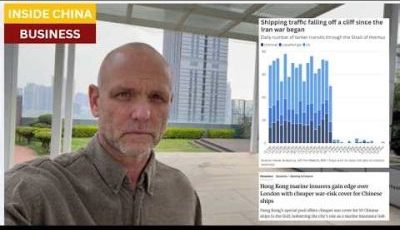
More Iran War fallout: Maritime insurance industry shifts from London to China
or go to
Aletho News Archives – Video-Images
From the Archives
The Biggest Threat to Peace in Middle East
By Dr. Elias Akleh* | Sabbah Report | May 24, 2010
A build up of heightened tension in the Middle East is escalating in the last few weeks. American and Israeli postures towards Lebanon, Syria, and Iran have become more threatening. Listening to speeches of political leaders one hears talks only about war not peace. Iranians and Israelis are continuously training hard for a possible showdown. Both sides are conducting extensive war games every month. This led Syrians to claim that Israel is preparing for a soon-to-come another war. The Jordanians also are warning that current stalemate of the peace process is an indication of a war breaking out this summer. The Russian President and his army chief hinted, a few months ago, that the US and Israel were planning for an attack on Iran.
Indeed Iran is, as it has been for last few years, the target of most of the threats and accusations of supporting terrorism. Escalating incitement against Iran the American Defense Department sent last month (April) to Congress a report on Iran’s military claiming Iran could develop intercontinental ballistic missiles capable of reaching the US by 2015.
Ignoring the fact that N. Korea, India, Pakistan, and Israel are proven to have nuclear weapons while Iran does not, the US Secretary of State Hillary Clinton chose in her speech, to the nuclear Non-Proliferation Treaty review conference at the UN, to focus on Iran’s alleged nuclear ambitions putting the whole world at risk as she put it. According to Clinton Iran’s acquisition of nuclear weapons, rather than Israel’s more than 200 nuclear bombs, is destabilizing the Middle East. She called on the world’s nations to rally around US efforts to hold Iran, not other nuclear countries, to account.
The accusation that Usama Bin Laden is living comfortably in Iran had received a boost after the broadcast of a documentary called “Feathered Cocaine”. This echoed the June 2003 claims of the Italian newspaper Corre de la Sierra that Bin Laden was in Iran according to some intelligence report, and according to Richard Miniter’s book “Shadow War”. … continue
Blog Roll
 Aletho News
- More Iran War fallout: Maritime insurance industry shifts from London to China
- US-Israeli aggression on Iran triggers review of GCC countries’ investment pledges to Washington
- Russia slams UK plan to seize tankers suspected of carrying its oil
- Pakistan ramps up food exports to Persian Gulf nations as war deepens food insecurity
- Iran submits response to US plan, sets terms for war’s end: Tasnim
- US vs Iran: Kharg Island Talk — Bluff or Escalation? Ex-Military Officer Weighs In
- Zelensky unnecessarily involves Ukraine in the Middle East crisis
- Turkish tanker blacklisted by Ukraine hit in drone attack – media
- Canada, the U.S., and NATO: the inescapable trap
- Villains of Judea: Leonid Radvinsky
- If Americans Knew
- ‘No Innocent Children’: Far-right Israeli Lawmaker Defends Killing of Palestinian Family
- Mossad’s promises helped Netanyahu convince Trump that Iran could be toppled
- US Arms Control Official Refuses To Comment When Asked If Israel Has Nuclear Weapons
- Veterans warn US landing could be ‘more Gallipoli than Vietnam’
- Israel may be committing war crimes in Lebanon – Not a ceasefire Day 167
- In the West Bank, life is a constant battle – 3 articles
- Jacob Reses, one of the most powerful pro-Israel operatives in Trump’s Washington
- Israeli-US assaults kill or injure 87 children a day – Not a ceasefire Day 166
- ‘Forever live by the sword’: Understanding Israelis’ massive support for Iran war
- UN’s special rapporteur on human rights says Israel is systematically torturing Palestinians
- No Tricks Zone
- Devastating Assessment Of Comirnaty Vaccine By Former Senior Pfizer Europe Toxicologist
- New Study: CO2 Is ‘Effectively Negligible’ As An Explanatory Climate Change Factor Since 2000
- Former Pfizer Toxicologist Dr. Helmut Sterz Tells Bundestag Hearing Pfizer Vaccine Should Have Never Been Approved
- Energy Expert: Germany’s Nuclear Phaseout Was A “500 Billion Euro Mistake”
- New Research: South Australia’s Mid-Holocene Sea Surface Temperatures Were 4°C Warmer Than Today
- Storing Green Energy To Last Germany 10 Days Would Require A 60-Million Tonne Battery
- New Studies: UK Sea Levels Were 4 Meters Higher Than Today During The Mid-Holocene
- Destructive Green New Deal: German Energy And Metal Group Warns Of Drastic Crisis
- New Study Documents A 20-Year Pause In Arctic Sea Ice Decline – Driven By Internal Variability
- Wake-up Call: Survey Shows Majority Of Germans Now Favor Postponing Climate Targets!
 Aletho News