Afghanistan war crimes probe a sham and cover-up for US
By Finian Cunningham | RT | November 14, 2017
When The Hague-based International Criminal Court (ICC) announced it was planning to investigate alleged war crimes in Afghanistan, the timing seemed appropriate.
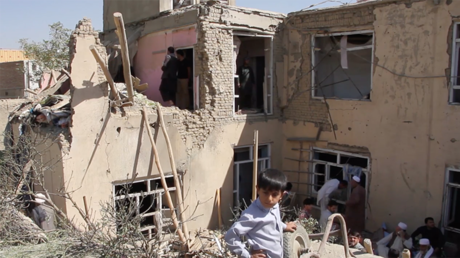
The announcement by the ICC on November 3 came within days of a deadly airstrike by US forces in northern Afghanistan, which UN officials say killed ten civilians.
But the history of the intergovernmental court since it was set up some 15 years ago gives pause to hope that it might deliver justice in Afghanistan. For many critics, the ICC is a byword for self-serving Western political control, either whitewashing crimes or smearing designated opponents. A pertinent question is: why has it taken the ICC so long to investigate alleged crimes in Afghanistan’s war?
The Pentagon claimed the air raid near the city of Kunduz on November 4 killed only Taliban militants. However, last week the United Nations Assistance Mission in Afghanistan (UNAMA) provided a very different version of events. UNAMA said extensive interviews with local residents and medics show that at least ten civilians died in the airstrike.
The incident would, therefore, be a prime case to investigate. ICC chief prosecutor Fatou Bensouda has promised an investigation into any alleged war crimes in Afghanistan would be “independent, impartial and objective.”
As a Reuters report stated, the ICC “could examine the role of US forces” in Afghanistan, which have been occupying the country for the past 16 years since October 2001, following the 9/11 terror attacks in Washington DC and New York City.
US torture practices conducted during CIA interrogations and renditions could also be probed, according to reports. An earlier announcement by the ICC said it would be looking into alleged violations committed by three parties: US military, Afghan security forces, and Taliban militants.
If the ICC did carry out an earnest probe into alleged war crimes in Afghanistan, it would have its work cut out – even if it just restricted itself to incidents involving US forces and the CIA.
Two years ago, in October 2015, the northern city of Kunduz was the location of another apparent atrocity committed by the US air force. A hospital run by the French-based Medecins Sans Frontieres (MSF) was bombed and machine-gunned by US aircraft, killing 42 medical staff and patients. MSF condemned the attack as a violation of the Geneva Convention – a war crime. Though, the Pentagon maintained that its forces made a mistake while targeting militants.
There is very little clarity on the number of Afghan civilians who have been killed by US forces over the past 16 years, from gun battles, house raids, drone strikes, and airstrikes. One estimate puts the total number of civilian deaths in the war at over 31,000. Many of them are victims of Taliban shootings, and bombings or operations carried out by the US-backed Afghan security forces.
Nevertheless, there are abundant incidents involving civilians being killed by US operations in what could merit war crimes prosecutions. This is especially so given the renewal of American military operations in the country ordered by President Trump in August this year – three years after the US forces were officially supposed to wind down.
Trump’s defense secretary James Mattis, on a trip to the Afghan capital Kabul in September, warned that US airstrikes would be ramped up in the coming months. Already this year, the UN reports that there was a surge in civilian casualties from American-backed air raids. The situation has an ominous resonance with how civilian casualties have escalated from increased US airstrikes in Iraq and Syria under the Trump administration’s wider authorization to the Pentagon to mount operations.
So, it seems clear that if the ICC were to open prosecution cases in Afghanistan it would, to say the least, be kept busy. However, critics of the ICC say that its intentions are not motivated by seeking justice.
It’s a political move, says international criminal lawyer Christopher Black.
Since its establishment in 2002, the international court has come in for much criticism that it is a “political tool” of the United States and European allies. Virtually all of the court’s prosecutions and indictments have been against African leaders. For example, Omar Bashir (Sudan), Uhuru Kenyatta (Kenya), Muammar Gaddafi (Libya), and Laurent Gbagbo (Ivory Coast) are among those indicted by the ICC.
The US is not a member of the 123-nation ICC. Neither are Russia, China, and India. However, the US exerts a controlling influence over the court’s prosecution office via European governments and the European Union, which are dominant in the administration of the ICC.
“The United States and its European allies use the ICC as a means of political control, not for justice,” says Christopher Black who is registered on the defense counsel for the court, but who has vociferously criticized its political subservience.
Black says the ICC has a similar function to several other ad hoc international tribunals, such as those which purportedly investigated war crimes in Rwanda and former Yugoslavia.
“These courts serve to cover-up actual crimes committed by Western powers while criminalizing political enemies of the West,” says Black.
In the case of former Yugoslavia, he points out, the Hague-based court did not examine the putative crimes of NATO bombing Belgrade in 1999. It only went after former Yugoslav President Slobodan Milosevic whom Washington and the European governments wanted to criminalize to justify NATO’s illegal intervention in the Balkans.
With regard to Afghanistan, the declared intention of the ICC to divide its investigations between US and Afghan parties raises the suspicion the court will seek to mitigate violations carried out by American forces by embroiling other criminal actors.
Even if the ICC were to find US forces guilty of war crimes, it is doubtful that Washington would take any notice of such rulings.
As Christopher Black points out too, the focus of any forthcoming investigation is misplaced in its entire framework. “The focus of a war crimes investigation should be looking at the way the US launched this military occupation back in 2001. A case can be made that the US is guilty of the supreme crime of war of aggression. All other violations stem from Washington committing the ultimate crime of going to war in Afghanistan.”
He says the ICC planned investigation is a piecemeal approach which will serve to conceal the primary responsibility of the US in Afghanistan.
So why then would the ICC bother to set up such a probe into Afghanistan?
The answer is simply to salvage much-needed credibility for the court. Because of its lop-sided focus in prosecuting African leaders, the ICC has come under fire from African members for “double standards” and serving as a neocolonial instrument for Western powers.
Beginning last year, several African nations threatened to walk away from the ICC, including Kenya, Namibia, South Africa, Gambia, and Uganda. Last month, Burundi formally completed its withdrawal from the ICC.
In other words, the court is in danger of imploding from lack of credibility. Hence, the announcement to go into Afghanistan is an attempt to salvage authority and public image by appearing to, at last, investigate alleged American war crimes.
“This is all about giving the ICC some badly needed credibility as it unravels in the face of a mass African walk-out,” says lawyer Christopher Black.
As such US and NATO states have nothing to fear from this proposed war crimes investigation in Afghanistan. It’s a cover-up and a sham driven by political interests, not by justice.
Finian Cunningham (born 1963) has written extensively on international affairs, with articles published in several languages. Originally from Belfast, Ireland, he is a Master’s graduate in Agricultural Chemistry and worked as a scientific editor for the Royal Society of Chemistry, Cambridge, England, before pursuing a career in newspaper journalism. For over 20 years he worked as an editor and writer in major news media organizations, including The Mirror, Irish Times and Independent. Now a freelance journalist based in East Africa, his columns appear on RT, Sputnik, Strategic Culture Foundation and Press TV.
Read more:
Arab states spent $130bn to destroy Syria, Libya, Yemen: Algerian PM
Press TV – November 12, 2017
Algerian Prime Minister Ahmed Ouyahia says some regional Arab states have spent $130 billion to obliterate Syria, Libya and Yemen.
Ouyahia made the remarks on Saturday at a time when much of the Middle East and North Africa is in turmoil, grappling with different crises, ranging from terrorism and insecurity to political uncertainty and foreign interference.
Algeria maintains that regional states should settle their differences through dialog and that foreign meddling is to their detriment.
Syria has been gripped by foreign-sponsored militancy since 2011. Takfirism, which is a trademark of many terrorist groups operating in Syria, is largely influenced by Wahhabism, the radical ideology dominating Saudi Arabia.
Libya has further been struggling with violence and political uncertainty since the country’s former ruler Muammar Gaddafi was deposed in 2011 and later killed in the wake of a US-led NATO military intervention. Daesh has been taking advantage of the chaos in Libya to increase its presence there.
Yemen has also witnessed a deadly Saudi war since March 2015 which has led to a humanitarian crisis.
Last Month, Qatar’s former deputy prime minister Abdullah bin Hamad al-Attiyah said the United Arab Emirates had planned a military invasion of Qatar with thousands of US-trained mercenaries.
The UAE plan for the military action was prepared before the ongoing Qatar rift, but it was never carried out as Washington did not give the green light to it, he noted.
In late April, reports said the UAE was quietly expanding its military presence into Africa and the Middle East, namely in Eritrea and Yemen.
The Eritrea “Massacre” That Never Happened
By Mela Ghebremedhin | Black Agenda Report | November 8, 2017
Mass protest. Mass rally. Indiscriminate gunshots. Mass casualties and death. These are some of the sensationalist words and phrases used to create buzz and portray events as simply black and white. They are often also used without nuance or context. Recently, Eritrea made the headlines after a group of teenagers walked down the streets of Asmara to voice their discontent at their school being closed. Shouting “Allahu Akbar”, the boys, mostly aged around 14-15, were walking from their neighborhood, Akria, towards the Ministry of Education.
Many Eritreans on the sidewalks, in shops and restaurants, and otherwise within the city center looked on in confusion, particularly with the chants of “God is Great” in Arabic. Generally, such loud, public proclamations are rare in a society long known for its sense of collective tolerance and respect. After some members of the group threw stones at several policemen, authorities dispersed the crowd and fired some shots into the sky. In total, the entire incident lasted several minutes, with no casualties or injuries.
However, almost instantly, reports of the incident were twisted, mashed, mixed and remade to provide an account that was quite far from the reality. One of the most culpable was Aljazeera. Lately, it seems that anything negative is a treasure for Aljazeera. Associated Press, reporting from Ethiopia, the BBC, and others followed not too long after. The statement by the US Embassy in Eritrea, warning its citizens from going to the city center, was also somewhat ironic considering that people in the streets of Asmara are far safer than those in the US, who must regularly confront police brutality and killings, stop and frisk campaigns, regular mass shootings, and general violence.
Ironically, as more time passed by, the more twisted the reports became. By Wednesday, the story was completely distorted. The Washington Post and its Ethiopian writer – with an extensive history of reports on Eritrea that later ended up being debunked – stated that 100 were injured and 28 killed, despite the fact that there were no casualties and no one was injured. Notably, it was overlooked that the source for the claim was the Red Sea Afar Democratic Organisation (RSADO), which is based in Ethiopia and is an internationally recognized terrorist group.
The Washington Post and its Ethiopian writer – with an extensive history of reports on Eritrea that later ended up being debunked – stated that 100 were injured and 28 killed, despite the fact that there were no casualties and no one was injured.
Expectedly, news outlets jumped on the new “fact” of multiple deaths and the story quickly began trending on Twitter. Repeated efforts at clarifying and providing an accurate account of the event were made by Eritreans, located both in the Diaspora and on the ground in Asmara, but they were largely ignored. Instead, self-titled experts on Eritrea and acknowledged regime change activists fueled the fire, and spread inaccurate, false accounts. Others would continue the lies by shifting the source of the youths’ discontent, and also claiming that the Internet, telephone lines, and power in the capital were cut – despite things proceeding as normal in the city. Soon afterwards, almost as expected, the AJStream started sending private messages to many on Twitter, inviting them on their show. Obvious, right?
It is hard to understand how, instead of pursuing the truth or trying to provide an objective, balanced account, mainstream media rejected information or views of people tweeting from on the ground in Asmara, dismissing them as “supporters of the dictatorship” or “regime sympathizers.” What mainstream media failed to understand, however, is that the great majority of Eritreans – regardless of gender, class, or faith – were disappointed and angry towards the youngsters. Eritrea is not a country divided along religious or ethnic lines.
Shortly after the brief, small incident things returned back to normal. Some men – ordinary civilians – did stay out during the night, but only to ensure that there would be no more incidents. Notably, no militia or army personnel were called in to stand guard; in Eritrea, the people themselves have a sense of ownership and civil responsibility, and the prevalent attitude was that no such incidents should happen again. Women even brought them food and drinks, and it was quite telling that both Muslims and Christians were standing together in solidarity and community, side by side. However, on the other side of the world, the media and the Internet were abuzz with fake news and false accounts.
It should be noted that, by law, Eritrea follows a secular system where religious schools and national curriculum of education are separate. The issue with the school being shut down was that some of the speeches by the staff were found to be radical and could have posed a threat to the tolerance and peace prevailing within the country. Similarly, in the past, other schools, such as Cathedrale (Catholic) and St. Mary’s (Orthodox), were also closed down illustrating that this latest closure had nothing to do with discrimination.
According to Eritrea’s National Charter of 1994, “the diverse cultures of Eritrea should be a source of power and unity. The national system should be secular, separate from religion, yet respectful of the equality of religions” (PFDJ 1994:9). This vision was enshrined during the long, bitter armed struggle where people from all layers of Eritrean society – regardless of religious background – came together to win the country’s independence.
In today’s Eritrea, implementing a secular system has helped ensure peace and tolerance in a region known more for its ethno-religious volatility, violence, and tensions. What mainstream media and individuals looking for storm and chaos in a general sea of calm totally fail to understand is that Eritreans have a long history of struggle. Eritreans paid a heavy price for independence and sovereignty, and the people condemn any signs of conflicts, violence, discrimination, or division. Thus, despite the continuous efforts to disturb this harmony, the country remains united and will continue to work toward a society based on peace, love, tolerance, and mutual respect.
Mela Ghebremedhin is a freelance journalist based in Asmara, Eritrea.
Glencore’s secret loan for Israeli billionaire to secure Congo mining rights revealed
RT | November 6, 2017
The world’s biggest mining firm Glencore secretly loaned tens of millions of dollars to an Israeli billionaire after enlisting him to secure a controversial mining agreement in the Democratic Republic of the Congo (DRC), it has been revealed. The details were leaked as part of the Paradise Papers.
A trove of more than 13 million documents from the world’s leading offshore law firms, including Appleby, was released through the International Consortium for Investigative Journalists (ICIJ) on Sunday. The documents lay bare the secretive multi-jurisdictional dealings of Glencore, a scandal-plagued, Anglo-Swiss multinational with mining interests across the globe.
As a friend of the Congolese President Joseph Kabila, Israeli billionaire Dan Gertler’s role has been questioned by anti-corruption campaigners since Glencore floated in London in 2011. His notoriety in the resource-rich but conflict-riven and corrupt DRC spans nearly two decades.
Gertler was cited by a 2001 UN investigation, which said that he had given Kabila $20 million to buy weapons to equip his army against rebel groups in exchange for a monopoly on the country’s diamonds. A 2013 Africa Progress Panel report said a string of mining deals struck by companies linked to him had deprived the country of more than $1.3 billion in potential revenue. Last year, he was implicated in a scheme to bribe Congolese officials on behalf of US hedge fund manager Och-Ziff Capital Management, according to Bloomberg.
According to the Guardian, the Paradise Papers confirm that several times during 2008 and 2009, Gertler was called in to negotiate with DRC authorities over the struggling Katanga copper mine in the southeast of the country, which was hampered by stalled talks to secure a joint-venture agreement with DRC’s state-run miner Gecamines.
In 2009, Glencore, through a loan offer, took effective control of Katanga, but also kept Gertler’s interest in the firm by secretly loaning his company Lora Enterprises $45 million in pledged shares for him to take part in the loan. The loan was granted with the caveat that it would be repayable in the event that an agreement was not made with DRC authorities to secure a contract for a company linked to the firm.
While the details of the loan have been previously reported, the new documents show that Gertler was required to secure certain approvals from the government in return, according to the Guardian.
Daniel Balint-Kurti of the Global Witness campaign group told The Times : “Glencore must explain to the world why it used a secret offshore company to pump millions of dollars to a controversial friend of the Congolese president linked to bribery scandals.”
In a written statement, lawyers for Gertler told the Guardian that neither he nor any company or person related to him received any loan funds directly, and any allegation that the $45 million loan was improper “demonstrates misapprehension of international finance transactions.”
“Mr Dan Gertler is a respectable businessman who contributes the vast majority of his wealth and time to the needy and to different communities, amounting to huge sums of money. He transacts business fairly and honestly, and strictly according to the law,” the statement said.
Gertler’s lawyers said there was no basis for the allegation that Katanga received “preferential terms” in its agreement with the DRC as a result of his involvement.
Glencore has dismissed any allegations of impropriety concerning the loan. The loan was made on commercial terms and “negotiated at arm’s length,” it told Bloomberg.
Chrystia Freeland: Canada doesn’t engage in “regime change”
A huge surprise to the people of Libya, Haiti, Honduras, Chile, Democratic Rep. Congo, Ghana, Uganda, Guatemala, and …
By Yves Engler | Dissident Voice | October 31, 2017
It may walk and quack like a regime-change-promoting duck, but Ottawa’s unilateral sanctions and support for Venezuela’s opposition is actually just a cuddly Canadian beaver, says Chrystia Freeland.
“Canada has never been an imperialist power. It’s even almost funny to say that phrase: we’ve been the colony,” said the journalist turned politician after a Toronto meeting of foreign ministers opposed to the Venezuelan government.
The above declaration was part of the Canadian foreign minister’s response to a question about Chavismo’s continued popularity, which was prefaced by a mention of protesters denouncing Ottawa’s interference in Venezuela’s internal affairs. Freeland added that “one of the strengths Canada brings to its international affairs” is that it doesn’t engage in “regime change”.
Notwithstanding her government’s violation of the UN and Organization of American States charters’ in Venezuela, Freeland’s claim that Ottawa doesn’t engage in “regime change” is laughable. Is she unaware that a Canadian General commanded the NATO force, which included Canadian fighter jets, naval vessels and special forces, that killed Muammar Gaddafi in Libya six years ago?
Sticking to contexts more directly applicable to the situation in Venezuela, Ottawa has repeatedly endorsed US-backed military coups against progressive elected leaders. Canada passively supported the ouster of Iranian Prime Minister Mohammad Mossadegh in 1953, Guatemalan President Jacobo Arbenz in 1954, Ugandan President Milton Obote (by Idi Amin) in 1971 and Chilean President Salvador Allende in 1973.
In a more substantial contribution to undermining electoral democracy, Ottawa backed the Honduran military’s removal of elected president Manuel Zelaya. Before his 2009 ouster Canadian officials criticized Zelaya and afterwards condemned his attempts to return to the country. Failing to suspend its military training program, Canada was also the only major donor to Honduras — the largest recipient of Canadian assistance in Central America — that failed to sever any aid to the military government. Six months after the coup Ottawa endorsed an electoral farce and immediately recognized the new right-wing government.
In the 1960s Ottawa played a more substantial role in the ouster of pan-Africanist independence leaders Kwame Nkrumah and Patrice Lumumba. In 1966 Ghana’s Canadian-trained army overthrew Nkrumah. In an internal memo to External Affairs just after Nkrumah was ousted, Canadian high commissioner in Accra, C.E. McGaughey wrote “a wonderful thing has happened for the West in Ghana and Canada has played a worthy part.” Soon after the coup, Ottawa informed the military junta that Canada intended to carry on normal relations and Canada sent $1.82 million ($15 million today) worth of flour to Ghana.
Ottawa had a strong hand in Patrice Lumumba’s demise. Canadian signals officers oversaw intelligence positions in the UN mission supposed to protect the territorial integrity of the newly independent Congo, but which Washington used to undermine the progressive independence leader. Canadian Colonel Jean Berthiaume assisted Lumumba’s political enemies by helping recapture him. The UN chief of staff, who was kept in place by Ottawa despite being labelled an “imperialist tool” by Lumumba’s advisers, tracked the deposed prime minister and informed army head Joseph Mobutu of Lumumba’s whereabouts. Soon after Lumumba was killed and Canadian officials celebrated the demise of an individual Prime Minister John Diefenbaker privately called a “major threat to Western interests”.
It’s in the Western Hemisphere’s poorest nation where Canada was most aggressive in opposing a progressive government. On January 31 and February 1, 2003, Jean Chrétien’s Liberal government organized an international gathering to discuss overthrowing Haiti’s elected government. No Haitian officials were invited to the “Ottawa Initiative on Haiti” where high-level US, Canadian and French officials decided that president Jean-Bertrand Aristide “must go”, the dreaded army should be recreated and that the country would be put under a Kosovo-like UN trusteeship.
Thirteen months after the “Ottawa Initiative on Haiti” meeting Aristide and most other elected officials were pushed out and a quasi UN trusteeship had begun. The Haitian National Police was also heavily militarized.
Canadian special forces “secured” the airport from which Aristide was bundled (“kidnapped” in his words) onto a plane by US Marines and deposited in the Central African Republic. Five hundred Canadian troops occupied Haiti for the next six months.
After cutting off aid to Haiti’s elected government, Ottawa provided tens of millions of dollars in foreign aid to the installed government, publicly supported coup officials and employed numerous officials within coup government ministries. Haiti’s deputy justice minister for the first 15 months of the foreign-installed government, Philippe Vixamar, was on the Canadian International Development Agency’s payroll and was later replaced by another CIDA employee (the minister was a USAID employee). Paul Martin made the first ever trip by a Canadian prime minister to Haiti to support the violent post-coup dictatorship.
Dismissing criticism of Ottawa’s regime change efforts in Venezuela by claiming Canada has been a benevolent international actor is wholly unconvincing. In fact, a serious look at this country’s foreign policy past gives every reason to believe that Ottawa is seeking to unseat an elected government that has angered many among the corporate set.
Anyone with their eyes open can tell the difference between a beaver and a duck.
Yves Engler is the author of A Propaganda System: How Canada’s Government, Corporations, Media and Academia Sell War and Canada in Africa: 300 years of aid and exploitation.
How America Spreads Global Chaos
By Nicolas J.S. Davies | Consortium News | October 30, 2017
As the recent PBS documentary on the American War in Vietnam acknowledged, few American officials ever believed that the United States could win the war, neither those advising Johnson as he committed hundreds of thousands of U.S. troops, nor those advising Nixon as he escalated a brutal aerial bombardment that had already killed millions of people.

U.S. F-105s bomb North Vietnam in 1966
(Photo credit: U.S. Air Force)
As conversations tape-recorded in the White House reveal, and as other writers have documented, the reasons for wading into the Big Muddy, as Pete Seeger satirized it, and then pushing on regardless, all came down to “credibility”: the domestic political credibility of the politicians involved and America’s international credibility as a military power.
Once the CIA went to work in Vietnam to undermine the 1954 Geneva Accords and the planned reunification of North and South through a free and fair election in 1956, the die was cast. The CIA’s support for the repressive Diem regime and its successors ensured an ever-escalating war, as the South rose in rebellion, supported by the North. No U.S. president could extricate the U.S. from Vietnam without exposing the limits of what U.S. military force could achieve, betraying widely held national myths and the powerful interests that sustained and profited from them.
The critical “lesson of Vietnam” was summed up by Richard Barnet in his 1972 book Roots of War. “At the very moment that the number one nation has perfected the science of killing,” Barnet wrote, “It has become an impractical means of political domination.”
Losing the war in Vietnam was a heavy blow to the CIA and the U.S. Military Industrial Complex, and it added insult to injury for every American who had lost comrades or loved ones in Vietnam, but it ushered in more than a decade of relative peace for America and the world. If the purpose of the U.S. military is to protect the U.S. from the danger of war, as our leaders so often claim, the “Vietnam syndrome,” or the reluctance to be drawn into new wars, kept the peace and undoubtedly saved countless lives.
Even the senior officer corps of the U.S. military saw it that way, since many of them had survived the horrors of Vietnam as junior officers. The CIA could still wreak havoc in Latin America and elsewhere, but the full destructive force of the U.S. military was not unleashed again until the invasion of Panama in 1989 and the First Gulf War in 1991.
Half a century after Vietnam, we have tragically come full circle. With the CIA’s politicized intelligence running wild in Washington and its covert operations spreading violence and chaos across every continent, President Trump faces the same pressures to maintain his own and his country’s credibility as Johnson and Nixon did. His predictable response has been to escalate ongoing wars in Syria, Iraq, Afghanistan, Yemen, Somalia and West Africa, and to threaten new ones against North Korea, Iran and Venezuela.
Trump is facing these questions, not just in one country, Vietnam, but in dozens of countries across the world, and the interests perpetuating and fueling this cycle of crisis and war have only become more entrenched over time, as President Eisenhower warned that they would, despite the end of the Cold War and, until now, the lack of any actual military threat to the United States.
Ironically but predictably, the U.S.’s aggressive and illegal war policy has finally provoked a real military threat to the U.S., albeit one that has emerged only in response to U.S. war plans. As I explained in a recent article, North Korea’s discovery in 2016 of a U.S. plan to assassinate its president, Kim Jong Un, and launch a Second Korean War has triggered a crash program to develop long-range ballistic missiles that could give North Korea a viable nuclear deterrent and prevent a U.S. attack. But the North Koreans will not feel safe from attack until their leaders and ours are sure that their missiles can deliver a nuclear strike against the U.S. mainland.
The CIA’s Pretexts for War
U.S. Air Force Colonel Fletcher Prouty was the chief of special operations for the Joint Chiefs of Staff from 1955 to 1964, managing the global military support system for the CIA in Vietnam and around the world. Fletcher Prouty’s book, The Secret Team: The CIA and its Allies in Control of the United States and the World, was suppressed when it was first published in 1973. Thousands of copies disappeared from bookstores and libraries, and a mysterious Army Colonel bought the entire shipment of 3,500 copies the publisher sent to Australia. But Prouty’s book was republished in 2011, and it is a timely account of the role of the CIA in U.S. policy.
Prouty surprisingly described the role of the CIA as a response by powerful people and interests to the abolition of the U.S. Department of War and the creation of the Department of Defense in 1947. Once the role of the U.S. military was redefined as one of defense, in line with the United Nations Charter’s prohibition against the threat or use of military force in 1945 and similar moves by other military powers, it would require some kind of crisis or threat to justify using military force in the future, both legally and politically. The main purpose of the CIA, as Prouty saw it, is to create such pretexts for war.
The CIA is a hybrid of an intelligence service that gathers and analyzes foreign intelligence and a clandestine service that conducts covert operations. Both functions are essential to creating pretexts for war, and that is what they have done for 70 years.
Prouty described how the CIA infiltrated the U.S. military, the State Department, the National Security Council and other government institutions, covertly placing its officers in critical positions to ensure that its plans are approved and that it has access to whatever forces, weapons, equipment, ammunition and other resources it needs to carry them out.
Many retired intelligence officers, such as Ray McGovern and the members of Veteran Intelligence Professionals for Sanity (VIPS), saw the merging of clandestine operations with intelligence analysis in one agency as corrupting the objective analysis they tried to provide to policymakers. They formed VIPS in 2003 in response to the fabrication of politicized intelligence that provided false pretexts for the U.S. to invade and destroy Iraq.
CIA in Syria and Africa
But Fletcher Prouty was even more disturbed by the way that the CIA uses clandestine operations to trigger coups, wars and chaos. The civil and proxy war in Syria is a perfect example of what Prouty meant. In late 2011, after destroying Libya and aiding in the torture-murder of Muammar Gaddafi, the CIA and its allies began flying fighters and weapons from Libya to Turkey and infiltrating them into Syria. Then, working with Saudi Arabia, Qatar, Turkey, Croatia and other allies, this operation poured thousands of tons of weapons across Syria’s borders to ignite and fuel a full-scale civil war.
Once these covert operations were under way, they ran wild until they had unleashed a savage Al Qaeda affiliate in Syria (Jabhat al-Nusra, now rebranded as Jabhat Fateh al-Sham), spawned the even more savage “Islamic State,” triggered the heaviest and probably the deadliest U.S. bombing campaign since Vietnam and drawn Russia, Iran, Turkey, Israel, Jordan, Hezbollah, Kurdish militias and almost every state or armed group in the Middle East into the chaos of Syria’s civil war.
Meanwhile, as Al Qaeda and Islamic State have expanded their operations across Africa, the U.N. has published a report titled Journey to Extremism in Africa: Drivers, Incentives and the Tipping Point for Recruitment, based on 500 interviews with African militants. This study has found that the kind of special operations and training missions the CIA and AFRICOM are conducting and supporting in Africa are in fact the critical “tipping point” that drives Africans to join militant groups like Al Qaeda, Al-Shabab and Boko Haram.
The report found that government action, such as the killing or detention of friends or family, was the “tipping point” that drove 71 percent of African militants interviewed to join armed groups, and that this was a more important factor than religious ideology.
The conclusions of Journey to Extremism in Africa confirm the findings of other similar studies. The Center for Civilians in Conflict interviewed 250 civilians who joined armed groups in Bosnia, Somalia, Gaza and Libya for its 2015 study, The People’s Perspectives: Civilian Involvement in Armed Conflicts. The study found that the most common motivation for civilians to join armed groups was simply to protect themselves or their families.
The role of U.S. “counterterrorism” operations in fueling armed resistance and terrorism, and the absence of any plan to reduce the asymmetric violence unleashed by the “global war on terror,” would be no surprise to Fletcher Prouty. As he explained, such clandestine operations always take on a life of their own that is unrelated, and often counter-productive, to any rational U.S. policy objective.
“The more intimate one becomes with this activity,” Prouty wrote, “The more one begins to realize that such operations are rarely, if ever, initiated from an intent to become involved in pursuit of some national objective in the first place.”
The U.S. justifies the deployment of 6,000 U.S. special forces and military trainers to 53 of the 54 countries in Africa as a response to terrorism. But the U.N.’s Journey to Extremism in Africa study makes it clear that the U.S. militarization of Africa is in fact the “tipping point” that is driving Africans across the continent to join armed resistance groups in the first place.
This is a textbook CIA operation on the same model as Vietnam in the late 1950s and early 60s. The CIA uses U.S. special forces and training missions to launch covert and proxy military operations that drive local populations into armed resistance groups, and then uses the presence of those armed resistance groups to justify ever-escalating U.S. military involvement. This is Vietnam redux on a continental scale.
Taking on China
What seems to really be driving the CIA’s militarization of U.S. policy in Africa is China’s growing influence on the continent. As Steve Bannon put it in an interview with the Economist in August, “Let’s go screw up One Belt One Road.”
China is already too big and powerful for the U.S. to apply what is known as the Ledeen doctrine named for neoconservative theorist and intelligence operative Michael Ledeen who suggested that every 10 years or so, the United States “pick up some small crappy little country and throw it against the wall, just to show we mean business.”
China is too powerful and armed with nuclear weapons. So, in this case, the CIA’s job would be to spread violence and chaos to disrupt Chinese trade and investment, and to make African governments increasingly dependent on U.S. military aid to fight the militant groups spawned and endlessly regenerated by U.S.-led “counterterrorism” operations.
Neither Ledeen nor Bannon pretend that such policies are designed to build more prosperous or viable societies in the Middle East or Africa, let alone to benefit their people. They both know very well what Richard Barnet already understood 45 years ago, that America’s unprecedented investment in weapons, war and CIA covert operations are only good for one thing: to kill people and destroy infrastructure, reducing cities to rubble, societies to chaos and the desperate survivors to poverty and displacement.
As long as the CIA and the U.S. military keep plunging the scapegoats for our failed policies into economic crisis, violence and chaos, the [elite elements of] United States and the United Kingdom can remain the safe havens of the world’s wealth, islands of privilege and excess amidst the storms they unleash on others.
But if that is the only “significant national objective” driving these policies, it is surely about time for the 99 percent of Americans who reap no benefit from these murderous schemes to stop the CIA and its allies before they completely wreck the already damaged and fragile world in which we all must live, Americans and foreigners alike.
Douglas Valentine has probably studied the CIA in more depth than any other American journalist, beginning with his book on The Phoenix Program in Vietnam. He has written a new book titled The CIA as Organized Crime: How Illegal Operations Corrupt America and the World, in which he brings Fletcher Prouty’s analysis right up to the present day, describing the CIA’s role in our current wars and the many ways it infiltrates, manipulates and controls U.S. policy.
The Three Scapegoats
In Trump’s speech to the U.N. General Assembly, he named North Korea, Iran and Venezuela as his prime targets for destabilization, economic warfare and, ultimately, the overthrow of their governments, whether by coup d’etat or the mass destruction of their civilian population and infrastructure. But Trump’s choice of scapegoats for America’s failures was obviously not based on a rational reassessment of foreign policy priorities by the new administration. It was only a tired rehashing of the CIA’s unfinished business with two-thirds of Bush’s “axis of evil” and Bush White House official Elliott Abrams’ failed 2002 coup in Caracas, now laced with explicit and illegal threats of aggression.
How Trump and the CIA plan to sacrifice their three scapegoats for America’s failures remains to be seen. This is not 2001, when the world stood silent at the U.S. bombardment and invasion of Afghanistan after September 11th. It is more like 2003, when the U.S. destruction of Iraq split the Atlantic alliance and alienated most of the world. It is certainly not 2011, after Obama’s global charm offensive had rebuilt U.S. alliances and provided cover for French President Sarkozy, British Prime Minister Cameron, Secretary of State Hillary Clinton and the Arab royals to destroy Libya, once ranked by the U.N. as the most developed country in Africa, now mired in intractable chaos.
In 2017, a U.S. attack on any one of Trump’s scapegoats would isolate the United States from many of its allies and undermine its standing in the world in far-reaching ways that might be more permanent and harder to repair than the invasion and destruction of Iraq.
In Venezuela, the CIA and the right-wing opposition are following the same strategy that President Nixon ordered the CIA to inflict on Chile, to “make the economy scream” in preparation for the 1973 coup. But the solid victory of Venezuela’s ruling Socialist Party in recent nationwide gubernatorial elections, despite a long and deep economic crisis, reveals little public support for the CIA’s puppets in Venezuela.
The CIA has successfully discredited the Venezuelan government through economic warfare, increasingly violent right-wing street protests and a global propaganda campaign. But the CIA has stupidly hitched its wagon to an extreme right-wing, upper-class opposition that has no credibility with most of the Venezuelan public, who still turn out for the Socialists at the polls. A CIA coup or U.S. military intervention would meet fierce public resistance and damage U.S. relations all over Latin America.
Boxing In North Korea
A U.S. aerial bombardment or “preemptive strike” on North Korea could quickly escalate into a war between the U.S. and China, which has reiterated its commitment to North Korea’s defense if North Korea is attacked. We do not know exactly what was in the U.S. war plan discovered by North Korea, so neither can we know how North Korea and China could respond if the U.S. pressed ahead with it.
Most analysts have long concluded that any U.S. attack on North Korea would be met with a North Korean artillery and missile barrage that would inflict unacceptable civilian casualties on Seoul, a metropolitan area of 26 million people, three times the population of New York City. Seoul is only 35 miles from the frontier with North Korea, placing it within range of a huge array of North Korean weapons. What was already a no-win calculus is now compounded by the possibility that North Korea could respond with nuclear weapons, turning any prospect of a U.S. attack into an even worse nightmare.
U.S. mismanagement of its relations with North Korea should be an object lesson for its relations with Iran, graphically demonstrating the advantages of diplomacy, talks and agreements over threats of war. Under the Agreed Framework signed in 1994, North Korea stopped work on two much larger nuclear reactors than the small experimental one operating at Yongbyong since 1986, which only produces 6 kg of plutonium per year, enough for one nuclear bomb.
The lesson of Bush’s Iraq invasion in 2003 after Saddam Hussein had complied with demands that he destroy Iraq’s stockpiles of chemical weapons and shut down a nascent nuclear program was not lost on North Korea. Not only did the invasion lay waste to large sections of Iraq with hundreds of thousands of dead but Hussein himself was hunted down and condemned to death by hanging.
Still, after North Korea tested its first nuclear weapon in 2006, even its small experimental reactor was shut down as a result of the “Six Party Talks” in 2007, all the fuel rods were removed and placed under supervision of the International Atomic Energy Agency, and the cooling tower of the reactor was demolished in 2008.
But then, as relations deteriorated, North Korea conducted a second nuclear weapon test and again began reprocessing spent fuel rods to recover plutonium for use in nuclear weapons.
North Korea has now conducted six nuclear weapons tests. The explosions in the first five tests increased gradually up to 15-25 kilotons, about the yield of the bombs the U.S. dropped on Hiroshima and Nagasaki, but estimates for the yield of the 2017 test range from 110 to 250 kilotons, comparable to a small hydrogen bomb.
The even greater danger in a new war in Korea is that the U.S. could unleash part of its arsenal of 4,000 more powerful weapons (100 to 1,200 kilotons), which could kill millions of people and devastate and poison the region, or even the world, for years to come.
The U.S. willingness to scrap the Agreed Framework in 2003, the breakdown of the Six Party Talks in 2009 and the U.S. refusal to acknowledge that its own military actions and threats create legitimate defense concerns for North Korea have driven the North Koreans into a corner from which they see a credible nuclear deterrent as their only chance to avoid mass destruction.
China has proposed a reasonable framework for diplomacy to address the concerns of both sides, but the U.S. insists on maintaining its propaganda narratives that all the fault lies with North Korea and that it has some kind of “military solution” to the crisis.
This may be the most dangerous idea we have heard from U.S. policymakers since the end of the Cold War, but it is the logical culmination of a systematic normalization of deviant and illegal U.S. war-making that has already cost millions of lives in Afghanistan, Iraq, Syria, Libya, Somalia, Yemen and Pakistan. As historian Gabriel Kolko wrote in Century of War in 1994, “options and decisions that are intrinsically dangerous and irrational become not merely plausible but the only form of reasoning about war and diplomacy that is possible in official circles.”
Demonizing Iran
The idea that Iran has ever had a nuclear weapons program is seriously contested by the IAEA, which has examined every allegation presented by the CIA and other Western “intelligence” agencies as well as Israel. Former IAEA Director General Mohamed ElBaradei revealed many details of this wild goose chase in his 2011 memoir, Age of Deception: Nuclear Diplomacy in Treacherous Times.
When the CIA and its partners reluctantly acknowledged the IAEA’s conclusions in a 2007 National Intelligence Estimate (NIE), ElBaradei issued a press release confirming that, “the agency has no concrete evidence of an ongoing nuclear weapons program or undeclared nuclear facilities in Iran.”
Since 2007, the IAEA has resolved all its outstanding concerns with Iran. It has verified that dual-use technologies that Iran imported before 2003 were in fact used for other purposes, and it has exposed the mysterious “laptop documents” that appeared to show Iranian plans for a nuclear weapon as forgeries. Gareth Porter thoroughly explored all these questions and allegations and the history of mistrust that fueled them in his 2014 book, Manufactured Crisis: the Untold Story of the Iran Nuclear Scares, which I highly recommend.
But, in the parallel Bizarro world of U.S. politics, hopelessly poisoned by the CIA’s endless disinformation campaigns, Hillary Clinton could repeatedly take false credit for disarming Iran during her presidential campaign, and neither Bernie Sanders, Donald Trump nor any corporate media interviewer dared to challenge her claims.
“When President Obama took office, Iran was racing toward a nuclear bomb,” Clinton fantasized in a prominent foreign policy speech on June 2, 2016, claiming that her brutal sanctions policy “brought Iran to the table.”
In fact, as Trita Parsi documented in his 2012 book, A Single Roll of the Dice: Obama’s Diplomacy With Iran, the Iranians were ready, not just to “come to the table,” but to sign a comprehensive agreement based on a U.S. proposal brokered by Turkey and Brazil in 2010. But, in a classic case of “tail wags dog,” the U.S. then rejected its own proposal because it would have undercut support for tighter sanctions in the U.N. Security Council. In other words, Clinton’s sanctions policy did not “bring Iran to the table”, but prevented the U.S. from coming to the table itself.
As a senior State Department official told Trita Parsi, the real problem with U.S. diplomacy with Iran when Clinton was at the State Department was that the U.S. would not take “Yes” for an answer. Trump’s ham-fisted decertification of Iran’s compliance with the JCPOA is right out of Clinton’s playbook, and it demonstrates that the CIA is still determined to use Iran as a scapegoat for America’s failures in the Middle East.
The spurious claim that Iran is the world’s greatest sponsor of terrorism is another CIA canard reinforced by endless repetition. It is true that Iran supports and supplies weapons to Hezbollah and Hamas, which are both listed as terrorist organizations by the U.S. government. But they are mainly defensive resistance groups that defend Lebanon and Gaza respectively against invasions and attacks by Israel.
Shifting attention away from Al Qaeda, Islamic State, the Libyan Islamic Fighting Group and other groups that actually commit terrorist crimes around the world might just seem like a case of the CIA “taking its eyes off the ball,” if it wasn’t so transparently timed to frame Iran with new accusations now that the manufactured crisis of the nuclear scare has run its course.
What the Future Holds
Barack Obama’s most consequential international achievement may have been the triumph of symbolism over substance behind which he expanded and escalated the so-called “war on terror,” with a vast expansion of covert operations and proxy wars that eventually triggered the heaviest U.S. aerial bombardments since Vietnam in Iraq and Syria.
Obama’s charm offensive invigorated old and new military alliances with the U.K., France and the Arab monarchies, and he quietly ran up the most expensive military budget of any president since World War Two.
But Obama’s expansion of the “war on terror” under cover of his deceptive global public relations campaign created many more problems than it solved, and Trump and his advisers are woefully ill-equipped to solve any of them. Trump’s expressed desire to place America first and to resist foreign entanglements is hopelessly at odds with his aggressive, bullying approach to every foreign policy problem.
If the U.S. could threaten and fight its way to a resolution of any of its international problems, it would have done so already. That is exactly what it has been trying to do since the 1990s, behind both the swagger and bluster of Bush and Trump and the deceptive charm of Clinton and Obama: a “good cop – bad cop” routine that should no longer fool anyone anywhere.
But as Lyndon Johnson found as he waded deeper and deeper into the Big Muddy in Vietnam, lying to the public about unwinnable wars does not make them any more winnable. It just gets more people killed and makes it harder and harder to ever tell the public the truth.
In unwinnable wars based on lies, the “credibility” problem only gets more complicated, as new lies require new scapegoats and convoluted narratives to explain away graveyards filled by old lies. Obama’s cynical global charm offensive bought the “war on terror” another eight years, but that only allowed the CIA to drag the U.S. into more trouble and spread its chaos to more places around the world.
Meanwhile, Russian President Putin is winning hearts and minds in capitals around the world by calling for a recommitment to the rule of international law, which prohibits the threat or use of military force except in self-defense. Every new U.S. threat or act of aggression will only make Putin’s case more persuasive, not least to important U.S. allies like South Korea, Germany and other members of the European Union, whose complicity in U.S. aggression has until now helped to give it a false veneer of political legitimacy.
Throughout history, serial aggression has nearly always provoked increasingly united opposition, as peace-loving countries and people have reluctantly summoned the courage to stand up to an aggressor. France under Napoleon and Hitler’s Germany also regarded themselves as exceptional, and in their own ways they were. But in the end, their belief in their exceptionalism led them on to defeat and destruction.
Americans had better hope that we are not so exceptional, and that the world will find a diplomatic rather than a military “solution” to its American problem. Our chances of survival would improve a great deal if American officials and politicians would finally start to act like something other than putty in the hands of the CIA.
Nicolas J. S. Davies is the author of Blood On Our Hands: the American Invasion and Destruction of Iraq. He also wrote the chapters on “Obama at War” in Grading the 44th President: a Report Card on Barack Obama’s First Term as a Progressive Leader.
Featured Video
Houthis Keep Advancing as the Red Sea Crisis Deepens
or go to
Aletho News Archives – Video-Images
From the Archives
15 Saudi ‘hijackers’ were CIA agents working for US: Scholar
Press TV – April 13, 2016
Fifteen of the 9/11 “hijackers” from Saudi Arabia were CIA agents working for the United States government, which was seeking to destroy the Middle East for Israel and to double the American military budget, says Dr. Kevin Barrett, an American academic who has been studying the events of 9/11 since late 2003…. continue
Blog Roll
 Aletho News
- Russia Just Struck the Eyes of NATO’s War Machine in Ukraine
- Russia summons UK charge d’affaires over Kiev drone support
- NATO member warns bloc seeking pretext for war with Russia
- Macgregor: We Haven’t Seen the Worst of the Iran War Yet
- ‘We are not like everyone else’ laws that bind other nations do not apply to Israel, says Likud lawmaker
- Report: Saudi Arabia seeks allies’ assistance as missiles deplete amid war on Yemen
- Fuel Crisis Deepens: Pakistan Warns Tanker Attack in Red Sea Would Be an ‘Act of War’
- ‘Bucha massacre’ a false flag orchestrated by UK – Moscow
- China Rejects Outside Pressure on Trade Ties After New US Russia Sanctions Bill
- Houthis Keep Advancing as the Red Sea Crisis Deepens
- If Americans Knew
- An error has occurred; the feed is probably down. Try again later.
- No Tricks Zone
- New Study: ‘Global Drought Shows No Detectable Recent Acceleration Under Climate Warming’
- Economic Masterminds: German Socialists Suggest Taxing Productivity Gains Stemming From Using AI
- The South China Sea Has Not Been Cooperating With The Climate Change Narrative
- Energy Crisis: Germany Enters Heating Season With Historically Low Gas Reserve Fill Levels
- New Study: The Antarctic Ice Sheet Gained Mass From 2020-2024 Due To Staggering Snow And Ice Accumulation
- Study: Ocean Heating Rates From Thousands Of Years Ago ‘Dwarf’ Modern Ocean Heating Rates
- Climate Extremists Target, Attack Large-Scale Power Grid Infrastructure In Germany!
- New Study: Antarctic Ice Melt Has Contributed Less Than 1 Centimeter To Sea Level Rise In The Last 30 Years
- Fear Of Debate: Alarmist German Climate Scientist Calls On Mainstream Media To Discredit Skeptic Voices
- End-Of-August Arctic Sea Ice Extent Hasn’t Fallen In 20 Years, Official Data Show!
 Aletho News