Opportunities should not be squandered. It is especially important at a time when the overall political relationship between Washington and Moscow has tumbled to a nadir. Donald Trump’s victory and the expected drastic changes in US foreign policy open up new prospects for the improvement of bilateral relations.
It is useless to make predictions without the new president announcing who his foreign policy advisers will be. But it is possible to define in general terms what could and should be done to change the tide.
With arms control and non-proliferation in doldrums, the tensions over Ukraine, the standoff between Russia and NATO and the failure to cooperate efficiently in Syria, the mission seems to be more of a tall order, but it would be a great mistake to waste time.
The next president needs to accept that Moscow cannot simply be defeated or contained but it can be engaged through a comprehensive balance of cooperation and competition. Mr. Trump is savvy when it comes to the economy but in order to tackle the relationship with Russia he’ll have to go outside of his comfort zone as the divisions are mainly related to security issues. However, his business experience resulting in a pragmatic and business-like approach to foreign policy issues may be just exactly what is required to mark a new page in the Russia-US relationship.
Steps to prevent backsliding on nuclear disarmament must be taken during the Donald Trump’s tenure. This is a key issue to shape the global nuclear security landscape. Setting aside the existing differences over other issues to take the bull by the horn and achieve progress on strategic nuclear arms control regime is the only way to go about it.
The problem is aggravated by the fact that Russia and the US have not had meaningful negotiations on this issue for almost three years, much like it was in the days of the Cold War when there were no contacts to discuss it in the period from 1983 to 1985.
Currently, the New Strategic Arms Reduction Treaty (New START) is in force. The treaty expires in February 2021, just three years after the parties are required to complete reductions in 2018. It can be prolonged for 5 years more if the parties agree. It remains unclear whether the United States and Russia can establish a new arms control regime.
If the two leading nuclear powers slide into a nuclear arms race, it will also adversely affect China’s interests and make it adjust its own nuclear policies – quite a headache for the new US commander-in-chief.
The future of the 1987 Intermediate-range Nuclear Forces (INF) treaty – a landmark Cold War-era agreement – has become a very contentious issue. Time is running out. The INF is a pillar of European security, if it is weakened or discarded, the whole system will collapse. Russia says the Mk 41 vertical launching system for SM-3 missile interceptors based in Romania (and slated for deployment in Poland in 2018) is similar to those on US Navy ships and can launch cruise missiles. This is a flagrant violation of the treaty which bans the use of such launchers. There are other problems related to the compliance with the treaty as both sides blame each other for failure to abide by its provisions. Donald Trump will have to deal with this problem on his watch. For instance, the new administration could offer transparency measures regarding the vertical launch boxes allowing to verify if they really hold interceptors, not cruise missiles.
The agenda of the president-elect includes NATO deployments in Eastern Europe to make Russia consider stationing short-range missiles near its borders that could be used in both nuclear and conventional scenarios. This development would increase Russia’s emphasis on tactical nuclear weapons (TNW), sending the Russia-NATO security relationship into a downward cycle.
The ballistic missile defense (BMD) is a threat to global stability. No progress in other areas is achievable without coming to agreements on the BMD.
To begin with, the new administration could make some steps to make sure that BMD systems do not undermine Russia’s assured second-strike capability. The interceptors could be located in geographic areas to make the interception of Russian intercontinental ballistic missiles (ICBMs) impossible. Radars could be redeployed not to provide substantial coverage of Russia. Anyway, the problem is too acute to be shelved. Donald Trump’s administration will have to deal with it one way or another.
The parties could launch regular discussions of the overall direction of ballistic missile programs, exchange intelligence and review developments assessing the missile threats and ways to counter them. Transparency is the best confidence building measure. US forward-deployed conventional strike assets with standoff range – boost-glide systems in particular – add to the problem.
It might be sensible to discuss the implications of conventionally armed cruise missiles for the strategic nuclear balance. Hypersonic missiles are very destabilizing weapons that should be covered by appropriate agreements. Some formal limitations would enhance security and mitigate the concerns of Russia, which feels threatened and has to respond.
If the problem of US conventional first strike superiority is not addressed – no agreement of tactical nuclear weapons is possible. Introducing limits is appropriate. The final goal in each and every case should be a formal binding agreement.
Military activities and conventional forces is another burning issue the Trump administration has to grapple with. Germany has recently come up with a proposal to start talks on a new Russia-NATO arms control agreement to comprise regional caps on armaments, transparency measures, rules covering new military technology such as drones, and the ability to control arms even in disputed territories.
Russia and the US could join together to convene a conference, presumably under the auspices of the Organization for Security and Cooperation in Europe with the full involvement of all relevant states.
With all the problems in existence and the proposed ways to tackle them, Russia and the US could scope out the issues and agree on how formal negotiations should be conducted.
Exploratory arms control discussions would help establish a useful venue for dialogue on other pressing problems. The agenda could be broadened to regional conflicts, with Ukraine and Syria discussed as separate issues. Enhancing the forums, like the Organization for Security and Co-operation in Europe (OSCE) and the NATO-Russia Council would be a step in the right direction. Achieving tangible progress on one issue could lead to positive results in other areas.
Donald Trump has said he is ready to ally with Russia in the fight against Islamic State. It could be a good start. The post-war crisis management is a key area where both countries could be allies as they are fighting the same enemy. International cooperation is crucial for success in Syria, Iraq and Libya. Russia and the United States leading the process would become a historic milestone to benefit all.
Cooperation in the Middle East and North Africa would change the Russia-West relationship for the better.
Lifting the anti-Russian sanctions so unpopular among US allies would greatly enhance the prospects for success. «Clearly the chances of sanctions being lifted on Russia have risen substantially», Charles Robertson, Renaissance Capital’s global chief economist, said. «That would improve the investment climate for Russia».
With the sanctions lifted, the parties could apply efforts to improve economic cooperation – the weak point of bilateral relationship. Actually, economy has never been high on the Russia-US agenda. Donald Trump is an experienced businessman, he could spur the process.
The president-elect is the right person to turn the tide in the Russia-US relations because he is independently minded and not tied to Washington’s establishment. He can avoid specific bureaucratic pitfalls and keep neocons and liberal hawks from positions of power something his predecessor has failed to do. As the presidential race has showed, he can see a problem from the other side’s perspective. What if Russia deployed forces and BMD installations near the US borders? He has imagination to understand such things. Donald Trump seems to possess the needed leadership traits to stand up to pressure and do things his way. His election victory is an opportunity not to miss. Normalizing relations with Russia will be a great foreign policy success – a historic legacy to make him go down in history as a great president.
November 10, 2016
Posted by aletho |
Economics, Militarism, Timeless or most popular | Africa, Donald Trump, Middle East, NATO, Russia, United States |
Leave a comment
Protests erupted yesterday in the Western Sahara over the construction of renewable energy plants without the permission of the Sahrawi people.
The protests, which took place in the capital Laayoune, coincided with the United Nation’s COP22 conference on climate change yesterday in Marrakech.
Siemens and Enel are building solar and wind plants in the region
“Siemens should not back Morocco’s occupation of Western Sahara through energy infrastructure,” the Western Sahara Resource Watch (WRSW) said on social media.
Siemens has constructed 22 new renewable energy plants in the Western Sahara, which power over 95 per cent of mineral extraction plants in the Sahrawi region.
The World Bank, the European Investment Bank, and the European Union have previously refused to finance development projects in Western Sahara.
“If we support those investments, it would look like we are supporting the Moroccan position. We are neutral regarding that conflict,” a banker told Reuters.
The contested region has recently been engrossed in tensions between Morocco and the Sahrawi Polisario Front which has been ongoing since 1975.
November 9, 2016
Posted by aletho |
Economics, Illegal Occupation | Africa, European Union, Morocco, Sahrawi Polisario Front, Solar energy, Western Sahara, World Bank |
Leave a comment
A few days after Burundi, South Africa and The Gambia announced their intention to withdraw from the International Criminal Court an article appeared in the American journal, Foreign Policy, stating that the ICC is considering investigating allegations of war crimes that may have been committed in Afghanistan. The allegations are spread among the Afghan resistance to the western invasion and occupation of the country, the puppet government installed by the United States, and the United States itself.
This has caused some surprise among observers of the ICC who have correctly criticised the tribunal as an asset of the US and its allies since it has only gone after certain African leaders who stand in the way of western interests while providing complete immunity to other leaders who are useful agents of those interests. Some of them have accused it of racism, a charge difficult to refute but which misses the point that the objective is the projection of imperial power.
The United States, though not a member of the ICC, has established its dominating influence in the staff of the tribunal so that it and its Canadian and EU allies effectively control its machinery, most importantly the prosecution, the administration and the selection of judges. It is because of this influence that the ICC falsely accused Muammar Gadhafi with crimes in 2011 thereby helping it excuse the NATO aggression against Libya and also provoking and excusing his murder.
The ICC is meant to prevent war crimes and war but it has been used in fact to overthrow governments and throw their leaders in prison, or in the tragic case of Muammar Gadhafi, provoke war and excuse murder; just as the ICTY in The Hague was used to justify the NATO aggression against Yugoslavia and the arrest and death in NATO hands of President Milosevic. The ICC continues in that criminal tradition.
But is this announcement a surprise, a hopeful step that the ICC may live up to its claims? The answer is a clear no. The timing of the announcement and its delivery are interesting. It comes within a few days of the disastrous blows to its prestige and credibility with the withdrawal of the African countries. Something needed to be done to try to restore some credibility, some appearance of impartiality; and that is what the announcement does, or tries to do because it will soon be realised that it is a cheap trick, a charade, designed to save the ICC so that the United States and its allies can continue to use it as they see fit, as a means of control, not justice.
It is not a surprise in the first place because the ICC made public its Report on Preliminary Examination Activities on November 12, 2015. In that report there is a section on Afghanistan setting out more or less the contents in the Foreign Policy Report. It makes interesting reading and starts off with a lie that indicates where we can expect this investigation to go.
On page 26 the document states,
-
“After the attacks of 11 September 2001, in Washington D.C. and New York City, a United States-led coalition launched air strikes and ground operations in Afghanistan against the Taliban, suspected of harbouring Osama Bin Laden. The Taliban were ousted from power by the end of the year. In December 2001, under the auspices of the UN, an interim governing authority was established in Afghanistan.”
This is a lie because the Taliban government, a government installed by the United States in the first place, was not “harbouring” Bin Laden. They stated to the US government, when it demanded they turn him over in 2001, that he was in the country but by law they were required to demand that the US provide them with evidence that he was involved in the events in New York. The US flatly refused to provide any evidence to form the basis of a legal extradition so the Afghanistan government refused to hand him over. Any country would have been required by law to do the same. Instead of a file containing evidence they received cruise missiles and exploding bombs. Bin Laden of course was just the excuse, not the reason for the war. So for the ICC to state a lie that serves the narrative of the United States and then to continue with the joke that instead of the US overthrowing the Afghan government, (they were “ousted from power” they say, but how and by who is not said), they in fact helped to reestablish government, with the help of the peace loving UN, is to give the United States immunity from prosecution of the ultimate crime of aggression against Afghanistan that still continues today and all the war crimes that have flowed from that aggression. They bear the ultimate responsibility. But since the ICC sees fit to rewrite history in favour of the United States in its investigation of the war how can we expect it to ever prosecute that nation for the crimes it has committed?
Most of the document discusses allegations of crimes and some attention is paid to allegations against US forces and Afghan government forces but most of it is concerned with crimes of the Taliban. Where it discusses war crimes allegedly committed by the United States it points out that the US is investigating those allegations and has taken disciplinary action against those responsible in hundreds of cases. The question then is whether the United States is properly investigating and then prosecuting those cases in its military discipline system. For if the United States were in fact properly investigating and actively prosecuting soldiers and officials then the ICC cannot step into the situation. Only if this is not being done and cases appear to be sham cases can the ICC claim jurisdiction. This writer cannot imagine the United States ever accepting a finding from the ICC that it is not acting correctly, and having regard to its rewriting of history, I do not expect it to make such a finding.
That this is a public relations exercise is supported by the source of the article, Foreign Policy, which is owned by the Washington Post ; and the writer, David Bosco, who lectures on international law and the ICC at the Washington College of Law, in Washington D.C. has an interesting career. After graduating from Harvard he worked on “refugee issues” in Bosnia, first for an “NGO” then the UN and NATO and interned at NATO Military Headquarters in Belgium, then went to the State Department, and has largely been an editor at the journal and law lecturer ever since. You can understand my doubts of the bone fides of their intentions when you know that.
Why is it that this information had to come from this source and not the ICC itself? The answer is that if it came from the ICC no one would believe it. Its credibility is in tatters. It would look like the face-saving action it is. So it had to be made to look like a revelation of something daring that the ICC was reluctant to make it public, a bold step for mankind, all hush hush, so the US cannot get in the way of justice. But instead of a revelation it looks like a manipulation, a propaganda action to support the ICC as a tool of domination by the west against the rest of the world. And so, the game continues.
Christopher Black is an international criminal lawyer based in Toronto, he is a member of the Law Society of Upper Canada and he is known for a number of high-profile cases involving human rights and war crimes.
November 6, 2016
Posted by aletho |
Deception, Ethnic Cleansing, Racism, Zionism, Illegal Occupation, Militarism, Subjugation - Torture, Timeless or most popular, War Crimes | Afghanistan, Africa, Canada, European Union, ICC, Muammar Gadhafi, NATO, United States |
Leave a comment
To date, the ICC has investigated about 39 cases and 38 of them are on the African continent.
The International Criminal Court was initially viewed as the world’s haven from atrocities and a tribunal that would protect the rights of those whose freedoms had been taken away and whose voices had been silenced. The court was established by the 1998 Rome Statute with 139 signatories and 123 ratifications.
Fast forward about 14 years from the year the statute entered into effect in 2016, when three ratifying countries—South Africa, Burundi and Gambia—have announced their withdrawal from the entity. Although the decisions have proven to be controversial both within and outside of nations’ borders, the question is why?
One of the biggest criticisms facing the international body is that it is biased against African states. The African Union has long pointed this out and in 2013 it called for immunity for sitting leaders indicted by the court. It was denied in 2015 in the pursuit of Sudanese President Omar al-Bashir along with the subsequent prosecution against the South African government for failure to detain him.
To see why these accusations persist is to understand the context: to date, the ICC has investigated about 39 cases and 38 of them are on the African continent. This fact undoubtedly places the court’s supposed impartiality under scrutiny when it appears to cast a blind eye on the doings of Western leaders. The court’s legitimacy is further questioned by the fact that super powers such as the U.S., China and Russia have yet to be subjected to its authority.
The legal body shrugged off the claims by reiterating that the ICC is comprised of some African officials and therefore cannot be biased against the continent. The ICC flaunted its double-standards when it announced that it would not investigate former British prime minister Tony Blair for sending U.K. troops into Iraq under false pretenses. However, British soldiers may still face prosecution.
According to an article published by Forbes in 2014, the ICC had only convicted two out of all the people it had indicted with an expenditure of about US$1 billion. Earlier in 2016, the court pursued its third prosecution against former vice-president of the Democratic Republic of Congo Jean-Pierre Bemba Gombo who was sentenced to 18 years for rape and pillage committed by his troops in the Central African Republic.
The irony of this conviction lies in the countless incidents of child abuse committed by European troops deployed in peace-keeping missions in that very nation. The U.N. rid itself of responsibility, stating that the onus is on each country to prosecute its own troops.
So another criticism of the legal body is that it has so far been ineffective and expensive, that in all of its 14 years, only perpetrators from two parts of the whole world have been indicted while everyday there are crimes ravaging humanity in all corners of the globe, many at the hands of the same members of the institutions who dominate the world.
It is not to say that such crimes should not be addressed, however if humanitarianism is going to continue to be used as a cloak that serves both as a hero’s cape during the day and a blanket to cover the truth at night, then the court’s mandate is skewed. Justice should not only be a privilege for the 1 percent.
November 4, 2016
Posted by aletho |
Subjugation - Torture, War Crimes | Africa, Burundi, Gambia, Human rights, ICC, South Africa, Tony Blair |
Leave a comment
Reprieve | October 30, 2016
Personnel on military bases in the UK have been involved in choosing targets for a secret US drone campaign which has killed hundreds of civilians in violation of international law, documents obtained by human rights charity Reprieve indicate.
Job adverts and CVs identified from publicly-available sources show that the US Air Force has employed a “MQ-9 REAPER [drone] ISR Mission Intelligence Coordinator” at RAF Molesworth in Cambridgeshire; while a Private Military Contractor (PMC) has advertised for an “All Source Analyst – Targeting” to work at the same base.
RAF Molesworth is leased to the US, but the UK Government has refused to answer questions on whether it plays a role in the covert drone campaign – which carries out missile strikes outside of warzones with minimal accountability.
British Ministers have said that “the US does not operate RPAS [drones] from the UK,” but have refused to answer questions on whether bases in the UK play a role in choosing targets and drawing up the US ‘kill list.’
A third job advert from contractor Leidos for someone to provide “FMV [full motion video] intelligence analysis in support of USAFRICOM… and Special Operations Command Africa,” also at Molesworth, indicates that the base may be involved in supporting illegal covert drone strikes in countries such as Somalia, where neither the US nor the UK is publicly at war. Along with the CIA, US Special Operations Command is the main player in the drone programme.
Concerns have been raised over the legality of the US covert drone programme, its lack of transparency, and reports that it has resulted in the deaths of hundreds of civilians. The UN has warned that it may violate international law, and British ministers have refused to be drawn on their view of its legality. President Obama has to date refused even to formally acknowledge that the CIA is carrying out drone strikes, because of the programme’s covert status. A 2014 study by Reprieve found that covert drone strikes in Yemen and Pakistan had killed as many as 1,147 unknown people in failed attempts to kill 41 named individuals.
The revelations come on top of documents published recently by The Intercept on the role played by Menwith Hill – another UK/US intelligence base – in identifying targets in Yemen, one of the main theatres in which the covert drone programme operates. One document states that targets at Yemeni internet cafes are “tasked by several target offices at NSA and GCHQ.” The document’s header shows it was copied to the UK, meaning that the British Government must have already been aware of the role its intelligence and bases were playing.
Commenting, Jennifer Gibson, staff attorney at Reprieve said:
“These documents are the strongest evidence yet that the US may be conducting its illegal, secret drone war from bases on British soil. Simply to say that drones are not flown from the UK is missing the point, if it is personnel on British soil that are at the top of the so-called ‘kill chain’ and British agencies who are feeding targets into those lists.
“The US drone programme, conducted in the shadows, has killed hundreds of civilians without any accountability. The British Government has questions to answer over its own involvement in this secret war and how much responsibility it bears for those deaths.”
October 31, 2016
Posted by aletho |
Deception, Timeless or most popular, War Crimes | Afghanistan, Africa, Central Intelligence Agency, CIA, GCHQ, NSA, Obama, Pakistan, Somalia, UK, United States, Yemen |
Leave a comment
Next week the Fraser Institute’s newly established Peter Munk Centre for Free Enterprise will offer a day long “Introduction to Economic Reasoning” seminar for Grade 10-12 students in Scarborough. Launched in June with $5 million from the founder of Barrick Gold, the Centre for Free Enterprise cements Munk’s position as leading contributor to right-wing ideas. But, the ideologue’s biggest contribution has been to a venerable public institution.
The Munk School of Global Affairs reveals much about the state of foreign-policy debate in this country. Among 35 million Canadians, the University of Toronto would be hard pressed to find a less credible source of support for the study of international affairs.
Peter Munk is a right wing ideologue and mining magnate with an important personal stake in a particular foreign policy. The Munk founded Barrick Gold has benefited from Canadian diplomatic support, export financing and development aid.
With its projects spurring ecological devastation, communal conflict and dozens of deaths on six continents, the Toronto company has led the charge against moves to withhold diplomatic and financial support to Canadian companies found responsible for significant abuses abroad. After An Act Respecting Corporate Accountability for the Activities of Mining, Oil or Gas Corporations in Developing Countries was narrowly defeated in 2010 Munk wrote a letter in the Toronto Star “celebrating those MPs who had the courage” to side with Canada’s massive mining industry lobby and vote against bill C 300.
Munk espouses far-right political views. In 1997 he praised dictator Augusto Pinochet for “transforming Chile from a wealth-destroying socialist state to a capital-friendly model that is being copied around the world” while two years later the Canadian Jewish News reported on a donation Munk made to an Israeli university and a speech in which he “suggested that Israel’s survival is dependent on maintaining its technological superiority over the Arabs.” In 2007 he compared Venezuelan president Hugo Chavez to Hitler and later dismissed criticism of Barrick’s security force in Papua New Guinea by claiming “gang rape is a cultural habit” in that country. He responded to a 2014 Economist question about whether “Indigenous groups appear to have a lot more say and power in resource development these days” by saying “globally it’s a real problem. It’s a major, major problem.”
An initial $6.4 million contract to rename the International Studies Department the Munk Centre for International Studies stipulated the Centre would receive advice from Barrick’s international advisory board, which included US President George Bush and former Prime Minister Brian Mulroney. (When asked why he appointed Mulroney to Barrick’s board, Munk told Peter C. Newman: “He has great contacts. He knows every dictator in the world on a first name basis.”) The 1997 agreement empowered Munk to stop payments if dissatisfied with the Centre. Happy with its direction, Munk contributed $5 million more in 2006 and $35 million to launch the Munk School of Global Affairs in 2010. That deal committed the U of T to pony up $39 million from its endowment while the Ontario and federal governments chipped in $50 million (as well as a $16 million tax credit to Peter Munk for his $35 million donation).
Flush with resources, the School is highly influential. It co-sponsors an award for the world’s best non-fiction book on foreign affairs, Canadian Forces College workshops, annual lecture with Washington’s National Endowment for Democracy and Toronto International Film Festival speakers series. The School also co-sponsors the Munk Debates, which held the first-ever Canadian foreign policy leaders debate during the 2015 federal election.
The School’s Munk Fellowship in Global Journalism awards twenty fellowships for a year-long program run in partnership with the Globe and Mail, CBC News, Toronto Star, Postmedia and Thomson Reuters. The School has significant ties to the Globe and Mail with former editors-in-chief John Stackhouse and William Thorsell both senior fellows at the School.
While executive director at the Munk Centre in 2007, Marketa Evans helped spawn the Devonshire Initiative, a project for NGOs and mining companies to discuss corporate social responsibility and development issues. Named after the street where the School is located, the Devonshire Initiative undermined a government–civil society Roundtable that called for withholding government financial and political support to resource companies found responsible for major abuses abroad. Evans would later be appointed Canada’s inaugural Corporate Social Responsibility counselor, a post the Harper Conservatives set up to alleviate pressure to restrict government support for companies found responsible for international abuses.
The School supported the Harper Conservatives’ low-level war against Iran. After severing diplomatic ties and designating Iran a state sponsor of terrorism in 2012, Foreign Affairs ploughed $250,000 into the Munk School’s Global Dialogue on the Future of Iran. The aim of the initiative was to foment opposition to the regime and help connect dissidents inside and outside Iran. Expanding the Global Dialogue on the Future of Iran, Foreign Affairs gave the Munk School $9 million in 2015 to establish the Digital Public Square project to undermine online censorship within enemy states.
Canada’s most influential global studies program is the brainchild of a mining magnate with a significant personal stake in a particular foreign policy. And the school has been shaped in his hard right image.
Yves Engler is the author of Canada in Africa: 300 years of aid and exploitation.
October 30, 2016
Posted by aletho |
Corruption, Environmentalism, Mainstream Media, Warmongering, Timeless or most popular | Africa, Canada, Human rights, Latin America, Munk School of Global Affairs, University of Toronto |
Leave a comment
Gambia has followed in the footsteps of Burundi and South Africa by declaring its intention to withdraw from the International Criminal Court (ICC).
The West African country’s Information Minister Sheriff Bojang announced the decision on television Tuesday night, accusing the ICC of being biased against Africa.
Bojang said that the court — set up to pursue some of the world’s worst crimes — had been used “for the persecution of Africans and especially their leaders” while ignoring crimes committed by the West.
He singled out the case of Tony Blair, a former British prime minister, whom the ICC failed to indict over the 2003 Iraq war.
“There are many Western countries, at least 30, that have committed heinous war crimes against independent sovereign states and their citizens since the creation of the ICC and not a single Western war criminal has been indicted,” the Gambian minister said.
He said the tribunal was an “international Caucasian court for the persecution and humiliation of people of color, especially Africans.”
The minister said Gambia has begun the process of withdrawing from the ICC, which involves notifying the United Nations secretary general and takes effect a year after the notification is received.
The ICC’s chief prosecutor, Fatou Bensouda, is ironically a former Gambian justice minister.
Only Africans have been charged in the six ICC cases that are ongoing or about to begin, though preliminary investigations have opened elsewhere, too.
The ICC has opened probes involving Kenya, the Ivory Coast, Libya, Sudan, the Democratic Republic of the Congo, the Central African Republic, Uganda and Mali.
The International Criminal Court was set up in 2002 to try war criminals and the perpetrators of genocide.
Last Friday, the South African government gave a formal notice of its intention to pull out of the ICC. Earlier that week, Burundi’s President Pierre Nkurunziza had signed a decree to quit the court’s jurisdiction.
October 26, 2016
Posted by aletho |
Deception, Subjugation - Torture, War Crimes | Africa, Gambia, ICC, Tony Blair |
Leave a comment
In the past week, Burundi and South Africa have joined Namibia in declaring their intention to withdraw from the jurisdiction of the International Criminal Court (ICC). They are likely to be followed by a parade of other African countries, jeopardizing the future of an international court that has prosecuted 39 officials from eight African countries but has failed to indict a single person who is not African.
Ironically, African countries were among the first to embrace the ICC, so it is a striking turnaround that they are now the first to give up on it.
But it is the United States that has played the leading role in preventing the ICC from fulfilling the universal mandate for which it was formed, to hold officials of all countries accountable for the worst crimes in the world: genocide; crimes against humanity; and war crimes – not least the crime of international aggression, which the judges at Nuremberg defined as “the supreme international crime” from which all other war crimes follow.
As the ICC’s founding father, former Nuremberg prosecutor Benjamin Ferencz, lamented in 2011, “You don’t have to be a criminologist to realize that if you want to deter a crime, you must persuade potential criminals that, if they commit crimes, they will be hauled into court and be held accountable. It is the policy of the United States to do just the opposite as far as the crime of aggression is concerned. Our government has gone to great pains to be sure that no American will be tried by any international criminal court for the supreme crime of illegal war-making.”
The U.S. has not only refused to accept the jurisdiction of the ICC over its own citizens. It has gone further, pressuring other countries to sign Bilateral Immunity Agreements (BIA), in which they renounce the right to refer U.S. citizens to the ICC for war crimes committed on their territory.
The U.S. has also threatened to cut off U.S. aid to countries that refuse to sign them. The BIAs violate those countries’ own commitments under the ICC statute, and the U.S. pressure to sign them has been rightly condemned as an outrageous effort to ensure impunity for U.S. war crimes.
Resistance to U.S. Impunity
To the credit of our international neighbors, this U.S. strategy has met with substantial resistance. The European Parliament overwhelmingly passed a resolution stating that BIAs are incompatible with E.U. membership, and urged E.U.- member states and countries seeking E.U. membership not to sign them.
Fifty-four countries have publicly refused to sign BIAs, and 24 have accepted cut-offs of U.S. aid as a consequence of their refusal. Of 102 countries that have signed a BIA, only 48 are members of the ICC in any case, and only 15 of those countries are on record as having ratified the BIAs in their own parliaments.
Thirty-two other ICC members have apparently allowed BIAs to take effect without parliamentary ratification, but this has been challenged by their own country’s legal experts in many cases.
The U.S. campaign to undermine the ICC is part of a much broader effort by the U.S. government to evade all forms of accountability under the laws that are supposed to govern international behavior in the modern world, even as it continues to masquerade as a global champion of the rule of law.
The treaties that U.S. policy systematically violates today were crafted by American statesmen and diplomats, working with their foreign colleagues, to build a world where all people would enjoy some basic protections from the worst atrocities, instead of being subject only to the law of the jungle or “might makes right.”
So current U.S. policy is a cynical betrayal of the work and wisdom of past generations of Americans, as well as of countless victims all over the world to whom we are effectively denying the protections of the U.N. Charter, the Geneva Conventions, the U.N. Convention on the Rights of the Child and other multilateral treaties that our country ignores, violates or refuses to ratify.
Avoiding the jurisdiction of international courts is only one of the ways that the U.S. evades international accountability for its criminal behavior. Another involves an elaborate and well-disguised public relations campaign that exploit the powerful position of U.S. corporations in the world of commercial media.
Major Propaganda Funding
The U.S. government spends a billion dollars per year on public relations or, more bluntly, propaganda, including $600 million from the Pentagon budget. The work of its P.R. teams and contractors is laundered by U.S. newspapers and repeated and analyzed ad nauseam by monolithic, flag-waving TV networks.
These profitable corporate operations monopolize the public airwaves in the U.S., and also use their financial clout, slick marketing and the support of the U.S. State Department to maintain a powerful presence in foreign and international media markets.
Foreign media in allied countries provide further legitimacy and credibility to U.S. talking-points and narratives as they echo around the world. Meanwhile, Hollywood fills cinema and TV screens across the world with an idealized, glamorized, inspirational version of America that still mesmerizes many people.
This whole elaborate “information warfare” machine presents the United States as a global leader for democracy, human rights and the rule of law, even as it systematically and catastrophically undermines those same principles. It enables our leaders to loudly and persuasively demonize other countries and their leaders as dangerous violators of international law, even as the U.S. and its allies commit far worse crimes.
Double Standards in Syria/Iraq
Today, for instance, the U.S. and its allies are accusing Syria and Russia of war crimes in east Aleppo, even as America’s own and allied forces launch a similar assault on Mosul. Both attacks are killing civilians and reducing much of a city to rubble; the rationale is the same, counterterrorism; and there are many more people in the line of fire in Mosul than in east Aleppo.
But the U.S. propaganda machine ensures that most Americans see one, in Mosul, as a legitimate counterterrorism operation (with Islamic State accused of using the civilians as “human shields”) and the other, in east Aleppo, as a massacre (with the presence of Al Qaeda’s Syrian affiliate, the former Nusra Front, virtually whited out of the West’s coverage, which focuses almost entirely on the children and makes no mention of “human shields”).
The phrase “aggressive war” is also a no-no in the Western media when the U.S. government launches attacks across international borders. In the past 20 years, the U.S. has violated the U.N. Charter to attack at least eight countries (Yugoslavia, Afghanistan, Iraq, Pakistan, Yemen, Somalia, Libya and Syria), and the resulting wars have killed about two million people.
A complex whirlwind of conflict and chaos rages on in all the countries where the U.S. and its allies have lit the flames of war since 2001, but U.S. leaders still debate new interventions and escalations as if we are the fire brigade not the arsonists. (By contrast, the U.S. government and the Western media are quick to accuse Russia or other countries of “aggression” even in legally murky situations, such as after the U.S.-backed coup in 2014 that ousted the elected president of Ukraine.)
Systematic violations of the Geneva Conventions are an integral part of U.S. war-making. Most are shrouded in secrecy, and the propaganda machine spins the atrocities that slip through into the public record as a disconnected series of aberrations, accidents and “bad apples,” instead of as the result of illegal rules of engagement and unlawful orders from higher-ups.
The senior officers and civilian officials who are criminally responsible for these crimes under U.S. and international law systematically abuse their powerful positions to subvert investigations, cover up their crimes and avoid any accountability whatsoever.
Pinter’s Complaint
When British playwright Harold Pinter was awarded the Nobel Prize for Literature in 2005, he bravely and brilliantly used his Nobel lecture to speak about the real role that the U.S. plays in the world and how it whitewashes its crimes. Pinter recounted a meeting at the U.S. Embassy in London in the 1980s in which a senior embassy official, Raymond Seitz, flatly denied U.S. war crimes against Nicaragua for which the U.S. was in fact convicted of aggression by the International Court of Justice (ICJ). Seitz went on to serve as Assistant Secretary of State, U.S. Ambassador to the U.K., and then Vice-Chairman of Lehman Brothers.
As Pinter explained: “this ‘policy’ was by no means restricted to Central America. It was conducted throughout the world. It was never-ending. And it is as if it never happened.
“The United States supported and in many cases engendered every right wing military dictatorship in the world after the end of the Second World War. I refer to Indonesia, Greece, Uruguay, Brazil, Paraguay, Haiti, Turkey, the Philippines, Guatemala, El Salvador, and, of course, Chile. The horror the United States inflicted upon Chile in 1973 can never be purged and can never be forgiven.
“Hundreds of thousands of deaths took place throughout these countries. Did they take place? And are they in all cases attributable to US foreign policy? The answer is yes they did take place and they are attributable to American foreign policy. But you wouldn’t know it.
“It never happened. Nothing ever happened. Even while it was happening it wasn’t happening. It didn’t matter. It was of no interest. The crimes of the United States have been systematic, constant, vicious, remorseless, but very few people have actually talked about them. You have to hand it to America. It has exercised a quite clinical manipulation of power worldwide while masquerading as a force for universal good. It’s a brilliant, even witty, highly successful act of hypnosis.”
If in 2016 the world seems to be more violent and chaotic than ever, it is not because the United States lacks the will to use force or project power, as both major party candidates for President and their military advisers appear to believe, but because our leaders have placed too much stock in the illegal threat and use of force and have lost faith in the rule of law, international cooperation and diplomacy.
After a century of commercial dominance, and 75 years of investing disproportionately in weapons, military forces and geopolitical schemes, perhaps it is understandable that U.S. leaders have forgotten how to deal fairly and respectfully with our international neighbors. But it is no longer an option to muddle along, leaving a trail of death, ruin and chaos in our wake, counting on an elaborate propaganda machine to minimize the blowback on our country and our lives.
Sooner rather than later, Americans and our leaders must knuckle down and master the very different attitudes and skills we will need to become law-abiding global citizens in a peaceful, sustainable, multipolar world.
Nicolas J S Davies is the author of Blood On Our Hands: the American Invasion and Destruction of Iraq. He also wrote the chapters on “Obama at War” in Grading the 44th President: a Report Card on Barack Obama’s First Term as a Progressive Leader.
October 25, 2016
Posted by aletho |
Illegal Occupation, Mainstream Media, Warmongering, Militarism, Timeless or most popular, War Crimes | Afghanistan, Africa, Human rights, ICC, Iraq, Latin America, Libya, Obama, Pakistan, Philippines, Somalia, Syria, United States, Yemen, Yugoslavia |
Leave a comment
Fifty-five years ago, shortly after midnight on 18 September 1961, an aircraft crashed on its approach to Ndola airport in the British colony of Northern Rhodesia, which is now Zambia. On board were 16 people: the UN Secretary-General Dag Hammarskjöld, the members of his mission, and the Swedish crew. The sole survivor, who spoke of “sparks in the sky” and said the plane “blew up”, died six days later.
Suspicions were voiced about the crash because of the strange details that quickly emerged. For instance, the British high commissioner, who was at Ndola, showed no concern that Hammarskjöld failed to land and insisted that he must have decided “to go elsewhere”.
It took four hours after daybreak to start an official search. This in spite of local residents, policemen and soldiers reporting a great flash in the sky shortly after midnight. There were also witness accounts of a second, smaller plane trailing and then dropping something that “looked like fire’ upon the larger one”.
The Prime Minister of the Congo, Cyrille Adoula, who had met with the Secretary-General just hours before the crash, believed he had been murdered. According to the 1961 Montreal Gazette he had commented:
How ignoble is this assassination, not the first of its kind perpetrated by the moneyed powers. Mr Hammarskjöld was the victim of certain financial circles for whom a human life is not equal to a gram of copper or uranium.
There were several inquiries into the crash in 1961-2, all of which failed to take seriously the testimonies of Zambian witnesses. A Rhodesian Commission of Inquiry identified pilot error as the cause of the crash. This was solely on the basis of an elimination of the other suggested causes.
A UN inquiry, however, reached an open verdict and stated that it could not rule out sabotage or attack. This led the UN General Assembly to pass a Resolution requesting the Secretary-General
to inform the General Assembly of any new evidence which may come to his attention.
More than half a century and many inquiries later, the search for the truth about what happened that September night continues. On 17 August 2016, UN Secretary-General Ban Ki-moon called on the 71st UN General Assembly to appoint an “eminent person or persons” to review the new information on the crash. He urged member states to release relevant records for review.
Ban Ki-moon’s statement ended on a moving and powerful note:
This may be our last chance to find the truth. Seeking a complete understanding of the circumstances is our solemn duty to my illustrious and distinguished predecessor, Dag Hammarskjöld, to the other members of the party accompanying him, and to their families.’
Hammarskjöld, as second Secretary-General, sought to shape the UN as an organisation devoted to peace. He developed the strategy of “preventive diplomacy”, which defused the Suez Canal crisis in 1956. His prevailing commitment was to the UN Charter and he refused to act in the interest of any particular state.
In 1961, the UN was only 15 years old and was undergoing a dramatic shift as European decolonisation gathered pace. The Afro-Asian bloc now provided 47 UN members out of 100. For these new states, said Hammarskjöld, the UN was their “main platform” and protector.
For decades, the former colonial powers have written the history of the night in which Hammarskjöld and his companions died. But a new history is about to be written if the recent momentum to find the full truth is anything to go by.
New quest for the truth
Hammarskjöld was on the way to meet Moise Tshombe, leader of the Belgian-backed secession of Katanga province from the newly-independent Congo. Mineral rich Katanga was of geostrategic importance, not least because of a mine in Katanga which produced the richest uranium in the world.
The UN’s declaration that it could not rule out sabotage or attack and the request for any new evidence emerged in 2011 as a crucial point of reference in the book Who Killed Hammarskjöld? The UN, the Cold War and White Supremacy in Africa. The book drew on a mass of evidence that had been available for many years but had been dismissed by the early inquiries, and presented many new findings.
The disturbing compilation of evidence includes the testimony of Commander Charles Southall, a naval officer working for the US National Security Agency listening station in Cyprus in 1961. Southall heard the recording of a pilot shooting down Hammarskjöld’s plane.
British peer Lord Lea of Crondall read the book and resolved to set up a new inquiry. Interest was growing. Professor K.G. Hammar, former Archbishop of the Church of Sweden, went to Zambia with Hans Kristian Simensen, a Norwegian researcher, and called on Sweden to get the case reopened. In 2012 the Hammarskjöld Inquiry Trust was formed, including Chief Emeka Anyaoku of Nigeria.
The Trust set up the Hammarskjöld Commission, an international group of four distinguished jurists, chaired by a former British Lord Justice of Appeal.
After a rigorous examination of the available evidence and interviews in Ndola with witnesses who were still alive, the commission concluded:
There is persuasive evidence that the aircraft was subjected to some form of attack or threat as it circled to land at Ndola … (and) was in fact forced into its descent by some form of hostile action.
It recommended that the UN conduct a further investigation and seek access to relevant records held by member states. The commission’s report was made public on 9 September 2013. On the same day, UN Secretary-General Ban Ki-moon announced that he would closely study the findings.
Ban Ki-moon takes the lead
In March 2014, the Secretary-General asked the General Assembly to pursue the matter further. This was welcomed by the growing worldwide campaign that had by now developed, which urged the creation of a new inquiry. The movement was supported by sympathetic journalists, social media campaigners, individuals, and organisations, largely coordinated by the United Nations Association Westminster Branch in London.
http://www.hammarskjoldinquiry.info/
The Swedish government submitted a draft Resolution to the UN General Assembly in October 2014, calling for a new investigation. This was strongly supported by Zambia.
On 29 December 2014, the UN General Assembly adopted the Resolution, authorising the Secretary-General to appoint an independent Panel of Experts to examine the evidence. Fifty-five nations joined Sweden to co-sponsor the resolution, which was adopted by the consensus of all 193 Member States.
On 16 March 2015, Ban Ki-moon appointed a Panel of Experts, which was headed by Mohamed Chande Othman, Chief Justice of Tanzania. Its report concluded that there was, indeed, significant information to warrant further inquiry into a possible aerial attack or other interference as a cause of the crash. It also introduced new areas to investigate, such as the possibility that Hammarskjöld’s communications were intercepted.
On 2 July 2015, Ban Ki-moon circulated the report among member states and expressed the view that “a further inquiry or investigation would be necessary to finally establish the facts.” He urged member states
to disclose, declassify or otherwise allow privileged access to information that they may have in their possession’.
Following Ban Ki-moon’s recommendations, the Swedish Permanent Mission to the UN circulated a draft Resolution urging all member states to release any relevant records in their possession. The draft Resolution was supported by 74 other states – but not the UK or the US.
When the Secretary-General in August 2016 called on the forthcoming General Assembly to appoint an eminent person or persons to take the inquiry forward, he attached as annexes to his statement the responses by several member states to the UN’s earlier call for documentation. These show a readiness by South Africa to search for lost records relating to an alleged plot by mercenaries. They also reveal the uncooperative nature of the responses by the US and the UK.
Ban’s courage, dignity and humanity in this matter have been followed with heartfelt appreciation by those who care about justice and about the principles enshrined in the UN Charter, which were advocated so vigorously by Hammarskjöld. It is to be hoped that Ban’s successor will follow the same path, and with the same integrity and determination.
Henning Melber is a Professor, Department of Political Sciences, University of Pretoria.
Susan Williams is a Senior Research Fellow, School of Advanced Study, University of London, Institute of Commonwealth Studies.
October 24, 2016
Posted by aletho |
Deception, Timeless or most popular | Africa, Dag Hammarskjöld, UK, United Nations, United States |
Leave a comment

As months of protest and civil unrest hurl Ethiopia into a severe political crisis, a new report from the Oakland Institute debunks the myth that the country is the new “African Lion.” Miracle or Mirage? Manufacturing Hunger and Poverty in Ethiopia exposes how authoritarian development schemes have perpetuated cycles of poverty, food insecurity, and marginalized the country’s most vulnerable citizens.
A key government objective is to make Ethiopia one of the largest sugar producers in the world. Several sugar expansion plans are underway, including the colossal Kuraz Project in the Lower Omo Valley, which will include up to five sugar factories and 150,000 hectares of sugarcane plantations that rely on Gibe III Dam for irrigation. Studies show that Gibe III could reduce the Omo River flow by as much as 70 percent, threatening the livelihoods of 200,000 Ethiopians and 300,000 Kenyans who depend on the downstream water flow for herding, fishing, and flood-recession agriculture.
Miracle or Mirage? offers lessons from the deadly impact of sugar and cotton plantations in the Awash Valley in the Afar Region, established in the 1950s. The projects drastically reduced land and water availability for people and cattle, undermined food security, destroyed key drought coping mechanisms, and stirred up violent conflicts between different groups over the remaining resources. The establishment of plantations was a critical factor in the 1972-1973 famine, resulting in the deaths of nearly 200,000 Afar people. These findings raise serious questions about the government’s logic behind sugar expansion, with $11.2 billion to be invested by 2020, and much more for irrigation schemes and dams – Gibe III alone cost Ethiopia $1.8 billion.
Using quantitative evidence, the report also details how plantations established in the Awash Valley have been far less profitable than pastoralist livestock production, while carrying massive environmental costs including the depletion of vital water resources.
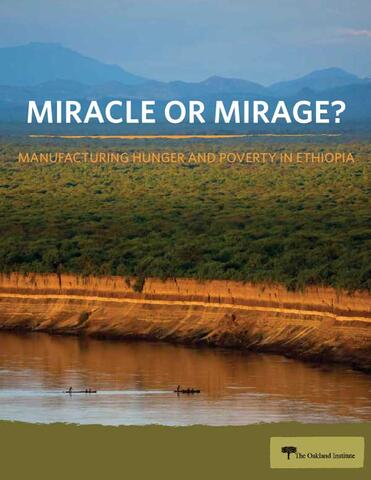
Download PDF (size: 0.73 MB) Miracle or Mirage? Manufacturing Hunger and Poverty in Ethiopia
October 22, 2016
Posted by aletho |
Civil Liberties, Deception, Economics, Ethnic Cleansing, Racism, Zionism, Supremacism, Social Darwinism, Timeless or most popular | Africa, Ethiopia, Human rights |
Leave a comment
South Africa has joined Burundi in officially announcing its withdrawal from the International Criminal Court (ICC), saying its laws are incompatible with obligations under the ICC.
The South African government gave a formal notice of its intention to pull out of the ICC on Friday.
South Africa “found that its obligations with respect to the peaceful resolution of conflicts at times are incompatible with the interpretation given by the International Criminal Court,” the document, signed by International Relations Minister Maite Nkoana-Mashabane, read.
Meanwhile, Justice Minister Michael Masutha told a media conference in the administrative capital, Pretoria, that the ICC’s obligations are inconsistent with laws giving sitting leaders diplomatic immunity.
“The Implementation of the Rome Statute of the International Criminal Court Act, 2002, is in conflict and inconsistent with the provisions of the Diplomatic Immunities and Privileges Act, 2001,” Masutha said.
South Africa says a bill over the matter, i.e. the withdrawal from ICC, will soon go to the country’s parliament.
The decision comes amid a dispute over last year’s visit by Sudanese President Omar Hassan al-Bashir to attend an African Union summit in Johannesburg. Bashir is wanted by the ICC over alleged war crimes. South Africa, however, said he had immunity as the head of a member state.
Nevertheless, the ICC criticized the South African government for its failure to arrest Bashir.
The announcement of the decision by South Africa to withdraw from the ICC sparked rapid criticism from the New York-based Human Rights Watch (HRW).
South Africa’s proposed withdrawal “shows startling disregard for justice from a country long seen as a global leader on accountability for victims of the gravest crimes,” HRW said in a statement. “It’s important both for South Africa and the region that this runaway train be slowed down and South Africa’s hard-won legacy of standing with victims of mass atrocities be restored.”
South Africa is the second African country to declare its withdrawal from the ICC. Earlier this week, Burundi’s President Pierre Nkurunziza signed a decree to quit the court’s jurisdiction.
Namibia and Kenya have also raised the possibility of withdrawal from the ICC.
Some African governments say the ICC has shown a post-colonial bias against the continent’s leaders.
October 21, 2016
Posted by aletho |
Aletho News | Africa, HRW, ICC, South Africa |
Leave a comment
Senegalese agro-pastoralists are striking wins against Senhuile SA, a foreign-owned agribusiness company established in Ndiaël, Saint-Louis Region of Senegal. In 2012, Senhuile obtained a 50 year lease on 20,000 hectares for a sweet potato plantation in a forest and wetland reserve, which was partially declassified to establish agribusiness activities.1 The deal threatened 9,000 pastoralists, who depend on these lands for their livelihoods. In addition to grazing their 100,000 animals (cows, sheep, goats, and horses), these lands also provide them with firewood, fruits, medicinal plants, and saps and resins.
For over four years, 37 villages impacted by Senhuile’s activities have shown fierce resistance. In the latest action, over 350 local opponents to the project gathered on July 29, 2016, to claim their right to farm the reserve lands. Previously, communities had been denied the authorization to cultivate small plots on the grounds that Ndiaël was classified among the Ramsar Wetlands of International Importance. Now that large tracts of the reserve have been declassified and cleared by Senhuile, residents of Ndiaël are determined to start their own agricultural activities in the area.
Prior to 2012, Senhuile had planned to settle in Fanaye, some 30 kilometers away, but was forced to relocate after violent local opposition led to the deaths of two protestors and injuries to many others in 2011. Upon arriving in Ndiaël, Senhuile did not seek the consent of the local communities or provide compensation for the loss of grazing lands. Instead, it carried out aggressive land clearing—religious spaces, cemeteries, schools were destroyed in the process—while protecting its concession with barbed wires and security guards.
Senhuile: Lack of Transparency & Scandals
Senhuile’s project has been opaque since its inception. Although located in a semi-arid area with plans for large-scale irrigation using water from the adjacent Lake Guiers—a crucial reservoir already affected by low water levels, algae proliferation, and pollution—Senhuile conducted its first environmental impact assessment only months after starting to clear the land. The company initially announced its intention to grow sweet potatoes for bioethanol production, but its strategy shifted several times, from sunflower plantations to finally opting in 2016 for rice, maize, and peanut production.
In addition, Senhuile has been involved in scandals repetitively. Held by a murky international conglomerate composed of Italy’s Tampieri Financial Group, Senegalese investors, and a shell company registered in New York, Senhuile has changed directors three times since 2012. Benjamin Dummai, its first CEO, was arrested in 2014 on charges of misappropriating CFA 200 million (over $300,000). Dummai’s successor, Massimo Castelluci, fired a large number of employees. Dismissal-related disputes are now opposing Senhuile in the regional Saint-Louis Court. In July 2016, Senhuile’s latest director, Massimo Vittorio Campadese, barely avoided prison after the company was accused of committing customs fraud and negotiated a CFA 1.1 billion ($1.85 million) fine to settle the matter.
Senhuile’s disastrous track record belies the company’s intentions and initial claims around its contribution to the local economy – Senhuile promised to create 2,500 jobs by 2013 but today employs less than 100 people. Unsurprisingly, initial resistance from the 37 villages impacted by the project has garnered strength as former Senhuile workers and neighboring rice growers, who were recently expropriated from lands previously granted to them by the company, have joined the opposition.
Senegalese authorities, consequently, have been forced to recognize the legitimacy of the local resistance. A few months ago, they announced—and recently confirmed—their intention to reduce Senhuile’s concession by half from 20,000 to 10,000 hectares. The recent mobilization was organized by local communities to build on this successful development. They are claiming their right to over 14,000 hectares of lands in the reserve, including all of Senhuile’s former lands and some other declassified areas. This action has served as a successful catalyst to kick-start a negotiation process in August 2016 between the Senegalese administration, the company, and protestors to demarcate and divide the declassified lands for redistribution.
The residents of Ndiaël hope to soon start using the land for cultivating cash crops including watermelons, sweet potatoes, and cassava. Cattle herding, the area’s traditional occupation, will accompany agricultural activities. Small-scale agricultural plots, contrary to large-scale farms, leave space for cattle routes and preserve animals’ access to water points. In addition, after harvesting, farmers will let the cattle graze leftover fodder from the fields and use the manure to fertilize the soil. These methods of small-scale agriculture will respect the zone’s ecology, feed entire families, and invigorate the local economy.2
While the expectations are high, the struggle isn’t over for the community members. They are still waiting for proper land demarcation and fear unexpected developments, including allocations of concessions to firms participating in the World Bank-funded Inclusive and Sustainable Agribusiness Development Project (PDIDAS). However, their tenacious resistance has voiced an honest appeal to the government to prioritize the future and food security of Senegalese families over the interests of foreign investors. If villagers win, the Ndiaël case may set a precedent for other populations affected by land grabbing in the country. If not, they are ready to scale up the resistance. As local opponent Ardo Sow explains, “this is a fight for survival. We cannot remain bystanders and watch the state run roughshod over the population. […] We will not cede for anything in the world.”
Footnotes
- [1] The declassification of 20,000 hectares of reserve land for a large-scale agriculture project was surprising considering that, in March 2012, the same month former President Wade issued the decree granting land to Senhuile, the Senegalese government submitted an official financing request to the World Bank for a project to restore the Lac de Guiers area and adjacent wetland ecosystems, particularly the Ndiaël reserve, considered an endangered Ramsar site.
- [2] Surveys conducted in the area have found that small farms obtain excellent profits from their commercial activities (notably potato and rice cultures) and employ a great number of workers.
October 18, 2016
Posted by aletho |
Economics, Environmentalism, Timeless or most popular | Africa, Bioethanol, Human rights, Senegal |
Leave a comment
 Aletho News
 Aletho News