President al-Assad: Western nations attack Syrian government openly and deal with it secretly
SANA | July 1, 2016
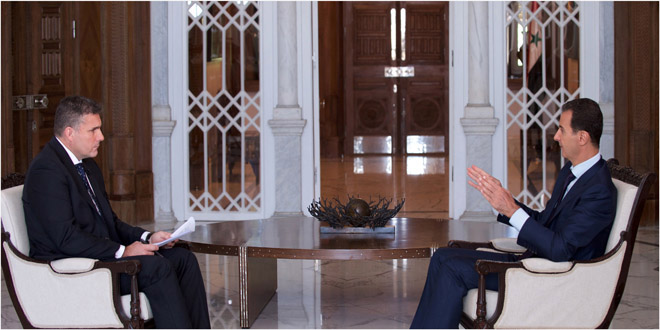
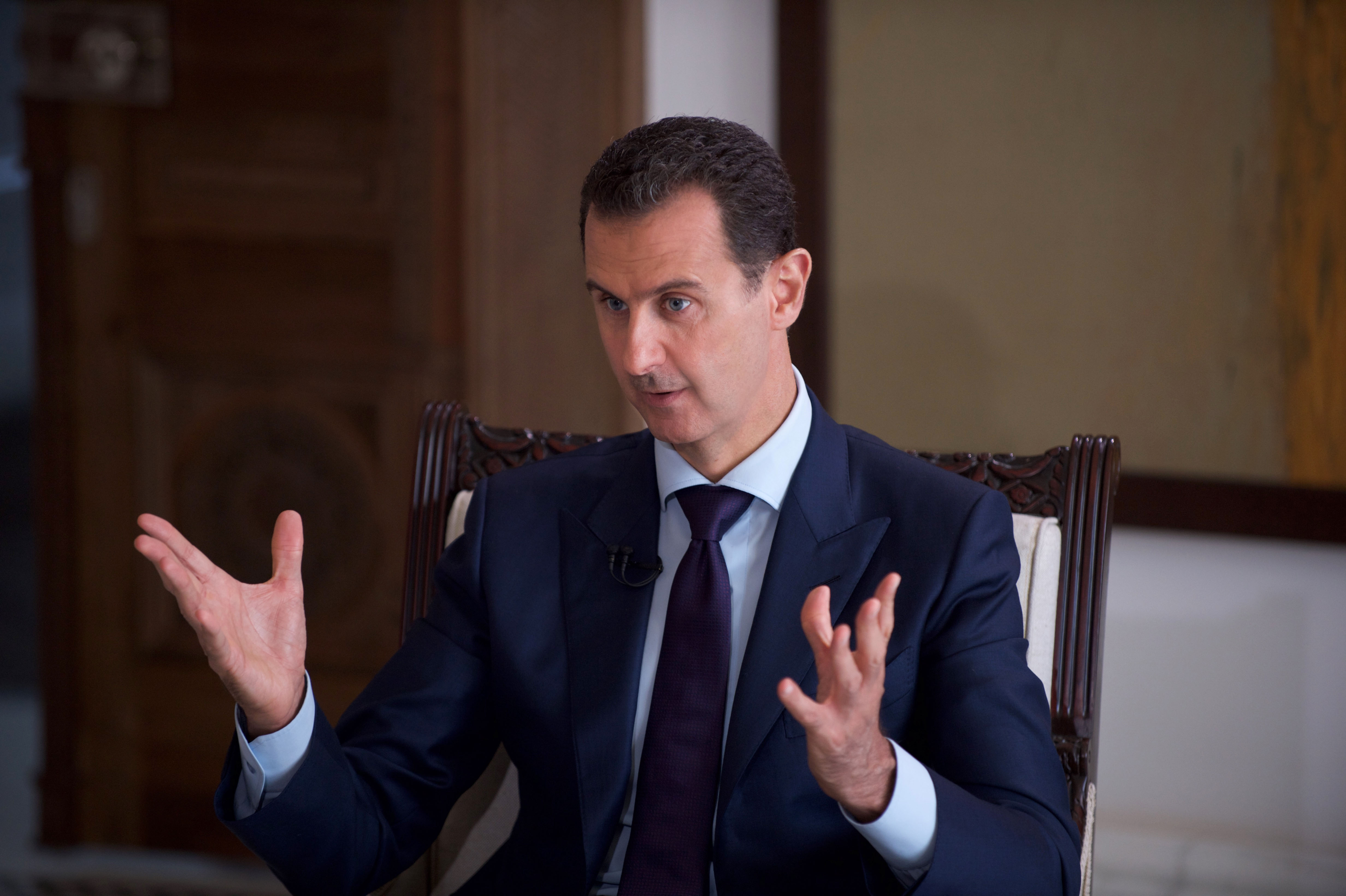
Damascus – President Bashar al-Assad gave an interview to the Australian SBS TV channel in which he criticized the double standards of the West – openly attacking the Syrian government politically, but continuing to deal with it through back channels-calling for a more humanitarian and less costly solution to the refugee crisis through stopping support to the terrorists.
The following is the full text of the interview:
Journalist: Mr. President, thank you for speaking with SBS Australia.
President Assad: You’re most welcome in Syria.
Question 1: It’s now more than five years since the Syrian crisis began. It’s estimated somewhere around a quarter of a million people have been killed, many of them civilians. There’s an undeniable humanitarian disaster. How far into the crisis do you think you are, and is there an end in sight?
President Assad: Of course, there is an end in sight, and the solution is very clear. It’s simple yet impossible. It’s simple because the solution is very clear, how to make dialogue between the Syrians about the political process, but at the same time fighting the terrorism and the terrorists in Syria. Without fighting terrorists, you cannot have any real solution. It’s impossible because the countries that supported those terrorists, whether Western or regional like Turkey, Saudi Arabia, and Qatar, don’t want to stop sending all kinds of support to those terrorists. So, if we start with stopping this logistical support, and as Syrians go to dialogue, talk about the constitution, about the future of Syria, about the future of the political system, the solution is very near, not far from reach.

Question 2: Much of the reporting in the West at the moment suggests that the demise of the Islamic State is imminent. Do you believe that’s true, and how far away from seizing Raqqa, this very important city of Raqqa, do you believe you are?
President Assad: It’s not a race. Raqqa is as important as Aleppo, as Damascus, as any other city. The danger of those terrorist groups is not about what land do they occupy, because it’s not a traditional war. It’s about how much of their ideology can they instill in the mind of the people in the area that they sit or live in. Indoctrination, this is the most dangerous thing. So, reaching Raqqa is not that difficult militarily, let’s say. It’s a matter of time. We are going in that direction. But the question when you talk about war is about what the other side, let’s say the enemy, could do, and that’s directly related to the effort of Turkey, especially Erdogan, in supporting those groups, because that’s what’s happening since the beginning. If you talk about Syria as an isolated military field, you can reach that area within a few months or a few weeks, let’s say, but without taking into consideration the Turkish effort in supporting the terrorists, any answer would be a far cry from the reality, an un-factual answer.
Question 3: Mr. President, how concerned are you about recent fatal clashes which have been reported between your longtime ally Hezbollah and your own forces?
There is good Syrian-Russian-Iranian coordination on fighting terrorism
President Assad: Fighting between us and Hezbollah? They are not fighting. They support the Syrian Army. They don’t fight against the Syrian Army, they fight with the Syrian Army. The Syrian Army and Hezbollah, with the support of the Russian Air Forces, we are fighting all kinds of terrorist groups, whether ISIS or al-Nusra or other affiliated groups with Al Qaeda that’s affiliated automatically to al-Nusra and ISIS.
Question 4: So, there have been some recent reports of clashes between… are those reports incorrect.
President Assad: No, they are talking not about clashes; about, let’s say, differences and different opinions. That’s not true, and if you look at the meeting that happened recently between the Ministers of Defense in Iran, in Tehran; Syrian, Russian, and Iranian, this means there’s good coordination regarding fighting terrorism.
Question 5: To be clear, do you categorize all opposition groups as terrorists?
President Assad: Definitely not, no. When you talk about an opposition group that adopts the political means, they’re not terrorists. Whenever you hold machineguns or any other armaments and you terrorize people and you attack civilians and you attack public and private properties, you are a terrorist. But if you talk about opposition, when you talk about opposition it must be Syrian opposition. It cannot be a surrogate opposition that works as a proxy to other countries like Saudi Arabia or any other country. It must be a Syrian opposition that’s related to its Syrian grassroots, like in your country. It’s the same, I think.
Question 6: You said recently that the ceasefire offered Syrian people at least a glimmer of hope. How, five months on, do you think that hope is going?
President Assad: Yeah, it is. It’s still working, the ceasefire, but we don’t have to forget that terrorist groups violate this agreement, on a daily basis. But at the same time, we have the right, according to that agreement, to retaliate whenever the terrorists attack our government forces. So, actually you can say it’s still working in most of the areas, but in some areas it’s not.
Question 7: There are various accounts of how the Syrian crisis began. Some say it was children graffiting anti-government slogans and they were dealt with brutally by the government. I understand you don’t accept that narrative. How, in your view, did the crisis begin?
President Assad: It’s a mixture of many things. Some people demonstrated because they needed reform. We cannot deny this, we cannot say “no everybody was a terrorist” or “everyone was a mercenary.” But the majority of those demonstrators – I’m not talking about the genuine demonstrators – were paid by Qatar in order to demonstrate, then later they were paid by Qatar in order to revolt with armaments, and that’s how it started, actually. The story of children being attacked, this is an illusive story. It didn’t happen. Of course, you always have, let’s say, mistakes happening in the practice on the ground, like what happened in the United States recently, during the last year, but this is not a reason for people to hold machineguns and kill policemen and soldiers and so on.
Question 8: You do say that some of these people legitimately needed reform. Was that as a result of any heavy-handedness from your government at all?
President Assad: No, we had reform in Syria. It started mainly after 2000, in the year 2000. Some people think it was slow, some people think it was too fast, this is subjective, not objective, but we were moving in that regard. But the proof that it wasn’t about the reform, because we made all the requested reforms after the crisis started five years ago, and nothing has changed. So, it wasn’t about reform. We changed the constitution, we changed the laws that the opposition asked for, we changed many things, but nothing happened. So, it wasn’t about the reform; it was about money coming from Qatar, and most of the people that genuinely asked for reform at the beginning of the crisis, they don’t demonstrate now, they don’t go against the government, they cooperate with the government. They don’t believe, let’s say, in the political line of this government, and this is their right and that’s natural, but they don’t work against the government or against the state institutions. So, they distinguish themselves from the people who supported the terrorists.

Question 9: How do you respond to the fact that some of your ministers defected and cited brutality as reason?
President Assad: Actually, they defected because they’ve been asked to do so by, some of them, Saudi Arabia, some of them by France, it depends on the country they belong to. And now, they are belonging to that so-called opposition that belongs to those countries, not to the Syrians. They have no values in Syria, so we wouldn’t worry about that. It didn’t change anything. I mean it didn’t affect the fact or the reality in Syria.
Question 10: One of your main backers, Russia, has called for a return to the peace talks. Do you think that’s a good idea?
President Assad: You mean in Geneva?
Journalist: Yes.
Geneva negotiations need to have the basic principles in order to be fruitful
President Assad: Yeah, of course, we support every talk with every Syrian party, but in reality those talks haven’t been started yet, and there’s no Syrian-Syrian talks till this moment, because we only made negotiations with the facilitator, which is Mr. de Mistura. Actually, it hasn’t started. So, we support the principle, but in practice you need to have a certain methodology that didn’t exist so far. So, we need to start, but we need to have the basic principles for those negotiations to be fruitful.
Question 11: One thing that intrigues a lot of people about the Syrian crisis is why your close allies Iran and Russia stay so loyal?
By defending Syria, allies are defending their stability and interests
President Assad: Because it wasn’t about the President, it’s not about the person. This is the misinterpretation, or let’s say the misconception in the West, and maybe part of the propaganda, that Russia and Iran supported Assad, or supported the President. It’s not like this. It’s about the whole situation. The chaos in Syria is going to provoke a domino effect in our region, that’s going to affect the neighboring countries, it’s going to affect Iran, it’s going to affect Russia, it’s going to affect Europe, actually. So, when they defend Syria, they defend the stability and they defend their stability, they defend their interest. And at the same time, it’s about the principle. They defend the Syrian people and their right to protect themselves. Because if they defend the President and the Syrian people are not with him and don’t support him, I cannot withstand five years just because Russia and Iran support me. So, it’s not about the President, it’s about the whole situation, the bigger picture, let’s say.
Question 12: Do you have any dialogue either direct or indirectly with the United States?
Western countries are dealing with Syria through back channels
President Assad: At all, nothing at all. Indirect, yes, indirect, through different channels. But if you ask them they will deny it, and we’re going to deny it. But in reality, it exists; the back channels.
Question 13: What are some of those channels?
President Assad: I mean, let’s say, businessmen going and traveling around the world and meeting with the officials in the United States and in Europe, they meet in Europe, and they try to convey certain messages, but there’s nothing serious, because we don’t think the administration, the American administration, is serious about solving the problem in Syria.
Question 14: Well, quite recently, there were reports more than 50 diplomats have called for what they described as “real and effective military strikes” against you, against Syria. Does this in any way concern you, and do you think it signals a more aggressive policy from the United States towards Syria moving forward?
American administrations are famous of creating problems, but they never solve any
President Assad: No, warmongers in every American administration always exist. It’s not something new. But we wouldn’t give a fig, let’s say, about this communique, but it’s not about this communique; it’s about the policy, it’s about the actions. The difference between this administration and the previous one, Bush’s one, is that Bush sent his troops. This one is sending mercenaries, and turned a blind eye to what Saudi Arabia and Turkey and Qatar did, since the beginning of the crisis. So, it’s the same policy. It’s a militaristic policy, but in different ways. So, this communique is not different from the reality on the ground. This is asking for war, and the reality is a war.
Question 15: You referred to the previous government, the Bush government. There are some who say one of the reasons you’ve survived as long as a government has been America’s reluctance to get on the ground in another war in the Middle East. Do you not accept that, based on what you’re saying?
President Assad: Yeah, the American administrations since the 50s are very famous of creating problems but they never solve any problems, and that’s what happened in Iraq. Bush invaded Iraq, in a few weeks he could occupy Iraq, but then what’s next? It’s not about occupying. This is a great power. We’re not a great power. So, it’s not about America occupying Syria. What’s next? What do they want to achieve? They haven’t achieved anything. They failed in Libya, in Iraq, in Yemen, in Syria, everywhere. They only created chaos. So, if the United States wants to create more chaos it can, it can create chaos, but can they solve the problem? No.
Question 16: Do you have a preference who wins the upcoming US election?
President Assad: Actually no, we never bet on any American president, because usually what they say in the campaign is different from their practice after they become president, and Obama is an example, so we don’t have to wait. We have to wait and see what policy they’re going to adopt, whoever wins the elections.
Question 17: So, you can see a circumstance where Syria would work collaboratively with the United States and the West?
We are not against cooperation with the US based on mutual interest
President Assad: We don’t have a problem with the United States, they’re not our enemy, they don’t occupy our land. We have differences, and those differences go back to the 70s and maybe before that, but in many different times, let’s say, and events and circumstances, we had cooperation with the United States. So, we’re not against this cooperation. But, this cooperation means talking about and discussing and working for the mutual interest, not for their interest at the expense of our interest. So, we don’t have a problem.
Question 18: Mr. President, you’ve spent a lot of time yourself, as you’ve just said, in the United Kingdom. Can you see there being any repercussions for Britain’s decision to exit the European Union for Syria and for the Syrian crisis?
British people are revolting against their “second-tier” and “disconnected” politicians
President Assad: I don’t think I can elaborate about that, as it’s a British issue, and I’m not British neither European. But at the same time I can say that this surprising result, maybe, has many different components, whether internal as economic and external as the worry from the terrorism, security issues, refugees, and so on. But this is an indication for us, as those officials who used to give me the advice about how to deal with the crisis in Syria, and say “Assad must go” and “he’s disconnected” proven to be disconnected from reality, otherwise they wouldn’t have asked for this referendum, but I think this is a revolt of the people there against, I would call them sometimes second-tier politicians. They needed special, let’s say, statecraft officials, to deal their country. If another administration came and understands that the issue of refugees and security is related to the problem in our region, this is where you’re going to have a different policy that will affect us positively. But I don’t have now a lot of hope about this. Let’s say we have a slim hope, because we don’t know who’s going to come after Cameron in the UK.
Question 19: Can I ask; Australia is part of the international coalition to defeat the Islamic State. Obviously, that’s one of your goals, so in that instance there’s a shared goal. Do you welcome international intervention when there’s a shared goal like that.
President Assad: Actually, we welcome any effort to fight terrorism in Syria, any effort, but this effort first of all should be genuine, not window-dressing like what’s happening now in northern Syria where 60 countries couldn’t prevent ISIS from expanding. Actually, when the Russian air support started, only at that time when ISIS stopped expanding. So, it needs to be genuine. Second, it needs to be through the Syrian legitimate government, not just because they want to fight terrorism and they can go anywhere in the world. We are a legitimate government and we are a sovereign country. So, only on these two circumstances we welcome any foreign support to fight terrorism.
Question 20: A number of Australians have died fighting for either the Kurdish militia or the Islamic State. Do you have a message for these young people who feel so enraged by what’s taking place in Syria that they travel over here to fight?
President Assad: Again, the same, let’s say, answer. If there are foreigners coming without the permission of the government, they are illegal, whether they want to fight terrorists or want to fight any other one. It is the same. It’s illegal, we can call it.
Question 21: Mr. President, Australian politicians have used very strong language about your role in the crisis, as have other leaders, internationally. Australia’s Prime Minister has referred to you as a “murderous tyrant,” saying that you’re responsible for killing thousands of innocent civilians. Australia’s opposition leader has called you a “butcher.” Yet Australia’s official position is still to work with you toward a peace agreement. How do you reconcile those two very different positions?
Western nations attack Syrian government and yet deal with it under the table
President Assad: Actually, this is the double standard of the West in general. They attack us politically and they send us their officials to deal with us under the table, especially the security, including your government. They all do the same. They don’t want to upset the United States. Actually, most of the Western officials only repeat what the United States wants them to say. This is the reality. So, I think these statements, I just can say they are disconnected from our reality, because I’m fighting terrorists, our army is fighting terrorists, our government is against terrorists, the whole institutions are against terrorists. If you call fighting terrorism butchery, that’s another issue.
Question 22: Australia has agreed to take an additional twelve thousand Syrian refugees; some have already arrived. Do you have a message for these Syrians, many of whom still say they love Syria and they want to return. Do you have a message for those people, as I said, who are in Australia, and other countries around the world?
A more humanitarian and less costly European solution to refugee crisis is stopping support to terrorists
President Assad: Actually, you mentioned a very important point. Most of the refugees that left Syria, they want to come back to Syria. So, any country that helped them enter their new country, let’s say, their new homeland, is welcome as a humanitarian action, but again there is something more humanitarian and less costly: is to help them staying in their country, help them going back by helping the stability in Syria, not to give any umbrella or support to the terrorists. That’s what they want. They want the Western governments to take decisive decisions against what Saudi Arabia and other Western countries, like France and UK, are doing in order to support the terrorists in Syria just to topple the government. Otherwise, those Syrians wouldn’t have left Syria. Most of them, they didn’t leave because they are against the government or with the government; they left because it’s very difficult to live in Syria these days.
Question 23: Do you hope that these people will return and would you facilitate for them to return?
President Assad: Definitely, I mean losing people as refugees is like losing human resources. How can you build a country without human resources? Most of those people are educated, well trained, they have their own businesses in Syria in different domains. You lose all this, of course, we need.
Question 24: The Commission for International Justice and Accountability says there are thousands of government documents which say has proved your government sanctioned mass torture and killings. In the face of that evidence, how do you say that no crimes have taken place, and I point also to other independent organizations, which are critical of deliberate targeting hospitals. Do you concede that some mistakes have been made as you’ve targeted some rebel-held areas?
President Assad: You are talking about two different things. One of them, the first one is the reports. The most important report that’s been financed by Qatar, just to defame the Syrian government, and they have no proof, who took the pictures, who are the victims in those pictures, and so on. Like you can forge anything if you want now on the computer. So, it is not credible at all. Second, talking about attacking hospitals or attacking civilians, the question, the very simple question is: why do we attack hospitals and civilians? I mean the whole issue, the whole problem in Syria started when those terrorists wanted to win the hearts of the Syrians. So, attacking hospitals or attacking civilians is playing into the hands of the terrorists. So, if we put the values aside now for a while, let’s talk about the interests. No government in this situation has any interest in killing civilians or attacking hospitals. Anyway, if you attack hospitals, you can use any building to be a hospital. No, these are an anecdotal claims, mendacious statements I can say; they are not credible at all. We’re still sending vaccines to those areas under the control of the terrorists. So, how can I send vaccines and attack the hospitals? This is a contradiction.
Question 25: Mr. President, as a father and as a man, has there been one anecdote, one story, one image from the crisis, which has affected you personally more than others?
President Assad: Definitely, we are humans, and I am Syrian like the other Syrians. I will be more sympathetic with any Syrian tragedy affecting any person or family, and in this region, we are very emotional people, generally. But as an official, I am not only a person, I am an official. As an official, the first question you ask when you have that feeling is what are you going to do, what are you going to do to protect other Syrians from the same suffering? That’s the most important thing. So, I mean, this feeling, this sad feeling, this painful feeling, is an incentive for me to do more. It’s not only a feeling.
Question 26: What’s your vision for Syria? How do you see things in two to three years?
President Assad: After the crisis or…? Because, the first thing we would like to see is to have Syria stable as it used to be before, because it was one of the most stable countries and secure countries around the world, not only in our region. So, this the first thing. If you have this, you can have other ambitions. Without it you cannot. I mean, if you have this, the other question: how to deal with the new generation that lived the life of killing, that saw the extremism or learned the extremism or indoctrinated by Al Qaeda-affiliated groups, and so on. This is another challenge. The third one is bringing back those human resources that left as refugees in order to rebuild Syria. Rebuilding the country as buildings or infrastructure is very easy; we are capable of doing this as Syrians. The challenge is about the new generation.
Question 27: How do you think history will reflect on your presidency?
President Assad: What I wish is to say that this is the one who saved his country from the terrorists and from the external intervention. That is what I wish about it. Anything else would be left to the judgment of the Syrian people, but this is my only wish.
Journalist: Mr. President, Thank you very much for speaking with SBS Australia.
President Assad: Thank you very much.
New ‘CIA Officer Whistleblowing’ Video Reeks Of Disinfo

By Brandon Turbeville | Activist Post | July 2, 2016
Making quite the circuit on the internet landscape is a new video purporting to show a former CIA agent speaking out against the manner in which the “war on terror” is prosecuted and portrayed to the American public. The video has been shared and discussed thousands of times particularly within the alternative media community as evidence that the “war on terror” is one big snowball of bad decisions and blowback.
The video, is a short clip of an interview conducted by AJ+ with Amaryllis Fox, a former CIA Clandestine Services Officer, who makes a number of claims during the three minute clip that range from the reasonable to the absurd. While many alternative media outlets have hailed Fox’s video as “brave” and Fox herself as a whistleblower, it would be wise to analyze her statements for what they are as opposed to praising them simply because they are being presented as “anti-establishment.”
Fox makes a surprising amount of claims for three minutes and she also manages to conflate issues, concepts, and people in a cleverly designed monologue that is clearly scripted for effect.
Fox begins by saying,
If I learned one lesson from my time with the CIA it is this: everybody believes they are the good guy. I was an officer with the CIA Clandestine Service and worked undercover on counterterrorism and intelligence all around the world for almost ten years. The conversation that’s going on in the United States right now about ISIS and the United States overseas is more oversimplified than ever.
Fair enough. Lower level agents of the CIA and most lower level fighters in terrorist organizations or national militaries believe they are the good guys. The propaganda surrounding the “war on terror” is oversimplified. All of this is true indeed. But Fox moves from information easily verified such as the statement above to much more questionable claims. For instance, she says,
Ask most Americans whether ISIS poses an existential threat to this country and they’ll say yes. That’s where the conversation stops. If you’re walking down the street in Iraq or Syria and ask anybody why America dropped bombs, you get: “They were waging a war on Islam.” And you walk in America and you ask why we were attacked on 9/11, and you get “They hate us because we’re free.” Those are stories, manufactured by a really small number of people on both sides who amass a great deal of power and wealth by convincing the rest of us to keep killing each other.
Fox is correct on the latter part of her statement. Much of these stories are indeed manufactured by a small number of people in order to drum up support for foreign invasions and a police state back at home. But who exactly is Fox talking to on the streets of Syria and Iraq that would respond “a war on Islam” to the question of why the United States is dropping bombs on their country? It certainly isn’t the average Syrian as she tries to portray. In fact, if one were to go to the average Syrian on the street and ask “Why is America dropping bombs?” the answer would almost always be centered around Israel. Almost every researcher is aware of this fact but not one time was the word “Israel” mentioned in Fox’s interview. The “war on Islam” line is typically reserved only for the more fanatical religious zealots who make up the so-called “opposition.” So what is Fox suggesting? Is she suggesting that the average Syrian holds the same belief system as the average al-Qaeda fighter?
Actually, that is exactly what she is doing, regardless of whether or not she states it explicitly or not. She continues,
I think the question we need to be asking, as Americans examining our foreign policy, is whether or not we are pouring kerosene on a candle. The only real way to disarm your enemy is to listen to them. If you hear them out, if you’re brave enough to really listen to their story, you can see that more often than not, you might have made some of the same choices if you’d lived their life instead of yours. An al-Qaeda fighter made a point once during a debriefing. He said all these movies that America makes, like Independence Day, and Hunger Games and Star Wars, they’re all about a small scrappy band of rebels who will do anything in their power with the limited resources available to them to expel and outside, technologically advanced invader. And what you don’t realize, he said, is that to us, to the rest of the world, you are the empire, and we are Luke and Han. You are the aliens and we are Will Smith.
Fox is implying that there was a “fundamentalist al-Qaeda” problem before America’s foreign policy was formed. In other words, that the problem existed and that the United States perhaps acted rashly in dealing with it. But the fact is that the al-Qaeda issue never would have existed in the first place had the United States not invented it. Indeed, al-Qaeda, ISIS, and other related terrorist organizations are entirely creations of the U.S. government and the NATO apparatus. While Fox may be forgiven for not knowing this little detail, not knowing the difference between a fundamentalist al-Qaeda fanatic and an average Syrian is not excusable. That is, assuming that the mistake is actually a mistake and not an intentional attempt to mislead the audience.
Fox also provides questionable analogies when she discusses the al-Qaeda fighters’ interpretation of Hollywood movies. If the fighter was so convinced that the U.S. is the empire (fair point – it is) and al-Qaeda is the equivalent of Luke and Han, why did al-Qaeda attack the Syrian government? Why did they attack the Iraqi government? Why did they attack the Libyan government? This would be the equivalent of Luke and Han attacking the Galactic Republic while claiming to fight the Empire. It doesn’t make sense. Continuing with the Star Wars analogy, Saddam Hussein, Bashar al-Assad, and Muammar Ghaddaffi would represent the Republic and those nations’ militaries along with Iraq’s “insurgents” fighting back against the U.S. would be the true rebels. Fox should know this very well.
Nevertheless, Fox concluded her statements by saying,
But the truth is when you talk to the people who are really fighting on the ground on both sides, and ask them why they’re there, they answer with hopes for their children, specific policies that they think are cruel or unfair. And while it may be easier to dismiss your enemy as evil, hearing them out on policy concerns is actually an amazing thing. Because as long as your enemy is a subhuman psychopath that’s going to attack you no matter what you do, this never ends. But if your enemy is a policy, however complicated, that we can work with.
So, again, the question would be “who is Fox actually talking about?” When she references “the people who are really fighting on the ground on both sides, does she mean U.S. forces and terrorists vs the Syrian military? Does she exclude the U.S. military? Her statements simply do nothing to clarify the reality on the ground, only to confuse it.
One good question for Fox would be how the Syrian government should listen to and hear out a “policy” coming from an organization that crucifies women, beheads “heretics,” and seeks to impose Shariah law on a civilized people? How should Syria simply listen to the “concerns” of the United States after the latter power has funded those “subhuman psychopaths” (yes, it is an accurate description) who have invaded their country? Is it possible that the “policy” of the United States and its proxy terrorists is simply wrong? Is it possible that the other sides might not be so willing to have a couples’ therapy session?
While Fox makes a number of good points regarding the fact that the narrative surrounding al-Qaeda and the situation in Syria and Iraq is indeed manufactured by a small number of people in high places, Fox herself makes an incredibly wrong description of the conflict, equating average Syrians and Iraqis with jihadists in terms of their mindset and suggesting that the upsurge of terrorism is a result of blowback as opposed to outright funding and conspiracy to overthrow sovereign states in search of world hegemony.
Fox’s statements simply serve to continue to drag Americans off into the abyss of misinformation surrounding the crisis in the Middle East while claiming to do otherwise. After watching Fox’s video, (notably produced by AJ+ – al-Jazeera, a Qatari news agency that has long been pro-jihadist), we can safely say that Ms. Fox is either misinformed herself or simply good at her job.
Image Credit: Anthony Freda
US proposal for military partnership with Russia in Syria – ‘desperate move’
RT | July 1, 2016
A new military cooperation deal on Syria the US has reportedly proposed to Moscow might be only useful for an American faction trying to protect Al-Qaeda in Syria, says Ron Paul Institute for Peace and Prosperity Executive Director Daniel McAdams.
The US government has reportedly offered to work with Russia in fighting terrorists in Syria.
RT: We still don’t know many details on the proposed agreement. How could it work, in your opinion?
Daniel McAdams: I don’t think it can work, I think it is an absurd agreement. I would call it a neocon trial balloon. Let’s look at the origins of why this came out now. It has been a pretty bad few days for the US in Syria. First, all of these weapons the CIA was sending to the rebels in Syria – were taken, put on the black market, and ended up in the hands of ISIS. Then we saw yet another military construct by the US government, the new Syrian army was sent to its maiden battle close to the Iraqi border. Even with US support they were completely annihilated, they completely failed in their mission. And what happened: a bunch of guns, trucks, satellite equipment – it all ended up in the hands of ISIS. The US is proving to be ISIS’s best line of support in Syria right now. This is a desperate move on the part of the US. Frankly if you look at what it contains, I don’t see what is in it for anyone except possibly the US, that faction of the US that is trying to protect Al-Qaeda in Syria.
RT: We also don’t know the source of the information about this proposal made by the US as the Washington Post cited an unknown administration official. How reliable is this?
DM: Well, this reporter Josh Rogin is a neoconservative; he is very, very tight in with the other neocons in the US government. I would call him more of a stenographer than a reporter. So there is a reason they leaked this. This comes just a week or so after the supposed 51 State Department employees sent a letter to John Kerry saying: “You need to go more aggressively after [Bashar] Assad.” A lot of this has to do with Hillary Clinton and people jogging propositions in the Clinton State Department. I think that is a lot what you’re seeing here.
RT: Under the agreement, the US would not give Russia the exact locations of rebels, but specify areas. Doesn’t this give a chance for terrorists to spread inside those zones and stay safe?
DM: That is exactly it! As I said before with Clinton, this is Clinton’s safe zones; this is a no-fly zone; this is essentially, what it is. The US is telling the Russians: “You know, we’re not going to tell you where they are. They are in the East Aleppo. So don’t bomb anywhere near there.” Then they know exactly where Al-Qaeda is safe. It doesn’t make any sense.
The US has claimed: “Oh, we can’t separate our good, moderate rebels from the Al-Qaeda rebels. Therefore you can’t bomb either of them.” If these are US-backed rebels why could Washington not call them up and say: “Listen, stop fighting with Al-Qaeda; stop being alongside Al-Qaeda, or you will get bombed too.” That seems to be a very effective way to solve the problem. If these people really are not part of Al-Qaeda, then they would separate themselves.
Are Al-Qaeda’s Lebanese Affiliates Opening a Lebanese Front in the Syrian War?
By Mahdi Darius Nazemroaya | Global Research | June 23, 2016
The US and its allies are working inside Lebanon to open a new front in the Syrian conflict. Lebanon has been sedated into a state of limbo by the lack of a government and the postponing of its parliamentary elections. Complicating matters, many institutional figures and military commanders have gone into retirement and the caretaker government is unable to replace them.
Hezbollah’s intervention into the Syrian conflict has given a boost to the Syrian government against the anti-government forces trying to overrun Syria.
This has turned the attention of the US and its allies onto Lebanon as a new arena of battle. Rockets are also being launched by anti-government forces from Syria, and even from inside Lebanon, against Hezbollah’s political strongholds and against Shia Muslim villages. The goal is to ignite the flames of sedition between Shiites and Sunnis inside Lebanon.
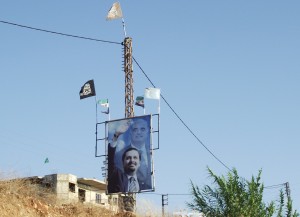
Photo Below: Picture of the Hariris adorned with the Future Party’s flag and Al-Qaeda and anti-government Syrian flags by their followers on the way to Sidon. (Photo by Mahdi Darius Nazemroaya)
Al-Qaeda in Lebanon
Al-Qaeda’s flag has been flying in Lebanon for years. Driving near the airport in Beirut or on the road to Sidon (Saida) you can see the Al-Qaeda flags flying in black. The same goes for Tripoli (Trablos) and some areas inside Beirut. Since the Syrian conflict you can see the Al-Qaeda flag flying next to the Syrian insurgent’s flag. The US and its allies have actually turned a blind eye to the support that the Future Party of Saad Hariri provides to Al-Qaeda. It is worth noting that the current head of the UN Secretariate’s Department of Political Affairs, Jeffrey Feltman, who was once the US ambassador to Lebanon before he was promoted in the US Department of State, also turned a blind eye to the support for Al-Qaeda by the Hariri family’s Future Party and its March 14 Alliance.
The Hariri family has had a long alliance with the takfiris and Al-Qaeda supporters. They have been political allies with groups in Lebanon that openly revere Osama bin Laden as a great leader. It was the Hariri family and members of their Future Party that also imported the fighters that would become Fatah Al-Islam into Lebanon. The exploitation of takfiri militias inside Lebanon by the Hariri family was intended to crush Hezbollah after Israel failed to do in 2006. Regionally, the same strategy involved the Hariri family’s Saudi patrons and George W. Bush’s administration, which were preparing and arming these militias as tools/weapons against Syria and Iran. The Hariris were furious when Seymour Hersh exposed them and had him publicly rebuked.
Months later Fatah Al-Islam would get out of control. Seymour Hersh would be vindicated. The Hariri-led March 14 Alliance would dishonestly try to blame Syria and the Palestinians for creating and supporting the group that they themselves had created. The fighting in Lebanon between the Lebanese military and Fatah Al-Islam foreshadowed the armies that were amassed for regime change in Libya and Syria by the US and its allies.
Tripoli and Sidon as Extensions of the Syrian Conflict
Lebanon’s second largest city, Tripoli, has seen intense fighting between the Alawite community of Lebanon, which is represented by the Arab Democratic Party, and the Hariri family’s takfiri allies. Hariri’s allies in Tripoli are open supporters of Al-Qaeda and the anti-government forces in Syria; they have smuggled weapons across the Lebanese-Syrian and sent large numbers of fighters into Syria to topple the government in Damascus. The Future Party has been involved in coordinating this also.
Lebanon’s third largest city, Sidon, has also been the scene of fighting and tensions between Ahmed Al-Assir, a Hariri ally, and Hezbollah’s supporters and allies. Al-Assir’s men have even tried to kill one of Sidon’s main Sunni Muslim clerics, Maher Hammoud, because he has constantly been working for Muslim and Lebanese unity and saying that there is an attempt to ignite a Shia-Sunni conflict in Lebanon and the broader region. A contingent from the Lebanese military has had stay in Sidon to keep the peace in the city.
Al-Assir’s men attacked and killed members of the Lebanese military in a village on the outskirts of Sidon for no apparent reason on June 23, 2013. This has ignited a battle in Sidon. Thick smoke from the city can be seen from a far distance. It has been reported that members of the anti-government forces from Syria have also joined them. The Lebanese military has deployed heavy weapons to fight Al-Assir’s group and to restore peace to the Lebanese city.
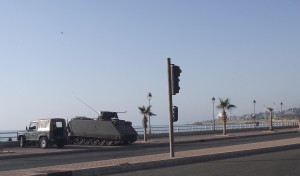
Photo Below: Lebanese Armed Forces checkpoint in Sidon. (Photo by Mahdi Darius Nazemroaya)
The Objective is to Force Hezbollah to Retreat in Syria by Targeting Lebanon
The Lebanese state is now being targeted. There have been an increasing number of attacks against the Lebanese military from the Syrian border since Hezbollah intervened in Syria. There were already attacks on Lebanon even before Hezbollah intervened in the Syrian conflict, but those were mostly intended to provoke Hezbollah.
Those targeting the Lebanese state are now taking advantage of the lack of a functioning government and the leaderless status of several national institutions to create a state of chaos in Lebanon. There have been attacks on both Shiite and Sunni villages in the Bekaa Valley and a cycle of violence has begun. It is clear that the objective is to turn Shiites and Sunnis against one another and the Lebanese military has understood this too. This is why Hezbollah has asked the Shiite clans in Bekaa to stay calm after they have been attacked. Protests have broken out in Lebanon too.
The violence in Sidon is part of a strategy. Al-Assir’s unprovoked attack against the Lebanese military is intended to mount pressure on the Lebanese state and exacerbate Shia-Sunni tensions.
Hezbollah refuses to get embroiled in a sectarian battle inside Lebanon. While the Amal Movement, the Shiite political party that is Hezbollah’s partner, has mobilized its militias and started manning the southern and eastern roads into Sidon, Hezbollah has kept calm. Amal’s media has also been reporting on the incident profusely and even in a sectarian fashion, but Hezbollah’s media have inversely been calm and said little.
Lebanon is being lit up with the aim of forcing Hezbollah to pullout from Syria by turning inwards to fight an internal battle. Essentially, Lebanon is now a second front in the Syrian conflict.
The US and Saudi Arabia have probably asked the Hariri family to prompt their Al-Qaeda affiliated clients to initiate violence in Lebanon and capitalize on the lack of a government and the weakened state of the Lebanese state.
Mahdi Darius Nazemroaya is a sociologist and Research Associate of the Centre for Research on Globalization (CRG). He is currently working out of Lebanon. He was in Sidon during the fighting and the deployment of the Lebanese military.
Copyright © Mahdi Darius Nazemroaya, Global Research, 2013
See also:
Saudi Arabia obstructing election of Lebanon president: Hezbollah
US Bombing Syrian Troops Would Be Illegal
By Marjorie Cohn | June 22, 2016
In an internal “dissent channel cable,” 51 State Department officers called for “targeted military strikes” against the government of Bashar al-Assad in Syria, a proposal that President Barack Obama has thus far resisted. However, were he to accept the cable’s advice, he would risk a dangerous – possibly catastrophic – confrontation with Russia. And, such a use of military force in Syria would violate U.S. and international law.
While the cable decries “the Russian and Iranian governments’ cynical and destabilizing deployment of significant military power to bolster the Assad regime,” the cable calls for the United States to protect and empower “the moderate Syrian opposition,” seeking to overthrow the Syrian government.
However, Assad’s government is the only legitimate government in Syria and, as the sovereign, has the legal right to seek international support as it has from Russia and Iran. There is no such legal right for the United States and other countries, such as Saudi Arabia and Turkey, to arm Syrian rebels to attack Assad’s government.
The dissent cable advocates what it calls “the judicious use of stand-off and air weapons,” which, the signatories write, “would undergird and drive a more focused and hardnosed US-led diplomatic process.”
Inside Syria, both the United States and Russia are battling the Islamic State (also known as ISIS) as ISIS and other jihadist groups seek to overthrow the Assad government. But while the U.S. is supporting rebel forces (including some fighting ISIS and some fighting Assad), Russia is backing Assad (and waging a broader fight against “terrorists,” including Al Qaeda’s Nusra Front). Reuters reports the U.S. has about 300 special operations forces in Syria for its “counter-terrorism mission against Islamic State militants but is not targeting the Assad government.”
The policy outlined in the dissent cable would change that balance, by having the U.S. military bomb Syrian soldiers who have been at the forefront of the fight against both ISIS and Nusra. But that policy shift “would lead to a war with Russia, would kill greater numbers of civilians, would sunder the Geneva peace process, and would result in greater gains for the radical Sunni ‘rebels’ who are the principal opponents of the Assad regime,” analyst James Carden wrote at Consortiumnews.com.
Journalist Robert Parry added that the authors of the cable came from the State Department’s “den of armchair warriors possessed of imperial delusions,” looking toward a Hillary Clinton administration which will likely pursue “no-fly-zones” and “safe zones” leading to more slaughter in Syria and risking a confrontation with Russia.
As we should have learned from the “no-fly zone” that preceded the Libyan “regime change” that the U.S. government engineered in 2011, a similar strategy in Syria would create a vacuum in which ISIS and Al Qaeda’s Nusra Front would flourish.
Violating U.S. and International Law
The strategy set forth in the cable would also violate both U.S. and international law.
Under the War Powers Resolution (WPR), the President can introduce U.S. troops into hostilities, or into situations “where imminent involvement in hostilities is clearly indicated by the circumstances,” only (1) after a Congressional declaration of war, (2) with “specific statutory authorization,” or (3) in “a national emergency created by attack upon the United States, its territories or possessions, or its armed forces.”
None of three conditions that would allow the president to use military force in Syria is present at this time. First, Congress has not declared war. Second, neither the 2001 Authorization for the Use of Military Force (AUMF), which George W. Bush used to invade Afghanistan, nor the 2002 AUMF, which Bush used to invade Iraq would provide a legal basis for an attack on Syria at the present time. Third, there has been no attack on the United States or U.S. armed forces. Thus, an armed attack on Syria would violate the WPR.
Even if a military attack on Syria did not run afoul of the WPR, it would violate the United Nations Charter, a treaty the U.S. has ratified, making it part of U.S. law under the Constitution’s Supremacy Clause. Article 2(4) of the Charter says that states “shall refrain in their international relations from the threat or use of force against the territorial integrity or political independence of any state.”
The Charter only allows a military attack on another country in the case of self-defense or when the Security Council authorizes it; neither has occurred in this case. Assad’s government has not attacked the United States, and the Council has not approved military strikes on Syria.
Indeed, Security Council Resolution 2254, to which the cable refers, nowhere authorizes the use of military force, and ends with the words, “[The Security Council] decides to remain actively seized of the matter.” This means that the Council has not delegated the power to attack Syria to any entity other than itself.
If the U.S. were to mount an armed attack on Syria, the Charter would give Assad a valid self-defense claim, and Russia could legally assist Assad in collective self-defense under Article 51 of the Charter. Moreover, forcible “regime change” would violate Article 1 of the International Covenant on Civil and Political Rights, which the U.S. has also ratified.
Although it’s true that the “dissent” cable eschews the use of U.S. “ground forces,” its recommendation that the U.S. should bomb Assad’s government would involve U.S. military personnel who would fly the bombers or fire off the missiles. And, such an operation would invariably necessitate at least a limited number of U.S. support troops on the ground.
Opposition to Violent ‘Regime Change’
Many commentators have warned of dangers from a U.S. military attack on Syria, risks that are either ignored or breezily dismissed by the “dissent” cable.
Jean Aziz cautions in Al-Monitor, “the recommendation of military strikes against the Syrian government – no matter how well intentioned – is, in the end, escalatory, and would likely result in more war, killing, refugees, less humanitarian aid reaching civilians, the empowerment of jihadis and so on.”
The United States is already empowering jihadis, “going out of its way to protect the interests of al-Qaeda’s closest and most powerful ally in Syria, Ahrar al-Sham,” Gareth Porter wrote in Truthout. Porter reported that Ahrar al-Sham, which works closely with the Nusra Front, “is believed to be the largest military force seeking to overthrow the Assad regime in Syria, with at least 15,000 troops.”
So, in seeking Assad’s ouster, the U.S. has terrorist bedfellows. So much for the “global war on terror.”
As CIA Director John Brennan recently told the Senate Intelligence Committee, “Our efforts have not reduced [Islamic State’s] terrorism capability and global reach,” adding, “The branch in Libya is probably the most developed and the most dangerous.”
No wonder President Obama told Fox News “the worst mistake” of his presidency was not planning for the aftermath of U.S. regime change in Libya, although he stubbornly maintains that ousting President Muammar Gaddafi was “the right thing to do.”
The Center for Citizen Initiatives, a group of U.S. citizens currently on a delegation to Russia in order to increase understanding and reduce international tension and conflict, issued a statement in strong opposition to the “dissent” cable. Retired Col. Ann Wright, anti-war activist Kathy Kelly and former CIA analyst Ray McGovern are part of the group.
“It is not the right of the USA or any other foreign country to determine who should lead the Syrian government,” the statement says. “That decision should be made by the Syrian people.”
The statement urges the State Department “to seek non-military solutions in conformity with the UN Charter and international law.” It also urges the Obama administration to “stop funding and supplying weapons to armed ‘rebels’ in violation of international law and end the policy of forced ‘regime change’.” Finally, the statement calls for “an urgent nation-wide public debate on the U.S. policy of ‘regime change’.”
This is sage advice in light of the disasters created by the U.S. government’s forcible regime change in Iraq and Libya, which destabilized those countries, facilitating the rise of ISIS and other terrorist groups. There is no reason to believe the situation in Syria would be any different.
Instead of saber-rattling against Assad, Russia and Iran, the Obama administration should include them all in pursuing diplomacy toward a political, non-military settlement to the Syrian crisis.
Marjorie Cohn is professor emerita at Thomas Jefferson School of Law, former president of the National Lawyers Guild, and deputy secretary general of the International Association of Democratic Lawyers. A member of the national advisory board of Veterans for Peace, Cohn’s latest book is Drones and Targeted Killing: Legal, Moral, and Geopolitical Issues.
US terror report on Iran a stupendous denial of Washington-Saudi terror reality
By Finian Cunningham | RT | June 7, 2016
Since 1984, the US has been labeling Iran a leading state sponsor of terrorism, a charge that was reiterated last week. However, global events explode Washington’s credibility and denial of reality.
Russia’s Defense Ministry, for example, this week reported that some 270 civilians were killed within 24 hours from shelling of Syria’s second city, Aleppo, by Al-Qaeda-affiliated terror groups.
Moscow said the surge in violence by these groups followed from the curbing of Russian air strikes at the request of Washington – purportedly to spare “moderate rebels” located in the same areas as Al-Qaeda terror brigades.
The latter include Jabhat al-Nusra and Islamic State (IS, formerly ISIS/ISIL), both of which are internationally proscribed by the United Nations Security Council.
As noted by former British ambassador to Syria, Peter Ford, the risible pretext of protecting “moderates” is a cynical cover for the unavoidable fact that the US is, in effect, siding with Al-Qaeda terrorism in Syria for the overthrow of the Assad government.
It has been reliably documented that the anti-government militia in Syria affiliated with Al-Qaeda, including Jaysh al-Islam and Ahrar al-Sham, are supported materially and politically by the governments of Saudi Arabia, Qatar and NATO-member Turkey – all close allies of Washington.
Also in the news, just as the latest US State Department report came out pillorying Iran over terrorism, the United Nations condemned the Saudi-led military coalition in Yemen for inflicting 60 percent of child deaths over the past year in the war-torn country.
The Saudi-led coalition includes the US and Britain which supplies warplanes and logistics for air raids purportedly aimed at defeating Houthi rebels who ousted the US-Saudi-backed regime in early 2015. The latest UN report also condemned the Saudi coalition for destroying hospitals and schools across Yemen, which had already been designated as the Arab region’s poorest country even before the US-Saudi military intervention began in March 2015.
Disgracefully, within days of the report being published UN Secretary General Ban Ki-Moon buckled under political pressure and removed Saudi Arabia and its coalition partners from a global blacklist of rights violations against children.
Nevertheless, while in Syria the terrorist campaign is being waged by Al-Qaeda-affiliated groups funded and weaponized indirectly by foreign governments. In Yemen a major part of the violence is attributable directly to the military forces of the same foreign governments. By any definition this is terrorism, either state-sponsored or state-directed.
In presenting its latest global terror report, the US State Department devotes the vast majority of its concern to the threat posed by Islamic State (also referred to as ISIL) and related Al-Qaeda franchises, such as Boko Haram in Nigeria and Al Shabaab in Somalia.
“ISIL remain the greatest terrorism threat globally,” said the US State Department, adding: “ISIL-aligned groups have established branches in parts of the Middle East, North Africa, West Africa, the Russian North Caucasus , and South Asia.”
In the US press briefing at least 95 per cent of the content was connected to Al-Qaeda-linked terror groups. Only about five per cent dealt with Iran and its alleged sponsorship of terrorism.
After detailing ISIS terrorism, the State Department then makes the discrepant assertion: “The United States continues to work to disrupt Iran’s support for terrorism. Iran remains the leading state sponsor of terrorism globally.”
If Iran is the “leading terror sponsor globally”, as Washington claims, then why is its latest global terror report preponderantly taken up with Al-Qaeda and various tentacle organizations?
Moreover, in the fleeting details on Iran in its report, the US bases its claim on the rather hackneyed allegation that “Iran continues to provide support to Hizballah [sic], Palestinian terrorist groups in Gaza, and various groups in Iraq and throughout the Middle East” as well as its support for “the Syrian regime.”
Iran scoffed at the allegations, saying that its support for Hezbollah in Lebanon and Hamas in Palestine is a legitimate alliance with liberation movements against US-backed Israeli state oppression.
As for Washington’s claim that Iranian support for Syria constitutes terror sponsorship, if it were a credible assessment then the US should at least be consistent in its logic and thereby should have included Russia in its latest terror report, given that Moscow is supporting the Syrian government militarily.
The US global terror report does not stand up to scrutiny. Its flagrant disconnect with reality betrays the study as having a political, or more bluntly, propaganda purpose.
The fact is that terrorist activity around the world is, by far, greatly more ascribed to Al-Qaeda-type groups. The US State Department says so itself. These groups are funded ideologically and logistically by Washington’s allies, principally Saudi Arabia. That connection of Saudi sponsorship of terror organizations has even been acknowledged previously by former US Secretary of State Hillary Clinton and the US Treasury Department, among other senior establishment sources.
Hezbollah’s, and by extension Iran’s, alleged involvement in terrorism is an equally politicized subject fraught with murky claims and counter-claims. The US and Israel designate Hezbollah as “terrorist” but the European Union and several European governments do not. Russia officially views Hezbollah as a legitimate political party, which is a member of Lebanon’s coalition government.
Washington’s antagonism to Hezbollah arises from a litany of alleged terrorist actions, including the bombing of a US marines barracks in Beirut in 1983, which killed 241 American troops – the single greatest US military loss since the Second World War.
Several US courts have convicted Hezbollah and Iran of involvement in the Beirut bomb massacre, as well as other atrocities in Lebanon. Hezbollah and Tehran reject many of these accusations. But even if there were some truth to the American claims, it could be reasonably argued that the actions constitute military combat, not terrorism. The US-backed Israeli invasions of Lebanon in 1982 and again in 2006 were themselves arguably acts of aggression, or state-terrorism.
Another disconnect in the latest US terror report highlighting Iran is the flurry of European trade agreements signed with Tehran since the conclusion of the international nuclear accord last year. Iranian Foreign Minister Mohammad Javad Zarif’s trip to Finland last week was but the latest in a host of renewed European relations.
If Iran were such a terrorist pariah, as Washington asserts, would European governments really be courting Tehran with evident diplomatic respect?
It is estimated the US owes Iran upwards of $100 billion in assets frozen since the Islamic revolution in 1979. The US is also accused of dragging its feet on implementing sanctions relief under the terms of the P5+1 nuclear accord that came into effect on January 16 this year.
It seems obvious that one way for Washington to procrastinate on implementing the nuclear accord and the financial rewards due to Iran from unfrozen assets and European trade deals would be for the US to maintain its narrative accusing Iran of “sponsoring terrorism”.
Despite Washington’s narrative sounding increasingly hollow and in denial of its own documented links to global terrorism.
Israel behind murders of Bangladesh bloggers, minister suggests
Press TV – June 7, 2016
Bangladesh’s home minister says Israel is spearheading an “international conspiracy” behind the serial killings of secular intellectuals and religious minorities in the Asian country.
Asaduzzaman Khan said on Monday that there was evidence of an “international conspiracy” against the Muslim-majority country, which backs the Palestinian cause and has no diplomatic ties with Tel Aviv.
“Bangladesh has become the target of an international conspiracy. And a foreign intelligence agency has joined the conspiracy,” Khan said.
He touched upon a meeting between an opposition politician and an Israeli intelligence agent as evidence of the Israeli involvement in the murders.
“You must have noticed that an Israeli intelligence agent had a meeting with a politician, it does not need to be verified further, all [Bangladeshis] know about it.”
Opposition MP Aslam Chowdhury was recently arrested and accused of sedition after his photographs with Israeli politician Mendi Safadi in India were published.
Chowdhury has denied the meeting and said he was on a business trip to India.
Reacting to Khan’s remarks, Emmanuel Nahshon, a spokesman of the Israeli Ministry for Foreign Affairs, described the accusation as “utter drivel.”
Serial murders
Khan’s remarks came on the same day that police found the dead body of Ananda Gopal Ganguly, 70-year-old Hindu priest, near his home in a village of western Jhenidah District.
According to police, the victim had his head nearly severed from his body.
A day earlier, a senior police officer’s wife, Mahmuda Aktar, had also been stabbed and shot dead in front of her six-year-old son in the city of Chittagong.
Also on Sunday, Sunil Gomes, a Christian grocer, was hacked to death in the village of Bonpara in an attack claimed by the Daesh terrorist group.
Police say more than 40 people have been killed since January 2015 in the spate of killings.
Most of the attacks against the secular bloggers, academics and members of religious minorities, including Shia Muslims, Hindus and Christians, were claimed by Daesh or al-Qaeda-linked groups.
However, Dhaka has disputed the claims and blamed opposition parties or local militant groups for the killings.
Israel is believed to be among the staunch supporters of the Takfiri outfits operating against the government in Syria over the past five years.
U.S. Anti-Hezbollah Law Unfairly Targeting Charity Network
teleSUR | May 21, 2016
A Lebanese charity network run by a Shiite Muslim cleric said it had been unfairly caught up in new U.S. financial sanctions against Hezbollah, accusing Lebanese banks of applying the restrictions too widely.
The U.S. act passed in December threatens to punish any organization providing significant finance to Lebanese Shiite group Hezbollah, deemed a terrorist organization by Washington.
The Mabarrat foundation told Reuters that some Lebanese banks, scared of risking international isolation, had frozen some of its accounts, even though it had no political affiliation.
The foundation was established by the late Grand Ayatollah Sayyed Muhammad Hussein Fadlallah, a top authority in Shiite Islam who was an early mentor to Hezbollah but later distanced himself from its ties to Iran. He died in 2010.
Sayyed Ali Fadlallah, his son, declined to say which bank or banks had frozen the accounts.
“The foundation’s name was not mentioned in this law … what is happening now are precautionary measures taken by some institutions that are dealing with this matter far removed from the accuracy required to ensure no one is done an injustice,” Fadlallah told Reuters in an interview on Friday.
The foundation generates funding through individual donations and a network of businesses including hotels, restaurants and petrol stations.
“We felt from our meeting with some of the banks that they are afraid and wanted to take precautions that were greater than necessary,” said Fadlallah, whose charities include schools, hospitals and orphanages.
The U.S. Hezbollah International Financing Prevention Act has ignited an unprecedented dispute between Hezbollah, Lebanon’s most powerful group, and the central bank.
The Shiite militia is Lebanon’s most powerful political and military group, has provided crucial support to the Syrian army, along with Iranian forces and the Russian air force. The group is estimated to have lost around 1,200 fighters in Syria’s five-year-old conflict. It has dealt serious blows to the Nusra Front, which is linked to al-Qaeda, and the Islamic State group.
The organization has said the law will lead to “a wide rift” between Lebanese citizens and the banks, suggesting many Shiites would stop dealing with banks for fear of being sanctioned.
The central bank has said the U.S. law must be applied to avoid the international isolation of Lebanon’s banking sector.
Central bank governor Riad Salameh said in a May 17 statement that banks that intended to close accounts of individuals or organizations considered to be in breach of the U.S. law must provide justification for that decision, and wait for a response from a central bank committee.
RELATED:
Hezbollah Claims Electoral Victory in Lebanon’s Eastern Region
Leaked Memo: Jordan’s King Reveals UK SAS Forces On The Ground In Syria, Israel Supports Nusra
By Brandon Turbeville | Activist Post | May 10, 2016
According to a leaked memo obtained by the Guardian in late March, 2016 King Abdullah of Jordan apparently briefed US officials on the fact that Jordanian Special Forces would be deployed to Libya to work alongside the British SAS. In that same briefing, Abdullah also allegedly stated that British SAS had been active in Libya since early 2016.
As Randeep Ramesh wrote for the Guardian at the time,
According to the notes of the meeting in the week of 11 January, seen by the Guardian, King Abdullah confirmed his country’s own special forces “will be imbedded [sic] with British SAS” in Libya.
According to the memo, the monarch met with US congressional leaders – including John McCain, the chairman of the Senate armed services committee, and Bob Corker, the chairman of the Senate foreign relations committee. Also present was the House of Representatives speaker, Paul Ryan.
King Abdullah said UK special forces needed his soldiers’ assistance when operating on the ground in north Africa, explaining “Jordanian slang is similar to Libyan slang”.
Abdullah also allegedly pointed out that the British had been instrumental in setting up a “mechanized battalion” in Southern Syria made up of “local tribal fighters” (aka terrorists) and lead by a “local commander” for the purposes of fighting against the Syrian government forces.
The Jordanian king also stated that his troops were ready to fight side by side with the British and Kenyans for the purposes of invading Somalia.
According to the Guardian,
The full passage of the briefing notes says: “On Libya His Majesty said he expects a spike in a couple of weeks and Jordanians will be imbedded [sic] with British SAS, as Jordanian slang is similar to Libyan slang.”
The monarch’s apparent openness with the US lawmakers is an indication of just how important an ally Jordan is to the US in the region. Since the 1950s Washington has provided it with more than $15bn (£10.5bn) in economic and military aid.
However, the Jordanians had become frustrated over perceived US inaction over the Middle East in recent months. Five years of fighting in Syria have dramatically impacted on Jordan, which has absorbed more than 630,000 Syrian refugees, and the king has repeatedly called for decisive action to end the conflict.
Interestingly enough, the King also allegedly admitted that Turkey and specifically Recep Erdogan is hoping for the victory of “radical Islamists” in Syria and that Israel is tacitly supporting al-Qaeda/al-Nusra in Syria.
Ramesh summarizes the King’s alleged statements by writing:
- The Turkish president, Recep Tayyip Erdoğan, “believes in a radical Islamic solution to the problems in the region” and the “fact that terrorists are going to Europe is part of Turkish policy, and Turkey keeps getting a slap on the hand, but they get off the hook”.
- Intelligence agencies want to keep terrorist websites “open so they can use them to track extremists” and Google had told the Jordanian monarch “they have 500 people working on this”.
- Israel “looks the other way” at the al-Qaida affiliate Jabhat al-Nusra on its border with Syria because “they regard them as an opposition to Hezbollah”.
In March, Stratfor analysts reported that UK Special Forces were already in Libya and that they were “escorting MI6 teams to meet with Libyan officials about supplying weapons and training to the Syrian army and to militias against the Islamic State. The British air force bases Sentinel aircraft in Cyprus for surveillance missions around [the Isis Libyan stronghold] Sirte as well.”
The presence of Western/NATO Special Forces in Syria is by no means a revelation at this point. These forces have been present in the embattled Middle Eastern country for some time.
In October, 2015, it was announced by the White House that 50 Special Forces troops would be sent to Syria. This announcement came days after it was reported that U.S. Special Forces commandoes were working with Kurdish forces to “free prisoners of the Islamic State” in Syria. Later, the presence of U.S. Special Forces in Syria was tacitly acknowledged in 2015 when the U.S. took credit for the killing of Abu Sayyaf.
Reports circulated in October, 2014 that U.S. soldiers and Special Forces troops were fighting alongside Kurdish battalions in Kobane. An article by Christof Lehmann published in March 20, 2015 stated,
Evidence about the presence of U.S. special forces in the Syrian town Ayn al-Arab a.k.a. Kobani emerged. Troops are guiding U.S. airstrikes as part of U.S support for the Kurdish separatist group PYD and the long-established plan to establish a Kurdish corridor.
A photo taken in Ayn al-Arab shows three U.S. soldiers. One of them “Peter” is carrying a Bushnell laser rangefinder, an instrument designed to mark targets for U.S. jets, reports Ceyhun Bozkurt for Aydinlik Daily.
The photo substantiated previous BBC interviews with U.S. soldiers who are fighting alongside the Kurdish separatist group PYD in Syria.
The photo of the three U.S. troopers also substantiates a statement by PYD spokesman Polat Can from October 14, 2014, reports Aydinlik Daily. Can admitted that a special unit in Kobani provides Kurdish fighters with the coordinates of targets which then would be relayed to “coalition forces”.
The first public U.S. Special Forces raid in Syria took place in July, 2014 when Delta Force personnel allegedly attempted to rescue several Americans being held by ISIS near Raqqa. Allegedly, the soldiers stormed the facility but the terrorists had already moved the hostages. While the raid would provide evidence that U.S. Special Forces were operating in Syria in 2014, many researchers believe the story is simply fabricated by the White House to provide legitimacy to the stories of murdered hostages and thus the subsequent pro-war propaganda that ensued as well as to promote the gradual acceptance of U.S. troops on the ground in Syria.
In 2012, an article published in the Daily Star by Deborah Sherwood revealed that SAS Special Forces and MI6 agents were operating inside Syria shortly after the destabilization campaign began in earnest. Sherwood writes,
Special Forces will help protect the refugees in Syria along the borders.
Last week as the president ignored an international ceasefire, plans were being finalised to rescue thousands of Syrians.SAS troops and MI6 agents are in the country ready to help rebels if civil war breaks out as expected this weekend.
They also have hi-tech satellite computers and radios that can instantly send back photos and details of refugees and Assad’s forces as the situation develops.
Whitehall sources say it is vital they can see what is happening on the ground for themselves so Assad cannot deny atrocities or battles.
And if civil war breaks out the crack troops are on hand to help with fighting, said the insider.
. . . . .
“Safe havens would be an invasion of Syria but a chance to save lives,” said a senior Whitehall source.
“The SAS will throw an armed screen round these areas that can be set up within hours.
“There are guys in the communications unit who are signallers that can go right up front and get involved in close-quarter fighting.”
In addition, in March 2012, it was reported by Lebanon’s Daily Star that 13 French intelligence agents had been captured by the Syrian government, proving not only that Western Special Ops presence in Syria did, in fact, exist but also that it existed essentially from the start.
Brandon Turbeville – article archive here – is the author of seven books, Codex Alimentarius — The End of Health Freedom, 7 Real Conspiracies, Five Sense Solutions and Dispatches From a Dissident, volume 1 andvolume 2, The Road to Damascus: The Anglo-American Assault on Syria, and The Difference it Makes: 36 Reasons Why Hillary Clinton Should Never Be President.
What’s Behind Saudi Arabia’s Claim To Have Killed 800 Terrorists In Yemen?
By Brandon Turbeville | Activist Post | April 28, 2016
As Saudi war crimes and crimes against humanity continue apace in Yemen, Saudi Arabia is now apparently attempting to gain public support and better reception from the viewing audience by painting itself as an enemy of al-Qaeda and ISIS, despite the fact that the feudal monarchy’s reputation for supporting these very same terror organizations has been documented time and again. From Syria and Libya to Yemen, Saudi Arabia has proven itself repeatedly as a funder, organizer, and supporter of ISIS and al-Qaeda while, at home, it has demonstrated that its own government and ISIS are more alike than they are different.
Still, Saudi Arabia is attempting to show that it is, in fact, the enemy of al-Qaeda by issuing claims that the Saudi “coalition” in Yemen has recently fought a large scale battle against the terror organization and that it was able to capture the city of Mukalla after killing around 800 terrorists.
As AFP reports,
Yemeni troops backed by Arab coalition air strikes killed more than 800 members of al-Qaida in an attack on a southeastern provincial capital held by the group for the past year, the coalition said Monday.
Pro-government forces recaptured an oil terminal as well as the city of Mukalla, which was considered a jihadist stronghold, military sources said.
“The operation resulted… in the death of more than 800 al-Qaida members and some of their leaders, while some others fled,” Arab coalition commanders said in a statement published by SPA, the official Saudi news agency.
AFP notes, however, that the death toll cannot be independently verified and pointed out that no civilian deaths were reported. This latter detail is most questionable to say the least.
What is interesting is that the alleged operation is part of another alleged operation “aimed at securing parts of the country captured by jihadist militants who have exploited a 13-month war between Gulf-backed loyalists and rebels supported by Iran.” The operation itself takes place alongside the UN-brokered ceasefire was enacted on April 11 where jihadist groups are excluded.
What is even more interesting, however, is the description provided by “military officer” sources quoted by the AFP as to the nature of the battle for Mukalla.
As AFP reports,
“We entered the city centre (of Mukalla) and were met by no resistance from Al-Qaeda militants who withdrew west” towards the vast desert in Hadramawt and Shabwa provinces, a military officer told AFP by phone from the city the jihadists seized last April.”
The officer, who requested anonymity, said residents of Mukalla, home to an estimated 200,000 people, had appealed to the jihadists to spare the city the destruction of fighting and to withdraw. Yemeni military sources said Emirati military vehicles were used in the operation and that troops from the Gulf country, a key member of the Saudi-led coalition, were among the forces that entered Mukalla.
AFP could not immediately confirm these reports from officials in the United Arab Emirates.
While it was reported that the coalition members had conducted airstrikes against “AQAP positions” in Yemen, it is important to note that coalition forces admittedly met no resistance when entering Mukalla. Putting aside the fact that the Yemeni people would scarcely be able to tell the difference between AQAP and Saudi Arabian control of their country to begin with, at what point did the Saudis kill 800 AQAP members? Was it in the alleged and unconfirmed airstrikes which apparently kill only terrorists but no civilians?
Is it not extremely convenient that Saudi forces would bomb Yemen back into the Stone Age, allow AQAP to gain vast amounts of territory against Houthi, rebel, and government forces in the process and then retake it from them “without any resistance” shortly after a ceasefire agreement is made that does not include AQAP?
Was the Saudi bombing merely an act of death squad herding or was the Saudi bombing never aimed at AQAP at all? Were the casualties actually civilians simply labeled as terrorists for propaganda purposes? Was there actually a bombing campaign?
What kind of military operation kills 800 militants while, at the same time, faces no resistance from those militants?
All of these questions are relevant and must be asked of any reports suggesting Saudi military action against AQAP in Yemen. While it is impossible to draw concrete conclusions based on the reports currently circulating throughout Western media, considering the nature of the Saudi involvement and their history of supporting terrorism across the world, one must question their motives as well as any claims made by the Saudi government.
Al-Mukalla is a strategic city in the Abyan Governate, a very important territorial gain since it provides access to the coast.
Saudi-led forces enter town after Qaeda exit
Press TV – April 25, 2016
Forces loyal to Saudi-backed ex-president Abd Rabbuh Mansur Hadi and Emirati troops have reportedly overrun Mukalla after al-Qaeda militants left the seaport in southeast Yemen.
Reuters quoted residents as saying that local clerics and tribesmen negotiated with al-Qaeda to exit quietly and that militants withdrew Sunday westward to neighboring Shabwa province.
They said there was no fighting after Saudi-backed units mobilized their forces at Mukalla’s suburbs. However, the official Saudi news agency SPA claimed on Monday that more than 800 al-Qaeda members had been killed.
Around 2,000 pro-Hadi and Emirati troops reportedly advanced into Mukalla, home to an estimated 200,000 people, taking control of its maritime port and airport and setting up checkpoints.
Mukalla has been the center of a rich mini-state that al-Qaeda in the Arabian Peninsula (AQAP) built up over the past year. The group took control of an almost 600-km (370-mile) band of Arabian Sea coastline.
Once faded into irrelevance, AQAP has gone from strength to strength in Yemen since Saudi Arabia began its ferocious military campaign against the impoverished neighbor.
Al-Qaeda and other Takfiri groups such as Daesh have become stronger as Houthis – their arch enemy in Yemen – have come under the heaviest Saudi attacks for more than a year.
The Rai al-Youm newspaper on Monday pointed out that Saudi Arabia had supplied weapons to al-Qaeda militants in the Abyan and Hadhramaut to confront Houthi fighters.
The paper, edited by prominent Palestinian journalist Abdel Bari Atwan, wrote that Saudi Arabia had decided to retake Mukalla from al-Qaeda in the face of rising criticism in the West of the fallout of the invasion.
The decision was also linked to a US congressional motion to hold the Saudi ruling family accountable for potential roles in the September 11, 2001 terrorist attacks, it added.
Pro-Saudi forces, however, retreated from Zinjibar, the capital of Abyan province in south Yemen, after they entered it on Saturday night.
A bomb-laden vehicle exploded Sunday killing seven pro-Hadi militants who had launched an offensive with the help of Saudi air power.
“The withdrawal was decided following information that al-Qaeda was preparing other car-bomb attacks against our troops,” AFP quoted a pro-Hadi officer as saying.
The alleged recapture of Mukalla coincided with UN-brokered peace talks in Kuwait after a ceasefire entered into effect on April 11, but from which Takfiri groups are excluded.
There was no immediate official reaction to the reports from Houthis and their allies who are to hold their fifth day of peace talks on Monday in a bid to end 13 months of war.
More than 9,400 people have been killed and at least 16,000 others injured since Saudi Arabia launched its airstrikes against Yemen last March.
Featured Video

Racist Seinfeld Dances for Joy as Bibi Unveils His New Map
or go to
Aletho News Archives – Video-Images
TV Drama Review
Japanese drama projects Japan’s wartime atrocities onto Chinese characters

Global Times | October 25, 2026
By portraying Chinese characters as perpetrators of ruthless violence while casting Japanese Self-Defense Forces (SDF) intelligence operatives as defenders, the season 2 of the Japanese drama Vivant has recently drawn criticism from Chinese netizens, who argue that its depiction turns historical reality on its head while ignoring Japan’s wartime atrocities.
The TBS drama series – a spy suspense story in which an alleged unofficial intelligence unit of the SDF operates across the globe — has attracted a passionate fanbase. Its currently airing season 2 opened with a household rating of 18.8 percent, the highest for a TV drama this year, according toa commentary article by Japanese media Toyo Keizai.
What draws attention is the portrayal of the enemies in the series, the article noted. Scenes in which the Chinese organization subjects kidnapped members of the SDF unit to brutal torture are repeated with unrelenting intensity.
It is rare for Japanese TV dramas to explicitly portray a real-life country as the enemy, the article noted.
Japanese Prime Minister Sanae Takaichi also made a reference to the drama, saying that she has been recording Vivant and hopes to binge-watch it over the year-end and New Year holidays, according to Japanese media outlets.
China’s CCTV News report on Sunday revealed that the drama features scenes in which Chinese personnel cut off the fingers of and stab Japanese intelligence operatives in the abdomen. Such acts bear striking similarities to the torture inflicted on Chinese nationals by invading Japanese troops during the World War II.
The drama distorts the truth by attributing these atrocities to modern Chinese characters. Beneath the surface, it subtly glorifies Japan’s cross-border overseas operations, blurs the functional boundaries of the SDF and implicitly promotes an expansionist narrative, per CCTV News. … continue
Blog Roll
 Aletho News
- Iran FM Araghchi: “Hormuz Will No Longer Be the Same”
- EU facing trillion-euro debt hole while seeking more cash for Kiev
- How US, Europe, Persian Gulf states exhausted missile stockpiles, splurged billions to defend Israel
- Up in arms… Koreans reject U.S. empire’s plan to make South Korea the next Ukraine
- Iran, Turkey, Pakistan, Saudi Arabia could advance region-led security framework in Tehran: FM spox
- Netizens condemn Japanese drama for projecting Japan’s wartime atrocities onto Chinese characters
- Racist Seinfeld Dances for Joy as Bibi Unveils His New Map
- A West Bank War for Netanyahu’s Election Campaign, Could It Backfire?
- Yemen denounces European Parliament’s ‘hypocritical’ push to blacklist Ansarullah
- Qalibaf: UAE’s UN bid aims to ‘clear the runway’ for ‘Greater Israel’, whitewash genocide
- If Americans Knew
- Israel punishes Palestinian prisoners with solitary confinement for making a cake
- US midterms: Where do candidates in key Senate races stand on Israel, Gaza, and Iran?
- Israeli forces demolish Hebron homes, displace thousands of Palestinians as raids expand
- Their Son Died in Israeli Prison. No Answers. No Body
- Biden’s Israel Catastrophe
- Why Israel’s latest assault on Hebron is so significant for the West Bank
- Israel Used “Where’s Daddy?” AI to Relentlessly Murder Palestinian Journalists and Their Families in Their Homes from October to December 2023
- DAILY UPDATE: Latest essential news on Palestine, Israel, & region
- Netanyahu Says Israel Must Prepare for Banking Sanctions, Floats Crypto as a Possible Bypass
- Latest updates from Israeli assault on West Bank
- No Tricks Zone
- Sudden Stratospheric Warming, Powerful El Niño Combination May Lead To Extreme Europe Cold, Energy Crisis!
- Two New Studies Find Thwaites Glacier Melt Cannot Be Driven By Human Activity Or A Warming Ocean
- E-Cars Reduce CO2 Emissions By Only 41% Compared To Internal Combustion Engine Vehicles
- Predictions Made By Renowned Climate Professor Over Past Decades Have Been Proven To Be Poor
- New Study Suggests Large Regions Of The Pacific Ocean Have Been Cooling For The Last 80 Years
- Germany’s Green Energy Debacle: High Energy Costs Force Kahla Porzellan to Close After 182 Years!
- New Study: 50 Years Of The Most Aggressive ‘Net Zero’ Policies Can Only Affect The Global Climate By 0.03°C
- US September “Heat” Was No Record…Many Records Set Decades Ago
- Latest European Green Energy Debacle; Portugal’s Largest Flagship Solar Park Insolvent!
- Green Energy Debacle: German Expert Professor Fritz Vahrenholt Warns Of Severe Economic And Social Consequences

