The Chinese Dimension of Russia’s Coal Business in a New Environment
By Petr Konovalov – New Eastern Outlook – 16.05.2022
Various projects to do away with coal and switch to other fuels that emit less combustion gases have long been discussed in developed countries. Some experts have even begun to predict the imminent demise of the entire global coal industry. One of the reasons for these forecasts has been statements by China, the world’s main coal consumer, that it also wants to reduce its use of coal as much as possible, along with Western countries.
However, despite all these claims, coal is still the cheapest and most transportable fuel, which no country with a developed industry can do without. The global coal trade continues to grow, generating good revenues for its main suppliers, including Russia.
In 2020, the Russian Federation produced about 401 million tons of coal, 199 million of which was exported to other countries.
In 2021, tensions between the PRC and Australia escalated, causing China to stop importing Australian coal and contributing to an increase in Chinese coal purchases from Russia.
By the end of 2021, Russian coal production was about 440 million tons per year, with 227 million tons exported. Thus, both Russian coal production and exports have shown significant growth. Of the above-mentioned coal exports, 129 million tons were sold to the Asia-Pacific region, which is particularly noteworthy because it is specifically this region that has major coal consumers such as China, South Korea and Japan, making the APR market particularly attractive for all coal exporters. China received 53 million tons of Russian coal, 20 million tons more than in 2020, earning Russia $7.4 billion.
In total, the Russian Federation accounted for more than 16% of the global coal market in 2021, 12% of the APR market and 15% of the Chinese market.
Since the Chinese coal situation came rather unexpectedly, the Russian Federation could not fully replace Australia on the Chinese market: most of Russia’s coal exports had already been allocated to other buyers and there was not enough time to multiply production. As a result, faced with an energy crisis, China started importing Australian coal again in late 2021, partly lifting the restrictions. However, the situation at the end of 2021 and beginning of 2022 still looked encouraging for the Russian coal sector. First, experience has shown that China cannot do without coal; Chinese decarbonization projects, which Beijing has been talking about for years, will not be implemented anytime soon – until then, the Celestial Empire will be importing coal. Second, having experienced power shortages without Australian coal, Beijing was able to see that its reliance on one supplier, Australia, was excessive. The tensions with Canberra in 2020-2021 are just one part of the larger political and economic confrontation between China and the West, and there could be many more conflicts ahead for the PRC and Australia. Therefore, to secure its energy sector, China needs to diversify its coal imports, including by further increasing supplies from Russia.
In February 2022, the media reported that Beijing and Moscow were negotiating an intergovernmental agreement under which coal supplies from Russia to China could be increased to 100 million tons per year.
However, at the end of February, a special operation by Russian troops in Ukraine began and the situation changed dramatically. The West has unleashed a torrent of sanctions on Russia, including Western countries starting to reduce imports of Russian hydrocarbons. In March 2022, for example, Russian coal shipments to the EU dropped by around 50%.
Although China is not an ally of the West, Russian coal exports to the Celestial Empire are also on the decline, as Chinese banks have reduced funding for related operations for fear of Western sanctions. The disconnection of a number of Russian banks from the SWIFT international payment system and the fact that most of the coal purchase contracts were in dollars also played a role: the Chinese side has had difficulty making payments.
Some pro-Western media have concluded that the Russian coal industry has suffered serious damage, that trade with China will not compensate for this damage, and that coal exports may not recover to their previous levels. However, such conclusions are rather premature.
Thus, despite the overall decline in the Russian coal exports to the PRC, exports of coking coal, a type of hard coal particularly valuable for the steel industry, increased in the first quarter of 2022. It can be assumed that the decline in Chinese purchases of other types of coal, which are used for winter heating, for example, may be due to the approaching summer period.
China now has a considerable supply of different types of coal, and in the run-up to the warm season, when there is no need for mass home heating, it can afford to reduce coal imports to explore new conditions. By autumn, however, it can be expected that Chinese-Russian coal cooperation will intensify.
As for sanctions-related difficulties, talks began as early as March between Russia and China on settlements in national currencies and on the use of CIPS, China’s equivalent of SWIFT.
It should further be noted that the Chinese side’s caution over the threat of Western sanctions is also a temporary phenomenon, as the PRC’s relations with the West are not good at all, and China may soon fall under its own sanctions regardless of its relations with Russia. Especially in view of certain features of Chinese foreign policy: on May 6, 2022, for example, some 15 Chinese planes entered the airspace of the partially recognized state of Taiwan, which the PRC considers part of its territory. The Taiwanese have scrambled their warplanes and put their air defense forces on alert. Fortunately, the incident ended peacefully. However, since Taiwan is under the protection of the US military, there is no doubt that the incident will further strain Chinese-US relations, and if it continues, the PRC will soon find itself in the same “sanctions boat” as Russia. In this case, Chinese coal imports from Australia are likely to suffer again.
It can therefore be assumed that China is seeking economic independence from the US and its allies, including from Australian coal supplies, and the Chinese leadership is already working out how to circumvent Western sanctions. One can fully expect that joint efforts in this area will soon allow Russia and China to move towards more intensive trade, including in coal and other energy sources.
With no missile host in Pacific, new US strategy seeks to arm Japan against China
Press TV – May 4, 2022
The United States is struggling to find allies in the Indo-Pacific region who would be willing to host its intermediate-range missiles (IRBM), a new report has found.
The report by US-based think tank RAND Corporation, close to the Pentagon, looks at the likelihood of Pacific countries agreeing to host US IRBMs, the benefits and drawbacks of potential alternatives, and the most feasible alternative.
The report finds that the US strategy that relies on an ally agreeing to permanently host these ground-based IRBMs is bound to fail because of its inability to find a willing partner in the Pacific region.
The author of the report concludes that in the absence of any willing hosts, Washington should encourage Japan to develop a missile arsenal of its own to threaten Chinese ships, thus using Japan as a pawn in its no-holds-barred war against China.
After the US pulled out from the Intermediate-Range Nuclear Forces (INF) Treaty in 2019, it sought to develop and deploy ground-based missiles with ranges between 500 and 5,500 km.
That immediately sparked a debate on where the US will deploy those missiles. Since China was not a signatory of the INF and had developed missiles of its own, Americans eyed the Indo-Pacific region.
The author of the report looks at the likelihood of US allies in the Indo-Pacific region—Australia, Japan, the Philippines, Republic of Korea, and Thailand—hosting its IRBMs to counter the Chinese threat, but finds all of them unwilling.
He also examines alternatives to permanently basing US missiles on allies’ territories, but finds drawbacks with each alternative and thus recommends Japan develop an arsenal of ground-based anti-ship standoff missile capabilities at the behest of the US.
In the report published on Monday, the author argues that “the likely receptivity to hosting such systems is very low as long as current domestic political conditions and regional security trends hold,” referring to Thailand, Australia, South Korea, the Philippines, and Japan.
As long as Thailand “continues to have a military-backed government that pursues closer ties with China”, the US “would not want Thailand to host GBIRMs”, it notes.
In the Philippines, as long as a president “continues policies toward the United States and China similar to those of President Rodrigo Duterte, the Philippines is “extremely unlikely to accept US GBIRMs.”
The government of South Korea shares ties with China, so Seoul also is “highly unlikely” to agree to host US missiles amid “a general deterioration of US-ROK relations.”
Australia’s historical ties with the US mean that the possibility cannot be ruled out, but “its historical reluctance to host permanent foreign bases and its distance from continental Asia make this unlikely.”
Japan is willing to “bolster its own defense capabilities vis-à-vis China,” but is reluctant to accept any increase in the US military presence or “deploying weapons that are explicitly offensive in nature”, the report says.
The report suggests that to continue to pursue GBIRMs for the Indo-Pacific, the strategy most likely to succeed would be “helping Japan develop an arsenal of ground-based, anti-ship missile capabilities”.
“This would be the first step in a longer-term US strategy to encourage Japan to procure similar missiles with longer ranges,” it states.
Meanwhile, the foreign affairs chief of Japan’s ruling Liberal Democratic Party (LDP) said on Tuesday that the country should deploy surface-launched intermediate-range missiles in the northernmost prefecture of Hokkaido to deter missile attacks from China, Russia and North Korea.
Masahisa Sato, the head of the LDP Foreign Affairs Division, made the remarks at an event in Washington organized by the Center for Strategic and International Studies, a US think tank.
Washington has in recent years made strenuous efforts to make inroads into the strategic Indo-Pacific region, with singular aim of countering the rise of Chinese dragon. The attempts, however, have produced no results.
In a bid to ramp up its diplomatic engagement with Pacific countries, the Biden administration is set to host leaders from the region later this year, a senior US government official said on Monday.
Kurt Campbell, who serves as coordinator for Indo-Pacific affairs on the US National Security Council, made the announcement at a US-New Zealand business summit, amid rising tensions with China.
Solomon Islands Fires Back at Australia for Criticising Security Deal With China
Samizdat | April 29, 2022
The Prime Minister of the Solomon Islands accused Australia of hypocrisy on Friday, saying that Canberra should have been more transparent with other Pacific nations when signing the AUKUS pact before criticising the new Honiara-Beijing security deal of secrecy.
Last week, China and the Solomon Islands signed a framework agreement on security cooperation. Australian Prime Minister Scott Morrison said that the construction of a Chinese military base in the Solomon Islands will be a “red line” for Canberra and Washington.
“One would expect that as a member of the Pacific family, Solomon Islands and members of the Pacific should have been consulted to ensure this AUKUS treaty is transparent since it will affect the Pacific family by allowing nuclear submarines in Pacific waters,” Manasseh Sogavare told parliament, as quoted by Australian broadcaster ABC News.
Sogavare said he had learned about Australia’s security pact with the United Kingdom and the United States from media.
“Oh, but Mr Speaker, I realise that Australia is a sovereign country which can enter into any treaty it wants to, transparently or not. Which is exactly what they did with AUKUS,” Sogavare said in an apparent mocking of Morrison’s tone.
He also criticised the “gaps” in a bilateral 2017 Honiara-Canberra security treaty. He said that when Australia sent troops to the Solomon Islands at its request to appease riots last year, they refused to protect Chinese infrastructure and investments. Sogavare said the Australian government’s refusal to admit this was “disappointing”.
Australia, the US and the UK announced a new trilateral defence partnership last September. Australia prioritised it over a $66 billion contract with France for 12 conventionally powered military submarines, as AUKUS partners promised it technology to develop its own nuclear-powered submarines.
US and Australia spreading fake news – Beijing
Samizdat | April 25, 2022
Beijing has dismissed as “fake news” allegations made earlier by Canberra and Washington that China is intending to set up a military base in the Solomon Islands.
At a press conference on Monday, the Chinese Foreign Ministry spokesperson, Wang Wenbin, insisted that the “so-called Chinese military base in the Solomon Islands is completely fake news made up by a few people with ulterior motives.” The diplomat also pointed out that cooperation between the two nations was “based on the principles of mutual equality, mutual benefit and win-win results.”
Wenbin called out Washington’s hypocrisy, saying that the US was among the loudest voices expressing concern over China’s alleged plans to set up a base in Oceania, while itself having “nearly 800 military bases in more than 80 countries.”
The Chinese official went on to remind Washington that the Solomon Islands is an “independent sovereign country, not the ‘backyard’ of the United States and Australia.”
Last Tuesday, China announced that State Councilor Wang Yi and Solomon Islands Foreign Minister Jeremiah Manele had signed a security pact between the two nations.
The US was quick to express concern. The White House National Security Council’s spokesperson claimed that the signing followed a “pattern of China offering shadowy, vague deals with little regional consultation in fishing, resource management, development assistance and now security practices.”
Several days later, the White House revealed that the American delegation to the Solomon Islands had warned the nation’s leadership that the US would “respond accordingly” should Chinese military installations appear in the country.
Canberra has also made it clear that such a military base, which would be some 2,000km (1,200 miles) from Australia’s shores, would represent a “red line.”
Meanwhile, Solomon Islands Prime Minister Manasseh Sogavare insisted that the deal was necessary to beef up security and was “guided by our national interests.” He stated last week that the agreement does not allow China to set up a military base on the islands.
Can Australian Green Hydrogen Replace Russian Gas?

By Paul Homewood | Not A Lot Of People Know That | April 5, 2022
According to Ambrose Evans-Pritchard:
“Look at the deal just reached between Andy Fortescue and EON to ship green hydrogen (as ammonia) from his 200 GW planned solar and wind zone in Australia to Germany. Simply amazing. This is where the world is going”
The first thing to point out is that there is no deal to ship anything. It is simply a commitment to a research and study partnership. In particular, there is no obligation at all for Fortescue to spend a penny beyond this research. [Fortescue Future Industries, FFI, is, by the way the company. Andy Forrest is its Chairman – “Andy Fortescue” does not exist!]
But is green hydrogen really the breakthrough AEP thinks?
The first thing to note is that hydrogen does not grow on trees! FFI plan to use wind and solar power in Australia to produce hydrogen via electrolysis, an expensive process which also wastes some of the energy input.
The hydrogen is then combined with nitrogen in another expensive process to produce ammonia, which is more energy dense, and thus cheaper to ship. The ammonia then has to be cracked in another expensive process to split the hydrogen out again.
It therefore goes without saying that in energy terms hydrogen is much more expensive than the electricity used in the first place.
Solar power, of course, will be relatively cheap in the deserts of Australia. The IEA carried out a detailed study on hydrogen a couple of years ago, and reckoned that green hydrogen there would cost around $2.20 per kg.
That translates to $72.60/MWh, say £55/MWh. But on top of that we need to add all of the other costs.
The current, extremely high wholesale price of gas is about 270p/therm, or £92/MWh. Even now, green hydrogen is unlikely to offer any significant savings, once all of the other costs are added in.
But there is no reason why natural gas costs should stay as high as they are now. Historically, market prices, which have reflected the “real” costs of extraction, have been around £14/MWh.
Allowed to function freely, markets will quickly correct the current imbalance of supply and demand, and prices will fall accordingly. It clearly makes no sense at all to spend literally hundreds of millions developing a green hydrogen alternative.
Indeed if we go down this route, we are locking in the current unaffordably high prices of gas for the long term.
So why are FFI and E.ON getting into bed on this one? The answer is simple – subsidy hunting.
There is no question from a technical point of view that green hydrogen can be produced and shipped in bulk in this way. But neither FFI or E.ON, nor for that matter their bankers, are going to invest big money just in the hope that the Ukraine crisis goes on forever.
There is only one way this project will get off the ground. They will be wholly dependent on subsidies from the EU or German government. This is most likely to be in the form of Contracts for Difference, already being mooted for hydrogen production in the UK.
Such a scheme would offer a guaranteed price to FFI and E.ON, with the cost passed on to consumers.
Finally, let’s put the production numbers into perspective.
The deal talks about 5 million tonnes of hydrogen a year. That equates to 165 TWh. In comparison, the UK consumes 855 TWh a year. Europe as a whole uses close to 6000 TWh annually.
Clearly this FFI project will make no more than a dent in the overall gas market.
Finally, one last number. The FT talk of a 200 GW wind and solar zone in Australia to make this happen.
Currently the global capacity of solar power is only 707 GW, and in Australia it is a tiny 17 GW.
It seems like we will need an awful lot of solar panels, simply to replace a tiny amount of gas!
Why are the Chinese losing their minds over Omicron?
Thoughts about the significance and meaning of the Shanghai lockdown

eugyppius | April 5, 2022
Sooner or later, Zero Covid makes you crazy, and right now, it is making the Chinese crazy.
That is my theory about what is going on in Shanghai, which has descended into a mass panic over a relative handful of Omicron infections, imposing a harsh and destructive lockdown to stop a disease that is probably no more dangerous than influenza.
Let us rehearse some recent history:
Lockdowns and mass testing and contact tracing and masking are all Asian (primarily Chinese) policies, adopted en masse and with little forethought by western countries in Spring 2020. Our public health mandarins set aside their own planning and opted for Chinese mass containment instead, because they noticed the virus was not very deadly in Asia, and they assumed this was because whatever it was the Asians were doing was the thing to do. Mass containment is a worldwide delusional rain dance: Everyone hops about trying to coax water out of the heavens, copying whatever dance was current in the first place it started to rain.
Crucially, virology has a very primitive and inadequate understanding of how viruses actually circulate. Virological doctrine is that they ought to behave the same everywhere, but they don’t. Early wild-type SARS-2 strains spread far more slowly and were far less deadly in the Asia Pacific, and this had nothing to do with lockdowns or “SARS experience.” Japan started out by ignoring Corona more or less entirely, while South Korea set up mass testing and contact tracing operations straightaway, and both countries saw minimal mortality.
There are many theories about why SARS-2 hit Asia so softly. Probably, the Asian-Pacific populations enjoyed some kind of prior immune protection, which would explain why the later, immune-resistant variant strains of SARS-2 have coincided with higher mortality in the East.
But the main point is this: Countries which did well early in the pandemic got another kind of virus, the Zero-Covid kind. They adopted an eradicationist orientation; they believed their containment measures had succeeded, and the officials who had championed these measures ascended to new heights of prestige. This is what happened in China and throughout Asia, and it is what happened in Australia and New Zealand. To a lesser extent, it is even what happened in Germany. The next act of this play, is the return of SARS-2, the impending revelation that there was only ever the illusion of control, and a spiral of harsh suppression measures that everyone believes in because they seemed to work last time, even though they’re not working now.
We’ve spent many months speculating about Chinese reasons for locking down Hubei and then promoting lockdowns to the rest of us. While malicious ends shouldn’t be excluded, their behaviour in Shanghai points increasingly to official incompetence and stupidity. The Chinese government has almost surely spent two years sowing horror of Corona among its people, to defend its harsh actions in Wuhan and to collect accolades for its alleged Zero Covid success. Now they are going the route of other Zero Covid regimes. They will double down on worthless policies, until their failure becomes so overwhelmingly evident, that they give up.
Further considerations, developed mostly in the context of a recent conversation with a friend, who is sceptical of my thoughts here:
Is this not better understood as some sort of exercise in new authoritarian methods? I don’t think so, because the Chinese won’t be able to control Omicron, and whatever methods they deploy in their attempts to do so will just be discredited.
Did the Chinese then promote lockdowns to the West, simply out of good will and charity, because they sincerely believe in these policies? No. We may never fully understand their motives, but an important aspect, was probably the fear that the West would ignore Corona, nothing much would happen, and the Hubei lockdown would be discredited. These were policies that had been developed in the belief that China was facing a wider-scale version of the SARS virus from 2003. In early March 2020, it was clear that these fears were exaggerated. Evidently, this does not mean that the institutional (and perhaps also popular) momentum behind Zero-Covid policies vanished. In China, in Australia, everywhere, the lockdowners are empowered, as long as Corona appears to be under control. When Corona endangers this illusion, the lockdowners will fight powerfully to vindicate their policies, but sooner or later they’ll lose.
Doesn’t this destroy your prior hypothesis, that the Chinese escaped the mass containment dilemma entirely, by changing test criteria and perhaps taking other actions behind the scenes to ‘construct’ Corona out of existence? Maybe, but perhaps these aren’t mutually exclusive possibilities. As long as a given virus isn’t having any population-wide impact, it is possible to ignore it. Omicron spreads too fast to be ignored.
Do Chinese officials, with unique knowledge of SARS-2 origins, know something we don’t about the virus? Most of the SARS-2 genome has natural analogues, with a couple of odd tweaks, like the furin cleavage site. There’s not a lot of room for hidden functions in there, and mainland Chinese policies and science have never demonstrated special foreknowledge or awareness of SARS-2 features. If anything, the opposite is true: They overestimated the risk at first, and they seem to persist in this error now.
So you believe the West is stupid, and China is stupid, you just believe everyone is stupid but you I guess? I think institutions in mass society develop behaviours and even ideologies that are beyond the understanding of the individuals who participate in them. Our critical views of containment and mass vaccination are surely shared by many people throughout these institutions, who however find it in their best interests to promote quite different ideas, not reluctantly but even with enthusiasm.
Why is it always boring banal explanations from you? The extent to which Corona resists elaborate conspiratorial theories is a good sign that it is either an emergent phenomenon or epiphenomenal. The most compelling theories are those which cast Corona and containment as the unintended consequences of something else.
In Australia, doctors are now being warned they “are obliged to” follow public health messages
EVEN IF THOSE MESSAGES CONTRADICT INDEPENDENT RESEARCH ON WHAT IS BEST FOR PATIENTS
By Alex Berenson | Unreported Truths | April 2, 2022
Australia’s march toward medical authoritarianism continues.
Doctors are now being told they could face discipline for saying anything that contradicts “public health messaging,” even if what they are saying is “evidence-based.”
They may even face investigations for “authoring papers” that health authorities do not like.
Unfortunately, I am not exaggerating.
Like all physicians, Australian doctors can face disciplinary investigations for medical errors or other problems. In Australia, those investigations are called “notifications,” a nicely Orwellian euphemism. Ahpra, the Australian Health Practitioner Regulatory Agency, oversees them.
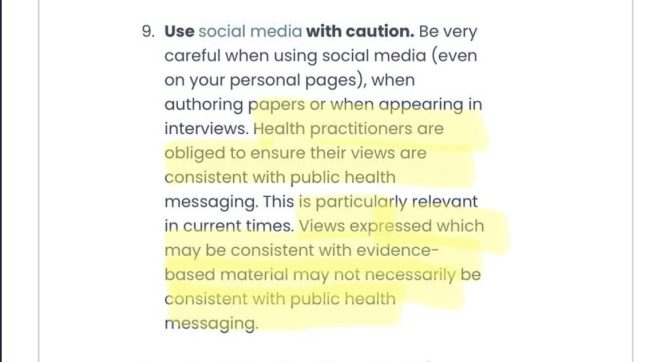
On Feb. 28, a big Australian medical insurer warned physicians that to avoid Aphra notifications, they needed to “be very careful” not to contradict “public health messaging” in social media comments.
But the warning – although first mentioning social media – went even further. It also warned against “authoring papers” that contradicted the authorities’ favored views.
SOURCE
Further, even “views… consistent with evidence-based material” could lead to problems if they contradicted “public health messaging.”
The warning came from the Medical Indemnity Protection Society, which provides professional insurance coverage for doctors. Although these insurers do not speak officially for government agencies, doctors effectively cannot practice without professional insurance, so their pronouncements are powerful.
In other words, only a very brave physician in Australia would consider offering advice that’s not “consistent with public health messaging” anytime soon.
No worries, though, the public health authorities know best!
AUKUS to bolster combat capabilities of nuclear submarine fleet to challenge China

By Paul Antonopoulos | March 18, 2022
Australia will become the second home for US and British nuclear submarines, meaning that the island country will effectively become a nuclear staging ground aimed at challenging China in the Asia-Pacific region. In this way, AUKUS – a trilateral security pact between Australia, the United Kingdom, and the United States, provokes increased confrontation with China.
Australian Prime Minister Scott Morrison announced on March 15 that the Anglo Alliance’s nuclear ships would initially be stationed in the sparsely populated state of Western Australia. However, he added that infrastructure on the east coast is “incredibly important for how we defend our nation.” Morrison explained that a site for a new base would be decided after the upcoming federal elections to be held on or before May 21. It is noted that although the eastern states account for 37% of the country’s total land area, they are home to over 80% of the population as well as Australia’s most important cities – Sydney, Melbourne, Canberra and Brisbane.
Earlier this week, in a virtual speech at the Lowy Institute, the Prime Minister announced his decision to build a new base in the east to support the deployment of Australia’s future nuclear submarine fleet under an agreement signed within the framework of the AUKUS military alliance. Three locations for the new eastern base are under consideration – Brisbane in the northeast state of Queensland, and Newcastle and Port Kembla to the north and south of Sydney respectively.
“The ability of US and UK nuclear-powered submarines to be here on the west coast, and ultimately we’d like to see them on the east coast as well, is all part of what our plan is as we continue to push forward our AUKUS partnership,” the Australian Prime Minister said.
In this way, the US and UK are using Australia as a junior partner to bolster the combat capabilities of the bloc’s nuclear submarine fleet in the Indian and South Pacific as confrontation with Russia and China escalates. With nuclear warships based in Australia, it greatly enhances the abilities of the US and British naval fleets to perform operations far off from home. However, it is likely not just about submarines, and we can maybe expect American and British aircraft carriers to also appear in Australia.
In general, for a long time, Australia banned nuclear vessels from entering its base.
For the goal of containing China in Asia-Pacific, Australia has now become critical for the US and UK. For example, a US aircraft carrier after 5-7 days of conflict with a potential enemy needs to replenish ammunition for aircraft on the carrier, while repairs and additional fuel for the aircraft are usually carried out in port. Australia can now fill this gap since quite obviously British and American ships operating in and around Southeast Asia are far from home.
This elevated importance given to Australia by Britain and the US has already resulted in greater military confrontation with China, with the East Asian country complaining that an Australian surveillance aircraft was flying in a “malicious” and “unprofessional” fashion close to its warships when the plane was targeted by a laser weapon.
Although China was accused of putting lives at risk by the Australian government in February when a laser was directed towards a RAAF P-8 Poseidon plane monitoring two People’s Liberation Army-Navy (PLA-N) warships sailing through the Arafura Sea, the Chinese Ministry of National Defence released a short video clip recorded on a warship, showing the Australian aircraft flying close by in a “nuisance” manner.
“It is evident in the video taken by the Chinese naval ship that the Australian military aircraft was conducting close-in reconnaissance on Chinese naval vessels,” Senior Colonel Tan Kefei said. “The Australian military aircraft’s conduct was malicious in intention and unprofessional in operation and posed threats to the safety of ships, aircraft and personnel of both sides.”
With Chinese and Australian militaries already skirmishing in such a manner, the entry of US and British nuclear submarines into Australian ports will only further destabilize the situation. It is recalled that Australia’s decision to equip its fleet with nuclear submarines under AUKUS was met with mistrust across the region, especially from Southeast Asian partners like Malaysia and Indonesia.
Now, it has been reported that Australia is actually becoming a “second home” for US and UK nuclear submarines. In the context of growing confrontations between the US and China, including the Taiwan issue, AUKUS in fact raises tensions in the region by encouraging the increasing nuclearization of the region.
Paul Antonopoulos is an independent geopolitical analyst.
Thailand Paid $45 Million in COVID Vaccine Injury Claims, While U.S. Has Paid $0
By Michael Nevradakis, Ph.D. | The Defender | March 15, 2022
Thailand’s National Health Security Office (NHSO) as of March 8 has paid 1.509 billion baht (the equivalent of $45.65 million) to settle COVID-19 vaccine injury compensation claims.
The payouts were made to 12,714 people, including family members of some people who died as a result of the vaccine.
An additional 891 claims are pending. A total of 15,933 claims have been filed since the start of the compensation program on May 19, 2021. Of the 2,328 complaints that were rejected, 875 are being appealed.
The figures released on March 9 represent a continued increase in claims approved by Thailand’s NHSO. As of Dec. 26, 2021, only 8,470 claims had been approved for compensation.
The vaccines being administered in Thailand are primarily the British-Swedish AstraZeneca vaccine, and the Chinese-made Sinovac vaccine.
Thailand’s vaccine injury compensation program is an example of a “no-fault compensation program.”
As reported by The Defender in December 2021, “no-fault” refers to a measure put in place by public health authorities, private insurance companies, manufacturers and/or other stakeholders to compensate individuals harmed by vaccines.
Such programs allow a person who has sustained a vaccine injury to be compensated financially, without having to attribute fault or error to a specific manufacturer or individual.
No-fault compensation schemes are one of three options used by various countries to handle vaccine injury claims.
The other two options include allowing vaccine-injured people to sue private-sector actors, such as vaccine manufacturers or their insurers, or to place the full financial burden on the patient.
In the case of Thailand, the compensation scheme sets forth the following payout categories:
- For cases of death or permanent disability, each family receives 400,000 baht ($11,928).
- Those who sustained a disability that affects their livelihood or who lost a limb receive 240,000 baht ($7,157).
- For other injuries or illnesses sustained as a result of COVID vaccination, a maximum of 100,000 baht ($2,982) is paid out.
For the third category of claims, the specific amount awarded is contingent on the level of damages found to have been caused by the vaccine, as well as the financial state of the patient.
When the compensation fund was set up in 2021, Dr. Jadej Thammatacharee, the NHSO’s secretary-general, stated the available funds would total 100 million baht ($2.98 million), but that initial budget already has been exceeded many times over.
Thailand’s “no-fault” system makes it easy to secure compensation, at least when compared to similar schemes in the U.S. and other western countries.
Claims can be submitted by the individuals in question, or their families, at the hospital where they were vaccinated, at provincial health offices, or at NHSO regional offices. Moreover, claims can be entered up to two years after the adverse effects first occur.
Any individual claiming injury or side effects can file a claim for initial financial aid to provide an unspecified amount to claimants prior to confirmation that the injuries resulted from the vaccine.
If it is later determined the adverse effects were not a result of the vaccine, the claimants are entitled to keep this initial financial payout.
The turnaround time on claims also appears to be quick, when compared to the U.S. and several other countries.
The Bangkok Post reported that 13 panels across Thailand meet on a weekly basis to consider compensation claims. Those that are approved are paid within five days. Rejected claims can be appealed directly to the NHSO secretary-general within 30 days.
Available figures from the Thai authorities do not break down the number awarded claims for deaths, serious injuries and disabilities, or other injuries and adverse effects.
However, according to information provided by Thailand’s Department of Disease Control (DDC), as of Oct. 24, 2021, three deaths were linked to COVID vaccination.
According to Chawetsan Namwat, the DDC’s director for emergency health hazard and disease control, two of these deaths were a result of thrombosis. The other death came after the onset of a severe allergic reaction and shock following the administration of the vaccine.
Of the 842 deaths that were investigated up until that date, 541 were found to be “coincidental events,” including cardiovascular disease, stroke, pulmonary embolism, blood infections, lung inflammation, lung cancer and breast cancer.
For an additional 66 deaths, it was inconclusive whether the vaccine led to the fatalities — with 47 of these individuals also having been diagnosed with cardiovascular disease.
A further 41 deaths were categorized as “unclassified,” as there was not enough information available to make a determination regarding whether the deaths were linked to the vaccines.
According to a Feb. 18 briefing from healthdata.org, COVID-19 was the 13th most common cause of death in the country for the preceding week, behind such causes as chronic kidney disease, liver cancer, Alzheimer’s disease, diabetes mellitus and road injuries.
Ischemic heart disease and stroke were recorded as the top two causes of death in Thailand during the same period.
U.S. remains ‘stuck’ at one approved vaccine injury claim since November 2021
As previously reported by The Defender, as of Nov. 1, 2021, only one COVID vaccine injury claim had been approved for compensation by the Countermeasures Injury Compensation Program (CICP).
As of today, the figure remains at one — a claim which has not yet been paid. No new claims were compensated in the interim.
As reported by the CICP:
“As of March 1, 2022, the CICP has not compensated any COVID-19 countermeasures claims.
“Six COVID-19 countermeasure claims have been denied compensation because the standard of proof for causation was not met and/or a covered injury was not sustained.
“One COVID-19 countermeasure claim, a COVID-19 vaccine claim due to an anaphylactic reaction, has been determined eligible for compensation and is pending a review of eligible expenses.”
Last week, U.S. Sen. Ron Johnson (R-Wis.) introduced the Countermeasure Injury Compensation Amendment Act to help expedite claims by those injured by COVID vaccines.
The bill would amend the CICP to improve responsiveness, create a commission to examine the injuries directly caused as a result of COVID countermeasures and allow those whose claims have been previously rejected to resubmit claims for new consideration.
With only one claim approved for compensation and six claims denied, the CICP has a backlog of approximately 7,050 claims, with 4,097 claims alleging injuries or death from COVID vaccines, and an additional 2,959 claims alleging injuries or death from other COVID countermeasures.
Since 2010, a total of 7,547 compensation claims have been filed with the CICP. Only 41 were deemed eligible for compensation; still fewer (30) were actually compensated.
Notably, as of the March 4 release of Vaccine Adverse Event Reporting System (VAERS) data, a total of 1,168,894 adverse effects following COVID vaccination have been reported, including 25,158 deaths and 46,515 cases of permanent disability.
Historically, VAERS has been shown to report only 1% of actual vaccine adverse events.
CICP was established under the aegis of the Public Readiness and Emergency Preparedness (PREP) Act of 2005. The PREP act was developed to coordinate the response to a “public health emergency.”
The law is scheduled to remain in place until 2024.
CICP differs from another U.S. federal vaccine compensation program, the National Vaccine Injury Compensation Program (VICP), which was established after the passage of the National Childhood Vaccine Injury Act of 1986.
VICP, however, covers only those vaccines routinely administered to children and to pregnant women. To help fund the program, those vaccines are subject to a federal 75-cent excise tax.
To date, more than 8,400 VICP claims have been settled, out of more than 24,000 petitions, with a total of $4.6 billion issued in settlements.
The small number of approved compensation claims and the slow review process has recently led to calls for the modernization of vaccine compensation programs in the U.S.
Other western countries appear to have developed similarly cumbersome compensation procedures.
For instance, Australia’s newly established no-fault vaccine compensation system was described as “intentionally complex and narrowly targeted.”
Canada, which also only recently established a no-fault compensation program, as of Dec. 16, 2021, had approved fewer than five of 400 claims filed. More recent data from Canada’s Vaccine Injury Support Program is unavailable as of this writing.
Michael Nevradakis, Ph.D., is an independent journalist and researcher based in Athens, Greece.
© 2022 Children’s Health Defense, Inc. This work is reproduced and distributed with the permission of Children’s Health Defense, Inc. Want to learn more from Children’s Health Defense? Sign up for free news and updates from Robert F. Kennedy, Jr. and the Children’s Health Defense. Your donation will help to support us in our efforts.
Papua New Guinea’s pandemic leadership is an inspiration to us all
Harry Dougherty Blog | February 24, 2022
When I find myself arguing with pro mandate Australians in social media comment sections (tragic, I know) I get the impression that they desperately want the last couple of years they’ve squandered to have been worthwhile.
Australia’s official Covid19 death rate happens to be low by international standards, which makes it easier for the Dan Andrews fanboys to delude themselves that the sick cruelty they inflicted on their fellow citizens was justified.
For a recap, this cruelty includes but is not limited to:
- Prolonged mass house arrest
- Vaccine Passports
- Vaccine injuries and deaths in individuals (often young and not at serious risk from Covid) who were coerced into getting it.
- The four newborn babies in South Australia who died after domestic Covid19 travel restrictions prevented them from being transferred for specialist life-saving emergency treatment in Victoria.
- In Western Australia, the prevention of unvaccinated parents from visiting their sick children in hospital.
If I was Australian Prime Minister Scott Morrison, (that snivelling, gaslighting, modern-day Pontius Pilate), I would not want to admit that pointlessly I stole two years of quality life from my citizens and presided over state policies that killed people,
“Australians have made many sacrifices during this pandemic,… together we have achieved one of the lowest death rates in the world,” he says.
Achieved? Everywhere in the Oceania region has a low death rate by global standards. When will Papua New Guinea’s PM be praised for his inspirational leadership? Don’t hold your breath, but PNG is Australia’s immediate neighbour, (and the only other country on Earth with kangaroos), yet has a lower Covid19 death rate than does oz.
Could that be because of the success of PNG’s vaccination rollout? Did they her the sheep through the gate, so to speak?
Vaccination rate for Australia (at least one dose): 85%
Vaccination rate for PNG (at least one dose): 3.4%
Since we are only allowed to compare Sweden with its neighbours, it’s only fair that the same rules must apply to everyone. I assume vaccine passports aren’t really a thing in PNG. But they seem to be coping without them.
Covid19 deaths per million for Australia: 193/1M
Covid19 deaths per million for PNG: 69/1M
Most countries in Europe have relatively high death rates, though the few nations that had extremely low death rates (Norway and Finland) did not have the strictest measures. Lockdown rejecting Sweden’s death rate is firmly in Europe’s lower half.
At present, the UK is the least restricted country in Europe, possibly in the developed world and has been since July 2021, yet our (questionably recorded) Covid19 death rate is only the 22nd highest in Europe, currently slightly lower than that of Italy, which has vaccine passports and vaccine mandates, and surgical masks remain compulsory.
What would Australia’s death rate be were it somehow squeezed into the North Atlantic or continental Europe? We cannot know.
Featured Video

Trita Parsi: Israel Set a Trap for Total War in the Region
or go to
Aletho News Archives – Video-Images
From the Archive
Zionism’s Violent Legacy
By Donald Neff | Washington Report On Middle East Affairs | January 1996
On January 4, 1948, Jewish terrorists drove a truck loaded with explosives into the center of the all Arab city of Jaffa and detonated it, killing 26 and wounding around 100 Palestinian men, women and children.[1] The attack was the work of the Irgun Zvai Leumi – the “National Military Organization,” also known by the Hebrew letters Etzel – the largest Jewish terrorist group in Palestine. The Irgun was headed by Revisionist Zionist Menachem Begin and had been killing and maiming Arabs, Britons and even Jews for the previous ten years in its efforts to establish a Jewish state.
This terror campaign meant that at the core of Revisionist Zionism there existed a philosophical embrace of violence. … continue
Blog Roll
 Aletho News
- Trita Parsi: Israel Set a Trap for Total War in the Region
- Trump’s Iran war is on an Israeli leash
- Saudi oil boss issues global supply warning
- Riyadh Says Its Oil System Is Intact. The Numbers Say Otherwise.
- Trump and Netanyahu Want to “Finish the Job” on Iran
- US ‘one-sided dictation’ not Iran’s beliefs makes rational talks impossible: Baghaei
- Iran’s Next Strike May Not Explode. It Could Shut You Down /Col Doug Macgregor
- Iran: US political targets legitimate if assassinations return
- Iraq shuts key border crossing with Iran under US pressure: Report
- Undersea Internet cables could be targeted in retaliation for attacks on Iran: IRGC deputy chief
- If Americans Knew
- The Israel Lobby’s Changing Fortunes
- AIPAC has become such a political liability that it’s shifting to a more “nimble” approach to buying politicians
- At least 160 Israeli settler attacks in 2 weeks
- Will Gaza’s Ancient Christian Community Disappear Forever?
- Israel’s vision of regional security rests on keeping Arab states weak
- Heidi Levine recounts how Palestinian youths helped save her in settler attack
- DAILY UPDATE: Latest essential news on Palestine, Israel, & region
- Trump’s Intensifying Sabotage of the ICC, for Israel’s Sake
- Israeli military detain US and UK volunteers in West Bank including Democratic NY politician Brad Lander
- Americans at National Conservatism Conference held in Israel this year criticize Israel
- No Tricks Zone
- E-Cars Reduce CO2 Emissions By Only 41% Compared To Internal Combustion Engine Vehicles
- Predictions Made By Renowned Climate Professor Over Past Decades Have Been Proven To Be Poor
- New Study Suggests Large Regions Of The Pacific Ocean Have Been Cooling For The Last 80 Years
- Germany’s Green Energy Debacle: High Energy Costs Force Kahla Porzellan to Close After 182 Years!
- New Study: 50 Years Of The Most Aggressive ‘Net Zero’ Policies Can Only Affect The Global Climate By 0.03°C
- US September “Heat” Was No Record…Many Records Set Decades Ago
- Latest European Green Energy Debacle; Portugal’s Largest Flagship Solar Park Insolvent!
- Green Energy Debacle: German Expert Professor Fritz Vahrenholt Warns Of Severe Economic And Social Consequences
- Two More Paleo Reconstructions Affirm Meters-Higher Sea Levels Across Ireland, Brazil 7000-6000 Years Ago
- New Study: Earth And Venus Surface Warmth Largely Explained By Convection And Lapse Rate, Not CO2 Or Radiation

