I was set up by ‘MAFIA’ & media served up misleading tapes: Austria’s Russiagate victim, ex-vice-chancellor Strache
RT | August 28, 2020
It took one “leaked” tape of a right-wing politician’s meeting with a fake Russian oligarch’s niece to topple the Austrian government in 2019. Ex-vice-chancellor Heinz-Christian Strache now says it was a “criminal network” plot.
Austria’s right-wing government imploded in spectacular fashion last summer, after two German newspapers, Der Spiegel and the Suddeutsche Zeitung, published excerpts from a videotape of Vice-Chancellor Strache negotiating a ‘quid pro quo’ deal with the supposed “niece of a Russian oligarch” in Ibiza.
The woman was later revealed to be a Bosnian student, posing as a Russian femme fatale, and the tapes turned out to be from 2017, but that didn’t save Austria’s ruling coalition.
Strache resigned and snap elections were called. His ex-coalition partner, Chancellor Sebastian Kurz, eventually regained power, but this time partnered with the environmentalist Green Party, and not the right-wing Freedom Party (FPO).
Strache has been fighting a court battle against the media to clear his name, and his lawyers have apparently obtained the full contents of the tape. He now says the unabridged transcripts – partly published in the media this week – prove that he’s been framed and misrepresented in the “leaks.”
“It was a manipulative extermination campaign that was launched on several levels,” Strache told RT Deutsch in an interview.
Indeed, much of the so-called “Ibiza affair” is still shrouded in mystery. Strache initially accused unnamed “intelligence agencies” of orchestrating the recording, while Kurz pointed the finger at an Israeli spin doctor, Tal Silberstein. A newspaper report last May blamed an Iranian-born lawyer, Ramin Mirfakhrai, who admitted his involvement but described the sting as a “civil society” project.
“This group of perpetrators is likely to be a very large one; one could perhaps also speak of a criminal network,” Strache told RT. He then claimed that a member of his own security team was apparently working with this “mafia” for nearly a decade and that the male escort of the ‘oligarch’s niece’ was allegedly working with Strache’s companion on the night – FPO deputy leader Johann Gudenus – to entrap him.
Strache also alleges that he was drunk – or maybe even “drugged” – during the “illegal” recording.
It is not clear if Strache’s assessment matches that of the committee of inquiry, which has been investigating the affair since June. Strache has little confidence in the inquiry, though, and told RT that he expects it to be derailed by “political tactics.” However, prosecutors in Austria are currently investigating the woman’s male companion – identified as “private investigator” Julian H. – for entrapment, while the newly-surfaced tapes appear to paint a different picture of the night in Ibiza.
In these, Strache can be heard rejecting some of the corrupt offers from the “Russian oligarch’s niece.” When she lays out the deal – favorable press coverage in a newspaper owned by her family in exchange for lucrative construction contracts – Strache responds: “No way, I won’t do it.”
“I don’t want to be vulnerable,” he says. “I want to sleep peacefully. I want to get up in the morning and say: I’m clean.”
While some of these lines were mentioned during the 2019 coverage, they did not appear in the “leaked” video – and Strache suspects this is no coincidence. He claims the additional footage now proves he is “neither corrupt nor for sale,” even despite the fact that he was plied with alcohol. He said he’s unsure whether to blame the two German newspapers for airing the original, selectively-edited footage, or the masterminds of the sting operation who sold them this footage.
Some of the German-language media that previously reported on the “Ibiza affair” have been left unimpressed by the new transcripts, and it remains to be seen whether the investigation sides with the so-called “civil society” project or condemns what Strache likes to call the “Stasi methods,” in reference to the infamous East German secret police. But given the alleged scope of the operation, Strache says he’s happy that at least he got out of it alive.
“I’m glad I’m alive,” he told RT. “I have the opportunity every day to experience the sun rising again, and also to defend myself and to fight such mechanisms. Because I say that such methods have no place in political debate.”
Austrians protest government cooperation with Israel in cyber drills
By Homa Lezgee | Press TV | August 4, 2020
Vienna – Protesters in Vienna are demanding an immediate end to Austria’s military cooperation with the Israeli regime.
The slogan of protesters gathered outside the American embassy in Vienna is “No to Austrian subordination to US/Israeli interests.”
They say the Austrian government’s decision to involve its intelligence forces in cyber maneuvers with Israel is meant to serve the interests of the US and Israel despite concerns it could lead to mass surveillance of the Austrian population.
Not much is known about the maneuvers, reportedly involving the Israeli military, the German Armed Forces, and units from Austria and Switzerland, during which cyber attacks would be simulated and countered.
Protesters also condemned the Austrian government for refusing to vote against Israel’s recent illegal annexation plans.
Pro-Palestinian groups in Austria, such as the Palestine Solidarity Platform, and the Boycott, Divestment and Sanctions Movement (BDS) have been facing increasing government restrictions amid allegations of promoting anti-Semitism, an accusation they say is being used to misrepresent their goal of opposing Israeli occupation and aggression.
‘Shameless Racism’: 13 Countries Change Long-Standing Position on Palestine at UN
Palestine Chronicle – December 5, 2019
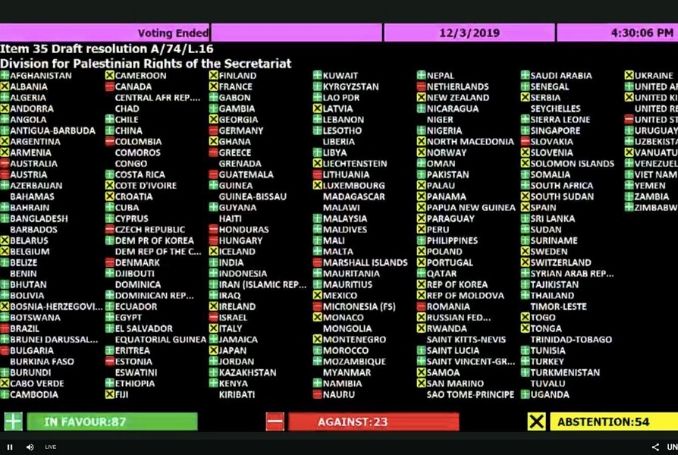
For the first time, 13 countries changed their longstanding positions and voted against a pro-Palestine measure at the United Nations on Tuesday.
Germany, the Czech Republic, Austria, Bulgaria, Denmark, Estonia, Greece, Lithuania, Netherlands, Romania, Slovakia, Brazil, and Colombia voted against the annual resolution regarding the “Division for Palestinian Rights of the Secretariat”, according to the Times of Israel.
They had previously abstained on the vote.
The resolution, which includes a call to halt to illegal Israeli settlements being constructed in the occupied West Bank, still passed with a large majority voting in favor.
The Palestinian representative told the council: “If you protect Israel, it will destroy you all.” He also said Israel’s character as a Jewish state is “shameless racism”.
The New York-based Division for Palestinian Rights oversees the Committee on the Exercise of the Inalienable Rights of the Palestinian People.
The resolution was co-sponsored by Comoros, Cuba, Indonesia, Jordan, Kuwait, Lao People’s Democratic Republic, Qatar, Saudi Arabia, Senegal, the United Arab Emirates, and Yemen.
The UK, France, and Spain abstained, as they do every year, allowing the resolution to pass with a vote of 87-54, with 21 other abstentions.
The General Assembly adopted five resolutions on the question of Palestine and the Middle East, including one calling on the Member States not to recognize any changes to the pre-1967 borders, including with regards to Jerusalem, other than those agreed by the parties through negotiations.
Washington’s Nord Stream 2 Sanctions May Have Boomerang Effect on US Interests – German Media Reports
By Svetlana Ekimenko – Sputnik – 27.08.2019
The US Congress has moved forward with legislation to impose sanctions on the Nord Stream 2 pipeline project in defiance of criticism from Washington’s allies in Europe, as the joint venture brings together Russia’s Gazprom, Germany’s Uniper and Wintershall, Austria’s OMV, France’s Engie, and Anglo-Dutch Royal Dutch Shell.
Possible US sanctions against companies involved in the construction of the Nord Stream 2 pipeline could potentially harm US oil and gas projects in the Gulf of Mexico, writes the German business newspaper Handelsblatt.
“From the point of view of Germany, the name of the US proposed sanctions bill, ‘Protecting Europe’s Energy Security Act’, is in itself an insolence”, writes the author.
The US is pushing to impose sanctions against Nord Stream 2 despite likely consequences that such restrictions may have.
Thus, European companies involved in laying the pipeline and targeted by Washington’s sanctions play a key role in the global energy market.
For a long time, these companies worked in the Gulf of Mexico as subcontractors of the American corporations Chevron and Exxon Mobil, recalls Handelsblatt.
Therefore, if they are included in the sanctions lists, projects in the Gulf of Mexico will be disrupted, since it is impossible to quickly replace such highly specialised firms.
Overall, the US economy views the proposed sanctions against Nord Stream 2 critically, the author points out. Such restrictions would also be likely to harm US gas exporters, prompting European buyers to reduce LNG imports from the United States and increase supplies from other countries.
Proposed US Sanctions on Nord Stream 2
The Nord Stream 2 project has long drawn opposition from a number of countries, with the United States, which is trying to sell more of its own liquefied natural gas to overseas allies, insisting that the project will make Europe dependent on Moscow – claims that Russia has repeatedly rebuffed.
Moscow has insisted that the pipeline project is strictly commercial, ultimately seeking to boost Europe’s energy security.
Nevertheless, in early August, the US Senate Foreign Relations Committee approved a bill on sanctions against companies providing vessels for the Nord Stream 2 pipeline project.
The document prohibits entry into the US for anyone involved in the “sale, lease, provision or assistance in providing” ships for laying Russian offshore pipelines at a depth of 30 metres or more, as well as the freezing of their assets in US jurisdiction.
Companies from Austria, Germany, the Netherlands, France, Finland, and Sweden may fall under the sanctions.
The project is being implemented by Nord Stream 2 AG, with Gazprom investing half of the funds, and the remainder being contributed by European partners: Germany’s Uniper and Wintershall, Austria’s OMV, France’s Engie, and Anglo-Dutch Royal Dutch Shell.
Germany has been strongly behind Nord Stream 2, emphasizing the commercial focus of the project.
German Chancellor Angela Merkel said that she supported the BDI’s (Federation of German Industries) stance that the Nord Stream 2 pipeline for delivering Russian natural gas to Europe is necessary given the German initiative to stop using nuclear and coal energy.
Austria, which is interested in reliable supplies of fuel, and Norway, whose government owns 30 percent of the shares of Kvaerner, one of the gas pipeline construction contractors, also spoke in favor of the project.
Nord Stream 2 Project
The 745-mile-long (1,200 km) Nord Stream 2 twin pipeline is set to run from Russia to Germany through the territorial waters or exclusive economic zones of Denmark, Finland, Germany, Russia, and Sweden to deliver Russian gas to European consumers.
The completed project will double the capacity of the existing Nord Stream pipeline network, allowing a total of up to 110 billion cubic metres of Russian natural gas to be transported to Western Europe via pipelines at the bottom of the Baltic Sea.
According to a statement made by project operator Nord Stream 2 AG on 26 August, the pipeline is 75 percent complete.
Austrian Ex-Colonel Accused of Espionage ‘Doesn’t Feel Like a Spy’ – Lawyer
Sputnik – November 14, 2018
The lawyer of the retired Austrian colonel, who is suspected of having passed secret information to Russia for 25 years, insists that his client could have never betrayed state secrets as he had no access to the classified data. According to the local outlet Kronen Zeitung, defender Michael Hofer welcomed the decision of the Salzburg State Court not to arrest the retired colonel.
“My client has assured me that he has not revealed any state secrets. He is very pleased with the decision of the court. He does not feel like a spy,” the lawyer told the media.
The judge dismissed the application for pre-trial detention, citing there’s no danger that the suspect flees. He is said to be optimally socially integrated and has an irreproachable profile. Court spokesman Peter Egger also stated that the accused man has no access to sensitive information anyway since he is retired. Besides, his communications are restricted.
According to the Salzburg prosecutor’s office, the suspect may be sentenced to up to 10 years in prison. The case against the retired officer, who is said to have spied for Moscow between the 1990s and the end of his careers, was made public last week following Kronen Zeitung’s report.
Austrian Chancellor Sebastian Kurz confirmed that a 70-year-old retired Austrian colonel was suspected of spying for Moscow and demanded that Russia provide “transparent” information on the issue. The incident prompted the cancellation of an official visit of Austrian Minister of Foreign Affairs Karin Kneissl to Russia.
Addressing the espionage case, Moscow protested to the Austrian Ambassador to Russia, calling the accusations baseless. In response, General-Secretary of the Austrian Interior Ministry Peter Goldgruber expressed hope that the incident would not undermine Austrian-Russian relations.
READ MORE:
UK Gave Austria Info on Ex-Colonel Suspected of Spying for Russia – Reports
The Remarkable Historiography of David Irving
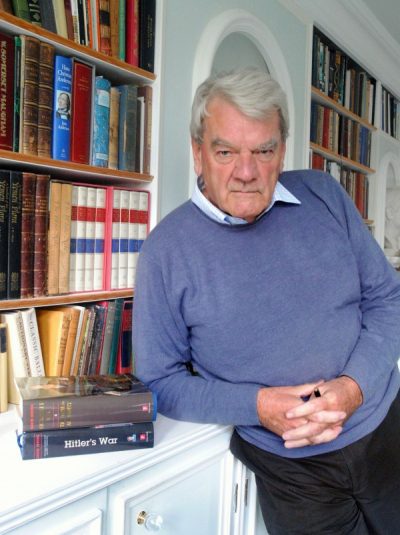
David Irving taken in London. CC by-SA 3.0. Credit: Allan Warren/Wikimedia Commons
By Ron Unz • Unz Review • June 4, 2018
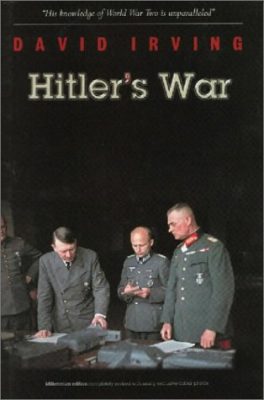
I’m very pleased to announce that our selection of HTML Books now contains works by renowned World War II historian David Irving, including his magisterial Hitler’s War, named by famed military historian Sir John Keegan as one of the most crucial volumes for properly understanding that conflict.
With many millions of his books in print, including a string of best-sellers translated into numerous languages, it’s quite possible that the eighty-year-old Irving today ranks as the most internationally-successful British historian of the last one hundred years. Although I myself have merely read a couple of his shorter works, I found these absolutely outstanding, with Irving regularly deploying his remarkable command of the primary source documentary evidence to totally demolish my naive History 101 understanding of major historical events. It would hardly surprise me if the huge corpus of his writings eventually constitutes a central pillar upon which future historians seek to comprehend the catastrophically bloody middle years of our hugely destructive twentieth century even after most of our other chroniclers of that era are long forgotten.
Carefully reading a thousand-page reconstruction of the German side of the Second World War is obviously a daunting undertaking, and his remaining thirty-odd books would probably add at least another 10,000 pages to that Herculean task. But fortunately, Irving is also a riveting speaker, and several of his extended lectures of recent decades are conveniently available on YouTube, as given below. These effectively present many of his most remarkable revelations concerning the wartime policies of both Winston Churchill and Adolf Hitler, as well as sometimes recounting the challenging personal situation he himself faced. Watching these lectures may consume several hours, but that is still a trivial investment compared to the many weeks it would take to digest the underlying books themselves.
When confronted with astonishing claims that completely overturn an established historical narrative, considerable skepticism is warranted, and my own lack of specialized expertise in World War II history left me especially cautious. The documents Irving unearths seemingly portray a Winston Churchill so radically different from that of my naive understanding as to be almost unrecognizable, and this naturally raised the question of whether I could credit the accuracy of Irving’s evidence and his interpretation. All his material is massively footnoted, referencing copious documents in numerous official archives, but how could I possibly muster the time or energy to verify them?
Rather ironically, an extremely unfortunate turn of events seems to have fully resolved that crucial question.
Irving is an individual of uncommonly strong scholarly integrity, and as such he is unable to see things in the record that do not exist, even if it were in his considerable interest to do so, nor to fabricate non-existent evidence. Therefore, his unwillingness to dissemble or pay lip-service to various widely-worshiped cultural totems eventually provoked an outpouring of vilification by a swarm of ideological fanatics drawn from a particular ethnic persuasion. This situation was rather similar to the troubles my old Harvard professor E.O. Wilson had experienced around that same time upon publication of his own masterwork Sociobiology: The New Synthesis, the book that helped launch the field of modern human evolutionary psychobiology.
These zealous ethnic-activists began a coordinated campaign to pressure Irving’s prestigious publishers into dropping his books, while also disrupting his frequent international speaking tours and even lobbying countries to bar him from entry. They also maintained a drumbeat of media vilification, continually blackening his name and his research skills, even going so far as to denounce him as a “Nazi” and a “Hitler-lover,” just as had similarly been done in the case of Prof. Wilson.
During the 1980s and 1990s, these determined efforts, sometimes backed by considerable physical violence, increasingly bore fruit, and Irving’s career was severely impacted. He had once been feted by the world’s leading publishing houses and his books serialized and reviewed in Britain’s most august newspapers; now he gradually became a marginalized figure, almost a pariah, with enormous damage to his sources of income.

In 1993, Deborah Lipstadt, a rather ignorant and fanatic professor of Theology and Holocaust Studies (or perhaps “Holocaust Theology”) ferociously attacked him in her book as being a “Holocaust Denier,” leading Irving’s timorous publisher to suddenly cancel the contract for his major new historical volume. This development eventually sparked a rancorous lawsuit in 1998, which resulted in a celebrated 2000 libel trial held in British Court.
That legal battle was certainly a David-and-Goliath affair, with wealthy Jewish movie producers and corporate executives providing a huge war-chest of $13 million to Lipstadt’s side, allowing her to fund a veritable army of 40 researchers and legal experts, captained by one of Britain’s most successful Jewish divorce lawyers. By contrast, Irving, being an impecunious historian, was forced to defend himself without benefit of legal counsel.
In real life unlike in fable, the Goliaths of this world are almost invariably triumphant, and this case was no exception, with Irving being driven into personal bankruptcy, resulting in the loss of his fine central London home. But seen from the longer perspective of history, I think the victory of his tormenters was a remarkably Pyrrhic one.

Although the target of their unleashed hatred was Irving’s alleged “Holocaust denial,” as near as I can tell, that particular topic was almost entirely absent from all of Irving’s dozens of books, and exactly that very silence was what had provoked their spittle-flecked outrage. Therefore, lacking such a clear target, their lavishly-funded corps of researchers and fact-checkers instead spent a year or more apparently performing a line-by-line and footnote-by-footnote review of everything Irving had ever published, seeking to locate every single historical error that could possibly cast him in a bad professional light. With almost limitless money and manpower, they even utilized the process of legal discovery to subpoena and read the thousands of pages in his bound personal diaries and correspondence, thereby hoping to find some evidence of his “wicked thoughts.” Denial, a 2016 Hollywood film co-written by Lipstadt, may provide a reasonable outline of the sequence of events as seen from her perspective.

Yet despite such massive financial and human resources, they apparently came up almost entirely empty, at least if Lipstadt’s triumphalist 2005 book History on Trial may be credited. Across four decades of research and writing, which had produced numerous controversial historical claims of the most astonishing nature, they only managed to find a couple of dozen rather minor alleged errors of fact or interpretation, most of these ambiguous or disputed. And the worst they discovered after reading every page of the many linear meters of Irving’s personal diaries was that he had once composed a short “racially insensitive” ditty for his infant daughter, a trivial item which they naturally then trumpeted as proof that he was a “racist.” Thus, they seemingly admitted that Irving’s enormous corpus of historical texts was perhaps 99.9% accurate.
I think this silence of “the dog that didn’t bark” echoes with thunderclap volume. I’m not aware of any other academic scholar in the entire history of the world who has had all his decades of lifetime work subjected to such painstakingly exhaustive hostile scrutiny. And since Irving apparently passed that test with such flying colors, I think we can regard almost every astonishing claim in all of his books—as recapitulated in his videos—as absolutely accurate.
Aside from this important historical conclusion, I believe that the most recent coda to Irving’s tribulations tells us quite a lot about the true nature of “Western liberal democracy” so lavishly celebrated by our media pundits, and endlessly contrasted with the “totalitarian” or “authoritarian” characteristics of its ideological rivals, past and present.
In 2005, Irving took a quick visit to Austria, having been invited to speak before a group of Viennese university students. Shortly after his arrival, he was arrested at gunpoint by the local Political Police on charges connected with some historical remarks he had made 16 years earlier on a previous visit to that country, although those had apparently been considered innocuous at the time. Initially, his arrest was kept secret and he was held completely incommunicado; for his family back in Britain, he seemed to have disappeared off the face of the earth, and they feared him dead. More than six weeks were to pass before he was allowed to communicate with either his wife or a lawyer, though he managed to provide word of his situation earlier through an intermediary.
And at the age of 67 he was eventually brought to trial in a foreign courtroom under very difficult circumstances and given a three-year prison sentence. An interview he gave to the BBC about his legal predicament resulted in possible additional charges, potentially carrying a further twenty-year sentence, which probably would have ensured that he died behind bars. Only the extremely good fortune of a successful appeal, partly on technical grounds, allowed him to depart the prison grounds after spending more than 400 days under incarceration, almost entirely in solitary confinement, and he escaped back to Britain.
His sudden, unexpected disappearance had inflicted huge financial hardships upon his family, and they lost their home, with most of his personal possessions being sold or destroyed, including the enormous historical archives he had spent a lifetime accumulating. He later recounted this gripping story in Banged Up, a slim book published in 2008, as well as in a video interview available on YouTube.
Perhaps I am demonstrating my ignorance, but I am not aware of any similar case of a leading international scholar who suffered such a dire fate for quietly stating his historical opinions, even during in darkest days of Stalinist Russia or any of the other totalitarian regimes of the twentieth century. Although this astonishing situation taking place in a West European democracy of the “Free World” did receive considerable media exposure within Europe, coverage in our own country was so minimal that I doubt that today even one well-educated American in twenty is even aware it ever happened.
One reason that most of us still believe that the West remains a free society is that Our American Pravda works so hard to conceal the important exceptions.
Vienna Opposes US Anti-Iran Sanctions That Affect Austria – President
Sputnik – 04.07.2018
VIENNA – Vienna regrets Washington’s decision to reimpose sanctions on Iran as these restrictions violate international law and affect Austria due to their extraterritorial nature, Austrian President Alexander Van der Bellen said on Wednesday.
“Austria regrets the US pullout from the JCPOA. We also regret the US decision to reimpose sanctions on Iran. This does not concern the so-called primary sanctions against Iran, but the secondary sanctions which affect Austria, too. We believe that these secondary sanctions violate international law due to their extraterritorial nature,” Van der Bellen told reporters after his talks with Iranian President Hassan Rouhani in Vienna.
The European Commission supports this position against the United States’ decisions related to the JCPOA, the Austrian president added.
Rouhani on Future of JCPOA
His Iranian counterpart Hassan Rouhani, in his turn, said that Tehran would remain in the deal, provided that the country is able to benefit from it.
“We will not withdraw from the JCPOA if we are able to benefit from it,” Rouhani said after talks with his Austrian counterpart Alexander Van der Bellen.
Rouhani specified that Iran would stay in the deal if the remaining signatories to the agreement manage to ensure Iran’s interests after the US pullout from the agreement.
The Iranian president also stressed that the remaining signatories to the JCPOA had demonstrated firm political will.
Rouhani is currently on his European trip aimed at discussing the future of the JCPOA after the US withdrawal with EU member states. On Monday and Tuesday, the Iranian president visited Switzerland, after which he arrived in Austria.
EU officials have repeatedly criticized the extraterritorial nature of sanctions imposed by the United States on the countries considered by Washington as its adversaries.
After the US withdrawal from the JCPOA, other signatories — Iran, China, France, Russia, the United Kingdom, Germany, and the European Union – said they would abide by it. Moreover, EU leaders asked the United States to grant sanctions waivers to the bloc’s companies cooperating with Iran.
Austria’s New Coalition Betrays on CETA Trade Agreement
By F. William Engdahl – New Eastern Outlook – 28.05.2018
US President Trump told the world his government rejects negotiations on the highly controversial TTIP (Trans-Atlantic Trade and Investment Partnership). Citizen groups and EU opponents of the Obama comprehensive trade agreement breathed a sigh of relief. Too little attention has been given to the agreement reached between Canada and CETA, the Comprehensive Economic and Trade Agreement (German: Umfassendes Wirtschafts- und Handelsabkommen), sometimes called the Canada-EU Trade Agreement. Secretly and behind any public open discussion, the largest global multinational corporations are moving the world closer to a top-down corporate dictatorship, a 21st Century version of Mussolini’s Corporativism. A major potential roadblock to CETA approval has now fallen in Austria under a new populist coalition government of Sebastian Kurz.
Legally the CETA must be approved by the national parliaments in a majority of the 28 EU member states before becoming operative. Now it comes out that Sebastian Kurz’s populist Austrian coalition, after campaigning on a platform of NO to CETA and TTIP, secretly agreed late in 2017 to renege on their election campaign promises opposing CETA as a precondition for the refugee-critical conservative Austrian People’s Party (ÖVP) of Sebastian Kurz as Chancellor, to be able to form a coalition government with the right populist FPÖ. It represents a major betrayal of Austrian voters as well as of the future of EU sovereign national laws on environment, health and safety. But it gets worse.
In terms of the legitimacy of the Austrian elections in October 2017, the coalition FPÖ party campaigned hard against any acceptance of the multinational CETA trade deal. It promised a Swiss-style “direct democracy” referendum process of citizen vote on issues where a substantial number of citizen petitions warranted such. In their election campaign the FPÖ promised repeatedly such slogans as ”with us no CETA” and “… CETA only with a peoples’ referendum.”
Pre-election polls showed that 72% of Austrians opposed both the TTIP and the closely-related CETA on grounds it would damage Austrian small and mid-size businesses to the advantage of global multinationals. Citizen groups gathered an impressive 562,000 signatures opposing both CETA and TTIP before the election.
Only days following the election, on November 21, 2017, the FPÖ showed signs of retracting that opposition when they surprised voters and voted in Parliament in favor of the CETA’s most controversial proviso, the so-called the investor-state dispute settlement (ISDS) mechanism (German: Investitionsschiedsgerichten). That ISDS proviso allows Canadian corporations sue any EU government over any new law or policy that might reduce their profits in future such as a new German minimum wage law or stricter laws prohibiting toxic chemicals such as glyphosate or neonicotinoids. However, the Canadian company or investor in say, Germany, does not sue in a German court. They rather go to a special secret arbitration tribunal over which the EU state has no control. Opposition to the ISDS was a central platform of the Austrian FPÖ campaign before October 15. Most USA large corporations have subsidiary companies in Canada meaning CETA is a backdoor for the now-frozen TTIP with the USA.
Forcing EU states to dilute laws
Among its provisions, under CETA as under TTIP if there is a difference in rigor for example in the environmental or safety and health standards for EU states and the Canadian rules, the lowest standard (North American) applies. The Canadian government has largely followed US loose corporate regulations in recent years and this under CETA now would threaten a diminishing of EU strict regulations. According to an Institute for Agriculture and Trade Policy
and Greenpeace-Holland study, “Canada has weaker food safety and labelling standards than the EU, and industrial agriculture more heavily dependent on pesticides and GMO crops. CETA gives Canadian and US multinationals the tools to undermine rules concerning cloning, GMO crops, growth hormones and country of origin labelling, among others.”
According to the September, 2017 joint study, CETA will “promote the harmonization of food safety standards to the lowest common denominator, and the weakening of the EU’s risk assessment standards for food products.” A horrifying example is the decision in March 2016, by the Canadian authorities to approve AquAdvantage Salmon, the first genetically modified animal to be approved for human consumption in the country. Canada did not require labelling. Under CETA now, unlabeled GMO salmon will be sold across the EU. That holds for other unlabeled Canadian GMO foods as well as industrial agribusiness products such as beef.
Giant Agribusiness Threatens EU Family Farm
With CETA, for example, current EU laws requiring Country of Origin Labeling for meat and fish could be challenged by Canadian agribusiness whose meat exports will now come almost tariff-free to compete with carefully-controlled EU meat products.
Another proviso of CETA relates to reducing business costs and limiting regulation. In reality it will mean stronger EU food and agricultural policies will be weakened under pressure from large Canadian-US agribusiness companies such as IBP or Cargill Foods. To date the EU agriculture associations have largely contained the economic cost-reduction pressure that has destroyed family farming smaller units in North America since the 1980’s and replaced it with cartel formations of giant food industry.
Driven by US agribusiness lobbying at the USDA and Canadian Department of Agriculture, economies of scale in meat processing as an example have created documented horrendous sanitary conditions in giant processing operations that slaughter up to 1,000,000 cattle a year at a plant. Now with CETA, EU small farmers will simply be driven into bankruptcy as was done since the 1980s in North America. There the giant meat processing firms had 25-30% lower costs than smaller meat packing firms that were driven out of business.
The creation of North American agribusiness, a major focus of the TTIP as of the CETA, involves the dramatic reduction of labor costs and speedup of the meat processing portions that are not automated. Work is not protected by trade union agreements, labor is mostly immigrant and largely illegal meaning they are vulnerable to threat from employers demanding longer hours and lessened safety conditions.
North American slaughterhouse workers face conditions of speedup on the meat chains that they must cut and process that they have abnormally high rate of work-related injuries or nerve damage but the Government regulators turn a blind eye and the workers are mostly sub-minimum wage illegal workers from Mexico or Central America who have little recourse to change it.
As I account in my book, Seeds of Destruction, the cartelization and vertical integration of agriculture in North America after World War II was a brainchild of the Rockefeller Standard Oil family, notably Nelson Rockefeller and a project they financed at Harvard Business School that created the term “agribusiness.” The countries of the European Union until today have largely defended more small-scale meat and food production by way of safety, health, environment and labor laws. With the flood of far cheaper Canadian (North American in reality) beef and other foods into the EU under CETA, European small scale, high quality agriculture producers will be literally slaughtered to the gain of mass agribusiness cartels that can now globalize in the all-important EU market as well.
Austria is a Warning Bell
Now on May 16 the Austrian coalition parties, FPÖ and the ÖVP of Sebastian Kurz, turned on the voters and voted in the Council of Ministers in favor of approving CETA including with the controversial investor-state dispute settlement mechanism. It will now come to the full Parliament before Summer for a final vote where passage looks certain.
The European Commission proposed the signature of the EU-Canada Comprehensive Economic and Trade Agreement (CETA) and despite need for national parliaments to ratify, CETA entered into force provisionally on 21 September 2017. National parliaments in EU countries have still to approve it before it can take full effect.
With an Austrian coalition government, one that owes its existence to vigorous opposition to CETA and defense of the right of citizens to hold a referendum on it and other issues, now betraying that voter pledge and backing CETA, implications for not just Austrian citizens—farmers and all consumers—but as well for the quality of world food exports, the health of world eaters (meaning us all) is to undergo a dramatic decline at a time we can ill afford it.
Under CETA now the world food chain will face over the coming decade or so an overwhelming concentration of corporate agribusiness control that will combine the two great agriculture production regions—North America and the EU. That, if it is allowed, will be devastating.
New Italian Government to Trigger Crisis in EU
By Alex GORKA | Strategic Culture Foundation | 07.04.2018
The formal consultations on forming a new coalition government in Italy kicked off on April 4. The center-right coalition led by the anti-migrant League won 37% of the vote to control the most parliamentary seats while the populist 5-Star Movement won almost 33% to become the single party with the highest number of votes. Neither of them can govern alone. It does not make great difference who President Sergio Mattarella will entrust with the task to form a coalition government: the leader of the center-right League, Matteo Salvini, or Five Star’s Luigi De Mayo. The outcome will be the same – the EU will face a crisis over its Russia policy. By and large, the two are at one on the issue – they want the Russia sanctions lifted.
The Five Star is not simply Eurosceptic; it’s openly anti-EU. The movement has always been known as “part of a growing club of Kremlin sympathizers in the West”. It shares a pro-Moscow outlook with the League. “STOP absurd Russia sanctions” tweeted Matteo Salvini to make his position known. It coincides with the opinion of Ernesto Ferlenghi, the President of Confindustria Russia, a non-profit association, who asks for government’s support of Italian businesses operating in Russia. Both agree that the sanctions hurt Italian economy. Salvini lambasted his country’s decision to expel Russian diplomats over the so-called spy poisoning case. In March, he signed a cooperation agreement with United Russia party.
It’s almost certain that Italy, the 3rd-largest national economy in the eurozone, the 8th-largest by nominal GDP in the world, and the 12th-largest by GDP (PPP), will question the wisdom of sanctions war. No doubt, it will be backed by a number of countries, including Greece, Austria, Cyprus, Hungary etc. If not for pressure exercised by the EU and German leadership, the sanctions would have been eased, or even lifted, long ago, especially as Great Britain is on the way out of the bloc. The Skripal scandal can delay the discussions but not for a long time. It will die away. If there were a solid proof to bolster the accusations against Moscow, it would have been presented to public without procrastination to fuel the anti-Russia sentiments. It has not been done. The scandal is doomed to fade away gradually.
The expedience of diplomats’ expulsions has been questioned in almost all EU member states, including Germany. Its newly appointed Foreign Minister Heiko Maas insists that Europe needs Russia as an ally to solve regional conflicts. According to him, “We are open to dialogue and are counting on building confidence again bit by bit, if Russia is ready to do so.”
Austria and Greece have refused to join so far but if such a big country as Italy joins them, the EU will be in a tight spot. The sanctions are to be prolonged in early fall but Rome will block their automatic extension. Italy is too big and important to be easily made to kneel. This is an EU founding nation. The bloc is facing serious cracks and adding more bones of contention will put into question its very existence. Under the circumstances, gradual easing of sanctions to ultimately lift them is the best solution for the EU. That will put the US and Europe on a collision course, especially at a time the divisions over the Nord Stream-2 gas project go on deepening.
US Ambassador to the UN, Nikki Haley, has recently stated that Russia is no friend of the US. Moscow is well aware that Washington is not its friend either. It’s not about friendship but rather the need for a dialogue on equal terms to address burning issues of mutual interests.
As one can see, the US hostility toward Russia does not strengthen its standing in the world. Quite to the contrary, it makes the gap wider to alienate European allies. The relationship is complicated enough as it is. The pressure exercised by the US and the UK, its staunch European ally, to involve the EU into the anti-Russia campaign provokes stiff resistance. Its strong alliances, not disagreements with close partners that make great powers stronger.
The CAATSA law that allows punitive measures against European allies, the divisions over the Iran deal being probably decertified by the US in May, the European resistance to the US tariff policy and a lot of other things undermine the West’s alliance the US considers itself the leader of. Adding Russia to the list of European grievances hardly makes the US position in the world stronger. By ratcheting up anti-Moscow sentiments it hurts itself to make the “America First” policy much less effective than it could be, if outright hostility gave place to business-like dialogue.
Looks like those who wish Russia ill have lost an important ally. The more effort is applied to hurt Moscow, the more damage is done to West’s unity.
15 European leaders call for new arms deal with Russia
RT | November 26, 2016
Fifteen European countries, headed by Germany, have issued a statement pushing for the reopening of “a new structured dialogue” with Russia aimed at preventing a possible arms race in Europe, according to the German foreign minister.
The countries, all belonging to the Organization for Security and Cooperation in Europe (OSCE), have expressed their deep concern over the current situation in Europe and support the relaunch of a conventional arms treaty with Russia, German Foreign Minister Frank-Walter Steinmeier told Die Welt newspaper in an interview published on Friday.
“Europe’s security is in danger. As difficult as ties to Russia may currently be, we need more dialogue, not less,” Steinmeier said.
The ongoing conflict in the Eastern Ukraine and the fact that Crimea joined Russia in 2014, a move most often dubbed as “annexation” by western officials, have put the question of war in Europe back on the table, Steinmeier continued. Fragile trust between Russia and European countries has suffered a significant setback and a “new armament spiral” is hanging over the continent, the foreign minister warned.
The statement contains strong anti-Russian rhetoric, blaming Moscow for violating arms deals as far back as 1990.
“The Conventional Forces in Europe treaty, which led to the destruction of tens of thousands of heavy weapon systems in Europe in the years following 1990, is no longer being implemented by the Russian Federation,” the statement said.
Russia put its participation in the treaty on hold in 2007 and then fully walked out of it last year.
Russian President Vladimir Putin called for the suspension of the treaty following a US decision to locate missile defense facilitates in the neighbouring Czech Republic and Poland. On top of that, President Putin noted that some of the NATO members did not join or ratify the treaty and there was no point in Russia abiding by the agreement.
Later Putin signed a decree suspending the treaty due to “extraordinary circumstances … which affect the security of the Russian Federation and require immediate measures,” having notified NATO and its members of the decision.
Since then NATO has taken no steps to upgrade the treaty, the Russian Foreign Ministry said in September, 2016, adding that Moscow is ready for dialogue on the subject. However, it is not planning to be the one to initiate it.
The statement names a number of other documents that need to be overviewed, including the OSCE’s Vienna document, stipulating the exchange of information on military movements, and the Open Skies treaty, enabling the monitoring of other countries’ ground forces. The documents are either neglected or in need of modernization.
The countries that spoke in favor of Steinmeier’s initiative include France, Italy, Austria, Belgium, Switzerland, the Czech Republic, Spain, Finland, the Netherlands, Norway, Romania, Sweden, Slovakia, Bulgaria and Portugal.
The group of the European foreign ministers is planning to meet again on the sidelines of a OSCE meeting in Hamburg on December, 8-9.
Holocaust Discourse and the Moral High Ground
By Barbara McKenzie | June 13, 2016
The Jewish Holocaust occupies a unique position in modern Western society, in that questioning the facts of the Holocaust is suppressed and vilified on a global scale as no other topic of human history. Why is research into the Holocaust so problematic? Why is it that serious research by scientists, historians and other academics is rejected out of hand as immoral? Why is the suppression of research into ANY aspect of history acceptable?
At present there are 14 countries that criminalise ‘Holocaust denial’, i.e. publicly questioning, or disseminating research that questions, any aspect of the approved Holocaust narrative: Canada plus 13 European countries including Germany, Austria and France. In many of these countries legislation was passed decades after the end of WWII, in France only in 1990. As recently as 2015 a German court convicted 87 year old Ursula Haverbeck of ‘Holocaust denial’ and sentenced her to 10 months prison. Other revisionists who have served jail sentences include the German publisher Ernst Zündel and the British historian David Irving, who was arrested, sentenced and imprisoned in Austria in 2005. Academic Robert Faurisson was convicted in France of holocaust denial in 2006 and given a three month suspended sentence. In Germany convictions are rising steadily: in 2000 there were more than 2,666 violations of the Holocaust denial law STGB 130, as compared with 437 in 1987.
Even where Holocaust revision is legal, those who are involved in it or support it in any way are liable to be vilified, persecuted and generally treated as lepers. British academics like Irving and Nicholas Kollerstrom saw their careers destroyed, and every effort is made to deny revisionists any sort of platform; it goes without saying that they are subjected to vindictive trolling on social media. Some, like Faurisson and Zündel, have been physically assaulted on more than one occasion. After pro-Palestine activist Paul Eisen wrote an article ‘The Holocaust Wars’ in which he suggested there were questions to answer about the Holocaust, he experienced an extraordinary campaign of vilification and ostracism, especially from the pro-Palestine movement he had given so much to. That he was Jewish himself was no defence against the charge of antisemitism. As Eisen himself says, ‘I had metamorphosed into that lowest of animal life forms, the maggot at the bottom of the food chain – a Holocaust denier’.
Paul Eisen saw an unexpected rise in his profile during the 2015 campaign for election of the leader of the UK Labour Party. It was discovered that Jeremy Corbyn had had some links with Eisen in the past, including appearing on the same platform as him. The media, who had hardly been supportive of Corbyn’s candidature, had a field day accusing Corbyn of associating with a Holocaust denier. Jeremy Corbyn’s response to accusations of an association with Eisen was unequivocal : ‘had I known he was a Holocaust denier I would have had nothing to do with him […]. Obviously Holocaust denial is vile and wrong’. (From 2.47 mins in the following)
There are two principle assumptions relating to the Holocaust, both implicit in Corbyn’s denial of Paul Eisen:
- It is an an indisputable fact that Adolf Hitler planned to exterminate the Jews of Europe, that he did so by gassing them with cyanide in specially constructed gas chambers, and that he was thus responsible for the deaths of 6 million Jews
- People who question any of these premises, do so ONLY because they are neo-Nazis and white supremacists, who wish to conceal the crimes of the Nazis while at the same time sharing their ideology. They are ‘Holocaust deniers’, and all Holocaust deniers are of necessity antisemitic.
The immutability of these two premises leads to another, that anyone who questions any aspect of the Holocaust or who supports the right of others to question the Holocaust, is at best morally compromised, and probably downright evil, deserving responses ranging from suspicion, condemnation, vilification, isolation, hate mail, through to arrest and imprisonment, sometimes for many years. Those who accept unreservedly the two premises are automatically morally superior to anyone who smells a rat.
In 2012 Piers Morgan interviewed the Iranian president Mahmoud Ahmadinejad, and asked him about his attitude to the Holocaust. I say ‘asked’, but Morgan puts his own position very clearly.
Morgan states that ‘it is an indisputable fact’ that over 6 million Jews were annihilated by Adolf Hitler and the Nazis. ‘Do you dispute that 6 million Jews died or no.’ Although Ahmadinejad tries to voice his suspicions about the narrative, aroused principally because so much effort goes into suppressing research, Morgan is unmovable: the Holocaust is a fact: either you believe in it or not (subtext: and if you don’t it’s because you choose to, because you are a bad person).
The biologist Richard Dawkins sees Holocaust debate in precisely the same terms as Piers Morgan:

So according to Richard Dawkins, too, the Holocaust’ is an immutable fact, and those who question it are intellectually on a par with people who think the earth is flat, and morally on a par with racists. Again, the Holocaust is presented as just one fact, a single package – you either believe in it or you don’t.
What is particularly interesting about Dawkins’ position is that he is one of the leaders of the New Atheist movement, ostensibly dedicated to pointing out all that’s wrong with religion. One might have thought he would be sensitive to the features of the Holocaust narrative and the protectors of its memory that are evocative of the most intolerant religions, for example Catholicism in medieval times. Criminalising Holocaust denial is like burning Bruno Giordano at the stake for claiming that the earth goes round the sun.
A number of writers have in fact analysed the parallels between the Holocaust and religion, most notably the Israeli writers Yeshayahu Leibowitz, Shraga Elam, Gilad Atzmon, and Yoshua Shalev. Their arguments have been summarised as follows: Most Jews today are either atheists or shun the religion of Judaism. Therefore, the Jewish people had to adopt belief in the ‘Holocaust’ as their new religion. They have spread this religion all over the world. ‘Holocaust’ museums are the new houses of worship and are present in most major cities. The new religion has its commandments, its decrees, its prophets, its high priests, its circle of saints, its rituals and its pilgrimages. It knows neither mercy, nor forgiveness, nor clemency but only the duty of vengeance. The Holocaust religion is coherent enough to define the new ‘antichrists’ (the Deniers) and it is powerful enough to persecute them (Holocaust denial laws).
The ‘Ten Commandments’ of this ‘Holocaust Religion’ have been enunciated as follows:
- Remember what Amalek (the Non-Jews) has done to thee.
- Thou shalt never compare THE HOLOCAUST with any other Genocide.
- Thou shalt never compare the Nazi crimes with those of Israel.
- Thou shalt never doubt the number of 6 million Jewish victims.
- Thou shalt never doubt that the majority of them died in gas chambers.
- Thou shalt not doubt the central role of SATAN Hitler in the extermination of the Jews.
- Thou shalt never doubt the right of Israel to exist as the Jewish state.
- Thou shalt not criticize the leading Jewish organizations and the Israeli government.
- Thou must never criticize Jewish organizations and the Zionist leadership for abandoning the European Jewry in the Nazi era
- Thou shalt take these commandments literally and never shew mercy to them that doubt!
So what if you question this Holocaust religion? There is an almost universal assumption that if you don’t believe in the Holocaust it is not because you have an inquiring mind, it’s because you are innately evil. The belief underlying the draconian legislation relating to Holocaust denial would seem to be that the Holocaust is only questioned by neonazis, whose ‘denial’ is motivated by hate and so they should be locked up before they contaminate anyone else.
I have to confess that when I recently learned of the existence of Ursula Haverbeck and her prison sentence for ‘Holocaust denial’, in a European country in the 21st century, for carrying out, as I saw it, serious research into history, I was shocked to the core. I mentioned this to various acquaintances here in Wellington, who were equally horrified, not at the imprisonment of Ursula Haverbeck, but at the thought that I appeared to be questioning the Holocaust narrative. I was quickly made to understand that if I thought there was something worrying, something odd about this punitive response to historical research, it indicated a moral flaw in my makeup.
Soon after I had a twitter exchange with one Daniel Finkelstein, peer of the British realm, ex-editor of The Times. I came across his savage indictment of a prolific tweeter, who had defended David Irving, the notorious ‘Holocaust denier’. When I commented that the said person ‘opposes land theft (in Palestine), ethnic cleansing and child abuse – what’s not to like? Finkelstein, twitter handle ‘Dannythefink’, responded by asking me what I thought of the Holocaust. The exchange continued as follows:

It comes as no surprise that Daniel Finkelstein, who is in total support of dispossession, ethnic cleansing and cruelty in Palestine, assumes morally superiority to me, since I have spoken in defense of a man who has spoken in defense of a man who does research into a field of history. And of course I have refused to commit myself to the undeniability of the Holocaust package …
One can assume that all these experts on the Holocaust, who know enough to be confident of the immutable truth of the Holocaust narrative, whether it be Piers Morgan, Dawkins, or Daniel Finkelstein, would also know another immutable truth about the Holocaust, that the Director of Auschwitz, Rudolf Höss was tortured for three days and three nights, and that his testicles were smashed beyond repair,as happened to 137 out of 139 Germans ‘interrogated’ before the Nuremberg trials. One can assume that this makes no difference to their perception of the Holocaust narrative, and they will remain confident of their moral superiority to those of us who are distressed and alarmed by the knowledge that German witness statements at Nuremberg were obtained under the most brutal torture. (From Höss’s confession was derived the figure of 4 million deaths at Auschwitz; the figure was later revised down to 1 million.)
‘Holocaust denial’ is generally conflated with antisemitism, ‘Jew hate’ or racism, and so automatically deserving of vilification. However, even if revisionism is considered to be intrinsically antisemitic, protectors of the Holocaust narrative like to bolster their case by pointing to more general indicators of racism in the culprit.
To the uninitiated the best-known Holocaust revisionist is probably the British historian David Irving, who was convicted of Holocaust denial in an Austrian court and sentenced to three years in prison. Irving was interviewed by Tim Sebastian on the BBC’s Hardtalk in 2000. The programme’s style is intended to be aggressive, but when I watched the programme in 2000, knowing nothing about either Irving or Holocaust denial, I was repelled by Sebastian’s overt hostility to Irving, and I believe that any other impartial person would be too. (Sebastian underlined his antagonism by refraining from shaking Irving’s hand at the end of the interview.)
Sebastian suggests that to deny the gas chambers is hurtful and tasteless (Holocaust denial is immoral per se). But like many others he feels the need to shore up this assumption by showing that there is other evidence that David Irving is a racist, and though he has few examples to work with he is relentless on this point. Irving’s suggestion that he is no more racist than millions of other people is brushed aside with the rather strange claim from the interviewer that there is no evidence for this whatsoever (so only Holocaust deniers are racist). Furthermore, it would appear that honest but naive David Irving confessed in an interview with the Independent that he once called someone a ‘nigger’, something he immediately regretted and remained bitterly ashamed of. As someone put it in the comments below the YouTube video, David Irving is probably the most honest person on the planet.
Another protector of the Holocaust narrative is Max Blumenthal, an American Jew who has a profile as a supporter of the rights of Palestinians. Blumenthal has attracted criticism from some pro-Palestine activists, who see him as an ‘antizionist’ zionist (AZZ), or gatekeeper, due to his attacks on other activists such as Alison Weir and Gilad Atzmon, his opposition to criticism of Jewish power, his prioritising of antisemitism and Holocaust denial, and his peddling of the NATO narrative on Syria; Gilad Atzmon sees him as racist, agressive and supremacist. In 2008 Blumenthal attended a meeting by David Irving when he was touring the States, and created this video:
The video is interesting for several reason. Blumenthal has interspersed his footage with clips from old German propaganda films promoting Germans superiority – of course if you question the Holocaust you must be a Nazi and white supremacist. Like Piers Morgan he presents the question of the Holocaust in bald holistic terms, with no allowance for individual aspects, or degrees of doubt. ‘Are you a Holocaust denier’, he asks, pretty much as one might ask ‘are you a paedophile?’
And as Holocaust denial is such a heinous crime, Blumenthal is justified in first finding out the location of the meeting (given freely to him by David Irving), and then outing Irving to the Vicar of the church hosting the meeting as a ‘Holocaust denier’. The smugness, the self-satisfaction of Blumenthal are palpable; he clearly sees himself as a hero, where others might just see a manipulative sneak. In any case we are left in no doubt that Max Blumenthal, the anti-German racist, the Palestine activist who along with Israel promotes the destruction of Syria, is morally superior to the ‘Holocaust denier’ David Irving, regardless of the latter’s transparent integrity.
The claim that ‘Holocaust denial’ is innately antisemitic was blown out of the water when Netanyahu, prime minister of Israel, took into his head to declare that the Holocaust was the brainchild of the Palestinian grand mufti of Jerusalem Haj Amin Husseini (so not Hitler afterall), that Hitler only wanted to expel the Jews, not exterminate them (thereby breaking Commandment 6, see above). There was anger and ridicule in Israel and amongst Jews abroad and Netanyahu was forced to climb down. Although Netanyahu was in general accused of ‘playing into the hands of Holocaust deniers’, he was actually guilty of Holocaust denial as it is defined, ie questioning an aspect of the Holocaust discourse – any German who made Netanyahu’s claim would be arrested. If one accepts the ruling that says ‘Holocaust denial’ is antisemitic, Netanyahu must be antisemitic. Which is clearly nonsense – Netanyahu’s racism does not lie in antisemitism, but in an overweening belief in Jewish exceptionalism.
Conclusion
It could be that those protecting the approved version of the Holocaust with such intolerance, aggression, and hate are absolutely right, that 6 million Jews died, in gas chambers, according to a plan drawn up by Adolf Hitler. I wouldn’t know – I haven’t done the research necessary for me to form an opinion.
However it is manifestly clear that those who question or deny the Holocaust are not united by a common neo-Nazi philosophy, of a type that on the one hand insists that Hitler was not guilty of the crimes attributed to him and on the other claims ‘Hitler was right’ to commit these crimes. Mainstream Holocaust revisionists are academics, philosophers, German patriots or Palestine activists. They do not necessarily support the far-right – many of them probably vote for left of centre parties. Some of them are notable for their immense compassion, such as Paul Eisen, who has always been a strong advocate of justice for Palestine. All of them have shown great courage and integrity, and are prepared to look for the truth and to speak it as they see it.
Regardless of the facts of the matter, criminalisation of responsible research into the Holocaust, and the vilification and isolation of those who carry it out, or even those who simply support their right to do so, is an outrageous denial of academic endeavour and historiography as a discipline. Anyone who supports such criminalisation, vilification and isolation is NOT morally superior but in fact morally and intellectually compromised. Furthermore, any honourable person with a modicum of intelligence and a modicum of courage will fight for the right of all people to carry out research into any branch of history, without treating one particular aspect as sacred and therefore exempt from scrutiny.
Austrian President wants EU to examine ending anti-Russia sanctions
RT | April 6, 2016
The Austrian President Heinz Fischer says the EU has to find a way to lift sanctions against Russia.
“I always say that sanctions are disadvantageous for both sides,” Fischer said at Wednesday’s meeting with Russia’s State Duma Speaker Sergey Naryshkin. “It is important to find a way to lift them in the near future.”
He also said Austria is actively participating in EU’s discussions on the issue.
“Our position is that it’s necessary to consider all the opportunities to develop cooperation between Russia and the EU,” he added.
A few days ago Austrian business leader Christoph Leitl criticized anti-Russian sanctions, saying they had proved unsuccessful. Leitl said Russia with its raw materials and Europe with its expertise would complement each other perfectly.
At the moment, there’s no unity among the European Union for automatically prolonging the economic sanctions against Russia which are due to expire on July 31.
The Italian and Hungarian foreign ministers said last month that things can’t be taken for granted at this stage; the question of sanctions should be decided at the highest level and cannot be automatic. Meanwhile, the Baltic republics and Poland are demanding sanctions should continue as a response to what they describe as expansionist Russia.
EU sanctions against Russia were introduced in March 2014 after Crimea voted to separate from Ukraine and rejoin Russia.
READ MORE: Italy and Hungary against automatic renewal of anti-Russian sanctions
Featured Video
No Threat Can Force Iran’s Surrender /Trita Parsi & Lt Cl Daniel Davis
or go to
Aletho News Archives – Video-Images
From the Archives
What is the Israeli Lobby in Australia Doing in Interfaith Dialogue?
By Ali Kazak | Dissident Voice | October 11, 2015
For years Israel and its lobby around the world have been trying to normalise their relations with Arabs and Muslims without solving the Palestine Question.
One of the methods they resorted to in the last few years is using human rights and community organizations such as interfaith dialogue and Multiculturalism to achieve this objective and to: isolate the Palestinians, marginalise the Palestine question, end Israel’s isolation, and prevent criticism of Israel, knowing that these organisations will be the first to stand against Israel’s violations, racial and religious discrimination.
The group responsible for this task in Australia is The Australia/Israel & Jewish Affairs Council (AIJAC); its Director of International & Community Affairs, Jeremy Jones is in charge of lobbying religious community organizations, specifically Muslims and Christians. Consequently he convened the Faith Communities for Reconciliation, founding participant in the Australian Partnership of Religious Organisations and the Australian National Dialogue of Christians, Muslims & Jews.
AIJAC is a private political propaganda group. It is recognised as the main Israeli lobby in Australia. It coordinates its activities and works intimately with the Israeli embassy in Canberra and different institutions in Israel. It is privately funded by some Jewish businessmen. It monitors closely Australian politicians, the media, ethnic and religious groups, (especially Arabs and Muslims), unions and academics on their stands towards Israel and the Palestine question. … continue
Blog Roll
 Aletho News
- ‘Economic terrorism’: Steel facilities hit again in US-Israeli strike
- ‘War Crime’: Iran condemns attacks on Arak, Ardakan nuclear sites
- Two-thirds of Americans want quick end to Iran war even if goals unmet
- Trump to Give “Important Update on Iran” Wednesday in Prime-Time Speech
- Theodore Postol: Iran’s Missiles & Drones Were Underestimated
- Iran To Target Military Industrial-Tech Complex That Facilitated Gaza Genocide
- Collapsing Empire: The Resistance Disarms ‘Israel’
- Suicide Should Not Be a Government Service
- Rethinking America’s greatest threat: Iran vs. Israel-Firsters
- Iran accuses adversaries of false flags to strain Turkey ties
- If Americans Knew
- Israel wants US to bomb more of Iran’s civilian structures (113,000 is not enough) – Not a ceasefire Day 173
- Ann Coulter Rips Into Fox News for Iran War Coverage
- Joe Kent Urges Americans To Call White House and Congress To Object To Sending Troops Into Iran
- DNC Resolution to Reject AIPAC Funding Puts Democratic Leaders in the Hot Seat
- Swedish foundation to build 400 schools as over 650,000 Gaza children remain without education for 2 years
- Israeli army admits photshopping image of slain Lebanese journalist
- This is how Israel is systematically killing health workers under the cover of war in Lebanon
- Carrying life under fire: Israeli invasion of Lebanon leaves pregnant women facing deadly risks
- Champagne all around for the new death penalty (for Palestinians) law – Not a ceasefire Day 172
- Why are Palestinian books struggling to be seen on Amazon?
- No Tricks Zone
- New Study Finds Warming Saves Lives…Cold Temperatures 12 Times More Deadly Than Excess Heat
- German Science Blog Accuses PIK Climate Institute Of Hallucinating Climate Tipping Points
- Devastating Assessment Of Comirnaty Vaccine By Former Senior Pfizer Europe Toxicologist
- New Study: CO2 Is ‘Effectively Negligible’ As An Explanatory Climate Change Factor Since 2000
- Former Pfizer Toxicologist Dr. Helmut Sterz Tells Bundestag Hearing Pfizer Vaccine Should Have Never Been Approved
- Energy Expert: Germany’s Nuclear Phaseout Was A “500 Billion Euro Mistake”
- New Research: South Australia’s Mid-Holocene Sea Surface Temperatures Were 4°C Warmer Than Today
- Storing Green Energy To Last Germany 10 Days Would Require A 60-Million Tonne Battery
- New Studies: UK Sea Levels Were 4 Meters Higher Than Today During The Mid-Holocene
- Destructive Green New Deal: German Energy And Metal Group Warns Of Drastic Crisis
 Aletho News
