Weapons makers cash in on Trump’s Iran war
Big Pentagon contractors like Lockheed Martin and Northrop Grumman saw billions added to their market value
By Ben Freeman and Janet Abou-Elias | Responsible Statecraft | March 3, 2026
The economic costs of the U.S. and Israel’s decision to start a war with Iran have already reverberated throughout the international economy. Oil prices rose, the stock market fell, and U.S. mortgage rates jumped sharply, raising the cost to buy a home for Americans. Unsurprisingly, public opinion polls have found that Americans are resoundingly opposed to Trump’s Iran war.
Yet, one sector has profited massively from the devastating conflict: Pentagon contractors. Arms supplier stocks as a whole rose 1.5% on Monday, but the largest Pentagon contractors and the contractors with the greatest stake in the conflict saw their share prices rise even more.
Lockheed Martin — the largest Pentagon contractor, which regularly receives more taxpayer dollars than the entire State Department — saw its stock price rise 3.4% Monday. Since the beginning of 2026, Lockheed’s stock price has increased nearly 40%, as tensions between the U.S. and Iran grew. Lockheed makes the THAAD system which has been used to intercept Iranian missiles. In January, Lockheed Martin signed a deal with the Pentagon to quadruple production of the THAAD interceptors — which each cost $12.77 million — from 96 to 400 per year.
RTX (previously Raytheon) stock rose 4.7% in the first day of trading since the Iran war began. RTX makes the Patriot radar and ground systems (Lockheed makes the $4 million Patriot missiles the system fires) that have been widely used in the conflict, which cost as little as $250,000. Multiple Patriot missiles are sometimes used to intercept every Iranian missile. In one case, for example, 11 Patriot missiles were reportedly used to intercept just one Iranian missile.
Of all the major Pentagon contractors, Boeing saw its share price rise the least on Monday, inching up just 1%. This relatively limited, though still sizable, gain is at least partially explained by the firm being the only major Pentagon contractor that does not derive a majority of its revenue from the Defense Department. The firm does, however, make the F-15 EX fighter jet, three of which crashed after being accidentally attacked by Kuwait’s air defense system. The cost of those three jets alone was around $300 million.
The biggest winner on Wall Street yesterday was Northrop Grumman, whose share price rose a remarkable 6%, increasing the company’s market value by billions of dollars in just one day of trading. Northrop’s B-2 Stealth Bombers were used in the recent Iran strikes, as well as in the strikes on Iran six months ago. The B-2s cost taxpayers around $2 billion to buy and more than $150,000 per hour to fly.
For investors and stock analysts, this was all to be expected. After all, the ticker for the global defense sector ETF is literally “War”.
As Jonathan Siegmann, a market analyst at the firm Stifel, succinctly explained to clients Monday, “Defense spending was already set to surge in 2026 and a protracted war with Iran will make the spending more urgent and less controversial.” As Marketwatch summed up the financial markets’ zeal for firms that will profit from the Iran war: “war can be good for business.”
The greatest threat to investors in these firms? Peace. When peace talks begin during prolonged conflicts, investors in defense firms tend to sell, as they did late last year when Russia, Ukraine, and the U.S. were in peace talks. But investment analysts are confident there’s no imminent threat of peace breaking out soon in the current Iran conflict. “Given the U.S. has assembled the largest set of military assets since the 2003 invasion of Iraq, we anticipate this conflict will be unfortunately more extended and violent than we have seen in recent years,” Siegmann said Monday.
In short, while more than 100 children were murdered in a strike on an Iranian school and the number of U.S. service members killed in the conflict continues to climb, war profiteering has a bright future ahead.
Ben Freeman is Director of the Democratizing Foreign Policy program at the Quincy Institute and the author of “The Trillion Dollar War Machine: How Runaway Military Spending Drives America into Foreign Wars and Bankrupts Us at Home” (2025).
Europe’s financial sector ‘directly funding’ firms complicit in Gaza genocide: Report

Press TV – November 26, 2025
A new report published by a coalition of 24 European and Palestinian organizations and trade unions has exposed financial relationships between top European institutions and 104 companies complicit in Israel’s genocidal war on the besieged Gaza Strip.
Under the title of “The Private Actors behind the Economy of Occupation and Genocide,” the report by the Don’t Buy Into Occupation Coalition (DBIO) lists 104 global companies that are active in one or more of the identified complicity categories in the Gaza war.
The list includes companies involved in the military-security sector, technology, resource extraction, construction and demolition, financial services, and other enterprises that sustain Israel’s unlawful presence in the occupied Palestinian territory, including East al-Quds.
Among them, the report includes priority BDS divestment targets such as major weapons manufacturers and tech companies that played a crucial role in providing Israel with key military components and technology to carry out its ongoing genocide against Palestinians in Gaza.
Among these 104 companies are numerous BDS campaign targets, including but not limited to Airbnb, Amazon, AXA, Booking.com, CAF, Carrefour, Chevron, Lockheed Martin, BAE Systems, Caterpillar, CISCO, Coca-Cola, DELL, Expedia, Google, HPE, Intel, Microsoft, and RE/MAX.
The report showed that 1,115 European financial institutions (including banks, asset managers, insurance companies, pension funds, and the European Investment Bank) have massive financial relationships with such complicit businesses.
Among the top creditor banks financing the Israeli genocide are BNP Paribas, Deutsche Bank and Barclays.
According to the report, European financial institutions provided over $310 billion in the form of loans and underwritings to these companies between January 2023 and August 2025. European investors also held over $1.5 trillion in shares and bonds in these businesses as of August 31, 2025.
“This report leaves no doubt, European financial institutions and investors have been funding dozens of corporations that are directly enabling Israel’s illegal occupation, apartheid and genocide against Indigenous Palestinians,” DBIO said.
“Without this, Israel wouldn’t be able to sustain its regime of oppression. These European institutions are in breach of both their international human rights responsibilities and their legal obligation to respect international law.”
Palestinian resistance movement Hamas and Israel agreed last month to a US-brokered Gaza ceasefire, aimed at ending the latter’s two-year-long genocidal war against Palestinians in the besieged territory.
The truce took effect on October 10, but Israel has continued to violate it by carrying out airstrikes, incursions, shootings, and arrests.
The deal marks the first phase of US President Donald Trump’s 20-point Gaza ceasefire plan, with further stages to be negotiated at a later date.
Israel has killed at least 69,000 Palestinians since it waged the US-backed genocide in Gaza on October 7, 2023.
Palestinian children have borne the brunt of Israel’s bombardment of Gaza. UNICEF estimated last month that at least 64,000 children have been killed or injured in Israeli attacks since October 2023.
British Arms Industry Giant Reaps Huge Windfall, Amid West’s Tensions with Russia and China
By Connor Freeman | The Libertarian Institute | August 2, 2023
Amid the surge in NATO members’ military spending as a result of the war in Ukraine, BAE Systems announced that – during the first half of this year – its net profits soared with a 57 percent increase. The British arms industry giant reported its huge windfall on Wednesday.
BAE Systems stated its revenue swelled to 11 billion pounds, an increase of 13 percent, while profits after taxes increased to 965 million pounds ($1.2 billion) during the first six months of 2023. This is compared with 615 million pounds in the same period last year.
Chief Executive Charles Woodburn declared “Our global footprint… and leading technologies enable us to effectively support the national security requirements and multi-domain ambitions of our government customers in an increasingly uncertain world.”
In a separate video that accompanies the company’s earnings statement, he acknowledges the profits are directly related to global destabilization and Western foreign policies, particularly those of London and Washington, aimed at Russia and China. Woodburn says “I’m particularly proud of our support to Ukraine… We’ve delivered an excellent set of results.”
In November, Chairman of the Joint Chiefs of Staff Gen. Mark Milley said that Ukrainian forces had already suffered over 100,000 casualties, killed or wounded, so far in the proxy war with Russia, along with thousands more civilians killed.
Woodburn’s euphoria regarding the “excellent results” notwithstanding, Ukraine has lost approximately 20 percent of its territory since the Russian invasion began last February. Moreover, Kiev’s long awaited counteroffensive has seen massive losses in military equipment and armor, as well as personnel no doubt, while no significant gains have been made.
Last month, the Wall Street Journal reported “When Ukraine launched its big counteroffensive this spring, Western military officials knew [Kiev] didn’t have all the training or weapons — from shells to warplanes — that it needed to dislodge Russian forces. But they hoped Ukrainian courage and resourcefulness would carry the day. They haven’t. Deep and deadly minefields, extensive fortifications and Russian air power have combined to largely block significant advances by Ukrainian troops. Instead, the campaign risks descending into a stalemate with the potential to burn through lives and equipment.”
The video continues with Woodburn boasting of further profits which will be reaped as a result of BAE’s role in the major military buildup in the Asia-Pacific targeting Beijing. “We’ve secured significant orders for combat vehicles… and the selection of the UK’s design for AUKUS.”
AUKUS is a trilateral military pact formed in 2021 between Washington, London, and Canberra which will see Canberra acquiring nuclear-powered attack submarines which will be used to patrol waters near China’s shores. The three countries are currently carrying out the largest iteration of the US-Australia Talisman Sabre war games, again eyeing Beijing. AUKUS will seriously undermine the Non-Proliferation Treaty as these submarines run on 90 percent or more enriched uranium, weapons-grade levels.
The most profitable policies for the arms industry are often the most destructive for civilians, such was the case in Saudia Arabia’s genocidal war against the Yemeni people, strongly supported by Washington and London. According to the UN, at least 377,000 people have been killed in this war, including mostly children and infants, as a result of the full blockade imposed by Riyadh on northern Yemen and its devastating bombing campaign against civilian infrastructure.
In 2020, The Guardian reported “Britain’s leading arms manufacturer BAE Systems sold £15bn worth of arms and services to the Saudi military during the last five years, the period covered by Riyadh’s involvement in the deadly bombing campaign in the war in Yemen.” By the following year, BAE’s sales to Riyadh, since the Gulf kingdom launched its invasion, had increased by 2.5 billion pounds.
According to The Defense Post, subsequent to the company’s announcement on Wednesday, shares in BAE rallied 4.5 percent in early London trading. Andy Chambers, a director at the research group Edison, affirmed “Leading [defense] contractor BAE Systems posted a very strong set of results… benefiting from a general rearmament among NATO countries as the war in Ukraine grinds on.”
In January, the Bulletin of Atomic Scientists admonished that the risk of nuclear annihilation has never been higher.
Connor Freeman is the assistant editor and a writer at the Libertarian Institute, primarily covering foreign policy. He is a co-host on Conflicts of Interest.
US Democrats fundraise from arms dealers amid Pentagon budget fight
Press TV – April 29, 2023
Top Democratic lawmakers in the US are holding a fundraising meeting with major arms companies on Thursday as Washington plunges into a budget battle in which concessions to the Pentagon and the defense industry could mean cuts to welfare programs such as food stamps.
House Democratic Leader Hakeem Jeffries of New York, his deputy Pete Aguilar, and Democratic Congressional Campaign Committee (DCCC) chair Rep. Suzan Delbene have been selected as the honorees to be invited to the event. The downtown D.C. function ― dubbed a “defense and national security dinner” ― is set to raise funds for the committee, which is the campaign arm for House Democrats and is central to their hopes of regaining the lower chamber of Congress.
Dozens of representatives of Pentagon contractors, including Lockheed Martin, Boeing, Northrop Grumman, BAE Systems, SpaceX, Palantir, and General Dynamics will attend the event.
The group includes figures who previously worked for congressional Democrats, such as Shana Chandler, director of government relations at General Dynamics. Chandler spent 15 years as chief of staff for Rep. Adam Smith, the Democratic chairman of the House Armed Services Committee and another co-host of Thursday’s event.
The event could provide a significant signal about the priorities of the House Democrats as they prepare for the 2024 elections and battle Republicans who are demanding spending cuts in exchange for passing critical legislation. It could be a disappointing message to those who want the party to support social justice and progressive reform.
A senior congressional aide said news of the fundraiser set off alarm bells among staffers, and the event could be a stark example of senior Democratic leaders saying one thing but doing another. Democrats claim to support reining in out-of-control defense spending and criticize Republicans for serving America’s most powerful corporate interests while doing exactly that themselves.
In the coming months, Democratic lawmakers are expected to make key decisions that will affect the US defense industry as they fight Republican efforts to cut government spending.
US House Speaker Kevin McCarthy says he wants comprehensive cuts. But signals from influential Republicans and analysis by budget experts suggest that McCarthy will protect the Pentagon budget.
Democrats can also demand limits on Pentagon spending to protect other government agencies. However, the defense industry will lobby hard to prevent such a development.
The United States remains by far the world’s biggest military spender, according to new data on global military spending published today by the Stockholm International Peace Research Institute (SIPRI).
US military spending reached $877 billion in 2022, which was 39 percent of total global military spending and three times more than the amount spent by China, the world’s second largest spender.
The 0.7 percent real-terms increase in US spending in 2022 would have been even greater had it not been for the highest levels of inflation since 1981.
“The increase in the USA’s military spending in 2022 was largely accounted for by the unprecedented level of financial military aid it provided to Ukraine,” said Dr Nan Tian, SIPRI Senior Researcher. “Given the scale of US spending, even a minor increase in percentage terms has a significant impact on the level of global military expenditure.”
US financial military aid to Ukraine totaled $19.9 billion in 2022. Although this was the largest amount of military aid given by any country to a single beneficiary in any year since the cold war, it represented only 2.3 percent of total US military spending.
In 2022 the USA allocated $295 billion to military operations and maintenance, $264 billion to procurement and research and development, and $167 billion to military personnel.
Apologies and compensation are simply not good enough for the victims of drone attacks
By Yvonne Ridley | MEMO | September 20, 2021
Palestine Action is, as its name implies, involved in direct action against some of the arms trade’s most deadly production lines, notably Israel’s Elbit Systems. Since it burst onto the scene, quite a few members have been arrested at some of Elbit’s ten known factories and offices in Britain.
Elbit Systems is Israel’s largest arms company; it makes deadly “unmanned aerial vehicles”, known as drones. Palestine Action’s trademark calling card is deep red paint; it has used gallons since last year, symbolising the blood of innocents spilled in drone strikes.
Recently, the group has expanded its brief from targeting weapons factories to spraying the tented entrance of Britain’s biggest arms fair — DSEI at London’s ExCel Centre — to remind those seeking to buy weapons of the bloodshed caused by the products marketed within. Key exhibitors such as Elbit Systems, Raytheon, BAE Systems, and Lockheed Martin use arms fairs to market their deadly technology and products to governments from around the world. Perhaps they should be the focus of police interest rather than members of Palestine Action.

Palestine Action activists dyed security tent blood red and threw red and green flares on the Excel exhibition centre in London – Sunday, Sept 12, 2021 [VX Photo/ Vudi Xhymshiti]
Like many others, I am sick and tired of half-hearted apologies from the armed forces which use (or misuse) their weaponry. There’s nothing “smart” about a precision-guided missile which kills innocent civilians as — and I hate this term — collateral damage. There is no such thing as a clinical kill, a point agreed by several protest groups which have criticised the arms fair for its role in enabling the destructive US-UK war in Afghanistan over the past twenty years.
According to US policy, attacks by drones are not to go ahead if there is a probability that innocent civilians will be killed or injured. As we found out a few days ago, the US doesn’t really have a clue who it’s blowing up. Call me naïve, but it seems that the only certain thing when a drone takes to the air is, that innocent civilians will die, whether they’re Afghani, Iraqi, Pakistani, Yemeni, Syrian, or Palestinian.
Drone attacks were much favoured by Barack Obama who joked about their efficiency. One news story illustrated how much he ordered their use by pointing out that it would take the former US president more than three years to get through them all if he apologised to one innocent person a day. Human rights groups have demanded transparency from all US presidents since the Bush administration launched its drone wars, but there remains very little clarity on the number of civilians killed.
I’ve suspected this for many years. After the most recent US apology for killing civilians, I had a sense of déjà vu. In April 2003, I travelled solo to Paktika in Afghanistan after hearing rumours of an atrocity against innocent civilians in a district called Bermal. All eyes were focused on Iraq so even though I got the story, it was difficult to find someone to publish it. There’s only so much injustice against the people of Asia and the Middle East that the media is prepared to broadcast or publish.
While I was investigating the atrocity in southern Afghanistan, a senior US army officer was also in the district with hush money to keep Afghan villagers quiet. He did not want people talking to me in case I found out that America had killed eleven children in another deadly blunder.
The Pentagon had claimed that it destroyed a Taliban stronghold when, in fact, US forces had destroyed a house. The grieving mother — Sawara was her name —lost all of her nine children in the attack. She was like an empty shell when I finally spoke to her.
She and her husband Mawes Khan had put their children to bed in the family home they shared with his brother Sardar, and his wife and their seven children. By morning, the corpses of eleven brothers, sisters, and cousins lay in a neat row in the courtyard. The Americans realised the full extent of their mistake and gave the family the equivalent of £6,350 and an apology.
That happened two years into the war when the number of dead Afghan civilians was not deemed important enough to register. How much compensation will the Americans pay to Zemari Ahmadi after wiping out ten members of his family, including eight children? The admission of guilt and an apology were only forthcoming because the world’s media was in Kabul on the day of the attack and had access to the scene of devastation as well as eyewitnesses and survivors to interview.
The media in Washington was briefed about how an unnamed ISIS-Khorasan fighter had been in a vehicle with an associate at the time of the strike, which was carried out by an MQ-9 Reaper drone. Captain Bill Urban, spokesman for US Central Command, assured journalists that the military had used specially chosen precision munitions in order to minimise civilian casualties. In essence, the compliant media was being fed propaganda packed with deceptive euphemisms.
The drone attack on the eve of the departure of the last US troops had come three days after Isis-Khorisan terrorists killed dozens of Afghan civilians, nearly 30 Taliban soldiers, and thirteen members of the US military in a suicide bombing at the gates of Kabul Airport. Civilians always suffer when the US rushes in to wreak revenge.
This week we heard US Defence Secretary Lloyd Austin apologise for a “horrible mistake” after he admitted: “We now know that there was no connection between Mr Ahmadi and Isis-Khorasan, that his activities on that day were completely harmless and not at all related to the imminent threat we believed we faced, and that Mr Ahmadi was just as innocent a victim as were the others tragically killed.”
Compare this with the narrative pushed out on 29 August when the US military claimed triumphantly to have taken out ISIS terrorists and that there had been “significant secondary explosions from the vehicle”, suggesting that explosives were on board. Journalists were told that there were “no indications” of civilian casualties. As I said, America would have got away with the lies had there not been so many foreign journalists on the ground.
It emerged that Zemari Ahmadi is an engineer for aid group Nutrition and Education International. He was observed placing large water bottles or jugs into the back of his white car. US intelligence (surely a contradiction in terms) interpreted this as an ISIS-K member packing explosives into a vehicle for another suicide mission.
It is time for the world to accept that there’s no such thing as a surgical strike and that unmanned drones are among the worst weapons for producing civilian casualties. It would, therefore, make more sense to listen to groups like Palestine Action rather than deploy deadly weapons which have a track record of killing innocent people.
The theme of the DSEI fair at the ExCel Centre was “Integrated Response to Future Threats”, with a focus on drone warfare and surveillance technology. Palestine Action says that this will mean a greater role for drones in British policing as the government enters new procurement and training contracts with the likes of Elbit Systems. According to the activists’ press release, the London fair and a similar exhibition in Liverpool “serve a similar purpose of normalising these firms’ operations and providing an open market for the exchange of the weapons of war. Palestine Action is calling for the cancellation of both events and the ceasing of these firms’ operations on British soil, failing which direct action will continue and will escalate.”
Drone strikes outside the declared war zones of Afghanistan and Iraq are the province of the CIA and the secretive US Joint Special Operations Command. Various US administrations have treated them as official secrets. In the absence of justice for the families of those killed accidentally and/or targeted in drone strikes, civil disobedience and resistance is thus the duty of all reasonable people in war zones like Palestine, Afghanistan, Syria, Yemen, Iraq, Somalia, and elsewhere.
It is easy for governments to demonise dead civilians as “terrorists” because most are killed in remote areas where the absence of justice or journalists makes it easier for the authorities to bury their mistakes. With governments prepared to lie or twist the facts, weapons manufacturers should be careful about those to whom they sell their arms, or be ready to be accused of complicity in war crimes.
We now suspect that the Palestinian children killed while playing on a beach in Gaza in 2014 were hit by an Israeli drone strike. The manufacturers are surely just as complicit as the Israeli soldiers who targeted young boys. Again, had journalists not been in an adjacent hotel when the strike took place, Israel might have got away with insulting everyone’s intelligence by claiming that Hamas “terrorists” were on active duty that day.
These are the sort of crimes that British police officers should be investigating, instead of arresting the people who draw attention to international war crimes and criminal negligence which led to the killing of Palestine’s 9-year-old Ismayil Bahar, 10-year-old Aed Bahar, 10-year-old Zacharia Bahar, and 11-year-old Muhammed Bahar on that Gaza beach; the Ahmadi family in Kabul earlier this month; and the Khan’s eleven children in Bermal in 2003, as well as the tens of thousands of others in-between. The law of universal jurisdiction exists to allow states to prosecute those responsible for international crimes committed elsewhere. The fact that few, if any such prosecutions go ahead, signals a degree of complicity at the highest levels of governments and judiciaries.
In such cases, it is not always the law that is an ass, but the people charged with implementing it and ensuring that justice is seen to be done for people like the Bahar, Ahmadi, and Khan families. Apologies and compensation are simply not good enough.
Is the Violent Dismemberment of Russia Official US Policy?
By Erik D’AMATO | Ron Paul Institute | January 18, 2019
If there’s one thing everyone in today’s Washington can agree on, it’s that whenever an official or someone being paid by the government says something truly outrageous or dangerous, there should be consequences, if only a fleeting moment of media fury. With one notable exception: Arguing that the US should be quietly working to promote the violent disintegration and carving up of the largest country on Earth.
Because so much of the discussion around US-Russian affairs is marked by hysteria and hyperbole, you are forgiven for assuming this is an exaggeration. Unfortunately it isn’t. Published in the Hill under the dispassionate title “Managing Russia’s dissolution,” author Janusz Bugajski makes the case that the West should not only seek to contain “Moscow’s imperial ambitions” but to actively seek the dismemberment of Russia as a whole.
Engagement, criticism and limited sanctions have simply reinforced Kremlin perceptions that the West is weak and predictable. To curtail Moscow’s neo-imperialism a new strategy is needed, one that nourishes Russia’s decline and manages the international consequences of its dissolution.
Like many contemporary cold warriors, Bugajski toggles back and forth between over-hyping Russia’s might and its weaknesses, notably a lack of economic dynamism and a rise in ethnic and regional fragmentation. But his primary argument is unambiguous: That the West should actively stoke longstanding regional and ethnic tensions with the ultimate aim of a dissolution of the Russian Federation, which Bugajski dismisses as an “imperial construct.”
The rationale for dissolution should be logically framed: In order to survive, Russia needs a federal democracy and a robust economy; with no democratization on the horizon and economic conditions deteriorating, the federal structure will become increasingly ungovernable… To manage the process of dissolution and lessen the likelihood of conflict that spills over state borders, the West needs to establish links with Russia’s diverse regions and promote their peaceful transition toward statehood.
Even more alarming is Bugajski’s argument that the goal should not be self-determination for breakaway Russian territories, but the annexing of these lands to other countries. “Some regions could join countries such as Finland, Ukraine, China and Japan, from whom Moscow has forcefully appropriated territories in the past.”
It is, needless to say, impossible to imagine anything like this happening without sparking a series of conflicts that could mirror the Yugoslav Wars. Except in this version the US would be directly culpable in the ignition of the hostilities, and in range of 6,800 Serbian nuclear warheads.
So who is Janusz Bugajski, and who is he speaking for?
The author bio on the Hill’s piece identifies him as a senior fellow at the Center for European Policy Analysis, a Washington, D.C. think-tank. But CEPA is no ordinary talk shop: Instead of the usual foundations and well-heeled individuals, its financial backers seem to be mostly arms of the US government, including the Department of State, the Department of Defense, the US Mission to NATO, the US-government-sponsored National Endowment for Democracy, as well as as veritable who’s who of defense contractors, including Raytheon, Bell Helicopter, BAE Systems, Lockheed Martin and Textron. Meanwhile, Bugajski chairs the South-Central Europe area studies program at the Foreign Service Institute of the US Department of State.
To put it in perspective, it is akin to a Russian with deep ties to the Kremlin and arms-makers arguing that the Kremlin needed to find ways to break up the United States and, if possible, have these breakaway regions absorbed by Mexico and Canada. (A scenario which alas is not as far-fetched as it might have been a few years ago; many thousands in California now openly talk of a “Calexit,” and many more in Mexico of a reconquista.)
Meanwhile, it’s hard to imagine a quasi-official voice like Bugajski’s coming out in favor of a similar policy vis-a-vis China, which has its own restive regions, and which in geopolitical terms is no more or less of a threat to the US than Russia. One reason may be that China would consider an American call for secession by the Tibetans or Uyghurs to be a serious intrusion into their internal affairs, unlike Russia, which doesn’t appear to have noticed or been ruffled by Bugajski’s immodest proposal.
Indeed, just as the real scandal in Washington is what’s legal rather than illegal, the real outrage in this case is that few or none in DC finds Bugajski’s virtual declaration of war notable.
But it is. It is the sort of provocation that international incidents are made of, and if you are a US taxpayer, it is being made in your name, and it should be among your outrages of the month.
In first, UK university divests from firms supplying Israel army

Students hold a protest calling for an end of Israel’s occupation on Gaza at Leeds University, UK on 5 May 2018
MEMO | November 5, 2018
In the first move of its kind, a UK university has divested from companies that supply military equipment to the Israeli army following a student campaign.
The University of Leeds this weekend made the decision to divest from three companies which were found to be complicit in the violation of Palestinian human rights: Airbus, United Technologies and Keyence Corporation. A fourth company – HSBC – is also under review by the university’s investment managers for its provision of loans to Elbit Systems, Caterpillar and BAE Systems, all of which sell weapons and military equipment to the Israeli government.
The move came after it emerged that the University of Leeds had invested £2.4 million ($3.1 million) in these companies this year alone. The sum was revealed by a Freedom of Information request dating back to August, under which the British public can demand access to information held by public authorities.
Students, staff, societies and alumni of the university then published an open letter to the Vice Chancellor calling for the cessation of investment in the four firms. The letter stated that: “In summer 2014, 2,251 Palestinians were killed, including 526 children, by the Israeli Defence Force in the attacks on Gaza […] the artillery used to carry out this destruction were made by Elbit Systems, funded by HSBC. The fighter jets employed by the IDF were maintained by United Technologies. The helicopters which patrol Gaza’s sea border are supplied by Airbus. Further military activity was aided by the equipment provided by Keyence Corporation. The University of Leeds knowingly enables this activity by investing in these companies.”
Our university should not enable military occupation. Our tuition fees should not fund killing. Our education should not be at the expense of a person’s life.
The move has been hailed as a victory for the Boycott, Divestment and Sanctions (BDS) movement. Co-President of the Leeds Palestine Solidarity Group, Evie Russell-Cohen, explained: “It’s clear that the Palestinian call for Boycott, Divestment and Sanctions is being heard in the UK. Students are no longer willing to see their tuition fees funding weapons companies which profit from the killing of Palestinians. This is a massive success, but we hope that it will only be the beginning of a wave change across UK Universities.”
Calls for UK universities to review their investments in companies known to assist the Israeli army have been growing in recent months. In April, activists at the University of Manchester exposed a web of connections between the university and several weapons companies, including Israel Aerospace Industries which produced drones used during Israel’s 2014 assault on the besieged Gaza Strip. The University of Manchester had previously tried to conceal its links to such companies until the Information Commissioner’s Office (ICO) – the body regulating data protection in the UK – found the university to be in contravention of the Freedom of Information Act, the same act which enabled University of Leeds students to force their institution to divest.
Who Loves Ya, Saudi?
Just the UK’s Theresa May and her deluded Foreign Office, and the callous death merchants of Washington and Tel Aviv
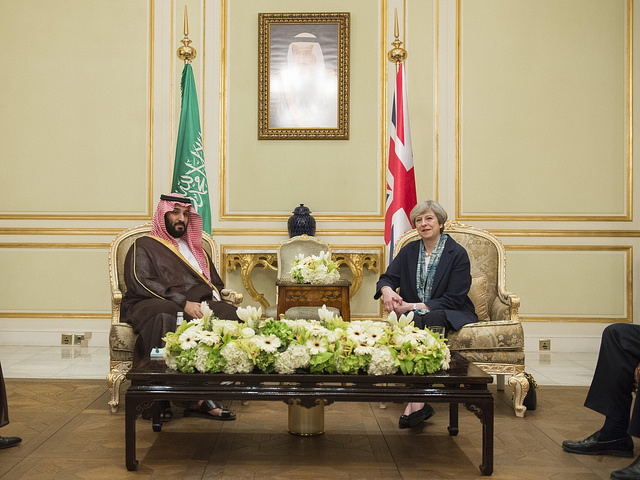
Prime Minister Theresa May met with Deputy Crown Prince Mohammad bin Salman Al Saud on her visit to Saudi Arabia. Image credit: Number 10/ flickr
By Stuart Littlewood | American Herald Tribune | March 3, 2018
It’s amazing what unprincipled people will admit to when goaded. A petition has been posted on the parliamentary website calling on prime minister Theresa May to withdraw her invitation to the Crown Prince of Saudi Arabia, Mohammad bin Salman, to visit the UK. It reads:
“The Saudi Arabian regime has one of the worst human rights records in the world. Torture and arbitrary detention are widely documented. In 2017 alone, over 100 people were executed.
“The Crown Prince has directed the bombardment of Yemen. Tens of thousands have been killed or injured. There is widespread famine and cholera, creating the worst humanitarian crisis in the world. Yet, the UK still sells arms to Saudi Arabia.
“The Saudi regime has supported repression in Bahrain, where its military intervened to end peaceful protests in 2011.”
An Early Day Motion (EDM865) has been tabled in Parliament also asking for the visit to be cancelled. It notes that the Saudi regime actually executed 142 people last year.
Bin Salman arrives in London on 7 March. He’ll be met by angry protesters.
The petition has well over 11,000 signatures so far. Of course, their request will be ignored. The UK Government is a great admirer of terror regimes such as Saudi Arabia and Israel, which are now bosom-pals. They share many ambitions, such as the de-stabilising and overthrow of countries they don’t happen to like with the help of their useful idiots in Washington and Westminster. Prime targets are Iran and Syria. And they are itching to annihilate resistance groups like Hezbollah and Hamas, and any others that get in their way.
They also share utter contempt for human rights and international norms of behaviour.
Successive British governments have gone to extreme lengths to invent preposterous reasons why they adore and support the criminals who run Israel, slaughter the Palestinians and menace the region (and indeed the rest of the world) with their undeclared and unsafeguarded nuclear arsenal. Now Westminster ties itself in knots trying to explain why we continue to snuggle up to the Saudis who are eager to join the US-UK-Israeli axis.
Wouldn’t it be nice if our mainstream media, instead of wringing their hands and broadcasting disinformation about the Middle East, investigated and named the evil warmongers who recruit, bankroll and arm the corrupt regimes, rebel militia, mercenaries and assorted hoodlums who started and now perpetuate the horror and devastation in Syria and Yemen?
Saudi Arabia a partner for “tackling international terror and extremism”? Seriously?
Responding to the petition, the ever-inventive Foreign Office says our strong relationship with Saudi Arabia “is important for mutual security and prosperity” and includes meaningful discussion on reform and human rights. The statement says it has helped make both of our countries safer and more prosperous. “We have vital national security and economic interests in maintaining and developing our strong relationship, including how we can work together to tackle international challenges such as terrorism and extremism.”
And Saudi intelligence “has saved potentially hundreds of lives in the UK”, according to Mrs May.
What’s more, the Crown Prince has embarked on a series of reforms to modernise society and the economy such as allowing women to drive and attend football matches, reopening cinemas and a commitment that women will make up one third of the Saudi workforce by 2030. “The visit will usher in a new era in bilateral relations focused on a partnership that delivers wide-ranging benefits for both the United Kingdom and the Kingdom of Saudi Arabia.”
As for the apalling state of affairs in Yemen, the Government says the UK “is committed to securing a political solution that ends the humanitarian disaster” and will continue to play a leading role in “supporting the UN to find a peaceful solution through close engagement with our regional and international partners”.
We’ve heard this claptrap many times before, especially in relation to never-ending crimes against the Palestinians.
What else does our upstanding Government say? “The UK supports the Saudi-led Coalition military intervention [in Yemen]…. We regularly raise the importance of compliance with International Humanitarian Law with the Saudi Arabian Government and other members of the military Coalition. Saudi Arabia has publicly stated that it is investigating reports of alleged violations of IHL, and that lessons will be acted upon.”
So why not wait for real evidence of that before rolling out the red carpet and infuriating decent people by allowing the Crown Prince of this obnoxious regime to pose on the steps of Downing Street for the world’s media and be filmed poncing around with our Royal Family? From his track record Bin Salman understands only too well the value of PR, which he exploits for all its worth, while precious little changes beneath the elaborate ‘modernising’ veneer.
Guilty as hell of complicity
Since Bin Salman’s bombing campaign in Yemen started three years ago the UK, instead of condemning such murderous aggression, has showered Saudi Arabia with £billions worth of aircraft and other weaponry to help deliver death and destruction. All principles are jettisoned, it seems, and all concerns for human suffering forgotten so that greedy business can milk the obscene wealth of that part of the world.
Last summer the Campaign Against Arms Trade (CAAT) brought a legal action against the Secretary of State for International Trade for continuing to grant export licences for arms to Saudi Arabia, arguing that this was a breach of UK policy which states that the Government must refuse such licences if there’s a clear risk that the arms might be used to commit serious violations of International Humanitarian Law.
It was, by then, undeniable that Saudi forces had used UK-supplied weaponry to violate International Humanitarian Law in their war on Yemen. According to the United Nations, well over 10,000 people had been killed up to that point, the majority by the Saudi-led bombing raids that had also destroyed vital infrastructure such as schools and hospitals and contributed to the cholera crisis. 3 million Yemenis had been displaced from their homes and 7 million were on the brink of dying from famine. UNICEF were reporting that a child died in Yemen every ten minutes from preventable causes including starvation and malnourishment.
A crippling naval blockade aided and supported by the US had been a key cause of the humanitarian crisis. The European Parliament and numerous humanitarian NGOs had condemned the Saudi air strikes as unlawful. And 18 months earlier a UN Panel of Experts had accused Saudi forces of widespread and systematic targeting of civilians.
The UK Government at that time had licensed £3.3 billion worth of arms such as aircraft, helicopters, drones, missiles, grenades, bombs and armoured vehicles to the Saudi regime and refused to suspend this lucrative trade even when the horrors stared them in the face. It was claimed that the Government ignored warnings by senior civil servants and its own arms control experts, and that some records of expressed concern had gone missing.
Despite the glaring facts, the High Court decided to allow the UK Government to carry on exporting arms to Saudi Arabia for use against Yemenis.
The CAAT website today reports that the UK has licensed over £4.6 billion worth of arms to Saudi Arabia since the bombing began in March 2015:
£2.7 billion worth of ML10 licences (Aircraft, helicopters, drones)
£1.9 billion worth of ML4 licences (Grenades, bombs, missiles, countermeasures)
£572,000 worth of ML6 licences (Armoured vehicles, tanks)
And the UK government admits that Saudi Arabia has used UK weapons in its attacks on Yemen. Typhoon and Tornado aircraft, manufactured by BAE Systems, have been central to the attacks. The Government confirms that they have been deployed on combat missions in Yemen and further Typhoons have been delivered. Meanwhile, BAE and the UK government are pushing for a new contract, so who knows what triumphant announcement compounding these crimes against humanity will be made during the Crown Prince’s visit?
The Government has also admitted that UK-supplied precision-guided weapons have been used in Yemen and that it “accelerated delivery of Paveway precision-guided bombs” in response to Saudi requests.
At the start of the conflict in March 2015 former Foreign Secretary Philip Hammond said:
“If we are requested to provide them with enhanced support – spare parts, maintenance, technical advice, and resupply – we will seek to do so. We’ll support the Saudis in every practical way short of engaging in combat.” [emphasis added]
In September 2016 the House of Commons Business, Innovation & Skills and International Development Committees commented:
“Given that the UK has a long history of defence exports to Saudi Arabia and its coalition partners, and considering the evidence we have heard, it seems inevitable that any violations of international humanitarian and human rights law by the coalition have involved arms supplied from the UK.” [emphasis added]
And in December 2016, the UK government finally admitted that UK-made cluster bombs had also been deployed in the conflict.
How sick is that?
London in arms talks with Riyadh despite Saudi war crimes in Yemen
Press TV – October 7, 2016
The UK’s leading arms maker, BAE Systems, says it is in talks with Saudi Arabia to secure a multi-billion-dollar arms contract, amid outrage over the use of British-made weapons by Riyadh in Yemen.
“Discussions between BAE Systems, the UK government and Saudi Arabia are progressing,” the London-based weapons maker said on Thursday.
BAE Systems also noted that it was working to define the scope of cooperation between the UK and the Arab kingdom over the next five years.
Under the terms of the contract, the multinational aerospace and electronics giant will provide training, support and upgrades for Hawk aircraft the UK has sold to Saudi Arabia. It also hopes to sell 48 Eurofighter Typhoon jets to the Saudis for a reported £4 billion ($4.97bn) under a separate deal.
This is while British lawmakers from a powerful committee said last month that there was evidence that UK-made weapons have been used in Yemen in violation of international humanitarian law.
“The weight of evidence of violations of international humanitarian law by the Saudi-led coalition is now so great, that it is very difficult to continue to support Saudi Arabia,” the Committee on Arms Export Control (CAEC) said.
The committee also raised serious concerns about the UK’s commitment to international law regarding the sale of arms.
CAEC inquiry chair Chris White stressed that the government must now take urgent action in halting the sale of weapons to Saudi Arabia.
UK supports repressive regimes
Meanwhile, the British government was accused on Thursday of sacrificing human rights in order to access oil from repressive regimes in the Persian Gulf region.
Human rights group War on Want said in a report that the UK regards Persian Gulf states as vital partners in securing Britain’s energy interests.
“From the sale of vast quantities of tear gas and other crowd control tools, to the training of sniper units used to put down pro-democracy protests, the UK government, working closely with a large number of private companies, are key partners for repressive regimes in the [Persian] Gulf, with devastating consequences for democracy and human rights,” said Dr. Sam Raphael, the report’s author and senior lecturer in international relations at the University of Westminster.
According to the report, Bahrain and Saudi Arabia are among the Persian Gulf countries regarded as priority markets. The two Arab kingdoms have been widely criticized by international advocacy groups for their human rights record.
London has been one of the biggest suppliers of weapons to Riyadh for 40 years.
According to sources, the UK supplied export licenses for close to £3 billion ($3.73bn) worth of arms to Saudi Arabia in 2015. The British government has also been accused of being involved in guiding the Saudi military aggression in Yemen.
Since the beginning of the Saudi war against Yemen in March of last year, nearly 10,000 people, including over 2,000 children, have been killed.
‘Arrest arms dealers, not peace campaigners!’ 8 on trial over weapons fair protest

RT | April 11, 2016
Eight activists are standing trial at Stratford Magistrates Court for disrupting the world’s biggest arms fair, held in London, where deadly merchandise was marketed to repressive regimes such as Saudi Arabia, Bahrain and Azerbaijan.
The campaigners blocked the road leading to the Defence & Security Equipment International (DSEI) in Stratford, London, last September, preventing tanks and weaponry from entering.
The defendants are using a defense of necessity, insisting their actions were justified because they intended to prevent greater crimes taking place around the world.
These include: “The sale of weapons to internally repressive regimes, including Bahrain and Saudi Arabia; the sale of weapons to countries imminently at war and overtly complicit in ongoing war crimes in Yemen, Kurdistan and Palestine; the sale of weapons to regimes that have been widely accused of arming ISIS [Islamic State or IS]; the promotion for sale of weapons that are designed specifically for torture or banned under international law for their capabilities concerning the mass indiscriminate killing of civilians.”
The DSEI arms fair is held every two years in London, and is regularly attended by representatives from repressive regimes. It has also previously provided a platform for weapons dealers to illegally promote arms that are used for torture.
Last September’s event featured stalls from more than 1,500 exhibitors, including arms giants Lockheed Martin, BAE systems, Finmeccanica and others.
Protestors sought to disrupt the fair by locking their bodies together to block access roads outside the Excel Centre, where the fair was held. Several were arrested.
Some protestors, such as Vyara Gylsen – who was arrested after writing a slogan on a military vehicle with a washable marker pen – have since seen criminal charges against them dropped.
The defendants in court this week include Isa Al Aali, a Bahraini activist who was tortured during the Arab Spring uprising in Bahrain.
Green Party activists Angela Ditchfield and Tom Franklin are also among the eight appearing in court.
“The government is supporting and facilitating the sale of weapons that are being used to kill ordinary people, from the West Bank to Yemen and Sudan,” Franklin, 57, of York, said.
“This week we will put the arms trade in the dock and highlight the crimes that the government and the companies at DSEI are complicit in. Arrest arms dealers, not peace campaigners.”
The defendants will be supported by expert witnesses, including former South African MP Andrew Feinstein, who resigned from parliament in 2001 in protest at the government’s refusal to investigate a £5 billion (US$7.12 billion) arms deal.
Amnesty International UK’s Oliver Sprague, who heads up the charity’s arms Control and Policing division, will also give oral evidence, as will Bahrain Institute for Rights and Democracy director Sayed Ahmed, who seeks to improve accountability in the repressive Gulf state.
Arms giants see stocks rocket after Syrian airstrikes vote
RT | December 3, 2015
The share prices of major international arms traders jumped in the wake of the British parliament’s decision to extend its aerial bombing campaign against Islamic State (IS, formerly ISIS/ISIL) from Iraq into Syria.
Stock values at BAE Systems, Airbus, Finmeccanica and Thales all soared as trading began on Thursday morning, CommonSpace reports. It comes as Britain prepares to spend millions more on its war with IS, and as an international collaboration against the terror group looks ever more likely.
BAE Systems leapt four points at the start of trading on Thursday. The jump comes as the arms trader’s value increased by 14 percent following the terror attacks in Paris which left 130 dead and over 300 injured.
Britain announced it is boosting its military spending and introducing a range of new security measures in the wake of the Paris attacks.
Aircraft firm Airbus, which develops the British Typhoon fighter jet, is also trading 1.5 percent up since the stock market opened on Thursday.
Italian arms dealer Finmeccanica has also seen its shares rise by 2 percent.
Andrew Smith of Campaign Against Arms Trade told CommonSpace that arms companies are cashing in on the bloodshed.
“Unfortunately, where most of us see war and destruction, the arms companies see a business opportunity. It is conflict and military intervention that fuel arms sales, and companies like BAE are only too happy to cash in from it. These companies don’t care who uses their weapons or the damage they cause, the only thing they care about is profit.”
Prime Minister David Cameron warned on Thursday that British military action in Syria will be complex and take a long time.
“This is going to take time. It is complex and it is difficult what we are asking our pilots to do, and our thoughts should be with them and their families as they commence this important work,” he added.
On Wednesday evening British bombers hit seven IS targets in eastern Syria, including oil fields used to supply the terror group with vital funds.
Defence Secretary Michael Fallon said the airstrikes had dealt IS “a real blow,” and added that British planes would not initially be targeting urban areas like Raqqa.
“I can confirm that four British Tornados were in action after the vote last night attacking oil fields in eastern Syria – the Omar oil fields – from which the Daesh (IS) terrorists receive a huge part of their revenue.”
“This strikes a very real blow at the oil and the revenue on which the Daesh terrorists depend,” he told the BBC.
Featured Video

America Racing to Strategic Defeat in Iran
or go to
Aletho News Archives – Video-Images
From the Archives
Should Europeans ‘Thank’ the Americans for Destroying Nord Stream?
By Robert Bridge | Strategic Culture Foundation | September 29, 2022
With an investigation continuing into the destruction of the Nord Stream gas pipeline that provided energy supplies to Europe from Russia, there appears to be just one prime suspect, and that should surprise nobody.
Following the sabotage of the Nord Stream 1 and 2 gas pipelines, former Polish Foreign Minister Radoslaw Sikorski already seemed to know the identity of the perpetrator when he tweeted out: “Thank you, USA.”
At first glance, it seemed that Sikorski was speaking sarcastically, berating Washington for carrying out an attack that will have severe repercussions for the people of Europe. After all, how could anyone see any good coming from the termination of Europe’s primary source of gas reserves with winter just around the corner? It was Sikorski’s homeland of Poland, after all, that urged its citizens to collect firewood in the face of dwindling gas reserves.
In fact, the Polish diplomat was speaking one-hundred percent literally… continue
Blog Roll
 Aletho News
- Growing insecurity, soaring prices fuel protests in north as regime bans evacuation: Sources
- Iran denies responsibility for ‘depraved’ attack on Kuwait desalination plant
- Bring The Troops Back. End This War Now!
- Can we please stop calling Israel the ‘only democracy in the Middle East’ now?
- US should start removing its troops from Germany, proposes AfD co-leader Chrupalla
- Iran Red Crescent: 600 educational centers attacked in US-Israeli ‘war crimes’
- Russian Oil Tanker Arrives in Cuba Amid U.S. Blockade
- America Racing to Strategic Defeat in Iran: Lt Col Daniel Davis
- FTC Warns Visa, Mastercard, PayPal, Stripe Over Political Debanking
- Russian tanker approaches Cuba despite US oil blockade
- If Americans Knew
- Will Trump Go Kamikaze?
- Is the University of Florida Shutting Down College Republicans over Israel Criticism?
- Jewish extremist arrested over alleged plot to firebomb Palestinian activist Nerdeen Kiswani’s home
- More than half of Palestinian child detainees have no charges
- The More Murderous Israel Gets, The More We Hear About “Antisemitism”
- Land Day and the Palestinian struggle after 30 months of genocide
- The Iran War Is About Palestine
- Israeli soldiers echo settler ideology, talk of revenge after targeting Palestinians and detaining CNN crew in the West Bank
- Israeli Policies Threaten Future of Christian Schools in Jerusalem
- Former US soldiers argue Israeli policy is now guiding US interests
- No Tricks Zone
- New Study Finds Warming Saves Lives…Cold Temperatures 12 Times More Deadly Than Excess Heat
- German Science Blog Accuses PIK Climate Institute Of Hallucinating Climate Tipping Points
- Devastating Assessment Of Comirnaty Vaccine By Former Senior Pfizer Europe Toxicologist
- New Study: CO2 Is ‘Effectively Negligible’ As An Explanatory Climate Change Factor Since 2000
- Former Pfizer Toxicologist Dr. Helmut Sterz Tells Bundestag Hearing Pfizer Vaccine Should Have Never Been Approved
- Energy Expert: Germany’s Nuclear Phaseout Was A “500 Billion Euro Mistake”
- New Research: South Australia’s Mid-Holocene Sea Surface Temperatures Were 4°C Warmer Than Today
- Storing Green Energy To Last Germany 10 Days Would Require A 60-Million Tonne Battery
- New Studies: UK Sea Levels Were 4 Meters Higher Than Today During The Mid-Holocene
- Destructive Green New Deal: German Energy And Metal Group Warns Of Drastic Crisis
 Aletho News