Francesca Albanese names over 60 states complicit in Gaza genocide
The Cradle | October 29, 2025
The UN special rapporteur for the occupied Palestinian territories, Francesca Albanese, told the General Assembly on 28 October that 63 countries, including key western and Arab states, have fueled or were complicit in “Israel’s genocidal machinery” in Gaza.
Speaking remotely from the Desmond and Leah Tutu Legacy Foundation in Cape Town, Albanese presented her 24-page report, ‘Gaza Genocide: A Collective Crime,’ which she said documents how states armed, financed, and politically protected Tel Aviv as Gaza’s population was “bombed, starved, and erased” for over two years.
Her findings place the US at the center of Israel’s war economy, accounting for two-thirds of its weapons imports and providing diplomatic cover through seven UN Security Council vetoes.
The report cited Germany, Britain, and a number of other European powers for continuing arms transfers “even as evidence of genocide mounted,” and condemned the EU for sanctioning Russia over the war in Ukraine while remaining Israel’s top trading partner.
Albanese accused global powers of having “harmed, founded, and shielded Israel’s militarized apartheid,” allowing its settler-colonial project “to metastasize into genocide – the ultimate crime against the indigenous people of Palestine.”
She said the genocide was enabled through “diplomatic protection in international fora meant to preserve peace,” military cooperation that “fed the genocidal machinery,” and the “unchallenged weaponization of aid.”
The report also identified complicity among Arab states, including the UAE, Egypt, Bahrain, and Morocco, which normalized ties with Tel Aviv.
Egypt, she noted, maintained “significant security and economic relations with Israel, including energy cooperation and the closing of the Rafah crossing,” tightening the siege on Gaza’s last humanitarian route.
Albanese warned that the international system now stands “on a knife-edge between the collapse of the rule of law and hope for renewal,” urging states to suspend all military and trade agreements with Tel Aviv and build “a living framework of rights and dignity, not for the few, but for the many.”
Her presentation provoked an outburst from Israel’s envoy Danny Danon, who called her a “wicked witch.”
Frascnesca fired back, saying, “If the worst thing you can accuse me of is witchcraft, I’ll take it. But if I had the power to make spells, I would use it to stop your crimes once and for all and to ensure those responsible end up behind bars.”
Human rights experts described the report as the UN’s most damning indictment yet of Israel’s ongoing genocide in Gaza.
Albanese had previously been sanctioned by the US in July, after releasing a report that exposed western corporations profiting from Israel’s genocide in Gaza.
The 27-page report, ‘From Economy of Occupation to Economy of Genocide,’ named over 60 companies, including Lockheed Martin, Caterpillar, Microsoft, Palantir, and Hyundai, for aiding and profiting from Israel’s settlements and military operations, and called for their prosecution at the International Criminal Court (ICC).
US Secretary of State Marco Rubio accused Albanese of waging a “campaign of political and economic warfare against the United States and Israel,” announcing the sanctions as part of Washington’s effort to counter what he called “lawfare.”
The move drew sharp condemnation from UN officials and rights groups, who warned that it threatened global accountability mechanisms.
Zionism without borders: Annexation and normalization as tools of Arab subjugation
By Mohamad Hasan Sweidan | The Cradle | August 1, 2025
Four weeks after Israel signed the US-brokered Abraham Accords with the UAE and Bahrain on 15 September 2020, Tel Aviv’s Higher Planning Council approved 4,948 new settler units in the occupied West Bank. No public fanfare.
No tanks rolled in – just signatures authorizing another layer of occupation. The first wave of expansion advanced quietly, legitimized by the language of “peace.”
This sequencing deliberately reflects the core logic of Zionist expansion: Normalize when the region submits, colonize when the world blinks.
Where possible, the occupation state’s army conquers land directly. Where resistance or scrutiny makes that unfeasible, the occupation government builds a web of security pacts, trade routes, and intelligence partnerships that extend its reach without a single uniformed soldier. This dual formula, territorial conquest and hegemonic integration, has underpinned Israeli strategy since 1967, and today stretches unimpeded from the Jordan Valley to the Atlantic coast.
Two paths, one destination
“Greater Israel” represents the settler-colonial ambition to annex, settle, and absorb land across historic Palestine and beyond. It is rooted in the Zionist vision of Jewish dominion over the so-called “biblical Land of Israel.” In contrast, “Great Israel” describes the imperial design to dominate the surrounding region through proxies, economic leverage, and security alignments.
Where occupation is costly, Tel Aviv turns to influence. Through deals, destabilization, or coercion, it reshapes the sovereignty of its neighbors. Greater Israel devours land. Great Israel neutralizes independence. Together, they are one project.
Zionist literature makes this plain. Ze’ev Jabotinsky, founder of Revisionist Zionism, demanded sovereignty over all of Mandatory Palestine and Transjordan – “Greater Israel on both sides of the Jordan River” – and rejected compromise with Arabs. In The Iron Wall (1923), he declared that only an unyielding Jewish force could compel Arab acquiescence:
“Zionist colonization, even the most restricted, must either be terminated or carried out in defiance of the will of the native population.”
The occupation state’s first prime minister and Labor Zionist leader, David Ben-Gurion, publicly accepted a partition plan in 1937, but privately described it as “not the end but the beginning.” In a letter to his son, he wrote that a Jewish state on part of the land would strengthen the Zionist project and serve as a platform to “redeem the entire country.” In a June 1938 meeting of the Jewish Agency executive, he said:
“After the formation of a large army … we shall abolish partition and expand to the whole of Palestine.”
Early Zionist leaders did not view borders as final, but as phases. During its first two decades, Israel lacked the military strength or western backing to expand beyond its 1949 borders. Direct confrontation with Arab states risked catastrophe. Instead, Tel Aviv pioneered a subtler doctrine of peripheral infiltration.
Through the “periphery doctrine,” it cultivated covert ties with non-Arab states and oppressed minorities – Shah-era Iran, Turkiye, Kurdish groups in Iraq, and Christian separatists in Sudan. This strategy sowed chaos among Israel’s Arab rivals while embedding Israeli influence in strategic corners of West Asia and Africa. Most recently, the occupation state has made overtures to Druze communities in southern Syria, seeking to replicate this strategy amid renewed instability.
The corridor to colonization
Israel’s integration into the Arab world is now deeper than ever before. Through normalization, Tel Aviv has converted former enemies into partners economically, diplomatically, and militarily. While Egypt and Jordan first formalized ties through Camp David and Wadi Araba, it was the Abraham Accords that opened the floodgates. What followed was a deluge of tech deals, weapons transfers, and commercial partnerships linking the occupation state to the Persian Gulf.
By 2023, Israel’s trade with the UAE had reached $3 billion annually. That figure rose by 11 percent the following year, even as Israel waged genocide in Gaza. Israeli Consul General Liron Zaslansky described trade relations between Abu Dhabi and Israel as “growing, so that we ended 2024 at $3.24 billion, excluding software and services.”
In 2022, Morocco purchased $500 million worth of Israeli Barak MX air defense systems. Rabat also partnered with BlueBird, an Israeli drone firm, to become the first UAV manufacturer in West Asia and North Africa.
This has created a “corridor of influence” that grants Tel Aviv access to new markets, air and sea routes, and intelligence spaces stretching from Casablanca to Khor Fakkan.
On the ground, the war continues
While trade flourishes, colonization accelerates. In 2023, Israeli Prime Minister Benjamin Netanyahu’s ultranationalist government approved 12,855 settler homes – a record for any six-month period. More than 700,000 settlers now occupy the West Bank and East Jerusalem. That figure has grown sevenfold since the early 1990s.
In May 2025, Defense Minister Israel Katz confirmed cabinet approval for the construction of 22 new West Bank settlements, including multiple previously unauthorized outposts. Katz framed the move as necessary to “strengthen our hold on Judea and Samaria” and to “prevent the establishment of a Palestinian state.”
These settlements are not arbitrary. They are connected by Jewish-only bypass roads, fortified by the occupation army, and strategically designed to fragment the occupied West Bank into isolated Palestinian enclaves. This is de facto annexation, defined by a matrix of irreversible facts that eliminates the territorial basis for any future Palestinian state, while avoiding the international fallout of formal annexation.
The “logic” of expansion has also spilled beyond Palestine. In Syria, Tel Aviv now occupies 250 square kilometers across Quneitra, Rural Damascus, and Deraa – territory seized during the collapse of former Syrian president Bashar al-Assad’s government by Al-Qaeda rooted terrorists – Hayat Tahrir al-Sham (HTS) – who now occupy the seat of power in Damascus. HTS was under the leadership of former ISIS chief Abu Mohammad al-Julani. Upon ousting Assad, Julani began using his government name, Ahmad al-Sharaa, and became the de facto president of Syria.
In Lebanon, Israeli forces maintain a presence over 30–40 square kilometers, including Shebaa Farms, Kfar Shuba Hills, and the northern half of Ghajar. Additional outposts and buffer zones stretch along the so-called Blue Line.
Occupation rebranded
Israel’s expansion today is no longer confined to bulldozers and soldiers; it is mediated through trade, tech, and treaties. But make no mistake: normalization has not replaced occupation. It has enabled and accelerated it.
Every Emirati deal, every Moroccan drone line, every Bahraini handshake fuels Tel Aviv’s capacity to deepen its military presence and Judaize more land. Plans are underway to double the number of settlers in the Golan Heights and to deploy armored units along the demilitarized zone.
The ripple effects are already destabilizing the region. Egypt has begun constructing a concrete wall on its border with Gaza to prepare for mass displacement or military spillover. Jordan faces existential peril in the Jordan Valley, where settler expansion is displacing Bedouin communities and draining natural aquifers. Syria and Lebanon remain hemmed in by fortified Israeli positions, with both countries facing increasing pressure from Washington to normalize relations.
Greater Israel devours Arab land. Great Israel colonizes Arab decision-making. One swallows borders. The other swallows sovereignty.
Netanyahu’s ‘Abraham Alliance’ Proposal Completely Detached From Reality – Analyst

By Ilya Tsukanov – Sputnik – 25.07.2024
Israel’s prime minister has sketched the outlines of a new NATO-style alliance between Tel Aviv, Washington and Arab countries which he said could “counter the growing Iranian threat.” Dr. Mehran Kamrava, professor of government at Georgetown University’s Qatar campus, explains why the proposal is ludicrous.
Prime Minister Benjamin Netanyahu’s hopes to bring countries like Bahrain, Saudi Arabia, the UAE and perhaps Egypt into a new Israeli and US-led, NATO-style pact dubbed the ‘Abraham Alliance’ is not only unrealistic, but not original, either, Kamrava told Sputnik, commenting on Netanyahu’s Wednesday afternoon address to a joint session of Congress.
“I don’t think that [an alliance between Israel and the Gulf States, ed.] is a realistic assumption because Saudi Arabia normalized relations with Iran… Bahrain and Iran have been in conversations about a rapprochement, and the UAE, despite having maintained its relationship with Israel, has also maintained a relationship with Iran,” Kamrava pointed out.
In his speech, Netanyahu outlined a “vision for the broader Middle East” involving taking a cue from what the US did after the Second World War by creating NATO and applying it to the Middle East. The proposed bloc should include the US and Israel, and “all countries that are at peace with Israel” or wish to “make peace with Israel,” Netanyahu said.
The Abraham Alliance proposal is “not new,” Kamrava stressed, noting that Netanyahu has “been advocating this for a number of years,” with Israel’s push to normalize ties with its Gulf neighbors seen as the first step in this direction.
Today, Israel can only dependably rely only on United States Central Command and Washington for weapons and other support, Kamrava said. That’s because “the Israeli lobby is quite powerful in the United States, particularly in Congress,” with both parties and all of its major figures, from presidents Biden and Trump to vice president Harris, declaring themselves Zionists or otherwise voicing “strong support” for Israel.
Netanyahu, meanwhile, remains mired in a “deep” and hopeless political mess, Kamrava said, facing “pressure from [his] left that want the hostages back…pressure from the Israeli army, which has said that it is unable now to bring the remaining hostages home through continued use of force and the continuation of the war,” and “pressure from the right that want a complete eradication of Palestinians.”
In this situation, only a continuation of the war, and playing up the “Iranian boogeyman” can save him, the observer summed up.
US, UK sacrifice international security for Israel’s interests: Tehran
Press TV – February 25, 2024
Iran’s foreign ministry spokesman has strongly condemned fresh “arbitrary” airstrikes by the United States and Britain on Yemen, saying the raids proved once again that the pair sacrifice international security for Israel’s interests.
Nasser Kan’ani made the remarks on Sunday after American and UK forces carried out a series of aerial assaults against positions across Yemen, including the capital Sana’a.
“Such arbitrary and adventurous attacks contravene the internationally recognized rules and principles and violate Yemen’s sovereignty and territorial integrity,” he said.
“The US and the UK once again proved that they fully support the Zionist regime’s war crimes and genocide in the Gaza Strip and the West Bank, and that they put the illegitimate security and interests of the occupying regime ahead of international peace and security.”
In a statement, the US Central Command (CENTCOM) said that the strikes were conducted with the support of Australia, Bahrain, Canada, Denmark, the Netherlands, and New Zealand in a bid to “degrade” Yemen’s capabilities to conduct naval pro-Palestine operations.
Kan’ani said that the US and Britain showed that they breach all moral and humanitarian principles, as well as international law and the UN Charter.
He added that the two countries are seeking to escalate tensions in the region, expand the scope of the Gaza war and divert public opinion from Israel’s war crimes, and buy an opportunity for the continuation of the ongoing genocide against Palestinians.
“Instead of taking effective and immediate action to eliminate the main cause of insecurity and instability, which is the Zionist regime’s warmongering and its daily killing of hundreds of Palestinians…, the US and the UK are waging military attacks on a country that is trying to somehow put pressure on this killer regime and stop its killing machine,” the top diplomat said.
In recent months, the US and its allies have launched illegal attacks on Yemen amid their frustration in the face of an anti-Israel maritime campaign by the Yemeni armed forces.
Israel waged a US-backed genocidal war on the besieged Gaza Strip on October 7 following a historic operation by the Palestinian Hamas resistance group against the occupying regime.
In support of Gaza, Yemeni armed forces have targeted ships going to and from ports in the occupied territories, or whose owners are linked to Israel, in the southern Red Sea, the Bab el-Mandeb Strait, the Gulf of Aden, and even in the Arabian Sea.
The US-led attacks on Yemen prompted the country’s military to declare American and British vessels to be legitimate targets.
New wave of US, UK strikes target Yemen
The Cradle – February 4, 2024
US and UK warships and fighter jets bombed Yemen on 4 February, in a wave of missile strikes US officials claim hit 36 targets.
The US said in a CENTCOM statement that it hit “36 targets at 13 locations,” striking “underground storage facilities, command and control, missile systems, UAV storage and operations sites, radars, and helicopters.”
According to the statement, the US, UK, Australia, Bahrain, Canada, Denmark, the Netherlands, and New Zealand took part in the attacks.
The strikes were in response to Yemeni efforts to target Israeli-linked commercial ships passing through the narrow Bab al-Mandab Strait in the Red Sea. The Yemeni attacks are in response to Israel’s genocidal bombing campaign in Gaza.
Rather than press its ally Israel to stop its military campaign, which has killed over 27,000 Palestinians, the majority women and children, the US has joined forces with the UK to bomb Yemen.
Saturday’s strikes were launched by US F/A-18 fighter jets from the USS Dwight D. Eisenhower aircraft carrier, British Typhoon FGR4 fighter aircraft, and the Navy destroyers USS Gravely and the USS Carney firing Tomahawk missiles from the Red Sea, according to US officials and the UK Defense Ministry.
The Yemen Armed Forces issued a statement detailing where the attacks took place, reporting 13 raids on Sanaa, 9 on Hodeidah, 11 on Taiz, 7 on Al-Bayda, 7 on Hajjah, and one on Saada.
“These attacks will not deter us from our moral, religious, and humanitarian stance in support of the steadfast Palestinian people in the Gaza Strip, and will not go unanswered and punished,” read the statement.
The strikes come one day after the US sent B-1 bombers to target 85 locations affiliated with the Islamic Resistance of Iraq in eastern Syria and western Iraq, killing at least 16. This was in response to an operation by the Islamic Resistance in Iraq that targeted US military outpost Tower 22 in Jordan last week, killing three US soldiers.
US officials reportedly told Al-Jazeera that the strikes on Yemen are “considered a next round of retaliation for the killing of the [US] soldiers in Jordan.”
Like Ansarallah, the Islamic Resistance in Iraq coalition, formed after 7 October, has also targeted Israel, as well as US bases in Syria and Iraq. The groups say their attacks are in response to Israel’s genocide in Gaza, which the US has supported militarily and diplomatically.
Ansarallah leaders in Yemen say they have no intention of scaling back their campaign despite pressure from the US and UK bombing.
Mohammed al-Bukhaiti, an Ansarallah official, said, “military operations against Israel will continue until the crimes of genocide in Gaza are stopped and the siege on its residents is lifted, no matter the sacrifices it costs us.” He wrote on social media that the “American-British aggression against Yemen will not go unanswered, and we will meet escalation with escalation.”
Bahrain jails dissident for blasting Manama’s role in US-led anti-Yemen coalition
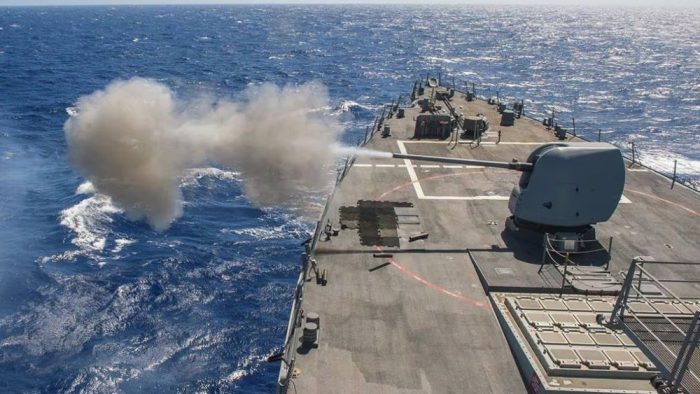
The Arleigh Burke-class guided-missile destroyer USS Cole (DDG 67)
Press TV | December 21, 2023
Bahraini authorities have ordered the seven-day detention of a leading opposition figure after he denounced the Al Khalifah regime’s participation in the US-led coalition against Yemen in the Red Sea.
Bahrain’s office of public prosecution ordered Ebrahim Sharif’s detention pending investigation for “spreading false news during wartime,” his family and lawyer said on Thursday.
Sharif, who heads the Wa’ad organization, in a series of posts criticized authorities in Manama for joining the coalition “without any consideration of the position of the Bahraini people who strongly support our besieged Palestinian people in Gaza.”
He was arrested on Wednesday. When asked about his case, the Bahraini government said “an individual” was being held for “allegedly supporting a proscribed terrorist organization.”
The charge against Sharif, a pro-democracy campaigner, can hold a prison sentence of up to 10 years.
Bahrain is the only state in the Persian Gulf region that has joined the US-led coalition established this week in response to Yemeni attacks on ships bound to the occupied Palestinian territories in the Red Sea.
Sayed Ahmed Alwadaei, advocacy director at the UK-based Bahrain Institute for Rights and Democracy (BIRD), said the Bahraini regime “wants to make an example of Sharif who is not alone in his criticism of Bahrain’s decision to the join the Americans.”
“Failure of the US administration to publicly denounce his arrest and push for his immediate release gives the green light to the Bahrain government to continue his detention,” Alwadaei said.
The Pentagon has announced a military coalition of 10 countries, including Britain and Spain, to counter the Yemeni forces that targeted ships bound for Israel in solidarity with the people of Gaza.
A series of strikes attributed to the Yemeni forces have been conducted in solidarity with the Palestinians in the besieged Gaza Strip. Yemen has already warned it will prevent the passage of all ships in the Red Sea bound to the occupied territories.
The leader of Yemen’s Ansarullah movement said in a televised speech broadcast live Wednesday that the armed forces will not hesitate to target US military warships in the Red Sea if Washington and its allies carry out military strikes against Yemen.
Bahrain’s main opposition group al-Wefaq National Islamic Society recently denounced human rights violations in the country.
Al-Wefaq has denounced Manama’s normalization of relations with Israel as “a crime.”
The opposition party has underlined that the normalization is in flagrant contradiction to Bahrain’s history and Islamic identity.
Bahrain and the Israeli regime established diplomatic relations in 2020 as part of the United States-brokered Abraham Accords.
Last month, the deputy speaker of Bahrain’s National Assembly said members of the legislative body were pressing to reverse the normalization following the regime’s devastating war in Gaza.
Abdulnabi Salman said Bahraini lawmakers were demanding an end to diplomatic relations with Israel.
The Persian Gulf country has witnessed numerous protests ever since the rapprochement.
The United States and Britain refrain from the criticism of human rights violations across Bahrain.
In July, British legislators were pressing the government to provide clear explanations why Bahrain has been removed from its list of human rights priority countries, accusing the government of putting its principles “up for auction” after sealing a billion-pound investment deal with the Persian Gulf state.
Bahrain ‘halts’ economic relations with Israel over war on Gaza: Parliament
Press TV – November 2, 2023
Bahrain’s lower house of parliament has said the country has halted its economic relations with the Israeli regime over Tel Aviv’s ongoing war against the Gaza Strip that has claimed thousands of Palestinians.
“Economic relations with Israel have been halted,” said a statement from the Council of Representatives on Thursday.
The chamber also “confirms that the Israeli ambassador to the Kingdom of Bahrain has left Bahrain, and the Kingdom of Bahrain decided to return the Bahraini ambassador from Israel to the country,” it noted.
The move was “in support of the Palestinian cause and the legitimate rights of the brotherly Palestinian people,” the statement read.
Abdulnabi Salman, the Bahraini legislature’s first deputy speaker, confirmed the decision to AFP, saying the “ongoing conflict in Gaza cannot tolerate silence.”
Bahrain’s National Communication Center, the government’s media arm, said the “priority at this stage must be focused on protecting the lives of civilians” in the besieged Palestinian territory.
The brutal war that the Israeli regime has been waging against the coastal sliver since October 7, has so far claimed the lives of nearly 9,061 people, including 3,700 children and more than 2,300 women.
The regime launched the war after Gaza’s resistance groups conducted Operation al-Aqsa Storm, their biggest operation against the occupying entity in years.
Bahrain and the regime established diplomatic relations in 2020 as part of United States-brokered Abraham Accords.
Back in 2021, Bahrain’s main opposition group, the al-Wefaq National Islamic Society, denounced Manama’s normalization of relations with Israel as “a crime,” emphasizing that the ruling Al Khalifah regime’s policies did not conform to the will of the Bahraini nation.
The country has witnessed numerous protests ever since the rapprochement, condemning the detente as an instance of “treason.”
US, Bahrain to Sign Strategic Security and Economic Agreement
By Connor Freeman | The Libertarian Institute | September 11, 2023
The US and Bahrain will ink a deal to upgrade the two nations’ strategic partnership this week, according to Axios. One source briefed on the issue said the White House hopes to use this deal as a framework for other regional agreements. The Joe Biden administration is currently striving to induce Riyadh into normalizing with apartheid Israel.
Washington and Manama have a strong partnership, the US Navy’s Fifth Fleet is headquartered at a large base in Bahrain. Since 2002, the Gulf Kingdom has been a major non-NATO ally of the United States, though this does not include a security commitment.
Two sources familiar with the upcoming deal told Axios, “[it] includes a commitment to consult and provide assistance if Bahrain faces an imminent security threat.” Another source explained that the deal outlines an economic partnership between the two countries, and cooperation involving “trusted technologies.”
Though legally binding, the security commitment will fall short of the NATO-style Article 5 guarantee which Riyadh is reportedly seeking in exchange for normalizing ties with Tel Aviv. Bahrain likely desired a bolstered commitment because of the threat of war with Iran.
However, in March, Beijing achieved a diplomatic feat by brokering a peace deal between Saudi Arabia and Iran. This has sparked a regional realignment with Iran’s ally Damascus being welcomed back into the Arab League after being suspended for more than a decade.
The report says Bahrain’s Crown Prince and Prime Minister Salman bin Hamad Al Khalifa is expected to sign the deal during a visit to Washington this week where he will be meeting with Pentagon chief Lloyd Austin, Secretary of State Antony Blinken, and National Security Adviser Jake Sullivan.
Last week, Brett McGurk, Biden’s top Middle East official on the National Security Council, visited Bahrain for meetings, discussing the final details of this new agreement, with the Crown Prince as well as other officials.
Bahrain is also a signatory of the Abraham Accords which is a thinly veiled foundation for a regional military coalition led by the US and Israel eyeing Iran. Under the accords, Gulf dictatorships such as Bahrain recognize Israel – absent a Palestinian state or end to the apartheid regime – and in turn receive increased access to advanced weapon systems manufactured by the US military-industrial complex. Washington is attempting to exploit the arms deals as a way of securing concessions from regional countries, namely downgrading economic ties with China.
Recent polling has shown that as a result of Israeli massacres and war crimes committed against the occupied Palestinians, the Abraham Accords are becoming increasingly unpopular among the populace in signatory states including Bahrain and the UAE. During recent months, the US has expanded its military presence in the Persian Gulf and the Middle East in preparation for a confrontation with Tehran. This weekend, David Barnea, the chief of the Israeli Mossad, declared Tel Aviv will launch another assassination campaign within the Islamic Republic.
UAE, Bahrain sour on Israeli normalization
The Cradle | July 31, 2023
Two of the signatories of the Abraham Accords – the UAE and Bahrain – have “soured” on the 2020 normalization agreement, according to sources in the know who spoke with US outlet Bloomberg.
“The [UAE] has expressed frustration in high-level contacts with Israel about the outcome of the 2020 Abraham Accords,” Bloomberg reported on 30 July. Bahrain has also “outlined its disappointment” with Tel Aviv, mainly out of concerns about Israel’s ongoing human rights violations against Palestinians and their unchecked expansion of illegal settlements in the West Bank.
According to the report, the tense situation is “likely to complicate” Washington’s efforts to see Saudi Arabia join the Abraham Accords, which also include Morocco and Sudan.
In the months after the Gulf kingdom inked a historic rapprochement deal with Iran under the auspices of China, the White House has deployed a charm offensive to convince Saudi Crown Prince Mohammed bin Salman (MbS) to normalize ties with Israel before the 2024 US elections.
Publicly, Saudi Arabia maintains Israel must first implement the 2002 Arab Peace Initiative to establish a Palestinian state before a normalization deal can be signed. Privately, however, Riyadh is demanding that the US sweeten the deal by providing firm defense guarantees, access to cutting-edge weaponry, and assistance in developing a nuclear energy program, including domestic uranium enrichment.
While the White House remains hesitant to accept these demands, US President Joe Biden told a gathering of donors to his 2024 re-election campaign last week, “There’s a rapprochement maybe underway.”
Israeli Prime Minister Benjamin Netanyahu echoed this claim on Sunday when announcing the construction of a $27 billion rail expansion connecting Israel’s outlying areas to metropolitan Tel Aviv.
“In the future, we will be able to transport cargoes of goods by train from Eilat to our ports in the Mediterranean Sea, and we will also be able to connect Israel by train to Saudi Arabia and the Arabian Peninsula. We are working on that too,” Netanyahu said.
Earlier this month, Yedioth Ahronoth reported that Washington was promoting a plan to build a railway connection from the Gulf to Israel and Europe.
Iran, Regional States to Form Naval Coalition Soon: Navy Commander
Al-Manar – June 3, 2023
Iranian Navy Commander Rear Admiral Shahram Irani announced that Iran’s navy and the countries of the region including Saudi Arabia, UAE, Qatar, Bahrain and Iraq will form a new naval coalition soon.
Irani in a televised program on Friday night announced the formation of new regional and extra-regional coalitions, saying that today, the countries of the region have realized that the security of the region can be established through synergy and cooperation of the regional states.
Referring to the holding of annual exercises of the naval coalition of Iran, Russia and China, he said that the regional coalition is also forming.
Almost all the countries of the North Indian Ocean region have come to the understanding that they should stand by the Islamic Republic of Iran and jointly establish security with significant synergy, he said, adding that Oman, Saudi Arabia, UAE, Qatar, Bahrain, Iraq, Pakistan and India are among these countries.
Earlier, a Qatari website reported that Iran, Saudi Arabia, the United Arab Emirates, and Oman are to form a joint naval force under China’s auspices towards enhancing maritime security in the Persian Gulf.
Al-Jadid carried the report on Friday, saying China had already begun mediating negotiations among Tehran, Riyadh, and Abu Dhabi aimed at reinforcing maritime navigation’s safety in the strategic body of water.
Since the 1979 victory of Iran’s Islamic Revolution, the Islamic Republic has invariably opposed foreign meddling and presence in the region, asserting that the regional issues have to be addressed by the regional players themselves.
Arab oil giants endorse OPEC+ production cut, shoot down US claims of ‘Saudi pressure’
The Cradle | October 17, 2022
Members of the OPEC+ group of countries issued a slew of statements on 16 October to endorse a major oil production cut that was announced earlier this month.
These statements were released in response to the accusations of irate US officials, who said Saudi Arabia “coerced” their OPEC partners into supporting the cut, allegedly to “increase Russian revenues and blunt the effectiveness of [western] sanctions.”
Washington went on to claim that several Gulf nations contacted them “privately” to say they disagreed with the OPEC+ decision.
“I would like to clarify that the latest OPEC+ decision, which was unanimously approved was a pure technical decision, with NO political intentions whatsoever,” the UAE Energy Minister, Mohamed al-Mazrouei, Tweeted on Sunday.
Kuwait Petroleum Corporation Chief Executive Officer, Nawaf Saud al-Sabah, also welcomed the decision by OPEC+ and said the country was “keen to maintain a balanced oil market.”
Similarly, Iraq’s Oil Marketing Company (SOMO) said via a statement on Sunday that OPEC+ decisions are “based on economic indicators and are taken unanimously.”
“There is complete consensus among OPEC+ countries that the best approach in dealing with the oil market conditions during the current period of uncertainty and lack of clarity is a pre-emptive approach that supports market stability and provides the future the guidance it needs,” the SOMO statement reads.
Algerian Energy minister Mohamed Arkab called the recent production cut “historic” and expressed his full confidence in the organization’s decision during a meeting on Sunday with OPEC Secretary General Haitham al-Ghais, who said that “these statements … are proof that the decision was correct.”
Oman’s energy ministry also released a statement endorsing the decision, saying via Twitter: “The recent decision of OPEC+ to cut production is in line with its previous decisions in terms of its reliance on market data and its variables, which was important and necessary to reassure the market and support its stability.”
A day earlier, the Oil Minister of Bahrain, Dr. Mohamed Bin Daina, said in a statement that the decision to cut production “was taken unanimously and after a thorough technical study of the global market.”
On 5 October, OPEC+ – a bloc of over 20 OPEC and non-OPEC nations, including Russia – announced an oil production cut of two million barrels per day (bpd) for November, their largest cut since the start of the COVID pandemic.
The decision was made despite intense lobbying by the White House, which had hoped to keep fuel prices down ahead of upcoming midterm elections, as Joe Biden’s democratic party is facing an uphill battle.
After yet again failing to coerce their Gulf partners into boosting production levels in order to keep fuel prices down, US officials have been scrambling for an appropriate response, even reviving a piece of legislation that would allow for sovereign states to be sued in federal court.
Moreover, Washington has accused Saudi Arabia of orchestrating the cut to “benefit Russia” after the kingdom responded to the US pleas with a “resounding no.”
Iran vs. UAE – ‘Russia and Ukraine Gulf edition’ coming soon?
By Gavin O’Reilly | OffGuardian | June 15, 2022
Although receiving miniscule media coverage, Thursday’s announcement that Israel had deployed military infrastructure to the UAE and Bahrain in the shape of radar systems, ostensibly to counter an alleged missile threat from nearby Iran, should be a cause for concern amongst onlookers.
Coming in the same 24 hour period in which Israeli Prime Minister Naftali Bennett paid a surprise visit to the Emirates, and in which Israeli Forces bombed Damascus International Airport, the announcement that both Abu Dhabi and Manama had agreed to host Israeli military infrastructure should be seen as the first step towards current tensions between Tel Aviv and Tehran being placed on a possibly irreversible path towards conflict in the region.
Indeed, Israeli encirclement of Iran via Tel Aviv-allied Arab states possibly triggering a war between Tehran and both the UAE and Bahrain bears a stark similarity to the nine-year long build-up of provocations which would ultimately led Russia to launch a military intervention into neighbouring Ukraine in February of this year.
In November 2013, following the decision by then-Ukrainian President Viktor Yanukovych to suspend a trade deal with the EU in order to pursue closer ties with Russia, a CIA-orchestrated regime change operation, known as ‘Euromaidan’, would be launched in order to depose Yanukovych’s leadership and replace him with the pro-Western Petro Poroshenko – whose coalition government would contain rabid far-right sympathisers hostile to Moscow.
Indeed, such was the anti-Russian sentiment amongst the new US-backed Kiev government that the predominantly ethnic-Russian Donbass region in the east of the country would breakaway to form the independent republics of Donetsk and Luhansk in April 2014, following the previous month’s successful reunification of the Crimean Peninsula with the rest of Russia.
The establishment of these two pro-Russian Republics however, would spark a near eight-year long conflict in the eastern European country, in which Kiev would use neo-Nazi paramilitaries such as Azov Battalion and Right Sector to wage an ethnic cleansing campaign against the inhabitants of the Donbass.
In spite of Western media descriptions of ‘Russian aggression’ however, Moscow had sought to resolve the conflict in Donbass through peaceful mean via the Minsk Agreements – which would see both Republics granted a degree of autonomy whilst still remaining under the rule of Kiev.
With 14,000 dead in the Donbass conflict, NATO failing to honour a post-Cold War agreement not to expand eastwards, and the subsequent confirmation that US-funded labs were developing bioweapons in Ukraine however, Moscow’s hand was ultimately forced in February of this year when a Russian military intervention was launched into Ukraine in order to remove neo-Nazi elements from power and to destroy any military infrastructure that would ultimately have been used by NATO had Kiev gone on to become a member.
This is where the similarities with Iran and the neighbouring Gulf states of the UAE and Bahrain come into play, with both countries having formalised diplomatic links with Tel Aviv via the September 2020 US-brokered Abraham Accords.
Lauded as a ‘peace deal’ by the then-administration of Donald Trump, despite Israel, the UAE and Bahrain never actually being at war, the ‘normalisation’ agreements, coming eight months after the US had nearly triggered a new Gulf war with the assassination of Iranian Quds Force commander Qasem Soleimani in a drone strike, were seen by many geopolitical observers as a means to contain Iran within the region, a long-time foreign policy aim shared by both Washington and Tel Aviv.
Indeed, despite the relationship between Israel and both states initially starting off on a purely diplomatic basis, the announcement that Israeli radar systems are to be moved into both the UAE and Bahrain marks a dangerous step towards a scenario were Israeli military infrastructure is placed within striking distance of Iran – a situation that would likely lead to a major regional conflict, one that could reach far beyond the Persian Gulf.
Gavin O’Reilly is an Irish Republican activist from Dublin, Ireland, with a strong interest in the effects of British and US Imperialism; he was a writer for the American Herald Tribune from January 2018 up until their seizure by the FBI in 2021, with his work also appearing on The Duran, Al-Masdar, MintPress News, Global Research and SouthFront. He can be reached through Twitter and Facebook and supported on Patreon.
Featured Video
Yemen joins the war – Red Sea could be blocked next – Saudi regime at risk
or go to
Aletho News Archives – Video-Images
From the Archives
A superpower and “the world’s sickest warrior state”
By Paul J. Balles | March 8, 2010
Living through five or six major wars has hardened me to what I thought were the extremes of inhuman cruelty and brutality.
Two things made those extremes almost bearable: the brutality always revealed – at least according to the media coverage – the viciousness of the enemy. It was therefore quite understandable when our “brave men and women” pulverized the enemy.
Films of Japanese torturing captive Americans somehow justified holding Japanese Americans in internment camps during World War II; and only a small percentage of Americans found the bombing of Hiroshima and Nagasaki unreasonably vengeful at best, at worst, depraved.
The media giants in America portrayed the North Koreans as barbaric beasts with their captives, quite unlike their southern counterpoints – our allies during the Korean War. No one ever felt the need to explain how the South Koreans were a civilized breed while the North Koreans were absolute savages, at least according to the official line.
In Vietnam, our warriors justifiably (or so the media made us believe) dropped napalm on the North Vietnamese who had the gall to hide in villages and tunnels to ravage our invaders. At least it was accepted practice until some rogue photojournalist filmed a young girl screaming down a Vietnamese road in flames. … continue
Blog Roll
 Aletho News
- Pro-Palestinian French member of European Parliament denied entry to Canada
- Pakistan to Host US-Iran Talks
- How Indonesia’s tilt toward the US left it stranded in the Strait of Hormuz
- US has no choice but to retreat from Iranian borders: Top commander
- Iran Retaliation Strikes Chemical Plant Near Dimona
- AWACS’ Destruction is a Major Loss for US Military – Ex-DoW Analyst
- Israel’s Iran Strategy Uses US Military & Gulf States as Its Pawns
- Iran: Trump wanted regime change, now just begging for Hormuz to open
- IRGC: Israeli, US universities in region legitimate targets after strikes on Iranian university
- Trump admits Iran hit USS Ford carrier: ‘We ran for our lives’
- If Americans Knew
- Israeli police block Catholic cardinal from entering Church of the Holy Sepulchre on Palm Sunday
- Israel is assassinating journalists again, more than any other nation, anywhere, ever – Not a ceasefire Day 170
- Over 300 US service members wounded, majority have brain injuries – Not a ceasefire Day 169
- Researchers at Human Rights Watch Resign Over Blocked Report on Palestinian Refugee Return
- Jewish Groups Are Backing a War Americans Don’t Want
- Eric Fingerhut Thinks He’s the President of the Jews
- Top Jewish Philanthropists, Rabbis Urge Israeli President to Take Action Against ‘Jewish Extremists’
- Don’t Be Fooled. Zionist Leaders Have Always Wanted to Control Southern Lebanon
- Israel’s widespread use of torture is a core element of its genocide against the Palestinian people
- In Israel’s War on Iran, Many Middle East US Bases Rendered “All But Uninhabitable”
- No Tricks Zone
- German Science Blog Accuses PIK Climate Institute Of Hallucinating Climate Tipping Points
- Devastating Assessment Of Comirnaty Vaccine By Former Senior Pfizer Europe Toxicologist
- New Study: CO2 Is ‘Effectively Negligible’ As An Explanatory Climate Change Factor Since 2000
- Former Pfizer Toxicologist Dr. Helmut Sterz Tells Bundestag Hearing Pfizer Vaccine Should Have Never Been Approved
- Energy Expert: Germany’s Nuclear Phaseout Was A “500 Billion Euro Mistake”
- New Research: South Australia’s Mid-Holocene Sea Surface Temperatures Were 4°C Warmer Than Today
- Storing Green Energy To Last Germany 10 Days Would Require A 60-Million Tonne Battery
- New Studies: UK Sea Levels Were 4 Meters Higher Than Today During The Mid-Holocene
- Destructive Green New Deal: German Energy And Metal Group Warns Of Drastic Crisis
- New Study Documents A 20-Year Pause In Arctic Sea Ice Decline – Driven By Internal Variability
 Aletho News