The murder of Iranian schoolchildren cannot be whitewashed
By Eva Bartlett | RT | March 4, 2026
In Iran, under ongoing US-Israeli attacks, a mass funeral took place today for 168 Iranian schoolgirls aged 7-12, killed by an Israeli airstrike on February 28.
The strike hit the Shajareh Tayyebeh girls’ primary school in Minab, southern Iran, in broad daylight, when the children were at school. Fourteen teachers were also killed in the bombing. The bombing occurred as part of US-Israeli attacks sadistically dubbed ‘Operation Epic Fury’, attacks which have to date targeted schools, hospitals, residential areas and other civilian infrastructure.
It was a scene all too familiar to Palestinians: grief-stricken parents collapsing sobbing at the site of their daughters’ murders, clutching bloodstained backpacks, pulling out schoolbooks and personal items of their slain daughters. Children’s desks covered in debris from the bombing. A child’s shoe in the rubble. Death where life had flourished.
None of this is being conveyed by Western legacy media – only ghoulish gloating over the US-Israeli bombardment of Iran and the murder of Ayatollah Ali Khamenei, Iran’s supreme leader, and his young granddaughter and children.
On March 2, Iranian Foreign Minister Abbas Araghchi posted a photo of the graves being dug on X, noting, “These are graves being dug for more than 160 innocent young girls who were killed in the US-Israeli bombing of a primary school. Their bodies were torn to shreds. This is how “rescue” promised by Mr. Trump looks in reality. From Gaza to Minab, innocents murdered in cold blood.”
At the time of this writing, 69 of the murdered girls remain unidentified.
International reaction: Silence
If the bombed school had been in Israel or Ukraine, news of it would have been plastered on front pages of Western media for days, with widespread demands for retaliation, or at least for justice and accountability. Back in 2016, Western media alleged Syria or Russian planes had injured Aleppo boy Omran Daqneesh. His photo went viral, for weeks, even years. A CNN news anchor fake-sobbed for the boy. In 2017, in his home, his father told me their home was not hit in an airstrike, but rather terrorists shelled it and used the boy in a cynical, and effective, photo op.
Footage shared on Telegram and on X clearly show horrific scenes of some of the young girls torn apart in the US-Israeli bombing of their school. But just like the untold thousands of Palestinian children killed by Israel, as well as the half a million Iraqi children killed by US sanctions, these Iranian children’s lives don’t merit Western media outrage. Instead, they produce cynical reports that not only lack any semblance of empathy, but suggest that Iran is either lying about or is to blame for the murders.
Take the BBC’s report, which describes the massacre as a “reported” strike on a school, which “Iran has blamed the US and Israel” for. Casting doubt is standard for legacy media whitewashing the US and Israel’s crimes. The US is “looking into reports.” Israel is “not aware.” Just one of those mysterious unknown strikes.
The BBC then overtly blamed the Iranian government as untrustworthy, writing, “Deep mistrust of the Iranian regime, however, makes official reports difficult for many to accept, and some Iranians directly blamed the regime for the attack.”
The BBC did similarly dishonest and deceptive journalism in 2014 in Damascus after terrorists in eastern Ghouta had shelled an elementary school, killing one child and injuring over 60. The BBC later reported: “the government is also accused of launching [mortar strikes] into neighborhoods under its control.” The BBC could have easily learned about the trajectory of mortars and from where the strike in question could only have come: the terrorist “moderates” east of Damascus.
The New York Times also got the memo, likewise omitting Israel from the headline and implying Iran is lying. But when it comes to blaming Iran for its retaliation, the NYT has no problem stating whose missile strike it was. And there is no “Israel says.”
CNN ran the headline “A girls’ elementary school was hit in Iran. Here’s what we know.” Its video report not only doesn’t mention the US or Israel, but insinuates Iranian blame: In an Israel-like tactic (recall Israel’s claiming Gaza’s Shifa hospital was a “Hamas base”, and staging weapons as “proof”), CNN claims the children’s school could be connected to an Iranian Revolutionary Guards (IRGC) base. But The Cradle noted that the school had operated independently as a civilian institution for over a decade, with separate entrances, playgrounds, and classrooms.
CNN’s report did, at least, debunk online claims that the school was hit by a failed missile launch by Iran, noting the photo shared online as “proof” of the claim was actually taken 800 miles from Minab. But, hello? If it wasn’t a failed Iranian missile there is clearly one remaining explanation: the schoolgirls were killed by US-Israeli bombing.
Most Western media cite The US military’s Central Command (Centcom) as saying it was “looking into reports of the incident,” and the Israeli army as saying it was “not aware of any IDF operations in the area.” Ah yes, the guilty shall investigate themselves. Right.
Even if you set aside the actual culprit of the school bombing, legacy media reports are devoid of any concern for the slaughtered children: no details, no empathy, no mention that they were murdered in the Muslim holy month of Ramadan. The tone would be radically different were the children Israeli, Ukrainian or American. We would see names, ages, stories about them. They would be humanized – if only they were not Iranian (or Palestinian, or Lebanese, or Syrian).
Since the February 28 Minab school massacre, US-Israeli strikes have attacked still more civilian infrastructure, killing and injuring more Iranian civilians.
One man recounted to RT how after the bombing of central Tehran’s Enghelab Square he’d seen a decapitated person in front of his café. Walking around showing the destruction, RT’s Tehran bureau chief Hami Hamedi pointed out residential buildings, cars, shops, damaged and destroyed in recent bombings where a police station was among those targeted.
This was the same tactic which Israel used on December 27, 2008, when it unleashed over 100 bombs nearly simultaneously on Gaza, targeting police stations, police academies, universities and more, destroying and damaging shops and residential buildings around them.
I was in Gaza at the time and saw the immediate aftermath of the initial bombings, the chaos and destruction in every direction. Shifa hospital, Gaza’s main hospital, was an endless circuit of cars and ambulances bringing the dead and injured.
That was 17 years ago, and Israel has repeated this brutal tactic over and over again in Gaza, Lebanon and now Iran. We’ve seen this US-Israeli strategy of terrorizing the people by widely attacking civilian infrastructure repeatedly in Gaza, Lebanon, Iraq, to list only some of the targeted regions – as well as being replicated by the Kiev regime in the Donbass. The intent is always destabilization and instigation of fear in hopes of causing the people to turn against their government. It never works, but it invariably kills countless innocent civilians and flattens infrastructure.
To add further insult, days after the girls’ school massacre, Melania Trump presided over a UN Security Council meeting on children in conflict. You can’t make this insanity up. The wife of a US president who is co-waging a war on children in Iran feigns concern over children in conflict.
The US and its bought media have so little regard for Iranian lives that they don’t even bother to try to explain, much less apologize for, the murders of the 168 schoolgirls. Outrageously, it is as if they simply never existed to Western media.
But it is true that every war crime, every murdered child, fuels support not only to their government but to resistance in general. And Iran is resisting and retaliating in ways that will make the US wish it hadn’t co-started this war on the people of Iran.
Eva Bartlett is a Canadian independent journalist. She has spent years on the ground covering conflict zones in the Middle East, especially in Syria and Palestine (where she lived for nearly four years).
Iran riots 2026: How the Erfan Soltani “execution” story went viral – and fell apart
By Yousef Ramazani | Press TV | February 3, 2026
The release on bail of Erfan Soltani, an Iranian national detained during recent riots in the country, on Sunday did more than conclude a domestic legal episode.
It also dismantled a carefully constructed and extremely flawed international narrative that, for weeks, had weaponized misinformation to portray his “execution” as an imminent certainty.
In mid-January 2026, a wave of alarming headlines rippled across global media, claiming without evidence that Iran was preparing to execute a young man named Erfan Soltani.
Major outlets – including the BBC, Euronews, The Guardian, and Sky News – reported his supposed “sentence” as fact, citing scandalous Western-based “human rights groups,” and triggering diplomatic warnings and an avalanche of political reactions.
“Iran set to execute protester days after arrest as Tehran speeds up death sentences,” declared Euronews. ABC News ran with: “Relative speaks out on plight of arrested Iranian protester Erfan Soltani, who had faced execution.” The Hill asked: “Who is Erfan Soltani, Iranian protester Trump mentioned facing execution?”
As the initial fog of propaganda began to lift, the narrative quietly shifted. The Guardian, which had earlier warned of Soltani’s “imminent execution,” later revised its framing: “Execution of condemned Iranian protester postponed, family told.” The BBC followed suit with: “Who is Erfan Soltani, Iranian protester who reportedly had execution postponed?”
The storyline consistently casts Iran’s judiciary as carrying out summary executions – a familiar script deployed in previous cycles of engineered unrest.
Yet on February 1, Soltani was released on bail. His case remains open, but without any death sentence outcome, Iranian judicial authorities had already signaled weeks earlier.
For charges against him, the provision of execution does not exist; they had made it clear.
The stark gap between the initial global coverage and the eventual reality revealed more than a routine correction. It exposed a complex ecosystem in which unverified activist claims, geopolitical pressure, and coordinated digital disinformation converged to shape a predetermined narrative against the Islamic Republic.
This investigation traces how the story was constructed, amplified, and sustained amid foreign-backed riots across Iran. It focuses in particular on the systematic manipulation of Wikipedia by a network of accounts linked to the exiled Mujahedin-e Khalq (MKO) cult, designated as a terrorist organization.
It also shows how contemporary information warfare is waged not only through headlines and breaking news, but through the quiet, strategic curation of what is presented as the world’s most trusted knowledge repository.
How a legal case became a global human rights flashpoint
The international narrative surrounding Soltani ignited with striking speed and uniformity in the second week of January 2026, while riots and terrorism were at their peak across Iran.
The initial spark did not originate in mainstream newsrooms, but rather from organizations operating outside Iran. Among the first to circulate claims were the Norway-based, Kurdish-focused Hengaw Organization for Human Rights and the Iran Human Rights (IHR) group.
Both organizations reported that Soltani had been arrested, tried, and sentenced to death within an extraordinarily compressed timeframe – allegedly in a matter of days. These assertions were disseminated through their own platforms and amplified across social media.
Hengaw and IHR have a documented record of promoting anti-Iranian narratives and of repeatedly circulating unverified or later-debunked claims in high-profile cases, including those of Armita Geravand and Mahsa Amini.
Their statements contained severe allegations: that Soltani had been denied access to legal counsel, informed of a death sentence almost immediately after his arrest, and was facing imminent execution.
These claims were framed within a broader warning that Iran was embarking on a new wave of summary executions aimed at suppressing the “protest movement.”
The framing was particularly effective from their standpoint. It cast Soltani not as an individual defendant in an ongoing legal process, but as an early signal of an escalated phase of state repression.
Presented under the moral authority of human rights reporting, the narrative offered international media outlets a ready-made, emotionally charged storyline – one that aligned seamlessly with prevailing coverage of unrest and political tension in Iran.
Western media machine and the rush to judgment
Major Western media outlets swiftly amplified these unsubstantiated claims, often with little independent verification of the underlying judicial details.
Headlines quickly shifted from cautious phrasing to declarative assertions presented as fact. The Independent, for example, ran a story titled, “Iran set to execute first protester after ‘no trial and no due process’,” unequivocally treating the allegations as established reality.
The Guardian’s live coverage included an entry stating, “Execution of condemned Iranian protester postponed, family told,” reinforcing the impression that an execution date had already been set and merely delayed.
Broadcast and digital video platforms adopted even more sensational framing. On YouTube, outlets such as NewsX Live ran segments headlined: “Iran Protests Day 17: Iran Set to Execute Protester Erfan Soltani (26) After Fast-Tracked Trial.”
Across media outlets, the narrative structure was remarkably uniform: an innocent protester, a sham judicial process, and an impending state-sanctioned killing.
This coverage was frequently interwoven with statements from Western politicians, most notably reports that US President Donald Trump had warned his administration would take “strong action” should such executions proceed.
The result was a self-reinforcing feedback loop. Media reports appeared to justify political pressure, while political statements in turn validated and amplified the media’s gravest framing.
On social media, the story rapidly achieved viral status under hashtags such as #ErfanSoltani, where it was often stripped of nuance and circulated as categorical proof of Iranian “barbarity.”
At this stage, the narrative’s momentum became self-sustaining. The sheer volume of coverage by respected international outlets lent it an air of inevitability, crowding out a critical component: the perspective of Iran’s judiciary and state institutions.
Iranian counterpoint: Legal clarifications and a different frame
At the same time, from the earliest moments of the international media surge around this particular case, Iranian officials issued firm and detailed denials, grounded in logic.
The Judiciary Media Center described the reports as a coordinated rumor campaign driven by what it termed “media supporters of street terrorists.” Beyond dismissing the allegations, authorities sought to ground their response in legal specifics.
Officials stated that Soltani was arrested on January 10, 2026, during the deadly foreign-backed riots on Bahar Street in Karaj, and charged with “gathering and colluding against the country’s internal security” and “propaganda activities against the state.”
Crucially, they emphasized that these charges – under Iran’s Islamic Penal Code – carry penalties of imprisonment, not execution.
Authorities further stated unequivocally that no death sentence had been issued and that no final verdict had been reached in Soltani’s case, dismissing the media trial.
Some international wire services, including Agence France-Presse (AFP), as well as outlets such as Euronews and CBS News, did report these denials, resulting in a fragmented media landscape of competing claims.
However, these reports often appeared as secondary updates or were framed with distancing language – “Iran claims” or “Iran denies” – subtly casting doubt on the official statements while preserving the primacy of the original allegations.
As a result, the Iranian position struggled to gain equal footing. It was presented less as a substantive legal clarification and more as a predictable rebuttal from an accused state.
This imbalance allowed the execution narrative to remain the dominant global understanding of the case for weeks, despite the absence of any confirmed death sentence.
Digital battleground: Wikipedia’s vulnerability to coordinated influence
While the media storm raged with a familiar viciousness, a more subtle and insidious battle unfolded on Wikipedia – a platform whose content shapes the work of most Western journalists, researchers, and public perception.
Wikipedia’s open-editing model, a cornerstone of its success, also makes it uniquely vulnerable to coordinated influence campaigns orchestrated by well-resourced political actors.
The case of Soltani did not arise in isolation on the platform; rather, it was planted into a digital landscape already carefully cultivated by partisan forces.
For years, Wikipedia administrators have waged a silent war against a network of user accounts dedicated to advancing the agenda of the Mujahedin-e-Khalq (MKO) terror cult.
This cult, which fought alongside Saddam Hussein during the Holy Defense War in the 1980s and is designated a terrorist group by Iran, has long sought international legitimacy and crafted a narrative of popular resistance against the Iranian government.
Its digital strategy includes systematic infiltration of Wikipedia to whitewash its own controversial history and amplify content critical of the Islamic Republic.
From whitewashing to newsjacking: Soltani case as a target
The emergence in early January 2026 of a new Wikipedia user, PatriceON, exemplifies how this disinformation apparatus exploits breaking news to shape and distort narratives.
Created in July 2025, the account initially gained credibility through minor, low-profile edits before dramatically ramping up activity at the exact moment the Soltani story broke internationally.
PatriceON focused intensively on creating and editing biographies of individuals portrayed as “victims” of unrest, applying a formulaic narrative that emphasized their innocence and state brutality. The account’s sources consistently included exile media outlets and the same human rights groups driving the Soltani narrative.
When the Soltani story erupted, accounts like PatriceON were ready to embed it into Wikipedia’s permanent record with a dual purpose: to frame Soltani’s case through the now-debunked execution narrative, thereby enshrining it as historical fact, and to connect this content within a broader web of articles depicting systemic state violence.
This activity produces a self-referential information loop. For example, an article on “Human rights in Iran” cites the Soltani case, which in turn relies on sources from the very same partisan entities. This cycle creates an illusion of independent verification, effectively “source-washing” activist claims into encyclopedic knowledge.
Unmasking the network: A persistent playbook of deception
The tactics employed by PatriceON were far from novel, following a well-established playbook honed by a network of earlier accounts linked to MKO advocacy.
Wikipedia’s volunteer administrators have repeatedly documented this exact modus operandi across accounts such as Stefka Bulgaria, ParadaJulio, and TheDreamBoat – created between late 2016 and 2017 and eventually exposed and blocked in 2023.
Each account began with a “gnoming” phase, making hundreds of benign edits to non-controversial topics to build edit counts, avoid suspicion, and gain editorial privileges.
Once legitimacy was established, they abruptly pivoted to intense editing of articles on Iranian politics – whitewashing the MKO and promoting opposition biographies.
The sophistication and coordination of this network were revealed through behavioral forensics, including distinctive technical quirks like consistent template misuse that acted as a digital fingerprint. In one telling incident, a user accidentally pasted part of an external email containing instructions, exposing off-platform direction.
The MKO link was further confirmed when the Stefka Bulgaria account petitioned to remove Wikimedia Commons photos of paid non-Iranian (African) protesters at an MKO rally in Paris, an effort documented by journalists as crowd manipulation.
Wikipedia officials concluded these accounts were part of a “complex and multi-person operation” designed to subvert editorial guidelines and promote a singular viewpoint.
The campaign exhibited persistence; blocking one account was quickly followed by the emergence of another, indicating an organized, long-term strategy rather than sporadic activism.
How Wikipedia and media fuel each other
The interplay between covert Wikipedia editing and mainstream media is symbiotic, often indirect but mutually reinforcing.
Journalists working under tight deadlines frequently rely on Wikipedia for quick background. Articles citing reports from organizations like Hengaw or IHR, framed around an alleged impending execution—reinforce the story’s perceived legitimacy.
Conversely, after major outlets like the BBC or The Guardian publish stories, Wikipedia editors, including those linked to influence networks, swiftly cite these articles as “reliable sources,” leveraging mainstream media’s authority to legitimize the narrative within the encyclopedia.
This creates a closed informational loop: activist claims → media amplification → Wikipedia codification → further media citation.
Though initial sourcing traces back to a handful of partisan actors, the journey through respected media intermediaries obscures this provenance.
In the Soltani case, this feedback loop operated with remarkable speed, cementing the execution narrative as accepted fact well before judicial clarifications could surface.
Unraveling: Bail and the narrative’s collapse
The factual cornerstone of the entire international narrative collapsed on February 1, 2026, when Soltani was released from Karaj Central Penitentiary on bail of two billion tomans.
His lawyer, Musa Khani, publicly confirmed the release, and Iranian media reported the news straightforwardly. This outcome was irreconcilable with the widely circulated story of a man on death row facing imminent execution.
Some Western outlets, such as Sky News, acknowledged the release but continued to frame it with headlines like “Iranian protester Erfan Soltani released after death sentence threat,” perpetuating the discredited execution claim as a foundational part of the story.
The contrast was stark: a judiciary accused of summary executions had, in reality, processed a bail application and released the defendant pending trial, standard procedure in legal systems worldwide.
Soltani’s own mother revealed she first learned of the alleged death sentence not from Iranian authorities, but from the BBC, underscoring how the family became collateral in the international media battle.
Aftermath and lingering damage
Despite the resolution, the damage to accurate public understanding was profound. The initial false narrative had already reached global saturation, and diplomatic capital had been expended.
The hashtag #ErfanSoltani remained indelibly linked to “state execution” within the digital ecosystem of social media. On Wikipedia, correcting the record became a difficult and contested process.
Editors seeking to update Soltani’s entry to reflect the bail release faced resistance from those invested in maintaining the earlier narrative. The MKO-linked networks, despite periodic disruptions, showed resilience, the blocking of PatriceON in January 2026 being merely one episode in an ongoing campaign.
Their strategy is long-term and systemic. It does not hinge on winning a single edit battle over Soltani’s case but on persistently shaping hundreds of articles to construct an overarching meta-narrative of Iranian illegitimacy and oppression, into which individual cases like Soltani’s are seamlessly woven as examples.
The protest article as a propaganda platform
The systemic nature of this influence campaign is perhaps most starkly revealed in the ongoing manipulation of Wikipedia’s main article covering the 2025-2026 Iranian protests-turned-riots.
Far from serving as a neutral encyclopedic record, this entry functions as a curated propaganda platform, actively shaped by a coalition of interest groups – including MKO advocates, monarchist partisans, and pro-Israeli editors.
Its foundation is critically compromised by heavy reliance on sources such as the Saudi-funded, Israeli-linked outlet Iran International – a propaganda channel widely documented as a disinformation platform. Yet, its own Wikipedia article is systematically whitewashed by the very same network of editors who promote its narratives.
The result is a narrative rife with blatant falsehoods presented as fact: the article claims an unverified figure of “5 million protesters,” despite independent analysis indicating that, at the peak of the unrest on January 8 and 9, fewer than 20,000 people were on the streets.
It elevates the Israeli-aligned Reza Pahlavi as a principal leader of the “protests” and inflates casualty counts by an order of magnitude, attributing all deaths solely to state forces.
This curated version deliberately omits documented counter-evidence, including forensic proof of terrorist infiltration and shootings, video footage of armed violence against police, extensive damage to infrastructure, and the scale of pro-government counter-demonstrations.
Instead of portraying the complex on-the-ground reality, the article foregrounds imagery from diaspora monarchist rallies in Western capitals, effectively substituting actual events with an externally manufactured political narrative.
This distortion epitomizes the ultimate goal of the coordinated campaign: to entrench a partisan version of history within the world’s most trusted knowledge repository.
Craig Murray, Reporting from Venezuela
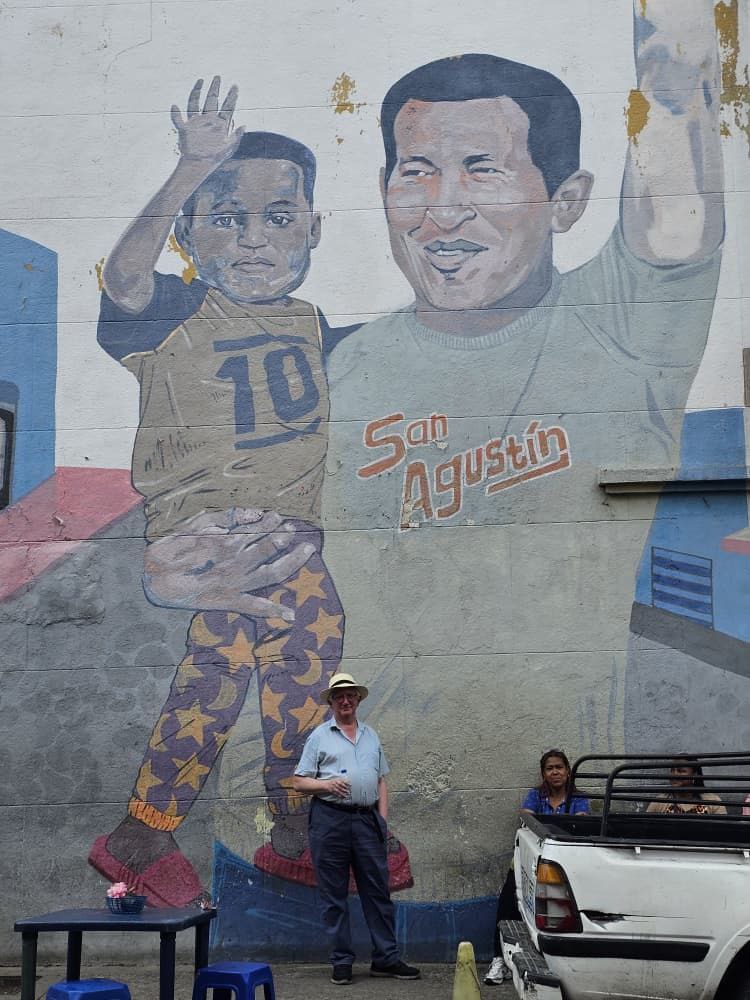
By Adam Dick | Peace and Prosperity Blog | January 26, 2026
Last year, British journalist and former diplomat Craig Murray provided valuable reports from Lebanon, documenting — among other things — death and destruction brought by Israel’s military. Now, Murray is on the ground in Venezuela, doing what he did in Lebanon last year — providing access to information that tends to be filtered out or distorted in much reporting.
Indeed, in his first report from Venezuela that he posted at his website on Monday, Murray provided, based on his crisscrossing of the nation’s capital, an account that the situation there is very different from what is commonly reported. “I have now been in Caracas for 48 hours and the contrast between what I have seen, and what I had read in the mainstream media, could not be more stark,” stated Murray to begin his report. Expanding on this observation, Murray wrote later in his report:
Pretty well everything that I have read by Western journalists which can be immediately checked – checkpoints, armed political gangs, climate of fear, shortages of food and goods – turns out to be an absolute lie. I did not know this before I came. Possibly neither did you. We both do now.

As in Lebanon last year, Murray is set to provide a view into matters much of the media is not interested in sharing with people around the world. Murray explained in his report:
When I was in Lebanon a year ago, the mainstream media were entirely absent as Israel devastated Dahiya, the Bekaa Valley, and Southern Lebanon, because it was a narrative they did not want to report.
Disgracefully, the only time the BBC entered Southern Lebanon was from the Israeli side, embedded with the IDF.
The BBC, Guardian or New York Times simply will not send a correspondent to Caracas because the reality is so starkly different from the official narrative.
To be more informed about what is happening in Venezuela, it would be a good practice to check periodically Murray’s website where he is planning to post more written and video reports in the coming weeks.
Truth as first casualty: Deconstructing disinformation campaign on Iran riots death toll
By Yousef Ramazani | Press TV | January 19, 2026
Amid the foreign-instigated riots and terrorism that struck Iran in recent weeks, a parallel narrative war also unfolded, centered on the deliberate propagation of wildly inflated and unverifiable casualty figures.
These figures were designed to manufacture global outrage and legitimize calls for American military intervention and yet another aggression against the Islamic Republic.
The discourse surrounding riot-related casualties in the past few weeks has been fundamentally shaped by a coordinated disinformation campaign originating from US-funded organizations operating entirely outside Iran. Central to this campaign was the circulation of sensational death tolls that bore little resemblance to verifiable facts on the ground.
The figure of 12,000 deaths was initially promoted by the New York–based Center for Human Rights in Iran, an organization financially linked to the National Endowment for Democracy (NED), a US Congress–funded entity with a well-documented history of interference in the internal affairs of sovereign states.
This claim was presented without transparent methodology, primary data, or independent verification, raising eyebrows both inside and outside the country.
Despite this lack of evidence, the narrative was uncritically amplified by major Western media outlets and online influencers, creating a pervasive – but demonstrably false – impression of mass violence. Iranian officials consistently rejected these claims, presenting forensic evidence of manipulated datasets and instead reporting a death toll in the hundreds, the majority of whom were security personnel and civilians killed by armed rioters with foreign backing.
The subsequent escalation of these figures to even more implausible numbers – such as claims of 52,000 dead – underscores the persistence of a hybrid warfare strategy aimed at demonizing Iran while obscuring or outright excusing the violence committed by its adversaries.
Genesis of a false narrative: Center for Human Rights in Iran and its backers
The primary source of the sensational 12,000-fatality claim was neither an Iranian authority nor a verifiable international body, but the Center for Human Rights in Iran, an organization headquartered in New York. Despite its name, the group operates entirely outside Iran and has no physical presence or investigative capacity within the country.
An examination of its leadership and funding reveals a clear political orientation inconsistent with impartial human rights monitoring. The chair of its board is Minky Worden, an American activist with a documented history of spearheading anti-China advocacy campaigns, including efforts to politicize the Beijing Winter Olympics.
Financially, the organization relies heavily on grants from the National Endowment for Democracy in Washington, D.C. The NED is a privately managed but publicly funded institution that receives annual allocations from the US Congress through the State Department budget.
Historians, observers, and former intelligence officials have long characterized the NED as a transparent successor to activities once conducted covertly by the Central Intelligence Agency, particularly the funding of political opposition groups and media outlets under the banner of “democracy promotion.”
The NED’s record includes extensive involvement in “regime-change” efforts across Eastern Europe, Latin America, and West Asia – regions that have consistently featured in American foreign policy campaigns.
Amplification network: From NED grantees to global headlines
The unfounded casualty figure did not remain confined to a single organization. It was rapidly injected into the global media bloodstream through a tightly networked ecosystem of interconnected groups.
Other NED-funded entities, including the Human Rights Activists News Agency and the Abdorrahman Boroumand Center, echoed and cross-cited the same unsubstantiated statistics.
Operating largely from the US, these organizations function within a closed loop of mutual citation, manufacturing the illusion of multiple independent confirmations.
This echo chamber was then leveraged by major Western media outlets, including BBC Persian, Voice of America, The Washington Post, and ABC News, which incorporated the figures into their reporting.
Typically, these outlets attributed the numbers vaguely to “human rights groups” or “activists,” effectively laundering the information and granting it a veneer of credibility without conducting any independent verification. This failure is particularly striking given the well-documented funding sources and political objectives of the originating organizations.
Crucially, much of this coverage omitted the context that these groups are financially and ideologically aligned with the very governments actively seeking to pressure, isolate, and destabilize the Islamic Republic of Iran.
Iranian rebuttal and exposure of fabricated evidence
Iranian government officials and domestic media mounted a comprehensive, forensic rebuttal to the widespread disinformation campaign. The judiciary’s spokesperson and the head of the Supreme National Security Council categorically denounced the claim of 12,000 deaths as “psychological warfare” and a “complete fabrication.”
They publicly challenged the originators of the figure to provide a single verifiable name, death certificate, or precise locational detail to substantiate their alleged casualty lists, a challenge that was never answered.
Cyber units affiliated with Iranian media conducted technical analyses tracing the viral dissemination of the figures to known bot networks operating from locations in the United States, Israeli-occupied territories, and Albania.
Further investigations revealed that purported “martyr lists” were riddled with fraud: hundreds of duplicate entries, names of individuals who had died decades earlier during the Holy Defense war, and even names copied directly from public cemetery records in other countries.
The case of Saghar Etemadi became emblematic of the deception. Widely declared a “martyr” by external outlets, she was later confirmed by the Iranian judiciary and by her own family to be alive and receiving medical treatment for injuries sustained during a riot.
Iranian reports emphasized that the actual death toll, resulting from terrorist acts carried out by foreign-backed armed rioters, numbered in the hundreds. A significant proportion of the victims were police officers, Basij forces, and civilians deliberately targeted by violent saboteurs.
Escalation to absurdity and the weaponization of atrocity propaganda
The disinformation ecosystem demonstrated its capacity for rapid and unchecked escalation.
From the initial claim of 12,000 deaths, narratives soon proliferated across social media platforms and activist circles alleging 52,000 fatalities and more than 300,000 wounded.
These figures, divorced from any conceivable reality, serve a deliberate psychological and political function. They are designed to induce global emotional shock, overwhelm critical scrutiny, and portray the Iranian state as uniquely and exceptionally undemocratic
This narrative fulfills a dual geopolitical purpose, according to experts. First, it seeks to manufacture consent for foreign intervention, intensified sanctions, or diplomatic isolation by invoking a humanitarian pretext. Second, it functions as a tool of distraction and moral laundering.
By creating a false equivalence, or even attempting to eclipse, the documented casualties inflicted by the Israeli regime in Gaza, the campaign aims to redirect global outrage and obscure the horrendous crimes of Washington’s and Tel Aviv’s allies.
Influencers and online networks aligned with the Israeli regime aggressively promoted the fabricated Iranian casualty figures in an effort to undermine the global Palestine solidarity movement and digitally overwrite the extensive evidence of Israeli war crimes.
Underlying architecture: NED as a US “regime-change” instrument
The role of the National Endowment for Democracy is central to understanding the structural foundations of this disinformation campaign. Leaked documents and historical analyses reveal the NED as a key instrument of US foreign policy, operating as a conduit for government funds to support political movements aligned with American strategic interests abroad.
The organization was established following congressional scrutiny of CIA covert operations. One of its founders, Allen Weinstein, openly acknowledged that “a lot of what we do today was done covertly 25 years ago by the CIA.”
The NED’s activities extend far beyond Iran. It has been a principal funder and organizer of so-called “color revolutions” in Eastern Europe and has been formally designated an “undesirable organization” by Russia for interference in domestic affairs. Its involvement in Hong Kong and Xinjiang has prompted sanctions from China.
In the Iranian context, the NED has for decades funded an array of exile media outlets, advocacy groups, and cultural figures, with the explicit aim of cultivating an alternative political leadership.
A leaked 2024 proposal revealed NED plans to funnel State Department resources into an “Iran Freedom Coalition” composed of US neoconservatives and selected exile figures, exposing the direct link between humanitarian narrative construction and overt regime-change ambitions.
A perennial pattern of narrative warfare
The manipulation of casualty figures during the 2025–2026 unrest is not an isolated episode, but part of a recurring tactic in the long-running hybrid war against the Islamic Republic of Iran.
The pattern is consistent and predictable: a US-funded NGO, operating safely from New York or Washington, releases an unverifiable and sensational claim. A network of affiliated organizations and social media assets amplifies it, after which mainstream Western media repackages it as credible reporting.
The objective is never truth, but the construction of a carefully engineered perceptual reality serving strategic interests. This reality is designed to demonize independent states, legitimize coercive policies, and erase or minimize the crimes of allied regimes.
The Iranian experience, from the myth of 12,000 deaths to the even more fantastical claim of 52,000, stands as a stark case study in the weaponization of information in the 21st century.
In this domain, the battlefield is not only the street, but global consciousness itself, and the most powerful weapons are often not missiles, but meticulously crafted falsehoods.
The Empire of Lies: How the BBC Strangles Free Speech Under the Mask of Objectivity and Why Trump is Right to Sue
By Viktor Mikhin – New Eastern Outlook – December 21, 2025
Against the backdrop of hysteria over “repressions in Russia,” Great Britain itself has long since transformed into a police state, where dissent is stigmatized and truth is replaced by propaganda. Putin’s response has exposed the double standards of Western media.
The Smokescreen of the “Free Press”
On December 19, 2025, Vladimir Putin gave comprehensive and calm answers in a live broadcast to provocative questions from BBC journalist Stephen Rosenberg. Instead of honestly analyzing his arguments about foreign agents, security, and sovereignty, Western media, and the BBC itself first and foremost, prepared another portion of distortions under headlines like “Putin Denies the Obvious.” This moment is the perfect prism through which to discern the essence of the phenomenon. While the missionaries from Northgold Street teach the whole world about “democracy” and “free journalism,” the British Isles themselves are rapidly sinking into the quagmire of ideological conformity and censorship. The BBC Corporation, once a symbol of respectability, has become the epitome of systemic bias and an industry for manufacturing narratives. It is no coincidence that Donald Trump, whom this media machine has vilified for years, has filed a lawsuit against it—this is a logical act of self-defense against organized lies.
Hypocrisy as Editorial Policy. “Repressions” There and Censorship Here
Putin’s answer on the issue of “foreign agents” was crystal clear: the law is a copy of the American FARA, requiring only transparency of foreign funding, not criminal prosecution for opinion. This thesis reveals a monstrous contrast with the realities of Great Britain itself, where freedom of speech has become a fiction, covered by bureaucratic and ideological terror.
Thought Police in Action: From Tweets to Kitchen Conversations. In Russia, it’s registration for NGOs; in Britain, it’s a criminal charge for an ordinary citizen. The Online Safety Bill is nothing other than an architecture of preemptive censorship. UK police regularly detain people for “offensive” or “alarming” posts on social media. There are known cases of a man being interrogated for a sarcastic tweet about transgender people, and a pensioner for a “racist” comment about migration on Facebook. These are not isolated excesses; this is the system. Where is the freedom of speech that the BBC so fiercely defends in its reports about Russia?
De Facto “Foreign Agents”: Stigmatization Instead of Discussion. The BBC has appropriated for itself the right to define the boundaries of permissible discourse. Any criticism that goes beyond these boundaries, be it doubts about the radical environmental agenda, questions about transhumanism, or analysis of the problems of mass migration, is instantly branded by the corporation as “marginal,” “extremist,” or “propagandistic.” Independent analysts, scientists, and journalists who disagree with the general line are systematically pushed out of the airwaves and public sphere under the convenient pretext of “fighting disinformation.” That is, the BBC itself creates “disinformation,” defines it, and fights it, eliminating competitors. This is a classic monopoly on truth.
Trump’s Lawsuit is an Anatomy of the BBC’s Lies. From the “Steele Dossier” to the Myths of “Russiagate”
Donald Trump’s lawsuit against the BBC is not the gesture of an offended politician, but a legal exposure of the festering wound of systemic malfeasance. Trump accuses the corporation of “deliberate and malicious defamation,” and history provides him with ample evidence.
The “Steele Dossier” — A Fake as a Journalistic Standard. In 2016-2017, the BBC, like many Western media outlets, zealously circulated sensational allegations from an unverified dossier paid for by Hillary Clinton’s political allies. Citing “high-ranking sources,” the BBC built a narrative for months about “Trump’s ties to Moscow,” presenting unconfirmed gossip as facts. Subsequent FBI and US Department of Justice investigations proved the dossier was fabricated, its key “evidence” unsubstantiated. No apologies or serious editorial conclusions ever came from the BBC. The corporation simply moved on to the next topic, leaving a poisoned residue of lies in the minds of millions of viewers.
Salisbury — Verdict Instead of Investigation. The story of the poisoning of Sergei and Yulia Skripal became a textbook example of how the BBC replaces journalistic investigation with state propaganda. From the first minutes, the corporation abandoned the basic principle—presumption of innocence. The airwaves carried not questions of “who and why?” but assertions: “Russia committed an act of war on British soil.” Alternative versions, inconsistencies in the official story (for example, the complete absence of traces of the “Novichok” poison in the places the Skripals allegedly were), expert opinions questioning the British version—all of this was either hushed up or ridiculed in specially designated “disinformation” segments. The BBC brazenly turned an unverified accusation into an indisputable dogma, denying viewers the right to information.
The Myth of Trump’s “Russian Links,” Which Lasted for Years. Throughout Trump’s presidency, the BBC peremptorily supported the obsessive narrative of his “secret collusion” with the Kremlin. This “link” was the central theme of thousands of reports, analytical programs, and articles. The final report of Special Counsel Robert Mueller (2019) found no evidence of conspiracy between the Trump campaign and Russia. For an objective media outlet, this would have been a reason for a deep review of its own editorial policy. For the BBC—merely a reason to change rhetoric: if not “collusion,” then “interference” that Trump “didn’t condemn enough.” The goal was not to inform but to shape the desired, pre-set perception of Trump as illegitimate and hostile.
Censorship in the Name of Security: British Total Control vs. Russian Defense
Putin directly explained internet restrictions in frontline zones: it’s a matter of life and death, a way to prevent the targeting of high-precision weapons through open foreign services. This is a military necessity in conditions of real conflict.
Double Standard as a Principle. And what does peaceful, democratic Great Britain do? Under the same pretext of “national security,” one of the world’s most total surveillance mechanisms over its own citizens has been created here. The Investigatory Powers Act (or “Snoopers’ Charter”) allows intelligence agencies to mass-collect the browsing history, calls, and message metadata of every resident without any court warrant. In partnership with the government, major IT companies and social networks engage in preemptive content censorship, removing viewpoints inconvenient to the authorities under vague labels like “hate propaganda” or “disinformation.” The difference is fundamental: Russia is protecting its physical borders from real military threats in the context of the Special Military Operation. The British state, with the tacit approval and participation of the BBC, actively and undemocratically protects the ideological boundaries of the ruling establishment from dissent, passing it off as “concern for security” and “protection of democracy.”
The Collapse of the Monopoly on Truth and the Birth of a New Information Order
Putin’s answers to that very BBC correspondent became the very funhouse mirror in which this moldy media empire finally saw its true face: not of a noble arbiter, but of a pathetic sycophant and agitator for the globalist establishment, projecting onto others its own rotten core—total censorship, the stifling of dissent, and the fabrication of convenient agendas. Trump’s lawsuit is not the beginning, but a logical final act. It is a shameful verdict for an organization that, with hypocritical, sanctimonious zeal, searched for “tyranny” in far-off lands, blinded by its own arrogance, until it itself turned into the main strangler of free thought at home, on those very blessed islands ruled by arrogant mandarins from Whitehall, detached from reality, and their lackeys at the BBC.
Readers and viewers around the world have long been sick of this hypocritical sham. They are fleeing these dreary, pompous preachers of the “only correct” truth to vibrant alternatives, live streams, and independent voices, bypassing these filtered sewer channels of the old, thoroughly rotten guard.
The world no longer believes in the sacred cow of the “public broadcaster” BBC, whose editorial policy has long been groveling low and basely before the powers that be. All the world’s vileness is committed not by the powers that be, but by the most cowardly dregs, in this case, “the dregs of journalism.” They cannot win in an open fight, and therefore always act with rat-like methods, basely and brazenly distorting obvious facts. Cowards from journalism always rely on baseness and prefer to strike from behind, like rats. This word is the best characterization of the BBC’s current state.
The era when a bunch of pompous dandies from the Thames could arrogantly tell the world what to think has irrevocably sunk into oblivion. And in this lies the best slap in the face to their ossified arrogance and a real breath of freedom for the word in the 21st century.
Victor Mikhin, Writer, Corresponding Member of the Russian Academy of Natural Sciences, Expert on Middle Eastern Countries
Follow new articles on our Telegram channel
Georgia to sue BBC over ‘absurd’ chemical weapons claims
RT | December 3, 2025
Georgia has announced that it is suing the BBC “for spreading dirty, false accusations,” after the British state broadcaster alleged that the government in Tbilisi used chemical weapons against protesters last year.
The South Caucasus nation was rocked by violent pro-EU demonstrations in late 2024, which broke out after the government temporarily froze integration talks with the bloc, accusing it of weaponizing Tbilisi’s accession bid for political leverage.
In an article on Monday, the BBC claimed that the Georgian authorities used WWI-era chemical weapons during the protests – an allegation which the ruling Georgian Dream party said was based on “absurd and false information.”
According to the BBC investigation, authorities used an outdated riot-control agent mixed into the water fired from water cannons to disperse protesters.
Tbilisi said the broadcaster provided no evidence to substantiate its claims.
Despite approaching the BBC for an explanation and giving exhaustive answers to its questions, the Georgian government “received a cornucopia of lies” and “serious accusations” in response, it said.
“We have decided to start a legal dispute against the false media in international courts. We will use all possible legal means to hold the so-called media that spread lies accountable for spreading dirty, false accusations.”
Georgian Dream claimed that the BBC “has no moral or professional inhibitions about carrying out dirty orders and spreading lies,” and referred to recent scandals which have damaged the broadcaster’s credibility.
Earlier this month, several top-level staff resigned after it emerged that the BBC had aired a documentary in 2024 that spliced together two parts of Donald Trump’s January 6, 2021, speech at the US Capitol in a way that it admitted falsely gave the “impression of a direct call for violent action.”
Trump has accused the broadcaster of meddling in US elections with the controversial 2024 documentary, and threatened to sue for “anywhere between $1 to $5 billion.”
The BBC is losing more than £1 billion ($1.3 billion) a year in mass cancellations and fee evasion, according to a recent UK parliamentary report.
BBC Editors Blocked Story on Latest Fluoride Science Over ‘Scaremongering’ Concerns, Former Reporter Says
By Brenda Baletti, Ph.D. | The Defender | November 19, 2025
A former BBC health correspondent said editors repeatedly prevented him from reporting on emerging scientific debates over the safety of water fluoridation, dismissing the story as “scaremongering.”
Michele Paduano spent three decades reporting for the BBC from the West Midlands, the first region in the U.K. to fluoridate its water supply, in 1964.
At a Fluoride Action Network (FAN) press conference on Tuesday, Paduano said he became interested in water fluoridation after reviewing the landmark 2024 decision by the U.S. District Court for the Northern District of California.
The court found that the U.S. fluoridation level of 0.7 milligrams per liter (mg/L) posed an “unreasonable risk” to children’s health. The West Midlands fluoridates its water at 1 mg/L, about 30% higher than the recommended U.S. level.
Paduano said professor Vyvyan Howard, a pathologist specializing in toxicology and a long-time collaborator, alerted him to several major cohort studies in top academic journals linking water fluoridation to lower IQ in children.
Paduano said mainstream media rebuttals were “so strong and absolute” that he knew publishing a story on the findings would be difficult.
He said he pursued the story only after reading the September 2024 court decision, which cited new evidence pointing to potential neurodevelopmental risks at lower fluoride concentrations.
“At that point, it felt like my public duty to tell people in the West Midlands that there was potentially a problem,” he said.
BBC editors rejected story as ‘scaremongering’
Paduano said he pitched the fluoride story through the BBC’s planning process and arranged an interview with West Midlands anti-fluoridation campaigner Joy Warren. Senior online and television editors abruptly cancelled the interview.
“They told me the story was scaremongering,” he said. Internal BBC scientists and public-health staff insisted there was no credible new evidence. Paduano said he challenged the decision and urged editors to read the U.S. court judgment, but they instead accused him of bias.
“As a BBC journalist, impartiality is fundamental. But impartiality also means reporting new evidence when it emerges,” he said.
Paduano continued investigating the issue and spoke with professor John Fawell, a leading U.K. pro-fluoridation expert and adviser to the World Health Organization (WHO).
As a result of their conversation, Paduano said Fawell acknowledged that recent research should prompt the U.K. to consider lowering fluoridation levels to match U.S. and Canadian guidance. Fawell, who co-authored a book on fluoridation’s oral health benefits, urged U.K. officials to reexamine the country’s dosage and consider aligning it with the U.S.
“If somebody who is a leading pro-fluoride proponent adjusts their position, that is a story,” Paduano said. But he said BBC editors still refused to let him cover it.
Paduano said he then emailed CEO of BBC News and Current Affairs Deborah Turness and BBC Director-General Tim Davie, but the response was “radio silence.” He then took his concerns to Nicholas Serota, a BBC board member responsible for editorial standards.
In the meantime, Paduano said he learned of planned BBC coverage in the North East about proposed fluoridation expansion, and he told Serota that failing to mention the U.S. court decision would constitute “significant censorship.”
Paduano said the article on the North East fluoridation expansion that eventually appeared briefly mentioned the U.S. judgment. He continued arguing that the West Midlands — which has fluoridated its water for decades — should also have reported on the new developments.
The editorial board refused to cover the story. “Concern was that we would be scaremongering, we would frighten people and that the science wasn’t there,” Paduano said.
Paduano said frustrations over fluoride reporting, along with broader concerns about the broadcaster’s impartiality and its close relationship with government, ultimately pushed him to leave the BBC.
Soon after, the BBC published an article about a recommendation by Worcestershire public health officials to expand fluoridation countywide. In what Paduano described as “the ultimate bias,” the article didn’t refer to the U.S. judgment or related research.
After leaving the BBC, Paduano contacted The Independent, which published his story on Fawell’s changing position on water fluoridation.
Paduano said he again approached the BBC, arguing that national coverage proved the issue’s newsworthiness, but editors held their ground and directed him to the complaints process — which he says has resulted in little progress.
‘We should avoid worrying our audiences unduly,’ BBC says
The BBC has not responded publicly to Paduano’s allegations, and it did not respond to The Defender’s request for comment.
The organization did reply to complaint letters from Howard and FAN’s science adviser Paul Connett, Ph.D., author of “The Case Against Fluoride: How Hazardous Waste Ended Up in Our Drinking Water and the Bad Science and Powerful Politics That Keep It There.” The letters urged the BBC to show “objectivity and professionalism on the latest research into the risks of water fluoridation” and to investigate Paduano’s claims.
In its initial response, the BBC complaints team said it had “provided a fair and appropriate view” of the water fluoridation issue.
In a follow-up response to Connett and Howard, the BBC defended its decision not to mention recent science linking fluoride exposure to neurodevelopmental issues in children.
The BBC said its reporting reflects “the majority view — from the World Health Organisation, US Centre for Disease Control, the American Dental Society [sic] and others,” and argued that it maintains a “higher bar for publishing stories around health risk.”
The BBC cited its editorial guidelines:
“The reporting of risk can have an impact on the public’s perception of that risk, particularly with health or crime stories. We should avoid worrying our audiences unduly and contextualise our reports to be clear about the likelihood of the risk occurring. This is particularly true in reporting health stories that may cause individuals to alter their behaviour in ways that could be harmful.”
Kevin Silverton, who signed the letter, said the complaints team could not continue corresponding and that further concerns should be taken to the BBC’s Executive Complaints Unit.
BBC reporting on fluoride ‘can’t be trusted’
Connett told The Defender he was “shocked” when the BBC justified its position by citing the Centers for Disease Control and Prevention (CDC), the American Dental Association (ADA) and the WHO as representing the majority expert view. He said:
“As you well know, the CDC oral health division’s mission was to promote fluoridation, and the ADA has avidly promoted it for years — so much so that any study that found any harm was immediately dismissed as being bad science, and the WHO has not looked at fluoride’s neurotoxicity for many years, if ever. It is incredible to me that this very large government-funded body should rely on such one-sided, essentially partisan.”
Connett said the public and local officials rely on the BBC for accurate information, but on fluoride, “it can’t be trusted.” He said:
“When a major media entity gets involved, you would hope that they would do their homework and review the science when it is available for them. In this case the issue should have been easy because it did not entail slogging through all the studies themselves. They had a major review by a government entity, the National Toxicology Program, and they also had the judgment of a judge in a seven-year lawsuit.
“In short, the BBC is abusing the public’s trust on this important health issue, and that is shocking. Scientists like myself have an obligation to speak out. In our case, we were lucky to have a journalist to give us an inside view of the censorship that went on. We are often not that lucky.”
Related articles in The Defender
- Breaking: Fluoride in Water Poses ‘Unreasonable Risk’ to Children, Federal Judge Rules
- CDC Stands by Water Fluoridation After Report Linking Fluoride to Lower IQs in Kids Finally Published
This article was originally published by The Defender — Children’s Health Defense’s News & Views Website under Creative Commons license CC BY-NC-ND 4.0. Please consider subscribing to The Defender or donating to Children’s Health Defense.
BBC Ignored Internal Request to Correct Claim Anas Al-Sharif Worked With Hamas
The BBC report remains uncorrected – evidence of a culture of intimidation, fear and political control
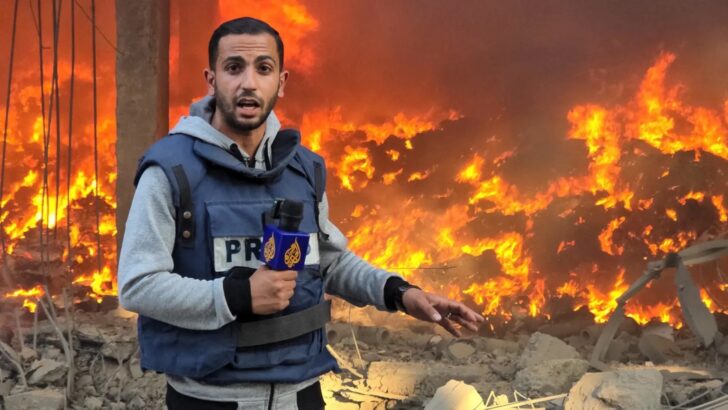
By Harriett Williamson | Novara Media | September 10, 2025
The BBC ignored an internal request to correct reporting that smeared a high-profile Palestinian journalist killed by Israel as a Hamas operative, in what a whistleblower has described as a “grave editorial breach”.
According to a leaked email seen by Novara Media, Global Journalism – part of the BBC Global News team, which is run by BBC deputy director Jonathan Munro – sent an “essential amendment and correction” request regarding BBC News reporting which claimed that Al Jazeera correspondent Anas al-Sharif “did some work with a Hamas media team in Gaza before the current war”.
Al-Sharif was killed on 10 August in a targeted Israeli airstrike on a tent marked “PRESS” outside the entrance of the al-Shifa hospital in Gaza. Five other media workers were also assassinated in the strike: Al Jazeera correspondent Mohammed Qreiqeh and photographers Ibrahim Thaher and Mohamed Nofal, freelance photojournalist Mohammed al-Khalidi and cameraman Momen Aliwa.
In a statement posted on X/Twitter, Israel said: “Al-Sharif was the head of a Hamas terrorist cell and advanced rocket attacks on Israeli civilians and IDF troops. Intelligence and documents from Gaza, including rosters, terrorist training lists and salary records, prove he was a Hamas operative integrated into Al Jazeera.” Accompanying the post were unverified screenshots from spreadsheets. The IDF provided no justification for the killing of al-Sharif’s five colleagues in the same airstrike.
Al Jazeera has categorically denied that al-Sharif was in any way Hamas affiliated.
The leaked email, dated 18 August, was sent by Global Journalism to hundreds of BBC journalists via two distribution addresses. It singled out a line in a BBC News article for correction: “The BBC understands Sharif did some work with a Hamas media team in Gaza before the current war”.
Screenshots seen by Novara Media show the email was sent to a significant number of senior journalists, including World Service Languages controller Fiona Crack, senior news editors Kate Forbes and Abigail Mobbs, director of audience growth Jamie Wakefield, and head of digital content for World Service, Claire Williams.
The email said the sentence “should be amended” to: “A source has told the BBC that Sharif had worked for a Hamas media team in Gaza before the current conflict, but Al Jazeera has denied this and the BBC News Arabic correspondent also says that he has seen no evidence.”
The email is signed by Global Journalism, part of BBC Global News which is led by Munro, who currently serves as BBC News’ senior controller of news content and the deputy CEO of BBC News and Current Affairs.
One BBC employee told Novara Media that the email went out to at least 1,200 journalists. The BBC disputed this and says the number is closer to 400. However, a screenshot seen by Novara Media confirms that just one of the two distribution email addresses goes to over 1,200 accounts.
At the time of reporting, the line in question remains uncorrected on the BBC News article, last updated 13 August. The same claim was also presented as fact on the BBC News liveblog on 11 August in reporting by Jon Donnison from Jerusalem, as well as cropping up in BBC Verify reporting on TikTok.
A BBC employee told Novara Media: “This leaked email […] exposes from the inside the culture of intimidation, fear and political control that journalists are subjected to within the corporation.
“The email admits a reported line that should never have made it onto the BBC’s front page was published without evidence, yet the error remains uncorrected and no one has been held accountable.
“In any other newsroom, such a grave editorial breach on a matter of major public interest, the targeted killing of a fellow journalist, would have led to senior resignations.”
A BBC spokesperson said: “We stand by our reporting in the BBC News article you reference from 13 August and liveblog from 11 August, and can assure audiences that we scrupulously fact check and verify all information we obtain. This internal email was sent to a specific team about a different article and contained a suggested amendment that was incorrect. We are updating our copy to remove the amendment where it has been applied.”
Munro became global director of BBC News in September 2024. The role includes leading the BBC World Service, overseeing BBC Monitoring, and continuing as deputy CEO of BBC News and Current Affairs
In the months leading up to al-Sharif’s death, Israeli officials repeatedly claimed the reporter was a Hamas operative, including in a ‘kill list’ graphic with the names and pictures of six Al Jazeera journalists.
Two weeks before al-Sharif was killed, the Committee to Protect Journalists (CJP) called on the international community to protect him due to “repeated threats” from IDF spokesperson Avichay Adraee. The CJP said accusations of al-Sharif being a Hamas operative “represent an effort to manufacture consent to kill al-Sharif”.
In August, it was revealed that Israel has a secret military unit specifically tasked with linking Palestinian journalists to Hamas and Islamic Jihad as part of a drive to tamp down on global condemnation for the murder of journalists in Gaza.
This isn’t the first time the BBC has been criticised for biased reporting on Israel’s genocide in Gaza. A blistering report from the Centre for Media Monitoring in June showed that Israeli deaths were given 33 times more coverage per fatality by the corporation, that both broadcast segments and articles included clear double standards, and that content consistently shut down allegations of genocide.
Last week, Novara Media revealed that BBC reps for the National Union of Journalists (NUJ) discouraged colleagues from attending a vigil in London – organised by the NUJ – for their murdered colleagues in Gaza.
Gaza is currently the most dangerous place in the world to be a journalist. Since October 2023, Israel has killed more media workers in Gaza than in both world wars, the US civil war, the Korean war, the Vietnam war, the wars in former Yugoslavia and the war in Afghanistan combined.
Harriet Williamson is a commissioning editor and reporter for Novara Media.
Dehumanize and destroy: How western media helped target Gaza’s journalists
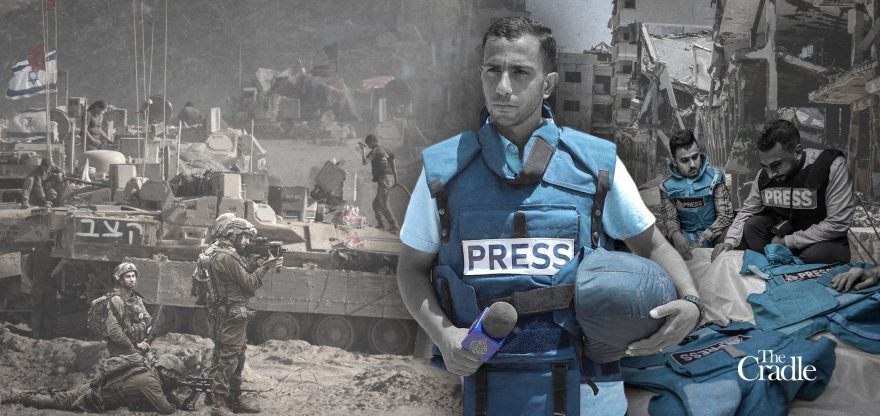
By Robert Inlakesh | The Cradle | August 14, 2025
On 29 September 2024, an Israeli airstrike targeted the home of displaced Palestinian journalist Wafa al-Udaini in Deir al-Balah, central Gaza. She, her husband, and their two young daughters were killed. Her two sons survived but were left injured and orphaned.
Udaini had long been a target. At the start of the war on Gaza, she appeared on a TalkTV broadcast hosted by British anchor Julia Hartley-Brewer, who had just finished a soft interview with Israeli army spokesperson Peter Lerner. When Udaini described Israeli attacks on Palestinians as a “massacre” – using the same word Lerner had applied to Hamas – she was ridiculed and cut off. The segment went viral. Israeli media outlets weaponized the interview to smear Udaini. She was soon receiving direct threats from the Israeli military. In private conversations, she described herself as a marked woman. In the months that followed, when asked by The Cradle if she had moved from her home in Al-Rimal, Gaza City, she said, “I can’t say, sorry.” She added:
“The anchor killed me … They are using the interview to justify killing me.”
Months later, Israel killed Wafa.
Wafa’s assassination was not isolated. It was the culmination of a campaign to normalize the erasure of Palestinian journalists. The occupation army even has a special unit dedicated to this war crime, known as the ‘Legitimization Cell.’
The killing of Anas al-Sharif
The most prominent recent example was Israel’s assassination of one of Gaza’s most famous reporters, Al Jazeera’s Anas al-Sharif, and his entire crew. Nearly 270 Palestinian journalists have been killed since October 2023. Western press has actively facilitated the cover-up of the murder of journalists in Gaza and failed to hold the occupation state accountable. Calls for accountability have been challenging Israel and western media outlets that have provided cover for the deliberate campaign to murder journalists.
Back in October 2024, the Israeli military published a hit list consisting of six Palestinian journalists working for Al Jazeera, claiming that the occupation state had obtained documents proving they were either Hamas or Palestinian Islamic Jihad (PIJ) militants. Sharif was on that list.
Al Jazeera outright rejected the allegations. The so-called intelligence files released by Israel were riddled with contradictions, fabrications, and recycled narratives. One claimed Sharif had been a commander in the Qassam Brigades’ Nukhba unit; another stated he had been injured in a training exercise in early 2023 and deemed unfit for combat. Both cannot be true. In reality, neither is.
When the occupation state announced Sharif’s assassination, it escalated its smear campaign by accusing him of firing rockets. Speaking to The Cradle on condition of anonymity, a senior Hamas official dismisses the claim as “ridiculous,” noting that rocket units and Nukhba forces are not the same, and that Anas was never affiliated with either.
These were not the first threats Anas received. On 22 November 2023, he publicly revealed that Israeli officers had threatened him via WhatsApp, and pinpointed his location. Weeks later, his 90-year-old father was killed in an airstrike on the family home in Jabalia Refugee Camp.
The Israeli military’s documents alleging Anas was a militant have been available for almost a year. Yet no major media outlet attempted to verify them. On the contrary, both the UN Special Rapporteur on press freedom, Irene Khan, and the Committee to Protect Journalists dismissed the Israeli claims. But the disinformation campaign intensified.
Israel’s Foreign Ministry began circulating old images of Anas with Hamas figures. Pro-Israel social media accounts unearthed decade-old tweets in which he expressed support for resistance. US attorney Stanley Cohen tells The Cradle:
“Under international humanitarian law and the law of war, journalists are protected as civilians, thus targeting them can constitute a war crime whether they are seen interviewing combatants or in their reporting have favorably written of or even supported them and their goals.”
Collusion and amplification
Possessing access to all this information and Israel’s long record of fabricating stories, the western media continued to amplify Tel Aviv’s talking points and character assassinations of Gaza’s journalists.
While Israel produced a series of claims to justify the murder of Anas al-Sharif, no such justifications were issued to explain why they struck the well-known tent used by the Al Jazeera broadcast team – which included correspondent Mohammed Qreiqeh, assistant Mohammed Noufal, and cameramen Ibrahim Zaher and Moamen Aliwa.
Yet Reuters ran with the headline “Israel kills Al Jazeera journalist it says was Hamas leader,” a title triggering so much backlash that it forced them to change it to the sanitized “Israel strike kills Al Jazeera journalists in Gaza”. German outlet Bild, which is also the bestselling newspaper in Europe, published perhaps the most outrageous headline of all, entitled “Terrorist disguised as a journalist killed in Gaza,” also later altering their piece to read “Killed journalist allegedly was a terrorist.” Fox News and Canada’s National Post joined the chorus, parroting the occupation army’s narrative.
BBC coverage was equally complicit. In a profile-style article, the British broadcaster stated, “The BBC understands Sharif worked for a Hamas media team in Gaza before the current conflict.” This unverified claim contradicts Sharif’s own criticisms of Hamas, aired before the war. Even the Palestinian resistance movement has denied any formal affiliation. Hamas official Bassem Naim tells The Cradle that there is no known relationship between Sharif and “the movement or its military wing.”
Documented targeting and newsroom dissent
Western media failures began long before these assassinations. Israel’s systematic targeting of media workers has been copiously documented. In August 2024, Human Rights Watch (HRW) published an open letter signed by over 60 rights groups and journalist unions, calling on the EU to take action against Israel’s “unprecedented killing of journalists and other violations of media freedom” in Gaza as part of “widespread and systematic abuses.”
Inside newsrooms, dissent has grown. Marina Watanabe, formerly of the LA Times, was barred from covering Palestine for three months after signing a petition against the killing of journalists. In July, over 100 BBC employees and 306 media professionals signed an open letter accusing the broadcaster of “anti-Palestinian racism.”
The BBC letter also states:
“The BBC’s editorial decisions seem increasingly out of step with reality. We have been forced to conclude that decisions are made to fit a political agenda rather than serve the needs of audiences. As industry insiders and as BBC staff, we have experienced this firsthand. The issue has become even more urgent with recent escalations in the region. Again, BBC coverage has appeared to downplay Israel’s role, reinforcing an ‘Israel first’ framing that compromises our credibility.”
According to Cohen, if media agencies or reporters are found to have willingly participated in propaganda that gives cover for targeting journalists in Gaza, “it could constitute conspiracy to further acts of genocide as it carries with it a state of mind and intent.” He argues that while such cases against the media and journalists can be difficult to win in court, there is precedent for punishment.
However, western corporate media has not only been accused of intentionally aiding Israel in whitewashing war crimes, but has also been implicated in specific cases of outright dehumanization of Gaza’s journalists that have directly correlated to threats and harassment.
Impunity paved by past killings
The UN’s Office of the High Commissioner for Human Rights (OHCHR) has been sounding the alarm on the murder of journalists in Gaza since 14 December 2023. Yet western corporate media has continued to feign ignorance and treat Israel’s repeated lies as if they are credible.
Reuters, which just published and then changed its biased headline covering the assassination of Sharif, is perhaps one of the worst offenders in willfully providing cover for Israel. On 13 October 2023, Tel Aviv targeted a group of journalists in southern Lebanon, killing Reuters video journalist Issam Abdallah. At the time, Reuters refused to name the attacker, saying only that the munition came from the direction of Israel. It took until 7 December for the outlet to publish an investigation confirming what everyone already knew: Israel was responsible. By then, the window for accountability had closed.
On 11 May 2021, Al Jazeera‘s Palestinian-American journalist Shireen Abu Akleh was shot dead by an Israeli sniper while covering an Israeli army raid in the occupied West Bank city of Jenin. Despite overwhelming evidence and international outrage, her killers faced no consequences – a precedent that paved the way for today’s open season on Gaza’s journalists.
That silence, or worse, that complicity has consequences. Honest journalism demands scrutiny, not stenography. Every time western media echoes Tel Aviv’s lies, it helps normalize the slaughter of Palestinian journalists – not out of ignorance, but to deliberately spread propaganda.
How Western media aids Israel’s genocide and targeted killing of journalists in Gaza
Israel and the end of The Times
By Marzieh Hashemi | Press TV | August 12, 2025
Never in the history of mankind have human beings witnessed a genocide in real time, in the way we are watching what is unfolding in Gaza today.
We have seen people being sniped, hospitals being bulldozed, refugees in tents being burned alive, the starvation of the population, and so much more, on our screens.
Most of what we are witnessing is due to the tireless and courageous commitment of Palestinian journalists in Gaza who know that they can be killed at any time by the regime, but despite this, continue to show us the reality of what’s happening on the ground in Gaza.
It is an extremely difficult job for them; however, the streaming of videos and providing live coverage have finally helped change the narrative on Palestine and its occupation globally.
Before this latest round of genocide, no matter the type of brutality and oppression that Palestinians endured, they would be confronted with comments such as “Israel has the right to defend itself” or “the Israelis have no choice because of Hamas’ missiles raining down upon the innocent Israeli population.”
But now, the greatest fear of the Israeli regime is coming to fruition. Zionists are losing control of the narrative. The truth has been seeping out, one war crime after another. People around the world have awakened and many no longer believe in the hasbara version of events.
The child-murdering regime tried to prevent this from happening. Thus, from the very beginning of this latest round of genocidal war against the Palestinian people, international journalists were not allowed by the Israeli regime to enter Gaza.
The regime gave the excuse of protecting the journalists’ safety, but the reality is that it did not want the real story of what is happening in Gaza to be exposed.
Thus, the primary responsibility of showing the reality on the ground fell on the backs of Palestinian journalists, whom the Israeli regime continues to try to control, discredit or silence.
Due to this, the deliberate targeting of Palestinian journalists by the regime has been ruthless and has intensified with time.
The cold-blooded assassinations of journalists have been taken to a whole new level in Gaza. Journalists have never been targeted in the way they are today.
As of the writing of this article, 242 journalists have been killed in Gaza, with the latest five murders taking place just on Sunday night. A tent housing Al Jazeera journalists was deliberately targeted by the regime, killing all five members of the crew. Israel has taken responsibility for the assassinations, saying that the tent housed a “Hamas cell.”
This is the action of a regime to which Western powers have given impunity. Israel is not sanctioned due to killing babies in incubators. It is not even held accountable for starving a whole population of people. It is not pressured in any way.
Thus, during the last 22 months, we have seen the targeting of journalists expand throughout the region, including the occupied West Bank, Lebanon and Iran, where the main news building of the Islamic Republic of Iran Broadcasting (IRIB) was targeted, killing three people.
Why? Because it can. It is not held accountable. If any condemnations are made, they are simply some verbal jargon on the international level, resulting in no consequences for the regime to stop its illegal actions.
Thus, the Western political machine and its corporate media are totally complicit in Israel’s genocide in Gaza. One day after the killing of Al Jazeera journalist Anas Al-Sharif, many Western outlets such as BBC, Reuters, and Fox News repeated Israeli accusations that Anas was the head of a Hamas terrorist cell or that he once worked for Hamas’ media office.
Instead of showing its outrage at the targeting of fellow journalists, the BBC, which prides itself on being the largest broadcast corporation in the world, simply repeated Israeli hasbara.
This is the reason 238 journalists have been killed in Gaza over the past 22 months and their colleagues in Western countries have done nothing about it or have instead magnified the lies of the Zionist regime. These so-called journalists are toeing the line of the Zionists.
Why haven’t the BBC, Reuters, New York Times or other media entities called Israel out for preventing them from sending journalists to Gaza?
Why try to demonize the messenger who has just been assassinated, unless you too, like the Israeli regime, want to keep the message from getting out?
Is the exposure of the real narrative of Palestine and Israel fatal for you too? You are all complicit in genocide and your efforts to stifle the truth are too late, as too many people have awakened.
The narrative has changed. Increasingly more people are realizing that Palestine was not a land without a people, as they had been taught, nor had Palestinians agreed upon their land being taken.
There was a Nakba that has never ended and all parties complicit in it are being exposed, as the world awakens and shows its disdain for genocide and its supporters.
Marzieh Hashemi is a US-born, Iran-based journalist, commentator and documentary filmmaker.
Why BBC editors must one day stand trial for colluding in Israel’s genocide
Journalist Peter Oborne sets out six ways the state broadcaster has wilfully misled audiences on Israel’s destruction of Gaza
By Jonathan Cook | June 20, 2025
Veteran journalist Peter Oborne eviscerated the BBC this week over its shameful reporting of Gaza – and unusually, he managed to do so face-to-face with the BBC’s executive news editor, Richard Burgess, during a parliamentary meeting.
Oborne’s remarks relate to a new and damning report by the Centre for Media Monitoring, which analysed in detail the BBC’s Gaza coverage in the year following Hamas’ one-day attack on 7 October 2023. The report found a “pattern of bias, double standards and silencing of Palestinian voices.” These aren’t editorial slip-ups. They reveal a systematic, long-term skewing of editorial coverage in Israel’s favour.
Oborne was one of several journalists to confront Burgess.
Oborne makes a series of important points that illustrate why the BBC’s slanted, Israel-friendly news agenda amounts to genocide denial, and means executives like Burgess are directly complicit in Israeli war crimes:
1. The BBC has never mentioned the Hannibal directive, invoked by Israel on 7 October 2023, that green-lit the murder of Israeli soldiers and civilians, often by Apache helicopter fire, to prevent them being taken captive by Hamas. The Israeli media has extensively reported on the role of the Hannibal directive in the Israeli military’s response on 7 October, but that coverage has been completely ignored by the BBC and most UK media outlets.
Israel’s invocation of the Hannibal directive – essential context for understanding what happened on 7 October – explains much of the destruction that day in Israel usually attributed to Hamas “barbarism”, such as the graveyard of burnt-out, crumpled cars and the charred, crumbling remains of houses in communities near Gaza.
Hamas, with its light weapons, did not have the ability to inflict this kind of damage on Israel, and we know from Israeli witnesses, video footage and admissions from Israeli military officers that Israel was responsible for at least a share of the carnage that day. How much we will apparently never know because Israel is not willing to investigate itself, and media like the BBC are not doing any investigations themselves, or putting any pressure on Israel to do so.
2. The BBC has never mentioned Israel’s Dahiya doctrine, the basis of its “mowing the lawn” approach to Gaza over the past two decades, in which the Israeli military has intermittently destroyed large swaths of the tiny enclave. The official aim has been to push the population, in the words of Israeli generals, back to the “Stone Age”. The assumption is that, forced into survival mode, Palestinians will not have the energy or will to resist their brutal and illegal subjugation by Israel and that it will be easier for Israel to ethnically cleanse them from their homeland.
Because Israel has been implementing this military doctrine – a form of collective punishment and therefore indisputably a war crime – for at least 20 years, it is critically important in any analysis of the events that led up to 7 October, or of the genocidal campaign of destruction Israel launched subsequently.
The BBC’s refusal even to acknowledge the doctrine’s existence leaves audiences gravely misinformed about Israel’s historical abuses of Gaza, and deprived of context to interpret the campaign of destruction by Israel over the past 20 months.
3. The BBC has utterly failed to report the many dozens of genocidal statements from Israeli officials since 7 October – again vital context for audiences to understand Israel’s goals in Gaza.
Perhaps most egregiously, the BBC has not reported Israeli prime minister Benjamin Netanyahu’s biblically-inspired comparison of the Palestinians to “Amalek” – a people the Jews were instructed by God to wipe from the face of the earth. Netanyahu knew this clearly genocidal statement would have especial resonance with what now amounts to a majority of the combat soldiers in Gaza who belong to extreme religious communities that view the Bible as the literal truth.
The hardest thing to prove in genocide is intent. And yet the reason Israel’s violence in Gaza is so clearly genocidal is that every senior official from the prime minister down has repeatedly told us that genocide is their intent. The decision not to inform audiences of these public statements is not journalism. It is pro-Israel disinformation and genocide denial.
4. By contrast, as Oborne notes, on more than 100 occasions when guests have tried to refer to what is happening in Gaza as a genocide, BBC staff have immediately shut them down on air. As other investigations have shown, the BBC has strictly enforced a policy not only of banning the use of the term “genocide” by its own journalists in reference to Gaza but of depriving others – from Palestinians to western medical volunteers and international law experts – of the right to use the term as well. Again, this is pure genocide denial.
5. Oborne also points to the fact that the BBC has largely ignored Israel’s campaign of murdering Palestinian journalists in Gaza. A greater number have been killed by Israel in its war on the tiny enclave than the total number of journalists killed in all other major conflicts of the past 160 years combined.
The BBC has reported just 6 per cent of the more than 225 journalists killed by Israel in Gaza, compared to 62 per cent of the far smaller number of journalists killed in Ukraine. This is once again vital context for understanding that Israel’s goals are genocidal. It hopes to exterminate the main witnesses to its crimes.
6. Oborne adds a point of his own. He notes that the distinguished Israeli historian Avi Shlaim lives in the UK and teaches at Oxford University. Unlike the Israeli spokespeople familiar to BBC audiences, who are paid to muddy the waters and deny Israel’s genocide, Shlaim is both knowledgeable about the history of Israeli colonisation of Palestine and truly independent. He is in a position to dispassionately provide the context BBC audiences need to make judgments about what is going on and who is responsible for it.
And yet extraordinarily, Shlaim has never been invited on by the BBC. He is only too ready to do interviews. He has done them for Al Jazeera, for example. But he isn’t invited on because, it seems, he is “the wrong sort of Jew”. His research has led him to a series of highly critical conclusions about Israel’s historical and current treatment of the Palestinians. He calls what Israel is doing in Gaza a genocide. He is one of the prominent Israelis we are never allowed to hear from, because they are likely to make more credible and mainstream a narrative the BBC wishes to present as fringe, loopy and antisemitic. Again, what the BBC is doing – paid for by British taxpayers – isn’t journalism. It is propaganda for a foreign state.
Burgess’ answer is a long-winded shrugging of the shoulders, a BBC executive’s way of acting clueless – an equivalent of Manuel, the dim-witted Spanish waiter in the classic comedy show Fawlty Towers, saying: “I know nothing.”
Other lowlights from Burgess include his responding to a pointed question from Declassified journalist Hamza Yusuf on why the BBC has not given attention to British spy planes operating over Gaza from RAF base Akrotiri on Cyprus. “I don’t think we should overplay the UK’s contribution to what’s happening in Israel,” Burgess answers.
So the British state broadcaster has decided that its duty is not to investigate the nature of British state assistance to Israel in Gaza, even though most experts agree what Israel is doing there amounts to genocide. Burgess thinks scrutiny of British state complicity would be “overplaying” British collusion, even though the BBC has not actually investigated the extent or nature of that collusion to have reached a conclusion. This is the very antithesis of what journalism is there to do: monitor the centres of power, not exonerate such power-centres before they have even been scrutinised.
Labour MP Andy McDonald responded to Burgess: “To underplay the role of the UK is an error.”
It is more than that. It is journalistic complicity in British and Israeli state war crimes.
Here are a few key statistical findings from the Centre for Media Monitoring’s report on BBC coverage of Gaza over the year following 7 October 2023:
- The BBC ran more than 30 times more victim profiles of Israelis than Palestinians.
- The BBC interviewed more than twice as many Israelis as Palestinians.
- The BBC asked 38 of its guests to condemn Hamas. It asked no one to condemn Israel’s mass killing of civilians, or its attacks on hospitals and schools.
- Only 0.5% of BBC articles mentioned Israel’s illegal occupation of Palestine.The BBC mentioned “occupation” – the essential context for understanding the relationship between Israel and Palestinians – only 14 times in news articles when providing context to the events of 7 October 2023. That amounted to 0.3% of articles. Additional context – decades of Israeli apartheid rule and Israel’s 17-year blockade of Gaza — were entirely missing from the coverage.
- The BBC described Israeli captives as “hostages”, while Palestinian detainees, including children held without charge, were called “prisoners”. During one major hostage exchange in which 90 Palestinians were swapped for three Israelis, 70% of BBC articles focused on those three Israelis.
- The BBC covered Ukraine with twice as many articles as Gaza in the time period, even though the Gaza story was newer and Israeli crimes even graver than Russia ones. The corporation was twice as likely to use sympathetic language for Ukrainian victims than it was for Palestinian victims.
- In coverage, Palestinians were usually described as having “died” or been “killed” in air strikes, without mention of who launched those strikes. Israeli victims, on the other hand, were “massacred”, “slaughtered” and “butchered” – and the author of the violence was named, even though, as we have seen, the Hannibal directive clouded the picture in at least some of those cases.
As is only too evident watching Burgess respond, he is not there to learn from the state broadcaster’s glaring mistakes – because systematic BBC pro-Israel bias isn’t a mistake. It’s precisely what the BBC is there to do.
Western media complicit in Kiev regime’s terrorism
Strategic Culture Foundation | June 6, 2025
Western news media have given up the pretense of being independent and impartial sources of information. American and European mainstream outlets are nothing but propaganda services for the NATO proxy war against Russia.
That observation is hardly new. Since the NATO-backed coup in Kiev in 2014, the Western media have systematically and relentlessly whitewashed the NeoNazi regime and its strategic purpose as a cat’s paw to embroil Russia in conflict. Russia’s inevitable military response to the decade-long proxy war has been distorted as “unprovoked aggression” against “democratic” Ukraine.
The Western “news media” have now outed themselves for the propaganda functionaries that they are. The veil is shredded.
Last weekend, the NATO-backed Kiev regime deliberately attacked a civilian passenger train in Russia’s Bryansk region. Seven people were killed and over 100 were injured after a bridge was blown up, crashing down on a train passing underneath. The death toll could have been much higher, given the hundreds on board.
Within hours of that heinous act, a second train was derailed when a bridge it was traveling over in Kursk was blown up. Mercifully, there were no deaths in the second attack despite several injuries.
Three more explosions have been reported on Russia’s railways this week: another in Bryansk and two in the Voronezh and Belgorod regions.
These calculated acts to cause maximum civilian casualties by the Ukrainian regime and its NATO enablers are nothing short of state terrorism. They are war crimes of the first magnitude.
Yet the Western media, like the Western governments, have maintained a shameful and damning silence on these crimes. One can imagine the outpouring of condemnation if Russia were to carry out such attacks, deliberately targeting civilians in Ukraine.
Instead, the Western “news” outlets gave prominent coverage of the drone attacks on Russia’s airfields. Certainly, the targeting of five airbases where Russian nuclear-capable bomber aircraft are stationed was big news.
However, Western media reports let their colors show by being ecstatic in tone about an “audacious” operation, amplifying unverified Ukrainian claims that 40 aircraft were destroyed. Britain’s Daily Telegraph and other Western outlets shared video of one plane exploding, headlining with glee that “Putin’s bombers” were knocked out.
For its part, the Russian military said that most of the drones were intercepted and only a few aircraft were damaged.
None of the Western outlets reported on the obvious role that NATO intelligence must have played in such a recklessly provocative attack on Russia’s strategic defenses. As such, the Western media is covering up for what could be deemed an act of war on Russia.
The gloating propagandist reporting on the airfield raids was in stark contrast to the relative silence over the terrorist attack on the passenger train.
U.S.-based ABC headlined with “Ukraine targets Russian airfields in major drone attack” and relayed dramatic details of the operation. It was only much further down in the report that ABC mentioned the deadly train explosion, as if it were a minor incident.
It reported: “Elsewhere, at least seven people were killed and 66 injured when a railway bridge collapsed and a train derailed in Russia’s western Bryansk region overnight.”
Note how ABC makes out that a bridge collapsed as if by gravity without explosive sabotage. It goes on to distort the terror attack by quoting a Ukrainian regime propagandist who insinuates that the wreckage was somehow carried out by Russia. The warped logic dignified by ABC was that the Russians carried out a fiendish false-flag ploy to scuttle negotiations that were due to take place the following day in Istanbul between Russian and Ukrainian delegates.
The British BBC deployed the same reprehensible disinformation. Its headline was: “At least seven dead after two Russian bridges collapse.”
Again, according to the BBC, bridges just collapse on passenger trains. Like ABC, the BBC buries important Russian information implicating Ukrainian responsibility for detonating explosives in the mass murder of civilians.
Significantly, the BBC also quotes the same Ukrainian regime propaganda source, Andriy Kovalenko, aired by ABC, who is described as “head of Ukraine’s National Security and Defence Council’s Centre for Countering Disinformation.” He is also permitted by the British outlet to accuse Russia of self-inflicted terrorism, allegedly “laying the groundwork to derail the negotiations” in Istanbul.
With blatant distortion, Western media are minimizing what are outrageous acts of terrorism by the NATO-weaponized regime. Sickeningly, deliberate acts of murdering civilians by the NATO-backed regime are twisted upside down as Russian dirty tricks.
Of course, Western media are obliged to tell lies to cover up crimes by their governments and their proxies. In that case, they have lost their pious and pretentious claims of being “independent media”. They are abject propaganda tools, dressed up with self-ordained virtue. And still they have the arrogance to accuse other nations’ media of being state-run propaganda. This charade by Western media has been running for a long time, decades and indeed centuries. It has always been a charade. It’s now flagrantly obvious. No wonder so many Western citizens have contempt for their mainstream media.
The peace talks in Istanbul – the second round was held earlier this week – to try to find an end to the proxy war in Ukraine have largely come about because of Moscow’s initiative. American President Donald Trump’s declared wish to end the conflict has brought the Kiev regime to the table. It is not clear if the talks will succeed.
In the meantime, it is abundantly clear that the NATO axis on both sides of the Atlantic wants the proxy war to continue.
Carrying out provocations and terrorist crimes against civilians is aimed at sabotaging any diplomatic effort.
Russia responded in recent days to the terror assaults last weekend with massive bombardments on Ukraine’s military sites.
Russian President Vladimir Putin warned Trump in a phone call mid-week that retaliation was imminent.
Western media reported Russia’s air strikes by giving prominence to the deaths of five civilians, according to Ukrainian officials. Russia claims it is not deliberately targeting civilian centers. That is an important distinction compared with the NATO-backed regime.
As usual, the latest Russian strikes were reported without a single mention of the terrorist murders of civilians in Russia. It is an all-too-familiar and deplorable pattern of bias. Russian lives are worthless, evidently from the Western perspective.
The one-sided Western media dereliction of journalism is seen over and over again throughout the proxy war in Ukraine. In another notorious distortion this week, the nuclear power plant in Zaporozhye – the biggest in Europe – came under drone attack from the Kiev regime. There were no reports in the Western media of this nuclear terrorism to contaminate Europe. When Western media reported on previous attacks on the ZNPP (by the Kiev forces), it absurdly claimed that Russia is doing the sabotage on a power plant under its control. Just like supposedly blowing up its own trains and citizens.
Western media silence and distortion are not merely disgraceful false propaganda. It is complicity in war crimes by giving cover and license for more.
Featured Video
Iran’s Next Strike May Not Explode. It Could Shut You Down
or go to
Aletho News Archives – Video-Images
From the Archive
Zionism’s Violent Legacy
By Donald Neff | Washington Report On Middle East Affairs | January 1996
On January 4, 1948, Jewish terrorists drove a truck loaded with explosives into the center of the all Arab city of Jaffa and detonated it, killing 26 and wounding around 100 Palestinian men, women and children.[1] The attack was the work of the Irgun Zvai Leumi – the “National Military Organization,” also known by the Hebrew letters Etzel – the largest Jewish terrorist group in Palestine. The Irgun was headed by Revisionist Zionist Menachem Begin and had been killing and maiming Arabs, Britons and even Jews for the previous ten years in its efforts to establish a Jewish state.
This terror campaign meant that at the core of Revisionist Zionism there existed a philosophical embrace of violence. … continue
Blog Roll
 Aletho News
- Trump’s Iran war is on an Israeli leash
- Saudi oil boss issues global supply warning
- Riyadh Says Its Oil System Is Intact. The Numbers Say Otherwise.
- Trump and Netanyahu Want to “Finish the Job” on Iran
- US ‘one-sided dictation’ not Iran’s beliefs makes rational talks impossible: Baghaei
- Iran’s Next Strike May Not Explode. It Could Shut You Down /Col Doug Macgregor
- Iran: US political targets legitimate if assassinations return
- Iraq shuts key border crossing with Iran under US pressure: Report
- Undersea Internet cables could be targeted in retaliation for attacks on Iran: IRGC deputy chief
- EU sending ‘biased’ observers to interfere in Serbian election – president
- If Americans Knew
- The Israel Lobby’s Changing Fortunes
- AIPAC has become such a political liability that it’s shifting to a more “nimble” approach to buying politicians
- At least 160 Israeli settler attacks in 2 weeks
- Will Gaza’s Ancient Christian Community Disappear Forever?
- Israel’s vision of regional security rests on keeping Arab states weak
- Heidi Levine recounts how Palestinian youths helped save her in settler attack
- DAILY UPDATE: Latest essential news on Palestine, Israel, & region
- Trump’s Intensifying Sabotage of the ICC, for Israel’s Sake
- Israeli military detain US and UK volunteers in West Bank including Democratic NY politician Brad Lander
- Americans at National Conservatism Conference held in Israel this year criticize Israel
- No Tricks Zone
- E-Cars Reduce CO2 Emissions By Only 41% Compared To Internal Combustion Engine Vehicles
- Predictions Made By Renowned Climate Professor Over Past Decades Have Been Proven To Be Poor
- New Study Suggests Large Regions Of The Pacific Ocean Have Been Cooling For The Last 80 Years
- Germany’s Green Energy Debacle: High Energy Costs Force Kahla Porzellan to Close After 182 Years!
- New Study: 50 Years Of The Most Aggressive ‘Net Zero’ Policies Can Only Affect The Global Climate By 0.03°C
- US September “Heat” Was No Record…Many Records Set Decades Ago
- Latest European Green Energy Debacle; Portugal’s Largest Flagship Solar Park Insolvent!
- Green Energy Debacle: German Expert Professor Fritz Vahrenholt Warns Of Severe Economic And Social Consequences
- Two More Paleo Reconstructions Affirm Meters-Higher Sea Levels Across Ireland, Brazil 7000-6000 Years Ago
- New Study: Earth And Venus Surface Warmth Largely Explained By Convection And Lapse Rate, Not CO2 Or Radiation

