Why are the globalists calling “Climate Change” a “Public Health Crisis”?
The answer is all to do with the pandemic treaty and climate lockdowns
By Kit Knightly | OffGuardian | October 30, 2023
The global elite plan to introduce a near-permanent “global state of emergency” by re-branding climate change as a “public health crisis” that is “worse than covid”.
This is not news. But the ongoing campaign has been accelerating in recent weeks.
I have written about this a lot over the last few years – see here and here and here. It started almost as soon as Covid started, and has been steadily progressing ever since, with some reports calling climate change “worse than covid”.
But if they keep talking about it, I’ll keep writing. And hopefully the awareness will spread.
Anyway, there’s a renewed push on the “climate = public health crisis” front. It started, as so many things do, with Bill Gates, stating in an interview with MSNBC in late September:
We have to put it all together; it’s not just climate’s over here and health is over here, the two are interacting
Since then there’s been a LOT of “climate change is a public health crisis” in the papers, likely part of the build-up to the UN’s COP28 summit later this year.
Following Gate’s lead, what was once a slow-burn propaganda drive has become a dash for the finish line, with that phrase repeated in articles all over the world as a feverish catechism.
It was an editorial in the October edition of the British Medical Journal that got the ball rolling, claiming to speak for over 200 medical journals, it declares it’s…
Time to treat the climate and nature crisis as one indivisible global health emergency”
Everyone from the Guardian to the CBC to the Weather Channel picked up this ball and ran with it.
Other publications get more specific, but the message is the same. Climate change is bad for the health of women, and children, and poor people, and Kenyans, and workers and…you get the idea.
And that’s all from just the last few days.
It’s not only the press, but governments and NGOs too. The “One Earth” non-profit reported, two days ago:
Why climate change is a public health issue
Again, based entirely on that letter to the BMJ. The UN’s “climate champions” are naturally all over it, alongside the UK’s “Health Alliance on Climate Change”, whoever they are.
Both the Red Cross and Doctors Without Borders have published (or updated) articles on their website in the last few days using variations on the phrase “The climate crisis is a health crisis.”
Local public health officials from as far apart as Western Australia and Arkansas are busy “discussing the health effects of climate change”
Tellingly, the Wikipedia article on “effects of climate change on human health” has received more edits in the last 3 weeks than the previous 3 months combined.
All of this is, of course, presided over by the World Health Organization.
On October 12th the WHO updated its climate change fact sheet, making it much longer than the previous version and including some telling new claims:
WHO data indicates 2 billion people lack safe drinking water and 600 million suffer from foodborne illnesses annually, with children under 5 bearing 30% of foodborne fatalities. Climate stressors heighten waterborne and foodborne disease risks. In 2020, 770 million faced hunger, predominantly in Africa and Asia. Climate change affects food availability, quality and diversity, exacerbating food and nutrition crises.
Temperature and precipitation changes enhance the spread of vector-borne diseases. Without preventive actions, deaths from such diseases, currently over 700,000 annually, may rise. Climate change induces both immediate mental health issues, like anxiety and post-traumatic stress, and long-term disorders due to factors like displacement and disrupted social cohesion.
They are tying “climate change” to anyone who is malnourished, has intestinal parasites or contaminated drinking water. As well as anyone who dies from heat, cold, fire or flood. Even mental health disorders.
We’ve already seen the world’s first “diagnosis of climate change”. With parameters set this wide, we will see more in no time.
Just as a “Covid death” was anybody who died “of any cause after testing positive for Covid”, they are putting language in place that can redefine almost any illness or accident as a “climate change-related health issue”.
Two days ago, the Director General of the World Health Organization, the UN’s Special Envoy for Climate Change and Health and COP28 President co-authored an opinion piece for the Telegraph, headlined:
Climate change is one of our biggest health threats – humanity faces a staggering toll unless we act
The WHO Director went on to repeat the claim almost word for word on Twitter yesterday:
At the same time, the Pandemic Treaty is busily working its way through the bureaucratic maze, destined to become law sometime in the next year or so.
We’ve written about that a lot too.
Consider, the WHO is the only body on Earth empowered to declare a “pandemic”.
Consider, the official term is not “pandemic”, but rather “Public Health Emergency of International Concern”.
Consider, a “public health emergency of international concern”, does not necessarily mean a disease.
It could mean, and I’m just spit-balling here, oh, I don’t know – maybe… climate change?
Consider, finally, that one clause in the proposed “Pandemic Treaty” would empower the WHO to declare a PHEIC on “precautionary principle” [my emphasis]:
Future declarations of a PHEIC by the WHO Director-General should be based on the precautionary principle where warranted
Essentially, once the new legislation is in place, the plan writes itself:
- Put new laws in place enabling global “emergency measures” in the event of a future “public health emergency”
- Declare climate change a public health emergency, or maybe a “potential public health emergency”
- Activate emergency measures – like climate lockdowns – until climate change is “fixed”
See the end game here? It’s just that simple.
Oh, and we won’t be able to complain, because “climate denial” is going to be illegal. At least, if prominent climate activists like this one get their way.
That’s only a whisper in the background right now, but it will get louder after COP28, just wait.
Until then, like I said, I’m stuck here writing forever.
All Those Responsible Must Pay a Price for Terrorising and Harming the People They Are Meant to Serve
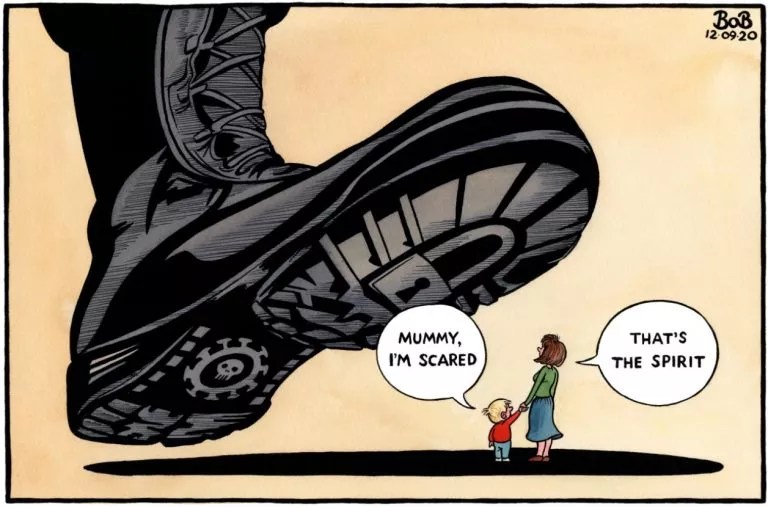
BY DR GARY SIDLEY | THE DAILY SCEPTIC | NOVEMBER 2, 2022
I belong to a privileged generation. Not that I was raised in affluence; far from it. Born in 1958, to a mother who worked all her life as a weaver in the textile industry and a father employed as a maintenance mechanic at the local factory, I lived on a council estate for the first decade of my life. Money was tight, holidays were basic and infrequent, and treats – in the form of confectionary – were rare, usually restricted to a Turkish Delight chocolate bar each Sunday evening. Although I never realised it until I was 62, I was, however, part of a cohort who possessed something sacrosanct, something so very precious and – deplorably – something future generations may never enjoy again: individual freedom.
To be clear, the world I have lived in has been far from perfect. My era has been one incorporating fundamental inequalities and injustices, widespread poverty, discrimination and – particularly in my young-adult years – a recurring risk of physical assault. But despite this context, each of us took for granted a range of basic human rights: to meet with whomever we wished; to leave our homes whenever we chose; to eat whatever we wanted; to express opinions others might not agree with; to take risks, make mistakes and learn sometimes painful lessons; to wear whatever we wanted; to work to improve our career prospects and earn more money to enhance our lives and those of our families; and to decide what drugs and other medical interventions to accept. When cheap flights emerged in the 1970s and 80s, the whole world became wonderfully accessible.
My perception (probably a naïve one) of successive Labour and Conservative Governments was that, although often inept and guilty of policy errors, they broadly sought to improve the lives of their citizens and could at least be relied upon to protect us against external malignant forces. Furthermore, it seemed that the life-spans of our elected politicians were dependent upon keeping us – their constituents – satisfied by acting primarily in the interests of U.K. citizens.
But 30 months ago, this illusion was shattered.
I knew something was awry as early as February 2020. By March the same year my early-warning detector would not rest. While the media, politicians and the science ‘experts’ informed us – incessantly – that a uniquely lethal pathogen was spreading carnage across the world, and unprecedented and draconian restrictions on our day-to-day lives were essential to prevent Armageddon, I wasn’t buying it. I formed the view that a momentous event, unparalleled in my lifetime, was unfolding, but it was not primarily about a virus.
Why, at that point in time, did I recognise that something sinister was underway while almost everyone else I met seemed to be swallowing the dominant narrative? It is a difficult question to answer. Perhaps my time in the early 1980s as a psychiatric charge nurse in an NHS hospital, occasionally interfacing with the ‘infection control’ department, gave me insight into how this professional group operate. Although well-meaning, their advice regarding how to minimise the spread of contagion on a ward often seemed impractical, revealing an apparent inability to see the bigger picture. Or maybe my in-depth knowledge of risk assessment (gleaned in my doctoral thesis during my time as a clinical psychologist) had impressed upon me how woefully inaccurate we are in gauging the relative threat levels posed by various hazards inherent in our environment. What I did know for sure was that Big Pharma – arguably the most corrupt industry in the world – would exploit the emerging ‘crisis’ for its own ends. And how right I was.
The list of state-driven human rights abuses we have endured under the pretence of ‘keeping us safe’ and the (ominous) ‘greater good’ is long: prohibition of travel; confinement in our homes; social isolation; closure of businesses; denial of access to leisure activities; de-humanising mask mandates; directives (scrawled on floors and walls) dictating which way to walk; an arbitrary ‘stay two metres apart’ rule; exclusion from the weddings and funerals of our loved ones; the seclusion and neglect of our elderly; school shutdowns; children’s playgrounds sealed off with yellow and black tape; muzzled children and toddlers; students denied both face-to-face tuition and a ‘rites-of-passage’ social life; and coerced experimental ‘vaccines’ that turned out to be more harmful and less effective than initially claimed. Equally egregious were the strategies deployed to lever compliance with these restrictions, namely psychological manipulation (‘nudging’), pervasive censorship across the media and academic journals and the cancellation and vilification of anyone brave enough to speak out against the dominant Covid narrative. All-in-all, a state-driven assault on the core of our shared humanity.
As the state-orchestrated infringement of our basic human rights continued, I felt compelled to act in ways that were far outside of my comfort zone. The 61-year-old man who had never been on a protest march until summer 2020, and who had innocently assumed that most of society’s leaders were decent people who tried to do what was right, had changed. I found myself walking with tens of thousands of others along Regent Street, London, screaming “Freedom!” I pushed “Back to Normal” leaflets through the letterboxes of hundreds of my neighbours. I stood on the corner of our local shopping street with a placard held aloft stating, “Say No To Vaccine Passports”.
Throughout 2020 and 2021, I struggled to find reasons for the irrational, masochistic Covid restrictions and the ubiquitous infringement of our basic human rights. My explanations evolved. Initially I clung to the ‘panic and incompetence’ rationale, that our governments had been spooked by the images coming out of China – remember the videos of people falling dead in the streets – and the mono-focused, blinkered and catastrophic prophecies of our so-called epidemiological experts. As the atrocities persisted, this explanation was rendered inadequate, and it morphed into an ‘opportunistic agendas’ account where activists – promoting green aspirations, digitalised IDs, social credit systems, a cashless society, universal income, a biosecurity state – had exploited the anxieties associated with the emergence of a novel respiratory virus. By 2021 these conclusions, in turn, seemed insufficient to explain the persistence of the horrors we were enduring and it – belatedly – became clear that globalist and ‘deep state’ powers were at work, striving to realise their inhuman aspirations. My further reading about the activities of World Economic Forum, the United Nations, the European Union, the World Health Organisation, the Bill & Melinda Gates Foundation, the Wellcome Trust, Anthony Fauci and Big Pharma, and others, confirmed this emerging conclusion.
As the Covid event fades from media attention (replaced by a focus on similarly dehumanising and totalitarian responses to environmental threats, the war in Ukraine and the imminent cost-of-living crisis) it is intriguing to reflect upon its residual effects.
I continue to mourn what I have lost, a process associated with a complex mix of fluctuating emotions. For two years, our Government, aided and abetted by state-funded scientists, denied us opportunities for fun and human connection, stymied our freedoms and orchestrated a systematic campaign to coerce us to both accept experimental ‘vaccines’ and to slavishly cover our faces with cloth or plastic. Consequently, I feel anger and disgust towards many of our politicians, epidemiological ‘experts’ and behavioural scientists who were complicit with this shameful period in our history. And I now distrust all sources of information, whether it be the media, the ‘scientific’ world or public health experts. Without an anchor for truth, I float – incredulous – in an ocean of mainstream-generated misinformation.
My 60-plus years of naivety have been shattered. I believe only those few who have shown selfless integrity throughout the Covid debacle. Also, I am now sceptical about much of the green agenda: state-funded scientists lied to us about Covid so why wouldn’t they show the same self-serving dishonesty about the climate?
Closer to home, it is clear my life has changed. I feel disappointment and irritation towards many people who I previously respected and liked, such as friends who colluded with the catastrophically damaging Covid restrictions because of fear, ignorance or a desire to avoid hassle and condemnation. Many relationships are now more distant. On the rare occasions we meet there is often an ‘elephant in the room’, and when the Covid issue is touched upon I typically feel frustrated that many do not want to consider the implications of what has been inflicted upon us.
I feel similarly towards mental health colleagues who, for years, I had stood alongside and respected, collectively fighting the tyranny of biological psychiatry (its human rights infringements, coercion, overuse of drugs and vilification of those who questioned them) but who failed to recognise a much bigger tyranny when it emerged in 2020. While a handful of this anti-psychiatry lobby did soon recognise the totalitarian threat inherent to the Covid response, most bought into the dominant narrative. Heated disagreements ensued with a few, followed by ongoing mutual resentment; for most we just avoid each other.
But the residual effects of the Covid debacle are not all negative. New friendships have emerged with people from across the political spectrum. Based on a mutual respect, enduring bonds have formed with fellow sceptics both locally (through the Community Assembly and the Stand in the Park initiatives) and nationally via joint endeavours in HART, Smile Free, and PANDA. And it was uplifting to recently discover – via a chance meeting in the local pub – that the family I had lived across the road from for the last seven years, yet had rarely spoken to, had always been as sceptical as me about the dominant Covid narrative.
Furthermore, I have noticed that my behaviour has changed in subtle ways. I now make more of an effort to smile and gain eye contact with – unmasked – strangers. Similarly, when greeting acquaintances, I’m more inclined to hug or shake hands as compared to pre-2020 levels of bodily contact. (Non of that fist-bump and elbow-touch nonsense for me.) It’s as if I’m striving to compensate for the human connection deficit that we’ve accrued over the last 30 months. Or perhaps I’m making a defiant metaphorical one-finger salute to any onlookers who still adhere to the risk-averse and dehumanising dominant Covid narrative?
While we continue to drown in a sea of propaganda, censorship and coercion, who knows what the future might hold?
One thing is for sure: We must never forget what the political leaders and public health specialists inflicted upon us. Whether the reason was weakness, groupthink, conflict of interest or unadulterated corruption, the miscreants must all be held to account and pay a price for terrorising the people they are meant to serve. This assertion is not fuelled by a primitive desire for retribution – well, not primarily – but by an expectation that, if the guilty are not named and shamed, the same totalitarian impositions will be repeated again and again.
The conviction sheet is a long one. It includes political leaders at home (Boris Johnson, Keir Starmer, Nicola Sturgeon, Mark Drayford) and abroad (including Justin Trudeau, Emmanuel Macron, Joe Biden and Jacinda Ardern); Bill Gates and his various funding agencies; SAGE scientists who danced to the tune of their academic and political paymasters; the behavioural science ‘nudgers’ at the helm of the worldwide psychological manipulation strategy; the professional organisations that have manifestly colluded with the state-driven tyranny (including the British Medical Association and the British Psychological Society); the conflicted drug regulators (such as the MHRA); the powerful, profit-driven pharmaceutical companies, deploying their financial clout to influence health policy decisions; and the mainstream media, who have slavishly peddled the dominant Covid narrative while dismissing alternative viewpoints.
To successfully expose the wrongdoings of such powerful individuals and institutions is a big ask. Realistically, only bottom-up resistance and protests from millions of ordinary people could achieve this aim, and in this regard there are reasons for optimism. Truth will – eventually – reveal itself. Despite the ongoing censorship and manipulation, public dissent to the attempted imposition of a biosecurity state is becoming increasingly visible. Masking in the community is – at the time of writing – practised only by an eccentric minority. The net harms of Covid restrictions are more widely recognised. Ordinary citizens increasingly claim they will not be locked down and separated from their loved ones ever again. And – perhaps more importantly – the ‘safe and effective’ vaccine narrative is crumbling, as indicated by more and more people rejecting the jabs.
If we do not wish to live in a ‘transhuman’ society devoid of personal freedoms, where our day-to-day decisions – where we go, what we say, what we eat, how we spend our money, what drugs we ingest – are determined by the state’s version of the ‘greater good’, we must all continue to show visible dissent to the globalists’ new world order.
Together, I believe we can defeat the biggest threat to Western values witnessed in my lifetime. And even if we don’t succeed, history will show that at least we tried.
Dr. Gary Sidley is a retired NHS Consultant Clinical Psychologist and co-founder of the Smile Free campaign. He blogs at Coronababble
POLITICO: How Bill Gates Took Over the Covid Pandemic
Bill Gates took over Covid just like he took over Operating Systems
By Igor Chudov | September 15, 2022
An amazing article from the least expected, mainstream source: Politico.
The title of the article was apparently edited in a hurry post-publication because Google News still lists it as “How Bill Gates and his partners took over the global Covid response”. Here’s the archive link to the original article with “Bill Gates” in the title — proving it was later edited in a hurry.
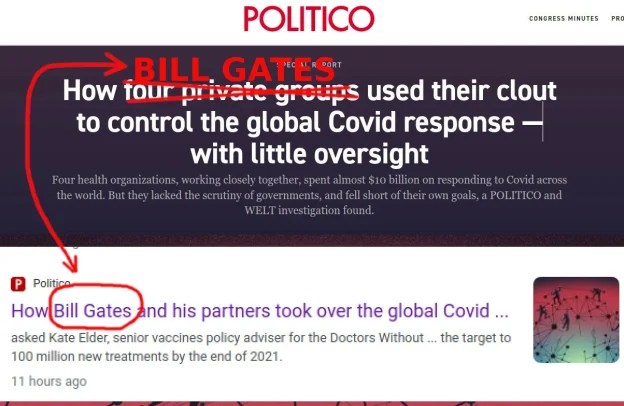
Even the article URL lists Bill Gates:
https://www.politico.com/news/2022/09/14/global-covid-pandemic-response-bill-gates-partners-00053969The article would be fascinating to read for people who were not previously aware of what most of us knew already — that the so-called “pandemic response” and global health are taken over by unaccountable private interest groups serving Bill Gates.
I highly recommend that you take a look!
The story given by the article is incomplete but very interesting.
It mentions that the pandemic response was taken over by the Bill and Melinda Gates Foundation, GAVI, CEPI, and the Wellcome Trust. All four organizations pretend to be independent, but all were financed by Bill Gates.
They participated in Event 201, planning out the pandemic, in October 2019.

“What makes Bill Gates qualified to be giving advice and advising the U.S. government on where they should be putting the tremendous resources?” asked Kate Elder, senior vaccines policy adviser for the Doctors Without Borders’ Access Campaign.
Several important items are glaringly missing from the article:
- Bill and Melinda Gates Foundation, along with the US government (Avril Haines representing the US intelligence community) and China CDC, planned out the pandemic in October of 2019 by means of an “exercise” called Event 201.
- Sars-Cov-2 is lab engineered and was designed intentionally
- As pointed out by our astute reader Mel, do not forget the 3.1 million shares of BioNTech that Gates bought in Sept 2019 for $18.10/share. That $55 million investment was worth $1.7 billion by Aug 2021.https://www.sec.gov/Archives/edgar/data/1776985/000119312519241112/d635330dex1036.htm
- Bill and Melinda Gates Foundation financed the organization that developed Sars-Cov-2 (EcoHealth Alliance) via grant INV-002838, and possibly more.
- Bill and Melinda Gates Foundation financed University of North Carolina, where Ralph Baric developed Sars-Cov-2 for EcoHealth Alliance, via 56 grants: INV-026327 INV-030330 INV-031704 INV-028991 INV-036494 INV-032887 INV-033909 INV-036560 OPP1192462 OPP1199232 OPP1201585 OPP1203327 OPP1195157 OPP1195363 OPP1191684 OPP1061107 OPP1090837 OPP1086528 OPP1108279 OPP1107923 OPP1235 OPP3436 OPP1142921 OPP38920 OPP38381 OPP23847 OPP17809 OPP1161858 OPP1158402 OPP1154943 OPP1172799 OPP1183027 OPP1181722 INV-006232 INV-001748 INV-005277 INV-016221 INV-019193 INV-016163 INV-003112 INV-001805 INV-003266 INV-002551 OPP1203712 OPP9404 OPP1014802 OPP1015539 OPP1024615 OPP1024664 OPP1015381 OPP1018000 OPP51976 OPP53107 OPP53450 OPP52037 OPP49260
- Bill Gates had close ties with Jeffrey Epstein and visited him numerous times
Nevertheless, the mere publication of this article has huge importance. The things that most of us know and talk about, are appearing in the so-called “mainstream press” — after the damage was all done, of course.
The virus was released; millions died; over a billion young people were force-vaccinated under false pretenses. When it is too late to change anything, Politico is finally stating the obvious. Still, it is better than nothing.
Almost everything in the Politico article was known a year ago. Where was Politico then? Busy taking government covid vaccine advertising money.
The pandemic was a crime, not an accident.
Bill Gates is Ready to Capitalize on ‘The Next Pandemic’
21st Century Wire | February 20, 2022
As the old says goes: “there’s no rest for the wicked.”
That’s certainly the case with vaccine mogul Bill Gates.
As the world finally gets an opportunity to take a breath easy – after being suffocated by two years of pandemic theatre and 24/7 government and corporate pharmaceutical propaganda, the notorious architect the global COVID-19 ‘vaccine’ roll-out, billionaire tech monopolist turned pharmaceutical scion, Bill Gates, is still determined to realize his life’s ambition of achieve 100% global vaccine compliance.
To keep the game going, Gates has reemerged from the shadows this week to prepare the public for “the next pandemic.”
CNBC reports…
Bill Gates said Friday that the risks of severe disease from Covid-19 have “dramatically reduced” but another pandemic is all but certain.
Speaking to CNBC’s Hadley Gamble at Germany’s annual Munich Security Conference, Gates, co-chair of the Bill & Melinda Gates Foundation, said that a potential new pandemic would likely stem from a different pathogen to that of the coronavirus family.
But he added that advances in medical technology should help the world do a better job of fighting it — if investments are made now.
“We’ll have another pandemic. It will be a different pathogen next time,” Gates said.
Initially, Gates had been actively promoting each and every ‘variant’ – constantly talking-up the crisis in order to help maintain the perception of a constant demand for the highly controversial experimental COVID-19 ‘vaccine’ gene-jabs. This includes the most recent media creation known as the “Omicron” variant. But as the public began shunning the booster shots en masse, the media gradually began the abandon the Omicron narrative. Gates has clearly read the propaganda tea leaves, and has since started backtracking from some of his previous positions – and is even admitting that natural immunity is more effective than the dubious pharmaceutical-based synthetic immunity he’s been pushing for the last two years through the media and his proxy organizations the World Health Organization (WHO) and the GAVI vaccine alliance.
Two years into the coronavirus pandemic, Gates said the worst effects have faded as huge swathes of the global population have gained some level of immunity. Its severity has also waned with the latest omicron variant.
However, Gates said that in many places that was due to virus itself, which creates a level of immunity, and has “done a better job of getting out to the world population than we have with vaccines.”
In order to further shield him from an increasing public backlash for his role in shamelessly promoting the ‘global pandemic’ and vaccine narratives, Gates has also carefully admitted the existence of comorbidities among the alleged COVID deaths.
“The chance of severe disease, which is mainly associated with being elderly and having obesity or diabetes, those risks are now dramatically reduced because of that infection exposure,” he said.
However, the vaccine kingpin is still lamenting his failure to reach 70% ‘penetration’ of the experimental mRNA toxic injections into the arms of the global population.
Gates said it was already “too late” to reach the World Health Organization’s goal to vaccinate 70% of the global population by mid-2022. Currently, 61.9% of the world population has received at least one dose of a Covid-19 vaccine.
He added that the world should move faster in the future to develop and distribute vaccines, calling on governments to invest now.
“Next time we should try and make it, instead of two years, we should make it more like six months,” Gates said, adding that standardized platforms, including messenger RNA (mRNA) technology, would make that possible.
It’s important for people to realize that Gates and his network are not finished in their plan to establish a global conveyor belt for experimental gene-based pharmaceutical injections – and he is already eyeing ‘the next pandemic’ in order to roll out the next phase of this globalist agenda. There is no shortage of funds either:
“The cost of being ready for the next pandemic is not that large. It’s not like climate change. If we’re rational, yes, the next time we’ll catch it early.”
Gates, through the Bill & Melinda Gates Foundation, has partnered with the U.K.’s Wellcome Trust to donate $300 million to the Coalition for Epidemic Preparedness Innovations, which helped form the Covax program to deliver vaccines to low- and middle-income countries.
The CEPI is aiming to raise $3.5 billion in an effort cut the time required to develop a new vaccine to just 100 days.
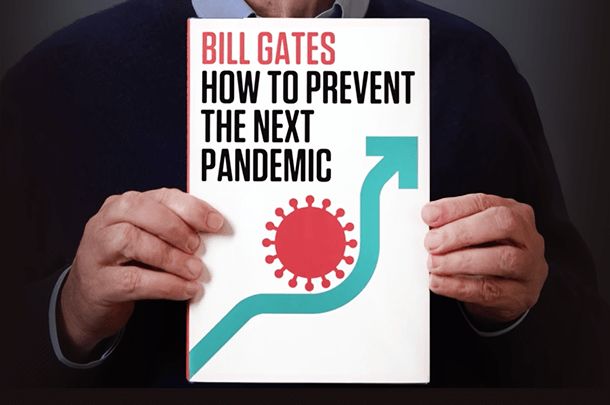
It’s no coincidence either that Gates has just begun marketing his latest manifesto entitled, How to Prevent the Next Pandemic.
“I’ve been following COVID since the early days of the outbreak, working with experts from inside and out of the Gates Foundation who are championing a more equitable response and have been fighting infectious diseases for decades. I’ve learned a lot in the process—both about this pandemic and how we stop the next one—and I want to share what I’ve heard with people. So, I started writing a book about how we can make sure that no one suffers through a pandemic ever again.”
To mark the occasion, Gates released this disturbing propaganda video – littered with many of the staged images and government tropes used to reinforce the COVID ‘global pandemic’ crisis narrative since the winter of 2020. Watch:
This Biden Proposal Could Make the US a “Digital Dictatorship”

BY WHITNEY WEBB |
UNLIMITED HANGOUT| MAY 5, 2021
Last Wednesday, President Biden was widely praised in mainstream and health-care–focused media for his call to create a “new biomedical research agency” modeled after the US military’s “high-risk, high-reward” Defense Advanced Research Projects Agency, or DARPA. As touted by the president, the agency would seek to develop “innovative” and “breakthrough” treatments for cancer, Alzheimer’s disease, and diabetes, with a call to “end cancer as we know it.”
Far from “ending cancer” in the way most Americans might envision it, the proposed agency would merge “national security” with “health security” in such as way as to use both physical and mental health “warning signs” to prevent outbreaks of disease or violence before they occur. Such a system is a recipe for a technocratic “pre-crime” organization with the potential to criminalize both mental and physical illness as well as “wrongthink.”
The Biden administration has asked Congress for $6.5 billion to fund the agency, which would be largely guided by Biden’s recently confirmed top science adviser, Eric Lander. Lander, formerly the head of the Silicon Valley–dominated Broad Institute, has been controversial for his ties to eugenicist and child sex trafficker Jeffrey Epstein and his relatively recent praise for James Watson, an overtly racist eugenicist. Despite that, Lander is set to be confirmed by the Senate and Congress and is reportedly significantly enthusiastic about the proposed new “health DARPA.”
This new agency, set to be called ARPA-H or HARPA, would be housed within the National Institutes of Health (NIH) and would raise the NIH budget to over $51 billion. Unlike other agencies at NIH, ARPA-H would differ in that the projects it funds would not be peer reviewed prior to approval; instead hand-picked program managers would make all funding decisions. Funding would also take the form of milestone-driven payments instead of the more traditional multiyear grants.
ARPA-H will likely heavily fund and promote mRNA vaccines as one of the “breakthroughs” that will cure cancer. Some of the mRNA vaccine manufacturers that have produced some of the most widely used COVID-19 vaccines, such as the Pfizer/BioNTech vaccine, stated just last month that “cancer is the next problem to tackle with mRNA tech” post-COVID. BioNTech has been developing mRNA gene therapies for cancer for years and is collaborating with the Bill & Melinda Gates Foundation to create mRNA-based treatments for tuberculosis and HIV.
Other “innovative” technologies that will be a focus of this agency are less well known to the public and arguably more concerning.
The Long Road to ARPA-H
ARPA-H is not a new and exclusive Biden administration idea; there was a previous attempt to create a “health DARPA” during the Trump administration in late 2019. Biden began to promote the idea during his presidential campaign as early as June 2019, albeit using a very different justification for the agency than what had been pitched by its advocates to Trump. In 2019, the same foundation and individuals currently backing Biden’s ARPA-H had urged then president Trump to create “HARPA,” not for the main purpose of researching treatments for cancer and Alzheimer’s, but to stop mass shootings before they happen through the monitoring of Americans for “neuropsychiatric” warning signs.
For the last few years, one man has been the driving force behind HARPA—former vice chair of General Electric and former president of NBCUniversal, Robert Wright. Through the Suzanne Wright Foundation (named for his late wife), Wright has spent years lobbying for an agency that “would develop biomedical capabilities—detection tools, treatments, medical devices, cures, etc.—for the millions of Americans who are not benefitting from the current system.” While he, like Biden, has cloaked the agency’s actual purpose by claiming it will be mainly focused on treating cancer, Wright’s 2019 proposal to his personal friend Donald Trump revealed its underlying ambitions.
As first proposed by Wright in 2019, the flagship program of HARPA would be SAFE HOME, short for Stopping Aberrant Fatal Events by Helping Overcome Mental Extremes. SAFE HOME would suck up masses of private data from “Apple Watches, Fitbits, Amazon Echo, and Google Home” and other consumer electronic devices, as well as information from health-care providers to determine if an individual might be likely to commit a crime. The data would be analyzed by artificial intelligence (AI) algorithms “for early diagnosis of neuropsychiatric violence.”
The Department of Justice’s pre-crime approach known as DEEP was activated just months before Trump left office; it was also justified as a way to “stop mass shootings before they happen.” Soon after Biden’s inauguration, the new administration began using information from social media to make pre-crime arrests as part of its approach toward combatting “domestic terror.” Given the history of Silicon Valley companies collaborating with the government on matters of warrantless surveillance, it appears that aspects of SAFE HOME may already be covertly active under Biden, only waiting for the formalization of ARPA-H/HARPA to be legitimized as public policy.
The national-security applications of Robert Wright’s HARPA are also illustrated by the man who was its lead scientific adviser—former head of DARPA’s Biological Technologies Office Geoffrey Ling. Not only is Ling the main scientific adviser of HARPA, but the original proposal by Wright would have Ling both personally design HARPA and lead it once it was established. Ling’s work at DARPA can be summarized by BTO’s stated mission, which is to work toward merging “biology, engineering, and computer science to harness the power of natural systems for national security.” BTO-favored technologies are also poised to be the mainstays of HARPA, which plans to specifically use “advancements in biotechnology, supercomputing, big data, and artificial intelligence” to accomplish its goals.
The direct DARPA connection to HARPA underscores that the agenda behind this coming agency dates back to the failed Bio-Surveillance project of DARPA’s Total Information Awareness program, which was launched after the events of September 11, 2001. TIA’s Bio-Surveillance project sought to develop the “necessary information technologies and resulting prototype capable of detecting the covert release of a biological pathogen automatically, and significantly earlier than traditional approaches,” accomplishing this “by monitoring non-traditional data sources” including “pre-diagnostic medical data” and “behavioral indicators.”
While nominally focused on “bioterrorist attacks,” TIA’s Bio-Surveillance project also sought to acquire early detection capabilities for “normal” disease outbreaks. Bio-Surveillance and related DARPA projects at the time, such as LifeLog, sought to harvest data through the mass use of some sort of wearable or handheld technology. These DARPA programs were ultimately shut down due to the controversy over claims they would be used to profile domestic dissidents and eliminate privacy for all Americans in the US.
That DARPA’s past total surveillance dragnet is coming back to life under a supposedly separate health-focused agency, and one that emulates its organizational model no less, confirms that many TIA-related programs were merely distanced from the Department of Defense when officially shut down. By separating the military from the public image of such technologies and programs, it made them more palatable to the masses, despite the military remaining heavily involved behind the scenes. As Unlimited Hangout has recently reported, major aspects of TIA were merely privatized, giving rise to companies such as Facebook and Palantir, which resulted in such DARPA projects being widely used and accepted. Now, under the guise of the proposed ARPA-H, DARPA’s original TIA would essentially be making a comeback for all intents and purposes as its own spin-off.
Silicon Valley, the Military and the Wearable “Revolution”
This most recent effort to create ARPA-H/HARPA combines well with the coordinated push of Silicon Valley companies into the field of health care, specifically Silicon Valley companies that double as contractors to US intelligence and/or the military (e.g., Microsoft, Google, and Amazon). During the COVID-19 crisis, this trend toward Silicon Valley dominance of the health-care sector has accelerated considerably due to a top-down push toward digitalization with telemedicine, remote monitoring, and the like.
One interesting example is Amazon, which launched a wearable last year that purports to not only use biometrics to monitor people’s physical health and fitness but to track their emotional state as well. The previous year, Amazon acquired the online pharmacy PillPack, and it is not hard to imagine a scenario in which data from Amazon’s Halo wellness band is used to offer treatment recommendations that are then supplied by Amazon-owned PillPack.
Companies such as Amazon, Palantir, and Google are set to be intimately involved in ARPA-H’s activities. In particular, Google, which launched numerous health-tech initiatives in 2020, is set to have a major role in this new agency due to its long-standing ties to the Obama administration when Biden was vice president and to President Biden’s top science adviser, Eric Lander.
As mentioned, Lander is poised to play a major role in ARPA-H/HARPA if and when it materializes. Before becoming the top scientist in the country, Lander was president and founding director of the Broad Institute. While advertised as a partnership between MIT and Harvard, the Broad Institute is heavily influenced by Silicon Valley, with two former Google executives on its board, a partner of Silicon Valley venture capital firm Greylock Partners, and the former CEO of IBM, as well as some of its top endowments coming from prominent tech executives.
Former Google CEO Eric Schmidt, who was intimately involved with Obama’s 2012 reelection campaign and who is close to the Democratic Party in general, chairs the Broad Institute as of this April. In March, Schmidt gave the institute $150 million to “connect biology and machine learning for understanding programs of life.” During his time on the Broad Institute board, Schmidt also chaired the National Security Commission on Artificial Intelligence, a group of mostly Silicon Valley, intelligence, and military operatives who have now charted the direction of the US government’s policies on emerging tech and AI. Schmidt was also pitched as potential head of a tech-industry task force by the Biden administration.
Earlier, in January, the Broad Institute announced that its health-research platform, Terra, which was built with Google subsidiary Verily, would partner with Microsoft. As a result, Terra now allows Google and Microsoft to access a vast trove of genomic data that is poured into the platform by academics and research institutions from around the world.
In addition, last September, Google teamed up with the Department of Defense as part of a new AI-driven “predictive health” program that also has links to the US intelligence community. While initially focused on predicting cancer cases, this initiative clearly plans to expand to predicting the onset of other diseases before symptoms appear, including COVID-19. As noted by Unlimited Hangout at the time, one of the ulterior motives for the program, from Google’s perspective, was for Google to gain access to “the largest repository of disease- and cancer-related medical data in the world,” which is held by the Defense Health Agency. Having exclusive access to this data is a huge boon for Google in its effort to develop and expand its growing suite of AI health-care products.
The military is currently being used to pilot COVID-19–related biometric wearables for “returning to work safely.” Last December, it was announced that Hill Air Force Base in Utah would make biometric wearables a mandatory part of the uniform for some squadrons. For example, the airmen of the Air Force’s 649th Munitions Squadron must now wear a smart watch made by Garmin and a smart ring made by Oura as part of their uniform.
According to the Air Force, these devices detect biometric indicators that are then analyzed for 165 different biomarkers by the Defense Threat Reduction Agency/Philips Healthcare AI algorithm that “attempts to recognize an infection or virus around 48 hours before the onset of symptoms.” The development of that algorithm began well before the COVID-19 crisis and is a recent iteration of a series of military research projects that appear to have begun under the 2007 DARPA Predicting Health and Disease (PHD) project.
While of interest to the military, these wearables are primarily intended for mass use—a big step toward the infrastructure needed for the resurrection of a bio-surveillance program to be run by the national-security state. Starting first with the military makes sense from the national-security apparatus’s perspective, as the ability to monitor biometric data, including emotions, has obvious appeal for those managing the recently expanded “insider threat” programs in the military and the Department of Homeland Security.
One indicator of the push for mass use is that the same Oura smart ring being used by the Air Force was also recently utilized by the NBA to prevent COVID-19 outbreaks among basketball players. Prior to COVID-19, it was promoted for consumer use by members of the British Royal family and Twitter CEO Jack Dorsey for improving sleep. As recently as last Monday, Oura’s CEO, Harpeet Rai, said that the entire future of wearable health tech will soon be “proactive rather than reactive” because it will focus on predicting disease based on biometric data obtained from wearables in real time.
Another wearable tied to the military that is creeping into mass use is the BioButton and its predecessor the BioSticker. Produced by the company BioIntelliSense, the sleek new BioButton is advertised as a wearable system that is “a scalable and cost-effective solution for COVID-19 symptom monitoring at school, home and work.” BioIntelliSense received $2.8 million from the Pentagon last December to develop the BioButton and BioSticker wearables for COVID-19.
BioIntelliSense, cofounded and led by former Microsoft HealthVault developer James Mault, now has its wearable sensors being rolled out for widespread use on some college campuses and at some US hospitals. In some of those instances, the company’s wearables are being used to specifically monitor the side effects of the COVID-19 vaccine as opposed to symptoms of COVID-19 itself. BioIntelliSense is currently running a study, partnered with Philips Healthcare and the University of Colorado, on the use of its wearables for early COVID-19 detection, which is entirely funded by the US military.
While the use of these wearables is currently “encouraged but optional” at these pilot locations, could there come a time when they are mandated in a workplace or by a government? It would not be unheard of, as several countries have already required foreign arrivals to be monitored through use of a wearable during a mandatory quarantine period. Saint Lucia is currently using BioButton for this purpose. Singapore, which seeks to be among the first “smart nations” in the world, has given every single one of its residents a wearable called a “TraceTogether token” for its contact-tracing program. Either the wearable token or the TraceTogether smartphone app is mandatory for all workplaces, shopping malls, hotels, schools, health-care facilities, grocery stores, and hair salons. Those without access to a smartphone are expected to use the “free” government-issued wearable token.
The Era of Digital Dictatorships Is Nearly Here
Making mandatory wearables the new normal not just for COVID-19 prevention but for monitoring health in general would institutionalize quarantining people who have no symptoms of an illness but only an opaque algorithm’s determination that vital signs indicate “abnormal” activity.
Given that no AI is 100 percent accurate and that AI is only as good as the data it is trained on, such a system would be guaranteed to make regular errors: the question is how many. One AI algorithm being used to “predict COVID-19 outbreaks” in Israel and some US states is marketed by Diagnostic Robotics; the (likely inflated) accuracy rate the company provides for its product is only 73 percent. That means, by the company’s own admission, their AI is wrong 27 percent of the time. Probably, it is even less accurate, as the 73 percent figure has never been independently verified.
Adoption of these technologies has benefitted from the COVID-19 crisis, as supporters are seizing the opportunity to accelerate their introduction. As a result, their use will soon become ubiquitous if this advancing agenda continues unimpeded.
Though this push for wearables is obvious now, signs of this agenda were visible several years ago. In 2018, for instance, insurer John Hancock announced that it would replace its life insurance offerings with “interactive policies” that involve individuals having their health monitored by commercial health wearables. Prior to that announcement, John Hancock and other insurers such as Aetna, Cigna, and UnitedHealthcare offered various rewards for policyholders who wore a fitness wearable and shared that data with their insurance company.
In another pre-COVID example, the Journal of the American Medical Association published an article in August 2019 that claimed that wearables “encourage healthy behaviors and empower individuals to participate in their health.” The authors of the article, who are affiliated with Harvard, further claimed that “incentivizing use of these devices [wearables] by integrating them in insurance policies” may be an “attractive” policy approach. The use of wearables for policyholders has since been heavily promoted by the insurance industry, both prior to and after COVID-19, and some speculate that health insurers could soon mandate their use in certain cases or as a broader policy.
These biometric “fitness” devices—such as Amazon’s Halo—can monitor more than your physical vital signs, however, as they can also monitor your emotional state. ARPA-H/HARPA’s flagship SAFE HOME program reveals that the ability to monitor thoughts and feelings is an already existing goal of those seeking to establish this new agency.
According to World Economic Forum luminary and historian Yuval Noah Harari, the transition to “digital dictatorships” will have a “big watershed” moment once governments “start monitoring and surveying what is happening inside your body and inside your brain.” He says that the mass adoption of such technology would make human beings “hackable animals,” while those who abstain from having this technology on or in their bodies would become part of a new “useless” class. Harari has also asserted that biometric wearables will someday be used by governments to target individuals who have the “wrong” emotional reactions to government leaders.
Unsurprisingly, one of Harari’s biggest fans, Facebook’s Mark Zuckerberg, has recently led his company into the development of a comprehensive biometric and “neural” wearable based on technology from a “neural interface” start-up that Facebook acquired in 2019. Per Facebook, the wearable “will integrate with AR [augmented reality], VR [virtual reality], and human neural signals” and is set to become commercially available soon. Facebook also notably owns the VR company Oculus Rift, whose founder, Palmer Luckey, now runs the US military AI contractor Anduril.
As recently reported, Facebook was shaped in its early days to be a private-sector replacement for DARPA’s controversial LifeLog program, which sought to both “humanize” AI and build profiles on domestic dissidents and terror suspects. LifeLog was also promoted by DARPA as “supporting medical research and the early detection of an emerging pandemic.”
It appears that current trends and events show that DARPA’s decades-long effort to merge “health security” and “national security” have now advanced further than ever before. This may partially be because Bill Gates, who has wielded significant influence over health policy globally in the last year, is a long-time advocate of fusing health security and national security to thwart both pandemics and “bioterrorists” before they can strike, as can be heard in his 2017 speech delivered at that year’s Munich Security Conference. That same year, Gates also publicly urged the US military to “focus more training on preparing to fight a global pandemic or bioterror attack.”
In the merging of “national security” and “health security,” any decision or mandate promulgated as a public health measure could be justified as necessary for “national security,” much in the same way that the mass abuses and war crimes that occurred during the post-9/11 “war on terror” were similarly justified by “national security” with little to no oversight. Yet, in this case, instead of only losing our civil liberties and control over our external lives, we stand to lose sovereignty over our individual bodies.
The NIH, which would house this new ARPA-H/HARPA, has spent hundreds of millions of dollars experimenting with the use of wearables since 2015, not only for detecting disease symptoms but also for monitoring individuals’ diets and illegal drug consumption. Biden played a key part in that project, known as the Precision Medicine initiative, and separately highlighted the use of wearables in cancer patients as part of the Obama administration’s related Cancer Moonshot program. The third Obama-era health-research project was the NIH’s BRAIN initiative, which was launched, among other things, to “develop tools to record, mark, and manipulate precisely defined neurons in the living brain” that are determined to be linked to an “abnormal” function or a neurological disease. These initiatives took place at a time when Eric Lander was the cochair of Obama’s Council of Advisors on Science and Technology while still leading the Broad Institute. It is hardly a coincidence that Eric Lander is now Biden’s top science adviser, elevated to a new cabinet-level position and set to guide the course of ARPA-H/HARPA.
Thus, Biden’s newly announced agency, if approved by Congress, would integrate those past Obama-era initiatives with Orwellian applications under one roof, but with even less oversight than before. It would also seek to expand and mainstream the uses of these technologies and potentially move toward developing policies that would mandate their use.
If ARPA-H/HARPA is approved by Congress and ultimately established, it will be used to resurrect dangerous and long-standing agendas of the national-security state and its Silicon Valley contractors, creating a “digital dictatorship” that threatens human freedom, human society, and potentially the very definition of what it means to be human.
The Maxwells: Mossad’s First Family of Spies
Who was running whom in the Epstein espionage ring?

By Philip Giraldi • Unz Review • December 8, 2020
The story of the deceased pedophile and presumed Israeli spy Jeffrey Epstein continues to enthrall because so little of the truth regarding it has been revealed in spite of claims by the government that a thorough follow-up investigation has been initiated. The case is reportedly still open and it is to be presumed that Justice Department investigators have been able to examine certain aspects of what occurred more intensively. A major part of the investigation has been a review of actions taken by the four government prosecutors who were most directly involved with the negotiations with Epstein and his lawyers in 2007-8. The 22 month-long review, carried out by the Justice Department’s Office of Professional Responsibility (OPR), finally produced a 350 page report which was released on November 12th.
The DOJ has now picked out a scapegoat for what many now think was gross prosecutorial negligence, possibly including corruption of senior government officials. He is not surprisingly Alexander Acosta, who was the U.S. Attorney for Miami when the Epstein case came up. Relying substantially on internal government emails as well as communications between the prosecutors and Epstein’s team of high-profile lawyers to reach its conclusion, the OPR review concluded that Acosta exhibited “poor judgment” in his handling of the Epstein deal. He did not inform the victims or their attorneys of developments in the case, as required by law, and overruled the lead prosecutor and FBI agents who argued that Epstein should face serious jail time. He even cut a deal with Epstein before the investigation into his crimes was completed. The OPR investigators also determined that many emails that would have materially aided the plaintiffs were not made available to their attorneys, a shortcoming that the report attributed to a “technological error.”
The email gap covers the time span from May 2007, when the prosecutor’s office prepared a 53-page draft indictment of Epstein, to April 2008, shortly before Epstein’s guilty plea and slap-on-the-wrist sentence in state court ended the federal investigation. Epstein’s defense attorneys had during that time period been engaged in an aggressive lobbying campaign to persuade the federal prosecutors to rescind the indictment and shut down the federal case. Epstein’s “sweetheart deal” with the federal government negated a possible conviction of serious crimes against 19 alleged victims, most of whom were minors. Instead of a possible sentence of between 14 and 17 years in federal prison, Epstein was encouraged by federal prosecutors to plead guilty to two prostitution-related crimes in state court to resolve the case. He served 13 months of an 18-month sentence in a county jail on a liberal work release program, often sleeping in his own home, and the federal case was duly closed.
It is, of course, noticeable that neither Acosta, who has possibly now retired from public life, nor anyone else will be punished for what was clearly a gross miscarriage of justice. That is the way the government works these days. But there is also a much bigger problem with the report, which is that it essentially failed to follow up on an argument that Acosta made when the bungling of the Epstein case began to surface in the media last year.
There has, in fact, been a cover-up of a major element in the Epstein saga, namely his possible connection with Israel’s intelligence agency Mossad. Investigative reporter Whitney Webb has recently completed an exhaustive review of what we know about Epstein’s partner in crime, lover and accomplice Ghislaine Maxell, to include some consideration of the possible involvement of her sisters Isabel and Christine in activity initially directed by their father, known Mossad agent Robert Maxwell.
The evidence that Epstein was directly involved in intelligence work to include bribing or blackmailing prominent individuals to act on behalf of Israel, derives both from the statement made by Acosta in 2017 that “I was told Epstein ‘belonged to intelligence’ and to leave it alone,” a comment that the Justice Department and FBI have apparently never sought to investigate further. It also derives from other external evidence. Epstein was found to be making videos of his guests having sex with his young girls, which is a version of a classic intelligence entrapment technique employed by every major spy agency worldwide and in his Manhattan mansion he had a large supply of diamonds, cash and an Austrian passport on hand if he should have to make a quick escape.
That Epstein would be linked to Israel rather than to some other intelligence service is inevitably due to his relationship with Robert Maxwell, which eventually included his daughter Ghislaine. Robert, a Czech Jew who became a naturalized British citizen, was believed by C.I.A. and other intelligence services to be a long-time agent of Mossad. After he died under mysterious circumstances, he was given a state funeral in Israel that was attended by every current and former head of the Jewish state’s intelligence service as well as by the country’s prime minister Yitzhak Shamir who eulogized: “He has done more for Israel than can today be said.” Ghislaine reportedly became the principal procurer of Epstein’s young girl victims.
Also corroborating the tale of espionage even if it appears to be of no interest to the FBI and Justice Department, is a book Epstein: Dead Men Tell No Tales written by a former Israeli intelligence officer who actually ran the “Robert Maxwell” operation, describing inter alia how Epstein and Maxwell were blackmailing prominent politicians on behalf of Mossad. According to Ari Ben-Menashe, the two had been working directly for the Israeli government since the 1980’s and their operation, which was funded by Mossad and also by prominent American Jews, was a classic “honey-trap” which used underage girls as bait to attract well-known politicians from around the world, a list that included Prince Andrew and Bill Clinton. The politicians would be photographed and video recorded when they were in bed with the girls.
But in spite of the evidence, the role of Ghislaine, currently in custody in a maximum-security Brooklyn prison, is less well known and is possibly being deliberately concealed by the Trump Administration, which is prone to do favors for Israel. Even less known are the possible roles of her two sisters. Webb details how Maxwell and his Israeli Mossad handlers compromised the top-secret information system then in use by the U.S. government. She observes that “While Ghislaine’s own ties to intelligence have… come to light in relation to her critical role in facilitating the Jeffrey Epstein sexual blackmail operation,… little, if any attention, has been paid to her siblings, particularly Christine and her twin sister Isabel, despite them having held senior roles at the Israeli intelligence front company that facilitated their father’s greatest act of espionage on Israel’s behalf, the sale of the bugged PROMIS software to the U.S. national laboratories at the heart of the country’s nuclear weapons system… Ghislaine herself also became involved in these [blackmail] affairs, as did Jeffrey Epstein following his first arrest, as they began courting the biggest names in the U.S. tech scene, from Silicon Valley’s most powerful venture capital firms to its most well-known titans. This also dovetailed with Epstein’s investments in Israeli intelligence-linked tech firms and his claims of having troves of blackmail on prominent tech company CEOs during this same period.”
Upon Robert Maxwell’s mysterious death in 1991, his sons Kevin and Ian took control of many of the interlocking companies that their father had used both to conceal assets and to obtain access and information while Ghislaine remained in the New York area and two other daughters Isabel and Christine opted to exploit the internet as an intelligence resource to build upon their father’s “legacy.”
Isabel, in particular, moved aggressively and eventually became recognized as the self-styled liaison between Israel’s government and Silicon Valley. Whitney Webb recounts in considerable detail how she “mov[ed] in ‘the same circles as her father’ and vow[ed] to ‘work only on things involving Israel’ … [to become] a pivotal liaison for the entry of Israeli intelligence-linked tech firms into Silicon Valley with the help of Microsoft’s two co-founders, Paul Allen and Bill Gates.”
One has to suspect that a tale of Mossad running a major spy ring in the U.S. using a pedophile and young girls might just be too much for some folks in power to tolerate and they have made sure that the true story will never see the light of day. But the tale of how the prominent ostensibly British Maxwell family, acting for Mossad, may have systematically spied on the United States over a number of years, often pretty much out in the open, and the FBI and Justice Department saw fit to look the other way, is bigger still. That is the real story. Israel yet again spies and Washington denies.
Philip M. Giraldi, Ph.D., is Executive Director of the Council for the National Interest, a 501(c)3 tax deductible educational foundation (Federal ID Number #52-1739023) that seeks a more interests-based U.S. foreign policy in the Middle East. Website is https://councilforthenationalinterest.org address is P.O. Box 2157, Purcellville VA 20134 and its email is inform@cnionline.org
Star ‘disinformation’ reporter brags about doxxing Trump supporters & NBC defends it as journalism
RT | October 22, 2020
An NBC reporter has bragged about doxxing Trump supporters, “anti-vaxxers,” and other societal rejects, one self-described victim has revealed, suggesting the aim is to turn the US’ national security apparatus against her targets.
Brandy Zadrozny, an NBC feature reporter who specializes in ‘disinformation’ and ‘extremism’ on the internet, is teaching the world how she digs up data on her targets – from phone numbers and home addresses to property records and even Amazon wishlists – to expose their real-life identities. She recently shared her doxxing methods in an online textbook hosted by DataJournalism.com.
But while this might sound like standard journalism practice, Zadrozny’s targets – who have recently included anonymous Trump supporters on Twitter – are private citizens who have committed no crimes, and exposing their real-life identities for allegedly posting “disinformation” is a not-so-subtle effort to turn them into enemies of the state, one such recent target, Revolver News reporter Darren Beattie, told Fox News’ Tucker Carlson on Wednesday.
“She uses state-of-the art-proprietary technical tools to dig up personal information about anonymous Trump supporters online,” Beattie told the Fox News host. “She’ll do anything she can to unearth anonymous Trump supporters – basically so she can ruin their lives.”
Beattie revealed that Zadrozny’s “doxxing handbook” is sponsored in part by Bellingcat, the notoriously partisan ‘open-source intelligence’ outfit that, in turn, is backed by the US’ National Endowment for Democracy. It’s also funded by Google, a military contractor in its own right, and the European Journalism Centre, which counts such oligarchic bogeymen as George Soros and Bill Gates among its financial backers. So much muscle behind the doyenne of doxxing would be enough to give anyone who’s ever tweeted “wrongthink” pause, especially when her how-to guide describes how she has “identified people by connecting photos of things like cars, homes, or pets” in addition to profile photos.
Calling the institutionally sanctioned outing “disgusting and disgraceful, even by modern journalism standards,” Beattie described the work of Zadrozny and her ilk as that of “a neo-Stasi” attempting to “crush the rebellion of the American people against their corrupt ruling class,” suggesting her repeated description of anonymous conservatives’ social media posts as “disinformation” was meant to bring down the force of the national security state “to silence Trump supporters domestically.”
The former White House staffer shared screenshots from the textbook on Twitter, revealing the extensive lengths to which Zadrozny went to “out” the Columbia Bugle, which she refers to as a “popular far-right anonymous Twitter account that boasts that it was retweeted twice by Donald Trump’s account.”
Such dogged detective work is one thing when an investigator is hunting a criminal, but quite another when the quarry’s only “crime” is posting political material on social media. And Zadrozny’s targets have been subjected to death threats and suffered real-world harm because of her work.
While Beattie and Carlson both called on NBC to denounce Zadrozny’s abusive tactics, the network responded by defending its employee, calling her an “incredible and meticulous reporter” whom they were “proud to call … our colleague.” Other colleagues stepped up to defend her and attack her accusers, painting the Fox News segment as a preemptive strike against an article Zadrozny was working on about Beattie’s site.
Trained by oligarch-funded journalism outfit the Poynter Institute, Zadrozny shot to journalistic stardom in the past few years, making her name hyping Russiagate, denouncing pedophile hunters, and shutting down Facebook communities in which parents of autistic children swap tips about healing what they believe are vaccine injuries. The unifying thread running through her work, other than a fanatical devotion to pro-establishment narratives, has been reliance on social media deep-dives to learn more about her subjects without having to actually, well, interview them.
Isabel Maxwell: Israel’s “Back Door” Into Silicon Valley
This is Part II of the series “The Maxwell Family Business: Espionage” and focuses on Isabel Maxwell. Part I can be found here.
By Whitney Webb | The Last American Vagabond | July 25, 2020
By moving in “the same circles as her father” and vowing to “work only on things involving Israel,” Isabel Maxwell became a pivotal liaison for the entry of Israeli intelligence-linked tech firms into Silicon Valley with the help of Microsoft’s two co-founders, Paul Allen and Bill Gates.
In 1992, Israel’s government created the Yozma Program at the urging of Chief Scientist of Israel’s Ministry of Industry and Trade – Yigal Erlich – as Erlich moved to leave that position. The Yozma Program aimed to “incentivize venture investment” by creating state-linked venture capital funds, which later spawned a myriad of Israeli hi-tech start ups with merging them with major, foreign technology companies. According to Erlich’s website, he had lobbied Israel’s government to launch Yozma because he had “identified a market failure and a huge need in Israel to establish for the first time a professionally-managed venture capital industry that will fund the exponential growth of high tech ventures coming out of Israel.” He then “convinced the Israeli government to allocate $100 million for his venture capital vision.”
Erlich’s vision would also result in the fusion of Israel’s hi-tech sector, which he helped to create, with Israel’s intelligence apparatus, with numerous Israeli hi-tech conglomerates created with funding from the Yozma program and its successors doubling as tools of Israeli espionage. Notably, not long before Erlich convinced Israel to place $100 million into this program, Israeli intelligence, thanks largely to the work of infamous spymaster Rafi Eitan, had learned the benefits of placing backdoors for their intelligence services into commercial software through the theft and subversion of the PROMIS software. As noted in Part I of this series, Israel’s bugged version of PROMIS was largely marketed by Robert Maxwell.
After the Yozma program was established, the first venture capital fund it created was called Gemini Israel Ventures and Israel’s government chose a man named Ed Mlavksy to lead it. Mlavksy, at the time, was the Executive Director of the Israel-U.S. Bi-national Industrial Research and Development Foundation (BIRD), where Erlich was Chairman of the Executive Committee. Mlavsky states that, while heading the BIRD foundation, “he was responsible for investments of $100 million in more than 300 joint projects between U.S. and Israeli high-tech companies.” BIRD’s connections to Gemini Israel Ventures and the Yozma Program in general are interesting, given that – just a few years prior – it had come under scrutiny for its role in the one of the worst spy cases in U.S. history – the Jonathan Pollard affair.
Jonathan Pollard had been a naval intelligence analyst turned Israeli spy who passed troves of documents regarding U.S. military technology (specifically nuclear technology) as well as clandestine U.S. intelligence operations to Israeli intelligence, specifically to the now defunct spy agency Lekem. Pollard’s handler was none other than Rafi Eitan, who had engineered Israel’s outsized role in the PROMIS software scandal. In the indictment of Pollard for espionage, it was noted that Pollard delivered documents to agents of Israel at two locations, one of which was an apartment owned by Harold Katz, the then-legal counsel to the BIRD foundation and an adviser to Israel’s military, which oversaw Lekem. Government officials told the New York Times at the time that they believed Katz “has detailed knowledge about the [Pollard] spy ring and could implicate senior Israeli officials.”
Journalist Claudia Wright, writing in 1987, openly speculated about whether the close ties between Katz and Pollard’s handlers meant that BIRD itself had been used to pass funds to Pollard or that BIRD funds themselves, most of which were provided by U.S. taxpayers as opposed to public claims of “joint” funding, had been used to pay Pollard for his “services” to Israel. In her article, she notes that Mlavsky had considerable discretion over the use of those funds while the U.S. official in charge of overseeing the U.S.’ interests in BIRD did “not know how investment is regulated” by the foundation. In addition, no U.S. official had access to any audit of the foundation, which were said to be conducted by an Israel-based accounting firm with no U.S. offices. The New York Times noted at the time that Katz specifically “may have knowledge of the method used to pay Mr. Pollard, who received tens of thousands of dollars from his Israeli handlers.”
After BIRD’s Mlavsky was chosen to head Gemini Israel Ventures, one of the first companies the firm invested in was called CommTouch (now known as Cyren and majority owned by Warburg-Pincus). Founded in 1991 by Gideon Mantel, a former officer in a “special bomb-squad unit” for the Israel Defense Forces (IDF), alongside Amir Lev and Nahum Sharfman, CommTouch was initially focused “on selling, maintaining and servicing stand-alone email client software products for mainframe and personal computers.” They specifically courted Original Equipment Manufacturers (OEMs), meaning companies whose products are used as components in the products of another company that are then sold to end users. Integration of its products into those of major software and hardware developers would allow CommTouch’s products to be widely used but unseen. A Wired article discussing CommTouch noted as much, stating that CommTouch products are meant “to be as seamless and unnoticeable as the copper is to a phone caller.”
However, from their founding through early 1997, CommTouch struggled to stay afloat, unable to turn a profit and unable to secure any notable deals or to expand its company beyond 25 employees. Yet, thanks to Gemini Israel Ventures and “grants” from Israel’s government, which were used to finance the research and development of its products, CommTouch managed to stay afloat. As late as 2006, CommTouch noted in official documents that the company “has a history of losses and may never achieve profitability,” further noting that they hemorrhaged millions of dollars a year in net losses. Clearly, the decision by Gemini Israel Ventures and Israel’s government to continue to pour money into a decidedly unprofitable company for several years was motivated by something other than profits.
At some point in early 1997, CommTouch decided to enter the U.S. market and began seeking out a new President for the firm who had “local clout.” “We knew exactly what we were looking for,” Gideon Mantel later told Wired ofCommTouch’s search, “Someone who knows her way around the Valley.” They found their woman in the daughter of Israeli “superspy” and PROMIS salesman par excellence, Isabel Maxwell.
An Intriguing Pedigree
Mantel and CommTouch allegedly chose to court Isabel Maxwell for their company’s presidency through an unspecified placement company and were “attracted to her expertise and insight in Silicon Valley when it sought her out.” The Israeli outlet Globes states that Gideon Mantel “went to Isabel Maxwell as soon as he arrived in Silicon Valley and realized that in order to progress, an e-mail solutions company like CommTouch needed help from someone who knew the rules of the game.” Wired offers a similar portrayal, further adding that it was “Gideon Mantel [who] got Isabel Maxwell to take the job.”
Mantel told Jewish Weekly that while Maxwell’s pedigree, i.e. being Robert Maxwell’s daughter, “was very intriguing at the beginning… it wasn’t her name that made the decision for us.” However, Mantel, in separate reports, compares Isabel to her father on numerous occasions when praising her professional abilities. For example, he told Haaretz that Isabel “is not cowed by anyone, and she never gives in…. She got all that at home. They taught her to go after things and not give up.” Similarly, he told Wired that “Like her father, she is a fighter,” later adding that “She always charges. She has no fear. Of course, it is from her father. It is in her blood.” Given that Robert Maxwell is rarely posthumously remembered (in media anyway) as “a fighter” and “fearless,” it goes without saying that Mantel views him with a degree of reverence that he also associates with his daughter Isabel.
Isabel, notably, has herself stated on several occasions that her acceptance of Mantel’s offer to be CommTouch’s President was also informed by her father’s controversial ties to Israel.
She told Haaretz that her reasons for accepting the CommTouch presidency was “from the heart” because it was “a chance to continue her father’s involvement in Israel,” leading her to reject other more lucrative job offers from actually established companies that she had received at the time. She similarly described her reasons for joining CommTouch to Jewish Weekly as “an affair of the heart,” adding that “it had to do with my father and my history.” The New York Times quoted her as saying that she had “considered other California-based Internet start-ups [in 1997], but felt a pull toward CommTouch and the Israeli connection.”
Isabel has some interesting views on her father, whom she describes as the “ultimate survivor,” and his involvement in Israel. She describes him as “highly complex,” adding that she doesn’t “have rose-coloured glasses about him,” but nonetheless says she is “proud” of his controversial legacy and that “if he were alive today that he would be proud of us too.” She said something similar to The Guardian in 2002, stating that “‘I’m sure [my father would] be thrilled to know what I’m doing now,’…. throwing back her head and laughing loudly.” In addition, when asked who the most influential person in her life had been, Isabel responded “My father was most influential in my life. He was a very accomplished man and achieved many of his goals during his life. I learned very much from him and have made many of his ways my own.”
Isabel told Haaretz around that same time that “When I was with him [her father], I felt power. Like being at the White House… Beyond that, it was a collective power, not my personal power. I was part of this unit,” apparently referring to her other siblings, Ghislaine and Christine among them, and suggesting that they were collectively extensions of their father’s power.
However, Isabel stands out from her other siblings, and even Ghislaine, in terms of a sense of loyalty to her father and to the state of Israel. According to Elizabeth Maxwell, Isabel’s mother, Isabel “is also loyal to the memory of her father, and to what Judaism represents in her life. All my children were brought up as Anglicans, but Isabel was very taken by the Jewish faith and the politics in Israel” compared to her other children, including Ghislaine.
Indeed, Isabel has close relationships to several prominent former Mossad officials and Israeli heads of state, with several of those relationships having been “forged by her father.” A now scrubbed report published by the Jerusalem Post in 2003, entitled “Isabel Maxwell Fights Back,” notes that “Maxwell travels in the same circles as her father, but she is more comfortable behind the camera, not in front of it…she is carrying on her father’s legacy in Israel, albeit in her own way.” It also noted that, by 2003, Isabel was visiting Israel every month, visiting her father’s grave on the Mount of Olives at least once every visit.
Arguably the most interesting part of the now-scrubbed Jerusalem Post article is the way in which Isabel views her father’s legacy. In discussing the book by Gordon Thomas and Martin Dillon, Robert Maxwell, Israel’s Superspy: The Life and Death of a Media Mogul, Isabel – even though she participated in interviews for the book – rejected its premise that her father was a “spy”and went on a private smear campaign against the book and its authors prior to its publication.
Tellingly, she does not object to the book’s contents regarding her father’s activities on Israel’s behalf, including his role in the PROMIS software scandal or Iran-Contra, but merely objects to the use of the word “spy” to describe those activities. “My father was certainly a ‘patriot’ and helped in back business and political channels between governments,” Isabel told the Jerusalem Post, “But that did not and does not make him a ‘spy.’” It could be said, then, that Isabel would view her subsequent career “in back business and political channels” via the “same circles as her father” as similarly “patriotic.” Yet, for those that consider her father a “spy” for his activities, that would also mean extending the same to Isabel, who self-identifies as Israeli.
Aside from her father’s own ties to Israeli intelligence, it is worth noting that Isabel’s own history – up to the point she joined CommTouch – involved her working for the Israeli intelligence front company used by her father to sell bugged PROMIS software in the U.S., Information on Demand, and subsequently the search engine Magellan, of which she shared ownership with her sister Christine (whose ties to U.S. intelligence will be explored in Part IV) and her sister Ghislaine, a sexual blackmailer and sex trafficker operating on behalf of U.S. and Israeli intelligence. Isabel’s past with both Magellan and Information on Demand were clearly known to CommTouch at the time of Isabel’s hiring. It also worth noting that, on several occasions, Isabel credits CommTouch’s success with the ties of all of its Israeli employees to the Israeli military and military intelligence, resulting in – per Isabel – a “dogged work ethic” and a “trained mind-set” among its Israeli workforce.
As will be shown in more detail in Part III of this series, upon departing CommTouch, Isabel deepened her already close ties to prominent Israeli politicians and intelligence officials, serving alongside ex-Mossad directors and counting former Israeli chief intelligence officers and heads of state among her “family friends” and business partners. This involvement continued during the period when her son was given a prominent position at the Middle East affairs desk at the State Department when it was headed by Hillary Clinton, who – as many are now aware – has close and controversial ties to Isabel’s sister, Ghislaine.
Microsoft’s Co-founders put CommTouch “On the Map”
Upon taking the job at the Israeli tech firm, Maxwell’s promotion of the company was called “almost messianic” even though her enthusiasm was described as “hard to fathom” given the lackluster performance of the company and its products. However, soon after becoming CommTouch’s president, her personal connections to prominent figures in Silicon Valley – forged through her past work at Magellan – paid off and the company announced new partnerships with Sun Microsystems, Cisco, and Nippon Telephone and Telegraph, among others. At CommTouch, Maxwell managed“all sales and marketing activities for CommTouch and co-direct[ed] strategic business development.”
Some reports have noted that Maxwell’s connections with prominent Silicon Valley figures were the key to her professional success, with Globes noting that “Everyone who has worked closely with Maxwell says that her advantage lies in her ability to help penetrate the market with a new product by opening the right doors,” an “advantage” also ascribed to her father while he sold bugged PROMIS software on behalf of Israeli intelligence. Yet, despite Isabel’s penchant for “opening the right doors,” reports well into Maxwell’s career at CommTouch still referred to the firm as “an obscure software developer.”
However, out of all the alliances and partnerships Isabel negotiated early on during her time at CommTouch, it was her dealings with Microsoft co-founders Bill Gates and Paul Allen that would put CommTouch “on the map.” Maxwell had previously negotiated a major deal with Microsoft’s Bill Gates earlier during her time as the McKinley Group/Magellan’s Executive Vice President, resulting in Microsoft announcing that the Maxwell-owned Magellan would power the search option for the company’s MSN service.
Yet, it appears that Microsoft’s co-founders did much more than put CommTouch “on the map,” but ended up preventing the collapse of its initial public offering, a fate that had befallen Isabel Maxwell’s previous company, the McKinely Group, not long before. Indeed, CommTouch kept pushing back its IPO until a massive investment from firms tied to Microsoft co-founder Paul Allen was announced in July 1999.
The investment from Allen’s Vulcan Ventures Inc. and Go2Net Inc resulted in a jump in “interest in the stock sale and in CommTouch, until now an obscure software developer,” according to a Bloomberg report, and also inflated their stock price immediately prior to their going public. The money from Allen-linked investment would be specifically used “to expand sales and marketing and build its presence in international markets.” Allen’s decision to invest in the company seems odd from a financial perspective, given that CommTouch had never turned a profit and had netted over $4 million in losses just the year before. Yet, thanks to Allen’s timely investment and apparent coordination with the company’s repeated delays of its IPO, CommTouch was valued at over $230 million when it went public, as opposed to a $150 million valuation just weeks prior to Allen’s investment.

Bill Gates at Deal Book Conference in New York, 2019
It’s not exactly clear why Paul Allen came to the rescue of CommTouch’s IPO and what he expected to gain from his investment. However, it is worth pointing out that Allen was among the members of an exclusive online community of elites set up in 2004 called “Small World,” whose membership also included Jeffrey Epstein and Epstein-linked figures like Lynn Forester de Rothschild and Naomi Campbell, as well as Petrina Khashoggi, the daughter of Adnan Khashoggi, a former client of Epstein’s. Small World’s largest shareholder was Harvey Weinstein, the now-disgraced media mogul who was a business partner of Epstein and was since accused by a number of women of sexual abuse.
Less than three months after Allen’s investments in CommTouch in October 1999, the company announced that it had struck a major deal with Microsoft whereby “Microsoft will utilize the CommTouch Custom MailTM service to provide private label web-based email solutions for select MSN partners and international markets.” In addition, per the agreement, “CommTouch will provide MSN Messenger Service and Microsoft Passport to its customers while building upon its Windows NT expertise by supporting future MSN messaging technologies.”
The agreement came less than two years after Microsoft had purchased Hotmail, which – up until the CommTouch/Microsoft agreement – had been one of CommTouch’s main competitors for its web-based e-mail services. In other words, this meant that Microsoft would use CommTouch’s “behind the scenes” software as the backbone of its web-based e-mail services, Hotmail included. “We are looking forward to further enhancing our relationship with Microsoft by integrating other state-of-the-art Microsoft products,” Gideon Mantel of CommTouch said upon the deal’s public announcement.
In December 1999, Microsoft then announced that it had invested $20 million in the company by purchasing 4.7% of CommTouch stock. The announcement pushed CommTouch stock prices from $11.63 a share to $49.13 in just a few hours time. Part of that deal had been finalized by Richard Sorkin, a recently appointed CommTouch director. Sorkin had just become a multimillionaire following the sale of Zip2, Elon Musk’s first company where Sorkin had been CEO.
It further appears that Bill Gates, then head of Microsoft, made a personal investment in CommTouch at the behest of Isabel Maxwell. In an October 2000 article published in The Guardian, Isabel “jokes about persuading Bill Gates to make a personal investment” in CommTouch sometime during this time frame.
The article then oddly notes the following regarding Isabel Maxwell and Bill Gates:
“In a faux southern belle accent, [Isabel] purrs: ‘He’s got to spend $375m a year to keep his tax free status, why not allow me to help him.’ She explodes with laughter.”
Given that individuals as wealthy as Gates cannot have “tax free status” and that this article was published soon after the creation of the Bill and Melinda Gates Foundation, Isabel’s statements suggest that it was the Bill and Melinda Gates Foundation Trust, which manages the foundation’s endowment assets, that had made this sizable investment in CommTouch. Furthermore, it is worth highlighting the odd way in which Isabel describes her dealings with Gates, speaking of her interactions with him in a way not found in any of Isabel’s numerous other interviews on a wide variety of topics (i.e. “purring”, speaking in a fake Southern accent). This odd behavior may have been related to Isabel’s previous interactions with Gates and/or the mysterious relationship between Gates and Epstein, alluded to in a 2001 Evening Standard article, and eyewitness testimony regarding Epstein’s and Ghislaine Maxwell’s comments about Bill Gates in 1995, discussed in Part I of this series.
After 2000, CommTouch’s business and clout expanded rapidly, with Maxwell subsequently crediting Bill Gates-led Microsoft and Paul Allen’s investment for the company’s shifting fortunes. Maxwell, as quoted in the 2002 book Fast Alliances, states that Microsoft viewed CommTouch as a key “distribution network,” adding that “Microsoft’s investment in us put us on the map. It gave us instant credibility, validated our technology and service in the marketplace.” By this time, Microsoft’s ties to CommTouch had deepened with new partnerships, including CommTouch’s hosting of Microsoft Exchange.
Though Isabel was able to secure lucrative investments and alliances for CommTouch and see its products integrated into key software and hardware components produced and sold by Microsoft and other tech giants, she was unable to turn the tide of the company’s dire financial performance, with CommTouch netting a loss of $4.4 million in 1998 and similar losses well into the 2000s, with net losses totalling $24 million in the year 2000 (just one year after the sizable investments from Microsoft, Paul Allen and Bill Gates). The losses continued even after Isabel formally left the company and became President Emeritus in 2001. By 2006, the company was over $170 million in debt.
The One-Woman Liaison Between Israel and Silicon Valley
Isabel Maxwell would leave her role at CommTouch in 2001, but remained President Emeritus for years afterward retaining a sizable amount of CommTouch stock then-valued at around $9.5 million. While Maxwell remained honorary president, CommTouch added Yair Shamir, son of former Israeli Prime Minister and friend of Robert Maxwell, Yitzhak Shamir, to its board. Yair Shamir, Chairman of the Israeli government owned corporation, IAI (Israeli Aerospace Industries) when he joined CommTouch’s board, had previously managed Scitex when it was owned by Robert Maxwell. After nearly collapsing due to its long-standing debt burden a few years later, CommTouch was rebranded as Cyren and, today, runs in the background of Microsoft, Google, Intel, McAfee and Dell products, among many others.
Haaretz wrote in 2002 that Isabel, as CommTouch was in dire financial straits, had decided to “work only on things involving Israel. Even the failure of CommTouch, the Israeli Internet company she headed, hasn’t deterred her: She still believes in the medium, and she still believes in Israel.” Maxwell would subsequently create “a unique niche for herself in high tech as a liaison between Israeli companies in the initial development stages and private angel investors in the US” as a private consultant, subsequently creating Maxwell Communications Network in 2006. That company offered “cross-border communications, funding and market research to leading venture capitalists and hi-tech companies in the US and Israel.” However, she notes that her “specialty” was in “helping Israeli high-tech companies.”
During this period (2001-2006), Isabel would also head an Israeli tech company that “protects children online,” at a time when her sister – Ghislaine Maxwell – was actively abusing and trafficking children as part of an intelligence-linked operation alongside Jeffrey Epstein. Isabel took the job at iCognito (now Pure Sight) “because it [the company] is in Israel, and because of its technology.” She also joined the board of the Israeli company Backweb alongside Gil Shwed, a famous alumnus of Unit 8200 (often likened to Israel’s NSA equivalent) and co-founder of Israeli tech giant Check Point, which is a long-time partner of CommTouch.
Isabel’s close involvement with former Israeli heads of state and heads of intelligence would only deepen after leaving CommTouch, particularly with former Israeli Prime Minister Shimon Peres. The Jerusalem Post described the Peres-Isabel relationship as “close” and “forged by her father.” Isabel was also in close contact with former Mossad deputy director David Kimche (until his death in 2010) and former head of Israeli military intelligence and Prime Minister Ehud Barak. Notably, Ehud Barak, in addition in being a major player in the Israeli-U.S. hi-tech scene, was also closely associated with Jeffrey Epstein and Isabel’s sister Ghisaline, having recruited Epstein for Israeli military intelligence and overseeing the Lekem agency at the time of the PROMIS scandal (including Robert Maxwell’s role) and the Pollard Affair as well as Israel’s involvement Iran-Contra. Barak was also a frequent visitor to Epstein’s island and slept over in New York apartments that were owned by Epstein’s brother and which housed many of Epstein’s underage “sex slaves.”
Also notable is the fact that Ghislaine Maxwell and Jeffrey Epstein would themselves become involved in Isabel’s world, i.e. the growing nexus between Silicon Valley and Israel, courting and allegedly blackmailing major Silicon Valley executives while also investing in Israeli intelligence-connected start-ups. During this time, Isabel was a major player in venture capital networks and other organizations aiming to further develop ties between Israeli intelligence-linked start-ups and U.S. tech companies, which is now part of an openly admitted Israeli intelligence operation (in which Microsoft plays a major role). The ties of Isabel, Ghislaine and Epstein to this hi-tech world of Israeli espionage, as well as Isabel having inspired what would later become Ghislaine’s TerraMar project and her ties to powerful groups like the World Economic Forum and even the Hillary Clinton-led State Department, will be explored in the next installment of this series.
Whitney Webb has been a professional writer, researcher and journalist since 2016. She has written for several websites and, from 2017 to 2020, was a staff writer and senior investigative reporter for Mint Press News. She currently writes for The Last American Vagabond.
The Maxwell Family Business: Espionage

July 15, 2020
Many were surprised to learn earlier this month that the key co-conspirator in Jeffrey Epstein’s intelligence-linked sexual blackmail operation, Ghislaine Maxwell, had been in hiding in New England since Epstein’s arrest and subsequent “suicide” last summer. Her recent arrest, of course, has returned attention to the Epstein scandal and to Ghislaine’s ties to the entire operation, in which she played a central and crucial role, arguably more so than Epstein himself.
Ghislaine was first reported to be living in New England at the mansion of her alleged boyfriend Scott Borgeson on August 14th of last year. Though Maxwell is believed to have stayed there until purchasing the nearby New Hampshire home where she was arrested, attention from her presence on the East Coast was immediately and sensationally re-directed to the West Coast when, a day later on August 15th, the New York Post published a picture allegedly depicting Maxwell reading a book on “CIA operatives” at an In-N-Out Burger in Los Angeles, California. The photo was later revealed to have been photoshopped and a fake, but ultimately served its purpose in distracting from her actual location in New England.
While the media frenziedly covered the fake In-N-Out Burger photo, the appearance of an unexpected visitor nearby Borgeson’s mansion succeeded in largely slipping under the radar. On August 18th, Ghislaine’s sister Christine was spotted “packing up a number of bags” into a SUV just a few miles from Borgeson’s “secluded beachfront” home. Christine, who currently lives and works in Dallas, Texas, declined to comment on why she was visiting the exact area where Ghislaine was allegedly hiding at the time.
Out of the seven Maxwell siblings, Ghislaine Maxwell has undoubtedly received the bulk of media scrutiny both in recent years and arguably ever since the suspected homicide of the family patriarch, Robert Maxwell, in 1991. In the years since his death, Robert Maxwell’s close ties to Israeli intelligence and links to other intelligence agencies have been documented by respected journalists and investigators including Seymour Hersh and Gordon Thomas, among others.
While Ghislaine’s own ties to intelligence have since come to light in relation to her critical role in facilitating the Jeffrey Epstein sexual blackmail operation. Little, if any attention, has been paid to her siblings, particularly Christine and her twin sister Isabel, despite them having held senior roles at the Israeli intelligence front company that facilitated their father’s greatest act of espionage on Israel’s behalf, the sale of the bugged PROMIS software to the U.S. national laboratories at the heart of the country’s nuclear weapons system.
Not only that, but Christine and Isabel later became directly involved with technology-based business ventures that directly involved Ghislaine during the very period she worked with Epstein on behalf of Israeli and U.S. intelligence to ensnare powerful U.S. political and public figures in a sexual blackmail scheme involving minors. At the time, Ghislaine described her profession to a number of newspapers as “an internet operator.” Then, after this venture’s multi-million dollar sale to a competitor, Christine and Isabel became involved with successors to the PROMIS software scandal that were closely tied to U.S. intelligence and Israeli intelligence, respectively.
Ghislaine herself also became involved in these affairs, as did Jeffrey Epstein following his first arrest, as they began courting the biggest names in the U.S. tech scene, from Silicon Valley’s most powerful venture capital firms to its most well-known titans. This also dovetailed with Epstein’s investments in Israeli intelligence-linked tech firms and his claims of having troves of blackmail on prominent tech company CEOs during this same period.
With Ghislaine’s name and her ties to intelligence now inking their way back into the media sphere, detailing the decades-long course of these technology-focused espionage operations and their persistent ties to the Maxwell sisters demands the attention it deserves, as the need to air out the real Maxwell family business – espionage – is now greater than ever before.
Trap doors and Treason
One of the most brazen and successful operations conducted by Israeli intelligence on a global scale is undeniably its sale of a bugged software program to governments, corporations and major financial and scientific institutions around the world. That software program, known as the Prosecutor’s Information Management System or by its acronym PROMIS, was originally created and marketed by Inslaw Inc., a company created by former NSA official Bill Hamilton and his wife Nancy.
In 1982, Inslaw leased its revolutionary PROMIS software to the U.S. Justice Department, then headed by arch neocon Edwin Meese III, Ronald Reagan’s most trusted advisor and who would later go on to advise Donald Trump following the 2016 election. The success of the software, which allowed integration of separate databases and information analysis on a previously unimaginable scale, eventually caught the attention of Rafi Eitan, the notorious and legendary Israeli spymaster and handler of the “most damaging spy” in American history, Jonathan Pollard. Eitan, at the time, was serving as the then-head of the now defunct Israel intelligence service known as Lekem, which focused specifically on espionage related to scientific and technical information and discoveries.
Eitan had first learned of PROMIS from Earl Brian. Brian was a long-time associate of Ronald Reagan who had previously worked for the CIA in covert operations and had been in charge of Reagan’s healthcare program when Reagan was governor of California. Brian often bragged of the nickname he had acquired in overseeing that health care initiative – “the man who walked over the dead.” In 1982, however, Brian was attempting to build a business empire, in which then-AG Ed Meese’s wife was a major investor, and he had first met Eitan while attempting to sell a healthcare system in Iran.
Brian divulged the efficacy of PROMIS, but – instead of praising its revolutionary approach to data analysis – expressed his frustration that the software enabled U.S. federal investigators to successfully track and target money laundering and other financial crimes. He also expressed frustration that he had been left out of the profits on PROMIS, the development of which he had followed closely for several years.
As their conversation wore on, Eitan and Brian hatched a plan to install a “trapdoor”, today more often referred to as a back door, into the software. They would then market PROMIS throughout the world, providing Israeli intelligence and allied elements of U.S. intelligence with a direct window into the operations of its enemies and allies while also netting Eitan and Brian massive profits for the sale of the software. Brian, of course, would also be able to use PROMIS to circumvent authorities investigating financial crimes.
According to the testimony of ex-Mossad official Ari Ben-Menashe, after PROMIS was obtained by Israel’s military intelligence through direct collusion with the U.S. Department of Justice, Ben-Menashe contacted an Israeli American programmer living in California on Eitan’s orders. That programmer then planted a “trapdoor” or back door into the software that would allow Lekem covert access to any database connected to a device on which the software was installed.
Once the back door was present, Brian attempted to use his company Hadron Inc to market the bugged PROMIS software around the world, though he first had tried to buy out Inslaw to do so. Unsuccessful, Brian turned to his close friend, then-Attorney General Ed Meese, and the Justice Department then abruptly refused to make the payments to Inslaw that had been stipulated by the contract, essentially using the software for free, which Inslaw claimed to be theft.
Meese’s actions would force Inslaw into bankruptcy and Inslaw subsequently sued the Justice Department, with a US court later finding that the Meese-led department “took, converted, stole” the software through “trickery, fraud and deceit.” With Inslaw out of the way, Brian sold the bugged software to Jordan’s and Iraq’s intelligence services, a major boon for Israel, and to a handful of companies. Despite this, Eitan was unsatisfied with Brian and Hadron and he quickly turned to the person he thought could most effectively market and sell PROMIS to governments of interest all over the world, Robert Maxwell.
First recruited as an asset of Israeli intelligence in the early 1960s, Maxwell’s standing with Israeli intelligence would strengthen considerably beginning in the early 1980s, when he purchased a web of Israeli companies, many of which were official “service providers” for the Mossad. One of these companies, a computer firm called Degem, had been used for years to provide cover to Mossad assassins that conducted kidnappings and murders in Latin America and Africa.
Through Degem and other Maxwell-owned companies based in Israel and elsewhere, Maxwell marketed PROMIS so successfully that Israeli intelligence soon had access to the innermost workings of innumerable governments, corporations, banks and intelligence services around the world. Many of Maxwell’s biggest successes came in selling PROMIS to dictators in Eastern Europe, Africa and Latin America. Following the sale and after Maxwell collected a handsome paycheck, PROMIS’ unparalleled ability to track and surveil anything – from cash flows to human movement – were used by these governments to commit financial crimes with greater finesse and used to hunt down and disappear dissidents. Israeli intelligence, of course, watched it all play out in real time.
In Latin America, for instance, Maxwell sold PROMIS to military dictatorships in Chile and Argentina, which were used to facilitate the mass murder that characterized Operation Condor as the friends and families of dissidents and so-called subversives were easily identified using PROMIS. PROMIS was so effective for this purpose that, just days after Maxwell sold the software to Guatemala, its US-backed dictatorship rounded up 20,000 “subversives” who were never heard from again. Of course, thanks to the back door in PROMIS, Israeli intelligence knew the identities of Guatemala’s disappeared before the victim’s own families. Israel was also intimately involved in the arming and training of many of the same Latin American dictatorships that had been sold the bugged PROMIS software.
Though Israeli intelligence found obvious use for the steady stream of sensitive and classified information, their biggest prize was yet to come – top secret government laboratories in the United States. Eitan tasked Maxwell with selling PROMIS to US labs in the Los Alamos complex, including Sandia National Laboratory, which was and is at the core of the US nuclear weapons system. Notably, the eventual sale of PROMIS to these laboratories by Maxwell occurred during the same period in 1984 when Eitan tasked one of Israel’s top experts in nuclear targeting with supervising Jonathan Pollard’s espionage of U.S. nuclear secrets on Israel’s behalf.
In order to plot how he would accomplish such a feat, Maxwell would meet with none other than Henry Kissinger, who told him that – in order to sell PROMIS to these sensitive laboratories – he needed to enlist the services of then-Senator for Texas John Tower, who was the head of the Senates’ Armed Services Committee at the time. Maxwell quickly struck a deal with Tower and then, using Mossad money, paid Tower $200,000 for his services, which included opening doors – not just to the Los Alamos complex, but also to the Reagan White House. Tower would arrange a trip for Maxwell to travel to Sandia National Laboratory, where he would market PROMIS. Unlike most other PROMIS sales, this one would not be handled by Degem, but a US-based company called Information on Demand.
It is worth noting that, despite Tower’s obvious and treasonous actions with respect to U.S. national security, another long-time “source” of Robert Maxwell, George H.W. Bush, would attempt to nominate Tower to serve as U.S. Secretary of Defense. When the Senate refused to confirm Tower, only then did Bush nominate Dick Cheney, who would then head the Pentagon and oversee the U.S.’ role in the First Gulf War. Not long after his failure to secure the nomination as Pentagon chief, Tower died in a suspicious plane crash soon after the equally suspicious death of Robert Maxwell.
Front Companies and FBI Cover-ups
Robert Maxwell purchased Information on Demand from its founder, Sue Rugge – a former librarian, through the Pergamon Group in 1982 – the very year plans were made by Rafi Eitan and Earl Brian to subvert PROMIS. Its offices were just a few doors down from the home of Isabel Maxwell and her first husband Dale Djerassi, son of the scientist credited with creating the birth control pill.
According to FBI files obtained by Inslaw Inc. via a FOIA request in the 1990s, San Francisco’s FBI opened an investigation into Information on Demand a year later in October 1983 and subsequently interviewed Rugge about the business and its activities. She told the FBI that the company’s sources “include over 250 computer data bases” and that company uses these to “locate single facts as well as provide answers to complex questions dealing with such areas as comprehensive marketing research, custom data summaries, sophisticated literature searching, current awareness service and global information capability.
One of these databases included Lockheed’s Dialog database and “the Defense Technical Center which is connected to the Department of Defense (DOD) which contains classified information.” She asserted, however, that the company “has no password for access and further no need for access.” Elsewhere in the document, it notes that Information on Demand claimed not have any access to classified information “to the best of their knowledge” and “includes information concerning government and various available means of tapping government information databases.”
The FBI asked Rugge about one client of the company in particular, whose name and identifying information is redacted in its entirety, but notes that this mysterious client had worked with Information on Demand since at least 1973. Subsequent efforts by Inslaw Inc. and others to learn the identity of the redacted client have been unsuccessful since 1994.
Notably, just one month before the FBI opened an investigation into Information on Demand and interviewed Sue Rugge, another related Maxwell-owned firm, Pergamon International Information Corporation, had sent a letter to then-CIA Director Bill Casey, offering to provide the agency with access to patent databases. The only redacted portion of the letter is the identity of PIIC’s Executive Vice President, who had written the letter to Casey.
After Rugge had been interviewed, FBI interest in Information on Demand peaked soon after in June 1984, when a formal investigation was opened. This took place after two employees of Sandia National Laboratory who worked in technology transfer approached the Bureau over Information on Demand’s efforts to sell PROMIS to the laboratory. Those employees were compelled to contact the FBI after obtaining information from employees of the National Security Agency (NSA) regarding “the purchase of Information on Demand Inc. by one Robert Maxwell, the owner of Pergamon International.” The specific information on this purchase from the NSA is included in the report but redacted in its entirety. Two months later, one of the Sandia employees followed up with the Bureau, suggesting that the NSA and FBI jointly investigate Information on Demand, but was essentially stonewalled and told to take it up with FBI headquarters.
The FBI case file is coded as a foreign counter-intelligence investigation specifically, suggesting that the case was opened because the FBI was made aware of the alleged involvement of a foreign intelligence service in some aspect of Information on Demand’s activities that related specifically to the “dissemination, marketing or sale of computer software systems, including but not limited to the PROMIS computer software product.” It also noted that Maxwell himself had previously been the subject of a “security investigation” conducted by the FBI from 1953 until 1961, the year Maxwell was formally recruited as an Israeli intelligence asset.
In early August 1984, FBI headquarters and other higher-ups in the Ed Meese-led Department of Justice, which itself was complicit in the whole sordid PROMIS affair, ordered the New Mexico office to halt its investigation into Information on Demand, Maxwell and PROMIS. The cover-up, oddly enough, continues today, with the FBI still refusing to release documents pertaining to Robert Maxwell and his role in the PROMIS scandal.
Several months following the shuttering of the FBI investigation into Information on Demand, Robert Maxwell again returned to Sandia National Laboratories in February 1985, signing the contract for the sale of PROMIS and listing himself as President and CEO of Information on Demand. A few months later, he passed that role on to his daughter Christine, who served as the company’s president and CEO up until her father’s death in 1991, according to her résumé. Upon the collapse of his business empire shortly after his demise, which also resulted in the closure of Information on Demand, Christine created a company called Research on Demand that offered similar services and specialized “in Internet- and Big Data analytics-related market studies for companies in the Telecoms.”
In addition, Isabel Maxwell, who lived in close proximity to the company’s offices in Berkely, CA, told Haaretz that she had also worked for Information on Demand, which she refers to as “her sister’s company,” following her 1989 divorce from Dale Djerassi.
Recreating their Father’s Legacy
After the death of Robert Maxwell, in what most of his family and many of his biographers regard as a murder conducted by Israeli intelligence, his children began to pick up the pieces and sought to rebuild their father’s empire. Of his seven children, five took on different aspects of their father’s vast portfolio.
Kevin and Ian Maxwell took over much of his business (and the associated fall-out) and his murky network of interlocking companies, trusts and foundations spread throughout the world. Ghislaine, having already positioned herself in New York at her father’s behest to anchor his efforts to expand his empire and operations into Manhattan, began a sexual blackmail operation on behalf of Israeli intelligence alongside Jeffrey Epstein. Christine and Isabel, however, would take off where Maxwell’s intelligence-linked work with PROMIS and in technology had left off by cashing in on a new revolutionary technology, the Internet.
“We literally were trying to think about how to restart this whole business” that had collapsed after their father’s death, Christine Maxwell would later say of her decision to found, along with her husband Roger Malina, Isabel and Isabel’s then-husband David Hayden, their internet services company – the McKinley Group – in January 1992. Isabel would remember the decision similarly, telling Wired in 1999, that she and her sister had “wanted to circle the wagons and rebuild,” seeing McKinley as “a chance to recreate a bit of their father’s legacy.” In 2000, Isabel would tell The Guardian that her father would “love it [the internet] if he was still here.” “He was very prescient…. He’d be in his element, he’d be having a blast, I’m sure he’d be thrilled to know what I’m doing now,” she told the UK-based publication while “throwing back her head and laughing loudly.” Notably, at that time, Isabel was leading Israeli software company with ties to Israeli military intelligence and powerful Israeli political players, including some who had previously worked directly under her father.
It’s not hard to see why Christine and Isabel saw the internet as their chance to expand upon and rebuild upon Robert Maxwell’s “legacy.” As previously mentioned, Christine, right up until her father’s death, had been president and CEO of the Robert Maxwell-owned Israeli intelligence front company, Information on Demand, where Isabel had also worked. Upon his death, Christine had founded a related company called Research on Demand, which specialized in “internet and big data analytics” for telecommunications firms, and would later overlap with the McKinley Group’s work. McKinley began as a directory with a rating system for websites, later transitioning into the Magellan search engine, all of which Isabel Maxwell told Cnet in 1997 were all Christine’s idea.
McKinley created what became known as the Magellan online directory, remembered as “the first site to publish lengthy reviews and ratings of websites.” Magellan’s “value-added content” approach attracted several large corporations, resulting in “major alliances” with AT&T, Time Warner, IBM, Netcom and the Microsoft Network [MSN] that were negotiated by Isabel Maxwell. Microsoft’s major alliance with McKinley came in late 1995, when Microsoft announced that Magellan would power the search option for the company’s MSN service. Time Warner first chose Magellan for its early web portal called Pathfinder and Magellan was on the homepage of the internet browser Netscape for much of the 1990s.
However, McKinley’s fortunes were troubled as its efforts to be the first search engine to go public fell through, igniting a stand-off between Christine Maxwell and Isabel’s husband that also resulted in the company’s essentially falling behind other market leaders both missing the window for a second IPO attempt and lagging behind in adding ad revenue to their business model. Excite, which was later acquired by AskJeeves, ultimately bought the McKinley Group and Magellan for 1.2 million shares of Excite stock in 1996, which was then valued at $18 million. It was allegedly Isabel Maxwell who made the deal possible, with Excite’s CEO at the time, George Bell, claiming she alone salvaged their purchase of McKinley.
Despite the company’s lackluster end, the Maxwell sisters and other stakeholders in the company, Ghislaine Maxwell among them, not only obtained a multi-million dollar payout from the deal, but also forged close connections with Silicon Valley high-rollers. Upon McKinley/Magellan’s sale, the overt ties of Christine and Isabel Maxwell to intelligence in both the U.S. and Israel would grow considerably.
A Family Affair
While the company is often framed as being a venture between Christine and Isabel Maxwell, McKinley Group and Magellan were much more than just the twin sisters’ business. For instance, a November 2003 article in The Evening Standard notes that Christine and Isabel launched the company with considerable help from their brother, Kevin Maxwell who the article described as being “consumed by an overwhelming desire to be his ‘dad reincorporated’” according to confidants. Another Evening Standard article from March 2001 cited report that “Kevin played a major role” in the company’s affairs.
In addition, at the time, The Sunday Times noed in November 2000 that Ghislaine Maxwell “had a substantial interest in Magellan” and netted a considerable sum following its sale to Excite in 1996. It also noted that Ghislaine, throughout the 1990s, had “been discreetly building up a business empire as opaque as her father’s” and that “she is secretive to the point of paranoia and her business affairs are deeply mysterious.” However, she would nonetheless describe “herself as an ‘internet operator’” even though “her office in Manhattan refuses to confirm even the name or the nature of her business.” A separate article in The Scotsman from 2001 also notes that Ghislaine “is extremely secretive about her affairs and describes herself as an internet operator.”
Exactly how involved Ghislaine Maxwell was involved in the McKinley Group and Magellan is unclear, though her decision to describe herself as an “internet operator” and her documented “substantial interest” in the company suggest that it was more than superficial. What is notable, however, is that Ghislaine’s time as an “internet operator” and her business interests in Magellan overlap directly with her time working alongside Jeffrey Epstein in an Israeli intelligence-linked sexual blackmail operation.
During this period of time, Ghislaine Maxwell and Jeffrey Epstein frequently had considerable overlap in their finances, with press reports from the time often asking whether Ghislaine’s expenses were paid by Epstein or through her access to the “lost Maxwell millions” that had been hidden in a web of murky, untraceable financial entities and allegedly “disappeared” following his 1991 death.
The latter is certainly a possibility as it was Ghislaine who was the first to walk into her late father’s office on the Lady Ghislaine following his death, where she “shredded all incriminating documents onboard,” according to journalist John Jackson who witnessed the scene. This would likely mean that she was quickly able to distinguish which documents were “incriminating” and was intimately aware of his more unsavory business activities. In addition, prior to his death, Robert Maxwell had provided Ghislaine with a “tailor-made” New York corporation called Maxwell Corporate Gifts, of which little is known. The corporation was reportedly intended to aid her in establishing a foothold in New York’s power base for Robert Maxwell’s planned expansion into New York society, a plan first set into motion following his purchase of the New York Daily News.
Notably, an article from The Evening Standard in 2001 makes an odd comment about a major source of income from Epstein during the 1990s, stating that “has made many millions out of his business links with the likes of Bill Gates, Donald Trump and Ohio billionaire Leslie Wexner, whose trust he runs.” In addition, Epstein victim Maria Farmer noted in an interview that she overheard Ghislaine and Epstein discuss Bill Gates as though they knew him well in 1995. However, these mentions of Bill Gates here defy the official narrative about the Epstein-Gates relationship, which claims they first met in 2011. Given the “major alliance” between McKinley/Magellan and Microsoft that was forged in 1995-1996, it is certainly possible that Epstein’s pre-2001 “business links” with Bill Gates were, in fact, related to Ghislaine’s involvement and stake in Magellan. This is also supported by the fact that, as will be shown in Part 2 of this report, Magellan co-founder Isabel Maxwell had a personal relationship with Bill Gates and that he put her subsequent company, Israel-based CommTouch, “on the map” after a major investment that had been brokered between Gates and Isabel personally. Part 2 will also show how both Isabel and Christine’s overt involvement, with Israeli and U.S. intelligence, respectively, deepened after Magellan was sold to Excite in 1996.
Government by billionaires? Cuomo names former Google CEO to join Gates & Bloomberg in drafting post-pandemic ‘reforms’
RT | May 6, 2020
New York Gov. Andrew Cuomo has appointed ex-Google CEO Eric Schmidt to lead a panel on post-pandemic “reform” of health and education systems, despite criticism for taking other billionaires with conflicts of interest on board.
Schmidt will head a ‘Blue Ribbon Commission’ tasked with “reimagining” New York’s existing systems of healthcare and education, Cuomo announced on Wednesday during his daily coronavirus briefing. The decision to place such power in the hands of another unelected billionaire has riled critics already uneasy about the governor’s post-Covid-19 plans.
The panel’s initial priorities will be “tele-health, remote learning and broadband,” Schmidt announced, dropping into Cuomo’s broadcast. The former Google exec still receives a paycheck from parent company Alphabet in an advisory capacity, raising questions of conflict of interest given Google’s leading role in developing a digital contact-tracing platform for Covid-19. While Cuomo confirmed in the same presser that the state is partnering with former New York Mayor Mike Bloomberg – another billionaire – in building a human contact-tracing network, any digital component will likely involve the participation of Google. At the same time, the tech giant’s insatiable hunger for health data, as evinced by initiatives like Project Nightingale and Google’s acquisition of Fitbit, is unlikely to sit well with New Yorkers concerned about the company’s privacy record.
Cuomo was previously deluged by criticism after announcing on Tuesday that he would place the Bill & Melinda Gates Foundation in charge of developing a “blueprint to reimagine education in the new normal,” praising former Microsoft CEO Bill Gates as a “visionary” and calling for state schools to be “revolutionized.” Public schooling groups slammed the billionaire, accusing him of promoting “one failed educational initiative after another, causing huge disaffection in districts throughout the state.”
The Gates Foundation poured nearly half a billion dollars of its own money into the notorious Common Core program, which while pitched as a way to improve floundering educational performance in mathematics has actually caused the US to drop even lower in international rankings since its nationwide implementation in 2013. After steering over $4 trillion of taxpayer dollars into the government-funded program, the Foundation tacitly admitted failure in 2016, acknowledging in a letter to donors that it had “underestimated the level of resources and support required for our public education systems to be well-equipped to implement [Common Core].”
Cuomo himself has landed in hot water in the past for his efforts to unilaterally refashion New York’s admittedly dilapidated public school system. In 2015, he was accused of “unconstitutional interference in education policy” by New York State Allies for Public Education, which highlighted his “cozy relationships” with charter school advocates and education technology businesses. One of those education technology businesses was Google. In 2014, Schmidt, then the company’s executive chairman, was appointed to a three-person commission to advise on a ‘Smart Schools’ bond issue, setting off alarm bells among consumer advocates who pointed out that Google would directly benefit from system-wide adoption of Google Apps and Chromebook laptops.
The New York governor’s history with his state’s healthcare system is equally checkered, marked by a long string of budget cuts, hospital consolidations, and layoffs, and his pledge to “revolutionize” the chronically strapped system has already gotten off on a bad foot. On Wednesday, Cuomo announced that out-of-state nurses who had come to New York to help out with the coronavirus epidemic would be required to pay state income tax on whatever compensation they had received, even if they were being paid by companies located in their home state.
Cuomo’s decision to appoint private equity bigwigs, including Bill Mulrow of Blackstone Group and Steven Cohen of MacAndrews & Forbes, to the economic advisory team charged with reopening New York has also come in for criticism, given that private equity firms often benefit from the same bankruptcies the state’s businesses are hoping to avoid.
Featured Video

America Racing to Strategic Defeat in Iran
or go to
Aletho News Archives – Video-Images
From the Archives
Should Europeans ‘Thank’ the Americans for Destroying Nord Stream?
By Robert Bridge | Strategic Culture Foundation | September 29, 2022
With an investigation continuing into the destruction of the Nord Stream gas pipeline that provided energy supplies to Europe from Russia, there appears to be just one prime suspect, and that should surprise nobody.
Following the sabotage of the Nord Stream 1 and 2 gas pipelines, former Polish Foreign Minister Radoslaw Sikorski already seemed to know the identity of the perpetrator when he tweeted out: “Thank you, USA.”
At first glance, it seemed that Sikorski was speaking sarcastically, berating Washington for carrying out an attack that will have severe repercussions for the people of Europe. After all, how could anyone see any good coming from the termination of Europe’s primary source of gas reserves with winter just around the corner? It was Sikorski’s homeland of Poland, after all, that urged its citizens to collect firewood in the face of dwindling gas reserves.
In fact, the Polish diplomat was speaking one-hundred percent literally… continue
Blog Roll
 Aletho News
- Growing insecurity, soaring prices fuel protests in north as regime bans evacuation: Sources
- Iran denies responsibility for ‘depraved’ attack on Kuwait desalination plant
- Bring The Troops Back. End This War Now!
- Can we please stop calling Israel the ‘only democracy in the Middle East’ now?
- US should start removing its troops for Germany, proposes AfD co-leader Chrupalla
- Iran Red Crescent: 600 educational centers attacked in US-Israeli ‘war crimes’
- Russian Oil Tanker Arrives in Cuba Amid U.S. Blockade
- America Racing to Strategic Defeat in Iran: Lt Col Daniel Davis
- FTC Warns Visa, Mastercard, PayPal, Stripe Over Political Debanking
- Russian tanker approaches Cuba despite US oil blockade
- If Americans Knew
- Israeli police block Catholic cardinal from entering Church of the Holy Sepulchre on Palm Sunday
- Israel is assassinating journalists again, more than any other nation, anywhere, ever – Not a ceasefire Day 170
- Over 300 US service members wounded, majority have brain injuries – Not a ceasefire Day 169
- Researchers at Human Rights Watch Resign Over Blocked Report on Palestinian Refugee Return
- Jewish Groups Are Backing a War Americans Don’t Want
- Eric Fingerhut Thinks He’s the President of the Jews
- Top Jewish Philanthropists, Rabbis Urge Israeli President to Take Action Against ‘Jewish Extremists’
- Don’t Be Fooled. Zionist Leaders Have Always Wanted to Control Southern Lebanon
- Israel’s widespread use of torture is a core element of its genocide against the Palestinian people
- In Israel’s War on Iran, Many Middle East US Bases Rendered “All But Uninhabitable”
- No Tricks Zone
- New Study Finds Warming Saves Lives…Cold Temperatures 12 Times More Deadly Than Excess Heat
- German Science Blog Accuses PIK Climate Institute Of Hallucinating Climate Tipping Points
- Devastating Assessment Of Comirnaty Vaccine By Former Senior Pfizer Europe Toxicologist
- New Study: CO2 Is ‘Effectively Negligible’ As An Explanatory Climate Change Factor Since 2000
- Former Pfizer Toxicologist Dr. Helmut Sterz Tells Bundestag Hearing Pfizer Vaccine Should Have Never Been Approved
- Energy Expert: Germany’s Nuclear Phaseout Was A “500 Billion Euro Mistake”
- New Research: South Australia’s Mid-Holocene Sea Surface Temperatures Were 4°C Warmer Than Today
- Storing Green Energy To Last Germany 10 Days Would Require A 60-Million Tonne Battery
- New Studies: UK Sea Levels Were 4 Meters Higher Than Today During The Mid-Holocene
- Destructive Green New Deal: German Energy And Metal Group Warns Of Drastic Crisis
 Aletho News