Brazilian police clash with Confederations Cup protesters
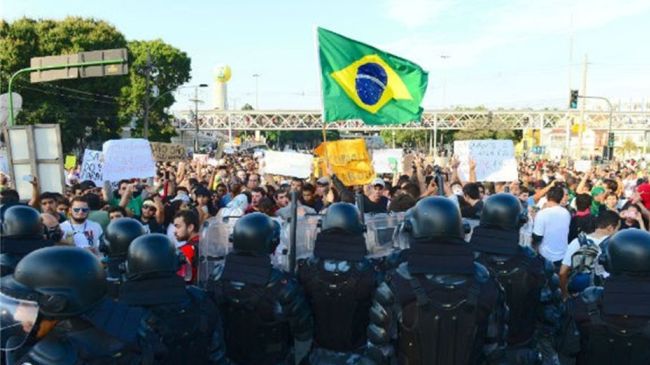
Brazilian police block protesters from entering Maracana soccer stadium in Rio on June 16, 2013
Press TV – June 17, 2013
Brazilian police have fired tear gas and rubber bullets to disperse a crowd of about 3,000 people protesting outside Rio de Janeiro’s Maracana stadium before a Confederation Cup soccer game.
The rally took place on Sunday in protest against the vast sums of public money spent on the organization of the tournament.
The protesters also opposed the huge cost of preparations to host next year’s World Cup, which is expected to reach USD 15 billion (about 11 billion euros).
“I don’t care about the World Cup – I want health and education!” shouted the protesters.
Initially, police stood in line as a barricade outside of the stadium.
However, as the crowd of protesters tried to pass the blockade riot police charged towards the group.
On June 15, police clashed with protesters in a similar demonstration during the opening of the Confederations Cup in the capital, Brasilia.
The clashes ended with 39 people injured after police fired tear gas and rubber bullets to disperse the crowd.
Related articles
Brazil: Soldiers Sent to Indigenous Occupied Land
By Emily Tarbuck | The Argentina Independent | June 6, 2013
The Brazilian government has announced that it will send around 200 soldiers to land occupied by indigenous groups in Mato Grosso do Sul.
The move comes after a member of the Terena indigenous group was killed whilst police attempted to evict the occupiers last week. The groups believe the land belongs to their indigenous ancestral territory, which is currently recognised as the property of local politician, Ricardo Bacha, and have occupied the land for over two weeks.
The announcement from the government detailed how the soldiers were being sent to the farm in order to prevent the problem from escalating. Brazil’s Justice minister Jose Cardozo said: “We’re not going to put out the flames by pouring alcohol on the bonfire…we must avoid radicalising a situation that goes back a long way in Brazilian history.”
Cardozo also announced that he would be travelling to Mato Grosso do Sul in order to oversee the deployment of soldiers, and that the soldiers from the National Force were being sent in order to support the local police force.
It was revealed that the call for soldier interception came from the governor of Mato Grosso do Sol, André Puccinelli, and that soldiers have been steadily deployed by land and air to the area since Tuesday.
Dozens of other indigenous groups have marched around Mato Grosso do Sul in the Sidronlandia region in support of the Terena people. A date has not been set for the withdrawal of the soldiers.
Brazil: Indigenous Group Member Killed After Police Eviction
By Laura Benitez | The Argentina Independent | June 2, 2013
Indigenous groups have re-occupied farm land in Mato Grosso do Sul, South of Brazil, after being evicted on Thursday.
The groups are claiming ownership over part of the farm as they say it forms part of their ancestral lands.
The groups have occupied the land, which is owned by a local politician, Ricardo Bacha, for over two weeks. During the eviction process on Thursday, one of the group members, Osiel Abriel was shot and killed by police.
According to press reports, police officers have claimed that the group became violent during Thursday’s eviction process.
Brazil’s justice minister José Eduardo Cardozo, has called an investigation into the death of Abriel which will determine if an excessive and unnecessary use of force and firearms were used.
“We will very accurately determine what happened. If there were abuses, those responsible will be punished, “he said.
On Friday, 250 people from the group returned back to the farm to re-occupy the land.
Local media have said that although the situation continues to be “tense”, there has been no violence since the re-occupation on Friday.
Related article
- Argentina: Violent Eviction of Indigenous Community Deemed Illegal (alethonews.wordpress.com)
Brazil: 30,000 People Displaced for Sports Events
Weekly News Update on the Americas | May 19, 2013
A total of 3,099 families have been removed from their homes in Rio de Janeiro and another 7,843 have been threatened with removal as part of Brazil’s preparations for hosting the 2014 World Cup and the 2016 Olympic Games, according to a study released on May 15 by the Popular Committee of the World Cup and the Olympics. The group estimates that 30,000 people have been affected, based on the average number of people in the households. The study, “Mega-Events and Human Rights Violations in Rio de Janeiro,” was produced with the collaboration of the impacted communities, the Institute for Urban and Regional Research and Planning (Ippur) and other groups, including the nongovernmental organization (NGO) Global Justice.
The city government initially offered 18,000 reais (about US$8,872) for each home. Residents said this wasn’t enough even to buy the land for a new house. The city finally agreed to pay 40,000 reais (US$19,735), which residents said would pay for a two-bedroom house in the hills. “What we’re seeing is an urban restructuring project without any participation of society,” said Orlando Alves dos Santos Junior, an urban planning professor and one of the coordinators of the May 15 study. “In fact, what’s going on under this pretext [of preparation for the sports events] is a serious urban intervention, on the basis of the real estate industry. The presence of inhabitants from the poorest classes has become an obstacle to be removed from the path.” (Adital (Brazil) 5/17/13 from Canal Ibase (Brazilian Institute of Social and Economic Analyses))
US robots, Israeli drones to help make 2014 World Cup in Brazil ‘one of safest sporting events ever’
RT | May 19, 2013
Brazil has added 30 US military robots to the Israeli drones and ‘Robocop-style’ glasses with face recognition cameras to its arsenal after the country allocated $900 million to make 2014 World Cup “one of the most protected sports events in history.”
The 30 PackBot 510 units, which usually cost between $100,000 and $200,000 apiece, will arrive in Brazil as part of the $7.2 million deal the country signed with American iRobot advanced technology company. The contracts include services, spare parts and associated equipment.
“IRobot continues its international expansion, and Brazil represents an important market for the company’s unmanned ground vehicles,” Frank Wilson, iRobot’s senior vice president, said in a statement. “IRobot is excited to be providing the company’s state-of-the-art robotic technologies to Brazil as the country prepares for several high profile international events, including the 2014 FIFA World Cup.”
The first real test for the PackBots will be the visit of Pope Franics to Brazil this July, with the country also looking to use the robots during the Rio Olympics in 2016.
The PackBots are equipped with cameras and are operated remotely in order to detect and examine suspicious objects or explore dangerous environments, while keeping their operators safe from harm.
The devices weigh about 27 kilogram and rely on caterpillar treads to move around, using videogame-style hand controllers to make it more familiar to the users.
More than 2000 of those military robots are currently stationed in Iraq and Afghanistan, with PackBots being the first to enter the damaged Fukushima nuclear plant after the 2011 earthquake and tsunami.
Brazil is spending $900 million to bolster its security forces, including high-tech surveillance equipment and helicopters, as the country is hoping to make the 2014 World Cup “one of the most protected sports events in history.”
The country’s police will be equipped with facial-recognition camera glasses that can capture 400 facial images per second to store them in a central database of up to 13 million faces.
Brazil is also reported to have spent $25 million on four Israeli-made drones, which are expected to make their debut at the FIFA Confederations Cup in June.
There’ll also be plenty of manpower involved in the security operation as the World Cup organizers plan have 3,000 to 5,000 soldiers from the Brazilian Armed Forces at each of the 12 host cities during the event.
UNASUR to Create Military Force
By Laura Benitez | The Argentina Independent | May 9, 2013
The Union of South American Nations (UNASUR) has announced that it will create a united defence body to promote democratic stability among its member countries.
Military delegates of Argentina, Brazil, and Ecuador concluded a two day meeting yesterday in Quito, and agreed on creating the first South American Defence College (ESUDE) – a safety training centre with the aim of turning “the regions into a zone of peace”.
UNASUR has said that the idea behind the project is to “eliminate outdated visions that have formed our military, with manuals and taxes from foreign powers.
“The goal is to start from scratch and consider a defence doctrine, without starting from the premise of opposing countries. It is important to define our role in the military, to assume responsibility for prevention, border control or emergency responses.
“We want to create a body of higher and postgraduate education to create a regional identity for civilians and our military, and to avoid interference of other countries or geopolitical zones,” a UNASUR spokesperson said.
The ESUDE proposal paper will be presented at the next meeting of the executive body for the South American Defence Council in Lima, Peru on the 16th and 17th May. Members who attended yesterday’s meeting in Quito will meet again during the second week of July in Buenos Aires, to define the Esude proposal.
One of the issues that is expected to be up for debate in the following meetings is the level of participation in the armed forces from each country.
The initiative already has the support of other member countries, including Argentina, Brazil, Ecuador, Peru, Venezuela, Guyana, Suriname, and Uruguay.
Related articles
- UNASUR Urges Respect for Venezuela’s Electoral Results (venezuelasolidarity.co.uk)
- U.S. refuses to recognize Maduro’s presidential win in Venezuela polls (panarmenian.net)
Brazil and Argentina Sign Agreement to Build Research and Radioisotope Reactors
Prensa Latina | May 8, 2013
Rio de Janeiro – Atomic power agencies from Brazil and Argentina signed an agreement to build two nuclear reactors for research and production of radioisotopes, said the Ministry of Science and Technology (MCT) today.
The agreement, signed by the Brazilian National Commission for Nuclear Energy (CNEN) and the National Commission of Atomic Energy (CNEA), is centered on the construction of two reactors: the Brazilian Multipurpose Reasearch Reactor (RMB) and the RA-10 in Argentina, said a spokesman from the MCT.
The action meets the Bilateral Integration and Coordination Mechanism, established in the Joint Declaration of 2008 and signed by Presidents Cristina Fernandez and Luiz Inacio Lula Da Silva, said the source.
To carry out the project, both sides created the Bi-National Commission on Nuclear Energy (COBEN) which will be in charge of the construction of both reactors.
The atomic agencies of these South American countries have closely collaborated since 2008. Argentina provides Brazil 30 percent of the Molybdenum 99 (Mo99) radioisotopes which are indispensable in the diagnosis and treatment of cancer.
Since 2011 both countries agreed to move forward on greater integration, and carry out a joint project to develop multipurpose reactors, demonstrating the mutual interest in increasing the peaceful use of nuclear energy.
Both reactors, once manufactured and functioning, will have a total capacity to cover 40 percent of the world radioisotope market.
At the present, only France, Canada, South Africa, Australia and Argentina have the technology to produce radioisotopes.
Leaked ProSAVANA Master Plan confirms worst fears
Justiça Ambiental! et al | April 30, 2013
Civil society groups have finally seen a leaked copy of the most recent version of the Master Plan for the ProSAVANA programme, which is dated March 2013. The copy makes clear the project’s intentions and confirms that the governments of Japan, Brazil and Mozambique are secretly paving the way for a massive land grab in Northern Mozambique. Several organisations from Mozambique and their international partners are now making this plan publicly available, along with some of their initial reflections. (Download the Master Plan here: part 1, part 2, part 3.)
ProSAVANA is a programme between Japan, Brazil and Mozambique to support agricultural development in Northern Mozambique. According to the copy of the Master Plan leaked to civil society, the programme will cover an area of over 10 million hectares in 19 districts within 3 provinces of Northern Mozambique– Nampula, Niassa, and Zambézia. Over 4 million people live and farm in this area, which has been dubbed the Nacala Corridor.
The entire process of developing the ProSavana programme and its Master Plan has been characterised by a complete lack of transparency, public consultation and public participation. While agribusiness corporations have been part of government delegations to investigate business opportunities in the Nacala Corridor, the 4 million farmers living in the affected area have received no information about the intentions shown in the Master Plan. Three governments have refused to make this version or earlier versions of the Master Plan available to the public.
The Master Plan was produced by a team of foreign consultants with close linkages to multinational agribusiness corporations, some of which are already acquiring land in the ProSavana area.1 There were no meaningful consultations with local communities and the plan does not consider their needs, their histories and knowledge, or their aspirations for the future. Nor is there any appreciation of their local farming and food systems.
ProSAVANA is presented as a development/ aid programme but the leaked version of the Master Plan makes it clear that it is simply a business plan for the corporate takeover of agriculture in Mozambique.
What does this Master Plan mean for small farmers?
The proponents of the ProSAVANA programme have said repeatedly that this is a programme to support small farmers. But the Master Plan only considers how small farmers can support agribusiness. This boils down to two main directives:
1. Push farmers out of traditional shifting cultivation and land management practices into intensive cultivation practices based on commercial seeds, chemical inputs and private land titles.
Although zero analysis was made of the effectiveness of traditional farming practices in the area, the Master Plan says the “transition from shifting cultivation to settled farming is an urgent need” and says this is “the key strategy proposed in the Master Plan”. It even calls for actions “combating the practice of shifting agriculture.”
The plan acknowledges that farmers are likely to resist giving up their traditional forms of agriculture, so it proposes several means to encourage them to do so, such as the formation of “leading farmers” who can demonstrate the advantages of intensive agriculture, “a pump-priming subsidy system for chemical fertilizers”, and, most importantly, private land titles (DUATs) for those farmers that make the switch.
It is clear to us that the real objective behind these efforts to push farmers into intensive cultivation is to privatise the land and make it more available to outside investors. Relegating farmers to a fixed parcel is a way to mark off lands more clearly for investors and to make it possible for provincial governments to establish the land banks (state land earmarked for commercial use by private investors) that the plan calls for. It also allows investors to bypass negotiations with communities to access lands. The Land Registration of the Small Scale and Medium Scale Farmers component of the Master Plan clearly states that its objective is to “facilitate the identification of areas for the promotion of agriculture by large farmers, private companies and medium scale farmers.” It is also described as a means to “create an environment of cooperation and integration between the small scale farm and new investors.”
2. Push farmers into contract farming arrangements with corporate farms and processors.
The Master Plan divides the Nacala Corridor into zones, and defines which crops should be grown in these zones, where and how they should be grown, and by whom they should be grown (small farmers, medium farmers or corporations). Within these zones, the plan lays out several projects for the production of commodities, some of them based exclusively on large corporate farms, others based on a mix of large or medium farms and contract production arrangements with small farmers.
Contract farming will not improve the lives of small farmers in the area. It will instead make them dependent on a single corporation for everything from their seeds to the sale of their crops. One of the proposed contract farming projects in the plan envisions a return on investment of 30% per year for the company while farmers in the project will be forced to devote 5 out of the 5.5 ha they will be allocated to the production of cassava under contract production with the investor.
A paradise for corporations
The plan lays out several business opportunities that companies can invest in and get huge projected returns of between 20%-30% per year. Companies that invest will be able to tap a $2 billion Nacala Fund that is being financed by governments and investors in Japan and Brazil. Although details of this fund are still missing from the leaked version of the Master Plan, other sources indicate that the fund will be registered in the fiscal paradise of Luxembourg and called the Africa Opportunity Fund 1: Nacala.2
Some of the projects within the plan will provide large areas of land to investors. The Integrated Grain Cluster, which is planned for Majune District, Niassa Province, will be managed by one vertically integrated company that will operate nine 5,000 ha farms, within a 60,000 ha zone, to produce a rotation of maize, soybeans and sunflower, mainly for export. According to the plan, “the project has a high profitability and the internal rate of return was calculated at 20.3% and the payback is 9 years.” The Master Plan calls for projects such as this one to be expanded and reproduced throughout the Corridor.
Corporations will also benefit from several Special Economic Zones (SEZs) that are proposed in the plan. In these zones, companies will be free from paying taxes and customs duties and will be able to benefit from offshore financial arrangements. These SEZs will be located at the main sites that the project is planning for processing and trading facilities, which will cut deeply into any revenues that could accrue to the government through the planned development of agro-export industries.
Since the planning for ProSAVANA began in 2009, many foreign investors and their local partners have already acquired large parcels of land in the programme area, leading to numerous conflicts over land with local communities. The intention of the Master Plan is to bring even more investors to the area, which will make land conflicts even worse.
The main solution that the Master Plan proposes to these growing conflicts are the “ProSAVANA Guidelines on RAI” (Responsible Agricultural Investment). These guidelines are essentially a checklist based on the seven RAI principles that were developed by the World Bank and have been widely denounced by peasant organisations and civil society groups. The “ProSAVANA Guideline on RAI” will be included as an annex in the “Data Book for Private Investors” that will be released by August 2013 as part of efforts to promote agribusiness investment in the Nacala Corridor.
The guidelines are weak and only voluntary and the plan does not call for any new laws or regulations that could really defend communities against land grabs. The plan only says that “private investors interested in agricultural development in the Nacala Corridor will be requested to comply with these principles, in addition to their internal codes of conduct and voluntary self-regulations.”
What’s the end result of this plan?
The Master Plan, in its current form, would destroy peasant agriculture by wiping out farmer seed systems, local knowledge, local food cultures and traditional systems of land management. It will displace peasants from their lands or force them on to fixed parcels of land where they will be obliged to produce under contract production for corporations and to go into debt to pay for the seeds, fertilisers and pesticides required. The peasants that do get private land titles will be left at extreme risk of quickly losing their lands to corporations and big farmers.
It is telling that only one of the seven clusters in the Master Plan is aimed at small scale farmers and family food production. And this cluster only proposes the same old failed green revolution model of development. The Master Plan puts no real thought and energy into the needs and capacities of peasants in the Nacala Corridor.
Corporations are the big beneficiaries of this Master Plan. They will get control over land and production and they will control the trade of the foods produced, which will be exported along the roads, rail lines and Nacala port that other foreign corporations will be paid to construct with public funds from Mozambique and Japan. Foreign seed, pesticide and fertiliser companies will also make a killing from this massive expansion of industrial agriculture into Africa.
Some Mozambicans will profit from this. For example, Portugal’s richest family has set up a joint venture to acquire lands and produce soybeans in Northern Mozambique with a national company controlled by the friends and family of Mozambique’s President and in partnership with one of Brazil’s largest corporate farmers. But these profits will be made at the expense of regular Mozambicans.
Seeing the Master Plan only confirms our determination to stop the ProSAVANA programme and to support Mozambican peasants and people in their struggle for food sovereignty.
Signed by:
Justiça Ambiental, JA!/ FoE Mozambique (Mozambique)
Forum Mulher (Mozambique)
Livaningo (Mozambique)
LPM – Landless Peoples Mouvement (Member of Via Campesina . South Africa)
Agrarian Reform for Food Sovereignty Campaign (Member os Via Campesina – South Africa)
AFRA – Association for Rural Advancement (South Africa)
GRAIN
Friends of the Earth International (FoEI) (*The world’s largest grassroots international environmental federation with 74 national member groups and more than two million individual members.)
National Association of Professional Environmentalists (NAPE) / Friends of the Earth (FoE) Uganda
FoE Swaziland
Amigos da Terra Brasil / FoE Brazil
Movimiento Madre Tierra, Honduras
NOAH Friends of the Earth Denmark
GroundWork (South Africa)
Amigos de la Tierra España / Friends of the Earth Spain
Environmental Rights Action / FoE Nigeria
Sahabat Alam Malaysia/ FOE Malaysia
SOBREVIVENCIA, Friends of the Earth Paraguay
CESTA, FOE El Salvador
Earth Harmony Innovators (South Africa)
Ukuvuna (South Africa)
FoE Africa
Kasisi Agricultural Training Centre (Zambia)
(As of 29 April 2013)
Contact: Anabela Lemos and Vanessa Cabanelas
JA!Justiça Ambiental/FOEMozambique
anabela.ja.mz@gmail.com and vanessacabanelas@gamil.com
+258 21 496668
1The Master Plan was drawn up by a group of consultants from the Getulio Vargas Foundation (FGV). These consultants are also directors with Vigna Brasil, also known as Vigna Projetos, which provides agribusiness consultancy services to corporations such as Galp Energia, Vale, Syngenta, Petrobras, and ADM. Galp, owned by the Amorim family of Portugal, is already invested in a large-scale soybean farming operation in the ProSAVANA project area through a joint venture called AgroMoz with Intelec, a holding company partly controlled by the family of the Mozambican President. Vigna Brasil has the same contact address as the company 4I.Green, which is described as the technical manager for the Nacala Fund– the main financing vehicle for the big agribusiness projects in the Nacala Corridor.
2See: http://www.g15.org/Renewable_Energies/J2-06-11-2012%5CPRESENTATION_DAKAR-06-11-2012.pptx
Related article
- The smallholders’ last stand (newint.org)
‘Noble Savages’: Chagnon’s new book triggers resignation and protests
Survival for Tribal Peoples | February 26, 2013
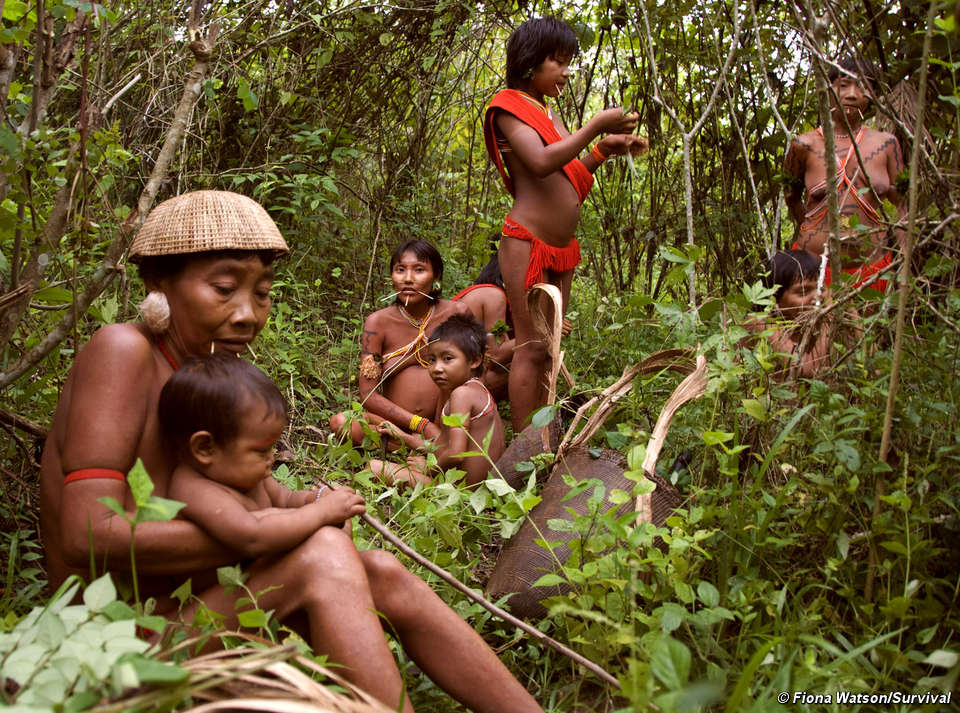
 Davi Kopenawa, Yanomami spokesperson and shaman, has spoken out against Napoleon Chagnon’s new book ‘Noble Savages’.
© Fiona Watson/Survival

A new book by controversial American anthropologist Napoleon Chagnon has triggered a wave of protests among experts and Yanomami Indians:
- Marshall Sahlins, ‘the world’s most respected anthropologist alive today’, has resigned from the US National Academy of Sciences in protest at Chagnon’s election to the Academy. Sahlins previously wrote a devastating critique of Chagnon’s work in the Washington Post.
- Davi Kopenawa, a spokesman for Brazil’s Yanomami and President of the Yanomami association Hutukara, has spoken out about Chagnon’s work: ‘[Chagnon] said about us, ‘The Yanomami are savages!’ He teaches false things to young students. ‘Look, the Yanomami kill each other because of women.’ He keeps on saying this. But what do his leaders do? I believe that some years ago his leader waged a huge war – they killed thousands of children, they killed thousands of girls and boys. These big men killed almost everything. These are the fierce people, the true fierce people. They throw bombs, fire machine guns and finish off with the Earth. We don’t do this…’
- A large group of anthropologists who have each worked with the Yanomami for many years have issued a statement challenging Chagnon’s assessment of the tribe as ‘fierce’ and ‘violent’. They describe the Yanomami as ‘generally peaceable.’
- Survival International’s Director Stephen Corry has said, ’Chagnon’s work is frequently used by writers, such as Jared Diamond and Steven Pinker, who want to portray tribal peoples as ‘brutal savages’ – far more violent than ‘us’. But none of them acknowledge that his central findings about Yanomami ‘violence’ have long been discredited.’
Napoleon Chagnon’s autobiography ‘Noble Savages: My Life Among Two Dangerous Tribes – the Yanomamö and the Anthropologists’, has just been published. His 1968 book ‘Yanomamö: The Fierce People’ portrayed the Yanomami as ‘sly, aggressive and intimidating’, and claimed they ‘live in a state of chronic warfare’. It is still a standard work in undergraduate anthropology.
The Yanomami live in Brazil and Venezuela and are the largest relatively isolated tribe in South America. Their territory is protected by law, but illegal goldminers and ranchers continue to invade their land, destroying their forest and spreading diseases which in the 1980s killed one out of five Brazilian Yanomami.
 Napoleon Chagnon’s view that the Yanomami are ‘sly, aggressive and intimidating’ and that they ‘live in a state of chronic warfare’ has been widely discredited.
© Fiona Watson/Survival
Chagnon’s work has had far-reaching consequences for the rights of the Yanomami. In the late 1970s, Brazil’s military dictatorship, which was refusing to demarcate the Yanomami territory, was clearly influenced by the characterization of the Yanomami as hostile to each other and in the 1990s, the UK government refused funding for an education project with the Yanomami, saying that any project with the tribe should work on ‘reducing violence’.
Most recently, Chagnon’s work was cited in Jared Diamond’s highly controversial book ‘The World Until Yesterday’, in which he states that most tribal peoples, including the Yanomami, are ’trapped in cycles of violence and warfare’ and calls for the imposition of state control in order to bring them peace.
Survival International’s Director Stephen Corry said today, ‘The greatest tragedy in this story is that the real Yanomami have largely been written out of it, as the media have chosen to focus only on the salacious details of the debate that rages between anthropologists or on Chagnon’s disputed characterizations. In fact, Yanomamö: The Fierce People had disastrous repercussions both for the Yanomami and tribal peoples in general. There’s no doubt it’s been used against them and it has brought the 19th century myth of the ‘Brutal Savage’ back into mainstream thinking.’
Related articles
Featured Video
Stanislav Krapivnik: Russia-Iran Cooperation & Escalation in Ukraine
or go to
Aletho News Archives – Video-Images
Frlom the Archives
A dark page from the CIA’s history: What was Project Artichoke, launched 74 years ago?
By Erkin Oncan | Strategic Culture Foundation | August 22, 2025
One of the most useful instruments hidden behind the U.S. empire’s rhetoric of “freedom and democracy” was the Central Intelligence Agency, founded on September 18, 1947, as the successor of the Office of Strategic Services (OSS).
Since its creation, the CIA has carried out countless inhumane operations: assassinations, coups, drug trafficking, support for terrorism, conspiracies. The list of its crimes is endless. But among the darkest and most inhumane chapters of its record lie the notorious “mind control” experiments. … continue
Blog Roll
 Aletho News
- Are the Jews indigenous to Palestine?
- Stanislav Krapivnik: Russia-Iran Cooperation & Escalation in Ukraine
- Indonesia suspends participation in Board of Peace following attack on Iran
- ‘Operation Epic Fury’ burns an estimated $5.82 billion in just 100 hours
- Zionism’s grip over the world: From Epstein to Greater Israel
- How Israel and the FBI manipulated assassination plots to goad Trump into Iran war
- Iranian Strikes Dispel the Illusion of US Security Umbrella
- US Boasts of Destroyed Iranian Launchers Lack Credibility – Ex-DoD Official
- Europe not in position to cooperate with US and Israel against Iran
- Iran Has ‘Broken the Myth’ of Israeli Military Power: Former Pakistani Envoy
- If Americans Knew
- US troops were told war on Iran was ‘all part of God’s divine plan’, watchdog alleges
- Trump wants to run the show in Iran, but doesn’t know what he’s doing – Not a ceasefire Day 147
- ‘Dirty Work’ :The truth about how Israel was founded
- Mass Expulsion in Lebanon as Israel Expands War: “We Don’t Know Where to Go”
- Lies, distortions, and propaganda: how the U.S. mainstream media coverage on Iran hides the truth
- Palestinians in Gaza fear famine returning as Israel cuts off food amid Iran war
- AIPAC, other pro-Israel groups enter midterms with $100 million to spend
- Iranian girls killed by ‘double-tap’ strikes on Minab school
- Bari Weiss Is Going Full ‘Propaganda-Palooza’ With the Iran War
- Inside the Pro-Israel Campaign to Stop ‘The Voice of Hind Rajab’ From Winning an Oscar
- No Tricks Zone
- Televised! Leading German Political Candidate Tells Schoolchildren CO2 Makes Sun Hotter!
- New Study: A Century Warming Of 1.1°C Is ‘Commonplace’ And ‘Not Unusual’ During This Interglacial
- New Study: ‘Internal Noise’ And Volcanic Forcing Can Trigger 10-15°C Warming Within Decades
- Glaciers Worldwide Are Suddendly Surging, Experts Blame Warming!
- Surprising Discovery: Sahara Is Greening…Billions Of Trees Where Once Thought To Be Barren
- New Research Reaffirms Clouds, Aerosols, And Surface Solar Radiation Are ‘Driving The Climate System’
- Germany: Electric Car Catches Fire At Charging Station, Sets Off Local “Inferno”, Widespread Damage
- New Study: Canada’s New Brunswick Was 1°C Warmer Than Today During The Medieval Warm Period
- Coal Power Back In Trend As Globe Tries To Keep Pace With Growing Demand For Power
- New Study: A 4°C Warmer Beaufort Sea Had ‘No Sea Ice’ 11,700 – 8200 Years Ago
 Aletho News