IMPERIAL WASTE
By Paul Robinson | IRRUSSIANALITY | March 3, 2021
Imperialism is big gigantic waste of money. Let’s start with that.
A couple of news items caught my attention this week that illustrate this point, but before getting on to them, we first need to make a bit of a detour and try to determine imperialism’s roots.
It’s harder than it might seem. For instance, historians have a real problem explaining late nineteenth century imperialism, in which European powers conquered large parts of the globe, most notably in Africa. All sorts of explanations have been generated, but few stand up to a lot of scrutiny.
Particularly implausible are the theories of socialist thinkers, the most famous of which is Lenin’s Imperialism: The Last State of Capitalism. The socialists’ idea was that capitalism generates lots of surplus capital that it can’t get rid of because it is suppressing the wages of its own workers and so denying itself investment opportunities at home. Instead, capitalism exports its surplus, for which it needs colonies – thus imperialism.
The problem was that, like a lot of Lenin’s stuff, the theory was total hogwash. First, capitalist economies had no shortage of investment opportunities at home; and second, they didn’t need colonies to invest abroad. The British, for instance, invested far, far more in Latin America, which they never conquered, than in Africa, which they did.
Furthermore, imperialism was, generally speaking, loss-making. Colonies had to be defended and administered, but they tended to be economically undeveloped, and so didn’t generate much revenue. There was a reason why the Brits were so happy to let the Canadians become self-governing – they were fed up having to pay for a frozen piece of wasteland that only produced some fur and lumber.
So, imperialism doesn’t make a lot of sense from the point of view of the national interest, broadly defined. But it does make sense to certain minority interests within an imperial society. There are medals and promotions to be won by the military; there are contracts for the military industrial complex; and there’s also money to be made by all sorts of other entrepreneurs willing to hang on the imperialists’ coattails. If these people and groups have outsized political influence – through control of the media, financial support to politicians, or whatever – they can distort politicians’ and even the entire population’s understanding of the national interest. And thus the nation gets dragged into foreign endeavours that enrich and empower a few but do nothing at all for the people as a whole.
Which brings me on to this week’s new stories, both of which involve staggering waste of government money on military and imperial adventures.
The first story concerns the Canadian navy’s program to build a new generation of warships. This was originally budgeted as costing $14 billion. Now the parliamentary budget officer has announced that the cost has leapt to a mind-blowing $77 billion, and that the total could go up even more if the project experiences further delays (which, let’s face it, is quite likely).
Going over-budget is hardly unusual in the world of defence procurement, but a leap from $14 to $77 billion is more than a bit off the charts. Imagine what you could do with $77 billion. Apart from putting it back in taxpayer’s pockets, think of what you could do for healthcare, education, or the condition of the country’s indigenous people, many of whom don’t even have access to drinkable water. And then think of what benefits you’re going to get from $77 billion worth of warships. Or rather, think of how you would suffer if you didn’t have those ships. Would anyone invade Canada? Would the world collapse into chaos? Would any of you not directly involved in building or manning them even notice??? No, no, and no.
This is a scandalous and appalling waste of the nation’s wealth. Yet it’s passed almost unnoticed. We live in a world of pandemic economics, in which money appears to grow on trees, budget deficits have ballooned to simply incomprehensible proportions, and the loss of $70-odd billion just slips by without causing so much as a blink of an eye. Clearly, something isn’t right.
And then there’s story number two. This is the latest report from the Special Inspector General for Afghanistan Reconstruction (SIGAR), a person whose work I have mentioned many times before. SIGAR audits the money spent by the United States in Afghanistan, and it’s a litany of waste and corruption on a scale that … well, I’ve already used the word mindblowing, so I won’t say that it blows the mind, but you get the point, it involves a lot, a real, real lot, of money flushed down the toilet of Afghanistan for no obvious benefit.
Anyway, SIGAR’s latest report, which came to me in an email, says the following:
–This report is the result of a congressional request of SIGAR to summarize all capital assets in Afghanistan paid for by U.S. agencies that SIGAR has found in its prior work to be unused, not used for their intended purposes, deteriorated or destroyed.
— The capital assets reviewed for this report were funded by DOD, USAID, OPIC, and the State Department to build schools, prisons, a hotel, hospitals, roads, bridges, and Afghan military facilities.
— Of the nearly $7.8 billion in capital assets reviewed in its prior reports, SIGAR identified about $2.4 billion in assets that were unused or abandoned, had not been used for their intended purposes, had deteriorated, or were destroyed.
— By contrast, SIGAR found that more than $1.2 billion out of the $7.8 billion in assets were being used as intended, and only $343.2 million out of the $7.8 billion in assets were maintained in good condition.
— Most of the capital assets not used properly or in disrepair or abandoned are directly related to U.S. agencies not considering whether the Afghans wanted or needed the facilities, or whether the Afghan government had the financial ability and technical means to sustain them.
— This waste of taxpayer dollars occurred despite multiple laws stating that U.S. agencies should not construct or procure capital assets until they can show that the benefiting country has the financial and technical resources, and capability to use and maintain those assets effectively.
Quote:
— “SIGAR’s work reveals a pattern of U.S. agencies pouring too much money, too quickly, into a country too small to absorb it,” said Special Inspector General John F. Sopko. “The fact that so many capital assets wound up not used, deteriorated or abandoned should have been a major cause of concern for the agencies financing these projects. The lesson of all of this is two-fold. If the United States is going to pay for reconstruction or development in Afghanistan or anywhere else in the world, first make certain the recipient wants it, needs it and can sustain it. Secondly, make certain before you spend the money there is proper oversight to prevent this type of waste.”
I’m a great fan of SIGAR, but there’s something about his work that really frustrates me. He’s been saying this stuff for years, but nothing ever changes. The money keeps flowing, and keeps getting squandered. There should be ‘proper oversight’ SIGAR says, but surely by now he’s got to have woken up to the fact that it’s not going to happen. It’s like all he can say is, ‘do all this stuff better’, but can never bring himself to say, ‘Stop doing it! It’s a gigantic boondoogle.’
To be fair, that’s not an auditor’s job, and I guess that he can’t go beyond his legal remit. But you see what I’m saying. This isn’t something you can solve by introducing better processes. It’s rotten to the core.
Unfortunately, it continues, and continues, and continues. And so it is that our profligate military and imperial adventures impoverish us all, while bringing us absolutely diddly squat in return for our money. Back in the day, I was taught that the essence of democracy is accountability. Judging by this, we’re not democracies at all.
But I’ll give the final word to two-times winner of the Congressional Medal of Honor, General Smedley Butler. ‘War is a racket’, he said.
How very true.
Canada’s mandatory Covid-19 hotel stays are not ‘internment camps’ but they are costly forced detention
By Eva Bartlett | RT | February 10, 2021
Since at least October 2020, some Canadians have been concerned about rumours of Covid-19 “internment camps.” In reality, there may be no barbed wire or gun turrets, but a number of travellers have experienced detention firsthand.
Last October, Canadian Prime Minister Justin Trudeau was asked about this. His reply didn’t address the specific claim at hand, instead he spoke generally of “noise and harmful misinformation on the Internet,” and bizarrely urged people to resist “people who would sow chaos within our communities and our democracy.” (I shudder to think which foreign interference he imagined.)
Earlier that month, Ontario member of provincial parliament (MPP) Randy Hillier had asked the province’s legislature about potential “internment camps,” referring to a federal government call for expressions of interest regarding “quarantine/isolation camps throughout every province and every territory in Canada.”
These camps fall under Canada’s Quarantine Act (2005), which specifies that the country can“designate any place in Canada as a quarantine facility.”
So fears of “being confined as a prisoner,” the standard definition of “internment,” can be laid to rest, right?
Well, while a temporary, mandatory, expensive hotel stay certainly isn’t the same as being kept in an internment camp, it is the 2021 plan for travellers flying to Canada, even if they “test negative” for Covid-19.
And many are rightly complaining that it is unlawful and goes against Canadians’ rights, including that those whisked away to secret locations are not given the right to legal counsel, much less right to contact families/friends.
At the end of January 2021, Canada decided to suspend flights to/from Mexico and Caribbean countries, and, effective February 3, implemented the three night stay-at-your-own-expense (or do jail time) hotel quarantine policy for travellers entering Canada with “positive tests” (or the “wrong” negative one). These rules were extended to travellers flying from the US, Central and South America as well.
Trudeau, on January 29, said the cost was expected to be more than Can$2000 (US$1575).
Further, as noted in the government’s news release on these measures, a violation of the quarantine instructions “is also an offence under the Quarantine Act and could lead to serious penalties, including six months in prison and/or $750,000 in fines.”
Whereas until recently it was enough to provide a negative coronavirus test, now travellers to Canada must provide specifically a “negative COVID-19 molecular (PCR) test” or do hotel time at their own expense until receiving such a result.
These new measures have already been trialled on passengers who have recently flown to Canada.
In one instance on January 30, a panicked mother (Rebekah McDonald) spoke of her son being taken away to a quarantine facility, saying, “They won’t let me talk to him. They won’t let me see him. They won’t tell me where he’s going.”
As it later turned out, while the son had complied and done a Covid-19 test (two, actually, the antigen and the PCR), he only had the paperwork for the former, and unbeknownst to him, Canada demanded the latter.
He and others likewise sent to hotel prison could be forgiven for missing the January 7, 2021 Transport Canada update specifying that antigen tests would not be accepted. Just two months prior, Government Canada listed antigen tests as a test for Covid-19.
In Ontario some days later, a passenger (Steve Duesing) also arriving with a negative test was shuttled to an approved quarantine hotel, apparently itself isolated from the public, with a “detention centre feel to it,” to wait for the Government Canada approved test results.
More recently, another passenger (Neil McCullough) subject to Canada’s arbitrary and draconian new rules spent 11 days in hotel isolation, because paperwork for his test didn’t list the clinic’s address.
In the latter case, there was an additional element of totalitarianism: according to McCullough, he and the woman in the next room he tried to speak with were allegedly both informed by the security guard that their quarantine period “would restart” if they didn’t stop talking about their experiences.
Rules for thee, but not…
The government paints its measures as precautions to limit the “spread” of Covid-19, but when numerous government officials themselves have repeatedly violated the regulations, it is clear that they don’t believe in the need for such rules.
This is not about “public safety,” but is about control of the populace.
Patty Hadju, Canada’s minister of health, is quoted as valiantly saying:
“No one should be travelling right now. Each of us has a part in keeping our communities safe, and that means avoiding non-essential travel, which can put you, your loved ones, and your community at risk.”
However, let’s recall that Hadju three times in April 2020 flew “between Ottawa and her home in Thunder Bay,” at a time when she advocated that “now is not the time for gatherings with family and friends. Connect with others with a phone call or video chat instead.”
And actually, she did more of the same in the following months, amounting to at least 11 flights.
The PM himself violated “the rules” over Easter last year, when he took his family, staff and a motorcade across provincial lines to the summer residence (after telling Canadians to suck it up and stay home).
Time will tell if the PM, health minister, and cohorts in positions of authority also violate these newest measures.
Legal action against Trudeau government
The Government Canada page on the new mandate notes that travellers will need to do the PCR test on arrival to Canada (in addition to having already just done it in order to arrive in Canada in the first place). So, according to this logic (and I use that term lightly), even if one has jumped through the absurd 2020 hoops and adapted to the early 2021 hoops, they’ll still need to do expensive hotel time upon arrival in Canada.
In any case, since the PCR test being pushed by Government Canada has long been shown to be unreliable and generate false positives, it thus becomes quite plausible that Canada’s preference of that test is because it will generate more “cases” and thus rack up fear of the pandemic.
An aside: The $2000+ for the three-night stay at government-approved hotels goes towards, Government Canada says, the test, the stay, and “all associated costs for food, cleaning and security.”
And although stays at hotels near airports are never cheap, in this case the food seems to be bordering on prison fare. A photo of Duesing’s Radisson meal shows a skimpy sandwich in a styrofoam container.
On February 3, the Justice Centre For Constitutional Freedoms published an update that it is “preparing to file legal action imminently,” regarding Government Canada’s mandatory hotel quarantine, noting they had “received hundreds of emails” since Canada announced the new travel measures.
The Canadian Civil Liberties Association views these measures as an affront against civilians’ rights:
“The quarantine rules will almost certainly impact those who travel to care for ill relatives or attend funerals, those who travel to receive specialized medical care, and those who have health conditions that will make isolating in a hotel a particularly challenging and potentially dangerous proposition.”
In a follow-up video on February 3, McDonald reflected on the lack of accountability for her son’s detention, with no means to speak to anyone to ask for information or help.
Likewise, McCullough was met with vagueness during his unlawful detention of 11 days.
“When I asked the health nurse who I could call, they just answered, ‘the department of health’ … I had no rights. No one to call, no one was accountable, no option to do anything but go along.”
While Canada’s forced quarantine at travellers’ expense program has been temporarily paused, it is allegedly scheduled to rebegin in the weeks after February 14.
So yes, while these stories of being forcibly locked away with no access to lawyers are happening in hotels and not internment camps, the people being locked up aren’t citizens living under the shining democracy of Trudeau’s fantasy world.
Canadians are right to be worried about what comes next, including potentially outsourcing the 11 federally run (non-hotel) quarantine sites to a “third party service provider.”
As with the government’s other totalitarian Covid-19 policies, Canadians have no say in the matter, as their lives become increasingly controlled, and destroyed, by these policies.
Eva Bartlett is a Canadian independent journalist and activist. She has spent years on the ground covering conflict zones in the Middle East, especially in Syria and Palestine (where she lived for nearly four years). Follow her on Twitter @EvaKBartlett
Canada to fund opposition in Belarus and names Russia and China its main enemies
By Lucas Leiroz | February 10, 2021
Canada is changing its geopolitical intentions. Apparently, this country, which has always been passive in the face of American decisions, wants to take more aggressive positions on the international stage. The Canadian government recently announced that it will finance opponents against Lukashenko in Belarus and now the Canadian intelligence director has made a note regarding Moscow and Beijing as “the biggest threats to Canada”. Ottawa visibly wants to take more incisive actions in the international scenario, perhaps because it doubts Washington’s ability to guarantee its interests at the moment. However, the country has no material conditions to carry out its plans and may be taking positions which are complicated to maintain in the long term.
Canadian positioning on the international arena has always been previously determined by its largest partner, the US. Washington has historically held a leadership role in bilateral relations, and this has always been accepted peacefully by Ottawa’s officials. Certainly, nothing will change in this regard and a rupture of interests between Americans and Canadians seems very unlikely in the near future. However, due to a number of issues, it is possible to say that Washington has become increasingly unable to maintain a foreign policy as broad as in the past, which has motivated Canada to make some decisions that in the past would have been taken first by the US.
Examples of this type of more aggressive attitude on the part of Canada can be seen in some recent events. Earlier this week, Canadian Foreign Minister Marc Garneau announced in a note the donation of 2.25 million Canadian dollars to political opponents of Lukashenko in Belarus. The money will go to all organizations working to “promote democracy” in Belarus. The note also observes that the country had already sent 600,000 Canadian dollars to help opposition organizations, in particular women and representatives of the “independent media”. In fact, oppositionists receiving foreign funding tend to increase their activities, which tends to generate more violence on the streets and social instability in the country. By promoting open funding for these organizations, Ottawa creates a strong diplomatic crisis, not only with Belarus, but also with Russia, which maintains good ties with Lukashenko and condemns Western interventionism.
Another fact worth mentioning is a recent statement by the Canadian intelligence director on Russia and China. During a conference, David Vigneault, director of the Canadian secret service (CSIS), singled out Moscow and particularly Beijing as the states most involved in “human and cyber threats” against Ottawa. The Chinese role in the alleged “cyber-attacks” suffered by Canada was emphasized, with China being considered the main threat to Canadian national security – although no evidence of the existence of such cyber-attacks has been presented. This speech, however, does not come about by chance. Previously, in November 2020, the Communications Security Establishment (CSE) had previously claimed in a report that China, Russia, Iran, and North Korea are Canada’s biggest threats to cybersecurity. China and Russia vehemently deny that they pose any kind of threat to Western countries, responding that such claims are devoid of any evidence, being nothing more than justifications for geopolitical maneuvers and international sanctions.
Biden’s election represented a resurgence of old American foreign policy, with a focus on preserving global hegemony. The Trump administration, marked by a huge geopolitical decline, had caused great discontent among Washington’s international allies because it had supposedly “decreased security” in these countries in the face of their common geopolitical rivals. However, even though the West celebrated Biden’s victory, there is still a collective distrust of the new president’s real ability to comply with his bold geopolitical plans. In other words, Biden undoubtedly wants to regain American global dominance, but it may be too hard for any American government to do so.
A recovery of American hegemony benefits Canada because, being a country that is geographically close and historically allied to the US, this guarantees security and stability. However, amid the decline of recent years and uncertainty about the future, the Canadian government may have to make its own decisions and seek a balance between a constantly changing world and an advanced process of geopolitical multipolarisation. What Justin Trudeau seems to want to do in his country is not very different from what Macron has been doing in France and Merkel in Germany: he is looking for a Westernist alternative to the American decline. To this end, these politicians anticipate decisions that historically were up to Washington.
If Biden keeps his promises, Canada will be in an extremely comfortable position due to its ties to the US. If Biden fails, Ottawa will have to seek European support. But in any case, getting ahead on some issues can be a serious strategic mistake for Canadians. Canada’s material apparatus, military capabilities and international influence are exceedingly small compared to the countries that Ottawa has chosen as its main enemies. The cyber-attacks that Canadian intelligence agencies accuse Russia and China of carrying out are unlikely to be real, however, it is undeniable that Moscow and Beijing have sufficient power to carry out such attacks and will not hesitate to do so if necessary.
If Canada really intends to guarantee its survival in a world of constant change, choosing much more powerful enemies and financing riots in the zone of influence of other powers seems to be a terrible strategy, even more considering that Canada also has its areas of instability and its foci of tensions, with separatist movements that are gradually growing, such as Quebec and Alberta, and that can at any moment evolve into deeper unrest if they receive foreign money from countries interested in responding to Ottawa’s affront.
Lucas Leiroz is a research fellow in international law at the Federal University of Rio de Janeiro.
#TheGreatReopening – #SolutionsWatch
Corbett • 01/27/2021
Podcast: Play in new window | Download | Embed
Yes, #TheGreatReopening is happening as we speak. No, it will not be televised (or even YouTubed). Find out the details as James highlights the resistance movements that are rising up around the world on this week’s edition of #SolutionsWatch.
Watch on Archive / BitChute / LBRY / Minds / YouTube or Download the mp4
SHOW NOTES
The Uprising Has Begun (New World Next Week)
30,000 Italian Restaurants Defy Lockdown Rules / Hugo talks #lockdown
100’s Of Polish Business’s To DEFY Lockdown / Hugo Talks #lockdown
“BURN IT DOWN!” – Anti-Lockdown RIOTS Lead To Covid Testing Facility Being TORCHED In Netherlands!
Ontario barbershop reopens despite provincial lockdown using loophole
Unmasked COVID protesters try, fail to place Canadian mayor under citizen’s arrest
What You Need to Know About Making a Citizen’s Arrest
Taking a Stand: Sheriffs, Local Officials, and Rule of Law VS. Covid Dictators
Left, Khaps, Gender, Caste: The solidarities propping up the farmers’ protest
Freedom Airway – #SolutionsWatch
Fact check: PCR testing and viral genetic sequencing serve different purposes
How the FBI Created Domestic Terrorism: 80 Years of Psychological Warfare Revealed
By Matthew Ehret | Strategic Culture Foundation | January 25, 2021
Since it has become increasingly evident that a vast extension of the Patriot Act will soon be unveiled that threatens to re-define “the war on terror” to include essentially anyone who disagrees with the governing neoliberal agenda, it is probably a good time to evaluate how and why terrorism – domestic or otherwise – has tended to arise over the past century.
If, in the course of conducting this evaluation, we find that terrorism is truly a “naturally occurring phenomenon”, then perhaps we might conclude alongside many eminent figures of the intelligence community and Big Tech, that new pre-emptive legislation targeting the rise of a new conservative-minded domestic terrorist movement is somehow necessary. Maybe the censoring of free speech, and the surveillance of millions of Americans by the Five Eyes is a necessary evil for the sake of the greater good.
However, if it is revealed that the thing we call “terrorism”, is something other than a naturally occurring, self-organized phenomenon, but rather something which only exists due to vast support from western political agencies, then a very different conclusion must be arrived at which may be disturbing for some.
But how to proceed?
Before it was revealed that ISIS was being supported by a network of Anglo-American intelligence agencies and their allies in a failed effort to overthrow Bashar al Assad, an exhaustive 2012 study was conducted by the Center on National Security at Fordham Law School. This study provides a convenient entry point to our inquiry.
In this course of its investigation, researchers at Fordham discovered that EVERY SINGLE ONE of the 138 terrorist incidents recorded in the USA between 2001-2012 involved FBI informants who played leading roles in planning out, supplying weapons, instructions and even recruiting Islamic terrorists to carry out terrorist acts on U.S. soil. Reporting on the Fordham study, The Nation reported on this scandal stating:
“Nearly every major post-9/11 terrorism-related prosecution has involved a sting operation, at the center of which is a government informant. In these cases, the informants—who work for money or are seeking leniency on criminal charges of their own—have crossed the line from merely observing potential criminal behavior to encouraging and assisting people to participate in plots that are largely scripted by the FBI itself. Under the FBI’s guiding hand, the informants provide the weapons, suggest the targets and even initiate the inflammatory political rhetoric that later elevates the charges to the level of terrorism.”
Of course, this trend preceded 9/11 itself as we see in the case of FBI informant Emad Salem (formerly associated with the Egyptian Military) who recorded hundreds of hours of conversation between himself and his FBI handlers which were reported publicly by the New York Times on October 28, 1993. Why is this important? Because Emad Salem was the figure who rented the van, hotel rooms, provided bomb-making instruction, tested out explosives on behalf of Mohammed Salamah and 15 other terrorists who carried out the February 1993 World Trade Center bombing which injured 1000 and killed 6 people.
Even though several large-scale military war game scenarios were conducted between October 2000 and July 2001 featuring planes flying into both the World Trade Center buildings and Pentagon, the incoming Neocon administration were somehow caught with their pants down when the events of 9/11 finally took place (conveniently at a moment that NORAD had suffered a total breakdown of their continental warning and response systems). When all flights were grounded over the coming several days, Cheney and his PNAC cohorts ensured that the only flights permitted to leave the USA was crammed with high level Saudi royals- including the Bin Laden family.
Why was this done?
As the declassified 28 pages from the 9/11 Commission report went far to demonstrate, the Saudis- largely coordinated by Prince Bandar Bin Sultan (Saudi Ambassador to the USA from 1983-2005 and Bush family insider) had provided the foundation for a cover story that was carefully scripted to justify the 9/11 incident.
Whether the plot was hatched by CIA-Saudi sponsored terrorists as some assume, or whether it was a controlled demolition as hundreds of architects and engineers have testified to (or whether it was a combination of both stories), one thing is certain: The official narrative is a lie and no matter how you try to explain it, two airplanes cannot cause the collapse of three WTC buildings.
Another thing is certain: Biden was happy.
Not only did Joe Biden act as one of the most aggressive voices for the invasion of Iraq in the days following 9/11, but he even bragged publicly that John Ashcroft’s 2001 Patriot Act was modelled nearly verbatim on his own failed 1994 Omnibus domestic surveillance legislation drafted in response to the first 9/11 attack and 1994 Oklahoma City bombing.
Another important outcome of 9/11 involved the re-organization of the FBI with a focus on domestic terrorist surveillance, prevention, disruption and entrapment.
In 2001, MI5’s Chief came to the USA where then-FBI director Robert Mueller was assigned the task of carrying out this new remix of U.S. intelligence that involved re-activating many of the worst characteristics of the FBI’s earlier COINTEL PRO operations that were made public during the 1974 Church Committee hearings.
A Christian Science Monitor report from May 19, 2004 cited the changes in the following terms:
“They have done a number of things to move them in the direction of an MI5,” says a person close to the changes. “They’ve created agents who are trained to have an intelligence function. They’re monitoring organizations within the U.S. that pose threats to national security … not with an eye toward prosecuting, but toward collecting and analyzing that information.”
An incredible report by investigative Journalist Edward Spannaus included a short list of some of the most extreme cases of FBI entrapment between 2001-2013 in the USA:
“One of the most egregious of these cases is the so-called “Newburgh Four” in New York State, in which an informant in 2008-09 offered the defendants $250,000, as well as weapons, to carry out a terrorist plot. The New York University Center for Human Rights and Justice reviewed this case and two others, and concluded: “The government’s informants introduced and aggressively pushed ideas about violent jihad and, moreover, actually encouraged the defendants to believe it was their duty to take action against the United States.”
The Federal judge presiding over the Newburgh case, Colleen McMahon, declared that it was “beyond question that the government created the crime here,” and criticized the Bureau for sending informants “trolling among the citizens of a troubled community, offering very poor people money if they will play some role—any role—in criminal activity.”
In Portland, Ore., it was disclosed during the trial of the “Christmas Tree bomber” earlier this year, that the FBI had actually produced its own terrorist training video, which was shown to the defendant, depicting men with covered faces shooting guns and setting off bombs using a cell phone as a detonator. The FBI operative also traveled with the target to a remote location where they detonated an actual bomb concealed in a backpack as a trial run for the planned attack.
In Brooklyn, N.Y., in 2012, an FBI agent posing as an al-Qaeda operative supplied a target with fake explosives for a 1,000-pound bomb, which the FBI’s victim then attempted to detonate outside the Federal Reserve building in Manhattan.
In Irvine, Calif., in 2007, an FBI informant was so blatant in attempting to entrap members of the local Islamic Center into violent jihadi actions, that the mosque went to court and got a restraining order against the informant.
In Pittsburgh, Khalifa Ali al-Akili became so suspicious of two “jihadi” FBI informants who were trying to recruit him to buy a gun and to go to Pakistan for training, that he contacted both the London Guardian and the Washington-based National Coalition to Protect Civil Freedoms, and told them that he feared the FBI was trying to entrap him. The National Coalition scheduled a press conference for March 16, 2012, at which al-Akili was to speak and identify the informants, but the day before the scheduled press conference, the FBI arrested al-Akili, charging him not with terrorism, but with illegal possession of a firearm.
The chief informant trying to entrap al-Akili turned out to be Shaden Hussain, a longtime FBI informant who had set up two earlier terrorism cases: the above-cited Newburgh, N.Y., case for which he was paid $100,000, and another in Albany, N.Y., for which his payments are not known.”
Not Only the USA
This post 9/11 practice was not isolated to the USA, as a Canadian appeals court overruled guilty sentences handed down to an idiotic couple who were caught by the RCMP before their July 2016 jihadi plot to bomb a public venue on Canada Day could occur. Why did the appeals judge overrule their sentence? Because it became clear that every single member of the operation which radicalized the young couple, trained them to make bombs and even scripted their attack were RCMP informants!
Earlier cases of controlled domestic terrorist movements in Canada saw CSIS (Canada’s Security and Intelligence Service) erase thousands of hours of wiretaps of Sikh terrorists that detonated bombs in 1984 which lead to 329 dead in the worst act of aviation terrorism until 9/11. Despite this destruction of evidence, CSIS was absolved of its sins in 2005 by the Security Intelligence Review Committee (SIRC). It was also this same organization that was revealed to have co-founded the white supremacist Heritage Front in 1988, and continued to finance it with tax payer funds using CSIS agent Grant Bristol as the conduit and Heritage Front controller until at least 1994.
Anglo-Canadian intelligence controls of domestic terrorism actually go as far back as the bomb-loving Front de Liberation Quebec (FLQ) of the 1960s that set dozens of mailbox bombs across the province. Not only did the RCMP Security Services get caught red handed managing FLQ cells, spreading FLQ graffiti on buildings and even supplying explosives to the group itself, but the FLQ’s “intellectual leader” (Pierre Vallieres) was also the Editor-in-Chief of the very same magazine (Cite Libre) which was run for a decade by none other than Canada’s Prime Minister Pierre Elliot Trudeau!

When major press agencies blew the whistle on the federal intelligence agencies behind the FLQ which justified months of Martial Law in Quebec in 1970, Trudeau’s right hand man (and fellow Cite Libre writer) Michael Pitfield created a new organization called the Canadian Security Intelligence Service (CSIS) in 1983 as a branch of the Privy Council Office in order to continue psychological operations going under a new name.
If anyone wishes to look through the voluminous RCMP/CSIS files accumulated on Pierre Trudeau’s strange connections with the FLQ and broader Fabian Society networks during the Cold War, they would be out of luck as historians were informed in 2019 that the entire Trudeau record archive were secretly destroyed by CSIS in 1989 simply because they “weren’t interesting”.
It is important to keep in mind that the RCMP’s techniques were not specifically Canadian, but were innovated by the FBI’s Counter-intelligence Program (COINTEL PRO) which J. Edgar Hoover launched in 1956 in order to subvert “dangerous civil rights groups” then emerging under the leadership of Paul Robeson and Martin Luther King Jr. From the program’s inception until its nominal death in 1975, not only did the FBI infiltrate every anti-establishment grouping from the U.S. Communist Party (CPUSA), to the Southern Christian Leadership Conference (SCLC), NAACP to the Black nationalist movements throughout the 1960s, but ensured that its informants played leading roles in instilling internal conflict, radicalized groups towards violence and even set up leaders like Fred Hampton for assassination.
The strange case of Bernadine Dohrn and Bill Ayers who enjoyed vast institutional support and protection after their time running domestic terrorism as leaders of the Weather Underground is something that should also be investigated. The fact that both domestic terrorists not only became affluent Soros-tied education reformers, and early sponsors of Barack Obama’s political career is more than just a tiny anomaly which can simply be dismissed. (1)
Where did Hoover’s FBI generate COINTEL PRO tactics?
To answer this question, we need to look further back to British Intelligence’s Camp X, established in December 1941 in Canada with the mandate to train American and Canadian spies under the control of spymaster William Stephenson (station chief for Britain’s Secret Intelligence Service (SIS) in New York).
The motive for Camp X had two interconnected components:
1) Prepare the groundwork for a deeper integration of U.S.-British Intelligence in preparation for the purge of patriotic U.S. intelligence officers allied to FDR’s vision of the post-war age, and
2) Train U.S. spies in the art of “secret warfare” which included counterfeiting, psychological warfare, propaganda, counter insurgency, assassination, and infiltration of target groups.
The integration of “full spectrum” alternative warfare tactics such as MK Ultra (modelled and steered by Britain’s earlier Tavis stock clinic), media propaganda (see: Project Mockingbird) and cultural war (see: the rise of modern art and atonalism promoted by the Congress For Cultural Freedom) were but a few of the tactics that were integrated during this process, and which continue virulently to this day.
Under Stephenson’s direction and staffed with Canadian RCMP operatives, the first generation of OSS spymasters were trained; including leading figures of the FBI’s Division 5 who went onto reformulate their WWII Camp X training in the form of assassination operations such as Permindex (operated by Camp X’s Major General Louis Mortimer Bloomfield).
In Conclusion
While I could have said more about the origins of America’s Secret Police which arose under Presidents Teddy Roosevelt and Woodrow Wilson, or the earlier deployment of domestic terrorism by Freemasonic lodges affiliated with Albert Pike (founder of the Ku Klux Klan) in an effort to undo Lincoln’s vision for industrial restoration of the South, these stories will have to be left for another time.
For now, it is enough to state that the “war on terror” set into motion by the World Trade Center attacks of 1993 and 2001, is now expanding to target a broad spectrum of the American population who would be morally resistant to the sorts of anti-human policies demanded by Great Reset Technocrats. This dishonest effort must be exposed and rejected before those actual controllers of terrorism attain their objectives: The destruction of nation states, the imposition of a new ethical paradigm premised on depopulation and entropy.
Biden’s Attack on the Keystone XL Pipeline Is Politics, Not Policy
By Steve Milloy | InsideSources | January 19, 2021
Joe Biden plans to make good on his promise to phase-out fossil fuels. Reportedly, he will cancel the permit for the Keystone XL pipeline on his first day as president.
The proposed pipeline would be an additional conduit for as much as 830,000 barrels of oil per day from Alberta’s oils sands into the U. S. and down to Gulf Coast refineries. The pipeline would be 1,700 miles long and cross six states. It would also transport oil from North Dakota for processing on the Gulf Coast.
Although the pipeline passed muster under conventional environmental considerations in 2010, its permit was denied in 2015 by the Obama administration, citing the then-novel excuse of climate change.
The pipeline was approved in 2017 by the Trump administration, but then blocked by a federal judge in 2018 to allow more time for environment review – even though the Keystone XL pipeline was first proposed in 2008.
The irony is that Keystone XL is much ado about nothing.
Oil from Alberta has already been flowing through the existing Keystone Pipeline since 2010. The Biden administration has so far not announced any action against that pipeline.
Oil that the Keystone Pipeline can’t handle is now transported into the U. S. by rail. The Biden administration is not likely to take any action against that, especially since some of the trains are owned by billionaire and Biden-supporter Warren Buffett.
So, that Canadian oil is coming anyway and pipelines are safer than rail–even Buffett admits this–but none of this reality apparently matters to the incoming Biden administration.
Will the cancellation accomplish anything for the environment?
There are already hundreds of thousands of miles of underground pipelines carrying petroleum products in the U. S.–millions of miles if you include natural gas pipelines.
What’s an additional 1,700 miles of pipeline?
The Biden administration’s main reasons for revoking the Keystone XL permit is climate. Is this reasonable?
The Obama EPA estimated that the oil flowing through Keystone XL would result in an extra 18.7 million tons of carbon dioxide (CO2) emitted into the atmosphere versus conventional oil. That may sound like a lot of CO2, but it’s not.
According to the most recent United Nations report on emissions, man-made emissions of greenhouse gases equated to 59.1 billion tons of CO2 in 2019. So according to the Obama EPA’s estimates, the oil flowing through the Keystone XL pipeline would increase global emissions of CO2 by about 0.03 percent (i.e., 18.7 million tons divided by 59.1 billion tons).
Even if you believe U. N. climate models predicting global warming from greenhouse gas emissions, a 0.03 percent increase in emissions is insignificant.
But the benefits of the pipeline aren’t insignificant. According to the U. S . Chamber of Commerce, the Keystone XL will:
- Produce 20,000 well-paying jobs during manufacturing and construction;
- Increase personal income for all America workers by $6.5 billion during the lifetime of the project.
- Generate an estimated $138.4 million in annual property tax revenue for state governments and local entities where the pipeline is located;
- Create $585 million in new taxes for communities among the pipeline route;
- Create more than $5.2 billion in property taxes during the lifetime of the pipeline.
- Generate additional private sector investment of around $20 billion on food, lodging, fuel, vehicles, equipment, construction supplies and services.
As will be the case with everything the Biden administration tries to do on climate, the revocation of the Keystone XL permit will be the exaltation of imaginary global climate benefits over real ones to U. S. workers and communities.
This is especially true since Canada is committed to developing the Alberta tar sands. The oil is going to be produced, transported and burned somewhere. The U.S. will just miss out on its benefits.
Steven Milloy is a recognized leader in the fight against junk science with more than 25 years of accomplishment and experience.
Clean Energy Hydro Plant In Canada Dubbed A “Boondoggle” After Economists Predict $8 Billion In Losses
By Tyler Durden | Zero Hedge | January 11, 2021
British Columbia is currently in the process of trying to erect a massive hydro dam called the “Site C Clean Energy Project” on the Peace River. The point of erecting the dam was to implement the province’s “green and clean” energy policy and try to create alternative clean energy while lowering carbon emissions.
But the economic price, and lackluster progress of the project had one op-ed in the Financial Post calling the project a “hydro power boondoggle” that “shows real cost of ‘clean’ energy”.
The project has been under construction since 2015, the op-ed notes, and more than $6 billion has already been sunk into it. Despite this, there have been numerous problems identified with the project:
Under foot, according to Premier John Horgan, “there is instability on one of the banks of the river.” Early last year B.C. Hydro identified “structural weaknesses” in the project, which has been under construction since 2015. Site C is also said to suffer from “weak foundations.” Vancouver Sun columnist Vaughn Palmer recently reported that new information on the precariousness of the project, structurally and financially…
The op-ed asks whether or not it is time for the province to simply cut their losses and abandon the job, which would likely need at least another $6 billion to complete.
A review of the project by three Canadian economists say “yes” and have concluded that “the whole project is uneconomic as an energy source and fails its major green and clean promise, which is to reduce carbon emissions.”
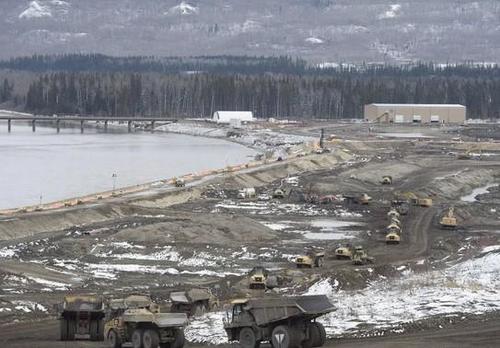 Photo: Financial Post
The breakdown of the numbers by the economists show how inefficient the project truly is:
The worst numbers in the study: the total present value of the electricity produced from Site C is estimated at $2.76 billion against an estimated total cost of $10.7 billion, implying a loss of $8 billion. That’s bad. However, if the project were cancelled now, the loss would be cut in half to maybe $4.5 billion. The economists conclude that “policy makers should stop throwing money at a project that is likely to end up under water.”
The economists found that the only way the hydro plant could be worth it, monetarily, would be in conjunction with a “massive national overhaul of the Canadian electricity system”:
“In summary, we find that Site C can offer value, but only if the provinces aim for near complete electricity system de-carbonization and only if new transmission between provinces can be built to enable greater inter-provincial electricity trade. Decisions about the future of Site C should be made in this light; if it is not possible to commit to fully decarbonizing electricity generation, and if prospects for inter-provincial transmission are low, Site C offers little value in comparison to its costs. In contrast, if B.C. and Alberta are committed to achieving a zero-carbon electricity system, and building new inter-provincial transmission lines is feasible, then Site C can offer value in excess of its costs.”
In light of there being a very small chance of that happening, it seems like the obvious decision to simply shut the project down and save several billion dollars.
And of course, it comes as no surprise to us that such a project is horribly cost inefficient. Because if it wasn’t, the free market would have put hydro electric plants to work a long time ago. In other words, the free market shut this project down before it ever even started.
But instead, we get another real life example of how virtue signaling and petty worries over carbon emissions – which are all trending the in the “right” direction globally anyway – lead to frivolous spending, funded by the taxpayer.
We hope B.C. remembers this if Elon Musk ever comes calling, looking for property to build his next solar roof tile factory…
You can read further analysis of the project and the full op-ed here.
Why isn’t NDP critic Randall Garrison questioning $200 billion navy procurement?
By Yves Engler · January 8, 2021
The job of the opposition in Parliament is to hold the government accountable, in part by asking questions. The role of an NDP critic should be to criticize from the left. So why the silence from Randall Garrison after Canada’s leading military reporter David Pugliese published a 5,000 word expose on the Canadian Surface Combatant headlined, “Billions in trouble: How the crown jewel of Canada’s shipbuilding strategy became a possible financial disaster waiting in the wings.”
Despite revelations over the past month of costs growing to over $200 billion, extreme secrecy, the addition of ballistic ‘missile defence’ and Tomahawk missiles that travel 1,700 kilometers, there has been nary a comment from the NDP defence critic on the 15 new frigates.
Initially pegged at $14 billion, the official price tag for the frigates later rose to $26 billion and now sits at $60 billion. In 2019 the Parliamentary Budget Officer put the cost about $10 billion higher and an updated frigates cost estimate next month is expected to reach $80 billion. To keep information about the swelling costs under wraps the military has resorted to extreme secrecy, reported Pugliese in the expose.
The recent winner of a lifetime achievement award from the Canadian Committee for World Press Freedom followed his investigation into the cost and secrecy surrounding the frigates with a story about government officials criticizing companies for speaking out. Subsequently, Pugliese published a story headlined “Top of the line Canadian-made naval equipment shut out of $70-billion warship program” about government subsidized firms cut out of the Lockheed Martin led consortium set to build the frigates. As a result, Thales Canada’s government funded naval radar, which is being used on German, Danish and Dutch warships, won’t be part of the Canadian Surface Combatant.
In response to Pugliese’s reporting, the Ottawa Citizen editorial board criticized the frigate purchase in “Choppy waters for Canada’s warship program”. In November the Hill Times also published a commentary titled “Canada’s surface combatant costs might be taking on water” and a front-page story titled “DND says budget for Surface Combatants remains unchanged; PBO report expected in late February”. Two days before Christmas CBC reported an astounding estimate for the lifecycle cost of the frigates. Initially detailed in Esprit de Corps, former defence official Alan Williams’ concludes that the 15 frigates will cost $213 – 219 billion over 40 years!
One explanation for the astronomical cost of the 15 frigates is the radar system that’s been chosen. According to a CBC story from early December, the radar can be easily upgraded to a ballistic missile defence system, which successive Canadian governments have resisted joining. In the mid 2000s the Canadian Peace Alliance, Échec à la guerre, Ceasefire.ca and others forced the Liberal government to shelve its plan to formally join the US Ballistic Missile Defence. (It’s called “missile defence” because it’s designed to defend US missiles when they use them in offensive wars.)
In November a number of military focused publications reported on the weaponry expected on the vessels. “Canada’s New Frigate Will Be Brimming With Missiles”, is how The Drive described the ships. In a first outside the US, Canada’s surface combatants look set to be outfitted with Tomahawk cruise missiles capable of striking land targets up to 1,700 kilometers away. As such, the frigates could be near London and hit Berlin or, more plausibly, docked in Panama City and strike Caracas, Venezuela.
As I recently detailed in Jacobin, Ottawa has long used naval force as a “diplomatic” tool. Early Canadian ‘gunboat diplomacy’ included pressing Costa Rica to repay the Royal Bank in 1921 and helping a dictator as he was massacring peasants in El Salvador in 1932. In recent years Canadian warships have gone to war with Libya and Iraq.
Amidst growing media criticism, NDP defence critic Randall Garrison has said nothing regarding the frigates’ cost, secrecy or weaponry. He hasn’t released a single tweet (or retweet) about any of the recent stories on the surface combatant vessels.
This is abysmal. What is the point of having an NDP defence critic if they are unwilling to question or challenge the largest procurement in Canadian history?
At the NDP convention in April members need to press Garrison to clarify his position on these violent, $200 billion frigates.
Politicians Criticize China’s Role in Hong Kong while Ignoring Canada’s Role in Haiti
By Yves Engler | Dissident Voice | December 11, 2020
For those who support a truly just foreign policy comparing Canadian politicians’ reactions to protests in Hong Kong and the slightly more populous Haiti is instructive. It reveals the extent to which this country’s politicians are forced to align with the US Empire.
Despite hundreds of thousands of Canadians having close ties with both Haiti and Hong Kong, only protests in the latter seem to be of concern to politicians.
Recently NDP MP Niki Ashton and Green MP Paul Manly were attacked ferociously in Parliament and the dominant media for participating in a webinar titled “Free Meng Wanzhou”. During the hullabaloo about an event focused on Canada’s arrest of the Huawei CFO, Manly — who courageously participated in the webinar, even if his framing of the issue left much to be desired — and Ashton — who sent a statement to be read at the event but responded strongly to the backlash in an interview with the Winnipeg Free Press — felt the need to mention Hong Kong. Both the NDP (“Canada must do more to help the people of Hong Kong”) and Greens (“Echoes of Tiananmen Square: Greens condemn China’s latest assault on democracy in Hong Kong”) have released multiple statements critical of Beijing’s policy in Hong Kong since protests erupted there nearly two years ago. So have the Liberals, Bloc Québecois and Conservatives.
In March 2019 protests began against an extradition accord between Hong Kong and mainland China. Hong Kongers largely opposed the legislation, which was eventually withdrawn. Many remain hostile to Beijing, which later introduced an anti-sedition law to staunch dissent. Some protests turned violent. One bystander was killed by protesters. A journalist lost an eye after being shot by the police. Hundreds more were hurt and thousands arrested.
During more or less the same period Haiti was the site of far more intense protests and state repression. In July 2018 an uprising began against a reduction in subsidies for fuel (mostly for cooking), which morphed into a broad call for a corrupt and illegitimate president Jovenel Moïse to go. The uprising included a half dozen general strikes, including one that shuttered Port-au-Prince for a month. An October 2019 poll found that 81% of Haitians wanted the Canadian-backed president to leave.
Dozens, probably over 100, were killed by police and government agents. Amnesty International, Human Rights Watch and other western establishment human rights organizations have all documented dozens of police killings in Haiti. More recently, Moïse has ruled by decree, sought to extend his term and to rewrite the constitution. Yet, I couldn’t find a single statement by the NDP or Greens, let alone the Liberals or Conservatives, expressing support for the pro-democracy movement in Haiti.
Even an equal number of statements from a Canadian political party would be less than adequate. Not only were the protests and repression far more significant in Haiti, the impact of a Canadian politician’s intervention is far more meaningful. Unlike in Hong Kong, the police responsible for the repression in Haiti were trained, financed and backed by Canada. The Trudeau government even gave $12.5 million to the Haitian police under its Feminist International Assistance Policy! More broadly, the unpopular president received decisive diplomatic and financial support from Ottawa and Washington. In fact, a shift in Canada/US policy towards Moïse would have led to his ouster. On the other hand, a harder Canada/US policy towards Hong Kong would have led to well … not much.
The imperial and class dynamics of Haiti are fairly straightforward. For a century Washington has consistently subjugated the country in which a small number of, largely light-skinned, families dominate economic affairs. During the past 20 years Canada has staunchly supported US efforts to undermine Haitian democracy and sovereignty.
Hong Kong’s politics are substantially more complicated. Even if one believes that most in Hong Kong are leery of Beijing’s growing influence — as I do — the end of British rule and reintegration of Hong Kong into China represents a break from a regrettable colonial legacy. Even if you take an entirely unfavorable view towards Beijing’s role there, progressive Canadians shouldn’t focus more on criticizing Chinese policy in Hong Kong than Canadian policy in Haiti.
Echoing an open letter signed by David Suzuki, Roger Waters, Linda McQuaig and 150 others and the demands of those who occupied Justin Trudeau’s office last year, the national president of the Public Service Alliance of Canada, Chris Aylward, recently sent a letter to Prime Minister Trudeau critical of Canadian support for Moïse. It notes, “Canada must reassess its financial and political support to the Jovenel Moïse government, including police training, until independent investigations are conducted into government corruption in the Petrocaribe scandal and ongoing state collusion with criminal gangs.” The NDP, Greens and others should echo the call.
To prove they are more concerned with genuinely promoting human rights – rather than aligning with the rulers of ‘our’ empire – I humbly suggest that progressive Canadians hold off on criticizing Beijing’s policy towards Hong Kong until they have produced an equal number of statements critical of Canada’s role in Haiti.
• To learn more about Canada’s role in Haiti tune into this webinar Sunday on “Imperialist attacks on Haiti and Haitian resistance: Canada’s Imperialist Adventures in Haiti.”
 Yves Engler is the author of 10 books, including A Propaganda System: How Canada’s Government, Corporations, Media and Academia Sell War and Exploitation.
Featured Video
Macgregor: We Haven’t Seen the Worst of the Iran War Yet
or go to
Aletho News Archives – Video-Images
From the Archives
15 Saudi ‘hijackers’ were CIA agents working for US: Scholar
Press TV – April 13, 2016
Fifteen of the 9/11 “hijackers” from Saudi Arabia were CIA agents working for the United States government, which was seeking to destroy the Middle East for Israel and to double the American military budget, says Dr. Kevin Barrett, an American academic who has been studying the events of 9/11 since late 2003…. continue
Blog Roll
 Aletho News
- Iran’s Plan to Shut Down AI in the Persian Gulf
- Israel seeks ‘compensation’ from Washington over Saudi F-35 sale
- Saudi crown prince seeks dialogue with Ansarullah after Yemeni blows: Report
- Damascus rejects Saudi request for Syrian fighters to counter Yemen: Report
- South Korea says will not send troops to join terrorist US war on Iran
- Russia Just Struck the Eyes of NATO’s War Machine in Ukraine
- Russia summons UK charge d’affaires over Kiev drone support
- NATO member warns bloc seeking pretext for war with Russia
- Macgregor: We Haven’t Seen the Worst of the Iran War Yet
- ‘We are not like everyone else’ laws that bind other nations do not apply to Israel, says Likud lawmaker
- If Americans Knew
- Debunking The Claim That Macklemore Has A “History Of Antisemitism”
- CPJ demands release of arrested Palestinian-US journalist near Bethlehem
- Robert Kraft: The Billionaire Friend of Netanyahu Pulling The Strings Behind the Macklemore/Ed Sheeran Blow Up
- Columbia Administered Fund Gives Big Money to Pro-Israel Groups
- Deportation Case of Palestinian Activist Salah Sarsour Tests First Amendment
- ‘We Will Not Forget’: Palestinians Mark 44 Years since Sabra and Shatila
- Why do we let Zionists decide what we can and can’t say?
- US welcomes Israeli, Iranian delegations to UN, but not Palestinians – Daily Update
- Biden’s Genocide Accomplices Targeted by New Accountability Campaign
- AIPAC’s Network Has Already Spent $67.2 Million to Shape the Midterm Elections
- No Tricks Zone
- New Study: ‘Global Drought Shows No Detectable Recent Acceleration Under Climate Warming’
- Economic Masterminds: German Socialists Suggest Taxing Productivity Gains Stemming From Using AI
- The South China Sea Has Not Been Cooperating With The Climate Change Narrative
- Energy Crisis: Germany Enters Heating Season With Historically Low Gas Reserve Fill Levels
- New Study: The Antarctic Ice Sheet Gained Mass From 2020-2024 Due To Staggering Snow And Ice Accumulation
- Study: Ocean Heating Rates From Thousands Of Years Ago ‘Dwarf’ Modern Ocean Heating Rates
- Climate Extremists Target, Attack Large-Scale Power Grid Infrastructure In Germany!
- New Study: Antarctic Ice Melt Has Contributed Less Than 1 Centimeter To Sea Level Rise In The Last 30 Years
- Fear Of Debate: Alarmist German Climate Scientist Calls On Mainstream Media To Discredit Skeptic Voices
- End-Of-August Arctic Sea Ice Extent Hasn’t Fallen In 20 Years, Official Data Show!
 Aletho News