Authorities Have No Intention of Relinquishing Lockdown, Says Canadian Rights Activist
By Denis Bolotsky – Sputnik – 11.04.2021
On 1 April, Ontario Premier Doug Ford announced another 28-day province-wide COVID “shutdown”. Some observers claim that the officials need the restrictions in order to introduce vaccination passports.
According to human rights advocate Chris Sky, local government representatives and their medical advisers also don’t want to end the string of lockdowns because it will undermine the vaccination campaign.
Sputnik: Your province is currently in “shutdown mode”, with restrictions on retail and with a stay-at-home order in place. How are the people of Ontario reacting to all that?
Chris Sky: People like me saw the shutdown coming a mile away. I was on shows like Alex Jones’ “Infowars” and others, and I literally warned about the exact state of the shutdown. I even gave people the headline they were going to use. I told everyone they are going to pretend to open then they are going to tell you they are “pulling the emergency brake” because this shutdown has been planned well in advance.
The entire “plandemic” has been planned in advance, and the goal at the moment is to close down as many businesses as possible, so they can push universal basic income through parliament, and make Canadians accept it as a good thing.
And the second part of this whole lockdown is trying to make it so Canadians can’t leave their homes until they agree to be vaccinated so then they can get enough compliance with the vaccine, which they are not getting right now – nobody wants it, even with all the coercion going on.
They want to get enough compliance with the vaccine, so they can implement the vaccine passport like we’ve seen them do in Israel, like we’ve seen them do in New York State, and like we’ve seen them try to do in Texas, Florida, Kansas, Massachusetts, who have blocked it. And Canadians are still in denial that vaccine passports are even a reality. It’s insane.
Sputnik: But the disease is still there, isn’t it?
Chris Sky: No one is saying there is no disease, but that doesn’t mean that you need to submit to a forced vaccination multiple times a year for the rest of your life in order for the pretense to be free to live your life and to travel. That’s medical tyranny. And the vaccine passport has been the goal since the start of this. The vaccine passport has been on the books in European law from 2018 before the pandemic.
And the European internal documents show that they planned to have the vaccine passport implemented worldwide by 2021. And what are we seeing? Just like the documents stated, it’s 2021 and we’re seeing vaccine passports being implemented.
Sputnik: Recently you were placed on Canada’s no-fly list. Why did it happen?
Chris Sky: Well, I can only speculate, but it’s seems pretty obvious – because of my activism, and because of me trying to inform Canadians of their rights and their ability to “#JustSayNo”. That’s my international hashtagging campaign to get people aware, to ask questions, and not just blindly comply with rules that are against their own best interests.
It ended up with a no-fly list, but it was a build-up of things from that – I’ve been getting charged by the police, I’ve been getting fined by the police, I had the police show up at my house at one o’clock in the morning without a warrant, and basically trying to get at me with about 40 police using 20 cruisers to block off both sides of the street around my house. And they didn’t even have a warrant to be there. So, basically they are just trying to silence me.
What they did to me – putting me on the no-fly list, was nothing short of lawless, communist-style dictatorship, political targeting of dissident. Our no-fly list explicitly states that it cannot be used against political activists or people utilising their free speech rights. And that’s exactly what they did, and it’s 100 percent illegal.
Sputnik: But formally they could have placed you on the list just because you are refusing to wear a mask, couldn’t they?
Chris Sky: It has nothing to do with the mask. If they pretend that it has to do with the mask – they are lying even further. Just like they did when they showed up at my house with 40 policemen to try to arrest me at one in the morning for not wearing a mask. I don’t wear a mask anywhere I go.
Sputnik: During the past year Ontario officials frequently used numbers of COVID cases as a pretext to shut down the province. At least in 2020, these numbers were overblown, since even suicides of persons with coronavirus were counted as COVID deaths – a practice which Toronto Public Health refused to comment on when asked by Sputnik last week. Do you think there is a chance that the authorities will impose further restrictions in Ontario beyond the current 28-day-long shutdown?
Chris Sky: Of course. What do you think they’ve done so far? Before it was about “flatten the curve”. We heard it a million times a day. And that mean don’t “overwhelm our hospitals”. Well, now the gig is up and everybody knows that there is nobody in the hospitals. So, now they lie and talk about “cases” and “new variants”. And they just make anything they want up.
If they want to raise cases – just test an extra 10 or 20 thousand people that week and – surprise, you’re going to have more cases. So, it’s all complete bull. Anybody that knows anything knows that they have no intention of relinquishing the lockdown, no intention of cancelling the emergency. The moment they cancel the emergency, they can no longer force the vaccine on people, because it only has emergency approval. So, they have absolutely zero intention of ever relinquishing this emergency until their agenda is complete.
Lockdown-skeptic Rebel News vows to sue Montreal police after reporters detained at ‘illegal gathering’
RT | April 10, 2021
Reporters for the right-leaning news outlet Rebel News have posted videos showing employees being detained by police at an Airbnb location where they were working covering Covid-19 lockdown measures.
In one video posted to Twitter on Saturday, Rebel News reporter David Menzies can be seen having a tense exchange with police officers, which eventually leads to him being hauled away and detained.
Another reporter for the outlet, Keene Bexte, tweeted that he had also been arrested.
Rebel News co-founder Ezra Levant promised he would be suing the officers for their conduct and in another video can be seen taking down one officer’s name.
According to a statement from the Canadian outlet, police arrived at an Airbnb where Rebel News journalists were staying to cover anti-lockdown protests and Covid-19-related arrests and forced everyone out and conducted a “room to room” search.
“When we asked them what the ‘crime’ was, all they could come up with was that our staying in the hotel was an illegal ‘gathering,’ contrary to Quebec’s lockdown laws,” they said.
The outlet added that they were staying in a “registered, legal hotel rental on Airbnb” and fewer guests than the place was built for.
Levant claims the outlet’s unflattering reporting on Montreal police and their enforcement of Covid-19 restrictions is what prompted the visit and search of the houseboat being utilized by the reporters.
“This is their revenge,” he said. “Because we report on their misconduct.”
Levant is already fundraising to support his lawsuit against police, alleging the search and arrests were unjustified and claiming officers have repeatedly harassed Rebel News reporters in recent weeks and made bigoted remarks.
The reaction to the arrests has been mixed at best. While many have expressed shock at the police behavior and allegations from Rebel News on social media, others have simply used the opportunity to blast the highly-controversial outlet, which is often dismissed in mainstream media as a “far-right” enterprise pushing misinformation.
Montreal on Saturday saw a mass protest against the strict Covid-19 measures recently imposed by the authorities in Quebec. An 8pm curfew has been reintroduced in the city, while all the non-essential businesses and schools have been told to shut down until at least April 19. According to the independent news outlet Westphalian Times, the organizers of the protest march sought to highlight the “negative impacts restrictions in schools have on the well-being & development of children.”
Updates:
Ontario has had the longest lockdown in North America – which has been so successful it’s just gone into another one
By Eva Bartlett | RT | April 8, 2021
It’s April 2021 and we’re still being fed the same “stay home, save lives” line of 2020. But lockdowns are based on dodgy data and exaggerations, as well as causing more harm than they supposedly prevent.
As of today, Ontario is once again locked down. The last lockdown of two months was lifted only a month ago.
The province has endured the longest lockdowns in the country, thanks to politicians and medical officers pushing selective statistics.
The “Stay-at-Home” order (sounds so much nicer than lockdown!) requires people to imprison themselves again, except for “essential purposes” (exempt, of course, are Canadian politicians, who have repeatedly violated their own exhortations).
This latest draconian lockdown again impacts nearly every aspect of Ontarians’ ability to live their lives
It means: closed businesses; increasing poverty, loneliness, and depression; increased domestic abuse, a rise in suicides and self-harm; and utter media hysteria (actually, the media hysteria and fear mongering has not ceased since the announcement of a pandemic one year ago).
A petition to end Ontario’s lockdown of small businesses notes:
“There are over 440,000 small businesses in Ontario.
“Less than a week ago [state premier] Doug Ford told restaurants they would be allowed to operate outdoor dining even in grey zones; this caused restaurant owners to spend thousands of dollars on these spaces only to find out that this would not be the case in this current closure.
This level of carelessness and lack of foresight could be the demise of many locally owned restaurants.”
Alarmism and exaggerated ICU data
Premier Doug Ford, in his address yesterday, spoke of case rates, hospitalizations, and ICU occupancy “increasing rapidly, threatening to overwhelm the healthcare system.”
But, as I’ve written before, the whole concept of “cases rising” is meaningless: “Cases are determined by Covid-19 tests, which have proved to be unreliable and inaccurate, giving false positives and creating a false picture of reality. This faulty testing is exacerbating the media hype over ‘rising cases.’”
And according to a long-time employee at the Ottawa General hospital I corresponded with: “I work in a large hospital and I pass through the Covid-19 ICU unit every day. And it’s never been overflowing or too busy.”
Or, as a columnist for the Toronto Sun noted: “Toronto’s top doc said that data was showing younger people in ICUs. Asked about the data, she changed her tweet to say she was ‘hearing’ of younger Toronto ICU patients. Big difference between data showing and you hearing anecdotally.”
Or, as an Ontario MPP noted: “The @OntHospitalAssn keeps fear mongering about ICU capacity. But Critical Care Services Ontario ICU data for Apr 3 reveals: Toronto 375 of 496 beds taken (76%) Central: 398 of 513 (78%) Ontario: 1852 of 2418 (77%) The question to the OHA is why?”
In fact, every year in flu season, we’ve had reports of overcrowding in hospitals, hospitals bursting at seams. This never caused us to shut down our economy and lock down our citizens.
Finally, more and more journalists are asking for proof of the claims bandied about by the Fords and media.
Even Naomi Wolf, not your average “conspiracy theorist” or “right winger” (as those opposed to brutal lockdowns are often described by dinosaur media) tweeted, “How are Canadians still being told such gigantic lies? The whole ‘lockdown equals public safety’ mythology is fully deceased.”
Vested interests in vaccines?
While ordinary Canadians suffer tremendously under lockdowns, Canada’s unelected medical tyrants, the Medical Officers of Health (MOH) are doing quite well, earning $200,000 – $300,000, and more.
In addition to pushing for this latest lockdown, Ontario MOHs went the extra mile and called for “fewer businesses to be deemed essential and more operations shut down.”
Because a year-plus of lockdowns destroying small businesses’ ability to survive just wasn’t enough…
Some of these MOHs may even have financial links to the rollout of vaccines.
In his press conference yesterday, much of Premier Ford’s focus was on pushing jabs.
Ford promised, “better days are ahead of us,” followed by more calls for Ontarians to get jabbed with vaccines made faster than ever before which, technically, will not even be out of the clinical trials stage till next year at the earliest.
The AstraZeneca vaccine is being suspended by countries around the world for causing blood clotting, which could lead to death.
In spite of this, Ontario continues to push it. As of April first, Canada has bought around 24 million doses. In addition to its AstraZeneca purchases, Canada agreed to purchase at least 20 million doses of Pfizer’s hurried vaccine.
In March, the media reported that Toronto’s MOH, Eileen de Villa, is married to Dr Richard Choi, a cardiologist and lecturer at Unity Health Toronto, who lists Pfizer and AstraZeneca among his ‘Relationships with financial interests.’ Under de Villa’s leadership, “Toronto Public Health has been used as a tool to counter any ‘misinformation’ about vaccination,” and was allegedly “behind a call to ban vaccine exemptions because of religious or philosophical beliefs.”
Another article on the de Villa-Choi conflict of interest noted: “It’s not a good look when you lock down your city when you don’t have to and your husband has financial interests with AstraZeneca and Pfizer.”
In mid-March, Premier Ford said he isn’t making the decisions, the chief medical officers are. He also said it would essentially be political suicide to go against them.
“To be frank, there’s no politician in the country who’s going to disagree with their chief medical officer. They’re just not going to do it. They might as well throw a rope around their neck and jump off a bridge.”
Last December, Toronto’s Associate MOH, Dr. Barbara Yaffe, and Chief MOH, Dr. David Williams, admitted they are just reading a script, “I just say what they write down for me.” And laughed about it.
So, we have unelected medical officers running the show, essentially forcing government decisions on lockdowns and related issues. And as a Toronto lawyer opposed to lockdowns noted,“local Councils are legally powerless to stop” these unaccountable MOHs. How wonderfully democratic.
There is definitely a will and momentum to resist the brutal lockdown measures affecting all but the fat cats flouting them. With a new round of bullying by unelected medical officers, I hope the resistance to tyranny grows.
Eva Bartlett is a Canadian independent journalist and activist. She has spent years on the ground covering conflict zones in the Middle East, especially in Syria and Palestine (where she lived for nearly four years).
Employment Standards Act: You can now be laid off without pay for not being vaccinated
Press for Truth | April 1, 2021
The newly revised Employment Standards Act in Ontario now states that an employer can layoff an employee without pay for failing to prove that the employee has received a Covid-19(84) vaccine. Meanwhile vaccine passports are becoming a big brother nightmare reality as the world shifts into a digital realm where your every move will be tracked, traced and databased all in the name of keeping you safe from Covid-19(84). In this video Dan Dicks of Press For Truth gives a Covid-19(84) update about new Draconian measures in Ontario when it comes to safety in the work place and also “vaccine passports” that are coming down the pike for everyone in the near future!
Sources:
https://www.theatlantic.com/health/archive/2021/03/fourth-surge-variant-vaccine/618463/
https://twitter.com/CBCAlerts/status/1376580038376689671
SUBSCRIBE:
BITCHUTE ➜ https://www.bitchute.com/pressfortruth/
LBRY ➜ https://lbry.tv/@PressForTruth
FLOTE ➜ https://flote.app/DanDicksPFT
MINDS ➜ https://www.minds.com/pressfortruth
YOUTUBE (meh) ➜ https://www.youtube.com/user/weavingspider
FOLLOW:
PARLER ➜ https://parler.com/profile/DanDicksPFT/posts
INSTAGRAM ➜ http://instagram.com/dandickspft
TWITTER ➜ http://twitter.com/#!/DanDicksPFT
POCKETNET➜ https://tinyurl.com/yyju6yg8
GAB ➜ https://gab.com/PressForTruth
If you appreciate my efforts please consider making a contribution here:
SUPPORT:
PATREON ➜ https://www.patreon.com/PressForTruth
SUBSCRIBESTAR ➜ https://www.subscribestar.com/pressfortruth
DONATE via Paypal ➜ https://www.paypal.me/PressforTruth
GoGetFunding ➜ https://goget.fund/2UBhENH
Bitcoin ➜ 13oNiHUNGn9vdfv7MT5kjwe7np9bwf5ccv
Or you can send an e-transfer to dan@pressfortruth.ca
If you’re old fashioned like we are and prefer to keep it old school, we also accept cash, cheques, equipment and words of encouragement! You can send us those things here:
Dan Dicks P.O. Box 1521 Squamish BC V8B 0B1
MILITARY INDUSTRIAL BOONDOGGLE
By Paul Robinson | IRRUSSIANALITY | March 29, 2021
Today in my defence policy course my students and I shall be spending some time discussing defence procurement. As luck would have it, as I was munching on my morning bread and marmalade, a highly relevant article swam into view in the op-ed page of my local rag, The Ottawa Citizen, after which I then discovered a new US report on a similar topic.
The Citizen article concerns Canada’s shockingly badly managed naval shipbuilding program. Written by a former Assistant Deputy Minister of Defence, Alan Williams, the article declares that ‘Canada’s Warship Program is Sinking Fast.’ In this Williams reports that Canada’s plan to build 15 new surface combatants originally had
an estimated cost of $26 billion, with deliveries to begin in the early 2020s. Today, the forecasted costs to build these ships is far beyond that. Deliveries are to start in the early 2030s, a decade later than scheduled … [The Parliamentary Budget Office] estimates that it will cost $77.3 billion … to maintain these ships over their expected total life-cycle would amount to an additional $208 billion, for a total life-cycle cost of $286 billion. In comparison, the funds available in DND’s [Department of National Defence] budget over the next 30 years to acquire and maintain its capital goods for the army, navy and air force combined is only $240 billion. This program alone would bankrupt the department’s capital and maintenance accounts for the next 30 years.
Despite this, DND insists that, ‘It will neither entertain a new design nor undertake a new procurement process.’ Williams adds that the United States is building very similar ships for about one-third of the price of the Canadian ones, and also that DND rejected an offer by the Italian company Fincantieri to build the ships in Canada ‘at a fixed cost of $30 billion’, less than half what DND is now paying. ‘As currently planned, these ships will likely never be built. They are simply unaffordable,’ concludes Williams.
But could the government cancel such a project after throwing so much money at it? That’s where the US report comes in. Published by the American Enterprise Institute, and entitled The 2020s Tri-Service Modernization Crunch, the report mentions how the shift in priorities during the War on Terror led the USA to cancel a whole series of projects originally designed for fighting wars of a different type. You can see the details in this chart, showing cancelled projects from 2002 to 2012 alone.

The ‘Sunk Cost’ column shows how much the US government had already spent on the project by the time it was cancelled. For instance, the Future Combat System, designed to revolutionize the US army by equipping it with networked vehicles, cost a staggering $22 billion before it was scrubbed. In total, in just one decade 2002-2012, projects were cancelled that had cost $81 billion. That’s $81 billion of taxpayers’ money that produced absolutely nothing! Nadda. Think about that for a second.
Waste on this scale is quite staggering. You’d think people would be outraged. But for whatever reason, it seems like nobody cares very much. It’s as if it’s just assumed that this is the cost of doing business.
Meanwhile, some people are doing very well out of it, namely defence industries. They, no doubt, would tell us all that the money isn’t wasted, because it all helps to stimulate the economy. ‘Money spent on defence boosts growth’ they tell us. But does it? I decide to check, and discovered this little table that summarizes economists’ research into the multiplier effect of defence spending.
For those of you without economics training, the multiplier effect is a measurement of how much the economy grows as a result of expenditure. The idea is that if the state spends some money on x, then that produces spending on y, which in turn produces spending on z, so that for every buck you spend, you stimulate the economy as a whole by several bucks. So what’s the multiplier of defence spending? The table tells us.

As you can see, research on the matter suggests strongly that for every dollar spend on defence, you get less than a dollar’s growth in the economy, with most studies showing a multiplier of around 0.6.
So, defence spending isn’t so great for the economy after all. I can’t say that I’m surprised. Yet somehow, we allow huge sums of money to be squandered on unnecessary and grotesquely overpriced military projects. I don’t know about you, but it suggests to me that there’s something seriously wrong with our democracy.
PS. An article published yesterday in Sputnik News tells us that the Russian Navy is planning to test its new Zircon hypersonic missile at the start of the summer. Coming on top of the deployment of Russia’s Avangard intercontinental hypersonic glide missile, this puts Russia well ahead of the rest of the world in the realm of hypersonic technology. Russia’s defence spending is about three times that of Canada in raw dollar terms (about $65 v. $22 billion). Yet, it’s in a completely different league. We can’t build a few ships. They can develop hypersonic missiles. All of which makes me think that raw numbers of defence spending don’t tell us everything. Just as important is how effectively the money is spent. From that perspective, we don’t seem to be doing so well.
Canadian Gov’t’s Move to Hire Influencers to Tout its Work is a ‘Form of Propaganda’: Journalist
Sputnik – 27.03.2021
A website called Blacklock’s Reporter revealed on Thursday that Canada’s Department of Health wants to hire celebrities and digital influencers “to say nice things” about its work on social media. According to Canadian independent journalist Leigh Stewart, this spin operation shows that the Liberal government lacks honesty and transparency.
Sputnik: The news about the government’s online endorsement campaign appeared after several controversial stories involving Minister of Health Patty Hajdu, some of them pandemic-related, surfaced online. What do you think about it as a journalist, and as a taxpayer?
Leigh Stewart: It doesn’t surprise me that the government would be willing to pay people to give them praise, or promote what they are dishing out. It’s a form of propaganda. It reminds me what they did in 2019: paid influencers to promote the election (Trudeau’s election) until they scrapped it when people realised the social media influencers that were chosen had a Trudeau bias. We never did get that money back.
Sputnik: According to another news outlet – The Post Millennial, the influencers will not be required to tell their audience that the Trudeau government will be paying them – something which is illegal, according to the Canadian government’s own website. It’s also unclear how much money the bloggers will be receiving. Do you think Canadians deserve to know how their tax dollars are being spent on celebrity endorsements?
Leigh Stewart: The government has never been transparent. If this current government was honest, they wouldn’t need to pay celebrities to praise them, that would come naturally. Canadians should definitely know where their tax dollars are going, it’s a mockery to the hard working Canadians to not be informed, personally I think it equates to theft.
Sputnik: It’s likely that a lot of that “positive content” about the government will be COVID-related. Do you think the handling of pandemic-related issues by the Department of Health during the past year has been adequate and effective?
Leigh Stewart: Health Canada needs all the help they can get, seeking praise for their decisions surrounding the coronavirus. Nothing they have put in place, whether it be lockdowns, wearing masks, has worked. We are in the same place we were a year ago and not much has changed. I think the lockdowns are doing more harm than good, with the help of big tech and corporations, especially for small business. Anyone who speaks out against the current government and their solutions backed with zero evidence is silenced, or presented with a summons to court. I think their goal is to abolish the middle class. Get a majority of people on government assistance (Canada has the highest unemployment in the G7) and inflate prices so eventually, people cannot afford to live.
Canadians don’t need a babysitter to tell them what to do, last time I checked we had a freedom of choice. If you don’t want to wear a mask, go ahead. If you want to keep your small business open, go ahead. There should be absolutely nothing wrong with people making the choices that they feel are best for them.
Sputnik: Ontario premier Doug Ford said that the authorities will be watching the daily case numbers, as the COVID infection rate has increased in your province. All of that may sound as if the authorities are preparing for another lockdown, while the previous one has not been fully lifted. Do you think people would readily accept the new restrictions?
Leigh Stewart: I think a lot of people are getting fed up. In the beginning it was only 15 days to flatten the curve and here we are, a year later, only now the narrative has changed. It’s now about waiting for a vaccine. Which health officials say you will still have to wear a mask, even if you receive one. The Premier of Ontario Doug Ford is relying on medical health professionals to tell him what to do, when I’m not convinced they actually do know what they are doing. Locking down again hurts small business and even Ford has admitted that himself.
Father of trans teen kept in jail after speaking to press about resisting hormone injections for his child
RT | March 21, 2021
A Canadian man, involved in a legal battle over his right to object to hormone treatment for his teenage trans child, has reportedly been jailed and denied bail for violating a gag order banning him from discussing the story.
Robert Hoogland was denied bail by the Vancouver Supreme Court on Friday and will remain in the North Fraser remand prison, according to news website the Post Millennial. He was arrested this week for contempt of court, due to his continued violation of an order restricting his speech regarding his transgender child. Hoogland fought a lengthy battle, defending his right to have a say in whether life-changing hormone therapy may be offered to a minor without parental consent.
The signature case in Canada’s British Columbia (BC) started several years ago. At the age of 12, ‘Maxine’ (not the child’s real name), who was assigned female gender at birth, struggled to find her place in life, including her gender identity. Her school counselor suggested she may be transgender, referring her to a doctor and telling the school to treat her like a boy.
By the age of 14 the teen was identifying as a male trapped in a female body and was eager to start hormone therapy. The mother was supportive of the decision, but Hoogland – who was separated from the rest of the family but shared custody over the child – felt things were rushed. He said he would be OK with a transition if his child were older and more prepared to make an informed decision about a life-altering procedure. The consent form he refused to sign said hormones could result in various health complications, including elevated risk of heart disease, stroke, or diabetes, and even infertility.
This happened in 2018 and led to a series of court proceedings to decide whether Maxine could be the ultimate arbiter on the matter. That was the position of the gender clinic at BC Children’s Hospital, based on the Infants Act. The law says a “mature minor” may give consent to receiving healthcare.
Critics believe the law allows ideologically driven trans activists to lean on confused children and convince them into making a transition that would not necessarily be beneficial to them, while barring their legal guardians from having a say on the issue.
In Hoogland’s case, Canadian courts repeatedly sided with the hospital and allowed hormone therapy to proceed. Moreover, the father was significantly restricted in how he could speak about the case. He was ordered to always use Maxine’s chosen name, gender, and pronouns, and was banned from trying to convince his child to stop the therapy. A judge even stated that his interviews with the media, in which Hoogland referred to Maxine as his daughter and said things like “her DNA will not change through all these experiments that they do,” may be considered “family violence.”
A 2020 review of the conflict at the BC Court of Appeal opined against such framing, acknowledging there was no evidence that Hoogland (who is called ‘CD’ in court papers and ‘Clark’ in some earlier media reports) was intentionally abusive, and saying the conflict was about “a complex family relationship stemming from a profound disagreement about important issues of parental roles and medical treatment.” His plea to block the transition, however, was rejected.
The April 2019 gag order, which barred Hoogland from sharing information about Maxine’s “sex, gender identity, sexual orientation, mental or physical health, medical status or therapies” with the general public, also remained in place. The dad, who believes his family’s story should be properly discussed, disobeyed, and in early March an arrest warrant was issued against him at the request of the BC Attorney General. He surrendered to the authorities on March 16.
The denial of bail puts Hoogland between a rock and a hard place. One of the things he was reportedly admonished for by the judge was failing to take down a crowdfunding page, on which he explains his situation – in apparent breach of the gag order – and asks for donations to cover legal fees. He had been instructed to comply by April 12, when proceedings on his contempt of court case are scheduled to begin, but says he cannot do it from jail.
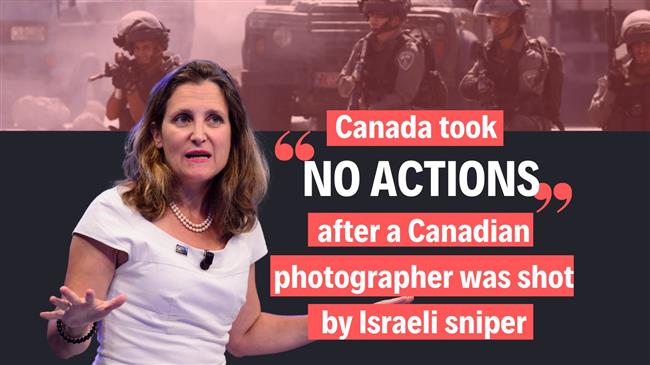
Canada has taken ‘no actions’ to incriminate Israel over shooting Canadian journalist
Press TV – March 13, 2021
A Canadian rights advocacy organization has revealed that the country’s government declined to hold to account the Israeli regime for the 2015 shooting of a Canadian journalist photographer in the occupied West Bank, denouncing Ottawa’s inaction as “shocking” and calling on the government to impose sanctions against Tel Aviv over the crime.
Canadians for Justice and Peace in the Middle East (CJPME) made the revelation in a series of tweets late on Friday, saying that the government in Ottawa, as confirmed by Canada’s Deputy Prime Minister Chrystia Freeland, had taken “no actions” to protest the shooting of Rehab Nazzal by an Israeli sniper in December 2015.
The Canadian-Palestinian journalist was photographing a protest rally in the occupied West Bank city of Ramallah at that time when she was shot in the leg by the Israeli sniper.
The rights organization said they had confirmation from Freeland that “no actions have been taken” by Canada “to protest this incident,” and added that, “This callous inaction is shocking and must be corrected.”
Canadians for Justice and Peace in the Middle East highlighted the official confirmation by attaching a letter from Freeland in response to Nazzal’s lawyer, Dimitri Lascaris, who had demanded that the Canadian government hold the Israeli sniper accountable.
“CJPME calls on the Canadian government to take immediate action to investigate the shooting of Rehab Nazzal, and to impose sanctions against the Israeli authorities responsible for this crime,” the advocacy organization said in one of its tweets.
“If Canada won’t even reprimand Israel when it shoots a Canadian citizen, how little value does Canada give to the lives of those under Israel’s occupation?” it added.
Moreover, the rights organization included in another tweet a statement from Nazzal’s daughter, Rana, who had censured as “racist” Canada’s response to her mother’s case.
“Six years ago, my mom was shot by an Israeli sniper. She photographed a soldier aiming at her, saw medics running and looked down to see blood,” Rana said. “Freeland’s callous response is in perfect line with Canada’s racist policy of pretending to not see Israeli violence, even as blood spills.”
The Canadian government has in some certain cases adopted a pro-Israeli approach to the issue of Palestine, which has been taken to task by rights groups and activists in the North American country.
In December last year, human rights activists in Canada called for an end to the recruitment of Canadian citizens by the Israeli military after reports indicated that hundreds of Canadian citizens had joined the occupying regime’s military in the recent years.
The activists maintained that the measure by the Israeli army is in violation of the Foreign Enlistment Act, which prohibits the recruitment of Canadian citizens by foreigners.
In another controversial case in 2019, the Canadian government was forced under pressure from the country’s rights groups to revoke the charity status of a Jewish organization over funding Israeli military projects and settlements in the occupied West Bank.
Under Canadian law, registered charities are prohibited from donating funds to “foreign armed forces.”
About 600,000 Israelis live in over 230 illegal settlements built since the 1967 Israeli occupation of the Palestinian territories of the West Bank and East Jerusalem al-Quds.
Palestinians want the West Bank as part of a future independent Palestinian state with East Jerusalem al-Quds as its capital.
Featured Video

Macgregor: We Haven’t Seen the Worst of the Iran War Yet
or go to
Aletho News Archives – Video-Images
From the Archives
15 Saudi ‘hijackers’ were CIA agents working for US: Scholar
Press TV – April 13, 2016
Fifteen of the 9/11 “hijackers” from Saudi Arabia were CIA agents working for the United States government, which was seeking to destroy the Middle East for Israel and to double the American military budget, says Dr. Kevin Barrett, an American academic who has been studying the events of 9/11 since late 2003…. continue
Blog Roll
 Aletho News
- Iran’s Plan to Shut Down AI in the Persian Gulf
- Israel seeks ‘compensation’ from Washington over Saudi F-35 sale
- Saudi crown prince seeks dialogue with Ansarullah after Yemeni blows: Report
- Damascus rejects Saudi request for Syrian fighters to counter Yemen: Report
- South Korea says will not send troops to join terrorist US war on Iran
- Russia Just Struck the Eyes of NATO’s War Machine in Ukraine
- Russia summons UK charge d’affaires over Kiev drone support
- NATO member warns bloc seeking pretext for war with Russia
- Macgregor: We Haven’t Seen the Worst of the Iran War Yet
- ‘We are not like everyone else’ laws that bind other nations do not apply to Israel, says Likud lawmaker
- If Americans Knew
- Debunking The Claim That Macklemore Has A “History Of Antisemitism”
- CPJ demands release of arrested Palestinian-US journalist near Bethlehem
- Robert Kraft: The Billionaire Friend of Netanyahu Pulling The Strings Behind the Macklemore/Ed Sheeran Blow Up
- Columbia Administered Fund Gives Big Money to Pro-Israel Groups
- Deportation Case of Palestinian Activist Salah Sarsour Tests First Amendment
- ‘We Will Not Forget’: Palestinians Mark 44 Years since Sabra and Shatila
- Why do we let Zionists decide what we can and can’t say?
- US welcomes Israeli, Iranian delegations to UN, but not Palestinians – Daily Update
- Biden’s Genocide Accomplices Targeted by New Accountability Campaign
- AIPAC’s Network Has Already Spent $67.2 Million to Shape the Midterm Elections
- No Tricks Zone
- New Study: ‘Global Drought Shows No Detectable Recent Acceleration Under Climate Warming’
- Economic Masterminds: German Socialists Suggest Taxing Productivity Gains Stemming From Using AI
- The South China Sea Has Not Been Cooperating With The Climate Change Narrative
- Energy Crisis: Germany Enters Heating Season With Historically Low Gas Reserve Fill Levels
- New Study: The Antarctic Ice Sheet Gained Mass From 2020-2024 Due To Staggering Snow And Ice Accumulation
- Study: Ocean Heating Rates From Thousands Of Years Ago ‘Dwarf’ Modern Ocean Heating Rates
- Climate Extremists Target, Attack Large-Scale Power Grid Infrastructure In Germany!
- New Study: Antarctic Ice Melt Has Contributed Less Than 1 Centimeter To Sea Level Rise In The Last 30 Years
- Fear Of Debate: Alarmist German Climate Scientist Calls On Mainstream Media To Discredit Skeptic Voices
- End-Of-August Arctic Sea Ice Extent Hasn’t Fallen In 20 Years, Official Data Show!
 Aletho News