Lion Electric School Buses Still Catching Fire
StacheD Training | September 9, 2025
On September 9, 2025, another Lion Electric school bus burst into flames in Montreal — this time with five children and their driver on board. Thankfully, everyone escaped safely, but this marks the third Lion Electric bus fire in less than a year (Ascot Corner, Huntsville, and now Montreal).
In this video, I break down what happened, why the fire department’s explanation doesn’t quite line up with the bus’s construction, and why these repeated incidents raise serious questions about safety, accountability, and taxpayer funding. Lion has already taken nearly $160 million in U.S. funding for 435 buses, yet many districts never received vehicles — and the ones that did are stuck with broken, unsafe buses and voided warranties.
Are these buses ready for prime time, or is this a dangerous rush to electrify at any cost?
Training & Consulting: https://www.stachedtraining.com
Exposing Jewish Exceptionalism In Canadian Media
The misguided belief in eternal Jewish victimhood is being weaponized to help allow Israel’s genocide to continue
By Davide Mastracci ∙ The Maple ∙ September 3, 2025
Over the past decade, I’ve written extensively on the pro-Israel bias in Canadian media. This article will focus on something different, but which helps shape the bias: Jewish exceptionalism.
You can find articles about how various -isms and -phobias impact Canadian media: homophobia, Islamophobia, transphobia, xenophobia, classism, racism, sexism, etc. And yet, there’s little out there on Jewish exceptionalism, which is increasingly being analyzed by commentators outside of the country.
Jewish exceptionalism is the belief that Jewish people as a demographic are eternally and ontologically oppressed, no matter the circumstances, and as such should be treated differently. Jewish exceptionalists refer to antisemitism as the “oldest hatred,” and treat it as though it’s the only one powerful enough to make its targets a permanently marginalized group.
This incorrect analysis fails to take into account the status of Jewish people in Canada and elsewhere over at least the past few decades. While Jews remain the targets of alleged hate crimes (though reports on the issue vastly overstate the reality), they face no systemic discrimination and generally fare exceptionally well in Canada and elsewhere on all other markers used to measure oppression. As a point of comparison, few that anyone would take seriously argue that dozens of churches being burned down in acts of arson since 2021 make Christians an oppressed group in Canada.
This article will illustrate how Jewish exceptionalist sentiment underlies much of the discussion in Canadian media involving Jewish Zionists by outlining five tropes, providing examples of them in mainstream publications and explaining how they smuggle in the idea that Jewish people are exceptional and should be treated as such. The tropes are: ‘Jewish-owned business’; ‘blood libel’; ‘Jewish state’; ‘Jewish neighbourhood’; ‘list of Jews.’
While this article could have been written at any point in recent years, I’ve done so now because Israel, the state claiming to represent Jews and which enjoys widespread support from them according to polling, is committing a genocide in the name of Jewish supremacy, the most explicit form of Jewish exceptionalism. Those who defend Israel and seek to undermine the pro-Palestine movement also utilize arguments that rely on Jewish exceptionalism to do so.
As such, these tropes deserve to be identified and refuted because they strengthen narratives defending the worst atrocity of our time: Israel’s genocide in Gaza.
‘Jewish-Owned Business’
The term “Jewish-owned business” appeared in Canadian newspapers 70 times between Oct. 7, 2023, and Aug. 31, 2025, according to the Canadian Newsstream database. This represents about 78 per cent of the times it had ever been used in Canadian newspapers up to that point.
Since October 7, the term has typically been used in reference to businesses that happen to be owned by Jewish people being targeted by pro-Palestine protesters. Those using the term typically employ the following logic in their articles: 1) the owner of a business is Jewish; 2) their business is being protested or boycotted in some form; 3) the action is happening because the owner is Jewish; 4) therefore, the protests are morally wrong and potentially illegal, and should be condemned.
As an example, a March 2024 editorial in The Globe and Mail erroneously stated as a fact that, “An Indigo bookstore in Toronto was vandalized, because the chain’s founder is Jewish,” and then added, “A democratic country cannot let this stand. And yet it is happening right before our eyes.”
There are genuine historical examples of Jewish businesses being protested or boycotted because of their owners’ religious backgrounds, such as in Nazi Germany, and they have justifiably received widespread condemnation. And yet, despite the explicit comparisons to these examples that commentators will make to generate an emotional response and demonize pro-Palestine protesters, the most high-profile instances of this sort of rhetoric being used in Canadian media have been cases where the owner’s religious identity had nothing to do with the protests and/or boycotts of their business.
In the case of Indigo, as I wrote in October 2024, “the store was targeted because Indigo CEO Heather Reisman is behind the HESEG Foundation, which offers a range of perks to so-called ‘lone soldiers’ who travel to Israel from abroad to join the army.” And as I wrote in October 2023, Café Landwer, an Israeli chain of restaurants, has been boycotted because its co-founder and CEO served in the Israeli military and it opened a location in Jerusalem atop the remains of a Muslim cemetery, among other reasons.
If you revisit the logic I outlined above, and remove the claim the business is being targeted because its owner is Jewish (which is clearly not the case with Indigo and Café Landwer), it breaks down to: the owner is Jewish and therefore their business should not be targeted. The implication here is that it’s OK to target businesses owned by other demographic groups, but not ones owned by Jewish people.
There are cases in Canadian media where this point is made explicitly.
In a March 2024 Toronto Star article, columnist Andrew Phillips writes, “It should have been obvious that an event featuring two such controversial leaders would be targeted by protesters, especially since pro-Palestinian demonstrators have been taking every opportunity to go into the streets and make their views known. And in this case it was a legitimate time and place to protest. They weren’t demonstrating outside a Jewish-owned business, a Jewish community centre, Mount Sinai Hospital or a synagogue in Thornhill, as happened on Sunday. All those should be out of bounds for protests about Israel’s war against Hamas in Gaza and the thousands of civilian deaths it’s caused.”
This is an astonishing claim. Others have made the point a bit more subtly.
Former Liberal MP and now Toronto Star columnist and Friends of Simon Wiesenthal Center CEO Michael Levitt wrote in an October 2023 article: “What Jews are now seeing in Canada is reason for serious concern, including for the safety of their children at schools and universities. It’s the source of tremendous anguish and pain. Anguish and pain from seeing demonstrators converge on Café Landwer in downtown Toronto, calling for a boycott of a Jewish-owned business.”
And in a November 2023 National Post article, Liberal MP Anthony Housefather wrote, “The worst massacre of Jews since the Holocaust somehow unleashed a wave of hate in Canada and around the world. Demonstrations have taken place outside an antisemitism conference in Ottawa, as well as a Jewish community centre in Toronto. Some demonstrators have called for the boycott of a Jewish-owned business.”
In both cases, the authors don’t make an attempt to prove the businesses in question are being boycotted because of their owners’ religious backgrounds, or even make that claim. Instead, the simple fact that a Jewish-owned business is being targeted is portrayed as a problem, with the implication being that doing so is out of bounds because the owner is Jewish.
The fact that antisemitic boycotts of Jewish businesses existed in the past when Jews were an oppressed group is used to imply or state that any boycotts of Jewish-owned businesses now must be hateful as well, despite the fact that the boycotts have nothing to do with the owners’ religious identities. This is Jewish exceptionalism.
‘Blood Libel’
The Holocaust Encyclopedia defines “blood libel” as “the false allegation that Jews used the blood of non-Jewish, usually Christian children, for ritual purposes.”
“Blood libel” appeared in Canadian newspapers 123 times between Oct. 7, 2023, and Aug. 31, 2025, according to the Canadian Newsstream database. I came across just two examples among the 123 of a writer arguing a pro-Palestine commentator invoked what could be interpreted as a version of a blood libel in their writing/speech. (One of them happened to be Norman Finkelstein in 2019.) In the vast majority of cases, the term was used to refer to individuals and/or organizations alleging Israel is committing a genocide in Gaza — allegations that don’t include claims of Israel killing Palestinian children to use their blood for ritual purposes.
Blood libel has a historical definition of which these authors are or should be aware. The discourse pointed to by these authors almost never meets this definition, and they do not make any attempt to prove that it does. And yet, they still wield this accusation.
The writers who use the term “blood libel” will argue I’m being disingenuous here, and that the term now means something else: accusing Jews of anything they’re not guilty of, which leads to Jewish people as a whole facing potential retribution. They are partially correct, as this is how they generally use the term now, though writers don’t note this change in their work when doing so. And yet, the fact that this is the case is actually an example of Jewish exceptionalist thought at work.
“Blood libel” was coined to refer to Jewish people in the Middle Ages — a genuinely oppressed group — being blamed for something of which they weren’t guilty. The term is now used freely by pro-Israel commentators as if nothing has changed since then.
In fact, much has: Jewish people are no longer an oppressed group, and are the beneficiaries of Jewish supremacy in Israel; the allegations made against the Jewish people who make up the vast majority of the Israeli army and political system are credible; the people making these allegations don’t argue the aggressors commit their alleged crimes because they’re Jewish. Despite all of this, “blood libel” is constantly used in Canadian media in an attempt to counter serious allegations against Israel.
National Post comment editor Carson Jerema, for example, wrote in a December 2023 article, “Hamas is using its population as a human shield to blame Israel for civilian deaths and to perpetuate the blood libel that the Jewish state is committing genocide, and the nonsense left is eating it up without question.”
Former Conservative MP and Cabinet member Joe Oliver wrote in a May 2024 National Post article: “Many people buy into the hideous blood libel of genocide of which Israel has been accused since October 7.”
And in a May 2024 article in The Globe and Mail, Noah Richler, the son of Mordechai Richler, wrote, “The blood libel of the Middle Ages makes Israelis in Gaza the deliberate, premeditated mass murderers not just of children and babies but, in the wake of the bombing of a fertility clinic, Jews wilfully slaughtering their enemies even before they are born.”
In calling these charges blood libels (a historic, antisemitic trope), the writers seem to believe it’s antisemitic for people to accuse Israel of genocide — not simply wrong on a factual basis, but inherently antisemitic. They do so because they seem to buy into Jewish exceptionalist thought, where Jewish people are always an oppressed victim group, unable to be oppressors in the way others can be.
I’ve never come across this type of claim in mainstream Canadian publications about another group.
A June 2021 article from The Conversation states, “In addition to the February [2021] motion against China’s treatment of its Uyghur population, Canada recognizes seven other genocides: the Holocaust during the Second World War, the Armenian genocide, the Ukrainian famine genocide (Holodomor), the Rwandan genocide, the Srebrenica massacres, the mass killing of the Yazidi people and the mass murder of the Muslim Rohingya in Myanmar.”
There are groups of people for each of these events who allege they don’t meet the criteria for genocide. But I’ve yet to find mainstream discussion that posits the allegations of genocide are in-and-of themselves hateful against the ethnic/religious group whose members are accused of perpetrating the genocide. For example, I haven’t found articles in any mainstream Canadian outlets alleging that it’s hateful against Russians, Hutus or Turkish people to accuse the states and/or forces purporting to represent them of committing genocide, nor any willingness to treat such claims from the fringes seriously.
As such, Israel is clearly treated as an exceptional state: writers see its Jewishness as making it incapable of genocide, and therefore imply it’s inherently antisemitic to make such an accusation regardless of the clear evidence for it and abundant examples of it being made against forces representing other religious and ethnic groups.
‘Jewish State’
The term “Jewish state” appeared in Canadian newspapers 1,514 times between Oct. 7, 2023, and Aug. 31, 2025, according to the Canadian Newsstream database. A review of these usages in the “commentary” category of articles revealed that the phrase was often used by supporters of Israel defending it against heinous crimes.
This type of usage may be disorienting for some readers, who don’t comprehend why those who support Israel and purport to want to defend Jews everywhere continuously bring up the state’s Jewishness in discussions of its atrocities where it’s not relevant. This would intuitively make sense if done by an antisemite, for example, but why would someone — Jewish or otherwise — who claims to want the best for Jewish people do it?
In some cases, the term is used to imply or outright state that Israel is only being accused of crimes because it’s a “Jewish state.” But as the evidence of Israel’s crimes has mounted, and the term continues to be used, it has become clear that it’s often employed to imply that Israel can’t be guilty of its alleged crimes because it is a “Jewish state,” or that its status as a “Jewish state” makes such allegations ridiculous.
For explicit Jewish supremacists, this implication comes from the belief that Jewish people are superior to others or that Israel’s victims aren’t fully human. For Jewish exceptionalists, it stems from the belief that Jews are eternal victims, and therefore Israel can’t be guilty of the crimes of which it is accused because it is a “Jewish state.”
There are hundreds of examples of “Jewish state” being used in Canadian media.
A November 2023 article from National Post deputy comment editor Jesse Kline uses the term four times, each in a sentence where he responds to Israel being accused of a crime:
- “In reality, Al-Ahli was just a test run, a prelude to a concerted Hamas campaign to falsely accuse the Jewish state of committing war crimes against vulnerable civilians while covering up its own violations of international law”;
- “And the same Hamas run health ministry that perpetrated the Al-Ahli fraud to incite violence against Israelis is now using Israel’s attempts to dismantle those terrorist assets to perpetuate the lie that the Jewish state is committing some sort of ‘genocide’ in Gaza”;
- “It then quoted the director of Shifa Hospital, who claimed Israel was ‘launching a war on Gaza City hospitals,’ and accused the Jewish state of targeting a school (even though Gazan schools have been closed for some time)”;
- “It also accuses Israel of committing war crimes – without, of course, providing any evidence – and calls on the media to use false and inflammatory terms such as ‘apartheid,’ ‘ethnic cleansing’ and ‘genocide’ when describing the Jewish state.”
There’s no apparent reason to use the term at all in the article, much less on four separate occasions. So the fact that it’s used, and the specific manner in which it is, is revealing: it’s employed to cast doubt on the idea that Israel committed the crimes of which it’s accused. And, as my search revealed, it’s not merely some tic Kline has in his writing: there are many other examples.
In a January 2024 Toronto Star article, former Israeli diplomat Daniel Taub wrote, “Far from being motivated by any humanitarian concern for the Palestinians, the South African initiative is a brazen attempt to weaponize a term coined to describe the worst crime committed against the Jewish people themselves and use it against the Jewish state in order to deprive it of the ability to defend itself.”
Avi Benlolo, the founder and CEO of the Abraham Global Peace Initiative, claimed in a January 2025 National Post article, “Trudeau’s criticism of Israel’s military response to Hamas, his government’s ban on arms exports to Israel and his tacit support for legal actions against the Jewish state have emboldened antisemitic rhetoric and actions within Canada.”
And Jay Solomon, the chief advancement officer for Hillel Ontario, claimed in a May 2025 National Post article about the BDS movement: “Let’s be clear: targeting the world’s only Jewish state for economic punishment – especially while ignoring or excusing the abuses of countless other nations – is not a principled stand for justice.”
It’s also worth noting that none of the organizations accusing Israel of genocide or other crimes have alleged its Jewishness makes it more likely of such behaviour. Instead, they’ve analyzed the evidence and come to the conclusion that Israel is guilty of the crime, without any irrelevant reference to the state’s Jewishness.
In essence, the organizations accusing Israel of genocide argue that it’s capable (and guilty) of committing crimes any other sort of state could and/or has. Israel’s defenders are the ones that bring up its Jewishness, and they do so to imply that it makes Israel a victim regardless of the circumstances. This is Jewish exceptionalism.
‘Jewish Neighbourhood’
The term “Jewish neighbourhood” appeared in Canadian newspapers 135 times between Oct. 7, 2023, and Aug. 31, 2025, according to the Canadian Newsstream database.
The phrase ‘x neighbourhood’ is not uncommon in Canadian media. However, the way it’s generally used differs in some important ways from how it’s used when referring to areas with what commentators regard as significant Jewish populations.
Generally, when something is referred to as an “x neighbourhood” it is merely descriptive, referring to the demographic makeup of an area. For example, a February 2025 National Post article refers to the Glen Park area in Toronto as once being a “sleepy Italian neighbourhood,” likely because its ethnic makeup in the 2001 Census was nearly 40 per cent Italian. I’m still not a fan of using this sort of language to describe neighbourhoods or countries, but it’s at least a descriptive statement based on a factual finding.
In contrast, “Jewish neighbourhood” is often used in a manner that goes beyond descriptive usages into prescriptive territory, stating or implying that non-Jewish people (including those who live in the neighbourhood) should behave in a certain way when in the area.
Here are several examples of the term being used in this manner.
In a January 2024 National Post article, Joel Kotkin wrote, “The Liberals also seem to worry as much about Islamophobia as the far more widespread problem of antisemitism, as demonstrated by the recent lawsuit filed by Jewish students at McMaster University alleging that they have been subjected to rising levels of hate. Perhaps sharing in this good cheer, Toronto police even brought coffee to pro-Hamas demonstrators blocking an overpass in a predominantly Jewish neighbourhood.”
In a November 2024 Toronto Sun article, columnist Brian Lilley wrote, “Are Jews being treated differently in Canada? Absolutely, and not in a good way. From local police to the federal government, Jews are clearly not the chosen people of Canadian government officials. […] Last Sunday, as a group of pro-Hamas types gathered at Bathurst St. and Sheppard Ave. W. – a predominantly Jewish neighbourhood – it was a Jew who was arrested.”
And in a December 2024 Toronto Sun article, reporter Joe Warmington wrote, “There was more recognition by police of the concern some Jewish residents, including Councillor James Pasternak, had expressed about pro-Hamas demonstrators aggressively coming into a Jewish neighbourhood disrupting a weekly, peaceful vigil for 100 hostages still held in Gaza.”
In all of these examples, “pro-Hamas” is used to demonize the pro-Palestine protesters in question and portray them as a threat. In doing so, and by highlighting what they perceive as the “Jewish” character of the neighbourhoods in question, the writers imply that it’s a problem for pro-Palestine people to exercise their Charter right to protest in certain areas, simply because more Jewish people may live there than in the average Canadian neighbourhood. And in other examples, it’s sometimes stated or implied that them doing so is the equivalent of Kristallnacht, an absurd comparison that can only be made due to Jewish exceptionalism.
This argument is problematic enough on its own, including when you consider that the areas in question are nowhere near majority Jewish anyways (not that this would make it alright). For example, York Centre, the Toronto ward where Pasternak serves as councillor, was 7.5 per cent Jewish as of 2021 (with larger populations of Filipinos at 13.4 per cent and Italians at 9.1 per cent).
It becomes more disturbing when you consider the demographic makeup of pro-Palestine protests, which, anecdotally, often have a disproportionate share of Arabs relative to Canada’s population. With this in mind, it’s difficult to avoid drawing comparisons to how so-called “Jewish neighbourhoods” in occupied Jerusalem are discussed, with the implication being that force should be used to keep undesirable outsiders away from Jews.
In Jerusalem that looks like attacks from the military and settlers, while in Canada it comes in the form of baseless arrests from police (and sometimes violence from others as well). In Jerusalem, the motivation for this violence is that Jews are entitled to the area and as such it should be cleansed for them, while in Canada the implication is that Jewish people’s supposed eternal status as exceptional victims means extraordinary measures need to be taken to prevent what they see as demographic threats from interacting with them.
To expand on this point, and help demonstrate that it’s not merely some abstract situation, consider the implementation of “bubble zones” in Toronto (which received explicit editorial support from The Globe and Mail on at least two occasions).
In May, Toronto city council passed a by-law allowing for protesters to be barred from being within 50 metres of institutions that successfully apply for the status. While the by-law was framed as being something that could protect people belonging to all communities, in reality it was sought after by the Israel lobby to make protests near some venues that have been linked to Israel illegal.
The first bubble zones were announced in July, and unsurprisingly, 19 of the 21 were centred on Jewish institutions. It’s possible the list may expand to include more institutions from other communities in the future, but as it stands, Toronto’s city council passed a motion that the Canadian Civil Liberties Association referred to as an example of “punitive laws that give municipalities and the police the discretion to broadly restrict peaceful expression,” in effect giving privileged status to Jewish institutions. This happened in part due to the prevalent belief in Jewish exceptionalism.
‘List Of Jews’
In February, I released Find IDF Soldiers, a database based entirely on public information that now contains profiles of 163 Canadians who joined the Israeli military at any point in their lives.
In order for someone to be included in the database, three criteria needed to be met: 1) being Canadian; 2) having served in the Israeli military; 3) having this service already be public.
Every single person on the list thus far is at least partially Jewish, and I haven’t refrained from pointing this out where relevant, including an analysis article presenting my findings on what the typical Canadian Israeli military member looks like.
The fact that the list is entirely Jewish should not be a surprise to anyone. As I wrote on the site: “Jews are the only ones able to immigrate to Israel as citizens due solely to their ethnoreligious background. That accounts for all of the soldiers who were born in Canada and immigrated to Israel later on — they could only do so in the way they did because they’re Jewish. As per the few soldiers in the project who were born and raised in Israel and moved to Canada later, all of them happened to be Jewish. This isn’t a surprise given the demographic makeup of Israel, and the fact that only Jews (74 per cent of the population as of 2023), Druze (just under 2 per cent of the population) and Circassians (0.05 per cent of the population as of 2024) are required to serve in its military.”
As I noted in the analysis article accompanying the database, the average Israeli military member from Canada is a white, Jewish man, born and raised in Canada, who grew up in the Greater Toronto Area in a wealthy neighbourhood, attended private Jewish schools for elementary and/or high school (costing as much as $24,000 per year), had white-collar professionals as parents, and chose to become a lone soldier. This is generally an incredibly privileged group of people willingly deciding to join the Israeli military.
And yet, despite all of this, much of the criticism the project received in mainstream media and elsewhere revolved around the false claim that I was somehow reviving Nazi-era tactics against Jews.
For example, a February National Post article contained a quote from one of the military members saying, “I think there’s a pretty dark historical precedent for making lists of Jews. That’s what it immediately reminded me of, a database of Jews.”
A March article from The Canadian Jewish News (CJN), meanwhile, contained multiple quotes to this effect. Another one of the Israeli military members, speaking on the project, said, “It was literally a list of Jews. That’s all it was. Good for you, you put a list of Jews together. That’s what you did. Like the SS.” Later, CJN stated the member said there was “never a good reason to make a list of Jews,” and then quoted them saying, “There’s a very dark history with that. People think it’s only the Holocaust—it’s not only the Holocaust…It was during the Spanish Inquisition, it was any time there was a need to round up Jews, lists were made. So Jews and lists—not a good thing.”
The article also quoted a professor of journalism at Toronto Metropolitan University and a former senior CBC News producer who said the project is “ethical, if abhorrent,” adding, “It’s ethical because it’s deemed to be in the public interest in some quarters. But it’s abhorrent because we’ve seen where lists of Jews have led in the past.”
There are many more examples of this sort of framing being used when discussing the project in international media, which I have compiled. They include headlines such as, “There’s a New ‘Jew List’ in Canada,” “Repackaging of Nazi-era tactics in a modern context” and “‘We Know What Jew Lists Mean’: Canadian Database of IDF Soldiers Sparks Alarm in Jewish Community.”
This whole saga is an incredibly straightforward example of Jewish exceptionalism. People cynically or genuinely alleged that a journalist creating a database of mostly privileged people on the basis of their participation in the Israeli military for journalistic purposes was in any way comparable to the Nazis compiling information on a systemically oppressed group based solely on their ethnoreligious identity with the intent to harm them.
The fact that this allegation has been taken seriously instead of being mocked is only possible thanks to the widespread belief in Jewish exceptionalism among Canada’s media class.
There are various reasons why writers may believe in Jewish exceptionalism and cling on to it in their writing.
A group of former Jewish-school students I spoke with earlier this year recounted being “brainwashed” with the idea of Jewish exceptionalism throughout their time in the institutions.
For some, Israel’s actions may have finally become too abhorrent to attempt to defend with any sort of logic or facts, and so a reliance on a non-material analysis that doesn’t need any correspondence with the real world can be useful.
Some non-Jewish commentators claim to be wracked with a sense of guilt for a time when systemic antisemitism did actually exist, and operate accordingly.
Others may be concerned about the personal consequences of stepping outside the Jewish exceptionalist framework, which applies to a much broader section of the political spectrum than many would like to admit.
Regardless of the reason, the effect of Jewish exceptionalism is to strengthen Zionist arguments and weaken the pro-Palestine movement by getting it to treat Israel’s genocide of Palestinians and alleged antisemitism as if they’re equally dangerous and urgent problems.
They aren’t. The paranoid spectre of antisemitism is being cynically weaponized to help allow the genocide to continue unabated, and it’s doing the people of Gaza a disservice to pretend otherwise.
Canadian Hikers Get the COVID-Style Tyranny Treatment
By Jim Bovard | The Libertarian Institute | September 1, 2025
Canadian politicians are creating one bonfire after another of freedom and individual rights. COVID crackdowns established persecution precedents that politicians in some provinces refuse to allow to gather dust. Politicians are claiming the right to financially cripple anyone who makes a single misstep in violation of the latest idiotic decrees.
On August 5, Nova Scotia Premier Tim Houston decreed a $25,000 fine for anyone walking in the woods or otherwise violating a new prohibition that covered both government and private lands. The prohibition will continue until October. Houston declared, “Most wildfires are caused by human activity, so to reduce the risk, we’re keeping people out of the woods until conditions improve. I’m asking everyone to do the right thing—don’t light that campfire, stay out of the woods and protect our people and communities.”
Canadian politicians are exploiting wildfires the same way that former Prime Minister Justin Trudeau exploited COVID to lockdown the entire nation. One critic on X/Twitter scoffed that “the province needs 10 weeks of no walking in the woods to flatten the curve”—paralleling the “two weeks to flatten the curve” crapola that initially sanctified the most onerous COVID restrictions. During the pandemic, Nova Scotia heavily fined citizens caught walking their dogs or exercising in park.
The government failed to document how the environmental peril situation this year was fundamentally different than in previous years. Author Peter Clark observed, “Fears of arson or climate hysteria appear to be behind bans on fishing & hiking in Nova Scotia’s forests. Canada’s forest fires have fallen almost half in the last 40 years & seem unrelated to weather or climate.” At the same time that Nova Scotian politicians are treating every resident and visitor like an arsonist, Canadian governments have let actual arsonists go free with legal wrist slaps.
Canadians are denouncing the new decree as “climate confinement”—an ominous development in a nation whose politicians have long swooned over the World Economic Forum. According to Travel and Tour News, “Even though the COVID-19 pandemic has officially ended, the consequences of restrictive policies are still being felt. With domestic travel restrictions now in place due to wildfire risks, many Canadians feel that their freedom to explore their country has been drastically reduced.”
“They’ve turned the great outdoors into the Forbidden Forest,” scoffed one critic. A photography website warned: “Photographing in the Woods in Nova Scotia Is Currently Illegal.” The government decrees provoked a firestorm of opposition:
“How does hiking in the woods with my dogs come across as a fire hazard?”
“Please tell me the difference between a trail and an unpaved road.”
“I’m confused. We’re banned from the woods? Half of us live in the woods.”
Nova Scotia established a snitch line so people could report neighbors or hooligans who strolled in the woods, and it quickly received thousands/tens of thousands of complaints.
Many opponents of the anti-hiking decree would support a government ban on campfires or other fires in areas at risk of wildfires. But defenders of the ban have gone stir crazy (maybe they have been inside too long?). They have claimed that “hikers could cause fires by dropping water bottles that might, in a remote theoretical scenario, focus sunlight like a magnifying glass.” Also, hiking in the woods might cause an asteroid to hit the earth, so better safe than sorry.
Canadian political mania has gone even further than in the progressive states south of the U.S.-Canadian border. Christine Van Geyn of the Canadian Constitution Foundation warns that “governments and institutions have embraced what’s been called safetyism: the belief that safety, especially from physical or emotional harm, should override all other values, including freedom, autonomy and open debate. When safety becomes the highest good, risk becomes intolerable, state control is normalized ‘for your own good,’ and dissent is cast as dangerous.”
But according to some Canadian political scorecards, the risk of wildfires apparently nullifies the risk of tyranny. And since there will always be a risk of wildfires, tyranny will be a small price to pay for any purported risks politicians choose to suppress.
The pre-emptive repression of hikers and dog walkers is symptomatic of regimes that feel entitled to unlimited power. The same mindset is driving Canada’s persecution of the leaders of the COVID lockdown protests. According to Canada’s top prosecutors, the only thing worse than tyranny is “mischief.” And the worst possible “mischief” is objecting to tyranny.
The Canadian government is seeking an eight year prison sentence for one of the leaders of the COVID “Freedom Convoy” protest that riled Ottawa in early 2022. In April, a court ruled that Tamara Lich and Chris Barber were not guilty of obstructing police or intimidation during the demonstrations. But they were convicted of “mischief” — in part because the truckers in the forty mile convoy honked their horns to protest some of the most oppressive COVID mandates in the world.
After Trudeau dictated that all truck drivers who cross the U.S. border must get COVID vaccines, a protest quickly snowballed and landed in Canada’s capital. Trudeau responded by invoking the Emergencies Act, effectively dropping a legal nuclear bomb on his opponents. Canada’s Deputy Prime Minister Chrystia Freeland announced that the government was “broadening the scope of Canada’s… terrorist-financing rules so that they cover Crowd Funding Platforms and the payment service providers they use.” The Trudeau government did not formally redefine horn honking as a terrorist offense but that didn’t impede their crackdown. Banks were authorized to freeze the personal accounts of anyone suspected of donating to the truckers. No court order was necessary to strip suspected COVID dissidents of their property. The government conscripted towing companies to cart away the trucks of the protestors.
Actually, the COVID vaccines were catastrophically failing to prevent infections at the same time Trudeau dropped an iron fist on anti-vax protestors. Almost 90% of Canadian adults had been vaccinated by the start of 2022 but COVID cases were soaring, setting records almost every week. Even though he was vaxxed and boosted, Trudeau himself came down with COVID during the trucker protest.
In January 2024, a Canadian federal judge ruled that Trudeau’s use of the Emergencies Act had been unreasonable, illegal, and unconstitutional. Trudeau’s regulations “criminalized the attendance of every single person at those protests regardless of their actions.” The judge slammed “the absence of any objective standard” for freezing bank accounts. There was no “threat to the security of Canada” – regardless of Trudeau’s panic about so many Canadians scoffing at his decrees and his majesty. But the court decision provided no relief for any of the victims whose bank accounts were unjustifiably seized or whose freedom and privacy was shredded.
Unless it is overturned, the Nova Scotia ban on hiking, photographing, and dog walking will set a precedent that will ravage far more Canadian freedom. Such policies will create toxic legal precedents that could prove far more disruptive in this nation than the occasional smoke from Canadian wildfires.
The Illusion of Israeli Self Sufficiency in Intelligence
By José Niño | The Libertarian Institute | August 26, 2025
Casual onlookers salivate at the supposed brilliance of Israel’s intelligence services. From Mossad’s assassinations abroad to daring sabotage campaigns in hostile territory, the Jewish state has been elevated in popular imagination as a scrappy David with unmatched cunning, capable of pulling off operations that leave even world powers like the United States in awe. Books, films, and mainstream pundits reinforce this myth, presenting Israel’s intelligence machine as self-sufficient and independent.
But when one peels back the layers, the narrative quickly unravels. Israel’s most celebrated operations—from targeted killings in Europe to sabotage inside Iran—were rarely the product of Israeli ingenuity alone. They relied on cooperation with the CIA, NSA cyberwarfare expertise, European intelligence networks, and even covert collaboration with Arab regimes that publicly denounce Israel while privately working with it. Much like its dependence on U.S. military aid and diplomatic cover, Israel’s intelligence empire survives not through independence but through reliance on Western logistics, intelligence sharing, and political approval. What is sold as the story of a bootstrapping nation is a case study in multinational complicity.
According to investigative reporting by Israeli journalists Melman and Ronen Bergman, Israel’s intelligence community relied heavily on intelligence partnerships with Western and allied nations to conduct clandestine activities in foreign territories.
The foundation of this intelligence cooperation traces back to the aftermath of the 1972 Munich Olympics massacre. According to Dr. Aviva Guttmann’s research, which Melman has covered extensively, the Berne Club—a secret European intelligence alliance founded in 1969—provided crucial support for Israel’s subsequent assassination campaign against Palestinian operatives. This multinational intelligence network initially included Switzerland, West Germany, France, the United Kingdom, Italy, Luxembourg, Austria, the Netherlands, and Belgium, and later expanded to include the United States, Canada, Australia, and other nations. Through an encrypted communication system called “Kilowatt,” thousands of cables were exchanged among eighteen Western intelligence services after the system was established in 1971. The network functioned as a secret clearinghouse for raw intelligence. Shared reports contained the locations of safe houses, vehicle registrations, the movements of high-value targets, updates on Palestinian guerrilla tactics, and analytical assessments, all of which provided Israel with crucial operational support for its clandestine operations.
Direct American involvement in Israeli operations became particularly evident during the George W. Bush administration. The February 2008 assassination of Hezbollah commander Imad Mughniyeh in Damascus was reportedly approved by President Bush himself after being briefed by then-CIA Director Michael Hayden. This was not merely intelligence sharing but active operational participation. “The Mossad agent would ID Mughniyeh, and the CIA man would press the remote control,” a Newsweek report noted. The CIA designed and built the bomb that killed Mughniyeh, tested it at a secret facility in North Carolina, and smuggled it into Syria through Jordan, while Mossad provided intelligence and logistical support.
When it came to confronting Iran’s nuclear program, the United States and Israel collaborated on the creation of the Stuxnet computer virus in a joint operation codenamed “Olympic Games.” The malware was designed to sabotage centrifuges at Iran’s Natanz uranium enrichment facility. According to Ronen Bergman, the virus was developed with input from Israeli cybersecurity experts alongside the U.S. National Security Agency. This operation represented a quadrilateral effort involving the CIA, NSA, Mossad, and Israel’s military intelligence agency, AMAN. It was conceived during the administrations of W. Bush and Israeli Prime Minister Ehud Olmert and ultimately executed in 2010 under President Barack Obama and Prime Minister Benjamin Netanyahu.
The scope of American involvement extended to Israel’s broader targeted killing policies. Ronen Bergman revealed that during Ariel Sharon’s tenure, a secret deal was struck with then-U.S. National Security Advisor Condoleezza Rice that committed Israel to “significantly reduce the construction of new settlements in exchange for American backing of the war with the Palestinians and of Israel’s targeted killing policy” of high-value Palestinian figures.
American intelligence cooperation facilitated Israel’s campaign against Iran’s nuclear program, with Melman documenting extensive Western knowledge of and potential involvement in the assassination of Iranian nuclear scientists between 2007-2012. The Obama administration was aware of the assassination campaign carried out by the Mujahideen-e-Khalq (MEK) terrorist organization, which was being financed, armed, and trained by Mossad. Joint Special Operations Command (JSOC) reportedly trained MEK members starting in 2005, and U.S. intelligence was providing crucial information for these operations. As one former senior intelligence official told investigative journalist Seymour Hersh, “the United States is now providing the intelligence” for assassinations carried out “primarily by MEK through liaison with the Israelis.”
Israeli dependency on foreign support went beyond Western allies to include collaborationist elements in the Arab world. Bergman revealed extensive details about Mossad’s regional cooperation during Meir Dagan’s tenure (2002-2010) as director of the Mossad, including secret partnerships with Arab intelligence services that publicly condemned Israel while privately cooperating with it. These arrangements involved joint operations with countries that “share more or less the same set of interests” despite public hostility, coordination in counter-terrorism operations across the Middle East, and partnerships that enabled many operations attributed solely to Mossad.
The pattern of foreign dependence continues in contemporary operations. An August 2025 ProPublica report by Yossi Melman and fellow journalist Dan Raviv showcased Israel’s enlistment of Iranian dissidents for executing missions inside Iran during “Operation Rising Lion.” They specifically outlined Mossad’s strategic shift from using Israeli personnel to cultivating a “foreign legion” of Iranian and regional operatives to carry out activities ranging from support functions to covert action.
This pattern of intelligence reporting by Melman and Bergman reveals that Israel’s reputation for independent intelligence capabilities obscures a reality of extensive foreign dependence, particularly on Western intelligence services, for conducting operations that extend Israeli influence and security interests globally.
Far from being a model of independence, Israel’s intelligence record underscores how deeply its operations are embedded in Western power structures. The myths of self-sufficiency and unmatched brilliance collapse under the weight of evidence: Mossad’s reach is extended only because Washington, European capitals, and even regional neighbors provide the pipelines of intelligence, technology, and manpower that make its operations possible.
The true scandal lies not in Israel’s dependency but in the willingness of other nations to abet its destabilizing campaigns by supplying the bombs, intelligence streams, and diplomatic cover that allow Tel Aviv to operate with impunity. To strip away the mythology is to confront the uncomfortable truth that Israel’s “miraculous” intelligence victories are collective endeavors, outsourced across continents, exposing not a triumph of independence but a parasitic reliance on collaborators who enable its shadow wars.
BC Nurse Fined and Suspended Over Gender Policy Criticism

By Cindy Harper | Reclaim The Net | August 20, 2025
A British Columbia nurse has been hit with a one-month license suspension and ordered to pay over $93,000 in legal fees for publicly supporting women’s access to female-only spaces, a stance that the province’s nursing regulator deemed unprofessional.
Amy Hamm, who has spent more than 13 years working in healthcare and had risen to the position of nurse educator, was disciplined by the British Columbia College of Nurses and Midwives (BCCNM) after a years-long process sparked by her political expression outside of work.
The controversy dates back to 2020, when Hamm co-sponsored a Vancouver billboard that read, “I ♥ JK Rowling.”
The message, referencing the author’s defense of sex-based rights, triggered backlash from activists and a city councillor. The ad was removed, and formal complaints were submitted to the College, accusing Hamm of hate speech and transphobia.
In response, the College launched an exhaustive investigation into Hamm’s public activity over several years, compiling a 332-page report that examined her tweets, writing, and podcast appearances from 2018 to 2021.
After 22 hearing days stretched across 18 months, the disciplinary panel concluded that four of Hamm’s statements crossed the line into professional misconduct.
The panel claimed that Hamm made comments about transgender individuals that they deemed discriminatory. Hamm has not accepted this finding and is already appealing it at the Supreme Court of British Columbia.
Her legal counsel, Lisa Bildy, said, “In our view, the panel made a number of legal and factual errors that make the decision unsound, and we look forward to arguing these points before the BC Supreme Court. We are now considering whether to appeal the penalty decision as well.”
Bildy also raised broader concerns about the implications for free speech: “This decision effectively penalizes a nurse for expressing mainstream views aligned with science and common sense. The Panel’s ruling imposes a chilling effect on free expression for all regulated professionals.”
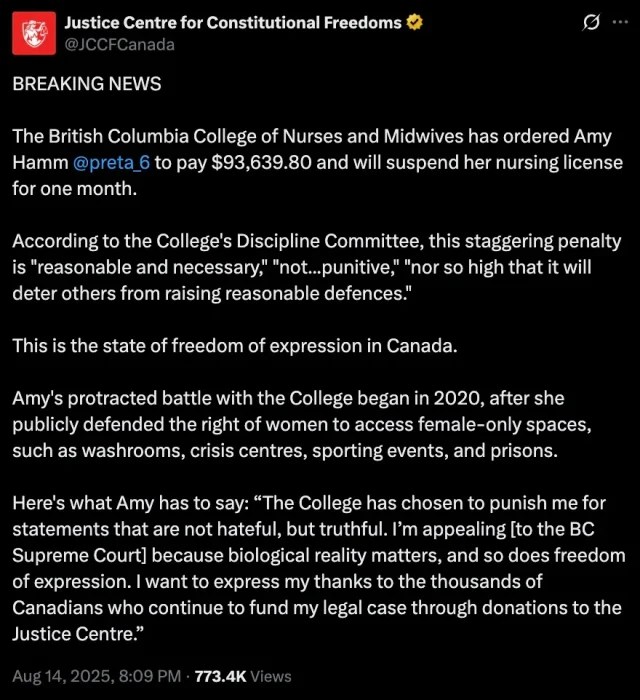
Hamm remains defiant. “The College has chosen to punish me for statements that are not hateful, but truthful. I’m appealing because biological reality matters, and so does freedom of expression. I want to express my thanks to the thousands of Canadians who continue to fund my legal case through donations to the Justice Centre,” she said.
The Justice Centre for Constitutional Freedoms, which is representing Hamm, announced the penalty and reiterated its commitment to pushing back against professional censorship.
NO WOODS, NO MEAT, NO FREEDOM
The HighWire with Del Bigtree | August 14, 2025
Unusually dry summer conditions on Canada’s Atlantic coast have prompted two provinces to take the unprecedented step of banning hiking, camping, and even walking in the woods in a bid to prevent forest fires. Learn about other alarming measures being floated in the name of climate change—from ticks that can trigger a meat allergy to proposals for calculating the carbon footprint of every medical procedure to determine its “importance.”
‘America First’ clashes with ‘Israel First’ as Trump threatens Canada over Palestine recognition
MEMO | August 1, 2025
Donald Trump has provoked outrage among parts of his own political base after threatening to block a trade deal with Canada in retaliation for Ottawa’s decision to formally recognise the State of Palestine. The US president posted on Truth Social: “Canada has just announced that it is backing statehood for Palestine. That will make it very hard for us to make a Trade Deal with them. Oh’ Canada!!!”
Trump’s statement was widely interpreted as prioritising Israeli interests over domestic economic concerns, prompting fierce backlash from some right-wing influencers. Prominent conservative commentator Matt Walsh posted on X: “This is ridiculous. If a trade deal with Canada is beneficial to the American people then it should go forward regardless of Canada’s stance on Palestine. The benefit of the American people should be the guiding principle here.”
Walsh’s post drew thousands of responses, many supportive, but others accused him of failing to grasp America’s “special alliance” with Israel. However, critics have pointed out that it is Canada, not Israel, that is bound to the US through comprehensive economic and military treaties.
Along with the UK and France, Canada is one of Washington’s oldest and closest allies. By contrast, US-Israel ties, while historically deep, are often framed as ideologically and politically driven, bolstered by domestic lobbying pressure rather than national interest.
Observers say the incident highlights a deepening divide in US politics: on one side, a growing segment of voters who either support Palestinian rights or advocate for an “America First” foreign policy that avoids foreign entanglements; on the other, a political elite that consistently prioritises Israeli interests, often regardless of public opinion or national cost.
Despite mounting evidence of Israeli war crimes in Gaza and a global shift toward recognising Palestinian statehood, including by key Western allies, US lawmakers remain overwhelmingly aligned with Israel.
This split is becoming more pronounced as influential voices on the right, once assumed to be pro-Israel by default, now openly question the costs of that allegiance.
Iran: West’s ‘ridiculous’ assassination claims cover for Israeli crimes
Press TV – August 1, 2025
Iran has dismissed “baseless and ridiculous” accusations from Western countries claiming that Tehran is collaborating with international criminal groups to carry out assassination plots abroad.
Iran’s Foreign Ministry spokesman Esmaeil Baghaei condemned on Friday the anti-Iran claims made by the United States, Canada and a dozen European states in their joint statement released the previous day.
He said the “blatant blame game” is an attempt to divert public attention from the most pressing issue of the day, which is the Israeli genocide in the occupied Palestine.
“The United States, France, and other signatories to the anti-Iran statement must themselves be held accountable for actions that violate international law, as they support and host terrorist and violent elements and groups,” he added.
Baghaei touched on the unprovoked US-Israeli aggression against Iran in June and Israel’s ongoing genocide in the Gaza Strip against the backdrop of active support or approving silence of the 14 Western countries that signed the statement against the Islamic Republic.
He further denounced the accusations as “blatant lies and an escape forward, designed as part of a malicious Iranophobia campaign aimed at exerting pressure on the great Iranian nation.”
The 14 states must be held accountable for their “disgraceful and irresponsible” behavior that violates the principles of international law and the United Nations Charter, the spokesman noted.
Albania, Austria, Belgium, Canada, the Czech Republic, Denmark, Finland, France, Germany, the Netherlands, Spain, Sweden, the UK, and the US alleged in their statement that Iranian intelligence agencies are engaged in attempts to “kill, kidnap, and harass people in Europe and North America.”
Canada continues arms transfers to Israel despite official denials: Report
Press TV – July 30, 2025
Canada has continued to supply weapons to the Israeli regime during its genocide in Gaza, contradicting official claims that such exports had stopped, a new investigation reveals.
Published by Arms Embargo Now Campaign (AEN) on Tuesday, newly uncovered shipping records and Israeli regime data show 47 documented shipments of military components from Canadian manufacturers to Israeli weapons firms between October 2023 and July 2025.
This includes over 421,000 bullets, with one shipment of 175,000 in April 2025.
Three cartridge shipments from a Quebec-based General Dynamics facility were also sent just nine days after Canada pledged to block munitions exports. These exports primarily supplied Elbit Systems, Israel’s largest arms manufacturer.
This comes as former Foreign Minister Melanie Joly and Prime Minister Justin Trudeau, as well as current Prime Minister Mark Carney, have repeatedly insisted that Canada has restricted arms exports to Israel, this report uncovers.
In March 2024, Canada’s parliament passed a non-binding motion urging the government to suspend further arms sales to Israel.
As pressure continued to mount, in September of last year, Joly announced that the government had not approved any new export permits for Israel since January 8, 2024.
This report, however, unveils the hidden reality behind Canada’s public statements on arms exports to Israel, revealing a systematic deception that has enabled the flow of Canadian-made weapons directly into one of the deadliest military aggressions in modern history.
Canada is currently breaching its own domestic legislation and international legal obligations by continuing to supply arms to Israel amid the ongoing ethnic cleansing and widespread starvation of Palestinians in Gaza.
Several Western countries have continued to supply lethal weapons to the Israeli regime despite the enormous human toll caused by its genocide in the Palestinian territory.
At least 60,034 Palestinians have been killed, mostly women and children, and another 148,870 individuals injured in the brutal Israeli onslaught on Gaza since October 7, 2023.
Court Orders Bank Freezing Records in Freedom Convoy Case
By Cindy Harper | Reclaim The Net | July 9, 2025
A Canadian court has ordered the release of documents that could shed light on how federal authorities and law enforcement worked together to freeze the bank accounts of a protester involved in the Freedom Convoy.
Both the RCMP and TD Bank are now required to provide records related to Evan Blackman, who took part in the 2022 demonstrations and had his accounts frozen despite not being convicted of any crime at the time.
The Justice Centre for Constitutional Freedoms (JCCF) announced the Ontario Court of Justice ruling. The organization is representing Blackman, whose legal team argues that the actions taken against him amounted to a serious abuse of power.
“The freezing of Mr. Blackman’s bank accounts was an extreme overreach on the part of the police and the federal government,” said his lawyer, Chris Fleury. “These records will hopefully reveal exactly how and why Mr. Blackman’s accounts [were] frozen.”
Blackman was arrested during the mass protests in Ottawa, which drew thousands of Canadians opposed to vaccine mandates and other pandemic-era restrictions.
Although he faced charges of mischief and obstructing police, those charges were dismissed in October due to a lack of evidence. Despite this, prosecutors have appealed, and a trial is set to begin on August 14.
At the height of the protests, TD Bank froze three of Blackman’s accounts following government orders issued under the Emergencies Act. Then-Prime Minister Justin Trudeau had invoked the act to grant his government broad powers to disrupt the protest movement, including the unprecedented use of financial institutions to penalize individuals for their support or participation.
In 2024, a Federal Court Justice ruled that Trudeau’s decision to invoke the act had not been justified.
Blackman’s legal team plans to use the newly released records to demonstrate the extent of government intrusion into personal freedoms. According to the JCCF, this case may be the first in Canada where a criminal trial includes a Charter challenge over the freezing of personal bank accounts under emergency legislation.
“Why Can’t We Talk About This?”
Rainey Media TV | June 4, 2025
Please Support Our Film via: E-Transfer: dean_rainey@yahoo.ca
PAYPAL: deanrainey@raineymedia.com
Buy My A Coffee: https://buymeacoffee.com/raineymedia
SNAIL MAIL: Rainey Media, PO Box 5, Delhi PO Main, ON, N4B 2W8 Canada
To book your own screening: deanrainey@raineymedia.com
“Why Can’t We Talk About This?” delves into the life of a man grappling with the aftermath of a COVID-19 vaccine injury, weaving his personal struggle into a broader examination of why such experiences are rarely discussed.
To help Michael via support: https://www.gofundme.com/f/benefit-fo…
We’ve made this film easily accessible for everyone because the information it contains and the discussion it starts is just too important. This film had no funding and was made without sponsorship. All costs were paid out of my own pocket. My team and I spent over a year and a half making this film. Any support you give will go towards expenses incurred making and marketing the movie. (Even sending the price of a movie ticket would help.) Once we cover those costs, we will be providing Michael with a share of the proceeds.
To order DVDs of this film, visit: https://raineymedia.com/video-store/
Also available on Rumble.
Featured Video
“Historic Russia”: The Land Putin Will Not Give Back
or go to
Aletho News Archives – Video-Images
Book Review
Why the War on Conspiracy Theories Is Bad Public Policy
By Kevin Barrett • Unz Review • February 1, 2019
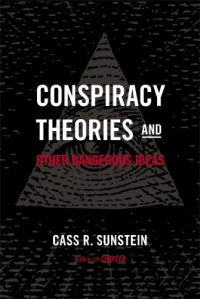 A Review of Conspiracy Theories and Other Dangerous Ideas by Cass Sunstein (based on an earlier paper co-authored with Adrian Vermeule); In Defense of Troublemakers: The Power of Dissent in Life and Business by Charlan Nemeth; and Conspiracy Theories and the People Who Believe Them, edited by Joseph E. Uscinski
On January 25 2018 YouTube unleashed the latest salvo in the war on conspiracy theories, saying “we’ll begin reducing recommendations of borderline content and content that could misinform users in harmful ways—such as videos promoting a phony miracle cure for a serious illness, claiming the earth is flat, or making blatantly false claims about historic events like 9/11.”
At first glance that sounds reasonable. Nobody wants YouTube or anyone else to recommend bad information. And almost everyone agrees that phony miracle cures, flat earthism, and blatantly false claims about 9/11 and other historical events are undesirable.
But if we stop and seriously consider those words, we notice a couple of problems. First, the word “recommend” is not just misleading but mendacious. YouTube obviously doesn’t really recommend anything. When it says it does, it is lying. … continue
Blog Roll
 Aletho News
- “Historic Russia”: The Land Putin Will Not Give Back
- How the Cambridge Analytica scandal still haunts Mark Zuckerberg
- The Ongoing Cancellation Campaign Against a Dissenting Academic in Norway
- Yemen and ‘the Houthis’: Challenging Sami Hamdi’s Narrative
- No, Christians did not invent Zionism
- AIPAC-led lobbying network opens branches in Cypriot, Greek parliaments
- Araghchi blasts ‘parasitic’ alliance as US taxpayers pay for Israel’s war on Iran
- Easy fix for Europe’s chaos? Stop fueling war against Russia
- Putin’s key remarks on peace talks and Europe’s ‘schizophrenia’
- Trita Parsi: Israel Set a Trap for Total War in the Region
- If Americans Knew
- Damning report shows the media must confront its failures on Gaza
- BBC senior broadcaster speaks out on Gaza coverage
- Netanyahu vows vast West Bank invasion in response to 20-minute skirmish that left 2 Israeli soldiers and 2 Palestinian fighters dead
- Tied up and tortured: Israel using US-made electroshock weapons on Palestinian detainees
- The outsourced risk: how newsrooms rely on Gaza’s freelancers without protecting them
- Gaza bakeries forced to shut as Israel blocks flour shipments
- Gaza’s breast cancer patients face a deadly wait for treatment amid Israel’s genocide
- DAILY UPDATE: Latest essential news on Palestine, Israel, & region
- The Israel Lobby’s Changing Fortunes
- AIPAC has become such a political liability that it’s shifting to a more “nimble” approach to buying politicians
- No Tricks Zone
- E-Cars Reduce CO2 Emissions By Only 41% Compared To Internal Combustion Engine Vehicles
- Predictions Made By Renowned Climate Professor Over Past Decades Have Been Proven To Be Poor
- New Study Suggests Large Regions Of The Pacific Ocean Have Been Cooling For The Last 80 Years
- Germany’s Green Energy Debacle: High Energy Costs Force Kahla Porzellan to Close After 182 Years!
- New Study: 50 Years Of The Most Aggressive ‘Net Zero’ Policies Can Only Affect The Global Climate By 0.03°C
- US September “Heat” Was No Record…Many Records Set Decades Ago
- Latest European Green Energy Debacle; Portugal’s Largest Flagship Solar Park Insolvent!
- Green Energy Debacle: German Expert Professor Fritz Vahrenholt Warns Of Severe Economic And Social Consequences
- Two More Paleo Reconstructions Affirm Meters-Higher Sea Levels Across Ireland, Brazil 7000-6000 Years Ago
- New Study: Earth And Venus Surface Warmth Largely Explained By Convection And Lapse Rate, Not CO2 Or Radiation

