Red star over Nepal
By M K Bhadrakumar | Indian Punchline | October 8, 2017
The Communist Party of Nepal-UML led by KP Oli, Communist Party of Nepal (Maoist Centre) led by Prachanda and the breakaway Naya Shakti Nepal led by Baburam Bhattarai have announced on October 3 the formation of a grand leftist alliance for the forthcoming provincial and federal elections in Nepal on November 26 and December 7 under the new constitution. The polarization of Nepal’s fragmented political spectrum on ideological lines makes the forthcoming elections a watershed event.
In reaction to the unexpected development, the Nepali Congress is reportedly planning to assemble a motley coalition of right-wing forces with some smaller parties to counter the grand leftist alliance. Interestingly, the constituents of the right-wing alliance may include the Rastriya Janata Party Nepal, which was formed in April with the merger of six “pro-India” Madhesi parties on the advice of their mentors in India. Even more interesting is the prospect of the Hindu right-wing, cultural conservative and royalist Rastriya Prajatantra Party Democratic – a veritable clone of India’s Bharatiya Janata Party – joining the Nepali Congress-led alliance.
It doesn’t require much ingenuity to figure out that the leitmotif of the polarization into two grand alliances lies in their respective disposition toward India. The announcement of the formation of the leftist alliance on October 3 seems to have taken not only the Nepali Congress but Delhi also by surprise. The Nepali Congress is scrambling to come up with a credible contestation – conceivably, with some encouragement from Delhi.
The polarization in Nepali politics is a good thing to happen since it presents a clear-cut choice to the electorate. The blurring of the ideological divide through the period of democratization in Nepal had been a major factor breeding the politics of expediency resulting in instability in the past. The big question is whether political stability as such guarantees good governance and can deliver on growth and development. India’s current experience speaks otherwise.
To be sure, the Leftist alliance is ideologically motivated and can be trusted to be far more cohesive and capable of offering a stable government. It will be campaigning on the plank of social justice, egalitarianism and Nepali nationalism. The alliance hopes to secure a two-thirds majority in the new Parliament which will strengthen their hands to steer future amendments to the Constitution smoothly, unlike in the past. During the general election, 165 members of the National Parliament will be elected by simple vote, while another 110 will be appointed through a system of proportional representation.
Based on the performance of the two main communist parties in the elections for the constituent assembly in 2013 and this year’s local polls, the leftist alliance has a distinct chance of winning a majority in the forthcoming elections. (The communists also have a strong party machinery all over the country.) If so, Nepal will be coming under communist rule – an unprecedented political feat not only for Nepal’s fledgling democracy but for the South Asian region as a whole. Importantly, based on the leftist alliance’s performance in the November elections, they intend to form a united Nepal Communist Party. It will be a big rebuff to the Indian establishment, which succeeded so far in splintering the Left in Nepal by fuelling internecine feuds and personality clashes.
These are early days but a communist government in Nepal will profoundly impact the geopolitics of South Asia. It is useful to factor in that Nepal took a neutral stance on the India-China standoff in Doklam. India’s capacity to influence Nepal’s foreign policies under a communist government will be even more limited. Equally, it remains to be seen how Nepal’s ‘defection’ from the Indian orbit might have a domino effect on Bhutan.
A ‘tilt’ toward China may well ensue under a communist government in Nepal. The country may embrace China’s Belt and Road Initiative unequivocally. Chinese investments can phenomenally transform Nepal. And comparisons will be inevitably drawn with the neighboring impoverished regions of Bihar and UP, which are run by India’s ruling party.
The forthcoming elections in Nepal assume great importance for India’s neighbourhood policies under the Modi government. The right-wing Hindu nationalist forces mentoring the Modi government will have a hard time in accepting the prospect of a communist government ruling the abode of the god Shiva. Will they attempt to interfere in the elections? Any overt Indian interference risks a furious backlash, given the pervasive anti-India sentiments in the country.
On the other hand, while the BJP is unable to tolerate a communist government even in the tiny southern state of Kerala, ironically, the Modi government may have to drink from the chalice of poison by doing business with a sovereign communist government in next-door Nepal. Read, here, an interview by Baburam Bhattarai, the well-known Marxist ideologue of Nepal, on the dramatic political developments in the country.
‘We need negotiations, not declarations’: Russia stays away from Trump’s UN reform plan
RT | September 18, 2017
As US President Donald Trump officially launched his 10-point reform program for the United Nations, Russian officials say they share many of the concerns it raises, but not the methods Washington is using to advance its solutions.
On Monday morning in New York, UN Secretary-General Antonio Guterres and Trump delivered speeches in support of the reform declaration, which has been endorsed by 128 states.
According to the published text of the plan, it would give Guterres greater executive powers “encouraging him to lead organizational reform,” which would “provide greater transparency and predictability” and “promote gender parity and geographic diversity,” while combating “mandate duplication, redundancy, and overlap” and other forms of inefficiency at the international body.
“In recent years, the United Nations has not reached its full potential because of bureaucracy and mismanagement. While the United Nations on a regular budget has increased by 140 percent, and its staff has more than doubled since 2000, we are not seeing the results in line with this investment,” said Trump, who previously emphasized that the US is the biggest contributor to United Nations funds.
“To serve the people we support and the people who support us, we must be nimble and effective, flexible and efficient,” declared Guterres, the former Prime Minister of Portugal, who assumed his current post this year.
Countries that were hesitant or unwilling to sign the document – which include Russia, China, Brazil and South Africa – were not invited to the launch.
“There was no consultation either prior or following the publication of the declaration,” said Vassily Nebenzia, Russia’s envoy to the UN, in an interview with TASS news agency, published Monday. “We are all for increasing the role of the UN on the international arena, and raising its efficiency. The organization needs reform, even if not a fundamental overhaul. But the reform itself should not come through a declaration, but through inter-governmental negotiations between members.”
State-owned daily Rossiyskaya Gazeta cited officials in the Russian delegation in New York, who criticized the US for hijacking the ongoing UN General Assembly for its own purposes, noting that the declaration “had nothing to do with the United Nations” and that Washington “has developed a bad habit of using the UN building during General Assemblies to push its own foreign policy agenda.”
Some were altogether suspicious of Trump’s motives, considering his previously dismissive attitude to the UN.
“Trump’s reform is a landmark move towards a unipolar world, and the reduction of the role of the UN in the international architecture that is forming in the 21st century. We are not ready to support or participate in this process,” Leonid Slutsky, the Chairman of the Committee on International Affairs in the Russian parliament, told RIA news agency.
“The US should start not with behind-the-scenes coalition-forming,” wrote Konstantin Kosachev, who heads in the Foreign Affairs Committee in the upper chamber of the Russian parliament, the Federation Council, on his Facebook page. “Instead, it should begin by acknowledging its mistakes, when it bypassed the UN in Yugoslavia, Iraq, Libya and Syria.”
Iran nuclear deal becomes an atomic cocktail
By M K Bhadrakumar | Indian Punchline | September 14, 2017
The unscheduled trip to Russia by Iranian Foreign Minister Mohammad Javad Zarif as the special envoy of President Hassan Rouhani and his meeting with President Vladimir Putin on Wednesday can be seen as indicative of an inflection point arising in regional and international security. There is growing concern that the Trump administration could be moving in the direction of reopening the US-Iran nuclear deal of July 2015.
During the campaign for the November election, candidate Trump disdainfully threatened to tear up the Iran accord. But as president, he has twice already certified to the US Congress that Iran is implementing its part of the deal. He is obliged to do it a third time by mid-October. Of course, Trump is not a stickler for consistency. He promised to wind up the Afghan war, but approved a strategy for open-ended war. Increasingly, he has exposed himself to be a man of straw.
All indications are that he doesn’t have the courage to upfront abandon the deal. So long as Tehran continues to observe the terms of the deal, Trump lacks an alibi to jettison it. Yet, he wants to resuscitate the sanctions regime of the past era so that Iran is deprived of the tangible benefits accruing to it legitimately under the nuclear deal, especially, as regards its integration with the world economy. This is one thing. Besides, the nuclear deal enjoys the overwhelming support of the world community. On the other hand, Trump is surrounded by “hawks” on Iran. The Israeli lobby also keeps him on a tight leash.
Hence Plan B. The White House recently deputed Nikki Haley, envoy to the UN, to Vienna to sound out the International Atomic Energy Agency about renegotiating the terms of the 2015 deal. Specifically, the White House would like to extend the scope of the IAEA inspection to also include, apart from Iran’s nuclear establishments, that country’s military bases.
Interestingly, the White House’ choice fell on Haley to undertake the mission to Vienna (rather than Secretary of State Rex Tillerson). It speaks of the backstage role of Jared Kushner, Trump’s son-in-law. Clearly, Israel is manipulating the Trump administration. Israel is paranoid that for the first time since the 1967 War, it has lost its pre-eminence militarily in the Middle East. The US and Israel’s defeat in the Syrian conflict brings about a historic shift in the military balance. Simply put, Israel lacks the capability to stop Iran’s inexorable surge as regional power. What is unfolding is a high-stakes game for Israel.
Tehran has made it clear that it is not open to renegotiation of the deal. Specifically, it rejects the notion that its military bases should be opened to allow foreigners to “inspect”. Simply put, Iran is unlikely to allow the US and Israeli spies masquerading as IAEA inspectors into its sensitive military installations.
Now, all indications are that the US is softening up the resistance of its European allies to the idea of reopening the 2015 nuclear deal. If past history is any evidence, it is a matter of time before the UK, France and Germany (who were part of the P5+1 negotiating with Iran) fall in line. Tillerson has called a meeting of his counterparts from the P5+1 and Iran for a meeting in New York on September 20 to broach the subject. A defining moment is approaching – least of all that Tillerson for the first time comes face to face with Zarif.
For Iran, the role of Russia and China will be of crucial importance. China may become wobbly when its self-interest is likely to be affected. The point is, all this ultimately would go into the alchemy of the ‘new type of relationship’ China hopes to work out with Trump. Also, Kushner happens to be Beijing’s point person in the White House. (China’s State Councilor Yang Jiechi met him Wednesday to discuss father-in-law’s state visit in November.)
After meeting Putin in Sochi, Zarif said that the discussion was “substantial and positive.” Zarif hinted that Russia also would agree that the 2015 nuclear deal is “non-negotiable and that all sides to the agreement must fulfil their obligations.” The situation developing around Iran will throw light on the ground realities as regards Iran’s integration into the Eurasian space. The Kremlin readout gave no details, but it stands to reason that given Russia’s quasi-alliance with Iran in regional politics, Zarif’s optimism is justified. Above all, Russia and Iran are working together as “guarantors” to stabilize the situation in Syria, as the latest development in regard of the de-escalation zone in Idlib in northern Syria highlights once again. To be sure, “multipolarity” in the world order is facing the litmus test.
Moscow ‘preparing inevitable response’ as US hits Russians with new sanctions over N. Korea
RT | August 23, 2017
Moscow has fired back at the latest round of US sanctions targeting Russian interests, as Washington blacklisted one Russian company and four individuals for their alleged dealings with North Korea.
On Tuesday, the US Treasury revealed it had imposed sanctions on 16 Russian and Chinese nationals and companies for their alleged dealings with North Korea. The Treasury claims the sanctions are in line with the internationally agreed measures against North Korea’s missile and nuclear weapons programs. The companies are accused of working with blacklisted individuals, helping develop the North Korean energy sector, help it place workers abroad or move money from abroad. As a result, their US assets are frozen and Americans are forbidden from doing business with them.
“It is unacceptable for individuals and companies in China, Russia, and elsewhere to enable North Korea to generate income used to develop weapons of mass destruction and destabilize the region,” Treasury Secretary Steven Mnuchin said in a statement.
“We are taking actions consistent with UN sanctions to show that there are consequences for defying sanctions and providing support to North Korea, and to deter this activity in the future.”
Reacting to the sanctions, Russian Deputy Foreign Minister Sergey Ryabkov issued a statement expressing disappointment, and warning Washington that Russia was working on a response.
“Against such a depressing backdrop, the lip service from American representatives about the desire to stabilize bilateral relations is extremely unconvincing,” Ryabkov said. “We have always and will always support resolving our existing differences through dialogue. In recent years, Washington in theory should have learned that for us the language of sanctions is unacceptable, and the solutions to real problems are only hindered by such actions. So far, however, there doesn’t seem to be an understanding of such obvious truths.”
“Nevertheless, we do not lose our hope that the voice of reason will sooner or later prevail, and that our American colleagues will be aware of the futility and detrimental nature of further sliding down the spiral of sanctions.”
In the meantime, we are beginning to work out the inevitable response to this situation.”
The companies under sanction include Gefest-M, a Moscow-based firm accused of acquiring metals for a North Korean company, and Mingzheng International Trading, a Chinese and Hong Kong-based bank that supposedly conducted transactions on behalf of North Korea.
Andrey Klimov, a senior Russian senator, said that the US sanctions against Gefest-M and the others lack legitimacy.
“These sanctions are illegal in themselves, because the only thing recognized by international law is the sanctions of the UN Security Council,” Klimov told Interfax. “We must react in principle to this insane and confrontational policy. The toolbox is rich, let’s hope that we will act consistently, reasonably, professionally and effectively.”
Klimov’s words were echoed by the Chinese government, with a spokesperson saying Beijing “opposes unilateral sanctions out[side] of the UN Security Council framework.”
“We strongly urge the US to immediately correct its mistake, so as not to impact bilateral cooperation on relevant issues,” the spokesperson said, as quoted by the Financial Times.
At the same time, the US Department of Justice also filed two complaints to forfeit over $11 million from two Asian companies for allegedly laundering funds for North Korea.
The DoJ alleges that the two companies violated the international sanctions against North Korea and indirectly supporting its missile and nuclear weapons programs.
“The United States filed two complaints today seeking imposition of a civil money laundering penalty and to civilly forfeit more than $11 million from companies that allegedly acted as financial facilitators for North Korea,” read the statement.
Proceedings have been launched against Velmur Management Pte Ltd., based in Singapore, as well as the Chinese company Dandong Chengtai Trading Co. Ltd.
READ MORE:
US embassy in Russia temporarily halts issue of non-immigrant visas
A ‘new normal’ in South China Sea
By M K Bhadrakumar | Indian Punchline | August 16, 2017
India’s ‘Look East’ policy, which shifted to ‘Act East’ under the Modi government circa 2015, may now have to quickly shift again – to, say, ‘Watch East’. It will be on the one hand a judicious shift in tune with the rapid stabilization of the ASEAN’s relations with China and on the other hand a cathartic experience insofar as the rapid flow of events in the south-east Asian region holds some useful lessons for Indian diplomacy.
Looking back, the Permanent Court of Arbitration’s award of 12 July 2016 on the South China Sea (SCS) has turned out to be a turning point, opening a new page of cooperation between the ASEAN and China. A fair amount of ground has been covered in the past year with the hotline at foreign ministry level to manage maritime emergencies, the operationalization of the observance of the Code for Unplanned Encounters at Sea, and the framework of the Code of Conduct in the SCS. Sourabh Gupta at the Institute for China-America Studies in Washington sums up:
- In fact, every member of Asean, with the exception perhaps of Singapore, yearns for the success of Asean-China political relations – but not at the inadmissible cost of having to capitulate to Beijing’s unilateral and non-conforming sovereign rights claim to oil and gas resources in their respective exclusive economic zones in the South China Sea.
- The current easing cycle, rather, will lend itself to a period of strategic calm in this critically important waterway. Without an agitated local claimant on whose behalf it can claim to be intervening to uphold the stability of the South China Sea, the US has few other tools at its disposal to assert its relevance and authority in this body of water other than to endlessly navigate its length and breadth.
No doubt, the announcement in Manila on Wednesday of a new “modus vivendi” or a new “way to get along” is in sync with the trend outlined above by Gupta. It appears that there has been a diplomatic breakthrough between the Philippines and China. “The Chinese will not occupy new features in the South China Sea nor are they are going to build structures in Scarborough Shoal,” Philippine Defense Minister Delfin Lorenzana told lawmakers in Manila on Tuesday. Cayetano also said the Philippines was working on a “commercial deal” with China to explore and exploit oil and gas resources in disputed areas of the SCS with an aim to begin drilling within a year. (Reuters )
To be sure, when the “frontline state” that is Philippines leaves behind standoffs and brinkmanship with China, something has fundamentally changed in the SCS. There are lessons here for other countries having territorial disputes with China. The Philippine approach under President Rodrigo Duterte is strikingly similar to India’s under the leadership of former Prime Minister Manmohan Singh – “compartmentalizing” different templates of the relationship with China whereby hugely beneficial economic engagement is possible without forfeiting the prerogative to uphold national security interests.
The East Asia Forum has featured a riveting analysis of Duterte’s policy by Prof. Aileen S P Baviera at the University of the Philippines, who writes,
- By de-linking economic relations from management of the disputes, Manila can benefit from Beijing at a time when sustained high growth and investor confidence in the Philippines coincides with a massive investment drive by China as part of BRI… Duterte’s China policy shift also reduces disagreement within ASEAN over the handling of the disputes.
Of course, the success of the policy also depends on China. To quote Baviera, “China would have to downplay nationalist emotions and restrain military adventurism. This could give Duterte breathing space both for repairing relations with China and reorienting the US alliance towards more convergent objectives.”
Ironically, Duterte’s new thinking bears striking similarity with the former Prime Minister Manmohan Singh’s policies toward China. Yet, Duterte’s political personality happens to have more in common with Prime Minister Modi than with Manmohan Singh. Like Modi, Duterte is also a strongman populist. Both thrive on polarizing domestic politics and both pursue controversial approaches to social problems. Neither can claim to have a sophisticated understanding of international affairs. But where Duterte leaves Modi miles behind is in his pragmatism to eschew confrontation and megaphone diplomacy to leave the territorial disputes as a stalemate and instead maximise the economic benefits of the China relationship .
These are early days, but according to reports from Hanoi, the Spanish drilling ship, which has been prospecting in the disputed waters in in Vietnam’s Block 136/3 last month, has left the area after pressure from China. Interestingly, according to reports citing a “diplomatic source with direct knowledge of the situation”, Hanoi’s decision to suspend the drilling followed the visit of a Vietnamese delegation to Beijing.
The big question is whether the tidings from Manila and Hanoi presage a “new normal”. Though the Code of Conduct between China and the aggrieved members of the ASEAN is not yet a done deal, a future order of the SCS based on international rules and norms seems a near-term possibility. The Global Times newspaper carried on Tuesday a “preview” of what a future SCS order might look like – based on principles of “equality”, “balance” and “openness”. Read it here.
‘Africans will be biggest losers after letting foreign military into their continent’
RT | August 9, 2017
Africa has become a staging ground where foreign countries can show off their military capabilities against one another away from their country of origin at the expense of Africans, says African affairs expert Ayo Johnson.
Turkey is gearing to open its largest overseas military base in Somalia.
The United Arab Emirates are building a military base at the port of Berbera, in the self-declared Republic of Somaliland.
Africa is an attraction to foreign militaries: China opened its first overseas military base on August,1 in Djibouti on the Horn of Africa. Djibouti is also currently housing Americans, Japanese and French troops.
RT discussed why Africa has become so popular with the foreign military with Africa affairs expert Ayo Johnson who believes the world powers are turning the continent into the latest theater of military confrontation.
“Back in colonial days, we saw Africa being cut up and carved up by the Western nations. Now we are seeing Africa again being the center ground for the new verge of a proxy war because all these different countries which are founding military bases on the African continent. It is a huge worry,” Ayo Johnson told RT.
In Johnson’s opinion, “it is showing that Africans can’t protect themselves and it is also showing that Africans can’t control their own affairs and ultimately it is finders keepers.”
“We have China who already has a military base of its own, the excuse is that it ultimately wants to protect its own investment which we know it has on the African continent. Also, it says it wants to prevent piracy and to be able to launch against such events,” Johnson said.
“The Americans have similar bases, not to mention the Europeans. So, on the ground itself, ultimately the African continent is becoming the staging ground for the next possibly violent confrontation between the superpowers of the world in their so-called proxy battles,” he continued.
According to Johnson, such interest in the continent might be explained by its strategic location.
“The Horn of Africa is the gateway for many shipping lanes, the protection of that area because of long term standing piracy issues. But others would say it is about land grab, control; it is about influence.”
“The Americans, the British and other Europeans, not to mention the Chinese most recently, all seem to have a huge stake and might show their muscles and their military capabilities against one another. Africa has now become a staging ground from which they can exploit those opportunities away from their own individual countries, a place where they can prowess their military might at the expense of Africans,” Johnson noted.
Despite the increased foreign military presence, the problem of piracy in the region remains unsettled.
“One thing for sure is that piracy still exists and it will continue and is unlikely to stop or to be slowed down.”
“Again in terms of terrorism, Al-Qaeda and ISIS still have strongholds and control, influence in that part of the world and the military bases that are physically positioned there. If they are there to prevent such attacks, I think in the short term or more long term it could create antagonism, create a problem for locals who may want to join those organizations to attack the military powers that are there. So the protection of Africa becomes the reverse, becomes an area where everyone wants to show each other what they are capable of doing and that is the worry, be it terrorist or be it an American, European or even most recently the Turks are also considering having bases there,” he told RT.
Johnson claimed “that comes at the expense of every single African nation – ultimately the biggest losers will be every single individual on the African continent.”
Why Siding with Washington on Korea May Be Dangerous
By Finian CUNNINGHAM | Strategic Culture Foundation | 10.08.2017
In backing the latest US-led sanctions against North Korea at the United Nations Security Council, both China and Russia seem to have made a tenuous bet to resolve the crisis on the Asian peninsula. By deferring to Washington’s punitive sanctions, Beijing and Moscow are calculating that the US will relent on their proposals for comprehensive talks and a freeze on American military exercises with its South Korean ally.
China and Russia may regret their course of action. Since the imposition of new sanctions on North Korea last weekend, the tensions in the region have ratcheted up to alarming levels. US President Trump has even been accused of using «unhinged» language by members of Congress after he threatened to unleash «fire and fury» on North Korea «with a power the world has never seen before». Some American lawmakers were comparing Trump’s rhetoric with that of North Korea’s fiery leader Kim Jong Un.
North Korea, predictably, responded to Trump’s outburst by declaring that its leadership was considering a pre-emptive military strike on the US air base on the Pacific island of Guam.
The region is being put on a hair-trigger for war – a war that would certainly involve the use of nuclear weapons. The American side has come to the conclusion that North Korea has finally mastered the technology to fit a nuclear warhead on its already proven intercontinental ballistic missile (ICBM) capability, reported the Washington Post this week. That means that if a military confrontation breaks out, the US will be tempted to use overwhelming force.
Trump’s words about deploying «power the likes of which the world has never seen before» are especially icy given the 72nd anniversary this week of the US dropping the atomic bombs on Hiroshima and Nagasaki in 1945.
When the UN Security Council convened last weekend it passed Resolution 2371 unanimously with 15 votes to 0. It was a surprise turnaround by China and Russia. Last month, following North Korea’s ICBM test on July 4, both Beijing and Moscow rejected the US call for more sanctions on Pyongyang. They said then that sanctions policy doesn’t work and instead called for all-party dialogue to resolve the long-running Korean crisis. China and Russia also made the eminently reasonable call for the US and its South Korean ally to desist from their frequent joint war maneuvers, which the Communist North perceives as a threat of invasion.
Over the past few weeks, the US and China reportedly engaged in intense negotiations over the Korean issue. Trump accused his Chinese counterpart President Xi Jinping of not doing enough to rein in allied North Korea. The US also threatened to take punitive action against China over wider issues of trade and intellectual property rights. Before the weekend vote at the UNSC, Trump inexplicably cancelled a speech in which he was expected to lay out tough American actions against China over commercial disputes. That suggests some kind of bargain was done between Washington and Beijing – and that China voting for further sanctions on North Korea was part of it.
Following the unanimous vote at the UNSC, Trump and his ambassador Nikki Haley reportedly could hardly contain their glee over «the united response» against «rogue state North Korea».
What Russia gets out of it is not clear. Perhaps Russia felt that to veto the sanctions against North Korea would have incurred international wrath. But it seems curious that Moscow should go along with sanctions at the very same time that Washington is provocatively imposing similar measures against it too.
What appears to be in the calculus by China and Russia is that by giving a sop to the American desire to get tough on North Korea, they are anticipating that the US will agree to calls for multi-party talks and a freeze on military activities on the Korean Peninsula.
Both the Chinese and Russian ambassadors to the UN coupled the latest resolution for sanctions against North Korea with the reboot of the six-party negotiations involving the two Koreas, China, Russia, Japan and the US. Those talks were abandoned in 2009 when the US and North Korea broke off in recriminations.
Last week, before the UN vote, US Secretary of State Rex Tillerson made a significant speech in which he said that the US was not seeking regime change in Pyongyang, nor had any intention of going to war on North Korea.
Following the UN sanctions, Tillerson sounded a conciliatory note while attending the summit of the Association of South East Asian Nations in Manila. The summit was also attended by Chinese and Russian counterparts Wang Yi and Sergei Lavrov. Tillerson said the US was open to dialogue with North Korea if the latter stopped its missile tests. That appeared to be a significant concession from the US side towards resolving the Korean problem.
However, this is where the calculation comes unstuck. The backing of more sanctions against North Korea by China and Russia may have softened the stance of the US somewhat, but at what price?
From the North Korean side, the increased sanctions are tantamount to an act of war. The new measures are aimed at banning the country’s top export earning commodities, including coal, minerals and seafood. The new sanctions will reportedly slash North Korea’s annual export revenue by one-third, down to $2 billion a year. Not surprisingly, Pyongyang responded furiously, saying the sanctions were an attack on its sovereignty.
Given Trump’s propensity for Twitter diplomacy, the spiral of rhetoric could lead to disastrous misunderstanding, as this week is tending to show.
In retrospect, it seems astonishing that Beijing and Moscow made the bet they did over new sanctions. The damage cannot be undone. But what China and Russia must do immediately is to insist that all sides proceed to multilateral talks and the standing down of military forces. The onus is primarily on the US to stand down its military power in the region. It needs to cancel its provocative maneuvers with its ally in Seoul – due again later this month – and it needs to halt the ongoing installation of the THAAD missile system on South Korean territory.
It is misplaced for China and Russia to pander to the US over sanctions and to expect something by way of concessions in return. The arrogant Americans don’t know the meaning of concessions, they only perceive weakness and will move to capitalize on weakness.
By indulging American demands for more sanctions on North Korea, the danger comes from emboldening Washington’s hubris and its own sense of impunity. One would think that Russia, above all, should understand that dynamic given its own experience over the US confiscating diplomatic properties and slapping on ever-more sanctions.
What Moscow and Beijing should do as a matter of urgency is to never mind new sanctions on North Korea; they should demand that Washington removes its military threat against North Korea – a threat that has been looming since the end of the Korean War in 1953. Then all sides must open talks without preconditions for a comprehensive peace settlement on the peninsula.
Pandering to a bully is never a good idea.
Russia, China call for freeze on both N. Korea launches & South’s drills with US – Lavrov
RT | August 6, 2017
Moscow and Beijing are against any missile launches carried out by North Korea and are at the same time calling on the US to halt military drills in the region, Russian Foreign Minister Sergey Lavrov says.
The statement comes following Lavrov’s meeting with his Chinese counterpart, Wang Yi, in the Philippines capital, Manila on Sunday. The ministers discussed the situation in the Korean Peninsula following the adoption of new sanctions on North Korea by the UN Security Council.
Lavrov said Russia and China have already suggested a roadmap to resolve the Korean crisis.
“Our joint initiative includes support of Russia’s proposal to create a roadmap for gradual restoration of trust and provide conditions for the resumption of the Six-Party talks. We have agreed to promote this concept in practice, including in the UN,” Lavrov said after the meeting with US Secretary of State Rex Tillerson in Manila.
Previously, Wang called the new restrictive measures against Pyongyang “a necessary response” aimed at “blocking North Korea’s nuclear missile development,” as cited by the South China Morning Post. He added that sanctions are not the “ultimate goal” and called for the resumption the so-called six party talks, as the situation on the Korean Peninsula “has come to a very critical juncture.”
“Sanctions are needed but are not the ultimate goal. The purpose is to pull the peninsula nuclear issue back to the negotiating table, and seek a final solution to realize the peninsula’s denuclearization and long-term stability,” Wang said.
Lavrov reiterated the joint Russian-Chinese initiative for “double freezing” which had previously been rejected by the US. The initiative, put forward by the Russian and Chinese foreign ministers on July 4, would freeze “any missile launches and any nuclear tests in North Korea,” as well as “large-scale military exercises by the United States and South Korea,” Lavrov said.
The Russian foreign minister also said that the new resolution seeks to bring the North Korean leadership to the negotiating table – the six-party talks – while the restrictive measures are designed to make Pyongyang curb its missile and nuclear programs in accordance with UN resolutions.
On Saturday night, the UN Security Council unanimously agreed to impose more restrictive measures on Pyongyang, banning exports of coal, iron, lead, and seafood. The move came in response to North Korea’s latest missile launches in July, which it, as well as South Korea and the US, claimed were intercontinental ballistic missile (ICBM) tests.
Multi-polar World Arrives: Russia, China Face Down US Bully
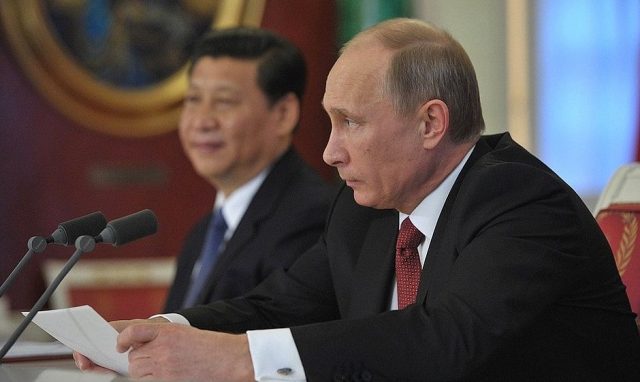
By Finian CUNNINGHAM | Strategic Culture Foundation | 07.07.2017
The United States’ hegemonic dominance in the world is heading to the exits. The decline in US uni-polar power has been underway for several years, in line with the emergence of a multi-polar world. This week, Russia and China showed important resolve to face down American bully tactics over North Korea. The confrontation suggests a turning point in the transition from American world dominance to a multi-polar one.
US President Donald Trump reiterated the possibility of military attack on North Korea while in Poland this week. This was also while Washington was hectoring China and Russia to join in a tougher response to North Korea over its ballistic missile launch days before – the former two nations themselves having recently been sanctioned anew by the US. Talk about American audacity and double think.
However, the crass arrogance shown by the US seems to have hit a new limit of tolerance in Moscow and Beijing. Both are beginning to demonstrate a loss of patience with the bumptious, insufferable Americans.
Reacting to North Korea’s breakthrough ballistic missile launch, Washington deployed its typical conceit, casually threatening to carry out a «retaliatory» military strike. Trump said he was considering «severe» options over Pyongyang’s «very, very dangerous behavior».
But Russia and China’s stance this time to the Americans had significantly stiffened. Both explicitly warned the US against taking military action against North Korea.
Moreover, Russia and China said that they would oppose Washington imposing further sanctions on the government of Kim Jong-un. The latter has already been subjected to six rounds of US-led sanctions.
In short, the American bully is finding that it is no longer able to dictate its unilateral way.
Addressing an emergency session of the United Nations Security Council, the Russian and Chinese ambassadors rejected the shrill American call for «global action to a global threat». Russian envoy Vladimir Safronkov stood firmly with his Chinese counterpart, saying that threatened American military action was simply not an option, and that a different policy was needed from the failed American one of slapping ever-more sanctions on North Korea.
One can imagine the exasperation felt within Washington of being bluntly told «no» to its invariable, self-anointed belligerence.
The alternative route being proposed by Russia and China was the «radical» one – radical from the American point of view – of diplomacy. It has perhaps taken the Russians and Chinese overdue time to reach this point. But what is remarkably apparent now is that they are asserting themselves against the US with increased confidence. And what they are asserting in this case is an eminently reasonable solution to the Korean crisis. They are calling for a freeze on Pyongyang’s nuclear weapons program in conjunction with the US freezing its constant military exercises on the peninsula, as well as withdrawing its anti-missile THAAD system. The next step is to then hold multilateral negotiations for a comprehensive peaceful settlement, without preconditions.
Such an eminently reasonable approach is anathema to the Americans. Because it negates their unilateral arrogance and self-righteousness to dictate terms.
This is a significant development, one that portends a new determination by Russia and China to confront the American bully head-on. For too long, Washington has gotten away with outrageous aggression, lawlessness, hypocrisy and absurd hubris, not just over Korea but on countless other international issues. On the world stage it behaves like a schoolyard bully, or perhaps more accurately that should be a street thug. Going around beating up other people, usually the weak, as it likes. Then when Washington feels particularly affronted about some perceived slight, it invokes international law and righteousness.
This week, what we saw over the North Korea missile launch and the typical American over-reaction was Russia and China saying to Washington: your days of self-licensing aggression and abusing international law are over; your American uni-polar hegemony is redundant.
Welcome to the multi-polar world forged largely by Russia and China where all nations must abide by international norms and law, principally the paramount pursuit of diplomacy.
Oh the shock to American arrogance to receive such a rude awakening.
The lawlessness of American «exceptionalism» is a theme that Russian President Vladimir Putin has been constantly hammering over the past decade. But it seems now that Russia and China are strong enough politically, economically and militarily to begin asserting and acting on the conviction that the days of American arrogance and lawlessness are indeed over. It is no coincidence that the firm Russian-Chinese opposition to American aggression over North Korea came at the same time that Putin was hosting his counterpart President Xi Jinping in Moscow, where both leaders hailed an even deeper Sino-Russian strategic alliance.
Moscow and Beijing censured North Korea over its 11th missile launch so far this year. They said it violated UN sanctions imposed on Pyongyang since it first exploded a nuclear warhead in 2006. Still, they sought to put a proper perspective on the event, rather than reflexively demonizing North Korea as the Americans never cease to do.
The intercontinental ballistic missile (ICBM) launched this week by North Korea was not armed with a warhead but Pyongyang said it now has the capability to do so and to strike anywhere on the globe. The trajectory of the ICBM indicates that North Korea could now hit the US state of Alaska. That heralds a major breakthrough in North Korea’s military capability. Earlier this year, President Trump claimed that North Korea would never be allowed to reach that point. Well, it just did this week.
Nevertheless, Russia and China realize that the Korean crisis is a complex issue, not the simplistic narrative put out by Washington about a «rogue regime» threatening world peace. Moscow and Beijing are well aware that Washington is very much part of the problem, with its relentless military exercises and provocative threats to North Korea’s sovereignty.
Russia and China understand that the only reasonable solution is not reckless escalation, but a negotiated engagement by all sides, including North Korea, South Korea, the US, Japan, China and Russia. Past multilateral negotiations have come unstuck largely because of Washington’s high-handed imperious attitude. Winding down conflict on the Korean Peninsula necessitates the winding down of military forces by all sides, and a primary responsibility for that lies with the US, the external protagonist in the region.
As the Russia-China strategic alliance grows ever stronger heralding a «post-West» world order, as Russian foreign minister Sergey Lavrov put it, one which was dominated by American capitalism, the US petrodollar and its military machine, it seems unmistakable that both Russia and China have reached a practical limit of tolerance to Washington’s lawless arrogance.
In recent weeks, Washington has slapped more sanctions on both Russia and China, conducted provocative military incursions into their territorial domains, and continued to disparage them with media distortions. Washington possesses thousands of ICBMs, test-fires them all the time, and installs missile systems around Russian and Chinese territory. Washington has waged or covertly sponsored criminal wars across the Middle East over the past two decades, resulting in millions of innocent deaths and spawning of terror groups.
North Korea has attacked no-one, has an arsenal of perhaps 10 nuclear weapons and conducts its missile tests far from any of its neighbor’s territory.
Yet the lawless, mass-murdering Americans – the only nation to have actually dropped nuclear weapons on civilian populations – have the audacity to declare North Korea a threat to world peace and insist on the «right» to preemptively attack Pyongyang. And if Russia and China do not acquiesce to this American demand then Washington threatens to increase more sanctions on them.
The American bully is patently beyond itself from its own megalomanic despotism. But the big, crucial difference now is that Russia and China are moving to finally put this bully in its place. The multi-polar world has arrived. And the only «radical» thing that Russia and China are insisting on is that the US behaves like everyone else and abides by international law. That basic requirement is an indication of how lawless the Americans are.
Addressing bused-in supporters in Poland’s Warsaw Square this week, Trump declared with bravado that «the West [that is, the US] will never back down».
Well, we’ll see about that. As noted, the multi-polar world has arrived and America is being compelled to back down by an ascendant Russia and China who also happen to have world opinion on their side.
US rejects Russo-Chinese proposal to suspend drills in South Korea
RT | July 6, 2017
The US rejects a proposal by Russia and China to suspend joint drills with South Korea in exchange for North Korea freezing its nuclear weapons programs, the State Department said, adding that Washington does not see the activities as equivalent.
US drills with South Korea are not the same as North Korea’s missile and nuclear tests, State Department spokeswoman Heather Nauert told reporters Thursday.
“These are all things that have taken place since the 1950s. So that wouldn’t change,” Nauert said, describing the drills as lawful and longstanding.
“We do these kinds of exercises and have relationships like this all over the globe. If China and Russia decide to come out against that, that is not going to change our position,” she added.
Moscow and Beijing have called on Washington and Seoul to freeze large-scale military exercises in an attempt to calm tensions on the Korean peninsula after Pyongyang test-fired a missile it said could reach the US mainland.
The US diplomatic offensive to pressure and isolate North Korea is still in its early stages, according to the State Department spokeswoman.
“We continue to believe that China can do a whole lot more to try to bring additional pressure to North Korea,” Nauert said, adding that China has “unique leverage” with Pyongyang because of the “strong trade relationship” between two countries.
One of the measures the US has proposed to other countries is to drastically scale back the number of North Korean guest-workers, Nauert said.
She also referenced last week’s decision by the US Treasury Department to sanction a Chinese bank that did business with Pyongyang, although she declined to say whether more such sanctions were in the works.
US ‘Can’t Get Facts Straight’ in Threats to Sanction China, Russia Over N. Korea
Sputnik – 06.07.2017
US officials say China has betrayed Washington in efforts to contain North Korea, citing a nearly 40% growth in trade between the two Asian countries. Chinese and Russian observers say the US doesn’t have its facts straight, and that Washington must work with, rather than ignore, Russian and Chinese initiatives on ensuring peace in the peninsula.
US UN Ambassador Nikki Haley has warned that Washington might use its “considerable military forces” against North Korea if necessary, and called on Russia and China to cut trade ties with the Asian country.
Speaking at an emergency meeting of the UN Security Council on Wednesday, a day after North Korea carried out its first test of its new intercontinental ballistic missile, the US ambassador accused Russia and China of failing to fully implement UN-mandated sanctions, and warned that the countries wouldn’t be able to maintain their trade arrangements with the US if the trade with Pyongyang didn’t stop.
Russia and China used the emergency meeting to present their own joint initiative aimed at reducing tensions on the Korean Peninsula, and urged Washington and Seoul to immediately suspend and abolish the deployment of THAAD missile defense on South Korean soil. The two countries also stressed that the US’s apparent willingness to consider the use of military force to stop North Korea’s nuclear and missile programs was “unacceptable.”
At the meeting, Haley proposed tightening the sanctions regime against Pyongyang, adding that the US would “go our own path” if the Security Council didn’t approve the proposal. Russian officials responded by saying that a tightening of sanctions would only “lead to a dead end” in attempts to arrange a diplomatic and political settlement to the crisis. Chinese UN Ambassador Liu Jieyi called on all parties to “exercise restraint, avoid provocative actions and belligerent rhetoric, demonstrate the will for unconditional dialogue and work actively together to defuse the tension.
In addition to threats of unilateral action, including more sanctions, US officials have also warned that Washington might sanction Chinese companies, including banks, which continue to do business with North Korea.
At Wednesday’s Security Council meeting, Haley accused China of failing to enforce sanctions, noting that the country accounted for 90% of North Korea’s total trade volume, and that trade has gone up. The ambassador stressed that the Trump administration would continue to work with China and other countries on the North Korean problem but would not repeat the “inadequate approaches of the past.”
Also Wednesday, President Donald Trump tweeted that trade between China and North Korea had grown “by almost 40%” in the first quarter of 2017. “So much for China working with us – but we had to give it a try!” he wrote.
Guo Yanjun, deputy director of Center for Asian Studies at the Chinese Diplomatic Academy, said that the US was deliberately distorting the facts on Chinese-North Korean trade statistics, and their relation to UN sanctions resolutions.
“Such so-called warnings are not based on objective data,” the expert told Sputnik.
“It is common knowledge that for the sake of implementing UN Security Council Resolution 2321 on sanctions against North Korea, China approved and strictly enforces the list of items prohibited under the resolution from start to finish,” Guo added.
“I suppose that such warnings against Beijing could be based on the fact that Washington has paid attention only to the 37.4 overall increase in trade between China and the DPRK in the first quarter of this year. At the same time, Washington should have seen that during this same period, China’s imports of coal amounted to 267.8 million tons, a drop of 51.6% compare to the same period last year,” the expert noted.
China, Guo stressed, “strictly and unfailingly implements the trade embargo against Pyongyang, but it is necessary to take into account the economic situation in the country and the living conditions of North Korea’s population. China’s trade embargo does not affect bilateral trade which serves the spheres of vital activity of the population. Doing otherwise would lead North Korea to face a humanitarian crisis. This is a threat to China as well, and one that would be difficult to avoid.”
Accordingly, the analyst noted, “on the one hand, we strictly implement the resolutions of the UN Security Council; on the other, we see the warnings and accusations from the US to be unreasonable. In this regard, I would like to stress once again that we should not confuse facts with speculation.”
Commenting on the fact that the US and its allies have ignored the Chinese and Russian proposals – including regarding North Korea’s economic strangulation and the THAAD deployment, Russian military observer Vladimir Evseev told Sputnik that Washington was doing so because these ideas do not fit its own scenario on how to respond to the North Korean nuclear and missile threat.
It’s “perfectly clear,” the expert noted, that what the US was doing now was “only an imitation” of defense against North Korean missiles via the THAAD missile defense system. THAAD, he stressed, is ineffective, and cannot realistically defend against the group launch of North Korean missiles. Furthermore, he noted, Tuesday’s test brings Pyongyang closer to being able to strike Hawaii.
“In these conditions, the US might decide on carrying out a strike to disarm North Korea. Pyongyang’s response to such a decision would not be a nuclear strike against South Korea, but the deployment of special forces troops on South Korean territory. The strength of this well-trained force is at least 50,000 troops, and according to some sources 80,000. They will pass through the demilitarized zone; special tunnels have already been created for this purpose. Passing through the DMZ will not present a serious problem for them. After that, they will carry out sabotage activities in South Korean territory, destroying chemical and nuclear industries, as a result of which the possibility of life on the Korean peninsula will be put under question.”
This, Evseev warned, would also “create serious environmental consequences for Russia, Japan and all other nearby states, including China. Such a scenario, unfortunately, is becoming more and more possible. It is absolutely clear that the policy of the Trump administration is not only completely hopeless, but also reckless, because it is factually leading to a war being unleashed on the Korean peninsula.”
“And the fact that the US does not notice the efforts by Russia and China to deescalate the situation in the region factually pushes Moscow and Beijing to joint efforts to prevent the implementation of the US military scenario,” the analyst added.
Following this week’s events, Russia and China have called for an end to the belligerent rhetoric, and for practical steps to implement the join Russian-Chinese plan to address the North Korean missile and nuclear programs. At the same time, both countries have urged Pyongyang to strictly comply with the demands of UN Security Council resolutions.
Featured Video

The Truth About the Trump Shootings with Ken Silva
or go to
Aletho News Archives – Video-Images
From the Archives
The Geopolitics behind the War in Yemen (I)
By Mahdi Darius NAZEMROAYA | Strategic Culture Foundation | 30.03.2015
The United States and the Kingdom of Saudi Arabia became very uneasy when the Yemenese or Yemenite movement of the Houthi or Ansarallah (meaning the supporters of God in Arabic) gained control of Yemen’s capital, Sanaa/Sana, in September 2014. The US-supported Yemenite President Abd-Rabbuh Manṣour Al-Hadi was humiliatingly forced to share power with the Houthis and the coalition of northern Yemenese tribes that had helped them enter Sana. Al-Hadi declared that negotiations for a Yemeni national unity government would take place and his allies the US and Saudi Arabia tried to use a new national dialogue and mediated talks to co-opt and pacify the Houthis.
The truth has been turned on its head about the war in Yemen. The war and ousting of President Abd-Rabbuh Manṣour Al-Hadi in Yemen are not the results of «Houthi coup» in Yemen. It is the opposite. Al-Hadi was ousted, because with Saudi and US support he tried to backtrack on the power sharing agreements he had made and return Yemen to authoritarian rule. The ousting of President Al-Hadi by the Houthis and their political allies was an unexpected reaction to the takeover Al-Hadi was planning with Washington and the House of Saudi. … continue
Blog Roll
 Aletho News
- Imran Khan’s entire immediate family detained in Pakistan ahead of mass protest demanding his release
- EU nation detains former presidential frontrunner
- Leaked: Britain’s Sham Conviction Of Hashim Thaci
- Seyed M. Marandi: U.S. Strike Imminent – Toward Total War in the Middle East
- Russia Voted Under Fire. Washington Is Loading the Tankers.
- 12 Things Your Oncologist Was Trained Not to Tell You
- Anthrax Attacks Paved Way for COVID-Era ‘Junk Drugs and Vaccines’
- How Real Is the Impact of Western Sanctions on Israel?
- France, You Are Guilty: How Paris Turned Western Sahara into the Maghreb’s Powder Keg
- 2025 Nature Paper Claiming Worsening Global Drought Gets RETRACTED …Heavily Flawed
- If Americans Knew
- An error has occurred; the feed is probably down. Try again later.
- No Tricks Zone
- 2025 Nature Paper Claiming Worsening Global Drought Gets RETRACTED …Heavily Flawed
- New Study: ‘Global Drought Shows No Detectable Recent Acceleration Under Climate Warming’
- Economic Masterminds: German Socialists Suggest Taxing Productivity Gains Stemming From Using AI
- The South China Sea Has Not Been Cooperating With The Climate Change Narrative
- Energy Crisis: Germany Enters Heating Season With Historically Low Gas Reserve Fill Levels
- New Study: The Antarctic Ice Sheet Gained Mass From 2020-2024 Due To Staggering Snow And Ice Accumulation
- Study: Ocean Heating Rates From Thousands Of Years Ago ‘Dwarf’ Modern Ocean Heating Rates
- Climate Extremists Target, Attack Large-Scale Power Grid Infrastructure In Germany!
- New Study: Antarctic Ice Melt Has Contributed Less Than 1 Centimeter To Sea Level Rise In The Last 30 Years
- Fear Of Debate: Alarmist German Climate Scientist Calls On Mainstream Media To Discredit Skeptic Voices
 Aletho News