China Builds Military Base in Afghanistan
By Peter KORZUN | Strategic Culture Foundation | 30.01.2018
The Afghan province of Badakhshan borders China’s Xinjiang Uygur Autonomous Region. It used to be part of an artery between the East and West known as the ancient Silk Road. Today, that road is being revived as an element of China’s “One Belt, One Road” (OBOR) initiative, which has prompted major infrastructure construction in Afghanistan and Central Asia, designed to fuel Beijing’s interest in the province.
Afghanistan is home to significant deposits of raw materials that China could import. Beijing is investing $55 billion in neighboring Pakistan and plans to construct an economic corridor stretching to the Arabian Sea. OBOR will energize the global economy and benefit Afghanistan as well. China is Afghanistan’s largest trading partner and investor. Stability in Afghanistan is in China’s interest, but there is little hope the United States can provide it. After all, Washington has not achieved any substantial gains since 2001. There have been surges and drawdowns, changes of tactics and strategy, and many treatises on how to turn the tide of the war, but the Taliban is strong and the Afghan economy is in shambles – drug trafficking is the only type of business to thrive there. So far the Trump administration has not presented its long-awaited strategy outlining its Afghanistan policy, despite the fact that there are at least 8,400 American troops in the country. And their number will soon be growing. Relationships between the US and other relevant actors, such as Pakistan, are a mess. Washington recently suspended military aid to that country.
The instability in Afghanistan threatens the China-Pakistan Economic Corridor – an important element of OBOR. China is acting as a mediator, trying to reconcile the differences between the regional actors. Afghan-Pakistani relations deteriorated in 2017 when they each accused the other of rendering support to the jihadists operating in the border areas. Beijing is working hard to improve those bilateral ties. It set up a three-way meeting between all the foreign ministers in 2017. One result of the talks was the creation of working panels to promote cooperation in various spheres of activity. Another meeting is expected to take place this year in Kabul.
The East Turkistan Islamic Movement, an Uighur nationalist and Islamic movement from China’s Xinjiang region, is active in Afghanistan. The militants gain combat experience fighting side-by-side with the Taliban and other militant groups. Beijing does not want those seasoned warriors to come back and engage in terrorist activities on its home soil.
Russia and China have stepped up their military aid to the Central Asian states. They believe that the Shanghai Cooperation Organization (SCO) can substantially contribute to achieving a peaceful settlement. Both are trying to build a network of regional states. Moscow and Beijing are motivated by their national interests. Mindful of their responsibilities as major powers, they are working together to promote security in Afghanistan and Central Asia.
All told, China might feel that its interests in the area are strong enough to justify a military engagement outside its borders. Afghan government officials have reported that China is planning to build a military base in Badakhshan. Discussions over the technicalities are to start soon. The weapons and equipment will be Chinese, but the facility will be manned by Afghan personnel. Vehicles and hardware will be brought in through Tajikistan. No doubt Chinese military instructors and other personnel will also come to conduct training and assist missions. The vice chairman of China’s Central Military Commission, Xu Qiliang, claims that the construction is expected to be complete in 2018.
After some powerful offensives in 2017, the Taliban temporarily captured the Ishkashim and Zebak districts of Badakhshan. The Afghan government failed to provide a military presence that was substantial enough to ensure security. An agreement with the local field commanders had been in place, giving them a share of the lapis lazuli production there, in exchange for a cessation of hostilities. But internal bickering undermined the fragile peace between the local groups, and the Taliban seized the opportunity to intervene. The Islamic State’s presence in the province is a matter of particular concern. It makes border security an issue of paramount importance for Beijing.
The question is: how far is China prepared to go? Until now, it has limited its military activities to special-operations teams patrolling the Wakhan Corridor. A military base in Badakhshan would be an important move demonstrating that Beijing is ready to expand its presence in the country and provide an alternative to the United States. China has a trump card the US lacks – its good relations with Russia and Pakistan. Beijing represents the SCO, a large international organization that includes actors such as Turkey, Iran, India, Pakistan, and the countries of Central Asia. Last year, Russian President Vladimir Putin took the initiative to restart the work of the SCO Afghanistan Contact Group. Those activities had been suspended in 2009. Russia advocates opening up direct talks between the Afghan government and the Taliban as soon as possible. Beijing also supports the idea. The two nations are in the same boat. Moscow has said it is ready to host a conference on Afghanistan.
The SCO can make the peace process a real, multilateral effort. It will weaken US clout in the region, but strengthen the chances for finding a settlement to the conflict. Cooperation and diplomacy might open a new chapter in the history of Afghanistan.
China to Build Second Foreign Naval Base, This Time in Pakistan
Sputnik – 05.01.2018
China is planning to build its second foreign naval base in Pakistan following the ribbon cutting ceremony for its first overseas base in Djibouti last July.
Sources close to the People’s Liberation Army have confirmed to the South China Morning Post that a Chinese naval port is being built at a strategic location on Pakistan’s southern coast.
“China needs to set up another base in Gwadar for its warships because Gwadar is now a civilian port,” Zhou Chenming, a Chinese military analyst, told the South China Morning Post on Friday. “Gwadar port can’t provide specific services for warships,” Zhou said; hence the need for a new base.
Gwadar is less than 50 miles east of the Pakistan-Iran border and sits in Balochistan Province, where fiercely independent Baloch nationalists have waged guerrilla wars against both the Pakistani and Iranian governments. “Public order there is a mess,” Zhou said.
“China and Pakistan have found common ground in terms of maritime interest in the region,” Pakistani analyst Sheikh Fahad says. “Gwadar port can be used for joint naval patrols in the Indian Ocean, further increasing the naval outreach of China and Pakistan in the region. Gwadar port will increase the countries’ naval movements and further expand defense cooperation, especially in the naval field,” Fahad noted.
In mid-December, Lawrence Sellin, a retired US Army Reserve colonel, reported for the Daily Caller that high-ranking Chinese and Pakistani officials had met in Beijing to discuss future projects.
Last June, a Pakistani diplomat said China’s help was needed as an “equalizer,” pointing to the naval base as all-but-inevitable. “Previously it was the US and Saudi Arabia… Now it’s China,” the diplomat told NBC. A Chinese Defense Ministry spokesman later dismissed the report as “pure guesswork,” but now it seems the port will, in fact, be built.
Experts have noted that India is keeping a close eye on the development of China-Pakistan relations. “China finds it very useful to use Pakistan against India and ignore India’s concerns, particularly on terrorism issues. That has created a lot of stress in the relationship between Beijing and Delhi,” Rajeev Ranan Chaturvedy, a researcher at the National University of Singapore, told SCMP.
But “Indian naval capabilities and experience in the Indian Ocean region are fairly good — much better than Pakistan and China,” Chaturvedy said.
Beijing responds to report of secret aid to North Korea with two words
‘Fake news’
Asia Times | January 3, 2018
An unverified report that Beijing was negotiating a secret deal with Pyongyang, published on Tuesday by the Washington Free Beacon, and syndicated by the Washington Times newspaper, has not gained much traction beyond that spattering of conservative American news outlets, garnering only a healthy dose of skepticism.
Not surprisingly, China was also not interested.
Chinese foreign ministry spokesperson Geng Shuang responded Wednesday to a Chinese-language question on the report with two words – in English.
“Fake news,” Geng was quoted as saying in the official transcript of Wednesday’s regular press breifing. Next question, please.
The “top secret” document published in the report was purported to be from “a person who once had ties to the Chinese intelligence and security communities,” whatever that means, but the author also said he could not independently verify the document.
The question we posed yesterday is whether conservative media’s reporting of the document as newsworthy will pique Trump’s interest, regardless of its veracity. If the report was true, it makes Trump look like he was played like a fiddle, so he might be careful not to draw attention.
We might also see if the US president buys the “fake news” line — which he uses exclusively to lambast hostile liberal media — when it is used against conservative media supportive of his administration.
China Responds to Reports of Alleged Oil Transfer to N Korea Amid UN Sanctions
Sputnik – 27.12.2017
The UN has introduced a number of trade restrictions against North Korea on December 22, limiting the country’s oil deals to four billion barrels per year.
China’s foreign ministry spokesperson Hua Chunying has commented on the South Korean newspaper Chosun Ilbo report, claiming that Chinese ships had transferred oil to North Korean vessels about 30 times in October by saying that Beijing has no information on the issue. However, she stressed that Beijing “completely and strictly” implemented UN trade restrictions recently adopted against North Korea.
“The Chinese government has been completely and strictly enforcing Security Council resolutions. We are taking a sincere and serious attitude and forceful and effective actions,” she said when responding to a question concerning a possible breach.
According to the Chinese customs data, presented by the Reuters news agency on Tuesday, China has not exported any oil products or gasoline, jet fuel, diesel or fuel oil to North Korea in November, following the UN restrictions. The country also has not been importing any iron ore, coal or lead from North Korea during the mentioned period, as the media specified.
The report also specifies that China’s exports of corn to North Korea has reduced by 82 percent, comparing to a year earlier, while rice exports plunged 64 percent.
This stance corresponds to China’s previous calls for all the parties concerned to show restraint and take collective efforts, aimed at the de-escalation of the conflict on the Korean peninsula, amid the recently toughened UN sanctions against Pyongyang.
The ramped-up measures, introduced on December 22, limit North Korea’s oil dealings to four billion barrels per year and making oil exporters working with the country to report on their deliveries to the UN Security Council as a response to the country’s recent missile launch.
Addressing the sanctions, Pyongyang has called them an “act of war,” explaining that the country’s nuclear program is a self-defense deterrent against the nuclear threats and blackmail of the US.
CPEC heading north to Hindu Kush
By M K Bhadrakumar | Indian Punchline | December 26, 2017
From the Indian perspective, today’s announcement by Chinese Foreign Minister Wang Yi that Beijing and Islamabad are open to extending the China-Pakistan Economic Corridor to Afghanistan dramatically changes the power dynamic in the region. Wang was speaking at a press conference following the first meeting in Beijing today of the newly created China-Afghanistan-Pakistan Dialogue format at foreign minister level, which has been a Chinese initiative. (Xinhua )
Some early deductions are possible. First, for the first time in the region, China is deploying the Belt and Road Initiative to leverage regional security and stability in South Asia. Of course, the economic aspects are there in terms of connectivity, infrastructure development, expansion of trade and investment and so on, but if Kabul becomes a CPEC partner, something fundamentally changes in the 3-way Afghan-Indian-Pakistani equation. That this would be happening under China’s mentorship is important.
Second, India is getting surrounded by BRI projects – north, east, south and west. It lacks the energy and resources to project and sustain a counter-strategy. All we are left with is our vacuous negative propaganda to malign the BRI for which there are no takers abroad. By implication, Afghanistan is rejecting India’s notions of “territorial sovereignty”, et al. At the same time, China’s interest in Indian participation in the BRI is self-evident. Time is running out for India. New thinking is needed urgently.
Third, Wang’s statement in Beijing on Monday during a media briefing on the agenda for Chinese diplomacy in the coming year singled out North Korea and Afghanistan as two regional problems where China intends to push for peacemaking. Today’s disclosure fits in with that. The trilateral format may eventually provide the platform for a regional initiative. The joint press release issued after today’s meeting called on the Taliban “to join the peace process at an early date.”
Fourth, China is displeased that the US is seeking a military solution to the conflict in Afghanistan. The Trump administration is pursuing a dangerous strategy that can destabilize the entire region surrounding Afghanistan. But China will not confront the US, either. Instead, China is introducing a counter-narrative. The US will increasingly find itself in a false position by threatening Pakistan even as Afghanistan is edging toward the CPEC to “conduct win-win trilateral economic cooperation”.
Fifth, the geopolitical implications are profound. Wang today outlined that the CPEC will eventually extend northward to link with the China-Central Asia-West Asia Economic Corridor (CCWAEC), which connects China with the Arabian Peninsula. The CCWAEC starts from China’s Xinjiang and traverses Central Asia before reaching the Persian Gulf, the Mediterranean Sea and the Arabian Peninsula. It crosses the five Central Asian countries and 17 countries and regions in West Asia (including Iran, Saudi Arabia and Turkey). It is a vast landmass, which is rich in resources but backward in infrastructure.
Finally, there is a high degree of foreign-policy coordination between Beijing and Moscow. We must anticipate that it is a matter of time before Russia evinces interest in the CPEC in one form or another. President Vladimir Putin disclosed on Monday that during a phone conversation with his Turkmenistan counterpart, the subject of the TAPI (Turkmenistan-Afghanistan-Pakistan-India) gas pipeline project came up. “He invites us to participate. Generally, certain projects are indeed implemented there, and quite successfully, including by Turkmenistan. But we must take a look, of course, at how feasible projects of this kind will be,” Putin has been quoted as saying.
Indeed, the bottom line is that the tense relations with Pakistan — and the downhill slide in the relations with China — through the past 3-year period virtually shut India out of the power dynamic in the region and reduces it to a lone bystander. The scenario looks pretty bleak.
Trump holds the line on foreign policy
By M K Bhadrakumar | Indian Punchline | November 13, 2017
For the first time since US President Donald Trump took office, a reality check is possible on the foreign policy platform he espoused during the 2016 campaign. Most of the key elements of that platform faced the litmus test one way or another during his 11-day Asian tour, which concludes today. How does the scorecard look?
On a scale of 10, one can say it stands at 8-9. Trump’s performance through the tour of the 5 Asian states – Japan, South Korea, China, Vietnam and the Philippines – shows that there has been a remarkable consistency in terms of the foreign policies he pledged to deliver if elected as president.
The first key element in the Asia-Pacific context has been Trump’s total rejection of the Trans-Pacific Partnership agreement, which the Obama administration had negotiated. The Asian tour put to test whether he’d hold the line to scrap the TTP. The pressure was immense, led by Japan and Australia, that the TTP should be revived in some form.
But Trump stuck to his ‘Nyet’. In his speech at the APEC summit in Da Nang on Friday, he reiterated that his administration would only seek bilateral trade agreements with the Asian countries. In fact, he let loose a volley on the WTO as well. That leaves Japan to lead a coalition of 11 countries originally a part of TPP – Japan, Australia, Canada, Mexico, Singapore, Malaysia, Vietnam, Chile, Peru, New Zealand and Brunei – to make their own deal.
It is unlikely that the effort to revive the TPP will go very far after Trump made it clear that the US has no interest in it. In any case, the latest development – Canada’s decision last week to pull out as well – virtually means that the efforts to revive the TPP in some form are unraveling.
Now, the TPP was supposed to have provided the vital underpinning for the Obama administration’s containment strategy against China (known as ‘pivot to Asia’.) This brings us to another Trump platform. During the 2016 campaign, it was apparent that Trump had no interest in pursuing a containment strategy against China.
Of course, candidate Trump was highly critical of China. But that was for other reasons – over the issue of trade deficit, currency manipulation, breach of intellectual property rights, market access, taking away US jobs and so on. The criticism continues. But then, Trump intends to sort out the issues directly with the Chinese leadership.
The point is, a containment strategy against China is unviable and unsustainable sans the TPP, but Trump couldn’t care less. The Asian tour has further confirmed his panache for transactional diplomacy, which he thinks is the optimal approach from the perspective of ‘America First’.
Trump is not a grand strategist; nor is he professorial like Barack Obama. He has no time or patience for geopolitics woven onto the tapestry of a comprehensive Asia-Pacific strategy. The Asian tour brings this out very clearly.
Nonetheless, it has been a most productive tour for ‘America First’. In Japan and South Korea he pushed arms exports. He got South Korea to increase its share of the financial cost of maintaining the big US military bases. He has lifted the cap on South Korea’s missile development program. These are in line with his approach to the importance of cost sharing and burden sharing by the US’ allies.
The “state visit-plus” to China was of course the high noon of the Asian tour. Trump wrapped up deals worth $235 billion, which ought to translate as tens of thousands of new jobs in the US economy.
Was he perturbed that China is overshadowing the US as the region’s principal driver of growth in Southeast Asia? Trump’s APEC speech showed no signs of it. He never once berated China’s Belt and Road Initiative. Ironically, he complimented the Chinese leadership for serving the national interests effectively! He didn’t show signs of competing with China for the ASEAN’s friendship, either.
Candidate Trump had shown an aversion toward US interventions in foreign countries except when American interests are directly involved. Indeed, North Korea was the only ‘talking point’ in his agenda.
Incredibly enough, Trump didn’t even mention the territorial disputes in the South China Sea in his remarks at the US-ASEAN summit in Manila earlier today. Instead, Trump’s focus was on economics. He said in the speech:
- We have the highest stock market we’ve ever had. We have the lowest unemployment in 17 years. The value of stocks has risen $5.5 trillion. And companies are moving into the United States. A lot of companies are moving. They’re moving back. They want to be there. The enthusiasm levels are the highest ever recorded on the charts. So we’re very happy about that, and we think that bodes very well for your region because of the relationship that we have. (Transcript)
The most controversial part of Trump’s tour came on Thursday when he was expected to meet Russian President Vladimir Putin but didn’t – apparently due to scheduling difficulties. (Putin later told the Russian media that functionaries will be ‘disciplined’ for the botch-up.) But what stood out was the Trump-Putin joint statement on Syria that was eventually issued on Friday, reflecting Trump’s intention to take Putin’s help in ending the war.
Trump is unwavering that it is in the US’ interests to engage with Putin. This is despite the civil war going on back home where critics are braying for his blood for being ‘soft’ on Russia. We get a glimpse of the classic Trump in his dogged persistence all through that the US and Russia ought to have a productive relationship and Russia’s help is necessary for solving regional and global issues. He rubbed it in in while speaking to the White House press party aboard Air Force One.
Indeed, Trump’s remarks have raised a furious storm in the US with Senator John McCain leading the pack of wolves. Read the transcript of Trump’s remarks on Russia here.
Iran’s snub to US has meaning for India
By M K Bhadrakumar | Indian Punchline | November 2, 2017
Only Tehran could have punctured US President Donald Trump’s massive ego with just a delicate deflection by the wrist. It all began in the weekend with an innocuous media disclosure in Iran that Trump had sought a meeting with President Hassan Rouhani during the latter’s visit to New York in September to address the UN General Assembly, but the latter spurned the overture summarily. On Sunday Iranian Foreign Ministry spokesman Bahran Qassemi commented crisply, “A request indeed was made by the US side, but it wasn’t accepted by President Rouhani.”
Of course, Washington went into a tizzy with White House struggling to deny the Iranian report at first, but belatedly realizing, perhaps, that a lie might boomerang, allowed the State Department spokesperson to tamely confirm it on Tuesday. Trump’s request was apparently transmitted to the Iranian side when the US secretary of state Rex Tillerson and his Iranian counterpart Mohammed Javed Zarif were closeted together on the sidelines of a meeting of the foreign ministers of the P5+1 and Iran to review the implementation of the Iran nuclear deal in September.
The episode speaks volumes about Trump, the man and the statesman – and his times in the White House and the US foreign policies in such extraordinary times. Countries such as India or China must draw appropriate conclusions. Indian analysts, in particular, are still crowing about Tillerson’s recent rhetoric at the CSIS conjuring up from thin air a quadripartite alliance between the US, Japan, India and Australia to contain China, while Trump on the other hand is preparing for a momentous state visit to China looking for some foreign-policy trophy as outcome in his barren presidency.
The point is, Trump could so blithely befool the wily Saudi King Salman and the pompous Israeli Prime Minister Benjamin Netanyahu in one go, sending them into wild ecstasy that he is about to go after the jugular veins of the Iranian leaders, while in reality also desiring to cultivate them on the quiet or at least keep open a line of communication to them – and, perhaps, even do some business with Tehran for ‘America First’.
The bad part is that the US is also intruding into India’s Iran policies. Did India have to cut back oil imports from Iran and replace it with US shale oil? For the US (or Israel), it is important that India-Iran relations remain sub-optimal for as long as their own relationships with Iran remain problematic. India’s interests, on the other hand, lie in forging a strategic partnership with Iran that can be highly productive and beneficial for advancing its development strategy as well as for strengthening regional security. To borrow the American expression, Iran is India’s ‘natural partner’.
Nothing brings this home as when Iran’s Supreme Leader Ali Khamenei proposed to the visiting Russian President Vladimir Putin at a meeting in Tehran on Wednesday that a transportation corridor could be built connecting the Iranian port of Chabahar with St-Petersburg. India cannot miss the point that Russia and Iran could be meaningful partners in fostering regional connectivity. Simply put, geography dictates geopolitics and geo-economy.
The bottom line is that the Iranian snub to Trump also highlights its strategic defiance of the US’ attempts to (re)impose hegemony in what the Americans call the ‘Greater Middle East’ – stretching from the Levant to the Central Asian steppes. Delhi should pay serious attention to the remark by Khamenei to Putin yesterday when he said that the “good cooperation” between Iran and Russia in Syria has proved “meaningful” and bore “important results”, and above all, “this cooperation showed that Tehran and Moscow can realize common goals in difficult situations.” (Tehran Times )
Khamenei didn’t specifically refer to Afghanistan, but the thought couldn’t have been far from his mind. The US’ plans to consolidate an open-ended military presence in Afghanistan is actually aimed at encircling Iran and Russia and containing them. It is useful to recall in this context that the then Iranian and Russian foreign ministers – Ali Akbar Velayati and Evgeniy Primakov – had worked closely together to bring the Tajik civil war to an end in 1997. Equally, Iran and Russia were on the same page in supporting the Northern Alliance in Afghanistan during 1997-2001.
No doubt, the preference of Tehran and Moscow once again will be to carry Delhi along with them in the struggle for strengthening regional security and stability through regional initiatives – as Khamenei’s remark on connecting Chabahar with St. Petersburg implies.
Russia-China Tandem Changes the World
By Gilbert Doctorow | Consortium News | October 23, 2017
Much of what Western “experts” assert about Russia – especially its supposed economic and political fragility and its allegedly unsustainable partnership with China – is wrong, resulting not only from the limited knowledge of the real situation on the ground but from a prejudicial mindset that does not want to get at the facts, i.e. from wishful thinking.
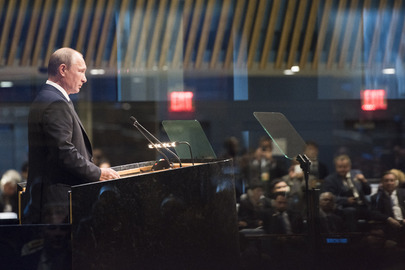
Russian President Vladimir Putin (UN Photo)
Russia may not be experiencing dynamic growth, but over the past two years it has survived a crisis of circumstance in depressed oil prices and economic warfare against it by the West that would have felled less competently managed governments enjoying less robust popularity than is the case in Vladimir Putin’s Russia. Moreover, as stagnant as Russia’s GNP has been, the numbers have been on a par with Western Europe’s very slow growth.
Meanwhile, Russian agriculture is booming, with the 2017 grain harvest the best in 100 years despite very adverse climatic conditions from early spring. In parallel, domestically produced farm machinery has been going from strength to strength. Other major Industrial sectors like civil aircraft production have revived with the launch of new and credible models for both domestic and export markets.
Major infrastructure projects representing phenomenal engineering feats like the bridge across the Kerch straits to Crimea are proceeding on schedule to successful termination in the full glare of regular television broadcasts. So where is this decrepit Russia that our Western commentators describe daily?
The chief reason for the many wrongheaded observations is not so hard to discover. The ongoing rampant conformism in American and Western thinking about Russia has taken control not only of our journalists and commentators but also of our academic specialists who serve up to their students and to the general public what is expected and demanded: proof of the viciousness of the “Putin regime” and celebration of the brave souls in Russia who go up against this regime, such as the blogger-turned-politician Alexander Navalny or Russia’s own Paris Hilton, the socialite-turned-political-activist Ksenia Sochak.
Although vast amounts of information are available about Russia in open sources, meaning the Russian press and commercial as well as state television, these are largely ignored. The sour grapes Russian opposition personalities who have settled in the United States are instead given the microphone to sound off about their former homeland. Meanwhile, anyone taking care to read, hear and analyze the words of Vladimir Putin becomes in these circles a “stooge.” All of this limits greatly the accuracy and usefulness of what passes for expertise about Russia.
In short, the field of Russia studies suffers, as it also did during the heyday of the Cold War, from a narrow ideological perspective and from the failure to put information about Russia in some factually anchored framework of how Russia fits in a comparative international setting.
Just what this means was brought into perspective last week by a rare moment of erudition regarding Russia when professor emeritus of the London School of Economics Dominic Lieven delivered a lecture in Sochi at the latest Valdai Club annual meeting summarizing his take on the Russian Revolution of 1917.
Lieven, arguably the greatest living historian of imperial Russia, is one of the very rare birds who brought to his Russian studies a profound knowledge of the rest of the world and in particular of the other imperial powers of the Nineteenth Century with which Russia was competing. This knowledge takes in both hard and soft power, meaning on the one hand, military and diplomatic prowess and, on the other, the intellectual processes which are used to justify imperial domination and constitute a world view if not a full-fledged ideology.
Self-blinded ‘Experts’
By contrast, today’s international relations “experts” lack the in-depth knowledge of Russia to say something serious and valuable for policy formulation. The whole field of area studies has atrophied in the United States over the past 20 years, with actual knowledge of history, languages, cultures being largely scuttled in favor of numerical skills that will provide sure employment in banks and NGOs upon graduation. The diplomas have been systematically depreciated.
The result of the foregoing is that there are very few academics who can put the emerging Russian-Chinese alliance into a comparative context. And those who do exist are systematically excluded from establishment publications and roundtable public discussions in the United States for not being sufficiently hostile to Russia.
If that were not the case, one could look at the Russian-Chinese partnership as it compares firstly with the American-Chinese partnership created by Richard Nixon and Henry Kissinger, which is now being replaced by the emerging Russian-Chinese relationship. Kissinger was fully capable of doing this when he wrote his book On China in 2011, but Kissinger chose to ignore the Russian-Chinese partnership though its existence was perfectly clear when he was writing his text. Perhaps he did not want to face the reality of how his legacy from the 1970s had been squandered.
What we find in Kissinger’s description of his accomplishments in the 1970s is that the American-Chinese partnership was all done at arm’s length. There was no alliance properly speaking, no treaty, in keeping with China’s firm commitment not to accept entanglement in mutual obligations with other powers. The relationship was two sovereign states conferring regularly on international developments of mutual interest and pursuing policies that in practice proceeded in parallel to influence global affairs in a coherent manner.
This bare minimum of a relationship was overtaken and surpassed by Russia and China some time ago. The relationship has moved on to ever larger joint investments in major infrastructure projects having great importance to both parties, none more so than the gas pipelines that will bring very large volumes of Siberian gas to Chinese markets in a deal valued at $400 billion.
Meanwhile, in parallel, Russia has displaced Saudi Arabia as China’s biggest supplier of crude oil, and trading is now being done in yuan rather than petrodollars. There is also a good deal of joint investment in high technology civilian and military projects. And there are joint military exercises in areas ever farther from the home bases of both countries.
I think it is helpful to look at this partnership as resembling the French-German partnership that steered the creation and development of what is now the European Union. From the very beginning, Germany was the stronger partner economically with France’s economy experiencing relative stagnation. Indeed, one might well have wondered why the two countries remained in this partnership as nominal equals.
The answer was never hard to find: with its historical burden from the Nazi epoch, Germany was, and to this day remains, incapable of taking responsibility in its own name for the European Union. The French served as the smokescreen for German power. Since the 1990s, that role has largely been transferred to the E.U. central bodies in Brussels, where key decision-making positions are in fact appointed by Berlin. Yet, France remains an important junior partner in the German-driven process.
The Russian-Chinese Tandem
One may say much the same about the Russian-Chinese tandem. Russia is essential to China because of Moscow’s long experience managing global relations going back to the period of the Cold War and because of its willingness and ability today to stand up directly to the American hegemon, whereas China, with its heavy dependence on its vast exports to the U.S., cannot do so without endangering vital interests. Moreover, since the Western establishment sees China as the long-term challenge to its supremacy, it is best for Beijing to exercise its influence through another power, which today is Russia.
Of course, in light of the E.U.’s Brexit troubles and Trump’s abandonment of world leadership, it is undeniably possible that China will step out of the shadows and seek to assume direction of global governance. But that would be problematic. China faces major domestic challenges including the transition of its economy from being led by exports to relying more on domestic consumption. That will absorb the attention of its political leadership for some time.
Kissinger, who has been an adviser to Trump, whispers in Trump’s ear about the importance of separating Russia from China, but Kissinger’s limited and outdated knowledge of Russia has caused him to underestimate the powerful motives behind the Russian-Chinese relationship. America’s less gifted and informed pundits are even more clueless.
For one thing, given the sustained hostility directed at Russia from the West in general and from Washington in particular, it is inconceivable that Putin would be wooed away from Beijing by some flirtatious “come hither” gestures from the Trump administration even if that were politically possible for Trump to do. One of Putin’s outstanding features is his loyalty to his friends and his principles as well as to his nation’s interests.
As Putin revealed during his address and Q&A at the Valdai Club gathering this past week, he now bears a deep distrust of the West in light of its having taken crude advantage of Russia’s weakness in the 1990s and by its expansion of NATO to Russian borders and other threatening actions. Whatever hopes Putin once may have held for warmer relations with the West, those hopes have been dashed over the past several years.
Putting personalities aside, Russian foreign policy has a commonality that is rare to see on the world stage: actions first, diplomatic charters later. Russia’s political relations with China come on top of massive mutual investments that have taken many years to agree on and execute.
In the same way, Russia is proceeding with Japan to work towards a formal peace treaty by first putting in place massive trade and investment projects. It is entirely foreseeable that the first step to the treaty will be the start of construction in 2018 of a railway bridge in the Far East linking the Russian island of Sakhalin with the mainland. The general contractor and engineering team is also in place: Arkady Rotenberg and his SGM Group. That bridge is the prerequisite for Japan and Russia signing a $50 billion deal to build a railway bridge linking Sakhalin and Hokkaido. This bridge will draw the attention of the whole region to Russian-Japanese cooperation. It could be the foundation for a durable and not merely paper peace treaty resolving the territorial dispute over the Kurile Islands.
Lost Opportunities
In light of these realities, it is puerile to speak of detaching Russia from China with the promise of normalized relations with the West. The opportunity to do that existed in the 1990s, when President Boris Yeltsin and his “Mr. Yes” Foreign Minister Andrei Kozyrev did everything possible to win U.S. agreement to Russian accession to NATO immediately following accession by Poland. To no avail.
Then again early in Putin’s presidency, the Russians made a determined effort to win admission to the Western alliance. Again to no avail. Russia was excluded, and measures were taken to contain it, to place it in a small box as just another European regional power.
Finally, following the confrontation with the United States and Europe over their backing of the 2014 coup in Ukraine, followed by the Russian annexation/merger with Crimea, and Russian support for the insurgency in Ukraine’s Donbas region, Russia openly was cast as the enemy. It was compelled to mobilize all of its friendships internationally to stay afloat. No state was more helpful in this regard than China. Such moments are not forgotten or betrayed.
The Kremlin understands full well that the West has nothing substantial to offer Russia as long as the U.S. elites insist on maintaining global hegemony at all costs. The only thing that could get the Kremlin’s attention would be consultations to revise the security architecture of Europe with a view to bringing Russia in from the cold. This was the proposal of then President Dmitry Medvedev in 2010, but his initiative was met by stony silence from the West. Bringing in Russia would mean according it influence proportionate to its military weight, and that is something NATO has opposed tooth and nail to this day.
It is for this reason, the failure to seek solutions to the big issue of Russia’s place in overall security, that the re-set initiative under Barack Obama failed. It is for this reason that Henry Kissinger’s advice to Donald Trump at the start of his presidency to offer relief from sanctions in return for progress on disarmament rather than implementation of the Minsk accords regarding the Ukraine crisis also failed, with Vladimir Putin giving a firm “nyet.”
Implicit in the few American “carrots” being extended to Russia these days is its acceptance of the anti-Russian regime in Ukraine and its authority over the heavily ethnic Russian areas of the Donbas and Crimea, concessions that would be politically devastating to Putin inside Russia. Yet, that “normalization” would still leave the much milder but still nasty “human rights” sanctions that the U.S. imposed in 2012 through the Magnitsky Act, driven by what the Kremlin regards as false propaganda surrounding the criminal case and death of accountant Sergei Magnitsky.
The sting of the Magnitsky Act was to discredit Russia and prepare the way for it being designated a pariah state. It came amidst an already longstanding campaign of demonization of the Russian president in the U.S. media. In fact, to begin to find a halfway normal period of bilateral relations, you would have to go back to before George W. Bush’s invasion of Iraq, which Russia denounced along with Germany and France. The latter two powers got a tap on the wrist from Washington. For Russia, it was the start of a period of reckoning for its uncooperativeness with American global domination.
Demonizing Russia
As for Europe and Russia, the question is very similar. To find mention of a strategic relationship, firstly from the German Foreign Ministry, you have to go back to before 2012. And what constituted normality then? At the time, renewal of the E.U.-Russia cooperation agreement was already being held up for years, nominally over a difference of views on the provisions of E.U. law governing gas deliveries through Russian-owned pipelines. Behind this difference was the total opposition of the Baltic States and Poland to anything resembling normal relations with Russia, for which they received full encouragement from the U.S.
The rallying cry was to put a stop to Russia’s status as “monopoly supplier” to Europe as regards gas, but also oil. Of course, no monopoly ever existed, nor does it exist today, but determined geopolitical actors never let such details stand in the way of policy formulation.
This hostility also played out in the contest of wills between the E.U. and Russia over introduction of a visa-free regime for travel by their respective citizens. Here the opposition of Germany’s Angela Merkel, justified by her vicious characterization of Russia as a mafia state, doomed the visa-free regime and by the same token doomed normal relations.
All of this unfinished business has to be addressed and put right for there to be any possibility of the U.S. and the E.U. ending their hostility toward Russia and for the Kremlin to regain any trust toward the West. Even then, however, Russia would not surrender its valued relationship with China.
In my view, the de facto Russian-Chinese alliance matches the de jure US-West European alliance. The net result of both is the partition of the world into two camps. We now have, in effect, a bipolar world that broadly resembles that of the Cold War, though still in a formative stage since many countries have not signed on definitively to one side or another.
Of course, more-or-less neutral states were also a feature of the Cold War, creating what was called the group of Nonaligned Nations, led back then by India and Yugoslavia. Yugoslavia no longer exists, but India has continued its tradition of let both poles court it, trying to eke out the greatest benefit to itself.
To be sure, a great many political scientists in the U.S., in Europe and in Russia as well, insist that we already have a multipolar world, saying that power is too diffuse in the world today, especially considering the rise of non-state actors after 1991. But the reality is that very few states or non-states can project power outside their own region. Only the two big blocs can do that.
The theoreticians defending multipolarity speak of a return to the balance of power of the Nineteenth Century, invoking the Congress of Vienna as a possible model for today’s world governance. This is an approach that Henry Kissinger laid out in 1994 in his book Diplomacy.
Within Russia, this concept has found support in some influential think tanks and is most notably associated with Sergei Karaganov, head of the Council of Foreign and Defense Policy. Nonetheless, I maintain that everyday realities of power will decide this question. And is there anything inherently wrong with this de facto bipolar world, assuming the tensions can be managed and a major war averted?
In my view, two large blocs are more likely to keep global order because the scope of activities by proxies can be reined in – as often happened during the Cold War – by big powers not wanting their various clients to disrupt a functioning world order. The tails are less likely to wag the dog.
Moreover, as regards the Russia-China strategic partnership or alliance, Western observers should take comfort and not take alarm. The rise of China is a given whatever the constellation of great powers may wish. The close embrace of Russia and China also can serve as a moderating influence on China, given Russia’s greater experience in world leadership.
For all of the above positive and negative reasons, the Russia-China relationship should be viewed with equanimity in Western capitals.
Gilbert Doctorow is an independent political analyst based in Brussels. His latest book, Does the United States Have a Future? was just published.
Featured Video

The Truth About the Trump Shootings with Ken Silva
or go to
Aletho News Archives – Video-Images
From the Archives
The Geopolitics behind the War in Yemen (I)
By Mahdi Darius NAZEMROAYA | Strategic Culture Foundation | 30.03.2015
The United States and the Kingdom of Saudi Arabia became very uneasy when the Yemenese or Yemenite movement of the Houthi or Ansarallah (meaning the supporters of God in Arabic) gained control of Yemen’s capital, Sanaa/Sana, in September 2014. The US-supported Yemenite President Abd-Rabbuh Manṣour Al-Hadi was humiliatingly forced to share power with the Houthis and the coalition of northern Yemenese tribes that had helped them enter Sana. Al-Hadi declared that negotiations for a Yemeni national unity government would take place and his allies the US and Saudi Arabia tried to use a new national dialogue and mediated talks to co-opt and pacify the Houthis.
The truth has been turned on its head about the war in Yemen. The war and ousting of President Abd-Rabbuh Manṣour Al-Hadi in Yemen are not the results of «Houthi coup» in Yemen. It is the opposite. Al-Hadi was ousted, because with Saudi and US support he tried to backtrack on the power sharing agreements he had made and return Yemen to authoritarian rule. The ousting of President Al-Hadi by the Houthis and their political allies was an unexpected reaction to the takeover Al-Hadi was planning with Washington and the House of Saudi. … continue
Blog Roll
 Aletho News
- Leaked: Britain’s Sham Conviction Of Hashim Thaci
- Seyed M. Marandi: U.S. Strike Imminent – Toward Total War in the Middle East
- Russia Voted Under Fire. Washington Is Loading the Tankers.
- 12 Things Your Oncologist Was Trained Not to Tell You
- Anthrax Attacks Paved Way for COVID-Era ‘Junk Drugs and Vaccines’
- How Real Is the Impact of Western Sanctions on Israel?
- France, You Are Guilty: How Paris Turned Western Sahara into the Maghreb’s Powder Keg
- 2025 Nature Paper Claiming Worsening Global Drought Gets RETRACTED …Heavily Flawed
- Your Milk Is Not the Problem
- The Truth About the Trump Shootings with Ken Silva
- If Americans Knew
- An error has occurred; the feed is probably down. Try again later.
- No Tricks Zone
- 2025 Nature Paper Claiming Worsening Global Drought Gets RETRACTED …Heavily Flawed
- New Study: ‘Global Drought Shows No Detectable Recent Acceleration Under Climate Warming’
- Economic Masterminds: German Socialists Suggest Taxing Productivity Gains Stemming From Using AI
- The South China Sea Has Not Been Cooperating With The Climate Change Narrative
- Energy Crisis: Germany Enters Heating Season With Historically Low Gas Reserve Fill Levels
- New Study: The Antarctic Ice Sheet Gained Mass From 2020-2024 Due To Staggering Snow And Ice Accumulation
- Study: Ocean Heating Rates From Thousands Of Years Ago ‘Dwarf’ Modern Ocean Heating Rates
- Climate Extremists Target, Attack Large-Scale Power Grid Infrastructure In Germany!
- New Study: Antarctic Ice Melt Has Contributed Less Than 1 Centimeter To Sea Level Rise In The Last 30 Years
- Fear Of Debate: Alarmist German Climate Scientist Calls On Mainstream Media To Discredit Skeptic Voices
 Aletho News