India doesn’t need a working relationship with US Central Command
By M K Bhadrakumar | Indian Punchline | March 23, 2018
The Indian media reported that following the 2+2 talks in Washington last week at the level of the foreign and defence secretaries of India and the US, a “path-breaking” decision has been firmed up to station a naval attaché at the US Naval Forces Command (NAVCENT) in Bahrain. The Defence Ministry officials in Delhi have reportedly said that the Indian attaché’s mandate will be to ‘ensure that the US and Indian navies are on the same page’ and to ‘ensure better coordination and logistic support for warships and aircraft carriers of the two countries.’
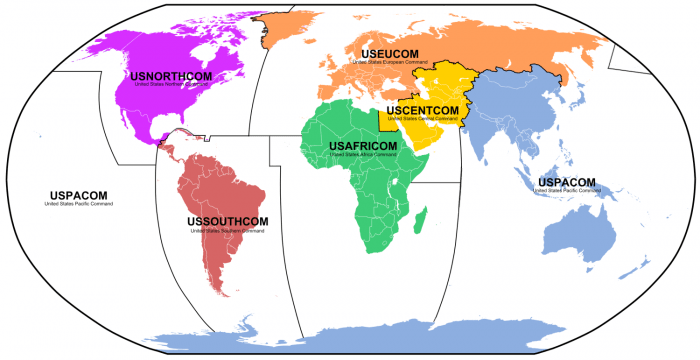
The NAVCENT, which comes under the US Central Command, has an area of responsibility that comprises the Red Sea, Gulf of Oman, Persian Gulf and Arabian Sea. The US Navy’s Fifth Fleet based in Bahrain is in charge of naval operations in the Persian Gulf region, Afghanistan and Pakistan. The highly secretive American base at Diego Garcia deep down in the Indian Ocean provides the underpinning for the NAVCENT.
If the proposed Indian deputation to the NAVCENT takes place, the US Pacific Command and Central Command will ‘share’ India, which would signify India’s growing importance to the US’ global strategies. The NAVCENT is currently fighting wars in Yemen, Syria, Iraq and Afghanistan. But then, India has nothing to do with any of these wars.
Does the US-Indian project to monitor the movement of Chinese ships in the Indian Ocean warrant such a step? Can’t we keep a tab on the Gwadar naval base without an attaché deployed to Bahrain? Are we contemplating force projection in the Indian Ocean?
On the other hand, this decision drips with profound symbolism and will be noted keenly by all regional states – especially, Iran and Pakistan – and global powers – Russia and China, in particular. Indeed, the stunning part is that, sadly, our policymakers can be so myopic about the country’s geography and the dangerous security environment surrounding it.
All indications are that a major escalation of the war in Syria is imminent. Tensions are rising alarmingly and last weekend Moscow openly warned of retaliation against US targets if it again attacked the Syrian government forces. Only two days ago, Russian Deputy Defence Minister Sergei Ryabkov said in Moscow, “We have been warning the United States about the need to abandon these plans unconditionally. Any illegal use of force… would be an act of aggression against a sovereign state.” Read the latest analysis by the Russian think tank on security issues entitled The Russian Military Warns: a Major War in Syria Is Imminent.
Again, there are sub-plots – the US plans to balkanize Syria with the help of Kurds and Turkey’s trenchant opposition to it; the US-Israeli strategy to contain Iran’s influence in Syria, Iraq and Lebanon; the NATO’s intent to evict Russia from its Syrian bases and Eastern Mediterranean and so on. Furthermore, it is only the US military support that is sustaining the brutal war waged by Saudi Arabia and the UAE in Yemen. A recent op-Ed in the Washington Post co-authored by 3 senior US senators – Bernie Sanders, Mike Lee and Chris Murphy says: “U.S. military is making the crisis (in Yemen) worse by helping one side in the conflict bomb innocent civilians… U.S. forces are coordinating, refueling and targeting with the Saudi-led coalition, as confirmed last December by Defence Secretary Jim Mattis.”
Above all, what India needs to be most vigilant about is the real possibility of a US-Iranian confrontation as a near-term scenario. The appointment of John Bolton as the new US National Security Advisor is indeed ominous. Read an analysis by the well-known investigative journalist and author Gareth Porter in the American Conservative entitled The Untold Story of John Bolton’s Campaign for War With Iran.
Our faujis are besotted with Uncle Sam. For the lucky bloke who gets the slot in Bahrain it may be an attractive ‘phoren posting’, but for India what does it add up to? India will be foolish to get entangled in the US’ military adventures. It simply won’t cut ice to say our chap will remain single-mindedly focused on the movement of Chinese ships.
Politics is largely a matter of perceptions. India gains nothing by displaying a working relationship with the US Central Command when the gathering storms on the horizon are already visible to the naked eye. The prudent thing will be to begin preparations to sequester our country from collateral damage when the tsunami actually arrives. Only fools rush in where angels fear to tread.
US in Afghanistan to Influence Russia, Iran, China – Russian Foreign Ministry
Sputnik – March 14, 2108
The United States retains its presence in Afghanistan to exert influence on neighboring countries and regional rivals – namely, Russia, Iran and China, Russian Foreign Ministry’s Second Asian Department Director Zamir Kabulov told Sputnik in an interview.
“In our opinion, the United States is in Afghanistan primarily with the aim of controlling and influencing the political processes in its neighboring countries, and also demonstrating its power to its regional competitors, primarily China, Russia and Iran. The United States is clearly trying to achieve destabilization of Central Asia and later transfer it to Russia in order to subsequently present itself as the only defender against potential and emerging threats in the region,” Kabulov said.
According to the diplomat, Russia and other countries neighboring with Afghanistan have questions about the true goals and time frame of the US military presence in the Central Asian country.
“If the United States and its NATO allies intend to continue their destructive policy in Afghanistan, this will mean that the West is heading toward the revival of the Cold War era in this part of the world. We closely monitor the developments and are ready to respond in cooperation with our partners and other like-minded people,” Kabulov noted.
The diplomat pointed out that Washington still failed to understand that the Afghan conflict could not be resolved solely by military means, stressing that it was impossible to defeat the Taliban by force.
Moscow is puzzled by the attempts of the United States and NATO to persuade Afghanistan to replace Russian weapons and military equipment, such move leads to reduction of Afghan’s military potential, Zamir Kabulov told Sputnik in an interview.
“The course taken by the United States and NATO to persuade Kabul to replace Russia-made small arms and aircraft is surprising, as it will inevitably lead to a decrease in the combat capabilities of the Afghan armed forces and further deterioration of the situation,” Kabulov said.
The diplomat reminded that a bilateral intergovernmental agreement on Russia’s defense industry assistance to Afghanistan had entered into force in November 2016, adding that the document created the legal framework for Russian assistance in arming and equipping the Afghan security forces.
“At the moment, negotiations are underway on repairs and supplies of spare parts for the Afghan Air Force’s helicopters for various purposes, produced in Russia (the Soviet Union),” Kabulov added.
Afghanistan Parliamentary Election
The parliamentary election in Afghanistan is unlikely to take place in July in the current circumstances, Kabulov said.
“I do not think that the parliamentary elections in Afghanistan will be held in July this year as scheduled. The Taliban continue to control about half of the country’s territory, engage in hostilities, organize and carry out terrorist attacks in large cities, and, apparently, are not going to make compromises and reconciliation with the Afghan government,” Kabulov said.
Afghanistan’s Independent Election Commission (IEC) is also unlikely to accomplish all the necessary procedures before the date set for the vote, given that the commission has announced earlier that the registration of voters will complete only by early August, the diplomat noted.
Furthermore, disagreements between the presidential administration and its political opposition regarding the parameters of the upcoming elections still remain unresolved, the official noted.
“In my opinion, if elections are conducted in the current circumstances, their results will not improve the political situation in the country and confidence in the current government, will not force the armed opposition to cooperate with the government,” Kabulov added.
The diplomat also noted that the Daesh terror group posed a serious threat to holding the election.
“The Daesh jihadists pose a serious threat to the security of the conduct of elections, especially in the north and a number of eastern provinces of Afghanistan. Some polling stations in the provinces of Helmand, Uruzgan, Kunduz, Badakhshan, Faryab and Ghazni are the most problematic in terms of security, according to the IEC data. I think that, in fact, the list of problematic areas in terms of organization of voting is much longer,” Kabulov said.
Afghanistan Reconciliation Talks
Russia considers the so-called Moscow format of talks an optimal platform for the promotion of national reconciliation in Afghanistan, Zamir Kabulov noted.
“Unfortunately, the existence of a large number of international formats on the Afghan issue has not significantly contributed to the involvement of the Taliban in peace negotiations. In this regard, we consider the Moscow format of consultations launched by us in early 2017 as the optimal platform for substantive negotiations to promote national reconciliation and establish a constructive dialogue between the government of Afghanistan and the Taliban movement,” Kabulov said.
Kabulov also noted that Moscow considered the format of talks in the Afghan capital as one approach toward achieving a collective solution to the problems surrounding Afghan settlement.
“A signal of international support for the resolution of the intra-Afghan conflict through political dialogue with the government of Afghanistan has been sent to the Taliban. The Taliban ignored the recent meeting of the ‘Kabul process’ in the Afghan capital, insisting on direct talks with the United States,” the diplomat added.
In February 2017, Russia, China, Pakistan, Iran, India and Afghanistan came together in Moscow for talks to promote the national reconciliation process in Afghanistan through regional cooperation with Kabul in the leading role. Apart from the aforementioned states, the latest round in April gathered five Central Asian countries: Kazakhstan, Kyrgyzstan, Tajikistan, Turkmenistan and Uzbekistan. The United States refused to take part in the meeting.
Afghanistan has long suffered political, social and security-related instability because of the simmering insurgency, including that of the Taliban, but also because of the actions of the Daesh terror group.
The United States has been in Afghanistan for almost 17 years following the 9/11 attacks. Before his election, Trump slammed sending US troops and resources to the Central Asian country.
Australia sees opportunity in China’s rise
By M K Bhadrakumar | Indian Punchline | February 27, 2018
From an Indian perspective, the visit to the United States by the Australian Prime Minister Malcolm Turnbull and his meeting with President Donald Trump on February 23 turns out to be a reality check on the power dynamic in the Asia-Pacific. Australia is torn between two vital partners – the US in the security sphere and China in the economic sphere. The dilemma is acute insofar as Turnbull has voiced opinions on threat perceptions regarding China, which are contrary to the Trump administration’s assessment and, yet, the US and Australia are key allies.
A month ago, Australian Foreign Minister Julie Bishop pointedly distanced her country from the US’ assessment of China (and Russia) being a strategic threat. The US National Security Strategy issued in January said, “China is a strategic competitor using predatory economics to intimidate its neighbors while militarizing features in the South China Sea… It is increasingly clear that China and Russia want to shape a world consistent with their authoritarian model — gaining veto authority over other nations’ economic, diplomatic, and security decisions.”
Bishop refused to share that assessment, saying, “We have a different perspective on Russia and China clearly — we do not see Russia or China posing a military threat to Australia, we continue to work closely with China in fact we undertake military exercises with China as well as with other countries in the region and we will continue to do so.”
Turnbull openly endorsed Bishop’s remarks. In his words, “Apart from North Korea, there is no country in the region that shows any hostile intent towards Australia,” Mr Turnbull said, “We don’t see threats from our neighbours in the region, but, nonetheless, every country must always plan ahead and you need to build the capabilities to defend yourself, not just today, but in 10 years or 20 years, hence.”Turnbull reverted to the topic as he was embarking on the visit to the US last week. In remarks to Sky News, Turnbull said:
- A threat, technically, is a combination of capability and intent. China has enormous capability of course, it’s growing as the country becomes more prosperous and economically stronger. But we do not see any hostile intent from China.
- We don’t see the region through what is frankly an out-of-date Cold War prism. Neither, by the way, does Donald Trump. President Trump has a long experience in this part of the world as a businessman. He understands the significance, the economic significance of China’s rise and its opportunity.
Indeed, the joint statement issued after Turnbull’s meeting with Trump in the White House contains no reference to China or the disputes in the South China Sea. (Nor on ‘Quad’!) It doesn’t mention ‘freedom of navigation’, either. At the joint press conference with Turnbull, Trump said he’d “love” to have Australia back the US effort to assert the right to maritime freedom in South China Sea – “We’d love to have Australia involved and I think Australia wants us to stay involved.”
But Turnbull was unmoved. He made no commitments about Australia joining the US naval display. On the other hand, he emphasized the economic opportunities from China’s rise. Turnbull had hopes of persuading Trump to take a fresh look at the Trans-Pacific Partnership agreement, but Trump repeated his distaste of the trade pact. Trump said, “The TPP was a very bad deal for the United States, it would have cost us a tremendous amount of jobs, it would have been bad.”
Equally, in the run-up to Turnbull’s visit, there was speculation that a possible economic front comprising the US, Japan, India and Australia could be in the making to “answer Chinese and Russian infrastructure-building efforts” in the Asia-Pacific. But it turned out to be mere drum-beating. (Reuters / Bloomberg) The Trump administration is focused single-mindedly on America First and has no interest in doing the diplomatic heavy lifting to push back at China’s Belt and Road Initiative.
Clearly, one substantive outcome of Turnbull’s visit has been in the launch of an Australia-US Strategic Partnership on Energy in the Indo-Pacific. This must be seen against the backdrop of the US gearing up to export LNG to the Asian market, especially China. While on the one hand runaway gas demand in China is transforming the outlook for LNG in Asia and could see a return to the seller’s market in 2018, on the other hand, Australia’s rapidly growing LNG exports are already finding a ready market. A joint press release in Washington spelt out the “core principles” and outlined a “work plan” for the proposed US-Australia energy partnership. (here)
China would be quietly pleased with the outcome of the Trump-Turnbull meeting in Washington. An editorial in the government newspaper China Daily noted, “if Turnbull is now choosing to look at China through a more objective prism that would obviously help build more trust between the two countries, which will only usher in a more cordial atmosphere for relations to deepen and grow. Yet the Australian government still needs to match words with deeds… In its most recent foreign policy white paper, Australia proposes that it can act as an honest broker between China and the US.”
The Global Times in an editorial, also commended that Turnbull’s remarks “show positive signs for the Sino-Australian relationship.”
China gives dressing-down to Maldives’ Nasheed
By M K Bhadrakumar | Indian Punchline | February 18, 2018
The mystery of the Supreme Court judges in Male promoting democracy in their beloved country is deepening. One of the three judges who gave the ruling to destabilize the political situation had unaccounted money to the tune of $220000 in his possession and a second judge in the troika had a big amount of $2.4 million transferred to him by “a private firm.” Evidently, democracy doesn’t come cheap.
We do not know who is spending all that money to promote democracy in the Maldives – at least, not yet. But Maldives is such a small country that nothing remains secret for long. All we know for the present is that “the investigation is not limited to Maldives.” Put differently, there has been the ubiquitous “foreign hand” pushing the regime change agenda in Maldives.
Male has approached unspecified foreign governments for assistance in conducting the enquiry. Hopefully, India is not one of them. It seems India – along with Sri Lanka, Malaysia, the Netherlands and the UK – is one of the countries the two debonair judges involved in the scam had visited in the past one-year period. (Gulf Today )
There is obviously more – much more – to the events in Maldives than meets the eye. The Xinhua news agency carried an extraordinary commentary last Thursday attacking by name the former Maldives President Mohamed Nasheed (who is spearheading the democracy campaign from his locations in Sri Lanka and India) for spreading canards about the Chinese “presence” in Sri Lanka. Nasheed recently told the Hindu newspaper, “Without firing a single shot, China has grabbed more land than what the East India company had, at the height of the colonial era. They have weaponised foreign direct investments.”
Evidently, the Chinese found it an outrageous remark even by Nasheed’s yardstick. Xinhua tore into him. The commentary disclosed, inter alia, that Nasheed himself was once an enthusiastic promoter of Maldives’ relations with China when he was president, and, in fact, the commentary drops a bombshell saying, “However, as a former Maldivian president, who has also experienced the benefits from the fruitful cooperation between the Maldives and China, Nasheed this time chose to turn a blind eye to the fact.”
The Counselor in the Chinese embassy in Male Yang Yin told Xinhua, “Why did Nasheed support this normal economic and trade cooperation during his tenure and now turns to oppose it? Let alone fabricating statistics to tarnish the normal bilateral cooperation between the two countries? These doubts remain in the mind of the Chinese side.”
Hmmm. This Nasheed fellow is turning out to be quite a guy. He always seemed a bit of a maverick. (He once made the immaculate decision on the opening of the Chinese embassy in Male to coincide with the arrival of the then PM Manmohan Singh in the Maldives on official visit in November 2011.) Indeed, it now appears that he has dark secrets that only he and the Chinese could be privy to. But, Yang has asked a good question: Why did Nasheed become a turncoat? Conceivably, some people made an offer to him in recent years that he couldn’t refuse.
To my mind, however, the fascinating thing about the Xinhua commentary is the snippet of information it shared in regard of the scale of the “Chinese presence” in the Maldives. Of course, there have been dark rumors circulating in the Indian press for months on this topic, making it out that the Chinese are building a military base in the Maldives. Well, it seems the plain truth is that the “Chinese presence” in the Maldives actually adds up to seven resort hotels that Chinese companies are constructing on seven islands (out of the country’s total 100 islands) for foreign tourists. To be sure, enterprising Chinese business people see that with the big influx of Chinese tourists into the Maldives, there is good money to be made.
According to Forbes magazine, Maldives figures 7th among the first ten eco-tourist hot spots that Chinese jet setters are choosing. The number of Chinese tourists visiting the Maldives tripled from 1 lakh in 2010 to 3.6 lakhs in 2014, accounting for nearly one-third of the entire tourist traffic to the island, representing the single biggest source market for Maldives. Tourism is the main source of income for Maldives and Male is smart enough to know that China already accounts for more than a fifth of the money spent by outbound tourists worldwide, twice as much as the next-biggest spender, the US (according to the United Nations World Tourism Organization.)
Read the Xinhua commentary here – Spotlight: Former Maldivian president’s statement on China “grabbing land” false, irresponsible.
US feels uneasy about inter-Korean amity
By M K Bhadrakumar | Indian Punchline | February 11, 2018
The North Korean leader Kim Jong-un has upset all doomsday predictions that once the Winter Olympics Games are over, the tensions on the Korean peninsula would reappear. Kim’s invitation to South Korean President Moon Jae-in to Pyongyang can be regarded as a ‘game changer’. Moon has been non-committal, saying conditions need to be created first. The important thing is that Moon neither accepted Kim’s invitation nor declined. As a senior South Korean official put it, Moon has “practically accepted” the invitation. Thereby hangs a tale.
Left to himself Moon may want to visit Pyongyang. But a number of factors come into play. First and foremost, North Korea should refrain from missile tests, especially nuclear tests. Kim’s invitation to Moon implies that Pyongyang intends to hold back on missile and nuclear tests even after the Winter Games are over. On the contrary, if the joint US-South Korean military drills resume, all bets are off.
Therefore, Moon faces the daunting challenge of persuading the Trump administration to defer military drills. Now, that is not going to be easy. The US insists that North Korea should unilaterally suspend its missile and nuclear tests and does not accept any linkage with the US-South Korean military drills. Indeed, the sensible thing to do is to follow the suggestion by China and Russia on ‘double suspension’ – ie., US and South Korea suspending military drills and North Korea reciprocally suspending missile and nuclear tests.
China can be expected to play a major role here in bridge-building. Xinhua news agency reported that during the visit by Chinese State Councilor Yang Jiechi to Washington on February 8-9, he “exchanged ideas on the nuclear issue on the Korean peninsula.” Yang was received by President Trump and he also had meetings with Secretary of State Rex Tillerson, National Security Advisor HR McMaster and the president’s senior advisor and son-in-law Jared Kushner. Xinhua cited Yang as calling for “global support for the inter-Korean rapport in a bid to maintain the tension-easing momentum on the peninsula.” Yang said Beijing hopes to keep “communication and coordination” with Washington with a view to seek a solution to the North Korean issue.
Significantly, Chinese president Xi Jinping also deputed a special envoy to meet Moon in the weekend. Accordingly, on Saturday Han Zheng, a member of the Standing Committee of the Political Bureau of the Communist Party of China Central Committee, met Moon. (Moon received Han before hosting a lunch for the high-ranking North Korean delegation led by Kim Yong Nam, president of the Presidium of the Supreme People’s Assembly on Saturday.) Xinhua reported Han as voicing support for the “conciliation and cooperation” between North and South Korea and expressing hope that “relevant parties would meet each other half way and make joint efforts to further ease tensions”
While things look hazy as of now and it is difficult to foresee how things may work out, the odds are that Moon will visit Pyongyang eventually. Put differently, South Korea may not be in a tearing hurry to resume the military drills with the US anytime soon. According to reports, Moon already had a testy exchange with the Japanese Prime Minister on the matter. They sparred, with Moon bluntly rejecting Abe’s call to resume the US-South Korean military drills without delay.
Meanwhile, the popular opinion in South Korea is visibly changing. It turned out to be a brilliant maneuver on the part of the North Korean leader to depute his younger sister Kim Yo Jong as part of the high-level delegation to attend the opening ceremony of the Winter Olympics. She is the first member of the ruling family in Pyongyang to visit the South since the Korean War broke out in 1950, and South Koreans were enthralled. Clearly, North Korea’s participation in the Olympics has already broken the momentum of the US’ pressure campaign. Some sanctions against North Korea are already suspended temporarily until the Winter Olympics ends. The big question is whether the US’ pressure campaign can be resumed in the changed climate between the two Koreas.
Moon is walking on eggshells. Surely, he won’t want to miss the window of opportunity for a peace engagement with Kim. But then, it is far too risky to go to Pyongyang unconditionally. By going out on a limb, not only would Moon be angering the Trump administration, but the reality is that Kim has not given any signals so far that he is willing to discuss denuclearization. Equally, it could be that Kim is simply buying time for his country’s nuclear weapon program. Above all, US backing is vital for Moon to negotiate with Kim.
However, Washington is not exactly pleased about the recent improvement in inter-Korean ties. There are already signs of discord in the US-South Korean alliance. Read a dispatch by Associated Press – Pence’s bid to isolate North Korea at Olympics falls flat.
Russia to deploy warplanes on Kuriles
By M K Bhadrakumar | Indian Punchline | February 3, 2018
A one-line decree signed by Russian Prime Minister Dmitry Medvedev on 30th January merely assigned a dual civilian-military role to the newly operational airport on the island of Iturop in the disputed Kurile chain. But its strategic content is unmistakable – Moscow is taking a big step forward in the militarization of the Kuriles by deploying warplanes, drones and command systems at the facility. The airport has a 2.3 milometer runway and can handle giant aircraft.
The Iturop island is one of four seized by Soviet forces in the final days of World War Two and is located off the north-east coast of Hokkaido, Japan’s biggest prefecture. The dispute over the islands (known as the Kuriles in Russia and the Northern Territories in Japan) has prevented the signing of a formal peace treaty between Russia and Japan to mark the end of the war.
Tokyo has lost no time to express concern over the Russian military deployment to Iturop. Japan’s Chief Cabinet Secretary Yoshihide Suga said, “We’ve conveyed through diplomatic channels that it goes against our country’s position. We’re gathering information on the Russian military’s behavior in the Northern Territories.”
Moscow’s decision can be seen in the context of the U.S.-built Aegis land-based missile defense system getting deployed in Japan. In December, Japanese government approved a record $46 billion defense budget and funds to survey potential sites for two Aegis ground interceptor batteries. A ship-based version of the Aegis system (made by Lockheed Martin) is already installed on Japanese warships. Japan is expected to deploy the Aegis Ashore system by 2023.
Moscow refused to accept the contention by Japan that the Aegis Ashore system is meant to defend against enemy missile attacks such as North Korean ballistic missiles. The Russian Foreign Ministry spokesperson Maria Zakharova said on December 28,
- The recent decision by the Japanese government to deploy US Aegis Ashore missile defence systems on its territory causes deep regret and serious concern. Whatever arguments and motives behind it, it is clear that the deployment of these systems is yet another step towards building a full-fledged Asian-Pacific regional segment of the global US missile defence system. It should be kept in mind that these systems are equipped with universal missile launchers capable of using strike weapons. In practice, it means another violation of the INF Treaty by the United States with Japan’s assistance.
- We consider Japan’s step as going against the efforts to establish peace and stability in the region. In addition, these actions by Tokyo directly contradict the priority task of fostering trust between Russia and Japan in the military-political area and will affect the general atmosphere of bilateral relations, including talks on a peace treaty.
Last November, Russian President Vladimir Putin had publicly voiced the expectation that Japan should review its alliance with the US as a condition for a peace treaty. Medvedev’s decree on January 30 is a snub to Japan, coming ahead of a scheduled meeting between the deputy foreign ministers of the two countries to discuss cooperation on the disputed territory of Kuriles. Russia seems to have given up hope since then that Japan can be encouraged to pursue independent foreign policies.
Meanwhile, the growing tensions over North Korea, the US military build-up in the Far East and the New Cold War between the US and Russia become added compulsions for Moscow to strengthen its defence lines in the Sakhalin Oblast. By the way, Moscow is also working on plans to create a new naval base in the region for submarines.
Clearly, under these circumstances, a Russo-Japanese peace treaty becomes an even more remote prospect. The ‘charm diplomacy’ by Japanese PM Shinzo Abe is not getting anywhere; Russia is not a pushover, as he’d have thought. This has serious implications for the power dynamic in East Asia in the near term, putting Japan at a disadvantage in the Russia-China-Japan triangular diplomacy.
Featured Video

The Truth About the Trump Shootings with Ken Silva
or go to
Aletho News Archives – Video-Images
From the Archives
The Geopolitics behind the War in Yemen (I)
By Mahdi Darius NAZEMROAYA | Strategic Culture Foundation | 30.03.2015
The United States and the Kingdom of Saudi Arabia became very uneasy when the Yemenese or Yemenite movement of the Houthi or Ansarallah (meaning the supporters of God in Arabic) gained control of Yemen’s capital, Sanaa/Sana, in September 2014. The US-supported Yemenite President Abd-Rabbuh Manṣour Al-Hadi was humiliatingly forced to share power with the Houthis and the coalition of northern Yemenese tribes that had helped them enter Sana. Al-Hadi declared that negotiations for a Yemeni national unity government would take place and his allies the US and Saudi Arabia tried to use a new national dialogue and mediated talks to co-opt and pacify the Houthis.
The truth has been turned on its head about the war in Yemen. The war and ousting of President Abd-Rabbuh Manṣour Al-Hadi in Yemen are not the results of «Houthi coup» in Yemen. It is the opposite. Al-Hadi was ousted, because with Saudi and US support he tried to backtrack on the power sharing agreements he had made and return Yemen to authoritarian rule. The ousting of President Al-Hadi by the Houthis and their political allies was an unexpected reaction to the takeover Al-Hadi was planning with Washington and the House of Saudi. … continue
Blog Roll
 Aletho News
- Leaked: Britain’s Sham Conviction Of Hashim Thaci
- Seyed M. Marandi: U.S. Strike Imminent – Toward Total War in the Middle East
- Russia Voted Under Fire. Washington Is Loading the Tankers.
- 12 Things Your Oncologist Was Trained Not to Tell You
- Anthrax Attacks Paved Way for COVID-Era ‘Junk Drugs and Vaccines’
- How Real Is the Impact of Western Sanctions on Israel?
- France, You Are Guilty: How Paris Turned Western Sahara into the Maghreb’s Powder Keg
- 2025 Nature Paper Claiming Worsening Global Drought Gets RETRACTED …Heavily Flawed
- Your Milk Is Not the Problem
- The Truth About the Trump Shootings with Ken Silva
- If Americans Knew
- Salah Sarsour’s Legal Team Says DHS Has Not Met Its Burden to Prove He Is Deportable
- An analysis of tax forms by The Intercept show Kraft’s charity and LLC have donated to Friends of the IDF and AIPAC’s super PAC.
- Israeli attacks kill four Palestinians in Gaza – Daily Update
- Inside Gaza’s death trap of collapsing, bombed-out buildings
- The everyday items Israel bans from Gaza every day
- Inside the siege, the ruined buildings of Gaza – Daily Update
- Debunking The Claim That Macklemore Has A “History Of Antisemitism”
- CPJ demands release of arrested Palestinian-US journalist near Bethlehem
- Robert Kraft: The Billionaire Friend of Netanyahu Pulling The Strings Behind the Macklemore/Ed Sheeran Blow Up
- Columbia Administered Fund Gives Big Money to Pro-Israel Groups
- No Tricks Zone
- 2025 Nature Paper Claiming Worsening Global Drought Gets RETRACTED …Heavily Flawed
- New Study: ‘Global Drought Shows No Detectable Recent Acceleration Under Climate Warming’
- Economic Masterminds: German Socialists Suggest Taxing Productivity Gains Stemming From Using AI
- The South China Sea Has Not Been Cooperating With The Climate Change Narrative
- Energy Crisis: Germany Enters Heating Season With Historically Low Gas Reserve Fill Levels
- New Study: The Antarctic Ice Sheet Gained Mass From 2020-2024 Due To Staggering Snow And Ice Accumulation
- Study: Ocean Heating Rates From Thousands Of Years Ago ‘Dwarf’ Modern Ocean Heating Rates
- Climate Extremists Target, Attack Large-Scale Power Grid Infrastructure In Germany!
- New Study: Antarctic Ice Melt Has Contributed Less Than 1 Centimeter To Sea Level Rise In The Last 30 Years
- Fear Of Debate: Alarmist German Climate Scientist Calls On Mainstream Media To Discredit Skeptic Voices
 Aletho News