Russia, China nearing alliance conditions
By M K Bhadrakumar | Indian Punchline | August 10, 2018
The Chinese Communist Party Politburo member Yang Jiechi is visiting Moscow on August 14-17 at the invitation of the secretary of the Russian national security council, Nikolai Patrushev to participate in the 14th round of Russian-Chinese consultations on strategic stability. The forthcoming event in Moscow will be closely watched since the two countries are fast nearing a situation of confronting a common ‘enemy’. This is a new experience for both since the halcyon days of the Sino-Soviet alliance in the 1950s.
The mainstream opinion has been that the Sino-Russian comprehensive partnership and cooperation is more the stuff of geopolitical signaling than a strategic alliance. The Western opinion has also been notably skeptical whether such partnership between Russia and China will be sustainable over time due to the growing asymmetry in the two countries’ comprehensive national power. Both premises may be getting outdated by the sheer force of developments.
Curiously, another body of opinion is steadily forming lately whether Russia and China could be actually on the verge of reaching alliance conditions in the rapidly changing global situation characterized by growing tensions in their respective relations with the United States. An essay in the Financial Times this week titled ‘China and Russia’s dangerous liaison’ authored by the daily’s Asia editor (who used to be the Beijing bureau chief previously), Jamil Anderlini, forcefully makes this point.
The writer argues that it is an intelligence blunder of historic proportions that the West is making by “dismissing the anti-western, anti-US alliance that is now forming between Moscow and Beijing.” Anderlini writes:
- This idea that Russia and China can never really be friends is just as wrong and dangerous as the cold war dogma that portrayed global communism as an unshakeable monolith… Their tightening embrace is as much about antipathy towards the US and the US-dominated global order as their rapidly growing common interests… Thanks to its continued rise and obvious ambition to supplant the US, China is a far bigger long-term challenge for America than Russia. No less a figure than Henry Kissinger – the architect of that reconciliation with China in 1972 – has reportedly counselled Donald Trump to pursue a “reverse Nixon-China strategy” by seeking to befriend Moscow and isolate Beijing.
However, the chances of a “reverse Nixon-China strategy” by the US are virtually zero. Even if President Trump is inclined in that direction, the ‘Deep State’ simply won’t allow him a free hand. It is after much effort that NATO has cast Russia in an ‘enemy’ image and anchored a whole new purposive agenda on that platform. Unshackling it can lead to the unraveling of the western alliance system itself. The New York Times today reported that the Washington establishment connived with the US’ NATO allies to present a fait accompli at the recent summit meeting of the alliance in Brussels.
In fact, the Trump administration has just announced plans to create a new Space Force as the sixth branch of its military to prepare for “the next battlefield” to counter Russia and China, which are “aggressively” working to develop anti-satellite capabilities. Announcing this at the Pentagon on August 9, US Vice-President Mike Pence said,
- China and Russia have been conducting highly sophisticated on-orbit activities that could enable them to maneuver their satellites into close proximity of ours, posing unprecedented new dangers to our space systems… We must have American dominance in space, and so we will.
President Trump promptly tweeted, “Space Force all the way!” And this comes soon after the announcement by Washington that it would impose extensive new sanctions against Moscow by August 22, including bans on a wide range of exports, by the end of the month as punishment for the alleged nerve agent attack on former Russian agent Sergei Skripal and his daughter Yulia in Britain in March. The State Department has further threatened another wave of sanctions in 3 months’ time, including a lowering of the diplomatic relations with Russia. Without doubt, within a month of the Helsinki summit, US-Russia relations are in free fall once again.
Moscow has strongly reacted. PM Dmitry Medvedev warned on Friday that tightening up of economic sanctions against Russia may be treated as a declaration of economic war, to which Russia will respond with all economic, political and other means possible.
Similarly, China and the US are embroiled in an escalating trade war. On Wednesday, Beijing unveiled a list of US$16 billion worth of American goods it plans to hit with tariffs. This is response to Washington’s announcement the previous day that it would impose 25 per cent tariffs on an equivalent value of Chinese exports. An editorial in the government-owned China Daily on Thursday flagged that “the possibility that the two countries are heading for a prolonged trade conflict has to be faced.”
Clearly, a closer coordination between Russia and China in a concerted strategy to push back at the US will be a key topic at the consultations in Moscow next week. The point is, the quasi-alliance between Russia and China cannot be belittled as ‘geopolitical signaling’ anymore. Just short of a formal military alliance, the two countries are intensifying their cooperation and coordination. In an unusual gesture, Moscow announced well in advance that President Vladimir Putin will be receiving Yang, signaling the high importance that the Kremlin attaches to the strategic consultations with China.
The bottom line is, despite the attempts by American analysts to create dissension in the Sino-Russian relations – by propagating that China poses demographic threat to the Russian Far East; that China is conspiring to militarily seize the Siberian Lebensraum; that China is overshadowing Russia in the Central Asian region, etc. –the attraction of China is only increasing in Moscow’s strategic calculus, thanks to China’s formidable economic firepower (with its nominal GDP set to overtake the Eurozone’s by the end of this year) and China’s rapidly developing technological sophistication.
Of course, Moscow realizes that no significant improvement in the Russian-American relations can be expected either so long as Trump remains in power. To be sure, new directions of Russia-China cooperation will be identified at the talks in Moscow. Read a commentary, here, by a leading Chinese pundit who envisions the Northern Sea Route (which is a key template of Moscow’s Arctic strategies) as an “important component” of China’s Belt and Road initiative, and could be considered as “part of an ambitious strategy to change China’s land and sea connections to Europe and the world.”
The knife in Iran’s back: Trump opens door to chaos
By Vijay Prashad | Asia Times | August 9, 2018
On Tuesday night, Iranian President Hassan Rouhani went on television to talk about the reinstatement of sanctions by the United States against his country. He prepared the country for more privations as a result of the sanctions. Responding to US President Donald Trump’s offer of a meeting, Rouhani said pointedly, “If you stab someone with a knife and then say you want to talk, the first thing you have to do is to remove the knife.”
It is clear to everyone outside the US government that Iran has honored its side of the 2015 nuclear deal that it made with the governments of the five permanent members of the United Nations Security Council (the US, the UK, France, China and Russia) as well as the European Union. In fact, quite starkly, EU foreign-policy chief Federica Mogherini said, “We are encouraging small and medium enterprises in particular to increase business with and in Iran as part of something that for us is a security priority.”
In other words, Mogherini is asking companies to resist Trump’s policy direction. What she is saying, and what Rouhani said, is that it is the United States that has violated the nuclear deal, and so no one needs to honor the US sanctions that have been reinstated.
Mogherini pointed to “small and medium enterprises” because these would not be the kind of multinational corporations with interests in the United States. But it is more than small and medium-sized enterprises that are going to challenge the US sanctions. China, Russia and Turkey have already indicated that they will not buckle under US pressure.
China
“China’s lawful rights should be protected,” said the Chinese government. China has no incentive to follow the new US position.
First, China imports about US$15 billion worth of oil from Iran each year and expects to increase its purchases next year. State energy companies such as China National Petroleum Corporation (CNPC) and Sinopec have invested billions of dollars in Iran.
CNPC and Sinopec also have shares in Iran’s major oil and gas fields – CNPC has a 30% stake in the South Pars gas field and has investments in the North Azadegan oilfield, while Sinopec has invested $2 billion in the Yadavan oilfield.
China’s Export-Import Bank, meanwhile, has financed many large projects in Iran, including the electrification of the Tehran-Mashhad railway. Other Chinese investment projects include the Tehran metro and the Tehran-Isfahan train. These projects are worth tens of billions of dollars.
Second, China is in the midst of a nasty trade war with the United States. In late August, Trump’s government slapped 25% tariffs on $16 billion worth of Chinese imports into the United States. China responded with its own tariffs, with its Commerce Ministry saying that the US was “once again putting domestic law over international law,” which is a “very unreasonable practice.”
The “once again” is important. China is seized by the unfairness of the reinstatement of sanctions on Iran, not only for its own economic reasons but also because it sees this as a violation of international agreements and a threat to Iranian sovereignty – two principles that China takes very seriously.
Sinopec, knee-deep in Iran’s oil sector, has now said that it would delay buying US oil for September. Iran has now been drawn into the US “trade war” (on which, read more here).
The Chinese have been quite strong in their position. The Global Times, a Chinese government paper, wrote in an editorial, “China is prepared for protracted war. In the future, the US economy will depend more on the Chinese market than the other way around.” This fortitude is going to spill over into China’s defense of Iran’s economy.
Russia
Russia and Iran do not share the kind of economic linkages that Iran has with China. After the 2015 sanctions deal, Iran did not turn to Russian oil and gas companies for investment. It went to France’s Total – which signed a $5 billion deal. Russia and Iran did sign various massive energy deals ($20 billion in 2014), but these did not seem to go anywhere.
Russia’s Gazprom and Lukoil have toyed with entry to Iran. In May, Lukoil directly said that it would be hesitant to enter Iran because of the proposed US reinstatement of sanctions. Lukoil’s hesitancy came alongside that of European companies such as Peugeot, Siemens and even Total, which decided to hold off on expansion or cut ties with Iran. Daimler has now officially halted any work in Iran.
It was a surprise this year when the Iranian Dana Energy company signed a deal with the Russian Zarubezhneft company to develop the Aban and West Paydar oilfields. The contract is for $740 million, which in the oil and gas business is significant but not eye-opening.
In July, senior Iranian politician Ali Akbar Velayati met with Russian President Vladimir Putin in Moscow. He left the meeting saying, “Russia is ready to invest $50 billion Iran’s oil and gas sectors.” Velayati specifically mentioned Rosneft and Gazprom as potential investors – “up to $10 billion,” he said.
When Putin was in Tehran last November, Russian companies signed preliminary deals worth $30 billion. Whether these deals will go forward is not clear. But after Trump’s reinstatement of sanctions, Russia’s Foreign Ministry said it would “take appropriate measures on a national level to protect trade and economic cooperation with Iran.” In other words, it would see that trade ties were not broken.
Turkey
Both Iran and Turkey face great economic challenges. Neither can afford to break ties. Turkish Foreign Minister Mevlut Cavusoglu has said that his government will only honor international agreements, and that the US reinstatement of sanctions is not part of an international framework. Turkey, therefore, will continue to trade with Iran.
Iranian oil and gas are crucial for Turkey, whose refineries are calibrated to Iran’s oil and would not be able to adjust easily and cheaply to imports from Saudi Arabia. Almost half of Turkey’s oil comes from Iran.
Turkish-US relations are at a low. Conflict over the detention of an American pastor, Andrew Brunson, has led to the US sanctioning two Turkish cabinet ministers, Justice Minister Abdulhamit Gul and Minister of Interior Suleyman Soylu. Gul is a leader of the ruling Justice and Development Party (AKP), while Soylu came to the party at the personal invitation of President Recep Tayyip Erdoğan. These are not men to be intimidated by US pressure.
A US mission led by Marshall Billingslea, assistant secretary of the US Treasury, went to Turkey to persuade the government to join the US sanctions. Meanwhile, the US has begun to put pressure on Turkey’s Halkbank, one of whose senior officials was found guilty of violation of the US sanctions on Iran by a court in the United States this year. This kind of pressure is not sitting well with the Turkish government.
Inside Iran
Pressure is mounting inside Iran. Protests have begun across the country, a reflection of the distress felt by the population as the country’s currency, the rial, slides and as fears of inflation mount.
Last week, the Iranian government fired the head of the central bank, Valiollah Seif, and replaced him with Abdolnasser Hemati. It reversed the foreign-exchange rules, including the failed attempt to fix the value of the rial that was put in place in April.
Hemati had been the head of Iran’s state insurance firm and before that of Sina Bank and Bank Melli. He is highly trusted by the government, which had already appointed him as ambassador to China before hastily rescinding that offer and moving him to the central bank. Whether Hemati will be able to balance the stress inside the Iranian economy is yet to be seen. Faith in the currency will need to be strengthened.
As part of that, Iran’s government has cracked down harshly against financial fraud, particularly scandals over foreign exchange. The man who signed the 2015 nuclear deal, Deputy Foreign Minister Abbas Araghchi, had to watch as his nephew Ahmad Araghchi, the central bank’s vice-governor in charge of foreign exchange, was arrested along with five other people as part of an inquiry over fraud. The message: No one, not even the Araghchi family, is immune from the long arm of the law.
Trump’s belligerence, the refusal of key countries to abide by Trump’s sanctions (including the European Union, but mainly Russia and China), as well as the internal pressure in Iran could very likely create the conditions for a military clash in the waters around Iran. This is a very dangerous situation. Sober minds need to push against the reinstatement of these sanctions – which the Iranians see as economic warfare – as well as escalation into military war.
This article was produced by Globetrotter, a project of the Independent Media Institute.
Trump’s Art of the Deal and Iran sanctions
By M K Bhadrakumar | Indian Punchline | August 4, 2018
An amicable formula seems to be emerging between the Trump administration on the one hand and China and India on the other hand as regards the impending US sanctions on Iran’s oil exports. Below-the-radar consultations are going on between Washington and Beijing and New Delhi.
The Trump administration initially threatened collateral damage to countries such as China and India unless they fell in line with the US diktat to stop all oil imports from Iran to zero by November 4. Oil is at the core of Trump’s containment strategy against Iran, since oil exports are a major source for income for Tehran and the American game plan is all about hurting the Iranian economy until its leadership capitulates and begs him for a meeting.
It’s a hackneyed notion to bully Tehran to make it bend. It never worked in these 40 years – not even under Barack Obama who enjoyed vast political capital in the international community. But the good thing about Trump is that behind the fire and fury, he’s a realist. (By the way, Iranians know it, too, as this utterly fascinating tongue-in-cheek commentary yesterday implies.)
So, after some rounds of diplomacy in world capitals (to test the waters, basically) – Beijing, New Delhi, Ankara, in particular, which are big-time buyers of Iranian oil – Washington began signaling that sanctions can also provide for ‘waivers’ – that is, Trump administration will selectively exercise the great privilege of deciding not to punish countries that may still want to buy Iranian oil after the November 4 cutoff date.
Quite obviously, from the feedback received from American diplomats, Washington senses great reluctance to pay heed to the US demarche. In particular, China and India (which account for over half of Iranian oil exports) are heavily dependent on Iranian oil – and, for good reason too. At least in the case of India, Iran offers oil at a discounted price on deferred payment basis with substantial reduction in freight and insurance costs.
Now, the US cannot possibly sanction the oil industry in China or India because Big Oil is also hoping to do business with them. (For shale oil, Asian market is the preferred destination.) Some analysts predict that Russia, which like America is also an energy superpower, will be a net gainer. Russia can cash in on the needs of China and India for oil; Russia can buy Iranian oil and sell it through swap deals and so on (and make some money in the bargain); or, Russia may even move into the Iranian oil industry in a big way and make investments there. At any rate, it is foolhardy for the US to imagine that it can control the world energy market in terms of price elasticity of supply.
In view of the above factors, the Trump administration is finessing an understanding with China and India whereby the US sanctions policy against Iran does not become an acrimonious issue. The interests to be reconciled are: a) China and India have legitimate interests in sourcing Iranian oil and it is unrealistic and counterproductive to coerce them; and, b) the US too has an abiding interest not to sanction the oil companies of China and India, which are prospective buyers of US oil.
The Bloomberg report, here, says that China has point blank refused to cut Iranian oil imports but may agree to keep imports at the existing level as of November 4. Interestingly, the report cites US officials heaving a sigh of relief: “That would ease concerns that China would work to undermine U.S. efforts to isolate the Islamic Republic by purchasing excess oil.” Plainly put, Washington is relieved that Beijing will not take advantage of the US sanctions against Iran.
On the other hand, the Reuters report on India, here, assesses that Indian imports of Iranian crude oil are dramatically increasing in recent months. A 30% increase is reported in July with crude imports from Iran touching record level of 768,000 barrels per day. (This is a whopping 85% jump over the corresponding period in July 2017, which was 415,000 bpd)!
Of course, if the US can allow China to keep its import of Iranian oil at the existing level as of November 4, it cannot deny a similar formula to India. And, therefore, doesn’t it make eminent sense that India keeps ramping up its oil imports from Iran to the maximum level possible by November 4?
Evidently, this is Trump’s Art of the Deal at work. By the way, for Iran too, this would provide some ‘sanctions relief’. Which in turn may even ‘incentivize’ Tehran to talk to Trump. If there is anything like a workable “win-win” in politics, this is it, this is it.
Regional states muscle in to seek a bigger ‘say’ in Afghan conflict
By M.K. Bhadrakumar | Asia Times | July 19, 2018
A new strategic fault line appeared in the Afghan conflict last week when Islamabad hosted an unusual meeting of the heads of the intelligence agencies of Russia, China and Iran on July 11.
Moscow thoughtfully publicized the event both for its optics as well as to pre-empt misperceptions that some sort of zero-sum game might be afoot.
The focus was on joint measures to stop the terrorist group Islamic State Khorasan Province (IS-K) from threatening the territorial boundaries of the four regional states. In the Russian estimation, there could be up to 10,000 fighters in IS-K’s ranks already and the group is already active in nine of the 34 provinces in Afghanistan.
The four participating countries “reached understanding of the importance of coordinated steps to prevent the trickling of IS terrorists from Syria and Iraq to Afghanistan, where from they would pose risks for neighboring countries.” But they also “stressed the need for a more active inclusion of regional powers in the efforts” to end the war in Afghanistan.
Clearly, the leitmotif is in the latter claim by the regional states seeking a greater say in Afghan peace-making. Three related developments over the weekend also signal the new churning. One, the Chief of Staff of the Iranian Armed Forces, General Mohammad Baqeri, started a three-day visit to Islamabad on July 15 at the invitation of Pakistani army chief General Qamar Bajwa.
This is the first time since the Islamic Revolution of 1979 that a chief of staff of Iran’s armed forces visited Pakistan. No doubt, the visit signals Tehran’s appreciation that Pakistan is no longer in the US orbit. General Bajwa visited Tehran in November.
According to the Pakistani readout, General Bajwa noted that Pakistan’s military cooperation with Iran would have a “positive impact on peace and security in the region.” Later, General Baqeri told the Iranian media that the US and its allies seek to weaken security in the region and Iran and Pakistan are “duty-bound to take actions” to safeguard regional peace and security.
There is a history of cross-border terrorism from across the porous Pakistani border in which Tehran suspected the hidden hand of hostile powers. Therefore, today, the Iranian calculus prioritizes the “return” of Saudi Arabia and the United Arab Emirates to the Afghan chessboard recently, after a prolonged absence, given the geopolitical rivalries playing out in a diverse theatre across the Greater Middle East.
Curiously, although the newfound Saudi-Emirati pro-activism in Afghanistan is coinciding with the steady expansion of IS-K, the two Gulf states today are preoccupied with weakening the Taliban, whom they had mentored in an earlier era in the 1990s. The Kabul government approved on June 6 the deployment of UAE Special Forces to Afghanistan.
On July 11-12, Saudi Arabia hosted an Ulema conference in Jeddah and Mecca, which issued a ‘fatwa’ against the ‘jihad’ waged by the Afghan Taliban. Washington encouraged these parallel Saudi-Emirati moves, which implies a concerted attempt to weaken the Taliban whom the US military failed to defeat, with a view to force it to compromise.
However, on the contrary, a paradigm shift is under way in the regional perceptions regarding the Taliban. The special envoy of the Russian president on Afghanistan, Zamir Kabulov, disclosed on the weekend that Moscow proposes to invite the Taliban to the second round of the Russian regional initiative on Afghanistan, which is expected to be held sometime late in the summer.
Kabulov characterized the Taliban as a force that has “integrated” with the Afghan nation, and therefore, having a legitimacy, which in some respects even exceeds the Kabul government’s, and controlling more than half the territory of Afghanistan. Kabulov implicitly doubted the representative character of the present Afghan government.
Suffice to say that the Russian policy is incrementally redefining the battle lines in Afghanistan from ‘Taliban versus the Rest’ to ‘Afghanistan versus the IS-K.’ Conceivably, Iran, China and Pakistan are in harmony with the Russian thinking.
The heart of the matter is that while these regional states regard the Taliban as an Afghan movement indigenously rooted in traditional Islam and with a political agenda confined to their homeland, they abhor the IS-K as a brutal terrorist group weaned on Salafi-Wahhabist teaching which casts a seductive appeal to misguided Muslim youth worldwide.
However, in the final analysis, the above interplay needs to be juxtaposed with recent reports that President Trump may order a policy review of his one-year old Afghan strategy. In fact, the sudden visit of the US Secretary of State Mike Pompeo to Kabul on July 9 only reinforced that impression in the region. Unsurprisingly, Pompeo maintained while in Kabul that the Trump administration’s “strategy is working.”
But then, instead of heaping praise on the US military, he instead stressed the urgency of a peace process with the Taliban. Pompeo offered that the US will “support, facilitate and participate in these peace discussions.” He then added meaningfully: “We expect that these peace talks will include a discussion of the role of international actors and forces.”
US Sanctions May Force India Out of Iran’s Chabahar Port With China More Than Able to Fill This Gap
By Adam Garrie | EurasiaFuture | June 27, 2018
Iran’s Chabahar Port on the Gulf of Oman represents the crowning achievement of Indo-Iranian cooperation in recent decades. The port itself represents the centre of the wider North-South Transport Corridor (NSTC) which will link India to Russia and the wider north-western Eurasian space via Iran and Azerbaijan. While under Premier Narendra Modi, India has sought to sell NSTC as an alternative to China’s One Belt–One Road and in particular as rival to the China-Pakistan Economic Corridor which links China to the wider Indian Ocean space via the Arabian Sea port at Gwadar, Iranian officials who themselves are eager participants in One Belt–One Road, have wisely distanced themselves from India’s zero-sum narrative on Chabahar and NSTC more widely.
Likewise, as Iranian relations with Pakistan continue to improve, it also remains clear that Iranian leaders are carefully avoiding being sucked into south Asia’s manifold rivalries by maintaining healthy ties with China, India and increasingly Pakistan simultaneously.
As it stands, Gwadar is a more substantial port vis-a-vis Chabahar in terms of its capacity and the fact that unlike the Indian built port in Iran, the Chinese built Gwadar is a Panamax deep water port. In this sense, both Gwadar and Chabahar could function together on the win-win model which would see some of the supplies shipped from China to Pakistan via Gwadar being routed on to Chabahar depending on their ultimate destination. Here one could see One Belt–One Road and the North South Transport Corridor functioning as integrated rather than as rival logistics networks – something that Pakistani officials recently spoke about with optimism.
Now though, India’s very presence in Chabahar may be impacted negatively as the US moves to sanction countries that conduct business with Iran. The US CAATSA sanctions aimed at Iran are back in the spotlight after the US withdrawal from the JPCOA (aka Iran nuclear deal) caused Washington to threaten many of its longstanding allies against conducting further business with Iran under the threat of so-called second party sanctions. These threats have most notably been aimed at the European Union, in spite of the fact that the bloc remains rhetorically adamant that it will continue to preserve the JCPOA without US involvement.
India has also come under threat of sanctions due to its healthy relationship with the Islamic Republic. The US has stated that it will sanction Indian companies who do business with Iran and this week, the US issued an even more specific threat to its Indian partner, stating that New Delhi will face sanctions if it continues to purchase Iranian oil.
Last month it was reported that international investors in Chabahar were beginning to show signs of nervousness in light of the new sanctions threats from Washington. As India is already facing tariffs on its exports to the United States while simultaneously cutting itself off from a would-be win-win Chinese partnership, India is scarcely in a position to economically leverage the United States which under Donald Trump has taken a merciless approach to conducting trade wars with allies as well as threatening partners with sanctions if they do business with countries including Russia, Iran and the DPRK (although this might soon change in the case of the DPRK).
This could mean that as the primary investor and operator of the Chabahar Port, India could find itself cut off from its own investment under the cloud of sanctions. If it comes to this and India is forced to either partially or even entirely withdraw from the Chabahar project, it would mean that Iran would seek a new international partner for the port.
The only realistic partner to take over Chabahar would be China, a nation with experience in port building and management, a country that has shown itself to be able to transact deals with Iran in spite of the attitude of Washington and a country that because of America’s own dependence on Chinese goods – is largely sanction proof for all practical purposes.
Not only could China help to revive the economic fortunes of Chabahar if India becomes frightened off due to threats from the United States, but China could actually help Chabahar to grow both infrastructurally and commercially by linking it into a uniformed trade route centred on the larger Gwadar port and existing One Belt–One Road lines of connectivity in the region. This would ultimately be a win-win for China, Iran and Pakistan.
If India were to abandon the underlying prejudices behind its zero-sum approach to antagonising both China and Pakistan, India could actually remain active in Chabahar as key player in a wider Sino-Iranian partnership which would necessarily also include Pakistan via CPEC. This could help to not only reduce tensions with India’s largest neighbours, but it could demonstrate that the only way for India to effectively leverage US threats of further tariffs and sanctions is by keeping at least one foot in China’s already open door.
However, given the attitude of the current Indian government, such a win-win model looks increasingly distant however theoretically attractive it might sound when analysed objectively. Because of this, the more likely scenario for Chabahar will be a short-term waiting game where India will see just how far the US is willing to punish its newfound south Asian partner due to its dealings with Iran.
If India’s involvement in Chabahar does come under a US financial attack, it is all but certain that India will minimise its involvement in the flagship project – thus paving the way for China to take over where India left off.
The choice for India therefore is three fold: New Delhi can simply hope for the best while possibly sweetening the deal by making concessions to the US over existing tariffs, India can bow out of Chabahar in order to possibly attain better trading relations with the US in the future or India can work with China to leverage the US over its anti-Iranian position.
At a time when the US is embracing unilateralism in its economic relations with the rest of the world – India must look realistically at its options, even if this means dropping its Sinophobic prejudices.
Guns vs. butter at Wuhan meeting
By M K Bhadrakumar | Indian Punchline | May 2, 2018
The anxiety syndrome in the American write-ups on the Wuhan summit is truly tragi-comic. An analyst at the Brookings Institution confidently predicted even before the summit between Prime Minister Narendra Modi and Chinese President Xi Jinping that the event was much ado about nothing. The US government-funded Voice of America in an analysis has now arrived at the same conclusion, after the summit. Why are these American analysts in such tearing hurry to debunk the Wuhan meeting?
It’s geopolitics, stupid! The prestigious Stockholm International Peace Research Institute (SIPRI) released a report today which says amongst other things that India’s defence spending rose by 5.5 per cent to US$63.9 billion in 2017, overtaking that of France as one of the world’s top five military spenders. The report estimates that one of the main motivations behind India’s plans to expand, modernise and enhance the operational capability of its armed forces lies in its tense relations with China.
From the US perspective, the situation is ideal to advance the business interests of America’s vendors of weaponry. Last year, business deals worth $15 billion were chalked up. Any improvement in India-China relations will profoundly hurt American interests. Fueling India-China tensions is a major objective of the US’ regional strategy.
Alas, there are Indians too who are eagerly serving the US interests. A prominent Chinese expert on South Asia recently wrote (in the context of the Wuhan meeting), “Many strategic elites in India are financially backed by the West and hence speak for Western countries.” It is a national shame, but true.
Be that as it may, these guys are missing the plot. Prime Minister Modi’s recent decisions to improve India-China relations, adjust India’s neighborhood policies and to rebalance India’s ties with the major powers are linked to his political agenda. Of course, the good part is that this agenda is also in the national interests.
Take India-China relations. The Voice of America is stupid to assume that the Wuhan meeting was about border tensions. No doubt, it is important that peace and tranquility prevails on the border with China. The Doklam standoff was an eye-opener for the political leadership. Hence the “strategic guidance” to the military issued from Wuhan (which is actually an order from the civilian leadership to the generals) to defuse confrontations during patrols in accordance with existing protocols and mechanisms. The military people may not like it, but that’s how a democracy prioritizes butter over guns.
Clearly, Modi’s top priority is about Chinese investments in India. The drivers of the Indian economy in our establishment played a decisive role in bringing about the strategic shift in the thinking toward China – and in preparing for the Wuhan meeting.
The fact of the matter is that China is already positioning itself as among India’s top investors. In 2017, despite Doklam, China tripled its investment to $2 billion. Bilateral trade touched $84.44 billion in 2017, which is an increase of 18.63% over 2016. (By the way, Indian exports to China went up by 40%.) This year, bilateral trade in the first quarter already hit $22.1 billion, up 15.4% year on year. In April, the two countries signed over 100 trade agreements, worth $2.38 billion, when a Chinese trade delegation visited India.
According to a report in Forbes magazine recently, India is courting Chinese companies to bridge its infrastructure deficit. Last year, China’s Sany Heavy Industry planned an investment of $9.8 billion in India, while Pacific Construction, China Fortune Land Development and Dalian Wanda planned investments of more than $5 billion each. Earlier this year, the China-led Asian Infrastructure Investment Bank approved funding of $1 billion for projects in India.
Meanwhile, Chinese investors have been pouring money into sectors outside the remit of government agencies. In 2015, Alibaba invested $500 million in Snapdeal and $700 million in Paytm. In 2016, Tencent invested $150 million in Hike, a messaging app, and a consortium of Chinese investors paid $900 for media.net. In 2017, Alibaba and Tencent announced or closed deals valued close to $2 billion—Alibaba’s second tranche of $177 million in Paytm, $150 million in Zomato, $100 million in FirstCry and $200 million in Big Basket. Tencent’s investments included $400 million in Ola, $700 million in Flipkart and a second round of investment in Practo. Last year, China’s drug giant Fosun Pharma acquired a 74% controlling stake in India’s Gland Pharma for $1.1 billion. Chinese smartphone makers Xiaomi, Huawei and Oppo all are operating manufacturing plants in India, and have had great successes in Indian market, too.
These plain facts may not be significant enough for our ‘China hands’, but they are a compelling reality for the PMO and North Block. Let me quote from the report in the Forbes magazine:
- Seemingly, there’s a shared belief in both countries (India and China) that a position of hostility undermines their interests, and stabilizing relations at a time of global uncertainty will yield economic dividends. India’s competitive edge in information technology, software and medicines, and China’s strengths in manufacturing and infrastructure development make the two sides natural partners…
By the way, it is yet to sink in that the single most far-reaching outcome of the Wuhan meeting could be that India is sidestepping the CPEC controversy and is moving on to join hands with China in the construction of the so-called Five Nations Railway Corridor connecting Xinjiang with Iran. It is a prestigious flagship project of the so-called Silk Road Economic Belt, which was proposed by President Xi Jinping in 2013. Conceivably, this could be the first step in a long journey. China has shown great interest in developing economic corridors to India across Nepal and Myanmar.
To be sure, Modi travelled to Wuhan with the “big picture”. Read a perspective on the Wuhan summit featured in the CNBC entitled China and India are trying to write a new page of the world economy, here.
Russia Stood Alone. China Didn’t Help Vote Down Trump’s Syria UN Resolution
By Marko Marjanović | Checkpoint Asia | April 11, 2018
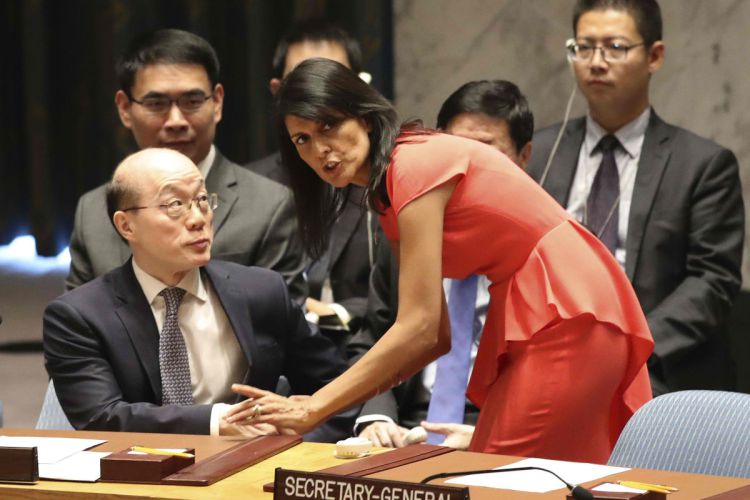
Russia’s proposed UN Security Council resolution envisaging a speedy and realistic investigation into Douma incident was voted down by a triple veto. US, UK and France all voted against it.
However an earlier US-proposed resolution, which proposed an investigation mechanism that couldn’t possibly work and would have opened an avenue for the American use of force had to be vetoed by Russia alone. Bolivia was the only other nation to vote against it as China merely abstained.
China did so albeit it had previously called for restraint and for no side to resort to force which should have naturally made it predisposed to oppose the American resolution. Likewise the Chinese did so albeit the newly-appointed Chinese defense minister was in Moscow talking up ties between the two armed forces and countries.
It has long been Chinese philosophy not to stick its neck out at the UN. Beijing rarely vetoes anything that does not concern its immediate interests and never alone. Additionally China has its own, more immediate American problems right now with Trump threatening a trade war and is presumably reluctant to provoke the US president into further enmity. Finally it is clear that in Beijing’s strategic calculation China benefits with the US and Russia at each other’s throats.
With US distracted by hostility towards Moscow it can not afford to at the same time act too aggressively against China, while the US pressure on Russia means Moscow has little choice but at least ensure the friendship of China.
Nonetheless, things are looking pretty grim for Russia right now (let’s not kid ourselves, in the Middle East the Empire holds escalation dominance) and a little support, no matter how symbolic, could have gone a long way towards securing long-term Russian appreciation. An opportunity missed for Beijing.
A Trump-Putin summit is just what’s needed
By M K Bhadrakumar | Indian Punchline | April 2, 2018
The Chinese commentators consistently paint a pessimistic outlook for the troubled relations between Russia and the West, which no doubt form a crucial template of Beijing’s foreign policy. China is a “stakeholder” in the tensions between Russia and the West. Beijing must be acutely conscious that there has always been a significant (albeit not influential currently) school of opinion in the West, including in the United States, that a rapprochement with Russia will make sound long-term strategy to effectively contain China’s rise, which must be the West’s top priority.
Nonetheless, a news analysis by Xinhua with a Moscow dateline has simply gone overboard in making some hasty conclusions about the state of play in the backdrop of the Skripal spy case that has suddenly invaded the centre stage of Russia’s ties with the West:
· With the inertia of the sanctions spiral going on, Russia and the West are expected to continue the hostility in the diplomatic sphere and even expand it to other areas that are more painful for both sides in the foreseeable future.
· Although the question hanging over the spy-poisoning attack remains unanswered, one thing is for sure: Russia’s reputation has been damaged in the eyes of the international community while the alliance between the United States and Europe has been consolidated… It is widely expected that the tensions between Russia and the West will not ease off anytime soon.
Is the state of play so hopeless? Xinhua has exaggerated. Things look gloomy but are not beyond salvation. Russia’s tensions with the West are actually not so serious as China’s own tensions with the West. But then, China is much smarter than Russia in its diplomacy in finessing these tensions. China also has the advantage that it was not a Cold-War adversary of the West in the sense in which the former Soviet Union got pitted in the “bipolar” world. China did splendidly well to exploit the rivalry between the US and USSR.
Russia is the main target today, because it is also the only power that has the capability to maintain global strategic balance and it has an ideological position with regard to the US’ hegemony, which it is determined to uphold no matter the costs involved — although Russia is not a communist country any more. Besides, Russia is not like any other country. It is a European power historically, culturally, economically and politically. And Russia’s habitation and name in a common European home profoundly impacts the US’ transatlantic leadership role.
China being an Asiatic country can run with the hare and hunt with the hound – making the best of both worlds by keeping a quasi-alliance with Russia while also on parallel track going in top gear to tap into the western markets to get fatter and richer. China’s supreme advantage is that it lacks any ideology (other than nationalism and self-interests). Russia takes a principled stance but China keeps its head under the parapet if its interests are not affected. If the tensions run high in Russia’s relations with the West, China is its beneficiary.
However, Russia’s tensions with the West over the Skripal case are more complex than what Xinhua has reported. It is discernible that European countries have been reluctantly dragged into the Skripal case. (Blood is thicker than water, after all.) The big question is how far the US collaborated with Britain. In my assessment, the jury is still out.
There are unanswered, unanswerable questions. The most important thing is that the Skripal case might have got dovetailed with the “anti-Trump” project of the Washington establishment. In particular, was this the swan song of Lt. Gen. HR McMaster (who was expecting dismissal for the past several weeks)? Is it a counterattack by the “Deep State” to keep Trump off balance just when he began making moves to put together a new team in his cabinet with a view to force his will on foreign policies?
Has there been an orchestrated (Anglo-American) attempt involving the intelligence agencies to force Trump’s hands? How much is the Skripal case entangled with the campaign over Trump’s “collusion” with Russia? Most important, where exactly does Trump himself stand in all this?
To my mind, Trump is not seeking confrontation with Russia, and if anything, his phone call to British PM Theresa May might have had a salutary effect on London, which has since noticeably piped down on the Skripal file. Read the White House readout of the phone call, here. There is no trace whatsoever here that Trump is traveling on a path of confrontation with the Kremlin.
In fact, neither Trump nor Vladimir Putin wants this “to be going beyond hysteria over diplomacy” – to borrow words from Xinhua. Trump has always had great conceptual clarity in his mind that it is China – and not Russia – that is the US’ real adversary.
Any longtime observer of Russian-American relations would know that most of the time things are never really what they’ve appeared to be on surface. The two big powers are greatly experienced in navigating through choppy waters. Therefore, it comes as no surprise to me that TASS has just at this juncture highlighted the prospect of a summit between Trump and Vladimir Putin.
Given the longstanding media culture in Moscow, it is inconceivable that the state news agency would have carried such a report on its own volition reflecting on the Kremlin leader. There is, for sure, some very serious “signaling” going on.
China becomes Trump’s indispensable partner
By M K Bhadrakumar | Indian Punchline | March 29, 2018
On Wednesday, the Chinese ambassador to the United States briefed the National Security Council in the White House regarding the visit by the North Korean leader Kim Jong Un to Beijing. The White House Press Secretary Sarah Sanders later expressed cautious optimism that in their estimation, “things are moving in the right direction” and the meeting in Beijing between Kim and Chinese President Xi Jinping was “a good indication that the maximum pressure campaign (on North Korea) has been working.” She said:
- You saw him (Kim) leave for the first time — since becoming the leader of North Korea — for that meeting. And we consider that to be a positive sign that the maximum pressure campaign is continuing to work. And we’re going to continue moving forward in this process in hopes for a meeting down the road.
- Certainly we would like to see this (end-May meeting between Trump and Kim). Obviously this is something of global importance and we want to make sure that it’s done as soon as we can, but we also want to make sure it’s done properly. And we’re working towards that goal. As we’ve said before, the North Koreans have made that offer and we’ve accepted, and we’re moving forward in that process.
Trump himself gave thumbs-up. He tweeted: “For years and through many administrations, everyone said that peace and the denuclearization of the Korean peninsula was not even a small possibility. Now there is a good chance that Kim Jong Un will do what is right for his people and for humanity. Look forward to our meeting!”
Evidently, Beijing transmitted some extraordinarily hopeful tidings. The remarks by former US state secretary James Baker (who still remains an influential voice in the conservative spectrum) praising China’s role suggests that Beijing is moving in tandem with the Trump administration. In an exclusive interview with NBC News, Baker said:
- “I think it’s too bad that there wasn’t some way that we could work with the Chinese to achieve this, this result of denuclearization of the peninsula. China is the only country in the world that really has any influence, significant influence on North Korea.”
- “I would have sent some high-level envoy to Xi Jinping, the president of China, that the Chinese trust and have confidence in. And I would have said, ‘Look, you don’t like what’s going on in the Korean Peninsula. We don’t like what’s going on. Why don’t we cooperate to stop it?”
- “We, the United States, will support any government you (China) install in North Korea, provided they repudiate the acquisition or maintenance of nuclear weapons. We will trade with that government, we will establish diplomatic relations, we will execute a peace treaty ending the Korean War. Your (China’s) job is to put a government in place there that is different than this government.” (See the video of the interview.)
There is great poignancy here in these remarks because Baker had played a key role under President Ronald Reagan (Trump’s role model) negotiating the end of the Cold War in the 1980s face to face with Mikhail Gorbachev.
China has positioned itself brilliantly as the facilitator-cum-partner-cum-ally-cum-friend – depending on who its interlocutor on the Korean Question happens to be. Xi deputed politburo member Yang Jiechi as his special envoy to visit Seoul to brief the South Korean leadership, even as preparatory talks for the inter-Korean summit in April were scheduled in the DMZ in Panmunjom. Evidently, Yang had a hand in the positive outcome today at the Panmunjom meeting where there is agreement to schedule the inter-Korean summit on April 27. (here and here)
Quite obviously, there are processes today that are beyond the US’ control. Again, the US’ number one ally in Northeast Asia – Japan – has been marginalized. No one set out from Beijing to brief Tokyo. Inevitably, there are conspiracy theories. The London Times newspaper resuscitated today the hackneyed thesis that China is driving a wedge between the US and South Korea. But that seductive conspiracy theory underestimates that China is, in actuality, playing for far higher stakes in its rise on the global stage as a great power.
To be sure, history is in the making. If, as Baker says, the US is willing to normalize with North Korea and conclude a peace treaty to bring the Korean War to a formal end, the raison d’etre of continued US military presence in South Korea (on which there is significant local opposition already) becomes unsustainable. That impacts the overall US power projection in Asia. Again, if the North Korean problem is resolved peacefully, can the Taiwan Question be far behind?
Equally, China must know that there is no quick fix to the North Korean problem and it suits China to leverage the US’ critical dependence on its cooperation for the long haul – which in turn can stabilize the Sino-American relationship itself and open a new era of big-power relationship based on trust, mutual respect and sensitivity to each other’s core interests, which Beijing has been assiduously seeking.
On the other hand, Trump is well aware that if he can swing a deal on North Korea, it will significantly boost his re-election bid in 2020. Wouldn’t China know it, too? (Read my column in The Week magazine recently – The art of the Korean deal.)
Featured Video
The Truth About the Trump Shootings with Ken Silva
or go to
Aletho News Archives – Video-Images
From the Archives
Trans ‘milk’ as good as the real thing – NHS
RT | February 18, 2024
The drug-induced nipple secretions of trans women are as good as mothers’ breast milk for babies, the University of Sussex Hospitals NHS Trust claimed in a letter to campaigners made public in a report by British think tank the Policy Exchange on Sunday.
The healthcare trust’s medical director, Rachel James, argued that the off-label prescription drug cocktail men transitioning to female take in order to produce milk was “similar to the natural hormones which encourage lactation to develop when the baby is newly born.”
“The evidence which is available demonstrates that the milk is comparable to that produced following the birth of a baby,” James wrote in the letter, sent to Children of Transitioners last August.
Biological men who wish to lactate must first take hormones to grow milk glands and then take high doses of either domperidone or metoclopramide to stimulate milk production. Neither drug is approved for this use, though they are occasionally prescribed off-label to biological women who have trouble lactating.
However, domperidone’s own manufacturer, Janssen, warns patients the drug “may cause unwanted side effects affecting the heart in a breastfed baby” and “should be used during breastfeeding only if your physician considers this clearly necessary.” … continue
Blog Roll
 Aletho News
- Leaked: Britain’s Sham Conviction Of Hashim Thaci
- Seyed M. Marandi: U.S. Strike Imminent – Toward Total War in the Middle East
- Russia Voted Under Fire. Washington Is Loading the Tankers.
- 12 Things Your Oncologist Was Trained Not to Tell You
- Anthrax Attacks Paved Way for COVID-Era ‘Junk Drugs and Vaccines’
- How Real Is the Impact of Western Sanctions on Israel?
- France, You Are Guilty: How Paris Turned Western Sahara into the Maghreb’s Powder Keg
- 2025 Nature Paper Claiming Worsening Global Drought Gets RETRACTED …Heavily Flawed
- Your Milk Is Not the Problem
- The Truth About the Trump Shootings with Ken Silva
- If Americans Knew
- Salah Sarsour’s Legal Team Says DHS Has Not Met Its Burden to Prove He Is Deportable
- An analysis of tax forms by The Intercept show Kraft’s charity and LLC have donated to Friends of the IDF and AIPAC’s super PAC.
- Israeli attacks kill four Palestinians in Gaza – Daily Update
- Inside Gaza’s death trap of collapsing, bombed-out buildings
- The everyday items Israel bans from Gaza every day
- Inside the siege, the ruined buildings of Gaza – Daily Update
- Debunking The Claim That Macklemore Has A “History Of Antisemitism”
- CPJ demands release of arrested Palestinian-US journalist near Bethlehem
- Robert Kraft: The Billionaire Friend of Netanyahu Pulling The Strings Behind the Macklemore/Ed Sheeran Blow Up
- Columbia Administered Fund Gives Big Money to Pro-Israel Groups
- No Tricks Zone
- 2025 Nature Paper Claiming Worsening Global Drought Gets RETRACTED …Heavily Flawed
- New Study: ‘Global Drought Shows No Detectable Recent Acceleration Under Climate Warming’
- Economic Masterminds: German Socialists Suggest Taxing Productivity Gains Stemming From Using AI
- The South China Sea Has Not Been Cooperating With The Climate Change Narrative
- Energy Crisis: Germany Enters Heating Season With Historically Low Gas Reserve Fill Levels
- New Study: The Antarctic Ice Sheet Gained Mass From 2020-2024 Due To Staggering Snow And Ice Accumulation
- Study: Ocean Heating Rates From Thousands Of Years Ago ‘Dwarf’ Modern Ocean Heating Rates
- Climate Extremists Target, Attack Large-Scale Power Grid Infrastructure In Germany!
- New Study: Antarctic Ice Melt Has Contributed Less Than 1 Centimeter To Sea Level Rise In The Last 30 Years
- Fear Of Debate: Alarmist German Climate Scientist Calls On Mainstream Media To Discredit Skeptic Voices
 Aletho News