The US Is Receptive To Kissinger’s Suggestion To Revive Talks With China On A New Détente
BY ANDREW KORYBKO | MAY 19, 2023
Two new narratives were introduced into the West’s information ecosystem over the past week. The first concerns the need to adapt to multipolar processes by engaging more with the Global South, which was expressed by German Chancellor Olaf Scholz, former US National Security Council member Fiona Hill, and Goldman Sachs’ President of Global Affairs Jared Cohen all on the exact same day last Monday. The next narrative complemented this one and came two days later on Wednesday.
Global affairs guru Henry Kissinger’s lengthy interview with The Economist from late April was published on that day, in which he devoted considerable time explaining why the US should revive its talks with China on a New Détente that were unexpectedly derailed by February’s balloon incident. CNN then reported on that same day that “Biden administration looking at arranging high-profile visits to China by senior officials,” which suggests that it was briefed earlier about his proposal and heeded his advice.
The first narrative about engaging more with the Global South complements the second one about reviving talks with China on a New Détente in the sense that the former is one of the three prerequisites for successfully accomplishing the latter, at least according to how American policymakers likely view it. They want to signal that the US won’t voluntarily cede influence in the Global South to China, but instead plans to compete with it there via economic and diplomatic means.
This goal will be greatly advanced through a combination of pragmatic engagement with the Global South’s informal Indian leader, whose Prime Minister visits the US late next month, and coordinating between America’s “Build Back Better World” and the EU’s “Global Gateway” development initiatives. These subgoals also align with Kissinger’s suggestions about cooperating more closely with India as well as crafting an inspirational vision for this century (i.e. merging the West’s development initiatives).
The second prerequisite for successfully negotiating a New Détente with China upon the seemingly impending resumption of this process is to diplomatically displace its envisaged role in the Russian-Ukrainian peace process. In pursuit of this, the US wants to “de-Sinify” the scenario of a ceasefire after the end of Kiev’s NATO-backed counteroffensive, which explains its support of the African-led peace mission that was announced on Tuesday in between Monday and Wednesday’s new narratives.
What’s most interesting about this initiative is that it’s organized by the Brazzaville Foundation, whose French chairman Jean-Yves Olivier is known for his shadow diplomacy over the decades that was documented by Wikipedia. This suggests that their peace mission is secretly organized by France with the US’ tacit approval, if not jointly coordinated with it, which would advance their goal of diplomatically engaging with the Global South in parallel with “de-Sinifying” the Russian-Ukrainian peace process.
Both’s prospects would be bolstered by India’s participation in these efforts, which has its own interests in presenting itself to the world as a peace broker, especially throughout the course of its G20 chairmanship. These two prerequisites for enhancing the odds that the US successfully negotiates a New Détente with China concern the economic and diplomatic spheres respectively, while the third that’ll now be described deals with the military one.
“The US Is Rounding Up Allies Ahead Of A Possible War With China”, while “NATO’s Planned Liaison Office In Japan Will Accelerate The Expansion Of AUKUS+”, both of which will contribute to more effectively containing China in the Asia-Pacific. American policymakers apparently expect that the People’s Republic will accept this emerging regional military reality instead of it serving to preclude the resumption of their talks on a New Détente.
Not only that, but they seem to think that it could even give their side an edge of some sort in those negotiations too, or at least enable the US to speak to China “from a position of strength” as they see it. The message would be that this containment noose could tighten even more if Beijing doesn’t agree to resume such talks, not to mention if they fail to achieve anything tangible, thus making it a form of military blackmail when viewed from this perspective.
Altogether, the introduction of this week’s two complementary narratives into the West’s information ecosystem suggest that this de facto New Cold War bloc’s American leader is recalibrating its grand strategy. Policymakers appear to have concluded that their side can’t restore unipolarity, instead settling for managing multipolar processes in the direction of their interests as much as is realistically possible, to which end they must engage more with the Global South and revive talks with China on a New Détente.
The observations shared in this analysis shouldn’t be interpreted as predicting the success of these policies, but simply as arguments that this approach is indeed being attempted and was almost certainly influenced by Kissinger’s suggestions that he shared in his interview. He and The Economist are close to American policymakers so they likely passed his ideas along to relevant figures, after which they agreed with the gist thereof and subsequently began implementing them this week as proven in this piece.
US Pushes Indonesia to Ramp Up Military Cooperation, Jakarta Pledges Neutrality
Sputnik – 15.05.2023
The US Army’s top general was deployed to Indonesia in an effort to solidify the country’s position in the American orbit this week amid Washington’s ongoing efforts to encircle China militarily and constrain its growth.
On Friday, the Army’s Chief of Staff, James McConville, described his meeting with Indonesian Defense Minister Prabowo Subianto as a relatively benign effort to bring peace to the Indo-Pacific region.
“We have many friends in the region, and we work closely together,” McConville said. “We all share the same interests for the region: peace, security, stability.”
“That’s why we work together on maintaining a free and open Indo-Pacific for everyone,” he insisted.
For his part, Subianto described peace and stability in the region as a “common concern,” but insisted Indonesia would maintain its neutrality, pledging to continue pursuing relationships with all world’s nations – “especially all the major powers.”
McConville touched down in Jakarta on Thursday on the heels of a visit to the Philippines. That trip came shortly after last month’s massive US-Philippine war drills provoked anger among authorities in Beijing, who simulated an encirclement of their own against the renegade island of Taiwan in response.
But it’s unclear that Jakarta’s leaders are as willing to sign up for a battle with Beijing as their counterparts in Manila. Last November, Subianto promised to restore joint military exercises with China following a meeting with the nation’s defense minister.
In 2017, the US embassy in Jakarta released around 30,000 documents showing “the US actively supported the Indonesian military’s killing of as many as 1 million suspected communist sympathizers in the mid-1960s despite concerns about the reasons behind the massacre,” the Financial Times reported.
But the US maintains close relations with Indonesia’s leaders despite its questionable legacy there.
China’s special envoy to visit Ukraine and related countries to promote political solution to crisis
Global Times | May 12, 2023
China’s special envoy for Eurasian affairs Li Hui will visit Ukraine, Poland, France, Germany and Russia, starting on May 15, to communicate with all parties on a political solution to the Ukraine crisis, Chinese Foreign Ministry spokesperson Wang Wenbin announced at a press conference on Friday.
Chinese experts said Li’s upcoming visits demonstrate China’s efforts to bring about a political settlement to the Ukraine crisis, showing China’s objective and fair stance as a responsible power.
According to Wang, since the beginning of the crisis, China has held an objective and just position and actively promoted talks for peace. President Xi Jinping has put forward four principles, called for joint efforts in four areas and shared three observations on Ukraine, which outline China’s fundamental approach to the issue. On this basis, China released its Position on the Political Settlement of the Ukraine Crisis, which reflects the above core ideas of China’s stance and takes into account the legitimate concerns of all parties, receiving extensive understanding and recognition from the international community.
During a phone conversation on April 26, President Xi told Ukrainian President Volodymyr Zelensky that China will send a special representative on Eurasian affairs to visit Ukraine and other countries to push for a political settlement to the crisis.
Li is a veteran diplomat and has been China’s special envoy for Eurasian Affairs since 2019. He was previously Chinese ambassador to Kazakhstan from 1997 to 1999, and from 2009 to 2019 he served as China’s ambassador to Russia, according to publicly available information.
Wang Wenbin said Li’s upcoming visit reflects China’s commitment to promoting peace talks and staying on the side of peace.
Wang noted that as the Ukraine crisis drags on and escalates, the world continues to experience the spillover effects of the crisis, with voices calling for a ceasefire and de-escalation in the international community.
China will continue to play a constructive role and build greater international consensus on ending hostilities, starting peace talks and preventing an escalation of the situation, and help facilitate a political settlement of the Ukraine crisis, said Wang.
Cui Heng, an assistant research fellow from the Center for Russian Studies of East China Normal University, told the Global Times on Friday that Li’s Europe tour is aimed at implementing China’s efforts to promote peace talks.
According to Cui, in the case of ongoing conflicts, even if there are people who want to talk with each other, under the influence of various forces, it is not convenient to have direct communication. In this case, a third party is needed.
“Under such circumstances, no matter what the outcome is, China must do it and only China can do it… This shows China’s responsibility as a major country,” Cui said.
However, there are still some Western media that doubt China’s neutrality, as Li’s background of former ambassador to Russia indicates Li has “close ties” with Moscow, a claim that experts described as nit-picking.
It’s absurd to believe that the special envoy’s background as former ambassador to Moscow will lead to a biased position, Cui said.
Almost all Chinese ambassadors to Russia have worked in the Department of Eurasian Affairs, where diplomats may be dispatched to different countries according to their job requirements, Cui explained, noting that Ukrainian affairs also fall under the Eurasian Division. If history serves as a reference, ambassador Li may be dispatched to Ukraine as well.
Chinese diplomats are objective and impartial, not biased, Cui said, adding that if there is any “bias,” then diplomats of all countries serve their own nations’ interests first.
“If we follow this inference from some US and Western media, is the US ambassador to China pro-China? The suggestion apparently does not stand up to scrutiny,” Cui added.
Historical anomaly of unipolarity has indisputably ended
By Andrew Korybko | Global Times | May 11, 2023
There’s a heated debate in the US nowadays about the future of global affairs. Some believe that what’s been described as their country’s unipolar moment is ending and giving way to multipolarity, while others believe that the US remains the world’s most comprehensively powerful country by far. Understanding the current state of international relations can provide policymakers with a clear and accurate picture of the world they are dealing with. This knowledge can help them make informed decisions and take appropriate actions. Americans first began worrying that their country’s predominant role was fading around the start of the Obama administration, which coincided with the 2008 financial crisis. For various reasons, some related to partisan opinions and others to compelling observations about the evolving world order, these concerns continued through the Trump administration and into the incumbent Biden one, but they were recently exacerbated by the start of conventional hostilities between Russia and Ukraine last year.
Several factors since then contributed to raising worldwide awareness of multipolarity, which simply refers to the system of international relations where there isn’t a hegemon like the US was after 1991 or aren’t two superpowers like there were from 1945 up until that year prior to the Soviet Union’s dissolution. Perhaps the most visible one concerns the documented fact that only a little more than three dozen countries joined the US in imposing sanctions against Russia and/or arming Ukraine.
The rest of the world remains neutral in practice despite most countries voting against Russia at the UN General Assembly, which in hindsight didn’t signal the change in policy toward Moscow that the US expected at the time. Some states might have been pressured to vote that way while others wanted to peacefully signal their disagreement with Russia for its military operations in Ukraine. Either way, the lack of any subsequently punitive consequences like those that the US demanded spoke volumes.
This observation is all the more impressive when remembering that many of these same neutral states are comparatively medium- and smaller-sized ones with economies that aren’t anywhere near as large as the US’. The importance in pointing this out is to show how surprising it is that the US couldn’t successfully pressure them into sanctioning Russia and/or arming Ukraine, which speaks to the very real limits of its influence nowadays.
China is already the top trade partner of practically every Global South country, which imbues them with the confidence to refuse the US’ political demands since their leaders believe that they could weather whatever sanctions it could threaten against them as punishment for their defiance. Meanwhile, India’s example of successfully resisting American pressure to sanction Russia and arm Ukraine despite its close ties with the US reassured other states that their own ties with it probably won’t suffer as a result either.
America has a track record of abusing developing countries in myriad ways, including through information warfare, political meddling, and strings-attached loans.
Many of these countries have become deeply resentful of the US after seeing how terribly it treated their beloved homeland, the sentiment of which their leaders sought to channel in strengthening their states’ strategic autonomy upon being given the chance to do so. The start of last year’s conventional Russia-Ukraine hostilities served as the perfect opportunity to do so in a way that would attract the rest of the world’s attention, inspired as they were by independent giants like China and India.
Besides, the center of global economic gravity is shifting away from the Atlantic and toward the Asia-Pacific over the past few decades. This is directly due to the rise of those two aforementioned giants, but especially China, whose Belt and Road Initiative (BRI) investments helped the rest of the Global South rise as well in its wake. With economic strength comes political influence, and the BRICS countries of which China, India, and Russia are a part want to reform the world.
They rightly concluded that the US-led unipolar system only serves that hegemon’s interests. Such a system is dictatorial due to the US aggressively enforcing its so-called “rules” onto everyone else, unequal in the sense that the West’s economic rise is entirely due to exploiting the Global South, and unjust because international law is wantonly violated by the US. Accordingly, the BRICS are leveraging their economic strength to accelerate reforms aimed at making international relations more democratic, equal, and just.
All Global South states will benefit once the BRICS succeeds with this noble goal, though expectations should responsibly be tempered since it’ll still likely take a lot of time for them to institutionalize their envisaged changes. Nevertheless, the wide awareness of those countries’ selfless mission to humanity was another reason why all of the Global South defied the US at once since they wanted to signal their support for the emerging multipolar world order that’s rapidly replacing the unipolar one.
And finally, everyone apart from the most media-indoctrinated people in the West knows that the world was multipolar for ages, thus meaning that the prior unipolar period that began after 1991 with the Soviet Union’s dissolution is literally a historical anomaly. Never before was the whole world under the control of a single country, but this happened as a result of unique circumstances, not due to the US being “exceptional” like its leaders ridiculously claim.
With this in mind, the entire Global South has an interest in returning international relations to their normal multipolar model that was in place for centuries prior to three decades ago, which is but a very brief moment in terms of the historical spectrum. Their leaders saw that the opportunity to speed up the so-called “return of history” appeared last year with the start of conventional Russia-Ukraine hostilities, which unprecedentedly accelerated the global systemic transition back to multipolarity.
Returning back to the debate that was referenced in the introduction, those Americans who still believe that unipolarity exists therefore aren’t accounting for any of the factors shared in this analysis. Upon doing so, the honest ones among them will realize that this historical anomaly has indisputably ended and been replaced by multipolarity, thus restoring balance to international relations. The global systemic transition still continues, however, since the latest manifestation of multipolarity hasn’t yet fully formed.
The author is a Moscow-based American political analyst. This is the third piece of the “Quest for multipolarity” series. opinion@globaltimes.com.cn
US congressman explains ‘blowing up’ Taiwan comment
RT | May 11, 2023
US Representative Seth Moulton on Thursday accused the Chinese government of twisting his remarks about destroying the Taiwanese semiconductor industry in order to ruin Washington’s relations with Taipei.
“One of the interesting ideas that’s floated out there for deterrence is just making it very clear to the Chinese, that if you invade Taiwan, we’re gonna blow up TSMC,” the Massachusetts Democrat had said on May 2, at a conference in California. TSMC stands for Taiwan Semiconductor Manufacturing Company, which makes the majority of the world’s advanced chips.
By May 6, a video clip of that remark was circulating on Douyin, the Chinese version of TikTok. On Thursday, Moulton claimed the Chinese Communist Party “selectively clipped my comments, spread them on social media, and attempted to undermine the US-Taiwan partnership.”
“The CCP has once again tried to divide the US and Taiwan using disinformation by deliberately taking a comment of mine out of context,” he told Taipei’s Central News Agency (CNA).
Moulton did not deny he said what he said, but insisted he was trying to discuss ideas on “how to convey to the CCP the enormous costs they would incur if they choose to invade Taiwan.”
Asked about the comment on Monday, Taiwanese Defense Minister Chiu Kuo-cheng said the island’s military “will not tolerate any others blowing up our facilities.” On Wednesday, Foreign Minister Joseph Wu Jaushieh told reporters that some media outlets may have succumbed to “China’s cognitive warfare” by quoting Moulton’s partial remarks.
Moulton had spoken at a panel during the Milken Institute’s 2023 Global Conference in California. After bringing up the destruction of TSMC, he added, “I just throw that out, not because that’s necessarily the best strategy, but because it’s an example. Of course, the Taiwanese really don’t like this idea, right?”
“This is a terrible idea,” replied fellow panelist and former Pentagon official Michele Flournoy.
“I’m not promoting the idea. I’m not promoting the idea,” Moulton said in response. “What I’m saying is these are some of the things that are actually actively being debated amongst US policymakers.”
The US Army War College published a paper in 2021 that suggested destroying TSMC as part of a “scorched-earth” tactic the US and Taiwan could embrace to deter China from seizing the island by force.
Beijing considers Taiwan a part of China, to be reintegrated – preferably peacefully – at some point. The island is currently ruled by descendants of the Nationalists who lost the Chinese civil war and were evacuated by the US from the mainland in 1949.
US blocks China’s effort to condemn Israeli attacks on Gaza at UN: Report
The Cradle | May 11, 2023
US officials blocked an effort led by China at the UN Security Council (UNSC) on 10 May to condemn Israel’s latest onslaught on the besieged Gaza Strip, according to senior Israeli officials that spoke with the Times of Israel.
Washington’s interference reportedly came at the request of Tel Aviv, who feared the motion at Tuesday’s emergency meeting “would draw an equivalence” between the Israeli army and the Palestinian Islamic Jihad (PIJ) resistance group.
Over the decades, the US has consistently stepped in to protect Israel from facing the consequences of rampant human rights abuses, the military occupation of Palestinian land, and the imposition of an apartheid system targeting Palestinians.
The only exception to this rule came earlier this year, when Washington allowed a statement to pass at the UNSC blasting Israel’s expansion of illegal settlements in the occupied West Bank. Nonetheless, the US went on to block a binding resolution against Israel.
Former US President Harry Truman was the first world leader to recognize Israel when it was created in 1948 following the ‘Nakba,’ or catastrophe, during which at least 700,000 Palestinians were violently evicted from their lands by Jewish settlers.
Israel is also the largest cumulative recipient of US foreign aid in the post-World War II era and enjoys unequivocal political and diplomatic cover from both the Democratic and Republican parties as well as from US corporate media.
However, US influence in the region has started to wane in recent months, pushing Israel further into isolation.
Last month, Beijing offered to help facilitate peace talks between Israel and Palestine as part of a larger effort to mediate historic conflicts in West Asia.
In December, Chinese President Xi Jinping expressed support for an end to the Israeli occupation of Palestine and voiced frustration over the “historical injustice” suffered by Palestinians.
He also called for granting Palestine “full membership in the United Nations” and said Beijing “supports the two-state solution and the establishment of a Palestinian state on the 1967 borders, with East Jerusalem as its capital.”
The Asian giant has slammed recent comments by a Jewish supremacist government minister, who in March said, “there is no such thing as a Palestinian people.”
“The Israeli senior official is wrong and irresponsible to deny Palestinian people’s existence and to display an ‘Israel map’ including Jordan and Palestinian places occupied by Israel at an event in Paris,” said Wang Wenbin, a spokesman for China’s Foreign Ministry.
Washington Wants War with China Served Hot, Not Cold
By Connor Freeman | Libertarian Institute | May 11, 2023
The ruling class in Washington is planning on using America’s sons and daughters as cannon fodder to wage their long-awaited war against China. President Joe Biden along with the other de facto employees of the military industrial complex, including in Congress, have not made their plans a secret. Contrarily, they are quite happy to brag about basically any escalation they can get.
Hawks in the Pentagon, along with those in the administration and legislative branch—including the key leadership—have been speaking explicitly about the coming war with China for a while now, usually boasting about all they are doing to prepare for, as well as provoke, such a conflict.
This all began in earnest during the Barack Obama administration. War with China, despite the Republican Party’s obsession with the Chinese Communist Party (CCP), is the Progressive Democrats’ project led by—among others—the likes of Obama, Biden, Hillary Clinton, Kurt Campbell, Antony Blinken, Lloyd Austin, and Michelle Flournoy.
In 2011, Obama launched the “pivot to Asia.” The policy has been expanded by each successive administration. Obama’s project for the new American century entails the largest military buildup since the Second World War, shifting hundreds of bases as well as two-thirds of all U.S. Air and Naval forces to the Asia-Pacific region. Washington is encircling China for a future war with Beijing. In the words of Lew Rockwell, “The U.S. seeks to encircle China and make it bow down before the hegemon.”
The new Cold War on China has been heating up for years, but things have taken a turn for the worse under the Biden regime which is significantly more hawkish than both the Obama and Donald Trump administrations.
In January, the top U.S. Marine Corps general in Japan explained to the Financial Times that Washington and Tokyo are “setting the theater,” for war with China. Lt. Gen. James Bierman, commander of the Third Marine Expeditionary Force (III MEF) and of Marine Forces Japan, said Washington is working with its allies in the region to prepare for the coming war with China, much like the U.S. did with its NATO allies following the 2014 U.S. backed coup in Kiev.
“Why have we achieved the level of success we’ve achieved in Ukraine? A big part of that has been because after Russian aggression in 2014 and 2015, we earnestly got after preparing for future conflict: training for the Ukrainians, prepositioning of supplies, identification of sites from which we could operate support, sustain operations,” the general said. He went on to explain this is called “setting the theater. And we are setting the theater in Japan, in the Philippines, in other locations.”
Later the same month, NBC News reported on a memo written by four-star U.S. Air Force General Mike Minihan, the head of Air Mobility Command (AMC), discussing the coming war with China. AMC includes 50,000 airmen and oversees roughly 430 aircraft. “I hope I am wrong. My gut tells me [we] will fight in 2025,” Minihan said, ordering his forces to begin preparing for war with Beijing.
In recent weeks and months, the U.S. has worked on deals to gain exclusive military access to the Federated States of Micronesia, secured an agreement with Manilla to gain access to four more military bases in the Philippines, awarded contracts to begin work on a new radar installation in Palau, announced increased cooperation between American and Japanese armed forces for a future confrontation with China, and made plans to deploy additional Marine units armed with anti-ship missiles along the Okinawa islands.
In April, Washington and Manila carried out their largest ever joint military exercises. 17,600 military personnel took part, including 12,000 American troops. The Balikatan exercises saw more than 100 Australian soldiers participate. The increasing pressure on both Russia and China has seen Moscow and Beijing step up their own cooperation in the region.
Later this year, the U.S. and Australia will carry out the “largest-ever” iteration of their Talisman Sabre war drills. This bilateral military exercise takes place every two years. As Antiwar.com News Editor Dave DeCamp has explained,
The plans for the massive exercises come after the US, Australia, and Britain unveiled their plans under the AUKUS military pact with the ultimate goal of Canberra being able to produce nuclear-powered submarines by the 2040s.
The U.S. Navy envisions AUKUS will turn Australia into a full-service submarine hub for the United States and its allies in the region in operations targeted at China. As part of the deepening U.S.-Australian military ties, the United States also plans to deploy more troops and aircraft to Australia, including nuclear-capable B-52 bombers.
The rhetoric of U.S. military leaders may seem unhinged, but it is now all too common. In February, U.S. Army Secretary Christine Wormuth declared that “we” need to be prepared to fight a direct, hot war against China over Taiwan, and win it. “I personally am not of the view that an amphibious invasion of Taiwan is imminent,” she told an audience at the American Enterprise Institute, adding but “we obviously have to prepare, to be prepared to fight and win that war.”
Her plan consists of sending more U.S. troops and advanced weapons to the region, including hypersonic missiles. She also discussed setting up “theater distribution centers” in the region where weapons and other supplies can be pre-positioned for the coming war, suggesting Japan and Australia would make good candidates.
She said “our goal is to have Army forces in the Indo-Pacific seven to eight months out of the year,” when the war starts their job will be establishing “staging bases for the Navy, for the Marines, for the Air Force,” adding they will be providing “intra-theater sustainment.”
Wormuth also discussed what appeared to be a plan for the Army to impose martial law in the United States during the coming war with China. “If we got into a major war with China, the United States homeland would be at risk as well, with both kinetic attacks and non-kinetic attacks. Whether it’s cyberattacks on the power grids, or on pipelines, the United States Army, I have no doubt, will be called to provide defense support to civil authorities.”
In March, General Kenneth Wilsbach, the head of U.S. Pacific Air Forces, told a symposium in Colorado that his focus is on blowing up Chinese ships in the event that Beijing orders a blockade on the island of Taiwan. “You saw when Speaker Pelosi went to Taiwan, what [China] did with their ships,” Wilsbach said, adding, “They put them on the east side of Taiwan… as a sort of blockade.”
The General’s conclusion is “[w]e’ve got to sink the ships.” He continued, “sinking ships is a main objective of not only PACAF [Pacific Air Forces] but really anyone that’s going to be involved in a conflict like this.” In other words, even if the cross-strait conflict which Washington’s build up and closer ties with Taiwan is actively provoking does not immediately go kinetic, General Wilsbach will ensure that it escalates quickly as a result of his attempts to shoot through the Chinese naval blockade.
That same month, Trump’s former national security adviser Robert O’Brien said in the event of a cross-strait conflict, the U.S. would bomb and destroy Taiwan’s advanced semiconductor manufacturing facilities. The “United States and its allies are never going to let those factories fall into Chinese hands,” O’Brien threatened during an interview with Semafor.
A similar plan was laid out, as a potential joint operation with Washington and Taipei, in a 2021 paper published by the U.S. Army War College. The paper characterizes obliterating the island’s chip factories as a “scorched earth strategy” designed to leave Taiwan in ruins “not just unattractive if ever seized by force, but positively costly to maintain.”
The paper continues, explaining this “could be done most effectively by threatening to destroy facilities belonging to the Taiwan Semiconductor Manufacturing Company, the most important chipmaker in the world and China’s most important supplier.”
This month, Rep. Seth Moulton (D-MA) told a think tank conference “the U.S. should make it very clear to the Chinese that if you invade Taiwan, we’re going to blow up [the Taiwan Semiconductor Manufacturing Company],” which produces most of the world’s advanced semiconductors.
Apparently, the Taiwanese military brass did not get the memo. Taiwan’s Defense Minister Chiu Kuo-cheng fired back against the Congressma, saying “[i]t is the military’s obligation to defend Taiwan and we will not tolerate any others blowing up our facilities.”
In April, for the first time, the U.S. Army’s Special Operations Command defended Taiwan from a mock Chinese invasion as part of CAPEX, the command’s annual capabilities exercise.
Lt. Gen. Jonathan P. Braga declared it was about time, these war drills are “in accordance with our national defense strategy, [China] is our true pacing challenge out there.”
According to Military.com, “[m]embers of the U.S. Army’s Special Operations Command fired Carl Gustaf recoilless rifles, breached tunnels and operated Switchblade drones that flew with an unsettling whiz over a training area… The exercise combined some of the hallmark tactics and weapons that were used during the Global War on Terror with other tools reflecting a seismic shift for the command as it prepares for potential conflict against major military rivals… and the mission they were gaming out was an insertion into Taiwan to defend against a Chinese invasion.”
Last fall, Navy Admiral Charles Richard, the head of Strategic Command, which oversees American nuclear forces, ominously warned the “Ukraine crisis that we’re in right now, this is just the warmup… The big one is coming. And it isn’t going to be very long before we’re going to get tested in ways that we haven’t been tested [in] a long time.” Unmistakably, the “big one” is the coming war with China.
For almost 50 years, the One-China policy has governed the now extremely fragile relationship between Washington and Beijing. Thirty years after Mao’s forces won the civil war, Washington accepted reality and made an agreement which has kept the peace and prevented war. Under the policy, the U.S. severed diplomatic ties with Taipei and recognized that there is but one China, with Beijing as the sole Chinese government.
One-China means the U.S. does not have an official relationship with Taipei, with Washington recognizing China and Taiwan as the same country. The U.S. also maintains “strategic ambiguity” towards Taiwan or at least it did until the Joe Biden administration unilaterally overturned that part of the delicate policy.
Per the former approach, the U.S. would never commit to defending or not defending the island against a potential attack against the breakaway province. Critically, “strategic ambiguity” has aimed to deter Beijing from attempting to retake the island by force and, at the same time, to discourage Taiwan’s radical factions seeking to declare Taiwan’s independence.
But for the bipartisan China hawks, that successful arrangement is no longer good enough. Worst of all, some are proposing, and in some cases outright issuing, defense commitments in contradiction of the longstanding U.S. policy.
Since Biden came into office, he has continued to make “gaffes” announcing the U.S. is doing away with “strategic ambiguity” and even potentially the One-China policy. Biden has seemingly committed Americans to Taiwan’s defense multiple times. But now it appears that these notorious mistakes which were often walked back by the White House, were not “gaffes” at all.
In March, speaking before a House Intelligence Committee hearing, Director of National Intelligence Avril Haines announced that “strategic ambiguity” was dead and gone. When asked by Rep. Chris Stewart (R-UT) if the policy needed to be changed, Haines responded by announcing “I think it is clear to the Chinese what our position is, based on the president’s comments.”
Indeed, Washington constantly ramps up U.S. military cooperation with Taipei, committing billions of dollars in military aid to Taiwan, expanding U.S. National Guard training programs with the Taiwanese military, sending ever more Congressional delegations to the island, deploying ever higher numbers of U.S. troops to the island, concurrently training hundreds of Taiwanese soldiers for war on U.S. soil, converting Taiwan into a “giant weapons depot,” and sailing American warships through the sensitive Taiwan strait almost every month.
The U.S. government absurdly promises these provocations are done to “deter” war, but China has made clear that Taiwan is a “red line” and Washington’s actions make war more likely. Beijing has repeatedly said that they are seeking a “peaceful reunification” with Taiwan but they have not ruled out using force.
Even Haines appeared to admit this when, at the same hearing, she admitted “it’s not our assessment that China wants to go to war.” Bellicose members of Congress are foaming at the mouth for a confrontation with China nonetheless.
In April, during an interview on Fox News Sunday, Republican senator and neoconservative spokesman Lindsey Graham (R-SC) called for an outright reversal of “strategic ambiguity,” as well as a complete overhaul of Washington’s China policy. As the Libertarian Institute’s Kyle Anzalone reported,
Graham claimed the United States had only a short window of time to prepare for the coming conflict, calling to “increase training and get the F-16s they need in Taiwan,” He also complained about a “backlog“ of arms sales to the island, arguing the transfers should move ahead while proposing new US military deployments in Asia and elsewhere.
“I would move war forces to South Korea and Japan. I would put nuclear-tipped cruise missiles on all of our submarines all over the world,” Graham continued.
He additionally explained he was willing to send US troops to fight for Taipei, a dramatic departure from longstanding policy, saying “Yes, I’d be very much open to using US forces to defend Taiwan.”
The ultra-hawkish Republican Chair of the House Foreign Relations Committee, Rep. Michael McCaul (R-TX), further declared that sending U.S. troops to fight China over the island of Taiwan is “on the table.” McCaul clarified his position that if “communist China invaded Taiwan, it would certainly be on the table and [that’s] something that would be discussed by Congress and with the American people.”
How gracious of our ostensible representatives! After more than 70 years of illegal, undeclared wars and millions killed, some are willing to concede perhaps before going to war with another nuclear superpower, it may warrant at least a discussion with the American people.
To date, we—the people—have not been consulted regarding any of these horrendous and reckless policies. The hyper-drive propaganda against China is already designedly overwhelming our neighbors’ psyches. Given the current anti-Russia hysteria among the populace, with minimal domestic resistance, the White House has been able to ratchet tensions with Moscow—via its proxy war in Ukraine—to levels not seen since the Cuban Missile Crisis. In fact, it’s even worse, the Bulletin of Atomic Scientists says the risk of nuclear war has never been higher.
There is no telling what Americans may be frightened into consenting to if a cross-strait conflict kicks off, or if there is an accident or confrontation between U.S. and Chinese forces in the South China Sea. Not too long ago, some were almost calling for war with China over a weather balloon.
As is the case with Russia, the U.S. launching a direct war with Beijing is essentially guaranteed to lead to a nuclear exchange. In such a scenario, China has the ability to destroy continental American cities, not just the aircraft carrier strike groups and the hundreds of U.S. military bases encircling China.
This should go without saying, if the hawks were honest about the risks of the war with China they are proposing, and indeed cultivating, the American people would refuse to allow a continuation of the buildup at all.
It is not inconceivable that, under the circumstances, an informed American populace may collectively decide they no longer wish to be ruled by notoriously venal people in Washington irrevocably caught up in the insane, outmoded, long discredited, and arms industry funded neoconservative ideology of unipolar, global hegemony.
And yes, that is what this coming war with China is about: world domination by Washington. The same Democrats and Republicans whose hands are still covered in blood from Ukraine, Iraq, Syria, Libya, Palestine, Yemen, Somalia, and Afghanistan now want to go to war with China.
But just like the other wars you’ve likely lived through, it’s not our war—it’s their war—even if the American people are fighting it.
We must stop this madness.
Connor Freeman is the assistant editor and a writer at the Libertarian Institute, primarily covering foreign policy. He is a co-host on Conflicts of Interest. You can follow him on Twitter @FreemansMind96
NATO’s Planned Liaison Office In Japan Will Accelerate The Expansion Of AUKUS+
BY ANDREW KORYBKO | MAY 11, 2023
“The US Is Rounding Up Allies Ahead Of A Possible War With China”, which the former plans to fight via the emerging alliance system that can be described as AUKUS+ if it unfolds. This refers to that regional group’s function as the core of a larger anti-Chinese network that informally includes Japan, New Zealand, the Philippines, and South Korea. NATO will also obviously play a role too, with that bloc building upon its Secretary-General’s related statement of intent by opening a liaison office in Japan.
Foreign Minister Yoshimasa Hayashi told CNN that this development is supposedly due to the Ukrainian Conflict making the entire world less stable, but the reality is that this is part of a preplanned move to more effectively coordinate the containment of China. It would have happened on a different pretext had that aforementioned conflict’s latest phase not broken out last year, but that event provided a convenient excuse for speeding up their plans and disguising them as anti-Russian instead.
NATO’s liaison office in Japan will serve as that alliance’s first official outpost in the Asia-Pacific, thus enabling it to more directly organize AUKUS+’s expansion. Assembling that regional dimension of this emerging system is important in and of itself, but the European one is indispensable for maximally pressuring China. It’s therefore expected that more countries from the continent will soon dispatch vessels to the region as part of the joint operations that the liaison office will organize.
This is precisely what EU foreign policy chief Josep Borrell had in mind when suggesting late last month that member states should patrol the Taiwan Strait. Since practically every EU member is also part of NATO, this de facto amounts to that alliance doing this, which is dangerous due to the risk of this provoking an incident with China that could prompt the implementation of Article 5. That’s probably the point though, namely to create a crisis that can justify the further acceleration of AUKUS+’s expansion.
Nothing good is therefore expected to come from the opening of NATO’s planned liaison office in Japan. This development will only destabilize the Asia-Pacific, put additional pressure on China, and thus take the chance that whatever incident transpires as a result is incapable of being contained. It’s an irresponsible risk, but NATO has convinced itself that it’s worth taking in order to speed up its regional hegemonic plans.
Who is behind Canada’s state-level Sinophobia?
By Timur Fomenko | RT | May 11, 2023
On Tuesday, China and Canada engaged in a tit-for-tat expulsion of diplomats. The row was triggered by allegations that Chinese diplomat Zhao Wei had“interfered” in Canadian politics, apparently targeting anti-China Conservative MP Michael Chong.
The claims created a media firestorm in Ottawa after the Canadian Secret Intelligence Service (CSIS) reportedly accused “an accredited Chinese diplomat” of targeting Chong. Justin Trudeau’s government, under political pressure from the opposition, subsequently decided to act.
This row isn’t the first to derail relations between China and Canada. It’s one of many, including Ottawa’s decision to arrest Huawei executive Meng Wanzhou in 2018, China’s retaliatory arrest of Canadian nationals Michael Spavor and Michael Kovrig, Ottawa’s sporadic allegations of Chinese interference, and then Xi Jinping’s harsh rebuke of Trudeau on the sidelines of the G20 summit last November. It’s fair to say that relations between the two countries are in a state of freefall. But the question might be asked, who is the real culprit here? Or more to the point, who governs Canada?
Allegations of foreign interference are a funny thing, because they tend to only be used against countries who represent an ideological or cultural “other.” They never focus on certain “allied” countries that actually do interfere in the nation’s politics, controlling its media and political discourse, while using think tanks, often sponsored by military and government bodies, and to deliberately cause controversies in Canada in order to steer the country in a certain direction. It seems, for example, very fishy that in the midst of this whole saga, the US-sponsored Center for Strategic and International Studies think tank published an article calling for Canada to join AUKUS, the Australia, UK, US Pacific military alliance.
If it was not obvious enough already, no country has interfered in Canadian politics more than the United States. Although Canada appears more “progressive” and “forward-thinking” than its southern neighbor in many respects, the reality is that Ottawa is a loyal and obligated follower of the US and steadfast in its commitment to Anglophone exceptionalism. Although Canada is geographically larger than the US, its population is about 10% the size and as such, it is strategically, economically, culturally, and geographically dominated by Washington, giving it very little leverage in its foreign policy direction.
Arguably, out of all the Five Eyes nations (US, UK, Canada, Australia, New Zealand), these realities mean Canada has the least political autonomy and space to pursue its own foreign policy path. While under Trudeau the country is not as openly aggressive as it might have been under its conservative prime ministers, the US has been deftly manipulating Canadian politics by either driving through “wedge issues” such as arresting Meng, or using economic leverage to coerce Canada into making anti-China commitments. The United States–Mexico–Canada Agreement (USMCA) and its “poison pill” clause, which allows the US to terminate the entire agreement if Canada enters into a free-trade agreement with a “non-market” economy (i.e. China), is an excellent example.
Likewise, through the Five Eyes mechanism, the US exerts direct influence over Canada’s intelligence service, the CSIS, which in turn, then cooperates with and manipulates the Canadian mainstream media through newspapers such as the Globe and Mail. This has long been revealed in detail by Canadian investigative website The Canada Files. With Canada having a higher percentage of ethnic Chinese residents than any other Anglosphere country, amounting to nearly 5% of the population, this has been weaponized into a wholesale “yellow peril” narrative. While Canada is seemingly more progressive, one should note that beneath the surface, the foundation of the country and its heritage is built on racism. The liberal image of Trudeau’s government, for one, is easily overshadowed by the dark legacy of indigenous boarding schools, wherein thousands died at the hands of authorities in what is considered genocide by many.
Yet, despite this heritage, Canadian politicians regularly point fingers at China, accusing it of genocide of Uyghurs, especially figures such as Chong, who sponsored a 2021 motion to that end. This demonstrates the problem the country faces. Who really governs Canada, and which country is actually interfering in its politics? The fact that Ottawa is repeatedly roped into supporting Washington’s preferences, policies, and worldviews is not so much an alliance bound by common values as it is full-scale manipulation of the country’s politics. The US baits Canada into making abrasive and rash moves which provoke China, only for Beijing to respond, and then for Ottawa to frame itself as the victim. But is this narrative really true? Canadians ought to think about who the real culprit is here.
America faces major hurdles trying to form ‘Asia-Pacific NATO’
By Drago Bosnic | May 11, 2023
While serving as the UK Foreign Secretary, Liz Truss pompously announced that so-called “Global NATO” was in the making, while also calling for the United Nations to be reformed to the political West’s liking (although quite the opposite is sorely needed). However, the ever-belligerent power pole seems to be having trouble forming even the “Asia-Pacific NATO”, let alone a global organization that would gather virtually all of Washington DC’s vassals and satellite states. The main issue seems to be stemming from the unresolved historical disputes of the Second World War and the way it affected the Asia-Pacific region.
It should be noted that attempts to create a NATO equivalent in the region are hardly new. The United States has been trying to accomplish this for decades during the (First) Cold War. However, the deals would usually fall apart faster than it took them to be signed by all parties involved. Such disunity greatly contributed to the humiliating defeat of US aggression in Vietnam/Indochina half a century ago. Nowadays, similar disunity is once again emerging among America’s East Asian satellite states, specifically between South Korea and Japan. The US insists that the two countries should set their differences aside and go for a historical push that would lead to complete reconciliation.
However, numerous Japanese war crimes during WWII (as well as in the decades prior) are deeply ingrained in the minds of the Korean people, on both sides of the 38th parallel. In fact, it’s one of the few things both Seoul and Pyongyang actually agree on, albeit tacitly. A recent South Korean court case was supposed to resolve the issue of several major Japanese companies using forced labor in Korea during WWII, but Tokyo was still left unscathed by the process, which angered many Koreans. South Korean President Yoon Suk-yeol dubbed the court decision “a step towards trilateral cooperation to defend freedom, peace and prosperity not only in our two countries, but also around the world”.
The “trilateral cooperation” he was referring to is between the US, Japan and South Korea. However, only a third of South Korean citizens support the deal, as they consider it didn’t truly address Japanese war crimes. Worse yet, this isn’t the first time such deals have fallen through. In 2015, a similar arrangement regarding the so-called “comfort women battalions”, another Japanese war crime that went largely unpunished, collapsed shortly after it was announced, as the vast majority of South Koreans rejected the deal. On the other hand, Japan considers this to be a “case closed”, further antagonizing the (rightfully) angered Korean people who suffered tremendously during decades of Japanese occupation.
To add insult to injury, South Korea is doing all this so it could firmly join an explicitly anti-Chinese coalition (and also implicitly anti-Russian), becoming the first country in the line to get quite literally obliterated in a possible superpower confrontation, as if the US inability to deal with North Korea wasn’t enough already. And while Seoul might feel “motivated” by incessant US pressure, the people of South Korea are wholly unmoved. They see China as an important trade partner, as well as a virtually endless market for South Korean pop culture. Thus, they have no interest in an open confrontation (or any other kind) with their giant neighbor. On the contrary, they prefer the current status quo.
The US is worried this could greatly weaken their ability to form a wider and more compliant anti-Chinese coalition. For years, Washington DC has been trying to enlist Beijing’s neighbors in a “freedom and democracy alliance”, the bulk of which would be composed of Japanese and South Korean forces. Precisely this is the reason why Tokyo started a massive rearmament program last year, while Seoul engaged its fast-growing domestic military-industrial complex to arm several key US vassals around the world (particularly Poland). However, the question remains, how ready this anti-Chinese/anti-Russian coalition would be to deal with powers that make North Korea’s nuclear program look like a footnote?
America’s usual warmongering doesn’t only bring instability to the region that enjoyed decades of relative peace, prosperity and economic cooperation, but it also risks leading to the complete fracturing of US-imposed alliances, which itself could backfire and cause Washington DC to lose influence in the region. Naturally, this would be fantastic for the advancement of actual peace, but it makes America’s foreign policy framework look completely self-defeating and even suicidal. Similar efforts have already led to such results, with the Quad (Japan, UK, US, India) effectively dead as New Delhi has outright rejected anti-Russian rhetoric. The only exception to this is the AUKUS (Australia, UK and US), but even this alliance has created issues with other US partners.
Apart from being virtually redundant, as the so-called Five Eyes (UK, US, Canada, Australia, New Zealand) covers its functions, AUKUS created a lot of controversies after Australia backed out of the extremely lucrative submarine deal with France and opted for an arrangement with its Anglo-American overlords. This didn’t only make Canberra look like an outright satellite state, but also made Paris deeply frustrated, which might have contributed to its (for now only apparent) tilt towards Beijing, the very superpower AUKUS is aimed against. Such dictatorial US moves are creating multilayered problems in other geopolitical theaters as America is effectively forcing others to prioritize its national interests over their own.
Drago Bosnic is an independent geopolitical and military analyst.
Featured Video
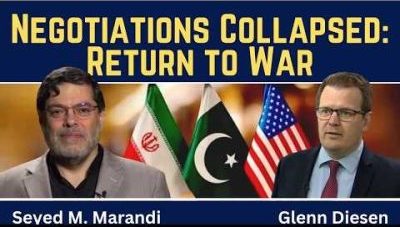
Seyed M. Marandi: Negotiations Collapsed – Return to War
or go to
Aletho News Archives – Video-Images
From the Archives
Wartime internment camps in Australia
National Archives of Australia
World War I
During World War I, for security reasons the Australian Government pursued a comprehensive internment policy against enemy aliens living in Australia.
Initially only those born in countries at war with Australia were classed as enemy aliens, but later this was expanded to include people of enemy nations who were naturalised British subjects, Australian-born descendants of migrants born in enemy nations and others who were thought to pose a threat to Australia’s security.
Australia interned almost 7,000 people during World War I, of whom about 4,500 were enemy aliens and British nationals of German ancestry already resident in Australia.
Records of World War I internment camps
World War II
During World War II, Australian authorities established internment camps for three reasons – to prevent residents from assisting Australia’s enemies, to appease public opinion and to house overseas internees sent to Australia for the duration of the war.
Unlike World War I, the initial aim of internment during the later conflict was to identify and intern those who posed a particular threat to the safety or defence of the country. As the war progressed, however, this policy changed and Japanese residents were interned en masse. In the later years of the war, Germans and Italians were also interned on the basis of nationality, particularly those living in the north of Australia. In all, just over 20 per cent of all Italians resident in Australia were interned. … continue
Blog Roll
 Aletho News
- Seyed M. Marandi: Negotiations Collapsed – Return to War
- Tomorrow’s naval blockade showdown
- ‘Israel’ attacks civilians to hide its embarrassing military failures & out of pure sadism
- Any Foreign Military Vessel Approaching Hormuz Under Any Pretext ‘Will Be Dealt With Severely’: IRGC
- Diplomats slam US negotiators’ performance in Iran talks
- Trump Refuses Exit Ramp, War with Iran will Continue
- Trump Says US Naval Blockade in Strait of Hormuz Will Begin Shortly
- US, Iran end 21-hour talks without agreement
- US IRAN TALKS: Who Are the Crazy Ones Here? /Lt Col Daniel Davis
- Talks with the US end without a deal over excessive US demands: Iran
- If Americans Knew
- US-Iran ceasefire negotiations make zero progress – Daily Update
- Pro-Israel ‘Thinktanks’ and Individuals who Influence U.S. Foreign Policy
- Mearsheimer reveals how Israel dictates US policies on Iran, Gaza – video
- After killing 350+, Israel still has a “score to settle” with Lebanon before ceasefire – Daily Update
- Military aid to Israel emerges as the latest political litmus test for Democrats
- The only Palestinian children’s rights organization closes following years-long Israeli campaign against it
- ‘I Can’t Forget the Smell’: Lebanese Reel After Israel Kills Over 300 in Single Day
- DNC Shoots Down Resolutions Calling Out AIPAC and Limiting Arms to Israel
- TCN: Is Israel Blackmailing President Trump?
- Israel killed at least 303 Lebanese yesterday – who were they? Daily Update
- No Tricks Zone
- German Expert: Heat Dome Led To Record Temps In Western USA…Warmer In 1934, 1936
- New Study: No Linear Warming Or Glacier Retreat Along Northern Antarctic Peninsula Since 1980s
- An Inconvenient Tree: Uncovered In Alps… Europe Much Warmer Than Today 6000 Years Ago
- New Study Reports A 60% Slowdown In Greenland’s Ice Loss Rate In The Last Decade
- Low Intensity Tornado Wrecks Major Solar Farm, Creating A Potential Toxic Dump
- New Study Finds Warming Saves Lives…Cold Temperatures 12 Times More Deadly Than Excess Heat
- German Science Blog Accuses PIK Climate Institute Of Hallucinating Climate Tipping Points
- Devastating Assessment Of Comirnaty Vaccine By Former Senior Pfizer Europe Toxicologist
- New Study: CO2 Is ‘Effectively Negligible’ As An Explanatory Climate Change Factor Since 2000
- Former Pfizer Toxicologist Dr. Helmut Sterz Tells Bundestag Hearing Pfizer Vaccine Should Have Never Been Approved
 Aletho News