China makes weapons ‘breakthrough’
RT | August 12, 2023
Chinese military scientists have reported a research breakthrough that could make it possible for Beijing to develop high-energy laser weapons that can shoot for as long as their operators desire, without interruption and without any degradation in performance.
Scientists at the National University of Defense Technology in Changsha, China, published the results of their research earlier this month in Acta Optica Sinica, a peer-reviewed Chinese journal. They claim to have developed a new cooling system that makes it possible to operate high-energy lasers “indefinitely,” without any effects from overheating.
“This is a huge breakthrough in improving the performance of high-energy laser systems,” the team said in its research paper. “High-quality beams can be produced not only in the first second, but also maintained indefinitely.”
The cooling system controls gas flows to remove heat from inside a laser weapon, preventing vibration and disruptions in performance. It can enable longer operation, increased range and greater firepower, the scientists said. They noted that 60 years on from the invention of the first ruby laser, weapons developers haven’t been able to create “death rays that can instantly kill targets.”
Some of the most high-profile US laser weapons projects have been canceled, despite shooting down targets in testing. “The true reason for the cancellation of these projects was that their destructive power did not meet expectations,” the Chinese scientists said. Longer, continuous operation times are needed to extend the range of laser weapons beyond a few kilometers, they said.
Such weapons generate high-energy beams that heat up the gas in their path as they pass through the air, creating turbulence. This effect can distort the beam, diminishing its accuracy and strength. The heated gases can also contaminate the mirrors in a laser weapon, reducing performance and potentially damaging a system.
The Chinese researchers said they developed a system that blows gas through the weapon to remove waste heat and keep the mirrors clear. Their technology is already being used in a number of laser weapons that the Chinese military has under development.
Beijing reportedly intends to use such weapons against drones, missiles and aircraft. They also could be used to target satellites, disrupting enemy communications, navigation and surveillance capabilities.
World sliding toward WW3 as more warhawks grab power in Washington DC

By Drago Bosnic | August 12, 2023
It’s hardly breaking news that there are numerous warhawks among the political elites in Washington DC. These people have been behind every instance of (geo)political instability initiated by the United States, be it illegal coups, civil wars, invasions, etc, all of which resulted in an exponential exacerbation of the supposed “problem” they were seemingly designed to “resolve”. Such warhawks are oftentimes so shamelessly belligerent that they don’t even bother concealing their openly planned war crimes under the guise of the mythical “moral high ground” used by other more subtle Washington DC warmongers.
It’s important to note that their style has always been preying on the weak, as these warmongers mostly focus on bringing the wanton “freedom and democracy” to those unable to retaliate or at least defend themselves. Direct attacks are unmistakably preceded by economic warfare (primarily sanctions) and “isolation” by the so-called “international community”, that is, the political West and its vassals and satellite states. After all, those are the countries “that matter”, the much-touted “garden”, while the rest of the world (or better said, the actual world) is “simply a jungle”, as EU foreign policy chief Josep Borrell (in)famously stated.
And yet, in recent years, the warhawks have become so overconfident that they don’t even consider the possibility of engaging in actual diplomacy (unless arm-twisting is considered “diplomatic”), not even with countries that have the means of bringing all the “freedom and democracy” the US “exports” back to it. This includes not only “pocket superpowers” such as North Korea, but also geopolitical giants wielding unprecedented military and/or economic might, such as Russia and China, the two only near-peer adversaries to the United States. Such dangerous trends in American politics are only getting worse.
Namely, as if there weren’t enough war criminals in Washington DC, the US government is becoming a virtual hive of such power circles. Infamous neoconservatives such as John Bolton, Michael McCaul and Lindsey Graham, whose political influence has become dangerously powerful, are now getting significant backup that includes rabid Russophobes and Sinophobes such as Victoria Nuland and USAF General Charles Brown. Such warhawks are now gaining even more influence, meaning that America’s foreign policy is set to become more belligerent than ever before (if that’s even imaginable to most people).
In early October last year, John Bolton, former US National Security Advisor, infamous for his insistence on invading Venezuela, Iran and North Korea or escalating the ongoing war of aggression against Syria, Libya, Yemen, etc, openly stated that Russian President Vladimir Putin is on the US target list and threatened he might be assassinated. And while his directly visible political influence may seem to be dwindling, Bolton’s close associates are grabbing more power than ever. Namely, he was one of the most prominent members of the infamous Washington DC-based think tank known as the Project for the New American Century (PNAC).
PNAC’s main focus was making the already extremely belligerent US foreign policy even more aggressive. One of the original founders of the now-defunct think tank was Robert Kagan, notorious for being one of the strongest proponents of America’s aggression against the world. There’s not a single war Kagan hasn’t supported. Worse yet, he regularly and deliberately spreads disinformation in order to speed up wars, as evidenced by his unadulterated lies in years before the illegal US invasion of Iraq. Kagan is the husband of Victoria Nuland, who was directly involved in the illegal Maidan coup that resulted in the war in Donbass that killed upwards of 15,000 people by early 2022.
She was recently promoted to acting Deputy Secretary of State by President Biden, placing her in one of the most influential positions in the State Department, second only to Secretary of State Antony Blinken. It should be noted that while Nuland was serving in the Obama administration, one of her phone calls with the then US ambassador to Ukraine Geoffrey Pyatt was leaked. In February 2014, she told Pyatt that Arseniy Yatsenyuk will become the new prime minister of Ukraine, which he did that same month. During the call, she also clearly expressed her stance on the significance of the European Union in decision-making when it comes to the political West’s foreign policy.
Nuland was one of the architects of the Neo-Nazi junta’s seizure of power in Ukraine, making her directly responsible for the ongoing hostilities. She also supported both US terrorist attacks on the Nord Stream pipelines and the setting up of military biolabs in Ukraine. Her no less aggressive ally Lindsey Graham also actively took part in pushing Ukraine into a bloodbath, while also calling it the “best money we’ve ever spent” because “Russians are dying”. He is also notorious for actively calling for US aggression in Mexico. The strong influence of such warhawks exponentially raises the possibility of a world-ending thermonuclear confrontation.
Unfortunately, this isn’t only limited to the political establishment. Namely, the Senate Arms Services Committee recently voted to confirm General Charles Brown as the next Chairman of the Joint Chiefs of Staff, replacing Mark Milley. He is adamant that the US confrontation with China in the Asia-Pacific is inevitable and that Washington DC should further militarize the area. Coupled with resurgent Neo-McCarthyism that also includes congressman McCaul’s insistence on direct confrontation for semiconductors, as well as calls for placing Taiwan under the US nuclear umbrella, this is bound to put America on a collision course with China.
Drago Bosnic is an independent geopolitical and military analyst.
WHY IS THE WEST SO WEAK (AND RUSSIA SO STRONG)?
THE ROLE OF HUMAN CAPITAL AND WESTERN EDUCATION

BY GAIUS BALTAR | AUGUST 2, 2023
It is becoming increasingly clear to more and more people in the West that something has gone terribly wrong with the Ukraine project. Predictions and projections didn’t pan out and the West doesn’t seem to know what to do. The Russian economy wasn’t a house of cards as predicted, Russian weapons weren’t inferior as predicted, Russian soldiers and commanders weren’t incompetent as predicted, and Russian technology wasn’t inferior as predicted.
In some respects the Russians even seem to be superior to the West. Their weapons are effective and in many cases outright technologically superior, as clearly demonstrated by their hypersonic missiles, SAM systems and electronic warfare systems. Their economy appears to be surprisingly advanced and diversified and based on real wealth creation rather than financialization and debt like the West’s. Their strategic and tactical thinking also seems to work, while the West‘s clearly doesn‘t.
The whole mess is often explained as a result of a miscalculation by the western elites – they underestimated Russia and overestimated the West. The situation, however, is far worse than that. Every day that passes reveals the impotence of the West more and more and the situation is becoming outright humiliating. At this point the rest of the world either shakes their heads or simply laughs at the West and its politicians and diplomats – not to mention its crazed populations.
The dysfunction of the West is far deeper than just the situation around the Ukraine project. It’s absolutely everywhere. The West can’t do diplomacy in general, it can’t run its cities or countries except into the ground, its high-tech projects fail almost as a rule, its infrastructure is crumbling, its economies are crumbling, and all public policies seem to have a civilizational suicide as a final goal. The West’s control mechanisms over the rest of the world are also crumbling, including the dollar, sanctions, color revolutions, military interventions and threats. Nothing seems to work and everything the West does seems to make things worse.
Any rational person upon hearing a western leader, diplomat or “expert” speak, asks himself this question: “Are they just lying or are they really this incompetent and delusional?” The answer is “both” but the incompetence factor is far greater than most people can imagine.
Why has this happened? It’s clear that the cause is far deeper than the deindustrialization of the West or economic problems in general. The economy doesn’t explain the incredible incompetence shown by the West before and during the war in Ukraine.
I suggest that the cause of this unfolding disaster is a serious structural problem in the West – which Russia seems to have largely avoided. This structural problem is a necessary condition for the current western system and has been purposely created to bring it about and maintain it. This problem is the subject of this article – as well as the “mechanism” behind it. This is unfortunately a long article, but the subject matter demands it.
The current ideologically-based power structure of the West outright requires that certain types of people be in positions of influence and certain types of people be sidelined. This applies to all steps of the social ladder; from kindergarten teachers to university teachers and corporate executives, and all the way up to the leaders of society itself. This has been progressing steadily for the last five decades or so, and has resulted in a major structural problem for the West. That problem is the obvious and massive degradation and misallocation of human capital in the West.
Human capital can be described as the quality of a company’s or nation’s workforce, or more specifically how competent the employee pool is – how well they are trained, how quickly they can be trained, how they are educated in general, and how they make decisions. In order to understand what competence really means, let’s define it further.
Competence can be described as specific or general. This distinction is extremely important and must be understood by anyone who attempts to manage human capital on a small or large scale.
Specific competence is the ability to do a certain type of work. This can be carpentry, coding, chemistry, medicine, piloting an airliner, and so on and so forth. Some of these types of jobs may require a lot of competence, training and intelligence, but what they have in common is that their scope is limited and clearly defined. They exist within clear boundaries, separate from the complexities and vagueness of the world in general. Each type of work requires certain abilities innate in the person, as well as varying degrees of training. People, of course, differ a lot in their level of specific competence within each field.
General or high-level competence is the ability to do work that is beyond clearly defined boundaries. The subject matter of those types of work exists in a complex “variable universe” and can be exceedingly vague and confusing. It requires the ability to be adaptive and be able to transfer skills between different types of work. This also applies to expertise in one field being applied to a completely different field – such as applying psychology to economics or astrophysics to climate science.
Examples of positions requiring general or high-level competence people are corporate executives, all kinds of planners and administrators, product developers, inventors, high-level consultants and analysts, military leaders and planners, diplomats, judges, political leaders, and high-level scientists and theoreticians, to name a few.
Specific and general competence types of work are not two separate things. Types of work or “jobs” can be said to range from almost completely specific up to almost completely general. Almost all types of work have elements of both but in varying proportions. To illustrate this I will take an example from a company I’m personally familiar with. This is a software company with several owners, most of whom work at the company. One of the owners is an exceptionally competent database specialist. However, when he contributes to decision making for the company as a whole, he becomes an outright problem. The management structure of the company had to be “modified” to neutralize him in that role, as well as a few others. This employee has exceptional specific competence but very poor general competence. He cannot “transfer” his specific database competence over to competence in moving the company into the future. He simply cannot operate objectively or sensibly outside his database job.
So what makes this employee have such poor general competence – or more specifically – what is general competence? General competence requires three necessary conditions: a) High general intelligence or IQ, b) the ability to be objective, even in situations where the result of your conclusions may not be to your liking, and c) the ability to reach conclusions without being influenced by others (i.e. independent thinking). The latter two conditions are a direct result of how the human brain interacts with the environment. The mechanism behind it is too complicated to describe here, but in simplistic terms it can be said that humans range in their relationship with reality from the emotional-outward/subjective to the introspective/objective. This variable, like all evolutionary traits, including IQ, is normally distributed. This has rather disturbing implications which may be difficult for some people to understand.
Let’s first look at IQ, or general intelligence. In order to be able to deal with seriously complicated work or get through a real university program, an IQ of about 125 is necessary. Only about 5% of the population in the West has this IQ or higher. This means that the pool of potentially high-level competence people is very small to begin with. Even if we use a cut-off of an IQ of 115, which is sufficient for most semi-complicated work, the potential pool only goes up to 16% of the population.
Now let’s take a look at the other variables, i.e. objectivity and independent thinking. Those two are correlated and we will, for the sake of convenience, handle them as the same variable or trait, even though they aren’t. They are normally distributed, much like IQ, with most in the middle and fewer toward the extremes in both directions. On one side of the distribution are people who, to state it bluntly, are incapable of thinking objectively about any issues that may interact with their personal views about anything at all. They can be competent in a limited field which is “neutral” to them (such as databases), but not involving anything else. They can’t run a company in a competitive environment, except into the ground. They can’t run a city, a country, a military campaign, an economy, or anything requiring general competence, except into the ground, regardless of their intelligence. These people are clearly not suitable for general/high-level competence jobs.
So, what is the proportion of the population that is objective enough and independent thinkers enough to be suitable for those jobs? That’s difficult to determine but it’s clear that it is maximum 50% of the population. In reality it’s far less but let’s be generous and say it’s 30%. What does that mean?
IQ and objectivity/independent thinking are somewhat correlated but let’s assume they are not. Let’s say that we have a pool of potentially objective and rational people that is 30% and a pool of people with IQ of 125 that is 5%. That means that the pool of high-level general competence people is 5% of 30%, or 1.5% of the population.
If we are really generous and assume that 50% of the population is objective and rational and an IQ of 115 is sufficient for those jobs, then we have 16% of 50%, which is a pool of 8% of the population.
The importance of this cannot be overstated. This group, whether we define it as 1.5% of the population or 8% of the population, is extremely valuable. This is essentially the only group in society that can reliably evaluate complex situations and make subsequent rational decisions. Without it, modern technological society simply cannot be built or maintained – let alone advanced. Let me rephrase this – if we do not identify and utilize this group, we cannot run our complicated societies except into the ground.
Modern western society is from a governance standpoint ideologically motivated and ideologically controlled. It is being pushed in a very clearly defined ideological direction, led by the European Union and the current US administration. This ideology is not the subject matter of this article, but it can be seen everywhere by any rational and independent-thinking person. For the uninformed-curious a good place to start is the website of the EU’s policy-making body; the World Economic Forum.
In order to achieve these ideological goals for the West, two things must happen: a) The right people must be put into power at all levels of society and b) any disruptive elements must be eliminated or suppressed. Since all ideological goals tend to be more or less in conflict with reality, there is no group more disruptive to them than the one who operates objectively and independently. People like that simply cannot be allowed into positions of power, and if they must be, they must be kept quiet and/or forced to toe the line.
The objective/rational/general competence group, whether it is 1.5% or 8% of the population, therefore becomes a problem rather than a resource. This is exactly the situation in the West today.
Many people have noticed that meritocracy has been systematically abandoned in the West and the relationship between competence and reward severed in giant swaths of the economy – and almost completely in government. What few people seem to realize is that this is a necessity for the West’s ideological goals to be reached. High-level competence cannot be promoted because it is a threat. It cannot therefore be rewarded.
In order to illustrate this, let’s take a look at what happens when a member of the 1.5% is allowed to gain significant power. Elon Musk is a smart man, probably with an IQ of 150 or more. He is also quite objective and realistic in his assessments, and an independent thinker. His ownership and governance of Twitter/X is a major problem for western ideological goals. Free speech is an obvious threat to any ideology and, to rub salt in the wounds, Musk belittled the guardians of the Ideology at Twitter by making fun of them, then by firing them all and only keeping the competent ones. This cannot be allowed to stand and we can already see the response. The EU is planning to use force to stop this affront to the Ideology and may actually block Twitter in Europe. Ideological champion (and suspected lizard robot) Mark Zuckerberg was even instructed to cook up an ideologically pure Twitter copy in response – but seems to have failed. We eagerly await further responses, which may range from lawfare up to more “direct” actions, and will most likely be directed at Musk personally.
As previously noted, two things must happen for the ideological goals to become reality: The right people must be promoted and the wrong people must be suppressed. This process of elevation/suppression has become the main goal of the western education system – all the way from kindergarten up to university. If we look at what the education system has been doing, this becomes extremely obvious. Here are a few examples:
- Evaluation of competence is being systematically degraded to avoid comparison between the competent and the incompetent. Exams are being discarded in favor of constant “projects” and students work in groups so the incompetent may hide. Schools avoid testing the individual directly as much as they can – and thereby comparing him to others. The competent ones must not be encouraged, and if at all possible, they themselves must not realize that they are above others.
- Universities are increasingly basing admittance on other criteria than competence, including quotas based on non-competence variables. The most insidious selection method is the “personal essay” which applicants must submit – and is sometimes even more important than grades. All applicants know that the more they signal virtue in the essay, the more likely they are to be admitted. On the basis of the essay, the universities can pick the ideologically pure – which is the only purpose of the essay requirement to begin with.
- Almost every academic subject is being turned from the objective to the subjective to assist the irrational-incompetent student. This even applies to hard subjects such as mathematics – where nowadays 2+2 doesn’t necessarily equal 4. Even intelligence is now subjective and the stupid can be as smart as the intelligent – it’s just a question of perspective, the right measuring tools, and idiotic inventions such as “emotional intelligence.”
- Almost every subject has been made easier than before to help the incompetent students and even critical fields such as medicine are now graduating people who are utterly incompetent and clueless – on a large scale. This systematic lowering of standards also has the added benefit of creating disinterest in smart and rational students. A smart student performs better and better relative to others as the subject gets harder. If the subject is easy or made uninteresting, he will sink down to mediocracy – which is a part of the purpose of lowering the standards to begin with.
- Disciplines which may be a threat to the irrationality of the Ideology have been massively subverted and corrupted. This applies to several fields, but particularly to psychology and history, which in their proper forms would be a massive threat to western ideological goals. Psychology has been twisted into an almost unrecognizable abomination, and history is mostly just lies these days.
- Fake disciplines have been invented from the ground up for the purpose of training the ideologically pure without the need for competence or intelligence or any connection to reality. These disciplines can be found in lists of “most useless university degrees” all over the internet, but that is a misunderstanding. Those degrees are not useless at all – they elevate the ideologically pure in society by awarding them university “certification.” This certification justifies giving them important positions in society.
I could go on but you get the picture. What we are looking at here is not the failure of the western education system, but a very carefully planned “pivoting” toward new objectives. The primary purpose of the education system is no longer education. The entire education system of the West has been reconfigured to carry out a “filtration” process. The purpose of this process is to identify, instruct and elevate the ideologically pure while suppressing the dangerous 1.5/8 group. The education system, particularly the universities, has largely abandoned real education and is almost solely focused on this mission. This mission is not just carried out by the education system, but by all institutions of governments and a large part of the corporate sector. A side-result of this filtration process is the degradation of all education in the West, and subsequently, degradation of its human capital in general.
Western society, in general, has abandoned rationality and replaced it with subjectivism (formally designated as “post-modernism”). The purpose of that is not just to train and advance the ideologically pure, but to use subjectivism as an oppression tool against the 1.5/8 group and the rational part of the population outside of it. The best way to suppress a rational person is to subject him to an existence of total and constant irrationality. It is essentially gaslighting on a civilizational scale, directed at the dangerous rational group.
While the dangerous rational group is being suppressed and subverted, the ideologically pure “leaders of tomorrow” are indoctrinated rather than educated, given university certifications rather than real degrees, and finally provided with an unending amount of fake and well paid jobs in both the private and public sector. This well-paid ideologically pure group then becomes the power base of the new ideological system.
The goal of this deliberate intervention into the educational system is to create what you might call a “migration pattern” in society based on (lack of) competence and ideological purity. The right people need to be put into the right positions and the right jobs, and since they are incompetent, this needs to be managed for them. After they leave school with their certifications, government and the private sector take over and actively push them upward, while pushing the dreaded 1.5/8 group away from influence and well-paid jobs.
Two developments in the West have been godsends for these efforts: the outsourcing of western manufacturing to Asia and the virtual abolition of competition in the corporate sector. This massively decreased the complexity level of the western economy and subsequently the need for the 1.5/8 group. When most companies operate services in a protected environment, there is far less need for high-level/rational people – while in a “real economy” these people simply cannot be sidelined. Also, when you can get away with operating a fake economy based on the dollar reserve status, you can also operate a fake society run by incompetents.
Let’s take a closer look at how this upward migration of the ideologically pure is managed after they receive their university certifications – and how the 1.5/8 group is systematically blocked. There are five main methods being employed – which together form a long-term takeover process of society. These methods are the following:
- Public sector filtering
- Public sector stuffing
- Job-creation by decree
- Private sector filtering
- Private sector stuffing
Public sector filtering – This describes the job selection process in the public sector. Initially the “foot-in-the-door” method is used. A few ideologically pure politicians and bureaucrats position themselves within the system and start controlling who is hired. This increases exponentially over the decades as more and more purists gain access to the levers of power. Currently the process is so overt that it is starting to become expressed in recruitment policy papers – such as the recent example of the British government excluding “white men” from becoming fighter pilots. The West has almost completely been able to exclude the 1.5/8 group from public-sector positions using this method – including its armed forces.
Public sector stuffing – As the public sector filtering process advances, the purists inside the system start creating more and more positions for their purist brethren. New departments are created, work groups and committees appear, and the public sector expands. Publicly owned companies, such utility companies, hospitals and schools are also often used as storage units for large numbers of the ideologically pure. This is extremely obvious in the West. Every unnecessary law or initiative requires more and more people – and these people are all carefully selected.
Job-creation by decree – This method is directed at the private sector, as well as the semi-public sector. Government purists start creating new laws and standards which all companies must fulfill. Those are justified on the basis of “goodness” and usually involve the environment, equality, safety and such things. This creates a large number of positions within private companies which are tailored for the ideologically pure – particularly in support functions such as human resources, compliance functions and others. This enables a “foot-in-the-door” situation in the private sector and gives the purists access to the levers of powers there – much like they already have in the public sector.
Private sector filtering – As the purists have gained access to the private sector – particularly human resources (which is the standard purist Trojan horse in private companies) – they start filtering new recruits exactly the same way the public sector does. As in the public sector, this filtering process is becoming more obvious. A significant number of companies are now specifying which groups will not be hired in their job advertisements. Since they can’t overtly say “we don’t hire smart, independent thinkers” they usually use “white men” as a proxy for that group for some reason. That group is considered to be a particular threat, although you can be sure that anyone who doesn’t follow the program will be fired, regardless of their gender or the color of their skin.
Private sector stuffing – Shortly after Elon Musk bought Twitter he fired something like 80% of its employees. That 80% was the company’s private sector stuffing ratio – quite high. Companies, particularly in sectors which can influence public opinion – but not solely, are increasingly creating a large number of positions which are either totally superfluous or intended for influence operations against the public.
Those filtering and stuffing methods are the primary mechanisms that have been used for the takeover of western societies by the ideologically pure. There are other mechanisms, such as ESG, filtering by certain banks and investment funds regarding who gets financing and who doesn’t – and the uncontrolled immigration engineered by the ideologically pure which is seen by them as a continuation of the internal migration process. However, all that is beyond the scope of this article.
The ideologically pure have systematically been moved into almost all positions of power in the public sector and a large part of the private sector – and the situation in the private sector is increasingly mirroring the public sector in hiring practices and employee stuffing. The dangerous 1.5/8 group is being kept away by all means, and with great success. The power base of the Ideology is firmly in place.
This job migration program hasn’t been cheap. Millions of unnecessary jobs cost money and it is clear that a significant part of western public debt can be attributed to this program, a fact which doesn’t seem to have been noticed by many people.
The consequences
The main thing to understand is that western societies and economies have been put on an ideological footing. Productivity, competitiveness, technology and science are simply not priorities anymore in the West. Explaining the consequences of this process for the West would take many articles, or a book of several hundred pages. Still, let’s mention a few examples.
The inverse competence crisis – The goal of this entire project has been to place the ideologically pure in all positions of power at all levels of society. These positions are, in a normal and competitive society, occupied by the highly competent 1.5/8 group. The process has now reached near-completion with most positions of power occupied by the ideologically pure. Some of those people have high IQs but they are neither objective nor independent thinkers. The Ideology they must subscribe to is simply incompatible with those qualities. This has some serious consequences.
Remember that positions of power and influence are more likely to demand general competence than other positions (as opposed to specific competence). The greater the power, the more the position demands general competence. The people in these positions now are selected by ideological fervor and reliability – so the higher you go, the more ideologically enthusiastic the people who hold them. This means that the least objective and independent thinking people hold the positions which require the greatest objectivity and independent thinking. Therefore, in the West incompetence becomes greater and more common the higher you go. As someone said – “a general is an incompetent colonel.” This can be seen absolutely everywhere except in some holdout private companies. Those exceptions are of course being addressed as we speak.
The second problem is that many of the irrational/subjective people holding all the power have reasonably high IQs. That may seem to be a positive thing but it has a major disadvantage. Moderate to high IQ irrational/subjective people are the easiest to brainwash of all people. The reasons for that are complicated and need to be addressed in another article – but what this means is that the top tier in the West is not only the most incompetent it can possibly be in comparison to what their jobs require – but are also the most malleable and delusional.
The cost and debt crisis – The migration of the ideologically pure into the ideological power base and positions of influence has created millions of jobs in western societies which create no value. These jobs are much more numerous and more widespread than most people realize, and I wouldn’t be surprised if something like 20%-30% of the entire labor force of the West could be fired without any adverse effect. In fact, the effect would be positive, especially if those people could be made to work the (mostly menial) real-economy jobs they are suitable for.
Deindustrialization has been blamed for the extreme debt levels and tax burdens of the West. That is, as far as it goes, true – but maintaining this giant group of incompetents in their fake jobs is also placing an extreme burden on the West. Western societies are now completely unsustainable and cannot be run without constant debt increase.
The competition crisis – This crisis can be explained by the following example: Let’s say there are three companies with combined 100% market share in some sector. There is no real competition between them and everybody can just relax because the customers can’t go anywhere else. These companies can get away with absolute incompetence on most levels, including in management. They don’t need to think about efficiency, safety, productivity or costs, except on their websites and in annual reports. However, if a competitor with competent employees manages to infiltrate the sector, those three companies will hit a wall. There will be an enormous crisis and one or more of them will most likely go under.
This is exactly the situation in the western economies now. Monopoly and oligopoly is the rule and the main objective of most large western companies is to prevent anyone from infiltrating their sector – usually by bribing regulators or by buying the competition. This is a necessity because a huge number of western companies are now run by incompetent management and staffed by incompetent people, particularly in support and management functions. The immortal words of the nameless Boeing employee about the 737 MAX apply to most large western companies; “this airplane is designed by clowns who in turn are supervised by monkeys.” Western companies are no longer competitive. They cannot compete with Chinese companies now and soon they won’t be able to compete with companies in general outside the West. They simply can’t function except inside an economic safe-space. In fact, the situation is such that the Chinese already do the real work for many of them and reshoring the work is problematic because of (surprise!) the human capital degradation in the West caused by the repurposing of its education system.
This also applies to western societies as a whole. The entire leadership and diplomatic classes of the West are no longer competitive against the rest of the world for exactly these reasons. They are being outmaneuvered by the Chinese, the Russians, the Indians, and everybody else at every turn. Even African leaders are now more competent than western leaders. They have consistently made decisions that are better for their people than leaders in the West – for the last few years anyway.
The complexity crisis – Earlier in this article I stated that the 1.5/8 group is extremely valuable for modern societies and without it complicated modern societies cannot be managed. In the West this group has been successfully sidelined to a great degree and a good part of it doesn’t even bother with university education anymore. The situation, however, is even worse than that. The reconfiguration of the education system and the break between competence and reward in the job market has fundamentally changed the decision making process behind the selection of university education. Why study engineering (which is hard) when you can get an even better paying job with a degree in psychology (which is easy nowadays)? The reconfiguration of the western education system has changed the reward structure, encouraging young people to pursue easy and useless education – simply because the “system” will provide them with jobs.
This has already caused a major crisis in western societies, particularly in the US. The “maintenance” of complex aspects of US society needs a large group of engineers and people with related education. This maintenance is faltering now, and significantly relies on foreign engineers educated in US universities. You see, why would Americans study engineering in a system which doesn’t reward it? If China and India could somehow recall their engineers and others with hard education from the US, the US system could probably not be maintained, let alone advanced. This will get progressively worse and we will soon reach a point where complex systems which underpin society cannot be kept running. That will require some kind of “reset” to a less complex society, with less prosperity of course.
There are far more crises than those four, but I wouldn’t want to sound like a doomsayer by listing more.
So, what about Russia? Firstly, there are clear signs that the Russians have figured out what is happening in the West and are learning from it. Recently they left the “Bologna process” which is a European education standardization system. The Bologna system has the express purpose of diluting education in member states, implementing certifications rather than real degrees, and filling European societies with badly educated and generally incompetent “experts” who follow the consensus, no matter what. The Russians saw this system as a threat to their country, which it is, and have, at least partly, reverted to the older and more hardcore Soviet system.
Secondly, the Russians seem to be carrying out purges of the incompetent and corrupt within state structures, including the military. Meritocracy seems to be on the agenda, a radical concept these days. The Russians most likely see these efforts as critical to the continuation of their state and nation – and they would be right.
The situation in China is much the same and there are indications that the rest of the non-western world is catching on. Remember that one of the results of the recent Russia-Africa summit was a Russian-organized education effort in Africa. I doubt that women’s studies will be a part of that curriculum.
The current clash between the West and Russia – and increasingly between the West and the rest of the world – is becoming a clash between the incompetent and irrational and the competent and rational. The result is obvious – but what happens when an irrational person who is backed into a corner has access to nuclear weapons? That’s anybody’s guess.
By putting its societies on an ideological footing the western elite has backed itself into a corner. They can’t compete; they can’t develop their economies or societies; and they can’t go back. Fixing the problems of the West will require an economic revival, where a real economy will replace the current fake financialized service economy. This cannot be done without putting the hated 1.5/8 group into positions of power. Therefore, it will not be done as long as the current western ruling class is in power. Western societies will not survive an economic revival in their current ideological configuration. Conflict is therefore the only remaining option for the ruling class to hang on to power.
Russian energy revenues higher than last year – Handelsblatt
RT | August 11, 2023
Russia saw revenues from energy exports surge last month despite Western sanctions that include embargos and price caps on the country’s oil, German news outlet Handelsblatt reported on Thursday.
According to the publication, Moscow’s revenues from oil and gas sales grew 5.3% year-on-year in July and amounted to $8.66 billion. Profits were said to be the largest in gas exports, while those from crude sales rose by 2.6%. The outlet noted it was the first time this year that Russia had increased state revenues from energy exports in comparison with 2022.
Russia is earning more from energy exports and “thus is in a better position than a few months ago,” Giovanni Staunovo, a commodity analyst at Swiss bank UBS, told the news outlet. He claimed that as a result, many have started to doubt the effectiveness of sanctions on Russia.
Robin Brooks from the Institute of International Finance (IIF) noted that sanctions “can be very effective when used against countries with current account deficits,” which depend on loans from foreign investors on the global capital market to finance imports. He noted, however, that Russia is not among that group and argued that the restrictions imposed on it are becoming increasingly ineffective.
An EU embargo on seaborne exports of Russian crude was introduced last year along with G7 price caps on oil and petroleum products originating from Russia, in response to Moscow’s military operation in Ukraine. The measures were presented as an effort to deprive Moscow of funds to finance its military effort.
While the restrictions have barred Russia from accessing its traditional Western markets, they have triggered a large-scale reshuffle in global oil supply, with Moscow successfully redirecting exports to Asia. According to the latest OPEC calculations, Russia has been the largest exporter of oil to India for the past year, accounting for 45% of India’s crude purchases in June. It has also been China’s top supplier since January.
The Sino-Russo Naval Patrol Near Alaska’s Aleutian Islands Flipped The Tables On The US
BY ANDREW KORYBKO | AUGUST 10, 2023
Alaskan Senators were apoplectic after Russia and China just carried out a previously unreported joint naval patrol near their state’s Aleutian Islands last week. Those officials condemned what they claimed was an “incursion”, though the US Northern Command confirmed that the patrol “remained in international waters and was not considered a threat.” In any case, this was an interesting turn of events since it’s usually the US that conducts such exercises near those two’s borders.
The Sino-Russo Entente isn’t an alliance, but rather an unprecedentedly close strategic partnership focused on coordinating efforts to accelerate the global systemic transition to multipolarity. To that end and in the context of last week’s joint naval patrols, these Great Powers decided to signal to the world that they’ll reciprocally respond to similar such exercises by the US. Up until now, each reacted separately and largely restricted this to rhetoric, but now they’re reacting jointly in a tangible way.
Several of their interests were served in this way. First, the US now knows that the Sino-Russo Entente isn’t reluctant to sail flotillas as close to American shores as is legally possible. Second, they voluntarily complied with the terms laid out in the UN Convention on the Law of the Sea (UNCLOS) regarding where foreign warships are allowed to sail despite the US not recognizing that framework. Third, this example demonstrated the sharp contrast between them and the US on the issue of international maritime law.
The fourth interest that was advanced through their joint naval patrol near the Aleutian Islands is that it made locals in that state, and likely also Americans elsewhere, experience how it feels when their geopolitical rivals conduct such exercises near their borders. Those drills won’t influence the formulation of US policy, but they can help shape some voters’ opinions about the wisdom of their leaders’ policies towards Russia and China considering that those two are merely responding to the US’ own such moves.
And finally, these drills importantly remained below the threshold of triggering an escalation, thus proving that it’s indeed possible to reciprocally respond to American provocations after both Great Powers were hitherto reluctant to do so. About that last-mentioned observation, they previously reacted separately and largely restricted this to rhetoric except on those rare occasions that they were accused by the US of flying or sailing their respective units too close to the latter’s.
Even so, those incidents took place near their own borders and not the US’, but this time they jointly sailed their warships near the Aleutian Islands in order to give America a taste of its own medicine. These plans were likely agreed to long ago but weren’t implemented until now since they each wanted to give the US the opportunity to stop making them feel uncomfortable by operating so closely to their shores. Russia and China’s patience has clearly run out, however, hence why they’re now jointly reacting.
This wasn’t their first joint naval exercise, but it’s the largest one near American shores thus far, which makes it a milestone. The Mainstream Media will predictably try to spin it as so-called “unprovoked illegal aggression” despite those two strictly abiding by international law per UNCLOS and carrying out their drills in response to the US’ earlier countless ones near their borders. By finally turning the tables on the US, the Sino-Russo Entente wants to show the world that the era of military unipolarity is over.
US response to Russia-China naval patrol exposes glaring hypocrisy
By Timur Fomenko | RT | August 8, 2023
Last week, the US sent a group of warships and a reconnaissance plane to waters off the coast of Alaska after Chinese and Russian vessels conducted a joint naval patrol in the area.
A former US Navy captain and analyst for right-wing think tank the Heritage Foundation described the patrol as “highly provocative.” Because the US and its allies would never, ever do something like that, right?
The US is engaged in the full-blown militarisation of the peripheries of both China and Russia in a manner that implies it has an unconditional right to do so. This behaviour has not only provoked one war, in Ukraine, but risks triggering a second one, over the Taiwan Strait, too. The reality, of course, is that neither Russia nor China poses any threat to Alaska whatsoever, because the conflict, or risk thereof, is at their own front doors, not America’s.
The US is the most militaristic and aggressive country in modern history. It has established a global military presence that spans every single continent with hundreds of military bases. In doing so, it claims it supports the freedom and self-determination of others. In reality, it provocatively encircles states that it deems rivals to its own global dominance, escalates tensions, and then when these states respond to the situation, subsequently brands them as the “aggressors,” thus affirming and even expanding its military footprint in these given regions.
With Russia, the US has pursued a relentless expansion of NATO eastwards since the Cold War, absorbing former members of the Soviet Union’s alliance system even when Russia had no will to compete with it. NATO has evolved from a unit of collective self-defence in a specific geographic region into an increasingly global ideological crusade which serves the goals of the US. The words “North Atlantic” in its name are increasingly redundant as Washington even endeavours to broaden its reach to Asia and the Pacific.
Which leads to the next point, China. The US is pushing for a full-scale military and naval encirclement around China’s eastern periphery, deliberately using the Taiwan independence issue as a wedge to ramp up tensions despite the One China Policy and giving the island region more and more arms. While doing this, it is forcing more and more countries to accept a greater American military presence. This recently included the Philippines, where the US gained access to a number of bases, as well as Papua New Guinea, where a defence cooperation agreement was recently signed. At the same time, the US constantly sails warships through the South China Sea and the Taiwan Strait, citing so-called “freedom of navigation” from a law which it does not even ratify. China’s retaliatory actions are then branded “aggressive” and threatening the peace of the region.
If this constitutes normal behaviour and a sovereign right of the US, why can China and Russia not sail patrols up to Alaskan waters? Why is one behaviour described as “freedom of navigation” but the other is labelled “highly provocative”? The reality is that because both countries are concerned about the US on their doorsteps, they have little interest in ever waging war as far afield in Alaska. The same cannot be said about US actions on their doorsteps, whereby the threat of war is very, very real and is being cranked up even higher by Washington. The US deems it has rights which other countries do not, which leads to the double standards voiced in the media regarding these seemingly equal actions.
China-Russia military cooperation is a product of the US antagonising them both, rather than so-called “provocative behaviour.” In the geographic sphere of Northeast Asia, the two countries have shared strategic interests which concern checking the expansion of US military power in Japan and the Korean Peninsula. This extends to the Northern Pacific. Neither country has any specific ambitions regarding Alaska. Neither China nor Russia is attempting to foster an independence or separatist movement there, unlike what the US is doing with Taiwan, and then groom it into a military partner hostile to Washington. Therein lies the difference between the two sets of military behaviour. China and Russia may cooperate for common strategic objectives, but they are not exerting aggression in the process. On the other hand, the US’ military presence and patrols are designed to upend a region and turn countries against other, provoke strife, and of course advance its economic goals. The irony is that media discourse presents this as entirely normal and justified, but then depicts Russia-China cooperation as a potential threat to Alaska.
The Jeddah Talks Backfired On Zelensky
BY ANDREW KORYBKO | AUGUST 6, 2023
The latest Western-centric Ukrainian peace talks in Jeddah were intended to sway the Global South towards Kiev’s side in the NATO-Russian proxy war by pressuring these countries to support Zelensky’s so-called “peace formula”. That goal was always doomed to fail from the get-go, however, since this event also provided the representatives of neutral countries like China and India with the opportunity to share their own envisaged endgame to the conflict as well as their shared Russian partner’s.
This resultant dialogue led to the meeting being a double-edged sword for Zelensky. On the one hand, he had yet another high-profile opportunity to repeat his talking points about why Russia needs to be punished for its special operation, but this time with all of that country’s BRICS partners in attendance. On the other hand, however, China and India ensured that his demands weren’t the only scenario on the table. Just like Zelensky, they too were able to share these views with a diverse international audience.
As was expected, no consensus was reached on the way forward, but Russian Deputy Foreign Minister Sergey Rybkov revealed on Sunday that Russia’s BRICS partners plan to brief it about the event. This is much more significant than the simple courtesy that it might appear to be at first glance since Moscow will be able to obtain a better understanding of all the attendees’ positions, which will in turn enable it to fine-tune its diplomacy towards those countries that might be interested in a compromise solution.
About that, Kremlin spokesman Dmitry Peskov debunked the speculation swirling around the Mainstream Media and even among some in the Alt-Media Community alleging that Russia wants to control more than the four former Ukrainian territories that united with it last September. He reaffirmed on the same day as Ryabkov’s earlier statement that “We just want to control all the land we have now written into our Constitution as ours”, which aligns with what President Putin strongly suggested in June.
This position was already known to Russia’s BRICS partners with whom it’s candidly discussed the special operation, particularly the Chinese and Indian representatives who attended the Jeddah talks. Special Representative on Eurasian Affairs Li Hui and National Security Advisor Ajit Doval each visited Moscow several months back, during which time they met with President Putin. Considering this context, it’s likely that they brought up his stance during the Jeddah talks when explaining their countries’.
Via Special Representative Li and National Security Advisor Doval, President Putin was therefore able to convey his country’s pragmatic position towards this conflict’s endgame to the largest international audience so far, thus breaking through the West’s information blockade. Upon learning that he doesn’t have any maximalist goals unlike Zelensky, those other representatives whose countries truly want peace as soon as possible might be in favor of tacitly recognizing Russia’s gains in exchange for a ceasefire.
China’s Rare Earths Export Curbs May Sink US’ Microchip Manufacturing Ambitions
By Ilya Tsukanov – Sputnik – 01.08.2023
Chinese export controls on germanium and gallium have stepped into effect amid fears that this will mean more expensive microchips, solar panels, cars, and even weapons. More significantly, the restrictions threaten to sink the Biden administration’s ambitious domestic microchip manufacturing goals, says China-US trade expert Thomas Pauken II.
China’s rare earths restrictions officially stepped into force on Tuesday, with the measures, announced last month after Beijing said it needed to protect its “national security and interests,” expected to cause a sharp jump in the cost of an array of advanced manufactured goods, particularly electronics.
The export controls, which will require companies seeking to export the pair of rare earth metals to apply for licenses, come in retaliation to a long list of US hostile measures, including restrictions on the import of Chinese high-tech goods.
“This is just the beginning,” former Chinese Vice Commerce Minister Wei Jianguo said last month, warning that “China’s tool box has many more types of measures available” should Washington try to retaliate to the rare earths semi-ban.
China produces upwards of 80 percent of the world’s gallium, and 60 percent of its germanium, with experts predicting that it could take “generations” for the US to replace lost Chinese capacity.
The rare earths restrictions show that Treasury Secretary Janet Yellen’s trip to Beijing last month to try to smooth over tensions clearly failed to get China to alter its position, with the Asian nation taking a harder line in retaliation to Washington’s tech and trade war, and attempts to box in Beijing in East Asia, earlier this year, starting by sanctioning US semiconductor giant Micron Technology in May.
Gallium and germanium are used in the manufacture of complex semiconductors, including chips with military applications, but also ordinary transistors, diodes, and other electronic components, for use in everything from smartphones and laptops to solar panels, vehicles, and medical equipment.
Move Could Sink Biden’s Semiconductor Scheme
“Obviously, these consequences are going to be devastating to US efforts to promote their manufacturing industry, to create these factories where they’re reshoring back home,” Thomas Pauken II, a veteran consultant and commentator on Asia-Pacific affairs, told Sputnik, referring to the $50+ billion push announced by the Biden administration last year to restore the US’ domestic electronics component manufacturing capabilities. “The thing is, you need these ingredients that are necessary for the chips and the semiconductors,” he said.
“So now I’m hearing that TSMC,” the Taiwan-based semiconductor giant, “is now having a rethink about doing their fab or semiconductor foundry that they were thinking about opening in Arizona. Also, there’s another story about Intel. They were going to open up this major chip manufacturing plant in Ohio, and now suddenly they’re saying, ‘Well, maybe we won’t open up this factory in Ohio because we lost all our Chinese customers. And because of these export controls we don’t have the ability to create all these chips,’” Pauken said.
US Caught Unprepared
Pauken believes the US and its allies may not have expected Beijing to go through with its rare earths export restriction threats, judging by the limited reporting on the matter, apart from specialized Washington-based think tanks warning about the “devastating impact” such export controls could have on the US, Europe, Japan, “and much of the world.”
“I think the real story is that the West maybe thought China was bluffing. Maybe they thought that China wasn’t being serious about these export controls. And now that they are starting to go into effect, they are realizing how destructive they can be. The fact of the matter is that the US has not done proper preparations to deal with the counter-sanctions or the counter-attacks led by China…They just thought that if they made all these announcements that they were going after China and all these other countries were following them, then somehow, China was going to wimp out, look scared, and then change their mind under the pressure. But in reality, what China has learned is that you cannot back down under peer pressure coming from Washington,” the observer said.
Pauken expects the export restrictions to put a “big hurt” on the global economy, but not so much on Beijing, which could even receive a boost to its domestic manufacturing industry as rare earths that once went to other countries will stay in China.
The expert stressed that if Washington were clever, it would “rethink” its China policy, and recognize that the get-tough approach to Beijing hasn’t been working, and won’t work, and has instead “been a disaster for the US economy.” Unfortunately, he added, “it doesn’t seem like the US has learned any lessons… so it seems as if they will just continue on with their anti-China legislation.”
“So basically it’s a case of if you’re tough to China, China will fight back just as tough. If you’re nice to China, then China will be nice. Right now, Europe decided they want to support the US and want to push back against China. So, of course, China is not only going after the US, but they’re also hitting Europe,” the observer said.
Options Limited
The escalating China-US tensions over rare earths has prompted US officials to begin a global search for alternatives, including Mongolia, a landlocked northeast Asian nation estimated to contain nearly 17 percent of global rare earths deposits.
“Mongolia is facing a generational opportunity. And that generational opportunity is a need for us to find critical minerals and rare earths in order to achieve our clean energy goals,” Under Secretary of State Jose Fernandez, who traveled to Mongolia in late June, recently told US media.
But it’s not as simple as investing in Mongolian rare earths production and extracting resources, Pauken said, pointing to the country’s landlocked status, and US efforts to irritate both of Mongolia’s neighbors, Russia and China.
“Obviously, you can’t go through Russia,” he said, citing anti-Russian sanctions. “So then they would have to go through China. And obviously, if Europe and the US decide to continue putting pressure on China, then they’re going to make it more difficult for the Mongolian miners to transport their products to the shipping ports,” the observer summed up.
Staggering Towards the Abyss
By William Schryver | imetatronink | July 28, 2023
I have long asserted, and I continue to be convinced, that the US could NOT establish air superiority against Russia, China, nor even Iran — not in a week; not in a year. Never. It simply could not be done.
American air power would prove substantially inferior to the extremely potent and abundantly supplied air defenses arrayed against it in any of those three countries.
American suppression of enemy air defenses would prove woefully inadequate to the task.
And even if any of the US’s aerial wunderwaffen were to prove, in ideal circumstances, to be potent weapons, US air power as a theater-wide undertaking could not be sustained in the context of a non-permissive regional and global battlefield.
In a high-intensity combat scenario in either eastern Europe, the China seas, or the Persian Gulf, the maintenance requirements for US aircraft could not be met. Mission-capable rates would plummet even lower than their notoriously abysmal peacetime standards.
The US would, quite literally after only a few days, see sub-10% mission-capable rates for the F-22 and F-35, and sub-25% rates for almost every other platform in the inventory.
It will be a huge scandal for the Pentagon … but hardly a huge surprise.
And this is hardly hyperbole. It is more or less common knowledge among those who think about these aspects of war — the only aspects that really matter in the final analysis.
US supply lines would be severely attrited on both a regional and a global scale.
Russian and Chinese submarines and long-range anti-ship missile systems would wreak havoc on US seaborne logistics.
I repeat: The US could not fight an overseas war in a non-permissive environment against a peer adversary. It doesn’t have the means, let alone the experience and competence, to do so.
In eastern Europe, Russia would savage NATO bases and supply routes. The Baltic and Black seas would effectively become Russian lakes where NATO shipping could not move.
And anyone who believes I am making unfounded hysterical assertions is either ignorant of the simple military and mathematical realities of the situation, or so blinded by American exceptionalism and its attendant ills that they are unable to discern things as they really are.
I have come across relatively little discussion of the crescendo pace with which Russia, China, and Iran have been conducting military coordination in general and naval drills in particular over the past few years.
Russia and China are now engaging in joint naval patrols of the western Pacific!
Russia, China, and Iran are engaging in regular joint exercises in the Arabian Sea.
This is not meaningless posturing. These are the actions of countries who intend to engage in mutual defense in the event of an existential attack on any one of them.
I am increasingly persuaded that, if the US chooses to make direct war against either Russia, China, or Iran, it will result in a war against all three simultaneously.
As I wrote in a previous article:
Building the Perfect Beast
Even more significantly, in a development I and many others have predicted for several years now – in the face of almost universal ridicule, I might add – the empire’s seemingly endless string of hubris-driven blunders has rapidly accelerated the formation of what is quite arguably the single most potent military / economic / geostrategic alliance seen in modern times: the tripartite axis of Russia, China, and Iran.
In its misguided and short-sighted gambit to thwart the long-dreaded Russo-German rapprochement — incomprehensibly punctuated by the late September 2022 sabotage of the Nordstream gas pipelines — the empire has astoundingly managed to jump from the frying pan of a regional proxy war against Russia into the fire of a global conflict all three of its steadily strengthening adversaries now view as existential.
In my considered opinion, this is almost certainly the single most inexplicable and portentous series of geopolitical blunders in recorded history.
For the time being, the fighting will remain confined to Ukraine. But the entire complexion of this war has been irreversibly altered.
In conclusion, I return again to my initial argument: the US could NOT establish air superiority against Russia, China, nor even Iran — not in a week; not in a year. Never. It simply could not be done.
And that, amazingly enough, is just one of multiple hard truths that the #EmpireAtAllCosts cult, and those acquiescing to its delusional designs, ought to give more serious consideration as they continue staggering towards the abyss of a war they cannot win.
FM says China’s move ‘based on facts and reason’ as Japan complains of China tightening seafood imports due to nuclear-contaminated wastewater dumping plan
By Wang Qi | Global Times | July 20, 2023
The Chinese government puts people first, the Chinese Foreign Ministry said, noting that China’s opposition to Japan’s ocean discharge plan is based on facts and reason, after Japan recently complained that China had tightened radiation testing on its seafood imports, and some Japanese seafood had reportedly been “held up” at China’s customs due to Tokyo’s nuclear-contaminated wastewater dumping plan.
At a press briefing on Thursday, Chinese Foreign Ministry spokesperson Mao Ning urged Japan to “heed the call of the international community, stop pushing through the discharge plan, engage in full, sincere consultations with its neighbors, dispose of the nuclear-contaminated water in a responsible way and accept rigorous international oversight.”
Japan’s chief cabinet secretary Hirokazu Matsuno said on Wednesday that there have been cases of Japanese seafood exports “being held up by China,” along with Japanese media reports saying that China has ramped up efforts to test “all seafood imports from Japan for radiation.”
Earlier on July 7, China’s customs announced a ban on imports of food from Japan’s Fukushima and nine other regions, as Japan makes final preparations to dump nuclear-contaminated wastewater into the ocean.
Mao said Thursday that “Our job is to be responsible for the health of our people and the marine environment. Our opposition to Japan’s ocean discharge plan is based on facts and reason, so are the measures that we have decided to take.”
According to Japanese media outlet Asahi Shimbum, China is Japan’s largest seafood destination, accounting for 87.1 billion yen ($624 million) in imports.
Many people from Japan and most of its neighboring countries, including China, are against Tokyo’s irresponsible plan to dump the nuclear-contaminated water from the Fukushima plant into the Pacific Ocean.
A recent Japanese poll by Kyodo News showed 80.3 percent of respondents said they felt the explanation provided by the Japanese government on dumping nuclear-contaminated wastewater was insufficient.
More than 80 percent of respondents in 11 countries in the Asia-Pacific region except for Japan said Japan’s plan to dump nuclear-contaminated water into the sea is “irresponsible,” a survey conducted by the Global Times Research Center found recently.
A Gallup Korea survey from June shows that 78 percent of those polled said they were very or somewhat worried about contamination of seafood, according to a CNN report.
The obstruction of Japan’s seafood exports is entirely self-inflicted, Lü Chao, the director of Institute of US and East Asian Studies under Liaoning University, told the Global Times on Thursday.
Trying to shift local fishermen’s anger toward the Japanese government to neighboring countries exposed Tokyo as having no sense of decency and its ill intentions, Lü noted.
The Japanese government recently used various multilateral diplomatic occasions, including the NATO summit, to justify its plan, and gave signs that it will not postpone the hazardous dumping.
Mao criticized Tokyo’s move as a global PR campaign. She said that the legitimacy and safety of Japan’s nuclear-contaminated wastewater dumpling plan have been questioned by the international community, and no matter how much the Japanese side tries, it cannot whitewash the plan, and the protests of neighboring countries and the voices of doubt in Japan are clear evidence of this.
“If the Fukushima nuclear-contaminated water is truly safe, Japan wouldn’t have to dump it into the sea—and certainly shouldn’t if it’s not,” Mao said.
Dumping nuclear-contaminated wastewater into the ocean will seriously damage Japan’s national image and its people’s interests, Lü said, “More countries may take more stricter measures or even reject Japanese seafood imports in the future, as it’s very obvious that radioactive elements can cause long-term damage to human.”
Kissinger’s ‘Sino-Soviet Split 2.0’ destined to fail
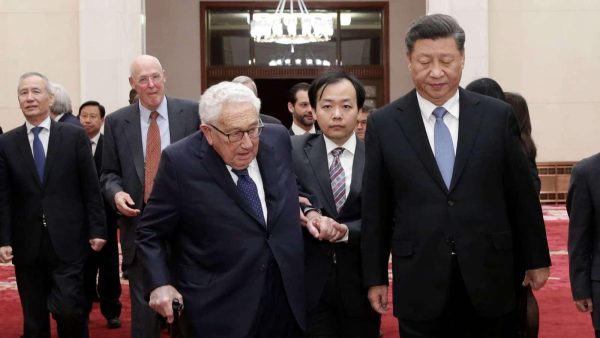
By Drago Bosnic | July 25, 2023
A bit over half a century ago, the United States under the Nixon administration sent its then-State Secretary Henry Kissinger to China in order to exploit the infamous Sino-Soviet split that nearly escalated into a full-blown war between Moscow and Beijing. The “cold war” between the two previously closely allied communist powers was a strategic gift to the US-led political West, as the belligerent thalassocracy was terrified of the prospect of facing a giant Eurasian monolith spanning from East Germany to Vietnam. The brewing ideological conflict between the post-Stalinist Soviet Union and Maoist China was heavily (ab)used by the US to somewhat soften the consequences of the humiliating defeat of America’s genocidal aggression in Indochina, where millions were killed in its indiscriminate attacks on Vietnam, Laos and Cambodia.
Henry Kissinger is often credited as the instrumental figure in engineering the Sino-American detente that gave the US much-needed geopolitical breathing room in the late 1970s and much of the 1980s after the belligerent thalassocracy pulled back to “lick its Vietnam wounds”. However, it should be noted that, despite Kissinger’s vast diplomatic experience and knowledge, the very fact that the early 1970s China was still largely isolationist, as well as in the process of recovering from the consequences of WWII and the Cultural Revolution, made his efforts significantly easier. Still, thanks to Kissinger, the Nixon administration achieved a major diplomatic win that lasted until the very end of the Cold War and was completely nullified only by the recent suicidal US foreign policy.
Back in the 1970s, it would’ve been almost entirely unimaginable that Henry Kissinger, quite literally a historical figure at this point, not only due to his Cold War-era achievements, but also his advanced age (now in triple digits), would have to engage in his “shuttle” and “triangular diplomacy” concepts once again. However, precisely this happened last week, culminating with Kissinger’s meeting with Xi Jinping himself on July 20. The Chinese President even called the centenarian “an old friend of China”. Owing to the Asian giant’s great attention to detail, particularly when it comes to diplomatic protocols, the meeting was held at the Villa 5 of the Diaoyutai State Guesthouse, the exact same place where Kissinger met the then-Chinese Premier Zhou Enlai in 1971.
Precisely that meeting was instrumental in preparing Richard Nixon’s visit to China the next year. However, that’s where the historical parallels end. Despite the reputation, influence and respect that he enjoys in China and worldwide, Kissinger went to Beijing in an unofficial capacity. Not representing the US anymore, he was largely relieved of the burden and responsibility for America’s diplomatic standing in China, a far cry from what it used to be during the (First) Cold War. The situation has changed drastically since Kissinger’s tenure, as the Asian giant is anything but a poor, underdeveloped nation with major ideological identity issues that could be exploited to further US interests. On the contrary, precisely Washington DC is the side that’s been going through major internal issues and waning global influence.
In this regard, Kissinger’s room for maneuver was extremely narrow, despite the overall cordiality of his hosts. Beijing is perfectly aware of the rabid hostility and ever-growing Sinophobia in Washington DC, as well as the fact that the belligerent thalassocracy will not change its course anytime soon. Whether it’s the lies about China’s supposed “spy balloon”, apparent doom and gloom propaganda about its alleged “strategic military advantage” or the numerous statements by the Pentagon about the “inevitable war with China“, Beijing is certainly prepared for any scenario and contingency, including the deployment of its forces in “America’s backyard”. This is despite Washington DC’s attempts to resuscitate its Monroe Doctrine, largely dormant up until the recent contraction of America’s geopolitical influence.
There’s only so much Kissinger could do given the active US threats that it will place China’s breakaway island province of Taiwan under its nuclear umbrella, a move that would be tantamount to a declaration of war. Beijing has already started to push back against not only the ongoing US aggression in the Asia-Pacific region, aided by its numerous vassals and satellite states (as well as some “Trojan horses” that have previously declared their intention of joining BRICS+), but also the openly announced involvement of NATO. Since the start of Russia’s special military operation (SMO), the belligerent alliance has repeatedly called China a “security threat” and has clearly defined it as such at its recent summit in Lithuania’s Vilnius. The US-led political West is desperate to keep its wanton “rules-based world order” on life support for as long as possible.
The consolidation and partial relegation of America’s geopolitical responsibilities to its vassals are the crucial segments of this controversial approach, and precisely China’s regional adversaries are poised to play a critical role in this regard. It’s wholly impossible for any US diplomat (former or current), even Kissinger himself, to offer any sort of detente with China while the US keeps talking, bragging even, that it will continue with its “strategic containment” policies, as well as arming not only Beijing’s neighbors, but also its breakaway province. This is without even considering the fact that two consecutive US administrations have been trying to derail China’s unparalleled economic and technological rise, a move that China only recently answered to with limited rare-earth elements restrictions. For these reasons, Kissinger’s attempts to create and then exploit another “Sino-Soviet split” are doomed to fail.
Drago Bosnic is an independent geopolitical and military analyst.
Featured Video

Macgregor: We Haven’t Seen the Worst of the Iran War Yet
or go to
Aletho News Archives – Video-Images
From the Archives
15 Saudi ‘hijackers’ were CIA agents working for US: Scholar
Press TV – April 13, 2016
Fifteen of the 9/11 “hijackers” from Saudi Arabia were CIA agents working for the United States government, which was seeking to destroy the Middle East for Israel and to double the American military budget, says Dr. Kevin Barrett, an American academic who has been studying the events of 9/11 since late 2003…. continue
Blog Roll
 Aletho News
- Iran’s Plan to Shut Down AI in the Persian Gulf
- Israel seeks ‘compensation’ from Washington over Saudi F-35 sale
- Saudi crown prince seeks dialogue with Ansarullah after Yemeni blows: Report
- Damascus rejects Saudi request for Syrian fighters to counter Yemen: Report
- South Korea says will not send troops to join terrorist US war on Iran
- Russia Just Struck the Eyes of NATO’s War Machine in Ukraine
- Russia summons UK charge d’affaires over Kiev drone support
- NATO member warns bloc seeking pretext for war with Russia
- Macgregor: We Haven’t Seen the Worst of the Iran War Yet
- ‘We are not like everyone else’ laws that bind other nations do not apply to Israel, says Likud lawmaker
- If Americans Knew
- Debunking The Claim That Macklemore Has A “History Of Antisemitism”
- CPJ demands release of arrested Palestinian-US journalist near Bethlehem
- Robert Kraft: The Billionaire Friend of Netanyahu Pulling The Strings Behind the Macklemore/Ed Sheeran Blow Up
- Columbia Administered Fund Gives Big Money to Pro-Israel Groups
- Deportation Case of Palestinian Activist Salah Sarsour Tests First Amendment
- ‘We Will Not Forget’: Palestinians Mark 44 Years since Sabra and Shatila
- Why do we let Zionists decide what we can and can’t say?
- US welcomes Israeli, Iranian delegations to UN, but not Palestinians – Daily Update
- Biden’s Genocide Accomplices Targeted by New Accountability Campaign
- AIPAC’s Network Has Already Spent $67.2 Million to Shape the Midterm Elections
- No Tricks Zone
- New Study: ‘Global Drought Shows No Detectable Recent Acceleration Under Climate Warming’
- Economic Masterminds: German Socialists Suggest Taxing Productivity Gains Stemming From Using AI
- The South China Sea Has Not Been Cooperating With The Climate Change Narrative
- Energy Crisis: Germany Enters Heating Season With Historically Low Gas Reserve Fill Levels
- New Study: The Antarctic Ice Sheet Gained Mass From 2020-2024 Due To Staggering Snow And Ice Accumulation
- Study: Ocean Heating Rates From Thousands Of Years Ago ‘Dwarf’ Modern Ocean Heating Rates
- Climate Extremists Target, Attack Large-Scale Power Grid Infrastructure In Germany!
- New Study: Antarctic Ice Melt Has Contributed Less Than 1 Centimeter To Sea Level Rise In The Last 30 Years
- Fear Of Debate: Alarmist German Climate Scientist Calls On Mainstream Media To Discredit Skeptic Voices
- End-Of-August Arctic Sea Ice Extent Hasn’t Fallen In 20 Years, Official Data Show!
 Aletho News