Hong Kong unveils Covid quarantine bracelets
Samizdat | July 13, 2022
Hong Kong is set to introduce electronic tracking bracelets for citizens who decide to quarantine at home after testing positive for Covid-19, the health chief has announced. Violators of the isolation rules face hefty fines and possibly even jail time.
The territory’s secretary for health, Lo Chung-mau, announced the move during a Monday press briefing, saying the bracelets are meant to stop infected people from spreading the illness further and will operate on the ‘Leave Home Safe’ app rolled out last year.
“We have to make sure that home isolation is more precise while being humane,” Lo said, adding that the trackers will be introduced on Friday.
Breaching Hong Kong’s quarantine order could result in fines up to $3,200 and a maximum of six months behind bars. Individuals who are able to isolate at home must do so for two weeks, though will be allowed to leave if they test negative for two days in a row and have their first pair of vaccine doses.
While the territory previously required overseas arrivals to use bracelets with unique QR codes to check in and account for their movements, the gadgets were later replaced with genuine tracking tech. The system is set to be expanded, though the government has not said what type of bracelet it will use for the latest initiative.
The health secretary also noted that Hong Kong will implement a color-coded system similar to the one in place in mainland China, which labels different levels of infection risk as yellow or red. Those with the red designation will face heavy restrictions on their movement, including outright bans on entering public venues, while yellow entails lesser limits.
However, the city’s recently inaugurated chief executive, John Lee, has since stressed that the traffic light system would only apply to “a specific and small number of people,” but nonetheless argued that Hong Kong needs “some identification method” to distinguish citizens with active infections from those quarantining as a precaution.
Local officials continue to warn that Hong Kong’s Covid-19 outbreak remains “very serious,” urging residents to minimize travel and observe social distancing rules, which were just extended for another two weeks on Tuesday.
The Department of Health said it recorded 2,558 new local coronavirus cases on Tuesday, as well as another 211 infections among travelers from abroad. It did not offer a daily update for fatalities, but noted the territory had tallied 9,420 deaths in total throughout the pandemic, most of them occurring this year.
WHO Wants To Run the World?
By Paul Frijters, Gigi Foster, Michael Baker | Brownstone Institute | July 11, 2022
In Geneva in late May at the 75th meeting of the WHO’s decision-making body, the World Health Assembly (WHA), amendments to its International Health Regulations (IHRs) were debated and voted upon. If passed, they would grant the WHO the right to exert unconscionable pressure on countries to accept the WHO’s authority and health policy actions if the WHO decides that there is a public health threat that might spread beyond a country’s borders.
As Ramesh Thakur, the second man at the UN for years, noted, the amendments would mean “the rise of an international bureaucracy whose defining purpose, existence, powers and budgets will depend on outbreaks of pandemics, the more the better.”
This is the first clear instance of a globalist coup attempt. It would subvert national sovereignty worldwide by putting real power into the hands of an international group of bureaucrats. It has long been suspected that the authoritarian elites arisen during covid times would try to strengthen their positions by undermining nation states, and the this 75th jamboree is the first solid evidence of this being true.
What an opportunity then to see who is in the conspiring club. Who drafted the amendments? What was in them? Which individuals supported them or spoke out against them?
WHO were the conspirators?
The amendments on the table at the May WHA meeting had been transmitted to the WHO by the US Department of Health and Human Services on January 18, circulated by WHO to its member states (‘States Parties’) on January 20 and formally introduced to the WHA on April 12.
The proposals, according to an announcement on January 26, were co-sponsored by 19 countries plus the European Union. Even if some co-sponsors had little direct involvement in drafting them, they all would have approved in principle the overarching goal of tightening up the WHO’s authority over member states in the face of a public health event.
Loyce Pace, the HHS’s Assistant Secretary for Global Affairs – the leading US official nominally responsible for the proposed amendments – arrived at the Biden administration fresh from a stint as executive director of an advocacy organization called the Global Health Council.
That council receives funding from the Bill & Melinda Gates Foundation and its members include Eli Lilly, Merck, Pfizer, Abbott Labs, and Johnson & Johnson. You get the idea. Via one of the foxes-turned-chicken-guard, it appears the HHS ‘worked closely’ on these amendments with large pharmaceutical companies, who will be chomping at the bit for a more proactive (read: profitable) response to any public health emergency, real or imagined.
So the conspiring club consists primarily of the US government and its Western allies in lockstep with Big Pharma, and they are looking to undermine both the sovereignty of their own governments and that of other countries, presumably with the idea that the Western elites would do the running.
What was in them? A blizzard of acronyms and euphemisms
To understand what the US proposed at the WHA, we need first to understand how things have worked in the WHO to this point.
The IHRs in their current form have been in force as international law since June 2007. Among other things, they impose requirements on countries to detect, report and respond to ‘public health events of international concern,’ or PHEICs. The WHO Director-General consults with the state where a possible public health event has occurred, and within 48 hours they are meant to come to a mutual agreement on whether or not it actually is a PHEIC, whether or not it needs to be announced to the world as such, and what counter-measures, if any, should be taken. It’s essentially an early-warning system on major health crises. This is a good thing if it’s run by people you can trust and if it has checks and balances to rein in expansionary tendencies.
The proposed amendments would greatly strengthen the power of the WHO relative to this baseline, in a number of ways.
First, they lower the threshold for the WHO to declare a public health emergency by empowering its Regional Directors to declare a ‘public health event of regional concern’ (PHERC, italics ours) and for the WHO to put out a new thing called an ‘intermediate public health alert.’
Second, they permit the WHO to consider allegations about a public health event from non-official sources, meaning sources other than the government of the state concerned, and allow that government only 24 hours to confirm the allegations and a further 24 hours to accept the WHO’s offer of ‘collaboration.’
Collaboration is essentially a euphemism for on-site assessment by teams of WHO investigators, and concomitant pressure at the whim of WHO personnel to enact potentially far-reaching measures such as lockdowns, movement restrictions, school closures, consumption of medicines, administration of vaccines and any or all of the other social, economic, and health paraphernalia that we have come to associate with the covid circus.
Should the state’s government acceptance of the WHO’s ‘offer’ not be forthcoming, the WHO is empowered to disclose the information it has to the other 194 WHO countries, while continuing to pressure the state to yield to the WHO’s invitation to ‘collaborate.’ A non-collaborating country would risk becoming a pariah.
Third, the proposal includes a new Chapter IV, which would establish a ‘Compliance Committee’ consisting of six government-appointed experts from each WHO region tasked with permanently nosing around to ensure the member states are complying with IHR regulations.
There are more crossings-out of the existing IHR language and new language added in, but the flavour of what the US-led alliance is shooting for is a WHO that can unilaterally decide whether there is a problem and what to do about it, and can isolate countries that disagree.
Compliant WHO member states could act as a supporting cast in the isolation effort, through the distribution of their own health budgets and their ‘health-related’ policies, which would include travel and trade restrictions. The WHO would become a kind of command-and-control center for globalist agendas, pushing the produce of (Western) Big Pharma.
Why and how would this work?
We learned during covid times why it would make sense that the US and its allies are insisting on these amendments.
Lowering the bar for declaring a global (or regional) public health threat triggers a huge opportunity for Western pharmaceutical companies. As legal experts have observed: “WHO emergency declarations can trigger the fast-track development and subsequent global distribution and administration of unlicensed investigational diagnostics, therapeutics and vaccines.
This is done via the WHO’s Emergency Use Listing Procedure (EULP). The introduction of an ‘intermediate public health alert’ in particular will also further incentivise the pharmaceutical industry’s move to activate domestic fast-track emergency trial protocols as well as for advance purchase, production and stockpile agreements with governments before the existence of a concrete health threat to the world’s population has been detected, as is already the case under WHO’s EULP via the procedures developed for a ‘pre-public health emergency phase’.”
You can bet that the WHO ‘expert teams’ sent in to make on-the-ground assessments, under the banner of ‘collaboration’ with the host country experiencing the health event, will be chock-a-block with operatives from the CDC and who knows what other Western agencies, all poking around potentially sensitive facilities that a host government might justifiably claim a sovereign right to keep to itself. Likewise with the ‘Compliance Committee’ proposed by the US under the new Chapter IV of the IHRs: its government-appointed members have an open-ended brief, enshrined in international law, to be busybodies.
In layman’s terms, the WHO would be turned into an international thug, with its member states offered the role of backyard gang members.
As a bonus for Western elites, the proposals are a sneaky form of rewriting history. By cementing authority within an international organisation to determine the existence of public health crises and direct potentially draconian emergency responses, Western governments would get to enshrine and legitimise their own extreme responses to the covid outbreak, as we have pointed out previously. Their backsides would thereby be given some protection from legal challenges.
The refusniks: Developing countries
The proposals were pushed primarily by Western countries: the US was joined by Australia, the UK and the EU in arguing for passage. The resistance was led by developing countries who saw it as a colonialist ambush in which their ability to set policy and respond to health threats in a manner commensurate with their domestic situations would be overridden.
Brazil reportedly went so far as to threaten to withdraw from the WHO, and the African group of almost 50 countries, along with India, argued that the amendments were being rushed through without adequate consultation. Russia, China and Iran also objected.
Failure on the first try, but the US and its allies in the West will get more shots to push it through.
How do we expect them to do this? Well, when a proposal gets bogged down inside a giant bureaucratic machine like the WHO, the inevitable response is to set up committees to work in the background and circle back with a new set of proposals to be presented at a future meeting. True to form, a ‘working group’ and ‘expert committee’ are being assembled to accept member state proposals on IHR reform by the end of September this year. These will be ‘sifted through’ and reports will be prepared for review by the WHO’s executive board in January next year. The objective is to have a fresh set of proposals on the table when the WHA convenes for the 77th time in 2024.
Not all was lost
Salvaging something from the fact that the WHA failed to get a consensus around its biggest agenda item, the US and its allies got a small victory on the point of when they can try again – though in their desperation they needed to violate the IHRs’ own rules to accomplish it. Article 55 of the IHRs states unambiguously that a four-month notice period is required for any amendments.
In this instance, revised amendments were presented on May 24, the same day that the first lot were rejected. These were discussed, further amended on May 27 and then adopted on the same day. The approved amendments halve the two-year period for any (further) approved amendments to the IHRs to take effect. (The IHRs that came into force in 2007 were agreed to in 2005 – but under the new resolution, anything agreed to in 2024 would come into effect in 2025 rather than 2026.)
Yet, what was achieved in terms of fast-tracking the force of new amendments was lost in slow-tracking their implementation. Nations would have up to 12 months – double the previous suggestion of six months – to implement any IHR amendments that newly enter into force of law.
State of play
Where is all this going?
If the WHO takes the reins on decisions about what constitutes a health crisis, and can pressure every country into a one-size-fits-all set of responses that it, the WHO, also determines, that’s bad enough. But what about if its invitation to ‘collaborate’ with countries is backed up with teeth, such as sanctions against those who demur? And what about if it then broadens the definition of ‘public health’ by, for example, declaring that climate change falls under that definition? Or racism? Or discrimination against LBTQIA+ people? The possibilities thereby opened up for running the world are endless.
A global ‘health’ empire would bring huge harms to humanity, but a lot of power and money is pushing for it. Don’t think it can’t happen.
Paul Frijters is a Professor of Wellbeing Economics at the London School of Economics: from 2016 through November 2019 at the Center for Economic Performance, thereafter at the Department of Social Policy
Biden is Right… Inflation Crisis Is Not Inevitable, So End the Reckless U.S.-Led Warmongering
Strategic Culture Foundation | July 8, 2022
It’s rare for Strategic Culture Foundation to find itself in agreement with pronouncements made by American President Joe Biden. This week, Biden asserted once again that economic inflation and recession hitting the American economy are “not inevitable”. He is correct – at least in part. Although not for reasons that he would ever admit.
Of course, Biden is trying to obscure the grim reality of economic crisis that is afflicting not just the American economy but also the European Union. Inflation of living costs for ordinary citizens in the U.S. and EU are at record highs not seen in decades. There is a sense of calamity in social conditions from mass poverty amid grotesque super-rich inequality. A major input to the general inflation is the soaring price of energy.
The global impact is causing food prices to escalate putting millions of people at risk of hunger, especially in Africa and other low-income nations.
The impending crisis is on an unprecedented scale. Yet, it is not inevitable. But what is making it unavoidable is the warmongering policy of the U.S. and its European NATO allies towards Russia and China. This week saw outlandish American and British efforts to label China along with Russia as an existential threat to “global peace”. The bitter irony of these two rogue Western states casting aspersions on any other nation is too much for words.
The world is being thrown into chaos, insecurity and uncertainty by reckless stoking of war in Ukraine by the Western powers who are funneling tens of billions of dollars-worth of military weapons to that country. This week saw US-supplied HIMARS artillery hitting cities in the Donbass breakaway republics. Where are the Western efforts to mediate a diplomatic end to that war? There are none. Russian President Vladimir Putin reiterated this week that Moscow would like to find a long-term peaceful settlement. The harsh and despicable truth is that the U.S. and its Western allies are incapable of seeking a political solution. They are willing to fight to the last Ukrainian.
Blaming Russia for that conflict is a fallacy. The war has been deliberately stoked by the United States and its NATO accomplices as part of their geopolitical objective of subjugating Russia and China to their hegemonic agenda.
Western sanctions against Russia have created a global energy crisis that is boomeranging on the economies of the United States and Europe as well as the wider world. Biden is trying to scapegoat Moscow for imposing price hikes and taxes on his nation. The reality is it is his administration and its European lackeys who are imposing hardships on their own citizens from a madcap policy of warmongering.
There is a straightforward way out of the abysmal situation. The U.S. and its NATO allies should halt all weapons supplies to the Nazi regime in Kiev. They should also reverse the draconian economic sanctions on Russia. They should pursue diplomatic relations to end the conflict in Ukraine that they have instigated. They should normalize relations with Russia and China instead of relentlessly pushing Cold War-style confrontation.
But that is unlikely to happen under prevailing circumstances. Because the United States and its NATO minions have locked themselves into a deceptive paradigm of hostility. This, in turn, is because of futile ambitions for hegemonic dominance and intrinsic opposition to the emergence of a multipolar world.
Demonizing and antagonizing Russia and China is the real agenda for U.S.-led global imperialism. That criminal policy is covered up with cynical and absurd claims about defending “rules-based order” and democracy in Ukraine, Taiwan and elsewhere.
Nevertheless, the Empire of Lies is running out of credibility and false pretexts. What is becoming more and more evident is the awful reality. The U.S.-led collective West is one predicated on warmongering to preserve its waning global power and privileges.
Russia and China have repeatedly appealed for the existence of a multilateral global order that is consistent with the vision of the United Nations that was set up in the aftermath of World War Two. The United States and its imperial surrogates have continually attacked and undermined that vision with unilateral violations of international law and the sovereignty of countless nations. The U.S. avowed “rules-based order” is synonymous with war, war, war. Decades of relentless U.S.-driven wars – albeit under specious guises and pretenses – prove that.
Today we are witnessing the historic endgame playing out. The current war in Ukraine is but one malignant manifestation.
When asked how long Americans (and presumably Europeans) will have to endure economic pain, Biden retorted, “As long as it takes”. As long as it takes for what? To defeat Russia, China and whomever other nation the U.S.-led imperial axis deems necessary to be subjugated? That’s not going to happen. Those days are over.
Russia and China are too strong militarily and economically for the U.S.-led axis to vanquish. The world is being driven to war, potentially a catastrophic one, by American death throes in the face of reality. In the meantime, American, European and other peoples are being assailed with economic misery as a result of this criminal warmongering for the sake of empire. That is, the crumbling, bankrupt empire of U.S.-dominated Western capitalism and its imperial roguery.
The appalling state of world affairs is not inevitable. But due to the depraved and implacable pursuit of hostility towards Russia and China by the U.S. and its servile European elite, the world is – for now at least – held hostage by these psychopathic Western politicians and their corporate paymasters. That, however, is changing as people realize more and more the real nature and perpetrators of their captive condition.
The giant Western charade is no longer sustainable. From European colonialism to American imperialism, the charade has indeed had a long run. Now, though, it is in tatters from its own inherent corruption and lies. The ignominious downfall this week of Boris Johnson, Britain’s clown prime minister, is just a bit-part of the collapsing Western axis of evil. That collapse is inevitable.
Western plan to severely isolate Russia fails
By Lucas Leiroz | July 5, 2022
The Western world has tried to “isolate” and “cancel” Russia, but apparently this plan has failed and Moscow remains absolutely integrated with its major trading and strategic partners. China and India remain willing to cooperate with Russia widely, increasing current levels of bilateral trade. This demonstrates how the current situation in Eastern Europe cannot be resolved by coercive means.
The Chinese Ministry of Foreign Affairs pledged April 19 that it will strengthen cooperation with Russia, no matter what happens in the international scenario. The message comes in an official statement from the foreign ministry following a meeting held the day before between Chinese deputy MOFA Le Yucheng and Russian ambassador to Beijing Andrey Denisov. The document says:
“No matter how the international situation changes, China will, as always, strengthen strategic coordination with Russia to achieve win-win cooperation, jointly safeguard the common interests of both sides, and promote the building of a new type of international relations and a community with a shared future for mankind (…) In the first quarter of this year, the bilateral trade volume between China and Russia reached 38.2 billion US dollars, an increase of nearly 30%, [which] fully demonstrates the great resilience… of cooperation between the two countries”.
Later, commenting on the statement, Ambassador Denisov stated:
“Russia always regards developing relations with China as its diplomatic priority and is ready to further deepen bilateral comprehensive strategic coordination and all-round practical cooperation in the direction set by the two heads of state (…) [Further efforts to strengthen Russia-China ties] will continuously benefit the two peoples.”
Although it is a well-known fact that bilateral relations between Moscow and Beijing have improved substantially in recent years, forming an important axis of economic and diplomatic cooperation, the current message is of enormous importance, as it works as a response to recent US pressure against China. Last month, US President Joe Biden called his Chinese counterpart Xi Jinping and during an hour-long conversation “warned” about the possible “consequences” that would be suffered by Beijing if there was not an immediate end to its economic support for Russia.
Naturally, Xi ignored Biden’s threats and the Chinese foreign ministry maintained its stance of absolute neutrality on the ongoing conflict in Ukraine. Not mixing political and economic issues is a key point of the Chinese foreign policy tradition and this is exactly what is being applied now. Beijing refuses to maintain positions on any political event outside its strategic environment, which is why it keeps the Russian military operation off the agenda in Beijing-Moscow bilateral relations, continuing to have projects to improve cooperation, independently of such extra-economic issues.
However, it is not only the Chinese who show interest in cooperating with the Russians, ignoring the Western attempts of “cancellation”. Apparently, India is about to announce its highest ever level of trade cooperation with Russia in oil. According to reliable sources quoted by the Economic Times on April 19, state-owned companies in New Delhi are planning to buy as much Russian oil as possible in the short term, considering the expected availability and low prices of the commodity.
The Indian attitude sounds absolutely pragmatic and not ideological: faced with the conflict scenario, Indians seek to benefit from the availability of Russian oil, which arises as a consequence of the sanctions applied by the West to prevent the oil from entering the European market. With large quantities available and prices dropping, it is in India’s interest to acquire as many Russian barrels as possible and this is what is about to be done.
Obviously, this was not what the West expected from the Indians. The US has always tried to make its military partnership with India – focused on creating an “anti-China axis” – a kind of hierarchical relationship, in which Indians would automatically obey and align themselves with every decision taken by the Americans. However, despite the pressure in this direction and the constant US threats to cut ties with New Delhi, India remains convinced of defending its interests above all, making it clear that it will continue to cooperate with Russia in terms of both military trade and energy partnership.
It is impossible to look at such news and continue to believe the Western media narrative that “Russia is isolated”. Moscow has lost a part of world trade and even then, not completely, as Western countries have not yet managed to fully break off relations with Russia. On the other hand, it has not only preserved most of the global consumer market in emerging nations but has also boosted its ties with China and India, which indicates great economic support and, even more, the emergence of new intra-BRICS cooperation opportunities.
What all this means is simple to understand: the special military operation in Ukraine will not end through economic pressures, coercive measures and attempts at “cancellation”, but through the Ukrainian willingness to accept the peace terms, which are (as Russia insists) political and military neutrality and recognition of the sovereign republics of Donbass and Russian Crimea. As long as the Ukrainian government is unwilling to do so, Russia seems to continue the operation and have sufficient economic strength to maintain it.
Lucas Leiroz is a researcher in Social Sciences at the Rural Federal University of Rio de Janeiro; geopolitical consultant.
India, BRICS in cold war conditions
BY M. K. BHADRAKUMAR | INDIAN PUNCHLINE | JULY 2, 2022
The phone conversation on Friday between Prime Minister Modi and Russian President Putin conveyed a big signal, coming on the morrow of the release of the new Strategic Concept by NATO which called Russia the alliance’s “most significant and direct threat.” The readouts from Moscow and New Delhi both highlighted the two leaderships’ determination to carry forward the momentum of economic cooperation despite the western sanctions against Russia. (here and here)
Ironically, the West’s “sanctions from hell” have given a big stimulus to India-Russia bilateral trade, giving it a dynamism that one never suspected would be recaptured in the post-Soviet era.
Friday’s call was agreed upon in the sidelines of the BRICS summit (June 23-24). Curiously, it has come at a time when the Western powers have stepped up their efforts to create discord among the BRICS member countries, and brainwash India, in particular, to join their bandwagon in the new Cold War conditions. India is of course cherrypicking.
But that is understandable at a time when the economy is in “stagflation.” India’s relationship with Russia was the leitmotif of Modi’s visit to Japan in April and three visits to Europe in May as well as his two meetings with US President Biden during this period. In the West’s calculus, China and India are giving what analysts would call “strategic depth” to Russia, which nullifies its frantic efforts to “erase” Russia. Interestingly, the western attempts to create paranoia in the Indian mind about the close ties between Russia and China are no longer having the desired effect of Delhi becoming wary of Russia’s intentions. India sees, on the contrary, great opportunities to tap into Russia’s tilt to Asia-Pacific region for economic partnerships.
Without doubt, India is “balancing” between Washington and Moscow and BRICS summit was a great occasion to monitor that trapeze act. An unabashedly pro-western internet paper from Delhi had predicted that Modi would act as a vigilante for US President Biden, blocking any BRICS statement critical of the US. Whether that was true or not, Modi made a rather anodyne speech at the BRICS summit.
On the other hand, Putin had stated in his speech at the summit that “Considering the complexity of the challenges and threats the international community is facing, and the fact that they transcend borders, we need to come up with collective solutions. BRICS can make a meaningful contribution to these efforts.”
Putin added, “We are confident that today, as never before, the world needs the BRICS countries’ leadership in defining a unifying and positive course for forming a truly multipolar system of interstate relations… we can count on support from many states in Asia, Africa and Latin America, which are seeking to pursue an independent policy.”
In his speech, Chinese President Xi Jinping made an even more direct appeal to the BRICS partners: “Our world today is overshadowed by the dark clouds of Cold War mentality and power politics and beset by constantly emerging traditional and non-traditional security threats. Some countries attempt to expand military alliances to seek absolute security, stoke bloc-based confrontation by coercing other countries into picking sides and pursue unilateral dominance at the expense of others’ rights and interests. If such dangerous trends are allowed to continue, the world will witness even more turbulence and insecurity.
“It is important that BRICS countries support each other on issues concerning core interests, practice true multilateralism, safeguard justice, fairness and solidarity and reject hegemony, bullying and division.”
Frankly, no matter the impressive-looking XIV BRICS Summit Beijing Declaration, the fact remains that the grouping is performing far below its actual potential and one principal reason for this is India’s zero-sum mindset regarding China, which makes it difficult for it to work with China collectively in any regional forum.
However, any apprehension in the Indian mind that China would “dominate” BRICS is unwarranted. Russia undoubtedly occupies a special place in the structure of the BRICS. In fact, BRICS was Moscow’s brainchild and Russia was responsible for launching the format. The first ministerial meeting (in the BRIC format) took place at the suggestion of Putin in September 2006, on the sidelines of the UN General Assembly session in New York. Thus, the idea of creating BRICS matured in Russia.
Second, BRICS is a “de-ideologised” format. It shows no animus against America although it challenges western hegemony of the international political and economic order. The very fact that the Manmohan Singh government welcomed Putin’s BRIC initiative at a most sensitive juncture when India’s negotiations for a nuclear deal with the US (with eye on Washington’s embargo on technology transfer) speaks for itself.
Moscow conceived the BRICS concept for the strengthening of the formation of a multipolar system of international relations and the growth of economic cooperation — and it has indeed contributed to the birth of a new economic system, based on the equal access of countries to financing and sales markets, a combination of state planning and market economy.
India has a problem to appreciate that the BRICS paradigm does not lie in expanding the capabilities or ambitions of the group’s member countries, but in fostering a qualitative change in the economic development model of the Global South. India’s dog-in-the-manger attitude — sulking and politicising the forum with extraneous issues (primarily to embarrass China) — doesn’t make sense.
Unlike India, China takes BRICS seriously. The Chinese initiative to create a BRICS Vaccine Centre has been under development and the implementation of this project amid the current conditions can be a significant achievement that will bolster the entire format of the association. Ideally, India should cooperate with the project instead of teaming up with its QUAD partners which has turned out to be a wild goose chase.
Again, industrial innovation is slated to be a priority for China’s BRICS Presidency in 2022. Expectations are high that during its presidency, China will come up with a number of breakthrough initiatives. Clearly, now that the construction of the BRICS’ New Development Bank headquarters in Shanghai has finished, new proposals are expected from China on the development of its operations, including possibly an expansion of the number of shareholders of the bank.
Of course, China will promote its own projects, including Belt and Road initiative. But then, China is also putting into the projects the most financial resources. It is high time for India to have a serious reassessment of values within the BRICS framework, and the changing internal balance of power in the grouping in the new Cold War conditions.
BRICS is at the crossroads and this realisation has propelled the concept of a “BRICS+” format to the centerstage of discussions. China’s BRICS chairmanship 2022 witnessed the launch of the extended BRICS+ meeting at the level of Ministers of Foreign Affairs. Participants included Egypt, Nigeria, Senegal, Argentina, Indonesia, Kazakhstan, Saudi Arabia, UAE and Thailand.
During the ministerial, China also announced plans to open up the possibility of developing countries joining the core BRICS grouping. Argentina and Iran have been mentioned as candidates for BRICS expansion. Be that as it may, “BRICS+” is certain to be on the agenda of global governance in times to come.
‘Ridiculous’: Russia dismisses claims of NATO being ‘defensive alliance’
Press TV – July 1, 2022
Russian Foreign Minister Sergei Lavrov says the claim of NATO being an exclusively defensive alliance is “ridiculous and disgraceful.”
He made the remarks on Friday while addressing students and teachers at the Belarusian State University, in response to recent statements by a number of NATO members’ officials.
“Recently, a representative of the White House once again reiterated that Russia should not be afraid of NATO and that no one should be afraid of it at all, because NATO is a defensive alliance. But it is already ridiculous to hear adults say such obvious nonsense. I would say, it is simply disgraceful,” Russia’s TASS quoted Lavrov as saying.
Pointing to the history of NATO’s establishment and its confrontation with the Warsaw Treaty Organization and the Soviet Union, he said both the Warsaw Treaty and the Soviet Union are gone but “NATO has moved eastward five times.”
“Who are they defending themselves from then?” he asked rhetorically, adding, “When someone pushes forward, establishes control of territories, and deploys armed forces and military infrastructure there, it is not exactly what is called defense. It’s just the opposite.”
The remarks come as the 2022 NATO Summit in Madrid wrapped up on Thursday with the bloc’s decision to strengthen its forces along the eastern flank while also officially inviting Sweden and Finland, which share borders with Russia, to join the alliance.
“NATO is a defensive alliance and poses no threat to any country,” reads part of the declaration of the Summit.
The declaration also named Russia as a “direct threat” to NATO members’ security, noting that the military alliance “does not seek confrontation and poses no threat” to Russia.
At the same time, it went on to threaten to respond in a “united and responsible way” to any threat from Moscow.
‘Joke of the century’
Chinese foreign ministry spokesperson Zhao Lijian also rejected the notion of NATO being only a defensive alliance.
“NATO is a ‘defensive’ alliance? Joke of the century,” he tweeted on Friday while also sharing a combination of images portraying NATO’s military intervention in several countries such as Afghanistan, Iraq, and Libya.
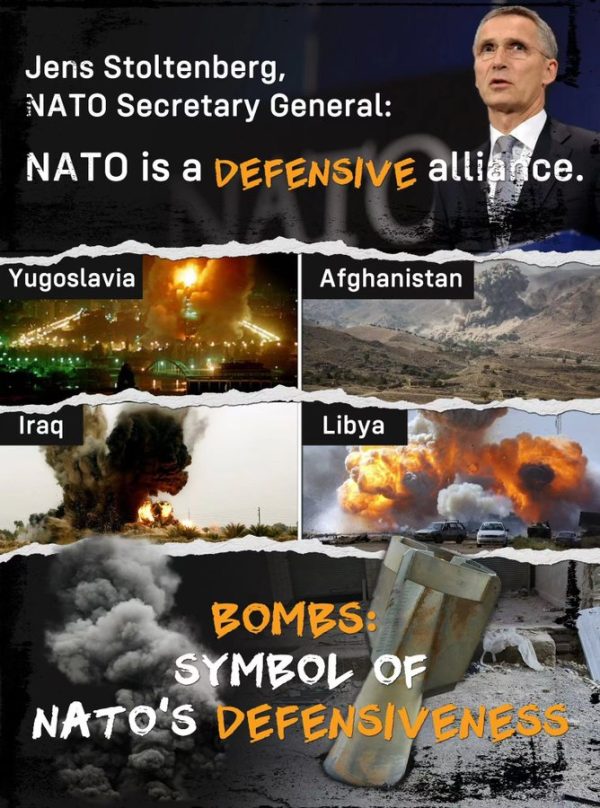
In a separate tweet, the Chinese official also pointed to the role of the US and its allies in the continuation of the war in Syria and its devastating effects on people’s lives.
“[The] US and its allies continue to fuel the war in Syria. More than 300,000 civilians have died in the conflicts according to UN statistics, 1.5% of Syria’s population,” he wrote on Friday, also sharing a photo of war damages in Syria with a note which read “who is the threat to peace?”
NATO members had also alleged that China poses a “challenge” to the bloc’s “interests, security, and values.”
Speaking in a daily briefing on Thursday, Zhao stressed the futileness of hyping up the so-called “China threat.”
“NATO has extended its reach to the Asia-Pacific region in an attempt to export the Cold War mentality,” he said, urging the bloc to stop making baseless accusations and provocation against China, abandon the outdated Cold War mentality, and stop dangerous acts that disrupt Europe and the Asia-Pacific.
Why G7’s Program for Developing Countries is Still No Match for China’s Belt & Road
Samizdat – 28.06.2022
The G7 on 26 June re-launched its previous Build Back Better World program to provide infrastructure funds to poor and developing nations under a new name, the Global Investment and Infrastructure Partnership. The project aims to compete with China’s Belt and Road Initiative kicked off by Beijing in 2013.
The Build Back Better World (B3W) program was pompously announced by the club of seven developed nations to counter China’s Belt and Road at the G7 Summit in Cornwall in July 2021. However, little had been heard of the G7’s endeavor since then. In June 2022, the Group of Seven decided to breathe new life into the project.
“So far, America has failed to build momentum on its plan to Build Back a Better World,” says Francesco Sisci, a Beijing-based China expert, author, and columnist. “However, with this new G7 plan, which includes other countries, this momentum could start to be built. It is a question mark. Nobody is sure until things are realized. But you cannot just underestimate and dismiss this plan, because there is a large commitment of many countries with a large economy and this plan could make big sense.”
The G7’s grand design envisages laying a secure sub-sea telecommunications cable that will connect Singapore to France through Egypt and the Horn of Africa; creating a COVID-19 vaccine plant in Senegal; expanding solar projects in Angola, including solar mini-grids and home power grids; and establishing an innovative modular nuclear reactor plant in Romania, among other issues.
The US president pledged to mobilize $200 billion in investments in global infrastructure projects over the next five years. The overall investment, including G7 member states and private capital, is expected to reach $600 billion.
“With two competing plans – size matters, at the end of the day,” says Sisci. “That is, China may be able to immediately finalize a lot of money in a short time in a number of projects. The G7 countries could be slower, but eventually they could build up momentum and they could channel much more money much more effectively, perhaps, in a much larger number of projects which could stifle Chinese projects.”
Sisci suggests that the club of developed capitalist countries “may end up being more effective in many ways [than China], a smaller non-capitalist country.”
“China, but also Russia, by far, don’t have the size, the gravitas to oppose even a divided G7, which is coming together because of this opposition to China or Russia-driven projects,” he notes.
G7 Economic & Geopolitical Hurdles
However, some other observers express skepticism over the ability of the US and G7 to implement the project given record-high inflation and cost of living crisis currently engulfing the states. The US, British and European central banks are struggling to tame skyrocketing inflation by raising interest rates to reduce demand, which is prompting recession fears.
“Washington claims they are going to be sending over $200 billion. But where’s the money coming from and how is it going to be really used?” asks Thomas W. Pauken II, the author of “US vs China: From Trade War to Reciprocal Deal,” a consultant on Asia-Pacific affairs and a geopolitical commentator.
He notes that previously the US Senate voted Biden’s landmark Build Back Better initiative down, and for good reason, as Republican congressmen feared that the Democratic administration’s spending spree would fan inflation and increase an already bloated national debt.
Pauken also expresses bewilderment over the G7’s apparent readiness to embark on the bold international project at a time when the group is involved in the Ukraine crisis with the UK trying to keep the military conflict dragging on. “I mean, it’s laughable that they have to think about [competing with] China at this time when they’re on the brink of a major war in Europe,” the commentator remarks.
Meanwhile, the G7’s Global Investment and Infrastructure Partnership cannot be regarded so far as a viable alternative to the Beijing-led Belt and Road Initiative that has been implemented for slightly less than a decade, according to Pauken.
“First of all, [the G7] actually need[s] to make these projects work,” says the geopolitical commentator. “Other than that solar plant in Angola, I don’t see any of these initiatives really working.”
In particular, China invested almost $59.5 billion in its comprehensive infrastructure project in 2021 alone. When it comes to crucial elements of the project, the West appears to be lagging behind. While the G7 is still considering building a subsea cable linking Europe and Southeast Asia, China kicked off its Digital Silk Road (DSR) almost seven years ago. The DSR’s backbone is the Pakistan and East Africa Connecting Europe (PEACE), a 9,300 mile long subsea cable network meant to tie Asia, Africa, and Europe together. The network is designed to transmit over 16Tbps per fibre pair with its Mediterranean section going from Egypt to France having already been laid.
Are Emerging Economies Interested in the G7 Agenda?
There is yet another problem as to how to make these Western projects attractive for Global South nations, the Asia Pacific expert continues. In particular, the G7 has been pushing ahead with a climate change agenda and the plan to cut carbon emissions, which is not relevant for the majority of third-world states which are still reliant on cheaper and more reliable fossil fuels and coal plants, he notes.
“You also have to deal with auditing issues as well as the so-called climate change consultants who go on the ground and on site,” he says. “You have to prove that those infrastructure projects are not causing much of a carbon footprint. But most of the major infrastructure does require a big carbon footprint, especially in the emerging markets, because they don’t have the same equipment or they don’t have the same standards or labor laws as they would have in Western Europe or the US.”
Many emerging economies, including African countries, are beginning to have a growing frustration with the US and Europe, according to Pauken. The reality is that Africans and many of the emerging markets want to focus on economic stuff, he notes. However, when the US officials come in, they’re talking about climate change or gender equity, and this is not as interesting to developing nations, the commentator emphasizes.
“[Developing nations] want help on improving their agricultural production levels and boosting their energy capacity, which the Russians and the Chinese have been doing,” Pauken notes.
Given all of the above, it is unlikely that the G7’s Global Investment and Infrastructure Partnership initiative is going to actually happen, argues the geopolitical commentator.
“They’re rebranding a failed policy, thinking it might work by using new names and new mergers. Last time it was separate between the EU and separate between the US and they somehow think that if you combine the two failed projects into one, that this will somehow succeed. That’s not going to work in the real world,” Pauken concludes.
Nepal’s rebuff of SPP is major failure in US attempts to expand influence in South Asia
By Paul Antonopoulos | June 28, 2022
The Nepalese government has refused to cooperate with the United States in security matters via the State Partnership Program (SPP). Kathmandu made the decision to not promote the SPP ahead of a visit to Washington by Prime Minister Sher Bahadur Deuba in mid-July, where he will be accompanied by senior military officials, including Nepal’s army chief of staff, General Prabhu Ram Sharma. Nepal effectively does not want to ruin the delicate balance it has between China and India, the two giants that the country is sandwiched between, by adding the US into the geopolitical equation.
The Kathmandu Post noted that Deuba’s administration has come under intense pressure due to disagreements with Washington over Nepal’s participation in the SPP. At the same time, not only the Nepal Communist Party, the country’s main opposition party, but also the Nepali Congress Party, led by the prime minister himself, has voiced opposition to this type of cooperation with the US.
It is recalled that commander of the US Army in the Pacific, General Charles Flynn, made a four-day visit to Nepal in early June. The arrival of an American general put the opposition on high alert, fearing the development of military ties between Nepal and the US.
At the time, Giriraj Mani Pokhrel, a former education minister and member of the country’s parliament representing the Nepal Community Party, asked the government to inform parliament of the objectives and agenda of its military contacts with the US. Shortly afterwards, Interior Minister Bal Krishna Khand said that the government had no intention of signing an SPP agreement during the prime minister’s upcoming visit to Washington.
Officially, the partnership program regulates the exchange with the US National Guard and their responses to natural disasters, such as earthquakes, floods and wildfires. Critics in Nepal, however, believe that the US could interfere in internal affairs under the guise of the SPP, arguing that participating in the program is tantamount to Nepal signing off on the US’ Indo-Pacific Strategy.
By the ruling government and the opposition being in unison on this matter, Washington has failed in its attempt to expand its strategic presence in South Asia. Kathmandu’s decision was largely due to foreign policy factors, with the Nepalese government not wanting to damage relations with China or India.
It must be noted that both Beijing and New Delhi yield significant influence on Nepalese politics and economics. However, only China was open in welcoming Nepal’s decision and its non-aligned foreign policy. Chinese Foreign Ministry spokesman Wang Wenbin “commended” Kathmandu’s decision on June 23 and assured that China will always support Nepal in defending its sovereignty, independence and territorial integrity.
From the Chinese perspective, Nepal avoided a trap that the US could have set in the hope of dragging the landlocked country into a confrontation with one of its two neighbours. Effectively, the Nepalese government prevented any attempts at being pushed into confrontation with China by blocking the possibility of Nepalese territory being used.
And although it may appear that New Delhi would have welcomed closer cooperation between Nepal and the US considering China’s claims over parts of Indian territory and their participation in QUAD, the Indian Army’s exclusive and unique relationship with their Nepali counterpart would have been weakened by the SPP.
According to sources quoted by Indian media, New Delhi was not in favor of Nepal’s participation in the SPP, believing that it would unsettle the traditional relationship between the Indian and Nepali militaries.
The US Embassy in Nepal denies that the SPP has ulterior motives, writing on its website that: “The State Partnership Program is not and has not ever been a security or military alliance. The United States is not seeking a military alliance with Nepal.”
However, the SPP is administered by the National Guard Bureau, which means it is guided by Washington’s foreign policy goals. As the National Guard admits on its own website: “Through SPP, the National Guard conducts military-to-military engagements in support of defense security goals but also leverages whole-of-society relationships and capabilities to facilitate broader interagency and corollary engagements spanning military, government, economic and social spheres.”
This essentially makes the SPP another American trojan horse to penetrate the political, economic and social orders of countries to advance foreign policy goals under the guise of humanitarian engagement. With Nepal’s two main political parties unified in opposing participation in the SPP, and with both Beijing and New Delhi supporting Kathmandu’s decision, it represents a major failure in the US’ attempts to extend its influence in South Asia and the borders of Tibet.
Paul Antonopoulos is an independent geopolitical analyst.
US pushes military pact with Nepal, puts Himalayan peace at stake for geopolitical ambition
By Hu Yuwei | Global Times | June 20, 2022
After pushing Nepal to approve the Millennium Challenge Corporation (MCC) economic pact, the US may have also urged the Himalayan country to join its military alliance, the State Partnership Program (SPP), widely believed to be another component of the US’ Indo-Pacific Strategy.
Observers from both Nepal and China warned against the program’s heavy military focus on the containment of China in the region.
Nepalese media reported that the US renewed a push last week on Nepal to participate in the SPP during the visit of Commanding General of the US Army Pacific, Charles Flynn, to Nepal. Flynn called for the signing of the SPP when he met with Nepalese Prime Minister Sher Bahadur Deuba and Chief of Staff of the Nepal Army General Prabhu Ram Sharma.
The disclosed six-page draft US proposal triggered a debate and faced backlash in Nepal for the possible US military presence in Nepal, which, many warned, contradicts Nepal’s non-aligned foreign policy.
The SPP, once approved, would draw Nepal one step closer to the US’ military alliance, despite Washington’s denial and calling it a development assistance, said experts.
Under huge pressure from the public and lawmakers, during his meeting with coalition partners on Wednesday, Deuba said that he will not sign any agreement with any country, including the SPP, that could bring harm to Nepal, the Kathmandu Post reported.
The American embassy called the SPP draft circulating online “fake.”
Inspite of this, many suspect the disclosure of the SPP in Nepal could be intended as a tactic to test the waters, as the ambition and intention of the US to strengthen its military presence in Nepal have long been clear under the core purpose of the US’ Indo-Pacific Strategy to contain China.
Concluding his four-day trip to Nepal, Flynn said on Twitter that “we cherish our decades-long defense partnership and look forward to opportunities for collaboration.”
Observers told the Global Times that the US has increased its penetration and interference in Nepalese politics in recent years, and the approval of the US-pushed MCC program in Nepal in February is an example.
If the MCC has supported US control and influence in Nepal economically, the SPP could be used to strengthen the US’ military ties in the Asian country, Qian Feng, director of the Research Department of the National Strategy Institute at Tsinghua University, said.
“The US has always valued the geographical importance of Nepal which borders Southwest China’s Xizang Autonomous Region. Since the Trump administration, the US has been trying to include Nepal in its Indo-Pacific Strategy to achieve its multiple political and security goals toward China,” Zhang Yongpan, a research fellow of the Institute of Chinese Borderland Studies under the Chinese Academy of Social Sciences, suggested. “In recent years, the political situation in Nepal has been turbulent, and the divided parties are vulnerable to pressures of external forces. The US takes the opportunity to increase influence and infiltrations in Nepal via multiple ways, trying to make it a tool to promote the US’ Indo-Pacific Strategy,” Zhang told the Global Times.
But such US tactics to contain China are bound to be futile, and Nepal will not easily become the frontline of the US’ attempts to suppress China, experts concluded.
Dangerous move with risky clauses
Widespread debate and criticism surged in the public opinion against both the US and Nepalese governments, after the draft of a proposed agreement by the US Department of Defense on the State Partnership Program between the US National Guard and the Nepal Army was disclosed on June 13.
The six-page draft agreement has 10 clauses, in which the US promises to provide Nepal $500 million for five years in addition to non-lethal equipment to the Nepal Army, the Kathmandu Post reported, citing officials privy to the draft.
The leaked document says it is for strengthening the “partnership, in the areas of defense and security,” between the US and Nepal. One of the clauses in the leaked document mentions that the “US National Guard and US contractors, related vehicles and light aircrafts operated by or for the United States, may use such agreed facilities and areas for training, transit, support and related activities, refueling, temporary maintenance of vehicles and aircrafts, accommodation of personnel, their dependents, communications, staging, deploying of forces and material.”
The proposed agreed areas of cooperation also include joint training exercises “in high-altitude terrains in Nepal,” with experts alerting the risk to the security and stability of China’s Xizang, in the Qinghai-Xizang Plateau that borders Nepal, as well as potential infiltration of American forces into the border area.
This clause will make the security situation in western China more complicated with higher risks, considering that Nepal has long been at the forefront of preventing Tibetan separatist forces from destroying stability in Xizang, said Qian.
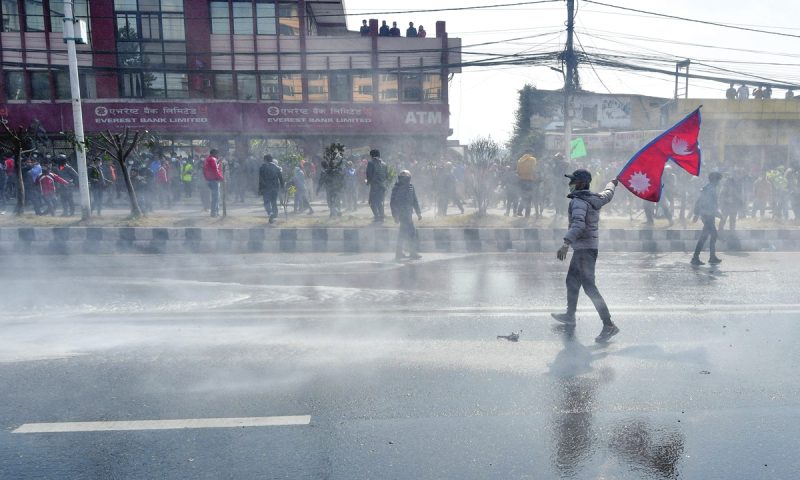
Demonstrators protest against the proposed grant agreement from America under the Millennium Challenge Corporation (MCC), in Kathmandu on February 24, 2022. Photo: VCG
Unanimous disapproval in Nepal
Public anger pumped up across social media over the last week with criticism against the Nepalese government and questions over the US’ intention in pushing the program. Netizens flocked to social media to urge the government to stop turning Nepal into a battlefield of geopolitical rivalry. Others shared their fear that the Deuba government is tilting toward the US and may submit to their pressure to advance in the SPP while ignoring the risks of harming the friendship with China.
Deuba is scheduled to visit the US in mid-July. Meanwhile, the Chief of the Army Staff, General Prabhu Ram Sharma, will be visiting the Pentagon before the Prime Minister’s trip, from June 27 to July 1, upon the invitation of the Pentagon, local media reported.
“This time, unlike the MCC, there is almost unanimous public opinion in Nepal that the SPP should not be approved by Nepal,” Ritu Raj Subedi, deputy executive editor of the Nepalese newspaper The Rising Nepal, told the Global Times.
“It can harm China-Nepal friendship and mutual understanding if the SPP gets approved. It can lead the nation toward long internal conflict and unrest. This type of activities will enhance distrust toward leaders because it is not transparent and was kept secret until the issue came to surface. Conflict mongers will try to reap benefits out of the situation. Internal conflicts can invite the involvement of foreigners and permanent corruption. There are so many byproducts of such issues,” Yogeshwar Romkhami, a former senior superintendent of the Nepal Police Service, told the Global Times.
Local people are not in the favor of MCC or SPP. Those who have even a little knowledge about it are worried. The West has penetrated every political party and the public believe these conspirators are pulling the country into internal conflict or uncertainties, said Romkhami.
Washington’s promotion of the SPP in Nepal comes at a time when the US’ Indo-Pacific Strategy is accelerating. The Biden administration’s essential competition with China through working with neighboring countries has never changed, Qian suggested.
US Under Secretary of State Uzra Zeya concluded her three-day trip to Nepal on May 22, the highest-level visit by a US official since 2012. Additionally, US Assistant Secretary of State Donald Lu visited Kathmandu in November last year. Before that, Vice President of MCC Compact Operations Fatema Sumar was in Kathmandu in September, local media reported.
The US is ramping up efforts in allying with Asian countries to suppress China both economically and militarily, Zhang said.
US foreign security tool
The US first came up with the concept of the SPP in 1993 as a humanitarian and disaster response training program.
Now the program has been established for over 25 years and includes more than 80 partnerships with over 90 countries. According to the SPP fact sheet of the National Guard, the program “supports the security cooperation objectives of the United States and the Geographic Combatant Commands (GCC) by developing enduring relationships with partner countries and carrying out activities to build partner capacity, improve interoperability, and enhance US access and influence while increasing the readiness of US and partner forces to meet emerging challenges. The SPP helps the United States react effectively to anticipated or unanticipated global scenarios as they emerge.”
Notably, Ukraine has been partnered with the California National Guard under the SPP since 1993. Over the past 29 years, the California National Guard conducted regular military-to-military exchanges with Ukrainian forces contributing to Ukraine’s continued defense modernization.
Since its inception, the SPP has been managed by the chief of the US Defense Department’s National Guard Bureau, a four-star general and also a member of the Joint Chiefs of Staff of the Department of Defense, equal to the heads of the army, navy and air force. This highlights the SPP’s military importance, according to Qian.
Although the SPP purportedly emphasizes disaster relief and anti-terrorism efforts, and intentionally downplays the military intentions of the US, its military essence has been clear in its implementation. It has served as an important foreign security cooperation tool for the US to achieve its foreign policy goals, said Qian.
Due to the unstable leadership in Nepal and possible reshuffled political landscape in the national elections at the end of the year, the operations and outcomes of the programs like SPP are still in doubt.
The Lockdown Advocacy of Devi Sridhar
By Jeffrey A. Tucker | Brownstone Institute | June 20, 2022
The Covid era gave rise not only to popular mania but also to astonishing intellectual pretension. The experts were everywhere. They had all the answers. They knew for certain that a path never tried in anyone’s lifetimes was the certain way to go in order to control a virus. And this fanatical attachment to one goal caused all other considerations to be pushed aside.
The end of the story was baked in from the start. The experts were proven to have massively exaggerated their prowess and understanding of events. On point after point, their models blew up. The epidemic would end the way they always have, through acquired immunity and endemicity. Nowhere did the methods of the vaunted experts achieve the goal; at best they delayed the end point and created tremendous destruction along the way.
Now there is a problem: how to dial it all back without admitting profound error. This is a particular problem for those who wrote books before the story was complete. And by complete I am referring especially to the tremendous waves of infections that came 20 months after lockdowns were first imposed.
A paradigmatic case is Devi Sridhar, professor and chair of global public health at the University of Edinburgh, Scotland. During the pandemic, she became a ubiquitous presence on television for two years both in the UK and the US. Her main message was to advocate and defend lockdowns, masking, mandates, and the entire apparatus of compulsion that characterized the pandemic response in nearly every country in the world. Her message was always geared toward what is called eliminationism or zero Covid.

As a Rhodes scholar in a high prestige position, she was well positioned to be this messenger. She has a compelling way and presents well in the medium. Plus, the message she delivered was the one that earned an official stamp of approval from all mainstream media. She was also a pro at delivering an attitude of disdain toward anyone who dared question the zero Covid story.
Now she has a book out that further elaborates on her point of view. It has the right title: Preventable: How a Pandemic Changed the World and How to Prevent the Next One. It’s a pretentious title, presuming that she knows for certain that the pandemic was preventable and therefore she should be trusted to tell us what to do next time.
What’s striking is the contrast between the certitude of the body of the book in which she is an unapologetic defender of China-style lockdowns and the afterword, which must have been written only days before the book went to print. Here we have a very different tone, discussed toward the end of this review.
Sadly for her, the book came out just before a wave of new lockdowns came to China that wrecked the lives and liberties of hundreds of millions of people and made an enormous mess of the entire economic mission of the country. She must not have had time to revise the manuscript.
Of China, her book says:
The way China set about eliminating SARS-CoV-2 could be described as draconian. It undertook house-to-house testing and removed individuals to quarantine facilities if they tested positive (sometimes against their will); it used tracking technology to trace 99–100 per cent of those who had had contact with the infected; it locked down entire buildings so individuals could not leave their flats or have free movement; and it constructed completely new hospitals within days…
The Chinese government understood well that the virus moves when people move. So it stopped people moving internally…
The efforts to contain the spread within Wuhan were effective and focused on reducing the R number…
These measures to contain spread worked…
[China showed that] containment strategies (however draconian) could be effective at stopping this respiratory pathogen…
The evidence in February 2020 showed that containment was successful…
Within the span of three months, China had eliminated the virus fully within its borders…
This is the same message she delivered to millions day after day for two years.
We could just stop this review here, observing that none of the above turns out to be true. Currently, China faces an enormous problem. If we are to believe the data, vast swaths of China’s population still lack acquired immunity to Covid. Millions or billions need the exposure, and, as with all places in the world, the result for nearly everyone moderately healthy and not elderly will be recovery. This will happen with or without lockdowns.
President Xi Jinping, however, became convinced either by virtue of his ego or his circle of sycophants that his lockdowns two and a half years ago were his greatest achievement. He was celebrated by the World Health Organization and nearly every country in the world copied his brutal methods of virus suppression. He regarded it then as evidence that the CCP was destined to rule the future, by virtue of its masterful social, economic, and now medical management of society.
So of course the CCP cannot turn back now. He has stated repeatedly that there will be no compromise of the zero Covid stance that both he and Dr. Sridhar have long advocated. He must now either continue to threaten and enact lockdowns or figure out some clever way to back away from the position without admitting past error. He may in fact figure it out at some point.
After all, nearly every other government in the world has finally figured it out. Even under the best of assumptions that lockdowns offer some contribution to mitigate the ill-effects of a pathogen, the costs far outweigh those benefits. And those costs not only include economic, educational, and nutritional ones but also costs in terms of deaths from overdoses, despair, and self-harm from the inevitable demoralization from being treated like a prisoner or lab rat.
So I did read Dr. Sridhar’s book in search of some insight as to why she could have made such a profound error. All I found was a relentless and single-minded attachment to a zero Covid agenda, or some version of it, a genuine belief that the right deployment of human force could somehow make a virus go away. It truly boggles the mind.
The rest of the narrative is utterly predictable.
Countries that locked down are good, especially New Zealand and Australia. Countries that did not are bad, especially Sweden but also the UK and the US after reopening. Countries that kept lockdowns longer are good. Countries that opened up too soon are corrupt and rejecting “the science.” The Great Barrington Declaration is bad. Ramdesivir is good while Ivermectin is bad. And so on.
Her hard-core bias extends even to a rousing defense of Rebekah Jones, the low-level data employee in Florida who wrongly accused the Governor’s office of manipulating data in a case that was later tossed out.
The book is so partisan that she sometimes lets her politics even race ahead of her epidemiological position. For example, and this probably won’t surprise you, she comes to the defense of the George Floyd protests even in the midst of lockdowns:
In late May 2020, I was asked whether protesters were wrong to take to the streets. I replied that racism is also a pandemic, and one that Black Americans feel can’t be swept under the carpet any longer. While clearly mass gatherings during a pandemic are risky, I could understand that people were willing to take this risk in order to effect change for their children and the children of their children. This is how the civil rights movement has attempted to progress racial equality over decades.
In any case, you get the point here. She has a tribe and she wants to be its messenger. Still, I struggled through the entire text to see if I could find insight. This one jumped out at me:
While WHO was at the forefront of press briefings and leading technical and normative guidance to the pandemic, the World Bank had the financial power to help governments respond with key policies, whether through building up health systems and testing, putting in place economic packages to support lockdown measures, or in acquiring and distributing vaccines.
There we go: the World Bank subsidized lockdowns. Fascinating. That I did not know. This is a serious problem that needs to be fixed. How many millions face malnutrition as a result?
So much for the body of the book.
Probably the most telling part of the book is the afterword, written January 2022. Here our author jumps in with the latest information, namely that China had not in fact eradicated the virus and now keeps locking down, which she says is due to inferior vaccines. Within a few paragraphs, she – for the first time in the book – recognizes that even the best vaccines do not stop infection and do not stop the spread..
Whoops. Is she willing to rewrite the entire book in light of this last-minute realization that lockdown eliminationism and even mass vaccination cannot achieve the goal? No. Is she willing to rethink? Perhaps a bit but not enough.
While some say we should adapt normal social relations and mixing for the foreseeable future, I struggle with this line of thought. Humans are social: we need to hug, talk, dance, sing, kiss and be around others. We’re not bears or rhinos or other solitary creatures. We like seeing each other’s faces. And we know that a sense of community and connection are vital to wellbeing too. A holistic approach to public health is vital, and this includes not just people’s mental health but also their ability to pay rent, feed their family, stay warm through the winter and have a meaningful role in society, be that going to church or being part of a glee club. For a certain period of time, altering these made sense, so that we could avoid preventable illness and deaths; allow vaccines to be created, trialled and distributed in 2020 and into 2021; allow clinicians to better understand how to treat COVID-19; and allow a better understanding of transmission and risk.
Again, very interesting, especially because the change in tone from the rest of the book is so sharp. She doesn’t come close to repudiating her entire book – and she still believes that totalitarian measures somehow make sense for a “period of time” – but she does say that she is tired and exhausted and perhaps ready for some rethinking.
“I’ve taken a step back from media work… I’ve been testing several times a week, and, while I cautiously avoid crowded spaces, and wear masks on public transport and in shops, I continue to go to the gym and to hot yoga and to see friends outside or in small groups. I’ve found a sustainable way to live alongside COVID-19 for now… You’ve heard enough from me.
These are hopeful signs. It’s possible that even Devi Sridhar might eventually come to see the error of her ways. Or perhaps like most of the exalted experts who assisted in driving the world into the greatest calamity of the modern era, she will quietly disappear from the op-ed pages and television screens and go back to her prior life as a public health professor with degrees in anthropology. At some point, too, she will get Covid and discover with millions of others that it is part of the human experience to get sick and get well and become stronger as a result.
We will wait in vain for any sort of extended literary mea culpas. Not even the pensive afterword comes close. After all, when the next great health crisis presents itself, the WHO pushes for lockdowns again, and the major media empires need some great excuse to order people back home to be glued to the screen, the expertise of these compelling pundits – now with real media experience – will need to be called upon again.
Jeffrey A. Tucker is Founder and President of the Brownstone Institute and the author of many thousands of articles in the scholarly and popular press and ten books in 5 languages, most recently Liberty or Lockdown.
Featured Video

ARE PATIENTS BEING PROPERLY INFORMED ABOUT OZEMPIC?
or go to
Aletho News Archives – Video-Images
From the Archives
Trans ‘milk’ as good as the real thing – NHS
RT | February 18, 2024
The drug-induced nipple secretions of trans women are as good as mothers’ breast milk for babies, the University of Sussex Hospitals NHS Trust claimed in a letter to campaigners made public in a report by British think tank the Policy Exchange on Sunday.
The healthcare trust’s medical director, Rachel James, argued that the off-label prescription drug cocktail men transitioning to female take in order to produce milk was “similar to the natural hormones which encourage lactation to develop when the baby is newly born.”
“The evidence which is available demonstrates that the milk is comparable to that produced following the birth of a baby,” James wrote in the letter, sent to Children of Transitioners last August.
Biological men who wish to lactate must first take hormones to grow milk glands and then take high doses of either domperidone or metoclopramide to stimulate milk production. Neither drug is approved for this use, though they are occasionally prescribed off-label to biological women who have trouble lactating.
However, domperidone’s own manufacturer, Janssen, warns patients the drug “may cause unwanted side effects affecting the heart in a breastfed baby” and “should be used during breastfeeding only if your physician considers this clearly necessary.” … continue
Blog Roll
 Aletho News
- 2025 Nature Paper Claiming Worsening Global Drought Gets RETRACTED …Heavily Flawed
- Your Milk Is Not the Problem
- The Truth About the Trump Shootings with Ken Silva
- ARE PATIENTS BEING PROPERLY INFORMED ABOUT OZEMPIC?
- US lawmaker blocks $2.8 billion weapons sale to Israel: Report
- Yemeni army claims responsibility for strikes on sensitive sites in Saudi capital, Aramco facilities in Yanbu
- Iran Judiciary issues indictments against 159 US, Israeli officials for assassination of Leader, commanders
- Turkiye revokes Iranian bank license under US sanctions campaign
- US-Denmark Agreement on Greenland Is ‘PR Stunt’ Ahead of Midterms
- Araghchi: Military intervention cannot create security; coercion cannot bring peace
- If Americans Knew
- Salah Sarsour’s Legal Team Says DHS Has Not Met Its Burden to Prove He Is Deportable
- An analysis of tax forms by The Intercept show Kraft’s charity and LLC have donated to Friends of the IDF and AIPAC’s super PAC.
- Israeli attacks kill four Palestinians in Gaza – Daily Update
- Inside Gaza’s death trap of collapsing, bombed-out buildings
- The everyday items Israel bans from Gaza every day
- Inside the siege, the ruined buildings of Gaza – Daily Update
- Debunking The Claim That Macklemore Has A “History Of Antisemitism”
- CPJ demands release of arrested Palestinian-US journalist near Bethlehem
- Robert Kraft: The Billionaire Friend of Netanyahu Pulling The Strings Behind the Macklemore/Ed Sheeran Blow Up
- Columbia Administered Fund Gives Big Money to Pro-Israel Groups
- No Tricks Zone
- 2025 Nature Paper Claiming Worsening Global Drought Gets RETRACTED …Heavily Flawed
- New Study: ‘Global Drought Shows No Detectable Recent Acceleration Under Climate Warming’
- Economic Masterminds: German Socialists Suggest Taxing Productivity Gains Stemming From Using AI
- The South China Sea Has Not Been Cooperating With The Climate Change Narrative
- Energy Crisis: Germany Enters Heating Season With Historically Low Gas Reserve Fill Levels
- New Study: The Antarctic Ice Sheet Gained Mass From 2020-2024 Due To Staggering Snow And Ice Accumulation
- Study: Ocean Heating Rates From Thousands Of Years Ago ‘Dwarf’ Modern Ocean Heating Rates
- Climate Extremists Target, Attack Large-Scale Power Grid Infrastructure In Germany!
- New Study: Antarctic Ice Melt Has Contributed Less Than 1 Centimeter To Sea Level Rise In The Last 30 Years
- Fear Of Debate: Alarmist German Climate Scientist Calls On Mainstream Media To Discredit Skeptic Voices
 Aletho News