Chinese Foreign Minister visits India to discuss Ukraine
Samizdat | March 25, 2022
Chinese Foreign Minister Wang Yi arrived in New Delhi on Thursday night for a diplomatic visit, where he is expected to meet his Indian counterpart Subrahmanyam Jaishankar, the Indian foreign ministry announced. This is the first visit of a high-ranking Chinese official to India since border clashes in Ladakh in 2020.
Wang Yi previously held talks with India’s National Security Adviser Ajit Doval, according to Reuters. Both China and India kept the visit secret until the Beijing diplomat touched down in New Delhi late on Thursday.
The talks, set for Friday, are likely to be focused on border tensions between India-China, as well as Russia’s military offensive in Ukraine. Both countries have, so far, abstained from condemning and sanctioning Russia for its actions, maintaining trade relations with the country despite pressure from the West.
While the two nations have called on Russia to cease hostilities and look for a diplomatic solution, India continues to buy Russian oil and is currently discussing means to switch to a rupee-rouble trade mechanism, allowing the two sides to avoid trading in the euro or the dollar. China has repeatedly denounced unilateral sanctions on Moscow, protesting against Russia’s exclusion from the G20.
The relations between China and India began to deteriorate after a clash in the Ladakh region on their Himalayan border in June 2020, where at least 20 Indian and four Chinese soldiers were killed.
“Few would have anticipated … the turn that India’s relations with China have taken in the last two years,” Indian Foreign Minister said on Thursday, stressing the importance of coordination on defense and foreign policies matters between the two countries. It is likely that India will push for complete disengagement of troops from the region during the Friday talks.
The Chinese foreign minister visited Pakistan and Afghanistan earlier this week, and is set to continue his tour across South Asia by traveling to Nepal. In Pakistan, Wang Yi said that “China shares the same hope” as its Islamic colleagues regarding the status of Indian Kashmir province, who advocate for the province’s “inalienable right to self-determination”. The remark drew anger from some Indian officials ahead of his visit, as the Muslim majority region, controlled by both India and Pakistan, is considered a disputed territory, where India has been fighting armed rebels for decades.
China refutes NATO secretary general’s misinformation accusation
By Du Qiongfang | Global Times | March 24, 2022
Chinese Foreign Ministry spokesperson Wang Wenbin said on Thursday that time will prove China stands on the right side of history and groundless accusations will collapse, refuting an allegation from NATO Secretary General Jens Stoltenberg that “China has provided Russia with political support by spreading lies and misinformation.”
When asked about Stoltenberg’s allegation at Thursday’s press briefing, Wang said the accusation against China itself is spreading disinformation.
With an objective and fair attitude, China has made active efforts to realize an immediate ceasefire, to avoid a humanitarian crisis and to restore peace and stability, Wang said, adding that Ukraine should be a bridge between the East and the West, not an outpost in major power rivalry.
“We need calm and rationality to defuse a crisis rather than ignite the fire and add more fuel to the fire; we need dialogue and communications to resume peace instead of using pressure and coercion; to achieve lasting peace and stability, we need to accommodate the legitimate security concerns of all parties, rather than promote collective confrontation and seek absolute security,” Wang said.
He added that China’s stance is in line with the wishes of most countries and it stands on the right side of history as time will tell. Any groundless accusations and suspicions against China are indefensible and will simply collapse.
The West thinks the war is about defending democracy and freedom but in reality it’s about security in the European geopolitical landscape, so the Ukraine crisis is not about differences in social systems or ideology, Yang Xiyu, a senior research fellow at the China Institute of International Studies, told the Global Times on Thursday.
Wang said that European countries should uphold the principle of strategic autonomy and work with Russia and Ukraine and other relevant countries to build a balanced, effective and sustainable European security architecture through dialogue and negotiations. The US and NATO should also engage in dialogue with Russia to address the root cause of the Ukraine crisis.
Wang also said that there are many loopholes in the US’ responses to the international community, including China’s questions surrounding the US biological laboratories in Ukraine which Russian experts claimed to have revealed new facts pointing to the direct involvement of the US Department of Defense in the development of biological weapons components in Ukraine.
The best way for the US to prove its innocence is to open its doors and accept the test of the international community, Wang said.
China denounces Israel’s illegal settlements and urges UN to focus on Palestine
MEMO | March 24, 2022
Israel’s ongoing illegal settlement expansion has been slammed by China during a UN briefing on the situation in Palestine. Beijing’s representative at the world body insisted that settlements are a violation of international law and urged the international community to support the Palestinian people.
“We call on Israel to halt the expansion of settlements, stop the eviction of Palestinians, stop the demolition of Palestinian homes, and create conditions for the development of Palestinian communities in the West Bank, as called for in [Security] Council Resolution 2334,” said Zhang Jun, China’s permanent representative to the UN.
Adopted unanimously in 2016, Resolution 2334 states that Israel’s settlement activity constitutes a “flagrant violation” of international law and has “no legal validity”. It demands that Israel should stop such activity and fulfil its obligations as an occupying power under the Fourth Geneva Convention.
“Settlement activities in the occupied Palestinian territory violate international law, disrupt the contiguity of the occupied Palestinian territory, squeeze the living space of the Palestinian people, and affect the prospects for achieving the two-state solution,” continued Jun.
The Chinese envoy also expressed concerns over the deterioration of security in Palestine and the plight of children. “The protection of children in conflict settings is not an empty slogan, but an unshakable moral responsibility and an international obligation that must be fulfilled. We call for a thorough investigation of the recent violence and for effective accountability.”
He also urged the international community to continue to help Palestine alleviate its fiscal crisis, improve its economy and people’s livelihood, and tackle the Covid-19 pandemic. Underscoring the need to keep the focus on Israel’s occupation, he stressed that the Palestinian question should not be marginalised, much less allowed to be pending for a long time.
“China will continue to work with the international community to make unremitting efforts and contribute China’s share to a comprehensive, just and lasting solution to the question of Palestine,” the envoy added.
US is reestablishing a new Inquisition using Russia-Ukraine crisis as excuse
Global Times | March 22, 2022
The US, leading several attendants, is launching a round of international mobilization to condemn Russia. After US Secretary of State Antony Blinken accused China of standing “on the wrong side of history” in the Russia-Ukraine conflict, British Prime Minister Boris Johnson and Australian Prime Minister Scott Morrison immediately followed suit by putting pressure on China. During his visit to India, Japanese Prime Minister Fumio Kishida raised his voice on the Ukraine issue, attempting to lobby New Delhi to switch its stance to condemn Russia. Even the Associated Press tweeted, “Amid a worldwide chorus of condemnation against Russia’s war on Ukraine, Africa has remained mostly quiet.”
It is not up to Washington to decide who stands “on the wrong side of history.” The US cannot forcibly pin the label that belongs to itself to someone else. As a netizen commented under the AP’s tweet, “Us drinking panadol for your own headache is not something we’ll be doing.” The US is the one that triggered the conflict and is the biggest hidden hand behind the curtain, who has made the Russia-Ukraine crisis where it is today. To shirk its responsibility and seek its own interests, Washington concocted a new charge for those who haven’t condemned Russia to set up a new moral high ground for global sanctions against Russia.
The US is reestablishing a new Inquisition, infamous in medieval Europe, and all who disagree with the US have been labeled “heretics.” And the US also wants to tie and burn the “heretics” on the pillars of international public opinion.
Yet, to the disappointment of the US and its attendants, although they have been clamoring that countries should take sides, they cannot cover the fact that they are still the minority in the international community. The US wishes that the whole world will follow it to condemn and sanction Russia, but more than 100 countries are not involved in imposing sanctions against Russia.
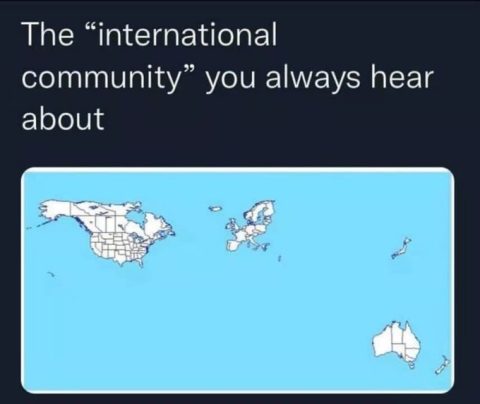
The attitude of non-Western major powers, including India, Brazil, and South Africa share a similar attitude with China – hoping to facilitate dialogue for peace and quell the conflict as soon as possible. Why? Because everyone with a sober mind can see that extreme sanctions will not help solve the crisis. On the contrary, they will only add fuel to the fire.
Washington has been clamoring that only sanctions against Russia are “correct” moves. It is humiliating the judgment and political experience of the entire international community. If the crisis can be resolved by simply condemning or sanctioning Russia, it is believed the international community will surely have done it.
But the situation is completely different. Condemning Russia or adding a few names on the sanctions list won’t fix anything. Instead, they cut off ties that could have maintained communication and mediation between Russia and Ukraine. Doing so has further weakened the intermediary role in facilitating dialogue for peace.
By mobilizing the international community to “condemn” Russia and join the US sanctions team, Washington has no sincerity or idea of solving the Russia-Ukraine crisis. The “united front” it is advocating is only to satisfy US interests.
Now it wants to pressure China to “condemn” Russia to create a rift in China-Russia relations. If China resists the pressure and does not do it, the US will have an excuse to blame China. For the US, it would be ideal if China were to participate in sanctions against Russia which would result in the breakup of China-Russia relations. In other words, the US has dug a hole and imagines that China will have to jump into it.
It has to be said that this smart-aleck bullying is very “American.” But there is a fundamental difference between China’s logic and that of the US. China has always decided its position and policy based on the merits of the matter itself.
China has no self-interest in the Ukraine issue and is making real efforts to alleviate the humanitarian crisis while urging peace and promoting talks, which is in stark contrast to Washington’s inflammatory operations of sending weapons and imposing extreme sanctions. Who is on the right side of history? The international community can judge by itself, and it is not up to the US, the initiator of this crisis, to define it.
It was noted that on March 20, Chinese Ambassador to the US Qin Gang was interrupted 23 times by the host during a 9-minute interview with CBS. In the same program that day, US Defense Secretary Lloyd Austin and US Senate Republican leader Mitch McConnell were never interrupted by the host. This is a reflection of the political climate in Washington, where any dissenting voice is considered “heretical.” This is the most dangerous thing for the Russia-Ukraine situation.
India, US have different priorities
BY M. K. BHADRAKUMAR | INDIAN PUNCHLINE | MARCH 23, 2022
An extraordinary week has passed for the Modi government’s dalliance with the Quad. Call it a defining moment, a turning point or even an inflection point — it has elements of all three.
The last week saw a 2-day visit to Delhi by Japanese prime minister Fumio Kishida, virtual summit between Prime Minister Narendra Modi and Australian PM Morrison, and foreign ministry level consultations with the visiting US Undersecretary for Political Affairs Victoria Nuland. The leitmotif was the situation around Ukraine.
Biden has since taken a jab that India has a “somewhat shaky” stance on Ukraine. Who would have imagined that the geopolitics of Ukraine was going to shake up Quad?
Certainly, India had a premonition. The Indian foreign-policy establishment has had no misconceptions about what began unfolding in Ukraine in the last week of February. It had spotted as far back as November/December at least, like Elijah in the Bible, a small cloud like the palm of a hand coming up from the sea.
Unlike the Indian media, academia or think tanks at large, the Indian leadership could sense that an epochal global struggle for ascendancy by the US and its western allies versus Russia and China was breaking out in Ukraine. Modi sensed that there would be collateral damage to India unless it saddled up to get down from the mountain, as the sky began to grow black with wind-driven clouds, before the huge cloudburst of rain arrived.
There is a background to it. Any perceptive observer would have noticed that Modi has been in a reflective mood as regards foreign affairs for the past several months. His participation in the Summit for Democracy last December discernibly had a fin-de-siècle air about it — the closing of one era and onset of another. One could attribute it to the sobering effect of the pandemic.
The point is, India struggled with the pandemic all by itself. No matter the hype about it, India realised that it has no real partnership with the US or EU, that it was a mere transactional relationship — and that in the final analysis, India lived in its region.
Indeed, India handled the pandemic far better than most countries. International experts acknowledge it today, and those who threw stones at that time grudgingly accept it, too.
However, with the economy ravaged beyond recognition, the government is picking up the pieces and staggering forward. There is still so much of uncertainty in the air about yet another “wave” of the pandemic stealthily advancing to drown all ceremonies of repair and reconstruction of life.
Succinctly put, the big-power struggle in faraway Europe, precipitated by the Biden administration for geopolitical purposes to isolate and weaken Russia, erupted at a most critical juncture when India has been increasingly sceptical about American policies and statesmanship. The picture that the US is presenting of itself is far from convincing either: a battleground of tribalism and culture wars, an ageing superpower in decline with dwindling influence globally.
In the Indian economy’s tryst with destiny, the US is of no help. On the other hand, the waning multilateralism and the new constraints imposed on growth by the US’ growing propensity to weaponise the dollar, threaten to blight the shoots of post-pandemic growth in the Indian economy.
On Monday, Biden celebrated a Business Roundtable with the CEOs of the largest corporations in the American economy. He boasted: “6.7 million jobs last year –- the most ever created in one year; more than 7 million now. 678,000 created just last month, in one month. Unemployment down to 3.8 percent. Our economy grew at 5.7 percent last year, and the strongest in nearly 40 years… We reduced the deficit by $360 billion last year… And we’re on track to reduce it by over $1 trillion this year.”
Biden is understandably thrilled beyond words. Yet, when he deliberately orchestrated a confrontation with Russia at this juncture, it didn’t occur to him what crippling impact and downstream consequences his draconian “sanctions from hell” against a major G20 economy would have on the developing economies.
A UNCTAD report on March 16, titled The Impact on Trade and Development of the War in Ukraine, concludes, “The results confirm a rapidly worsening outlook for the world economy, underpinned by rising food, fuel and fertiliser prices, heightened financial volatility, sustainable development divestment, complex global supply chain reconfigurations and mounting trade costs.
“This rapidly evolving situation is alarming for developing countries, and especially for African and least developed countries, some of which are particularly exposed to the war in Ukraine and its effect on trade costs, commodity prices and financial markets. The risk of civil unrest, food shortages and inflation-induced recessions cannot be discounted…”
Does Biden even know that at least 25 African countries depend on Russia for meeting more than one-third of their wheat imports? Or, that Benin actually relies 100% on Russia for its wheat imports? And that Russia supplies wheat at concessional prices for these poor countries?
Now, how do these meek and wretched countries of the planet import from Russia when Biden and EU chief Ursula Gertrud von der Leyen join hands to block the banking channels for trading with Russia? Can Delaware find a solution?
The cruelty and cynical complacency with which the Biden Administration and the EU conduct their foreign polices is absolutely stunning. And, mind you, all this is happening in the name of “democratic values” and “international law”!
India cannot agree with the US and EU’s reckless attempt to weaponise global economic links. The fact of the matter is that the US and EU may not even win this war in Ukraine. Russia has almost completed 90 percent of its special operations. Unless Biden allows Kiev to agree to a peace settlement, the division of Ukraine along the Dnieper river is in the cards.
The US is destabilising the European security order while the western sanctions are destabilising the global economic order. The US and EU must bear responsibility for this collateral damage. The West is in panic that the world is living in the Asian century already.
“One reason for the optimism across the heart of Asia is the immense natural resources of the (Asian) region,” writes the famous Oxford historian Peter Frankopan in his recent book The New Silk Roads: The Present and Future of the World. For, the Middle East, Russia and Central Asia account for almost 70% of global proven oil reserves, and nearly 65% of proven natural gas reserves.
Prof. Frankopan writes: “Or there is the agricultural wealth of the region that lies between the Mediterranean and the Pacific… which account for more than half of all global wheat production… (and) account for nearly 85% of global rice production.”
“Then there are elements like Silicon, which plays an important role in microelectronics and in the production of semiconductors, where Russia and China alone account for three-quarters of global production; or there are rare earths like yttrium, dysprosium and terbium that are essential for everything from super magnets to batteries, from actuators to laptops — of which China alone accounted for more than 80% of global production… Resources have always played a central role in shaping the world… This makes the control of the Silk Roads more important than ever.”
The West still seems to want to “return to ‘normal’”, Frankopan writes, “and expects the newcomers to resume their old positions in the world order.” Clearly, India, an erstwhile British colony, understands the real agenda behind Washington and Brussels’ geopolitical struggle with Russia. Principally, India is looking in all directions — Russia and China included — for partnerships.
If the Chinese news website Guancha is correct, which it mostly is, “China-India diplomatic relations will significantly ease and enter a recovery period. China and India will realise the exchange of visits of diplomatic officials in a relatively short time. Chinese officials will go to India first, and Indian Foreign Minister Jaishankar will come to China.”
This is good news. Modi’s unique stature in Indian politics enables him to take difficult decisions. The renewed mandate he secured from the heartland puts him in a position to break fresh ground in foreign policy.
US continues to push harsh narrative to pressure China over Ukraine crisis; a self-deceiving move of no help
By Xu Hailin and Liu Xin | Global Times | March 19, 2022
After the widely observed virtual summit between Chinese President Xi Jinping and US President Joe Biden on March 18, some US officials and mainstream US media outlets still tried to continue to push the harsh narrative against China with the headlines such as “Biden warns China of ‘consequences,'” a move that attempts to hype isolation of Russia and to show US “toughness” against China, analysts said, noting that such self-deceiving narrative will not help solve the Ukraine crisis and if the US takes no practical action, the consequences of the crisis will be unbearable, not only for Europe, the US itself will not be spared.
Soon after the nearly-two-hour video summit, China released an official readout of what the two leaders talked about. While the White House readout came hours later and was very short and mentioned that during the meeting with Chinese President Xi, Biden “described the implications and consequences if China provides material support to Russia as it conducts brutal attacks against Ukrainian cities and civilians.”
However, during the background press call after the Xi-Biden meeting, when answering questions from media on what are the consequences and how Biden made it, a US senior administration official was reluctant to offer details and said they would not “publicly lay out the options.”
The official then continued that “the President really wasn’t making specific requests of China. He was laying out his assessment of the situation.” The official also repeated that “China will make its own decisions.”
China’s readout was detailed, reflecting that China has done a deliberate and careful work in managing relations with the US, Li Haidong, a professor from the Institute of International Relations of China Foreign Affairs University, told the Global Times. It shows that China is highly responsible in handling the ties with the US and willing to see both sides advance their relations on the basis of difference management.
“The White House’s readout reveals the utilitarianism of the US in its relations with China, focusing only on its own concerns without considering how to maintain the overall landscape of China-US relations. It also reflects the inaccurate understanding of the summit by the US side,” Li noted.
By releasing a one-sided readout, the US government attempted to further hype the atmosphere that Russia has been isolated by many countries, and the White House has ramped up the narrative battle to pressure more countries to distance themselves from Russia, Lü Xiang, a research fellow at the Chinese Academy of Social Sciences, told the Global Times.
After the Xi-Biden meeting on Friday, some mainstream US media outlets, including The New York Times and The Washington Post, reported the event with the headline that highlights “Biden warns China.”
Emphasizing Biden’s “warning” to China is the US government’s way to set its own diplomatic narrative with the purpose to show American public its toughness and capability in pressuring China, further isolating Russia and driving a wedge between China and Russia, Lü said, noting that however, this is a self-deceiving narrative.
Chinese President Xi Jinping encouraged the US and NATO to have conversations with Russia to solve the problems behind the Ukraine crisis, and expressed opposition to indiscriminate sanctions.
Washington is eager to influence China’s attitude over Ukraine crisis, but as the situation evolves, China’s largely neutral stance on the issue has been strengthened. The conflict between Russia and Ukraine has significant impacts, but it has also opened up new geopolitical space, said observers.
The US tried to coerce China to meet its own needs. Such a way is an unhealthy and problematic way to handle relations with China and other major powers. But this is in line with the US’ bullying nature and logics, which apparently is not accepted by China and many other countries. Besides, it is such bullying norm that has made many international issues harder to solve, Li said.
Just hours before the Xi-Biden meeting, China, in a rare move, sent tough signals, stating it will never accept US threats and coercion over the Ukraine issue and vowing to make a strong response if the US takes measures harming China’s legitimate interests. In an exclusive interview with the Global Times, an anonymous Chinese official said China accepted the US’ proposal for the video meeting between the heads of the two countries on China-US relations and the Ukraine situation out of considerations of bilateral relations, promoting peace talks and urging the US to take right stance.
The US continues to see itself as exceptional. The superiority mentality makes the US believe it can set up rules around the world and then act beyond those rules. Washington thinks pressure campaign can solve all the problems while sanctions can bring all it wants, Li noted.
However, the US has overlooked the shattered ties between itself and Russia due to its pressure and sanction campaign of the past three decades, which contributed to the Ukraine crisis. Moreover, the US wants to apply such logics to its relations with China. “Hasn’t the US learned any lesson from this tragedy?” Li asked.
China sees parallel between Ukraine, Taiwan
BY M. K. BHADRAKUMAR | INDIAN PUNCHLINE | MARCH 20, 2022
The Chinese stance on developments around Ukraine was initially one-dimensional, namely, there is no conceivable comparison between Ukraine and Taiwan issues, as they are fundamentally different, because Taiwan is a part of China, whereas Ukraine is an independent country. Factually, that was a correct stance.
However, there has been a shift lately toward acknowledging that the Eurasian tensions hold an analogy for the Indo-Pacific region. Chinese commentaries underline that the relentless expansion of NATO in the post-Cold War era is the root cause of events unfolding over Ukraine. In the video call with President Biden in the weekend, President Xi Jinping implicitly touched on this aspect:
“The US and NATO should also have dialogue with Russia to address the crux of the Ukraine crisis and ease the security concerns of both Russia and Ukraine… As two Chinese sayings go, ‘It takes two hands to clap.’ ‘He who tied the bell to the tiger must take it off.’ It is imperative that the parties involved demonstrate political will and find a proper settlement in view of both immediate and long-term needs… An enduring solution would be for major countries to respect each other, reject the Cold War mentality, refrain from bloc confrontation, and build step by step a balanced, effective and sustainable security architecture for the region and for the world…”
In the spate of Chinese commentaries on the Ukraine conflict, one report that catches attention for its incisiveness and insights is an interview in the Global Times entitled Russia-Ukraine conflict can be regarded as a ‘preview’ of US’ possible acts in Asia: Zheng Yongnian – NATO’s phantom.
Zheng Yongnian is best known as an international authority on Chinese politics, political economy and the CCP. He opined categorically that NATO’s expansion will not stop and it will likely expand to Asia.
In his view, the US is already putting in place “the prototype of an “Asian NATO” — referring to AUKUS, Quad, Five Eyes, Indo-Pacific Strategy, US moves vis-a-vis Vietnam and Singapore. Second, he said China should anticipate a Ukraine-style crisis taking place in “many countries and regions” in Asia and “the expansion of NATO will only stop when another bloc can compete with it and form a check and balance.”
Third, while China’s economic openness and interdependence are its strong points, that may not prevent a war but can probably slow it down. He said bluntly: “Once fierce conflicts happen between China and the US, will the US kick China out of the SWIFT system as it did with Russia? My opinion is: 100 percent YES.” That said, China’s economy, deeply embedded in the West, can make the West feel real pain.
However, Zheng Yongnian also pointed out that it is not all black and white, either. On the one hand, while China and Europe have common interests and no geopolitical disputes, on the other hand, Europe’s current solidarity with the US is very fragile, as European interests are at risk in a longer term perspective and the EU itself is “at a particularly vulnerable moment.”
Besides, a remilitarised Germany will cause uneasiness in the continent, especially for France, with geopolitical implications. Also, the spectre of nuclear proliferation haunts Europe now. It is no longer possible to rule out conflicts happening again within the Western civilisation.
Interestingly, Zheng Yongnian also flagged that the geopolitical landscape of Asia may radically change if Japan, on the footfalls of Germany, also opts for remilitarisation. “This will impact on the entire East Asia, he warned.”
The analysis is very profound and there is very little to add to it. China is wary that Washington is moving in the direction of creating a “Ukraine-like” strategic dilemma for Beijing apropos Taiwan. To be sure, China has been provoked by the abrasive remarks recently by Gen. Kenneth Wilsbach, commander of Pacific Air Forces, on the “key lessons” Beijing should draw out of the Ukraine conflict.
The general listed them as the “solidarity of the global community” in opposing “an unprovoked attack on a neighbour” and “the onerous sanctions that have economically crippled Moscow”. Wilsbach threatened that if China behaves in the Russian way, “something more robust will happen.”
In addition, he warned, China should also consider the opposition of regional countries, apart from the ravages of the war in human lives and treasure. It could not have been lost on Beijing that Wilsbach shot straight from the hip just before Biden’s phone call to Xi Jinping.
Against this backdrop, the speech by Chinese Vice Foreign Minister Le Yucheng on Saturday at the Tsinghua University on the implication of the Ukraine developments for the Asia-Pacific region merits careful attention.
These are the first authoritative remarks by a top Chinese official acknowledging that “the Ukraine crisis provides a mirror for us to observe the situation in the Asia-Pacific. We cannot but ask, how can we prevent a crisis like this from happening in the Asia-Pacific?” They have followed immediately after the 2-hour long phone conversation between President Xi Jinping and President Biden.
Le Yucheng took note that the Asia-Pacific is in “promising situation” today — an anchor of peace and stability, an engine for growth and a “pace-setter” for development. The region faces two choices between building “an open and inclusive family for win-win cooperation or go for small blocs based on the Cold War mentality and group confrontation.”
Le Yucheng explained this binary choice as between: “peace and not undermining regional tranquility; so-called absolute security and common security; mutual respect and wanton interference in others’ internal affairs; and, unity and cooperation versus division and confrontation. Without doubt, he was sounding alert about the US’ so-called Indo-Pacific strategy.
Le Yucheng underscored that the India-Pacific strategy characterised by acts of provocation, formation of “closed and exclusive small circles or groups”, and fragmentation and bloc-based division can only lead to a situation “as dangerous as the NATO strategy of eastward expansion in Europe… (which) would bring unimaginable consequences, and ultimately push the Asia-Pacific over the edge of an abyss.” He underscored the criticality of the regional states pursuing “independent, balanced and prudent foreign policies” that dovetail with the process of regional integration.
The parallels between the situations around Ukraine and Taiwan respectively, are being discussed explicitly in the Chinese commentaries and articulation — while the US “squeezed Russia’s strategic space” through NATO expansion and simultaneously incited Kiev to confront Russia, when it comes to Taiwan too, Washington is instigating the secessionist forces in the island by upgrading arms sales to provoke Beijing.
Of course, the US has refrained from direct intervention in Ukraine, as Russia is not only a military power but also a nuclear power. The big question is whether China will arrive at a conclusion that its best opportunity “to solve its internal Taiwan question” lies in confronting the US at the present juncture when “the US is short of confidence and needs to bluster to embolden itself” and when the NATO’s hands are full in Eurasia and it is unlikely that the US’ allies in the Asia-Pacific will want to intervene in Taiwan.
China-Russia relations the most important strategic asset that cannot be damaged by US provocation
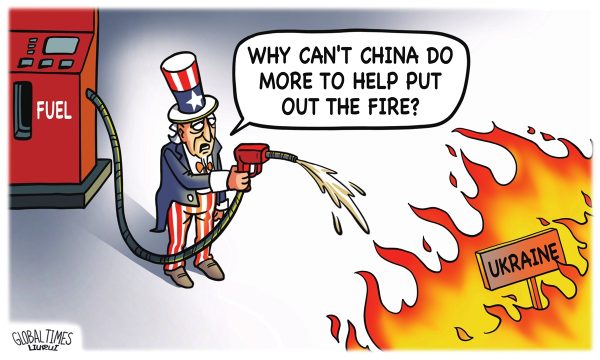
Illustration: Liu Rui/GT
Global Times | March 18, 2022
The close relationship between China and Russia has been a thorn in the US’ side, especially against the backdrop of the ongoing Ukraine crisis. With the simmering of the situation, it couldn’t be any clearer that Washington is eager to exploit the Russia-Ukraine conflict to drive a wedge between Beijing and Moscow.
For one thing, senior White House officials have on multiple occasions accused China of not exerting enough pressure on Russia to stop the country’s military action in Ukraine. US Secretary of State Antony Blinken said on Thursday before US President Joe Biden’s virtual meeting with Chinese President Xi Jinping that Washington will “impose costs” for any support Beijing provides to Russia’s actions against Ukraine. He urged Beijing to assume “responsibility to use its influence and defend the international rules and principles that it professes to support.” For another, an increasing number of Western media reports and analyses have emerged to hype how China’s ties with Russia have made China “uncomfortable” and “awkward” and warn that Beijing risks isolation if it doesn’t distance itself from Moscow.
NATO’s eastward expansion is the root cause of Russia’s anger and military operation in Ukraine. It’s the US that should put out the fire it lit in Ukraine. Ridiculously, it is demanding Beijing to do this job at the cost of damaging China-Russia relations. This is unreasonable and insidious. By pushing China to denounce Russia and asking China to bear the responsibility for the fatal strategic mistake the US and NATO made in the construction of so-called European security, Washington has no intention of hiding its desire to sow discord between China and Russia.
US State Department spokesperson Ned Price said on Monday that China could use its unique relationship to bring an end to Russia’s actions against Ukraine. What nonsense. Russia is an independent major power and China has no ability to exert influence on Russia’s decision on the Ukraine issue which it deems as a “life-and-death” matter.
If China really pressures Russia in a way that is inconsistent with the China-Russia comprehensive strategic partnership of coordination, it will only undermine the China-Russia relationship and sabotage mutual trust, which will be a huge strategic loss to both sides. This is what the US is eager and happy to see.
Washington knows that China cannot influence Russia or force it to do anything. But it has regarded the Ukraine crisis as a good chance to tear the two countries apart. The more discord Washington could sow between China and Russia, the more it will be in line with US interests. But how can Beijing and Moscow allow such an evil trick to succeed?
Not like the petty followers that Washington can manipulate at will, China and Russia are both independent great powers. Besides, China has maintained a consistent position over the Ukraine issue, emphasizing all sides’ security concerns and interests should be respected and upheld. Its position is out of its own interests and the interests of the region. It will never dance to the tune of the US or sacrifice relations with Russia to satisfy US demands.
It also should be noted that no matter how the Ukraine crisis evolves and how heavily Russia is targeted by the US now, Washington still views China as its biggest strategic competitor. China should bear this in mind all the time. It must not give the US any chance to drive a wedge in the China-Russia relationship.
For a long time, the West has misinterpreted the China-Russia relationship, believing it’s based on expediency and could be easily torn apart. The truth is, the China-Russia comprehensive strategic partnership of coordination has withstood the test of the time and is rock solid. It’s China’s most important and stable diplomatic strategic asset that cannot be damaged.
AUKUS to bolster combat capabilities of nuclear submarine fleet to challenge China

By Paul Antonopoulos | March 18, 2022
Australia will become the second home for US and British nuclear submarines, meaning that the island country will effectively become a nuclear staging ground aimed at challenging China in the Asia-Pacific region. In this way, AUKUS – a trilateral security pact between Australia, the United Kingdom, and the United States, provokes increased confrontation with China.
Australian Prime Minister Scott Morrison announced on March 15 that the Anglo Alliance’s nuclear ships would initially be stationed in the sparsely populated state of Western Australia. However, he added that infrastructure on the east coast is “incredibly important for how we defend our nation.” Morrison explained that a site for a new base would be decided after the upcoming federal elections to be held on or before May 21. It is noted that although the eastern states account for 37% of the country’s total land area, they are home to over 80% of the population as well as Australia’s most important cities – Sydney, Melbourne, Canberra and Brisbane.
Earlier this week, in a virtual speech at the Lowy Institute, the Prime Minister announced his decision to build a new base in the east to support the deployment of Australia’s future nuclear submarine fleet under an agreement signed within the framework of the AUKUS military alliance. Three locations for the new eastern base are under consideration – Brisbane in the northeast state of Queensland, and Newcastle and Port Kembla to the north and south of Sydney respectively.
“The ability of US and UK nuclear-powered submarines to be here on the west coast, and ultimately we’d like to see them on the east coast as well, is all part of what our plan is as we continue to push forward our AUKUS partnership,” the Australian Prime Minister said.
In this way, the US and UK are using Australia as a junior partner to bolster the combat capabilities of the bloc’s nuclear submarine fleet in the Indian and South Pacific as confrontation with Russia and China escalates. With nuclear warships based in Australia, it greatly enhances the abilities of the US and British naval fleets to perform operations far off from home. However, it is likely not just about submarines, and we can maybe expect American and British aircraft carriers to also appear in Australia.
In general, for a long time, Australia banned nuclear vessels from entering its base.
For the goal of containing China in Asia-Pacific, Australia has now become critical for the US and UK. For example, a US aircraft carrier after 5-7 days of conflict with a potential enemy needs to replenish ammunition for aircraft on the carrier, while repairs and additional fuel for the aircraft are usually carried out in port. Australia can now fill this gap since quite obviously British and American ships operating in and around Southeast Asia are far from home.
This elevated importance given to Australia by Britain and the US has already resulted in greater military confrontation with China, with the East Asian country complaining that an Australian surveillance aircraft was flying in a “malicious” and “unprofessional” fashion close to its warships when the plane was targeted by a laser weapon.
Although China was accused of putting lives at risk by the Australian government in February when a laser was directed towards a RAAF P-8 Poseidon plane monitoring two People’s Liberation Army-Navy (PLA-N) warships sailing through the Arafura Sea, the Chinese Ministry of National Defence released a short video clip recorded on a warship, showing the Australian aircraft flying close by in a “nuisance” manner.
“It is evident in the video taken by the Chinese naval ship that the Australian military aircraft was conducting close-in reconnaissance on Chinese naval vessels,” Senior Colonel Tan Kefei said. “The Australian military aircraft’s conduct was malicious in intention and unprofessional in operation and posed threats to the safety of ships, aircraft and personnel of both sides.”
With Chinese and Australian militaries already skirmishing in such a manner, the entry of US and British nuclear submarines into Australian ports will only further destabilize the situation. It is recalled that Australia’s decision to equip its fleet with nuclear submarines under AUKUS was met with mistrust across the region, especially from Southeast Asian partners like Malaysia and Indonesia.
Now, it has been reported that Australia is actually becoming a “second home” for US and UK nuclear submarines. In the context of growing confrontations between the US and China, including the Taiwan issue, AUKUS in fact raises tensions in the region by encouraging the increasing nuclearization of the region.
Paul Antonopoulos is an independent geopolitical analyst.
Featured Video

The Truth About the Trump Shootings with Ken Silva
or go to
Aletho News Archives – Video-Images
From the Archives
Trans ‘milk’ as good as the real thing – NHS
RT | February 18, 2024
The drug-induced nipple secretions of trans women are as good as mothers’ breast milk for babies, the University of Sussex Hospitals NHS Trust claimed in a letter to campaigners made public in a report by British think tank the Policy Exchange on Sunday.
The healthcare trust’s medical director, Rachel James, argued that the off-label prescription drug cocktail men transitioning to female take in order to produce milk was “similar to the natural hormones which encourage lactation to develop when the baby is newly born.”
“The evidence which is available demonstrates that the milk is comparable to that produced following the birth of a baby,” James wrote in the letter, sent to Children of Transitioners last August.
Biological men who wish to lactate must first take hormones to grow milk glands and then take high doses of either domperidone or metoclopramide to stimulate milk production. Neither drug is approved for this use, though they are occasionally prescribed off-label to biological women who have trouble lactating.
However, domperidone’s own manufacturer, Janssen, warns patients the drug “may cause unwanted side effects affecting the heart in a breastfed baby” and “should be used during breastfeeding only if your physician considers this clearly necessary.” … continue
Blog Roll
 Aletho News
- Anthrax Attacks Paved Way for COVID-Era ‘Junk Drugs and Vaccines’
- How Real Is the Impact of Western Sanctions on Israel?
- France, You Are Guilty: How Paris Turned Western Sahara into the Maghreb’s Powder Keg
- 2025 Nature Paper Claiming Worsening Global Drought Gets RETRACTED …Heavily Flawed
- Your Milk Is Not the Problem
- The Truth About the Trump Shootings with Ken Silva
- ARE PATIENTS BEING PROPERLY INFORMED ABOUT OZEMPIC?
- US lawmaker blocks $2.8 billion weapons sale to Israel: Report
- Yemeni army claims responsibility for strikes on sensitive sites in Saudi capital, Aramco facilities in Yanbu
- Iran Judiciary issues indictments against 159 US, Israeli officials for assassination of Leader, commanders
- If Americans Knew
- Salah Sarsour’s Legal Team Says DHS Has Not Met Its Burden to Prove He Is Deportable
- An analysis of tax forms by The Intercept show Kraft’s charity and LLC have donated to Friends of the IDF and AIPAC’s super PAC.
- Israeli attacks kill four Palestinians in Gaza – Daily Update
- Inside Gaza’s death trap of collapsing, bombed-out buildings
- The everyday items Israel bans from Gaza every day
- Inside the siege, the ruined buildings of Gaza – Daily Update
- Debunking The Claim That Macklemore Has A “History Of Antisemitism”
- CPJ demands release of arrested Palestinian-US journalist near Bethlehem
- Robert Kraft: The Billionaire Friend of Netanyahu Pulling The Strings Behind the Macklemore/Ed Sheeran Blow Up
- Columbia Administered Fund Gives Big Money to Pro-Israel Groups
- No Tricks Zone
- 2025 Nature Paper Claiming Worsening Global Drought Gets RETRACTED …Heavily Flawed
- New Study: ‘Global Drought Shows No Detectable Recent Acceleration Under Climate Warming’
- Economic Masterminds: German Socialists Suggest Taxing Productivity Gains Stemming From Using AI
- The South China Sea Has Not Been Cooperating With The Climate Change Narrative
- Energy Crisis: Germany Enters Heating Season With Historically Low Gas Reserve Fill Levels
- New Study: The Antarctic Ice Sheet Gained Mass From 2020-2024 Due To Staggering Snow And Ice Accumulation
- Study: Ocean Heating Rates From Thousands Of Years Ago ‘Dwarf’ Modern Ocean Heating Rates
- Climate Extremists Target, Attack Large-Scale Power Grid Infrastructure In Germany!
- New Study: Antarctic Ice Melt Has Contributed Less Than 1 Centimeter To Sea Level Rise In The Last 30 Years
- Fear Of Debate: Alarmist German Climate Scientist Calls On Mainstream Media To Discredit Skeptic Voices
 Aletho News