The Moment Biden Casually Committed To WW3 Over Taiwan At Last Night’s Town Hall
By Tyler Durden | Zero Hedge | October 22, 2021
Apparently the commander-in-chief thinks that the United States has some kind of treaty or “commitment” to defend Taiwan in the scenario of an attack from China.
There is absolutely no commitment to do such a thing, but the casualness with which Joe Biden at last night’s 90-minute CNN town hall pledged that he’s ready to send young American men and women to die over an island in the Western Pacific is staggering and hugely alarming.
A Loyola student asked what President Biden would do to “keep up with China militarily” after reports of testing a hypersonic missile, and “what can you do to protect Taiwan?”
“Yes and Yes,” the president answered.
“I don’t want a Cold War with China, I just wanna make China understand – that we are not gonna step back, we are not gonna change any of our views…” – and that’s when Anderson Cooper cut in:
Cooper: “Are you saying that the United States would come to Taiwan’s defense if China attacked?”
Biden: “Yes. Yes, we have a commitment to do that.”
Though after this surprise emphasis on having a “commitment” to go to war on behalf of the tiny self-ruled island which lies over 7,000 miles away from the US mainland, Cooper didn’t follow up and simply moved on.
As the South China Morning Post noted in follow-up to the exchange, Biden’s words sparked immediate confusion over longstanding US policy:
Though Washington does not have official diplomatic relations with Taipei, US law requires it support the island’s efforts to defend itself, including through the sales of weapons. But the Taiwan Relations Act does not include an explicit commitment to intervene militarily in the event of an invasion of or attack on Taiwan by the mainland.
… The US has long maintained a policy of strategic ambiguity on Taiwan, opting not to state whether it would take military action if the island came under attack. The strategy is designed to discourage Taiwan from taking any unilateral action to declare full independence, while also dissuading Beijing from unilaterally seeking to annex the island.
“RIP strategic ambiguity,” Derek Grossman, a senior defense analyst at the Rand Corporation, wrote in a tweet soon after Biden’s remarks.
It goes without saying that a direct military confrontation with China in the Western Pacific and South China Sea would make the 20-year Afghan fiasco and nightmare pale in comparison, not to mention the inevitable collapse of the economy and global trade while two military superpowers duke it out using advanced weapons on each other like hypersonics.
Lockdown: Where Did ‘The Science’ Come From?
By Noah Carl • The Daily Sceptic • October 19, 2021
In a previous post, I looked at where ‘The Science’ of community masking came from. Here I’ll do the same thing for lockdowns.
As many lockdown sceptics (including myself) have noted, lockdowns represent a radical departure from conventional forms of pandemic management. There is no evidence that, before 2020, they were considered an effective way to deal with influenza pandemics.
In a 2006 paper, four leading scientists (including Donald Henderson, who led the effort to eradicate smallpox) examined measures for controlling pandemic influenza. Regarding “large-scale quarantine”, they wrote, “The negative consequences… are so extreme” that this measure “should be eliminated from serious consideration”.
Likewise, a WHO report published mere months before the COVID-19 pandemic classified “quarantine of exposed individuals” as “not recommended under any circumstances”. The report noted that “there is no obvious rationale for this measure”.
And we all know what the U.K.’s own ‘Pandemic Preparedness Strategy’ said, namely: “It will not be possible to halt the spread of a new pandemic influenza virus, and it would be a waste of public health resources and capacity to attempt to do so.”
As an additional exercise, I searched the pandemic preparedness plans of all the English-speaking Western countries (U.K., Ireland, U.S., Canada, Australia and New Zealand) for mentions of ‘lockdown’, ‘lock-down’ ‘lock down’ or ‘curfew’.
Only ‘curfew’ was mentioned, and only once – in Ireland’s plan. The relevant sentence was: “Mandatory quarantine and curfews are not considered necessary.” None of the lockdown strings were mentioned in any of the countries’ plans.
So where did ‘The Science’ of controlling Covid using lockdowns come from? As everyone knows, China implemented the first lockdown (of Hubei province) in January of 2020. Yet it wasn’t until March that lockdowns became part of ‘The Science’.
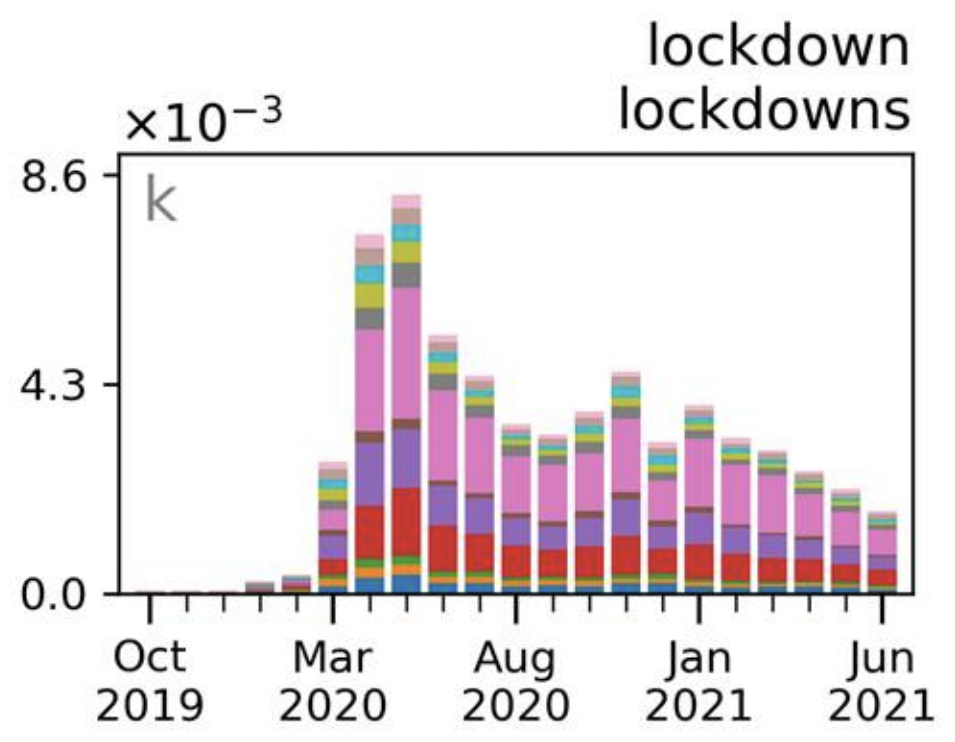
As this chart taken from the paper by David Rozado shows, major Western media outlets did not start mentioning ‘lockdown’ frequently until March:
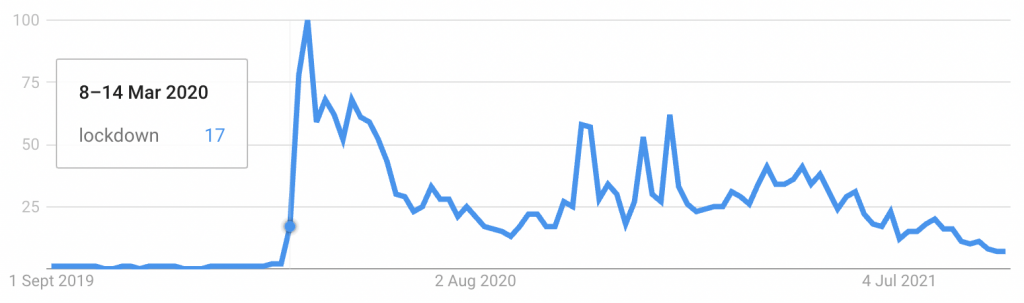
And this chart confirms that worldwide Google search interest for ‘lockdown’ was essentially nil until 8th March 2020:
So what happened in early March? Well, Italy was the first Western country to lock down – on 9th March last year. And as Michael Senger argues, its decision appears to have been prompted by the WHO’s report of 24th February, which gave a glowing evaluation of China’s lockdown. (Senger’s piece is well worth reading.)
Other Western countries then followed suit. The next most important event, following Italy’s decision to lock down, was the publication of a report by Neil Ferguson’s team on 16th March.
This report has been described as the “catalyst for policy reversal”. Up until then, the U.K. had been more or less following its pandemic preparedness plan. As late as March 5th, Chris Whitty told the Health and Social Care Committee that “what we’re very keen to do is minimise social and economic disruption”.
Although other, similar reports had already been published, the analysis by Neil Ferguson’s team was seen as particularly authoritative. According to the New York Times, the report “also influenced the White House to strengthen its measures”.
On March 17th, Neil Ferguson and his colleagues held a press conference after returning from Downing Street. They confirmed that Britain would be adopting a new strategy. “The aim is not to slow the rate of growth of cases but actually pull the epidemic into reverse,” Ferguson said.
As to why the U.K. was changing tack, Ferguson noted, “We have had bad news from Italy and from early experience in UK hospitals”. However, subsequent revelations suggest that “bad news” was less important than the shifting of the Overton window.
In an interview with the Times published in December last year, Ferguson noted that “people’s sense of what is possible in terms of control changed quite dramatically between January and March”. Referring to China’s lockdown, he elaborated, “We couldn’t get away with it in Europe, we thought… And then Italy did it. And we realised we could”.
After China’s initial response in Hubei, it took two months for lockdowns to go from ‘unprecedented’ to ‘unavoidable’. They received two major doses of intellectual credibility: first from the WHO, and then from Neil Ferguson’s team. Italy set the all-important precedent for Western countries.
As to whether one should trust ‘The Science’ on lockdowns, a reasonable answer would be, ‘Do you mean the pre or the post-Covid science?’
Yahoo! News Informs the Stupid Peasants Why the US Needs to Go to War to Protect Taiwan
By Andrew Anglin | The Daily Stormer | October 14, 2021
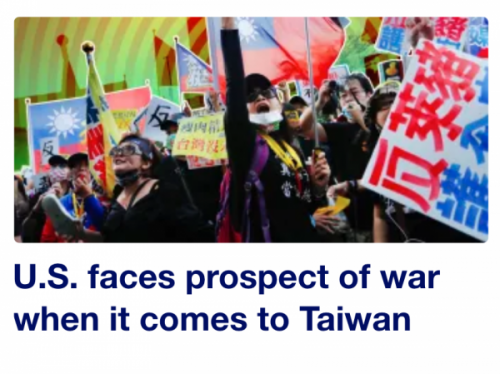
Yahoo! News had this headline at the top on Thursday morning.
When you click the article, you get this different headline:

The actual appropriate headline for this article would be “A Baby’s First Guide to Why the US Must Initiate a World War in Order to Prevent Chinese Reunification.”
The article gives a quick, slanted and false outline of the situation which does not attempt to either:
- Explain the Chinese position on Taiwan, or
- Explain why Taiwan is important to “American interests.”
It then gives a series of quotes from supposed experts on what Joe Biden should do.
A firm commitment to defend Taiwan is the best way to prevent an invasion
“The United States needs to remove the ambiguity about whether it would come to Taiwan’s defense. Uncertainty about U.S. intentions raises the risk of war. … President Biden should declare that, though we will not support a Taiwanese declaration of independence from China, we will defend the island if it is attacked.” — Max Boot, Washington Post
The U.S. must accept it has nothing to gain from defending Taiwan
“Bluntly put, America should refuse to be drawn into a no-win war with Beijing. It needs to be said up front: there would be no palatable choice for Washington if China finally makes good on its decades-long threat to take Taiwan by force.” — Daniel L. Davis, defense priorities senior fellow, Guardian
The U.S. should maintain its noncommittal position as long as it can
“As a superpower, the United States should preserve flexibility in its global security relationships. It also is not even obvious that Taiwan’s body politic would welcome an explicit security guarantee from the United States.” — Therese Shaheen, National Review
Taiwan is too important to U.S. interests to let it be taken by the Chinese
“Abandoning Taiwan in the face of a Chinese military assault would be a monumental disaster. … The U.S. cannot afford to see a country that occupies vital strategic space in the Western Pacific subdued by Beijing.” — Hal Brands, Bloomberg
War with China would pose an existential threat to the U.S.
“Stumbling into a shooting war over Taiwan is akin to opening a Pandora’s box, and it would make the last 20 years of conflict in the Middle East look like an uneventful peacekeeping mission. A fight between Washington and Beijing could also escalate to the nuclear level, particularly if the Chinese Communist Party determines that the use of such weapons is the only thing standing in the way of a humiliating defeat.” — Daniel R. DePetris, NBC News
America has a duty to protect the free world from authoritarianism
“The United States and its allies have built and defended a rules-based system over the past 75 years that has produced unprecedented peace, prosperity, and freedom globally. I don’t want to trade that in for a world in which Americans stand by as revisionist autocracies like China gobble up neighbors by military force.” — Matthew Kroenig, Foreign Policy
The U.S. also has diplomatic tools to deter China from invading
“To further demonstrate U.S. resolve, Biden should tell Beijing that any more threats of force against Taiwan’s participation in the democracy summit will trigger immediate diplomatic recognition of Taiwan and an official statement of Washington’s new ‘One China, One Taiwan’ policy. Beijing must understand that war would mean instant Taiwan independence.” — Joseph Bosco, The Hill
The best way to defend Taiwan is through investment, not military threats
“Hyping the threat that China poses to Taiwan does Beijing’s work for it. Taiwan’s people need reasons for confidence in their own future, not just reminders of their vulnerabilities. If American policy makers want to help Taiwan, they will need to go beyond focusing on the military threat. They need to modernize the U.S.-Taiwan economic relationship, help Taiwan diversify its trade ties and provide platforms for Taiwan to earn dignity and respect on the world stage.” — Richard Bush, Bonnie Glaser and Ryan Hass, NPR
Some of those are funnier than others. The idea that a country that is force-vaccinating its population is less authoritarian than a country that is not doing that is actually so ridiculous that it borders on the deranged or outright insane.
But this is actually more anti-war material than you usually see anywhere on a mainstream website, so I guess good job with that, Yahoo!
But while they do include people saying “we really should probably think about whether or not we want to start a nuclear war,” what is lacking is a sober perspective.
Why is Taiwan even an issue?
Why are we even talking about this at all?
Not one single person in this entire media landscape will either:
- Outline, in real terms, how occupying Taiwan is in “the interests of America,” or
- Point out that no one will give that outline
You end up in a situation where no one even has any idea what we’re actually talking about.
How is it possible that we’ve reached the point where we’re considering a nuclear war over vague “strategic interests” that no one is able to explain in concrete terms?
Furthermore – and I hate to be the one to have to point this out – but things are tough all over.
America and the rest of the West have a lot, lot, lot of problems. We have very real economic, political and social problems that no one is offering any solutions to. So the idea that we’re talking about going to war to protect some fake country on the other side of the globe is simply inexplicable.
If I was allowed to offer a 200-word sound bite for that Yahoo! News article, it would be this:
Taiwan is a part of China, and the reasons the US occupied it originally are no longer relevant. Instead of continuing to support the fantasy of a democratic China under the guise of the myth of Taiwanese nationhood, the United States should open talks about reunification. China will be open to giving wide-ranging concessions in exchange for the opportunity at peaceful reunification, and this will allow the West to clear up various unrelated conflicts with China, including on matters of international trade. — Andrew Anglin, Hoax Watch
I am happy that some in the media are finally saying that what we are talking about here is a nuclear war. That’s a long way from where we were a couple years ago, when the State Department first started its saber-rattling under Donald Trump. The humiliation in Afghanistan seems to have sobered a few people up.
But the fact that this discussion still remains so very far outside of the real, in the realm of the viciously and confusingly abstract, speaks to the moronic nature of the American mind. These people are literally asking you to believe that every single person in the entire Western world supports the idea of an “independent and democratic Taiwan” being “strategically important to the United States and its allies” even while not one person among this unified chorus is capable of explaining what either of those concepts means.
The basic fact, which anyone who knows the history knows but which no one in the American media is willing to say (and it wouldn’t be printed if they were willing), is that Taiwan was set up as an alternative government to the CCP government of China. The American goal was to foster a “democracy” government in Taiwan, which would eventually rule all of China. To this day, the government of Taiwan officially claims that it is the legitimate government of the entirety of China. This is not a secret, and yet somehow, it remains totally unsaid, and instead we are told that “Taiwan” is some kind of independent country that “China” is trying to invade and conquer.
The fact that Taiwan is not a country, but a piece of China occupied by the United States, does not necessarily mean that we should just give it back to China. But any serious discussion about whether we should or should not give it back to China should start from the point of accurately defining what Taiwan is. Obviously, if it is accurately defined, that would lead a lot of people to grasp the Chinese perspective on the issue, and make China look much less villainous, which is why there is some kind of soft ban on properly defining Taiwan in the media.
I think it would be morally good to simply give Taiwan back to China. But geopolitics are not based around moral goodness, so it makes sense that because America currently maintains control of Taiwan, America would instead negotiate concessions from China as part of the reunification process. But because we live in this fantasy world, we can’t have that discussion, and instead it’s simply “should we go to war to protect Taiwanese independence?” – a stupid and nonsensical question.
America is not a serious country, and its fixation with censorship has ensured that there can never be any form of seriousness injected into any discussion. Instead of talking about actual reality, the media and the political class argue about fantasies with only abstract connection to physical realities.
This is what a “dying empire” looks like.
Chinese Uyghur responsible for suicide bombing; Taliban and Turkey accuse CIA of creating ISIS-K
By Eric Striker | National Justice | October 14, 2021
Afghanistan’s ISIS-K has identified the suicide bomber behind last weeks gruesome suicide attack on a Shiite mosque, “Muhammad al-Uyghuri,” a member of China’s Uyghur population that the United States has in recent years claimed is being oppressed by Beijing.
The bombing in Afghanistan’s Kunduz province killed up to 80 people and injured 143 others and represents a drastic escalation in ISIS-K’s war on the Taliban’s rule.
Both the Taliban and even NATO ally Turkey are publicly accusing the CIA and US government of creating ISIS-K to destabilize the region.
It is rare for ISIS to identify the ethnicity of its suicide bombers. Experts believe the decision was made to recruit Uyghurs in China and inspire them to commit similar attacks.
According to a statement made by Turkish Foreign Minister Mevlut Cavusoglu last Saturday, his nation holds credible intelligence showing that the CIA and US military were covertly transporting members of ISIS out of Syria and unleashing them in Afghanistan. It is believed that thousands of Chinese Uyghur jihadists, who developed a close relationship with Washington under former Secretary of State Mike Pompeo, fought with and beside ISIS in Syria.
ISIS-K has officially declared war on the Taliban, citing its diplomatic overtures towards China and Iran. Ahmad Yasir, a Taliban spokesman in Qatar, has also said that his government has evidence that ISIS-K is an American intelligence operation and will be releasing it in the future. The Taliban has held that the ISIS-K problem is manageable because the group has no local contacts or popular support in Afghanistan.
Numerous governments have blamed the US for the sudden resurrection of ISIS in Central Asia. Last May, Iran provided reports and testimony, including from former US allies in the Afghan government, revealing that CIA aircraft was transporting jihadists out of Syria and Iraq and into Afghanistan.
The cruel acts this latest iteration of the terrorist group has performed in the last two years has made it such a pariah that even Al Qaeda has vowed to fight against them. Last year, ISIS-K was identified as the group that committed a suicide bombing targeting a maternity ward in Kabul that slaughtered dozens of mothers in labor and newborn babies.
A piece published yesterday by analyst Julia Kassem theorizes that ISIS-K is part of an American geopolitical operation that seeks to drag China into a costly Afghan quagmire. The large number of jihadists belonging to China’s Uyghur population, who come from the Xinjiang province, that have spread throughout Central Asia and the Middle East create a risk of terrorism against Chinese economic ambitions in the region.
Colonel Lawrence Wilkerson, former Chief of Staff to Colin Powell, has written and spoken extensively about discussions inside the Pentagon regarding the use of the CIA to penetrate Xinjiang to destabilize China.
The goal would not only be to create chaos in the Chinese mainland, but also to encourage and support terrorist groups that target the Chinese Belt and Road Initiative (BRI) in neighboring countries. The Taliban has shown significant interest in joining the BRI since taking power.
Neo-conservative writers in America have started calling for a military re-entry into Afghanistan to address the supposed threat of ISIS-K. The Taliban is adamantly opposed to the idea.
Little is known about ISIS-K other than many of its members were interned in the US’ Bagram Air Base and released during the withdrawal.
This follows a pattern in the history of ISIS, which was reportedly created at Camp Bucca in Iraq under the supervision of US forces. The Pentagon has claimed that ISIS was created by inmates who radicalized one another at the camp under the noses of US personnel because they did not speak Arabic and had no idea what the inmates were talking about.
Uyghur Tribunal: US Lawfare at its Lowest
By Brian Berletic – New Eastern Outlook – 07.10.2021
The so-called “Uyghur Tribunal” is promoted across the Western media as an “independent” tribunal. AP claims that it seeks to lay out evidence that will “compel international action to tackle growing concerns about alleged abuses in Xinjiang.”
The tribunal – having no legal basis or enforcement mechanism – will clearly be used to help bolster calls for a boycott of the 2022 Beijing Winter Olympic games and may serve to help pressure nations around the globe to roll back ties with China and aid the US in imposing additional sanctions and boycotts.
An “Independent” Tribunal Funded by the US Government
Media platforms like the US State Department’s Radio Free Asia in articles have claimed the tribunal has “no state backing.” The abovementioned AP article only claims the tribunal “does not have UK government backing.”
Yet the Uyghur Tribunal’s official website, under a section titled, “About,” admits (emphasis added):
In June 2020 Dolkun Isa, President of the World Uyghur Congress formally requested that Sir Geoffrey Nice QC establish and chair an independent people’s tribunal to investigate ‘ongoing atrocities and possible Genocide’ against the Uyghurs, Kazakhs and other Turkic Muslim Populations.
It also claims on a second page about funding that:
A crowdfunder page has raised nearly £250 000, with an initial amount of around $115 000 dollars donated by the Uyghur diaspora through the World Uyghur Congress.
What isn’t mentioned is that the World Uyghur Congress, along with many of the supposed experts and witnesses providing statements during the supposed tribunal, are funded by the United States government through the National Endowment for Democracy (NED).
This includes the president of WUC himself, Dolkun Isa, who provided a statement on June 4, 2021. Other members of US NED-funded organizations participating in the so-called tribunal included Muetter Illiqud of the NED-funded Uyghur Transitional Justice Database (UTJD), Rushan Abbas and Julie Millsap of the NED-funded Campaign for Uyghurs, Bahram Sintash and Elise Anderson of the NED-funded Uyghur Human Rights Project and Laura Harth of Safeguard Defenders, formerly known as the NED-funded China Action organization.
WUC is listed by name along with the UHRP, Campaign for Uyghurs, and the Uyghur Refugee Relief Fund on the official US NED website under “Xinjiang/East Turkestan 2020.” On another NED page titled, “Uyghur Human Rights Policy Act Builds on Work of NED Grantees,” the Uyghur Transitional Justice Database Project is also listed as receiving money from the US funding arm.
Also participating in the supposed tribunal was Adrian Zenz of the US government-funded Victims of Communism Memorial Foundation (VOC), Shohret Hosur who works for the US State Department’s Radio Free Asia, Mihrigul Tursun who was awarded the NED-affiliated “Citizen Power Award in 2018, Sayragul Sauytbay who received the 2020 US State Department’s Women of Courage Award, and IPVM which is a video surveillance information service previously commissioned by the US government in regards to Chinese government surveillance programs in Xinjiang.
There was also Sean Robert who was a senior advisor to the USAID mission to Central Asia from 1998-2006 – the very region and time period Uyghur separatism was being organized from beyond China’s borders. Robert has been active in promoting US-funded propaganda regarding Xinjiang for years alongside other mainstays like Rushan Abbas and Louisa Greve.
Nearly every other “witness” brought before the so-called tribunal has a long-established history of participating in the US government-funded propaganda campaign aimed at China and its alleged abuses in Xinjiang. This includes Omir Bekali who was previously invited to testify in front of the US Congress in 2018, Asiye Abdulahed who claims to be the alleged source of the so-called “China Files,” Zumret Dawut whose allegations were used by former US Secretary of State Mike Pompeo in attacks aimed at China, and Tursunay Ziyawudun who spoke in front of Congress in 2021.
There were also Westerners representing corporate-funded think tanks long engaged in a propaganda war with China including Nathan Ruser of the Australian Strategic Policy Institute (ASPI), Darren Byler and Jessica Batke of “ChileFile” – a subsidiary of Asia Society funded by the Australian and Japanese governments as well as Open Society, and Charles Parton of the Royal United Services Institute (RUSI) funded by the US State Department, the EU, Canada, Qatar, the UK, Japan, Australia, as well as arms manufacturers like BAE, Airbus, Lockheed, Northrop Grumman, Raytheon, and General Dynamics.
Only a handful of participants appeared to be relatively new faces, perhaps drawn from lesser corners of the global Uyghur diaspora being cultivated by the US as a political weapon.
Tedious, Holes-Filled Testimony
The testimony itself was tedious and lengthy with a total of nearly 80 hours recorded and uploaded to the Uyghur Tribunal’s YouTube channel. However, spot checking any of the testimony reveals massive discrepancies.
For example, on the first day of hearings, Muetter Illiqud of the abovementioned US government-funded UTJD provided conflicting total numbers of Uyghurs allegedly interned as well as conflicting accounts regarding Chinese government restrictions on the number of children permitted in cities and in rural villages. Illiqud failed to explain the discrepancies and was invited by Geoffrey Nice, chair of the tribunal, to return in September with the discrepancies fixed.
Another alleged witness, Gulzire Alwuqanqizi who spoke with an NED-affiliated “ChinaAid” banner behind her, claimed in her written statement that she was forced to work in a factory for a month and a half (approximately 45 days) where she claims she made a total of 2,000 gloves. Yet in her spoken statement she claims she was never able to meet the daily quota of 20 gloves and instead made only 10-12. If that is true, she would have only produced at most 540 gloves. She was never asked to clarify this discrepancy.
Also in her written statement, she claims she was caught sending photos of the factory to her husband. She claims:
One day, I took a picture of the factory and sent it to him. From there it became public. Following this, I was interrogated, they asked the same questions they had always asked, all night long, but eventually they let me go.
Yet in her spoken statement, she claimed:
At the factory where we were producing the gloves, I sent a photo and as punishment I was put in something like a ditch, a 20 meter deep well. They threw some electric currents at me, they poured water on me, and kept me there for 24 hours.
No comment was made by the panel interviewing her regarding this glaring inconsistency either.
Another witness, Tursunay Ziyawudun, claimed in her written statement to have been detained upon entering China after living in Kazakhstan from 2011 to 2016.
She inferred that she was being asked questions about the US NED-funded World Uyghur Congress during an interrogation, and claimed:
I didn’t even know what World Uyghur Congresses were at that time. We don’t have access to this information in China.
Yet clearly, while living in Kazakhstan for 5 years prior to returning to China, she did have access to this information. It is yet another inconsistency left unchallenged by the so-called tribunal.
Out of about 80 hours of proceedings, there are always bound to be inconsistencies, yet when the panel observed these, it took no action at all, skipping past them, excusing them, or allowing witnesses to alter their claims at a later date to iron out obvious inconsistencies. All of this further calls into question the professionalism, objectivity, and integrity of the entire “tribunal.”
Of course, no one in the public will likely watch any of the testimony first hand, let alone cross examine the spoken statements with their written statements. The general public will instead rely on the Western media’s interpretations of the so-called tribunal consisting of cherry-picked highlights designed to prey on the public’s emotions.
The “Uyghur Tribunal” – a Bad Sequel to the “China Tribunal”
The so-called “Uyghur Tribunal” unfolds as a sort of sequel to the 2019 “China Tribunal.” The China Tribunal and the Uyghur Tribunal following it were both chaired by Geoffrey Nice and included Hamid Sabi, Nicholas Vetch, and Aarif Abraham as participants. Both were initiated and funded by US government-funded organizations.
While the WUC organized the Uyghur Tribunal, the so-called International Coalition to End Transplant Abuse in China (ETAC) was the organization behind the “China Tribunal.” ETAC’s own webpage does not disclose its funding, but provides a list of names on its “international advisory committee.” They include Louisa Greve who was part of the NED’s senior leadership for 24 years before shifting over to the NED-funded Uyghur Human Rights Project. Ethan Gutmann is also listed. His book, “The Slaughter,” regarding alleged human organ harvesting in China, was launched at an NED event in Washington D.C. There is also Benedict Rogers, an advisor to the NED-funded World Uyghur Congress.
In other words, both tribunals were not tribunals at all, but instead an exhibition put on by a US government-funded troupe of activists deeply invested in maligning China and helping advance US foreign policy objectives versus Beijing.
It is merely a larger, more elaborate version of a literal exhibition funded by the US government and organized by the World Uyghur Congress in Geneva Switzerland also this year. A September 2021 Reuters article titled, “China accuses Washington of ‘low political tricks’ over Uyghur exhibit,” would note:
A US-backed Uyghur photo exhibit of dozens of people who are missing or alleged to be held in camps in Xinjiang, China, opened in Switzerland on Thursday, prompting Beijing to issue a furious statement accusing Washington of “low political tricks”.
The article also claimed:
The United States gave a financial grant for the exhibit, which will later travel to Brussels and Berlin, the World Uyghur Congress told Reuters. Earlier this week, the US mission in Geneva displayed it at a diplomatic reception, according to sources who attended.
“We are committed to placing human rights at the center of our China policy, and we will continue to highlight the grave human rights abuses we see the PRC committing across China, in Xinjiang, Tibet, Hong Kong, and elsewhere,” a US mission spokesperson said, referring to the People’s Republic of China.
The US, guilty of the very worst crimes against humanity of the 21st century, only claims to put human rights at the center of its foreign policy when politically convenient. No mention is made of the US’ decades of supporting violent separatism in China including in Tibet and Xinjiang – creating the very real terrorism China’s security measures were put in place to combat.
No mention or note is made in articles about the “Uyghur Tribunal” regarding the constant use of the term “East Turkestan” instead of Xinjiang or the fact that most of the people speaking at the tribunal are separatists and at least partly responsible for the violence and instability that seized Xinjiang before Beijing intervened.
No mention is made about the constant presence of East Turkestan separatist flags in the backgrounds as witnesses provide testimony. At one point in the proceedings, pro-separatist Arslan Hidayat was seen interpreting for at least two witnesses. Hidayat has repeatedly called for Xinjiang to be ethnically cleansed of Han Chinese.
As China reacted to the violence the US fuelled – the US used accusations of human rights abuses to hamstring and undermine Chinese efforts to restore peace and stability. The US uses the sword of state-sponsored terrorism to strike at China, and the shield of feigned rights advocacy to defend US-sponsored separatists from justice.
The “Uyghur Tribunal” is merely the latest and perhaps grandest iteration of this strategy of striking and defending. The tribunal’s final “ruling” will be read in December 2021, just ahead of the 2022 Beijing Winter Olympics and a concerted US-led media campaign to call for the world’s boycott of the games. Beyond that, further sanctions could be leveled against China – all in the wake of a clearly US-engineered show tribunal dishonestly presented to the public as “justice” and “human rights advocacy.”
The harsh irony is that the US seeks to blunt China’s rise specifically so it can continue acting on the global stage with impunity, and continue carrying out the verified, very real campaign of death, destruction, and genocide it has led since the turn of the century.
More News On The Progress Toward Eliminating Fossil Fuels
By Francis Menton | Manhattan Contrarian | October 3, 2021
The bureaucrats of the world, particularly in the UN and developed countries, have the idea that they are going to eliminate all use of fossil fuels by somewhere around 2040-50. They have no conception of how to accomplish that, other than to order from on high that it shall occur and assume that somebody else will figure out the details. This gives the rest of us the opportunity to sit on the sidelines and observe how bureaucratic fantasy gradually runs into the brick wall of physical reality.
Back in June I covered the Report just out from Ren21 Renewables Now wherein we learned that in the ten years from 2009 to 2019, despite hundreds of billions of dollars of subsidies for intermittent wind and solar power, the percent of world final energy consumption coming from fossil fuels had dropped all the way from 80.3% to 80.2%. Oh, but world final energy consumption was substantially up over that decade from about 320 to 385 exajoules, so despite all the strenuous efforts to reduce their use, in fact annual fossil fuel consumption had increased from about 260 to 310 exajoules.
And then just two weeks ago I covered the unfolding energy crisis in the UK. There, the mad rush to close coal plants and build wind turbines had left the country completely subject to just-in-time natural gas deliveries from others, particularly Russia. When a period of calm hit the North Sea wind farms, gas prices spiked by a multiple, and Britain was left closing factories and begging Russia for supply.
And there is plenty more news coming out on the same subject. Here are a couple of examples for today:
China. With the waning of the pandemic, all the rich countries of the West are back to wanting to consume lots of manufactured stuff. But of course the obsession with eliminating fossil fuels has gradually made the industrial energy supply of the rich countries more expensive and less reliable. (This is more true in Europe than in the U.S., but California and New York are doing their best to keep up.). Anyway, no problem, we’ll just get the stuff from China. So in recent months China has been in the mode of ramping up production. That will of course require much more energy. Do you think that it is going to come from wind and solar? Don’t be ridiculous. On September 27, Reuters reported that the ramp-up is causing massive energy shortages around China, and the solution is — coal. “China provincial governor urges more coal imports to resolve power shortages”:
China should work to import more coal from Russia, Indonesia and Mongolia in order to resolve supply shortages now crippling large sections of industry, said Han Jun, governor of the northeastern province of Jilin, one of the worst-hit regions. Speaking to local power firms on Monday, Han said “multiple channels” needed to be set up to guarantee coal supplies, according to the province’s official WeChat social media account. He said the province would also dispatch special teams to secure supply contracts in the neighbouring region of Inner Mongolia.
OPEC World Oil Outlook. On September 28 OPEC came out with its annual World Oil Outlook. This Report looks forward through the year 2045. It’s becoming increasingly impossible to get any straight information out of the American and European oil companies, as threats of lawsuits and regulatory actions cause them to mouth green groupthink and to pretend that they are planning to go out of business over the next couple of decades. But OPEC isn’t subject to the same pressures, so their Report is a much better indication of where knowledgeable people think things are going.
And where might that be? Here is OPEC’s chart of projected demand growth for petroleum from now to 2045:

In short, it’s continued growth in consumption all the way through 2045, albeit with the growth leveling off toward the end of the period. But basically, OPEC projects that any and all decreases in oil consumption achieved by the OECD nations (developed countries) will be offset and more by increases in the rest of the world.
OPEC also tries its hand at projections of demand for coal and natural gas over the same period. Here’s their chart of projected demand for natural gas:

It’s increases as far as the eye can see. Yes, they project that demand from the OECD countries will remain essentially flat at just under 30 mboe/d over the whole period; but meanwhile demand from the rest of the world is projected to go up dramatically from about 35 mboe/d to around 55 mboe/d.
In another chart relating to coal, they project a small decline in world demand from around 70 mboe/d today to around 60 mboe/d by 2045. Substantial declines in OECD nations will be offset by almost equivalent increases in places like India and Africa.
Do the people at OPEC know what they are talking about with these projections? I think that these figures are far more likely to be close to the mark than the fantasies coming out of the UN, where the talk is that the entire world economy will reach “net zero” carbon emissions by 2050. For example, here is the UN’s IEA, November 17, 2019, discussing what they call a “1.5 °C scenario that does not rely on negative emissions technologies”:
This . . . [scenario] means a reduction in emissions of around 1.3 billion tonnes CO2 every year from 2018 onwards. That amount is roughly equivalent to the emissions from 15% of the world’s coal fleet or from 40% of today’s global passenger car fleet. The year by which different economies would need to hit net-zero in such a scenario would vary, but the implication for advanced economies is that they would need to reach this point in the 2040s. . . . [D]eveloping economies . . . would all need to be at net-zero by 2050.
Not happening. Do they have any idea how completely absurd this is?
Released docs describe ‘HIGHEST RISK’ involved in US-funded coronavirus research in Wuhan
Deadly bat caves & humanized mice tests
RT | September 7, 2021
Documents obtained by The Intercept reveal that the US government funded studies into coronavirus in bats in Wuhan long before the pandemic, with the proposal showing it was aware of the risk that researchers would be infected.
More than 900 pages of material related to this research were published on the non-profit media company’s website on Tuesday. The documents were acquired as part of an ongoing Freedom of Information Act litigation by The Intercept against the National Institutes of Health.
The documents detail the work of EcoHealth Alliance, a US-based organization specializing in protection against infectious diseases, and its work with Chinese partners on coronaviruses, specifically those originating in bats.
The papers detail that EcoHealth Alliance was granted a total of $3.1 million by the federal government, with $599,000 of that going to the Wuhan Institute of Virology. The funding received in Wuhan was used in part to identify and genetically alter bat coronaviruses that might infect humans.
EcoHealth Alliance president Peter Daszak led one of the studies, titled ‘Understanding the Risk of Bat Coronavirus Emergence’, which screened thousands of bats for novel coronaviruses. The research also involved the screening of people who work with live animals.
However, the released documents include a recognition of the potential risks posed by the project. “Fieldwork involves the highest risk of exposure to SARS or other CoVs while working in caves with high bat density overhead and the potential for fecal dust to be inhaled,” the grant application reads.
“In this proposal, they actually point out that they know how risky this work is. They keep talking about people potentially getting bitten – and they kept records of everyone who got bitten,” Alina Chan, a molecular biologist at the Broad Institute, in the US, told The Intercept in response to the release.
Another revelation was that experimental work with humanized mice (that is, with functioning human genes, cells, tissues, and/or organs) was conducted at the Wuhan University Center for Animal Experiment, a biosafety level-three lab, and not at the Wuhan Institute of Virology, mainland China’s first biosafety level-four lab, as originally thought.
The program ran from 2014 to 2019, and was renewed in 2019, only for former US president Donald Trump to cancel it. Robert Kessler, communications manager at EcoHealth Alliance, maintained there wasn’t a lot to say on the matter. “We applied for grants to conduct research. The relevant agencies deemed that to be important research, and thus funded it,” he noted.
While the US has blasted China for not releasing all the relevant information on Covid-19, The Intercept said it had requested the recently released documents back in September 2020.
Although they don’t provide conclusive evidence to support the theory that Covid-19 was leaked from a Chinese lab, it does highlight the fact that risky research into bat coronaviruses was being undertaken in the years leading up the pandemic, and the US was not only well aware of that, but also funded it. Bats have been identified as a possible zoonotic source for the virus.
World Health Organization experts spent around a month in China from January this year. Their report suggested that cases identified in Wuhan in 2019 were believed to have been acquired from “a zoonotic source, as many [of those initially infected] reported visiting or working in the Huanan Wholesale Seafood Market.”
Beijing has refused to take part in a second probe, rejecting the lab leak theory while, in turn, calling for an investigation into US-based laboratories.
Japan Outraged Over US Release of Toxic Water in Okinawa
By Ilya Tsukanov – Sputnik – 04.09.2021
In April, Japan’s neighbours expressed outrage in over Tokyo’s plans to release 1.23 million tonnes of contaminated wastewater from a storage facility at destroyed Fukushima Daiichi Nuclear Power Plant into the Pacific Ocean. Japanese authorities have insisted that the wastewater is safe, but environmental groups have contested such claims.
China Global Television Network (CGTN), a Beijing-based English-language TV news service, has poked fun at Japanese authorities over the apparent hypocrisy shown by Tokyo when it comes to the dumping of hazardous wastewater.
In recent weeks, Japanese media, government officials and environmental activists have been up in arms over plans by US forces in Okinawa to dump potentially dangerous chemicals into the local sewage system.
The scandal began to gather steam in June, when the Pentagon reported the leakage of water containing toxic materials from a US Army storage facility in Uruma and other locations across the strategically situated islands. In July, the US military informed Okinawa authorities of plans to release treated but potentially hazardous wastewater to prevent the danger of another leak.
The US military insisted that the wastewater was treated to Japanese government standards and safe to drink, and began dumping it into the local sewage system on 26 August. The water was known to contain trace concentrations of organofluorine compounds, including perfluorooctanesulfonic acid and perfluorooctanoic acid. Scientific studies have indicated that these chemicals can affect the health of wildlife, with the potential to cause reduced immunoglobulin levels and brain asymmetry in offspring, and to result in increased risk of chronic kidney disease and other ailments among humans. The chemicals’ resistance to natural breakup and tendency to accumulate in organisms have led them to be dubbed “forever chemicals.” Japan banned the production of the acids in 2010, and established strict guidelines on safe levels of the substances of less than 50 nanograms per liter of water last year.
The US military informed Japanese authorities of their plans to dump the chemical-laced water less than an hour before starting, and insisted that their wastewater contained less than 2.7 nanograms of the acids.
Okinawa authorities had asked for an immediate halt to the dumping, but the US military apparently ignored their protest, releasing at least 64,000 liters of the potentially toxic wastewater into the sewage system, with the water then dumped into the ocean due to the system’s inability to treat it. Before proceeding with the dump, US forces turned down a local company’s offer to treat the water, deeming it prohibitively expensive.
At a news conference organized on the day the water was dumped, Okinawa Governor Denny Tamaki expressed outrage over the release of the contaminated water. “I feel strong outrage that the US military unilaterally dumped the water even while they knew that discussions were proceeding between Japan and the United States on how to handle the contaminated water,” he said.
Last week, Japan’s national authorities formally intervened, with Environment Minister Shinjiro Koizumi issuing a strong protest and saying that US Marines’ decision to dump the water was “extremely regrettable.”
“Local residents are feeling very anxious,” Koizumi complained, while promising to work with the relevant ministries and Okinawa authorities “to ensure this is handled in an appropriate manner, as well as reconfirm the details with the United States.”
In a separate statement, Defence Minister Nobuo Kishi said that he had asked US forces to please stop dumping any more contaminated water.
Environment Ministry and Defence Ministry officials visited Okinawa this past week to discuss the problem, offering a rare public apology to Masanori Matsugawa, the mayor of Ginowan, Okinawa, the city potentially most heavily affected by the dumping. “We extend our deepest apology,” Makoto Ikeda, the head of the Defence Ministry’s environmental policy division told Matsugawa. “We also consider it extremely regrettable that the water was dumped so suddenly,” he added.
Chinese Media: ‘What goes around comes around’
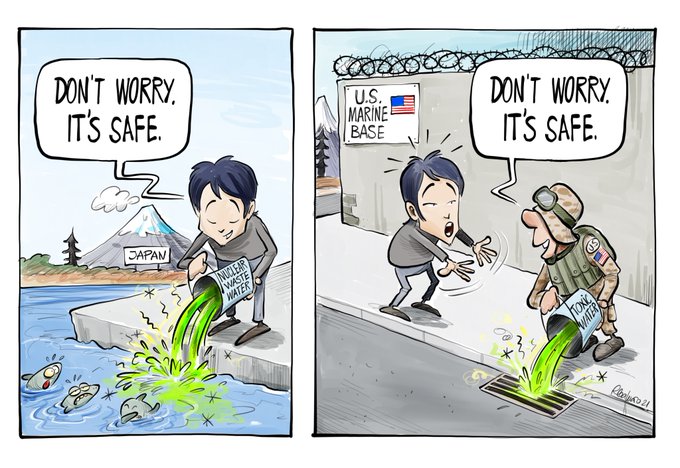
China’s CGTN poked fun at the Japanese government over the calamity on Saturday, tweeting a political cartoon showing a Japanese man nonchalantly dumping nuclear wastewater from the Fukushima nuclear plant into the ocean, and then complaining as a Marine is pictured dumping hazardous water into Okinawa’s sewage system.
Featured Video

The Truth About the Trump Shootings with Ken Silva
or go to
Aletho News Archives – Video-Images
From the Archives
Trans ‘milk’ as good as the real thing – NHS
RT | February 18, 2024
The drug-induced nipple secretions of trans women are as good as mothers’ breast milk for babies, the University of Sussex Hospitals NHS Trust claimed in a letter to campaigners made public in a report by British think tank the Policy Exchange on Sunday.
The healthcare trust’s medical director, Rachel James, argued that the off-label prescription drug cocktail men transitioning to female take in order to produce milk was “similar to the natural hormones which encourage lactation to develop when the baby is newly born.”
“The evidence which is available demonstrates that the milk is comparable to that produced following the birth of a baby,” James wrote in the letter, sent to Children of Transitioners last August.
Biological men who wish to lactate must first take hormones to grow milk glands and then take high doses of either domperidone or metoclopramide to stimulate milk production. Neither drug is approved for this use, though they are occasionally prescribed off-label to biological women who have trouble lactating.
However, domperidone’s own manufacturer, Janssen, warns patients the drug “may cause unwanted side effects affecting the heart in a breastfed baby” and “should be used during breastfeeding only if your physician considers this clearly necessary.” … continue
Blog Roll
 Aletho News
- Russia Voted Under Fire. Washington Is Loading the Tankers.
- 12 Things Your Oncologist Was Trained Not to Tell You
- Anthrax Attacks Paved Way for COVID-Era ‘Junk Drugs and Vaccines’
- How Real Is the Impact of Western Sanctions on Israel?
- France, You Are Guilty: How Paris Turned Western Sahara into the Maghreb’s Powder Keg
- 2025 Nature Paper Claiming Worsening Global Drought Gets RETRACTED …Heavily Flawed
- Your Milk Is Not the Problem
- The Truth About the Trump Shootings with Ken Silva
- ARE PATIENTS BEING PROPERLY INFORMED ABOUT OZEMPIC?
- US lawmaker blocks $2.8 billion weapons sale to Israel: Report
- If Americans Knew
- Salah Sarsour’s Legal Team Says DHS Has Not Met Its Burden to Prove He Is Deportable
- An analysis of tax forms by The Intercept show Kraft’s charity and LLC have donated to Friends of the IDF and AIPAC’s super PAC.
- Israeli attacks kill four Palestinians in Gaza – Daily Update
- Inside Gaza’s death trap of collapsing, bombed-out buildings
- The everyday items Israel bans from Gaza every day
- Inside the siege, the ruined buildings of Gaza – Daily Update
- Debunking The Claim That Macklemore Has A “History Of Antisemitism”
- CPJ demands release of arrested Palestinian-US journalist near Bethlehem
- Robert Kraft: The Billionaire Friend of Netanyahu Pulling The Strings Behind the Macklemore/Ed Sheeran Blow Up
- Columbia Administered Fund Gives Big Money to Pro-Israel Groups
- No Tricks Zone
- 2025 Nature Paper Claiming Worsening Global Drought Gets RETRACTED …Heavily Flawed
- New Study: ‘Global Drought Shows No Detectable Recent Acceleration Under Climate Warming’
- Economic Masterminds: German Socialists Suggest Taxing Productivity Gains Stemming From Using AI
- The South China Sea Has Not Been Cooperating With The Climate Change Narrative
- Energy Crisis: Germany Enters Heating Season With Historically Low Gas Reserve Fill Levels
- New Study: The Antarctic Ice Sheet Gained Mass From 2020-2024 Due To Staggering Snow And Ice Accumulation
- Study: Ocean Heating Rates From Thousands Of Years Ago ‘Dwarf’ Modern Ocean Heating Rates
- Climate Extremists Target, Attack Large-Scale Power Grid Infrastructure In Germany!
- New Study: Antarctic Ice Melt Has Contributed Less Than 1 Centimeter To Sea Level Rise In The Last 30 Years
- Fear Of Debate: Alarmist German Climate Scientist Calls On Mainstream Media To Discredit Skeptic Voices
 Aletho News