Last Chance Saloon: best chance to ease East-West tensions cannot be missed
By Tony Kevin | Pearls and Irritations | January 7, 2022
We are at a crunch point now in Russia-US relations. Their high-level talks starting next week will be closely observed by China, Russia’s de facto strategic ally. The coming days and weeks will determine the shape of world security for decades to come.
On Monday, January 10, vital Russia-US talks will start in Geneva. Russia’s delegation will be headed by Deputy Foreign Minister Sergei Ryabkov and the US by National Security Adviser Jake Sullivan.
These are ‘precursor’ negotiations – ‘talks about talks’, in the old strategic arms limitation treaties (SALT) terminology. Russia is driving the pace. The US is in reactive mode, trying unsuccessfully to slow things down, to trim Russia’s sails. So far they are not succeeding.
Russia’s best-case scenario for Monday is this. Successful precursor talks will be followed soon after by substantive detailed Foreign Minister level negotiations, led by Russian Foreign Minister Sergei Lavrov and US Secretary of State Antony Blinken, with participation of top military brass from both sides. Russia will seek to secure detailed US-Russia agreements on mutual security guarantees in Europe.
Unusually, Russian drafts of these agreements were handed over by Russia to the US and at the same time made public on December 17. Russia will want to achieve these solemn written mutual commitments, as well-summarised by Patrick Lawrence in Consortium News on December 28.
- NATO will cease all efforts to expand eastward, notably into Ukraine and Georgia.
- NATO guarantees that it will not deploy missile batteries in nations bordering Russia.
- An end to NATO military and naval exercises in nations and seas bordering Russia.
- The effective restoration of the treaty covering intermediate-range nuclear weapons. The US abandoned the INF pact in August 2019.
- An ongoing East-West security dialogue.
These desired agreements would be backed up by early NATO-Russia negotiations to achieve corresponding agreements at that level. Finally, the two presidents would formally seal the deal.
Russia’s worst-case scenario: that if the US fails to negotiate towards this complete package – if the US tries in its usual way to equivocate, delay, or cherry-pick Russia’s proposed deal – Russia will terminate the talks.
Russia-US and Russia-NATO relations would then enter the deepest of deep freezes since the worst years of Cold War One. Russia would focus its economic and diplomatic resources entirely on relations with the East and South – backstopped by the Belt and Road Initiative of its reliable friend China. Russia would effectively stop trying to dialogue with US and NATO Europe and call the US bluff on enhanced sanctions. On the now highly militarised Russia-NATO frontier, armies, navies and tactical intermediate range missile forces (sufficient to destroy most of Europe and European Russia) would confront each other. Risks of East-West war by provocation or accident would be far greater than in the years 1989-2014, before the sharp deterioration in East-West relations brought about by the illegal 2014 Ukraine coup.
These present talks instigated by Russia are thus really the Last Chance Saloon: the last opportunity maybe for decades to pursue relaxation of East-West tensions – ‘détente’, in the old nearly — forgotten word of late Cold War One. Russia has had enough of years of creeping security deterioration and has drawn its red lines. These are not in my view ‘ultimatums’ though they do demand major military pullbacks by the US and NATO not matched by Russia, because almost all Russian forces are within Russian territory. In my view these proposed written agreements would enhance European and global security if achieved.
In 2021, Russia decided that it has had enough of decades of Western duplicity and creeping aggression, as persuasively analysed by Marshall Auerback in The Scrum, December 1, 2021.
Russia has seen how under successive US presidents Clinton, George W. Bush, Obama, Trump, and now Biden, a strategically destructive pattern of US and NATO behaviour had emerged since 1999, when President Bill Clinton welshed on the solemn though unwritten 1989-91 agreements between Reagan and George H.W. Bush with Gorbachev, that NATO would not expand into Eastern Europe following the reunification of Germany.
As the West offered soothing words and prevarications, NATO expanded, first with Poland, Czechoslovakia and Hungary in 1999. There were further large expansions in 2004 and 2009, bringing NATO right up against Russia’s Western frontiers. Provocatively, NATO then listed Ukraine and Georgia as candidates for NATO membership. The West successfully engineered an anti-Russia ‘colour revolution’ in Ukraine in 2014 and nearly succeeded in doing so in Belarus in 2020. It continued even to try to subvert Russia itself through lavish funding of anti-government human rights NGOs. Military and naval manouevres and build-ups continued on Russia’s Western approaches.
An angry Russia saw every expansion and interference as Western betrayals and as violations of its sovereignty and strategic depth. Russia was initially too weak to do anything about it. As Putin rebuilt Russian strength and morale, Russia began to fight back: first in Georgia in 2008, then in Crimea and East Ukraine in 2014, and in Belarus since 2020.
World events have now decisively turned in Russia’s favour. The global strategic balance is shifting. China firmly has Russia’s back, as seen in recent statements by President Xi Jinping and China’s Foreign Minister. China has repelled Western regime-change pressures in Xinjiang, Hong Kong and around Taiwan. Iran has joined the Belt and Road initiative. The West was expelled from Afghanistan. Syria has somewhat stabilised.
Russia and China see now that they are stronger against their common Western adversary if they stand together. Important non-Western powers and groupings such as India, Japan, South Korea and ASEAN are quietly adjusting their diplomacy to suit. The Quad is dead in the water, and AUKUS is a diplomatic joke.
In publishing these draft treaty texts, Russia is appealing to the world outside the Atlantic alliance to see that its cause is just, and in accordance with the five principles of peaceful coexistence proposed by China to the non-aligned world in 1954.
These five principles as articulated by Chinese foreign minister Zhou Enlai first appeared in the Sino–Indian Agreement signed in April 1954, and subsequently at the Bandung Conference of non-aligned nations, which Indonesia hosted one year later. These principles are mutual respect for sovereignty, non-aggression, non-interference in the internal affairs of others, equality for shared benefit, and peaceful coexistence. These are very much the stated principles of current Russian foreign policy.
Quite suddenly, the West is on the diplomatic defensive. Its years of salami-slice aggression against Russia and China are now coming to an end.
For years since the fall of the Soviet Union in 1991, the West used the vital consensus agreed by Reagan and Gorbachev, that nuclear war cannot be won and must never be fought, as cover for creeping aggression in Eastern Europe, violating and weakening Russia’s sphere of security.
Now, with the Russian initiative last week for the UN Security Council P5 to reaffirm the Reagan-Gorbachev doctrine, with which the Western nuclear powers had perforce to agree, the tables have been turned.
Putin is in effect telling the West now: we all agree that none of us can allow military conflict between us to escalate to nuclear war. But we and China are strong enough now to defeat you in non-nuclear conflicts close to our borders, if you should be foolish enough to instigate such conflicts. These are the military facts of the matter: Russia could easily occupy Ukraine and China could easily occupy Taiwan. And you, the US and NATO, could not stop this without risking nuclear war.
Putin has no wish to invade Ukraine but he is determined to stop now the erosion of Russia’s security. The new harder and more confident tone in Russian diplomatic language is unmistakable. A confused West has not yet worked out how to respond. Urgent talks have taken place between Biden and Ukrainian President Volodymyr Zelensky, and between the US and NATO. One hopes that Biden has been preparing the ground for a prudent Western accommodation. A wise old owl, he can smell the coffee.
Putin is now holding the strongest negotiating cards. My betting — indeed my hope — is that Russia will achieve its demanded mutual security guarantees in Europe in coming weeks.
International security – Australia’s security — will be greatly strengthened if he succeeds.
Much could still go wrong. There are troublemakers in the Western bloc whose careers depend on maintaining East-West tensions at just below the level of war. They will try hard to subvert and derail Russia’s goals.
In Australia there is almost complete public ignorance of this subject matter. Be prepared for massive disinformation in coming weeks from the US-fed think tanks like ASPI and our mainstream media, and a hysterical whipping-up of alleged threats of imminent Russian invasion of Ukraine. This propaganda offensive is already under way.
Australia sadly no longer has the intellectual resources for an informed and balanced public discussion of these momentous developments. Ignorance and groundless fears of Russia prevail. Dissenting voices such as mine have been marginalised and almost silenced.
One might hope there is more reality-based knowledge in our national security community. But if there is, they are not telling the public. I fear that there too, ignorance and prejudice have taken hold. We are leaving the strategic thinking on Russia to our Big Brother.
I expect this article to be either mocked or ignored. But let us see how events develop in coming weeks.
Tony Kevin is a former Australian senior diplomat, having served as ambassador to Cambodia and Poland, as well as being posted to Australia’s embassy in Moscow. He is the author of six published books on public policy and international relations.
Kazakhstan turns into graveyard for US diplomacy
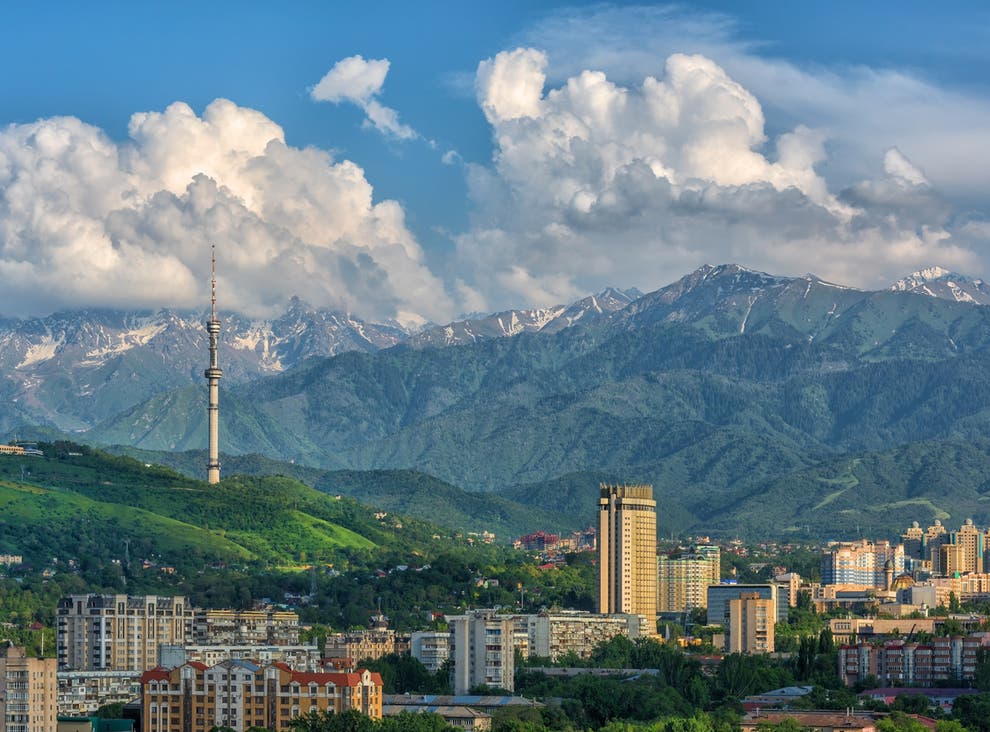
A Pentagon-funded bio-lab near Almaty, Kazakhstan, has become focus of attention for its research on “dangerous pathogens”
BY M. K. BHADRAKUMAR | INDIAN PUNCHLINE | JANUARY 9, 2022
The Kazakh Ministry of Health issued an innocuous disclaimer today denying social media reports about the seizure of a “military biological lab near Almaty by unidentified people.”
According to Tass news agency, the social media had speculated that specialists in chemical protection suits were working near the lab as “a leak of dangerous pathogens” occurred.
The carefully worded press release by the Kazakh ministry clarifies: “This is not true. The facility is being protected.” Period.
The intriguing report highlights the tip of an iceberg which has implications for public health and holds serious geopolitical ramifications.
Since the late 1990s, when it came to be known that the US was steadily establishing and building up partnerships in biological research with several ex-Soviet republics, Moscow has repeatedly alleged that such cooperation posed a threat to Russia.
These biological research facilities were originally envisaged as part of the so-called Nunn-Lugar Biological Threat Reduction Program to prevent the proliferation of expertise, materials, equipment and technologies that could contribute to the development of biological weapons.
But Moscow suspected that the exact opposite was happening — in reality, the Pentagon has been sponsoring, lavishly financing and providing technical assistance to these laboratories where “under the guise of peaceful research, the US is building up its “military-biological potential.”
In a sensational statement in October 2018, Major General Igor Kirillov, the commander of Russia’s Radiological, Chemical and Biological Defense Troops went to the extent of disclosing a discernible pattern of the network of Pentagon labs being located near the borders of Russia and China.
The US-Kazakh partnership in this field dates back to 2003. Kazakhstan has been an interesting “hotspot” for infectious disease occurrence and surveillance due in part to its history, geography, and its diversity of host species. Kazakhstan has long maintained an infrastructure and tiered network for infectious disease surveillance since the time of the Tsars.
The US-funded research projects centred on studies involving select agents including zoonoses: anthrax, plague, tularemia, highly pathogenic avian influenza, brucellosis, etc. These projects funded researchers in Kazakhstan, while project collaborators in the US and UK mentored and guided these researchers to develop and test their hypotheses.
It has been a “win-win” arrangement. The Kazakh institute staff got trained in modern diagnostic and data management techniques, and did research work with lavish external funding, while the Pentagon obtained through such labs valuable inputs for US covert biological weapons programs with military application specifically directed against ethnic groups in Russia and China.
The unassumingly-named Central Reference Laboratory (CRL) in Almaty figuring in the Tass report was originally planned in 2013 with the US investing $102 million in a biosecurity lab to study some of the most deadly pathogens that could potentially be used in bioterrorism attacks.
Rather than locating the new facility in some obsecure tract of land in Nevada, the Pentagon deliberately chose a site near Almaty to securely store and study the highest-risk diseases such as plague, anthrax and cholera.
The rationale was that the lab would provide gainful employment to talented Kazakh researchers and get them off the streets, so to speak — that is, discourage them from selling their scientific expertise and services to terrorist groups who may have use for biological weapons!
But the CRL, now operational, is anchored on institutional cooperation between Kazakh government and the US Defense Threat Reduction Agency under the the Pentagon, which is tasked with protecting “US National Security interests in a rapidly evolving, globalised threat environment to enable a greater understanding of our adversaries and provide solutions to WMD threats in an era of Great Power Competition.”
By the way, Germany also has a similar arrangement under the rubric German-Kazakh Network for Biosafety and Biosecurity, which is co-managed by the Bundeswehr Institute of Microbiology (a military research facility of the German Armed Forces for Medical Biological Defence.)
Why is Kazakhstan a sought-after partner? Simply put, the country provides unique access to ethnic Russian and Chinese groups as “specimen” for conducting field research involving highly pathogenic, potential biological warfare agents. Kazakhstan has 13,364 km of borders with its neighbouring countries Russia, China, Kyrgyzstan, Uzbekistan, and Turkmenistan.
Is China indifferent to all this? Far from it. Beijing Review featured a report sourced from BBC Monitoring in 2020 conveying China’s concerns in the matter. As recently as in November last year, a Russian commentator wrote that these bio-labs are virtual Pentagon bases and demanded an international inquiry. He highlighted that the Kazakh ministry of education and science “now works mainly on Pentagon research programmes.”
How could Kazakhstan, a CSTO member country, have got away with such conduct? This needs some explaining.
Paradoxically, these biological labs are living examples of something sinister that has been going on which everyone knew and no one wanted to talk about — namely, the extensive penetration of the decadent Kazakh ruling elites by the US intelligence.
This penetration has been going on for years but significantly deepened as the 81-year old former president Nurusultan Nazarbayev’s “hands-on” leadership began to loosen and his family members and cronies increasingly began moonlighting (under the patriarch’s benevolent gaze, of course) — something akin to Yeltsin years in Russia.
Sadly, it is a familiar story. The Kazakh elites are notoriously corrupt even by Central Asian standards and the parasitic elites have preferred to keep their loot in safe havens in the western world . Unsurprisingly, they are hopelessly compromised to the US intelligence. It’s as simple as that.
Most certainly, Moscow sensed that popular disaffection was building up and the ground beneath the feet of Nazarbayev, a close friend of Putin, was shifting. But it did not — or more likely, would not — interfere since the US was operating through powerful comprador elements who happened to be the ageing patriarch’s family members and associates.
Given the clan affiliations in that part of the world, Moscow probably felt it prudent to keep its counsel to itself. An added factor would have been the fear that the US might manipulate the ultra-nationalist forces (as happened in Ukraine) to inflict harm on the vulnerable 3.5 million ethnic Russian minority (18% of the population.)
Above all, the fact of the matter is that Nazarbayev cronies held the levers of state power, especially over the security apparatus, which gave Washington a decisive edge.
But things have dramatically changed this past week. Nazarbayev may still have some residual influence but not good enough to rescue the elite who subserved US interests. President Tokayev, a low-profile career diplomat by profession, is finally coming on his own.
Two of Tokayev’s decisive moves have been the replacement of Nazarbayev as the head of the National Security Council and the dismissal of the country’s powerful intelligence chief Karim Masimov (who has since been arrested along with other unidentified suspects as part of a probe into “high treason.”)
Indeed, Washington has much to worry about because, at the end of the day, Kazakhstan remains an unfinished business unless and until a colour revolution can bring about regime change and install a pro-West ruler in power, as in Ukraine. The current turbulence signified an abortive attempt at colour revolution, which boomeranged.
Unlike in Afghanistan, the CIA and Pentagon are not in a position to “evacuate” their collaborators. And the torrential flow of events has shocked the Washington establishment. Kazakhstan is a large country (two-thirds the size of India) and sparsely populated (18 million), and the CSTO forces who moved in are well-equipped and led by a tough seasoned general who crushed the US-backed insurgency in Chechnya.
The Russian forces have taken with them the advanced Leer-3 electronic warfare system, which includes specially configured Orlan-10 drones, jamming devices, etc. Borders have been sealed.
The mandate for Russian forces is to protect “strategic assets”. Presumably, such assets include the Pentagon-funded labs in Kazakhstan.
Neocolonialism haunts Horn of Africa
BY M. K. BHADRAKUMAR | INDIAN PUNCHLINE | JANUARY 5, 2022
Chinese foreign ministers have traditionally marked the new year by visiting the African continent. Wang Yi’s 2022 African tour begins with Eritrea against the backdrop of the US strategy in the Horn of Africa to gain control of the strategically vital Red Sea that connects Indian Ocean with the Suez Canal.
Eritrea and China are close friends. China was a supporter of the Eritrean liberation movement since the 1970s. Eritrean President Isaias Afewerki, the veteran revolutionary who led the independence movement, had received military training in China. More recently, Eritrea was one of the 54 countries backing China’s Hong Kong policy (against 39 voicing concern in a rival Western bloc) at the UN General Assembly in October 2020.
Last November, Eritrea signed an MoU with China to join the Belt And Road Initiative. Neighbouring Djibouti is already a major participant in the BRI. So is Sudan along the Red Sea coastline.
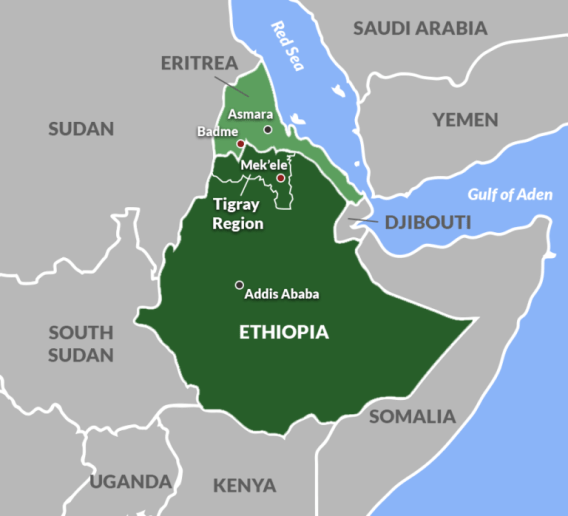
Central to regional cohesion in the Horn of Africa is the relationship between Ethiopia and Eritrea. It has been a conflict-ridden troubled relationship but China, which also has close ties with Ethiopia, is well-placed to meditate reconciliation.
One common view is that Ethiopian Prime Minister Abiy Ahmed pulled off a stunning victory in the conflict with US-backed Tigray Peoples Liberation Front (TPLF) with the help of armed drones supplied by the United Arab Emirates, Turkey and Iran. But civil wars are won on the ground. And the politico-military axis between Ethiopia and Eritrea to take on the TPLF proved to be the decisive factor. China encouraged the rapprochement between Addis Ababa and Asmara.
Effectively, the two leaderships understood that they have a congruence of interests in thwarting the TPLF which is an American proxy to destabilise their countries and trigger regime changes. (Read the analysis in CounterPunch titled Ethiopia Conflict by US Design.)
Washington is mighty displeased that China’s influence in Djibouti is on the rise and resents that the Marxist regime of Isaias Afewerki keeps the US at arm’s length.
The Horn of Africa is of great strategic importance, and Ethiopia sits at its heart. Destabilise Ethiopia and impact the whole region; install a dictatorial expansionist ethnocentric regime (TPLF); sow division and poison the atmosphere of mutual understanding and cooperation that is being built within the region — this is the neocolonial agenda.
President Uhuru of Kenya, speaking at Ethiopian Prime Minister Abiy Ahmed’s inauguration had said, “Ethiopia is the Mother of African independence… for all of us on the continent, Ethiopia is our Mother… As we know, if the Mother is not at peace, the family cannot be at peace.”
The US is going for the jugular veins of the Mother of post-colonial Africa. An analogy would be destabilising India to gain control of the South Asian region, the difference being that Ethiopia is the only African country never to have been colonised.
The widespread revulsion among Afghans all over the continent is palpable over the US using its TPLF proxy to destabilise Ethiopia. Their collective cry is “No more” — no more colonialism, no more sanctions, no more disinformation, no more lies by the CNN, BBC, etc. The cry resonates widely amongst the Ethiopians, Eritreans, Sudanese, Somali, Kenyan, and friends of Ethiopia.
The paradox is, Ethiopia today has a democratically elected government after decades of thuggery under the TPLF that ruled with an iron fist for over 30 years with US backing. The Tigray people actually add up to only 5% of Ethiopia’s population but such details were irrelevant to Washington so long as the government in Addis Ababa obeyed its diktat.
There is also a religious sub-text. The Tigray people are Christians whereas the largest ethnic group in Ethiopia is the Oromo, native to the region of Ethiopia and Kenya. They are a Cushitic people who have inhabited the East and Northeast Africa since at least the early 1st millennium. The Oromo people have a glorious history of forced resistance to religious conversion, primarily by European explorers, Catholic Christians missionaries.
Broadly, the resistance ideology is embedded in the Oromo collective memory. Abiy Ahmed is the first ethnic Oromo to become prime minister. Nobel laureate Abiy Ahmed is an extraordinary politician, far-sighted and deeply committed to his country’s plural identity national sovereignty.
In geopolitical terms, Washington would see many advantages in the destabilisation of Ethiopia as it would trigger a multi-vector regional conflagration, as happens when multi-ethnic nations unravel — such as the former Yugoslavia or today’s India or Russia. And neighbouring countries would be inevitably sucked into ethnic wars such as Sudan, Eritrea, Djibouti, Somalia and Kenya — and even Egypt and Persian Gulf states.
The fact that the UAE, Turkey and Iran — improbable allies — are supporting Abiy’s desperate effort to preserve Ethiopia’s sovereignty and national cohesion and helped boost his military campaign to ward off another attempt by the US-backed TPLF to capture power speaks volumes.
In this matrix, while the US aims to dominate the hugely strategic Horn of Africa, “Plan B” will be to be the spoiler by throwing the region into turmoil so that China is also a loser. The point is, the Western world has no answer to China’s BRI.
China and Ethiopia have a strong political affinity and deep economic bonds, and Ethiopia is one of China’s top five investment destinations on the African continent. Beyond investment, relations extend to trade, infrastructure finance and other areas. Economic engagement with China has provided Ethiopia with many opportunities.
Curiously, even prior to the advent of the BRI, China was already a major financier of Ethiopia’s infrastructure. Chinese investment in the manufacturing sector — incidentally, one of the Abiy government’s focus areas currently — has contributed to the country’s economic transformation and diversification and to job creation.
A recent report by the well-known London-based global think-tank ODI titled The Belt and Road and Chinese Enterprises in Ethiopia estimates that China’s BRI “has the potential to open up new development pathways through infrastructure development, stimulating investment and job creation and promoting economic transformation… BRI can be an engine for growth and development. However, this is not a given…”
The ODI report, dated August 2021, concludes, “Chinese investors are concerned regarding economic and political uncertainty in Ethiopia. Political uncertainty has to do with domestic conflict and political instability, which may affect not only investors’ profitability, but also their personal safety and the safety of their assets. The economic challenges relate to high production and transport costs and the difficulties of accessing foreign exchange, which is a problem for virtually all Chinese businesses in the country. The challenges identified by Chinese investors could pose a threat to the sustained development of China–Ethiopia economic cooperation.”
Simply put, if there is mayhem in Ethiopia, the locomotive of China’s BRI in the vast regions of the Horn of Africa and East Africa can be potentially slowed down if not derailed. That is the least the US can do faced with the grim prospect that it has no alternative offer to make to the African nations to counter the BRI.
If the BRI locomotive chugs along unimpeded, the entire Western neocolonial project in Africa in the 21st century is threatened with extinction. The existential angst shows in the Biden Administration’s announcement on New Year’s Eve terminating Ethiopia’s access to the US duty-free trade program under the U.S. African Growth and Opportunity Act (AGOA “amid the widening conflict in northern Ethiopia.”
President Biden had threatened in November already that Ethiopia would be cut off from the AGOA because of alleged human rights violations in the Tigray region. Biden spoke up in sheer despair in anticipation of Wang Yi’s working visit to Ethiopia on December1!
Russia explains why it vetoed climate change resolution at UN
RT | December 13, 2021
Russia has vetoed a draft UN Security Council (UNSC) resolution, linking climate change to security threats. Russia’s ambassador to the body claimed the document would have set a dangerously one-sided approach to future conflicts.
The UNSC voted on the draft resolution, tabled by temporary members Ireland and Niger, on Monday. The proposal, co-sponsored by over 100 nations, called upon the UN secretary-general to make climate-related risks “a central component” of conflict prevention, while “incorporating information on the security implications of climate change” to make the council “pay due regard to any root causes of conflict or risk multipliers.”
While the draft was supported by the majority of UNSC members, it was vetoed by Russia, with another permanent member, China, abstaining. Among the temporary invitees, India was the only country to vote against the draft. Between them, the three countries are home to close to 40% of the world’s population.
Explaining the decision to sink the resolution, Russia’s Permanent Representative Vassily Nebenzia said the document would have imposed an extremely one-sided perspective to deal with conflicts, while potentially enabling the UNSC to put any country on its agenda under the guise of climate-related issues.
“We object to the creation of a new branch in the council’s work that asserts a generic and an automatic link between climate change and international security, turning a scientific and socio-economic issue into a political issue,” Nebenzia said during the meeting.
The proposed document was effectively “coercing the council to take a one-dimensional approach to conflicts and threats to international peace and security, i.e. through the climate lens,” Russia’s mission said in a separate statement.
We recognize the range of complex and intertwined challenges, including the impact of climate change, natural disasters, poverty, poor local governance that is mostly rooted in the colonial past, and terrorism threats that are an intolerable burden for some countries and regions. All those situations have their own specific characteristics.
The mission also noted that the draft was not actually as universally supported as its sponsors tried to present it, stating that the “penholders of the document were pushing it through without readiness to discuss the root causes of challenges” that the “vulnerable countries” are facing.
“As a responsible member of the United Nations and its Security Council, the Russian Federation along with India and China does not share such an approach imposed by the Western nations that have already made a significant number of countries expecting assistance believe in it,” the mission stressed.
Ireland has already voiced its displeasure over the demise of the draft resolution, with the country’s mission at the UN blasting the veto powers of permanent UNSC members as “an outdated tool, for what we think is an outdated perspective.”
“A historic opportunity to recognize climate change as contributing to conflict has been vetoed for now, but the consensus of international opinion is more than clear,” Ireland’s Foreign Minister Simon Coveney said.
Forget China, was it CEPI’s bio-spooks who locked down the West?
By Paula Jardine | TCW Defending Freedom | December 15, 2021
IT is nearly two years since the world turned upside down and a sequence of unprecedented lockdowns and quarantines in the name of public health and safety were imposed across the West.
The narrative of the still unfolding story of Covid-19 is familiar to all of us, with China the chief bogeyman of the tale. But is that right?
In this drama has something really important been overlooked? Namely, the role of a powerful, self-appointed supranational organisation, set up 2017, called the Coalition for Epidemic Preparedness Innovations (CEPI).
Members of CEPI’s board and scientific advisory committee have been, and still are, key actors in global and national responses to the Covid-19 virus. Its mission? To ‘create a world in which epidemics are no longer a threat to humanity’.
At the start of 2020, all eyes were glued on China. The communist government had dutifully notified the World Health Organisation (WHO) on New Year’s Eve 2019 of its concerns over a small cluster of cases of ‘pneumonia of unknown origin’.
Three weeks later, when the death toll stood at 17, the CCP was sufficiently alarmed to order the home confinement of nearly 12 million mostly healthy people who were unfortunate enough to reside in the outbreak city, Wuhan.
Having fingered as the culprit a relative of the SARS virus that claimed 774 victims in 2003, the Chinese determination to contain the self-evidently nastier 2019 co-variant at all costs was made plain to the world.
The scenes broadcast out of China nightly on the TV news were surreal, but strangely familiar to anyone with a passing familiarity with vintage sci-fi. A nightmare amalgamation of The Andromeda Strain and The Hamburg Syndrome was unfolding in real life, right before our eyes.
Here, a man falling down dead in the street. There, men in white hazmat suits walking through empty Chinese thoroughfares equipped with Ghostbuster-esque backpacks blowing smoke in a desperate attempt to fumigate the invisible peril out of existence.
Knowing that the Queen’s own men at the Porton Down chemical and biological defence establishment long ago discovered that fresh air and sunlight, two commodities already in short supply in Chinese cities, are the most potent of disinfectants, it seemed a strangely futile spectacle. What on Earth were they trying to do? Death apparently lurked around every corner.
As the Wuhan lockdown was being imposed on January 23, 2020, the global elite were busy congregating at their annual networking fest, the World Economic Forum, in Davos, Switzerland (where CEPI had been founded three years earlier by the governments of Norway and India, the Bill & Melinda Gates Foundation, the Wellcome Trust global charity organisation, and the World Economic Forum).
Next day, a little-noticed press conference was convened in Davos to discuss the SARS-like, closely-related, but definitely novel, SARS Wuhan coronavirus.
Appearing in front of about 30 reporters were Sir Jeremy Farrar, Director of the Wellcome Trust and board member of CEPI; Richard Hatchett, chief executive of CEPI, and Stephane Bancel, chief executive of Moderna, one of three companies being funded to develop a coronavirus vaccine. A Chinese reporter asked the panel if there was any historical precedent for the lockdown.
Hatchett said: ‘One thing that is important to understand, is that when you don’t have treatments and you don’t have vaccines, non-pharmaceutical interventions are literally the only thing that you have, and it’s a combination of isolation, containment, infection prevention and control and then these social distancing interventions.
‘There is historical precedent for their use. We looked intensively and did an historical analysis of the use of non-pharmaceutical interventions in US cities in 1918 and what we found was that cities that introduced multiple interventions, early in an epidemic, had much better outcomes.
‘The challenge of course is that it is very difficult to sustain these interventions, as they impose enormous cost and they also can produce enormous anxiety among the affected population.’
The ‘we’ Hatchett was referring to was the US Department of Homeland Security where, as an official, he had helped develop the US pandemic preparedness plan in 2005 and 2006 during the H5N1 avian influenza outbreak, which Farrar had discovered in Vietnam.
Hatchett continued: ‘At that time, we looked at how could you have those interventions implemented in a way that maximised their benefit and minimised the cost and we developed an approach that we called “community mitigation” interventions and CDC (the US Centres for Disease Control and Prevention) published guidance on this several years ago.
‘There is a literature which I would certainly encourage Chinese authorities to review and certainly I would be happy to talk to them about that, although that’s not my current job.’
There was no need to encourage the Chinese authorities to review the literature. CEPI already had a man in Beijing, Dr George Gao, the director of China’s Centre for Disease Control, but also member of the CEPI scientific advisory panel. The community mitigation approach the Chinese adopted in Wuhan was straight out of the 2006 US Homeland Security pandemic playbook.
Gao, like Farrar, completed his PhD at Oxford University before conducting post-doctoral work under Sir John Bell, the controversial Regius Professor of Medicine at Oxford, holder of several extranumerary positions and multiple interests, not least as chair of the global health scientific advisory board of the Bill & Melinda Gates Foundation.
An expert on coronaviruses, Gao served on CEPI’s first scientific advisory committee in 2016 and was a player in Event 201, the pandemic simulation hosted in October 2019 by the World Economic Forum, Bill & Melinda Gates Foundation and the Johns Hopkins Bloomberg School of Health – discussed here by Robert F Kennedy Jr.
In all probability, Gao is the old friend Farrar was referring to when he said on Desert Island Discs that he had had a phone call on December 31, 2019 – the day the Chinese authorities reported the Wuhan pneumonia outbreak to the WHO – to alert him that China would release the genome of the new virus on January 10. As things stood on New Year’s Eve, the virus had yet to cause any deaths, although it was making a few people very ill.
By January 17, another CEPI scientific adviser, Dr Christian Drosten, had conveniently developed a PCR test from the genetic sequence posted online by the Chinese, which the WHO advised laboratories could be used as a diagnostic test for Covid-19.
This was almost two months before the WHO declared the novel coronavirus a pandemic on March 11, 2020. Following a visit to Wuhan by the WHO in February 2020, led by its assistant director-general Dr Bruce Aylward, the world was being encouraged to adopt what were now being called Chinese measures.
‘China didn’t approach this new virus with an old strategy for one disease or another disease,’ said Aylward. ‘It developed its own approach to a new disease and extraordinarily has turned around this disease with strategies most of the world didn’t think would work.’
The Chinese government, with its own Big Brother infrastructure, had its own reasons for going along with that. But the response plan is in reality far more complex, and has a much darker background in the West.
The Yellow Brick Road that passes through CEPI and Beijing leads right back to the US Department of Homeland Security, and its 1998 Pentagon strategy paper.
The response plan is in reality an American scheme, with its origins more than decade and a half earlier and against a backdrop of bioterrorism concerns. Uncle Sam is the wizard behind the curtain, not acting in the West’s interests at all.
Useless Green Energy Hitting The Wall
By Francis Menton | Manhattan Contrarian | October 13, 2021
In the field of litigation settlements, people sometimes talk about a “win, win” scenario — a settlement structure where both sides can get some advantage and simultaneously claim victory. By that criterion, what is “green” energy (aka intermittent wind and solar power)? The public pays hundreds of billions of dollars of subsidies to get the things built, and in return it gets: sudden shortages and soaring prices for coal, oil, gas and electricity; and dramatically reduced reliability of the electrical grid, leading to periodic blackouts and risks of many more of same; and despite it all fossil fuel use doesn’t go down. It’s a “lose, lose, lose.”
As the world comes out of the pandemic and the international economy returns to attempting to fulfill normal consumer demand, you can see green energy hitting the wall pretty much everywhere you look. It’s just a question of which data points you want to collect for a day’s entertainment.
The current energy crisis in Europe and Asia is of course getting next to no coverage in the U.S. media. But over at Bloomberg News they have a big story on October 4. That’s Bloomberg News as in Mike Bloomberg — the man with four private jets and at least ten houses who devotes his public life to hectoring you to cut your “carbon footprint.” But now suddenly the Bloomberg News people seem to have figured out that periodic energy crises are an inevitable consequence of increasing reliance on the undependable wind and sun. The headline of the article is “Global Energy Crisis Is the First of Many in the Green Power Era.” The Bloomberg piece itself is behind paywall, but extensive excerpts can be found at Climate Depot, where they call it a “moment of clarity”:
The next several decades could see more periods of energy-driven inflation, fuel shortages and lost economic growth as electricity supplies are left vulnerable to shocks.. . . . The world is living through the first major energy crisis of the clean-power transition. It won’t be the last. . . . Wind and solar power production have soared in the last decade. But both renewable sources are notoriously fickle — available at some times and not at others. And electricity, unlike gas or coal, is difficult to store in meaningful quantities. That’s a problem, because on the electrical grid, supply and demand must be constantly, perfectly balanced. Throw that balance out of whack, and blackouts result.
No kidding.
Meanwhile, the latest place to get hit with blackouts due to an unreliable grid is China. (Previous rounds of blackouts traceable to over-reliance on unreliable wind and/or solar power have hit South Australia in 2016, California in 2020, and Texas in February this year.). From the New York Times, September 27:
Power cuts and even blackouts have slowed or closed factories across China in recent days, adding a new threat to the country’s slowing economy and potentially further snarling global supply chains ahead of the busy Christmas shopping season in the West. The outages have rippled across most of eastern China, where the bulk of the population lives and works.
But didn’t the same New York Times just tell us on October 8 that China is “the world leader” in both solar power and wind power? Somehow, neither of those seems to help when electricity demand suddenly ramps up. Just yesterday the Guardian reported that the recent power chaos is causing China to re-emphasize what they call “energy security,” which the Guardian takes to mean fossil fuels, particularly coal:
China plans to build more coal-fired power plants and has hinted that it will rethink its timetable to slash emissions. . . . In a statement after a meeting of Beijing’s National Energy Commission, the Chinese premier, Li Keqiang, stressed the importance of regular energy supply, after swathes of the country were plunged into darkness by rolling blackouts that hit factories and homes. While China has published plans to reach peak carbon emissions by 2030, the statement hinted that the energy crisis had led the Communist party to rethink the timing of this ambition, with a new “phased timetable and roadmap for peaking carbon emissions”. . . . “Energy security should be the premise on which a modern energy system is built and and the capacity for energy self-supply should be enhanced,” the statement said.
Over in the UK, somebody has now finally taken the time to do a calculation of how much it would cost to provide sufficient battery storage to get the country through an extended (ten day) period of dark and calm in the winter, assuming a grid relying 100% on wind and solar generation. The calculation has been made by Professors Peter Edwards and Peter Dobson of Oxford University, and Gari Owen of Annwvyn Solutions, on behalf of Net Zero Watch, which is a project of the Global Warming Policy Foundation. (Full disclosure: I serve on the board of the American affiliate of this organization.). The answer that Edwards, Dobson and Owen come up with is approximately 3 trillion British pounds. For comparison, UK GDP in 2020 was just under 2 trillion British pounds. And if you look at the Edwards/Dobson/Owen calculation, you will realize that they assume zero loss of energy on the round trip into and out of the batteries. That’s rather a favorable assumption, given that in practice an all-wind-and-solar system would need to store power all the way from the summer to the winter. What percentage of your cell phone’s battery charge is left if you leave the device unplugged on the shelf for six months? But then, it’s all fantasy anyway, so what does it matter?
And finally, the Department of Energy’s Energy Information Agency has just (October 6) come out with its annual International Energy Outlook. This is the sage projection of our wisest gurus of how the production and consumption of energy will change over the three decades from now until 2050. Surely then these guys will show us how the world will achieve the true path to Net Zero carbon emissions within that time frame, if not much sooner.
OK, then, here is the key chart:
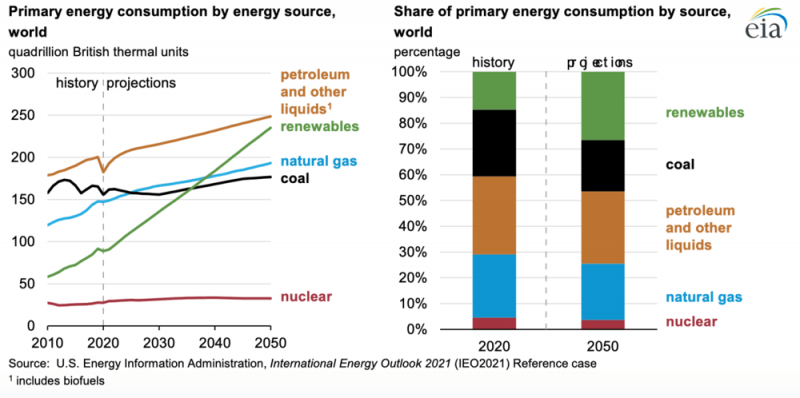
Wait a minute! Could they really be saying that, rather than being on a path to oblivion, all major fossil fuel categories (petroleum, natural gas and coal) will continue to see increased usage right on through 2050, and with no indication that any decline will have begun even then? Yes, that is exactly what they are saying. Indeed the projected increases in consumption of two of those fuels are quite dramatic — up in the range of 50% for natural gas and 40% for petroleum. Yes, so-called “renewables” are projected to increase dramatically; but after thirty years of this, they will still, according to EIA, provide only about 25% of “primary energy consumption,” which is less than petroleum alone, and barely a third of the combined contribution of petroleum, natural gas and coal.
But don’t worry, prices for gasoline and electricity will increase by a multiple, and we’ll have regular blackouts.
Whatever China is doing in Tajikistan, it’s wrong to compare it to American imperialism
By Bradley Blankenship | RT | October 29, 2021
Reports of China building a military base in the Central Asian country of Tajikistan are causing unease in Washington. But it’s wrong to assume Beijing is embarking on the sort of empire-building we expect from the United States.
Earlier this week, reports from Radio Free Europe/Radio Liberty suggested that Tajikistan had approved the construction of a new Chinese military base on its soil. Separately, the same US government-controlled media outlet claims that the Tajik government offered full control to Beijing of what was said to be an already-in-use Chinese military base, and has pledged to waive future rent in exchange for Chinese military aid.
Neither China nor Tajikistan has officially confirmed this news, and there is good reason to believe the US may be exaggerating these claims in order to raise the alarm on some kind of renegade Chinese militarism.
Earlier this month, a report was leaked to the Financial Times from anonymous US government sources claiming that China had tested an orbital hypersonic missile capable of carrying a nuclear warhead, apparently able to travel around the world. Beijing denied this report, saying it had actually tested a reusable orbital space vehicle.
Chinese media were also quick to respond, with CGTN suggesting the US was trying to create a kind of ‘Sputnik moment’ to ramp up anti-China hysteria, referring to when the Soviet Union launched the world’s first artificial satellite in 1957, causing great concern in Washington and beginning the space race.
And indeed General Mark Milley, chairman of the US Joint Chiefs of Staff, went public with that very suggestion, saying on Bloomberg that this alleged weapon test was “close to” a Sputnik moment. Are US cold war tactics really so predictable?
The answer is yes, and the same can also be applied to this latest development in Tajikistan. Even if the news is true, it does not in any way suggest what the US government is insinuating – that China is becoming an overly ambitious, hostile power.
For one, Tajikistan, believed to have the weakest military in Central Asia, is worried about its security after the American-led retreat from Afghanistan and the return of the Taliban. If China was to increase its involvement this would not be surprising, since other powerful countries in the region, such as Russia, have also been called on by the Tajik government to assist on security matters.
The likelihood of a war between Tajikistan and Afghanistan is low, despite Tajik President Emomali Rahmon’s hardline stance against the Taliban and rumors that his government is interfering in Kabul’s internal affairs. He has repeatedly said that his government will not recognize Taliban rule in Afghanistan due to concerns over human rights.
While this may just be political posturing from Rahmon, evidenced by his strong invocation of Afghanistan’s Tajik minority, Chinese security involvement in Tajikistan could serve as a moderating influence between the two sides, since Beijing has high-level contact with the interim Afghan government.
China also has legitimate concerns for its own security and that of its Belt and Road Initiative (BRI) in relation to Afghanistan, since it shares a border with the country.
There are at least three terrorist groups in Afghanistan and Pakistan – the Balochistan Liberation Army, Tehreek e-Taliban Pakistan, and Islamic State Khorasan – that are explicitly anti-Chinese and, in the case of the former two, have committed acts of terror against Chinese diplomats.
The latter two of these groups have also expressed support for Uighur extremist groups in China, like the Turkistan Islamic Party, which has drawn serious concern from Beijing as it seeks to cool down ethnic tensions in Xinjiang Uighur Autonomous Region.
These concerns are valid, and so what we are seeing is not some far-flung overextension of China’s military presence, as is the working definition of ‘security’ for the US. Discounting these unconfirmed reports in Tajikistan, China has only one foreign military base, in Djibouti, compared to upwards of 750 operated by the US – including some 400 in China’s neighborhood alone.
Washington commentators have consistently blasted out a message that China will end up the next empire to die in Afghanistan, suggesting that Beijing would actually make the same ridiculous mistakes that they did over the past 20 years in Afghanistan. This is nonsense. Unlike Washington, Beijing has pursued a multilateral framework with Afghanistan that welcomes input from every regional country, including high-level discussion through the Shanghai Cooperation Organisation, a Eurasian regional security pact, and the SCO-Afghanistan contact group.
China will also not bomb Afghanistan to the Stone Age and construct a foreign-dependent warlord economy, instead opting to include Afghanistan in the BRI, meaning Beijing will help plug Kabul into an interconnected future in Eurasia – all without political strings attached. That’s because it’s a win-win situation for China, Afghanistan, Central Asia, and the world.
And if this might sound hard to believe? Well, it’s not. You would be hard-pressed to find any example of a Chinese war of aggression in modern history, because such an example doesn’t exist. On the other hand, there are examples of China helping clean up messes created by the US and its allies, including in Europe.
For instance, look at China’s involvement in the Balkans – particularly in Serbia, where at least one US-sponsored think tank, the Center for Strategic and International Studies (CSIS), now accuses the country of being a puppet for Beijing. But here’s the reality: NATO tore Serbia apart during the Yugoslav wars and used so much depleted uranium in airstrikes against Serbia in 1999 – about 15 tons – that the country has the highest cancer mortality rate in Europe.
On the contrary, the report by the CSIS notes that 40 percent of Serbians think China gives the most aid to the country – in terms of dollars – even though the European Union actually does.
Instead of spending billions on “government and civil society” programs (foreign interference, in other words) like the US and EU, in 2019 in Serbia, Beijing focused 31 percent of its investments toward transportation, 20 percent to information and communications technology, 20 percent to manufacturing, 13 percent to energy, and nine percent to health and human services.
These are, as the CSIS notes, highly visible and consequential sectors – and, I would add, the ones that Serbia obviously needs the most after the devastation brought on by the NATO bombing. Belgrade’s Pupin Bridge, built by the Chinese – one of its two major bridges that cross the Danube – serves as a permanent reminder of how important China’s aid to Serbia has been.
So, when considering an extended Chinese influence in Central Asia, in whatever form that takes, there’s no reason to conflate this in any way with US imperialism and its deleterious effects.
Bradley Blankenship is a Prague-based American journalist, columnist and political commentator. He has a syndicated column at CGTN and is a freelance reporter for international news agencies including Xinhua News Agency.
Featured Video

The Truth About the Trump Shootings with Ken Silva
or go to
Aletho News Archives – Video-Images
From the Archives
Trans ‘milk’ as good as the real thing – NHS
RT | February 18, 2024
The drug-induced nipple secretions of trans women are as good as mothers’ breast milk for babies, the University of Sussex Hospitals NHS Trust claimed in a letter to campaigners made public in a report by British think tank the Policy Exchange on Sunday.
The healthcare trust’s medical director, Rachel James, argued that the off-label prescription drug cocktail men transitioning to female take in order to produce milk was “similar to the natural hormones which encourage lactation to develop when the baby is newly born.”
“The evidence which is available demonstrates that the milk is comparable to that produced following the birth of a baby,” James wrote in the letter, sent to Children of Transitioners last August.
Biological men who wish to lactate must first take hormones to grow milk glands and then take high doses of either domperidone or metoclopramide to stimulate milk production. Neither drug is approved for this use, though they are occasionally prescribed off-label to biological women who have trouble lactating.
However, domperidone’s own manufacturer, Janssen, warns patients the drug “may cause unwanted side effects affecting the heart in a breastfed baby” and “should be used during breastfeeding only if your physician considers this clearly necessary.” … continue
Blog Roll
 Aletho News
- Russia Voted Under Fire. Washington Is Loading the Tankers.
- 12 Things Your Oncologist Was Trained Not to Tell You
- Anthrax Attacks Paved Way for COVID-Era ‘Junk Drugs and Vaccines’
- How Real Is the Impact of Western Sanctions on Israel?
- France, You Are Guilty: How Paris Turned Western Sahara into the Maghreb’s Powder Keg
- 2025 Nature Paper Claiming Worsening Global Drought Gets RETRACTED …Heavily Flawed
- Your Milk Is Not the Problem
- The Truth About the Trump Shootings with Ken Silva
- ARE PATIENTS BEING PROPERLY INFORMED ABOUT OZEMPIC?
- US lawmaker blocks $2.8 billion weapons sale to Israel: Report
- If Americans Knew
- Salah Sarsour’s Legal Team Says DHS Has Not Met Its Burden to Prove He Is Deportable
- An analysis of tax forms by The Intercept show Kraft’s charity and LLC have donated to Friends of the IDF and AIPAC’s super PAC.
- Israeli attacks kill four Palestinians in Gaza – Daily Update
- Inside Gaza’s death trap of collapsing, bombed-out buildings
- The everyday items Israel bans from Gaza every day
- Inside the siege, the ruined buildings of Gaza – Daily Update
- Debunking The Claim That Macklemore Has A “History Of Antisemitism”
- CPJ demands release of arrested Palestinian-US journalist near Bethlehem
- Robert Kraft: The Billionaire Friend of Netanyahu Pulling The Strings Behind the Macklemore/Ed Sheeran Blow Up
- Columbia Administered Fund Gives Big Money to Pro-Israel Groups
- No Tricks Zone
- 2025 Nature Paper Claiming Worsening Global Drought Gets RETRACTED …Heavily Flawed
- New Study: ‘Global Drought Shows No Detectable Recent Acceleration Under Climate Warming’
- Economic Masterminds: German Socialists Suggest Taxing Productivity Gains Stemming From Using AI
- The South China Sea Has Not Been Cooperating With The Climate Change Narrative
- Energy Crisis: Germany Enters Heating Season With Historically Low Gas Reserve Fill Levels
- New Study: The Antarctic Ice Sheet Gained Mass From 2020-2024 Due To Staggering Snow And Ice Accumulation
- Study: Ocean Heating Rates From Thousands Of Years Ago ‘Dwarf’ Modern Ocean Heating Rates
- Climate Extremists Target, Attack Large-Scale Power Grid Infrastructure In Germany!
- New Study: Antarctic Ice Melt Has Contributed Less Than 1 Centimeter To Sea Level Rise In The Last 30 Years
- Fear Of Debate: Alarmist German Climate Scientist Calls On Mainstream Media To Discredit Skeptic Voices
 Aletho News