Creating New Enemies
BY PHILIP GIRALDI • UNZ REVIEW • MARCH 1, 2022
It should come as no surprise that many observers, from various political perspectives, are beginning to note that there is something seriously disconnected in the fumbling foreign policy of the United States. The evacuation failure in Afghanistan shattered the already waning self-confidence of the American political elite and the continuing on-again off-again negotiations that were by design intended to go nowhere with Iran and Russia provide no evidence that anyone in the White House is really focused on protecting American interests. Now we have an actual shooting war in Ukraine as a result, a conflict that might easily escalate if Washington continues to send the wrong signals to Moscow.
To cite only one example of how outside influences distort policy, in a phone call on February 9th, Israeli Prime Minister Naftali Bennett advised President Joe Biden not to enter into any non-proliferation agreement with Iran. Biden was non-committal even though it is an actual American interest to come to an agreement, but instead he indicated that as far as the US is concerned, Israel could exercise “freedom of action” when dealing with the Iranians. With that concession has ended in all probability the only possible diplomatic success that the Administration might have been able to point to.
The Biden Administration’s by default global security policy is currently reduced to what some critics have described as “encirclement and containment.” That is why an overstretched US military is being tasked with creating ever more bases worldwide in an effort to counter perceived “enemies” who often are only exercising their own national sovereignty and right to security within their own zones of influence. Ironically, when nations balk at submitting to Washington’s control, they are frequently described as “aggressors” and “anti-democratic,” the language that has most particularly been used relating to Russia. The Biden policy, such as it actually exists, appears to be a throwback to the playing field in 1991-2 when the Soviet empire collapsed. It is all about maintaining the old American dream of complete global dominance coupled with liberal interventionism, but this time around the US lacks both the resources and the national will to continue in the effort. Hopefully the White House will understand that to do nothing is better than to make empty threats.
Meanwhile, as the situation continues to erode, it is becoming more and more obvious that the twin crises that have been developing over Ukraine and Taiwan are “Made in Washington” and are somewhat inexplicable as the US does not have a compelling national interest that would justify threats to “leave on the table” military options as a possible response. The Administration has yet again responded to Russian moves by initiating devastating sanctions. But Russia also has unconventional weapons in its arsenal. It can, for starters, shift focus away from Ukraine by intervening much more actively in support of Syria and Iran in the Middle East, disrupting feeble American attempts to manage that region to benefit Israel.
According to economists, Russia has also been effectively sanction-proofing its economy and is capable of selective reverse-sanctioning of countries that support an American initiative with any enthusiasm. Such a response would likely hurt the Europeans much more than it would damage the leadership in the Kremlin. Barring Russian gas from Europe by shutting down Nord Stream 2 would, for example, permit increased sales to China and elsewhere in Asia and would inflict more pain on the Europeans than on Moscow. Shipping US supplied liquid gas to Europe would, for example, cost more than twice the going rate being offered by the Kremlin and would also be less reliable. The European NATO members are clearly nervous and not fully behind the US agenda on Ukraine, largely because there is the legitimate concern that any and possibly all options being considered by Washington could easily produce missteps that would escalate into a nuclear exchange that would be catastrophic for all parties involved.
Apart from the real immediate danger to be derived from the fighting currently taking place in Ukraine, the real long-term damage is strategic. The Joe Biden Administration has adroitly maneuvered itself into a corner while America’s two principal adversaries Russia and China have drawn closer together to form something like a defensive as well as economic relationship that will be dedicated to reducing and eventually eliminating Washington’s assumed role as the global hegemon and rules enforcer.
In a recent article in the New Yorker foreign affairs commentator Robin Wright, who might reasonably described as a “hawk,” declares the new development to be “Russia and China Unveil[ing] a Pact Against America and the West.” And she is not alone in ringing the alarm bell, with former Donald Trump National Security Council (NSC) Russia watcher Fiona Hill warning that the Kremlin’s intention is to force the United States out of Europe while former NSC Ukrainian expert Alexander Vindman is advising that military force be used to deter Russia now before it is too late.
Wright provides the most serious analysis of the new developments. She argues that “Vladimir Putin and Xi Jinping, the two most powerful autocrats, challenge the current political and military order.” She describes how, in a meeting between the two leaders before the Beijing Olympics, they cited an “agreement that also challenges the United States as a global power, NATO as a cornerstone of international security, and liberal democracy as a model for the world.” They pledged that there would be “No ‘forbidden’ areas of cooperation” and a written statement that was subsequently produced declared that “Russia and China stand against attempts by external forces to undermine security and stability in their common adjacent regions, intend to counter interference by outside forces in the internal affairs of sovereign countries under any pretext, oppose color revolutions, and will increase cooperation.” Wright notes that there is considerable strength behind the agreement, “As two nuclear-armed countries that span Europe and Asia, the more muscular alignment between Russia and China could be a game changer militarily and diplomatically.” One might add that China now has the world’s largest economy and Russia has a highly developed military deploying new hypersonic missiles that would give it the advantage in any conflict with NATO and the US. Both Russia and China, if attacked, would also benefit because they would be fighting close to their bases on interior lines.
And, of course, not everyone agrees that nudging the United States out of its self-proclaimed hegemonic role would be a bad thing. Former British diplomat Alastair Crooke argues that there will be a perpetual state of crisis in the international order until a new system emerges from the status quo that ended the Cold War, and it would be minus the United States as the semi-official transnational rules maker and arbiter. He observes that “The crux of Russia’s complaints about its eroding security have little to do with Ukraine per se but are rooted in the Washington hawks’ obsession with Russia, and their desire to cut Putin (and Russia) down to size – an aim which has been the hallmark of US policy since the Yeltsin years. The Victoria Nuland clique could never accept Russia rising to become a significant power in Europe – possibly eclipsing the US control over Europe.”
What is happening in Europe and Asia should all come down to a very simple realization about the limits of power: America has no business in risking a nuclear war with Russia over Ukraine or with China over Taiwan. The United States has been fighting much of the world for over two decades, impoverishing itself and killing millions in avoidable wars starting with Iraq and Afghanistan. The US government is cynically exploiting memories of old Cold War enemy Russia to create a false narrative that goes something like this: “If we don’t stop them over there, they will be in New Jersey next week.” It is all nonsense. And besides, who made the US the sole arbiter of international relations? It is past time Americans started asking what kind of international order is it that lets the United States determine what other nations can and cannot do.
Worst of all, the bloodshed in Ukraine has all been unnecessary. A little real diplomacy with honest negotiators weighing up real interests could easily have come to acceptable solutions for all parties involved. It is indeed ironic that the burning desire to go to war with Russia demonstrated in the New York Times and Washington Post as well as on Capitol Hill has in fact created a real formidable enemy, tying Russia and China together in an alliance due to their frustration at dealing with a Biden Administration that never seems to know what it is doing or where it wants to go.
Philip M. Giraldi, Ph.D., is Executive Director of the Council for the National Interest, a 501(c)3 tax deductible educational foundation (Federal ID Number #52-1739023) that seeks a more interests-based U.S. foreign policy in the Middle East. Website is councilforthenationalinterest.org, address is P.O. Box 2157, Purcellville VA 20134 and its email is inform@cnionline.org.
Chinese embassy points to ‘real threat to the world’
RT | February 27, 2022
Chinese diplomats have published a list of US military adventures in recent decades, arguing that Washington was the “real threat” to the world, as the EU, the US, the UK, NATO, and the UN chief have all accused Moscow of an “unprovoked” attack on Ukraine.
The Chinese embassy in Russia on Saturday reposted an image originally shared by China’s Foreign Ministry spokesperson Lijian Zhao earlier this week showcasing the United States’ “Democracy World Tour.” Listing many of the incidents where the US had either bombed or invaded other countries since the end of the Second World War, the image noted that these nations represented “roughly one-third of the people on earth.”
“Never forget who’s the real threat to the world,” Zhao captioned the photo. The embassy added the same caption to its post, but in Russian.

The embassy went on to point out that 81% of wars between 1945 and 2001 were launched by the US, accusing Washington of “pouring oil” on the conflict in Ukraine.
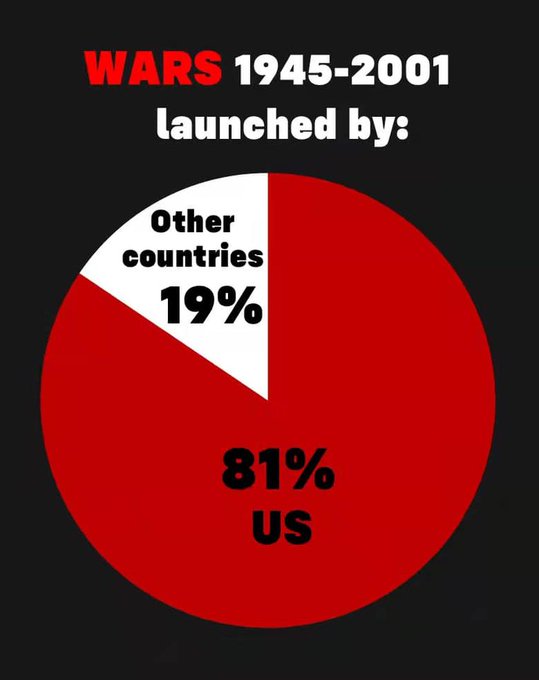
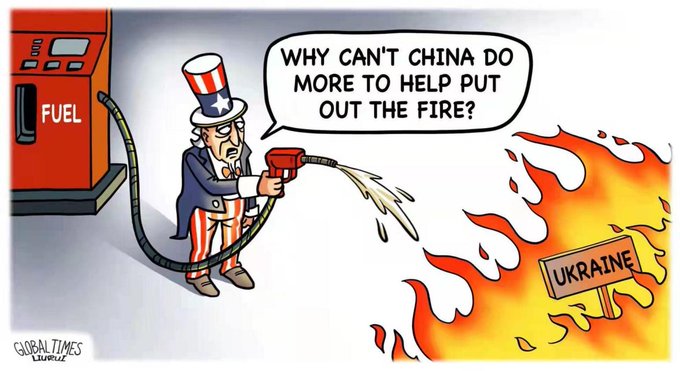
On Saturday, Zhao took yet another swipe at Washington with an image listing “bomb attacks, sabotage, attempted regime change” by Washington. The diplomat accompanied the post with a hashtag #NeverForget.
China was one of the three nations that abstained from the voting on a United Nations resolution condemning Russia’s “aggression” against Ukraine after it was vetoed by Russia. The resolution demanded the immediate withdrawal of troops engaged in the Kremlin’s “special military operation” in Ukraine. Bloomberg reported on Saturday that at least two of China’s largest state-controlled banks limited financing to purchase raw materials from Russia, reportedly out of concern about US sanctions.
Russia’s space agency responds to Western sanctions
RT | February 26, 2022
Roscosmos will cease work on joint space projects with Europe and the United States and instead seek cooperation with China, the head of the Russian space agency Dmitry Rogozin announced on Saturday.
Rogozin told Tass news agency on Saturday that he had given his team an order to start negotiations with Beijing on coordination and mutual technical support of all deep space missions, including the ‘Venera-D’ project, the first Russian mission to Venus since Soviet times.
“Under the conditions of sanctions, US participation in the project is impossible,” Rogozin said.
Earlier on Saturday, Rogozin also announced the suspension of cooperation with European partners on launches from the Kourou spaceport in French Guiana.
In a tweet, Rogozin said Roscosmos was suspending the cooperation in light of new sanctions and “recalling its technical staff, including the launch team.”
The European Space Agency (ESA) has been using the Russian-made Soyuz rockets to send some of its satellites into orbit. Kourou’s proximity to the equator makes it an ideal place for space launches.
NASA said on Friday, however, that despite new sanctions and export controls imposed on Moscow it would continue working with Roscosmos on the operation of the International Space Station (ISS).
The West has implemented a harsh new wave of sanctions on Russia following its military attack on Ukraine, with restrictions varying from banning operations of Russian banks and companies to airspace closures, the suspension of visas, and personal sanctions aimed at President Vladimir Putin and Foreign Minister Sergey Lavrov.
US President Joe Biden said on Thursday that restrictions slapped on Moscow would “degrade their aerospace industry, including their space program.”
Russia insists that its offensive in Ukraine was its only option to protect the Donetsk and Lugansk People’s Republics, which it recognizes as independent states, and to ensure that Russia would not be put under threat by NATO from Ukrainian territory. Moscow is now working on retaliation measures. Earlier on Saturday, Putin’s spokesperson Dmitry Peskov said that analysis and coordination of efforts between various agencies would be required to provide a response which “would best serve” Russia’s interests.
China points finger over Ukraine offensive
RT | February 24, 2022
China has blamed the US for creating the tensions which led to Thursday’s Russian attack on Ukraine. Beijing further called on the international community to avoid “stoking panic” over the situation.
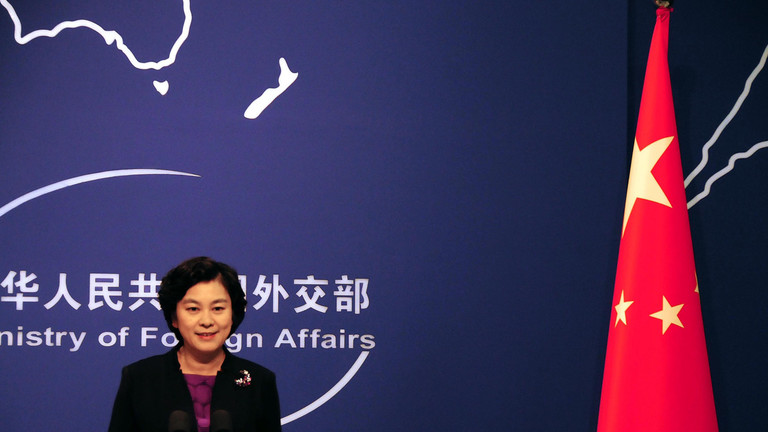
During a press briefing, China’s Foreign Ministry spokeswoman Hua Chunying said the key question was the role played by the Americans, whom she branded “the [main] culprit of current tensions.”
“If someone keeps pouring oil on the flames while accusing others of not doing their best to put out the fire, such kind of behavior is clearly irresponsible and immoral,” Hua said. China objects to “any action that hypes up war,” she added.
Chunying accused the US of hypocrisy, asking whether Washington had respected the sovereignty and territorial integrity of Iraq and Afghanistan, where she said it had “wantonly killed innocent people.” She called on the US to “take these questions seriously and abandon double standards.”
Describing the unfolding events as “complex,” the spokeswoman confirmed that Beijing was not providing military support to Russia, and said China was not “jumping to any conclusions” over the situation.
She called on all sides to “work for peace instead of increasing tensions” or “stoking panic.”
Russian President Vladimir Putin launched a military attack on Ukraine on Thursday, which he said was aimed at demilitarizing and “denazifying” the country. He accused the West of flooding Ukraine with advanced weaponry and ramping up the NATO presence in the country, arguing that the Russian “special operation” was necessary to protect the Donetsk and Lugansk People’s Republics, which Moscow has recognized as sovereign states.
Russia’s military action has prompted an international outcry and threats of new, large-scale sanctions. Ukrainian President Volodymyr Zelensky announced on Thursday that Kiev had cut diplomatic ties with Moscow.
The Chinese Defeated the US Army in 1950
Tales of the American Empire | February 18, 2022
Korea is often called the “Forgotten War” mostly because American Generals want it forgotten. In late 1950, the Chinese Army intervened and routed the US Army. Most blame falls upon the overall commander, General Douglas MacArthur. He was certain that American air power could destroy Chinese armies. However, the Chinese had years of experience fighting the Japanese and developed tactics to evade aerial attacks. As a result, American units were outmaneuvered and defeated in several large battles by Chinese forces of similar size.
US Army X Corps Commander Lt. General Almond told officers of one regiment: “We’re still attacking and we’re going all the way to the Yalu. Don’t let a bunch of Chinese laundrymen stop you.” That regiment was overrun a few days later, by Chinese laundrymen. A US Army historian noted: “General Willoughby [MacArthur’s Chief of Staff] asserted that a Chinese intervention was highly unlikely but that if it occurred the Chinese would suffer massive casualties to UN air power. This optimism colored the plans and ideas of all subordinate commands. At the start of the massive Chinese intervention, the X Corps staff at first tried to ignore it or downplay its effect on the corps’ offensive plans. In response to the new guidance and in an attempt to react to the rapidly changing situation for which they had no contingency plans.”
___________________________________
“United States Army in the Korean War”; James F. Schnabel; U.S. Army Center of Military History; 1992; https://history.army.mil/books/P&D.HTM
“The Chinese Intervention”; The Korean war; US Army Center of Military History; https://history.army.mil/brochures/kw…
“MacArthur’s Grand Delusion”; David Halberstam; Vanity Fair; September 24, 2007; https://www.vanityfair.com/news/2007/…
“Staff Operations: The X Corps in Korea, December 1950”; Richard Stewart; U.S. Army Command and General Staff College; 1951; https://apps.dtic.mil/sti/pdfs/ADA244…
Related Tale: “MacArthur’s Plot for War with China”; https://www.youtube.com/watch?v=OzF8G…
Related Tale: “The American Empire’s Disastrous Defeat in 1942”; https://www.youtube.com/watch?v=cG1yL…
Joe Biden Regime One Year On… America Is Back, With More Aggression Than Ever
Biden hasn’t started a war yet. But he’s still got three years to go and the first one fills the outlook with dread.
By Finian Cunningham | Strategic Culture Foundation | February 19, 2022
This weekend marks Joe Biden’s first year in office since his inauguration on January 20, 2021, as 46th president of the United States. In that time, it’s quite staggering how rapidly relations have deteriorated between the U.S. and Russia on the one hand and China on the other.
Right now, Europe is on the cusp of a war breaking out between a U.S.-backed regime in Ukraine and Russia. The volatile situation has the potential to drag the U.S. and other NATO powers into a proxy war with Russia, if not a full-blown international military conflict that could escalate into a nuclear conflagration.
Washington’s baleful relations with Beijing have been eclipsed by the recent stand-off with Russia. But make no mistake, U.S.-China tensions have also been heightened with the attendant risk of war. Much of the tension has been increased by the Biden administration’s provocations towards China over the breakaway island province of Taiwan. Under Biden, U.S. arms sales to Taiwan have burgeoned as have the large-scale maneuvers of American military forces near Chinese territory – in the name of “freedom of navigation”.
Let’s rewind to Biden’s inauguration on that cold, sunny day of January 20 last year. There was the usual jamboree that often accompanies a new Democrat president. We saw it when Bill Clinton and Barack Obama were installed in the White House. Likewise, with Biden’s tenure, there were expectations of a more professional president, a more multilateral president, a more proficient president on foreign policy, and, dare we say, a more refined and law-abiding president. As usual, there was rosy rhetoric about how Biden would recover America’s international image that had been tarnished under his boorish predecessor, Donald Trump.
Biden declared over and over again that “America was back” as he took office. European leaders swooned at the prospect of again having an American ally who respected them. The expectation was that the “adults were back in control” of U.S. policy (whatever that’s supposed to mean) and that the feathers ruffled by Trump would be smoothed.
Strategic Culture Foundation can take pride in not having bought into any of the wishful thinking regarding a Biden administration. We predicted in several articles at an early stage of his presidency that international relations would take a serious turn for the worse under Joseph Robinette Biden Jr.
Take, for example, this interview on November 23, 2020, with Christopher Black. It was headlined: “A Biden Administration Will Be Dominated by More U.S. Aggression”. It predicted that the world “would see more intensified militarism and aggression under a Joe Biden presidency than under the outgoing Trump administration.”
Another observation in the same interview was “the Biden administration will be bent on war… in particular against Russia and China… we can expect U.S. provocations to accelerate.”
See also our weekly editorial on January 22, 2021, entitled: “President Biden’s New Administration, Old Aggression”.
In a subsequent column, on January 28, 2021, Strategic Culture Foundation highlighted how the Biden administration would ramp up efforts to sabotage the Nord Stream 2 gas project between Russia and the European Union. This unspoken objective has come to a head in the present crisis over Ukraine. It is driving the geopolitical dynamics behind the conflict between the U.S. and Russia, as explained in a later SCF article published on June 8, 2021, – some five months before the crisis erupted in Western media coverage.
Virtually every U.S. president has gone to war or overseen some form of criminal foreign aggression. Barack Obama – the “hope and change president” went on to unleash American wars and bombing in seven countries. Obama’s vice president was Joe Biden who owns some of the past criminality. Donald Trump didn’t start any new American wars but he too was up to his neck in waging aggression abroad.
Republican and Democrat presidents are all the same. They are tools of U.S. imperialism.
So far, Biden hasn’t actually started a new war. He has continued some of the existing militarism. And if he keeps going in the same mode, a war against either Russia or China or both is a “distinct possibility” to use Biden’s words this week about an alleged Russian invasion of Ukraine.
Underpinning the intensified aggression under Biden is the objective historic condition of failing U.S. imperial power. This has nothing to do with whether the president is Democrat or Republican. From the early post-Cold War years we had the Wolfowitz Doctrine, coined under a Republican president as it happened, that set out the objective of staving off U.S. imperial decline and in particular staving off the challenge to U.S. power from a resurgent Russia or an ascendant China.
Under prevailing U.S. establishment politics and the national security state, the Cold War policy against Russia and China would inevitably continue. American power relies fundamentally and intrinsically on confrontation with perceived rivals who must be treated as enemies to be subjugated.
It just so happens that Biden and his administration are more in tune with the U.S. political establishment and the national security state than, for example, the maverick egomaniac Trump. That’s why there has been a more determined and discernible deterioration in U.S. relations with Russia and China over the last year.
Biden hasn’t started a war yet. But he’s still got three years to go and the first one fills the outlook with dread.
One final note: Strategic Culture Foundation has come under fire from the U.S. authorities who have banned America-based writers from publishing articles in our journal. The U.S. government accuses SCF of being an agent of Russian foreign intelligence. See this recent hit-job on ABC news which cites some of our headlines without providing links to the articles. SCF is not an agent of the Russian government. It is an independent journalistic forum for analysis and comment. The prescience of our articles cited above on exposing the criminality of U.S. imperial power would suggest that is the real reason why SCF is being targeted with American slander and sanctions.
The War Party Wants a New Cold War, and the Money That Comes with It
By Ryan McMaken | Mises Wire | February 12, 2022
In perhaps the most predictable column of the year, the Wall Street Journal this week featured a column by Walter Russell Mead declaring it’s “Time to Increase Defense Spending.”
Using the Beijing Olympics and the potential Ukraine war to push for funneling ever more taxpayer dollars into military spending, Mead outlines how military spending ought to be raised to match the sort of spending not seen since the hot days of the Cold War.
Mead claims that “[t]he world has changed, and American policy must change with it.” The presumption here is that the status quo is one of declining military spending, in which Americans have embraced some sort of isolationist foreign policy. But the reality doesn’t reflect that claim at all. The status quo is really one of very high levels of military spending, and even outright growth in most years. This sort of gaslighting by military hawks is right up there with left-wing attempts to portray the modern economy as one of unregulated laissez-faire.

Rather, according to estimates from the White House’s Office of Management and Budget, military spending is set to reach a post–World War II high in 2022, rising to more than $1.1 trillion. That includes $770 billion spent on the Pentagon plus nuclear arms and related spending. Also included is current spending on veterans. Keeping veteran spending apart from defense spending is a convenient and sneaky political fiction, but veteran spending is just deferred spending for past active-duty members—necessary to attract and retain personnel. And finally, we have the “defense” portion of the interest of the debt, estimated to be about 20 percent of total interest spending. Taking all this together, we find military spending has increased thirteen years out of the last twenty and is now at or near the highest levels of spending seen since the Second World War.
This, not surprisingly, is not enough for Mead, who would like to see military spending much closer to the Cold War average of 7 percent of gross domestic product (GDP), up from today’s spending of a little less than 4 percent. To get this average back up would require at least an extra $300 billion in spending, and possibly even spending levels not seen since the bad old days of the Vietnam War. In those days, of course, the US was busy spending enormous amounts of taxpayer wealth on a losing war that cost tens of thousands of American lives. The spending was so enormous that the US regime was driven to breaking the dollar’s last link to gold and subjecting ordinary Americans to years of price controls, inflation, and other forms of economic crisis.
But none of that will dissuade hawks like Mead, who pound the drum incessantly for more military spending. Note also that Mead uses the “spending as a percentage of GDP” metric, which is a favorite metric of military hawks. They use this metric because as the US economy has become more productive, wealthy, and generally larger, the US has been able to maintain sky-high military spending levels without growing the amount of spending in relation to GDP. The use of this metric allows hawks to create the false impression that military spending is somehow going down and that the US is being taken over by peaceniks. In reality, spending levels remain very high—it’s just that the larger economy has been robust.
Yet even if we use this metric—and then compare it to those of other states with large militaries—we find that Mead’s narrative doesn’t quite add up. These numbers in no way suggest that the US regime is being eclipsed by rivals in terms of military spending.

For example, according to the World Bank, China—with a GDP comparable to that of the US—has military spending amounting to about 1.7 percent of GDP (as of 2020). Meanwhile, the total was at 3.7 percent of GDP in the United States. Russian military spending rose to 4.2 percent of GDP in 2020, but that’s based on a GDP total that’s a small fraction of the US’s GDP. Specifically, the Russian economy is less than one-tenth the size of the US economy.
Thus, when we look at actual military spending, we find the disconnect to be quite clear.
According to the SIPRI Military Expenditure Database, in 2020 total Chinese military spending totaled approximately $245 billion in 2019 dollars. In Russia, the total was $66 billion. In the US, the total—which in the SIPRI database excludes veteran spending and interest—amounted to $766 billion in 2020.

In other words, total military spending by these presumed rivals amounts to mere fractions of total spending in the US. Moreover, as China scholar Michael Beckley has noted, the US benefits from preexisting military capital—think military know-how and productive capability—built up over decades. Even if the US and China (or Russia) were spending comparable amounts on military capability right now, this would not demonstrate any sort of actual military superiority in real terms.
But, as usual, Mead’s strategy is to claim that financial prudence is in fact imprudence with the usual refrain of “you can’t afford to not spend boatloads of extra money!” This claim is premised on the new domino theory being offered by anti-Russia hawks today. This theory posits that if the US does not start wars with every country that has pushed back against US hegemony—i.e., Iran or Russia—then China will see this “weakness” and start conquering countless nations within its own periphery.
The old cold warriors were telling us this back in 1965 also, insisting that a loss in Vietnam would place all the world under the Communist boot. Needless to say, that didn’t happen, and it turned out Vietnam had nothing to do with American national security.
But none of this will convince the usual hawks—for example, the Heritage Foundation—that there’s never enough military spending.
Prudence, however, suggests the US should be going in the opposite direction. At its most belligerent, the US regime should be adopting a doctrine of restraint—focusing on naval defense and cutting back troop deployments—while changing its nuclear posture to one that is less costly and more defensive.
The ideal solution is far more radically anti-interventionist than that, but a good start would be eliminating hundreds of nuclear warheads and freezing military spending indefinitely. After all, the US’s deterrent second-strike capability does not at all depend on keeping an arsenal of thousands of warheads, as many hawks insist. And geography today continues to favor US conventional defense, just as it always has.
Unfortunately, we’re a long way from a change toward much more sane policy, but at the very least we must reject the latest opportunistic calls for a new cold war and trillions more taxpayer dollars burned in the name of “defense.”
China’s support is a game changer for Russia
BY M. K. BHADRAKUMAR | INDIAN PUNCHLINE | FEBRUARY 6, 2022
During the visit by President Vladimir Putin to Beijing on Friday, the world attention was focused on how far China would go in support of Russia in the latter’s standoff with the US and NATO. From the joint statement issued after the visit, China has given fulsome support to Russia, endorsing Moscow’s demand for security guarantee and its opposition to NATO expansion, the two core issues.
Russia never expected or sought any Chinese intervention in any military confrontation with the western alliance. Russia has the capability to safeguard its sovereignty.
The Chinese support to Russia at the present juncture can still manifest in a variety of ways. Aside China’s backing at the UN Security Council, what really matters most for Moscow would be the myriad ways in which Beijing can mitigate the effect of any harsh western sanctions against by way of transfer of technology, trade, investments, etc. Conceivably, Putin and Xi Jinping have reached an understanding.
Already, a significant step has been taken in this direction during Putin’s visit with the agreement on new Russian oil and gas deals with China worth an estimated $117.5 billion, and China promising to ramp up Russia’s Far East exports. A new 30-year contract to supply 10 billion cubic meters (bcm) per year to China from Russia’s Far East was signed.
Separately, Russian oil giant Rosneft signed a deal with China’s CNPC to supply 100 million tonnes of oil through Kazakhstan over 10 years, effectively extending an existing deal, which is worth an estimated $80bn. The construction of the Power of Siberia 2 gas pipeline to China with a massive capacity of 50 bcm annually is also under discussion.
No doubt, Russia is seriously diversifying its markets for oil and gas exports. This will create space for Moscow to negotiate with its European partners. The new deal with Beijing will not necessitate diversion of Russia’s gas exports to Europe, as they are linked to the gas reserves from the Pacific island of Sakhalin, whereas Russia’s European pipeline network sources gas from the Siberian fields.
The ball is in now entirely in the European court — whether to continue to source assured energy supplies from Russia at such incredibly low prices or punish itself by forgoing that option.
While sanctions may inflict some dislocation initially necessitating readjustments, Moscow will cope with it, as past experience shows. With around $640 billion in foreign exchange reserves, Moscow could persevere longer than the Europeans in the energy market.
The big question is about Putin’s decisions regarding the dangerous situation on Russia’s western borders. The short answer is that Putin will not be browbeaten by the Biden Administration’s threat of sanctions.
China does not consider that a full scale invasion of Ukraine is in the Russian calculus but it neatly sidesteps the issue, nonetheless. Putin acts very cautiously, and almost always is reactive. Be it in Chechnya, Georgia, Syria or Ukraine itself, that has been the pattern. Of course, it is a different matter that in all these instances, Putin acted decisively to make sure his objectives were realised.
In the situation surrounding Ukraine, the Biden Administration is forcing Putin’s hands. The latest US and NATO troop reinforcements to Russia’s neighbours—particularly to the Baltic states, in close proximity to St. Petersburg — were completely unwarranted and can only be seen as a calculated act of provocation when there has so far been no evidence of an adequate justification for a major Russian military operation.
Yet, there could be a method in this madness, given the real possibility of risky military operations in Donbass by an emboldened Ukrainian military or even worse, by the nationalist battalions in that region (to whom NATO has secretly provided a large influx of arms in recent weeks.)
In the event of any attack on Donbass, make no mistake, Russian intervention is guaranteed. The legislation under consideration with the Duma in Moscow currently factors in precisely such a contingency. It calls upon the Russian government to recognise the independence of Donetsk and Luhansk and, secondly, authorises the government to provide with new weapons to these two “people’s republics.”
A plausible scenario could be that Russia will patiently wait for the Ukrainian provocation. That is, it all boils down to a question of resolve. For Russia, the stakes are exceedingly high and its staying power is far greater than that of its Western adversaries.
There is a big element of brinkmanship here. What is happening in Europe at the moment has turned out to be a huge distraction for the US and as time passes, the Biden Administration would rue that its Indo-Pacific strategy is faltering and it is bogged down. The likelihood of Russia backing off is zero.
Evidently, the North Korean missile testing is already putting enormous strain on the US’ alliance system in the Far East. Unlike Ukraine, the US’ security interests are directly affected. Yet, on Friday, a US-drafted statement condemning Pyongyang crash-landed.
Ironically, China called on the US to be more flexible in its dealings with North Korea and joined six other member countries (including Russia and India) in refusing to sign the joint statement.
China’s ambassador to the UN, Zhang Jun later told reporters, “If they do want to see some new breakthrough, they should show more sincerity and flexibility. They should come up with more attractive and more practical, more flexible approaches, policies and actions and accommodating the concerns of the DPRK.”
This is where the US is facing the new reality that its Cold War mentality to isolate China in the Asia-Pacific region and Russia in Europe will not work.
The solidarity between China and Russia reflected in Friday’s joint statement goes far beyond the immediate crisis in Ukraine or the tensions over Taiwan and has an epochal significance heralding a new era in international relations based on a pluralistic world order where the role of the US will no longer be exclusive or defining.
Russia and China have a broad consensus today on almost all core issues related to global strategic stability, which is unprecedented in modern history.
The joint statement mentions the US not less than five times while highlighting the common stance of China and Russia on several key regional and global issues, including the expansion of NATO, the US-led ideological clique in the name of democracy, the US’ Indo-Pacific strategy, AUKUS, etc.
Xi told Putin he is willing to work with him to plan a blueprint and guide the direction of China-Russia ties under the new historical conditions. China has lent support to the fundamental principle of the indivisibility of security that Russia is upholding. In these circumstances, if the US with its zero-sum mindset thinks it can defeat Russia through sanctions, it is being delusional.
Stonewalling the Russian demands is not going to be feasible, either. The challenge facing the Biden Administration will be how to preserve its credibility, especially in the European eyes. For, if Russia is compelled to act militarily to defend its non-negotiable core interests, as it will be at some point, a dangerous escalation may happen.
Is the US ready for an open-ended conflict with Russia? Are its allies game for it? Can they afford it? Will their domestic opinion allow it — war with a thermonuclear nuclear power in Europe to defend ill-defined notions?
A far more judicious course would be to seek a diplomatic formula that takes into account all of these self-evident realities and negotiate some kind of a document that guarantees Russia’s legitimate security needs.
Is The TAPI Pipeline Finally Ready To Go?
Zero Hedge | January 19, 2022
Submitted by James Durso, Managing Director of Corsair LLC, a supply chain consultancy.
The Turkmenistan–Afghanistan–Pakistan–India (TAPI) natural gas pipeline has been long aborning, but its prospects recently got a shot in the arm.
The 1100-mile, $10 billion project has seen numerous delays since the pipeline consortium was announced in late 2014, though the project was first mooted in 1991. Construction started in early 2018 with a projected in-service date of 2021, but halted later that year after workers clearing the route were killed by unknown assailants. Also, the project’s $10 billion cost estimate is a decade old, and an update may cause further delay to the Asian Development Bank-funded effort that is now slated to resume work in September 2022. Turkmenistan will loan Afghanistan the funds for its share of the project, to be repaid from gas transit revenues.
Representatives of the government of Tajikistan recently met officials in Afghanistan, and the Taliban announcement that it will dedicate 30,000 troops to pipeline security may motivate the parties to start construction.
The completed pipeline will allow Turkmenistan to reduce its reliance on its biggest gas customer, China, which has recently taken most of Turkmenistan’s gas exports, though in 2021 the country doubled its gas exports to Russia, which used to be the biggest importer of Turkmen gas until it was displaced by China in 2010. The pipeline will generate additional income that Ashgabat can use to improve services to citizens, a priority after the recent unrest in neighboring Kazakhstan.
But there may be competing opportunities. For example, Iran, Azerbaijan, and Turkmenistan recently signed a trilateral gas swap deal for up to 2 billion cubic meters (bcm) per year. It’s not a large amount – Turkmenistan exports about 40bcm to China every year – but it’s another income stream that should be managed with an eye to future growth. Then there’s the possibility of a connection to the proposed Trans-Caspian Pipeline (TCP) to supply Europe via the Southern Gas Corridor (SGC). Connecting to the SGC would require a 200-mile subsea pipe between Baku and Türkmenba?y, but may face opposition from Iran and Russia on (probably spurious) environmental grounds. Once the politics are resolved, the project would likely be cheaper and carry less of a security burden than the overland TAPI route, and build on the January 2021 agreement between Baku and Ashgabat to jointly develop the Dostluq (“friendship”) oil and natural gas field in the Caspian Sea.
For Afghanistan, the project would provide transit fees of about $500 million per year, along with an annual share of 500 million cubic meters of gas for the first ten years, ultimately increasing to 1.5 bcm per year.
For the Taliban government, a successful project would: demonstrate it can be a reliable partner in a major infrastructure project, employ demobilized Taliban troops so they don’t defect to the Islamic State or Al-Qaeda, earn revenue to pay for electricity imports (the country relies on imports for 78% of its power), demonstrate to China it is safe to invest in Afghanistan, and be an opportunity for cooperation with Pakistan despite the dispute over their shared border.
Of course, Kabul will have to figure out what to do with that natural gas, in addition to its one trillion cubic feet of reserves. The U.S.-driven development plan for the country emphasized renewables, like solar and wind, and the U.S.-funded $335 million Tarakhil Power Plant near Kabul, which relied on expensive, imported diesel fuel, is now used as a back-up facility when hydropower and imported power aren’t available. An International Finance Corporation-sponsored 59-megawatt gas-to-power plant in Mazar-i-Sharif would have boosted the country’s current total domestic generation by up to 30 percent, but can it be revived under the Taliban?
And time is of the essence as Uzbekistan recently reduced its power exports by 60%, possibly due to increased domestic demand as winter sets in, possibly to nudge Kabul (or the UN) to start paying the $90 million owed to power suppliers in Uzbekistan, Tajikistan, Turkmenistan, and Iran.
For Pakistan, the pipeline would help solve the country’s persistent energy shortfalls, such as the deficit between current gas production of 4 Billion Cubic Feet per Day (BCFD) against demand of 6 BCFD. By 2025, gas production is expected to fall to less 1 BCFD due to depletion of gas reserves while demand increases to 8 BCFD.
And Pakistan won’t have to wait to 2025 for an economic impact: Between 2008 and 2012, 40 percent of Pakistan’s textile sector moved to Bangladesh, one reason being the uneven supply of gas and electricity.
Then there’s Pakistan’s view of its regional interests and its endless search for “strategic depth.” The pipeline would be an independent source of revenue for Afghanistan, just when Pakistan feels the Taliban government should be beholden to it. And India would be able to increase the share of gas in its energy mix from 6.5% to 15%, possibly encouraging more trade between Kabul and New Delhi. To Islamabad, it will add to an already bad outcome: the ungrateful Taliban still aren’t helping Pakistan isolate the Tehreek-e-Taliban Pakistan, while India is expected to be the world’s fastest growing economy in 2022, according to the World Bank.
They say “all politics is local” and that may be the case here. One Pakistani observer, Hina Mahar Nadeem, noted the country’s gas shortfalls have a silver lining – for the interests that control the import of expensive liquefied natural gas (LNG). Accordingly, TAPI and the much-delayed (mostly by U.S. sanctions on Iran) Iran-Pakistan gas pipeline are a threat to their economic and political power.
In late 2020, Pakistan and Russia signed a deal to complete the 700-mile Pakistan Stream Gas Pipeline, to move LNG from Port Qasim (Karachi) to Kasur, in the Punjab. Pakistan may be treating with Russia to balance against China, or maybe the deal was decided on strictly dollars-and-cents terms. Regardless, this project may crowd out attention and funding for Pakistan’s phase of TAPI.
A richer energy mix and pipeline transit revenues would strengthen Pakistan as it negotiates new efforts with China under the umbrella of the China–Pakistan Economic Corridor. Pakistan’s leaders will need to strengthen their position vis-à-vis China while demonstrating to Beijing they are a reliable partner that will develop energy resources that can accommodate China’s projects. But first, those leaders must take on entrenched business and national security interests to successfully support TAPI, despite the economic benefits to its neighbors. But this assumes the country’s leaders aren’t captive (willing or otherwise) to their business confederates and the securicrats.
For India, TAPI would add to the country’s energy mix, propelling its impressive economic growth. India is the world’s third-largest energy consuming country, and has doubled energy use since 2000, with 80% of demand still being met by coal, oil and solid biomass. TAPI gas would allow India to use less coal, helping it meet its COP26 carbon emission goal, and satisfy increased energy demand by 2030 of 25% to 35% according to the International Energy Agency.
India has built a connection for TAPI at Fazilka at the Indo-Pakistan border in the Punjab region, a location on the border with Pakistan that may be subject to cross-border attacks by Pakistan-affiliated groups. Will Pakistan or its proxies be able to resist attacking such a key piece of infrastructure if India-Pakistan relations fail to improve?
For India, the best approach may be “wait and see” if the U.S. threatens sanctions against TAPI partners, whether the Taliban can prove they know how to govern and secure the country against the Islamic State and Al-Qaeda, and how serious is the announced Russia-Pakistan pipeline deal.
Where does this leave Turkmenistan?
It, too, should take it slow. It is no longer 2014, and it now has opportunities for increased swaps with Iran and Azerbaijan, and further opportunities with Iran may blossom if Tehran and Washington can secure a nuclear deal. The opportunity to connect to Europe via the TCP/SGC may present more revenue with fewer security concerns, or iffy partners like Pakistan and Afghanistan. Also, Washington needs to clear the way regarding sanctioned officials in Kabul, though the acting minister of defense, Mullah Muhammad Yaqub, who declared “I am directly responsible for and overseeing the security of the TAPI project” hasn’t been sanctioned by Washington… yet.
Washington might get behind TAPI in the wake of the recent deployment of Collective Security Treaty Organization peacekeeping troops to Kazakhstan, which has increased Russia’s clout in Central Asia. Increased revenue for Ashgabat that can be directed to services for its citizens may prevent the public unrest that gave Moscow an opening to intervene, and Turkmen leader Gurbanguly Berdimuhamedow may not need much convincing in this regard.
But it may serve Ashgabat well to ask Washington for a blanket sanctions exemption for all project principals and suppliers, and any government officials in the mix, to make it clear who bears responsibility if the project again fails to launch. If this happens, it will be a shabby way to treat ally India, and in Pakistan it will be interpreted as U.S. revenge against the country for supporting the Taliban.
The “push” of increased regional influence for Moscow and the “pull” of clean energy for ally India will hopefully make Washington green-light (or get out of the way of) the long-delayed project.
Featured Video

The Truth About the Trump Shootings with Ken Silva
or go to
Aletho News Archives – Video-Images
From the Archives
Trans ‘milk’ as good as the real thing – NHS
RT | February 18, 2024
The drug-induced nipple secretions of trans women are as good as mothers’ breast milk for babies, the University of Sussex Hospitals NHS Trust claimed in a letter to campaigners made public in a report by British think tank the Policy Exchange on Sunday.
The healthcare trust’s medical director, Rachel James, argued that the off-label prescription drug cocktail men transitioning to female take in order to produce milk was “similar to the natural hormones which encourage lactation to develop when the baby is newly born.”
“The evidence which is available demonstrates that the milk is comparable to that produced following the birth of a baby,” James wrote in the letter, sent to Children of Transitioners last August.
Biological men who wish to lactate must first take hormones to grow milk glands and then take high doses of either domperidone or metoclopramide to stimulate milk production. Neither drug is approved for this use, though they are occasionally prescribed off-label to biological women who have trouble lactating.
However, domperidone’s own manufacturer, Janssen, warns patients the drug “may cause unwanted side effects affecting the heart in a breastfed baby” and “should be used during breastfeeding only if your physician considers this clearly necessary.” … continue
Blog Roll
 Aletho News
- Russia Voted Under Fire. Washington Is Loading the Tankers.
- 12 Things Your Oncologist Was Trained Not to Tell You
- Anthrax Attacks Paved Way for COVID-Era ‘Junk Drugs and Vaccines’
- How Real Is the Impact of Western Sanctions on Israel?
- France, You Are Guilty: How Paris Turned Western Sahara into the Maghreb’s Powder Keg
- 2025 Nature Paper Claiming Worsening Global Drought Gets RETRACTED …Heavily Flawed
- Your Milk Is Not the Problem
- The Truth About the Trump Shootings with Ken Silva
- ARE PATIENTS BEING PROPERLY INFORMED ABOUT OZEMPIC?
- US lawmaker blocks $2.8 billion weapons sale to Israel: Report
- If Americans Knew
- Salah Sarsour’s Legal Team Says DHS Has Not Met Its Burden to Prove He Is Deportable
- An analysis of tax forms by The Intercept show Kraft’s charity and LLC have donated to Friends of the IDF and AIPAC’s super PAC.
- Israeli attacks kill four Palestinians in Gaza – Daily Update
- Inside Gaza’s death trap of collapsing, bombed-out buildings
- The everyday items Israel bans from Gaza every day
- Inside the siege, the ruined buildings of Gaza – Daily Update
- Debunking The Claim That Macklemore Has A “History Of Antisemitism”
- CPJ demands release of arrested Palestinian-US journalist near Bethlehem
- Robert Kraft: The Billionaire Friend of Netanyahu Pulling The Strings Behind the Macklemore/Ed Sheeran Blow Up
- Columbia Administered Fund Gives Big Money to Pro-Israel Groups
- No Tricks Zone
- 2025 Nature Paper Claiming Worsening Global Drought Gets RETRACTED …Heavily Flawed
- New Study: ‘Global Drought Shows No Detectable Recent Acceleration Under Climate Warming’
- Economic Masterminds: German Socialists Suggest Taxing Productivity Gains Stemming From Using AI
- The South China Sea Has Not Been Cooperating With The Climate Change Narrative
- Energy Crisis: Germany Enters Heating Season With Historically Low Gas Reserve Fill Levels
- New Study: The Antarctic Ice Sheet Gained Mass From 2020-2024 Due To Staggering Snow And Ice Accumulation
- Study: Ocean Heating Rates From Thousands Of Years Ago ‘Dwarf’ Modern Ocean Heating Rates
- Climate Extremists Target, Attack Large-Scale Power Grid Infrastructure In Germany!
- New Study: Antarctic Ice Melt Has Contributed Less Than 1 Centimeter To Sea Level Rise In The Last 30 Years
- Fear Of Debate: Alarmist German Climate Scientist Calls On Mainstream Media To Discredit Skeptic Voices
 Aletho News