ISIS 101
What’s really terrifying about this threat
By John Chuckman | Aletho News | March 1, 2015
ISIS certainly is not what a great many people think that it is, if you judge what they think by what our corporate press proclaims incessantly.
Judging by what ISIS actually does and whom its acts benefit, its clandestine associates, and the testimony of some witnesses, ISIS is a complex intelligence operation. Its complexity reflects at least in part the fact that it serves the interests of several countries and that it has more than one objective. Its complexity reflects also the large effort to reinforce a false image with disinformation and staged events such as a video of a beheading which could not have been a beheading unless they’ve discovered a bloodless method until now unknown to science.
The subject of ISIS is not without brief glimmers of humor. The image of bands of men, swathed in Arabic robes and bumping their way around the desert in Japanese pick-up trucks with Kalashnikovs raised in the air for every picture has elements of Monty Python. The idea of modern, trained and well-armed military units turning and running from them resembles a war scene in a Laurel and Hardy comedy such as the one with Hardy stuck upside down in a WWI tank turret kicking his legs the whole time Laurel drives towards the German positions managing accidentally to round-up a whole trench-full of prisoners with some wire fencing that becomes snagged on the tank.
Despite the tiresome stupidities we see and hear about it, ISIS unquestionably does kill people and destroy things, that being its purpose, and there is no humor in that.
ISIS appears to have served several tasks so far. First, it frightened Iraq’s Prime Minister, Nouri al-Maliki, out of office in Iraq, a man America and Israel grew very much to dislike owing simply to his good relations with Iran, one of the unintended consequences of America’s invasion of Iraq being expanded Iranian influence in the region. No doubt al-Maliki was terrified not so much by ISIS approaching in their pick-up trucks as he was by his own military’s tendency, as if on cue, to turn and run from ISIS, often leaving weapons behind. The message was clear: you won’t be protected.
Second, America’s highly selective “air war” against ISIS somehow manages to attack infrastructure targets inside Syria with the feeble excuse that they are facilities helping ISIS. We’ve seen what American bombing can do when it’s undertaken seriously, and somehow I have a hard time imaging the men in Japanese pick-ups lasting long when faced with what hit the Taleban in Afghanistan or Gadhafi’s forces in Libya. The air strikes are partly a show for the world – after all, how can America be seen not to be fighting such extremely well-advertised, super-violent terrorists, guys putting out videos regularly from a studio trailer they must haul around with one of their pick-up trucks? The air strikes’ main purpose appears to be a way of hurting Assad and assisting those fighting Syria’s army without coming into conflict with Russia, as they would with a large, direct campaign. They likely also punish elements of ISIS which have exceeded their brief and serve as a reminder to the rest of what could happen to them if they stray too far from their subsidized purpose once the war comes to an end.
Three, in some of the ground fighting in Iraq where we’ve read of Iraqi units fighting ISIS, the units are often Kurdish, and sometimes the press uses expressions like “Iraqi and Kurdish troops.” But the Kurdish region is still part of Iraq legally, although it has been given a good deal of autonomy by the central government. The Kurdish region of Iraq is the country’s prime oil-producing area, and in the estimation of many observers, an area both the United States and Israel would very much like to see severed from Iraq in the way Kosovo was severed from Serbia after America’s devastating air war there. This would not only permanently assure Iraq’s weakness, it would create a rather grateful and more willing oil supplier.
Where does ISIS get its technical equipment and the know-how to produce videos and run Internet sites? These are not qualities commonly found among fanatical fundamentalists anywhere; indeed most true radical fundamentalists tend to eschew technology. A supply of advice, technical assistance, and equipment comes from somewhere. Where does ISIS get the money for food, gasoline, clothes, ammunition, and Japanese pick-up trucks? And I wonder, did one of those wild-looking jihadi types just show up one day at an Iraqi car dealership and order a fleet of Japanese pick-ups? Were they delivered out on the desert or did a gang of jihadists march in, waving their Kalashnikovs, to drive them away?
The effort to destroy the Syrian government, whether by means of ISIS or anyone else, is warmly and generously supported by Saudi Arabia and its buddy Qatar – another oil-rich, absolute monarchy where political parties are banned – both these countries’ primary interest being the defence of their immensely privileged situations against creeping threats of all progressive developments such as equal human rights or democracy or indeed against revolt led by external forces. The payments we now know the Saudi royal family long made to Osama bin Laden before 9/11 were simply bribes to keep him and his anti-establishment work out of the country. They really didn’t care a lot about what the money bought elsewhere, but since 9/11 and its many Saudi connections – 15 of the perpetrators plus the past financing plus the many members of the royal family and bin Laden family secretly flown out by American officials at the time – the Saudi authorities were genuinely fearful of how America might respond and have become far more responsive to what America wants in the Middle East and now apply their money to such projects. What America wants in the Middle East is, invariably, what Israel wants, so there is now extensive, secret cooperation where once there was complete official hostility.
We have reports from plane-spotters in the region of daily flights of mysterious planes from Israel to Qatar. We have several eye-witness reports and photographs of supply bundles dropped from unknown planes into ISIS territory. Maybe ISIS has its own air force now? We know Turkey has served both as an entry point for countless terrorists into Syria and as a place of retreat and refuge when fighting with the Syrian army becomes too hot for them, the volumes of such activity having been too great to keep secret. We have reports of Turkish supply flights. A Jordanian official recently told a reporter that ISIS members were trained in 2012 by American instructors working at a secret base in Jordan.
If ISIS is what our corporate news pretends that it is – a fanatical Muslim extremist group that sprang suddenly from the desert sands much like Jack’s bean stalk – one blindingly obvious question is, why does it not attack Israel or Israeli interest? Isn’t that what one would expect from such a cast of characters? But it has not done so, undoubtedly because Israel is an important covert benefactor and supplier.
We might equally ask why ISIS has not attacked Saudi Arabia or its interests, for although the Saudi royal family officially professes a strict and conservative form of Islam, Wahhabism, in fact many of them are very worldly people who spend a good deal of time and money at the world’s great pleasure palaces. Perhaps even more damning for a genuine fanatical fundamentalist, the Saudis now often secretly cooperate and make plans with Israel where mutual interests exist.
No, there is something highly suspicious about Islamic fundamentalist terrorists who avoid such interests while managing to brutally kill poor Syrian soldiers just doing their jobs along with the odd foreign journalist or aid worker who may just have seen something they shouldn’t have seen. Of course, we have Edward Snowden himself having described ISIS as an operation intended to protect Israel. Despite the fact that some news sources have said the interview in which this was revealed never took place, my instincts tell me it likely did. Snowden has never refuted it, and the news sources saying it did not are highly suspect on such a subject.
The way ISIS serves Israeli and American interests is by providing a focus point for extremists, attracting them from various parts of the world so that they can be recorded and kept track of. Also the tracks back to the various countries from which they come provide security services with leads to places where there might be some festering problems. In the meantime, ISIS serves the interest of helping to bring down President Assad, a goal dear to the hearts of Israelis. Please remember that black operations, even the ones about which we know, show little consideration for lives or property. Just think of Israel’s attack on an American spy ship in the Mediterranean during the Six Day War, its pilots knowingly shooting up and bombing for two hours the well-marked ship of its ally and benefactor, no explanation worth hearing ever having been offered.
Just read conservative mainline sources (pretty much a redundant pair of adjectives) about the harm Snowden has done: claims of everything from his revelations about American intelligence having served to help ISIS avoid detection (!) to his revelations having set up the United States for another 9/11! You might think intelligent people would be ashamed of making such asinine public statements, but, no, there are almost no limits to trying to discredit those revealing murderous, dark operations.
We’ve had many reports of officials in various countries, including Canada as I write, concerned about the odd individual or small group running off to join ISIS. Now why should that be a concern? A few flaky people going abroad just removes them from your country, something I should have thought was a complete gain from a security point of view. Even if they were ever to return in future, you would know exactly who they are. Where is the basis for serious concern? But the psychological advantages of noise and hype to scare people about obscure dangers and “lone wolves” and “home-grown terrorists” outweigh completely good sense and intelligence.
Finally, there are numerous reports that Abu Bakr al-Baghdadi (a nom de guerre, not his real name), the leader of ISIS, is a Western intelligence asset. What little we can learn about him makes that entirely plausible. The Supreme Leader of Iran, Ali Khamenei, has said that the man is a Mossad agent, a claim supported supposedly by documents revealed by Edward Snowden. Abu Bakr al-Baghdadi is by all accounts a secretive man who speaks directly with few people, and even his birth place, given as Samarra, Iraq, is not sure. Records of his past, as those from his period of American captivity (always a great opportunity to “turn” someone to serving two interests), are not available. He was once reported killed but is still alive. He is said to have received intensive training from Mossad and the CIA, and some sources give his real name as Simon Elliot (or, Elliot Shimon), but few details can ever be certain in such dark operations.
The truly terrifying aspect of ISIS and other forces fighting with it in Syria is that the United States and Israel have approved and supported such wanton destruction in so beautiful and formerly-peaceful a place as Syria. Millions of lives destroyed and countless historic places damaged as though they were all nothing more than a few pieces moved on a geopolitical chessboard. I think it fair to describe that as the work of psychopaths.
UN Reveals ‘Credible and Reliable’ Evidence of US Military Torture in Afghanistan
By Sarah Lazare | Common Dreams | February 26, 2015
The United Nations revealed Wednesday it has “credible and reliable” evidence that people recently detained at U.S. military prisons in Afghanistan have faced torture and abuse.
The UN’s Assistance Mission and High Commissioner for Human Rights exposed the findings in a report based on interviews with 790 “conflict-related detainees” between February 2013 and December 2014.
According to the investigation, two detainees “provided sufficiently credible and reliable accounts of torture in a U.S. facility in Maydan Wardak in September 2013 and a U.S. Special Forces facility at Baghlan in April 2013.”
The report states that the allegations of torture were investigated by “relevant authorities” but provided no information about the outcome of the alleged probes or the nature of the mistreatment.
This is not the first public disclosure of evidence of torture during the U.S. war in Afghanistan, now into its 14th year. The U.S. military’s Bagram Prison, which was shuttered late last year, was notorious for torture, including beatings, sexual assault, and sleep deprivation, and further atrocities were confirmed in the Senate report (pdf) on CIA torture, released late last year in a partially-redacted form. Afghan residents have repeatedly spoken out against torture and abuse by U.S., international, and Afghan forces.
The Senate report on CIA torture, released late last year in a partially-redacted form, exposes U.S. torture at black sites in Afghanistan and around the world.
Moreover, residents of Afghanistan have testified to—and protested—torture by U.S., international, and Afghan forces.
Beyond U.S.-run facilities, the UN report finds that torture and abuse have slightly declined over recent years but remain “persistent” throughout detention centers run by the U.S.-backed Afghan government, including police, military, and intelligence officials. Of people detained for conflict-related reasons, 35 percent of them faced torture and abuse at the hands of their Afghan government captors, the report states.
Recent Academy of Sciences Reports on Climate Change were Partially Funded by CIA
By Noel Brinkerhoff | AllGov | February 17, 2015
A voluminous scientific study on climate change and man-made possibilities of altering it was funded by several federal agencies, including the Central Intelligence Agency (CIA).
The CIA’s decision to partially fund the research left at least one expert who participated in the study a little uneasy.
Scientist Alan Robock at Rutgers University told The Guardian the CIA’s investment in the $630,000 study “makes me really worried who is going to be in control” of efforts to stem the impact of climate change.
In addition to the CIA, the National Aeronautics and Space Administration, the Department of Energy, and the National Oceanic and Atmospheric Administration funded the National Academy of Sciences research that produced two reports within the study.
One report addressed ways to remove carbon dioxide from the atmosphere, and the other looked at ways to alter cloud cover or change the planet’s surface to make it reflect more sunlight back into space.
The CIA never explained to the academy why it was funding the project.
But Robock became suspicious after two CIA consultants contacted him inquiring about the possibility of another country gaining control of the weather.
“They said: ‘We are working for the CIA and we’d like to know if some other country was controlling our climate, would we be able to detect it?’ I think they were also thinking in the back of their minds: ‘If we wanted to control somebody else’s climate could they detect it?’” he told The Guardian.
He said that he told the consultants that any attempt to generate large, climate-changing clouds would be noticed by weather satellites or other equipment used to monitor the atmosphere.
The CIA didn’t respond to a press inquiry about its involvement and has previously refused to confirm its role in the study. In 2013, CIA spokesman Edward Price told Mother Jones: “It’s natural that on a subject like climate change the Agency would work with scientists to better understand the phenomenon and its implications on national security.”
Using the weather as a weapon is forbidden under international law, per the Environmental Modification Convention of 1978.
The agency’s inquiry left Robock concerned. “I’d learned of lots of other things the CIA had done that didn’t follow the rules,” he said. “I thought that wasn’t how my tax money was spent.”
The CIA opened its own climate change office in 2009 but shut it down three years later after criticism from some Republicans who called it a distraction from the agency’s focus on combatting terrorism.
To Learn More:
Spy Agencies Fund Climate Research in Hunt for Weather Weapon, Scientist Fears (by Ian Sample, The Guardian )
CIA Backs $630,000 Scientific Study on Controlling Global Climate (by Dana Liebelson and Chris Mooney, Mother Jones )
C.I.A. Closes Its Climate Change Office (by John Broder, New York Times )
‘Minsk II’ – What About Foreign Troops in Ukraine?
By Daniel McAdams | Ron Paul Institute | February 12, 2015
After a marathon 17 hour negotiation session, the leaders of Russia, Germany, France, and Ukraine agreed on an upgraded ceasefire plan, “Minsk II,” that lays out 13 points to be implemented by the west-backed government in Kiev and the independence-seeking regions in eastern Ukraine.
While there is much to be skeptical about in such an agreement — the devil is always in not just the details but especially in the interpretation of the agreement — there is one point of the plan that appears very much worth pondering.
According to a translation of the 13 points, point number ten reads:
All foreign troops, heavy weapons and mercenaries are to be withdrawn from Ukraine. Illegal armed groups would be disarmed, but local authorities in Donetsk and Lugansk would be allowed to have legal militia units.
There are two very significant points to ponder in this statement to which all sides agreed. First, it is most likely that when proposing this point, France and Germany, along with Kiev, were thinking of what they claim are as many as 10,500 regular Russian soldiers fighting inside Ukraine. For this point to be implemented and thus the plan carried out in good faith, the “10,500 Russians” as well as a handful of French and other volunteers for the breakaway regions must return home.
But the statement is unequivocal: All foreign troops must leave Ukraine.
What about US troops, including CIA and Special Forces, that are said to be assisting the US-backed government in Kiev? Would Kiev not have the same obligation to expel these foreign troops? And, most importantly, what of the 600 US paratroopers that are to be sent by President Obama to train the Ukrainian military starting next month?
Would it not be a violation of “Minsk II” ceasefire agreement for the US to go through with sending 600 troops into Ukraine?
The second important issue to consider about point ten of the agreement is the 10,500 regular Russian army troops that Kiev claims are fighting in the breakaway east. Russia has always maintained that this claim is a fiction and has called on Kiev and Washington to produce some evidence for the claim. Surely a satellite photo would easily prove such a claim.
However, something significant will happen either way on point ten of the agreement. There are three possibilities: either, 1) Russia will initiate a massive withdrawal of troops that will be easily visible to anyone watching; 2) Russia will not initiate a massive and easily visible withdrawal of troops from eastern Ukraine because it chooses to violate the “Minsk II” agreement; or, finally, 3) Russia will not initiate a massive withdrawal of troops from eastern Ukraine because there are no regular Russian army troops in eastern Ukraine.
In other words, point ten of the agreement is key to determine who is lying about Russian troops in eastern Ukraine.
Indeed, point ten appears a make or break issue in the agreement. Will Kiev break the agreement by allowing in 600 American troops — or even American weapons? Will Russia finally prove or disprove the claims made about the Russian military in Ukraine?
Something interesting is bound to happen soon. Don’t count on the western mainstream media to report it, however.
Former CIA chief controls most of the media in Serbia – report
in NEWS | February 8, 2015
American Fund “KKR investment”, headed by former CIA chief General David Petraeus, from October 2013 until this day, in less than a year and a half, has put under its control a significant part of Serbian media, internet portal Vaseljenska reported.
Americans first bought SBB, the largest cable television network in Serbia, then became the owner of “Grand production” through which they exercise control over “Prva TV”, then they founded CNN outlet “TV N1″, bought shares of the internet portal of the Serbian daily Blic, and more recently, as some sources claim, in the greatest secrecy they bought one Belgrade daily.
The fact is that Americans can, over the largest cable operator “SBB” and their media, control the flow of information in Serbia and are in a position to fully create public opinion in Serbia.
As Internet portal Vaseljenska found out, “KKR investment” will in the next few months formally take over control of the daily newspapers in whose operations they have already pumped substantial financial resources.
“Although in this case we could possibly be talking about inappropriate concentration or even monopoly, Americans made the deal on taking over the newspaper. They are, in fact, convinced that no one in the [Serbian] government will be allowed to prohibit purchasing of another media …”, says a source for daily Informer.
Coincidentally or not, last year Serbia changed the law on information and enabled an owner to have both the electronic and print media, which had previously been forbidden to ensure media pluralism.
The Ministry of Culture and Information did not want to comment on findings, but only briefly said that “as of February 13 begins registration of a media under the new rules.”
Before he became head of “KKR investment”, David Petraeus was the director of the CIA, from September 2011 to November 2012. Prior to that, he served as a commander of international forces in Afghanistan and Iraq.
Latin America’s Mass Murderers to Be Tried in Italian Court
teleSUR | February 8, 2015
After decades of impunity, those responsible for the wave of political violence that swept Latin America under the dictatorships of 1970s and 1980s will be tried in court this week in Rome, Italy.
Thirty-three people have been formally charged for their links to the operation, which left 50,000 people dead, 30,000 disappeared, and 400,000 jailed.
Among those killed were 23 Italian citizens, which is why Italy’s justice system is now ruling on the case, opened in 1999.
Operation Condor was a coordinated political assassination and persecution plan drafted in the 1970s by South American military dictatorships, with the help of foreign governments. It sought to eliminate any resistance or political rivals, mostly targeting left-wing groups.
The military chiefs of participating countries were provided with a command center by the United States, located in Panama, through which they could communicate and share intelligence on their victims. Declassified U.S. documents show the government knew about the operation but still continued to back the military dictatorships.
Evidence suggests that the beginning of the operation coincided with a visit made by Manuel Contreras – then Chile’s intelligence chief – to CIA headquarters in Langley, Virginia. Several researchers believe that U.S. Secretary of State Henry Kissinger was involved in the assassination scheme.
French intelligence agents were also part of the operation and helped the South American military chiefs to implement many of the counterinsurgency tactics that France had used against the Algerian resistance.
The Italian court is not expecting the former military chiefs and politicians to attend the hearing, although it has given them the possibility to do so through a video conference.
Among the people charged are 11 former military junta members from Chile, 16 from Uruguay, four from Peru, and one from Bolivia.
Former Bolivian President Luis Garcia Meza has also been accused by the Attorney Giancarlo Capaldo, however he has not been charged given that he has not yet responded to the formal notification against him.
The trial will take place inside Rebbibia prison and will be presided over by Judge Evelina Canale and Judge Paolo Colella.
Court presses US govt to act on withheld photos of post-9/11 detainee abuse
RT | February 5, 2015
A federal court insists it wants the Department of Defense to supplement the 2,100 pictures showing US military abuse of detainees in Iraq and Afghanistan with an individual reason for not making each of them public.
Judge Alvin Hellerstein gave a week to the government on Wednesday either to submit a written estimate of how long it might take to comply with the August 2014 ruling and list individual exemptions for the disclosure of the photographs, or to appeal the court’s decision.
“I have a feeling where we are at this point – to make up a phrase – at a line in the sand,” Hellerstein said, as cited by the Guardian.
The photographs in question depict abuse at US detention facilities in Iraq and Afghanistan following 9/11 attacks. They are believed to be more disturbing than the notorious images of torture and humiliation of detainees at Abu Ghraib prison.
The legal battle for making the classified cache of 2,100 abuse photos public has been led by the American Civil Liberties Union (ACLU) since 2004. The watchdog initiated the case after it was denied the release of photos under the Freedom of Information Act (FOIA).
Hellerstein ruled in 2005 that the government had to make the pictures public. The ruling was supported by the Second Circuit Court of Appeals in 2008.
However, a bill passed by the US Congress in 2009 made it possible for the Department of Defense to conceal images it deemed dangerous for Americans. That same year, President Obama denied the release of the photographs on the grounds they would “further inflame anti-American opinion and … put our troops in greater danger.”
The bulk concealment of abuse pictures is something judge Hellerstein believes wrong. That’s why he ruled in August 2014 that individual reasons should be given for the non-disclosure of each of the photos.
The government has not complied, providing instead a general assessment of the photos, done by associate deputy general counsel Megan M. Weis. She sorted the photos into three categories based on the extent of injury suffered by the detainee, if a US service member was depicted and the location of the photograph. Weis then took samples from each of the categories and showed them to a group of senior military officials, who recommended that CIA Director Leon Panetta keep the images secret.
“I could give you more time to satisfy my ruling…but I am not changing my view,” Hellerstein told the government on Wednesday, as cited by Newsweek.
“Some are harmless” he said of the pictures, while describing others as “highly prejudicial.”
Hellerstein also offered looking through the images with the government, as a way of complying with the court ruling.
In December, the intelligence committee of the US Senate released report detailing the CIA’s use of torture on prisoners in the wake of the September 11, 2001 terrorist attacks.
Sleep deprivation and the simulated-drowning practice known as waterboarding were listed among the so-called enhanced interrogation techniques used by the CIA.
The report released to the public consists of only a 524-page summary out of the full 6,000-page document. It has most of the details blacked out, such as the names of those involved.
The UN and major human rights groups have urged prosecution of those responsible US officials, listed in the Senate’s report. The Justice Department however said it would not pursue charges.
READ MORE:
Why Would Seahawks Coach Pete Carroll Question 9/11?
By Kevin Ryan | Dig Within | February 1, 2015
 The coach of the Super Bowl winning Seattle Seahawks is in the media again as his team prepares for a second championship game. Coach Pete Carroll is getting special attention in the news because he is known to have questioned the official account of the 9/11 attacks. Even today, he is still looking for answers about those crimes, saying, “I will always be interested in the truth.”
The average football fan, whose exposure to questions about 9/11 is typically limited to snarky, ill-informed mainstream media stories, might wonder why Carroll would go there.
Here are a dozen quick reasons why everyone should seek the truth about 9/11.
- The directors of the FBI and the CIA ignored or facilitated terrorism in the years leading up to 9/11.
- Before 9/11, the nation’s leading counter-terrorism expert repeatedly notified his friends in the United Arab Emirates of top-secret U.S. plans to capture Osama bin Laden. These treasonous leaks prevented Bin Laden’s capture on at least two separate occasions.
- On 9/11, NORAD was running military exercises that mimicked the events of the day. This caused the military air defense responders to confuse the actual hijackings with the exercises.
- In the years since 9/11, we’ve been given several, distinctly different, official explanations for the failure to intercept any of the hijacked planes. The last explanation, given in The 9/11 Commission Report, requires us to believe that many U.S. Air Force officers had previously been lying in a way that made them all look very bad.
- We’ve also been given several, distinctly different, official explanations for the unprecedented destruction of the World Trade Center (WTC) towers. The last explanation is false in every way and critical evidence has been ignored to this day.
- The U.S. government now admits that the third WTC skyscraper that was destroyed on 9/11 was in free-fall. The official report for its destruction was built entirely on a computer model that we are not allowed to see.
- No changes have been made to building construction standards in response to the officially cited root causes for the WTC destruction. No existing buildings have been retrofitted to ensure that they do not fail from those alleged causes.
- On 9/11, the Secret Service did not protect the president at his well-publicized location, despite the obvious danger from terrorism.
- The 9/11 Commission claimed 63 times in its Report that it could find “no evidence” related to important aspects of the crimes.
- The U.S. Securities and Exchange Commission notified the FBI of suspected 9/11 insider trading transactions. That evidence was ignored and the suspects were not even questioned by the FBI or the 9/11 Commission.
- The first alleged Al-Qaeda leader detained by the U.S., upon whose torture testimony the 9/11 Commission Report was built, is now known to have never had any relationship to Al-Qaeda at all. The 9/11 Commission vice-chairman has developed amnesia about that most important torture victim while his Report stands as the best, and perhaps only, argument in favor of a continued U.S. torture policy.
- Some of the most lucid and intelligent Americans, including Noam Chomsky, quickly feign ignorance when presented with information that contradicts the official account of 9/11.
Therefore Pete Carroll probably has good reasons to wonder what really happened on 9/11. The next question is—will football fans be able to take Carroll’s lead and move beyond the vacuous official account of 9/11? As the threat of never-ending war continues, an increasing number will answer in the affirmative.
CIA, Mossad Behind Killing of Imad Mughniyeh, Washington Post Confirms
Al-Akhbar | January 31, 2015
A report from the Washington Post on Friday confirmed that the CIA and Israel’s spy agency Mossad were behind an elaborate plot to kill Hezbollah commander Imad Mughniyeh in a 2008 car bomb attack in Syria.
Citing former intelligence officials, the newspaper reported that US and Israeli spy agencies worked together to target Mughniyeh on February 12, 2008 as he left a restaurant in the Syrian capital Damascus.
He was killed instantly by a car bomb planted in a spare tire on the back of a parked car, which exploded shrapnel in a tight radius, the Post said.
On January 19, Jihad, Mughniyeh’s 24-year-old son, was also killed by Israeli forces in Syria, along with five Hezbollah members and and an Iranian general in a helicopter airstrike near the city of Quneitra.
The bomb that killed Mughniyeh, built by the United States and tested in the state of North Carolina, was triggered remotely by Mossad agents in Tel Aviv who were in communication with the CIA operatives on the ground in Damascus.
“The way it was set up, the US could object and call it off, but it could not execute,” a former US intelligence official told the newspaper.
The CIA declined to comment to the Post about the report.
According the newspaper, the authority to kill required a presidential finding by George W. Bush. Several senior officials, including the attorney general, the director of national intelligence and the national security advisor, would have had to sign off on the order, it added.
The newspaper said that during the Iraq war, the Bush administration had approved a list of operations aimed at Hezbollah, and according to one official, this included approval to target Mughniyeh.
“There was an open license to find, fix and finish Mughniyeh and anybody affiliated with him,” a former US official who served in Baghdad told the Post.
According to the newspaper, American intelligence officials had been discussing possible ways to target the Hezbollah commander for years, and senior US Joint Special Operations Command agents held a secret meeting on the issue with the head of Israel’s military intelligence service in 2002.
“When we said we would be willing to explore opportunities to target him, they practically fell out of their chairs,” a former US official told the Post.
Though it is not clear when the agencies realized Mughniyeh was living in Damascus, a former official told the newspaper that Israel had approached the CIA about a joint operation to kill him in Syria’s capital.
The agencies collected “pattern of life” information about him and used facial recognition technology to establish his identity after he walked out of a restaurant the night he was killed.
In 2013, an Al-Akhbar investigation into the 2008 assassination revealed that Mossad, under the leadership of Meir Dagan at the time, was responsible for the operation, which took around six weeks to implement, from A to Z.
Mossad and CIA have repeatedly planned and carried out assassinations on Hezbollah’s senior commanders and members in Lebanon and Syria.
In 2013, Hezbollah commander Hassan al-Laqqis was assassinated in the suburbs of Beirut, an attack that the resistance group said was orchestrated by Israeli intelligence.
On Friday, Hezbollah Secretary-General Hassan Nasrallah spoke about the latest attack on Hezbollah members in Quneitra, stressing that Israel had “planned, calculated and took a premeditated decision to assassinate” Hezbollah fighters.
(AFP, Al-Akhbar)
Cuba Détente
By ROBERT SANDELS and NELSON P. VALDÉS | CounterPunch | January 28, 2015
“I do not expect the changes I am announcing today to bring about a transformation of Cuban society overnight.”
— Barack Obama, Dec. 17, 2014
President Obama’s Dec. 17 statement announcing changes in U.S. Cuba policy was a mixture of historical truths and catch phrases drawn from the catalog of myths about Cuba and U.S. policy goals.
The first round of rule changes, announced by Jan. 16 by the Office of Foreign Assets Control (OFAC), was significant in the areas of trade and banking. At the same time, much of the language is drawn from the old justifications for regime change. (Let us put aside the hypocrisies in Obama’s speech such as the instruction — coming from a country where labor unions have been systematically destroyed — that “Cuban workers should be free to form unions.”)
In his speech, Obama reworked Einstein’s famous definition of insanity to support his partial abandonment of the half-century attempts to destroy the Cuban revolution. “I do not believe we can keep doing the same thing for over five decades and expect a different result,” said Obama. (If he means that the policy he has supported for six years is insane, what does that say about him?)
Nowhere in the speech did Obama renounce the longstanding U.S. commitment to regime change in Cuba or even acknowledge that it ever existed. While implicitly recognizing that the use of sanctions to achieve political results had failed, he continues to pursue them in Korea, Russia and elsewhere. One day after making the Cuba speech, he signed a bill imposing sanctions on Venezuela alleging that the government of President Nicolas Maduro had violated the human rights of protestors during violent anti-government demonstrations last February. The demonstrations were led by right-wing representatives of the Venezuelan elite who have long been backed by the United States.
We should note that the phrase about doing the same thing for over five decades and expecting a different result is incorrect. True, five decades ago the Eisenhower administration broke diplomatic relations with Cuba, but since then his 10 successors, who account for 14 presidential terms, tried a variety of other “things” besides cutting diplomatic relations. There were the commando raid things launched from U.S. territory by Cuban exiles burning cane fields and sugar mills and the CIA-trained underground blowing up movie theaters and shopping centers. Then of course, there was the Bay of Pigs invasion thing by an exile expeditionary force landing in a swamp. That was a really big thing. With that failure came Bobby Kennedy’s Operation Mongoose thing, which was expected to be a let’s-get- it-right-this-time do-over of the Bay of Pigs disaster.
Since the 1962 Missile Crisis, there have been endless “democracy promotion” things financed by CIA front organizations. There have been clandestine anti-Cuban shortwave things broadcast from all manner of conveyances — yachts, balloons, zeppelins, airplanes. Leaflets, books and pamphlets of every kind were surreptitiously sent to Cuba in tourist luggage, in diplomatic pouches, hidden in hollow trees and even dropped from airplanes. Then there were the hit-and-run attacks from speedboats shooting up Russian ships, Cuban fishing boats, coastal hotels and hamlets.
Alan Gross, pretending to bring computer equipment to synagogues in Cuba that didn’t need them, is only a recent and not the last example of the often ludicrous plotting of various U.S. government agencies. Currently, the U.S. Agency for International Development (USAID) is at the forefront of the regime-change program. Obama did not mention the Gross thing but revealed that he would have proposed détente earlier had Cuba not imprisoned him.
Obama has it backwards. It’s not the “thing” that needs to be changed but the desired “result.” His new policy direction does not promise to end imperial bullying or to accept Cuban independence and sovereignty. Why else would he say the new thing he has in mind “will promote our values through engagement”?
Making the crime fit the punishment
To justify the long hostility toward Cuba, the United States has created a Cuba that never existed; a tropical gulag of indiscriminate terror where hordes of political prisoners rot while a cartoon dictator recites hours of his political poetry to a captive audience.
It is not surprising that the external and domestic opponents of the Cuban government, whether or not they are paid by the United States or its European partners, do not have their own vision of what a post-Castro society would look like. They and Obama are bound by the official blueprint drawn up by Congress in the Helms-Burton law of 1996, which essentially calls for a non-Cuban Cuba.
What would happen to employment, housing, health care and education in the new Cuba of Washington and Miami invention? Why is it that regime change is couched in fuzzy terms like “freedom” devoid of any economic, social or cultural content? And why is it that Obama criticizes the old policy because it “failed to advance our interests” without acknowledging what those interests really are?
Nothing in Obama’s speech corrects the half-century assault on truth. Many of the media commentaries on the Obama speech recite from the fantasies concocted over the years to mask the insanity of the policy. Here is just a sampling:
-Seventy-five Cubans dissidents were arrested in April 2003 in what is called the Black Spring. Ever since then they have been referred to as political prisoners or freedom fighters.
Actually, they were tried and convicted in a Cuban court for operating as paid agents of the pretend dissident movement funded by the United States. Roger Noriega, former assistant secretary of state for Western Hemisphere Affairs, conspired with James Cason, then head of the U.S. Interest Section in Havana, to openly encourage local dissidents hoping that the Cuban government would kick Cason out and give George W. Bush an excuse for closing the Cuban Interest Section in Washington and worsening bilateral relations. The scheme is what got the 75 arrested.
Among the 75 were journalists, few of whom ever practiced journalism. There also were pretend independent librarians paid by the United States to pose as part of a pretend grassroots defiance of a pretend Cuban control of what people could read.
A report to the American Library Association in 2001 described how one of the “independent” libraries in Cuba “consisted of four or five dusty shelves of books.” A woman in one of these libraries said, “No books had ever been confiscated [and] that she was not being intimidated or threatened by the government as a result of having this collection….The woman receives many of her books as well as payment for her activities from the U.S. and Mexico but would not identify individual sources. She said she was asked to operate the library because she is a dissident.”
-Cuba always blocks U.S. efforts to improve relations.
The example often cited is the shooting down in 1996 of two private exile planes near the Cuban coast. But Fidel Castro did not plot with well-known terrorist José Basulto, founder of Brothers to the Rescue, to have him organize provocative flights over the Cuban capital; Basulto did that on his own. It was the shootdown that led to enactment of the Helms-Burton law, which now prevents Obama from lifting the blockade. So, was it Fidel Castro or Helms, Burton and Basulto who torpedoed some supposed improvement in bilateral relations?
– The Cuban Five were spies.
Nearly every news outlet continues to refer to the five Cuban agents imprisoned in 1998 as “spies.” (The last three were released as part of the Obama opening.)
Actually, they were Cuban agents who infiltrated Brothers to the Rescue and other counterrevolutionary groups in Florida and then alerted the FBI to their plans for attacks against Cuba from the United States in violation of U.S. law.
– Alan Gross, who, was released from prison on “humanitarian grounds” as part of the Obama opening, was unjustly imprisoned in Cuba.
Actually, he was a sub-contractor working under a USAID grant and sent on five trips to Cuba to set up clandestine electronic networks as part of the U.S. subversion obsession and therefore correctly imprisoned. People who do that sort of thing in the United States can be tried as unregistered agents of a foreign power and sent to prison, just like Alan Gross.
Where did all those doctors come from?
The president’s positive comment on Cuba’s contribution to fighting Ebola in Africa has been noted as one of the inducements for change. Good, but Obama needs to explore what Cuba’s worldwide medical missionary program says about the island.
Imagine what it would take for the mythical Cuba the United States created, with its tiny population of the impoverished and the oppressed, to produce such quantities of surplus doctors, nurses and medical technicians who are now working in 66 countries. If Obama could admit that his mythical Cuba could never have done that, he might start setting the historical record straight and maybe ask the Cubans to advise him on Obamacare.
Today Cuba has 75,000 physicians or one per 160 inhabitants. Approximately 132,000 medical/health professionals have provided medical and dental attention to poor people abroad. At present, there are over 50,000 medical workers and no less than 25,000 doctors working outside of Cuba. In 2013, the health sector had 322,627 health professionals and technicians – that is, 28.9 per 1000 inhabitants — 76,836 physicians and 14,964 dentists as well as 88,364 nurses.
All of these accomplishments at home and abroad have taken place while the U.S. government persisted in enticing doctors, nurses and other professionals to leave Cuba. Remember, it was the people of Cuba who, we are incessantly told, make only $20 a month, who paid for their education even as Cuba confronted relentless U.S. financial and economic obstruction. Does Obama intend to reimburse the Cubans?
The United States calls the maze of economic and commercial sanctions an embargo. (The Cubans, referencing international law, call it a blockade.) Obama cannot unilaterally put an end to this kind of warfare but must wait for Congress to act. While the executive branch has the constitutional power to define foreign policy, Bill Clinton signed the Helms-Burton bill transferring control of Cuba policy to Congress. This was the second time he relinquished executive power over Cuba policy. The first was in 1992 when, running against George H.W. Bush, he announced his support for the Torricelli Act, which severely tightened trade restrictions. Obama’s Democratic predecessor made it necessary for him to go before Congress in his recent State of the Union message and ask Republicans to give back his foreign policy powers.
New rules
Clearly, the old rules lacked consistency. For example, when OFAC travel and remittance rules affecting Cuban-Americas were relaxed in the past, the justification was always to promote democracy and to separate Cubans from dependence on their government. But, when the same rules were made more severe, as under George W. Bush, the justifications were the same.
OFAC’s new regulations will materially ease the sanctions. Some of the changes sound like attempts through administrative regulations, to overturn fundamental sanctions in the Helms-Burton law. These include new rules allowing direct interbank transfers with the U.S. banking system, the use of U.S.-issued credit and debit cards and the elimination of “cash and carry,” which was a burdensome requirement for Cuba in paying for imports in convertible currencies.
Nevertheless, other changes may conflict with old practices. For example, will the U.S. Treasury Department protect credit/debit card companies from lawsuits by U.S. nationals seeking compensation from the Cuban government? The logistics of these transactions remains to be clarified.
Travel to Cuba can now be insured by U.S. companies and U.S. airlines could fly to Cuba from any city if market demand is sufficient instead of from a few government-selected cities. The major airlines could then reduce the advantage that the smaller companies enjoyed until now.
The travel ban has been relaxed even as OFAC preserves the principle of controlling travel for political purposes. The 12 categories of allowable travel remain in place although now without requiring a written specific license and organized travel and tours will be opened to more players.
Still, restrictions remain. Those who will be able to travel more freely are prohibited by a watchful government from having fun. New categories of travel are authorized under the new rules, “provided that the traveler’s schedule of activities does not include free time or recreation in excess of that consistent with a full-time schedule.”
Picking winners for a Cuban market economy
Trade sanctions have always had the effect of indirectly “managing” the Cuba economy. The new rules can determine who gets to invest in or trade with Cuba and which Cuban sectors will receive the most benefit. The majority of U.S. firms will be left out of the great Cuban market economy as envisioned in Washington.
Until now only agricultural and some medical and educational materials could be sold to Cuba. The new regulations allow for an increase in the kinds of goods that Cuba can import from the United States such as construction and agricultural tools and machinery. However, these can only be sold to non-state sectors such as co-ops and private entrepreneurs. Thus, certain sectors of the U.S. corporate world will be given preferential treatment.
OFAC is also giving Cuban entrepreneurs in the private sector an advantage over the state, but the Obama administration also wants U.S. information technology corporations to invest in Cuba’s telecommunications infrastructure, which means selling services, software and equipment to the Cuban government.
Rules applied to the banking sector raise significant questions. Financial institutions will be allowed to open accounts in Cuban banks to simplify transactions that are authorized by the United States and Cuba. But will Cuban banks be allowed to do the same in the United States?
Are these U.S. banks going to open dollar accounts in Cuban banks? Are they going to be held liable for breaking the restrictions that the United States Treasury Department imposed on dozens of banks for doing the same thing? Less than 24 months, ago the Bank of Nova Scotia, Commerzbak, Credit Suisse and many others were charged with billions of dollars in fines. Will the new rules be retroactively applied or is this a case of sorry — bad timing?
Since 1962, any ship that called on a Cuban port was prohibited from entering a U.S. port for at least six months. Now, ships transporting food, medicine, medical equipment and other materials may, in case of some emergency in Cuba, go to Cuba and then enter any U.S. port without prejudice as can any other ship owned by the same company. But Cuba is still not permitted to use U.S. currency in international transactions or purchase of technologies that might have more than 10 percent of U.S. components.
Some U.S. companies shall not suffer
Obama appears to have come around to where former Secretary of State Henry Kissinger was in 1972 when he limited the scope of economic sanctions to protect the interests of selected U.S. corporations. In April of that year, Kissinger approved export licenses for three U.S. automakers with subsidiaries in Argentina permitting them to sell cars to Cuba. The State Department issued a statement that read in part, “Our policy toward Cuba is unchanged. We did not wish to see these U.S. companies suffer as a result of U.S. policy.”
Stifling trade and financial transactions in Cuba by withholding all the utilities of capitalism was inconsistent with promoting a free market, which is mentioned 13 times in Helms-Burton.
Do the new regulations show that Obama is rejecting the old insanity and striking out toward true respect for Cuban sovereignty? While there is symbolic importance in resuming formal diplomatic relations, there is nothing in normal diplomacy that prevents Obama from carrying on regime change schemes by other means. As he said Dec. 17, “we can do more to support the Cuban people and promote our values through engagement.”
Relaxing the restrictions on travel is fine but does anyone find Obama’s reasoning for doing so a little suspicious? “Nobody represents America’s values better,” said Obama, “than the American people, and I believe this contact will ultimately do more to empower the Cuban people.”
Obama wants to transfer information technology to Cuba. Good. He could also transfer to dissidents the supplies of military-grade microchips that Alan Gross was imprisoned for doing.
The day for celebration should be postponed until we see whether the true potential of Cuba’s social and political experiment can proceed unobstructed by an enraged superpower and whether the United States is ready to work with Cuba in bringing a more constructive future to both countries. Maybe by then Cuba can show the United States how to form labor unions.
Robert Sandels lives in Mexico and writes on Cuba and Mexico.
Nelson P. Valdés is Professor Emeritus, University of New Mexico. For more information on Cuba visit: http://www.cuba-l.com
Why is Hollywood Rewarding Claire Danes and Mandy Patinkin for Glamorizing the CIA?
Legitimizing Torture, Lies and Killer Drones
By Dave Clennon | CounterPunch | January 25, 2015
The Screen Actors Guild has nominated Claire Danes of “Homeland” for its Best Actress Award. It has also nominated Danes, Mandy Patinkin and the rest of the “Homeland” cast for the Outstanding Ensemble Award.
The Hollywood Foreign Press Association nominated Danes for its Golden Globe Award. Danes did not win, but the nomination was a valuable honor for her, and for “Homeland.”
In addition, “Homeland” will be a strong candidate for Emmy nominations, in several categories (Best Drama, writer, director, etc.) in June.
“Homeland” dramatizes the actions of a fictional Central Intelligence Agency.
The CIA is pleased with the way it is portrayed on “Homeland.” The Agency invited the show’s cast and producers to come on a friendly visit to its headquarters in Virginia. CIA Director John Brennan gave actor Mandy Patinkin (Brennan’s fictional counterpart) a tour of his office. USA Today reported, “Patinkin … was struck by the CIA director’s sincerity. ‘I thought he had a wonderful heart,’ [Patinkin] said.”
Later, CIA officials attended a screening of “Homeland”‘s third season premiere at D.C.’s Corcoran Gallery of Art.
The C.I.A. likes “Homeland.”
“Homeland” likes the C.I.A.
The problem is that the C.I.A. has a long history of incompetence and, what is more disturbing, a long history of criminal activity.
I believe that most creative endeavors in film and television have a moral dimension.
Specifically, I believe there can be a powerful connection between real-world government criminality and the mass entertainment which we, the people, consume.
Well-crafted dramas can promote our tolerance of immoral behavior.

Actors physically embody the moral implications of the story they help to tell. For two years, beginning in 2001, I acted in a CBS series, “The Agency.” It showed glimpses of the darker side of the CIA, but each episode implied that the Agency’s morally questionable actions were necessary to safeguard the American people, and therefore, not immoral. Not evil. Taking money for spreading that lie plagued my conscience.
The greatest shame of my career was a fall 2002 episode which dramatized, convincingly, the proposition that Iraq’s Saddam Hussein was actively engaged in the development of nuclear weapons. The Bush Administration was warning Americans that the WMD “smoking-gun” could appear in the form of “a mushroom cloud.” And on “The Agency,” we were confirming Bush’s lies in the minds of viewers in at least 13 million households. Members of Congress were nervously contemplating a resolution giving Bush the power to invade Iraq, and more than 13 million of their constituents were seeing persuasive dramatic “proof” that an invasion was indeed necessary. That hour of television drama was one effective salvo in the larger propaganda war. We all know what followed. I’ll always regret that I didn’t have the courage to quit “The Agency.”
The dismissive cliché, “It’s just a TV show,” just isn’t true.
“Homeland” is more popular and highly esteemed than “The Agency” was. “Homeland” is produced by Howard Gordon and Alex Gansa. The show is a continuation of the flattering posture which they adopted toward the CIA, as producers of Fox’s “24.” Gordon and Gansa are masterful at playing on the audience’s post-9/11 paranoia. They employ outstanding skills to keep us in suspense, and our fears incline us to tolerate crimes we’d ordinarily find inexcusable.
As the recent Senate Intelligence Committee Report makes clear, one of the C.I.A.’s most atrocious crimes has been the routine torture of detainees. Kiefer Sutherland and the producers of “24” succeeded where Dick Cheney and Donald Rumsfeld struggled: they made torture morally acceptable in Bush’s America. And, thanks to the Senate Report, we now have some idea of how wantonly the C.I.A. exploited that popular tolerance.
In Gordon and Gansa’s new show, Claire Danes follows in Sutherland’s footsteps, as C.I.A. officer Carrie Mathison, and “Homeland” is even more openly friendly to the C.I.A. than “24” was.
“Homeland” makes a hero of Mathison who orders Predator drone attacks from her new post in Pakistan. It shows that she is guilty of the murder of innocents, but, in the end, “Homeland” justifies and condones the real-life CIA practice of murder-by-drone, and its horrific “collateral damage.” Despite her crimes, Danes’s Mathison remains sympathetic and admirable.
Under Barack Obama, the CIA has dramatically expanded its drone-homicide program, the perfect expression of malice and cowardice. Obama has revealed that “Homeland” is one of his favorite television shows.
It’s troubling to me that The Hollywood Foreign Press Association nominated Danes for a Golden Globe, and that the Screen Actors Guild, has nominated her and the cast of “Homeland,” including Patinkin, for SAG Actor Awards.
I can only express the hope that SAG and Emmy voters will consider the voice of their consciences, as well as their personal artistic standards, when they cast their ballots. Whatever their final conclusions may be, I hope they will allow the moral dimension to have a place in their own, private evaluations.
I myself would expect to be judged, not only on my performance in a project, but also on the moral values of the film or TV program in which I choose to exercise my skills. I received favorable reviews for my performances on “The Agency,” but the last thing I would have expected was any kind of award for the use of my craft in a deceitful project that condoned grievous crimes, including a catastrophic war of aggression.
The goodness or evil of a fictional character is not the issue. The moral stance of the movie or TV program is what matters. “Homeland”‘s Mandy Patinkin skillfully portrays a sympathetic and upright C.I.A. chief, Saul Berenson, who tries to discourage the misdeeds of his subordinates. Unfortunately, Patinkin’s Good Guy contributes to “Homeland”‘s false portrayal of the CIA as a benevolent, self-correcting institution.
I believe that writers, directors and actors all share responsibility for the world-view and the moral values a film or TV show promotes.
In my opinion, giving members of the “Homeland” cast a Screen Actors Guild Award would be tantamount to rewarding them, and their show, for promoting the C.I.A. and its criminal practices.
I do not advocate censorship. I just don’t think the legitimization of torture, disinformation, drone-killings, and other crimes should be rewarded.
Dave Clennon is a long-time actor and political agitator, probably best known for portraying the advertising mogul Miles Drentell on ABC’s thirtysomething. His more recent projects include: Syriana, Grey’s Anatomy, Prison Break, Weeds, and The Mentalist.
Featured Video
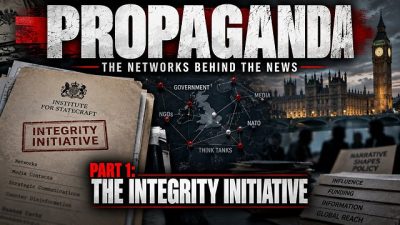
Integrity Initiative: UK-funded network framed dissent as Russian disinformation for years
or go to
Aletho News Archives – Video-Images
From the Archives
Why Saudi Ties to 9/11 Mean U.S. Ties to 9/11
By Kevin Ryan | Dig Within | September 27, 2015
Media interest in Saudi Arabian connections to the crimes of 9/11 has centered on calls for the release of the 28 missing pages from the Joint Congressional Inquiry’s report. However, those calls focus on the question of hijacker financing and omit the most interesting links between the 9/11 attacks and Saudi Arabia—links that implicate powerful people in the United States. Here are twenty examples. … continue
Blog Roll
 Aletho News
- EUROPE FEARS RUSSIA’S NEXT MOVE / Ian Proud
- Big tech hands in its DSA censorship reports to the EU
- ‘A Big Victory’ – Palestine Chronicle Wins Two-Year Legal Battle
- IAEA inspectors cannot return to Iran amid US threats: Russia
- Senate Rejects Iran War Powers Resolution Passed By House
- ‘We did not attack Pakistan with drones’: Afghan sources
- Iraqi Resistance faction links arms to sovereignty, questions US exit
- Cannon fodder no more… South Korea rejects Trump’s pressure to join his criminal war on Iran
- Neria Leiter Was A Legitimate Military Target
- Integrity Initiative: UK-funded network framed dissent as Russian disinformation for years
- If Americans Knew
- ‘This is where I live now, the back of a truck’: a day in the life of a grandmother in Gaza
- In UN Speech, Iran’s President Displays Pictures of Children Killed by US, Brings Attention to Israel’s Nuclear Arsenal
- Israel displaces hundreds of Palestinians amid wave of demolitions in West Bank
- Aid, reconstruction, and Israel’s history of obstruction in Gaza
- Trump administration digs an ever-deeper hole of complicity in genocide – Daily Update
- US-Israel $2.8 Billion Arms Deal, 40,000-Bomb Supply Faces New Gaza Complicity Accusations
- Caught on Tape: AIPAC CEO Boasted of Controlling Trump’s National Security Officials
- Why Hamas Attacked Israel in October 2023 – Israeli professor Ilan Pappé
- They see them, then kill them: Israeli quadcopters track, deliberately target civilians in Gaza
- Winter could turn Gaza’s treacherous, war-damaged buildings into deathtraps
- No Tricks Zone
- New Study: Earth And Venus Surface Warmth Largely Explained By Convection And Lapse Rate, Not CO2 Or Radiation
- 2025 Nature Paper Claiming Worsening Global Drought Gets RETRACTED …Heavily Flawed
- New Study: ‘Global Drought Shows No Detectable Recent Acceleration Under Climate Warming’
- Economic Masterminds: German Socialists Suggest Taxing Productivity Gains Stemming From Using AI
- The South China Sea Has Not Been Cooperating With The Climate Change Narrative
- Energy Crisis: Germany Enters Heating Season With Historically Low Gas Reserve Fill Levels
- New Study: The Antarctic Ice Sheet Gained Mass From 2020-2024 Due To Staggering Snow And Ice Accumulation
- Study: Ocean Heating Rates From Thousands Of Years Ago ‘Dwarf’ Modern Ocean Heating Rates
- Climate Extremists Target, Attack Large-Scale Power Grid Infrastructure In Germany!
- New Study: Antarctic Ice Melt Has Contributed Less Than 1 Centimeter To Sea Level Rise In The Last 30 Years

