Empire-Speak
By Jacob G. Hornberger – Future of Freedom Foundation – June 28, 2017
One of the most fascinating aspects of living under imperialism is the lexicon that this philosophy brings into existence. It’s called Empire-Speak. Given the complexity of this specialized language, it usually takes people years of education and training to master it.
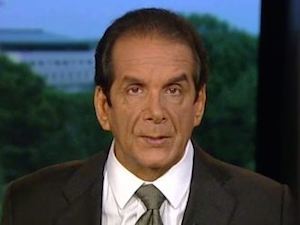
One of the finest examples of Empire-Speak appeared last week in a Washington Post op-ed by Post columnist Charles Krauthammer, who often appears as a commentator on Fox News. Krauthammer penned an op-ed entitled “The Great Muslim Civil War – and Us” that is an absolute masterpiece of Empire-Speak.
Comparing what is happening in the Middle East to Europe 1945, Krauthammer describes the “great Muslim civil war” that has enveloped the Middle East, which he writes, is “approaching its post-Islamic phase.” ISIS is about to be defeated on the battlefield, he writes, and the parties are now maneuvering, as they did after World War II, to “determine postwar boundaries and spheres of influence.” Once ISIS loses its hold on Mosul in Iraq and Raqqa in Syria, “the caliphate dies.”
So does that mean that the Pentagon and the CIA can finally declare victory in the Middle East and come home after more than 25 years of warfare in the Middle East? Does that mean that there can now be a ticker-tape parade in New York City honoring the victorious American forces?
Are you kidding? As Krauthammer points out, all that has gone before is just “the end of the beginning.” Things are just getting started. After all, as Krauthammer points out, “At stake is consolidation of the Shite Crescent.”
Who would have known? I’ll bet that 99 percent of Americans haven’t even heard of the “Shite Crescent” or that it’s being consolidated. Thank goodness we have Krauthammer and other people well-versed in Empire-Speak to tell us about it.
According to Krauthammer, the world is witnessing a gigantic battle between Shiite Muslims and Sunni Muslims.
Leading the Shiite side is Iran. Combined with Russia, Syria, Iraq, and Hezbollah (“which Krauthammer labels the “tip of the Iranian spear”), this is the so-called “Shiite Crescent.” According to Krauthammer, it poses a “nightmare for the entire Sunni Middle East.”
On the opposing side of this gigantic battle are the Sunnis, led by Saudi Arabia, Egypt, Jordan, and the United States. Needless to say, this is considered the good side of the war.
As I was reading through his op-ed, I kept hoping that Krauthammer would not omit one of my favorite terms in Empire-Speak: “the hegemon.” Isn’t that a great term? Whenever I hear an imperialist refer to the danger of the rise of a “regional hegemon,” I think of Transformers or Godzilla.
Krauthammer didn’t disappoint. He states that Syria is “the central theater of a Shiite-Sunni war for regional hegemony.” Moreover, Russia — yes, that Russia! — Krauthammer labeled “the outside hegemon.” OMG! Scary, right? Maybe even scarier than rise of communism and the Soviet Union, the two official enemies of the Cold War era.
What’s really going on here?
Krauthammer is simply preparing the American people for what lies ahead — more interventionism, more imperialism, more militarism, and more death and destruction at the hands of the US Empire. And, of course, more official enemies as old official enemies are defeated or disappeared.
You see, I bet you thought that once ISIS was defeated, the troops could finally be brought home and revel in their glorious victory. Sort of like “Mission Accomplished” after the US invasion of Iraq.
Not so. Undoubtedly expressing the mindset of the Pentagon, the CIA, and the rest of the US national-security establishment, Krauthammer is telling us that unfortunately we cannot rest. We must continue to soldier on, presumably until the Shiite Crescent is defeated and the world is no longer facing the possibility of a rise of a “regional hegemon.” And don’t even think for a moment that once that is accomplished, the war will finally be over. It will simply spell the beginning of the end of the beginning.
As I stated soon after the 9/11 attacks, the “war on terrorism” is going to be just like the war on drugs, where every drug lord they kill or capture is soon replaced by dozens more.
The real problem is that the US Empire keeps running out of official enemies. If we go back to the maneuvering after World War II to which Krauthammer refers, we see US officials converting their World War II partner and ally, the Soviet Union, to a new official enemy, one that necessitated, they said, the conversion of the federal government to a national-security state.
As we all know, for the next 45 years the Cold War was a bonanza for the Pentagon, the CIA, the NSA, and what President Eisenhower called the “military-industrial complex.” Ever-increasing budgets and powers. The best part, for them, was that it was never supposed to end. The Cold War was supposed to go on forever because communism and the Soviet Union were supposed to go on forever.
But life can be cruel. In 1989, the Soviet Union suddenly and unexpectedly dismantled itself, declared socialism a bankrupt philosophy, and unilaterally declared an end to the Cold War, thereby depriving the US Empire of its big official Cold War enemy.
No problem. A new official enemy was soon announced: Saddam Hussein, dictator of Iraq and former partner of the US Empire (just like Stalin had been). Throughout the 1990s, Americans obsessed over Saddam Hussein and how he was coming to get us and the rest of the world with his WMDs.
To oust Saddam from power, the Pentagon and the CIA began wreaking death and destruction in Iraq, including 11 years of sanctions that killed hundreds of thousands of Iraqi children.
That led to terrorist blowback and a new official enemy: “terrorism,” which ultimately enabled US officials to invade Iraq and oust their official enemy, Saddam Hussein, from power, and install a new regime in Iraq, a Shiite Muslim regime.
Over time, the “terrorists” have morphed into “the Muslims,” which are now viewed as the new official enemy.
Which brings us back to Krauthammer’s op-ed. If the Muslims are the new official enemy, how is that the United States is on the side of the Sunnis in what Krauthammer describes as a giant Muslim civil war that is now supposedly taking place? Aren’t Sunnis Muslims too?
Hmmm. So does this mean that we are no longer supposed to focus on Muslims in general or even “radical Muslims” or “extreme Muslims” but instead on “Shiite Muslims” as the new official enemy?
Oh, another thing Krauthammer doesn’t make clear: If we are now battling the Shiite Muslims, why did the US government use its invasion and occupation of Iraq to install a Shiite regime there? And why is it that US troops have been killing and dying for some 14 years to preserve the existence of that Shiite regime? Why are they still doing so? Were Americans wrong to thank the troops for their service in Iraq by bringing into existence a regime that is now part of the “Shiite Crescent,” which, according to Krauthammer, is now facing us on the field of battle?
Boy, imperialism sure is hard to learn and comprehend. Just like Empire-Speak.
NYT Finally Retracts Russia-gate Canard
By Robert Parry | Consortium News | June 29, 2017
The New York Times has finally admitted that one of the favorite Russia-gate canards – that all 17 U.S. intelligence agencies concurred on the assessment of Russian hacking of Democratic emails – is false.
On Thursday, the Times appended a correction to a June 25 article that had repeated the false claim, which has been used by Democrats and the mainstream media for months to brush aside any doubts about the foundation of the Russia-gate scandal and portray President Trump as delusional for doubting what all 17 intelligence agencies supposedly knew to be true.
In the Times’ White House Memo of June 25, correspondent Maggie Haberman mocked Trump for “still refus[ing] to acknowledge a basic fact agreed upon by 17 American intelligence agencies that he now oversees: Russia orchestrated the attacks, and did it to help get him elected.”
However, on Thursday, the Times – while leaving most of Haberman’s ridicule of Trump in place – noted in a correction that the relevant intelligence “assessment was made by four intelligence agencies — the Office of the Director of National Intelligence, the Central Intelligence Agency, the Federal Bureau of Investigation and the National Security Agency. The assessment was not approved by all 17 organizations in the American intelligence community.”
The Times’ grudging correction was vindication for some Russia-gate skeptics who had questioned the claim of a full-scale intelligence assessment, which would usually take the form of a National Intelligence Estimate (or NIE), a product that seeks out the views of the entire Intelligence Community and includes dissents.
The reality of a more narrowly based Russia-gate assessment was admitted in May by President Obama’s Director of National Intelligence James Clapper and Obama’s CIA Director John Brennan in sworn congressional testimony.
Clapper testified before a Senate Judiciary subcommittee on May 8 that the Russia-hacking claim came from a “special intelligence community assessment” (or ICA) produced by selected analysts from the CIA, NSA and FBI, “a coordinated product from three agencies – CIA, NSA, and the FBI – not all 17 components of the intelligence community,” the former DNI said.
Clapper further acknowledged that the analysts who produced the Jan. 6 assessment on alleged Russian hacking were “hand-picked” from the CIA, FBI and NSA.
Yet, as any intelligence expert will tell you, if you “hand-pick” the analysts, you are really hand-picking the conclusion. For instance, if the analysts were known to be hard-liners on Russia or supporters of Hillary Clinton, they could be expected to deliver the one-sided report that they did.
Politicized Intelligence
In the history of U.S. intelligence, we have seen how this selective approach has worked, such as the phony determination of the Reagan administration pinning the attempted assassination of Pope John Paul II and other acts of terror on the Soviet Union.
CIA Director William Casey and Deputy Director Robert Gates shepherded the desired findings through the process by putting the assessment under the control of pliable analysts and sidelining those who objected to this politicization of intelligence.
The point of enlisting the broader intelligence community – and incorporating dissents into a final report – is to guard against such “stove-piping” of intelligence that delivers the politically desired result but ultimately distorts reality.
Another painful example of politicized intelligence was President George W. Bush’s 2002 National Intelligence Estimate on Iraq’s WMD that removed State Department and other dissents from the declassified version that was given to the public.
Since Clapper’s and Brennan’s testimony in May, the Times and other mainstream news outlets have avoided a direct contradiction of their earlier acceptance of the 17-intelligence-agencies canard by simply referring to a judgment by “the intelligence community.”
That finessing of their earlier errors has allowed Hillary Clinton and other senior Democrats to continue referencing this fictional consensus without challenge, at least in the mainstream media.
For instance, on May 31 at a technology conference in California, Clinton referred to the Jan. 6 report, asserting that “Seventeen agencies, all in agreement, which I know from my experience as a Senator and Secretary of State, is hard to get. They concluded with high confidence that the Russians ran an extensive information war campaign against my campaign, to influence voters in the election.”
The failure of the major news organizations to clarify this point about the 17 agencies may have contributed to Haberman’s mistake on June 25 as she simply repeated the groupthink that nearly all the Important People in Washington just knew to be true.
But the Times’ belated correction also underscores the growing sense that the U.S. mainstream media has joined in a political vendetta against Trump and has cast aside professional standards to the point of repeating false claims designed to denigrate him.
That, in turn, plays into Trump’s Twitter complaints that he and his administration are the targets of a “witch hunt” led by the “fake news” media, a grievance that appears to be energizing his supporters and could discredit whatever ongoing investigations eventually conclude.
Investigative reporter Robert Parry broke many of the Iran-Contra stories for The Associated Press and Newsweek in the 1980s.
A spook comes out of the woodwork to attack Brad Pitt’s ‘War Machine’
Netflix drama strikes a nerve …
By David Walsh | WSWS | June 21, 2017
Does art have social consequences? Does it matter which attitude filmmakers or novelists, for example, adopt toward the big events of the day?
Here’s a case that may help settle the argument or at least provides strong circumstantial evidence.
Three weeks ago we reviewed War Machine, the Netflix satire about Gen. Stanley McChrystal and the bloody, neo-colonial American war effort in Afghanistan.
We noted its unusually biting character. This is not a film that makes obeisance to the greatness of the US military. It presents the war in Afghanistan as “a debacle, presided over by lunatics and egomaniacs,” the WSWS review noted.
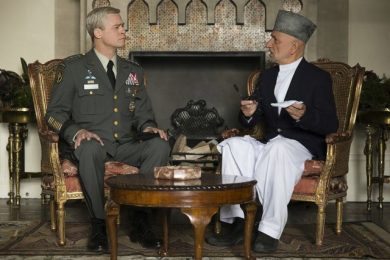
Brad Pitt and Ben Kingsley in War Machine
Written and directed by Australian David Michôd, and based on the 2012 non-fiction book, The Operators: The Wild and Terrifying Inside Story of America’s War in Afghanistan, by the late American journalist Michael Hastings, War Machine sarcastically hails the US in its opening moments, “Ah, America. You beacon of composure and proportionate response. You bringer of calm and goodness to the world.”
The WSWS noted that for once a film reflected some of the widespread hostility toward a quarter century of brutal war and toward the politicians and generals who have conducted it.
It was only fitting that a spokesperson for those war criminals would respond.
Whitney Kassel, late of the Defense Department, Special Operations in Afghanistan and Pakistan, a former member of McChrystal’s “team,” and an associate in private business of a long-time leading figure in the CIA, has written a denunciation of War Machine in Foreign Policy magazine, “Screw Brad Pitt and the ‘War Machine’ he rode in on.”
The unusually frank language of the headline presumably provides some sense of Kassel’s disapproval. Indeed, she acknowledges that her initial “eye-rolling quickly gave way to expletives.”
The character of Kassel’s objectivity in regard to Gen. McChrystal makes itself evident early on when she notes that Hastings (whose Rolling Stone article, later expanded into the book on which War Machine is based, essentially ended the general’s career) “took down a man I worked with during the time in question and deeply respected—one near-universally viewed as an American hero of integrity and intelligence.”
McChrystal was a ruthless practitioner of counterinsurgency warfare, responsible for the killing of thousands of Iraqis. His entourage in Afghanistan, according to Hastings, was “a handpicked collection of killers, spies, geniuses, patriots, political operators and outright maniacs.” A staffer neatly describes in Hasting’s book the now infamous Gen. Michael Flynn, one of McChrystal’s toadies, as a “rat on acid.”
Kassel presents the 16-year US-led intervention in Afghanistan as “a war effort that, while certainly replete with absurdities and mistakes, was and continues to be fought by men and women who are dedicated to improving the security of the United States and its allies by helping to build an Afghanistan that will not provide safe haven for al Qaeda or, more recently, the Islamic State.”

War Machine
This is a pack of lies. The US is not in Afghanistan to protect American lives, but to advance its interests in a geopolitically strategic area. The war has led to nothing but death, destruction and misery on a vast scale.
Kassel is particularly concerned that War Machine casts doubt on the legitimacy of the entire “war on terror,” the code phrase with which American imperialism has justified its drive for global hegemony since 2001.
She goes on: “Likewise—and this is the part that matters today—the portrayal of the U.S. and NATO’s very presence in the country since 2001 as rooted in fantasy and an inflated sense of American prowess is disingenuous and dangerous in its mischaracterization of a war that remains, particularly in the face of escalating violence and instability, an important part of reducing global terrorism.”
Kassel seems unaware that this last sentence contains an obvious contradiction. The longest war in US history has ostensibly been carried out in the name of “reducing global terrorism,” yet there is “escalating violence and instability.”
War Machine is not a primer in anti-imperialist politics, but it does make clear that the war in Afghanistan is a doomed project. The film’s narrator asks in the opening moments, “What do you do when the war you’re fighting just can’t possibly be won in any meaningful sense?”
The narrator further explains that the US military’s “counterinsurgency” strategy runs up against basic political realities: “When … you’ve just gone and invaded a place that you probably shouldn’t have, you end up fighting against just regular people in regular-people clothes. These guys are what are called insurgents. Basically, they’re just guys who picked up weapons ’cause … so would you, if someone invaded your country. Funnily enough … insurgencies are next to impossible to defeat.”
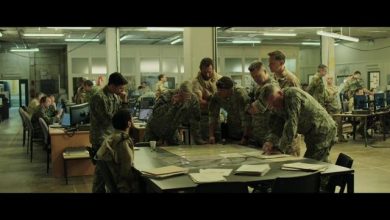
But Kassel inhabits a different political and moral universe. Her writing has the ghastly quality of the “democratic” military bureaucrat or intelligence agent, the muffled, perpetually disingenuous tone of the individual who plots bombings and murders and mass repression, but refers to such activities as “strategic options” and “the tools available for trying to turn around what was considered an urgent national security priority,” and half-believes her own obscurantism.
She presents a glowing picture of the same crowd among whom Hastings placed “killers … and outright maniacs.” Kassel writes: “I found McChrystal and his team to be respectful, thoughtful … McChrystal spent endless hours with the members of the assessment team [which included Kassel]—very few of whom had direct military experience—exploring the strategic options available to the United States and NATO.”
Toward the end of her tirade, Kassel once again expresses anxiety about the impact of War Machine and points to “a particular hazard,” that the film will reinforce “a view of the war in Afghanistan as this generation’s Vietnam, led by men … who care only about protecting their own egos and reputations, with no sense of the sacrifices inherent in war and no strategic vision or logic behind their decisions.”
She expresses nervousness about the “reworking” of the US approach to Afghanistan that Trump administration officials may be considering and asserts that “it is critical that they, and the American public to whom they report, understand how we got here, and the reasons why some elements of a counterinsurgency strategy may remain valid moving forward.”
Kassel, according to the Huffington Post, for whom she writes occasionally, “spent four years at the Office of the Secretary of Defense where she focused on Special Operations, Counterterrorism, and Pakistan policy. During this time she spent a year in Pakistan working for the Office of the Defense Representative and Special Operations Command Forward. She also served as the representative of the Secretary of Defense to General Stanley McChrystal’s Strategic Assessment Team in Afghanistan in 2009.”
This is someone up to her neck in imperialist violence and intrigue. At one point, Kassel served “as Assistant for Counterterrorism Policy in the Office of the Assistant Secretary of Defense for Special Operations, Low Intensity Conflict, and Interdependent Capabilities (ASD SO/LIC&IC) within the Office of the Under Secretary of Defense for Policy (OSD-Policy).”
Kassel, a Democratic Party supporter apparently, often tweets about women’s rights and racism—and Russian aggression! Of course, how could it be otherwise?
A special mention must be made of her association with the Arkin Group, the private intelligence firm, where she “served as a senior director focused on strategic analysis and risk management.”
A founding partner of the Arkin Group is Jack Devine, according to the company’s website, “a 32-year veteran of the Central Intelligence Agency (‘CIA’). Mr. Devine served as both Acting Director and Associate Director of CIA’s operations outside the United States from 1993-1995, where he had supervisory authority over thousands of CIA employees involved in sensitive missions throughout the world. In addition, he served as Chief of the Latin American Division from 1992-1993 and was the principal manager of the CIA’s sensitive projects in Latin America.”
In fact, Devine’s first foreign assignment was in Chile, where he arrived in August 1970. Even before being physically assigned there, he writes in his autobiography, Good Hunting: An American Spymaster’s Story, “I had worked the night shift for the Chile Task Force in Langley, synthesizing cables from Santiago into a morning intelligence report for the bosses.” Devine was present in Santiago in September 1973 when the Nixon administration and the CIA organized a coup, along with the Chilean military, that brought the brutal Pinochet dictatorship to power, which tortured and murdered tens of thousands of political opponents, trade unionists and young people.
The Arkin website also notes, “From 1985-1987, Mr. Devine headed the CIA’s Afghan Task Force, which successfully countered Soviet aggression in the region. In 1987, he was awarded the CIA’s Meritorious Officer Award for this accomplishment.”
In other words, Devine is one of the figures criminally responsible for arming and fomenting Islamic fundamentalism in Afghanistan as part of the effort to undermine the Soviet Union. In his own words, Devine moved “guns and ammunition across the border into Afghanistan,” aiding “the Afghan mujahideen and their determined opposition to the Soviet Union’s occupation of their country in the 1980s. I ran the last, and largest, cover operation of the Cold War.” The career of Osama bin Laden, Al Qaeda, the 9/11 terrorist attacks and ISIS itself all emerge, directly or indirectly, from this operation.
Devine and Kassel have co-authored numerous articles, including “Afghanistan: Withdrawal Lessons,” in the World Policy Journal, 2013. This cynical morsel of realpolitik offered advice to the Obama administration on the best policy to pursue “in protecting U.S. interests” in the region. “Robust covert action” remained high on the list. Should the Pakistani government, for example, turn down US aid, “we should respond with appropriate covert action. This would include paramilitary activities as well as psychological operations, propaganda, and political and economic influence.”
Devine also acknowledges Kassel’s assistance in the preparation of his autobiography.
Devine and Kassel continued to do at Arkin what they did at the CIA and the Defense Department, respectively, defend the interests of American corporate and financial interests.
The Arkin website, in its “Case Studies” section, offers the example of the work it did for an investor, “concerned about instability and uncertain about prospects for South African agriculture.” The firm “initiated a political risk analysis and market intelligence project, and also completed an investigation of political, legal, and regulatory events that could impact foreign investors, agriculture operations, and the industry of interest.” Arkin “uncovered no evidence indicating that South Africa’s leaders would reverse foreign investment-friendly policies.”
In Vietnam, Arkin assessed “the future of pro-privatization initiatives” and also laid out “incentives and road blocks associated with privatization and elucidated the process by which entities become eligible for consideration.”
This background has provided Ms. Kassel with the moral and intellectual high ground from which to criticize the anti-war satire, War Machine, which lifts the lid on the lethal madness of the US military and dares to call into question American foreign policy.
It is entirely to the film’s credit that it has provoked an angry response from this trusted agent of American imperialism.
A US-Iran confrontation is just what Israel seeks – and it may get
By M K Bhadrakumar | Indian Punchline | June 18, 2017
The move by the US military to shift for the first time the High Mobility Artillery Rocket System (HIMARS) into Syrian territory from Jordan signifies that the Pentagon has created a new fact on the ground. According to the CNN, the deployment will be in the military base in Al-Tanf near Syria’s border with Iraq in the south-eastern region, which is currently an area of contestation between US-backed rebel groups and Syrian government forces.
A Russian Defence Ministry statement in Moscow on Thursday noted that the deployment might suggest a US intention to attack the Iran-backed Syrian government forces. The Russian statement said:
- The range of the High Mobility Artillery Rocket System is not enough to support the US-backed units… in Raqqa. At the same time, the US-led anti-terrorist coalition has several times attacked the Syrian government forces near the Jordanian border, so it can be assumed that such attacks will continue, but this time involving the High Mobility Artillery Rocket Systems.
Indeed, such authoritative Russian statements, even while speculative, must be relying on intelligence inputs. Clearly, the US intentions need to be interpreted. One possibility could be that it might actually be a defensive move. The US has so far counted on other protagonists – government forces, Hezbollah, Iran, Turkey and Russia – to exercise absolute self-restraint in not confronting the American forces. This tacit understanding (or pragmatism on both sides) largely worked well so far. Although, US-Russia relations continue to deteriorate, the ‘de-confliction’ arrangement in Syria has worked well so far.
However, war is war and there is nothing like a bit of self-help in such uncertain times. The point is the HIMARS provides an alternate means to hit the adversary if air operations are not feasible for some reason – or is simply a preferable option. From all appearances, the US reportedly has plans to create military bases in southern Syria (similar to what it has done in the northern regions bordering Turkey and Iraq) and, if so, the deployment of HIMARS fits into the plan.
Suffice to say, it all boils down to the big question: What are, going ahead, the Trump administration’s politico-military intentions in Syria? At a press briefing in Baghdad on June 7, Brett McGurk, US Special Presidential Envoy for the Global Coalition to Counter ISIS, maintained that the US military presence in and around Al-Tanf (near Syrian-Iraqi border) is purely temporary. While explaining the rationale for the recent US attacks on the Syrian government forces in that area, McGurk claimed that the US mission is to fight the ISIS in Syria and “when the fight against Daesh is over, we won’t be there.” But then, one thing that the Qatar crisis has shown is that the Trump administration can be diabolical.
On the other hand, Syrian government forces are interested in regaining control of their country’s border with Iraq. President Bashar Al-Assad has repeatedly insisted that he intends to regain control of the whole of Syria. And there are sufficient indications that the Syrian government forces are being deployed to regain the vast, vacant, lawless spaces in eastern Syria bordering Iraq. This Syrian military thrust has been interpreted by some commentators as aimed at opening a land route across Iraq all the way to Iran through which Tehran can beef up Hezbollah. The assumption here is that a 1000-kilometre long land bridge connecting Damascus with Tehran (via al-Tanf and Baghdad) serves the purpose.
A commentary by the Brussels-based think tank European Council on Foreign Relations – US must avoid a war with Iran in eastern Syria – cautions the Trump administration that it is bound to lose in any rivalry with Iran over control of the Syrian-Iraqi border. However, Israel is betting on a US-Iranian conflagration and it remains to be seen how far the Trump administration can withstand the pressure from the Jewish lobby.
Meanwhile, latest reports suggest that Iraqi government forces and Sunni fighters have taken control of the border crossing near Al-Tanf inside Iraq (known as al-Waleed border crossing). A Reuters report has interpreted this development as in effect “preventing Iranian-backed forces supporting Syrian President Bashar al-Assad from receiving heavy weaponry from Iran by using the main highway between Iraq and Syria.” Quite obviously, a US-Iranian contestation is building up in southern Syria.
In sum, Israel might be getting what it seeks, but it is another matter altogether whether it is going to like the final outcome of the struggle between the US and Iran over control of southern Syria near Golan Heights. It is improbable that Iran will give up the ‘axis of resistance’ because it is ultimately about Iran’s own defence. Read an incisive analysis by the Middle East Eye on the joint Israeli-US game plan to work in tandem with ISIS to pile pressure on Iran to pull back from the Syrian and Iraqi theatres — The CIA and Islamic State: Iran’s twin threats.
Syria, Iran and N. Korea: Will Trump Attempt to Finish the Neocon Hitlist?
By Steven MacMillan – New Eastern Outlook – 16.06.2017
In Donald Trump’s short time in office, he has already shown his propensity to use military force. From dropping the largest non-nuclear bomb ever used on Afghanistan, to launching 59 Tomahawk cruise missiles at Iraq (oh wait, Syria), there is no doubt that the Trump administration has a prominent militaristic streak.
But is this just for starters? If Trump stays in power for the duration of his term, is there a major war, or even multiple wars, on the horizon? Judging by the rhetoric and actions already taken by the Trump administration, it will be a miracle if the US does not start a major war in the near future. Coincidentally, the main countries in the sights of the Trump administration just happen to be the three countries that the neoconservatives pinpointed for regime change 17 years ago, but have not yet been dealt with.
1997 marked the birth of the Project for the New American Century (PNAC), a neoconservative think tank of catastrophic proportions. It was founded by William Kristol, the longtime editor of the Weekly Standard, who also served as the chief of staff to Vice President Dan Quayle, and Robert Kagan, a former State Department official who is now a Senior Fellow at the Brookings Institute. A long list of neocons belonged to the group, including Dick Cheney, Donald Rumsfeld and Paul Wolfowitz.
PNAC’s stated objectives included the desire to “shape a new century favourable to American principles and interests,” “increase defense spending significantly,” and challenge “regimes hostile to US interests and values.” In September 2000, the PNAC group released a report titled: ‘Rebuilding America’s Defenses – Strategy, Forces and Resources for a New Century.’ The introduction to the report clearly expressed PNAC’s desire to maintain US supremacy in the world:
“At present, the United States faces no global rival. America’s grand strategy should aim to preserve and extend this advantageous position as far into the future as possible…Preserving the desirable strategic situation in which the United States now finds itself requires a globally preeminent military capability both today and in the future.”
In order to maintain this supremacy, the report called for the Defense Department to be at the forefront of experimenting with transformative technologies, a move that would require a dramatic increase in defense spending.
Curiously, the report – published one year prior to 9/11 – argued that this transformation would likely be a “long one” unless an event on the scale of “Pearl Harbor” occurred:
“To preserve American military preeminence in the coming decades, the Department of Defense must move more aggressively to experiment with new technologies and operational concepts, and seek to exploit the emerging revolution in military affairs… The effects of this military transformation will have profound implications for how wars are fought, what kinds of weapons will dominate the battlefield and, inevitably, which nations enjoy military preeminence…
The Pentagon [however], constrained by limited budgets and pressing current missions, has seen funding for experimentation and transformation crowded out in recent years. Spending on military research and development has been reduced dramatically over the past decade… Any serious effort at transformation must occur within the larger framework of U.S. national security strategy, military missions and defense budgets… The process of transformation, even if it brings revolutionary change, is likely to be a long one, absent some catastrophic and catalyzing event – like a new Pearl Harbor” (p.50-p.51).
Under the guise of missile capability, the report then pinpointed five countries that the neocons, in conjunction with the CIA, considered “deeply hostile” to the US:
“Ever since the Persian Gulf War of 1991… the value of the ballistic missile has been clear to America’s adversaries. When their missiles are tipped with warheads carrying nuclear, biological, or chemical weapons, even weak regional powers have a credible deterrent, regardless of the balance of conventional forces. That is why, according to the CIA, a number of regimes deeply hostile to America – North Korea, Iraq, Iran, Libya and Syria – ‘already have or are developing ballistic missiles’ that could threaten U.S allies and forces abroad. And one, North Korea, is on the verge of deploying missiles that can hit the American homeland. Such capabilities pose a grave challenge to the American peace and the military power that preserves that peace” (p.51-p.52).
This report was published approximately three years prior to the invasion of Iraq, and approximately 11 years prior to both the war in Libya and the start of the proxy war in Syria. The central point I am getting at here is that the wars we have seen unfold, and the wars to come, are not just short-term actions taken by the administration who happens to be in power at that particular time. They are planned years and sometimes decades prior to the first shot being fired. Regardless of which party the President belongs to – George Bush invaded Iraq with a blue tie on, whilst Barack Obama bombed Libya with a red one on – the same regime-change-agenda continues.
Two Down, Three to Go
Although there were other reports that marked more countries that the neocons considered ‘hostile’ to the US, or more accurately, hostile to US (Western) imperial ambitions, the September 2000 report focused on five countries. With Iraq and Libya already ‘liberated,’ three countries are still on the hitlist: Syria, Iran and North Korea. Coincidentally (or not), these are some of the main countries that the Trump administration is targeting, and we are only a few months into Trump’s reign.
Syria: Trump has already bombed Syrian government forces – or forces fighting on the side of the Syrian government – on multiple occasions since being elected. After Trump bombed Syria back in April, both Kagan and Kristol praised him, yet demanded more blood. Even though they claimed not to be major supporters of Trump during the campaign, many Bush-era hawks were – including Rumsfeld, the former Defense Secretary. The Trump administration has also admitted sending hundreds of US troops – which includes Marines – into Syria, officially in order to fight against ISIS (through training and advising rebel forces), yet it’s clear the move has as much to do with the Syrian and Iranian governments than anything else.
Iran: Throughout Trump’s campaign for the White House, he repeatedly criticized both Iran and North Korea. Trump has always been a severe critic of the Iranian nuclear deal, and a loyal supporter of the state of Israel, meaning war with Iran seems more probable that not. In fact, Iran has claimed that Trump and Saudi Arabia are behind the recent terror attacks in Tehran, which ISIS has claimed responsibility for.
During his trip to Saudi Arabia last month, Trump took the opportunity to take another jab at Iran. In February, the US Defence Secretary, James “Mad Dog” Mattis, called Iran the “biggest state sponsor of terrorism in the world,” completely ignoring the role Saudi Arabia plays in exporting terrorism. It appears as though the Trump administration is in the process of deciding which path to Persia it thinks is going to be the most effective.
North Korea: In relation to North Korea, the Trump administration has essentially backed the country into a corner, producing the obvious response from North Korea: an (attempted) show of strength. A country that the US carpet bombed during the Korean war – which included using napalm – it hardly seems likely that North Korea is just going to give in to US threats, considering the resentment many in the country still feel towards America.
This is not a defense of North Korea, but the Trump administration making one provocative statement after another has hardly reduced tensions in the region. In March, Mattissaid that “reckless” North Korea has “got to be stopped.” The following month, Trump said North Korea is a problem that “will be taken care of.” Although Mattis has acknowledged that a conflict with North Korea would be “catastrophic,” the Trump administration appears to be willing to ratchet up tensions regardless.
In contrast, both Russia and China have emphasised that dialogue and diplomacy trump threats. Speaking in May, the Russian President, Vladimir Putin, said that “we have to stop intimidating North Korea” and “return to dialogue” with them, after affirming that Russia “is against expanding the pool of nuclear powers, including North Korea.” Also in May, the Chinese Foreign Ministry called for the US and North Korea to “stop irritating each other,” and advocated “dialogue and negotiation.”
It also important to note that the North Korean issue is really about a lot more than just North Korea. As Paul Craig Roberts has highlighted, the North Korean ‘crisis’ has everything to do with Russia and China. Similar to how the US used the Iranian ‘threat’ to put anti-ballistic missile systems close to Russia’s borders, the North Korean crisis can be used to deploy anti-ballistic missiles systems next to the eastern borders of Russia and China. In a positive development however, the South Korean government has just announced (at the time of writing anyway) that it will halt the deployment of the US anti-ballistic missile system – known as the Terminal High Altitude Area Defense (THAAD) – on its territory for potentially up to a year, citing environmental concerns.
If the Trump administration and the neocons are actually reckless enough to try and force regime change in all three countries in the near future, this brings the US into direct confrontation with both Russia and China. And if a hot war between these three nuclear powers erupts, this would mark the end of human civilization as we know it.
NBC’s Kelly Hits Putin with a Beloved Canard
By Ray McGovern | Consortium News | June 12, 2017
NBC’s Megyn Kelly wielded one of Official Washington’s most beloved groupthinks to smack Russian President Vladimir Putin over his denials that he and his government were responsible for hacking Democratic emails and interfering with the U.S. presidential election.
In her June 2 interview with Putin, Kelly noted that all “17 intelligence agencies” of the U.S. government concurred in their conclusion of Russian guilt and how could Putin suggest that they all are “lying.” It’s an argument that has been used to silence skeptics for months and apparently is so useful that no one seems to care that it isn’t true.
For instance, on May 8, in testimony before a Senate Judiciary subcommittee, former Director of National Intelligence James Clapper conceded publicly that the number of intelligence agencies involved in the assessment was three, not 17, and that the analysts assigned to the project from CIA, FBI and NSA had been “handpicked.”
On May 23, in testimony before the House Intelligence Committee, former CIA Director John Brennan confirmed Clapper’s account about the three agencies involved. “It wasn’t a full inter-agency community assessment that was coordinated among the 17 agencies,” Brennan acknowledged.
But those public admissions haven’t stopped Democrats and the mainstream media from continuing to repeat the false claim. In comments on May 31, failed presidential candidate Hillary Clinton repeated the canard, with a flourish, saying: “Seventeen agencies, all in agreement, which I know from my experience as a Senator and Secretary of State, is hard to get.”
A couple of days later, Kelly revived the myth of the consensus among the 17 intelligence agencies in her interview with the Russian president. But Putin passed up the opportunity to correct her, replying instead:
“They have been misled and they are not analyzing the information in its entirety. … We have talked about it with former President Obama and with several other officials. No one ever showed me any direct evidence. When we spoke with President Obama about that, you know, you should probably better ask him about it – I think he will tell you that he, too, is confident of it. But when he and I talked I saw that he, too, started having doubts. At any rate, that’s how I saw it.”
As I noted in a Jan. 20 article about Obama’s news conference two days earlier, “Did President Barack Obama acknowledge that the extraordinary propaganda campaign to blame Russia for helping Donald Trump become president has a very big hole in it, i.e., that the U.S. intelligence community has no idea how the Democratic emails reached WikiLeaks? For weeks, eloquent obfuscation – expressed with ‘high confidence’ – has been the name of the game, but inadvertent admissions now are dispelling some of the clouds. …
“At President Obama’s Jan. 18 press conference, he admitted as much: ‘the conclusions of the intelligence community with respect to the Russian hacking were not conclusive as to whether WikiLeaks was witting or not in being the conduit through which we heard about the DNC e-mails that were leaked.’” [Emphasis added]
Explaining the Technology
More importantly, Putin in his interview with Kelly points out that “today’s technology” enables hacking to be “masked and camouflaged to an extent that no one can understand the origin” of the hack. “And, vice versa, it is possible to set up any entity or any individual that everyone will think that they are the exact source of that attack. Modern technology is very sophisticated and subtle and allows this to be done. And when we realize that we will get rid of all the illusions. …”
Later, when Kelly came back to the issue of hacking, Putin expanded on the difficulty in tracing the source of cyber attacks.
“Hackers may be anywhere,” Putin said. “There may be hackers, by the way, in the United States who very craftily and professionally passed the buck to Russia. Can’t you imagine such a scenario? In the middle of an internal political fight, it was convenient for them, whatever the reason, to put out that information. And put it out they did. And, doing it, they made a reference to Russia. Can’t you imagine it happening? I can.
“Let us recall the assassination of President Kennedy. There is a theory that Kennedy’s assassination was arranged by the United States special services. If this theory is correct, and one cannot rule it out, so what can be easier in today’s context, being able to rely on the entire technical capabilities available to special services than to organize some kind of attacks in the appropriate manner while making a reference to Russia in the process. …”
Kelly: “Let’s move on.”
However carefully Megyn Kelly and her NBC colleagues peruse The New York Times, they might well not know WikiLeaks’ disclosure on March 31 of original CIA documents showing that the agency had created a program allowing it to break into computers and servers and make it look like others did it by leaving telltale signs (like Cyrillic markings, for example).
The capabilities shown in what WikiLeaks calls the “Vault 7” trove of CIA documents required the creation of hundreds of millions of lines of source code. At $25 per line of code, that amounts to about $2.5 billion for each 100 million code lines. But the Deep State has that kind of money and would probably consider the expenditure a good return on investment for “proving” the Russians hacked into Democratic Party emails.
In other words, it is altogether possible that the hacking attributed to Russia was actually one of several “active measures” undertaken by a cabal consisting of the CIA, FBI, NSA and Clapper — the same agencies responsible for the lame, evidence-free report of Jan. 6, that Clapper and Brennan acknowledged last month was not the consensus view of the 17 intelligence agencies.
There is also the issue of the forensics. Former FBI Director James Comey displayed considerable discomfort on March 20, explaining to the House Intelligence Committee why the FBI did not insist on getting physical access to the Democratic National Committee’s computers in order to do its own proper forensics, but chose to rely on the examination done by the DNC’s private contractor, Crowdstrike.
The firm itself has conflicts of interests in its links to the pro-NATO and anti-Russia think tank, the Atlantic Council, through Dmitri Alperovitch, who is an Atlantic Council senior fellow and the co-founder of Crowdstrike.
Strange Oversight
Given the stakes involved in the Russia-gate investigation – now including a possible impeachment battle over removing the President of the United States – wouldn’t it seem logical for the FBI to insist on its own forensics for this fundamental predicate of the case? Or could Comey’s hesitancy to demand access to the DNC’s computers be explained by a fear that FBI technicians not fully briefed on CIA/NSA/FBI Deep State programs might uncover a lot more than he wanted?
Comey was asked again about this curious oversight on June 8 by Senate Intelligence Committee Chair Richard Burr:
BURR: “And the FBI, in this case, unlike other cases that you might investigate — did you ever have access to the actual hardware that was hacked? Or did you have to rely on a third party to provide you the data that they had collected?”
COMEY: “In the case of the DNC, and, I believe, the DCCC, but I’m sure the DNC, we did not have access to the devices themselves. We got relevant forensic information from a private party, a high-class entity, that had done the work. But we didn’t get direct access.”
BURR: “But no content?”
COMEY: “Correct.”
BURR: “Isn’t content an important part of the forensics from a counterintelligence standpoint?”
COMEY: “It is, although what was briefed to me by my folks — the people who were my folks at the time is that they had gotten the information from the private party that they needed to understand the intrusion by the spring of 2016.”
Burr demurred on asking Comey to explain what amounts to gross misfeasance, if not worse. Perhaps, NBC could arrange for Megyn Kelly to interview Burr to ask if he has a clue as to what Putin might have been referring to when he noted, “There may be hackers, by the way, in the United States who very craftily and professionally passed the buck to Russia.”
Given the congressional intelligence “oversight” committees’ obsequiousness and repeated “high esteem” for the “intelligence community,” there seems an even chance that – no doubt because of an oversight – the CIA/FBI/NSA deep-stage troika failed to brief the Senate “oversight committee” chairman on WikiLeaks “Vault 7” disclosures – even when WikiLeaks publishes original CIA documents.
Ray McGovern is a 27-year veteran of the CIA analysis division and was chief of its Soviet Foreign Policy Branch and prepared the President’s Daily Brief for Nixon, Ford, and Reagan.
The US Hand in the Libyan/Syrian Tragedies
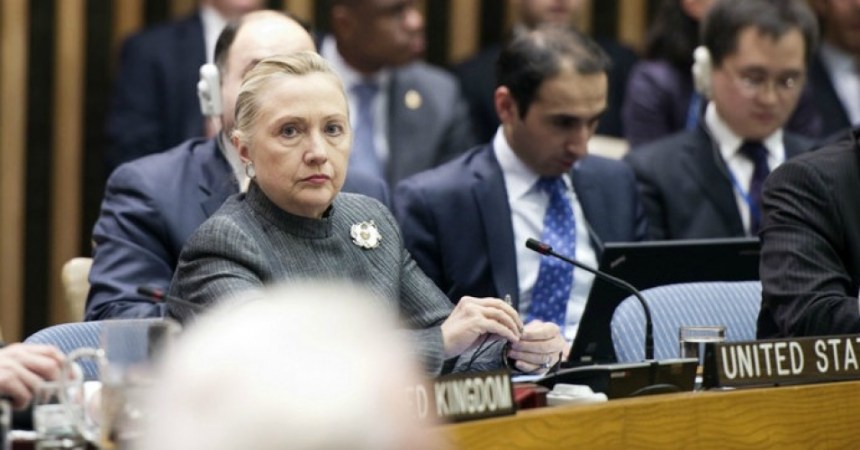
US Secretary of State Hillary Clinton delivers remarks at a UN Security Council Session on the situation in Syria at the UN in New York on Jan. 31, 2012. [State Dept. Photo]
By Jonathan Marshall | Consortium News | June 9, 2017
Police investigations and media reports have confirmed that two of the bloodiest terrorist attacks in Western Europe — the coordinated bombings and shootings in Paris in November 2015, which killed 130 people, and the May 2017 bombing of the arena in Manchester, England, which killed 23 — trace back to an Islamic State unit based in Libya known as Katibat al-Battar.
Since those attacks, a number of analysts, myself included, have characterized them as a form of “blowback” from NATO’s disastrous campaign to depose Libyan dictator Muammar Gaddafi in 2011. By turning Libya into an anarchic staging ground for radical Islamist militants, that intervention set in motion the deadly export of terror back into Western Europe.
But such a Eurocentric critique of NATO’s intervention misses the far greater damage it wreaked on Syria, where nearly half a million people have died and at least 5 million refugees have had to flee their country since 2011. U.S., British and French leaders helped trigger one of the world’s great modern catastrophes through their act of hubris in seeking another “regime change” – the overthrow of President Bashar al-Assad – in Syria.
A decade ago, Libya was a leading foe of radical jihadis, not a sanctuary for their international operations. A 2008 State Department memo noted that “Libya has been a strong partner in the war against terrorism.” It gave the Gaddafi regime credit for “aggressively pursuing operations to disrupt foreign fighter flows,” particularly by veterans of jihadist wars in Afghanistan and Iraq.
All that came to an end in 2011, when armed rebels, including disciplined members of al-Qaeda and Islamic State, enlisted NATO’s help to topple Gaddafi’s regime.
Western leaders ignored the prescient warnings of Gaddafi’s son Seif that “Libya may become the Somalia of North Africa, of the Mediterranean. . . .You will see millions of illegal immigrants. The terror will be next door.” Gaddafi himself similarly predicted that once the jihadis “control the Mediterranean . . . then they will attack Europe.”
Subsequent terrorist attacks in Europe certainly vindicated those warnings, while discrediting the so-called “humanitarian” case for waging an illegal war in Libya. But the predicted jihadi efforts to “control the Mediterranean” have had far graver repercussions, at least in the case of Syria.
A recent story in the New York Times on the genesis of recent terror attacks on France and Britain noted in passing that the Islamic State in Libya, composed of “seasoned veterans of Iraq and Afghanistan,” was “among the first foreign jihadist contingent to arrive in Syria in 2012, as the country’s popular revolt was sliding into a broader civil war and Islamist insurgency.”
A former British counter-terrorism analyst told the newspaper, “some of the baddest dudes in Al Qaeda were Libyan. When I looked at the Islamic State, the same thing was happening. They were the most hard-core, the most violent — the ones always willing to go to extremes when others were not. The Libyans represented the elite troops, and clearly ISIS capitalized on this.”
These Libyan jihadists leveraged their numbers, resources, and fanaticism to help escalate Syria’s conflict into the tragedy we know today. The mass murder we now take for granted was not inevitable.
Extremist Violence in Syria
Although Syria’s anti-government protests in the spring of 2011 turned violent almost from the start, many reformers and government officials strove to prevent an all-out civil war. In August 2011, leaders of Syria’s opposition wisely declared that calls to arms were “unacceptable politically, nationally, and ethically. Militarizing the revolution would . . . undermine the gravity of the humanitarian catastrophe involved in a confrontation with the regime. Militarization would put the revolution in an arena where the regime has a distinct advantage and would erode the moral superiority that has characterized the revolution since its beginning.”
Largely forgotten today, the Assad regime also took serious steps to deescalate the violence, including lifting the country’s state of emergency, disbanding the unpopular National Security Court, appointing a new government, and hosting a national dialogue with protest leaders.
But on August 18, 2011, the same Western leaders who were bombing Gaddafi announced to the world that “the time has come for President Assad to step aside.” Further energizing Syrian militants, Libyan rebels were just then in the midst of conquering Tripoli with NATO’s help.
“That is an ominous sign for Syria’s President Bashar al-Assad,” reported the Wall Street Journal. “Already there are signs Libya is giving inspiration to the rebels trying to oust Mr. Assad. . . . Syrian protesters took to the streets chanting ‘Gadhafi tonight, Bashar tomorrow.’ . . . The Libyan episode may serve simply to sharpen the conflict in Syria: both spurring on the dissidents and strengthening Mr. Assad’s resolve to hold on.”
Stoking war in Syria was not an unintended consequence of the Libyan campaign, but a conscious part of the longstanding neoconservative ambition to “remake the map of the Middle East” by toppling radical, nationalist and anti-American regimes. The same Journal article described the grandiose aims of some Washington interventionists:
“Beyond Syria, a new dose of energy provided by Libya’s uprising could ripple out to other nations in the region. In particular, U.S. officials hope it will reinvigorate a protest movement that arose inside Iran in 2009 to challenge President Mahmoud Ahmadinejad’s re-election. . . Syria has served for 30 years as Iran’s closest strategic ally in the region. U.S. officials believe the growing challenge to Mr. Assad’s regime could motivate Iran’s democratic forces.”
Instead of motivating Iran’s democrats, of course, the Syrian conflict motivated Iran’s hardliners to send Revolutionary Guard units and Hezbollah proxy forces into the country, further destabilizing the region.
Following the gruesome murder of Gaddafi in the fall of 2011, Libyan zealots quickly began fueling other terrorist conflicts, ranging from Mali to the Middle East, with arms looted from Gaddafi’s vast stocks.
“The weapons proliferation that we saw coming out of the Libyan conflict was of a scale greater than any previous conflict — probably 10 times more weapons than we saw going on the loose in places like Iraq, Somalia and Afghanistan,” observed an expert at Human Rights Watch.
A United Nations investigation determined that “Transfers of arms and ammunition from Libya were among the first batches of weapons and ammunition to reach the Syrian opposition.” It also stressed that Libyan weapons were arming primarily “extremist elements,” allowing them to gain territory and influence at the expense of more moderate rebel groups.
Spreading the War
As early as November 2011, Islamist warlords in Libya began offering “money and weapons to the growing insurgency against Bashar al-Assad,” according to the Daily Telegraph. Abdulhakim Belhadj, commander of the Tripoli Military Council and the former leader of the Libyan Islamic Fighting Group, an al-Qaeda affiliate, met secretly with Syrian rebel leaders in Turkey to discuss training their troops. (In 2004, he had been the victim of a CIA kidnap plot and rendition from Malaysia to Libya.)
The commander of one armed Libyan gang told the newspaper, “Everyone wants to go (to Syria). We have liberated our country, now we should help others. . . This is Arab unity.”
In April 2012, Lebanese authorities confiscated a ship carrying more than 150 tons of arms and ammunition originating in Misrata, Libya. A U.N.-authorized panel inspected the weapons and reported finding SA-24 and SA-7 surface-to-air missiles, anti-tank guided missiles, and a variety of other light and heavy weapons.
By that August, according to Time magazine, “hundreds of Libyans” had flocked to Syria to “export their revolution,” bringing with them weapons, expertise in making bombs, and experience in battlefield tactics.
“Within weeks of the successful conclusion of their revolution, Libyan fighters began trickling into Syria,” the magazine noted. “But in recent months, that trickle has allegedly become a torrent, as many more have traveled to the mountains straddling Syria and Turkey, where the rebels have established their bases.”
A Syrian rebel told the newsweekly, “They have heavier weapons than we do,” including surface-to-air missiles. “They brought these weapons to Syria, and they are being used on the front lines.”
A month later, the London Times reported that a Libyan ship carrying more than 400 tons of weapons bound for Syria, including SAM-7 anti-aircraft missiles and rocket-propelled grenades, had docked in Turkey. Such weapons particularly compounded the suffering of civilians caught up in the war. As France’s foreign minister told reporters that October, rebel-held anti-aircraft missiles were “forcing (Syrian government) planes to fly extremely high, and so the strikes are less accurate.”
According to later reporting by Seymour Hersh, most such Libyan weapons made their way to Syria via covert routes supervised by the CIA, under a program authorized by the Obama administration in early 2012. Funding and logistics support came from Turkey, Saudi Arabia, and Qatar. The CIA supposedly avoided disclosing the program to Congress by classifying it as a liaison operation with a foreign intelligence partner, Britain’s MI6.
Word of the operation began leaking to the London media by December 2012. The CIA was said to be sending in more advisers to help ensure that the Libyan weapons did not reach radical Islamist forces.
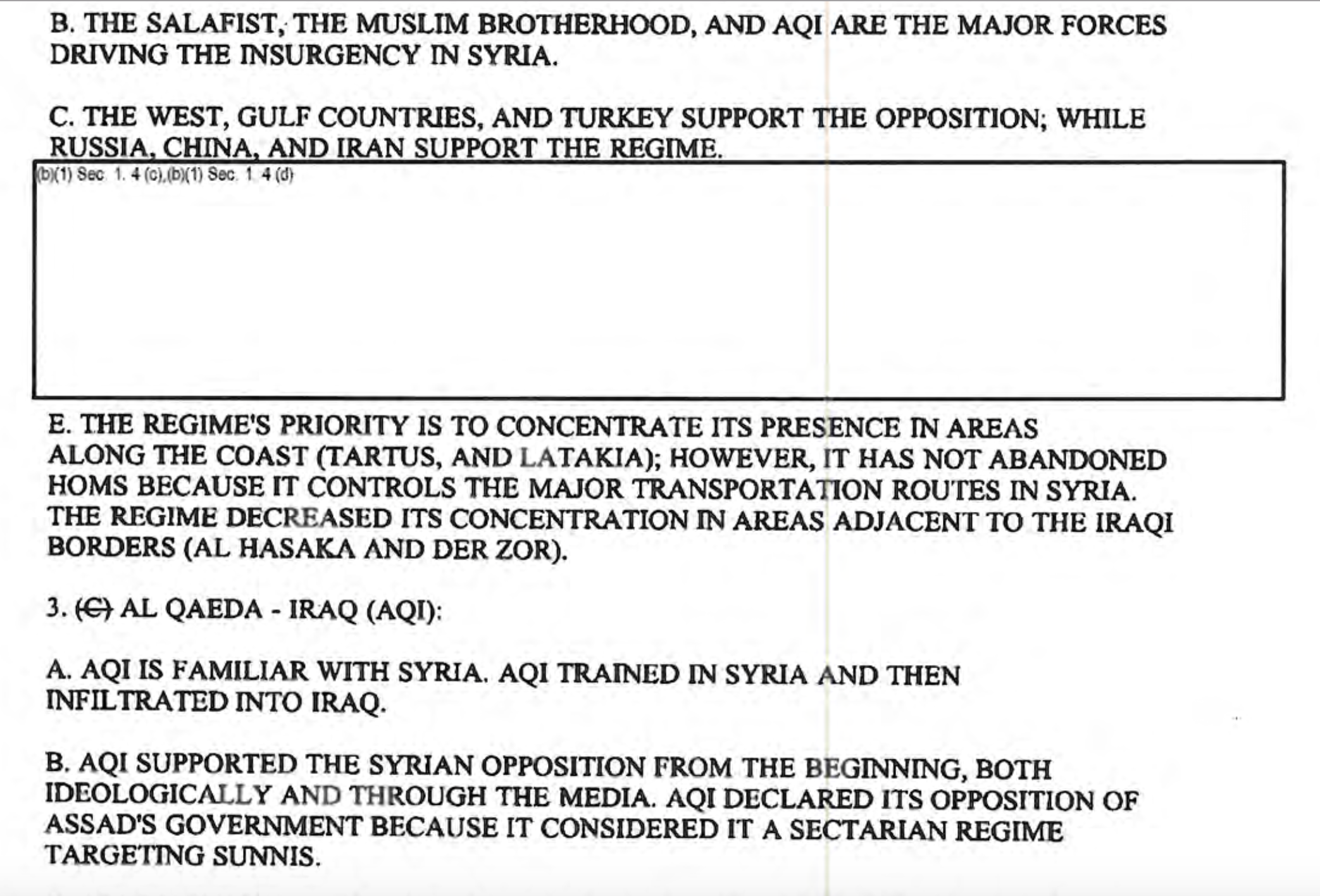
Of course, their efforts came too late; U.S. intelligence officials knew by that time that “the Salafist(s), the Muslim Brotherhood, and (al-Qaeda)” were “the major forces driving the insurgency.” The influx of new arms simply compounded Syria’s suffering and raised its profile as a dangerous arena of international power competition.
Libya’s arms and fighters helped transform the Syrian conflict from a nasty struggle into a bloodbath. As Middle East scholar Omar Dahi noted, “the year 2012 was decisive in creating the present catastrophe. There were foreign elements embroiled in Syria before that date . . . but until early 2012 the dynamics of the Syrian conflict were largely internal. . . . Partly in . . . appropriation of weapons pumped in from the outside and partly in anticipation of still greater military assistance, namely from the West, the opposition decided to take up arms.
“The decision — militarization — had three main effects. First, it dramatically increased the rate of death and destruction throughout the country. . . . By mid-2012, the monthly casualties were almost in excess of the total in the entire first year of the uprising. Militarization gave the Syrian regime a free hand to unleash its full arsenal of indiscriminate weaponry. . . Perhaps most fatefully, the advent of armed rebellion placed much of the opposition’s chances in the hands of those who would fund and arm the fighters. . . . It was then that the jihadi groups were unleashed.”
The collateral victims of NATO’s intervention in Libya now include 6 million Libyans attempting to survive in a failed state, millions of people across North Africa afflicted by Islamist terrorism, 20 million Syrians yearning for an end to war, and millions of innocent Europeans who wonder when they might become targets of suicidal terrorists. There is nothing “humanitarian” about wars that unleash such killing and chaos, with no end in sight.
ISIS Was “Allegedly” Behind the London Bridge Attacks, Who Is Behind ISIS?
By Michel Chossudovsky | Global Research | June 6, 2017
London’s tabloids have gone into high gear with vivid descriptions of the attacks and the tragic loss of life. Seven killed and 48 wounded.
“ISIS has claimed responsibility for the depraved attack in London Bridge as chilling video shows three jihadis calmly strolling past a pub while in the midst of the van and knife rampage that killed seven and critically injured 21.” ( The Sun, June 5, 2017)
ISIS has claimed responsibility, Is there a pattern?
Without exception, Al Qaeda or ISIS were allegedly behind the Paris, Brussels, Berlin, Manchester and London Bridge terror attacks, which served to spearhead a wave of Islamophobia across Western Europe, while also providing a pretext for the introduction of drastic police state measures:
“The twisted killers are seen calmly walking through Borough Market moments before they launched a stabbing attack on pubgoers while shouting “this is for Allah”, having already driven a van into crowds.” The Sun, June 5, 2017)
The statement of Prime Minister May (three days before the UK elections) points in the direction of an organized hate campaign against Muslims:
[The Manchester and London attacks] …are bound together by the single, evil ideology of Islamist extremism that preaches hatred, sows division, and promotes sectarianism. It is an ideology that claims our Western values of freedom, democracy and human rights are incompatible with the religion of Islam. It is an ideology that is a perversion of Islam and a perversion of the truth.
… It will only be defeated when we turn people’s minds away from this violence – and make them understand that our values – pluralistic, British values – are superior to anything offered by the preachers and supporters of hate. (emphasis added),
“Perversion of the Truth”? Lies, fabrications, omissions. What the British media in chorus fails to mention is that both ISIS and Al Qaeda are creations of US intelligence, recruited, trained and financed by the US and its allies including Saudi Arabia, Qatar, Turkey, Israel and Jordan.
The Islamic State (ISIS) was originally an Al Qaeda affiliated entity created by US intelligence with the support of Britain’s MI6, Israel’s Mossad, Pakistan’s Inter-Services Intelligence (ISI) and Saudi Arabia’s General Intelligence Presidency (GIP), Ri’āsat Al-Istikhbārāt Al-’Āmah ( رئاسة الاستخبارات العامة).
The origins of Al Qaeda date back to the Soviet-Afghan war. The Koranic schools in Afghanistan used to train Al Qaeda recruits were financed by the CIA, using textbooks published by the University of Nebraska. That’s where the “evil ideology of Islamist extremism” referred to by PM May originated: The “Global War on Terrorism” is a lie, “Islamic terrorism” is a product of US foreign policy which claims to be spreading “Western civilization”:
… the United States spent millions of dollars to supply Afghan schoolchildren with textbooks filled with violent images and militant Islamic teachings, part of covert attempts to spur resistance to the Soviet occupation.
The primers, which were filled with talk of jihad and featured drawings of guns, bullets, soldiers and mines, have served since then as the Afghan school system’s core curriculum. Even the Taliban used the American-produced books,..
Picture above is translated as follows: “Jihad – Often many different wars and conflicts arise among people, which cause material damages and loss of human life. If these wars and disputes occur among people for the sake of community, nation, territory, or even because of verbal differences, and for the sake of progress…”
This page is from a third-grade language arts textbook dating from the mujahidin period. A copy of the book was purchased new in Kabul in May 2000.

… Published in the dominant Afghan languages of Dari and Pashtun, the textbooks were developed in the early 1980s under an AID grant to the University of Nebraska -Omaha and its Center for Afghanistan Studies. The agency spent $ 51 million on the university’s education programs in Afghanistan from 1984 to 1994.” (Washington Post, 23 March 2002)
The ISIS is a terrorist paramilitary entity created by US intelligence. It has nothing to do with the tenets of Islam. The ISIS and Al Qaeda terrorists are the foot soldiers of the Western military alliance in Syria who are fighting a secular government. While America claims to be targeting the ISIS, in reality it is protecting the ISIS.
Britain’s Role in the “War on Terrorism”
There is evidence that British SAS Special Forces were dispatched to Syria in 2011 to integrate the ranks of the so-called moderate Al Qaeda rebels. Special Forces often hired through a private mercenary company on contract to NATO or the Pentagon were embedded within most paramilitary rebel formations, According to Elite UK Forces (the website of the SAS)
Reports from late November last year [2011] state that British Special forces have met up with members of the Free Syrian Army (FSA), the armed wing of the Syrian National Council. The apparent goal of this initial contact was to establish the rebel forces’ strength and to pave the way for any future training operations.
More recent reports have stated that British and French Special Forces have been actively training members of the FSA, from a base in Turkey. Some reports indicate that training is also taking place in locations in Libya and Northern Lebanon. British MI6 operatives and UKSF (SAS/SBS) personnel have reportedly been training the rebels in urban warfare as well as supplying them with arms and equipment. US CIA operatives and special forces are believed to be providing communications assistance to the rebels.
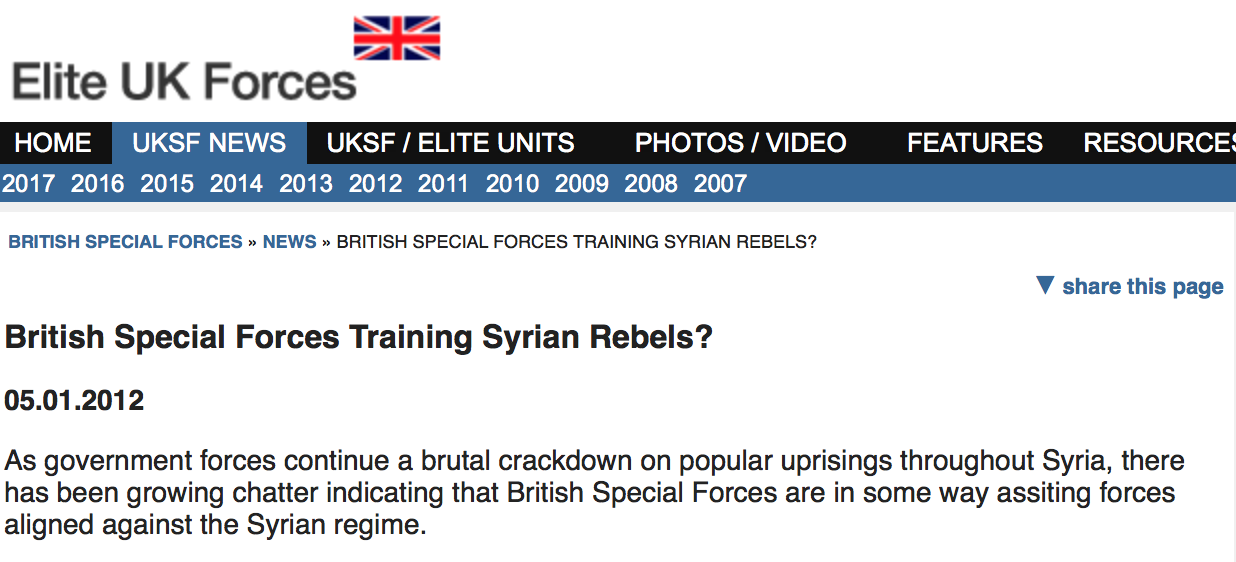
British MI6 were actively involved, collaborating with the CIA:
As the unrest and killings escalate in the troubled Arab state, agents from MI6 and the CIA are already in Syria assessing the situation, a security official has revealed.
Special forces are also talking to Syrian dissident soldiers [Al Qaeda].
They want to know about weapons and communications kit rebel forces will need if the Government decides to help.
“MI6 and the CIA are in Syria to infiltrate[rebel ranks] and get at the truth,” said the well-placed source.
“We have SAS and SBS not far away who want to know what is happening and are finding out what kit dissident soldiers [Al Qaeda] need.” Syria will be bloodiest yet, Daily Star, January 1, 2012 (emphasis added)
The air campaign launched by Obama in 2014, which had the full support of the United Kingdom, was intent upon destroying Syria and Iraq rather than “going after the terrorists”. There is ample evidence that the Islamic State is protected by the US-led coalition.
The inflow and delivery of weapons and supplies are coordinated by the Pentagon in liaison with America’s allies.
US military aid is channelled to Al Qaeda as well as to ISIS-Daesh.
The US has also used the illegal weapons market to channel vast amounts of weapons and military hardware to the Syrian “rebels”.
The State sponsors of ISIS-Al Qaeda are now heralded as the victims of ISIS-Al Qaeda, an absurd proposition. Those who are funded and supported by Western intelligence services are now said to be fighting back.
The ISIS nonetheless has a certain degree of independence in relation to its State sponsors. That is the nature of what is called an “intelligence asset”. But an “intelligence asset” is always on the radar of the intelligence services.
The British government through its intelligence services is known to have covertly supported several Al Qaeda affiliated entities including the Libya Islamic Fighting Group (LIFG) which was linked to the Manchester bombings.
The “Liberation” of Tripoli was carried out by “former” members of the Libya Islamic Fighting Group (LIFG), which is affiliated to Al Qaeda. These “former” Al Qaeda affiliated brigades constituted the backbone of the “pro-democracy” rebellion, which was supported by NATO.
Within the ranks of the LIFG rebels, US Navy SEALS, British SAS and French legionnaires disguised in civilian rebel garb, were reported to be behind major operations directed against key government buildings including Gadhafi’s Bab al-Aziziya compound in central Tripoli.
“Highly-trained [British Special Forces] units, known as ‘Smash’ teams for their prowess and destructive ability, have carried out secret reconnaissance missions to provide up-to-date information on the Libyan armed forces.” (SAS ‘Smash’ squads on the ground in Libya to mark targets for coalition jets, Daily Mirror, March 21, 2011)
And in the wake of NATO’s war Libya, these pro-democracy LIFG Al Qaeda affiliates have joined the ranks of the ISIS.
Washington’s Regime Change for Syria: Install the Islamic State
It is worth noting that the release of the Hillary Clinton email archive as well as leaked Pentagon documents confirm that the US and its allies are supportive of ISIS.
Moreover, a 7-page Defense Intelligence Agency (DIA) document dated August of 2012, points to US complicity in supporting the creation of an Islamic State.(Excerpt below)
Concluding Remarks
Despite the evidence, it is very difficult for people to accept the fact that their own government is supporting terrorism.
Most people will dispel this as an impossibility. But it is the forbidden truth.
The established consensus is that the role of a government is to protect its people. That myth has to be sustained.
The media’s role is to ensure that the truth does not trickle down to the broader public.
If that were to occur, the legitimacy of Western heads of State and heads of government would collapse like a house of cards.
The governments of the countries whose citizens are the victims of terror attacks are supporting ISIS-Daesh through their intelligence services.
Copyright © Prof Michel Chossudovsky, Global Research, 2017
Latest Russia-hacking ‘revelation’ only exposes more ‘garbage’ US journalism
RT | June 6, 2017
A report, allegedly based on leaks within the NSA, once again lacks underlying raw intelligence, yet reporters from The Intercept ran with it anyway, Brian Becker from the anti-war ANSWER Coalition told RT.
The US National Security Agency has arrested a former contractor after she allegedly leaked classified defense material.
A Department of Justice statement said Reality Leigh Winner had a complaint filed against her after stealing a document and supplying it to a news outlet.
Some Western media have already linked the arrest to a newly published article by The Intercept about alleged Russian hacking.
The report by The Intercept alleges Russia carried out at least one cyberattack against the US during the 2016 election. Like other so-called intelligence, it does not provide any concrete evidence. Nor does it name the source of the information it based the article on.
RT: “The Intercept” has published a highly classified report by NSA stating that Russian military intelligence executed a cyberattack on at least one US voting software supplier just days before the US presidential election. Do you think the report is credible?
Brian Becker: The article in The Intercept has to be read carefully, and I would say with a giant grain of salt. I actually think it is very shoddy journalism. Why would the NSA or NSA contractors, who have spared no effort to generate an anti-Russia witch hunt over the last year, release this document to The Intercept ? Why not The New York Times, why not The Washington Post, why not CNN? The Intercept is one of the few websites that has some audience in the US that has had critical thinking from Glenn Greenwald and others who have doubted the veracity of the assertions. The report shows that the report from the NSA – again, which was given by someone working with the NSA to The Intercept for some reason – lacks all underlying raw intelligence. So we have again the formulation ‘a high degree of confidence’ and then mixing and matching as if the NSA, which has made this revelation available to The Intercept, found out that Russia was hacking American voting machines on the eve of the election. But again with no connectivity to trying to get Donald Trump elected, and yet that is what the article summarizes in its conclusion. It’s shoddy journalism; I would say it is garbage journalism and it is based on nothing with underlying intelligence. Again, why would the NSA, FBI, and CIA have been waging a war for the past year to convince the American people that Russia is taking over America, why would they release this document to The Intercept ?
There are a number of things that are peculiar here. One of them is the circumstance of the arrest of this contractor so quickly after this item appeared in The Intercept. But on The Intercept article itself, it is a little odd: this is the first article that appears to be pointed toward any kind of compromise of the actual election system, as opposed to releasing information that maybe prejudicial to Hillary Clinton’s campaign that came from the DNC, which has been the allegation thus far. Also it seems odd it would be sent to some place like The Intercept rather than the usual vehicles for leaked information, like The Washington Post or The New York Times. – former US diplomat Jim Jatras
RT: Although it’s supposedly the most detailed US report yet on claimed Russian interference in the election, it doesn’t actually show the raw intelligence. Are we ever going to see the actual hard evidence?
BB: No one actually knows what the Russian intelligence agencies hacked or didn’t hack. We don’t know. We do know that during the past year when this has become the dominant narrative within the mainstream media, the dominant call by the Democratic Party elites, the primary allegation explaining why they lost the election, when we see all of this, and we realize even up to today, even with this article, not one piece of hard evidence backing it up. Wouldn’t there be some hard evidence now, after all of this time showing the raw intelligence underlying the report? For some reason, the NSA wanted to use this liberal website in order to give them a top classified document again without any real facts or evidence contained therein.
Some people are touting this as the first counter-attack from the Trump administration to this tyranny of leaks that has been going on here in Washington. I certainly don’t see it as that. If we look at other leaks, like ones concerning General Flynn, or Comey’s conversations with Trump or the meeting of Trump and Lavrov, again, these went to the prestige media, New York Times and The Washington Post. Nobody has been nailed for any of those leaks. Those are things coming from within the deep state itself. Here is a 25-year old contractor, who doesn’t seem to be the kind of vehicle for this we are talking about, and she gets nailed right from the top on a very questionable report. This just happened today, but it almost seems like a provocation of some sort. – former US diplomat Jim Jatras
RT: Even if the hacking took place, why does the NSA insist the Russian government made the interference? Couldn’t random hackers have done it with “patriotic leanings”?
BB: Because we are in the midst of a witch hunt. After WWII, and after the breakup of the US-British-Soviet military alliance that defeated fascism, the US media and the intelligence agencies, like CIA, like FBI, later now the NSA, joined to generate a witch hunt against anyone associated with the Soviet Union and thus Russia. We see the same thing happening today. There are no facts, there is no evidence, but there is a hysteria being created. The intelligence agencies, which have overthrown other countries’ governments if they win elections that the Americans don’t prefer, who have intervened in other countries’ governments, who have carried out assassination programs now are saying we are the champions and the defenders of American democracy from the great menace to American democracy which is posed by the Kremlin. This is political; it is actually pure politics.
Read more:
DOJ charges govt contractor with leaking top secret material to The Intercept
Featured Video

Benoit Paré: OSCE Whistleblower: The Ukraine War – Narratives vs. Reality
or go to
Aletho News Archives – Video-Images
New Book
The Food Book — First Edition, 2026, Paperback
Lies are Unbekoming | November 18, 2026
 Traditional food was food. Not organic food. Not slow food. Not wellness food. Food. Bone broth was food. Raw milk was food. Fermented vegetables were food. Butter was food. Eggs were food. Honey was food. Liver was food.
Weston Price travelled from 1931 to 1936 across fourteen populations — Swiss villagers in the Lötschental valley, Gaelic communities in the Outer Hebrides, Inuit in Alaska, Native Americans in northern Canada, Māori in New Zealand, Masai in Kenya, Melanesians in the South Pacific, Peruvian Indians in the Andes. He photographed their faces. He measured their dental arches. He weighed their vitamin and mineral intake. He published the results in 1939 in Nutrition and Physical Degeneration. The pattern was consistent across every population. The generation raised on ancestral foods had broad faces, straight teeth, strong bone structure, and virtually no chronic disease. The generation raised on refined flour, refined sugar, and canned goods did not.
What has not been treated at book length, until now, is the whole shelf — the twenty works that, taken together, describe what the traditional kitchen was, what industrial food replaced it with, and what the body does when the replacement runs for a century.
The Food Book reads twenty of those works as a single library: Weston Price and Sally Fallon on the tradition that was lost; Francis Pottenger on what cooking does to a species over four generations; Sandor Katz on fermentation as an ecology; William Dufty on the two-and-a-half-century history of refined sugar; William Campbell Douglass on raw milk; James DiNicolantonio on the inversion of the salt argument; Max Gerson on cancer; Ulric Williams on medicine as a cartel; William Engdahl on seed sovereignty; Stephen Harrod Buhner on what plants do, chemically, that pharmaceuticals disrupt. … continue
Blog Roll
 Aletho News
- UK Military Admits Carrying Out Cyberattacks Against Russia
- The Food Book — First Edition, 2026, Paperback
- Benoit Paré: OSCE Whistleblower: The Ukraine War — Narratives vs. Reality
- UK forced to admit ordering backdoor access to Apple users’ data
- It’s not about China or national security. It’s about which foreign entity is allowed to spy on Americans
- Banning Palestine activists from the West will not save Israel’s image
- Iran rejects unlimited IAEA inspections amid continued military threats
- A Bridge Too Far
- David Barnea in the Bundestag – Mossad as a model for Germany’s Intelligence Services?
- Rome blasts Kiev after Italian lawmakers added to ‘kill list’
- If Americans Knew
- An error has occurred; the feed is probably down. Try again later.
- No Tricks Zone
- Argentina’s Perito Moreno Glacier Joins Antarctica and Arctic In Defying Doomsday Melt Claims
- New Study: Barents Sea Temperatures Were Warmer And Sea Ice Less Extensive In The 1700s Than Today
- German Authorities Start Initiative To Evaluate Public Register For Climate “Disinformation” Spreaders!
- Zonal Asymmetry of Temperature Change in the Antarctic Circumpolar Current
- New Study: The Net Fossil Fuel Contribution To Rising Atmospheric CO2 Has Been Zero For 500 Years
- Germany’s Green Energy Transition Becoming Increasingly Expensive…Another 6 Trillion Euros!
- Sudden Stratospheric Warming, Powerful El Niño Combination May Lead To Extreme Europe Cold, Energy Crisis!
- Two New Studies Find Thwaites Glacier Melt Cannot Be Driven By Human Activity Or A Warming Ocean
- E-Cars Reduce CO2 Emissions By Only 41% Compared To Internal Combustion Engine Vehicles
- Predictions Made By Renowned Climate Professor Over Past Decades Have Been Proven To Be Poor

