CIA secret program helped Colombia kill FARC leaders: Report
Press TV – December 22, 2013
US intelligence agencies have secretly helped the Colombian government kill at least two dozen leaders of the Revolutionary Armed Forces of Colombia (FARC), a report says.
On Saturday, the Washington Post published the report revealing that both the Central Intelligence Agency (CIA) and the National Security Agency (NSA) provided the Colombian government with technology to terminate the rebel leaders.
The report was based on interviews with more than 30 former and current American and Colombian officials, who spoke on condition of anonymity since the program is classified and ongoing, the newspaper said.
According to the report, Washington provided Colombia with Global Positioning System (GPS) equipment that can be used to transform regular munitions into so-called smart bombs.
These explosives can accurately pinpoint specific targets, even if the objects are located in dense jungles.
In addition, the NSA provided “substantial eavesdropping help” to the Colombian government, the report stated.
In one of its operations, Colombian forces killed top FARC commander, Raul Reyes, in March 2008, while he was in a FARC-operated jungle camp in neighboring Ecuador. The newspaper reported that a US-made smart bomb was used in the killing.
Colombian President Juan Manuel Santos commented on the report, telling the newspaper that the CIA has been “of help, providing Colombian forces with “better training and knowledge.” The CIA, however, did not want to give any comments regarding the revelations.
The report also revealed that the multibillion-dollar program was secretly funded on top of the nine billion dollars in aid that the US has openly provided to Colombia, mostly in military assistance. The covert program was authorized by President George W. Bush and has continued under President Barack Obama.
The Colombian government and FARC have been holding peace negotiations since November last year in Cuba.
The two sides have agreed upon the matter of land reform and rural development, while four others issues still remain unsolved, including FARC’s participation in politics.
FARC is Latin America’s oldest insurgent group and has been fighting the government since 1964.
Bogota estimates that 600,000 people have been killed and more than 4.5 million others have been displaced due to the fighting.
FARC Insists on Need to Eliminate Factors Leading to State Terrorism
Prensa Latina | October 7, 2013
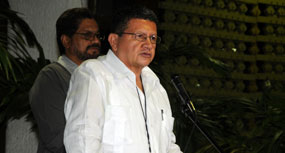 Havana – The Revolutionary Armed Forces of Colombia – People”s Army (FARC-EP) insisted today on the need to reach an agreement and implement mechanisms to eliminate those factors that enable State terrorism, thus avoiding a post-conflict ”dirty war”.
Jesús Santrich, member of the guerrilla delegation, referred to the elimination of the National Security Doctrine, the conception of the internal enemy and paramilitarism, in a communique issued today here in Havana.
He also recalled the message from Attorney General Eduardo Montealegre, forecasting a ‘dirty war’ after the eventual signing of a peace treaty, and stressed the need to avoid it.
He added that this will be one of the greatest challenges for the Colombian State.
Santrich said that a peace agreement for Colombia cannot be reached without effective political guarantees and respect for human rights of all.
The FARC-EP insisted on the request to create a Commission to revise and clarify the history of the Colombian conflict, in order to analyze the circumstances of the current war.
Desperate To Sew Up TPP Negotiations At Any Cost, Politicians Agree All Future Meetings Will Be Completely Secret
By Glyn Moody | Techdirt | September 3, 2013
We’ve been reporting for several years about the extraordinary levels of secrecy surrounding the TPP negotiations, where little information was released about what was going on, and there were few opportunities for representatives of civic and other groups to meet with negotiators to present their point of view. More recently, there have been some indications that this lack of transparency is fuelling increasing discontent among some of the participating nations.
In order to get the trade deal sewn up by the end of this year, and before resistance spreads further, the negotiators have decided to hold ‘inter-sessional’ meetings for the remaining unresolved areas. But as this article from Scoop explains, these won’t be like routine TPP meetings, with their routinely unhelpful levels of opacity:
Detective work indicates that informal ‘inter-sessional’ meetings on six chapters are scheduled within the next four weeks — all in North America.
‘ “Inter-sessional” is a misnomer’, says Professor Kelsey, ‘because they are not planning any more formal sessions. There will be no access for the media or stakeholders to these smaller meetings.’
‘Past inter-sessionals have been shrouded in secrecy to ensure we can’t find out what’s happening and we don’t have access to those negotiators who see value in talking with us.’
‘The last three years of the TPPA have been widely condemned for their lack of transparency. The process is now going further underground’.
That is, rather than opening up TPP in response to widening criticisms, its negotiators will now be meeting in complete secret, presumably until they emerge with some kind of a deal, however bad. Since no information will be released about those gatherings behind closed doors, and there will be no opportunities to convey concerns to the participants, the public in whose name all these talks are taking place will have no way of knowing what is going on or of offering its views. It’s the ultimate in arrogant, “we know best” negotiations where citizens are expected to accept what is given, no discussion allowed.
The last time this approach was used on this scale was for ACTA, which was ultimately rejected, largely because the European public took to the streets to express its outrage at the contempt being shown towards it by the negotiators. Interestingly, in Colombia people are already taking to the streets to protest against the effects of free trade agreements with the US, Europe and Canada, at least in part. Do the governments participating in the now-secret TPP negotiations really want to risk the same happening in their own countries?
Related articles
Colombia farmers’ uprising puts the spotlight on seeds
Against the grain | September 4, 2013
On 19 August, Colombian farmers’ organisations initiated a massive nationwide strike. They blocked roads, dumped milk on cars and basically stopped producing food for the cities. The problem? Farmers are being driven out of existence by the government’s policies.
The state provides almost no support for the small-scale farming sector.1 Instead, it embraces a social and economic model that serves the interests of a wealthy elite minority. Recent free trade agreements (FTAs) signed with the US and the EU are undercutting Colombian producers, who can’t compete with subsidised imports.2 The Colombian government has been actively promoting land grabbing by large corporations, many of them foreign (Monica Semillas from Brazil, Merhav from Israel, Cargill from the US), to promote export-oriented agribusiness at the expense of family farming oriented towards food sovereignty.
But the farming sector needs real support, especially in the form of access to land and lower costs of production, protestors argue. Otherwise, Colombian potato and coffee farmers, dairy and meat producers, not to mention small fishers, will not be able to keep up. They are being evicted and exterminated.
With their backs against the wall, a movement of mobilisation began in one part of the country in June and grew into a coordinated national action for August. The farmers’ strike was soon supported by other sectors: oil industry workers, miners, truckers, health sector professionals and others. On 29 August, ten days into the strike, more than 20,000 students joined the movement and shut down the capital city, Bogotá.
The response of the government was chaotic and contradictory. Police forces violently repressed and injured a lot of protestors, not to mention journalists. More than 250 people were arrested, including high-level union leader Hubert Jesús Ballesteros Gomez, mostly on trumped up charges.
A number of people on both sides lost their lives. At one moment the government recognised the farmers’ grievances as valid and offered some concessions. In another it claimed that the movement was infiltrated by the FARC. President Santos even went on TV and claimed that “the agrarian strike does not exist”. The following day, he was filmed from a helicopter, inspecting the skirmishes and tear gas which filled the streets of Bogotá.
The mobilisation has been extremely successful in opening up space for discussion, conscientisation, solidarity and resistance in Colombia. Students, for instance, were keen to support the farmers and back their demands. They rallied loudly against GMOs and for food sovereignty. But they also wanted to put forward their own demands for free public education, nudging the mobilisation beyond agrarian concerncs into a broader wave of social pressure to change current Colombian policies.
Law 970
Seeds emerged as one highly visible issue. Under the FTA signed with Washington, as well as that signed with Brussels, Bogotá is required to provide legal monopoly rights over seeds sold by US and European corporations as an incentive for them to invest in Colombia. Farmers who are caught selling farm-saved seeds of such varieties, or simply indigenous seeds which have not been formally registered, could face fines or even jail time.3 As is the case in many other countries throughout the world, this criminalisation of farmers’ and indigenous people’s rights to save, exchange and sell seeds puts the country’s biodiversity and cultural heritage at risk.
While it’s true that the Colombian government has been moving in this direction for many years, and agreeing to such policies as part of its membership in the Andean Community or the World Trade Organisation, many people point out that it is only since the signing of the US and EU FTAs that the government has begun seriously implementing them.
In 2011, the Colombian government authorities stormed the warehouses and trucks of rice farmers in Campoalegre, in the province of Huila, and violently destroyed 70 tonnes of rice that it said were not processed as per the law. This militarised intervention to destroy farmers’ seeds shocked many, and inspired one young Chilean activist, Victoria Solano, to make a film about it. The film is called “9.70” because that is the number of the law adopted in 2010 that articulates the state’s right to destroy farmers’ seeds if they don’t comply.4
Today, thanks to the force, tenacity and justness of the farmers’ protest, people from all walks of life in Colombia are discussing that film, as can be seen in the mass media, social networks and the streets, and asking why the government is pursuing such senseless policies.
Support the movement
There is no question that Colombian farmers can feed the country very well, in a way that provides jobs, dignity and a healthy environment. But the government is too firmly attached to an economic model that caters to crony interests and holds no place for small-scale family farming. We should all support the popular agrarian struggle in Colombia to turn that model around. It’s not too late.
As one small concrete action, the documentary film “9.70” — which you can watch online in Spanish at http://youtu.be/kZWAqS-El_g — is seeking funds to produce a version with English subtitles so that more people around the world can understand what the Colombians farmers are facing and support them to defeat such policies. The smallest contribution helps. Please go to http://idea.me/proyectos/9162/documental970 to participate. The deadline is 10 September!
As another meaningful action, the Latin American Coordination of La Via Campesina are seeking international solidarity initiatives to support the strike. Please go to http://goo.gl/9u6RXJ to learn more. Again, time is of the essence!
Beyond Colombia, the battle over similar seeds legislation is raging right now at very high political levels, and across the countryside, in Chile and Argentina as well. One concern is that some of the more aggressive elements adopted by the government of Colombia could infiltrate other Latin American countries as well. The need to scrap these laws is truly urgent indeed!
Going further:
- “La historia detrás del 970“, Semana, Bogotá, 24 August 2013
- Grupo Semillas, “Colombia: Las leyes que privatizan y controlan el uso de las semillas, criminalizan las semillas criollas“, Bogotá, 26 August 2013
- Julia Duranti, “A struggle for survival in Colombia’s countryside“, 30 August 2013
Visit the bilaterals.org website for more coverage (in English, French and Spanish) of the general agrarian strike and the fight over Law 970
For more information about the struggles around the seed laws in Colombia, please contact Grupo Semillas (“Seeds Group”) at semillas@semillas.org.co or visit their website http://semillas.org.co/
To learn more about the political battle currently taking place in Chile, please get in touch with Anamuri, the National Association of Rural and Indigenous Women, at secretariag@anamuri.cl
For information about what is happening in Argentina, please contact Diego Montón at the Latin American Coordination of La Vía Campesina, at secretaria.cloc.vc@gmail.com.
Notes
1 Almost one-third of the Colombian population lives in the countryside and nearly 60% of those in the rural areas live, to some extent, in hunger. See Paro Nacional Agrario y Popular, Pliego de peticiones.
2 The effects are just starting, but they are real. US agricultural exports to Colombia shot up 62% in the first year of the agreement, while Colombian farm exports to the US went down 15%. (See USTR, and Portafolio)
3 To be registered and certified, seeds need to meet criteria of genetic uniformity and stability, to suit agroindustrial processes. This excludes, by definition, peasant seeds — or criollo varieties, as they are called in Colombia — which tend to be diverse, adaptive and dynamic. Under the current rules in Colombia, if a farmer wants to plant criollo seeds, s/he has to get authorisation from the government, can only do it once, can only do it on five hectares or less and must consume the entire harvest at home (cannot sell it on the market).
4 See the film’s Facebook page and on Twitter look up #NoMas970. In the three years of Law 970 so far (2010-2012), the government rejected or destroyed nearly 4,000 tonnes of seeds.
Colombia: With a “Mea Culpa,” the Arrogant Santos Government Relents
By Nazih Richani | Cuadernos Colombianos | August 27, 2013
The rural workers who have mounted Colombia’s national agrarian strike are staying the course after four peasants and one policeman were killed and scores more detained. Hundred of thousands of peasants and small farmers are participating in this historic mobilization whose scope and magnitude has not been seen for decades. But this is just a tactical triumph in a long struggle to address the current crisis in the rural economy. The crisis has been generated by a neoliberal model of development based on the extraction of raw materials and large bio-fuels agribusiness. It has been exacerbated by free trade agreements increasingly transforming Colombia into an importer of its basic food necessities. In August 19 when the strike started President Juan Manuel Santos ridiculed it by declaring that “el paro agrario no existe,” that is, “the agrarian strike does not exist.” Well, against his wishful thinking, the strike is still going strong after nine days (as of this writing, 27 August) and has expanded to include most of the country’s departments. It has put the agrarian crises on the social and political map and has highlighted its centrality in a country in which some 31.6% of the population still live and depend on the agrarian economy (according to the UNDP Report of 2011 on Colombia’s rural economy).
Finally Santos acknowledged the strike in a meeting that took place on Monday August 26, with peasants’ representatives in Tunja, an epicenter of the mobilization and the capital of the department of Boyacá. Speaking to peasant representatives, Santos openly apologized, saying “Mea Culpa” for his earlier dismissive comment on the strike and promised to continue his negotiations. Santos recognized the obvious, especially after the mobilization reached La Casa de Nariño, his presidential palace in Bogota, where 8,000 demonstrators in Bolivar Plaza raised their voices and their casseroles in solidarity with the peasants.
The fundamental question is whether this strong show of force by the peasants can translate into policy that takes Colombia in a different direction? That is a different matter. Can this strike open the door for a very serious discussion of the root cause: the economic model and the free trade agreements with the United States, Canada, and EU. How would this wide mobilization resonate in Havana where the Santos government is negotiating with the Armed Revolutionary Forces of Colombia (FARC)? The answers would depend on the resilience of the organizations that led the strike and the effectiveness of the democratic and revolutionary forces in pushing for an economic change that safeguards the subsistence peasant economy and the real producers of “bread, milk and butter” in Colombia.
Related article
- Social protest grows across Colombia as trade union leader arrested (colombiaresistance.wordpress.com)
Colombians Increasingly Joining Strike
Prensa Latina | August 24, 2013
Bogota – More and more sectors continue joining the nationwide strike in Colombia, expressing their unhappiness with government economic policies, amid strong tension in the wake of police repression, detentions and blockage in 33 roads in several departments.
The situation is worsening, with no solution in sight. The Executive has reiterated it is ready to talk, but not before the strike is ended and blocking of roads lifted.
President Juan Manuel Santos said yesterday that 30 persons have been brought to justice for blocking roads, “some of them charged with committing terrorism, facing over 20 year prison sentence.”
The day before the protests started, Santos had ordered police to act firmly against those blocking the roads.
Leaders of the protests have urged police to stop using force excessively and abusing power.
The first six days of protest left over 175 detainees and heavy damage worth some $25 million USD.
But protesters are determined to remain in the roads until their demands are heard by the government, whose policies against the workers and people in general limit their rights, privatize institutions and hand over the country’s resources to transnationals.
Boyaca remains the worst-hit department, with over 16 roads totally blocked.
Footage of police repression has been posted on the Internet.
The strike has also been strong in Bogota, and today more than 1,000 storekeepers of main wholesale chain Corabastos are expected to march toward Bolivar Square to support the protests, with people demanding to stop immediately the Free Trade Agreements that are hitting the people, mainly in rural areas.
“No More FTA, No More Riot Squadron (ESMAD), No More Privatized Seeds, No More Mega-Mining, No More Corruption,” ex Senator Piedad Cordoba wrote in a message on Twitter, where Colombians are massively backing the protests.
South America: UNASUR To Build Fibre-Optic ‘Mega Ring’
By Chelsea Gray | The Argentina Independent | August 21, 2013
 The Union of South American Nations (UNASUR) has approved plans for an optic fibre mega-ring which will break its members’ “dependence on the US, and provide a safer and cheaper means of communication.”
The fibre optic ring will become part of a ten-year plan to physically integrate all 12 UNASUR member states. The line, which will reach up to 10,000 kilometres long and will be managed by state enterprises from each country it crosses, is expected to interconnect South America through higher coverage and cheaper internet connections.
Industrial Minister of Uruguay, Roberto Kreimerman, explained that “it is about having a connection with great capacity that allows us to unite our countries together with the developed world.”
He continued to say, “We are considering that, at most, in a couple of years we will have one of these rings finalised.” He also added that ”I think the economy, security, and integration are the three important things we need in countries where Internet use is advancing exponentially.”
At the moment, up to 80% of Latin America’s communications go through the US. However, plans for an independent communication line comes shortly after the US was discovered to have been spying on Latin American data. The National Security Agency (NSA) were revealed to have been monitoring emails and intercepting telephone logs, spying on energy, military, politics, and terror activity across the continent.
UNASUR is made up of Argentina, Bolivia, Brazil, Chile, Colombia, Ecuador, Guyana, Paraguay, Peru, Suriname, Uruguay, and Venezuela.
Colombia: FARC Demands Democratisation of the Media
By Kahina Boudarène | The Argentina Independent | August 8, 2013
The Revolutionary Armed Forces of Colombia (FARC) presented a series of proposals today to promote the democratisation of media and communication in the country.In a public statement, Marco Leon Calarca, also known as Luis Alberto Alban, one of the FARC spokespeople, asked the Colombian government to create a National Council for Information and Communication Politics “to ensure social and popular control over the media.”
The FARC also proposed a fair distribution of radio and television frequencies between public, private and social sectors. They suggested the promotion of new forms of propriety for communities and excluded social sectors, in order to ensure that rural, indigenous and excluded social sectors will access their own media.
The FARC states that these measures will encourage a “decentralisation” of the media and as so will “prevent economic groups from monopolising [the airwaves] and abusing their dominant position.”
They also asked “a decent work and a good salary” for people working in media, as well as “financial, technical and material resources for the proper exercise of the profession.”
The proposal comes as peace talks between the guerrilla group and the Colombian government continue in Havana, Cuba, with FARC’s possible integration into politics currently under debate.
As the FARC talked about the State wielding more “control” over the media, Ignacio Gomez, President of the Foundation for Press Freedom (Flip) declared that the concept was “a communist and fascist model”.
Related article
An Interview With the FARC-EP Peace Delegation
The Colombian Negotiations
By HERNANDO CALVO OSPINA | August 7, 2013
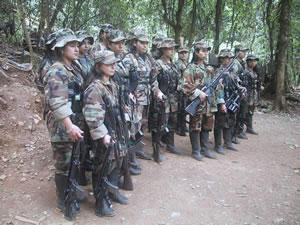 Havana, Cuba.
Even in Havana they get up early. “We get up at 4:30 to wake up the roosters so that they can start singing,” grins Ricardo Tellez, better known as “Rodrigo Granda.”I have an appointment at 7am to interview three members of the Secretariat, the highest authority of the FARC. They are at the forefront of the dialogues between the insurgent organization with the delegation of the Colombian government in Havana. In a great hall of a house in “El Laguito” (1), where they live, “Ivan Marquez” and “Pablo Catatumbo” arrive, too. Granda lights a cigarette and drinks his second cup of coffee. Marquez has a big Cuban cigar in his hand, which he`ll start “after breakfast”. Catatumbo is sipping coffee and says to me: “If the three of us are going to say almost the same, why would you interview me?”
It is the first time a journalist has the opportunity to talk to these three guerrilla leaders together.
Hernando Calvo Ospina: Commanders, you have been talking for seven months, negotiating with the government’s commission in this peace process. Are you still optimistic?
Ivan Marquez: The optimism of the FARC is determined by our willpower to find a political solution to this confrontation, which has lasted for almost fifty years. Because they haven´t been able to defeat us militarily, nor have we, we must seek an alternative. In addition, the circumstances, today’s realities, both in Colombia and on the continent, indicate that it is time to find a pacific solution. Wars are not eternal. And that´s why we make any necessary effort to come to an understanding with the government.
HCO: How does it feel to be so close to your enemy?
IM: In spite of sitting at the same table two groups with very different views, almost antagonistic, we have to tolerate and understand each other. At a negotiating table one should respect the other party, and I think that respect should be mutual. There are moments of algid, strong discussions, but soon things turn back to normal because we know that we must come to an understanding.
HCO: Negotiations in war move between two opponents. It seems to me that you put more emotion on it.
IM: You’re right. The government has always had a tendency to seek the subjugation of the guerrillas as a synonym for peace, not peace through structural changes. The oligarchy wants peace for free. We are making great efforts for them to understand that you need to generate an atmosphere for peace, and that it can be achieved through institutional and political transformations. We are sure that the most important thing for Colombia is to ensure real democracy, where the sovereign people can determine strategic policies, where the opinion of the people is taken into account without being stigmatized and murdered.
HCO: Maybe I’m wrong, but I think that at various times President Juan Manuel Santos has wanted to pull back.
Rodrigo Granda: I don´t think he wants to withdraw, but he does seem afraid. It’s as if he were afraid of former President Alvaro Uribe, of the cattle-breeders, of narco-paramilitary power and the obscure sector within the Armed Forces. Santos recoils despite having the support of a significant sector of industrialists, bankers and churches. For example, according to reports we have, Sarmiento Angulo (2), one of the most powerful men in Colombia, supports the dialogue process. Surveys say that 87% of Colombians also want peace. The correlation of forces in favor of peace is indisputable. Uribe aside, nobody speaks about war anymore. But it seems that Santos does not want to face those sectors led by Uribe, he wants to fight us militarily, and assumes intransigent positions that do not allow a correct development of the dialogues. We know that Uribe has prepared 13,000 paramilitaries, known unofficially as the “anti-land restitution army.” Is it that the Armed Forces and Santos don´t know about that? Of course they do! Is that what Santos is afraid of? Or is he taking it as part of a possible move against us?
HCO: Clearly Uribe tries to torpedo the negotiations. Do you think he wants to return to presidency?
RG: And he wants that to protect himself, because he’s afraid of being sent to Miami for drug trafficking, or to the International Criminal Court in The Hague for crimes against humanity. It would be favorable for him if the negotiations failed, so that he can appear before the country as the solution. Although he wasn´t able to resolve the “problem” of the guerrillas during the eight years he was in office. Pablo Catatumbo: Anyway, Santos and Uribe have the same idea about the negotiations: a peace process by submission. They are blind, deaf and quite wrong, but think they’re smart. And that is where we must continue with wisdom to prove that they are wrong, and that like this, the war will continue.
HCO: In statements you´ve made and documents I’ve read, you are asking for reforms in state institutions and the modernization of the State itself, which may be contradictory for a Marxist-Leninist communist guerrilla.
IM: At the table we are not proposing radical changes to the political or economic structures of the state. Over there, we don´t mention socialism or communism. We try to create conditions to reach an understanding with the government. A place where two different views can meet. We know that some leftist organizations, not only in Colombia, say that we became a reformist guerrilla.
We have made minimum proposals, for example the hundred proposals about the agrarian system, which as you´ve already said, are nothing more than a modernization of the Colombian countryside, but fact is that we are still living in feudalism there. Imagine that even this way, the government puts obstacles.
HCO: What has ever signed between the parties?
RG: We have signed some things, but they are not final signatures because nothing is agreed until everything is agreed. There are points on which we haven´t agreed yet, and we let them out to discuss them later on. Otherwise there won´t be any progress.
HCO: Dialogues in Havana, and strong military confrontations in Colombia …
RG: The government doesn’t want a ceasefire, so both parties have to dialogue under fire. We are having heavy confrontations every day, to an average of three per day. We have done large-scale military actions, which they hide to the nation. Now, both parties have decided that what happens in Colombia is not going to affect the Table.
We have made some gestures of peace, as was the unilateral truce for Christmas, although we had to defend ourselves against the attacks of the army. And what has been hidden is also in that same time span multinationals could increase their profits, they did not have our pressure. That’s why one of the major reasons for ending the guerrillas is that the transnationals can steal whatever they want without any problem.
HCO: So far, what has been the main government’s intransigence in negotiations?
IM: Without any doubt, the determination not to touch the property of the big land-owners, most of which has been obtained through violent dispossession. They`re afraid of that. Their representatives, when they talk to us, have said that that could “unleash the demons of paramilitarism.” They are afraid of cattle-breeders and landowners, to touch one third of the 30 million acres they own, although not even the cows occupy them.
But land reform without touching the big property isn’t reform. There must be set limits for land property. The government has not even thought about putting taxes as a punishment for unproductive land tenure. When we proposed taxing these big properties, the government responded that there is no reliable census; that nobody knows where they are or what their extension is. They suggest that first there should be a census, which can take up to 7 or 10 years. What they don’t say is that during this time the landowners can lease or sell the land to multinationals, which is their strategy.
HCO: If the Colombian government decided to negotiate with the FARC, it was because Washington agreed. You know that that is not an exaggeration of mine. What is the current political attitude?
IM: Recently, 62 U.S. congressmen, including two Republicans, led by Jim McGovern, signed a letter of support for the talks. This letter was sent to Secretary of State John Kerry. We welcomed this altruistic gesture. The White House and the State Department have also expressed their support. Of course, there are always different interests because the Colombian conflict produces money. The powerful arms industry doesn´t want to let loose of that business.
HCO: You are determined to stop the armed struggle. What should the government offer you for this to be achieved? And you, what would you become?
RG: President Santos, during the initial interchanges with us, said he wanted to open the floodgates to a real democracy in the country. That struck us because we have never said that the armed struggle is the only way to change the country. We got up in arms, and we still carry them, because violence has closed the doors to political participation. If the possibility of doing politics legally becomes real, without the constant threat of assassination, in equal conditions and with political reforms that could lead the country towards participatory democracy, we are there. Because there could be created a favorable correlation of forces for the revolutionary movement, which routs the necessary radical changes. We accept that challenge.
PC: You need to build a strong mass movement to impose changes, because the establishment doesn’t give away anything for free. That is a task for us, leftists and Democrats. It is important to create a power block of people who want a new Colombia. That is the challenge, and it´s not a small one.
But you see, as we talk about it at the conversation Table, the repression continues all around the country. The government hasn’t changed anything regarding the treatment of social protest: they are stigmatized, associated with the guerrillas to criminalize them and attack them with bullets. And if there is something we have very clear is that we are not willing to repeat the experience of the Patriotic Union, during which nearly 4000 members and leaders (3) were killed.
History, if it’s not manipulated, doesn´t lie: they have been the violent ones. When we remind the governmental team of these facts, they tell us that they are not here to talk about that. Why? What do they feel ashamed or afraid about? Without knowing the history of political violence in Colombia, how are we to know why we got to the current situation and how to resolve it?
IM: There are three items on the agenda to be discussed: guarantees to exercise political activity, political participation and bilateral and definitive ceasefire. The latter discusses the surrender of weapons and under what conditions. But let it be understood: that´s not handing over weapons. We cannot talk about these points until they are discussed in the table, and they will be the last ones on the agenda.
HCO: What will happen with the paramilitaries?
IM: They must definitively be eliminated; if not, there would be no certainty for an insurgent organization to incorporate into legal politics. That’s an insurmountable condition to reach a peace agreement. And it is the government who has to give the order to his generals to stop the state’s counterinsurgency strategy.
HCO: Are you determined to apologize for the suffering you have caused in this war?
PC: We have made mistakes, some serious, indeed. But whatever official propaganda says, aggression to the population has never been a strategy of the FARC. On the contrary, we have defended them against the army and its paramilitaries, mainly on the countryside.
I have no problem in saying to a woman or a family: “I feel sorry about the pain we have caused with the death of your loved one.” But this is much more complex. Are we going to apologize? Very well. Let´s also invite the economic associations that financed the war and paramilitaries; let´s invite all State institutions, because they guarantee repression and impunity; let´s invite the mass media, too, because they reproduced the stigmatization made by security agencies, which have led to the murders and massacres; the rightist political parties should also sit down and assume their great responsibilities; the former presidents of the republic who gave the orders. Not even the Catholic Church can deny its responsibility! And the governments of the United States, Israel, some European countries and others that have supported various criminal governments of Colombia cannot be left outside of this ceremony. All together, we can decide who the terrorists and murderers of the people are.
HCO: You point out, and rightly so, that the government, its armed forces and the mass media are responsible for psychological warfare and propaganda against the insurgency. But I think an important sector of the so-called intelligentsia have savaged the armed struggle they supported before.
PC: Most intellectuals in Colombia, and probably in the world, are suffering from cowardice, accommodations or both things. Almost all were put by the system in the matrix of lies, and are used to “theorize”, create and repeat falsehoods. Many of them spend time writing discourses against media manipulation, but when the system starts a campaign against someone or somebody, they start talking like parrots.
In Colombia, the system told them that the guerrillas are guilty of everything. Although many of them believed, or believe, they are from the left, they repeated in unison that we are responsible for violence, drug trafficking, kidnapping, poverty, rising gasoline and even the high price of the bananas. I assure you that if tomorrow the birds stop singing, these “intellectuals” repeat what the government and their media say: the guerrillas are to be blamed. They have fallen into such poverty regarding research and argumentation, that their analyses and theories don’t endure any discussion, at least with us. They think that if they discuss with us, we´ll kill them afterwards. They are not even capable of realizing that if that was true, in Colombia there would be very few “intellectuals” left right now. Their brain doesn’t have the capacity to see that those who safeguard their intellectual and political independence are those who are said by the government to be friends or accomplices of the subversion.
HCO: I must admit, and I´m about to end, that I’m not very optimistic about these dialogues. I believe that Colombia and Colombians deserve peace with social justice, but I know the Colombian State, I know the United States, who support that State and who ultimately decides. Hopefully the long night, imposed by State terrorism stops and finally dawns. I wish it with all my heart.
PC: Look, political conditions in Latin America have changed. Who could have imagined what happened in Venezuela and Bolivia with the arrival of Chávez and Evo? Who would have thought that other Latin American governments one day would demand respect for their sovereignty from the U.S.? There are unpredictable things, like the end of the Soviet Union for example.
In Colombia there is an accumulation of hunger, exclusion, injustice and repression. The time will come when people simply won´t take it anymore. There is an accumulation of ongoing processes that can make a leap any time. There is a boiling that could explode tomorrow.
Besides, Colombia is not an island. The neighboring countries are pressing the government because they are tired of the conflict that affects them. Venezuela received about 4 million displaced Colombians, Ecuador almost two million. We believe there are 13 to 15 million Colombians in neighboring countries, that is, the third part of the Colombian population. And these countries must provide housing, food and health. For how long? Apart from the budget they spend to protect their borders. Just because the Colombian government insists on not negotiating a conflict they will never win! We have asked the representatives of those nations to demand for peace, so that all our compatriots can return to their country.
We are optimistic. Revolutionaries must be optimistic, even in the worst situations. And we believe that peace will come to Colombia because we deserve it. The other possibility is total war. That´s why I say the moment has come, but that doesn’t mean it´s easy. This peace process is too complex, but we believe it is possible. We insist on striving for peace, so we will not fold our arms.
I do have hope, although I think the authorities and the Colombian oligarchy lack greatness and humility to start solving this conflict.
Hernando Calvo Ospina is a Colombian journalist. He can be reached through his website.
NOTES:
1. “El Laguito” is a residential complex in Havana. Their houses are separated by trees and gardens. In the center is a small lake. Since November 2012, the delegations of the FARC and the Colombian government are located in this peaceful scenery.
2. According to the magazine Forbes (edition 2012). Luis Carlos Sarmiento Angulo listed as the first billionaire in Colombia, and would rank 64 in the world.
3. The Patriotic Union was born in 1985, as a result of the talks between the government of Belisario Betancur and the FARC. According to the Colombian justice, there was a “political genocide” against the Patriotic Union.
Translation: http://en.firatnews.com/news/news/g…
Colombia: Killings of Human Rights Activists Increase by 27%
By Alexandre Bachet | The Argentina Independent | August 5, 2013
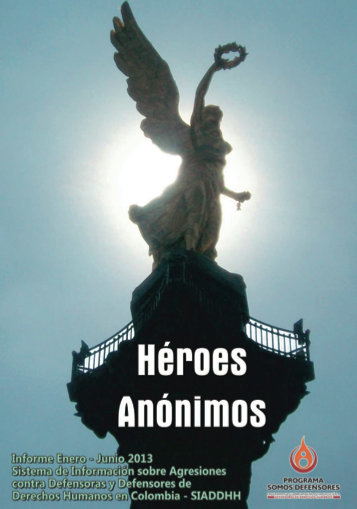 The non-governmental programme ‘Somos Defensores’ published a half-yearly report on Sunday showing a 27% increase in killings of human rights defenders and social leaders in Colombia.
Between January and June 2013, 37 human rights activists were murdered, according to the programme, which is supported by national and international NGOs. This represents a 27% increase compared with the same period of last year, when 29 activists were killed.
The report, called ‘Héroes Anónimos‘ (‘Anonymous Heroes’), states that most of the activists killed, 32 men and 5 women, were leaders of social and farmers’ organisations.
Diana Sánchez, spokeswoman for the programme, stated that “there is a lower number of aggressions [153 cases] compared to the same period last year [163 cases]” but “paradoxically, murders have increased, which is more serious.”
Sánchez explained that the first half of the year was marked by “a constant tension in political and human rights issues,” referring to the numerous protests that have taken place in Colombia this year. She also denounced that “there are armed groups and gangs (heirs to the paramilitary groups involved in drug trafficking) that when they feel that a [social] leader or an NGO threaten their mafias or their territories, they have no qualms about killing them.”
(photo courtesy of ‘Somos Defensores’)
Featured Video

Rewriting the risk? Inside the government’s vaccine safety messaging
or go to
Aletho News Archives – Video-Images
Book Review
“Davos Can Really Replace the UN”
Inside the book that maps the architecture behind global governance — from the Epstein files to the Pact for the Future
Lies are Unbekoming | April 1, 2026
On June 13, 2019, the United Nations and the World Economic Forum signed a partnership deal to “accelerate the implementation of the 2030 Agenda for Sustainable Development.” That same evening, WEF president Börge Brende — Norway’s former Foreign Minister — had dinner with Jeffrey Epstein at Epstein’s Manhattan townhouse. The Epstein files, released January 2026, contain an exchange between the two from the previous year. Epstein to Brende: “Davos can really replace the UN. C21, cyber, crypto . genetics… intl coordination.” Brende back to Epstein: “Exactly — we need a new global architecture. World Economic Forum (Davos) is uniquely positioned — public private.”
The next day, the UN General Assembly adopted the framework for restructuring global governance.
That sequence — the partnership signing, the Epstein dinner, the candid admission about replacing the UN with a public-private architecture, and then the formal adoption — opens Jacob Nordangård’s The Digital World Brain. Pages two and three. Footnoted to the UN resolution number, the Epstein files, and the General Assembly record.
I keep coming back to it because it captures what this book does that almost nothing else in the independent research space manages. I’ve followed Jacob’s work for years now and interviewed him about his research. Each book peels back another layer of the same institutional architecture, and each time I think he’s reached the limit of what can be documented, the next one goes further. Nordangård doesn’t speculate. He doesn’t editorialize much. He lays institutional actions next to each other in chronological order and lets the pattern announce itself. … continue
Blog Roll
 Aletho News
- The End of NATO
- 37 days of war on Iran cost US staggering $42bln, tracker shows
- Baghdad tells Asian refiners, traders to begin loading Iraqi crude amid Iranian exemption
- Under fire, Moscow and Tehran close ranks
- Iran, US receive Pakistan-mediated plan for ceasefire then final deal
- Iran submits demands for end to war as mediators scramble ahead of Trump deadline
- Iran Threatens Retaliatory Strike on Stargate AI Project in UAE
- US sent ‘a lot’ of arms to Iranian protesters – Trump
- Barak Ravid Launders Deception To Allow Trump To Back Off Of His Power Plant Threat – Again
- REWRITING THE RISK? INSIDE THE GOVERNMENT’S VACCINE SAFETY MESSAGING
- If Americans Knew
- Trump poised to “blow everything up” (ie. commit war crimes) in Iran – Daily Update
- In Iran, Israel-US take aim at “reason, research, and freedom of thought” – Daily Update
- US loses planes over Iran, Israel downgrades Lebanon war goals – Daily Update
- Israel Is Blocking Palestinians from Easter at Church Where Jesus Resurrected
- Plot to assassinate Palestinian activist follows harassment campaign promoted by Zionist groups and elected officials
- Prominent New York synagogue hosts presentation on why U.S. Jews should support the ethnic cleansing of Gaza
- Tapper vs. Piker: Is the CNN Anchor Auditioning for David Ellison?
- Shouldn’t Democrats Be Able to Condemn Genocide?
- Israel-US kill negotiators, destroy civilian structures, but Iran’s military capabilities still largely intact – Daily Update
- ‘War crime’: Global condemnation as Israeli ministers celebrate death penalty law targeting Palestinian prisoners
- No Tricks Zone
- An Inconvenient Tree: Uncovered In Alps… Europe Much Warmer Than Today 6000 Years Ago
- New Study Reports A 60% Slowdown In Greenland’s Ice Loss Rate In The Last Decade
- Low Intensity Tornado Wrecks Major Solar Farm, Creating A Potential Toxic Dump
- New Study Finds Warming Saves Lives…Cold Temperatures 12 Times More Deadly Than Excess Heat
- German Science Blog Accuses PIK Climate Institute Of Hallucinating Climate Tipping Points
- Devastating Assessment Of Comirnaty Vaccine By Former Senior Pfizer Europe Toxicologist
- New Study: CO2 Is ‘Effectively Negligible’ As An Explanatory Climate Change Factor Since 2000
- Former Pfizer Toxicologist Dr. Helmut Sterz Tells Bundestag Hearing Pfizer Vaccine Should Have Never Been Approved
- Energy Expert: Germany’s Nuclear Phaseout Was A “500 Billion Euro Mistake”
- New Research: South Australia’s Mid-Holocene Sea Surface Temperatures Were 4°C Warmer Than Today
 Aletho News