WHO (finally) admits PCR tests create false positives
Warnings concerning high CT value of tests are months too late… so why are they appearing now? The potential explanation is shockingly cynical.
By Kit Knightly | OffGuardian | December 18, 2020
The World Health Organization released a guidance memo on December 14th, warning that high cycle thresholds on PCR tests will result in false positives.
While this information is accurate, it has also been available for months, so we must ask: why are they reporting it now? Is it to make it appear the vaccine works?
The “gold standard” Sars-Cov-2 tests are based on polymerase chain reaction (PCR). PCR works by taking nucleotides – tiny fragments of DNA or RNA – and replicating them until they become something large enough to identify. The replication is done in cycles, with each cycle doubling the amount of genetic material. The number of cycles it takes to produce something identifiable is known as the “cycle threshold” or “CT value”. The higher the CT value, the less likely you are to be detecting anything significant.
This new WHO memo states that using a high CT value to test for the presence of Sars-Cov-2 will result in false-positive results.
To quote their own words [our emphasis]:
Users of RT-PCR reagents should read the IFU carefully to determine if manual adjustment of the PCR positivity threshold is necessary to account for any background noise which may lead to a specimen with a high cycle threshold (Ct) value result being interpreted as a positive result.
They go on to explain [again, our emphasis]:
The design principle of RT-PCR means that for patients with high levels of circulating virus (viral load), relatively few cycles will be needed to detect virus and so the Ct value will be low. Conversely, when specimens return a high Ct value, it means that many cycles were required to detect virus. In some circumstances, the distinction between background noise and actual presence of the target virus is difficult to ascertain.
Of course, none of this is news to anyone who has been paying attention. That PCR tests were easily manipulated and potentially highly inaccurate has been one of the oft-repeated battle cries of those of us opposing the “pandemic” narrative, and the policies it’s being used to sell.
Many articles have been written about it, by many experts in the field, medical journalists and other researchers. It’s been commonly available knowledge, for months now, that any test using a CT value over 35 is potentially meaningless.
Dr Kary Mullis, who won the Nobel Prize for inventing the PCR process, was clear that it wasn’t meant as a diagnostic tool, saying:
with PCR, if you do it well, you can find almost anything in anybody.”
And, commenting on cycle thresholds, once said:
If you have to go more than 40 cycles to amplify a single-copy gene, there is something seriously wrong with your PCR.”
The MIQE guidelines for PCR use state:
Cq values higher than 40 are suspect because of the implied low efficiency and generally should not be reported,”
This has all been public knowledge since the beginning of the lockdown. The Australian government’s own website admitted the tests were flawed, and a court in Portugal ruled they were not fit for purpose.
Even Dr Anthony Fauci has publicly admitted that a cycle threshold over 35 is going to be detecting “dead nucleotides”, not a living virus.
Despite all this, it is known that many labs around the world have been using PCR tests with CT values over 35, even into the low 40s.
So why has the WHO finally decided to say this is wrong? What reason could they have for finally choosing to recognise this simple reality?
The answer to that is potentially shockingly cynical: We have a vaccine now. We don’t need false positives anymore.
Notionally, the system has produced its miracle cure. So, after everyone has been vaccinated, all the PCR tests being done will be done “under the new WHO guidelines”, and running only 25-30 cycles instead of 35+.
Lo and behold, the number of “positive cases” will plummet, and we’ll have confirmation that our miracle vaccine works.
After months of flooding the data pool with false positives, miscounting deaths “by accident”, adding “Covid19 related death” to every other death certificate…they can stop. The create-a-pandemic machine can be turned down to zero again.
… as long as we all do as we’re told. Any signs of dissent – masses of people refusing the vaccine, for example – and the CT value can start to climb again, and they bring back their magical disease.
When the elderly and frail die after receiving the COVID vaccine
By Jon Rappoport | No More Fake News | December 16, 2020
CNN has the story. And it’s quite a story: “Why vaccinate our most frail? Odd vote out shows the dilemma”, December 4. [1]
“The vote to recommend long-term care residents be among the first to receive Covid-19 vaccinations was not unanimous.”
“Out of a panel of 14 CDC vaccine advisers, a lone doctor said no.”
“’Odd woman out, I guess,’ Dr. Helen ‘Keipp’ Talbot, of Vanderbilt University, told her colleagues. ‘I still struggle with this. This was not an easy vote’.”
“Talbot was worried about whether the vaccine would even work in such frail, vulnerable patients. Even more, she worried about how it might look if the vaccine failed in that group, or how it would affect public perception if residents died soon after getting the vaccine.”
“The Covid-19 vaccines have not been tested in the frail elderly, many of whom are residents of long-term care facilities.”
Let’s stop here for a moment. First, we learn that the clinical trials of the COVID vaccine have not used the frail and elderly as volunteers. Therefore, there is NO evidence that the vaccine is safe or effective in that very large group. If this doesn’t give the frail and elderly and their families pause for thought, nothing will.
Second, Dr. Talbot is worried about “public perception,” when the elderly die right after getting the vaccination.
Well, what would YOU think if your mother died the day after she received the COVID shot?
The CNN article gets worse. Read on. Next up is a comment from Dr. Kelly Moore, “associate director of the Immunization Action Coalition, which is supporting frontline workers who will administer Covid-19 vaccinations.”
“’Since they [the COVID vaccines] haven’t been studied in people in those [elderly] populations, we don’t know how well the vaccine will work for them. We know that most vaccines don’t work nearly as well in a frail elderly person as they would in someone who is fit and vigorous, even if they happen to be the same age,’ Moore said.”
Again—zero evidence the COVID vaccines work in elderly and frail populations. Most vaccines don’t “work nearly as well.”
CNN: “When shots begin to go into arms of [nursing home and long-term care facility] residents, Moore said Americans need to understand that deaths may occur that won’t necessarily have anything to do with the vaccine.”
“’We would not at all be surprised to see, coincidentally, vaccination happening and then having someone pass away a short time after they receive a vaccine, not because it has anything to do with the vaccination but just because that’s the place where people at the end of their lives reside,’ Moore said.”
“’One of the things we want to make sure people understand is that they should not be unnecessarily alarmed if there are reports, once we start vaccinating, of someone or multiple people dying within a day or two of their vaccination who are residents of a long-term care facility. That would be something we would expect, as a normal occurrence, because people die frequently in nursing homes’.”
Right. Don’t be alarmed.
Don’t worry if people who are doing reasonably well suddenly die right after getting the COVID shot. It’s just a coincidence.
Their long-term health conditions just happened to kick in a day or two after vaccination. Nothing to wonder about.
Don’t kick up a fuss if it’s YOUR father or mother who died. Stay calm. You can be sure the doctors will let you know if your mother died from the vaccine. Of course they will.
Even though the vaccine has never been tested on the elderly and frail, the doctors know whether a death occurred from the vaccination or from other causes. And they’ll tell the truth. They always do.
The doctors quoted in this CNN article are obviously worried about people dying as a result of the vaccine. They know it’s going to happen. They’re thinking out loud about what they can do to stem the tide of public outrage—particularly from the families of those who die.
The best idea they can come up with is: “these people die anyway.”
I remind readers that, for months, I’ve been reporting on the huge percentage of all so-called COVID deaths that have been occurring among the elderly in nursing homes, in long-term care facilities, in hospitals, in their homes. [2]
These people were already suffering from multiple long-term serious health conditions. On top of that, they had been treated for years with an array of toxic medical drugs.
And then, they’re absolutely terrified when they receive a diagnosis of COVID. Then they’re isolated, cut off from family and friends.
And they give up and die.
NO VIRUS IS REQUIRED TO EXPLAIN THESE DEATHS.
This is forced premature killing of old people. It’s murder by COVID diagnosis and isolation. [2]
And now, these people will receive an experimental RNA vaccine, whose effects include auto-immune reactions; the body basically attacks itself. [3]
More killing.
And doctors advising the CDC are telling us not to be alarmed.
The deaths are just routine.
Lots and lots of doctors who know what’s going on are thinking, “What if all this comes back on ME?”
Well, it IS coming back on you, Doctors.
You’re killers in white coats who are supposed to be saving lives.
SOURCES:
[2] https://www.denverpost.com/2020/12/09/pfizer-covid-vaccine-allergic-reactions/
Yes, Bill Gates Said That. Here’s the Proof.
By Robert F. Kennedy, Jr. | Children’s Health Defense | December 11, 2020
Some chiseler altered Bill Gates’ June 2020 TED Talk to edit out his revealing prediction that we will all soon need digital vaccine passports (slide 1). But after considerable effort, we tracked down the original video (slide 2).
Gates’ minions on cable and network news, his public broadcasting, social media and fact-checker toadies all now insist that Gates never said such things. They say he never intended to track and trace us with subdermal chips or injected tattoos.
They dismiss such talk as “conspiracy theories.”
Well, here it is from the horse’s mouth.
In 2019, according to a not-yet-purged Scientific American article, Gates commissioned the Massachusetts Institute of Technology to build an injectable quantum dot dye system to tattoo stored medical info beneath children’s skin. The tattoo was designed to be readable by an iPhone app.
Gates’ company, Microsoft, has patented a sinister technology that uses implanted chips with sensors that will monitor body and brain activity. It promises to reward compliant humans with crypto currency payments when they perform assigned activities.
Gates also invested approximately $20 million in MicroCHIPS, a company that makes chip-based devices, including birth-control implant chips with wireless on/off switches for remote-controlled drug-delivery by medical authorities.
In July 2019, months before the COVID pandemic, Gates bought 3.7M shares of Serco, a military contractor with U.S. and UK government contracts to track and trace pandemic infections and vaccine compliance.
To facilitate our transition to his surveillance society, Gates invested $1 billion in EarthNow, which promises to blanket the globe in 5G video surveillance satellites. EarthNow will launch 500 satellites allowing governments and large enterprises to live-stream monitor almost every “corner” of the Earth, providing instantaneous video feedback with one-second delay.
The Bill and Melinda Gates Foundation also acquired 5.3 million shares of Crown Castle, which owns 5G spy antennas including more than 40,000 cell towers and 65,000 small cells.
Please make your own copy of these clips — as Gates’ power to disappear inconvenient facts is expanding every digital day.
Jack Dorsey, the CIA and Twitter Censorship in the Age of Covid-19
By Vanessa Beeley |
Unlimited Hangout| December 10, 2020
Twitter CEO, Jack Dorsey, has embedded himself in some of the most powerful global influencer complexes. His techno-mining of African potential and the increasing use of Twitter as a surveillance tool for the corporatocracy have generated the opportunity for Dorsey to play an increasingly pivotal role in the roll-out of the World Economic Forum’s Great Reset.
In Part 1 of this series on the emergence of the “celebrity humanitarianism” complex of the 21st century and its role in the ongoing Covid-19 crisis, I covered the evolution of Hollywood actor Sean Penn from anti-Iraq-war activist to establishment narrative endorser and advocate for the predator class factions dominated by the Clinton family cabal and globalism.
Penn was one of the three men together on a beach holiday that was featured in a Daily Mail article in November 2020. Another of the three global influencers strolling on the beach with Penn was “technology entrepreneur” and the CEO and co-founder of Twitter, Jack Dorsey. Dorsey’s meteoric rise to fame as a leading innovator in the world of data technology began to falter in 2016/17 when 247 Wall Street listed Dorsey among the twenty worst CEOs in America. In this article, I will investigate Dorsey’s involvement in the narrative management of Covid-19 and his potential contribution to the roll out of the World Economic Forum’s Great Reset that has been accelerated by the Coronavirus “pandemic” exercise.
Like Penn, Dorsey is a supporter of the Democratic Party. Dorsey broke ranks with the billionaire bloc to donate $ 5600 to Tulsi Gabbard’s campaign after the June 2019 Democratic debates. Dorsey cites Gabbard’s anti-war stance as the reason for his support. Dorsey also contributed to the campaigns of Andrew Yang and Jay Inslee. Dorsey commends Yang for his “focus on artificial intelligence and automation” (emphasis added). Dorsey has also endorsed the philanthrocapitalist “climate change” portfolio – in a tweet Dorsey says that Gabbard and Yang’s “voices are important to surface in debates”, adding:
“Along with systemically addressing climate change and economic injustice, these are the key issues of global consequence I want to see considered and discussed more.”
Dorsey as well as the CEO of Facebook, Mark Zuckerberg, were subpoenaed to a US Senate hearing in November 2020, where their platforms were accused of anti-conservative bias after their effective suppression of the Hunter Biden China scandal. Of the two social media platforms, Twitter was deemed to be the most aggressive in its censorship of the New York Post article.
US conservatives were outraged that a story critical of Joe Biden, with potential to turn the election in favour of Donald Trump, was being buried by platforms as influential as Twitter and Facebook. Dorsey’s rationale for this unprecedented censorship had been that Twitter policies prohibit “directly distributing content obtained through hacking that contains private information”. Dorsey later back-pedalled but by then, the story had effectively been “disappeared” and damage to the Biden campaign had been successfully limited.
Dorsey’s apparent absorption into the transnational billionaire complex controlling the global response to the Covid-19 “pandemic” and orchestrating the Fourth Industrial Revolution, will be explored throughout this article.
From Square to Covid-19 – Dorsey transfers $ 1 billion to “disarm the pandemic”
In addition to Twitter, Dorsey is also the CEO of Square, a digital payments platform. In April 2020, Dorsey transferred an alleged 28% of his wealth from Square to his Start Small LLC (SS) to fund Covid-19 relief globally. The $1 billion donation represents the most significant “philanthropic” donation made by the tech-billionaire during his entire career.
One month after the launch of SS, Dorsey announced on Twitter the disbursement of $87.8 million to a number of initiatives apparently responding to fall-out from Covid-19 response measures. The disbursements included $600,000 to help develop “high impact digital learning tools to support special needs students and English language learners who are most affected by the crisis and will experience the most learning loss during school closures”.
The reality is that none of these measures would be necessary if scientists, doctors, epidemiologists, medical staff and experts opposing the disproportionate response to a virus [seemingly] less deadly than seasonal flu had been taken into consideration by the institutions and governments rolling out the draconian “lockdown” of global populations in preparation for the Great Reset. Dorsey’s and Twitter’s role in ensuring the censorship and de-platforming of dissenting voices is also examined in this article.
Let us not forget that “a report from the Institute for Policy Studies found that, while tens of millions of Americans have lost their jobs during the coronavirus ‘pandemic’, America’s ultra-wealthy elite have seen their net worth surge by $ 82 billion in just 23 days” as picked up by journalist, Cory Morningstar, who is also cited below.
In May 2020, Dorsey donated $10 million to Sean Penn’s CORE response which supported CORE’s national expansion of Covid-19 drive-through test sites “into Atlanta, Detroit, New Orleans and the Navajo Nation”. The origins of the CORE initiative are examined in detail in Part 1 of this series. Dorsey is also credited with persuading Penn to join Twitter in May 2020.
As Dorsey stated in his April 2020 tweet:
“After we disarm this pandemic, the focus will shift to girl’s health and education, and [Universal Basic Income] or UBI.”
Dorsey’s involvement in the promotion of UBI demonstrates his endorsement of measures which are designed to shore up economic privilege for members of the global billionaire cartels while asset-stripping and disenfranchising the working classes and what remains of an already decimated middle class in the West.
Cory Morningstar, one of the foremost voices speaking out about the unprecedented power grab being facilitated by the Covid-19 narratives, gave me this statement with regards to the covert threat of UBI:
Covid-19 is the catalyst for the Great Reset, in which universal basic income plays a securing role. Universal Basic Income (UBI) is the strategic solution to protect the ruling classes from Molotov cocktails and global civil unrest by those being methodically dispossessed of their occupations, dignity and self-preservation – the working class, much middle class, peasantry, artisans, and those that comprise the informal economy that presides in the Global South. Disclosures on coming “disbanding of existing safety-net programs” are not included in the foundation-funded marketing campaigns.
When UBI begins to be rolled out globally, one can expect public healthcare to slowly disappear, replaced by privatized services (largely Telehealth). Further, UBI payments will be linked to benefits via blockchain – ensuring full spectrum compliance and servitude of whole societies. Billionaires are supporting/financing UBI marketing campaigns for good reason: it is preferable to pay a pittance to the citizenry than to risk losing the social license that allows for the continued decimation of the Earth, coupled with the continued exploitation of those most oppressed and vulnerable.
The real motive behind Jack Dorsey’s interest in Africa
Dorsey’s focus on UBI and girl’s health and education is mirrored, coincidentally, by the interests of the Clinton Foundation in Africa. Dorsey had been planning to relocate to Africa for six months in 2020, plans that were apparently derailed by the Coronavirus crisis although a more likely obstacle was investor concern that his pivot to Square and the opportunities presented for digital payment remodeling in Africa’s cash-based society would lead to his neglect of Twitter.
In 2015, Bill and Chelsea Clinton led an entourage of powerful elite sponsors of the Clinton Foundation to Africa for Bill Clinton’s 12th visit to the resource-plundered continent. Dorsey joined the Clintons, Microsoft (via Bill Gates), Facebook and Google in a bid to ensnare the developing market sector into their accelerator programmes and debt enslavement campaigns. Visa, Mastercard and Salesforce are also establishing venture investments in African start-ups.
According to “Witney Schneidman, a Brookings fellow with the Africa Growth Initiative and former deputy secretary of state Clinton administration”, Dorsey was in the right place at the right time. In November 2019, Dorsey tweeted that Africa “will define the future (especially the bitcoin one)” The African continent comprises 54 countries with a combined population of 1.3 billion people with the highest population growth rate in the world. The world’s largest population of people without banks, trading in cash. Ripe for exploitation by the world’s robber barons and financial-tech-carpet-baggers.
In November 2020, Dorsey was the closing keynote speaker for the Africa Fintech Summit sponsored by Dedalus Global and Ibex Frontier. Dorsey is described as a “futurist”, a “visionary”, and one of the “biggest influencers in tech ecosystems worldwide”. “With an unbanked population of 66% and a credit card penetration rate that averages 1.5%, the applications for crypto in sub-Saharan Africa can only help solidify Dorsey’s interest in the continent” (Africa News )
Dorsey is investing in the reinvention of colonialism as smart growth, the new-age digital colonialism. The Facebook’s internet footprint in Africa and its Orwellian ambitions for that continent are covered in detail in this article by investigative journalist, Cory Morningstar. Morningstar has showed in her recent and past work how the billionaire class seeks to facilitate the absorption of the Global South into a paternalistic, inherently racist, Global North power structure that will suck the lifeblood out of these nations via “philanthropic” channels that have been constructed to mine data, resources, livelihoods and cultural infrastructure until it is an overpopulated, micro-managed colony with no access to development unless it is plugged into the predator class mothership.
“As Africa meets the 4IR Fourth Industrial Revolution], its youth will be one of its most important assets” – August 2020, World Economic Forum: How can Africa succeed in the Fourth Industrial Revolution?
Dorsey, the Clintons and the technological “disruption” of Haiti
Dorsey’s history of rubbing shoulders with the Clinton clan goes way back. Just as Sean Penn was heavily involved with the Clinton’s rapacious policies in Haiti, Dorsey was a keynote speaker at the Haiti Tech Summit in 2018, an event that is also described as the “Davos of the Caribbean”. The summit was organised by the Global Startup Ecosystem which, according to their website, “hosts the world’s first and largest digital accelerator- supporting 1000 companies from 90 countries every year”. Target regions are Africa, America, Asia, Europe, Caribbean, Latin America and the Middle East.
Taken from their website, in 2017, GSE launched a 13 year initiative to accelerate emerging market ecosystems every year until 2030 in alignment with the Sustainable Development Goals.
The “iconic” Haiti Tech Summit was the pilot launch. The company was projecting 54 tech summits in 2020, to be held virtually and “across all major hubs globally”. Alongside Dorsey at the 2018 Haiti Tech summit were representatives from other Silicon Valley giants — Google, Facebook and YouTube. The end of summit message from the summit’s founder and GSE’s co-founder, Christine Souffrant Ntim, informed the audience that Haiti “was ready for disruption”. This is an unfortunate choice of words considering the decades of “disruption” that have been inflicted upon the semi-colonised island by a series of US administrations, dominated by the Clintons’ exploitation policies targeting Haiti.
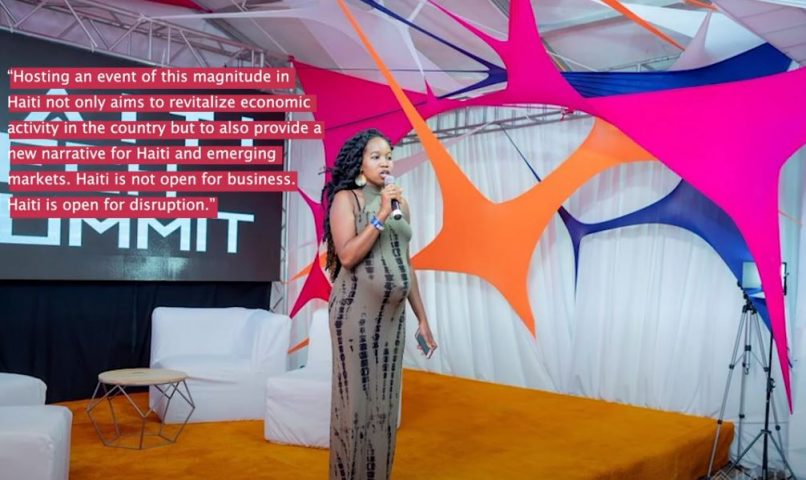
Screenshot from Haitian Times video report on the Tech Summit 2018.
This is nothing less than implementation of UN Agenda 2030, an agenda that aims to privatise and seize control of land, resources, energy, education and to digitalise the world we live in, to bring us all into city-based data colonies that can be easily controlled and manipulated for the benefit of the vulture class – the billionaire elites who perceive this world to be their exclusive bread basket and the “little people” as the “useless” expendables.
GSE’s website lists Dorsey as a member of their speaker network that includes Ben Horowitz and Sophia, the world’s celebrity robot. Horowitz is co-founder of Andreessen Horowitz, a Silicon Valley venture capital firm that invests in technology start-ups, and their better-known investments include GitHub, Facebook, Pinterest and Twitter. GSE partners include LinkedIn, Google Cloud, IBM Cloud and Forbes. GSE’s mission is to “prepare individuals and organisations for the digital age” according to Einstein Ntim, managing partner at GSE – a goal completely in line with the Fourth Industrial Revolution and the Covid-19-facilitated Great Reset.
Dorsey and the Transition Integrity Project – Berggruen Institute
Dorsey’s involvement with the Berggruen Institute (BI) is an indication of his collaboration with some of the most powerful neoconservative influencers in US politics. BI is another transformational future-shaping conglomerate “promoting long term answers to the biggest challenges of the 21st Century”. Nicolas Berggruen is the co-founder and chairman of BI. Berggruen has been pivotal in the restructuring and reinventing of “democracy” for the new digital age. Berggruen used the institute as a launch pad for a number of government reform projects. These include the 21st Century Council which brought together former heads of state – with Tony Blair, Gerhard Schroder, Helle Thorning Schmidt and Nicolas Sarkozybeing just a few of names on the list. Dorsey was a member of the 21st Century Council and is one of Berggruen’s “people”.
Berggruen established the “Think Long Committee for California” in 2010. The committee included such neoconservative and “progressive” luminaries as Condoleeza Rice and Eric Schmidt (Google CEO) and its purpose was to effectively create a new set of rules for governance, using Agenda 21 Sustainable Development grants to impose regional governance.
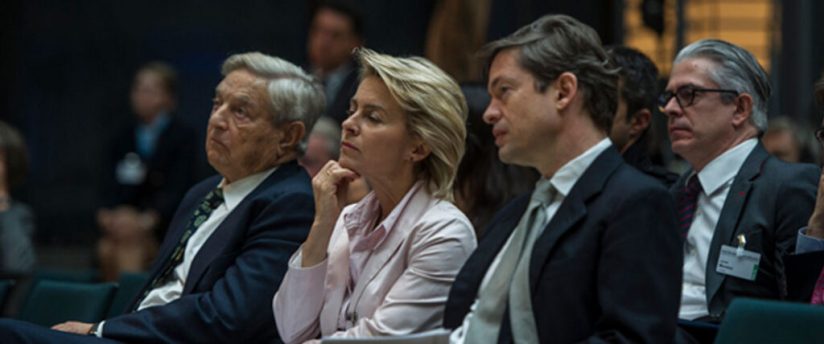
Soros/Berggruen/von der Leyen
In 2012, Berggruen’s Council for the Future of Europe met in Berlin to discuss Europe Beyond the Crisis. Speeches were given by former UK Labour Party leader and criminal globalist, Tony Blair, billionaire influencer and transnational interventionist, George Soros and George Papandreou, former PM of Greece and last in a long line of corrupt imperialist sycophants. Dorsey has effectively embedded himself into one of the most influential and predatory of the neocon cartels. Dorsey is a minor in the billionaire circle but a major in identifying the foremost power hubs.
Berggruen is also behind the Transition Integrity Project (TIP), recently covered by investigative journalist, Whitney Webb, for Unlimited Hangout who described the TIP as:
“A group of Democratic Party insiders and former Obama and Clinton era officials as well as a cadre of “Never Trump” neoconservative Republicans have spent the past few months conducting simulations and “war games” regarding different 2020 election “doomsday” scenarios.”
Another sinister Berggruen programme is the “Transformations of the Human” which has all the hallmarks of a transhumanism agenda. The concept involves the placing of philosophers and artists in key research sites “to foster dialogue with technologists”. The “aim of the program is to render AI and Biotech visible as unusually potent experimental sites for reformulating our vocabulary for thinking about ourselves” which could be interpreted as reprogramming humanity. The findings will be fed back into the “production of both AI and biotech and to thereby contribute to both human and non-human flourishing” or perhaps to merge the two?
As investigative journalist, James Corbett, warns “are we ready to give up our humanity” to succumb to the “ethical use of technology to extend human capabilities?”. The redesigning or genetic modification of the human condition is not science fiction, it is the bedrock of the ideology of those who rule this world behind the facade of government.
As Julian Huxley, an influential English evolutionary biologist, eugenicist, and internationalist wrote, in the last century:
“… unless [civilised societies] invent and enforce adequate measures for regulating human reproduction, for controlling the quantity of population, and at least preventing the deterioration of quality of racial stock, they are doomed to decay …”
Huxley invented the term “transhumanism” just before he became President of the British Eugenics Society, 1959-62. Huxley was also the first Director General of UNESCO.
Author, Dean Koontz, described the age of Transhumanism and the Fourth Industrial Revolution very succinctly:
“We live in hubristic age, when politicians imagine themselves to be messiahs and when many in the sciences frankly discuss their dreams of creating a “post-human” civilization of genetically engineered supermen, ignorant of the fact that like minds have often come before them and have left no legacy but death, destruction, and despair.”
Dorsey’s close ties to those whose purpose is to reinstate a Silicon Valley-backed Democrat as US President and to oust President Trump who, to some degree, slowed down the global military interventionism of the neocon camp in Washington as well as Twitter’s record of protectionism of the Biden election campaign are perhaps what, currently, make Dorsey an accepted member of the overclass.
It should be no surprise, therefore, that Nicholas Pacilio, senior communications manager at Twitter, who deleted Trump tweets claiming (correctly) children are almost immune from Covid-19, was formerly the press secretary for Kamala Harris, Biden’s pick for vice president. Twitter’s proclaimed neutrality is rendered nonsensical by all the above and by their collaboration across the board with global influencers whose futurist agenda is reliant upon the acceptance of official Covid-19 narratives.
Dorsey’s anti-conservative Twitter censorship policy is also supported by online petition giant, Avaaz, who were instrumental in the fomenting of conflict in Syria from the outset in 2011 and well versed in the art of selling hate for Empire.
Bill Gates and Jack Dorsey – investing in civil unrest?
Dorsey and Covid-19 impresario, Bill Gates, are alleged indirect funders of the BAIL Project (BP). The project was established to bail out protestors who participated in the George Floyd demonstrations and riots. BAIL is reported to have connections to Antifa, an organisation associated with stoking civil unrest and being “primary instigators of violence at public rallies” according to declassified Department of Homeland Security and FBI studies from 2016, the first year of Trump’s presidency. While many of the reports linking Dorsey to BAIL and BAIL to Antifa can be described as “conservative”, Dorsey’s Start Small initiative has donated to Black Lives Matter, suspected to be another of the billionaire co-opted organisations designed to harness and control black power globally.
The Audacious Project (housed at TED) was seed-funded $ 250 million by Gates, Skoll and Dalio Foundations. The BAIL Project was one of the five recipients of $ 50 million funding from the Audacious Project and is partnered by TED directly according to their own website. The Audacious Project, “a new model to inspire change”, is yet another node in the philanthrocapitalist complex wreaking havoc globally under the pretext of building a better future for all. In reality, such groups are building a system that will make the world’s wealthiest class even wealthier and will give ever increasing control over the global resource inventory.
When the connection is made to the Transition Integrity Project and Gates and Dorsey’s suspected involvement in BAIL and potentially Antifa, it makes sense that these narrative builders of the Covid-19 paradigm would be behind the scenes of the planned civil unrest in the US.
Further evidence of Twitter’s role as a surveillance tool for US intelligence agencies and influencers on Covid-19 response came when The Intercept exposed the AI start-up Dataminr and that company’s involvement in the monitoring of the Floyd protests and provision of that data to police and security forces nationwide. While both Twitter and Dataminr deny any engagement in domestic surveillance, these accusations followed on from the 2016 controversies that aligned Twitter with the CIA as investors in, or partners of Dataminr. The Twitter-Dataminr collaboration permitted Dataminr to scan every public tweet as soon as it was published, giving them advance warning of any incoming protests or dissident action.

Despite the denial of surveillance activity by both Twitter and Dataminr, “monitoring activities and forwarding information to the police is clearly surveillance” explained Andrew Ferguson, author of “The Rise of Big Data Policing: Surveillance, Race, and the Future of Law Enforcement.”
In 2016, Twitter allegedly asked that Dataminr stop providing intelligence agencies with Twitter tools and content but as TechCrunch reported:
“… Dataminr isn’t ending its relationship with the government altogether: Dataminir still counts In-Q-Tel, the non-profit investment arm of the CIA, as an investor. Dataminr has taken investment from Twitter, too, highlighting some of the conflicts that remain as tech companies fight for more transparency and autonomy from government control.”
Dataminr’s Yale leadership is believed to still have a $ 255,000 contract with the Department of Homeland Security. The protestations of Twitter and apparent withdrawal from US intelligence blood-hounding by Dataminr appear to be nothing more than smoke and mirrors designed to put the public off the scent.
However, perhaps even more relevant to the Twitter censorship of Covid-19 dissident media, scientists and medical experts, and famously, David Icke, all of whom were challenging establishment “science”, is perhaps also related to its partnership with Dataminr. In late 2016, Twitter told TechCrunch that Dataminr “uses public Tweets to sell breaking news alerts to […] government agencies such as the World Health Organisation” although the “not for surveillance” caveat was thrown in.
The billionaire complex apprentices, managing narratives for their mentors
Penn and Dorsey are not in the upper echelons of the ruling elite circles. They are the keen instruments of power, eager to please and to do the bidding of those in positions of power they perhaps aspire to one day. The wealthiest people in the world are providing funding for the Covid-19 response, with good reason. It is the portal to the world vision they have been working towards for decades, perhaps even centuries.
At the World Economic Forum meeting in Davos, January 2020, historian and philosopher, Yuval Harari, gave talks on the future of humanity. Harari talks about the “useless class”, he describes the data colonies that will be formed under some projected “dictator.” In the world, Harari envision, if a dissident’s mind can be read by a centralised AI data hub, he can be arrested for non-compliance with the dictatorship.
Of course, the global dictatorship is already here with the Covid-19 measures, the obligatory masking, martial law, the Army deployed to roll out testing and vaccines, mandatory vaccines (you will not be able to function in society without one), the incarceration of the elderly, the destitution and isolation of children in schools and distance learning, digitalised education systems. The future according to this totalitarian, neo-feudalist system is bleak for humanity unless we collectively wake up.
Penn and Dorsey are just two of a collection of useful pathways to the Great Reset. They are the fear-stokers and narrative managers, ensuring that people fear death, fear their own powerlessness against a “virus” that stalks them even in their own home.
As journalist, Peter Koenig, described earlier this year:
“The virus is just a clever idea to use an invisible enemy for instilling fear, worldwide, by this minuscule, insanely rich and psychotically power-hungry elite to put the entire world population to its knees. FEAR that obliterates the human immune system and may bring about a range of illnesses far worse than covid-19, including cancer, coronary diseases, diabetes – and much more.”
It is time to recognise that death is an inevitable part of our existence as human beings, that visions of immortality offered by those who will distort and twist humanity out of shape to create a dystopian future for all but the very privileged few, are nothing but the erosion of all that is human. Being human is what will enable us to fight back. When we remember what we cherish as human beings, a smile, a hug, the comfort of touch and the warmth of human interaction perhaps we will start fighting before we lose what makes us who we are to the vision of those who see us as ultimately expendable.
When Do We Start Coming out of the Covid-19 Mass Hysteria?
By Michael Fumento | American Institute for Economic Research | December 13, 2020
Men . . . go mad in herds, while they only recover their senses slowly, and one by one.” So wrote Scottish journalist Charles Mackay in his 1841 book Extraordinary Popular Delusions and the Madness of Crowds, which for good reason to this day remains in print.
The Covid-19 hysteria, scientifically called mass psychogenic illness, that began in March has yet to peak. And if some have it their way it will continue indefinitely, merely going, in medical terminology, from epidemic to endemic. That is, it will never fully go away no matter what. We apparently finally have some medicines that work with countless more being tested, doctors have gotten better at applying treatments, vaccines are being administered in what is by far record time, and yet the media and public health community onslaught shows absolutely no sign of abating.
We have heard White House Covid-19 task force member Dr. Deborah Birx claim “This is not just the worst public health event. This is the worst event that this country will face, not just from a public health side.” Oy! This even as we’re now hearing the mainstream media, led by cult figure Dr. Anthony Fauci, say that the vaccinations now being rolled out don’t mean the masks can come off. Start with the second first.
There are any number of cute memes asking in some manner, “If masks work, why do we need social distancing? If social distancing works, why do we need masks?” Well, it’s called a layered defense (with no pun intended regarding the use of masks or those people you see wearing two at once.) Cars are filled with a vast number of safety devices and roads have also been made safer in myriad ways, but it doesn’t mean they all don’t work in their own manner. So whatever arguments there are against masks (such as that they don’t stop aerosolized virus) aren’t necessarily negated because social distancing is still encouraged or mandated.
But we are left wondering, “Then when do masks come off? When do the other measures end if it’s independent of vaccinations?”
Remember that originally lockdowns and masking were supposed to be extremely temporary, as little as 15 days, to “flatten the curve.” And it was supposed to be a one-time flattening. But it didn’t work out that way. Once the original goal was achieved, the posts were moved. And nobody told us to where. It’s like literal goalposts; if not the zero-yard line then any other goal is arbitrary.
Except. For. One. That’s total elimination of the disease. That may be close to impossible and incredibly expensive to even try, but like eliminating all carbon emissions in a decade it is a goal.
The problem, of course, is that we’ve never eliminated an airborne virus by quarantining healthy people and there’s no scientific breakthrough that has made that any more possible now than it’s ever been. For example, the masks virtually everyone is using, even first-liners, are no better than what some people used during the Spanish flu a century ago. Social distancing dividers at various businesses and schools are just like the sneeze guards at the local buffet. Contact tracing with use of mobile devices has been hailed as a savior of sorts, and perhaps can be of help, albeit at the expense of invading privacy. At least it’s targeted, right? Well, no. It seems to be of limited efficacy without distancing.
So again, when do masks get to come off? Can we ever return to pre-Covid life? Or is the answer contained in the term “New Normal?” That is at least until Covid-19 is eliminated, which took 25 years with a smallpox vaccine. (By the way, the polio eradication program has a target date of 2005.) That’s not a typo. And now it’s being threatened by a shift of resources to, you guessed it, Covid-19.
When is it okay to sit next to another human being or be touched again without being guilt-tripped – or fined and jailed? It doesn’t seem an unreasonable query, but nobody at the press conferences dazzled by the glow of Fauci’s halo ever thinks to ask.
As for Birx’s claim, repeated by CDC director Robert Redfield, she’s either off her rocker or simply lying. There’s no third option. In 1918-19, the so-called Spanish Flu swept through the world killing, adjusted to today’s population, 325 to 430 million. These people died of the flu, not with. And, notes the CDC, in direct contrast with coronavirus, “The high mortality in healthy people, including those in the 20-40 year age group, was a unique feature of this pandemic.”
At the same time the world was suffering the torment of WWI (perhaps 20 million deaths), not to mention the horrific smallpox, and vastly higher rates than today of malaria, yellow fever, Dengue, measles, mumps, rubella and a host of other lethal diseases against which there weren’t even treatments. Remember that President Calvin Coolidge’s son died of infection from a blister in 1924. No antibiotics.
As for Time’s “Worst Year Ever” cover, perhaps it’s a matter of perspective, as exemplified in the satirical term “First World Problem.” Which to a great extent is what Covid-19 is. Consider that all those comorbidities tied to higher mortality are related to the cultures of advanced societies – essentially bad diet, sedentary lifestyles, and simply living longer. Covid-19 this year could represent “a loss of less than 1/1,000th of the population’s remaining years to live,” according to one published analysis. Imagine throwing a brick into an Olympic-sized pool and trying to measure a rise in the waterline.
Meanwhile about 2.2 million children alone die each and every year in poorer countries from diarrhea, according to the CDC. That’s last year, this year, and next year as well. (Assuming coronavirus doesn’t drain anti-diarrheal efforts – which apparently it is. No Covid-19 shibboleth is more disingenuous than “All lives matter.” Perhaps, but obviously some lives matter more than most.
What we clearly have is a pandemic of self-absorption, part and parcel to mass psychogenic illness. At some point hopefully we will feel the shame of the Salem witch hunters and all those who aided and abetted them, those in the courts who squirmed and screamed every time a suspect witch was questioned. Maybe we’ll shun the current panic-mongers, as those people were later shunned. But for now it’s full-bore hysteria. And there’s no end in sight. It’s more for that reason that, indeed, 2020 has been a very bad year.
Michael Fumento is a lawyer, author, and journalist who has been writing on epidemic hysterias for 35 years. His Website is http://www.fumento.com.
Why this campaign of terror?
Never outside war time have populations been subjected to such outrageous assault and battery by government propaganda machines
By Gillian Dymond | OffGuardian | December 13, 2020
In the morning, the world is as the world should be. The sun rises, as predicted for this part of England in early December, at around twenty past eight. Shortly after this, I get up, go through the usual morning routines, have a quick breakfast, wash up, and am at my computer by ten o’clock. The hours pass unexceptionably until lunchtime. And then I can no longer put off the trip to the shops.
Going to the shops is something I do as little as possible nowadays. Once I might have walked in and out of the nearby town centre several times in a day, without thinking twice: but that was when I could move from home to street seamlessly, with no jarring transition between here and there.
Now it’s different. Now, beyond the protective confines of our home lies a parallel universe, a place of outlandish rituals and dogmas, where grotesquely masked figures pass each other warily on the street or, in the supermarket, lurk out-of-touch behind symbolic plastic screens. Instead of muzak, as I follow the prescribed route between the aisles, disembodied voices warn of death and disease, order me to protect myself and others by maintaining distance and keeping my plague-ridden exhalations to myself.
“We’re in this together!” they proclaim.
In less than a year some malign necromancy has transformed the fearless social beings who once thronged shops and cafés in the run-up to each Christmas into an infestation of dangerous, outsized germs: or, if scrupulous examination of the facts has left you confident that “the novel coronavirus” is no more threatening to moderately healthy people than the nastier brands of flu, into the crazed adherents of some apocalyptic cult.
Since I have spent the past nine months scrupulously examining the facts, the eyes now peering out at me over the inadequate face-covering of that woman beating a hasty retreat behind the cans of tuna as I approach are, it seems to me, those of a poor, unhinged lunatic. But then, I am an unbeliever. I do not wear the mask of allegiance. Marked out by the lanyard around my neck, I do my shopping as quickly as possible, and hurry back to the embattled sanity of domestic life.
Yes, even here embattled: for as the onslaught of propaganda continues without remission, only complete divorce from the outside world can afford protection. Fortunately, since the arrival of the computer I am beyond the reach of programmed television, but in order to wake to the accompaniment of pleasant but undemanding music, I used to put up with the intermittent smattering of adverts on Classic FM. Now that government has become the media’s most lucrative source of income, however, this is no longer tolerable. Who wants to be roused abruptly from sleep by inane incantations of “Hands! Face! Place!”, sometimes repeated twice within five minutes ?
“It’s just an actor!” my husband pleads with me, as I hurl execrations, and worse, at the radio. But whether it comes from actors or health ministers, the brain-washing stinks. “Don’t you just long for a nice commercial about sofas?” a friend asks mournfully, as we discuss the incremental take-over of advertising slots by the government’s ‘nudge unit‘. Even bona fide adverts from the likes of Boots and the big supermarkets are made nauseous by mealy-mouthed assurances of “safe” shopping. The only kind of safe shopping I long for is shopping safe from constant reminders of The Virus: shopping unmasked and convivially mingling; the chance to browse unimpeded in bookshops, and linger socially-undistanced over cups of coffee in a crowded café.
Why this campaign of terror, you have to ask? Why, in the midst of a genuine pandemic, would anyone need to be reminded unceasingly that death is dogging their footsteps? That at any moment The Virus, wafted abroad by some super-spreader passed fleetingly in the street, might be insinuating itself into one’s body – or, worse, that we ourselves, infected but unaffected, might be silently contaminating a loved-one?
The short answer is, they wouldn’t. In a genuine pandemic, this constant mental battering would be superfluous. If the Black Death were raging outside my door, government would know full well that they didn’t have to fork out millions to convince me to stay inside; more likely, they would have to pay me to leave the house.
Yet this government has bought the mass media lock, stock and barrel, at vast expense, with the sole purpose, it seems, of hammering home a message of impending doom. Instead of calming our fears with facts and rational arguments, they have seen fit to flood the airwaves with slogans calculated to maintain panic; with disingenuous appeals to the emotions; with out-of-context death counts, wilful obfuscation of the difference between cases and infections, a criminally dodgy PCR test and graphs and computer models (rubbish in, rubbish out) carefully selected to emphasise the worst possible eventualities.
And not content to cow us into submission with a constant diet of skewed and incomplete information, they have unleashed the army’s 77 Brigade to troll social media exchanges and snuff out any lingering dissent – or, as the government prefer to call it, “misinformation“. The aim can only be to induce maximum public terror in the face of a virus which, without all this deceptive ballyhoo, would hardly have been noticed by the population at large.
Why are they doing this? Surely, by now, they must be aware that increasing numbers of highly esteemed and experienced scientists contest policies which are killing vastly more people than they are saving, and which will go on killing well into the future!
True, non-scientists could get lost in all the reams of conflicting information churned out since we were first put on terror alert back in February and March, but one question is both fundamental and easily answered: are excess mortality figures for this year significantly above average? Only a huge and sustained divergence from the norm would indicate the presence of a new disease deadly enough to justify the extraordinary measures the government have taken.
The Euromomo charts for the UK show no such anomaly. In Northern Ireland there has never been any substantial increase in deaths overall. In Wales, too, mortality has hardly diverged from the normal range. Scotland had a well-above-average peak in the spring, but since then has remained almost entirely within the bounds of normality. Even populous England, despite a death rate which soared sharply to a great height in March before falling equally sharply back by the middle of June, has spent most of the year chugging along below the “substantial increase” line, with the usual increase as winter approaches. A further chart at Covid-19 in Proportion? shows that,
Levels of mortality in 2019/2020 are very similar to those suffered in 1999/2000
Definitely not the Black Death, then, nor even the 1918 influenza. In fact, one of the world’s premier epidemiologists, John Ioannidis, has long been assuring us that the infection fatality rate of Covid-19 is comparable with that of a bad flu. His early estimate, in March, of a case fatality rate in the general population of between 0.05% and 1.0%, as indicated by the outbreak on the cruise ship Diamond Princess – a conclusion for which the eminent professor was, hilariously, censored by the non-scientists at YouTube.
Yet now we are being told that only mass vaccination against this fairly run-of-the-mill virus will allow us to return to any semblance of normal life. By special dispensation, millions of doses of insufficiently tested vaccine are already in the pipeline, with a guarantee of no come-back for Big Pharma or for doctors turning a blind eye to the precept “First to do no harm”, should those treated be hit with damaging repercussions on their health or, indeed, on life itself.
We are told that we should all accept the suspect panacea regardless, in order to beat “this dreadful virus”: it’s quite safe – honest, you’ve got my word for it, says Matt Hancock. Yet, side-effects apart, there is no assurance that the Pfizer vaccine, received with jubilation on 8th December by its first grateful recipient, will be effective in preventing either the disease or its transmission: and even if it does turn out to offer initial protection, this may last for as little as three months, so presumably regular repeat injections will be required.
What? Repeat injections! Are the young and healthy facing a lifetime of booster shots against a disease that is dangerous almost exclusively to the old and sick? And if this isn’t crazy enough, we are being told that, even while being turned into human pin-cushions, we will probably need to go on wearing masks and holding our friends and family at arm’s length well into the future: a future, it is hinted, of health passports and routine mass surveillance, if we wish to travel on public transport or generally engage in life beyond our doorstep.
This, it seems, will be the New Normal – but not to worry! After all, you’re already masking up automatically when you leave the house, aren’t you, and following the one-way footsteps on the pavement as a matter of course? And if it becomes too much of a nuisance to carry your proof of vaccination around with you, well, we should soon be able to offer you the trouble-free alternative of an implanted microchip, to cover all eventualities: health; finance; your social credit score …
Sometimes I think it would be better to be one of the masked zombies. Trusting, obedient, they live in a world which, though threatening, they understand and accept. It is real to them. They know, unquestioningly, that a dreadful plague has been visited upon us, a plague which threatens to wipe out the species: and they know that if they wear their masks faithfully, wash their hands a thousand times a day and steer clear of other human beings, they will be doing their bit to save the nation, and, eventually, be granted the supreme unction of a vaccine; after which, they believe, everything will go back to normal – perhaps with a few more bicycle lanes and wind farms, and somewhat fewer jobs – but hey! – what will that matter, when the nice, compassionate government is promising us all a Universal Basic Income?
For the rest of us, it’s not so simple. The rest of us must live in a world where our own perceptions are remorselessly challenged by the prevailing lie. Guided by rational thought processes and the evidence, we know that we are at no more risk from Covid-19 this year than we were in previous years from one of the more aggressive strains of influenza, but as soon as we venture into the outside world, everything contradicts our inner reality: and though we may not participate actively in the masquerade, we are condemned to a perpetual state of cognitive dissonance, compelled to acquiesce silently in the grand illusion being played out all around us, under the direction of the government.
And to what end ?
If it were ever possible to put the enormities which have taken place since last March down to mere blundering, it certainly is not now. The argument that the government has simply blundered, and is now trying to save face by digging itself in deeper does not wash. Nor does the line about saving the NHS. The NHS has regularly survived winter flu seasons which saw beds lined up in corridors and staff rushed off their feet.
Besides, the Nightingale hospitals were quickly whisked into existence: and if the amount of money poured by the government into fear porn and the purchase of dud PCR tests and hastily concocted vaccines had been diverted into more beds, plus better pay for nurses and other non-administrative staff, the lesson might at last have been learned, and future winters made less chaotic.
It was obvious from the start to anyone with a basic education who bothered to check the facts that closing down the economy would be more damaging to life and limb than any virus. Why was this not also obvious to a prime minister with a PPE degree from Oxford, who is surrounded by whole cohorts of colleagues and advisers armed with equally prestigious qualifications?
Even granting an initial surge of panic when faced with hysterical predictions from the Imperial College fortune-telling team, it would have been possible to withdraw in fairly good order after the first lockdown, when many scientists were already saying that the danger had been exaggerated, that the virus was now endemic, and widespread natural immunity was in sight.
Why didn’t our government seize the opportunity, in June, to give themselves a pat on the back, announce that the lockdown had worked, and ease us all back into rationality via an interval of sensible voluntary precautions, as practised in Sweden?
Given a modification of the propaganda, the country would have believed them. When adroitly handled by the Behavioural Insights Team the country, it appears, will believe anything.
Why, then, insist on sticking to the advice of SAGE, and continuing to give credence to the serially failed speculations of Neil Ferguson, rather than attending to the more balanced suggestions offered by Carl Heneghan and Sunetra Gupta?
Instead, the government chose to fan the flames of fear with an intensification of propaganda and orders to mask up, extending the reign of unjustified terror into the autumn, when the annual onset of respiratory diseases began to fill up hospital beds, and allowed the death counts and lockdowns to resume. One by one, those small businesses which survived the first onslaught are giving up the ghost, and it seems that our rulers will not rest content until every last man, woman and child in Britain has been thrown into the linked arms of corporate and state dependency.
What price conspiracy “theories” now? What we are dealing with are facts.
As countries throughout the world commit consensual suicide to a rousing chorus of “Build Back Better!”, what makes more sense? To shake the head in puzzlement, that so many nations, with one accord, should not only have made exactly the same mistakes earlier this year, but are now insisting, in unison, on entrenching the evils that have been unleashed?
Or to contemplate the possibility that a network of powerful supranational agencies – banks, corporations, NGOs – have for some time been collaborating to direct the course of world events through placemen and beneficiaries in local and national governments and their attendant bureaucracies, and that “the novel coronavirus” is being used to achieve the final push into an era of artfully camouflaged “global governance”: an era where policies devised by centralised, unelected committees are handed down to elected heads of state in the shells of what were once independent nations, and passed on by them to regional mayors and administrators for implementation and enforcement.
I caught the Asian flu in 1957. So did my mother: the only time I ever knew her to take a couple of days off work. The infection swept through the country, and tens of thousands died. In 1968 the Hong Kong flu passed me by, but once again the death toll was in the tens of thousands.
On neither occasion was it considered necessary to destroy millions of lives and livelihoods by closing the country down, nor was any attempt made to terrorise its inhabitants. Covid-19 is no more lethal than either of those previous infections – less so, unless you actually believe that all those currently described as dying “with Covid”, or dying within 28 days of testing positive, actually died from Covid. Never before have such destructive policies been inflicted on the nation in a futile attempt to wipe out a virus. Never before, outside war time, has the population of the UK been subjected to such outrageous assault and battery by a government propaganda machine.
Draw what conclusion you will. I’m off to feed the ducks. They don’t do anti-social distancing, and they don’t wear masks.
48% Of U.S. Small Businesses Fear They May Be Forced To “Shut Down Permanently” Soon

By Michael Snyder | The Economic Collapse | December 10, 2020
What would the United States look like if we lost half of our small businesses? The reason I ask that question is because approximately half of all small business owners in the entire country believe that they may soon be forced to close down for good. Not even during the Great Depression of the 1930s did we see anything like this. The big corporate giants with extremely deep pockets will be able to easily weather another round of lockdowns, but for countless small businesses this is literally a matter of life and death. Every day we are seeing new restrictions being implemented somewhere in the nation, and the politicians that are doing this are killing the hopes and dreams of countless small business owners. According to a recent Alignable survey, 48 percent of U.S. small business owners fear that they could be forced to “shut down permanently” in the very near future…
Based on this week’s Alignable Q4 Revenue Poll of 9,201 small business owners, 48% could shut down permanently before year’s end.
In fact, this number jumped from 42% just two months ago, demonstrating how several factors have converged to devastate small businesses: COVID resurgences, forced government reclosures, elevated customer fears, and a surge in online shopping at Amazon and other national ecommerce giants.
When a small business with only a few employees closes down forever, it never makes any national headlines.
But the truth is that small businesses are the heart and soul of our economy, and we are losing more of them with each passing day.
Here are some quotes from actual small business owners that took part in the Alignable survey…
- “COVID has raised its ugly head again. I’m a caterer and I’ve had no work in November and my clients are cancelling for Dec. This is so sad. I have worked so hard to build my business the last 14 years. My business has gone from half a million to not even 200,000. This is devastating for any business.”
- “COVID closings are killing this country! My business is on hold — no art walks or gallery openings, and I can’t even open my studio. Everything’s online.”
- “Because therapeutic massage is so ‘up close and personal,’ I have only come back to about 40% of my previous clientele. I am afraid that the governor will shut us down again, which will be the end of my business. I also believe the ‘ruling elite’ does not care about small businesses.”
How would you feel if you spent years putting everything you had into a small business in order to make it successful, only to have the politicians come along and completely destroy it?
And every time a small business has to let workers go, it just makes the unemployment crisis in this country even worse.
On Thursday, we learned that another 853,000 Americans filed new claims for unemployment benefits last week…
First-time claims for unemployment insurance totaled 853,000, an increase from the upwardly revised 716,000 total a week before, the Labor Department reported Thursday. Economists surveyed by Dow Jones had been expecting 730,000.
I have been warning that the new lockdowns would make the numbers worse, and that is precisely what is happening.
And one expert that was interviewed by CNBC says that this is just the beginning…
“It looks like the unemployment losses are starting to stack up for the economy. It’s not going to be a good month,” said Chris Rupkey, chief financial economist at MUFG Union Bank. “You’re starting the first week of the month on a bad note, and it’s probably going to be all downhill from here. It feels like the lockdowns are intensifying. It’s closer to reality for those forecasts that look for the economy to go negative in the first quarter.”
It is also important to remember that there are many Americans that have been unemployed for so long that they are no longer eligible to receive benefits.
One of those long-term unemployed workers is 35-year-old Sarah Groome…
For six months, she received unemployment benefits from the government – but those payments shrank as the programmes wound down this summer. Since October, she’s received nothing.
“I don’t know what I’m going to do financially,” she says. “I’m applying to jobs and I’ve probably applied to over 100 at this point and I’ve had one interview.”
“It’s scary,” she says. “I don’t know what’s going to happen.”
What do you say to someone in her position?
It’s heartbreaking to hear stories like that, and more people are being laid off with each passing day.
And as our new economic depression gets progressively deeper, an increasing number of Americans are becoming very desperate.
In fact, many have already become so desperate that they are turning to shoplifting…
Shoplifting is up markedly since the pandemic began in the spring and at higher levels than in past economic downturns, according to interviews with more than a dozen retailers, security experts and police departments across the country. But what’s distinctive about this trend, experts say, is what’s being taken – more staples like bread, pasta and baby formula.
“We’re seeing an increase in low-impact crimes,” said Jeff Zisner, chief executive of workplace security firm Aegis. “It’s not a whole lot of people going in, grabbing TVs and running out the front door. It’s a very different kind of crime – it’s people stealing consumables and items associated with children and babies.”
Everywhere we look, our society is starting to break down all around us. Americans have filed new claims for unemployment benefits more than 70 million times this year, the number of homeless in New York City has reached an all-time record high, and civil unrest continues to erupt all over America.
No matter what happens politically, conditions are going to continue to deteriorate as we head into 2021.
Of course the mainstream media is boldly proclaiming that the new vaccines will pull us out of this tailspin and that life in America will soon return to normal.
You can believe the mainstream media if you want, but in the end the “hope” that they are promising will turn out to be a complete mirage.
Michael’s new book entitled “Lost Prophecies Of The Future Of America” is now available in paperback and for the Kindle on Amazon.
Reid Sheftall MD – Comprehensively Decoding the Viral Issue, Pt 1 of 2
Ivor Cummins | December 11, 2020
Super-smart Reid Sheftall MD has worked it all out – period. Here is part 1 of our comprehensive conversation – no stones unturned!
Note our Covid Chronicles Movie Kickstarter is here – please help us to make this most crucial movie – a time capsule for the future of our children! https://www.kickstarter.com/projects/…
If no like Kickstarter, can donate here and message “CHRONICLES”: https://www.tinyurl.com/IvorCummins
Virus Avoidance Is Not the Whole of Life
By Jenin Younes | American Institute of Economic Research | December 11, 2020
Lest you were hopeful that some semblance of normal life will return in 2021, either due to the development of vaccines or the pandemic fizzling out on its own, the New York Times and 700 epidemiologists have news for you. An article that appeared in the paper on December 4, 2020, entitled “How 700 Epidemiologists are Living Now, and What They Think is Next,” with the subheading “They are going to the grocery store again, but don’t see vaccines making life normal right away,” reveals that most in the profession, or at least the vast majority of those interviewed for the piece, believe that masks and some form of social distancing should continue for years, if not forever.
As an aside, I wonder how these scientists believe groceries arrive at their doorsteps, if not by another human being whose safety is, apparently, less worthy of consideration.
While a minority of epidemiologists interviewed for the article believe that “if highly effective vaccines were widely distributed, it would be safe for Americans to begin living more freely this summer,” these relative optimists are vastly outnumbered by those who think that life should not return to normal for many years, if ever. Indeed, only one third of the 700 plan to “return to more activities of daily life” once vaccinated. The others intend to severely restrict travel, gather only in small groups with close relatives, work from home at least part time, avoid crowded places, and wear a mask, all indefinitely, because they are concerned about the efficacy of a vaccine, as well as issues with respect to distribution and reluctance to get it.
One epidemiologist declares that “[b]eing in close proximity to people I don’t know will always feel less safe than it used to.”
I may not have a background in psychology or psychiatry, but I am fairly confident that before March of 2020, this mentality would have been recognized as some form of ailment of the mind warranting intervention. These epidemiologists implicitly embrace the principle that virus avoidance is a singularly important goal. If not life’s sole priority, it is certainly among its most crucial objectives.
This is a dogma that should be resoundingly rejected. As I (and many others) have written before, there is no reason to assign SARS-CoV-2 a special status as a killer virus, or to view it as significantly worse than many other of the world’s problems that typically go largely unnoticed by educated professionals in the developed world. Over the past year, around 1.5 million deaths worldwide have been attributed to SARS-Cov-2. On average, 1.35 million people die in traffic accidents, 1.7 million people die of AIDS, and 1.4 million of tuberculosis, each year (We know that the counter to this — that if we did not take extreme mitigation measures, the virus would spiral out of control and bodies would be falling in the streets — is not borne out by the reality).
Back to our 700 epidemiologists. Unfortunately, because of their profession – expertise in the incidence, distribution, and control of disease within a population– there is a danger that their ideas will be endowed with undeserved authority. Although not expressly stated, that is, presumably, the article’s objective: to encourage readers to conclude that, if this is what the experts are doing, perhaps I should, too. That is why the Times did not run an article about how 700 lawyers or baseball players or receptionists are living now.
I urge readers not to pay attention to the ideas propagated in that article. These epidemiologists are no better equipped to weigh the competing values that inform how one chooses to live during the coronavirus era than individuals are to make their own choices. To the contrary, we should entirely discount these epidemiologists’ opinions on the topic, as it appears that immersion in the world of infectious disease control has robbed them of perspective.
If you are under 70 and in reasonably good health, there is no reason to rearrange your existence and sacrifice activities that are crucial to your happiness and flourishing in the name of virus avoidance unless, perhaps, that was your lifestyle prior to 2020. And if the concern is others, one could devote resources to saving some of the twenty-five thousand people succumbing to starvation each day or the million children who die annually of malaria, with considerably less disruption to one’s life. It is puzzling that these epidemiologists, so concerned with the spread of coronavirus, have not chosen to devote their time and money to these causes.
Thankfully, more and more people appear to be reaching the same conclusion (including many of the politicians who have been exhorting people to stay home and shaming them for refusing to do so), as evidenced by the fact that only four percent fewer Americans traveled long distances for Thanksgiving than they did last year, and there has been increased resistance to illogical, disruptive measures such as closures of schools, playgrounds, and outdoor dining.
Of course, we are far from triumphing over the oppression inflicted upon us by politicians and so-called experts, but refusing to give into their absurd dictates is the only path to victory. The more of us who reject the idea that avoiding the coronavirus should inform virtually every aspect of life, the harder it will be for these epidemiologists to achieve their goal of making the new normal last forever.
Jenin Younes is a graduate of Cornell University and New York University School of Law. Jenin currently works as an appellate public defender in New York City.
Featured Video
Integrity Initiative: UK-funded network framed dissent as Russian disinformation for years
or go to
Aletho News Archives – Video-Images
From the Archives
Why Saudi Ties to 9/11 Mean U.S. Ties to 9/11
By Kevin Ryan | Dig Within | September 27, 2015
Media interest in Saudi Arabian connections to the crimes of 9/11 has centered on calls for the release of the 28 missing pages from the Joint Congressional Inquiry’s report. However, those calls focus on the question of hijacker financing and omit the most interesting links between the 9/11 attacks and Saudi Arabia—links that implicate powerful people in the United States. Here are twenty examples. … continue
Blog Roll
 Aletho News
- Senate Rejects Iran War Powers Resolution Passed By House
- ‘We did not attack Pakistan with drones’: Afghan sources
- Iraqi Resistance faction links arms to sovereignty, questions US exit
- Cannon fodder no more… South Korea rejects Trump’s pressure to join his criminal war on Iran
- Neria Leiter Was A Legitimate Military Target
- Integrity Initiative: UK-funded network framed dissent as Russian disinformation for years
- ‘We don’t seek permission to defend our country’: Snippets from President Pezeshkian’s UNGA address
- NATO chief wants Europeans to fight American wars [for Israel]
- German chemicals giant reveals details of downsizing
- Refaat Al-Areer Was The Canary In The Coal Mine In Israel’s War On The Truth
- If Americans Knew
- Israel displaces hundreds of Palestinians amid wave of demolitions in West Bank
- Aid, reconstruction, and Israel’s history of obstruction in Gaza
- Trump administration digs an ever-deeper hole of complicity in genocide – Daily Update
- US-Israel $2.8 Billion Arms Deal, 40,000-Bomb Supply Faces New Gaza Complicity Accusations
- Caught on Tape: AIPAC CEO Boasted of Controlling Trump’s National Security Officials
- Why Hamas Attacked Israel in October 2023 – Israeli professor Ilan Pappé
- They see them, then kill them: Israeli quadcopters track, deliberately target civilians in Gaza
- Winter could turn Gaza’s treacherous, war-damaged buildings into deathtraps
- Majority of Democratic Voters Want to Prosecute Both Biden and Trump Administration Officials Over Gaza
- As Gaza languishes, world leaders gather at the UN – Daily Update
- No Tricks Zone
- New Study: Earth And Venus Surface Warmth Largely Explained By Convection And Lapse Rate, Not CO2 Or Radiation
- 2025 Nature Paper Claiming Worsening Global Drought Gets RETRACTED …Heavily Flawed
- New Study: ‘Global Drought Shows No Detectable Recent Acceleration Under Climate Warming’
- Economic Masterminds: German Socialists Suggest Taxing Productivity Gains Stemming From Using AI
- The South China Sea Has Not Been Cooperating With The Climate Change Narrative
- Energy Crisis: Germany Enters Heating Season With Historically Low Gas Reserve Fill Levels
- New Study: The Antarctic Ice Sheet Gained Mass From 2020-2024 Due To Staggering Snow And Ice Accumulation
- Study: Ocean Heating Rates From Thousands Of Years Ago ‘Dwarf’ Modern Ocean Heating Rates
- Climate Extremists Target, Attack Large-Scale Power Grid Infrastructure In Germany!
- New Study: Antarctic Ice Melt Has Contributed Less Than 1 Centimeter To Sea Level Rise In The Last 30 Years

