Neighboring countries ready to pay Zelensky to stop conflict – Seymour Hersh
RT | May 17, 2023
Poland is leading a group of European nations that are secretly urging Vladimir Zelensky to find a way to settle the conflict with Russia, veteran journalist Seymour Hersh has reported, citing a “knowledgeable” American official.
According to US intelligence, other EU countries that want to see an end to the fighting include Hungary, Germany, the Czech Republic, Lithuania, Latvia and Estonia, Hersh wrote in an article published on his Substack page on Wednesday.
“Hungary is a big player in this and so are Poland and Germany, and they are working to get Zelensky to come around,” the unnamed official claimed. Those countries have made it clear that “Zelensky can keep what he’s got if he works up a peace deal even if he’s got to be paid off, if it’s the only way to get a deal.”
By “keep what he’s got,” the source was referring to the Ukrainian president’s villa in Italy and interests in an offshore bank, Hersh clarified.
However, Zelensky has so far rejected the proposal, while other major European players – France and the UK – “are too beholden” to the Biden administration, which is continuing to back the Ukrainian leader, the official said.
One of the main reasons why Poland and the others want the conflict to end is because the burden of accommodating Ukrainian refugees has become too much for them, the Pulitzer Prize-winning journalist wrote.
The problem for those countries “is how to get the US to stop supporting Zelensky,” Hersh’s source suggested.
He claimed that US intelligence is well aware that “Ukraine is running out of money and… that the next four or months are critical. And Eastern Europeans are talking about a deal.”
However, he added that “it’s not clear to the intelligence community what the president and his foreign policy aides in the White House know of the reality.”
The US is “still training Ukrainians how to fly our F-16s that will be shot down by Russia as soon as they get into the war zone. The mainstream press is dedicated to Biden and the war, and Biden is still talking about the Great Satan in Moscow while the Russian economy is doing great,” the official explained.
Russia has repeatedly stated that it’s ready to resolve the conflict at the negotiating table. However, it did not receive any proposals from Ukraine and its Western backers that it could consider reasonable.
Zelensky has been promoting his ten-point peace plan, which calls for Russian forces to withdraw to borders claimed by Ukraine, to pay reparations, and to submit to war-crime tribunals.
Moscow has rejected the plan as “unacceptable,” saying it ignores the reality on the ground and is actually a sign of Kiev’s unwillingness to solve the crisis through diplomatic means.
Ukraine looking to grab more of Russia’s oil revenues
RT | April 28, 2023
Kiev is preparing to significantly increase tariffs for transporting Russian crude oil to the EU through its territory via the Druzhba pipeline, business daily Kommersant reported on Friday.
According to the report from the Russian outlet, which cites the consultancy Argus and market sources, Ukrainian pipeline operator Ukrtransnafta has applied for a two-step increase in transit prices, by 25% from the current $14.90 per ton to $18.70 on June 1, and by an additional 23.5% to $23 on August 1.
Transneft, Russia’s state pipeline transport company, confirmed to Kommersant having received notification from Ukrtransnafta of the tariff hike but said that it was not conducting negotiations with Kiev on the matter.
According to Kommersant’s sources, Ukraine is currently negotiating the hike directly with buyers in Slovakia, Hungary, and the Czech Republic. However, any arrangements with them will have to be formalized with the Russian Energy Ministry and Transneft, experts say. The latter traditionally pays in advance for the transit of Russian oil through Ukrainian territory. The transit cost is included in the price of oil deliveries, and Russian oil companies, having received payment from buyers, reimburse Transneft for the transit.
The planned hike in transit costs will be the second this year, after Kiev raised the tariff by €2.10 per ton (18.3%) on January 1. Prior to that, the tariff was hiked twice last year.
Experts warn that overly frequent tariff hikes may bring oil transport via Druzhba to a halt, as buyers, despite not having many alternatives to Russian oil, may find the costs too high. According to Igor Yushkov, a professor at the Financial University under the Government of the Russian Federation, this scenario would hurt Ukraine, which relies on the transit fees.
Druzhba carries crude some 4,000km from Russia to refineries in the Czech Republic, Germany, Hungary, Poland, and Slovakia. Supplies via the route were not targeted by the EU embargo on Russian crude that was introduced late last year.
Czechs rally against ‘warmonger’ government
RT | April 17, 2023
Thousands protested in downtown Prague on Sunday, arguing that the Czech government is devoting too many resources to helping Ukraine fight Russia rather than tackling the energy crisis and high inflation at home. Many are calling on Prime Minister Petr Fiala to resign.
The ‘Czechia Against Poverty’ rally was spearheaded by the opposition party Law, Respect, Expertise (PRO 2022). Protesters gathered at Wenceslas Square, condemning what one called “the lying government” and carrying banners that said “No to war” and “Get out of NATO.”
Addressing the crowd, Jaroslav Foldyna, an MP from the Freedom and Direct Democracy party, said that “the government needs to go before it destroys the country.”
A protester named Renata Urbanova told AFP that the government is “full of warmongers” who “are making us suffer economically.”
A group of people with Ukrainian flags rallied in support of Kiev in the center of the capital at around the same time. Members of opposing camps shouted at each other, but were ultimately separated by police.
A similar anti-government demonstration was held last month. More than a dozen people were arrested and scuffles with police broke out at that event.
The monthly cost of living has increased for most Czechs and up to 70% of households were forced to resort to austerity measures, according to a survey released by pollster Median in January.
At the same time, Prague has supplied heavy weapons to Ukraine, including 89 tanks, and has backed economic sanctions imposed on Russia by the EU. More than 460,000 Ukrainian refugees arrived in the Czech Republic after February 2022, and around 300,000 of them are still in the country, according to Euronews.
Last year, the Czech parliament adopted a law aimed at providing assistance to refugees, which was recently extended until April 2024.
Ukraine to hike transit fees for Russian oil to EU – Transneft
RT | December 27, 2022
Ukraine will raise transit fees for Russian oil running via the Druzhba pipeline through its territory to the EU on January 1, Russian oil exporter Transneft announced on its website on Monday.
It is expected that Kiev will increase tariffs for transporting crude to Hungary and Slovakia by €2.10 per ton to €13.60 ($13.90), bringing the total hike to 18.3%.
In November, Bloomberg reported that Ukraine was mulling a tariff hike on Russian oil transit starting next year, citing a letter from Ukrtransnafta, the operator of Ukraine’s oil pipeline network. The Ukrainian operator had attributed the need for the price hike to the “continued destruction of Ukrainian energy infrastructure” which had resulted in “a significant shortage of electricity, an increase in its costs, a shortage of fuel, and spare parts.”
Transneft spokesman Igor Demin confirmed to the Russian media that the company had received the letter and was studying it.
Ukrainian oil transit fees have already been raised twice this year. The last hike in April reportedly brought the total increase to 51% on an annual basis.
Druzhba, one of the longest pipeline networks in the world, carries crude some 4,000 km from Russia to refineries in the Czech Republic, Germany, Hungary, Poland and Slovakia.
Ukraine to hike transit fees for Russian oil to EU
RT | November 22, 2022
Ukraine has announced plans to raise transit fees for Russian oil running through the Druzhba pipeline to the EU, due to higher costs resulting from Russian air and missile strikes targeting the country’s energy infrastructure.
Ukrtransnafta, the operator of Ukraine’s oil pipeline network, is expected to increase tariffs for transporting crude to Hungary and Slovakia by €2.10 per ton to €13.60 ($13.90) starting on January 1, according to a letter from the company seen by Bloomberg. Its Russian counterpart Transneft confirmed to RIA Novosti that it has received a letter and is studying it.
“We are studying these proposals, preparing relevant reports to the Federal Antimonopoly Service and the Energy Ministry,” Transneft spokesman Igor Demin told the agency.
The Ukrainian company has attributed the price hike to the “continued destruction of Ukrainian energy infrastructure” which has resulted in “a significant shortage of electricity, an increase in its costs, a shortage of fuel, spare parts.”
Ukrainian oil transit fees have already been raised twice this year. The last hike in April reportedly brought the total increase on an annualized basis to 51%.
Druzhba, one of the longest pipeline networks in the world, carries crude some 4,000km from Russia to refineries in the Czech Republic, Germany, Hungary, Poland and Slovakia.
EU plotting to force Hungary to pay more for oil
Samizdat | June 1, 2022
The EU is reportedly considering imposing import tariffs on Russian crude if any members of the bloc refuse to implement the terms of the newly announced embargo on oil from the country, the FT reported on Wednesday.
Earlier this week, EU member states reached an agreement on a partial ban of Russian crude from the bloc’s market. The cushioned embargo will affect about 75% of Russian oil imports, with that percentage growing to 90% by the end of the year.
However, the measure allows a temporary exemption for pipeline supplies, which was introduced to win the support of Hungary and other landlocked countries that had been blocking the proposal for about a month. The exemption reportedly didn’t come with any agreed timeframe, raising concerns that Budapest may continue importing Russian crude for as long as it wishes.
To avoid this scenario, the EU is seeking tariffs on Russian oil imports if Hungarian prime minister Viktor Orban doesn’t ultimately commit to a cut-off date, according to a senior European Commission official, as quoted by media.
The proposal of tariffs would reportedly require a qualified majority vote among the 27 member states, rather than the unanimity that is needed for normal sanctions, so Hungary could not veto the measure.
“The preferred option is the import ban,” the senior commission official told the FT, adding that tariffs are an “alternative possibility we can look into”.
If imposed, the tariffs are expected to make Russian oil less competitive, potentially forcing Moscow to discount its crude or Hungary and other nations to pay more.
Russian crude delivered through the Druzhba pipeline to Hungary, Slovakia and the Czech Republic, is reportedly 20% cheaper than the alternatives other member states have to use.
This week’s elections could pave way for Prague to Czech out of EU
By Paul A. Nuttall | RT | October 4, 2021
The elections in the Czech Republic later this week have largely been ignored, but the political situation in the country is not only compelling, it could have ramifications for the rest of Europe, and in particular for the EU.
Czechs go to the polls on Friday and Saturday in legislative elections that will determine who will lead the country for the next four years. These elections have been getting little attention in the international press, mainly because the focus has been on the elections taking place in Germany.
The Czech Republic has been led by a coalition government since 2017. The senior partner in the coalition is the ANO 2011 party, and its leader is the current Prime Minister Andrej Babis.
Babis’ party is described as ‘populist’. An ally of Hungarian Prime Minister Viktor Orban, he recently attended the Demographic Summit in Budapest, where Babis and his counterparts from Poland, Serbia and Slovenia announced their intention to oppose further mass immigration in Europe.
Babis is also opposed to further EU integration and determined not to see the euro replacing the country’s current official currency, the koruna. He claims his party “will not hand over the sovereignty of the Czech Republic to the European Parliament or the European Commission.”
Recent polls put the ANO 2011 party in the lead with 27%. The main opposition parties, SPOLU (an alliance of liberals and conservatives) and the bizarrely named Pirates and Mayors party are polling around 21%. Both are committed to combining their votes in an alliance to force Babis from power.
Indeed, some commentators, who it must be said are firmly opposed to Babis’ politics, are predicting that the Czech Republic could be heading towards a constitutional crisis. However, it is expected that President Milos Zeman will use his constitutional powers to appoint the leader of the largest party as prime minister.
In all likelihood, this will be Babis, and it will give him the first opportunity to form a coalition. However, even if this is the case, he will be facing a big problem, as his current coalition partners have seen their support fall off a cliff recently.
The Social Democrats, who share power with Babis, are only polling between 4% and 6% and may not even make the 5% threshold to have candidates elected to parliament. And this puts Babis in a difficult position because, devoid of his main coalition partner, he will be forced to look elsewhere.
The ‘elsewhere’ in this case is most likely to be the Freedom and Direct Democracy Party (SPD), which is the most Eurosceptic political party in the country and is polling around 11%. The SPD is committed to a direct democracy law that will allow citizens to force referendums, and the one the party wants most is a referendum on Czech membership of the European Union.
SPD leader Tomio Okamura has made it clear that any negotiations for his party to join a future coalition will be conditional on holding such a referendum: “One of the fundamental conditions is for the government manifesto… to include a referendum law including the possibility of a referendum on leaving the EU or potentially NATO.”
Now this places Babis in a difficult position because, although he is a Eurosceptic, he does not envisage the Czech Republic leaving the EU anytime soon. Moreover, he is opposed to the idea of citizen-led referendums, or at least he would like prohibitive barriers implemented, such as a requirement for a huge number of signatories to force a referendum.
Another problem is that a direct democracy law would require the support of a three-fifths majority in both the Chamber of Deputies and the Senate. However, the upper house, which is elected for a six-year term, is dominated by a pro-EU majority.
Nevertheless, the fact that an EU referendum is on the agenda could be seen as an outlier to where the Czech Republic is eventually headed. And let us not forget, the Czechs are not alone here. Recently, there have been noises in Budapest about the need for a referendum on EU membership in Hungary.
Although largely ignored, the elections in the Czech Republic this weekend will be fascinating, but even more enthralling could be the political “horse trading” that follows – the outcome of which could have ramifications for the rest of the EU.
Paul A. Nuttall is a historian, author and a former politician. He was a Member of the European Parliament between 2009 and 2019 and was a prominent campaigner for Brexit.
Czech Republic might have to destroy 45,000 AstraZeneca doses as demand for the jab nosedives
RT | September 13, 2021
Prague might have to dispose of thousands of AstraZeneca’s Covid-19 vaccine doses as they expire next month. The demand for the jab recommended only to those over 60 years old due to possible side-effects remains low.
Some 55,000 doses of the vaccine manufactured by Anglo-Swedish company AstraZeneca and shipped to the Czech Republic are set to expire by the end of October, Czech radio station IROZHLAS reported. While some 10,000 of them are expected to be used to administer second doses, the remaining batches might have to be incinerated if the demand for the jab fails to shoot up.
So far, it has been hitting rock bottom. According to the data cited in the report, only 36 people have chosen AstraZeneca for their first dose in September, and a total of 774 people have been vaccinated with it so far.
In the span of July and August, only about 1,200 of those newly vaccinated opted for AstraZeneca’s vaccine, a tiny fraction of some 860,000 people who applied for their first dose within that period.
Some 14,000 doses of AstraZeneca’s vaccine were thrown away in the past month alone due to the lack of interest from the public, Czech media reported.
The apparent lack of popularity has been blamed on the fact that the Czech health ministry recommends AstraZeneca and Johnson&Johnson’s Covid-19 vaccines only to those older than 60 years since June. The precaution was introduced after the vaccines were suspected of causing potentially deadly blood clots detected in some younger people after they received the jab. Although the cases are reported to be rare, several countries, including the Czech Republic, limited or halted the use of the vaccine.
Spokesman for the Czeh Ministry of Health, Daniel Köppl, admitted that the government expects that not all outstanding doses could be used before time runs out. And while Prague has donated over 200,000 of doses, including that of AstraZeneca, to other countries before, this time the batches can’t be salvaged due to legal hurdles, he told the outlet over the weekend.
The problem is that the unused doses have already been delivered and distributed across the country. “The law does not allow us to donate these vaccines, because the moment they are removed from the controlled distribution chain, they are expected to be used. They cannot be passed on,” Köppl said.
So far, some 55 percent of the eligible Chezh population have been fully vaccinated, while the authorities set 75% vaccination rate as their target.
Czech politics in crisis over 2014 ammo depot explosions as President refuses to accept intelligence reports blaming Russia
By Jonny Tickle | RT | May 17, 2021
The Czech Republic’s internal spat over the 2014 ammunition depot explosions shows no signs of calming down, with President Milos Zeman refusing to accept Prague’s security service’s conclusions that Russia is to blame.
The dispute has now become so intense that both the country’s Prime Minister Andrej Babis and Minister of Justice Marie Benesova have gone on the attack against Zeman.
In October and December 2014, explosions took place at arms depots in Vrbetice, killing two people. Last month, Czech First Deputy Prime Minister Jan Hamacek revealed that the country’s authorities believe they know the identities of two men supposedly responsible for the explosions, and both allegedly work for Russian military intelligence.
Following the revelations, Prague expelled 18 of Russia’s diplomats, before later announcing that the Russian Embassy in the capital would be reduced to match the size of the Czech delegation in Moscow.
However, despite the conclusions of his country’s intelligence services, the Czech president is not convinced. Speaking on Sunday, Zeman told radio station Frekvence 1 that he is not convinced that there is only one explanation for the explosions, noting that he trusted the country’s police, but did not trust the security and information service. In particular, he suggested that the incidents were staged to cover up a shortage.
In response, Babis explained that there is only one theory for what happened.
“I explained to the president that the police are investigating only one version [of the story],” Babis said, according to Russian news agency RIA Novosti. “It is possible that there were more versions [in the past]. But I can’t explain why the president insists that there is more than one version [today].”
Justice head Benesova also backed up the prime minister, noting that the country only has one theory, blaming Russian military intelligence.
Moscow has denied any involvement, with Kremlin spokesman Dmitry Peskov calling the allegations “inflammatory and unfriendly.”
Mandatory vaccines are ‘necessary in democratic society,’ don’t infringe human rights, EU court rules
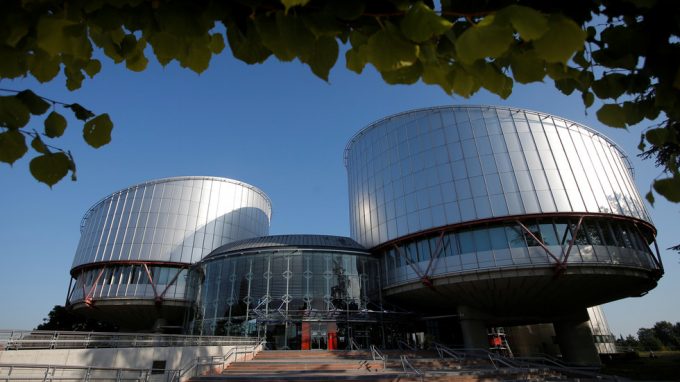
European Court of Human Rights, in Strasbourg, France. (FILE PHOTO) © Reuters / Vincent Kessler
RT | April 8, 2021
Making children get jabs for common diseases is ‘necessary in democratic society’ and is in their best interests, the European Court for Human Rights (ECHR) ruled on Thursday in a landmark decision against anti-vaxxers.
It’s the first time the ECHR has ruled on mandatory vaccinations for children against common diseases. While the case dealt with the Czech Republic’s laws that require schoolchildren to have jabs against diseases like whooping cough, tetanus and measles, it has implications when it comes to compulsory Covid jabs.
Nicolas Hervieu, a legal expert specializing in the ECHR, said the ruling reinforces the possibility of compulsory vaccination under the current coronavirus pandemic conditions.
A panel of judges ruled 16-1 that the Czech health policy that prevented unvaccinated children from attending nurseries or schools was consistent with “the best interests” of children.
“The… measures could be regarded as being ‘necessary in a democratic society,” the court ruled.
“The objective has to be that every child is protected against serious diseases, through vaccination or by virtue of herd immunity.”
The judges dismissed the appeal brought by six Czech nationals who were fined for failing to comply with mandatory vaccination rules or whose children were denied admission to nursery school for the same reason. The parents had claimed that the mandatory jab rules violated their human rights.
“The objective had to be to protect every child against serious diseases,” the court ruled.
It said that the need for compulsory vaccination in the Czech Republic represented the national authorities’ answer to the pressing social need to protect individual and public health against diseases and “to guard against any downward trend in the rate of vaccination among children.”
The court said that while mandatory vaccinations raised sensitive issues, the value of social solidarity to protect the health of all members of society, particularly those who were especially vulnerable, required everyone to assume a minimum risk by having jabs.
There was no immediate reaction from the six who appealed the case to the ECHR.
‘Shameless Racism’: 13 Countries Change Long-Standing Position on Palestine at UN
Palestine Chronicle – December 5, 2019
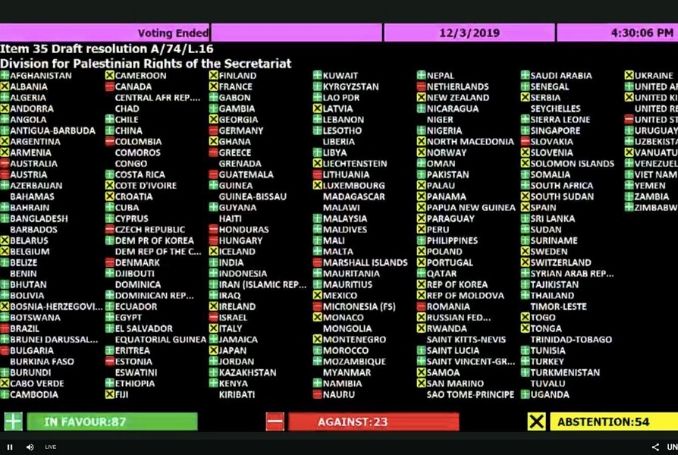
For the first time, 13 countries changed their longstanding positions and voted against a pro-Palestine measure at the United Nations on Tuesday.
Germany, the Czech Republic, Austria, Bulgaria, Denmark, Estonia, Greece, Lithuania, Netherlands, Romania, Slovakia, Brazil, and Colombia voted against the annual resolution regarding the “Division for Palestinian Rights of the Secretariat”, according to the Times of Israel.
They had previously abstained on the vote.
The resolution, which includes a call to halt to illegal Israeli settlements being constructed in the occupied West Bank, still passed with a large majority voting in favor.
The Palestinian representative told the council: “If you protect Israel, it will destroy you all.” He also said Israel’s character as a Jewish state is “shameless racism”.
The New York-based Division for Palestinian Rights oversees the Committee on the Exercise of the Inalienable Rights of the Palestinian People.
The resolution was co-sponsored by Comoros, Cuba, Indonesia, Jordan, Kuwait, Lao People’s Democratic Republic, Qatar, Saudi Arabia, Senegal, the United Arab Emirates, and Yemen.
The UK, France, and Spain abstained, as they do every year, allowing the resolution to pass with a vote of 87-54, with 21 other abstentions.
The General Assembly adopted five resolutions on the question of Palestine and the Middle East, including one calling on the Member States not to recognize any changes to the pre-1967 borders, including with regards to Jerusalem, other than those agreed by the parties through negotiations.
Featured Video

10K More U.S. Troops Deploy as Trump Weighs New Iran Strikes
or go to
Aletho News Archives – Video-Images
From the Archives
Genetic baloney in thick slices
MAYBE COULD BE INC.
By Jon Rappoport | No More Fake News | July 8, 2021
Gene research companies tend to come and go. They start out banging and popping like fireworks in the sky, and then they fade out—selling themselves to larger outfits who’ve hired better liars…
Once upon a time, it sounded easy. Start with a disease, find the gene responsible for the disease, and correct the problem.
Then, researchers wondered, was disease the result of one gene or a group of genes acting together?
Either way, the proof would be in devising cures for diseases using gene therapy. “Not yet, but soon…”
And regardless, the major need was: money. Lots and lots of money.
This need required good PR people. “We have to pump up the idea that we’re on the edge of tremendous breakthroughs. We’re always on that edge…”
This hype also needed to obscure the fact that there wasn’t (and isn’t) ANY gene cure for ANY disease. … continue
Blog Roll
 Aletho News
- UK Government Body Kept Files on People Criticizing Prevent Program
- US military withdrawal from Iraq and the collapse of US-Israeli hegemonic project in West Asia
- What does Europe want – a war with Russia?
- She Followed the Actual Data on COVID Vaccines and Masks — Her Career Took a Huge Hit
- Florida AG Sues Pfizer, Bourla Over Deceptive Marketing of COVID Vaccines
- Von der Leyen gifts her spin doctor a job for life
- 10K More U.S. Troops Deploy as Trump Weighs New Iran Strikes /Suliaman Ahmed
- Iranian crew declared Dena training vessel ‘unarmed’ to US warship before deadly torpedo strike: Report
- Iran’s NPT debate moves beyond parliament
- Houthis condemn Saudi claims of attack on Medina
- If Americans Knew
- Israel is squeezing the life out of Palestinians – Daily Update
- The Israeli Right Portrays Islam as Murderous. It Serves a Political Purpose
- Jordan Has Had Enough: King Abdullah’s Scathing Warning to Israel
- Israeli Colonizers (i.e. Settlers) Kill Palestinian Man Near Salfit
- New Google Maps images reveal massive scale of devastation in Gaza
- Jewish supremacy, anti-Palestinian bigotry on display in Israel – Daily Update
- Israeli Soldiers Abduct At Least 22 Across Occupied West Bank
- Eight Palestinians Killed in Israeli Attacks on Gaza
- Israeli former leaders and security chiefs threaten legal action over ‘Jewish terrorism’
- Israel map in LA Times ad includes all land from the river to the sea
- No Tricks Zone
- Green Energy Debacle: German Expert Professor Fritz Vahrenholt Warns Of Severe Economic And Social Consequences
- Two More Paleo Reconstructions Affirm Meters-Higher Sea Levels Across Ireland, Brazil 7000-6000 Years Ago
- New Study: Earth And Venus Surface Warmth Largely Explained By Convection And Lapse Rate, Not CO2 Or Radiation
- 2025 Nature Paper Claiming Worsening Global Drought Gets RETRACTED …Heavily Flawed
- New Study: ‘Global Drought Shows No Detectable Recent Acceleration Under Climate Warming’
- Economic Masterminds: German Socialists Suggest Taxing Productivity Gains Stemming From Using AI
- The South China Sea Has Not Been Cooperating With The Climate Change Narrative
- Energy Crisis: Germany Enters Heating Season With Historically Low Gas Reserve Fill Levels
- New Study: The Antarctic Ice Sheet Gained Mass From 2020-2024 Due To Staggering Snow And Ice Accumulation
- Study: Ocean Heating Rates From Thousands Of Years Ago ‘Dwarf’ Modern Ocean Heating Rates

