DHS Issues Terrorism Bulletin Over “Conspiracy Theories” and “Misleading Narratives”
By Paul Joseph Watson | Summit News | February 9, 2022
The Department of Homeland Security has issued a new terrorism bulletin in response to concerns over “conspiracy theories” and “misleading narratives.”
Yes, really.
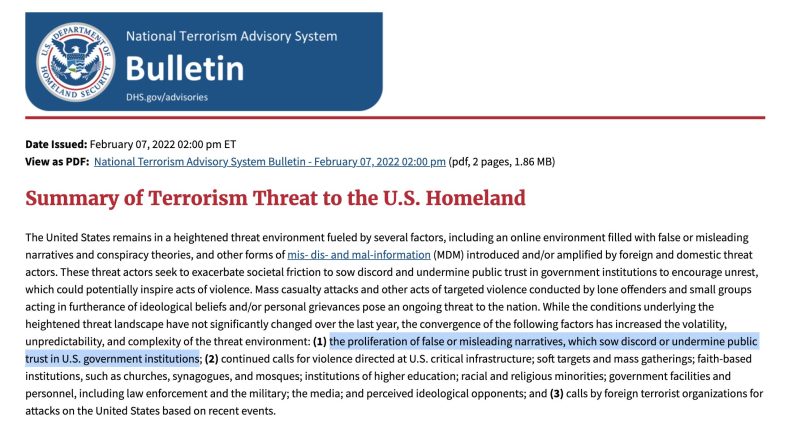
“The United States remains in a heightened threat environment fueled by several factors, including an online environment filled with false or misleading narratives and conspiracy theories, and other forms of mis- dis- and mal-information (MDM) introduced and/or amplified by foreign and domestic threat actors,” the DHS bulletin stated.
The advisory goes on to assert that the US is in a “heightened threat landscape” due to “the proliferation of false or misleading narratives, which sow discord or undermine public trust in U.S. government institutions.”
Apparently, lack of trust in the Biden administration and the legacy media represents a terrorist threat.
Under DHS chief Alejandro Mayorkas, who thinks “white extremists” are the biggest terror threat to America, five separate bulletins striking a similar tone have now been issued.
One of the bulletins even suggested that Americans who are angry at COVID lockdown rules or who express concerns about election integrity are potential extremist threats.
“It’s clear as day these bulletins are pure political propaganda to demonize all white people as “domestic terrorists” ready to carry out terrorist attacks at any moment and justify using terrorism laws against them as part of the new Domestic War on Terror,” writes Chris Menahan.
Since Biden took office, his administration has intensified efforts to demonize its political adversaries, tens of millions of ordinary Americans, as domestic extremists.
Following the January 6 Capitol riot, Democrats ludicrously compared the events to September 11 in an attempt to justify using federal resources that would normally be focused on actual terrorists against American conservatives.
Last month, the Justice Department created a new “specialized unit focused on domestic terrorism” in response to an “elevated” threat from violent extremists in the United States.
As we also reported in January, the US Army conducted a “guerrilla warfare exercise” in North Carolina where troops engaged in mock battle against “freedom fighters.”
In September last year, the National Association of School Boards (NASB) sent a letter to the Biden administration claiming parents were engaging in domestic terrorism by fighting against CRT and mask mandates.
Attorney General Merrick Garland subsequently announced the DOJ and FBI would establish a task force aimed at probing a “disturbing spike” in threats against school officials.
Forget China, was it CEPI’s bio-spooks who locked down the West?
By Paula Jardine | TCW Defending Freedom | December 15, 2021
IT is nearly two years since the world turned upside down and a sequence of unprecedented lockdowns and quarantines in the name of public health and safety were imposed across the West.
The narrative of the still unfolding story of Covid-19 is familiar to all of us, with China the chief bogeyman of the tale. But is that right?
In this drama has something really important been overlooked? Namely, the role of a powerful, self-appointed supranational organisation, set up 2017, called the Coalition for Epidemic Preparedness Innovations (CEPI).
Members of CEPI’s board and scientific advisory committee have been, and still are, key actors in global and national responses to the Covid-19 virus. Its mission? To ‘create a world in which epidemics are no longer a threat to humanity’.
At the start of 2020, all eyes were glued on China. The communist government had dutifully notified the World Health Organisation (WHO) on New Year’s Eve 2019 of its concerns over a small cluster of cases of ‘pneumonia of unknown origin’.
Three weeks later, when the death toll stood at 17, the CCP was sufficiently alarmed to order the home confinement of nearly 12 million mostly healthy people who were unfortunate enough to reside in the outbreak city, Wuhan.
Having fingered as the culprit a relative of the SARS virus that claimed 774 victims in 2003, the Chinese determination to contain the self-evidently nastier 2019 co-variant at all costs was made plain to the world.
The scenes broadcast out of China nightly on the TV news were surreal, but strangely familiar to anyone with a passing familiarity with vintage sci-fi. A nightmare amalgamation of The Andromeda Strain and The Hamburg Syndrome was unfolding in real life, right before our eyes.
Here, a man falling down dead in the street. There, men in white hazmat suits walking through empty Chinese thoroughfares equipped with Ghostbuster-esque backpacks blowing smoke in a desperate attempt to fumigate the invisible peril out of existence.
Knowing that the Queen’s own men at the Porton Down chemical and biological defence establishment long ago discovered that fresh air and sunlight, two commodities already in short supply in Chinese cities, are the most potent of disinfectants, it seemed a strangely futile spectacle. What on Earth were they trying to do? Death apparently lurked around every corner.
As the Wuhan lockdown was being imposed on January 23, 2020, the global elite were busy congregating at their annual networking fest, the World Economic Forum, in Davos, Switzerland (where CEPI had been founded three years earlier by the governments of Norway and India, the Bill & Melinda Gates Foundation, the Wellcome Trust global charity organisation, and the World Economic Forum).
Next day, a little-noticed press conference was convened in Davos to discuss the SARS-like, closely-related, but definitely novel, SARS Wuhan coronavirus.
Appearing in front of about 30 reporters were Sir Jeremy Farrar, Director of the Wellcome Trust and board member of CEPI; Richard Hatchett, chief executive of CEPI, and Stephane Bancel, chief executive of Moderna, one of three companies being funded to develop a coronavirus vaccine. A Chinese reporter asked the panel if there was any historical precedent for the lockdown.
Hatchett said: ‘One thing that is important to understand, is that when you don’t have treatments and you don’t have vaccines, non-pharmaceutical interventions are literally the only thing that you have, and it’s a combination of isolation, containment, infection prevention and control and then these social distancing interventions.
‘There is historical precedent for their use. We looked intensively and did an historical analysis of the use of non-pharmaceutical interventions in US cities in 1918 and what we found was that cities that introduced multiple interventions, early in an epidemic, had much better outcomes.
‘The challenge of course is that it is very difficult to sustain these interventions, as they impose enormous cost and they also can produce enormous anxiety among the affected population.’
The ‘we’ Hatchett was referring to was the US Department of Homeland Security where, as an official, he had helped develop the US pandemic preparedness plan in 2005 and 2006 during the H5N1 avian influenza outbreak, which Farrar had discovered in Vietnam.
Hatchett continued: ‘At that time, we looked at how could you have those interventions implemented in a way that maximised their benefit and minimised the cost and we developed an approach that we called “community mitigation” interventions and CDC (the US Centres for Disease Control and Prevention) published guidance on this several years ago.
‘There is a literature which I would certainly encourage Chinese authorities to review and certainly I would be happy to talk to them about that, although that’s not my current job.’
There was no need to encourage the Chinese authorities to review the literature. CEPI already had a man in Beijing, Dr George Gao, the director of China’s Centre for Disease Control, but also member of the CEPI scientific advisory panel. The community mitigation approach the Chinese adopted in Wuhan was straight out of the 2006 US Homeland Security pandemic playbook.
Gao, like Farrar, completed his PhD at Oxford University before conducting post-doctoral work under Sir John Bell, the controversial Regius Professor of Medicine at Oxford, holder of several extranumerary positions and multiple interests, not least as chair of the global health scientific advisory board of the Bill & Melinda Gates Foundation.
An expert on coronaviruses, Gao served on CEPI’s first scientific advisory committee in 2016 and was a player in Event 201, the pandemic simulation hosted in October 2019 by the World Economic Forum, Bill & Melinda Gates Foundation and the Johns Hopkins Bloomberg School of Health – discussed here by Robert F Kennedy Jr.
In all probability, Gao is the old friend Farrar was referring to when he said on Desert Island Discs that he had had a phone call on December 31, 2019 – the day the Chinese authorities reported the Wuhan pneumonia outbreak to the WHO – to alert him that China would release the genome of the new virus on January 10. As things stood on New Year’s Eve, the virus had yet to cause any deaths, although it was making a few people very ill.
By January 17, another CEPI scientific adviser, Dr Christian Drosten, had conveniently developed a PCR test from the genetic sequence posted online by the Chinese, which the WHO advised laboratories could be used as a diagnostic test for Covid-19.
This was almost two months before the WHO declared the novel coronavirus a pandemic on March 11, 2020. Following a visit to Wuhan by the WHO in February 2020, led by its assistant director-general Dr Bruce Aylward, the world was being encouraged to adopt what were now being called Chinese measures.
‘China didn’t approach this new virus with an old strategy for one disease or another disease,’ said Aylward. ‘It developed its own approach to a new disease and extraordinarily has turned around this disease with strategies most of the world didn’t think would work.’
The Chinese government, with its own Big Brother infrastructure, had its own reasons for going along with that. But the response plan is in reality far more complex, and has a much darker background in the West.
The Yellow Brick Road that passes through CEPI and Beijing leads right back to the US Department of Homeland Security, and its 1998 Pentagon strategy paper.
The response plan is in reality an American scheme, with its origins more than decade and a half earlier and against a backdrop of bioterrorism concerns. Uncle Sam is the wizard behind the curtain, not acting in the West’s interests at all.
DHS hypes ‘increasing’ threat from ‘conspiracy theorists & extremists’ seeking Trump return… but unaware of ‘specific plots’
RT | August 7, 2021
The US Department of Homeland Security has again alleged growing threats of violence from online conspiracy theorists who expect ex-president Trump to return to power, even as it said it had no details on “planned actions.”
The agency warned of “an increasing but modest level of activity” by those advocating violence online, saying they may resort to more drastic measures if Donald Trump does not regain the presidency sometime this month, as they purportedly believe will happen.
“Some conspiracy theories associated with reinstating former president Trump have included calls for violence if desired outcomes are not realized,” the DHS said on Friday in an internal intelligence bulletin obtained by ABC News.
“Over the last few days… there’s been much more public visibility, meaning the discussions and these theories have migrated away from being contained within the conspiracy and extremist online communities.”
However, despite the alarming tone of the document, the DHS went on to say that “we lack information on specific plots or planned actions,” instead citing generic “reporting” which suggests “these activities may occur during August 2021.”
Still, the agency said it does not have the “luxury” to wait around for evidence and must take a more proactive approach, adding that “lone offenders and small groups of individuals could mobilize to violence with little-to-no warning.” It did not elaborate on how it planned to prevent such unspecific threats.
Friday’s bulletin is far from Homeland’s first on the subject, as it has issued a flurry of similar warnings about so-called “domestic extremists” since the riot at the US Capitol on January 6. The agency churned out two separate documents on the growing extremism threat in June, one also pointing to ‘QAnon’ conspiracy theories about Trump’s imminent return to office. Nonetheless, that bulletin also acknowledged that DHS had “no evidence” of any particular plans for violence at the time, but merely noted that some extremists have been influenced by conspiracy theories in the past.
The FBI has also joined the growing crusade against homegrown extremism, putting out its own series of breathless warnings about QAnon, Trump supporters and conspiracy theories since the unrest at the Capitol. One joint report with the DHS in June predicted that many believers in such theories would soon “disengage from the movement,” though that apparently did not come to pass given the steady stream of warnings since.
Last month, the bureau even went as far as to urge friends and family members of suspected violent extremists to report their loved ones to the feds. The request drew heated criticism online, with some blasting the FBI as the ‘American Stasi.’
FBI goes ‘American Stasi’ encouraging family members to rat each other out for ‘extremism’
RT | July 11, 2021
The FBI has asked Americans to examine their own family members for signs of “homegrown violent extremism,” and report them. The call for snitches comes as the FBI turns its surveillance powers on regular Americans.
“Family members and peers are often best positioned to witness signs of mobilization to violence,” read a tweet from the FBI on Sunday. To help prevent “homegrown violent extremism,” the agency advises Americans to visit its website, “to learn how to spot suspicious behaviors and report them to the FBI.”
The link provided by the FBI brings visitors to a 2019 document listing “mobilization indicators” that may suggest an individual is preparing to engage in terrorism – for example, “preparing and disseminating a martyrdom video,” “communicating directly with violent extremists online,” and “preparing to travel to fight with or support terrorist groups.”
The indicators and imagery used in the document suggest that its focus was on radical Islamic terrorism, but the FBI, along with the rest of the US security apparatus, has in recent months has turned its surveillance powers on white, conservative America.
Since the pro-Trump riot on Capitol Hill in January, FBI Director Christopher Wray has testified before Congress that the anti-government sentiment responsible for the affray has been “metastasizing” in the US for years, and that “the problem of domestic terrorism … is not going away anytime soon.” Former Assistant Director Frank Figliuzzi was more explicit last month when he called for the arrest of high-level Republicans to “really tackle terrorism, this time domestically.”
President Joe Biden has linked the Capitol mob to “white supremacism,” which he called “the most lethal terrorist threat to our homeland today” during his first speech to Congress in April. Against this supposed “threat,” the Justice Department has asked for new powers of prosecution, and the Department of Homeland Security (DHS) has claimed that right-wingers and conservatives, “inspired by foreign terrorist groups” and “emboldened by the breach of the US Capitol Building,” are “plotting attacks against government facilities” and “threatening violence against critical infrastructure.”
In addition to their own powers, the DHS, FBI, and National Security Council also want to hire third-party ‘researchers’ to spy on Americans, recent reports have claimed.
Though the riot on Capitol Hill was broken up in a matter of hours and Congress returned to work the same evening, the FBI has left no stone unturned in finding and prosecuting hundreds of Trump supporters who took part. Out of more than 500 arrested already, some were turned in by their own family members and co-workers, with those who merely entered the building charged alongside militia members in what prosecutors are terming a “shock and awe” campaign of arrests and charges.
The agency’s latest call for snitches didn’t sit well with some pundits and commenters online, who drew uncomfortable parallels with the totalitarian dystopia of George Orwell’s ‘1984’, and with the real-life surveillance and repression of East Germany’s dreaded Stasi.
Amid the ongoing domestic terror crackdown, questions remain unanswered as to the FBI’s suspected foreknowledge of, and potential involvement in organizing, the Capitol Hill riot.
Inside Biden’s new “domestic terrorism” strategy
By Kit Knightly | OffGuardian | July 1, 2021
Following the (completely contrived) Capitol Hill “riot” on January 6th, Joe Biden made it clear – or rather, the people that control Joe Biden made it clear – “domestic terrorism” was going to be a defining issue of his presidency.
Indeed, in an act of startling prescience, the incoming administration had been talking about a new “Domestic Terrorism Bill” for well over three months before the “riot” happened. The media had been calling for one for at least six. Major universities were writing papers about it.
It’s funny how often that happens, isn’t it?
I wrote at the time that the Capitol Hill “riot” could prove to be America’s Reichstag Fire – a fake attack, blamed on an invisible enemy and used to rush through restrictive legislation and emergency powers. A 9/11 sequel, extending the Patriot Act franchise.
Now, just a few short months later, the Biden White House has released their National Strategy for Countering Domestic Terrorism. Let’s take a look inside it, shall we?
SO, WHAT IS “DOMESTIC TERRORISM”?
The first thing to say about the “strategy”… is that it’s not really a strategy. It’s more of a mission statement or even a press release. It hits talking points, but not real policies. Its watchword is “vague” – in both definition of the problem and proposed solutions (with a couple of noteworthy exceptions, but we’ll get to that.)
For starters – who or what IS a “domestic terrorist”?
Well, their answer to that is, essentially, potentially anybody. They’re not identifying any particular ideology or cause or group – but rather EVERY ideology cause or group. I wrote, back in January, that any definition would be kept intentionally loose, and the strategy does not disappoint.
The cause of “domestic terrorism” can be racism, religious intolerance, environmental protest, anti-government feeling, animal rights, anti-abortion campaigners, “perceived government overeach”, “incel ideology”, “anti-corporate globalization feeling” or a mixture of any of the above.
“Domestic terrorists” may espouse violence or they may not espouse violence. They may work in groups, or be loners, or be loose associations with no organizational structure. They can be left wing or right wing, religious or secular.
They can be anybody who thinks anything.
There is a lot of entirely intentional vagueness here. Again and again, we are told that “the domestic terrorism threat is complex, multifaceted, and evolving”. They are keeping their options open.
Don’t expect ANY specifics on who is a “domestic terrorist” until AFTER any legislation is passed. That way, the great American public can insert their own personal bugbear into the ellipsis (and then be taken completely by surprise when it turns out the new laws apply to everyone).
That said, there have been some clues as to the kind of person that might be the target of any new anti-terror legislation.
In the Washington Post, in February this year, California State Senator Richard Pam wrote:
Anti-vaccine extremism is akin to domestic terrorism
He wasn’t alone, on this side of the Atlantic the head of the Metropolitan Police’s counter-terrorism unit “called for action against coronavirus anti-vaxxers”.
Even this document makes insinuations on that front.
In a startling contradiction, after spending five or six pages talking up the “complex” and “unpredictable” nature of “domestic terrorism,” they then make an incredibly specific prediction about a future “domestic terrorist attack”:
Taken from the “Assessment of the Domestic Violent Extremism Threat” (p. 10):
Newer sociopolitical developments–such as narratives of fraud in the recent general election, the emboldening impact of the violent breach of the U.S. Capitol, conditions related to the COVID–19 pandemic, and conspiracy theories promoting violence–will almost certainly spur some DVEs to try to engage in violence this year.
Apparently, the official position of the FBI, CIA, NSA and DHS is that domestic terrorism is a vast cloud of mystery, swirling with unknown and conflicting motivations…. but they definitely know when the next attack will happen, and why it will take place..
SO WHAT’S TO BLAME?
The evil “domestic terrorists” and “violent extremists” might be widely diverse in their ideologies, social structures, motives and political leanings… but nevertheless, they ALL use the same exact methods of communication, and the same platforms to host their “misinformation”.
It turns out, according to this strategy, there’s really only one thing at the root of all “domestic terrorism”: The internet.
Yes, the vast majority of this “strategy” is focused on the digital world. In only 28 pages of text the words “online”, “social media”, “internet”, “platform”, “encryption”, and “site” occur well over 60 times combined. Here’s some examples:
… social media, file–upload sites, and end–to–end encrypted platforms, all of these elements can combine and amplify threats to public safety…
*
DVEs exploit a variety of popular social media platforms, smaller websites with targeted audiences, and encrypted chat applications to recruit new adherents, plan and rally support for in-person actions, and disseminate materials that contribute to radicalization and mobilization to violence
*
Recruiting and mobilizing individuals to domestic terrorism [is] increasingly happening on Internet–based communications platforms, including social media, online gaming platforms, file–upload sites, and end–to–end encrypted chat platforms
*
… extreme polarization, fueled by a crisis of disinformation and misinformation often channeled through social media platforms, which can tear Americans apart and lead some to violence.
*
DVE attackers often radicalize independently by consuming violent extremist material online.
It goes on, and on and on in that fashion.
As much as the Deep State talks up the supposedly unknowable nature of “domestic terrorism” early on, they are equally sure that every single one of them is on the net. Which, fortunately from the state’s point of view, means they can all be tackled with the same solution.
WHAT THEY’RE GONNA DO ABOUT IT
You probably don’t need me to tell you what the supposed “solution” to this entirely created “problem” is. It’s the same grab-bag of solutions that a power-hungry state will always seek, given the opportunity. Yes, there’s a token reference to guns and “high-capacity” magazines, but really it’s all about controlling the internet.
Specifically – it’s about surveillance, censorship, and propaganda. The big three.
Of course, the document never ever uses those words. Surveillance is “information gathering”. Propaganda is “messaging” or “education”. Censorship is “countering propaganda” or “working with media partners to remove incitement of violence”.
They use the shifting, indirect language of government, but the meaning is clear if you know how to read it:
… the Department of Homeland Security and others are either currently funding and implementing or planning evidence–based digital programming, including enhancing media literacy and critical thinking skills, as a mechanism for strengthening user resilience to disinformation and misinformation online for domestic audiences. The Department of State and United States Agency for International Development are doing similar work globally.
Translation: The DHS is funding massive propaganda campaigns designed to both brainwash the public, and discourage them from reading any sources which disagree with the official line.
The Department of Homeland Security has expanded its efforts to provide financial, educational, and technical assistance to those well placed to recognize and address possible domestic terrorism recruitment and mobilization to violence and will ensure that its counter–domestic terrorism prevention efforts are driven by data and informed by community–based partners.
Translation: DHS is working with social media monopolies to censor certain people, and paying them to pass citizens’ private information to the government and/or intelligence agencies.
Enhancing faith in American democracy demands accelerating work to contend with an information environment that challenges healthy democratic discourse. We will work toward finding ways to counter the influence and impact of dangerous conspiracy theories that can provide a gateway to terrorist violence.
Translation: “Enhancing faith in democracy” means censoring anybody who posts evidence that elections are fixed, that the political class is corrupt or that the media are servants of the state who peddle lies for cash.
And then there are some phrases that need no translation at all:
the Department of Justice is examining carefully what new authorities might be necessary and appropriate.
… seems pretty clear.
The obvious end goal here is new legislation granting greater powers to the state.
THE NATURE OF “VIOLENCE”
Time to address the elephant in the room: “violence”. The word is used a lot in the report. One-hundred and eleven times in 28 pages. It’s never just “extremism” when it can be “violent extremism”. But what does that word really mean in this context?
The answer to that is “absolutely nothing”. It is a phrase robbed of meaning. Applied on an ad hoc basis, based on political convenience rather than physical reality.
A reminder that this is described as “violent extremism”:

And this as “mostly peaceful”:

And this is “inciting violence”:

If the President of the United States can be deleted from the internet, impeached and tried before the Senate because “go home in peace and love” and “stay peaceful” are “inciting violence”, then the word is totally meaningless and we should simply ignore it.
Essentially, they have demonstrated they will classify anything they want as violent, and ignore any actual violence if they need to.
THE ROLE OF IDENTITY POLITICS
I doubt any White House policy announcement has ever leaned so heavily into the politics of identity before now. “Hatred”, “bigotry”, “LGBTQI+” “racism”… and so on. They all get a lot of mentions. But why?
Well, the simple answer is camouflage. Generally, by draping the inevitable Patriot Act 2.0 in the language of identity, they can trick “liberals” into believing it’s some kind of progressive policy.
More specifically, they can align “anti-government” with “white-supremacy”, as if they are always the same. In this sentence for example:
Today’s domestic terrorists espouse a range of violent ideological motivations, including racial or ethnic bigotry and hatred as well as anti–government or anti–authority sentiment…
Look at the other causes listed alongside “White supremacy” in this document: “perceived government overreach”, “anti-corporate globalization”, “opposing government institutions”, “anti-authority sentiment”. Rational, reasonable anti-government positions, bracketed alongside bigotry and racism.
General Mark Miley recently testified in front of the senate about how the need to “understand white rage”.
As Glen Greenwald wrote, this is not about racism, but about aligning the “progressive left” with the military. Turning militaristic, totalitarian Imperialism into a progressive cause, whilst smearing all those who oppose it as bigots and potential “domestic terrorists”.
THE WAY AHEAD
This strategy is just the latest domino put in place. It’s a long con, with multiple moving pieces, but the end is clear. Though this document is deliberaletely cagy about the possibility of new legislation, that is all part of the dance.
The manipulation of the public has been government practice since the dawn of time. The contrived public reticence to act, concealing intrigues behind the scenes which create an apparent need for action. Eventually, the public will beg the state to “do something”, and they’ll unveil the something they were planning the whole time. Tale as old as time. True as it can be.
This is no different.
Only last night, the US Senate voted to create a “select committee” investigating the Capitol Hill riot. This political pantomime will roll on for a few weeks with “shocking testimony” from FBI agents and military intelligence operatives.
They will detail how “misinformation radicalised people online”, alongside admitting they “had knowledge, but lacked the power to act” or that “counter-terrorism forces were focused on foreign groups” and/or lacked “legal authority” to surveil domestic threats. There will be a couple of throwaway admissions, something akin to a “failure of imagination”.
Senators from liberal states will make speeches about how the military/CIA/FBI are institutionally racist because they assumed white people can’t be terrorists, and a few willing uniformed fall guys will look appropriately shame-faced behind their medals.
There will be no real inquest, and no new information. It will be an exercise in reinforcing an entirely fake reality. And the final findings will be that the FBI/CIA/NSA… or whoever…needs more money and power. A new bill (likely already written) will be pushed into the hands of some hip “liberal” politician, who will do a decent job pretending they wrote it.
If there is any noteworthy public objection to the new powers, well then we’ll see another “domestic terrorist” attack. Maybe there’ll be one anyway, just to underline how vital the new bill is. (They’re prepping us already, with the DHS warning about attacks on July 4th and a possible “summer of violence”).
And then, stirring itself to act only at the insistence of the Democrat-controlled Senate, the White House will sign-off on its Patriot Act 2.0.
The final paragraph of the strategy document reads:
This document represents that Strategy – a Strategy whose implementation is, already, well underway.
No kidding.
FBI hypes QAnon threat again, says some conspiracy theorists ‘likely’ to attack Democrats
RT | June 14, 2021
Some followers of the QAnon conspiracy theory might decide to engage in real-world violence against the ruling Democrats, FBI and Homeland Security analysts wrote in a memo provided to Congress that has now been made public.
“We assess that some DVE [domestic violent extremist] adherents of QAnon likely will begin to believe they can no longer ‘trust the plan’ referenced in QAnon posts and that they have an obligation to change from serving as ‘digital soldiers’ towards engaging in real world violence—including harming perceived members of the ‘cabal’ such as Democrats and other political opposition—instead of continually awaiting Q’s promised actions which have not occurred,” says the memo, breathlessly reported by CNN and other corporate media outlets as a clear and present danger to the US.
Right below that assessment of likelihood, however, the FBI and DHS say that other QAnon adherents “likely will disengage from the movement or reduce their involvement in the wake of the administration change,” which might be “spurred by the large mainstream social media deplatforming of QAnon content.”
The memo itself leads with the disclaimer that it’s “provided for informational purposes only.” It is dated June 4, and was provided to Congress at the request of Senator Martin Heinrich (D-New Mexico), a member of the Senate Intelligence Committee, according to CNN. An earlier, classified version of the memo was provided to lawmakers in February, according to Heinrich.
This might explain why there are references to mass deplatforming of QAnon – which was going on in the wake of the January 6 riot at the US Capitol – and that the most recent example of “DVE activity” is dated January 8.
One of the examples, dated back to March 2020, was also questioned by an expert. There was “no evidence” that the train derailment in California “was directly linked to QAnon,” said Marc-Andre Argentino of the International Centre for the Study of Radicalisation (ICSR) at King’s College London.
The memo says more than 20 QAnon followers were among those arrested for trespassing at the Capitol on January 6. Over 400 people have been charged in connection with the riot, however. As 25,000 National Guard troops deployed to Washington, DC to secure Joe Biden’s inauguration, mainstream media outlets cited a purported FBI memo warning about militias threatening to storm DC and state capitals. No one showed up on the appointed day, however.
As criticism of the “occupation” in DC grew, the Capitol Police cited another secret intelligence bulletin claiming QAnon, Boogaloo Boys, or some other sovereign citizen militia would try to attack the Capitol on March 4. The House adjourned early citing the threat, while the Senate carried on. Nothing happened.
The Capitol was actually attacked on April 2, but not by QAnon. An African-American man rammed into a barricade, killing one Capitol Police officer and attacking another with a knife before he was shot to death. He claimed to have been a member of Nation of Islam, which disavowed him. The last remaining 2,000 National Guard troops departed the Capitol on May 24.
According to the FBI memo, followers of the QAnon conspiracy theory believe that the US is run by “a corrupt cabal of ‘global elites’ and ‘deep state’ actors run a Satan-worshiping international child sex trafficking ring,” which Donald Trump tried to oppose while president.
Democrats have accused the Republican party of being QAnon believers, but a recent poll suggested that 23% of Republicans – as well as 15% of independent voters and 8% of Democrats – actually found the conspiracy theory plausible.
The New Domestic War on Terror Has Already Begun — Even Without the New Laws Biden Wants
By Glenn Greenwald | June 2, 2021
The Department of Homeland Security on Friday issued a new warning bulletin, alerting Americans that domestic extremists may well use violence on the 100th Anniversary of the Tulsa race massacre. This was at least the fourth such bulletin issued this year by Homeland Security (DHS) warning of the same danger and, thus far, none of the fears it is trying to instill into the American population has materialized.
The first was a January 14 warning, from numerous federal agencies including DHS, about violence in Washington, DC and all fifty state capitols that was likely to explode in protest of Inauguration Day (a threat which did not materialize). Then came a January 27 bulletin warning of “a heightened threat environment across the United States that is likely to persist over the coming weeks” from “ideologically-motivated violent extremists with objections to the exercise of governmental authority” (that warning also was not realized). Then there was a May 14 bulletin warning of right-wing violence “to attack higher-capacity targets,” exacerbated by the lifting of COVID lockdowns (which also never happened). And now we are treated to this new DHS warning about domestic extremists preparing violent attacks over Tulsa (it remains to be seen if a DHS fear is finally realized).
Just like the first War on Terror, these threats are issued with virtually no specificity. They are just generalized warnings designed to put people in fear about their fellow citizens and to justify aggressive deployment of military and law enforcement officers in Washington, D.C. and throughout the country. A CNN article which wildly hyped the latest danger bulletin about domestic extremists at Tulsa had to be edited with what the cable network, in an “update,” called “the additional information from the Department of Homeland Security that there is no specific or credible threats at this time.” And the supposed dangers from domestic extremists on Inauguration Day was such a flop that even The Washington Post — one of the outlets most vocal about lurking national security dangers in general and this one in particular — had to explicitly acknowledge the failure:
Thousands [of National Guard troops] had been deployed to capitals across the country late last week, ahead of a weekend in which potentially violent demonstrations were predicted by the FBI — but never materialized.
Once again on Wednesday, security officials’ worst fears weren’t borne out: In some states, it was close to business as usual. In others, demonstrations were small and peaceful, with only occasional tense moments.
Americans have seen this scam before. Throughout the first War on Terror, DHS, which was created in 2002, was frequently used to keep fear levels high and thus foster support for draconian government powers of spying, detention, and war. Even prior to the Department’s creation, its first Secretary, Tom Ridge, when he was still the White House’s Homeland Security Chief in early 2002, created an elaborate color-coded warning system to supply a constant alert to Americans about the evolving threat levels they faced from Islamic extremists.
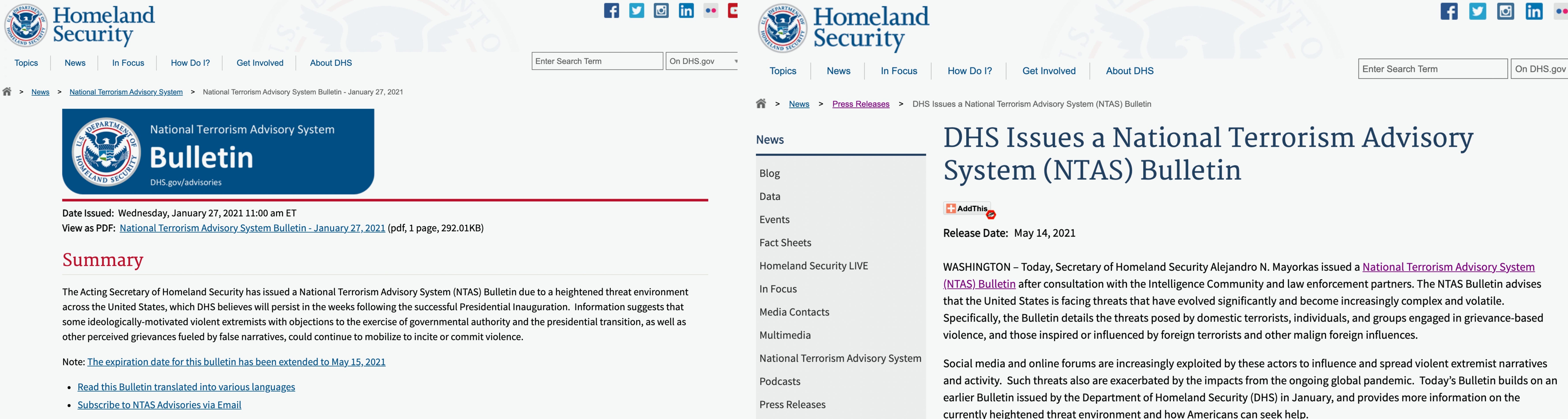
DHS Bulletin on domestic extremists, Jan. 27, 2021; DHS Bulletin on domestic extremists, May 14, 2021.
In 2004, Ridge admitted that he had been repeatedly pressured by Bush officials to elevate the warnings and threat levels for political gain and to keep the population in fear. He claims that he, in particular, was coerced against his will to raise the threat level just prior to the 2004 presidential election and resigned for that reason shortly thereafter. DHS’s color scheme became “the brunt of endless jokes and derision,” concluded a 2007 scholarly study in the journal International Security, noting that it “became perceived as being politically motivated” largely due to the complete lack of specific information about what Americans were supposed to fear or avoid. Moreover, “its designers assumed that the population would trust in the national leadership and believe in the utility of the system’s information.” It failed because of how often the alleged threats failed to materialize, and because the warnings were rarely accompanied by any specificity that could permit action to be taken or avoided.
Though Obama scrapped the unpopular color-coded system in 2011, he — in a classic Obama gesture — merely replaced it with an equally vague and fear-generating bureaucratic alternative that was also subject to political manipulation. National security writers at Lawfare ultimately acknowledged that “like the [Bush/Ridge] system, there were no clear triggers for alerts [under Obama’s new scheme,] so the system remained objective and opaque.” As a result, they said, “the lack of specificity over time has resulted in similar levels of confusion as surrounded the [Bush/Ridge] color alerts.”
Fear is crucial for state authority. When the population is filled with it, they will acquiesce to virtually any power the government seeks to acquire in the name of keeping them safe. But when fear is lacking, citizens will crave liberty more than control, and that is when they question official claims and actions. When that starts to happen, when the public feels too secure, institutions of authority will reflexively find new ways to ensure they stay engulfed by fear and thus quiescent.
I saw first-hand how this dynamic functions when doing the Snowden-enabled reporting on mass domestic NSA surveillance under the Obama administration. By the time we broke the stories of mass domestic surveillance on Americans — twelve years after the 9/11 attack — fear levels over Al Qaeda in the U.S. had diminished greatly, especially after the 2011 killing of Osama bin Laden. As a result, anger over Obama’s sprawling domestic surveillance programs was pervasive and bipartisan. A bill jointly sponsored by then-Rep. Justin Amash (R-MI) and Rep. John Conyers (D-MI) — which would have greatly reined in NSA domestic spying powers — was on its way to easy, bipartisan victory as a result of that anger over NSA spying. But suddenly, the Obama White House convinced Nancy Pelosi to whip enough Democratic votes to ensure its defeat and save NSA domestic spying from reform. But the momentum which that bill had — it would have been the first since 9/11 to rollback rather than expand government powers — along with anti-surveillance-and-pro-privacy polling data, proved how significantly the playing field had shifted as a result of those revelations and, especially, the reduction in fear levels experienced by Americans.
But shortly thereafter, a new group — ISIS — emerged to replace Al Qaeda. It had a two-year stint with middling success in scaring Americans, but it was sufficient to turn back the tide of pro-privacy sentiment (at one point in 2014, the U.S. intelligence community claimed out of nowhere that a Syria-based group that virtually nobody in the U.S. had ever heard of previously or since — “the Khorasan Group” — was “a more direct and imminent threat to the United States,” but that new villain disappeared as quickly as it materialized). After ISIS’s star turn in the role of existential threat, the Democrats, during the 2016 campaign, elevated Russia, Putin and the Kremlin to that role, abandoning without explanation Obama’s eight-year argument that Russia was merely a regional power of no threat to the U.S. This revolving carousel of scary villains ensured that the pressure to reduce the powers and secrecy of the U.S. security state eroded in the name of staying safe.
Before Joe Bidenwas even inaugurated, he and his allies knew they needed a new villain. Putin never generated much fear in anyone beyond MSNBC panels, the CNN Green Room, and the newsrooms and op-ed pages of The New York Times and The Washington Post. While negative views of Russia increased in the U.S. during Russiagate mania, few outside of hard-core Democratic partisans viewed that country as a genuine threat or primary enemy. Few Americans woke up shaking in fear about what the Kremlin might do to them.
The search for a new enemy around which the Biden administration could coalesce and in whose name they could keep fear levels high was quickly settled. Cast in that role would be right-wing domestic extremists. In January, The Wall Street Journal reported that “Biden has said he plans to make a priority of passing a law against domestic terrorism, and he has been urged to create a White House post overseeing the fight against ideologically inspired violent extremists and increasing funding to combat them.”
Pending Domestic War on Terror legislation favored by the White House — sponsored by Rep. Adam Schiff (D-CA) — would simply amend the old War on Terror laws, which permitted a wide range of powers to fight foreign terrorist organizations, so as to now allow the U.S. government to also use those powers against groups designated as domestic terror organizations. Just as was true of the first War on Terror, this second one would thus vest the government with new, wide-ranging powers of surveillance, detention, prosecution and imprisonment, though this time for use against U.S. citizens on U.S. soil.
Even while that legislation is pending, the U.S. government is already waging an aggressive new domestic war on terror that has largely flown under the radar. Grave warnings from DHS are now just as common, vague and unreliable — but also fear-inducing — as they were in the days of Tom Ridge. Domestic surveillance is also on the rise. Last month, CNN reported that “the Biden administration is considering using outside firms to track extremist chatter by Americans online, an effort that would expand the government’s ability to gather intelligence but could draw criticism over surveillance of US citizens.”
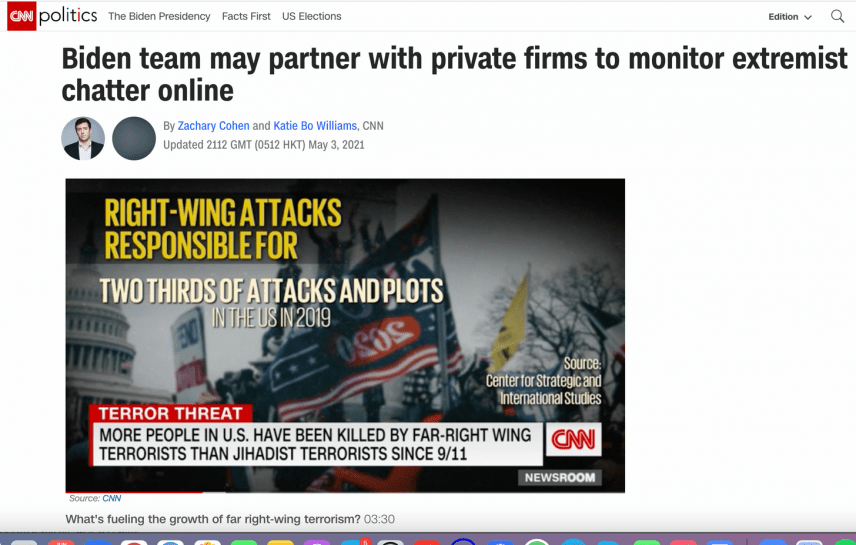
CNN, May 3, 2021
The security mindset has subsumed the Democratic Party in particular. Just last week, the same Party that spent the summer of 2020 denouncing the police approved $1.9 billion in additional spending for Capitol security and police. The very faction of that party which chanted “Defund the Police” — the Squad — had the power to stop that expenditure, but half of them instead voted “present,” ensuring its passage.
Meanwhile, one of the most repressive features of the first War on Terror — due-process-free no-fly lists against American citizens — is now back in full force. Democratic Senate Majority Leader Chuck Schumer (D-NY) and House Homeland Security Committee Chairman Bennie Thompson (D-MS) have both been demanding that the FBI ban January 6 protesters and other “domestic extremists” from air travel without being convicted of any crime or even given a hearing to determine whether this prohibition is justified. Rep. Thompson even demanded that Sens. Ted Cruz (R-TX) and Josh Hawley (R-MO) be put on the no-fly list, then took to Twitter to boast of how proud he was of this demand.
Beyond the DHS bulletins, that agency and other intelligence operatives continue to issue reports, for both public and classified consumption, warning that the greatest national security threat the U.S now faces is domestic extremism. As we reported here last month, that “domestic extremist” designation includes not just anti-Biden and anti-government protesters on the right but also leftist groups including animal rights activists — essentially anyone who objects to prevailing ruling class dogma and wants to use their constitutional rights to advance those views. To compile these reports, the CIA appears clearly to be breaking the law in using its vast intelligence weapons for domestic monitoring and control.
Online censorship, of course, is also rapidly increasing in the name of stopping the threat of domestic extremism. The extraordinary destruction of Parler in January by three Silicon Valley monopolies — Apple, Google and Amazon — occurred after leading Democrats, including Rep. Alexandria Ocasio-Cortez (D-NY) — publicly demanded the platform’s removal from the internet. And Democratic-led Congressional committees continue to summon Silicon Valley executives to demand they impose greater degrees of political censorship against their political adversaries or else face legislative and regulatory reprisals.
These are all the same weapons as the ones invoked for the first War on Terror. Yet what is perhaps most notable about comparing this new domestic War on Terror to the first one is not the common weapons invoked to fight it but rather how identical are the rhetorical strategies used to demand submission to it.
No nuance or questioning is permitted when it comes to discussions of how much danger America really faces from domestic extremists. The parallels with the first War on Terror are manifest.
I know of nobody who dismissed the significance of the 9/11 attacks. A one-day attack that wipes out 3,000 human beings and crashes four passenger jets into three large buildings is a gravely serious event. But there were plenty of people — including myself — who spent years arguing that the threat reflected by that attack was being aggressively and deliberately exaggerated by U.S. officials and both political parties in order to justify extraordinary power grabs for themselves.
In response, a standard tactic was deployed against those who, after 9/11, urged that the threat be placed in rational context rather than melodramatically and cynically inflated. Anyone urging sober restraint was instantly accused of being sympathetic toward if not outright supportive of anti-American terrorism. The Bush administration demanded a binary framework most vividly expressed by the then-president’s decree in his late September, 2001, address to the Congress: “Either you are with us or you are with the terrorists.” And thus was any middle ground — I condemn the 9/11 attack but oppose dangerous overreaction or authoritarian power grabs in the name of combatting it — abolished.
That Bush “with-us-or-with-the-terrorists” directive provoked a fair amount of outrage at the time but is now the prevailing mentality within U.S. liberalism and the broader Democratic Party. I do not know a single prominent commentator or political figure who, after seeing what transpired, expressed support for the January 6 riot at the Capitol. Quite the contrary: all of them, at least to my knowledge, condemned the conduct of at least some of the protesters on that day. From the start, that group certainly included me (on January 7, I wrote: “It is not hard to understand why [the Capitol riot] has generated intense political passion and pervasive rage: the introduction of physical force into political protest is always lamentable, usually dangerous, and, except in the rarest of circumstances that are plainly inapplicable here, unjustifiable”). That is still my view, even as I denounce the Biden administration’s expansive domestic powers and attempts to exaggerate the threats and dangers that protest illustrated.
But that position is disallowed, or at least not recognized. Just as was true of the first War on Terror, any attempt to place the actual lingering threat in context (by rejecting the claim that the danger is so grave that it requires vast new powers), or to suggest it is being manipulatively exaggerated (by calling it The Insurrection), or to document actual lies being told in service of the prevailing narrative (such as the ongoing lie that a pro-Trump crowd murdered Officer Brian Sicknick) provokes furious accusations that one must be sympathetic to if not supportive of the January 6 rioters and any groups associated with them. Attempts to suggest that those charged in connection with the January 6 riot are being excessively prosecuted and punished provoke even greater rage — despite the fact that not a single one of them has been charged with treason, sedition, insurrection or domestic terrorism, and despite the fact that concerns about overzelaous prosecutors and the carceral state are supposed to be staples of liberals politics (though ones which, like anti-police sentiment and opposition to killing unarmed protesters, instantly disappear when convenient, such as when it comes time to exploit Officer Sicknick or cheer the fatal point-blank shooting of the unarmed Ashli Babbitt).
Objections to new powers vested in the U.S. security state in the name of fighting domestic terrorism are met with still greater scorn. If you oppose new anti-terrorism legislation for use on U.S. soil or are deeply concerned about the invocation of civil-liberties-destroying weapons such as no-fly lists, online censorship, and heightened domestic surveillance, then it is assumed that you must support domestic extremists — just as those who opposed the war in Iraq or the Patriot Act or NSA spying or torture were accused of supporting Al Qaeda.
It is a shoddy, anti-intellectual and deceitful tactic, to be sure, but it is now commonplace. And that is particularly concerning as the Democrats’ devotion to a new War on Terror continues to grow. On Monday, President Biden, citing “the intelligence community,” asserted that white supremacist terrorism is “the most lethal threat to the Homeland today.”
Opposing this new domestic War on Terror and all those new powers and secrecy authorities that go with it does not require support for or even indifference toward what happened at the Capitol on January 6. It merely requires a basic knowledge of recent U.S. history and how these powers are invariably used by the secretive U.S. security state when government-generated fears lead to their widespread enactment. The dangers of the first War on Terror were grave enough. Transferring it to “the Homeland,” as President Biden calls it, is bound to be far more dangerous still.
Journalists, Learning They Spread a CIA Fraud About Russia, Instantly Embrace a New One
By Glenn Greenwald | April 16, 2021
That Russia placed “bounties” on the heads of U.S. soldiers in Afghanistan was one of the most-discussed and consequential news stories of 2020. It was also, as it turns out, one of the most baseless — as the intelligence agencies who spread it through their media spokespeople now admit, largely because the tale has fulfilled and outlived its purpose.
The saga began on June 26, 2020, when The New York Times announced that unnamed “American intelligence officials” have concluded that “a Russian military intelligence unit secretly offered bounties to Taliban-linked militants for killing coalition forces in Afghanistan — including targeting American troops.” The paper called it “a significant and provocative escalation” by Russia. Though no evidence was ever presented to support the CIA’s claims — neither in that original story nor in any reporting since — most U.S. media outlets blindly believed it and spent weeks if not longer treating it as proven, highly significant truth. Leading politicians from both parties similarly used this emotional storyline to advance multiple agendas.
The story appeared — coincidentally or otherwise — just weeks after President Trump announced his plan to withdraw all troops from Afghanistan by the end of 2020. Pro-war members of Congress from both parties and liberal hawks in corporate media spent weeks weaponizing this story to accuse Trump of appeasing Putin by leaving Afghanistan and being too scared to punish the Kremlin. Cable outlets and the op-ed pages of The New York Times and Washington Post endlessly discussed the grave implications of this Russian treachery and debated which severe retaliation was needed. “This is as bad as it gets,” said House Speaker Nancy Pelosi. Then-candidate Joe Biden said Trump’s refusal to punish Russia and his casting doubt on the truth of the story was more proof that Trump’s “entire presidency has been a gift to Putin,” while Sen. Ben Sasse (R-NE) demanded that, in response, the U.S. put Russians and Afghans “in body bags.”
What was missing from this media orgy of indignation and militaristic demands for retaliation was an iota of questioning of whether the story was, in fact, true. All they had was an anonymous leak from “intelligence officials” — which The New York Times on Thursday admitted came from the CIA — but that was all they needed. That is because the vast majority of the corporate sector of the press lives under one overarching rule:
When the CIA or related security state agencies tell American journalists to believe something, we obey unquestioningly, and as a result, whatever assertions are spread by these agencies, no matter how bereft of evidence or shielded by accountability-free anonymity, they instantly transform, in our government-worshipping worldview, into a proven fact — gospel — never to be questioned but only affirmed and then repeated and spread as far and wide as possible.
That has been the dynamic driving the relationship between the corporate press and the CIA for decades, throughout the Cold War and then into the post-9/11 War on Terror and invasion of Iraq. But it has become so much more extreme in the Trump era. As the CIA became one of the leading anti-Trump #Resistance factions — a key player in domestic politics to subvert the presidency of the 45th President regarded by media figures as a Hitler-type menace — the bond between the corporate press and the intelligence community deepened more than ever. It is not an exaggeration to call it a merger: so much so that a parade of former security state officials from the CIA, NSA, FBI, DHS and others was hired by these news outlets to deliver the news. The partnership was no longer clandestine but official, out in the open, and proud.
John Brennan, James Clapper, Chuck Rosenberg, Michael Hayden, Frank Figliuzzi, Fran Townsend, Stephen Hall, Samantha Vinograd, Andrew McCabe, Josh Campbell, Asha Rangappa, Phil Mudd, James Gagliano, Jeremy Bash, Susan Hennessey, Ned Price, Rick Francona…
Also Michael Morell, John McLaughlin, John Sipher, Thomas Bossert, Clint Watts, James Baker, Mike Baker, Daniel Hoffman, Susan Rice, Ben Rhodes, David Preiss, Evelyn Farkas, Tony Blinken, Mike Rogers, “Alex Finley,” Malcolm Nance…
The first goal this story served was to weaponize it in the battle waged by pro-war House Democrats and their neocon GOP allies to stop Trump’s withdrawal plan from Afghanistan. How, they began demanding upon publication of the CIA/NYT story, can we possibly leave Afghanistan when the Russians are trying to kill our troops? Would that not be a reckless abdication to the Kremlin of this country that we own, and would withdrawal not be a reward to Putin after we learned he was engaged in such dastardly plotting to kill our sons and daughters?
In late June, this alliance of pro-war House Democrats — funded overwhelmingly by military contractors — and the Liz-Cheney-led neocon wing announced amendments to the military budget authorization process that would defund Trump’s efforts to withdraw troops from either Afghanistan or Germany (where they had been stationed for decades to defend Western Europe against a country, the Soviet Union, that ceased to exist decades ago). They instantly weaponized the NYT/CIA story as their primary argument.
The record-breaking $740 billion military budget was scheduled to be approved by the House Armed Services Committee in early July. In a joint statement with Rep. Mac Thornberry (R-TX) on June 29 — the day the NYT story appeared — Liz Cheney proclaimed that “we remain concerned about Russian activity in Afghanistan, including reports that they have targeted U.S. forces.” One of the Democrats’ most pro-war House members, Rep. Ruben Gallego (D-AZ), announced on July 1 (three days after the NYT story) his own amendment to block any troop withdrawal from Germany, citing “increasing Russian aggression.”
On July 1 and 2, the House Armed Services Committee held its hearings and votes — I watched all fourteen hours and reported on it in a series of articles and a 90-minute video report — and it not only approved this massive military budget but also both amendments to bar troop withdrawal. Over and over, the union of pro-war Democrats and Cheney-led neocon Republicans steamrolled the anti-war faction of left-wing and right-wing war opponents (led by Congressmembers Ro Khanna (D-CA), Tulsi Gabbard (D-HI) and Matt Gaetz (R-FL)), and repeatedly used the Russia bounty story to justify continuation of the longest war in America’s history. This little speech from Rep. Seth Moulton (D-MA) was illustrative of how this CIA story was used all day:
The U.S. media was somehow more militaristic and blindly trusting about this CIA story than even this pro-war union of lawmakers. That the CIA’s leaked claim to The New York Times should even be questioned at all — given that it was leaked anonymously and was accompanied by exactly zero evidence — is not something that even crossed their journalistic minds.
These people who call themselves “journalists” do not view pronouncements from the U.S. security state as something that prompts skepticism let alone requires evidence before believing. The officials who run those agencies are their friends, partners and colleagues — those they most revere — and their every utterance is treated as Gospel. If — after watching them behave this way the last five years without pause — you think that is an exaggeration, watch this short video compilation produced by The Daily Caller to see for yourself how they instantly converted this CIA “Russia bounty” leak into proven fact that nobody, least of all them, should question:
As usual, the media figure most loudly and dramatically enshrining the CIA leak about Russia as Proven Truth was the undisputed Queen of demented conspiracy theories, jingoistic rhetoric, and CIA propaganda: MSNBC’s Rachel Maddow.
Over and over, she devoted melodramatic segments to denouncing the unparalleled evil of Russian treachery in Afghanistan (because the U.S. would never pay bounties to kill Russian soldiers in Afghanistan), at no point pausing her histrionics for even a second or two to wonder whether evidence ought to be presented before telling the millions of #Resistance liberals who watch her show that she is vouching for the truth of this story.
Predictably, now that this CIA tale has served its purpose (namely, preventing Trump from leaving Afghanistan), and now that its enduring effects are impeding the Biden administration (which wants to leave Afghanistan and so needs to get rid of this story), the U.S. Government is now admitting that — surprise! — they had no convincing evidence for this story all along.
The Daily Beast on Thursday was the first to notice that “the Biden administration announced that U.S. intelligence only had ‘low to moderate’ confidence in the story after all.” The outlet added: “that means the intelligence agencies have found the story is, at best, unproven—and possibly untrue.” The Guardian also reported that “US intelligence agencies have only ‘low to moderate confidence’ in reports last year that Russian spies were offering Taliban militants in Afghanistan bounties for killing US soldiers.” NBC News went even further, citing Biden’s campaign attacks on Trump for failing to punish Putin for these bounties, and noting: “Such a definitive statement was questionable even then…. They still have not found any evidence, a senior defense official said Thursday.”
What made this admission particularly bizarre — aside from rendering weeks of decrees from media figures and politicians humiliatingly reckless and baseless — is that the Biden administration continued to assert this claim as truth as recently as Thursday. When announcing new sanctions aimed at Moscow and diplomatic expulsions of Russian diplomats — primarily in response to allegations of Russian hacking — the White House said “it was responding to reports that Russia encouraged Taliban fighters to injure or kill coalition forces in Afghanistan.” The official White House announcement of the retaliation said explicitly that “the Administration is responding to the reports that Russia encouraged Taliban attacks against U.S. and coalition personnel in Afghanistan based on the best assessments from the Intelligence Community (IC)” — a claim for which the IC itself admits it has only “low to moderate confidence” is even true.
When asked about this glaring contradiction yesterday, White House Press Secretary Jen Psaki gave an answer that barely rose to the level of cogency, yet she clearly admitted the lack of evidentiary basis for this long-standing CIA/media tale:
That there is no evidence for this media-laundered CIA story is not something we learned only yesterday. It has been obvious for many months. In September, NBC News — as Maddow was in the midst of her performative sadness and indignation over the story on its cable network — noted:
Two months after top Pentagon officials vowed to get to the bottom of whether the Russian government bribed the Taliban to kill American service members, the commander of troops in the region says a detailed review of all available intelligence has not been able to corroborate the existence of such a program.
“It just has not been proved to a level of certainty that satisfies me,” Gen. Frank McKenzie, commander of the U.S. Central Command, told NBC News. McKenzie oversees U.S. troops in Afghanistan. The U.S. continues to hunt for new information on the matter, he said.
“We continue to look for that evidence,” the general said. “I just haven’t seen it yet.
That was what made the refusal to question this story all along so maddening. Not only was no evidence presented to support the CIA’s assertions — something that, by itself, should have prevented every real journalist from endorsing its truth — but commanders in Afghanistan were saying months ago they could not find convincing evidence for it. That is what The Daily Beast meant in Thursday’s report when it said “there were reasons to doubt the story from the start” — not just the lack of evidence but also that “the initial stories emphasize[d] its basis on detainee reporting” and “the bounties represented a qualitative shift in recent Russian engagements with Afghan insurgents.” NBC News on Thursday also said that “such a definitive statement was questionable even then.”
But these doubts were virtually non-existent in most media reports. Indeed, one of the New York Times reporters who broke the story publicly attacked me as a conspiracy theorist back in September when I cited that NBC News story about the lack of evidence while pointing out what a crucial role this uncorroborated story played in stopping troop withdrawal from Afghanistan and claiming Trump was beholden to Putin. And while The Daily Beast on Thursday said there were reasons to doubt the story from the start, that same outlet was one of the most vocal and aggressive in pushing the story as true:

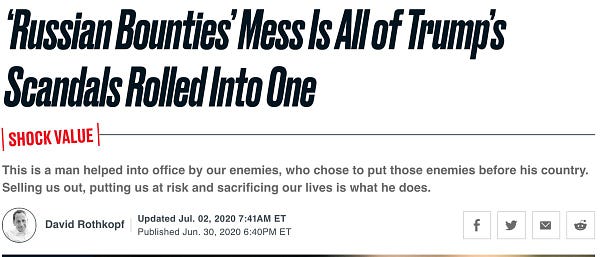
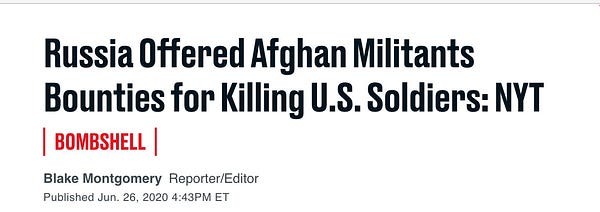
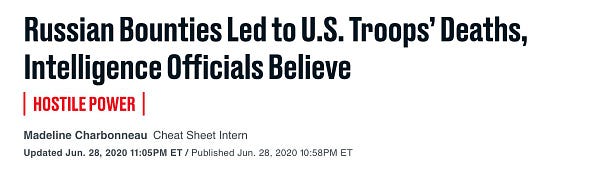
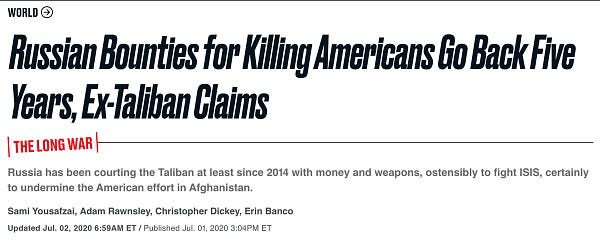
Even worse, other media outlets — led by The Washington Post — purported to have “independently confirmed” the NYT/CIA tale of Russian bounties. Twice in the last year, I have written about this bizarre practice where media outlets purport to “independently confirm” one another’s false stories by doing nothing more than going to the same anonymous sources who whisper to them the same things while providing no evidence. Yet they use this phrase “independent confirmation” to purposely imply that they obtained separate evidence corroborating the truth of the original story:

We have confirmed the @nytimes scoop: A Russian military spy unit offered bounties to Taliban-linked militants to attack coalition forces in Afghanistan. From @nakashimae @missy_ryan me and @shaneharris
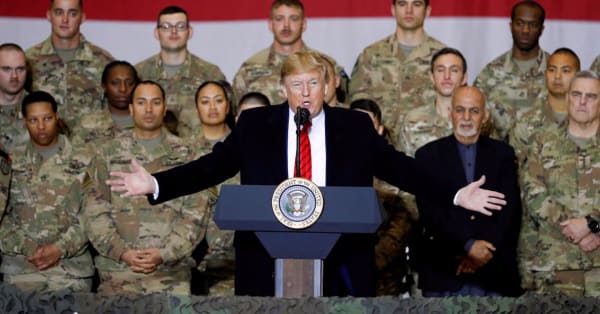
For months, pro-war members of both parties and leading members of the NYT/CNN/MSNBC media axis pushed a story — an inflammatory, dangerous one — based on nothing more than the say-so of anonymous CIA operatives. How can anyone do this who knows even the bare minimum about what this agency does and what its function is: to spread disinformation not just to foreign countries but the domestic population as well? It is both mystifying and toxic. But for people who call themselves “journalists” to repeat, over and over, evidence-free CIA claims, telling those who trust them to believe it, is nothing short of repulsive.
If you think that, upon learning yesterday’s news, there was any self-reflection on the part of the media figures who spread this, or that they felt chastened about it in any way, you would be very, very wrong. In fact, not only did few if any admit error, but they did exactly the same thing on Thursday about a brand new evidence-free assertion from the U.S. Government concerning Russia: they mindlessly assumed it true and then stated it to millions of people as fact. They are not embarrassed to get caught spreading false CIA propaganda. They see their role, correctly, as doing exactly that.
On Thursday, the U.S. Department of the Treasury, run by Biden’s Treasury Secretary Janet Yellen, issued a short Press Release about its targeting of Russian-Ukrainian political consultant, Konstantin Kilimnik, with new sanctions. One sentence of this press release asserted a claim that the Mueller investigation, after searching for eighteen months, never found: namely, that “Kilimnik provided the Russia intelligence services with sensitive information on polling and campaign strategy” that he received from then-Trump campaign manager Paul Manafort.
Is it true that Kilimnik passed this polling data to the Kremlin? Maybe. But there is no way for a rational person — let alone someone calling themselves a “journalist” — to conclude that it is true. Why? Because, like the CIA tale about Russian bounties — a claim they learned yesterday had no evidence — this is nothing more than a U.S. Government assertion that lacks any evidence.
Do you think journalists learned the lesson that they just had rubbed in their faces hours before about the foolishness of assuming official statements to be true with no evidence? Of course that is a rhetorical question: too many to count instantly proclaimed that this story was true without spending an ounce of mental energy to question if it was or apply any skepticism. Here’s Maddow’s MSNBC comrade showing how this is done:
Do you see what Hayes just did there? It is vital not to lose sight of how irresponsible and destructive this behavior is just because it is now so common. He saw a Press Release from a U.S. Government agency, read an assertion that it contained in one sentence, had no evidence that this assertion was true, but nonetheless “reported” it as if it were proven fact to millions of people in a predictably viral tweet.
Hayes was far from alone. I cannot count how many employees of corporate media outlets did the same: read the Treasury Department’s Press Release and, without pausing for a second, proclaimed it to be true. Indeed, the two MSNBC hosts who follow Hayes’s nightly news program explicitly described this evidence-free Press Release as “confirmation”— confirmation!

MSNBC’s Rachel Maddow and Lawrence O’Donnell celebrating an evidence-free Treasury Department Press Release as “confirmation,” Apr. 15, 2021
Let’s set aside the absurdity of treating this as some shocking revelation even if it were true. Just like the oozing historical ignorance of pretending that there would be something astonishing about Russians paying for the killing of U.S. troops in Afghanistan when the CIA just last week explicitly boasted of having done the same to Russian soldiers in Afghanistan, what is this Treasury Press Release supposed to prove that is so breathtaking and scandalous: that the Kremlin could not possibly have obtained polling data about the U.S. electorate had Manafort not provided it to them? That they never would have known that Wisconsin and Pennsylvania were swing states without an elaborate plot of collusion to learn this from the Trump campaign?
But the far more important point is the U.S. media’s willingness — their subservient eagerness — to obediently treat U.S. government pronouncements as Truth. Just like with the Russia bounty story, where there were ample reasons to doubt it from the start, the same is true of this Treasury Press Release. To begin with, if this were such a smoking gun “confirming” collusion, why did the Mueller investigation after eighteen months of highly aggressive subpoena-driven investigative activity not discover it?
Let’s express this as clearly as it can be expressed. Any journalist who treats unverified stories from the CIA or other government agencies as true, without needing any evidence or applying any skepticism, is worthless. Actually, they are worse than worthless: they are toxic influences who deserve pure contempt. Every journalist knows that governments lie constantly and that it is a betrayal of their profession to serve as mindless mouthpieces for these security agencies: that is why they will vehemently deny they do this if you confront them with this accusation. They know it is a shameful thing to do.
But just look at what they are doing: exactly this. These are not journalists. They are obsequious spokespeople for the CIA and other official authorities. Even when they learn that they deceived millions of people by uncritically repeating a story that the CIA told them was true, they will — on the very same day that they learn they did this — do exactly the same thing, this time with a one-paragraph Treasury Department Press Release. These are agents of disinformation: state media. And when they speak, you should listen to them with the knowledge of what they really are, and treat them accordingly.
DHS is paying Deranged Leftists to find a way to make you change your political beliefs
By Eric Striker | National Justice | February 19, 2021
Fresh off a summer of prolonged murder and arson organized by leftists, the Department of Homeland Security announced the lucky winners of its “domestic terrorism prevention” grant system last September.
One recipient program is at American University’s School of Communications, which got $568,613 from the DHS to partner with Google’s Jigsaw (an AI project that specializes in manipulating search results to achieve political ends) in order to “define and describe the growing threat of violent white supremacist extremist disinformation, evaluate attitudinal inoculation as a strategy for communication to combat the threat, and develop a suite of operational tools for use by practitioners and stakeholders.”
The highly subjective language of this description is only the tip of the iceberg. The project is being led by Kurt Braddock, a professor of Public Communications at AU. Braddock is known for pioneering social engineering and Soviet-style indoctrination techniques as a “vaccine” against what he arbitrarily deems to be “hate.”
Braddock’s leading role in this project, which seeks to develop his theories and put them into practice on a wide scale, is cause for concern. He doesn’t hide his fanatical left-wing prejudices, and he makes it a point to show his disregard for fundamental American values like free speech.
“Stochastic Terrorism”
 Last month, Braddock penned a piece for Common Dreams declaring Donald Trump a “stochastic terrorist.”
The logic of the stochastic terrorism concept is that an individual engaging in lawful political advocacy should be found guilty of a crime if a person who he has no relationship to but shares his critique crosses the line and becomes violent. In other words, guilt by association.
In his article, he asserts that Trump should’ve been held responsible for the FBI agent instigated plot to kidnap Gretchen Whitmer, merely for previously tweeting the slogan “LIBERATE MICHIGAN.”
To understand the absurdity of the idea, Dylann Roof told investigators that his main inspiration for the shooting spree at the Emanuel AME Church in South Carolina was reading interracial crime statistics, which the FBI itself compiles and releases every year. Under a system that prosecutes stochastic terrorism, the FBI itself would be partially responsible.
For Braddock, there is no such thing as the peaceful expression of beliefs or even raw data that challenges his worldview. Most enlightened people side with Socrates in the trial that found him guilty and put him to death for blasphemy, but the assistant professor upholds the Athenian court’s decision, “As a professor of communication, my teaching and research is based on a fact that has been clear since the days of Socrates– words have consequences,” he says.
In an interview with CBS News earlier this week, he reiterated this view, complaining that “far-right leaders” will be emboldened by Trump’s Senate acquittal into making statements that “motivate the far right” due to seeing a lack of “repercussions.”
The underlying first principle of all of Braddock’s work, seen in works like Weaponized Words which talks about using social psychology and manipulation to alter people’s political values, relies on the assertion that simply disagreeing with him on a broad range of issues is an act of violence.
Braddock’s Experiments Aren’t New
While Braddock may present his ideas and experiments as novel to DHS grant makers, they are in truth mostly taken from the established work of Chinese commissars in the 1970s and 80s.
In Michael Keane’s The Chinese Television Industry, he details the Maoist theory of culture and mass media. Journalists and state-backed intellectuals in China were instructed to become “guardians of the soul” tasked with instilling loyalty to the ruling elite’s interests as a way to “protect” the masses from the “viral infection” of so-called disinformation and counter-revolution.
The process of social engineering was referred to by Chinese officials as “positive education.” In Keane’s retelling, “positive education” was described as a way to “inoculate” the people against ideas critical of the state. Positive education methods were used until the 1980s.
In Braddock’s experiments, individuals are shown pro-white or populist arguments deliberately taken out-of-context in a way to induce a psychological response. The subjects are then rapidly bombarded with ideological “counter-arguments,” almost identical in method to what Maoists did on a wide scale in China.
Braddock claims these experiments have shown a high success rate in “inoculating” white people against anti-establishment ideas. Through his partnership with Google, he is trying to figure out ways to apply this on an industrial scale to social media, similar to how Mao attempted to solidify obedience to his doctrine through newspapers and television in China.
Petty Partisanship, Not Science
Braddock’s social media behavior reveals an individual deeply entrenched in the world of the online far-left.
In one tweet tagging Tom Cotton, he refers to him as a fascist “licking the boots of those who advocate white supremacy” over a June op-ed calling for government action against unabated anarchist violence.
In an older message from 2016, Braddock refers to Antifa members who tried to stab outnumbered Sacramento nationalists attending a permitted march as “counter-protesters.”
A cursory look at Braddock’s personal webpage is filled with Rick & Morty references and infantile writings that demonstrate a lack of professionalism, such as a self-description that reads “Terrorism is bad, so I try to understand, interpret, and stop it. Counter-terrorism is good, so I try to do work that helps it.”
It should be noted that the money behind this crusade was allocated to Braddock’s team by the Trump administration. At best, the grant is a huge waste of taxpayer dollars. But the malice behind his thinking should not be underestimated. This small-souled man isn’t a blogger for the Huffington Post, he has the full deference of history’s most advanced surveillance state. If he gets his way, half of America could be classified as terrorists targeted for re-education. The consequences of this kind of designation is no laughing matter.
US – UK Intel Agencies Declare Cyber War on Independent Media
By Whitney Webb |
Unlimited Hangout| November 11, 2020
In just the past week, the national-security states of the United States and United Kingdom have discreetly let it be known that the cyber tools and online tactics previously designed for use in the post-9/11 “war on terror” are now being repurposed for use against information sources promoting “vaccine hesitancy” and information related to Covid-19 that runs counter to their state narratives.
A new cyber offensive was launched on Monday by the UK’s signal intelligence agency, Government Communications Headquarters (GCHQ), which seeks to target websites that publish content deemed to be “propaganda” that raises concerns regarding state-sponsored Covid-19 vaccine development and the multi-national pharmaceutical corporations involved.
Similar efforts are underway in the United States, with the US military recently funding a CIA-backed firm—stuffed with former counterterrorism officials who were behind the occupation of Iraq and the rise of the so-called Islamic State—to develop an AI algorithm aimed specifically at new websites promoting “suspected” disinformation related to the Covid-19 crisis and the US military–led Covid-19 vaccination effort known as Operation Warp Speed.
Both countries are preparing to silence independent journalists who raise legitimate concerns over pharmaceutical industry corruption or the extreme secrecy surrounding state-sponsored Covid-19 vaccination efforts, now that Pfizer’s vaccine candidate is slated to be approved by the US Food and Drug Administration (FDA) by month’s end.
Pfizer’s history of being fined billions for illegal marketing and for bribing government officials to help them cover up an illegal drug trial that killed eleven children (among other crimes) has gone unmentioned by most mass media outlets, which instead have celebrated the apparently imminent approval of the company’s Covid-19 vaccine without questioning the company’s history or that the mRNA technology used in the vaccine has sped through normal safety trial protocols and has never been approved for human use. Also unmentioned is that the head of the FDA’s Center for Drug Evaluation and Research, Patrizia Cavazzoni, is the former Pfizer vice president for product safety who covered up the connection of one of its products to birth defects.
Essentially, the power of the state is being wielded like never before to police online speech and to deplatform news websites to protect the interests of powerful corporations like Pfizer and other scandal-ridden pharmaceutical giants as well as the interests of the US and UK national-security states, which themselves are intimately involved in the Covid-19 vaccination endeavor.
UK Intelligence’s New Cyberwar Targeting “Anti-Vaccine Propaganda”
On Monday, the UK newspaper The Times reported that the UK’s GCHQ “has begun an offensive cyber-operation to disrupt anti-vaccine propaganda being spread by hostile states” and “is using a toolkit developed to tackle disinformation and recruitment material peddled by Islamic State” to do so. In addition, the UK government has ordered the British military’s 77th Brigade, which specializes in “information warfare,” to launch an online campaign to counter “deceptive narratives” about Covid-19 vaccine candidates.
The newly announced GCHQ “cyber war” will not only take down “anti-vaccine propaganda” but will also seek to “disrupt the operations of the cyberactors responsible for it, including encrypting their data so they cannot access it and blocking their communications with each other.” The effort will also involve GCHQ reaching out to other countries in the “Five Eyes” alliance (US, Australia, New Zealand and Canada) to alert their partner agencies in those countries to target such “propaganda” sites hosted within their borders.
The Times stated that “the government regards tackling false information about inoculation as a rising priority as the prospect of a reliable vaccine against the coronavirus draws closer,” suggesting that efforts will continue to ramp up as a vaccine candidate gets closer to approval.
It seems that, from the perspective of the UK national-security state, those who question corruption in the pharmaceutical industry and its possible impact on the leading experimental Covid-19 vaccine candidates (all of which use experimental vaccine technologies that have never before been approved for human use) should be targeted with tools originally designed to combat terrorist propaganda.
While The Times asserted that the effort would target content “that originated only from state adversaries” and would not target the sites of “ordinary citizens,” the newspaper suggested that the effort would rely on the US government for determining whether or not a site is part of a “foreign disinformation” operation.
This is highly troubling given that the US recently seized the domains of many sites, including the American Herald Tribune, which it erroneously labeled as “Iranian propaganda,” despite its editor in chief, Anthony Hall, being based in Canada. The US government made this claim about the American Herald Tribune after the cybersecurity firm FireEye, a US government contractor, stated that it had “moderate confidence” that the site had been “founded in Iran.”
In addition, the fact that GCHQ has alleged that most of the sites it plans to target are “linked to Moscow” gives further cause for concern given that the UK government was caught funding the Institute for Statecraft’s Integrity Initiative, which falsely labeled critics of the UK government’s actions as well as its narratives with respect to the Syria conflict as being related to “Russian disinformation” campaigns.
Given this precedent, it is certainly plausible that GCHQ could take the word of either an allied government, a government contractor, or perhaps even an allied media organization such as Bellingcat or the Atlantic Council’s DFRLab that a given site is “foreign propaganda” in order to launch a cyber offensive against it. Such concerns are only amplified when one of the main government sources for The Times article bluntly stated that “GCHQ has been told to take out antivaxers [sic] online and on social media. There are ways they have used to monitor and disrupt terrorist propaganda,” which suggests that the targets of GCHQ’s new cyber war will, in fact, be determined by the content itself rather than their suspected “foreign” origin. The “foreign” aspect instead appears to be a means of evading the prohibition in GCHQ’s operational mandate on targeting the speech or websites of ordinary citizens.
This larger pivot toward treating alleged “anti-vaxxers” as “national security threats” has been ongoing for much of this year, spearheaded in part by Imran Ahmed, the CEO of the UK-based Center for Countering Digital Hate, a member of the UK government’s Steering Committee on Countering Extremism Pilot Task Force, which is part of the UK government’s Commission for Countering Extremism.
Ahmed told the UK newspaper The Independent in July that “I would go beyond calling anti-vaxxers conspiracy theorists to say they are an extremist group that pose a national security risk.” He then stated that “once someone has been exposed to one type of conspiracy it’s easy to lead them down a path where they embrace more radical world views that can lead to violent extremism,” thereby implying that “anti-vaxxers” might engage in acts of violent extremism. Among the websites cited by Ahmed’s organization as promoting such “extremism” that poses a “national security risk” were Children’s Health Defense, the National Vaccine Information Center, Informed Consent Action Network, and Mercola.com, among others.
Similarly, a think tank tied to US intelligence—whose GCHQ equivalent, the National Security Agency, will take part in the newly announced “cyber war”—argued in a research paper published just months before the onset of the Covid-19 crisis that “the US ‘anti-vaxxer’ movement would pose a threat to national security in the event of a ‘pandemic with a novel organism.’”
InfraGard, “a partnership between the Federal Bureau of Investigation (FBI) and members of the private sector,” warned in the paper published last June that “the US anti-vaccine movement would also be connected with ‘social media misinformation and propaganda campaigns’ orchestrated by the Russian government,” as cited by The Guardian. The InfraGard paper further claimed that prominent “anti-vaxxers” are aligned “with other conspiracy movements including the far right . . . and social media misinformation and propaganda campaigns by many foreign and domestic actors. Included among these actors is the Internet Research Agency, the Russian government–aligned organization.”
An article published just last month by the Washington Post argued that “vaccine hesitancy is mixing with coronavirus denial and merging with far-right American conspiracy theories, including Qanon,” which the FBI named a potential domestic terror threat last year. The article quoted Peter Hotez, dean of the School of Tropical Medicine at Baylor College of Medicine in Houston, as saying “The US anti-vaccination movement is globalizing and it’s going toward more-extremist tendencies.”
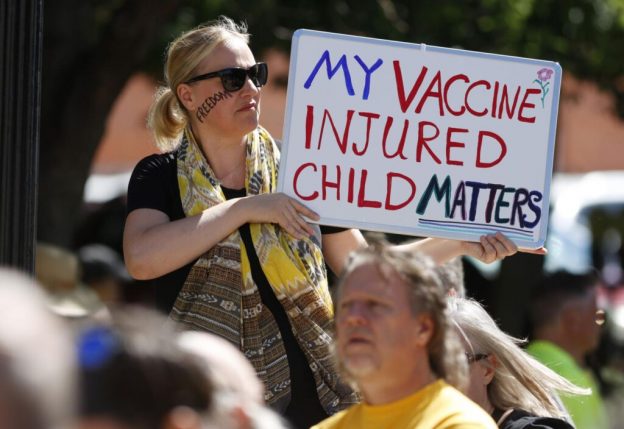
Simone Warstat attends a rally against a legislative bill to make it more difficult for parents to opt out for non-medical reasons to immunize their children, June 7, 2020, in Denver Colorado.
It is worth pointing out that many so-called “anti-vaxxers” are actually critics of the pharmaceutical industry and are not necessarily opposed to vaccines in and of themselves, making the labels “anti-vaxxer” and “anti-vaccine” misleading. Given that many pharmaceutical giants involved in making Covid-19 vaccines donate heavily to politicians in both countries and have been involved in numerous safety scandals, using state intelligence agencies to wage cyber war against sites that investigate such concerns is not only troubling for the future of journalism but it suggests that the UK is taking a dangerous leap toward becoming a country that uses its state powers to treat the enemies of corporations as enemies of the state.
The CIA-Backed Firm “Weaponizing Truth” with AI
In early October, the US Air Force and US Special Operations Command announced that they had awarded a multimillion-dollar contract to the US-based “machine intelligence” company Primer. Per the press release, “Primer will develop the first-ever machine learning platform to automatically identify and assess suspected disinformation [emphasis added]. Primer will also enhance its natural language processing platform to automatically analyze tactical events to provide commanders with unprecedented insight as events unfold in near real-time.”
According to Primer, the company “builds software machines that read and write in English, Russian, and Chinese to automatically unearth trends and patterns across large volumes of data,” and their work “supports the mission of the intelligence community and broader DOD by automating reading and research tasks to enhance the speed and quality of decision-making.” In other words, Primer is developing an algorithm that would allow the national-security state to outsource many military and intelligence analyst positions to AI. In fact, the company openly admits this, stating that their current effort “will automate the work typically done by dozens of analysts in a security operations center to ingest all of the data relevant to an event as it happens and funnel it into a unified user interface.”
Primer’s ultimate goal is to use their AI to entirely automate the shaping of public perceptions and become the arbiter of “truth,” as defined by the state. Primer’s founder, Sean Gourley, who previously created AI programs for the military to track “insurgency” in post-invasion Iraq, asserted in an April blog post that “computational warfare and disinformation campaigns will, in 2020, become a more serious threat than physical war, and we will have to rethink the weapons we deploy to fight them.”
In that same post, Gourley argued for the creation of a “Manhattan Project for truth” that would create a publicly available Wikipedia-style database built off of “knowledge bases [that] already exist inside many countries’ intelligence agencies for national security purposes.” Gourley then wrote that “this effort would be ultimately about building and enhancing our collective intelligence and establishing a baseline for what’s true or not” as established by intelligence agencies. He concludes his blog post by stating that “in 2020, we will begin to weaponize truth.”
Notably, on November 9, the same day that GCHQ announced its plans to target “anti-vaccine propaganda,” the US website NextGov reported that Primer’s Pentagon-funded effort had turned its attention specifically to “Covid-19 related disinformation.” According to Primer’s director of science, John Bohannon, “Primer will be integrating bot detection, synthetic text detection and unstructured textual claims analysis capabilities into our existing artificial intelligence platform currently in use with DOD. . . . This will create the first unified mission-ready platform to effectively counter Covid-19-related disinformation in near-real time.”
Bohannon, who previously worked as a mainstream journalist embedded with NATO forces in Afghanistan, also told NextGov that Primer’s new Covid-19–focused effort “automatically classifies documents into one of 10 categories to enable the detection of the impact of COVID” on areas such as “business, science and technology, employment, the global economy, and elections.” The final product is expected to be delivered to the Pentagon in the second quarter of next year.
Though a so-called private company, Primer is deeply linked to the national-security state it is designed to protect by “weaponizing truth.” Primer proudly promotes itself as having more than 15 percent of its staff hailing from the US intelligence community or military. The director of the company’s National Security Group is Brian Raymond, a former CIA intelligence officer who served as the Director for Iraq on the US National Security Council after leaving the agency.
The company also recently added several prominent national-security officials to its board including:
- Gen. Raymond Thomas (ret.), who led the command of all US and NATO Special Operations Forces in Afghanistan and is the former commander of both US Special Operations Command and Joint Special Operations Command (JSOC).
- Lt. Gen. VeraLinn Jamieson (ret.), the former deputy chief of staff for Air Force Intelligence, Surveillance and Reconnaissance who led the Air Force’s intelligence and cyber forces. She also personally developed “strategic partnerships” between the Air Force and Microsoft, Amazon, Google, and IBM in order “to accelerate the Air Force’s digital transformation.”
- Brett McGurk, one of the “chief architects” of the Iraq War “surge,” alongside the notorious Kagan family, as NSC Director for Iraq, and then as special assistant to the president and senior Director for Iraq and Afghanistan during the Bush administration. Under Obama and during part of the Trump administration, McGurk was the special presidential envoy for the Global Coalition to Defeat ISIS at the State Department, helping to manage the “dirty war” waged by the US, the UK, and other allies against Syria.
In addition to those recent board hires, Primer brought on Sue Gordon, the former principal deputy director of National Intelligence, as a strategic adviser. Gordon previously “drove partnerships within the US Intelligence Community and provided advice to the National Security Council in her role as deputy director of national intelligence” and had a twenty-seven-year career at the CIA. The deep links are unsurprising, given that Primer is financially backed by the CIA’s venture-capital arm In-Q-Tel and the venture-capital arm of billionaire Mike Bloomberg, Bloomberg Beta.
Operation Warp Speed’s Disinformation Blitzkrieg
The rapid increase in interest by the US and UK national-security states toward Covid-19 “disinformation,” particularly as it relates to upcoming Covid-19 vaccination campaigns, is intimately related to the media-engagement strategy of the US government’s Operation Warp Speed.
Officially a “public-private partnership,” Operation Warp Speed, which has the goal of vaccinating 300 million Americans by next January, is dominated by the US military and also involves several US intelligence agencies, including the National Security Agency (NSA) and the Department of Homeland Security (DHS), as well as intelligence-linked tech giants Google, Oracle, and Palantir. Several reports published in The Last American Vagabond by this author and journalist Derrick Broze have revealed the extreme secrecy of the operation, its numerous conflicts of interest, and its deep ties to Silicon Valley and Orwellian technocratic initiatives.
Warp Speed’s official guidance discusses at length its phased plan for engaging the public and addressing issues of “vaccine hesitancy.” According to the Warp Speed document entitled “From the Factory to the Frontlines,” “strategic communications and public messaging are critical to ensure maximum acceptance of vaccines, requiring a saturation of messaging across the national media.” It also states that “working with established partners—especially those that are trusted sources for target audiences—is critical to advancing public understanding of, access to, and acceptance of eventual vaccines” and that “identifying the right messages to promote vaccine confidence, countering misinformation, and targeting outreach to vulnerable and at-risk populations will be necessary to achieve high coverage.”
The document also notes that Warp Speed will employ the CDC’s three-pronged strategic framework for its communications effort. The third pillar of that strategy is entitled “Stop Myths” and has as a main focus “establish[ing] partnerships to contain the spread of misinformation” as well as “work[ing] with local partners and trusted messengers to improve confidence in vaccines.”
Though that particular Warp Speed document is short on specifics, the CDC’s Covid-19 Vaccination Program Interim Playbook contains additional information. It states that Operation Warp Speed will “engage and use a wide range of partners, collaborations, and communication and news media channels to achieve communication goals, understanding that channel preferences and credible sources vary among audiences and people at higher risk for severe illness and critical populations, and channels vary in their capacity to achieve different communication objectives.” It states that it will focus its efforts in this regard on “traditional media channels” (print, radio, and TV) as well as “digital media” (internet, social media, and text messaging).
The CDC document further reveals that the “public messaging” campaign to “promote vaccine uptake” and address “vaccine hesitancy” is divided into four phases and adds that the overall communication strategy of Warp Speed “should be timely and applicable for the current phase of the Covid-19 Vaccination program.”
Those phases are:
- Before a vaccine is available
- The vaccine is available in limited supply for certain populations of early focus
- The vaccine is increasingly available for other critical populations and the general public
- The vaccine is widely available
Given that the Covid-19 vaccine candidate produced by Pfizer is expected to be approved by the end of November, it appears that the US national-security state, which is essentially running Operation Warp Speed, along with “trusted messengers” in mass media, is preparing to enter the second phase of its communications strategy, one in which news organizations and journalists who raise legitimate concerns about Warp Speed will be de-platformed to make way for the “required” saturation of pro-vaccine messaging across the English-speaking media landscape.
Dark web voter database report casts new doubts on Russian election hack narrative
By Gareth Porter | Grayzone | September 13, 2020
A new report showing that US state-level voter databases were publicly available calls into question the narrative that Russian intelligence “targeted” US state election-related websites in 2016.
A September 1 report in the Moscow daily Kommersant on a “dark web” site offering a database of personal information on millions of registered American voters undermines one of the central themes of the Russia hysteria pervading US politics.
Democratic politicians and corporate media pundits have long accepted it as fact that Russian intelligence “targeted” US state election-related websites in 2016. But the Kommersant report shows that those state registered voter databases were already available to anyone in the public domain, eliminating any official Russian motive for hacking state websites.
Kommersant reported that a user on a dark web Forum known as Gorka9 offered free access to databases containing the information of 7.6 million Michigan voters, along with the state voter databases of Connecticut, Arkansas, Florida and North Carolina.
There are differences between the Michigan database described by Gorka9 and the one that the State of Michigan releases to the public upon request. Tracy Wimmer, the spokesperson for the Michigan Secretary of State, said in an e-mail to Grayzone that when the Michigan voter registration database is released to the public upon request, the state withholds “date of birth (year of birth is included), driver’s license number, the last four digits of someone’s social security number, email address and phone number….” However, Gorka9’s description of the Michigan data includes driver’s license numbers, full dates of birth, social security numbers and emails.
In fact both un-redacted and redacted state voter files are obviously widely available on the dark web as well as elsewhere on the internet. Meduza, a Russian-language news site based in Riga, Latvia, published the Kommersant story along with an “anonFiles” download portal for access to the Michigan voter database and a page from it showing that it is the officially redacted version. The DHS and the FBI both acknowledged in response to the Kommersant story that “a lot of voter registration data is publicly available or easily purchased.”
Criminal hackers have been seeking to extract such personal information from online state personal databases for many years — not only from voter registration databases but from drivers license, health care and other databases. Oregon’s chief information security officer, Lisa Vasa, told the Washington Post in September 2017 that her team blocks “upwards of 14 million attempts to access our network every day.”
Ken Menzell, the legal counsel to the Illinois state Board of Elections, told this writer in a 2017 interview that the only thing new about the hack of the state’s voter database in 2016, in which personal data on 200,000 Illinois registered voters was exfiltrated, was that the hackers succeeded. Menzell recalled that hackers had been “trying constantly” to get into every Illinois personal database ever since 2006.
The motive for the hackers was simple: as observed by Andrey Arsentiev, the head of analytics and special projects at the private security partnership, Infowatch, databases can be mined for profits on the dark web, primarily by selling them to scam artists working on a mass scale. Gorka9 was offering state voter files for free because the owner had already squeezed all the potential profit out of selling them.
For the Russian government, on the other hand, such databases would be of little or no value. When FBI counterintelligence chief Bill Priestap was asked by a member of the Senate Intelligence Committee in June 2017 how Moscow might use personal voter registration data, the only explanation he could come up with was that the Russian government and its intelligence agencies were completely ignorant of the character of U.S. state voter databases. “They took the data to understand what it consisted of,” Priestap declared.
Priestap was obviously unaware of the absurdity of the suggestion that the Russian government had no idea what was in such databases in 2016. After all, the state voter registration databases had already been released by the states themselves into the public domain, and had been bought and sold on the dark web for many years. The FBI has steered clear of the embarrassing suggestion by Priestap ever since.
Priestap’s inability to conjure up a plausible reason for Russia to hack U.S. election sites points to the illogical and baseless nature of the claims of a Russian threat to the U.S. presidential election.
DHS creates the Russian cyber campaign against state election sites
Back in 2016, the Department of Homeland Security did its best to market the narrative of Russian infiltration of American voting systems. At the time, the DHS was seeking to increase its bureaucratic power by adding election infrastructure to its portfolio of cybersecurity responsibilities, and exploiting the Russian factor was just the ticket to supercharge their campaign.
In their prepared statement to the Senate Intelligence Committee in June 2017, two senior DHS officials, Samuel Liles and Jeanette Manfra, referred to an October 2016 intelligence report published by the DHS Office of Intelligence and Analysis. They stated it had “established that Internet-connected election-related networks, including websites, in 21 states were potentially targeted by Russian government cyber actors.” That “potentially targeted” language gave away the fact that DHS didn’t have anything more than suspicion to back up the charge.
In fact DHS was unable to attribute any attempted election site hack to the Russian government. On October 7, 2016, in fact, DHS Secretary Jeh Johnson and Director of National Intelligence James Clapper stated explicitly that they could not do so. Liles and Manfra appeared to imply such an attribution, however, by associating DHS with a joint assessment by CIA, FBI and NSA released January 7, 2017, that contained the statement, the “Russian intelligence obtained and maintained access to elements of multiple US state or local electoral boards.”
But the meaning of that language was deliberately vague, and the only additional sentence related to it stated, “Since early 2014, Russian intelligence has researched US electoral processes and related technology and equipment.” That was far from any finding that Russia had scanned or hacked election-related websites.
In September 2017, under pressure from governors, DHS finally notified state governments about the cyber incidents that it had included in its October 2016 intelligence report as examples of “potential” Russian targeting. Now, it abandoned its ambiguous language and explicitly claimed Russian responsibility.
One state election official who asked not to be identified told this writer in a 2018 interview that “a couple of guys from DHS reading from a script” had informed him that his state was “targeted by Russian government cyber actors.”
DHS spokesman Scott McConnell issued a statement on September 28, 2017 that DHS “stood by” its assessment that 21 states “were the target of Russian government cyber actors seeking vulnerabilities and access to U.S. election infrastructure.” But McConnell also revealed that DHS had defined “targeting” so broadly that any public website that a hacker scanned in a state could be included within that definition.
The dishonest tactics the DHS employed to demonstrate plausible evidence of “targeting” was revealed by Arizona Secretary of State Michelle Reagan’s spokesperson Matt Roberts, who told this writer in an interview, “When we pressed DHS on what exactly was targeted, they said it was the Phoenix public library’s computer system.” Another 2016 hacking episode in Arizona, which the FBI originally believed was a Russian government job, was later found to be a common criminal hack. In that episode, a hacker had targeted a local official with a phishing scheme and managed to steal their username and password.
Ironically, DHS had speculated in its initial intelligence report “that cyber operations targeting election infrastructure could be intended or used to undermine public confidence in electoral processes and potentially the outcome.”
That speculation, reiterated by corporate media, became a central feature of the Russiagate hysteria that electrified the Democratic Party’s base. None of the journalists and politicians who repeated the narrative stopped to consider how unsubstantiated claims by the DHS about Russian penetration of the US election infrastructure was doing just that – lowering public confidence in the democratic process.
The hysteria surrounding the supposed Russian threat to elections is far from over. The Senate Intelligence Committee report released in July 2019 sought to legitimize the contention by former Obama cyber security adviser Michael Daniel that Russia “may have” targeted all fifty states for cyber attacks on election-related sites. In explaining his reasoning to the Senate committee’s staff, Daniel said: “My professional judgment was we have to work on the assumption [Russians] tried to go everywhere, because they’re thorough, they’re competent, they’re good.”
The New York Times eagerly played up that subjective and highly ideological judgment in the lede of a story headlined, ‘Russia Targeted Election Systems in All 50 States, Report Finds.’
As for DHS, it appeared to acknowledge by implication in an October 11, 2018 assessment excerpted in the Senate Committee report that it could not distinguish between a state-sponsored hack and a criminal hack. This August, the senior cybersecurity adviser for the Cybersecurity and Infrastructure Security Agency (CISA), Matthew Masterson, said, “We are not and have not seen specific targeting of those election systems that has been attributable to nation-state actors at this time…. We do see regular scanning, regular probing of election infrastructure as a whole, what you’d expect to see as you run IT systems.”
Despite these stunning admissions, DHS has faced no official accountability for deliberately slanting its intelligence assessment to implicate Russia for common criminal hacking activity. No matter how shoddy its origins and development have proven to be, the narrative remains too politically useful to be allowed to die.
Featured Video
No Threat Can Force Iran’s Surrender /Trita Parsi & Lt Cl Daniel Davis
or go to
Aletho News Archives – Video-Images
From the Archives
What is the Israeli Lobby in Australia Doing in Interfaith Dialogue?
By Ali Kazak | Dissident Voice | October 11, 2015
For years Israel and its lobby around the world have been trying to normalise their relations with Arabs and Muslims without solving the Palestine Question.
One of the methods they resorted to in the last few years is using human rights and community organizations such as interfaith dialogue and Multiculturalism to achieve this objective and to: isolate the Palestinians, marginalise the Palestine question, end Israel’s isolation, and prevent criticism of Israel, knowing that these organisations will be the first to stand against Israel’s violations, racial and religious discrimination.
The group responsible for this task in Australia is The Australia/Israel & Jewish Affairs Council (AIJAC); its Director of International & Community Affairs, Jeremy Jones is in charge of lobbying religious community organizations, specifically Muslims and Christians. Consequently he convened the Faith Communities for Reconciliation, founding participant in the Australian Partnership of Religious Organisations and the Australian National Dialogue of Christians, Muslims & Jews.
AIJAC is a private political propaganda group. It is recognised as the main Israeli lobby in Australia. It coordinates its activities and works intimately with the Israeli embassy in Canberra and different institutions in Israel. It is privately funded by some Jewish businessmen. It monitors closely Australian politicians, the media, ethnic and religious groups, (especially Arabs and Muslims), unions and academics on their stands towards Israel and the Palestine question. … continue
Blog Roll
 Aletho News
- Envoy warns UN on Trump’s threat to ‘obliterate’ Iran’s civilian infrastructure
- The Larak Corridor: Iran’s Rial Gate With No US, No Israel, and No Way Around
- ‘Economic terrorism’: Steel facilities hit again in US-Israeli strike
- ‘War Crime’: Iran condemns attacks on Arak, Ardakan nuclear sites
- Two-thirds of Americans want quick end to Iran war even if goals unmet
- Trump to Give “Important Update on Iran” Wednesday in Prime-Time Speech
- Theodore Postol: Iran’s Missiles & Drones Were Underestimated
- Iran To Target Military Industrial-Tech Complex That Facilitated Gaza Genocide
- Collapsing Empire: The Resistance Disarms ‘Israel’
- Suicide Should Not Be a Government Service
- If Americans Knew
- Israel wants US to bomb more of Iran’s civilian structures (113,000 is not enough) – Not a ceasefire Day 173
- Ann Coulter Rips Into Fox News for Iran War Coverage
- Joe Kent Urges Americans To Call White House and Congress To Object To Sending Troops Into Iran
- DNC Resolution to Reject AIPAC Funding Puts Democratic Leaders in the Hot Seat
- Swedish foundation to build 400 schools as over 650,000 Gaza children remain without education for 2 years
- Israeli army admits photshopping image of slain Lebanese journalist
- This is how Israel is systematically killing health workers under the cover of war in Lebanon
- Carrying life under fire: Israeli invasion of Lebanon leaves pregnant women facing deadly risks
- Champagne all around for the new death penalty (for Palestinians) law – Not a ceasefire Day 172
- Why are Palestinian books struggling to be seen on Amazon?
- No Tricks Zone
- New Study Finds Warming Saves Lives…Cold Temperatures 12 Times More Deadly Than Excess Heat
- German Science Blog Accuses PIK Climate Institute Of Hallucinating Climate Tipping Points
- Devastating Assessment Of Comirnaty Vaccine By Former Senior Pfizer Europe Toxicologist
- New Study: CO2 Is ‘Effectively Negligible’ As An Explanatory Climate Change Factor Since 2000
- Former Pfizer Toxicologist Dr. Helmut Sterz Tells Bundestag Hearing Pfizer Vaccine Should Have Never Been Approved
- Energy Expert: Germany’s Nuclear Phaseout Was A “500 Billion Euro Mistake”
- New Research: South Australia’s Mid-Holocene Sea Surface Temperatures Were 4°C Warmer Than Today
- Storing Green Energy To Last Germany 10 Days Would Require A 60-Million Tonne Battery
- New Studies: UK Sea Levels Were 4 Meters Higher Than Today During The Mid-Holocene
- Destructive Green New Deal: German Energy And Metal Group Warns Of Drastic Crisis
 Aletho News