HHS Office of Inspector General Maneuvers to Throw Fauci Under Bus Without Hurting Him
Audit finds lax oversight of EcoHealth grants for “enhanced potential pandemic pathogens (ePPPs)”
By John Leake | Courageous Discourse | January 27, 2023
Three years after SARS CoV-2 broke out, the Department of Health and Human Services (HHS) Office of Inspector General (OIG) just issued a dry-as-dust report on its audit of the NIH grants to EcoHealth Alliance “totaling approximately $8.0 million, which included $1.8 million of EcoHealth’s subawards to eight subrecipients, including the Wuhan Institute of Virology (WIV).”
The auditors concluded that:
Using its discretion, NIH did not refer the research to HHS for an outside review for enhanced potential pandemic pathogens (ePPPs) because it determined the research did not involve and was not reasonably anticipated to create, use, or transfer an ePPP. However, NIH added a special term and condition in EcoHealth’s awards and provided limited guidance on how EcoHealth should comply with that requirement. We found that NIH was only able to conclude that research resulted in virus growth that met specified benchmarks based on a late progress report from EcoHealth that NIH failed to follow up on until nearly 2 years after its due date.
In plain English, the NIH financed a company conducting dangerous and illegal research that likely resulted in or contributed to a viral pandemic that inflicted incalculable damage on the entire human race. Note the Orwellian sleight of hand trick of using the term “enhanced potential pandemic pathogens ePPP” instead of the “Gain-of-Function,” which the public now understands to be illegal.
And what does the OIG recommend be done about this? Its recommendations are written in such toothless and boring prose that the average reader will likely fall asleep before reaching the end of the paragraph.
We recommend that NIH ensure that EcoHealth accurately and in a timely manner report award and subaward information; ensure that administrative actions are appropriately performed; implement enhanced monitoring, documentation, and reporting requirements for recipients with foreign subrecipients; assess whether NIAID staff are following policy to err on the side of inclusion when determining whether to refer research that may involve ePPP for further review; consider whether it is appropriate to refer WIV to HHS for debarment; ensure any future NIH grant awards to EcoHealth address the deficiencies noted in the report; and resolve costs identified as unallowable as well as possibly unreimbursed costs.
The OIG report suggests that the HHS is now maneuvering to throw retired NIAID director Anthony Fauci under the bus for these “regrettable indiscretions,” while giving the appearance of taking corrective action. Fauci will enjoy his retirement, only occasionally interrupted by theatrical Congressional hearings that will result in zero disciplinary action. EcoHealth Alliance will continue receiving generous grants like the $3 million it was just awarded, and its officers will continue pocketing much of the money for themselves. Business as usual in the Land of the Racketeers will continue.
Head of the Lancet COVID-19 Commission discusses the likely Lab Origins of SARS-CoV-2
The Naked Emperor’s Newsletter | August 6, 2022
Professor Jeffrey Sachs is an American academic with specialities in economics, global poverty, human-induced climate change and financial crises. Jeffrey is University Professor at Columbia University and before this was professor at Harvard University. He has worked as Special Advisor to UN Secretaries-General Kofi Annan, Ban Ki-moon and Antonio Guterres.
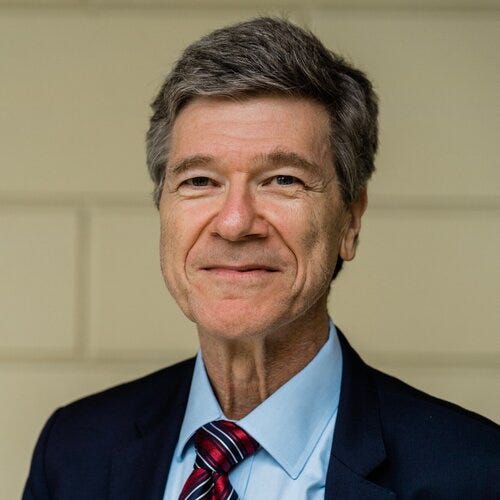
The mini résumé above is to show that Professor Sachs is pretty mainstream. So mainstream in fact, that he was appointed, early in the pandemic, as the Chair of the Lancet Covid-19 Commission. So mainstream, that he appointed Peter Daszak of EcoHealth Alliance to chair the Lancet’s task force on the origins of SARS-CoV-2.
A few weeks ago, Professor Sachs said a few ‘controversial’ statements about the origins of Covid. Now, a more detailed interview with him, in Current Affairs, has revealed some important facts. Most of us have read much of this information for a few years now but coming from the head of the Lancet Commission, these statements are quite extraordinary.
Click on the link above to read the whole interview but I have included some fascinating quotations below.
When asked about his recent statement about being pretty convinced about a lab leak he said:
[Scientists are] creating a narrative. And they’re denying the alternative hypothesis without looking closely at it. That’s the basic point.
Now, what is the alternative hypothesis? The alternative hypothesis is quite straightforward. And that is that there was a lot of research underway in the United States and China on taking SARS-like viruses, manipulating them in the laboratory, and creating potentially far more dangerous viruses. And the particular virus that causes COVID-19, called SARS-Cov-2, is notable because it has a piece of its genetic makeup that makes the virus more dangerous. And that piece of the genome is called the “furin cleavage site.” Now, what’s interesting, and concerning if I may say so, is that the research that was underway very actively and being promoted, was to insert furin cleavage sites into SARS-like viruses to see what would happen. Oops!
Professor Sachs was asked to distinguish between facts and speculation; do we actually know gain of function research was actually ongoing somewhere?
We have a lot of reason to believe that it was, because the scientists that were doing that research loved that research. And they explained to us publicly why it’s so important. And they wrote editorials about why this research must continue. And they made grant proposals saying that it should continue. And for those of us in the business of writing grant proposals, the fact that a particular grant proposal that’s deeply troubling was turned down doesn’t mean that it wasn’t carried out afterwards…
And the scientists like those that talk about the Huanan market, they don’t even discuss that research that was underway. That is just misdirection, to my mind. It’s like sleight of hand art. Don’t look over there. Look over here…
And yet I see NIH with its head in the ground. “Oh, no, nothing here to look at.” And then I see the scientists. “Oh, nothing here to look at. We know it’s the market. Did we find an animal? No. Do we have an explanation of where that furin cleavage site came in? No. We don’t have an explanation of the timing, which doesn’t quite look right. Oh, but don’t look over there, because there’s nothing there, they keep telling us. Well, that’s a little silly.
What I’m calling for is not the conclusion. I’m calling for the investigation. Finally, after two and a half years of this, it’s time to fess up that it might have come out of a lab and here’s the data that we need to know to find out whether it did.
He continued about Gain of Function research.
But they [champions of Gain of Function research] weren’t actually aiming to just test viruses that they were collecting in nature. They were aiming to modify those viruses. Because the scientists knew that a SARS-like virus without a furin cleavage site wouldn’t be that dangerous. But they wanted to test their drugs and vaccines and theories against dangerous viruses. Their proposal was to take hundreds, by the way—or least they talked about in one proposal more than 180 previously unreported strains—and test them for their so-called “spillover potential.” How effective would they be? And to look: do they have a furin cleavage site, or technically what’s called a proteolytic cleavage site? And if not, put them in. For heaven’s sake. My God! Are you kidding?
Jeffrey was asked about the distinction between ‘kooky theories’ and plausible ones.
The right one to look at is part of a very extensive research program that was underway from 2015 onward, funded by the NIH, by Tony Fauci, in particular NIAID [National Institute of Allergy and Infectious Diseases], and it was to examine the spillover potential of SARS-like viruses. The champions of this research explained in detail their proposals. But after the event, we’d never asked them, “So what were you actually doing? What experiments did you do? What do you know?” We somehow never asked. It was better just to sweep it under the rug, which is what Fauci and the NIH have done up until this point. Maybe they could tell us, “Oh, full exoneration,” but they haven’t told us that at all. They haven’t shown us anything. So there’s nothing “kooky” about it, because it’s precisely what the scientists were doing…
So you saw a narrative being created. And the scientists are not acting like scientists. Because when you’re acting like a scientist, you’re pursuing alternative hypotheses. And the scientists just wrote recently an op-ed saying the only evidence that this came out of a lab that’s been put forward is that it came in a city, Wuhan, where an institute was located. Well, that’s a lie. That is not the only coincidence that leads to this theory. What leads to this alternative hypothesis is the detailed research program the NIH funded that was underway in the years leading up to the outbreak. So I see the scientists absolutely trying to create a narrative and take our eyes off of another issue.
Next, he was asked about the research being undertaken in the Wuhan Institute of Virology.
We know that at the Wuhan Institute of Virology, the scientists there had been trained by American scientists to use advanced bioengineering methodologies. And in particular, we have scientists in North Carolina, Texas, and so forth who do this kind of research, believe in it, argue for it, and say that they don’t want any regulations on it and so on. And they were in close contact with Wuhan Institute of Virology, and they were part of a joint research group that was stitched together by something called EcoHealth Alliance. And EcoHealth Alliance was the kind of marriage maker between the American scientists and the Chinese scientists. That was the vehicle for funding from the U.S. government, especially from the National Institutes of Health, and especially from Tony Fauci’s unit, the NIAID.
When asked about EcoHealth Alliance, Professor Sachs admitted that he hired Peter Daszak to head the task force on the origins of Covid.
I thought, naively at the beginning, “Well, here’s a guy who is so connected, he would know.” And then I realized he was not telling me the truth. And it took me some months, but the more I saw it, the more I resented it.
And so I told him, “Look, you have to leave.” And then the other scientists in that task force attacked me for being anti-scientific. And I asked them: “What are your connections with all of this?” They didn’t tell me. Then when the Freedom of Information Act released some of these documents that NIH had been hiding from the public, I saw that people that were attacking me were also part of this thing. So I disbanded that whole task force. So my own experience was to witness close up how they’re not talking. And they’re trying to keep our eyes on something else. And away from even asking the questions that we’re talking about…
He [Peter Daszak] could have explained to me right from the beginning that there was a big research program and that they were manipulating the viruses, and here’s how. He could have given me the research proposals. And when I asked him for one of the research proposals, he said, “No, my lawyer says I can’t give it to you.” I said, “What? You’re heading a commission. We’re a transparent commission. You’re telling me your lawyer says you can’t give me your project proposal.” I said, “Well, then you can’t be on this commission. This is not even a close call.”
But there were so many other things. He was just filled with misdirection.
He concluded that we need far more oversight over Gain of Function work.
I can tell you one thing that I’ve learned from talking to a lot of scientists in the last couple of years: the technological capacity to do dangerous things using this biotechnology is extraordinary right now. So I want to know what’s being done. I want to know what other governments are doing, too, not just ours. I want some global control over this stuff.
Furthermore, he is disappointed with the information that, even he as the head of the commission, is able to obtain.
The most interesting things that I got as chair of the Lancet commission came from Freedom of Information Act (FOIA) lawsuits and whistleblower leaks from inside the U.S. government. Isn’t that terrible? NIH was actually asked at one point: give us your research program on SARS-like viruses. And you know what they did? They released the cover page and redacted 290 pages. They gave us a cover page and 290 blank pages! That’s NIH, for heaven’s sake. That’s not some corporation. That is the U.S. government charged with keeping us healthy.
A fascinating interview which I recommend you read in full.
Evidence of Pandemic and Bioweapon Cover-Ups
By Dr. Joseph Mercola | April 7, 2022
As evidence of a potential bioweapons cover-up has started emerging, a company called Metabiota is gaining prominence. The links between Metabiota and several key players in the COVID pandemic and/or the Ukraine labs story are manifold, so there’s no really simple way to unravel it in a logical sequence. That said, let’s start with what Metabiota does and the connections of its founder, and expand from there.
Metabiota’s Mission
Metabiota’s mission is to make the world more resilient to epidemics by providing “data, analytics, advice and training to prepare for global health threats and mitigate their impacts.”1
Through data analysis, they help “decision makers across government and industry” to estimate and mitigate pandemic risks. But they also claim to support “sustainable development,” which seems to have little to do with pandemic risk management.
That term, “sustainable development,” is one promoted by Klaus Schwab, founder of the World Economic Forum (WEF). It’s part and parcel of Schwab’s plan for a global Great Reset and transhumanist revolution (aka, the Fourth Industrial Revolution).
It’s not surprising, then, to find out that the founder of Metabiota, Nathan Wolfe, not only has close ties to the WEF, but is also a rising star there. He’s a WEF Young Global Leader graduate and was awarded the WEF’s Technology Pioneer award in 2021.
Metabiota and the Search for Pandemic Viruses
Metabiota was a core partner of a United States Agency for International Development’s (USAID) Pandemic Threat Program called PREDICT, which sought to identify viruses with pandemic potential.
Contractors funded through this program have included the EcoHealth Alliance, headed by Peter Daszak. The PREDICT program, directed by Dennis Carroll, appears to have served as a proof of concept for the Global Virome Project that Carroll founded.
According to a recent investigation by U.S. Right to Know (USRTK),2 Carroll appears to have diverted government funds from the PREDICT program while he was still running it, to fund this personal side project, which was set up with the intention to collect, identify and catalogue 1 million viruses from wildlife in an effort to predict which ones might cause a human epidemic.
Metabiota’s Funding
Metabiota receives funding from several interconnected organizations and agencies, including:3
•Pilot Growth Management, cofounded by Neil Callahan. Callahan is also a cofounder of Rosemont Seneca Technology Partners, and he sits on Metabiota’s board of advisers
•The Global Virome Project, which reportedly paid (or was planning to pay) Metabiota $341,000 to conduct a cost-benefit analysis4
•In-Q-Tel, a CIA venture capital firm that specializes in high-tech investments that support or benefit the intelligence capacity of U.S. intelligence agencies
•The U.S. Department of Defense’s Threat Reduction Agency (DTRA).5 Specifically, in 2014, DTRA awarded Metabiota $18.4 million in federal contracts for scientific and technical consulting services to the DTRA’s labs in Ukraine and Georgia6
By outsourcing work to private companies, DTRA is able to circumvent Congressional oversight. Russia is now accusing the U.S. of funding secret and illegal bioweapons research in these Ukraine labs, and claims this was the real reason behind its invasion
•Rosemont Seneca,7 an investment fund co-managed by Hunter Biden.8 If Russia’s accusations turn out to be true, this tie may prove deeply problematic for the White House, as this means the Biden family was more or less directly involved in the funding of that research
Wolfe has also received more than $20 million in research grants from Google, the NIH and the Bill & Melinda Gates Foundation, just to name a few, and was a friend of now-deceased Jeffrey Epstein. In his 2012 book, “The Viral Storm,” Wolfe thanked friends for their support, including Epstein and Boris Nikolic. Nikolic, a biotech venture capitalist, was named “back-up executor” in Epstein’s will.9
Epstein, who besides being a convicted pedophile and accused child sex trafficker, had a robust interest in eugenics. It’s now well-known that he dreamed of creating a “superhuman” race of his own by impregnating dozens of women at a time at his New Mexico ranch.10 Epstein also managed to secure meetings with Bill Gates,11 whose family history is also marked by an interest in eugenics and population control.
Metabiota’s Founder Tied to Suspect in COVID Pandemic
In addition to having close ties to the WEF and its Great Reset agenda, Wolfe, the founder of Metabiota, has also served on the EcoHealth Alliance’s editorial board since 2004. In 2017, he even co-wrote a study on coronaviruses in bats together with EcoHealth Alliance president, Peter Daszak.
As you may recall, EcoHealth Alliance, a nonprofit organization focused on pandemic prevention, worked closely with the Wuhan Institute of Virology (WIV) in China, where SARS-CoV-2 is suspected of having originated.12
Daszak — who received funding for coronavirus research from the National Institute of Allergy and Infectious Diseases (NIAID), led by Dr. Anthony Fauci, and the U.S. State Department13 — subcontracted some of that work to Shi Zheng-li at the WIV. He was also the coauthor on research projects at the WIV.
Once rumors of SARS-CoV-2 being man-made first began, Daszak played a central role in the plot to obscure the lab origin by crafting a scientific statement condemning such inquiries as “conspiracy theory.”14,15 This manufactured “consensus” was then relied on by the media to counter anyone presenting theories and evidence to the contrary.
This, despite the fact that he, in 2015, warned that a global pandemic might occur from a laboratory incident — and that “the risks were greater with the sort of virus manipulation research being carried out in Wuhan”!16
In 2021, two investigations into the origins of the COVID pandemic were opened, one by the World Health Organization17 and another by The Lancet,18 and Daszak somehow managed to end up on both of these committees, despite having openly and repeatedly dismissed the possibility of the pandemic being the result of a lab leak.19
Editor’s note: The WHO reference has been scrubbed from both the agency’s website and internet archives, but several news stories like this one from NPR,20 published after the investigation was launched, are still live and accessible.
Interestingly, one of EcoHealth Alliance’s policy advisers is a former Fort Detrick commander named David Franz. Fort Detrick is the principal U.S. government-run “biodefense” facility, although Franz himself has publicly admitted that “in biology … everything is dual use — the people, the facilities and the equipment.”21
Metabiota and the DTRA
In late May 2016, Metabiota hired Andrew C. Weber,22 a member of the Council on Foreign Relations, to head up its Global Partnerships.23 Between 2009 and 2014, Weber served as assistant secretary of defense for Nuclear, Chemical and Biological Defense under then-president Obama.
Weber is credited with creating the Defense Threat Reduction Agency (DTRA) — a combat support agency within the U.S. DoD, specializing in countering weapons of mass destruction, including biological weapons24,25 — and as mentioned earlier, the DTRA has reportedly funded Metabiota to operate U.S.-funded biological research labs in Ukraine.
The DTRA has also issued a number of grants to the EcoHealth Alliance, totaling at least $37.5 million,26,27 including a 2017 grant for $6.5 million to “understand the risk of bat-borne zoonotic disease emergence in Western Asia.”28
According to a December 2020 report by The Defender,29 EcoHealth Alliance had tried to hide most of the Pentagon funding that it had received between 2013 and 2020, most of which came from the DTRA.
Metabiota’s Bungled Ebola Response
In 2016, CBS News published a scathing critique of Metabiota’s response to the 2014 Ebola epidemic in West Africa.30 Metabiota had been hired by the WHO and the local government of Sierra Leone to monitor the spread of the epidemic, but according to an investigation by The Associated Press, “some of the company’s actions made an already chaotic situation worse.”
In a July 17, 2014, email obtained by AP, Dr. Eric Bertherat, medical officer at the WHO’s Department of Epidemic and Pandemic Alert and Response, complained about misdiagnoses and “total confusion” at the small laboratory Metabiota shared with Tulane University in Kenema, Sierra Leone.
According to Bertherat, there was “no tracking of the samples” and “absolutely no control on what is being done.” “This is a situation that WHO can no longer endorse,” he wrote. Similarly, Sylvia Blyden, special executive assistant to the president of Sierra Leone, told AP Metabiota’s response was a disaster:31
“’They messed up the entire region,’ she said. She called Metabiota’s attempt to claim credit for its Ebola work ‘an insult for the memories of thousands of Africans who have died.’”
U.S. health official Austin Demby, who evaluated Metabiota’s and Tulane’s lab work at the request of the U.S. Centers for Disease Control and Prevention and the government of Sierra Leone, was also critical.
In one email, Demby noted used needles were left out and there was no ultraviolet light for decontamination. The space was also too small to safely process blood samples. “The cross-contamination potential is huge and quite frankly unacceptable,” he wrote.
Anja Wolz, an emergency coordinator with Doctors Without Borders, told AP she witnessed Metabiota workers entering homes of suspected Ebola patients without protective gear, and leaving high-risk areas without performing any kind of decontamination procedure. She also accused Metabiota of miscalculating the severity of the outbreak, while insisting that they had the situation under control when clearly, they didn’t.
Tulane microbiology professor Bob Garry was also critical of Metabiota’s choice to have Dr. Jean-Paul Gonzalez run the operation, as Gonzalez, in 1994, had accidentally gotten infected with a rare hemorrhagic fever while working in a Yale University lab.
He failed to notify anyone about the exposure for more than a week, a delay that put more than 100 other people at risk. Gonzalez was ordered to take a remedial safety course, but according to Garry, such carelessness was a red flag, and he didn’t think Gonzalez was the right man to teach Sierra Leoneans about Ebola.
“Do you really want the person who infected himself with hemorrhagic fever going around explaining to people how to be safe?” Garry asked in an email to a Metabiota media representative. Wolfe defended his company, saying there was no evidence they’d done anything wrong. Some of the problems he blamed on misunderstandings, and others on commercial rivalry.
Lab Accident ‘Most Likely,’ yet Least Probed Cause of COVID
In a March 28, 2022, report,32 U.S. Right to Know (USRTK) revealed the contents of a 2020 State Department memo33 obtained by the group. USRTK writes:34
“‘Origin of the outbreak: The Wuhan labs remained the most likely but least probed,’ reads the topline. The memo is written as a BLUF — ‘bottom line up front’ — a style of communication used in the military. The identity of the author or authors is unknown …
‘BLUF: There is no direct, smoking gun evidence to prove that a leak from Wuhan labs caused the pandemic, but there is circumstantial evidence to suggest such is the case,’ the memo reads. Apparently drafted in spring 2020, the memo details circumstantial evidence for the ‘lab leak’ theory — the idea that COVID-19 originated at one of the labs in Wuhan, China, the pandemic’s epicenter.
The memo raises concerns about the ‘massive amount’ of research on novel coronaviruses apparently conducted at the Wuhan Institute of Virology and the nearby Wuhan Center for Disease Control lab … The memo also flags biosafety lapses at both labs, calling the Wuhan Institute of Virology’s ‘management of deadly viruses and virus-carrying lab animals … appallingly poor and negligent.’
The memo provides an extraordinary window into behind-the-scenes concerns about a lab accident among U.S. foreign policy leaders, even as this line of inquiry was deemed a conspiracy theory by international virologists, some of whom had undisclosed conflicts of interest.
The memo also calls into question these virologists’ impartiality. Shi Zhengli, a Wuhan Institute of Virology coronavirus researcher nicknamed the ‘Bat Woman,’ has forged wide-reaching international collaborations, including with prestigious Western virologists, the memo notes.
‘Suspicion lingers that Shi holds an important and powerful position in the field in China and has extensive cooperation with many [international] virologists who might be doing her a favor,’ it reads …
The memo laments that ‘the most logical place to investigate the virus origin has been completely sealed off from inquiry by the [Chinese Communist Party]’ … The memo even suggests that other hypotheses may have served as a distraction from a probe of the city’s extensive research on novel coronaviruses. ‘All other theories are likely to be a decoy to prevent an inquiry [into] the WCDC and WIV,’ it states …
The memo cites a 2015 paper35 coauthored by Shi titled ‘A SARS-like cluster of circulating bat coronaviruses shows potential for human emergence’ that described creating a ‘chimera,’ or engineered virus, with the spike protein of a coronavirus from a Chinese horseshoe bat.
Editors at Nature Medicine added a note in March 2020 cautioning that the article was ‘being used as the basis for unverified theories that the novel coronavirus causing COVID-19 was engineered’ … But the memo shows that the State Department indeed considered the paper relevant to the pandemic’s origins.”
NIH Retracted Gene Sequence at WIV Researcher’s Request
While we’ve yet to obtain bulletproof evidence that SARS-CoV-2 was developed as a bioweapon, there’s plenty of circumstantial evidence that points in that direction. Disturbingly, as time goes on, more and more of this circumstantial evidence seems to highlight the United States’ involvement. If one proverbial finger is pointing at China, four others are pointing back at us.
This is profoundly bad news, but it really ought to strengthen our resolve to get to the bottom of it. None of us are safe until the mad scientists responsible for this pandemic are brought to justice. It doesn’t matter who they are. In all likelihood, we’ll find that blame cannot be pinned on a single nation. At bare minimum, the U.S. and China appear to be covering for each other.
As just one example, there are the deletions of information that have occurred both at the National Institutes of Health and the WIV, either at the other’s request, or as what appears to be a favor.
As reported by Just the News,36 NIH deleted a genetic sequencing submission of SARS-CoV-2 from its Sequence Read Archive (SRA) at the request of a researcher at the WIV. Emails37 obtained via FOIA request to the NIH by Empower Oversight show a WIV researcher who had submitted two genetic sequences to the SRA, one in March 2020, and a second in June 2020, asked to have the last one retracted.
NIH initially stated that it would be better to edit or replace the submission rather than retracting it, but the researcher insisted it be removed, which they did. To be fair, the NIH also states it has retracted at least eight SRA submissions in total, most from American researchers, at their request. However, emails also show the NIH directed reporters on how to provide more favorable and less sensationalized coverage of the deletion of the Chinese sequence. Just the News writes:38
“[Empower Oversight] says one of the most disconcerting elements of the emails is evidence showing the NIH has refused to participate in a transparent process to examine data on the deleted sequences.
‘Most importantly, why has NIH refused to examine archival copies of deleted sequences in an open scientific process to determine whether any of that information might be able to shed light on the origins of the COVID-19 pandemic?’ the group asked.
However, that argument was dismissed by NIH official Steve Sherry. Although sequences are never fully deleted, according to the agency, Sherry told a researcher who asked for transparency, ‘As you know, when data sets are withdrawn from the database, that status does not permit use for further analyses.’”
WIV Deleted Mentions of US Collaborators
The WIV has also deleted information in what appears to be an effort to shield the NIH. Shortly after Fauci testified in a Senate hearing in March 2021,39 the WIV quietly deleted all mentions of its collaboration with Fauci’s NIAID, the NIH and other American research partners from its website. As reported May 15, 2021, by The National Pulse :40
“March 21st, 2021, the lab’s website listed six U.S.-based research partners: University of Alabama, University of North Texas, EcoHealth Alliance, Harvard University, the National Institutes of Health (NIH), the United States, and the National Wildlife Federation.41
One day later, the page was revised to contain just two research partners — EcoHealth Alliance and the University of Alabama.42 By March 23rd, EcoHealth Alliance was the sole partner remaining.43
EcoHealth Alliance is run by long-standing Chinese Communist Party-partner Dr. Peter Daszak, who National Pulse Editor-in-Chief Raheem Kassam has repeatedly claimed will be the first ‘fall guy’ of the Wuhan lab debacle …
Beyond establishing a working relationship between the NIH and the Wuhan Institute of Virology, now-deleted posts44 from the site also detail studies bearing the hallmarks of gain-of-function research conducted with the Wuhan-based lab.”
Indeed, a now-deleted WIV web page titled “Will SARS Come Back?” stated that:45
“Prof. Zhengli Shi and Xingyi Ge from WIV, in cooperation with researchers from University of North Carolina, Harvard Medical School, Bellinzona Institute of Microbiology … examine the disease potential of a SARS-like virus, SHC014-CoV, which is currently circulating in Chinese horseshoe bat populations.
Using the SARS-CoV reverse genetics system, the scientists generated and characterized a chimeric virus expressing the spike of bat coronavirus SHC014 in a mouse-adapted SARS-CoV backbone.
The results indicate that group 2b viruses encoding the SHC014 spike in a wild-type backbone can efficiently use multiple orthologs of the SARS receptor human angiotensin converting enzyme II (ACE2), replicate efficiently in primary human airway cells and achieve in vitro titers equivalent to epidemic strains of SARS-CoV.
Evaluation of available SARS-based immune-therapeutic and prophylactic modalities revealed poor efficacy; both monoclonal antibody and vaccine approaches failed to neutralize and protect from infection with CoVs using the novel spike protein.
On the basis of these findings, they synthetically re-derived an infectious full-length SHC014 recombinant virus and demonstrate robust viral replication both in vitro and in vivo …”
The WIV’s deletions of American research partners from its website (with the exception of EcoHealth Alliance), and its deletion of the article discussing genetic research on the SARS virus only served to strengthen suspicions of a cover-up. At the time, the most surprising thing about it was that they were covering up American involvement and not just their own.
Are We the Bad Guys?
https://twitter.com/MaajidNawaz/status/1496800671739174913
Alas, as noted by Maajid Nawaz,46 a former Islamist revolutionary who became an anti-extremism activist, if it turns out that the U.S. did in fact engage in illegal bioweapons development in Ukraine, it might just turn out that we’re the bad guys here. He writes, in part:47
“On the 24th February 2022, the very day of Russia’s invasion, some of us were already worried about the prospect of biological weapons laboratories existing in Ukraine …
The existence of bio-weapons labs on Ukraine’s border with Russia has since been confirmed by both Russia and the US (I say both because the Ukrainian government is essentially serving as a US proxy). The only remaining question is around what we were doing in those laboratories.
It is no longer in doubt that we funded bio-weapons research in the Wuhan lab in China, from where it is now believed that COVID most likely leaked from. So were we doing the same in Ukraine too? Russia has certainly made the allegation …
The official representative of the Russian Ministry of Defense, Major General Igor Konashenkov stated48 ‘In the course of a special military operation, the facts of an emergency cleansing by the Kiev regime of traces of a military biological program being implemented in Ukraine, funded by the US Department of Defense, were uncovered.’
With this, he released this document drop49 alleging … that these papers substantiated their case. If Russia’s allegations hold up, the US and her proxy Ukrainian regime would be in violation of the first article of the UN Convention on the Prohibition of Bacteriological (Biological) and Toxin Weapons.50
Russia’s announcement appears to have forced America’s hand to admit that such bio labs do indeed exist. US Undersecretary of State Victoria Nuland framed this admission by stating that these labs were for defensive research only.
Under Secretary Nuland however continued to make the case that such labs would be dangerous if they fell into Russian hands, without apparently noticing the contradiction inherent in her position that such labs are only dangerous because they can be weaponized …
Matching Russian precision strikes to a map of bio lab locations inside Ukraine certainly does suggest that Putin’s ‘special military operation’ appears to be targeting some of these dangerous labs.”
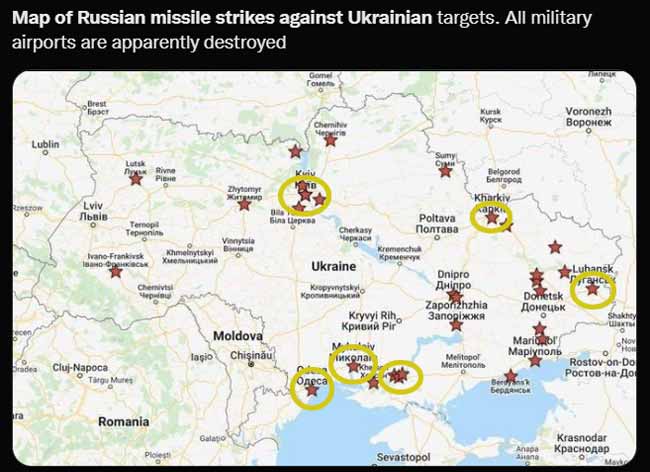
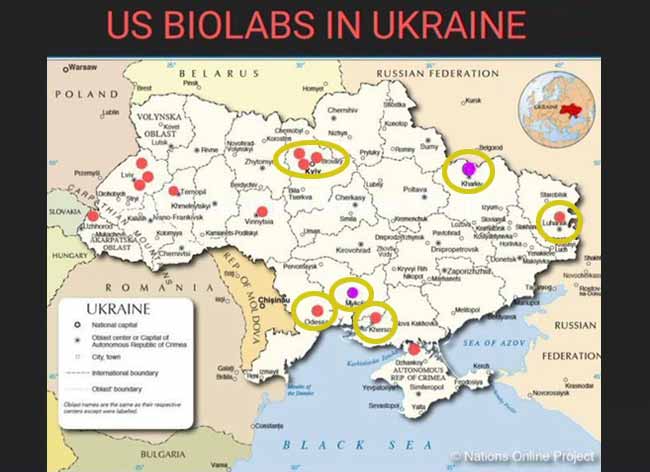
Indeed, Nawaz highlights a 2021 Ukrainian petition51,52 to president Zelensky, asking for a) the immediate closure of “American bio-laboratories in the territory of Ukraine,” b) an investigation into the activities of those labs, and c) an investigation into potential Ukrainian participation in the creation of SARS-CoV-2.
In other words, at least some Ukrainians, by 2021, were wondering whether the U.S. labs in their country might have been involved in the creation of this pandemic.
Denouncements Ring Hollow
Not surprisingly, the U.S. State Department took a hard line, denouncing all allegations with the statement that “The United States does not have chemical and biological weapons labs in Ukraine.”53 In another statement,54 the State Department “clarified” that the labs were for “biodefense,” not biological weapons, thus semantically cleansing their criminal activities.
The problem with that is that there’s no hard line between biodefense and bioweapons research. As admitted by EcoHealth Alliance’s policy advisor and former Fort Detrick commander David Franz, it’s all “dual use — the people, the facilities and the equipment.”55 Biodefense implies biowarfare, as it involves the creation of more dangerous pathogens for the alleged purpose of finding treatments against them.
Bioweapons expert Francis Boyle, who drafted the Biological Weapons Anti-Terrorism Act of 1989, has also pointed out that most BSL-4 labs are dual use: “They first develop the offensive biological warfare agent and then they develop the supposed vaccine.”56 And then, there’s the weapons proliferation agreement57 between the U.S. and Ukraine, signed at the end of August 2005.
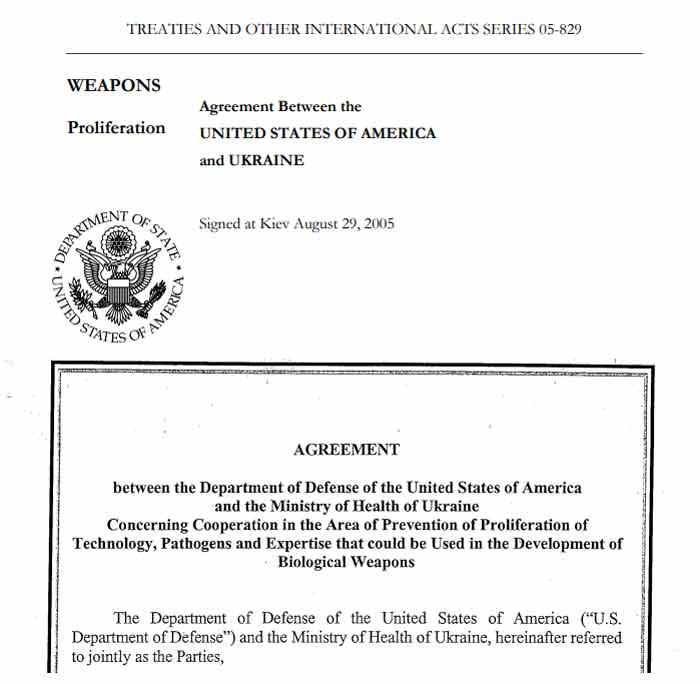
Incidentally, former President Barrack Obama spearheaded the project to construct these Ukrainian labs back in 2005, when he was still a senator and, curiously, the online announcement of his involvement in this project has also been deleted from the web.58
According to this agreement, the U.S. Department of Defense will assist the Ministry of Health in Ukraine, at no cost, to prevent “proliferation of technology, pathogens and expertise” found in a number of Ukraine labs, that “could be used in the development of biological weapons.”
The Burning Question of Intent
So, the agreement itself clarifies that they’re working on pathogens that COULD be used as biological weapons, and Nuland’s stated concerns back this up. The only question remaining then is one of intention. What’s the intended use of these pathogens? Defense? Or offense? And is there really a difference?
As noted by Nawaz, the U.S. clinging to the defense of “biodefense” and anti-bioweapons proliferation is “the equivalent of denying that Einstein’s discovery of splitting the atom to generate energy is not also something that could be used to make nuclear weapons. After the COVID outbreak, the notion that bio labs can be weaponized should simply be presumed as a rule.”
Also, consider the network of players reviewed earlier. The Ukrainian-American collaboration to study pathogens capable of weaponization is run by the DTRA, which funds Metabiota, which is run by a WEF leader with close personal ties to the one person — Daszak — suspected of being a key player in the creation of SARS-CoV-2, a go-between of the NIH and the WIV, and a central force in the cover-up of the lab leak theory.
Interestingly, Metabiota is also financially backed by Hunter Biden’s investment company, and let’s not forget that young Biden also collected a six-figure salary from a Ukrainian gas company for doing literally nothing, other than supplying his “powerful name.”59
Circumstantial or not, it just doesn’t look good. And, by now, it should be crystal clear that any lab doing defensive work is equally capable of churning out offensive weapons. Debating that point is just silly, as it all boils down to semantics.
According to Bulgarian journalist Dilyana Gaytandzhieva, Metabiota is a key player in the Ukrainian labs. David Horowitz, a political writer, has noted that Metabiota is “a company that tracks the trajectory of outbreaks and sells pandemic insurance, but also seems to have its hand in the actual labs that … might be the source of some of these outbreaks.”60
In other words, could it be that Metabiota has been producing biological agents under diplomatic cover and then selling pandemic insurance and pandemic trackers to “help countries get ahead of what they are putting out”?61
Nawaz asks, “was ensuring that a ‘next pandemic’ doesn’t occur by taking out these bio labs, what Putin had in mind by his phrase ‘special military operation’?”62 At this point, it seems a valid question.
Sources and References
- 1 Metabiota.com
- 2 USRTK March 16, 2022
- 3, 5, 9 The Daily Expose March 20, 2022
- 4 Disinformation Chronicle Substack March 22, 2022
- 6, 60 Medicalexperiments.news March 31, 2022
- 7 Rosemont Seneca Investments
- 8 Rosemont Seneca Team
- 10 New York Times July 31, 2019
- 11 New York Times October 12, 2019
- 12, 16 Daily Mail January 9, 2021
- 13 Independent Science News March 24, 2021
- 14 USRTK November 18, 2020
- 15 GM Watch November 19, 2020
- 17 WHO.int Origins of the SARS-CoV-2 Virus
- 18 The Lancet October 10, 2020; 396(10257): 1102-1124
- 19 GM Watch September 23, 2020
- 20 NPR. WHO Launches a New Group to Study the Origins of the Coronavirus. October 13, 2021
- 21, 29, 55 The Defender December 18, 2020
- 22 D60.darpa.mil Andrew Weber bio
- 23 Twitter Alexis Baden-Mayer March 28, 2022
- 24 DTRA.mil
- 25 History of DTRA 1998-2008
- 26 Daily Caller June 7, 2021
- 27 USA Spending Project Grant to EcoHealth August 2019
- 28 USA Spending Project Grant to EcoHealth October 2017
- 30, 31 CBS News March 7, 2016
- 32, 34 USRTK March 28, 2022
- 33 State Department Memo
- 35 Nature Medicine 2015; 21: 1508-1513
- 36, 38 Just the News March 29, 2022
- 37 FOIA emails from the NIH
- 39 MSNBC March 19, 2021
- 40 National Pulse May 15, 2021
- 41 Web Archive WIV research partners March 21, 2021
- 42 Web Archive WIV research partners March 22, 2021
- 43 Web Archive WIV research partners March 23, 2021
- 44, 45 Web Archive WIV Will SARS Come Back? December 4, 2015
- 46, 47, 53, 59, 61, 62 Maajid Nawaz Substack March 14, 2022
- 48 CDN Substack
- 49 Exposing the Darkness Substack March 6, 2022
- 50 UN Convention on the Prohibition of Bacteriological (Biological) and Toxin Weapons
- 51 National File March 11, 2022
- 52 Petition on Ukraine’s government website
- 54 WSWS.org March 11, 2022
- 56 Mercola interview with Francis Boyle published March 8, 2020
- 57 Agreement Between the United States and Ukraine August 29, 2005
- 58 Web Archive Bioprepwatch.com June 18, 2010
A short history of laboratory leaks and gain-of-function studies
By Professor Paul R. Goddard | GM Watch | February 19, 2022
Two myths have hindered investigations into the origins of the SARS-CoV-2 virus: one, that viruses seldom escape from laboratories; and two, that most pandemics are zoonotic, caused by a natural spillover of a virus from animals to humans.
Promoters of the first myth include the World Health Organization (WHO). At a press conference in Wuhan, China, in February 2021, Peter Ben Embarek, the head of the WHO inspection team tasked with looking into the origins of the virus, said it was “extremely unlikely” that it had leaked from a lab and as a result the lab escape hypothesis would no longer form part of the WHO’s continuing investigations.[1]
Dr Peter Daszak, president of the EcoHealth Alliance, has promoted both myths. As long ago as 2012, Dr Daszak co-authored a paper in The Lancet claiming that “Most pandemics – e.g. HIV/AIDS, severe acute respiratory syndrome, pandemic influenza – originate in animals”.[2] Since the start of the pandemic, he has claimed that “lab accidents are extremely rare”, and that they “have never led to large scale [disease] outbreaks”. He also said that suggestions that SARS-CoV-2 might have come out of a lab are “preposterous”, “baseless”, “crackpot”, “conspiracy theories”, and “pure baloney”.[3]
In September 2020 Dr Anthony Fauci, director of the US National Institutes of Health’s (NIH) National Institute of Allergy and Infectious Diseases (NIAID), and his co-author wrote in a paper about COVID’s origins, “Infectious diseases prevalent in humans and animals are caused by pathogens that once emerged from other animal hosts.”[4] Fauci has tried to quash the notion that SARS-CoV-2 could have come from a lab. In May 2020 he said that the virus “could not have been artificially or deliberately manipulated” and in October 2020 that year that the lab leak theory was “molecularly impossible”.[5]
But emails uncovered this year by a Freedom of Information request in the US reveal a wide gap between what Fauci was being told by experts about the virus’s origins and what he was saying publicly. In January 2020, a group of four virologists led by Kristian G. Andersen of the Scripps Research Institute told Fauci that they all “find the genome inconsistent with expectations from evolutionary theory”[6] – in other words, it likely didn’t come from nature and could have come from a lab.
Fauci hastily convened a teleconference with the virologists on 1 February 2020.[7] As the New York Post reported, “Something remarkable happened at the conference, because within three days, Andersen was singing a different tune. In a Feb. 4, 2020, email, he derided ideas about a lab leak as ‘crackpot theories’ that ‘relate to this virus being somehow engineered with intent and that is demonstrably not the case’.”[8]
Andersen and his colleagues then published an article on 17 March 2020 in the journal Nature Medicine that declared, “Our analyses clearly show that SARS-CoV-2 is not a laboratory construct or a purposefully manipulated virus.”[9] The article was highly influential in persuading the mainstream press not to investigate lab leak theories.[10]
While the emails do not prove a conspiracy to mislead the public, they certainly make it more plausible. Just one day after the teleconference at which his experts explained why they thought the virus seemed manipulated, Francis Collins, then-director of the NIH, complained about the damage such an idea might cause.
“The voices of conspiracy will quickly dominate, doing great potential harm to science and international harmony,” he wrote on 2 February 2020, according to the emails.[11]
But there is another reason why Fauci and Collins might not want the lab leak idea to take hold. Dr Daszak’s EcoHealth Alliance had channelled funding from the NIH’s NIAID to the Wuhan Institute of Virology (WIV) in China, for dangerous gain-of-function (GoF) research on bat coronaviruses. So money from organisations headed by Fauci, Collins, and Daszak funded research that could have led to the lab leak that some believe caused the pandemic.[12]
While it should have been clear from the beginning that Drs Fauci and Daszak have strong vested interests in denying the lab leak theory, until recently their assertions were taken as objective fact by most science writers and media.
But a brief look at the history of lab leaks and the origins of pandemics confirms that their claims are highly misleading. Research shows that the escape of viruses from laboratories and supposedly contained experiments, such as vaccine research and programmes, is a common occurrence. In addition, many pandemics have arisen from lab escapes and almost all have not been directly zoonotic. Even when viruses do ultimately originate in animals and make the jump into humans, they mostly fester in a separated community of human beings for many years – centuries or millennia – before spreading during abnormal movements of people due to wars and famines.
What is GoF research?
In its broadest definition, GoF research provides a virus or other microbe with a new function, such as making it more virulent or transmissible, or widening its host range (the types of hosts that the organism can infect).[13] Through GoF, researchers can create new diseases in the laboratory.
GoF can be achieved by any selection process that results in changes in the genes of the organism and as a result, its characteristics. One example of such a process is passing a virus through different animal cells, which can result in a loss of function (weakening it) or a gain of function (making it more able to replicate in a new host species). The researcher can then select the altered organism, depending on the purpose of the research.
In the last decade, GoF researchers have used genetic engineering to directly intervene in the genome of viruses to enhance a desired function.
But long before GoF studies involving deliberate genetic alteration, researchers had started to experiment with widening the host range of certain viruses, in order to develop vaccines. Often these experiments had unintended outcomes, including causing outbreaks of the disease being targeted.
Smallpox
An example is the development of the smallpox vaccine. Most of us are aware of how Edward Jenner in 1796 put cowpox to work in a new way, to infect humans. This led to the successful vaccination programme that eventually eliminated smallpox from the world.
But what many people do not know is that the experiments of 1796 were not his first attempts at using an animal pox in humans. His first subject was his baby son, who had been born in 1789. He inoculated the lad with swinepox and later tested the inoculation’s effectiveness with smallpox. As Greer Williams pointed out in the book Virus Hunters, “The best we can say for this experiment is that it muddied the water… whether the experimental infections had anything to do with [the son’s] mental retardation it is impossible to say.”[14]
Vaccination does not give immunity from smallpox for life: A booster is required every few years. The last person to die from smallpox was Janet Parker, a photographer who worked on the floor above a lab in Birmingham, UK, where research on the virus was being conducted. She had been vaccinated against smallpox in 1966 but contracted the disease in 1978 when the virus escaped from the lab by an unknown route. She died some days later (see Table 1).
Introducing a virus or other microbe to a new host has historically been associated with problems. Before Jenner, inoculation with variola minor (smallpox from a sufferer with minor disease), had been used as a preventive measure in China as early as the tenth century.[15] Variolation, as it was termed, was introduced to the UK in 1717, but is reported to have killed 1 in 25. So Jenner’s experiments have to be viewed in the light of the contemporary practice, which was killing 4% of those inoculated.
What is more, as Greer Williams noted, variolation was an “excellent way of spreading the disease and starting new epidemics”.[16]
Yellow fever
In 1900 the French had given up on building the Panama Canal due to yellow fever decimating the workers. Eventually the disease was conquered in the region by a mosquito eradication programme based on the experiments of the US Army surgeon Major Walter Reed.[17] This success was crucial to the completion of the project in 1914.
But what is often forgotten is that a series of doctors and laboratory workers died trying to combat yellow fever. In 1900 Dr Jesse W. Lazear was the first researcher to die from yellow fever after he apparently allowed himself to be bitten by an infected mosquito as part of his experiments.[18] Between 1927 and 1930, yellow fever caused 32 laboratory infections, killing five people.[19]
As the research into viruses continued, so did the infection rate amongst the researchers and the death toll of researchers and those inoculated against diseases rose. I do not doubt that the final outcome was to the good of mankind, but occasionally a “vaccine” would go spectacularly wrong.
Polio
In the 1930s, 40s and 50s the infection that seemed to most frighten Western society was poliomyelitis. Perhaps it was because unlike with most infectious diseases, cleanliness did not seem to be a protection and exercising could be positively harmful. In fact polio struck those who were healthy and wealthy and was worse if the person was fit and active. Much effort was put into finding a vaccine and among the first to succeed was Dr Jonas Salk. There had been abortive attempts in the 1930s but the 1935 vaccination programme had actually killed people.
Salk was a meticulous researcher and his technique was excellent. Unfortunately this was not the case with all of the laboratories that prepared the vaccine for public use. In particular, the Cutter Laboratories failed to kill the virus and poliomyelitis was spread by their version of the Salk vaccine, paralysing and killing the recipients. Eventually the proper controls permitted the successful rollout of the killed vaccine. It was later replaced by an attenuated polio virus vaccine, which has nearly eliminated polio from the world. It will not, however, succeed in completely eliminating the disease, as the attenuated virus can revert to a wild form. Thus the final push may require the use, once again, of the killed virus polio vaccine.
The infection of laboratory workers with the microbes they were working on was so common that steps were introduced in the 1940s to prevent escape of the organisms. According to Wikipedia, the first prototype Class III (maximum containment) biosafety cabinet was fashioned in 1943 by Hubert Kaempf Jr., then a US Army soldier.[20] The regulations were enhanced and the escape of dangerous organisms decreased, but has never disappeared. This is clearly demonstrated in Table 1, which lists some, but by no means all, of the known lab leaks since the 1960s.
Escapes from bioweapons facilities
Whilst all of the incidents in the table are of interest, some are more worrying than others. In 1971 and 1979 there were outbreaks of smallpox and anthrax in the Soviet Union, caused by escapes of weaponised smallpox and weaponised anthrax from their own bioweapons facilities. In 1977 it is believed that a laboratory somewhere on the border of China and Russia put the H1N1 virus back together and it escaped and caused at least two pandemics. SARS1, which erupted first in 2003, later escaped from laboratories six times, four of which were in China, plus Singapore and Taiwan.[21]
The more you look at the table, the more you wonder if there is any virus that has not at some time escaped from a laboratory. Laboratory workers have told me that it is common for technicians to become infected with the organisms they are working with and their usual response in the past has been to take multivitamins and hydroxychloroquine.
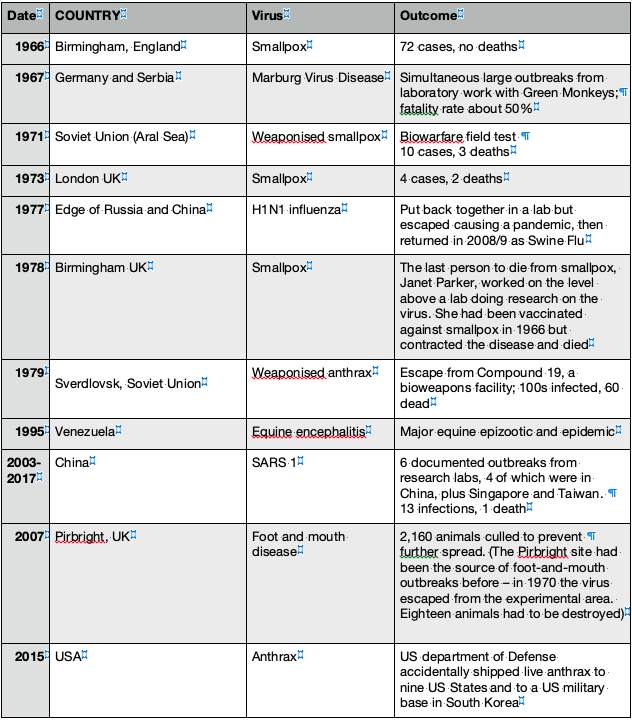
Table 1: Some serious leaks of viruses from laboratories[22]k
The recent history of gain-of-function studies
Since 2010, GoF studies have increasingly focused on finding out whether non-pathogenic strains of viruses could be made infective and harmful to human beings.[23] This was supposedly in order to know whether or not the microbe was likely to be hazardous to human beings and then, if it was, devise vaccines and drugs against it.
In my opinion, such work simply increases the sum total of different pathogens that can affect human beings. When medical doctors are made aware of this type of research, they are usually speechless at the stupidity that anybody would contemplate doing such work. I now call such studies Make Another Disease (MAD) research.
This type of MAD research dramatically increased in laboratories in the USA between 2012 and 2014. The resulting accidents in which small outbreaks of novel viral diseases occurred led to three hundred scientists writing to the Obama administration asking for GoF to be stopped. The US Government responded by announcing a pause on the research in 2014 because of the inherent dangers.[24]
In the same year Dr Fauci, whose recorded belief was that the studies were worth the risk,[25] gave money from the NIH to Dr Daszak of Ecohealth Alliance to continue GoF research on coronaviruses.[26] This was carried out at the Wuhan Institute of Virology using genetically engineered humanized mice, culminating in reports in 2017 and 2018 that the researchers had successfully made harmless coronaviruses pathogenic to humans.[27]
In the autumn of 2019 the Covid-19 pandemic of SARS-2 started in Wuhan and, to date, over five million people across the world have died from the virus.
Are pandemics ever zoonotic?
In addition to stating erroneously that viruses only rarely escape from laboratories and/or that SARS-Cov-2 was unlikely to have done so, Drs Daszak and Fauci hold that most pandemics are zoonotic in origin. They say that pandemics start from a disease spreading from an animal but they do not state the time period involved. I would suggest that pandemics never occur from the immediate spread from an animal. In order for a pandemic to occur, a reservoir of the infection, adapted to human beings, must develop. This usually takes many years. Moreover the spread usually occurs due to the unnaturally large movement of people that occurs due to wars and famines.
I will give just a couple of well known examples.
When the Europeans invaded the Americas, 90% or more of the indigenous people of America died from the introduced diseases, which included measles, smallpox and mumps. In return, syphilis spread to Europe. Yes, the diseases had all arisen from animals initially, but the adaptation to make them pathogenic enough to cause a pandemic must have occurred over a period of the several thousand years during which the populations of Europe and America were separated.
AIDS was discovered in the early 1980s and it was soon clear that the Human Immunodeficiency Virus had arisen from the Simian Immunodeficiency Virus. However, studies have concluded that the first transmission of SIV to HIV in humans took place around 1920 in Kinshasa in the Democratic Republic of Congo (DR Congo),[28] so that it had at least 40–50 years of sporadic infection of human beings before it started to spread round the world as a pandemic. During that time there were many local wars in Africa and, of course, the 2nd World War.
In my book PANDEMIC, I document the world’s worst pandemics and conclude that it is only malaria that seems to be indifferent to wars, killing people whether or not there are hostilities. All other historical pandemics have at least some connection with war and occur when isolated groups with an endemic disease meet another group without the disease.
Conclusion
Thus historically we come to an impasse with SARS-CoV-2. This arose in a city many miles away from an animal population that might have harboured a similar virus, at a time when the supposed original host was dormant (late autumn), near a laboratory known to be working on the viruses. It then spread from person to person at an alarming rate and was seen to be totally adapted to human beings, to the extent that it was unable to even infect the bat it was supposed to have arisen from.
As a person who has studied the history of pandemics and lab leaks, imagine my surprise when authorities, not only in China but also in the USA and UK, stated categorically that the virus was obviously zoonotic and we were conspiracy theorists if we proposed the opposite. I had to conclude that they were misguided or purposely lying.
References
1. Matthews J (2021). WHO investigation descends into farce in rush to rule out a lab leak. GMWatch. 10 Feb. https://www.gmwatch.org/en/news/archive/2021-articles2/19691
2. Morse SS et al (2012). Prediction and prevention of the next pandemic zoonosis. The Lancet 1-7 Dec; 380(9857):1956–1965. https://www.ncbi.nlm.nih.gov/pmc/articles/PMC3712877/
3. Matthews J (2020). Why are the lab escape denialists telling such brazen lies? GMWatch. 17 Jun. https://gmwatch.org/en/news/archive/2020-articles/19437
4. Morens DM, Fauci AS (2020). Emerging pandemic diseases: How we got to COVID-19. Cell 182. 3 Dec. https://www.cell.com/cell/pdf/S0092-8674(20)31012-6.pdf
5. Chaffetz J (2022). Fauci, Feds tried to quash COVID lab leak origin theory – protecting Chinese interests over American lives. Fox News. 27 Jan. https://www.foxnews.com/opinion/fauci-covid-lab-leak-origin-theory-china-jason-chaffetz
6. Wade N (2022). Emails reveal scientists suspected COVID leaked from Wuhan lab – then quickly censored themselves. New York Post. 17 Feb. https://nypost.com/2022/01/24/emails-reveal-suspected-covid-leaked-from-a-wuhan-lab-then-censored-themselves/
7. Carlson J, Mahncke H (2021). Behind the scenes of the natural origin narrative. Epoch Times. 30 Sep. https://www.theepochtimes.com/behind-the-scenes-of-the-natural-origin-narrative_4023181.html
8. Wade N (2022). As above.
9. Andersen KG et al (2020). The proximal origin of SARS-CoV-2. Nature Medicine 26:450–452. 17 Mar. https://www.nature.com/articles/s41591-020-0820-9
10. Wade N (2022). As above.
11. Wade N (2022). As above.
12. Lerner S, Hvistendahl M, Hibbett M (2021). NIH documents provide new evidence US funded gain-of-function research in Wuhan. The Intercept. 10 Sep. https://theintercept.com/2021/09/09/covid-origins-gain-of-function-research/
13. Board on Life Sciences et al (2015). Gain-of-function research: Background and alternatives. In: Potential Risks and Benefits of Gain-of-Function Research: Summary of a Workshop. National Academies Press (US). Apr 13. https://www.ncbi.nlm.nih.gov/books/NBK285579/
14. Williams G (1959). Virus Hunters. Knopf.
15. Goddard PR (2020). PANDEMIC: Plagues, Pestilence and War: A Personalised History. Clinical Press. https://www.amazon.co.uk/PANDEMIC-Paul-Goddard-MD-FRCR/dp/1854570994
16. Williams G (1959). Virus Hunters. As above.
17. Feng P (undated). Yellow fever. National Museum of the United States Army. https://armyhistory.org/major-walter-reed-and-the-eradication-of-yellow-fever/
18. College of Physicians of Philadelphia (undated). Jesse Lazear. https://www.historyofvaccines.org/content/jesse-lazear
19. Berry GP and Kitchen SF (1931). Yellow fever accidentally contracted in the laboratory: A study of seven cases. The American Journal of Tropical Medicine and Hygiene s1–11(6):365–434. https://www.ajtmh.org/view/journals/tpmd/s1-11/6/article-p365.xml
20. Wikipedia (undated). Biosafety level. https://en.wikipedia.org/wiki/Biosafety_level#:~:text=The%20first%20prototype%20Class%20III,Laboratories%2C%20Camp%20Detrick%2C%20Maryland.
21. Mihm S (2021). The history of lab leaks has lots of entries. Bloomberg. 27 May. https://www.bloomberg.com/opinion/articles/2021-05-27/covid-19-and-lab-leak-history-smallpox-h1n1-sars
22. Sources:
* 1967 https://www.who.int/news-room/fact-sheets/detail/marburg-virus-disease
* 1966 and 1978 https://en.wikipedia.org/wiki/1978_smallpox_outbreak_in_the_United_Kingdom
* 1971 Aral smallpox incident: https://en.wikipedia.org/wiki/1971_Aral_smallpox_incident; 1973 https://api.parliament.uk/historic-hansard/written-answers/1973/apr/12/smallpox
* 1977, 1979 The history of lab leaks has lots of entries: https://www.bloomberg.com/opinion/articles/2021-05-27/covid-19-and-lab-leak-history-smallpox-h1n1-sars
* 2003-2017 Breaches of safety regulations are probable cause of recent SARS outbreak, WHO says BMJ. 2004 May 22; 328(7450): 1222 and The Origin of the Virus (Clinical Press, Bristol) 2021;
* 2007 https://en.wikipedia.org/wiki/2007_United_Kingdom_foot-and-mouth_outbreak
* 2015 US military accidentally ships live anthrax to labs. https://doi.org/10.1038/nature.2015.17653
23. Herfst S et al (2012). Airborne transmission of influenza A/H5N1 virus between ferrets. Science 336(6088):1534-41. https://pubmed.ncbi.nlm.nih.gov/22723413/
24. The White House (2014). Doing diligence to assess the risks and benefits of life sciences gain-of-function research. 17 Oct. https://obamawhitehouse.archives.gov/blog/2014/10/17/doing-diligence-assess-risks-and-benefits-life-sciences-gain-function-research
25. Fonrouge G (2021). Fauci once argued for risky viral experiments – even if they can lead to pandemic. New York Post. 28 May. https://nypost.com/2021/05/28/fauci-once-argued-viral-experiments-worth-the-risk-of-pandemic/ ; Barnard P, Quay S, Dalgleish A (2021). The Origin of the Virus. Clinical Press.
26. NIH (2014). Understanding the Risk of Bat Coronavirus Emergence. Project Number 1R01AI110964-01. https://reporter.nih.gov/search/-bvPCvB7zkyvb1AjAgW5Yg/project-details/8674931
27. Barnard P, Quay S, Dalgleish A (2021). The Origin of the Virus. Clinical Press.
28. Avert (2019). Origin of HIV and AIDS. https://www.avert.org/professionals/history-hiv-aids/origin
About the author: Professor Paul R Goddard BSc, MBBS, MD, DMRD, FRCR, FBIR, FHEA is Emeritus Professor, University of the West of England, Bristol; retired consultant radiologist; and former president of the Radiology Section of the Royal Society of Medicine. He is the author of PANDEMIC, A Personalised History of Plagues, Pestilence and War, Clinical Press Ltd, August 2020, and PANDEMIC, 2nd Edition 2021, Clinical Press, Bristol, available from Gazelle Book Services Ltd and good bookshops, ISBN 978-1-85-457105-2. On a similar theme, see The Origin of the Virus, Clinical Press 2021.
The above article is adapted from material that was first presented as the Long Fox lecture to The Bristol Medico-Chirurgical Society and Bristol University (2017) and to the British Society for the History of Medicine Biennial Congress (September 2021).
Was Peter Daszak Working For The Central Intelligence Agency?
An EcoHealth Alliance whistleblower steps forward
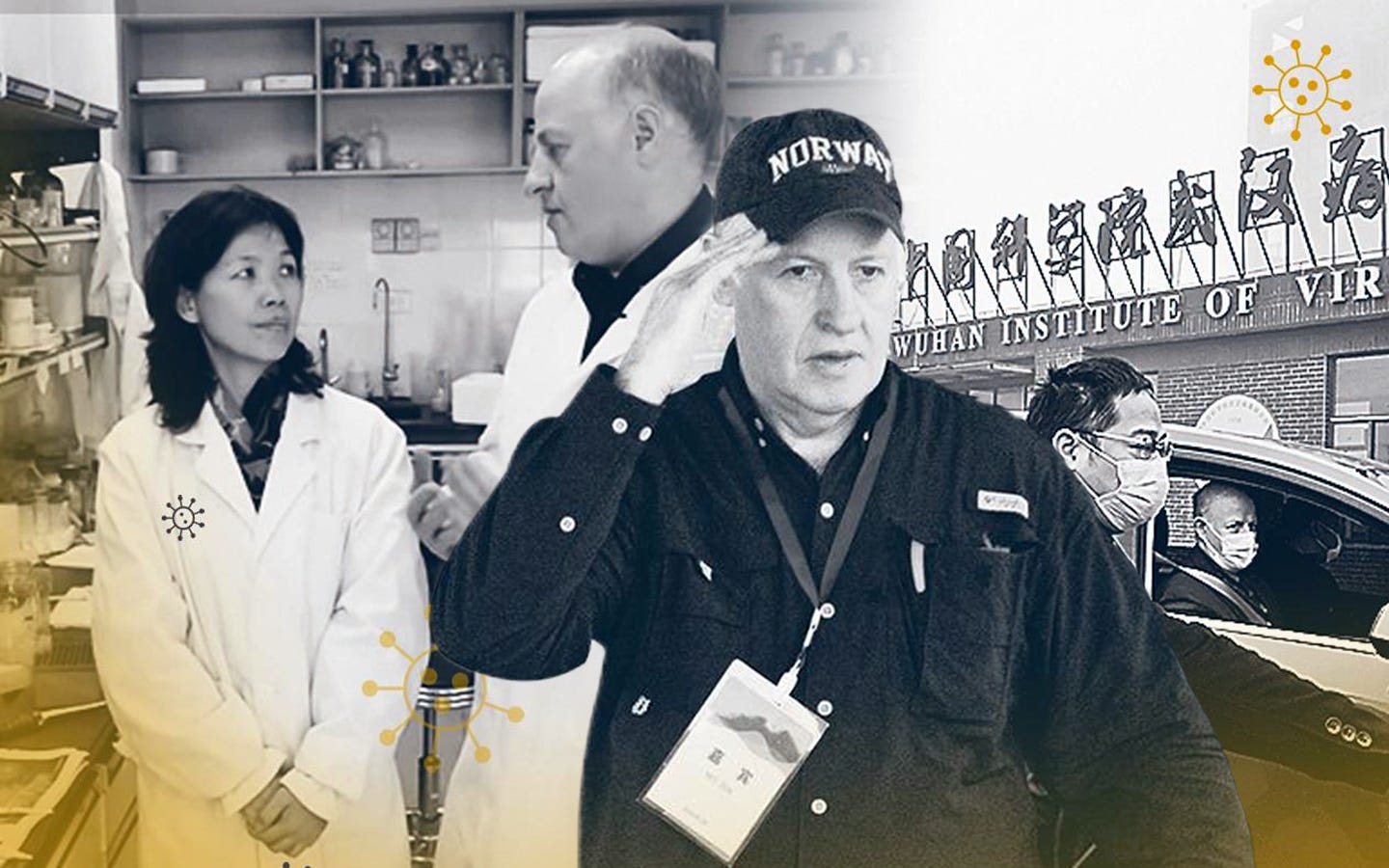
Dr. Shi Zhengli, Dr. Peter Daszak, and the Wuhan Institute of Virology
Kanekoa TheGreat | January 18, 2022
“We found other coronaviruses in bats, a whole host of them, some of them looked very similar to SARS. So we sequenced the spike protein: the protein that attaches to cells. Then we… Well, I didn’t do this work, but my colleagues in China did the work. You create pseudo particles, you insert the spike proteins from those viruses, see if they bind to human cells. At each step of this, you move closer and closer to this virus could really become pathogenic in people. You end up with a small number of viruses that really do look like killers.”
This statement was said by EcoHealth Alliance President Peter Daszak at a 2016 forum discussing “emerging infectious diseases and the next pandemic”. Daszak, who received more than $118 million in grants and contracts from federal agencies, including $53 million from USAID, $42 million from DOD, and $15 million from HHS, appeared to boast about the manipulation of “killer” SARS-like coronaviruses carried out by his “colleagues in China” at the now infamous Wuhan Institute of Virology.
According to investigative research done by independent-journalist Sam Husseini and The Intercept, much of the money awarded to EcoHealth Alliance did not focus on health or ecology, but rather on biowarfare, bioterrorism, and other dangerous uses of deadly pathogens.
EcoHealth Alliance received the majority of its funding from the United States Agency for International Development (USAID), a State Department subsidiary that serves as a frequent cover for the Central Intelligence Agency (CIA). Their second largest source of funding was from the Defense Threat Reduction Agency (DTRA), which is a branch of the Department of Defense (DOD) which states it is tasked to “counter and deter weapons of mass destruction and improvised threat networks.”
The United States Agency for International Development (USAID) has a long history of acting as a contract vehicle for various CIA covert activities. With an annual budget of over $27 billion and operations in over 100 countries, one former USAID director, John Gilligan, once admitted it was “infiltrated from top to bottom with CIA people.” Gilligan explained that “the idea was to plant operatives in every kind of activity we had overseas; government, volunteer, religious, every kind.”
In 2013, a US cable published by WikiLeaks outlined the U.S. strategy to undermine Venezuela’s government through USAID by “penetrating Chavez’s political base”, “dividing Chavismo”, and “isolating Chavez internationally.” In 2014, the Associated Press disclosed that USAID contracted out a project to develop a rival to Twitter in order to foment a rebellion in Cuba.
From 2009 to 2019, USAID partnered with EcoHealth Alliance on their PREDICT program which identified over 1,200 new viruses, including over 160 coronavirus strains; trained roughly 5,000 people around the world to identify new diseases; and improved or developed 60 research laboratories.
What better way for the CIA to collect intelligence on the world’s biological warfare capabilities?
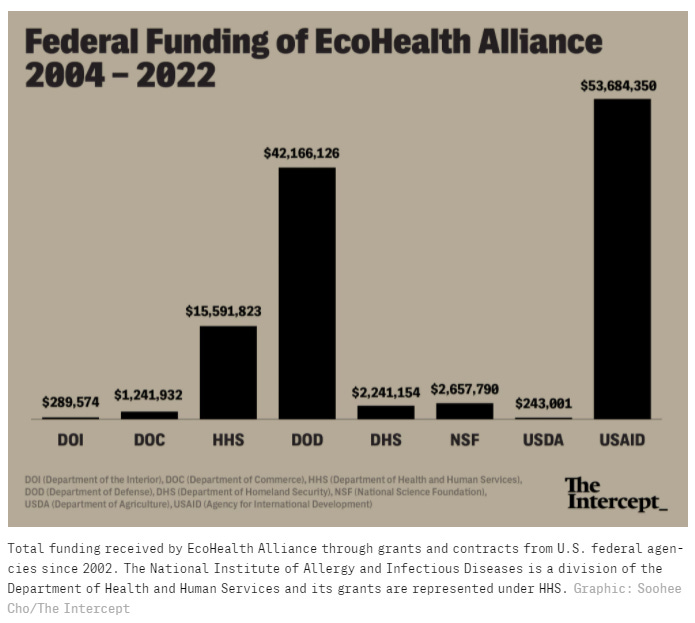
Source: The Intercept
Dr. Andrew Huff received his Ph.D. in Environmental Health specializing in emerging diseases before becoming an Associate Vice President at EcoHealth Alliance, where he developed novel methods of bio-surveillance, data analytics, and visualization for disease detection.
On January 12, 2022, Dr. Andrew Huff issued a public statement (on Twitter) in which he claimed, Peter Daszak, the President of EcoHealth Alliance, told him that he was working for the CIA.
Dr. Andrew Huff’s full statement below:
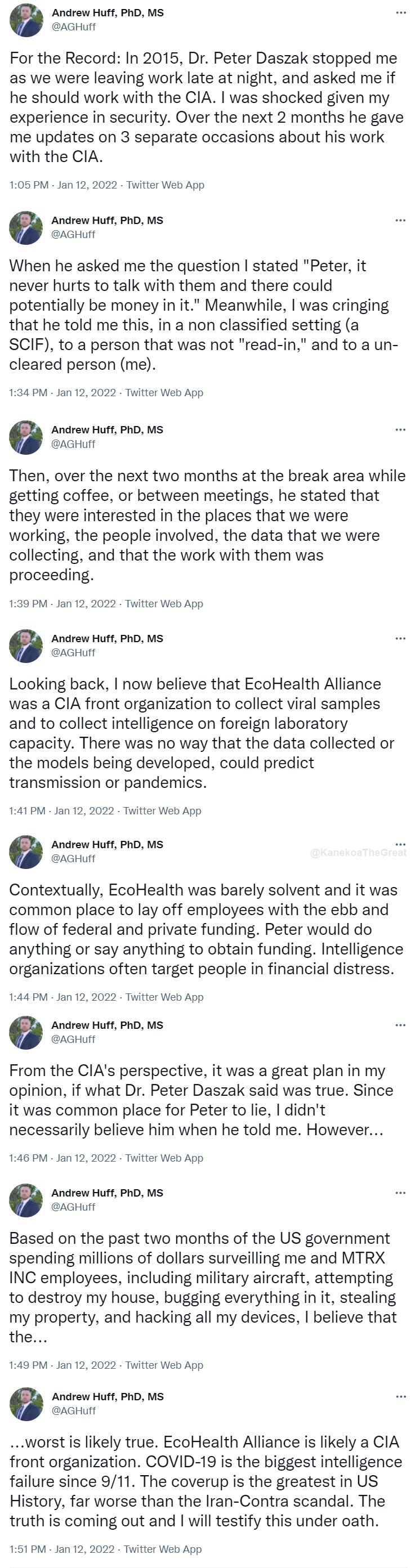
Source: Dr. Andrew Huff
Dr. Huff continued, “… I wouldn’t be surprised if the CIA / IC community orchestrated the COVID coverup acting as an intermediary between Fauci, Collins, Daszak, Baric, and many others. At best, it was the biggest criminal conspiracy in US history by bureaucrats or political appointees.”
What exactly did they cover-up?
Peter Daszak’s EcoHealth Alliance—financed by USAID, DOD, and other U.S. Government agencies—partnered with Dr. Ralph Baric of the University of North Carolina and Dr. Shi Zhengli of the Wuhan Institute of Virology to conduct gain-of-function research on bat-borne coronaviruses.
Baric successfully created a “chimeric” coronavirus in 2015. There is a well-documented scientific paper trail that details how Dr. Baric and Dr. Zhengli continued to collaborate on gain-of-function research together to create what went on to be a potential precursor to the SARS-CoV-2 virus.
Dr. Anthony Fauci, Dr. Francis Collins, and Dr. Peter Daszak, who were proponents of this type of international collaboration on gain-of-function research were heavily incentivized to cover up the possibility of a lab origin because they previously had funneled U.S. taxpayer money to the Chinese lab.
At the start of 2020, there was a lot of chatter about where the virus SARS-CoV-2 actually originated from. Two papers published in March 2020—one in Nature Medicine and one in The Lancet—controlled the direction of the dialogue on the origin of the virus.
Both papers were repeatedly cited by Fauci, Collins, Daszak, the corporate media, and big tech as evidence to shut down and even censor any discussion of the possibility that the virus originated at the Wuhan Institute of Virology.
Only later through redacted emails released by FOIA did we learn that Fauci, Collins, and Daszak were intimately involved in crafting the two papers which dismissed the lab origin hypotheses as “conspiracy theory.”
In February 2020, Daszak told University of North Carolina coronavirus researcher Dr. Ralph Baric that they should not sign the statement condemning the lab-leak theory so that it seems more independent and credible. “You, me and him should not sign this statement, so it has some distance from us and therefore doesn’t work in a counterproductive way,” Daszak wrote.
More unredacted emails have revealed that while these scientists held the private belief that the lab release was the most likely scenario, they still worked to seed the natural origin narrative for the public through the papers published in Nature Medicine and The Lancet.
In April 2020, Daszak opposed the public release of Covid-19-related virus sequence data that has been gathered from China, as part of the U.S. Agency for International Development (USAID) PREDICT program because he said it would bring “very unwelcome attention” to the aforementioned “PREDICT and USAID” programs.

Source: U.S. Right To Know FOIA
In September 2020, scientists were outraged when Daszak was chosen to lead the World Health Organization task force examining the possibility that Covid-19 leaked from the Wuhan Institute of Virology.
Despite many clear attempts to cut off a legitimate scientific inquiry into the Wuhan lab origin hypothesis, the theory continued to persist predominantly due to the fact that the Chinese government was unable to provide a single shred of evidence in support of the natural origin theory.
In May 2021, the narrative turned when, Nicholas Wade, a former science reporter at the New York Times published his seminal column outlining the case for the Covid lab-leak theory.
For SARS1, an intermediary host species was identified within four months of the epidemic’s outbreak and the host of MERS was identified within nine months. Yet some 15 months after the SARS2 outbreak began, and a presumably intensive search, Chinese researchers had failed to find either the original bat population, or the intermediate species to which SARS2 might have jumped, or any serological evidence of a natural origin.
Every step of the way, Fauci, Collins, and Daszak have done everything in their power to obfuscate, mislead, and misinform the world about the possibility of SARS-CoV-2 originating at the Wuhan Institute of Virology.
If Dr. Andrew Huff is telling the truth, Fauci, Collins, and Daszak are not covering up the lab origin only for themselves, but also for the Central Intelligence Agency, the Department of Defense, and the U.S. Government.
Fauci Must Be Fired and Arrested
By Dr. Joseph Mercola | November 4, 2021
The crimes of Dr. Anthony Fauci, director of the National Institute of Allergy and Infectious Diseases (NIAID), a division of the National Institutes of Health (NIH), is making news again as revelations of abusive research on dogs have surfaced. Interestingly, while many shrug at abuse of human beings, including the elderly, far fewer are willing to overlook the torture of dogs.
In the video above, Kim Iversen makes the case that Fauci should resign or be fired over his repeated lies, questionable research ethics and mishandling of the pandemic.
Many others have also chimed in on the matter. In an October 24, 2021, article1 on Substack, Leighton Woodhouse points out that “Fauci has been abusing animals for 40 years,” and that “the stuff you’ve seen on social media barely scratches the surface.”
The Beagle Experiments
In one experiment that has raised public ire, beagles were sedated and their heads placed in mesh cages filled with sand flies that had been intentionally starved before the experiment to encourage feeding.
The study2 in question, “Enhanced Attraction of Sand Fly Vectors of Leishmania Infantum to Dogs Infected with Zoonotic Visceral Leishmaniasis” was published in PLOS Neglected Tropical Diseases in July 2021. Some of the photos from this study have circulated on Twitter and other social media platforms. According to the researchers:
“The sand fly Phlebotomus perniciosus is the main vector of Leishmania infantum, etiological agent of zoonotic visceral leishmaniasis in the Western Mediterranean basin. Dogs are the main reservoir host of this disease. The main objective of this study was to determine, under both laboratory and field conditions, if dogs infected with L. infantum, were more attractive to female P. perniciosus than uninfected dogs.”
Spotlight on Animal Testing
In the Ron Paul Liberty Report above, Ron Paul discusses the public outcry over Fauci’s cruel research on beagles. However, that’s just the tip of the iceberg. According to Woodhouse,3 “The experiment was just one of countless tests done on animals with the funding of the NIH, and of NIAID in particular, over the course of decades.”
The White Coat Waste Project4 estimates anywhere from tens of millions to more than 100 million animals — including more than 1,100 dogs — are experimented on in the U.S. each year, and most of these experiments are paid for by U.S. taxpayers.
The NIH funds medical research to the tune of $40 billion annually, and an estimated 47% of that research involves animal testing.5 The NIAID alone has an annual budget of $6 billion, almost all of which goes to funding of animal research.
Other Fauci-funded research on dogs include a 2020 experiment carried out by the University of Georgia where beagles were infected with a parasite before being sacrificed and autopsied.
“The purpose of the experiment was to test a drug that, by the investigators’ own admission, had already been ‘extensively tested and confirmed’ in numerous other animal species,” Woodhouse writes.6
While the University claims this and all other experiments were carried out in accordance with the Animal Welfare Act, four “critical” violation reports have allegedly been filed against the University after U.S. Department of Agriculture inspections in 2021 alone.7,8,9
In 2019, NIAID paid $1.68 million to feed toxic drugs to beagle puppies before sacrificing them. In this case, the puppies had their vocal cords cut “so that lab technicians don’t have to hear them cry and howl in distress.”10
Other NIAID-funded experiments on dogs include research where beagles were infected with pneumonia to induce septic shock and acute hemorrhage. Survivors were euthanized after 96 hours. In another experiment, beagles were infected with anthrax to test the effectiveness of an already approved anthrax vaccine.
In yet another, researchers induced heart attacks in dogs which then underwent MRI scanning before being euthanized and autopsied. What do we have to show from all this torture? Very little, it turns out. Even when medications look promising in animal studies, 90% end up failing in human clinical trials, Woodhouse notes, typically due to differences in physiology.
Why Is NIAID Funding a Psychological Torture Factory?
Perhaps one of the most gruesome experiments paid for by Fauci involves the psychological torturing of monkeys, for purposes that remain unclear. The experiment involves first boosting the monkeys’ capacity for terror by destroying a particular part of their brains with acid.11
The monkeys are then tormented with plastic spiders and mechanical snakes as their behavior is observed. Bizarrely, these particular psychological experiments have been funded for 43 years straight, costing taxpayers nearly $100 million, even though they’ve not resulted in a single drug or medication.
As noted by White Coat Waste Project vice president Justin Goodman, “Some people have made a career out of torturing monkeys.”12 At the end of December 2020, the White Coat Waste Project reported that:13
“As a result of our investigation, Congress has directed the NIH to commission an independent study by the National Academies of the NIH’s intramural primate testing and how modern alternatives can reduce their use. This direction is in the NIH’s 2021 funding bill14 (see page 69).”
A Gain-of-Function Cover-Up?
In related news, in an NIH letter,15,16,17 the agency acknowledges that Fauci lied to Congress when he emphatically insisted the NIH/NIAID have never funded gain-of-function (GOF) research.
The letter, dated October 21, 2021, was sent by NIH principal deputy director Dr. Lawrence Tabak to James Comer, ranking member of the Committee on Oversight and Reform, “to provide additional information and documents regarding NIH’s grant to EcoHealth Alliance Inc.”
“It is important to state at the outset that published genomic data demonstrate that the bat coronaviruses studied under the NIH grant to EcoHealth Alliance, Inc. and subaward to the Wuhan Institute of Virology (WIV) are not and could not have become SARS-CoV-2,” Tabak writes.
“Both the progress report and the analysis attached here again confirm that conclusion, as the sequences of the viruses are genetically very distant … The limited experiment described in the final progress report provided by EcoHealth Alliance was testing if spike proteins from naturally occurring bat coronaviruses circulating in China were capable of binding to the human ACE2 receptor in a mouse model.
All other aspects of the mice, including the immune system, remained unchanged. In this limited experiment, laboratory mice infected with the SHC014 WIV 1 bat coronavirus became sicker than those infected with the WIV1 bat coronavirus. As sometimes occurs in science, this was an unexpected result of the research, as opposed to something that the researchers set out to do …
The research plan was reviewed by NIH in advance of funding, and NIH determined that it did not to fit the definition of research involving enhanced pathogens of pandemic potential (ePPP) because these bat coronaviruses had not been shown to infect humans. As such, the research was not subject to departmental review under the HHS P3CO Framework.
However, out of an abundance of caution and as an additional layer of oversight, language was included in the terms and conditions of the grant award to EcoHealth that outlined criteria for a secondary review, such as a requirement that the grantee report immediately a one log increase in growth.
These measures would prompt a secondary review to determine whether the research aims should be re-evaluated or new biosafety measures should be enacted. EcoHealth failed to report this finding right away, as was required by the terms of the grant.”
What Did Fauci Know?
In essence, it appears the NIH is throwing EcoHealth Alliance under the proverbial bus. Yes, EcoHealth Alliance ended up conducting GOF research when its manipulation resulted in a virus with wildly enhanced virulence in humans.18 While Tabak claims this was unintentional, that seems a bit odd, considering the experiment in question was testing the “emergency potential” of bat coronaviruses in the human population.
Either way, Tabak claims EcoHealth failed to properly report this outcome to the NIH, so the NIH cannot be held responsible for not taking appropriate action. According to the NIH, researchers must file a report any time a virus produces “a one log increase in growth.” EcoHealth’s experiment resulted in a log increase of 10, which should have triggered an NIH review and potentially shut down of the experiment.
EcoHealth, on the other hand, claims “These data were reported as soon as we were made aware, in our Year 4 report in April 2018.”19,20 Now, if EcoHealth reported the results, then Fauci must have been aware that GOF had taken place, and the NIH for some reason let it slide without review.
Is NIH Looking for a Scapegoat?
As noted by Jordan Schachtel in an October 22, 2021, Substack article:21
“If you read the entire text of the letter, especially in light of the sudden, unexplained resignation of NIH chief Francis Collins, it seems to be desperate to find a scapegoat for the U.S.-approved gain-of-function research.
There are two major unproven claims that have been advanced by the NIH: First, EcoHealth, which has long served as a middleman between U.S. and Chinese Communist Party ‘health’ networks, was accused of violating the terms of the grant it had received …
EcoHealth has long collaborated with the alleged COVID-19 origin lab in Wuhan, China … But the letter seems to be setting up EcoHealth as the ‘fall guy’ entity in this story, pinning all blame on the organization in order to allow for the U.S. Government Health agency to rinse its hands clean of any improper behavior.
The second cause for concern in this letter involves the NIH completely ruling out the possibility that its research grant contributed to the outbreak … It claims it is scientifically impossible for their approved gain-of-function research to have modified this particular virus. And in doing so, they add a strange comparison between human evolution and the evolution of a virus to make their case …
Scientists have weighed in on social media to make it clear that the NIH does not have a definitive case on this front. Renowned molecular biologist Richard Ebright went as far as to label it a ‘false’ claim.22”
Scientist Alina Chan tweeted,23 “How can this type of work not be flagged as gain-of-function research of concern? Knowing what they knew in 2018, there was a reasonable expectation that this type of experiment could enhance the pathogenicity of MERS in humanized animal models and therefore humans.”
Jaime Yassif, senior fellow for global biological policy and programs at the Nuclear Threat Initiative, told CQ,24 “I would have flagged this project. Looking at the experiment of concern that’s highlighted in the letter, it appears to me as gain-of-function research, even before the ‘one log’ requirement.” Commenting on the letter, Comer stated:25
“NIH confirmed that EcoHealth violated the terms of their grant by concealing data on dangerous coronavirus experiments in Wuhan. Even worse, NIH Director Collins and Dr. Anthony Fauci potentially misled the Committee and the American people about its knowledge of this cover up.”
More Incriminating Evidence Against EcoHealth
But there’s more. As reported by Vanity Fair :26
“… another disclosure last month made clear that EcoHealth Alliance, in partnership with the Wuhan Institute of Virology, was aiming to do the kind of research that could accidentally have led to the pandemic.
On September 20, a group of internet sleuths calling themselves DRASTIC (short for Decentralized Radical Autonomous Search Team Investigating COVID-19) released a leaked $14 million grant proposal that EcoHealth Alliance had submitted in 2018 to the Defense Advanced Research Projects Agency (DARPA).
It proposed partnering with the Wuhan Institute of Virology and constructing SARS-related bat coronaviruses into which they would insert ‘human-specific cleavage sites’ as a way to ‘evaluate growth potential’ of the pathogens. Perhaps not surprisingly, DARPA rejected the proposal, assessing that it failed to fully address the risks of gain-of-function research.
The leaked grant proposal struck a number of scientists and researchers as significant for one reason. One distinctive segment of SARS-CoV-2’s genetic code is a furin cleavage site that makes the virus more infectious by allowing it to efficiently enter human cells. That is just the feature that EcoHealth Alliance and the Wuhan Institute of Virology had proposed to engineer in the 2018 grant proposal.”
Amazingly, NIH Suddenly Revises Its Gain-of-Function Webpage
Adding fuel to suspicions that the NIH/NIAID are trying to cover their tracks is the fact that the NIH suddenly, in the third week of October 2021, deleted the definition of GOF from its website, replacing it with a section on enhanced potential pandemic pathogens (ePPP) research.27
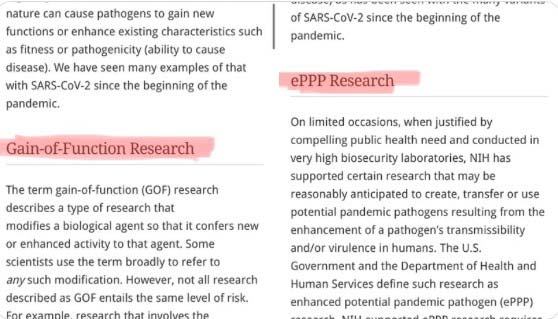
“The National Institutes of Health appears to be engaged in an ongoing misinformation campaign and a coverup of an unprecedented scale,” Schachtel writes.28 “Sure, Fauci lied, but that might only scratch the surface of the ongoing whitewashing campaign advanced by U.S. Government Health institutions.”
Appropriations Bill Bars Federal Funding of GOF
As reported by CQ, the U.S. Congress is now trying to curtail funding of GOF in general and EcoHealth Alliance in particular: 29
“Congressional efforts to curtail funding to EcoHealth Alliance included House votes to prohibit Defense Department funding through the fiscal 2022 defense bill (HR 4432) and the National Defense Authorization Act (HR 4350).
The draft fiscal 2022 Senate Labor-HHS-Education appropriations bill does not contain any language targeting gain-of-function research or the Wuhan Institute of Virology, but other bills do.
The House-passed Labor-HHS-Education appropriations bill (HR 4502) included language to bar federal funding for the Wuhan Institute of Virology or gain-of-function research. It was adopted by voice vote during the markup process.
A Senate-passed technology bill (S 1260) included an amendment to ban any federal agency from funding gain-of-function research in China. The amendment was accepted by voice vote. The House has not taken up the bill yet.”
A Crisis of Trust
Commenting on the latest revelations, health care entrepreneur and political commentator Vivek Ramaswamy tweeted:30
“Another ‘conspiracy theory’ becomes accepted fact … So to sum it up:
1.US bans gain-of-function research
2.Rogue bureaucrats fund it abroad instead
3.Lab leak occurs. Global pandemic ensues
4.Scientific leaders lie about it and label dissenters as racists
Want to create a crisis of trust in science? That’ll do it… The facts have been apparent for a long time. The fact that the media missed it says a lot about the quality of true journalism in the US today: almost entirely absent.”
Sources and References
- 1, 3, 5, 6, 9, 10 Substack Leighton Woodhouse October 24, 2021
- 2 PLOS Neglected Tropical Diseases July 2021; 15(7): e0009647
- 4 Whitecoatwaste.org
- 7 Twitter Amy Meyer October 25, 2021
- 8 Twitter Amy Meyer October 25, 2021 #2
- 11 White Coat Waste Project Blog February 23, 2020
- 12 Washington Times February 24, 2020
- 13 White Coat Waste Project Blog February 23, 2020, Updated December 30, 2021
- 14 NIH Appropriations Act 2021
- 15 Twitter Richard Ebright NIH Letter dated October 20, 2021
- 16 NIH Letter dated October 20, 2021
- 17, 19, 26 Vanity Fair October 22, 2021
- 18, 24, 25, 29 CQ October 22, 2021
- 20 ZeroHedge October 25, 2021
- 21, 27, 28 Dossier.substack.com October 22, 2021
- 22 Twitter Richard Ebright October 22, 2021
- 23 Twitter Alina Chan October 21, 2021
- 30 Twitter Vivek Ramaswamy October 23, 2021
Pentagon Gave $39 MILLION To Dr. Peter Daszak’s EcoHealth Alliance
“Charity” that funded coronavirus research at the Wuhan lab accused of being the source of the outbreak, federal data reveals
By JOSH BOSWELL and MARTIN GOULD – Daily Mail – June 10, 2021
The Pentagon gave $39 million to a charity that funded controversial coronavirus research at a Chinese lab accused of being the source for Covid-19, federal data reveals. The news comes as the charity’s chief, British-born scientist Dr. Peter Daszak, was exposed in an alleged conflict of interest and back-room campaign to discredit lab leak theories.
The charity, EcoHealth Alliance (EHA), has come under intense scrutiny after it emerged that it had been using federal grants to fund research into coronaviruses at the Wuhan Institute of Virology in China.
The U.S. nonprofit, set up to research new diseases, has also partly funded deeply controversial ‘gain of function‘ experiments, where dangerous viruses are made more infectious to study their effect on human cells.
A political storm broke when former president Donald Trump canceled a $3.7 million grant to the charity last year amid claims that Covid-19 was created in, or leaked from, the Wuhan lab funded by EHA.
But federal grant data assembled by independent researchers shows that the charity has received more than $123 million from the government – from 2017 to 2020 – and that one of its biggest funders is the Department of Defense, funneling almost $39 million to the organization since 2013.
Exactly how much of that money went toward research at the Wuhan Institute of Virology is unknown.

Federal grant data assembled by independent researchers shows that the charity has received more than $123 million from the government – and that one of its biggest funders is the Department of Defense, funneling almost $39million to the organization since 2013.
Grants from the Pentagon included $6,491,025 from the Defense Threat Reduction Agency (DTRA) from 2017 to 2020 with the description: ‘Understanding the risk of bat-borne zoonotic disease emergence in Western Asia.‘
The grant was categorized as ‘scientific research – combating weapons of mass destruction.‘
The majority of the DoD funding came from the DTRA, a military branch with a mission to ‘counter and deter weapons of mass destruction and improvised threat networks.’
EHA also received $64.7 million from the US Agency for International Development (USAID), $13 million from Health and Human Services, which includes the National Institutes of Health and Centers for Disease Control, $2.3 million from the Department of Homeland Security, and $2.6 million from the National Science Foundation.
A government funding figure of $3.4 million was widely reported, after White House chief medical advisor Anthony Fauci was questioned in a Senate hearing on how much money the National Institutes of Health sent to the Wuhan lab via its grants to EcoHealth Alliance in 2019.
But the total grant figures including Pentagon funding dwarf that number.
Researchers James Baratta and Mariamne Everett assembled grant filings from US government agencies to EHA, which were published on popular science site Independent Science News in December.
The site found EHA’s declaration of its vast military funding is nestled deep in the ‘Privacy Policy’ section of its website, under the title ‘EcoHealth Alliance Policy Regarding Conflict of Interest in Research’.
In the disclosure EHA says it is ‘the recipient of various grant awards from federal agencies including the National Institute of Health, the National Science Foundation, US Fish and Wildlife Service, and the US Agency for International Development and the Department of Defense.‘
It does not disclose the size of its DoD funding.
In 2014 the Obama administration outlawed gain of function research, such as the experiments funded by EHA, after concerns were raised among scientists that it could lead to a global pandemic from a genetically enhanced virus escaping a lab.
But EHA reportedly continued to legally fund the practice, using a loophole that allowed for the research in cases ‘urgently necessary to protect the public health or national security.‘
One notable EHA ‘policy advisor’ is David Franz, a former commander at the principal US government biowarfare and biodefense facility Fort Detrick.
Franz was an official in the United Nations Special Commission which inspected for bioweapons in Iraq.

The charity’s head, Daszak, has been accused of orchestrating a behind-the-scenes ‘bullying’ campaign to ensure the blame for covid-19 did not fall on the Wuhan lab he funded.
The 55-year-old worked closely with the lab’s so-called ‘bat woman,’ Shi Zhengli, in their studies of coronaviruses.
In February 2020 Daszak persuaded more than two dozen other scientists to sign off on a letter he had written to highly respected medical journal The Lancet, that was seen as so influential that it cowed most experts into refusing even to consider that the virus could have been man-made and escaped from the Wuhan institute.
Former high-level Clinton administration staffer Jamie Metzl, who now sits on the World Health Organization’s advisory committee on human genome editing, told DailyMail.com that the Lancet letter ‘was scientific propaganda and a form of thuggery and intimidation.‘
Freedom of Information Act disclosures revealed Daszak tried to distance his charity from the letter to make it appear it was coming from ‘a community supporting our colleagues.‘
The charity chief told his fellow signatories in an email that the letter would not be sent under the EcoHealth logo ‘and will not be identifiable as coming from any one organization or person.‘
The joint letter, published in the journal on February 19 last year, praised the Chinese ‘who continue to save lives and protect global health during the challenge of the Covid-19 outbreak‘ and added ‘We stand together to strongly condemn conspiracy theories suggesting that Covid-19 does not have a natural origin.‘
Despite his close connections to the Chinese lab, Daszak was also picked by the World Health Organization (WHO) to be part of its 13-member team that was tasked with finding the cause of the pandemic which began in Wuhan, a city of some 11 million people in Central China.
Metzl told DailyMail.com the appointment was a ‘massive and outrageous conflict of interest,‘ allowing a man who had significant financial and reputational stakes in discrediting lab leak theories to investigate those theories.
Prominent scientists have criticized the WHO probe, which dismissed lab leak theories, as lackluster and incomplete.
In a Freedom of Information disclosure of Fauci’s emails obtained by Buzzfeed last month, Daszak thanked the White House doctor for pushing back on the theory that covid-19 was man made.
‘I just wanted to say a personal thank you on behalf of our staff and collaborators, for publicly standing up and stating that the scientific evidence supports a natural origin for COVID-19 from a bat-to-human spillover, not a lab release from the Wuhan Institute of Virology,‘ Daszak wrote in April 2020.
Fauci says the emails have been taken out of context.
EHA’s most recent financial statements filed with the IRS say that around 90 per cent of its funding comes from government sources.
The 2019 report says Daszak was paid a total $410,801 for the year, including $311,815 base pay, $42,250 bonus, $24,500 deferred compensation and $32,236 nontaxable benefits.
The Case Is Building That COVID-19 Had a Lab Origin
By Jonathan Latham, PhD and Allison Wilson, PhD | Independent Science News | June 2, 2020
If the public has learned a lesson from the COVID-19 pandemic it is that science does not generate certainty. Do homemade face masks work? What is the death rate of COVID-19? How accurate are the tests? How many people have no symptoms? And so on. Practically the lone undisputed assertion made so far is that all the nearest known genetic relatives of its cause, the Sars-CoV-2 virus, are found in horseshoe bats (Zhou et al., 2020). Therefore, the likely viral reservoir was a bat.
However, most of these ancestor-like bat coronaviruses cannot infect humans (Ge et al., 2013). In consequence, from its beginning, a key question hanging over the pandemic has been: How did a bat RNA virus evolve into a human pathogen that is both virulent and deadly?
The answer almost universally seized upon is that there was an intermediate species. Some animal, perhaps a snake, perhaps a palm civet, perhaps a pangolin, served as a temporary host. This bridging animal would probably have had an ACE2 cellular receptor (the molecule which allows cellular entry of the virus) intermediate in protein sequence (or at least structure) between the bat and the human one (Wan et al., 2020).
In the press and in the scientific literature, scenarios by which this natural zoonotic transfer might have occurred have been endlessly mulled. Most were fuelled by early findings that many of the earliest COVID-19 cases seem to have occurred in and around Wuhan’s Huanan live animal market. [The latest data are that 14 of the 41 earliest cases, including the first, had no connection to the animal market (Huang et al. 2020)].
Since the two previous coronavirus near-pandemics of SARS (2002-3) and MERS (2012) both probably came from bats and both are thought (but not proven) to have transitioned to humans via intermediate animals (civets and dromedaries respectively), a natural zoonotic pathway is a reasonable first assumption (Andersen et al., 2020).
The idea, as it applied to the original (2002) SARS outbreak, is that the original bat virus infected a civet. The virus then evolved briefly in this animal species, but not enough to cause a civet pandemic, and then was picked up by a human before it died out in civets. In this first human (patient zero) the virus survived, perhaps only barely, but was passed on, marking the first case of human to human transmission. As it was successively passed on in its first few human hosts the virus rapidly evolved, adapting to better infect its new hosts. After a few such tentative transmissions the pandemic proper began.
Perhaps this scenario is approximately how the current COVID-19 pandemic began.
But one other troubling possibility must be dispensed with. It follows from the fact that the epicentre city, Wuhan (pop. 11 million), happens to be the global epicentre of bat coronavirus research (e.g. Hu et al., 2017).
Prompted by this proximity, various researchers and news media, prominently the Washington Post, and with much more data Newsweek, have drawn up a prima facie case that a laboratory origin is a strong possibility (Zhan et al., 2020; Piplani et al., 2020). That is, one of the two labs in Wuhan that has worked on coronaviruses accidentally let a natural virus escape; or, the lab was genetically engineering (or otherwise manipulating) a Sars-CoV-2-like virus which then escaped.
Unfortunately, in the US at least, the question of the pandemic’s origin has become a political football; either an opportunity for Sinophobia or a partisan “blame game“.
But the potential of a catastrophic lab release is not a game and systemic problems of competence and opacity are certainly not limited to China (Lipsitch, 2018). The US Department of Homeland Security (DHS) is currently constructing a new and expanded national Bio and Agro-defense facility in Manhattan, Kansas. DHS has estimated that the 50-year risk (defined as having an economic impact of $9-50 billion) of a release from its lab at 70%.
When a National Research Council committee inspected these DHS estimates they concluded “The committee finds that the risks and costs could well be significantly higher than that“.
A subsequent committee report (NAP, 2012) continued:
“the committee was instructed to judge the adequacy and validity of the uSSRA [updated Site-Specific Risk Assessment]. The committee has identified serious concerns about (1) the misapplication of methods used to assess risk, (2) the failure to make clear whether and how the evidence used to support risk assessment assumptions had been thoroughly reviewed and adequately evaluated, (3) the limited breadth of literature cited and the misinterpretation of some of the significant supporting literature, (4) the failure to explain the criteria used to select assumptions when supporting literature is conflicting, (5) the failure to consider important risk pathways, and (6) the inadequate treatment of uncertainty. Those deficiencies are not equally problematic, but they occur with sufficient frequency to raise doubts about the adequacy and validity of the risk results presented. In most instances (e.g., operational activities at the NBAF), the identified problems lead to an underestimation of risk; in other instances (e.g., catastrophic natural hazards), the risks may be overestimated. As a result, the committee concludes that the uSSRA is technically inadequate in critical respects and is an insufficient basis on which to judge the risks associated with the proposed NBAF in Manhattan, Kansas.”
China, meanwhile, having opened its first in Wuhan in 2018, is planning to roll out a national network of BSL-4 labs (Yuan, 2019). Like many other countries, it is investing significantly in disease surveillance and collection of viruses from wild animal populations and in high-risk recombinant virus research with Potential Pandemic Pathogens (PPPs).
On May 4th, nations and global philanthropies, meeting in Brussels, committed $7.4 billion to future pandemic preparedness. But the question hanging over all such investments is this: the remit of the Wuhan lab at the centre of the accidental release claims is pandemic preparedness. If the COVID-19 pandemic began there then we need to radically rethink current ideas for pandemic preparation globally. Many researchers already believe we should, for the sake of both safety and effectiveness (Lipsitch and Galvani, 2014; Weiss et al., 2015; Lipsitch, 2018). The worst possible outcome would be for those donated billions to accelerate the arrival of the next pandemic.
Historical lab releases, a brief history
An accidental lab release is not merely a theoretical possibility. In 1977 a laboratory in Russia (or possibly China), most likely while developing a flu vaccine, accidentally released the extinct H1N1 influenza virus (Nakajima et al., 1978). H1N1 went on to become a global pandemic virus. A large proportion of the global population became infected. In this case, deaths were few because the population aged over 20 yrs old had historic immunity to the virus. This episode is not widely known because only recently has this conclusion been formally acknowledged in the scientific literature and the virology community has been reluctant to discuss such incidents (Zimmer and Burke, 2009; Wertheim, 2010). Still, laboratory pathogen escapes leading to human and animal deaths (e.g. smallpox in Britain; equine encephalitis in South America) are common enough that they ought to be much better known (summarised in Furmanski, 2014). Only rarely have these broken out into actual pandemics on the scale of H1N1, which, incidentally, broke out again in 2009/2010 as “Swine flu” causing deaths estimated variously at 3,000 to 200,000 on that occasion (Duggal et al., 2016; Simonsen et al. 2013).
Many scientists have warned that experiments with PPPs, like the smallpox and Ebola and influenza viruses, are inherently dangerous and should be subject to strict limits and oversight (Lipsitch and Galvani, 2014; Klotz and Sylvester, 2014). Even in the limited case of SARS-like coronaviruses, since the quelling of the original SARS outbreak in 2003, there have been six documented SARS disease outbreaks originating from research laboratories, including four in China. These outbreaks caused 13 individual infections and one death (Furmanski, 2014). In response to such concerns the US banned certain classes of experiments, called gain of function (GOF) experiments, with PPPs in 2014, but the ban (actually a funding moratorium) was lifted in 2017.
For these reasons, and also to ensure the effectiveness of future pandemic preparedness efforts, it is a matter of vital international importance to establish whether the laboratory escape hypothesis has credible evidence to support it. This must be done regardless of the problem–in the US–of toxic partisan politics and nationalism.
The COVID-19 Wuhan lab escape thesis
The essence of the lab escape theory is that Wuhan is the site of the Wuhan Institute of Virology (WIV), China’s first and only Biosafety Level 4 (BSL-4) facility. (BSL-4 is the highest pathogen security level). The WIV, which added a BSL-4 lab only in 2018, has been collecting large numbers of coronaviruses from bat samples ever since the original SARS outbreak of 2002-2003; including collecting more in 2016 (Hu, et al., 2017; Zhou et al., 2018).
Led by researcher Zheng-Li Shi, WIV scientists have also published experiments in which live bat coronaviruses were introduced into human cells (Hu et al., 2017). Moreover, according to an April 14 article in the Washington Post, US Embassy staff visited the WIV in 2018 and “had grave safety concerns” about biosecurity there. The WIV is just eight miles from the Huanan live animal market that was initially thought to be the site of origin of the COVID-19 pandemic.
Wuhan is also home to a lab called the Wuhan Centers for Disease Prevention and Control (WCDPC). It is a BSL-2 lab that is just 250 metres away from the Huanan market. Bat coronaviruses have in the past been kept at the Wuhan WCDPC lab.
Thus the lab escape theory is that researchers from one or both of these labs may have picked up a Sars-CoV-2-like bat coronavirus on one of their many collecting (aka ‘”virus surveillance”) trips. Or, alternatively, a virus they were studying, passaging, engineering, or otherwise manipulating, escaped.
Scientific assessments of the lab escape theory
On April 17 the Australian Science Media Centre asked four Australian virologists: “Did COVID-19 come from a lab in Wuhan?“
Three (Edward Holmes, Nigel McMillan and Hassan Vally) dismissed the lab escape suggestion and Vally simply labeled it, without elaboration, a “conspiracy”.
The fourth virologist interviewed was Nikolai Petrovsky of Flinders University. Petrovsky first addressed the question of whether the natural zoonosis pathway was viable. He told the Media Centre:
“no natural virus matching to COVID-19 has been found in nature despite an intensive search to find its origins.”
That is to say, the idea of an animal intermediate is speculation. Indeed, no credible viral or animal host intermediaries, either in the form of a confirmed animal host or a plausible virus intermediate, has to-date emerged to explain the natural zoonotic transfer of Sars-CoV-2 to humans (e.g. Zhan et al., 2020).
In addition to Petrovsky’s point, there are two further difficulties with the natural zoonotic transfer thesis (apart from the weak epidemiological association between early cases and the Huanan “wet” market).
The first is that researchers from the Wuhan lab travelled to caves in Yunnan (1,500 Km away) to find horseshoe bats containing SARS-like coronaviruses. To-date, the closest living relative of Sars-CoV-2 yet found comes from Yunnan (Ge et al., 2016). Why would an outbreak of a bat virus therefore occur in Wuhan?
Moreover, China has a population of 1.3 billion. If spillover from the wildlife trade was the explanation, then, other things being equal, the probability of a pandemic starting in Wuhan (pop. 11 million) is less than 1%.
Zheng-Li Shi, the head of bat coronavirus research at WIV, told Scientific American as much:
“I had never expected this kind of thing to happen in Wuhan, in central China.” Her studies had shown that the southern, subtropical provinces of Guangdong, Guangxi and Yunnan have the greatest risk of coronaviruses jumping to humans from animals—particularly bats, a known reservoir. If coronaviruses were the culprit, she remembers thinking, “Could they have come from our lab?”
Wuhan, in short, is a rather unlikely epicentre for a natural zoonotic transfer. In contrast, to suspect that Sars-CoV-2 might have come from the WIV is both reasonable and obvious.
Was Sars-CoV-2 created in a lab?
In his statement, Petrovsky goes on to describe the kind of experiment that, in principle, if done in a lab, would obtain the same result as the hypothesised natural zoonotic transfer–rapid adaptation of a bat coronavirus to a human host.
“Take a bat coronavirus that is not infectious to humans, and force its selection by culturing it with cells that express human ACE2 receptor, such cells having been created many years ago to culture SARS coronaviruses and you can force the bat virus to adapt to infect human cells via mutations in its spike protein, which would have the effect of increasing the strength of its binding to human ACE2, and inevitably reducing the strength of its binding to bat ACE2.
Viruses in prolonged culture will also develop other random mutations that do not affect its function. The result of these experiments is a virus that is highly virulent in humans but is sufficiently different that it no longer resembles the original bat virus. Because the mutations are acquired randomly by selection there is no signature of a human gene jockey, but this is clearly a virus still created by human intervention.”
In other words, Petrovsky believes that current experimental methods could have led to an altered virus that escaped.
Passaging, GOF research, and lab escapes
The experiment mentioned by Petrovsky represents a class of experiments called passaging. Passaging is the placing of a live virus into an animal or cell culture to which it is not adapted and then, before the virus dies out, transferring it to another animal or cell of the same type. Passaging is often done iteratively. The theory is that the virus will rapidly evolve (since viruses have high mutation rates) and become adapted to the new animal or cell type. Passaging a virus, by allowing it to become adapted to its new situation, creates a new pathogen.
The most famous such experiment was conducted in the lab of Dutch researcher Ron Fouchier. Fouchier took an avian influenza virus (H5N1) that did not infect ferrets (or other mammals) and serially passaged it in ferrets. The intention of the experiment was specifically to evolve a PPP. After ten passages the researchers found that the virus had indeed evolved, to not only infect ferrets but to transmit to others in neighbouring cages (Herfst et al., 2012). They had created an airborne ferret virus, a Potential Pandemic Pathogen, and a storm in the international scientific community.
The second class of experiments that have frequently been the recipients of criticism are GOF experiments. In GOF research, a novel virus is deliberately created, either by in vitro mutation or by cutting and pasting together two (or more) viruses. The intention of such reconfigurations is to make viruses more infectious by adding new functions such as increased infectivity or pathogenicity. These novel viruses are then experimented on, either in cell cultures or in whole animals. These are the class of experiments banned in the US from 2014 to 2017.
Some researchers have even combined GOF and passaging experiments by using recombinant viruses in passaging experiments (e.g. Sheahan et al., 2008).
Such experiments all require recombinant DNA techniques and animal or cell culture experiments. But the very simplest hypothesis of how Sars-CoV-2 might have been caused by research is simply to suppose that a researcher from the WIV or the WCDCP became infected during a collecting expedition and passed their bat virus on to their colleagues or family. The natural virus then evolved, in these early cases, into Sars-CoV-2. For this reason, even collecting trips have their critics. Epidemiologist Richard Ebright called them “the definition of insanity“. Handling animals and samples exposes collectors to multiple pathogens and returning to their labs then brings those pathogens back to densely crowded locations.
Was the WIV doing experiments that might release PPPs?
Since 2004, shortly after the original SARS outbreak, researchers from the WIV have been collecting bat coronaviruses in an intensive search for SARS-like pathogens (Li et al., 2005). Since the original collecting trip, many more have been conducted (Ge et al., 2013; Ge et al., 2016; Hu et al., 2017; Zhou et al., 2018).
Petrovsky does not mention it but Zheng-Li Shi’s group at the WIV has already performed experiments very similar to those he describes, using those collected viruses. In 2013 the Shi lab reported isolating an infectious clone of a bat coronavirus that they called WIV-1 (Ge et al., 2013). WIV-1 was obtained by introducing a bat coronavirus into monkey cells, passaging it, and then testing its infectivity in human (HeLa) cell lines engineered to express the human ACE2 receptor (Ge et al., 2013).
In 2014, just before the US GOF research ban went into effect, Zheng-Li Shi of WIV co-authored a paper with the lab of Ralph Baric in North Carolina that performed GOF research on bat coronaviruses (Menachery et al., 2015).
In this particular set of experiments the researchers combined “the spike of bat coronavirus SHC014 in a mouse-adapted SARS-CoV backbone” into a single engineered live virus. The spike was supplied by the Shi lab. They put this bat/human/mouse virus into cultured human airway cells and also into live mice. The researchers observed “notable pathogenesis” in the infected mice (Menachery et al. 2015). The mouse-adapted part of this virus comes from a 2007 experiment in which the Baric lab created a virus called rMA15 through passaging (Roberts et al., 2007). This rMA15 was “highly virulent and lethal” to the mice. According to this paper, mice succumbed to “overwhelming viral infection.”
In 2017, again with the intent of identifying bat viruses with ACE2 binding capabilities, the Shi lab at WIV reported successfully infecting human (HeLa) cell lines engineered to express the human ACE2 receptor with four different bat coronaviruses. Two of these were lab-made recombinant (chimaeric) bat viruses. Both the wild and the recombinant viruses were briefly passaged in monkey cells (Hu et al., 2017).
Together, what these papers show is that: 1) The Shi lab collected numerous bat samples with an emphasis on collecting SARS-like coronavirus strains, 2) they cultured live viruses and conducted passaging experiments on them, 3) members of Zheng-Li Shi’s laboratory participated in GOF experiments carried out in North Carolina on bat coronaviruses, 4) the Shi laboratory produced recombinant bat coronaviruses and placed these in human cells and monkey cells. All these experiments were conducted in cells containing human or monkey ACE2 receptors.
The overarching purpose of such work was to see whether an enhanced pathogen could emerge from the wild by creating one in the lab. (For a very informative technical summary of WIV research into bat coronaviruses and that of their collaborators we recommend this post, written by biotech entrepreneur Yuri Deigin).
It also seems that the Shi lab at WIV intended to do more of such research. In 2013 and again in 2017 Zheng-Li Shi (with the assistance of a non-profit called the EcoHealth Alliance) obtained a grant from the US National Institutes of Health (NIH). The most recent such grant proposed that:
“host range (i.e. emergence potential) will be tested experimentally using reverse genetics, pseudovirus and receptor binding assays, and virus infection experiments across a range of cell cultures from different species and humanized mice” (NIH project #5R01Al110964-04).
It is hard to overemphasize that the central logic of this grant was to test the pandemic potential of SARS-related bat coronaviruses by making ones with pandemic potential, either through genetic engineering or passaging, or both.
Apart from descriptions in their publications we do not yet know exactly which viruses the WIV was experimenting with but it is certainly intriguing that numerous publications since Sars-CoV-2 first appeared have puzzled over the fact that the SARS-CoV-2 spike protein binds with exceptionally high affinity to the human ACE2 receptor “at least ten times more tightly” than the original SARS (Zhou et al., 2020; Wrapp et al., 2020; Wan et al., 2020; Walls et al., 2020; Letko et al., 2020).
This affinity is all the more remarkable because of the relative lack of fit in modelling studies of the SARS-CoV-2 spike to other species, including the postulated intermediates like snakes, civets and pangolins (Piplani et al., 2020). In this preprint these modellers concluded “This indicates that SARS-CoV-2 is a highly adapted human pathogen”.
Given the research and collection history of the Shi lab at WIV it is therefore entirely plausible that a bat SARS-like cornavirus ancestor of Sars-CoV-2 was trained up on the human ACE2 receptor by passaging it in cells expressing that receptor.
[On June 4 an excellent article in the Bulletin of the Atomic Scientists went further. Pointing out what we had overlooked, that the Shi lab also amplified spike proteins of collected coronaviruses, which would make them available for GOF experimentation (Ge et al., 2016).]
How do viruses escape from high security laboratories?
Pathogen lab escapes take various forms. According to the US Government Accountability Office, a US defense Department laboratory once “inadvertently sent live Bacillus anthracis, the bacterium that causes anthrax, to almost 200 laboratories worldwide over the course of 12 years. The laboratory believed that the samples had been inactivated.” In 2007, Britain experienced a foot and mouth disease outbreak. Its’ origin was a malfunctioning waste disposal system of a BSL-4 laboratory leaking into a stream from which neighbouring cows drank. The disposal system had not been properly maintained (Furmanski, 2014). In 2004 an outbreak of SARS originating from the National Institute of Virology (NIV) in Beijing, China, began, again, with the inadequate inactivation of a viral sample that was then distributed to non-secure parts of the building (Weiss et al., 2015).
Writing for the Bulletin of The Atomic Scientists in February 2019, Lynn Klotz concluded that human error was behind most laboratory incidents causing exposures to pathogens in US high security laboratories. While equipment failure was also a factor, of the 749 incidents reported to the US Federal Select Agent Programme between 2009-2015, Klotz concluded that 79% resulted from human error.
But arguably the biggest worry is incidents that go entirely unreported because escape of the pathogen goes undetected. It is truly alarming that a significant number of pathogen escape events were uncovered only because investigators were in the process of examining a completely different incident (Furmanski, 2014). Such discoveries represent strong evidence that pathogen escapes are under-reported and that important lessons still need to be learned (Weiss et al., 2015).
The safety record of the WIV
The final important data point is the biosafety history of the WIV. The WIV was built in 2015 and became a commissioned BSL-4 lab in 2018. According to Josh Rogin of the Washington Post, US embassy officials visited the WIV in 2018. They subsequently warned their superiors in Washington of a “serious shortage of appropriately trained technicians and investigators needed to safely operate this high-containment laboratory”.
And according to VOA News, a year before the outbreak, “a security review conducted by a Chinese national team found the lab did not meet national standards in five categories.”
Credible reports from within China also question lab biosafety and its management. In 2019, Yuan Zhiming, biosecurity specialist at the WIV, cited the “challenges” of biosafety in China. According to Yuan: “several high-level BSLs have insufficient operational funds for routine yet vital processes” and “Currently, most laboratories lack specialized biosafety managers and engineers.” He recommends that “We should promptly revise the existing regulations, guidelines, norms, and standards of biosafety and biosecurity”. Nevertheless, he also notes that China intends to build “5-7” more BSL-4 laboratories (Yuan, 2019).
And in February 2020, Scientific American interviewed Zheng-Li Shi. Accompanying the interview was a photograph of her releasing a captured bat. In the photo she is wearing a casual pink unzipped top layer, thin gloves, and no face mask or other protection. Yet this is the same researcher whose talks give “chilling” warnings about the dire risks of human contact with bats.
All of which tends to confirm the original State Department assessment. As one anonymous “senior administration official” told Rogin:
“The idea that it was just a totally natural occurrence is circumstantial. The evidence it leaked from a lab is circumstantial. Right now, the ledger on the side of it leaking from the lab is packed with bullet points and there’s almost nothing on the other side.”
The leading hypothesis is a lab outbreak
For all these reasons, a lab escape is by far the leading hypothesis to explain the origins of Sars-CoV-2 and the COVID-19 pandemic. The sheer proximity of the WIV and WCDCP labs to the outbreak and the nature of their work represents evidence that can hardly be ignored. The long international history of lab escapes and the biosafety concerns from all directions about the labs in Wuhan greatly strengthen the case. Especially since evidence for the alternative hypothesis, in the form of a link to wild animal exposure or the wildlife trade, remains extremely weak, being based primarily on analogy with SARS one (Bell et al,. 2004; Andersen et al., 2020).
Nevertheless, on April 16th Peter Daszak, who is the President of the EcoHealth Alliance, told Democracy Now! in a lengthy interview that the lab escape thesis was “Pure baloney”. He told listeners:
“There was no viral isolate in the lab. There was no cultured virus that’s anything related to SARS coronavirus 2. So it’s just not possible.”
Daszak made very similar claims on CNN’s Sixty Minutes: “There is zero evidence that this virus came out of a lab in China.” Instead, Daszak encouraged viewers to blame “hunting and eating wildlife”.
Daszak’s certainty is highly problematic on several counts. The closest related known coronaviruses to Sars-CoV-2 are to be found at the WIV so a lot depends on what he means by “related to”. But it is also dishonest in the sense that Daszak must know that culturing in the lab is not the only way that WIV researchers could have caused an outbreak. Third, and this is not Daszak’s fault, the media are asking the right question to the wrong person.
As alluded to above, Daszak is the named principal investigator on multiple US grants that went to the Shi lab at WIV. He is also a co-author on numerous papers with Zheng-Li Shi, including the 2013 Nature paper announcing the isolation of coronavirus WIV-1 through passaging (Ge et al., 2013). One of his co-authorships is on the collecting paper in which his WIV colleagues placed the four fully functional bat coronaviruses into human cells containing the ACE2 receptor (Hu et al. 2017). That is, Daszak and Shi together are collaborators and co-responsible for most of the published high-risk collecting and experimentation at the WIV.
An investigation is needed, but who will do it?
If the Shi lab has anything to hide, it is not only the Chinese Government that will be reluctant to see an impartial investigation proceed. Much of the work was funded by the US taxpayer, channeled there by Peter Daszak and the EcoHealth Alliance. Virtually every credible international organisation that might in principle carry out such an investigation, the WHO, the US CDC, the FAO, the US NIH, including the Gates Foundation, is either an advisor to, or a partner of, the EcoHealth Alliance. If the Sars-CoV-2 outbreak originated from the bat coronavirus work at the WIV then just about every major institution in the global public health community is implicated.
But to solve many of these questions does not necessarily require an expensive investigation. It would probably be enough to inspect the lab notebooks of WIV researchers. All research scientists keep detailed notes, for intellectual property and other reasons, but especially in BSL-4 labs. As Yuan Zhiming told Nature magazine in an article marking the opening of the facility in Wuhan: “We tell them [staff] the most important thing is that they report what they have or haven’t done.”
Meticulous lab records plus staff health records and incident reports of accidents and near-accidents are all essential components (or should be) of BSL work. Their main purpose is to enable the tracking of actual incidents. Much speculation could be ended with the public release of that information. But the WIV has not provided it.
This is puzzling since the Chinese government has a very strong incentive to produce those records. Complete transparency would potentially dispel the gales of blame coming its way; especially on the question of whether Sars-CoV-2 has an engineered or passaged origin. If Zheng-Li Shi and Peter Daszak are correct that nothing similar to Sars-CoV-2 was being studied there, then those notebooks should definitively exonerate the lab from having knowingly made an Actual Pandemic Pathogen.
Given the simplicity and utility of this step this lack of transparency suggests that there is something to hide. If so, it must be important. But then the question is: What?
A thorough investigation of the WIV and its bat coronavirus research is an important first step. But the true questions are not the specific mishaps and dissemblings of Drs Shi or Daszak, nor of the WIV, nor even of the Chinese government.
Rather, the bigger question concerns the current philosophy of pandemic prediction and prevention. Deep enquiries should be made about the overarching wisdom of plucking and counting viruses from the wild and then performing dangerous ‘what if’ recombinant research in high tech but fallible biosafety labs. This is a reductionistic approach, we also note, that has so far failed to predict or protect us from pandemics and may never do so.
Footnote: This article was updated on June 3rd to broaden the estimates of “Swine Flu” deaths, from 3,000 to 3- to 200,000.
Featured Video
America Racing to Strategic Defeat in Iran
or go to
Aletho News Archives – Video-Images
From the Archives
Should Europeans ‘Thank’ the Americans for Destroying Nord Stream?
By Robert Bridge | Strategic Culture Foundation | September 29, 2022
With an investigation continuing into the destruction of the Nord Stream gas pipeline that provided energy supplies to Europe from Russia, there appears to be just one prime suspect, and that should surprise nobody.
Following the sabotage of the Nord Stream 1 and 2 gas pipelines, former Polish Foreign Minister Radoslaw Sikorski already seemed to know the identity of the perpetrator when he tweeted out: “Thank you, USA.”
At first glance, it seemed that Sikorski was speaking sarcastically, berating Washington for carrying out an attack that will have severe repercussions for the people of Europe. After all, how could anyone see any good coming from the termination of Europe’s primary source of gas reserves with winter just around the corner? It was Sikorski’s homeland of Poland, after all, that urged its citizens to collect firewood in the face of dwindling gas reserves.
In fact, the Polish diplomat was speaking one-hundred percent literally… continue
Blog Roll
 Aletho News
- Growing insecurity, soaring prices fuel protests in north as regime bans evacuation: Sources
- Iran denies responsibility for ‘depraved’ attack on Kuwait desalination plant
- Bring The Troops Back. End This War Now!
- Can we please stop calling Israel the ‘only democracy in the Middle East’ now?
- US should start removing its troops for Germany, proposes AfD co-leader Chrupalla
- Iran Red Crescent: 600 educational centers attacked in US-Israeli ‘war crimes’
- Russian Oil Tanker Arrives in Cuba Amid U.S. Blockade
- America Racing to Strategic Defeat in Iran: Lt Col Daniel Davis
- FTC Warns Visa, Mastercard, PayPal, Stripe Over Political Debanking
- Russian tanker approaches Cuba despite US oil blockade
- If Americans Knew
- Israeli police block Catholic cardinal from entering Church of the Holy Sepulchre on Palm Sunday
- Israel is assassinating journalists again, more than any other nation, anywhere, ever – Not a ceasefire Day 170
- Over 300 US service members wounded, majority have brain injuries – Not a ceasefire Day 169
- Researchers at Human Rights Watch Resign Over Blocked Report on Palestinian Refugee Return
- Jewish Groups Are Backing a War Americans Don’t Want
- Eric Fingerhut Thinks He’s the President of the Jews
- Top Jewish Philanthropists, Rabbis Urge Israeli President to Take Action Against ‘Jewish Extremists’
- Don’t Be Fooled. Zionist Leaders Have Always Wanted to Control Southern Lebanon
- Israel’s widespread use of torture is a core element of its genocide against the Palestinian people
- In Israel’s War on Iran, Many Middle East US Bases Rendered “All But Uninhabitable”
- No Tricks Zone
- New Study Finds Warming Saves Lives…Cold Temperatures 12 Times More Deadly Than Excess Heat
- German Science Blog Accuses PIK Climate Institute Of Hallucinating Climate Tipping Points
- Devastating Assessment Of Comirnaty Vaccine By Former Senior Pfizer Europe Toxicologist
- New Study: CO2 Is ‘Effectively Negligible’ As An Explanatory Climate Change Factor Since 2000
- Former Pfizer Toxicologist Dr. Helmut Sterz Tells Bundestag Hearing Pfizer Vaccine Should Have Never Been Approved
- Energy Expert: Germany’s Nuclear Phaseout Was A “500 Billion Euro Mistake”
- New Research: South Australia’s Mid-Holocene Sea Surface Temperatures Were 4°C Warmer Than Today
- Storing Green Energy To Last Germany 10 Days Would Require A 60-Million Tonne Battery
- New Studies: UK Sea Levels Were 4 Meters Higher Than Today During The Mid-Holocene
- Destructive Green New Deal: German Energy And Metal Group Warns Of Drastic Crisis
 Aletho News