Egypt claims to have brokered ceasefire agreement; Palestinian factions say they were not consulted
By Celine Hagbard | IMEMC News | July 15, 2014
The Israeli security cabinet reportedly agreed to a ceasefire agreement on Tuesday proposed by the Egyptian government, but leaders with the Palestinian resistance said that no one had contacted them to negotiate any ceasefire.
According to Israeli military reports, the alleged ceasefire proposal would require the Israeli military to end its aerial and naval bombardment of the Gaza Strip that has been constant for the past week, while Palestinian armed factions would be required to stop firing homemade shells into Israel.
Despite claims of having agreed to a ceasefire, Israeli bombardment continued to pound Gaza on Tuesday morning.
The armed wing of the Hamas party, the Izz-al Deen al-Qassam Brigades, claimed that the ceasefire agreement amounted to a ‘surrender’, and that no representative of Hamas or any other armed resistance group had been involved in the negotiations. Therefore, the group said, they would continue their resistance to Israeli aggression in Gaza.
The supposed agreement does not meet the four key elements reiterated by Hamas leaders in recent days. These requirements include the lifting of the Israeli siege of the Gaza Strip, which has led to the unemployment rate of 80%, the sealing of all borders and the prevention of aid, construction materials and fuel, as well as staple goods, from entering Gaza.
Ismail Haniyeh, the elected Prime Minister of the Palestinians people who has not been recognized by Israel because of his association with the Hamas party, said on Monday, “The Gaza blockade must be lifted so that our people live in freedom like all other peoples around the world.”
Egyptian officials negotiated with Israel, apparently without involving Palestinians in the negotiation of the proposed ceasefire. Despite the lack of involvement, Palestinian President Mahmoud Abbas with the Fateh party urged rival parties to accept the agreement.
Hamas officials stated over the weekend that Egypt was an unacceptable negotiator for any ceasefire negotiations, and only Turkey or Qatar could be considered as potential negotiators of a ceasefire.
Egypt’s President Abdel Fattah al-Sisi has kept the Egyptian border with Gaza closed over the last week, apart from one opening to allow critically wounded patients through. This has led to widespread disapproval of Egypt as a negotiator among the Palestinian populace of Gaza, who have not had any way to escape the near-constant bombardment that began on July 8th.
In the two weeks prior to July 8th, 13 Palestinians had been killed by Israeli soldiers and settlers.
In the week since, 195 Palestinians have been killed, including three babies under age two, and several families that were totally wiped out.
2 Israeli girls were wounded on Monday night by a Palestinian shell, the first such injuries in the week of escalation. One of them, age 10, was wounded critically, according to Israeli sources.
Over the past week of escalation, at least 1,385 Palestinians have been wounded, many with head injuries, amputated limbs, permanent disabilities and embedded shrapnel. They include a four-day old infant, who was critically wounded by Israeli forces on Tuesday morning.
More than 180 Palestinians have been killed and 1,385 injured since Israel launched Operation Protective Edge against Gaza exactly a week ago.
Early on Tuesday evening, as Operation Protective Edge entered its second week, Israeli air strikes and rocket continued to strike Gaza even while reports of the ceasefire began to emerge.
Hamas rockets also continued to fly toward Israel where they have largely caused minor injuries and damage. Monday evening saw the most serious incident of the week-long conflict so far with two sisters – aged 10 and 13 – being hospitalised following a rocket attack. The younger sister, 10-year-old Maram Wakili remains in critical condition.
Egypt closes Rafah crossing
Ma’an – July 11, 2014
GAZA CITY – Egyptian authorities closed the Rafah crossing with Gaza on Friday, having opened it for one day to allow Palestinians injured in Israel’s military assault to seek treatment.
“We received orders from the Egyptian authorities to close the Rafah crossing after we partially opened it on Thursday,” spokesman for Gaza’s interior ministry Iyad al-Buzm told Ma’an.
The ministry strongly condemned the decision by Egypt as it had prepared buses and ambulances to take wounded Palestinians to the crossing.
Only 11 Palestinians were able to cross Rafah on Thursday when Egypt opened the crossing, al-Buzm added.
Over 600 Palestinians have been injured in Israel’s assault on Gaza with hospitals in the besieged enclave struggling to cope with the amount of casualties.
During Israel’s 2012 assault on Gaza, Egyptian president Mohamed Morsi condemned “Israeli aggression” and sent his prime minister to Gaza in a show of support for the Palestinians.
Since the military overthrew him in July 2013, Cairo has cracked down on smuggling tunnels to the Gaza Strip and accused Hamas of aiding the Brotherhood in militant attacks inside Egypt.
Tony Blair ‘to advise’ Egyptian dictatorship
RT | July 2, 2014
Tony Blair has reportedly agreed to advise coup-appointed Egyptian President, Abdel Fattah el-Sisi, as part of a United Arab Emirates-funded program which promises lucrative “business opportunities” to those involved.
Blair is set to give Sisi advise on economic reform in tandem with a UAE financed taskforce in Cairo, the Guardian reported on Wednesday. According to the daily, the taskforce is being run by the management consultancy Strategy&, formerly Booz and Co, now part of PricewaterhouseCoopers. The group hopes to attract foreign direct investment to Egypt’s crisis racked economy at an upcoming Egypt donors’ conference, which is being sponsored by oil-rich UAE, Kuwait and Saudi Arabia.
The former prime minister and Middle East peace envoy supported the coup against Egypt’s democratically elected president Mohamed Morsi last July and continues to generate controversy with his complicated dealings in the region.
A spokeswoman for Blair told the Guardian that his attempts to garner support for Egypt from the international community were not being done “for any personal gain whatsoever.”
“He is giving advice, he will have meetings, that’s all,” she said, stressing that neither Blair nor any organizations associated with him would make money out of Egypt.
She added that he believes the Sisi government “should be supported in its reform agenda and he will help in any way he can, but not as part of a team.”
When pressed on the lucrative “business opportunities” the Egypt project and its Gulf backers promised, she said: “We are not looking at any business opportunities in Egypt.”
A former close political associate, however, told the Guardian that Blair’s role in advising the Egyptian regime would cause “terrible damage to him, the rest of us and New Labour’s legacy.”
The associate said that Blair was able to kill two birds with one stone in Egypt, battling the threat of Islamism while sinking his teeth into “mouth-watering business opportunities” in return for Bush-era advocacy.
He added that it would be a very lucrative business model, but one Blair should not be involving himself with.
“He’s putting himself in hock to a regime that imprisons journalists. He’s digging a deeper and deeper hole for himself and everyone associated with him.”
Alastair Campbell, Blair’s former press secretary who resigned in 2003 over the Iraq Dossier scandal, is also a paid advisor consulting the Sisi government on its public image. When asked by the Guardian on Wednesday if he had been working with Strategy&, Campbell refused to say who he had been working with. Like Blair, Campbell also visited Cairo earlier this year as part of the Gulf-funded program to prop up the regime. Another former Blair employee, Darren Murphy, a so-called special advisor in the Blair government who has traded off the former PM’s name for years, has also been working on the program.
In June, Sisi, Egypt’s former army, won 96.9 percent of the votes in a presidential poll that had all the hallmarks of a dictatorial election.
Saudi King Abdullah bin Abdulaziz was the first international leader to congratulate Sisi on his election victory.
King Abdullah hailed Sisi’s ’win as a “historic day” for Egypt, calling for donors a donors conference to help Egypt through its economic troubles.
“To the brothers and friends of Egypt… I invite all to a donors conference… to help it overcome its economic crisis,” he said.
Since the Morsi government was toppled, hundreds of alleged supports of the ex-president and his Muslim Brotherhood movement have been sentenced to death. The persecution of political opponents and crackdown on journalists has pushed US congressional leaders to consider withholding $1.3 billion in military support to Cairo.
Since stepping down as prime minister in 2007, Blair and his companies have worked with a variety of repressive and dictatorial regimes across the world. Blair’s Middle East interest appear to be expanding, with aids confirming last month he was considering opening an office in the UAE capital Abu Dhabi. His work in Egypt could be viewed as even more contentious, due to the bloody nature of the coup and his work as a mediator in the region.
In June, retired diplomats and political enemies came together to demand that Blair be fired as the envoy to the Quartet on the Middle East– the UN, US, Russia and EU – after failing to bring Israel and Palestine closer to a peace deal.
AIPAC urges US lawmakers not to cut Egypt aid
Press TV – June 25, 2014
American Israel Public Affairs Committee (AIPAC), the pro-Israel lobby which is based in Washington, has begun a lobbying campaign to stop US lawmakers from cutting military aid to Egypt.
The group already said in public that it wanted aid to Egypt to continue flowing.
“In light of the treaty’s achievements and resilience,” AIPAC said in a March 27 memorandum, “The United States should continue its strong support for the treaty and back Egypt as it works with Israel to combat the threats of extremists within its borders who would seek to undermine it.”
On Tuesday, an amendment from Rep. Adam Schiff, D-Calif. was defeated in the House of Representatives. The amendment called for a cut in US military assistance to Egypt by $300 million – from $1.3 billion down to $1 billion.
Tuesday’s vote was partly due to pressure by AIPAC, Schiff said as reported by Al-Monitor.
“I didn’t know that AIPAC was weighing in at all on this until after the vote,” Schiff said. “But members did communicate to me after the vote that they had been persuaded by AIPAC not to support this.”
According to the report, Israel was a main topic of discussion during the debate of Schiff’s amendment as part of Tuesday’s markup of the State and Foreign Operations spending bill for FY2015.
Pro-Israel representatives argued the new government of President Abdel Fattah al-Sisi was doing a better job fighting Israel’s “enemies,” the report said.
“The aid we provide for the military also provides for Israel’s security,” said Rep. Kay Granger, R-Texas, the chairwoman of the State and Foreign Operations panel.
Egyptian security forces seize Brotherhood members’ assets
MEMO | June 16, 2014
Egyptian authorities yesterday seized two supermarket chains owned by two prominent Muslim Brotherhood members.
Judge Wadee Hanna, the secretary of a government committee charged with identifying and managing Brotherhood assets, said the committee had decided to seize the supermarket chain Zad, which is owned by the detained Deputy Supreme Guide of the Muslim Brotherhood, Khairat Al-Shater. The committee also seized Seoudi, another chain owned by businessman Abdulrahman El-Seoudi.
The government formed this committee after a decree declared the Muslim Brotherhood a terrorist organisation and ordered the confiscation of its assets.
“The decision to seize [the two chains] came after it was proven that the two businessmen who belong to the Muslim Brotherhood are involved in funding the group’s activities,” Hanna said.
“We received an order from the committee to seize the chains, Zad and Seoudi, and we just went and took them,” a security source said.
Al-Shater’s daughter Aisha said a large number of security forces stormed all the branches of the chain that her father owns as well as the chain owned by the Seoudi family yesterday.
“They confiscated all contents of some of the stores and emptied other stores of their goods,” Aisha told Anadolu Agency.
Anadolu could not obtain an immediate response to these accusations from the Egyptian Interior Ministry. Members of the Seoudi family could not be reached for comment.
Ali Kamal, a member of the legal committee of the Muslim Brotherhood movement, told Anadolu that “confiscation should be done at a legal level, not by damaging the contents inside the stores”.
Kamal noted that the stores are owned by individuals, not by the Muslim Brotherhood as an organisation.
Al-Shater has been in jail since July 6, 2013, on various charges, including inciting violence.
Before the January 25 revolution erupted in 2011, Al-Shater had been detained for six months for a total of 12 years.
In September, an Egyptian court banned the Muslim Brotherhood and all affiliates in Egypt and ordered the confiscation of all of its assets.
Egypt sentences 10 Brotherhood leaders to death

MEMO | June 7, 2014
An Egyptian court on Saturday referred ten Muslim Brotherhood leaders charged with inciting violence to Egypt’s grand mufti, the country’s highest religious authority, to consider possible death sentences against them.
The ten are part of a group of 48 defendants, including Brotherhood Supreme Guide Dr Muhammad Badie, who are standing trial on charges of inciting violence in the Qalioubiya province last year.
The defendants face charges of blocking roads, inciting violence and attacking security forces on July 22 – some three weeks after the ouster of elected president Muhammad Morsi by the military.
Among the defendants referred to mufti – who were all tried in absentia – was senior Brotherhood leader Abdel-Rahman al-Bar, who is known as the Brotherhood mufti.
The same court also set July 5 as a date for issuing a final verdict in the case, the judicial source said.
Among other Brotherhood leaders charged in the same case are senior Brotherhood leader Muhammad Beltagi, former youth minister Osama Yassin, and former supply minister Bassem Ouda.
Members of the Muslim Brotherhood, the movement from which Morsi hails, have been the target of a mounting crackdown since Morsi’s ouster by the army in July last year.
The army-backed interim government late last year designated the Brotherhood as a terrorist organization.
Thousands of Brotherhood members have been arrested on charges of incitement-to-violence and joining a “terrorist” group.
The defendants, however, deny the accusations, which they describe as “politically motivated”.
Egypt: Two students disappear after being tortured in police camp
MEMO | June 3, 2014
Two Egyptian university students have disappeared since Sunday after being abducted by police and tortured in a central security camp in Zagazig, spokesman of a student group said.
According to Ahmadi Hamoudi, spokesperson of the Students Against the Coup movement, the students are Anas Al-Sayed, a freshman student at the School of Business, Zagazig University, and Anas Mousa, a student at the Higher Engineering Institute in 10 Ramadan city. The two disappeared from their detention center after reportedly being brutally tortured.
Hamoudi said on his Facebook page that the two students were rounded up in the early hours of Sunday morning from their homes in Zagazig, Sharqeya governorate.
Anas Moussa, one of the disappeared students, had lost his left eye after being shot at during his participation in an anti-coup protest on 6 October. There are unconfirmed reports, however, that the two students were transported to the Azouli military prison.
Egyptian comedian cancels TV show citing ‘pressures’

MEMO | June 3, 2014
Egyptian comedian and TV satirist Bassem Youssef said Monday his show has been cancelled, citing pressures faced by the Saudi-owned MBC group to suspend his show.
According to producers of the show, as quoted by Reuters, the latest episode poked fun at the latest presidential elections, particularly the staggeringly low turnout and the resulting pro-Al-Sisi media panic.
MBC spokesman Mazen Hayek said that his group “had no hand” in the decision to suspend the show, saying the channel “did its best” to keep the show on air.
He refused to respond to questions regarding Saudi government pressures to cancel the show.
The Saudi government is one of the main backers of the former army chief Abdel-Fattah Al-Sisi who led the July 3 military coup against elected President Mohamed Morsi. Al-Sisi won a controversial presidential election last week in what has been internationally denounced as an illegitimate and unfair process.
Egypt revokes citizenship of Associated Press journalist
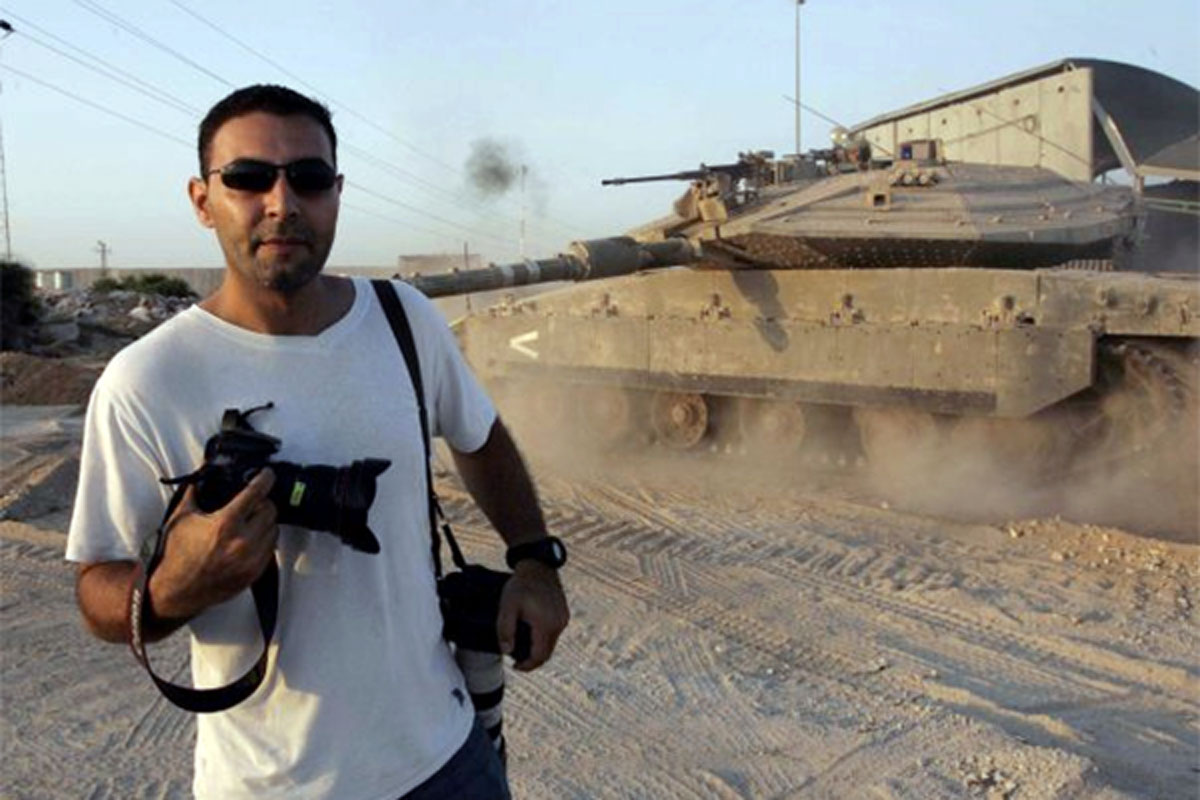
Award-winning photojournalist Khalil Abdel-Kader Abu Hamra
MEMO | May 26, 2014
The Egyptian cabinet decided Sunday to revoke the Egyptian citizenship from a Palestinian Associated Press photojournalist on charges of membership in a foreign militant group.
Award-winning AP photojournalist Khalil Abdel-Kader Abu Hamra said in statements Sunday that he had lived in Egypt for a long time, and was never harassed by authorities whenever he travelled abroad. The Ministry of Interior stated that Hamra left Egypt on November 27, 2013 and never came back. It accused him of “membership in a foreign militant group that aims at disrupting social and economic order of the Egyptian state.”
Hamra, whose mother is Egyptian and his father Palestinian, obtained Egyptian citizenship since 2012 in accordance with Egyptian law, which allows Palestinians with Egyptian mothers to receive citizenship.
Hamra said he has been in vacation in Jordan for few days, and travelled from Egypt and returned without facing any problems by airport authorities.
He added that he has no political affiliations, and that he is merely a journalist by profession.
Hamra said he will take necessary legal measures to appeal the “unjustified” decision.
Britain’s MI5 accused of complicity in torture
Press TV – May 20, 2014
Britain’s domestic spying apparatus MI5 has been accused of complicity in torture.
A Dutch man of Somali origin, Ahmed Diini, accused the British spy agency of questioning him while he was being tortured in an Egyptian prison earlier this year.
Diini said during his eight-month imprisonment in Cairo that he was shackled, hooded, repeatedly beaten, and threatened that his wife would be raped.
The former British resident, who is also a grandson of the deposed Somali dictator Mohamed Siad Barre, claimed that the alleged MI5 agents worked closely with Egyptian security forces, promising him his freedom if he agreed to work for the British intelligence service.
The Dutch man was imprisoned for unknown reasons following the ouster of Egyptian president Mohamed Morsi.
The claim comes as the head of MI5 told lawmakers in November that his officers would never participate in or condone torture, or take part in operations where a suspect is being illegally detained by a foreign state.
This is while the Constitution Project report last year slammed Britain for violating human rights through colluding with the US in the torture and rendition of terror suspects.
The dossier also claims MI5 agents under the last Labour government knew that prisoners were ill-treated at the hands of their captors
For years, Labour ministers denied involvement in rendition. But the report pointed out that the UK had paid out around £10 million to more than a dozen detainees after they were illegally rendered and tortured.
Egyptian Court Sentences Brotherhood Chief and 682 Others to Death

Muslim Brotherhood leader Mohamed Badie
Al-Manar | April 28, 2014
An Egyptian court sentenced Muslim Brotherhood leader Mohamed Badie and 682 others of the organization to death Monday, a lawyer and prosecutor said, after two brief sessions which the defense partly boycotted.
The same court also reversed 492 of 529 death sentences it passed in March, commuting most of those to life in prison.
The court presided over by judge Said Youssef Sabry had sparked an international outcry with its initial sentencing last month, which came amid an extensive crackdown on supporters of ousted president Mohammad Mursi.
Under Egyptian law, death sentences are referred to the top Islamic scholar for an advisory opinion before being ratified. A court may choose to commute the sentences, which can later be challenged at an appeals court.
Of the 683 sentenced on Monday, only about 50 are in detention. The judge will confirm the verdict on June 21. The others have a right to a retrial if they hand themselves in.
The verdict was the first against Badie, the spiritual head of Mursi’s Muslim Brotherhood, in the several trials he faces on various charges along with Mursi himself and other Brotherhood leaders.
Those sentenced on Monday were accused of involvement in the murder and attempted murder of policemen in Minya province on August 14, the day police killed hundreds of Mursi’s supporters in clashes in Cairo.
Defense lawyers boycotted the last session, branding it “farcical” after the mass death sentencing which the United Nations denounced as a breach of international human rights law.
Defense lawyer Khaled Elkomy claims that 60 percent of the 529 defendants, including teachers and some doctors, have evidence that “proves they were not present the day they were accused of attacking the Matay police station” in Minya, a statement released by human rights group Avaaz said.
The government has defended the court’s handling of the first mass case, insisting that the sentences were passed only “after careful study” and were subject to appeal.
Source: AFP
Critics say new Egyptian business law to foster corruption
Al-Akhbar | April 24, 2014
A new Egyptian law that prevents third parties from challenging contracts made with the government may encourage foreign investors, but critics say it will increase scope for corruption.
President Adly Mansour on Tuesday approved the law that will restrict the right to challenge state business and real estate deals to only the government, the institutions involved and business partners.
The law is meant to revive investment hit by political instability since a 2011 uprising toppled autocratic president Hosni Mubarak.
“Uncertainty over the legality of contracts has been one factor behind the lack of foreign investment into Egypt since the Arab Spring revolution, and so this law could provide the protection that some investors have been craving,” said Jason Tuvey, assistant economist at Capital Economics.
Many state-land and business deals were revoked after court challenges by people with no direct links to the transactions, harming business confidence in a country where population growth has long outpaced job creation.
The lawsuits have been brought by activists and lawyers who allege that companies were sold off too cheaply, reflecting corrupt business practices during the Mubarak era.
Since the 2011 uprising, Egyptian courts have issued at least 11 rulings ordering the state to reverse deals signed by former administrations.
Direct foreign investment in Egypt fell to $3 billion in the fiscal year ending June 2013, $1 billion less than the previous year. Foreign reserves fell to a critical low of $13.4 billion last year and the economy grew a meager 2.1 percent.
Gulf investors have been lobbying for more assurances that their money will be safe in Egypt.
In 2011 a court annulled a deal to sell Egypt’s historic Omar Effendi department store chain to a Saudi investor after activists argued it was sold too cheaply. Similar cases have kept wealthy Saudis wary of buying Egyptian assets, said Abdullah Bin Mahfouz, Chairman of the Saudi Egyptian Business Council.
“I’m sure that due to this law we will see an inflow of investment no less than $15 billion in the next three years because there are huge opportunities in steel and mining and factories that are considered the biggest in the Middle East,” Mahfouz said.
Although the new law is expected to remove legal hurdles, political stability may still deter investment. The new legislation is also likely to anger activists and lawyers who say it would foster corruption.
“Although the law prior to this change was abused constantly, and to a large extent by vexatious litigants, this amendment effectively removes part of the judicial and civilian oversight over government deals,” Mustafa Bassiouny, an economist at Signet Institute, said.
Another concern is that companies that miss out on a tender process have no legal avenue to challenge government decisions.
“This could lead to a situation where the authorities agree to contracts that ultimately represent poor value for money,” said Tuvey at Capital Economics.
Mika Minio-Paluello, researcher at Platform London, an advocacy group focused on social and environmental justice issues, said the new law would undermine democratic oversight.
“There’s no mechanism or means for citizens to intervene and prevent corruption, to challenge breaches of the law and unfair contracts,” said Minio-Paluello.
“If you are a decent investor, it is not in your interest because you will come up against other investors who are dodgy – breaching environmental standards, not paying workers properly.”
Egypt’s government has faced 37 international and domestic arbitration cases worth $14.3 billion in the three years since the 2011 uprising, Ezzat Ouda, head of the state’s lawsuits authority, told state newspaper Al-Ahram.
Since general Abdel Fattah al-Sisi toppled the country’s first freely elected president, Mohammed Mursi of the Muslim Brotherhood, last July, Islamist militants based in the Sinai Peninsula have stepped up attacks on security forces, killing hundreds.
The government has outlawed the Brotherhood, quashed protests and sentenced hundreds of its members to death.
(Reuters, Al-Akhbar)
Featured Video

Racist Seinfeld Dances for Joy as Bibi Unveils His New Map
or go to
Aletho News Archives – Video-Images
TV Drama Review
Japanese drama projects Japan’s wartime atrocities onto Chinese characters

Global Times | October 25, 2026
By portraying Chinese characters as perpetrators of ruthless violence while casting Japanese Self-Defense Forces (SDF) intelligence operatives as defenders, the season 2 of the Japanese drama Vivant has recently drawn criticism from Chinese netizens, who argue that its depiction turns historical reality on its head while ignoring Japan’s wartime atrocities.
The TBS drama series – a spy suspense story in which an alleged unofficial intelligence unit of the SDF operates across the globe — has attracted a passionate fanbase. Its currently airing season 2 opened with a household rating of 18.8 percent, the highest for a TV drama this year, according toa commentary article by Japanese media Toyo Keizai.
What draws attention is the portrayal of the enemies in the series, the article noted. Scenes in which the Chinese organization subjects kidnapped members of the SDF unit to brutal torture are repeated with unrelenting intensity.
It is rare for Japanese TV dramas to explicitly portray a real-life country as the enemy, the article noted.
Japanese Prime Minister Sanae Takaichi also made a reference to the drama, saying that she has been recording Vivant and hopes to binge-watch it over the year-end and New Year holidays, according to Japanese media outlets.
China’s CCTV News report on Sunday revealed that the drama features scenes in which Chinese personnel cut off the fingers of and stab Japanese intelligence operatives in the abdomen. Such acts bear striking similarities to the torture inflicted on Chinese nationals by invading Japanese troops during the World War II.
The drama distorts the truth by attributing these atrocities to modern Chinese characters. Beneath the surface, it subtly glorifies Japan’s cross-border overseas operations, blurs the functional boundaries of the SDF and implicitly promotes an expansionist narrative, per CCTV News. … continue
Blog Roll
 Aletho News
- EU facing trillion-euro debt hole while seeking more cash for Kiev
- How US, Europe, Persian Gulf states exhausted missile stockpiles, splurged billions to defend Israel
- Up in arms… Koreans reject U.S. empire’s plan to make South Korea the next Ukraine
- Iran, Turkey, Pakistan, Saudi Arabia could advance region-led security framework in Tehran: FM spox
- Netizens condemn Japanese drama for projecting Japan’s wartime atrocities onto Chinese characters
- Racist Seinfeld Dances for Joy as Bibi Unveils His New Map
- A West Bank War for Netanyahu’s Election Campaign, Could It Backfire?
- Yemen denounces European Parliament’s ‘hypocritical’ push to blacklist Ansarullah
- Qalibaf: UAE’s UN bid aims to ‘clear the runway’ for ‘Greater Israel’, whitewash genocide
- Pakistan reopens Iran border after boosting security: Report
- If Americans Knew
- An error has occurred; the feed is probably down. Try again later.
- No Tricks Zone
- Sudden Stratospheric Warming, Powerful El Niño Combination May Lead To Extreme Europe Cold, Energy Crisis!
- Two New Studies Find Thwaites Glacier Melt Cannot Be Driven By Human Activity Or A Warming Ocean
- E-Cars Reduce CO2 Emissions By Only 41% Compared To Internal Combustion Engine Vehicles
- Predictions Made By Renowned Climate Professor Over Past Decades Have Been Proven To Be Poor
- New Study Suggests Large Regions Of The Pacific Ocean Have Been Cooling For The Last 80 Years
- Germany’s Green Energy Debacle: High Energy Costs Force Kahla Porzellan to Close After 182 Years!
- New Study: 50 Years Of The Most Aggressive ‘Net Zero’ Policies Can Only Affect The Global Climate By 0.03°C
- US September “Heat” Was No Record…Many Records Set Decades Ago
- Latest European Green Energy Debacle; Portugal’s Largest Flagship Solar Park Insolvent!
- Green Energy Debacle: German Expert Professor Fritz Vahrenholt Warns Of Severe Economic And Social Consequences

