El Salvador’s New Anti-Corruption Crusaders
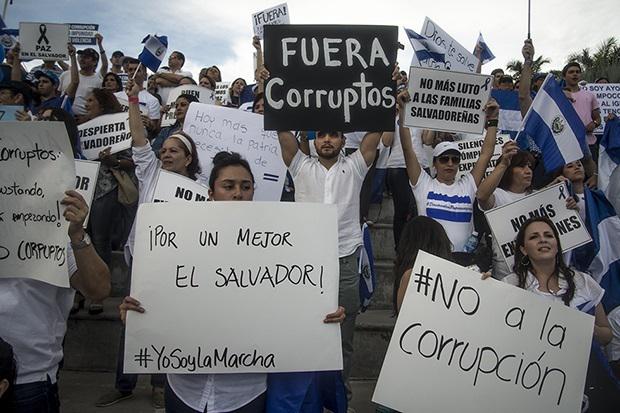
A right-wing rally on Sept. 5 in San Salvador (Contrapunto/ Jessica Orellana)
By Hilary Goodfriend – NACLA – 11/16/2015
Over the summer, news out of Central America seemed to take a positive turn. According to reports worldwide, the streets and plazas in several countries had filled with empowered citizens, united under the banner of “anti-corruption.” In Guatemala, a president notorious for the genocidal atrocities he helped wage against indigenous communities during the U.S.-backed civil war was toppled and disgraced. In Honduras, thousands marched against a repressive regime with a dubious mandate, stained by a 2009 coup d’état against democratically elected president Manuel Zelaya. In neighboring El Salvador, strategists of the political opposition looked on longingly as pundits enthusiastically heralded a “Central American Spring.”
Unlike in Honduras and Guatemala, in El Salvador, the political Left has governed the country since 2009, placing the Salvadoran Right in the unfamiliar role of the opposition. Hoping to capitalize on the trending currents next door, El Salvador’s elites are now hastily hoisting the banner of anti-corruption politics. Theirs is a cynical, if clumsy, effort to foment a tide of popular opposition against the current FMLN administration of President Salvador Sánchez Cerén. The conservative Nationalist Republican Alliance (ARENA) party is leading this charge, desperate to recover executive power and, with it, unbridled access to the state coffers it once ransacked. This movement is acting through a handful of small but well-funded right-wing civil society organizations, such as the Movimiento de 5 en 5, Grupo 300, and Democracia Limpia, as well as powerful economic groups like the National Association of Private Enterprise (ANEP) and the right-wing think tank FUSADES, ARENA, and its private sector allies. They are convening marches, filling headlines with empty accusations against the FMLN, and flooding social media with snappy civic hashtags like #YoTambiénEstoyIndignado (“I’m Outraged, Too”) and #NoALaCorrupción (#NoToCorruption).
The hypocrisy of this tactic is hard to overstate. From 1989 to 2009, the ARENA party oversaw the disappearance of more than $3.9 billion in public funds. The extent of such corruption only came to light after ARENA lost the presidency. Former president Francisco Flores (1999-2004), the poster boy for the ARENA party’s legacy of corruption, is now on trial for misappropriating at least $15 million in Taiwanese aid for earthquake victims. Even the U.S. State Department, historically a loyal supporter of ARENA politicians, admitted in a cable released by Wikileaks that the Salvadoran party’s finances were dependent on its ability to “hand out” government “patronage.”
Since unseating ARENA in 2009, the FMLN administrations of Mauricio Funes and Salvador Sánchez Cerén have made unprecedented efforts to investigate and prosecute many high-ranking former officials, like Flores, for acts of corruption. At the same time, the Salvadoran government, under the FMLN’s leadership, has completed several important public works projects, such as major highway constructions and hospital repairs, that languished unfinished, in part due to the rampant theft and embezzlement that occurred under ARENA. In addition, the FMLN has enacted new policies aimed at improving government transparency, such as the Access to Public Information Law; the establishment of a Secretary for Citizen Participation, Transparency and Anti-Corruption; the creation of a digital open government platform; and the establishment of a new policy forcing government institutions to present and publish annual reports of their activities. The Foundation for the Study of the Application of the Law (FESPAD) has observed that since the election of a leftist government in El Salvador there have been “important advances oriented towards honest and transparent public administration based on accountability, access to public information as well as the prevention and investigation of State corruption.”
For months now, the Salvadoran opposition has recklessly thrown corruption allegations at the FMLN administration. Thus far, however, they have been unsuccessful in making such allegations stick. As a result, conservative efforts to rally the public against the government have floundered. In a country accustomed to large protests, the Salvadoran Right has failed to bring more than a few hundred people into the streets – despite significant efforts on social media. The demonstrations have consistently featured an elite “who’s who” of ARENA party leaders and allies. Even government detractors have dismissed these events as partisan political theater.
This is not to say ARENA’s efforts have been wholly unsuccessful. While street mobilizations have faltered, ARENA’s diplomatic maneuvering has gotten significantly more traction. Its latest instrument of choice is the so-called CICIES, or International Commission against Impunity in El Salvador. And it’s here that ARENA has encountered its old ally: the United States.
The CICIES proposal is modeled on the International Commission against Impunity in Guatemala (CICIG), the United Nations-run body whose investigations recently toppled President Otto Pérez Molina and his vice president, Roxanna Baldetti. The CICIG was founded at the behest of human rights organizations to address the activities of paramilitary security groups that undermined the fragile achievements of Guatemala’s peace accords. Today, these groups defend the CICIG as the only feasible means of imposing justice in an utterly compromised judicial system.
At the same time, significant U.S. financial backing for the CICIG has also served to justify ongoing U.S. assistance to abusive Guatemalan security forces and neoliberal economic agreements with corrupt Guatemalan administrations. As the U.S. promotes the Alliance for Prosperity in the Central American Northern Triangle, a controversial economic and security strategy modeled on Plan Colombia, the CICIG has emerged as a key player. During a March visit to Guatemala, Vice President Joe Biden himself stressed that “the International Commission against Impunity in Guatemala should be extended” as a condition of the Alliance.
In 2011, then Salvadoran president Mauricio Funes considered the implementation of a commission similar to the CICIG. The ARENA party, however, strongly opposed the proposal. At that time, former ARENA presidential candidate Rodrigo Ávila declared that in El Salvador there were sufficiently capable police, jurists, and lawyers. “To come and say that we need foreign attorneys […] who do not know the reality of the country” was, Ávila argued, “a blow to the capabilities of Salvadorans.”
The idea of creating an anti-corruption commission in El Salvador did not resurface again until this year – this time as a suggestion from the U.S. State Department. During a visit to the country in July, State Department Counselor Thomas Shannon hailed the CICIG, and recommended the implementation of a similar model throughout the region. “It would be intelligent for El Salvador and Honduras to seek the support of the international community” in combating impunity and corruption, Shannon told a group of Salvadoran reporters.
ARENA, in a sudden change of heart, quickly echoed Shannon’s call. “The scourge of corruption and high levels of impunity are affecting our country and democracy,” ARENA legislator David Reyes told the media in late August. “With this type of independent international body, many of the problems can be solved, and [it will] help recoup trust in our institutions.” On October 12, ARENA party representatives held a press conference announcing the delivery of a letter to the president calling for the establishment of CICIES. The conservative organization Allies for Democracy, a USAID-supported group whose membership includes the powerful National Association of Private Enterprise, has also since come out in favor of CICIES.
The fact that the U.S.’s statements regarding the CICIES come at the same moment that the U.S. is pushing the Alliance for Prosperity suggests that State Department concerns about corruption in the region are less than altruistic. While recognizing the gains of Guatemala’s U.N.-backed anti-impunity commission, historian Greg Grandin noted in The Nation that under other circumstances, CICIG might “easily be dismissed as a neocolonial imposition meant to press order on a country so that it could continue to participate in the ‘international community’ as a ‘responsible’ free-trade partner.” The fact that the U.S.’s statements regarding the CICIES come at the same moment that the U.S. is pushing the Alliance for Prosperity suggests that State Department concerns about corruption in the region are less than altruistic. As Thomas Shannon told Salvadoran media, “It is strategically important for us to have a successful Northern Triangle in terms of our regional policy.” If the State Department has its own interests in mind as it pushes for an International Commission against Impunity in El Salvador, its recommendations have played nicely into the hands of El Salvador’s right-wing opposition.
To be sure, the Salvadoran Left is not blind to ARENA’s opportunism. Despite the rampant corruption during two decades of ARENA governance, the U.S. never pushed for an International Commission against Impunity in El Salvador until the election of a left-leaning administration. Most former ARENA officials have little to fear today; the ten-year statute of limitations for crimes of corruption in El Salvador now protects most ARENA officials from prosecution, leaving only former President Tony Saca (2004-2009), who since defected from the party and is therefore of small concern to his former colleagues, and, of course, the FMLN.
The Salvadoran government and other transparency advocates contend that unlike in Guatemala, the very institutions created by the 1992 Peace Accords would fight corruption and impunity. “After the armed conflict, the intervention of international institutions like ONUSAL [the United Nations Observer Mission in El Salvador] was justified because there wasn’t institutionality in the country […] The Truth Commission report even said that the judicial system was complicit in systematic human rights violations,” explained Abram Abrego, director of the respected legal aid non-profit FESPAD. “The judicial branch was questioned, and an international organization was necessary to verify its conduct […] But after more than 20 years, institutionality has developed in other ways. There’s more to do,” Abrego says, “but the country now has better laws than after the Peace Accords; it has better guarantees.”
Because of this history, Salvadoran progressives have thus far dismissed the need for an international commission to investigate corruption and impunity, calling instead for judicial reform to ensure justice within the country’s existing institutions. “The bourgeoisie is asking for it, not the people,” says Margarita Posada of the National Healthcare Forum, in reference to the proposed Commission. “What our people want is justice, and for the judicial system to work.”
In a recent editorial, Luis Cruz of the youth organization Progre expressed similar sentiments. “Salvadoran institutionality is still weak,” Cruz notes, “and the response should be to solve our problems by strengthening ourselves without appealing to foreign institutions.” In a rally outside the Supreme Court, Francisco Garcia of the Popular Coalition for a Peaceful Country without Hunger (CONPHAS) declared that, “The issue of purging the judicial system is an urgent necessity in order to guarantee the democratic transformations in this country.” Groups like CONPHAS, the National Healthcare Forum, and Progre have rejected the proposed Commission as a political smokescreen. Instead, they are focusing on critical measures like the election of a new Attorney General, the creation of an internal body to investigate corruption within the judicial system, and the dismissal of compromised judges from the bench.
The fact that ARENA’s calls for an international anti-corruption commission have no resonance with the country’s popular movement organizations has not deterred El Salvador’s elites in their crusade. Indeed, the U.S. State Department has bolstered their message. In this respect, their charade reveals the disturbing underside of the anti-impunity movements that have taken hold in other parts of Central America, often unseen to the international community.
There is much work to be done in El Salvador, and all of Central America for that matter, to claim victory in the battle against corruption and impunity. That is precisely why it is imperative to see this right-wing anti-corruption discourse in El Salvador for what it is: a cynical strategy to return to the status quo at a time when the powerful interests who have historically run the country are being challenged.
Hilary Goodfriend is a researcher in El Salvador. A graduate of New York University in Latin American Studies, she is currently completing a master’s thesis at the Central American University (UCA) in San Salvador.
Human Rights Center Suing CIA Broken Into, Research Stolen
teleSUR – October 21, 2015
Just over two weeks after the University of Washington’s Center for Human Rights filed a lawsuit in federal court against the CIA for the intelligence agency’s refusal to release declassified documents, the office of the center’s director was broken into, with data and equipment stolen.
Sensitive documents, including personal details about ongoing investigations in El Salvador, pertaining to a lawsuit filed by the University of Washington against the the CIA were stolen from the office of Professor Angelina Godoy, University officials reported on Wednesday.
The robbery has been described by university officials as a “possible act of retaliation” by individuals interested in compromising the university’s case against the CIA due to circumstances that suggest this wasn’t just a common burglary.
“We are concerned because it is also possible this was an act of retaliation for our work. There are a few elements that make this an unusual incident,” the Center for Human Rights said in a statement.
Following the incident, Center for Human Rights Director Dr. Angelina Godoy reported that her desktop computer was stolen along with a hard drive containing about 90 percent of the information relating to the center’s research in El Salvador. However, according to the center, what was peculiar about the circumstances is that her office was the only one targeted and that the stolen hard drive has no real monetary value; what was valuable was the data on the drive.
“Lastly, the timing of this incident — in the wake of the recent publicity around our freedom of information lawsuit against the CIA regarding information on a suspected perpetrator of grave human rights violations in El Salvador — invites doubt as to potential motives,” added the press statement.
On Oct. 2 the center filed a lawsuit under the Freedom of Information Act alleging that the CIA is illegally withholding information on retired Salvadoran Army officer, Col. Sigifredo Ochoa, who is currently under criminal investigation for complicity in the 1981 Santa Cruz massacre in El Salvador.
The lawsuit hopes to support justice-seeking survivors of the U.S-backed counterinsurgency against left-wing rebels that left more than 75,000 people dead and over 30,000 disappeared between 1980 and 1992.
“Access to the documents … could facilitate justice proceedings in these and other cases of grave rights abuses,” the lawsuit claims.
Chile, El Salvador, Peru Recall Israel Envoys in Protest of Gaza Offensive
Al-Manar | July 30, 2014
Chile, El Salvador and Peru have announced they are recalling their ambassadors in Tel Aviv in consultation to protest the Israeli assault on the besieged strip of Gaza.
The moves come on the heels of Brazil and Ecuador, who announced last week that they were recalling their envoys.
“Given the escalation of Israeli military operations in Gaza, the Government of Chile, in coordination with others in our region, has decided to call in consultation Santiago Ambassador of Chile in Tel Aviv, Jorge Montero,” the Chilean foreign ministry in Santiago said in a statement.
“Chile notes with great concern and dismay that such military operations, which at this stage of development are subject to a collective punishment against the Palestinian civilian population in Gaza do not respect fundamental rules of international humanitarian law.”
The Chilean foreign ministry emphasized the more than 1,000 Palestinians killed, including women and children during Operation Protective Edge, which continued for a 22nd day on Tuesday. The statement also noted Israel’s attacks “on schools and hospitals.”
“The scale and intensity of Israeli operations in Gaza violate the principle of proportionality in the use of force, an essential requirement to justify self-defense,” the statement added, referring to rocket fire by the resistance movements in the coastal territory.
El Salvador Ambassador in the Zionist entity Susana Edith Gun was also recalled for “urgent consultations” on Tuesday. The Foreign Ministry of the Central American country said that El Salvador President Sanchez Ceren gave these instructions “over serious escalation of violence and Israel’s bombings in the northern part of the Gaza Strip.”
A similar statement was also published by the Peruvian Foreign Ministry, condemning Israel’s operation in Gaza.
Venezuela and Bolivia that cut their ties with Tel Aviv over Israel’s 2009 war on Gaza have also strongly condemned Israel’s actions.
Brazil, Chile, Argentina, Costa Rica, Cuba, Mexico and Venezuela were among the 29 countries that voted in favor of a probe by the UN Human Rights Council into Israel’s war crimes in Gaza.
US Immigration Judge Rules Against School of the Americas Grad
Weekly News Update on the Americas | April 20, 2014
A US immigration judge has ruled that former Salvadoran defense minister José Guillermo García Merino (1979-1983) is eligible for deportation from the US because of “clear and convincing evidence” that he “assisted or otherwise participated” in 11 acts of violence during the 1980s, including the March 1980 murder of San Salvador archbishop Oscar Arnulfo Romero. Gen. García also helped conceal the involvement of soldiers who raped and killed four US churchwomen in December1980 and “knew or should have known” about the military’s December 1981 massacre of more than 800 civilians in the village of El Mozote, according to the 66-page decision by Immigration Judge Michael Horn in Miami. The judge ruled against García on Feb. 26, but the decision was only made public on Apr. 11 as the result of a Freedom of Information Act (FOIA) request by the New York Times. García’s lawyer said the general would appeal.
The decision against García comes after repeated efforts to bring him to justice in the US for war crimes committed in El Salvador. He came to the US in 1989 and was granted political asylum a year later. In May 1999 the families of the four murdered US churchwomen filed a suit (Ford et al. v. García, Vides Casanova) against García and former defense minister Gen. Carlos Eugenio Vides Casanova (1983-1989) in Florida, where both generals have lived since moving to the US. A jury cleared the generals. Also in 1999 the San Francisco-based Center for Justice and Accountability (CJA) brought a suit (Ramagoza Arce v. Garcia and Vides Casanova) against the generals on behalf of Salvadoran torture victims; the jury awarded the victims $54.6 million in 2002. US prosecutors began seeking the generals’ deportation in 2009, and an immigration judge cleared the way for Gen. Vides Casanova’s removal in February 2013 [see World War 4 Report 2/24/13].
Like many Salvadoran military officers, García and Vides Casanova received training at the US Army School of the Americas (SOA), which was renamed the Western Hemisphere Institute for Security Cooperation (WHINSEC) in 2001 [see Update #1200]. García completed a counterinsurgency course in 1962, when the SOA was located in Panama; it is now in Fort Benning, Georgia. García and Vides Casanova were both recipients of the US Legion of Merit, an award from the US Armed Forces for meritorious service, during the 1980s. (NYT 4/12/14; SOA Watch press release 4/15/14; National Catholic Reporter 4/17/14)
The war crimes with which García and Vides Casanova are charged took place during a bloody counterinsurgency against the rebel Farabundo Martí National Liberation Front (FMLN); the fighting left 70,000 people dead. The FMLN later became a legal political party under a 1992 peace accord, and it backed current president Mauricio Funes, an independent, in his 2009 campaign. A leader of the FMLN, Salvador Sánchez Cerén, won the presidency in a runoff on Mar. 9 this year and is to take office on June 1. (BBC News 3/17/14)
FMLN Wins First Round of Presidential Elections in El Salvador
CISPES | February 3 2014
San Salvador —With 99% of votes counted, candidate for the governing Farabundo Martí national Liberation Front (FMLN) party, Salvador Sanchez Cerén, has won the first round of El Salvador’s 2014 presidential election, with ten-point lead over Norman Quijano of the Nationalist Republican Alliance (ARENA). Both candidates will head to a run-off on March 9.
According to the CISPES electoral observation mission, which included delegates from the National Lawyers Guild, the American Association of Jurists and various U.S. universities, the electoral proceedings were calm and peaceful.
As Laura Embree-Lowry reported for CISPES’ mission, “This has been a much more transparent and peaceful process than we’ve observed in the past.” Observers noted the positive impact of several steps taken by the Supreme Electoral Tribunal over the past four years to increase both voter access and transparency, especially the new neighborhood voting system, which was carried out throughout the entire country for the first time on February 2.
The mission reported several denouncements made to them throughout the day, primarily concerning voting centers that did not open to the public at 7:00 am as scheduled due to the lack of sufficient numbers of poll workers, but these incidents were characterized as minor anomalies.
Embree-Lowry noted, “CISPES has observed every election since the Peace Accords. Today’s election shows that the process of democratization in the country continues to advance.”
Supreme Electoral Tribunal president Eugenio Chicas announced that the final vote count will be formally announced on Tuesday, February 4th. None of the candidates have challenged the preliminary results; both Sánchez-Cerén and Quijano gave press conferences in San Salvador on Sunday night expressing satisfaction and hope for a victory on March 9.
The 70-person CISPES observer mission, together with the SHARE Foundation, U.S.-El Salvador Sister Cities, and other international organizations will issue their report on the election at a press conference on Tuesday in San Salvador.

Increase in homicides linked to “extermination groups” and ARENA campaign
CISPES | January 21, 2014
Since the beginning of the New Year and with the February 2nd presidential elections less than two weeks away, El Salvador has seen a dramatic increase in homicides. In the month of January, El Salvador has seen an average of 9.4 violent deaths per day, a shocking increase from months past, many of them carried out en masse and reminiscent of death squad-style murders.
The Foundation for the Study of the Application of Law (FESPAD), a Salvadoran legal aid clinic and research group, reports that the murders are being carried out by “extermination groups.” Nelson Flores of FESPAD notes that these types of murders often occur prior to electoral periods, and that the “extermination groups” are trying to generate terror in the population and make the government look like it cannot stop this phenomenon.
The type of group that FESPAD describes have been operating in El Salvador since during the armed conflict; many of the groups take their names from “historic figures tied to the worst state violence, including General Maximiliano Hernández Martínez, Domingo Monterrosa, Roberto D´Aubuisson.” This is not the first time that FESPAD has publicized the continued operation of social cleansing groups in El Salvador (For more background, download a report in Spanish here).
Even before FESPAD’s recent announcement, many prominent voices in El Salvador had been questioning whether the right-wing Nationalist Republican Alliance (ARENA) party was behind the recent rise in homicides.
President Mauricio Funes expressed concern about a possible link between the increased violence and ARENA’s electoral campaign, while FMLN spokesperson Roberto Lorenzana described ARENA, wracked by internal crises and an unpopular candidate, as being driven to desperate measures, including the use of confrontation and violence as part of a last ditch effort at a “black campaign.”
ARENA’s new campaign manager, the infamous right-wing Venezuelan campaign manager J.J. Rendón, is renowned for his use of “rumorology” and smear tactics. At the very least, ARENA is taking advantage of the increase in murders in their campaign, which has in recent weeks turned more vitriolic, with a focus on violence and insecurity. Some ads use slogans like “My money will no longer go to gangs” and “Children will play safely in the streets again” while others directly attack the Funes administration’s public security policies. In a recent presidential debate, ARENA candidate Norman Quijano, who was the only candidate to directly attack the administration, proposed militarizing public security as a solution to the insecurity problems, a measure that would directly violate El Salvador’s Constitution.
US Lawmakers Lobby for Right-wing and US Intervention in Honduran, Salvadoran Elections
CISPES | November 8, 2013
On Saturday, October 16, US Congressmen Matt Salmon (R-AZ) and Albio Sires (D-NJ) from the House’s Foreign Affairs Western Hemisphere subcommittee wrote a letter to Secretary of State John Kerry using vague, fear-mongering rhetoric to delegitimize a potential left-wing victory in the upcoming presidential elections in Honduras and El Salvador, where the left candidates are leading in the polls. Explicitly denigrating two of the three leading Salvadoran candidates, Salmon and Sires exposed themselves as mouthpieces for the right-wing Nationalist Republican Alliance (ARENA) party, which has mounted an escalating smear campaign against its opposition in both El Salvador and the US.
In the letter—which was then republished in El Salvador—the congressional duo question the “democratic credentials” of both Honduran presidential candidate Xiomara Castro de Zelaya, wife of former President Manuel Zelaya ousted in the 2009 US-backed coup d’état, and Salvador Sánchez Cerén, the leftist candidate for the Farabundo Martí National Liberation Front (FMLN) in El Salvador, accusing them of being allies of late Venezuelan president Hugo Chávez. The congressmen also call out Salvadoran right-wing UNITY coalition candidate Tony Saca as corrupt, clearly demonstrating their preference for ARENA—the only other leading party in the race. In a particularly troubling gesture, they call for “heightened security to ensure that all candidates abide by the democratic rules of the game,” and tacitly request greater participation of the National Democratic Institute (NDI) and the International Republican Institute (IRI)— US institutions notorious for undermining democratic elections in the region.
This is not the duo’s first effort to intervene in the democratic process in El Salvador. In April, Salmon and Sires published a letter implying—falsely—that $300 million in US development aid from the Millennium Challenge Corporation was at risk because the US-backed Public-Private Partnership Law had not yet been approved by the Salvadoran legislature. Now, in questioning the democratic legitimacy of both Xiomara Castro and Sánchez Cerén, Sires and Salmon are setting the stage to delegitimize any leftist electoral victory from the US, and throwing their weight behind the ARENA party in El Salvador.
This is the same tactic recently employed by ultra-conservative lobbyist Otto Reich in his public comments against the FMLN, and was promptly followed by the November 4 publication of an article in the Spanish-language edition of the Miami Herald interviewing several ARENA party leaders claiming that Saca had made an agreement with the FMLN to divide the right-wing and bring socialism to El Salvador. The stakes are high in the upcoming presidential elections in Honduras and El Salvador, and ARENA and its allies are hard at work prevent any electoral outcome that conflicts with their vast economic interests in the region.
Related article
… The electoral contest takes place in the context of a Salvadoran social movement to end the impunity of war criminals who have thus far escaped justice due to a 1993 amnesty law whose constitutionality is now under examination by the Supreme Court of El Salvador. The issue has become especially intense since October 1, 2013, when the Catholic Archdiocese of San Salvador shut down the most important human rights archives in the country, Tutela Legal, and dismissed the employees, placing the very documents that would be used in war crimes tribunals at risk of being compromised. [3] These actions have provoked international solidarity with the thousands of Salvadorans, including those in the Salvadoran diaspora, who are at work recuperating the historical memory of the country and seeking justice for the more than 70,000 citizens killed during the war as well as the survivors of torture and other war crimes. …
Tales of Reagan’s Guatemala Genocide
By Robert Parry | Consortium News | April 16, 2013
The first month of the genocide trial of former Guatemalan dictator Efrain Rios Montt has elicited chilling testimony from Mayan survivors who – as children – watched their families slaughtered by a right-wing military that was supported and supplied by U.S. President Ronald Reagan.
As the New York Times reported on Monday, “In the tortured logic of military planning documents conceived under Mr. Ríos Montt’s 17-month rule during 1982 and 1983, the entire Mayan Ixil population was a military target, children included. Officers wrote that the leftist guerrillas fighting the government had succeeded in indoctrinating the impoverished Ixils and reached ‘100 percent support.’”
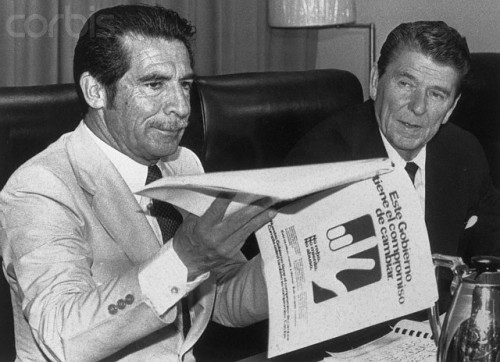
President Ronald Reagan meeting with Guatemalan dictator Efrain Rios Montt.
So, everyone was targeted in these scorched-earth campaigns that eradicated more than 600 Indian villages in the Guatemalan highlands. But this genocide was not simply the result of a twisted anticommunist ideology that dominated the Guatemalan military and political elites. This genocide also was endorsed by the Reagan administration.
A document that I discovered recently in the archives of the Reagan Library in Simi Valley, California, revealed that Reagan and his national security team in 1981 agreed to supply military aid to the brutal right-wing regime in Guatemala to pursue the goal of exterminating not only “Marxist guerrillas” but people associated with their “civilian support mechanisms.”
This supportive attitude toward the Guatemalan regime’s brutality took shape in spring 1981 as President Reagan sought to ease human-rights restrictions on military aid to Guatemala that had been imposed by President Jimmy Carter and the Democratic-controlled Congress in the late 1970s.
As part of that relaxation effort, Reagan’s State Department “advised our Central American embassies that it has been studying ways to restore a closer, cooperative relationship with Guatemala,” according to a White House “Situation Room Checklist” dated April 8, 1981. The document added:
“State believes a number of changes have occurred which could make Guatemalan leaders more receptive to a new U.S. initiative: the Guatemalans view the new administration as more sympathetic to their problems [and] they are less suspect of the U.S. role in El Salvador,” where the Reagan administration was expanding support for another right-wing regime infamous for slaughtering its political opponents, including Catholic clergy.
“State has concluded that any attempt to reestablish a dialogue [with Guatemala] would require some initial, condition-free demonstration of our goodwill. However, this could not include military sales which would provoke serious U.S. public and congressional criticism. State will undertake a series of confidence building measures, free of preconditions, which minimize potential conflict with existing legislation.”
The “checklist” added that the State Department “has also decided that the administration should engage the Guatemalan government at the highest level in a dialogue on our bilateral relations and the initiatives we can take together to improve them. Secretary [of State Alexander] Haig has designated [retired] General Vernon Walters as his personal emissary to initiate this process with President [Fernando Romeo] Lucas [Garcia].
“If Lucas is prepared to give assurances that he will take steps to halt government involvement in the indiscriminate killing of political opponents and to foster a climate conducive to a viable electoral process, the U.S. will be prepared to approve some military sales immediately.”
But the operative word in that paragraph was “indiscriminate.” The Reagan administration expressed no problem with killing civilians if they were considered supporters of the guerrillas who had been fighting against the country’s ruling oligarchs and generals since the 1950s when the CIA organized the overthrow of Guatemala’s reformist President Jacobo Arbenz.
Sympathy for the Generals
The distinction was spelled out in “Talking Points” for Walters to deliver in a face-to-face meeting with General Lucas. As edited inside the White House in April 1981, the “Talking Points” read: “The President and Secretary Haig have designated me [Walters] as [their] personal emissary to discuss bilateral relations on an urgent basis.
“Both the President and the Secretary recognize that your country is engaged in a war with Marxist guerrillas. We are deeply concerned about externally supported Marxist subversion in Guatemala and other countries in the region. As you are aware, we have already taken steps to assist Honduras and El Salvador resist this aggression.
“The Secretary has sent me here to see if we can work out a way to provide material assistance to your government. … We have minimized negative public statements by US officials on the situation in Guatemala. … We have arranged for the Commerce Department to take steps that will permit the sale of $3 million worth of military trucks and Jeeps to the Guatemalan army. …
“With your concurrence, we propose to provide you and any officers you might designate an intelligence briefing on regional developments from our perspective. Our desire, however, is to go substantially beyond the steps I have just outlined. We wish to reestablish our traditional military supply and training relationship as soon as possible.
“As we are both aware, this has not yet been feasible because of our internal political and legal constraints relating to the use by some elements of your security forces of deliberate and indiscriminate killing of persons not involved with the guerrilla forces or their civilian support mechanisms. I am not referring here to the regrettable but inevitable death of innocents through error in combat situations, but to what appears to us a calculated use of terror to immobilize non politicized people or potential opponents. …
“If you could give me your assurance that you will take steps to halt official involvement in the killing of persons not involved with the guerrilla forces or their civilian support mechanism … we would be in a much stronger position to defend successfully with the Congress a decision to begin to resume our military supply relationship with your government.”
In other words, though the “talking points” were framed as an appeal to reduce the “indiscriminate” slaughter of “non politicized people,” they amounted to an acceptance of scorched-earth tactics against people involved with the guerrillas and “their civilian support mechanisms.” The way that played out in Guatemala – as in nearby El Salvador – was the massacring of peasants in regions considered sympathetic to leftist insurgents.
The newly discovered documents – and other records declassified in the late 1990s – make clear that Reagan and his administration were well aware of the butchery underway in Guatemala and elsewhere in Central America.
According to one “secret” cable also from April 1981 — and declassified in the 1990s — the CIA was confirming Guatemalan government massacres even as Reagan was moving to loosen the military aid ban. On April 17, 1981, a CIA cable described an army massacre at Cocob, near Nebaj in the Ixil Indian territory, because the population was believed to support leftist guerrillas.
A CIA source reported that “the social population appeared to fully support the guerrillas” and “the soldiers were forced to fire at anything that moved.” The CIA cable added that “the Guatemalan authorities admitted that ‘many civilians’ were killed in Cocob, many of whom undoubtedly were non-combatants.” [Many of the Guatemalan documents declassified in the 1990s can be found at the National Security Archive’s Web site.]
Dispatching Walters
In May 1981, despite the ongoing atrocities, Reagan dispatched Walters to tell the Guatemalan leaders that the new U.S. administration wanted to lift the human rights embargoes on military equipment that Carter and Congress had imposed.
The “Talking Points” also put the Reagan administration in line with the fiercely anticommunist regimes elsewhere in Latin America, where right-wing “death squads” operated with impunity liquidating not only armed guerrillas but civilians who were judged sympathetic to left-wing causes like demanding greater economic equality and social justice.
Despite his aw shucks style, Reagan found virtually every anticommunist action justified, no matter how brutal. From his eight years in the White House, there is no historical indication that he was morally troubled by the bloodbath and even genocide that occurred in Central America while he was shipping hundreds of millions of dollars in military aid to the implicated forces.
The death toll was staggering — an estimated 70,000 or more political killings in El Salvador, possibly 20,000 slain from the Contra war in Nicaragua, about 200 political “disappearances” in Honduras and some 100,000 people eliminated during a resurgence of political violence in Guatemala. The one consistent element in these slaughters was the overarching Cold War rationalization, emanating in large part from Ronald Reagan’s White House.
Despite their claims to the contrary, the evidence is now overwhelming that Reagan and his advisers knew the extraordinary brutality going on in Guatemala and elsewhere, based on their own internal documents.
According to a State Department cable on Oct. 5, 1981, when Guatemalan leaders met again with Walters, they left no doubt about their plans. The cable said Gen. Lucas “made clear that his government will continue as before — that the repression will continue. He reiterated his belief that the repression is working and that the guerrilla threat will be successfully routed.”
Human rights groups saw the same picture. The Inter-American Human Rights Commission released a report on Oct. 15, 1981, blaming the Guatemalan government for “thousands of illegal executions.” [Washington Post, Oct. 16, 1981]
But the Reagan administration was set on whitewashing the ugly scene. A State Department “white paper,” released in December 1981, blamed the violence on leftist “extremist groups” and their “terrorist methods” prompted and supported by Cuba’s Fidel Castro.
What the documents from the Reagan Library make clear is that the administration was not simply struggling ineffectively to rein in these massacres – as the U.S. press corps typically reported – but was fully on board with the slaughter of people who were part of the guerrillas’ “civilian support mechanisms.”
U.S. intelligence agencies continued to pick up evidence of these government-sponsored massacres. One CIA report in February 1982 described an army sweep through the so-called Ixil Triangle in central El Quiche province.
“The commanding officers of the units involved have been instructed to destroy all towns and villages which are cooperating with the Guerrilla Army of the Poor [the EGP] and eliminate all sources of resistance,” the report said. “Since the operation began, several villages have been burned to the ground, and a large number of guerrillas and collaborators have been killed.”
The CIA report explained the army’s modus operandi: “When an army patrol meets resistance and takes fire from a town or village, it is assumed that the entire town is hostile and it is subsequently destroyed.” When the army encountered an empty village, it was “assumed to have been supporting the EGP, and it is destroyed. There are hundreds, possibly thousands of refugees in the hills with no homes to return to. …
“The army high command is highly pleased with the initial results of the sweep operation, and believes that it will be successful in destroying the major EGP support area and will be able to drive the EGP out of the Ixil Triangle. … The well documented belief by the army that the entire Ixil Indian population is pro-EGP has created a situation in which the army can be expected to give no quarter to combatants and non-combatants alike.”
On Feb. 2, 1982, Richard Childress, one of Reagan’s national security aides, wrote a “secret” memo to his colleagues summing up this reality on the ground:
“As we move ahead on our approach to Latin America, we need to consciously address the unique problems posed by Guatemala. Possessed of some of the worst human rights records in the region, … it presents a policy dilemma for us. The abysmal human rights record makes it, in its present form, unworthy of USG [U.S. government] support. …
“Beset by a continuous insurgency for at least 15 years, the current leadership is completely committed to a ruthless and unyielding program of suppression. Hardly a soldier could be found that has not killed a ‘guerrilla.’”
The Rise of Rios Montt
However, Reagan remained committed to supplying military hardware to Guatemala’s brutal regime. So, the administration welcomed Gen. Efrain Rios Montt’s March 1982 overthrow of the thoroughly bloodstained Gen. Lucas.
An avowed fundamentalist Christian, Rios Montt impressed Official Washington where the Reagan administration immediately revved up its propaganda machinery to hype the new dictator’s “born-again” status as proof of his deep respect for human life. Reagan hailed Rios Montt as “a man of great personal integrity.”
By July 1982, however, Rios Montt had begun a new scorched-earth campaign called his “rifles and beans” policy. The slogan meant that pacified Indians would get “beans,” while all others could expect to be the target of army “rifles.” In October, Rios Montt secretly gave carte blanche to the feared “Archivos” intelligence unit to expand “death squad” operations in the cities. Based at the Presidential Palace, the “Archivos” masterminded many of Guatemala’s most notorious assassinations.
The U.S. embassy was soon hearing more accounts of the army conducting Indian massacres, but ideologically driven U.S. diplomats fed the Reagan administration the propaganda spin that would be best for their careers. On Oct. 22, 1982, embassy staff dismissed the massacre reports as communist-inspired “disinformation campaign,” concluding that “that a concerted disinformation campaign is being waged in the U.S. against the Guatemalan government by groups supporting the communist insurgency in Guatemala.”
Reagan personally joined this P.R. campaign seeking to discredit human rights investigators and others who were reporting accurately about massacres that the administration knew, all too well, were true.
On Dec. 4, 1982, after meeting with Rios Montt, Reagan hailed the general as “totally dedicated to democracy” and added that Rios Montt’s government had been “getting a bum rap” on human rights. Reagan discounted the mounting reports of hundreds of Maya villages being eradicated.
In February 1983, however, a secret CIA cable noted a rise in “suspect right-wing violence” with kidnappings of students and teachers. Bodies of victims were appearing in ditches and gullies. CIA sources traced these political murders to Rios Montt’s order to the “Archivos” in October to “apprehend, hold, interrogate and dispose of suspected guerrillas as they saw fit.”
Despite these grisly facts on the ground, the annual State Department human rights survey praised the supposedly improved human rights situation in Guatemala. “The overall conduct of the armed forces had improved by late in the year” 1982, the report stated.
A different picture — far closer to the secret information held by the U.S. government — was coming from independent human rights investigators. On March 17, 1983, Americas Watch condemned the Guatemalan army for human rights atrocities against the Indian population.
New York attorney Stephen L. Kass said these findings included proof that the government carried out “virtually indiscriminate murder of men, women and children of any farm regarded by the army as possibly supportive of guerrilla insurgents.”
Rural women suspected of guerrilla sympathies were raped before execution, Kass said, adding that children were “thrown into burning homes. They are thrown in the air and speared with bayonets. We heard many, many stories of children being picked up by the ankles and swung against poles so their heads are destroyed.” [AP, March 17, 1983]
Putting on a Happy Face
Publicly, senior Reagan officials continued to put on a happy face. In June 1983, special envoy Richard B. Stone praised “positive changes” in Rios Montt’s government, and Rios Montt pressed the United States for 10 UH-1H helicopters and six naval patrol boats, all the better to hunt guerrillas and their sympathizers.
Since Guatemala lacked the U.S. Foreign Military Sales credits or the cash to buy the helicopters, Reagan’s national security team looked for unconventional ways to arrange the delivery of the equipment that would give the Guatemalan army greater access to mountainous areas where guerrillas and their civilian supporters were hiding.
On Aug. 1, 1983, National Security Council aides Oliver North and Alfonso Sapia-Bosch reported to National Security Advisor William P. Clark that his deputy Robert “Bud” McFarlane was planning to exploit his Israeli channels to secure the helicopters for Guatemala. [For more on McFarlanes’s Israeli channels, see Consortiumnews.com’s “How Neocons Messed Up the Mideast.”]
“With regard to the loan of ten helicopters, it is [our] understanding that Bud will take this up with the Israelis,” wrote North and Sapia-Bosch. “There are expectations that they would be forthcoming. Another possibility is to have an exercise with the Guatemalans. We would then use US mechanics and Guatemalan parts to bring their helicopters up to snuff.”
However, more political changes were afoot in Guatemala. Rios Montt’s vengeful Christian fundamentalism had hurtled so out of control, even by Guatemalan standards, that Gen. Oscar Mejia Victores seized power in another coup on Aug. 8, 1983.
Despite the power shift, Guatemalan security forces continued to murder with impunity, finally going so far that even the U.S. Embassy objected. When three Guatemalans working for the U.S. Agency for International Development were slain in November 1983, U.S. Ambassador Frederic Chapin suspected that “Archivos” hit squads were sending a message to the United States to back off even mild pressure for human rights.
In late November, in a brief show of displeasure, the administration postponed the sale of $2 million in helicopter spare parts. The next month, however, Reagan sent the spare parts anyway. In 1984, Reagan succeeded, too, in pressuring Congress to approve $300,000 in military training for the Guatemalan army.
By mid-1984, Chapin, who had grown bitter about the army’s stubborn brutality, was gone, replaced by a far-right political appointee named Alberto Piedra, who favored increased military assistance to Guatemala. In January 1985, Americas Watch issued a report observing that Reagan’s State Department “is apparently more concerned with improving Guatemala’s image than in improving its human rights.”
It was not until 1999, a decade after Ronald Reagan left office, that the shocking scope of the atrocities in Guatemala was publicly revealed by a truth commission that drew heavily on U.S. government documents that President Bill Clinton had ordered declassified.
On Feb. 25, 1999, the Historical Clarification Commission estimated that the 34-year civil war had claimed the lives of some 200,000 people with the most savage bloodletting occurring in the 1980s. The panel estimated that the army was responsible for 93 percent of the killings and leftist guerrillas for three percent. Four percent were listed as unresolved.
The report documented that in the 1980s, the army committed 626 massacres against Mayan villages. “The massacres that eliminated entire Mayan villages … are neither perfidious allegations nor figments of the imagination, but an authentic chapter in Guatemala’s history,” the commission concluded.
The army “completely exterminated Mayan communities, destroyed their livestock and crops,” the report said. In the northern highlands, the report termed the slaughter “genocide.” [Washington Post, Feb. 26, 1999]
Besides carrying out murder and “disappearances,” the army routinely engaged in torture and rape. “The rape of women, during torture or before being murdered, was a common practice” by the military and paramilitary forces, the report found.
The report added that the “government of the United States, through various agencies including the CIA, provided direct and indirect support for some [of these] state operations.” The report concluded that the U.S. government also gave money and training to a Guatemalan military that committed “acts of genocide” against the Mayans. [NYT, Feb. 26, 1999]
During a visit to Central America, on March 10, 1999, President Clinton apologized for the past U.S. support of right-wing regimes in Guatemala dating back to 1954. “For the United States, it is important that I state clearly that support for military forces and intelligence units which engaged in violence and widespread repression was wrong, and the United States must not repeat that mistake,” Clinton said. [Washington Post, March 11, 1999]
Impunity for Reagan’s Team
However, back in Washington, there was no interest in holding anyone accountable for aiding and abetting genocide. The story of the Guatemalan butchery and the Reagan administration’s complicity quickly disappeared into the great American memory hole.
For human rights crimes in the Balkans and in Africa, the United States has demanded international tribunals to arrest and to try violators and their political patrons for war crimes. In Iraq, President George W. Bush celebrated the trial and execution of Iraqi dictator Saddam Hussein for politically motivated killings.
Even Rios Montt, now 86, after years of evading justice under various amnesties, was finally indicted in Guatemala in 2012 for genocide and crimes against humanity. The first month of his trial has added eyewitness testimony to the atrocities that the Guatemalan military inflicted and that Ronald Reagan assisted and covered up.
On Monday, the New York Times reported on some of this painful testimony, but – as is almost always the case – the Times did not mention the role of Reagan and his administration. However, what the Times did include was chilling, including accounts from witnesses who as children fled to mountain forests to escape the massacres:
“Pedro Chávez Brito told the court that he was only six or seven years old when soldiers killed his mother. He hid in the chicken coop with his older sister, her newborn and his younger brother, but soldiers found them and dragged them out, forcing them back into their house and setting it on fire.
“Mr. Chávez says he was the only one to escape. ‘I got under a tree trunk and I was like an animal,’ Mr. Chávez told the court. ‘After eight days I went to live in the mountains. In the mountain we ate only roots and grass.’”
Lawyers for Rios Montt and his co-defendant, former intelligence chief José Mauricio Rodríguez Sánchez, have maintained that the pair did not order the killings, which they instead blamed on over-zealous field commanders.
However, the Times reported that “prosecution witnesses said the military considered Ixil civilians, including children, as legitimate targets. ‘The army’s objective with the children was to eliminate the seed for future guerrillas,’ Marco Tulio Alvarez, the former director of Guatemala’s Peace Archives, testified last week. ‘They used them to get information and to draw their parents to military centers where they arrested them.’
“In a study of 420 bodies exhumed from the Ixil region and presumed to date from the Ríos Montt period, experts found that almost 36 percent of those who were killed were under 18 years old, including some newborns.
“Jacinto Lupamac Gómez said he was eight when soldiers killed his parents and older siblings and hustled him and his two younger brothers into a helicopter. Like some of the children whose lives were spared, they were adopted by Spanish-speaking families and forgot how to speak Ixil.”
Though some belated justice may still be possible in Guatemala, there is no talk in the United States about seeking any accountability from the Reagan administration officials who arranged military assistance to this modern genocide or who helped conceal the atrocities while they were underway.
There has been no attention given by the mainstream U.S. news media to the new documents revealing how the Reagan administration gave a green light to the slaughter of Guatemalans who were considered part of the “civilian support mechanisms” for the Mayan guerrillas resisting the right-wing repression.
Ronald Reagan, the U.S. official most culpable for aiding and abetting the Guatemalan genocide, remains a hero to much of America with his name attached to Washington’s National Airport and scores of other government facilities. U.S. officials and many Americans apparently don’t want to disrupt their happy memories of the Gipper.
~
Investigative reporter Robert Parry broke many of the Iran-Contra stories for The Associated Press and Newsweek in the 1980s. You can buy his new book, America’s Stolen Narrative, either in print here or as an e-book (from Amazon and barnesandnoble.com).
Related articles
- Genocide trial of former Guatemala dictator Rios Montt opens (alethonews.wordpress.com)
- Guatemala: Ríos Montt Trial Implicates Current President (alethonews.wordpress.com)
- Ríos Montt and the Need for International Accountability for War Crimes in Guatemala (alethonews.wordpress.com)
- How Reagan Promoted Genocide (consortiumnews.com)
- Guatemala genocide trial continues; watch or listen live (boingboing.net)
Chávez Haters Not “Limited by Truth, Reality or Common Sense”
By Dan Beeton | CEPR Americas Blog | February 26, 2013
A new op-ed in the Guardian by Ricardo Hausmann portrays a dystopian fictional Venezuela, one in which the Venezuelan government has run the economy into the ground despite abundant oil wealth, but yet its charismatic president continues to be re-elected through some sort of sinister trickery.
Sound familiar? It should: it’s the same tired story repeated in the U.S. and U.K. media almost every day, but in this case Hausmann was apparently given free rein to present his own set of “facts.” It isn’t surprising that Hausmann would write something so divorced from reality; he went to elaborate lengths to invent a conspiracy theory about supposed fraud in Venezuela’s 2004 recall referendum by relying on fake exit polls. An independent panel of statisticians selected by the Carter Center determined that Hausmann and his colleague Roberto Rigobón had in fact found no evidence of fraud. [PDF]
But let’s get back to Hausmann’s latest Guardian piece, starting with the economy. Hausmann writes, “Since 1999, the year [Chávez] took over the presidency, Venezuela has had the lowest average GDP growth rate and the highest inflation of any Latin American country except Haiti.”
The source for this “lowest average GDP growth rate” to which Hausmann links is a highly opinionated BBC article which in turn quotes a colleague of Hausmann’s from the Center for International Development at Harvard University who has a Bachelor of Arts degree in economics. Had Hausmann consulted official government data, or growth numbers for the region from the IMF, he would have found a very different set of facts.
In fact, Brazil, Mexico, El Salvador, Guatemala, Jamaica, Nicaragua, Paraguay, Uruguay, and other countries all had lower average GDP growth than did Venezuela since 1999, according to IMF data.
Hausmann’s next sentence reads: “[Venezuela] has also seen a fivefold increase in assassinations to arguably the highest murder rate in the world.”
Why does Hausmann want to “argue” the case for Venezuela having the “highest murder rate” in the world? Because the U.N. keeps track of such figures, and at 91 per hundred thousand, post-coup Honduras’ homicide rate is about twice as high as Venezuela’s; El Salvador’s is also much higher.
Hausmann then makes the usual claims about Chávez “eliminat[ing] checks and balances” and describes – without providing any evidence – “a very large civilian army of political activists that are handsomely compensated by the state for their party work.” Such distortions of Venezuela’s democracy belittle both the many elections in which voters have overwhelmingly chosen pro-Chávez legislators and state and local officials, and the bottom-up nature of much of the transformative processes occurring in Venezuela. Hausmann then claims that Chávez “dominate[s] the airwaves,” even though Venezuelan state television has a 5.4 percent audience share while more than 94 percent of the TV seen by Venezuelans is not pro-government.
As Hausmann himself writes, “in choosing your narrative, be creative. Don’t be limited by truth, reality or common sense. …Whenever you fail, blame a conspiracy.” Hausmann has provided an excellent demonstration of the former with his Guardian op-ed, just as his post-recall referendum fantasy stories were a great example of the latter.
Related articles
- World Bank and IMF Forecasts Follow Predictable Pattern for Haiti, Venezuela
- There is an alternative: what Venezuela can teach us about the banking sector
- Venezuela’s Economy Grows by 5.5 Percent in 2012
- Economic BS in Rich Countries is Reinforced by BS about Venezuela
- The Achievements of Hugo Chavez
- Venezuela Among the Most Positive Countries, Gallup Says
Featured Video
America Racing to Strategic Defeat in Iran
or go to
Aletho News Archives – Video-Images
From the Archives
An Expert Military Analysis of War with China
Actually, None is Necessary
By Fred Reed • Unz Review • December 13, 2020
The Correlation of Armed Forces: U.S. goods and services trade with China totaled an estimated $634.8 billion in 2019. Exports were $163.0 billion; imports were $471.8 billion. The U.S. goods and services trade deficit with China was $308.8 billion in 2019. Trade in services with China (exports and imports) totaled an estimated $76.7 billion in 2019. Services exports were $56.5 billion; services imports were $20.1 billion. The U.S. services trade surplus with China was $36.4 billion in 2019.
There is talk within the Washingtoniat of a possible war with China. Steve Bannon, who apparently was dropped on his head as a child, actually favors such a war. We hear the usual shoo-the-boobs alarm about how the Chinese are doing something terrible and we must gird our loins and American values and show them what for, bow wow, woof. The danger is that the current game of who-blinks-first in Asian waters might actually provoke a shooting war. You know the kind of thing: One warship refuses to get out of the way of another, a collision ensues, some retard lieutenant who signed up on waivers opens fire, and we’re off and running. It is not a good idea to let children play with matches.
The said war is discussed either in emotional terms by idiots or in purely naval terms by those familiar with such things, so we hear of the First Island Chain and the Second Island Chain and whose missiles against the other’s missiles and so on. This would be appropriate if we were fighting World War Two again. Which we aren’t. Let’s take a quick-and-dirty look at how such a war might go.
To begin the war, America would overestimate itself and underestimate China. This is doctrine in the Pentagon. … continue
Blog Roll
 Aletho News
- Tehran approves new Hormuz plan with major restrictions
- No Threat Can Force Iran’s Surrender /Trita Parsi & Lt Cl Daniel Davis
- UK’s New Pandemic Plan Would Turn Big Tech Into a Mass Location Tracking Network
- Growing insecurity, soaring prices fuel protests in north as regime bans evacuation: Sources
- Iran denies responsibility for ‘depraved’ attack on Kuwait desalination plant
- Bring The Troops Back. End This War Now!
- Can we please stop calling Israel the ‘only democracy in the Middle East’ now?
- US should start removing its troops from Germany, proposes AfD co-leader Chrupalla
- Iran Red Crescent: 600 educational centers attacked in US-Israeli ‘war crimes’
- Russian Oil Tanker Arrives in Cuba Amid U.S. Blockade
- If Americans Knew
- As Iran targets US military bases, will they be relocated to Israel? Not a ceasefire Day 171
- Will Trump Go Kamikaze?
- Is the University of Florida Shutting Down College Republicans over Israel Criticism?
- Jewish extremist arrested over alleged plot to firebomb Palestinian activist Nerdeen Kiswani’s home
- More than half of Palestinian child detainees have no charges
- The More Murderous Israel Gets, The More We Hear About “Antisemitism”
- Land Day and the Palestinian struggle after 30 months of genocide
- The Iran War Is About Palestine
- Israeli soldiers echo settler ideology, talk of revenge after targeting Palestinians and detaining CNN crew in the West Bank
- Israeli Policies Threaten Future of Christian Schools in Jerusalem
- No Tricks Zone
- New Study Finds Warming Saves Lives…Cold Temperatures 12 Times More Deadly Than Excess Heat
- German Science Blog Accuses PIK Climate Institute Of Hallucinating Climate Tipping Points
- Devastating Assessment Of Comirnaty Vaccine By Former Senior Pfizer Europe Toxicologist
- New Study: CO2 Is ‘Effectively Negligible’ As An Explanatory Climate Change Factor Since 2000
- Former Pfizer Toxicologist Dr. Helmut Sterz Tells Bundestag Hearing Pfizer Vaccine Should Have Never Been Approved
- Energy Expert: Germany’s Nuclear Phaseout Was A “500 Billion Euro Mistake”
- New Research: South Australia’s Mid-Holocene Sea Surface Temperatures Were 4°C Warmer Than Today
- Storing Green Energy To Last Germany 10 Days Would Require A 60-Million Tonne Battery
- New Studies: UK Sea Levels Were 4 Meters Higher Than Today During The Mid-Holocene
- Destructive Green New Deal: German Energy And Metal Group Warns Of Drastic Crisis
 Aletho News