Sputnik Estonia Journalists to Terminate Employment Over Threats – Rossiya Segodnya
Sputnik – December 31, 2019
Sputnik Estonia journalists are forced to terminate their employment starting January 1, 2020, over a fear of criminal prosecution in the country, Rossiya Segodnya International Information Agency said, slamming the Estonian government’s pressure on the journalists as a totalitarian campaign violating the freedom of speech.
“Due to the threat of criminal prosecution by the Estonian authorities under an article envisioning up to five years of imprisonment, Sputnik Estonia employees have been forced to make a decision to terminate their employment with the agency starting January 1, 2020. Sputnik Estonia and Rossiya Segodnya support this decision of their employees”, Rossiya Segodnya said in a statement, adding that it does not find it possible to put the journalists’ freedom at risk.
“We consider the Estonian regime’s actions targeting the citizens of our country as overt bullying, lawlessness, a manifestation of totalitarianism and a gross violation of the principles of freedom of speech, which has no precedents in the European Union. The only thing the journalists are ‘guilty’ of is working for a Russian media outlet,” the agency added.
Harlem Desir, the Organization for Security and Co-operation in Europe’s representative on freedom of the media, has already said that EU sanctions on Dmitry Kiselev cannot be extended on Sputnik Estonia journalists, the news agency added.
“We will take all the necessary steps, legal and others, to enable Sputnik journalists to work without fear of criminal prosecution by Estonian security structures”, Rossiya Segodnya said, adding that the operation of the Sputnik Estonia website will be resumed later, although it will take time.
The information agency called on all the international and European organisations to express their position regarding Tallinn’s steps, and thanked global politicians and journalists for their support.
The Estonian Police and Border Guard Board warned Sputnik Estonia earlier in December that its journalists could face criminal prosecution unless they severed their ties with the Moscow-based parent news agency, Rossiya Segodnya, by 1 January. The Estonian authorities cited the 2014 European Union’s sanctions, imposed on a range of entities and persons in light of the events in Ukraine, as a pretext for the possible legal action.
Journalist groups call to protect Sputnik reporters from police harassment in Estonia
RT | December 20, 2019
The International Federation of Journalists urged Estonian authorities to stop threatening journalists working for Russian news media Sputnik Estonia with criminal prosecution over EU sanctions on Russia’s media chief.
“Media professionals should be allowed to freely carry out their duties, without threats from higher authorities,” IFJ General Secretary Anthony Bellanger said while commenting on the harassment of Sputnik journalists by Estonian police. At the same time, the organization’s Vice President Timur Shafir stressed that the threat of criminal proceedings “goes beyond all existing norms,” especially taking into account the fact that the majority of Sputnik Estonia office employees are Estonian citizens.
Sputnik Estonia’s editor-in-chief Elena Chernysheva said that journalists have been receiving letters from the Financial Intelligence Unit (FIU) of Estonian Police and Border Guard Board, in which they were threatened with “criminal liability” unless they cut work ties with the Russian state-owned media agency Rossiya Segodnya, Sputnik’s parent company, by January 1.
“In other words, they want to jail us for simply working for Russian state-owned media.”
The head of the FIU, which primarily deals with money laundering, Madis Reimand, confirmed that the journalists were getting “notices” because Rossiya Segodnya’s chief Dmitry Kiselyov is currently under EU sanctions.
Reimand told Estonian ERR media company that sanctions against Kiselyov mean that certain individuals “are banned from working for him,” even if they have not been placed on a sanctions list themselves.
Rossiya Segodnya reported earlier that several foreign banks, operating in Estonia, have unexpectedly frozen transfers of money used to pay taxes and rent for Sputnik’s office in the country. The transfers of salaries to employees, the vast majority of whom are Estonian nationals, have also been frozen.
The company argues that Sputnik itself is not subjected to any sanctions. Sputnik and RT Editor-in-Chief Margarita Simonyan has already asked the Estonian president to not allow the journalists to be arrested.
A veteran journalist and media producer, Kiselyov, was sanctioned in 2014 after Crimea voted to leave Ukraine and rejoin Russia. He blasted the sanctions as “a shame for the European Union” and argued that they “can be equated to the sanctions against the freedom of speech.”
Secretary General of the European Federation of Journalists (EFJ) Ricardo Gutierrez told RIA Novosti that Estonia’s actions are based on “an excessive interpretation of the European sanctions” and is “absolutely unacceptable.” He added that the actions of authorities lack transparency and “remain unclear.”
“The EFJ urges the Estonian authorities to reconsider applying restrictive and selective measures to foreign journalists working in Estonia.”
On Friday, Valery Fadeyev, the head of the Presidential Council for Civil Society and Human Rights called the situation around Sputnik Estonia “highly disturbing.” He sent letters to the OSCE Representative on Freedom of the Media Harlem Desir and the Council of Europe Commissioner for Human Rights Dunja Mijatovic asking both to investigate the case.
Meanwhile, a spokesperson for the UN Secretary-General Antonio Guterres, Stephane Dujarric, said that he is looking into the case.
During a Q&A session on Thursday, Russian President Vladimir Putin condemned Estonia for pressuring Sputnik. They are “afraid of the truth you are telling your viewers and listeners,” he told reporters.
International Federation of Journalists Says Concerned Over Threats to Sputnik Estonia
Sputnik – December 20, 2019
The International Federation of Journalists (IFJ) expressed concern over the threats, received by employees of Sputnik Estonia, and called on Tallinn to respect freedom of media.
On Wednesday, the Rossiya Segodnya International News Agency said that employees of Sputnik Estonia had received letters from the Baltic country’s Police and Border Guard Board that warned they would face criminal prosecution unless they stopped working for the news agency by 1 January. The Estonian authorities cited the 2014 EU sanctions as a pretext for possible legal action. Sputnik and RT Editor-in-Chief Margarita Simonyan has already asked Estonian President Kersti Kaljulaid to not allow the journalists to be arrested.
“We are concerned by the current situation of Sputnik journalist in Estonia. Media professionals should be allowed to freely carry out their duties, without threats from higher authorities. We call on the Estonian government to respect press freedom, regardless of the journalists’ nationality,” IFJ General Secretary Anthony Bellanger said on late Thursday.
IFJ Vice President and Russian Union of Journalists’ Executive Secretary Timur Shafir described the threats to employees of Sputnik Estonia as a violation of the journalists’ rights and freedom of speech.
“The Estonian Police and Border Guard Board actions are a gross violation of the journalists’ rights and freedom of speech. The threat of criminal proceedings only for the fact of cooperation with the Russian media goes beyond all existing norms. What is particularly surprising is the fact that the majority of Sputnik Estonia office employees are Estonian citizens, so we can observe that the government applies repressive actions not only to the Russian media, but also to Estonians,” Shafir noted.
The situation was condemned by the Russian Foreign Ministry, which called it outrageous and called on international organizations and rights groups to react immediately.
According to Rossiya Segodnya, which Sputnik is a part of, the news agency is planning to urge the United Nations; United Nations Educational, Scientific and Cultural Organization; Organization for Security and Co-operation in Europe; Council of Europe; and European Court of Human Rights to address this unprecedented violation of the right to free speech and take measures to protect the right of journalists to work in their professional capacity.
Russian media in Estonia and its two Baltic neighbors have been frequently targeted by authorities. The Russian Foreign Ministry has accused the three nations of a coordinated crackdown on media, which is not in line with the principle of freedom of expression.
‘Shameless Racism’: 13 Countries Change Long-Standing Position on Palestine at UN
Palestine Chronicle – December 5, 2019
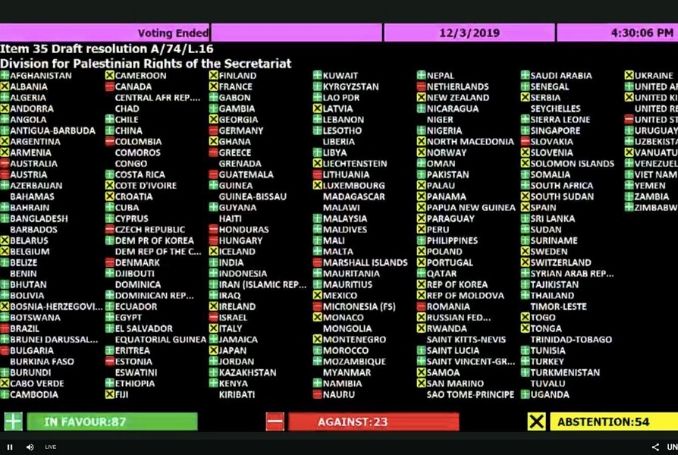
For the first time, 13 countries changed their longstanding positions and voted against a pro-Palestine measure at the United Nations on Tuesday.
Germany, the Czech Republic, Austria, Bulgaria, Denmark, Estonia, Greece, Lithuania, Netherlands, Romania, Slovakia, Brazil, and Colombia voted against the annual resolution regarding the “Division for Palestinian Rights of the Secretariat”, according to the Times of Israel.
They had previously abstained on the vote.
The resolution, which includes a call to halt to illegal Israeli settlements being constructed in the occupied West Bank, still passed with a large majority voting in favor.
The Palestinian representative told the council: “If you protect Israel, it will destroy you all.” He also said Israel’s character as a Jewish state is “shameless racism”.
The New York-based Division for Palestinian Rights oversees the Committee on the Exercise of the Inalienable Rights of the Palestinian People.
The resolution was co-sponsored by Comoros, Cuba, Indonesia, Jordan, Kuwait, Lao People’s Democratic Republic, Qatar, Saudi Arabia, Senegal, the United Arab Emirates, and Yemen.
The UK, France, and Spain abstained, as they do every year, allowing the resolution to pass with a vote of 87-54, with 21 other abstentions.
The General Assembly adopted five resolutions on the question of Palestine and the Middle East, including one calling on the Member States not to recognize any changes to the pre-1967 borders, including with regards to Jerusalem, other than those agreed by the parties through negotiations.
A Second Whistle Blown on the OPCW’s Doctored Report
By Jeremy Salt | American Herald Tribune | December 3, 2019
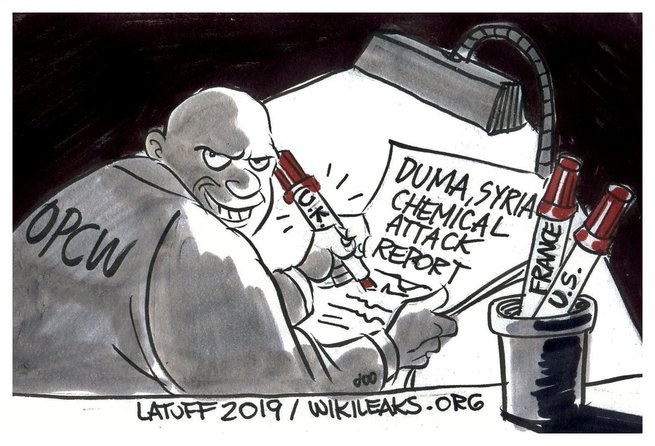
Another whistleblower leak has exposed the fraudulent nature of the Organization for the Prevention of Chemical Weapons (OPCW) report on the alleged chemical weapons attack in the Syrian city of Douma, close to Damascus, on April 7 last year.
The first leak came from the Fact-Finding Mission’s engineering sub-group. After investigating the two sites where industrial gas cylinders were found in Douma and taking into account the possibility that the cylinders had been dropped from the air it concluded that there was a “higher probability” that both cylinders were placed at both sites by hand. This finding was entirely suppressed in the final report.
The engineering sub-group prepared its draft report “for internal review” between February 1-27, 2018. By March 1 the OPCW final report had been approved, published and released, indicating that the engineers’ findings had not been properly evaluated, if evaluated at all. In its final report the OPCW, referring to the findings of independent experts in mechanical engineering, ballistics and metallurgy, claimed that the structural damage had been caused at one location by an “impacting object” (i.e. the cylinder) and that at the second location the cylinder had passed through the ceiling, fallen to the floor and somehow bounced back up on to the bed where it was found.
None of this was even suggested by the engineers. Instead, the OPCW issued a falsified report intended to keep alive the accusation that the cylinders had been dropped by the Syrian Air Force.
Now there is a second leak, this time an internal email sent by a member of the Fact-Finding Mission (FFM) on June 22, 2018, to Robert Fairweather, the British career diplomat who was at the time Chief of Cabinet at the OPCW, and copied to his deputy, Aamir Shouket. The writer claims to have been the only FFM member to have read the redacted report before its release. He says it misrepresents the facts: “Some crucial facts that have remained in the redacted version have morphed into something quite different from what was originally drafted.”
The email says the final version statement that the team “has sufficent evidence to determine that chlorine or another reactive chlorine-containing chemical was likely released from the cylinders is highly misleading and not supported by the facts.” The writer states that the only evidence is that some samples collected at locations 2 and 4 (where the gas cylinders were found) had been in contact with one or more chemicals that contain a reactive chlorine atom.
“Such chemicals,” he continues, “could include molecular chlorine, phosgene, cyanogen chloride, hydrochloric acid, hydrogen chloride or sodium hypochlorite (the major element in household chlorine-based bleach.” Purposely singling out chlorine as one of the possibilities was disingenuous and demonstrated “partiality” that negatively affected the final report’s credibility.
The writer says the final report’s reference to “high levels of various chlorinated organic derivatives detected in environmental samples” overstates the draft report’s findings. “In most cases” these derivatives were present only in part per billion range, as low as 1-2 ppb, which is essentially trace qualitiea.” In such microscopic quantities, detected inside apartment buildings, it would seem, although the writer only hints at the likelihood, that the chlorine trace elements could have come from household bleach stored in the kitchen or bathroom.
The writer notes that the original draft discussed in detail the inconsistency between the victims’ symptoms after the alleged attack as reported by witnesses and seen on video recordings. This section of the draft, including the epidemiology, was removed from the final version in its entirety. As it was inextricably linked to the chemical agent as identified, the impact on the final report was “seriously negative.” The writer says the draft report was “modified” at the behest of the office of Director-General, a post held at the time by a Turkish diplomat, Ahmet Uzumcu.
The OPCW has made no attempt to deny the substance of these claims. After the engineers’ report made its way to Wikileaks its priority was to hunt down the leaker. Following the leaking of the recent email, the Director-General, Fernando Arias, simply defended the final report as it stood.
These two exposures are triply devastating for the OPCW. Its Douma report is completely discredited but all its findings on the use of chemical weapons in Syria must now be regarded as suspect even by those who did not regard them as suspect in the first place. The same shadow hangs over all UN agencies that have relied on the OPCW for evidence, especially the UN’s Independent International Commission of Inquiry on the Syrian Arab Republic, an arm of the OHCHR (Office of the High Commissioner for Human Rights).
This body is closely linked to the OPCW and while both mostly hide the sources of their information it is evident that where chemical weapons allegations have been made, the commission of inquiry has drawn on the OPCW.
As of January 2018, the commission reported on 34 “documented incidents” of chemical weapons use by various parties in Syria. It held the Syrian government responsible for 23 of them and, remarkably, did not hold the armed groups responsible even for one, despite the weight of evidence showing their preparation and use of such weapons over a long period of time.
The commission has made repeated accusations of chlorine barrel bombs being dropped by government forces. On the worst of the alleged chemical weapons attacks, on August 21, 2013, in the eastern Ghouta district just outside Damascus, it refers to sarin being used in a “well-planned indiscriminate attack targetting residential areas [and] causing mass casualties. The perpetrators likely had access to the Syrian military chemical weapons stockpile and expertise and equipment to manipulate large amounts of chemical weapons.”
This is such a travesty of the best evidence that no report by this body can be regarded as impartial, objective and neutral. No chemical weapons or nerve agents were moved from Syrian stocks, according to the findings of renowned journalist Seymour Hersh. The best evidence, including a report by Hersh (‘The Red Line and the Rat Line,’ London Review of Books, April 17, 2014), suggests a staged attack by terrorist groups, including Jaysh al Islam and Ahrar al Sham, who at the time were being routed in a government offensive. The military would have had no reason to use chemical weapons: furthermore, the ‘attack’ was launched just as UN chemical weapons inspectors were arriving in the Syrian capital and it is not even remotely credible that the Syrian government would have authorized a chemical weapons attack at such a time.
Even the CIA warned Barack Obama that the Syrian government may not have been/probably was not responsible for the attack and that he was being lured into launching an air attack in Syria now that his self-declared ‘red line’ had been crossed. At the last moment, Obama backed off.
It remains possible that the victims of this ‘attack’ were killed for propaganda purposes. Certainly, no cruelty involving the takfiri groups, the most brutal people on the face of the planet, can be ruled out. Having used the occasion to blame the Syrian government, the media quickly moved on. The identities of the dead, many of them children, who they were, where they might have been buried – if in fact they had been killed and not just used as props – were immediately tossed into the memory hole. Eastern Ghouta remains one of the darkest unexplained episodes in the war on Syria.
The UN’s Syria commission of inquiry’s modus operandi is much the same as the OPCW’s. Witnesses are not identified; there is no indication of how their claims were substantiated; the countries outside Syria where many have been interviewed are not identified, although Turkey is clearly one; and where samples have had to be tested, the chain of custody is not transparent.
It is worth stepping back a little bit to consider early responses to the OPCW report on Douma. The Syrian government raised a number of questions, all of them fobbed off by the OPCW. Russia entered the picture by arranging a press conference for alleged victims of the ‘attack’ at the OPCW headquarters in the Hague. They included an 11-year-old boy, Hassan Diab, who said he did not know why he was suddenly hosed down in the hospital clinic, as shown in the White Helmets propaganda video.
All the witnesses dismissed claims of a chemical weapons attack. Seventeen countries (Australia, Bulgaria, Canada, the Czech Republic, Denmark, Estonia, France, Germany, Iceland, Italy, Latvia, Lithuania, the Netherlands, Poland, Slovakia, the United Kingdom and the US) then put out a joint statement (April 26, 2018) expressing their full support for the OPCW report and dismissing the “so-called” information session at the Hague as a Russian propaganda exercise. Their statement claimed the authenticity of the information in the OPCW report was “unassailable.”
Russia followed up with a series of questions directed at the OPCW’s technical secretariat. It noted that the OPCW report did not mention that samples taken from Douma were “split” in the OPCW’s central laboratory in the Netherlands and not in the Syrian Arab republic. Fractions of samples were handed to Syria only after six months of insistent pressure (OPCW response: its terms of reference provided for Syria to be provided with samples “to the extent possible” but do not specify when or where samples should be ‘split’).
Russia also referred to the collection of 129 samples and their transfer to OPCW-designated laboratories. 31 were selected for the first round of analysis and an additional batch of 13 sent later. Of the 129 samples 39 were obtained from individuals living outside territory controlled by the Syrian army. Of 44 samples analyzed 33 were environmental and 11 biomedical: of the 44, 11 (four environmental and seven biomedical) were obtained from alleged witnesses.
As remarked by the Russian Federation, the OPCW report does not explain the circumstances in which these samples were obtained. Neither is there any information on the individuals from whom they were taken; neither is there any evidence demonstrating compliance with the chain of custody (OPCW response: there was respect for the chain of custody, without this being explained; the “standard methodology” in collecting samples was applied, without details being given. It stressed the need for privacy and the protection of witness identities).
Russia observed that the samples were analyzed in two unnamed OPCW laboratories and on the evidence of techniques and results, it raised the question of whether the same laboratories had been used to investigate earlier ‘incidents’ involving the alleged use of chlorine. Of the 13 laboratories that had technical agreements with the OPCW, why were samples analyzed at only two, apparently the same two as used before? Russia also observed that of the 33 environmental samples tested for chlorinated products, there was a match (bornyl chloride) in only one case.
Samples taken from location 4, where a gas cylinder was allegedly dropped from the air, showed the presence of the explosive trinitrotoluene, leading to the conclusion that the hole in the roof was made by an explosion and not by a cylinder falling through it (OPCW response: the Fact-Finding Mission did not select the labs and information about them is confidential. As there had been intense warfare for weeks around location four, the presence of explosive material in a broad range of samples was to be expected but this did not – in the OPCW view – lead to the conclusion that an explosion caused the hole in the roof).
Russia pointed out that the FFM interviewed 39 people but did not interview the actual witnesses of the ‘incident’ inside the Douma hospital who appeared and were easily identifiable in the staged videos (OPCW response: the secretariat neither confirms nor denies whether it interviewed any of the witnesses presented by Russia at the OPCW headquarters “as any statement to that effect would be contrary to the witness protection principles applied by the secretariat”).
Russia also pointed out the contradictions in the report on the number of alleged dead. In one paragraph the FFM says it could not establish a precise figure for casualties which “some sources” said ranged between 70 and 500. Yet elsewhere “witnesses” give the number of dead as 43 (OPCW response: the specific figure of 43 was based on the evidence of “witnesses” who claimed to have seen bodies at different locations).
Russia also pointed out that no victims were found at locations 2 and 4, where the ventilation was good because of the holes in the roof/ceiling. Referring to location 2, it asked how could chlorine released in a small hole from a cylinder in a well-ventilated room on the fourth floor have had such a strong effect on people living on the first or second floors? (OPCW response: the FFM did not establish a correlation between the number of dead and the quantity of the toxic chemical. In order to establish such a correlation, factors unknown to the FFM – condition of the building, air circulation and so on – would have had to be taken into account. It does not explain why this was not attempted and how it could reach its conclusions without taking these “unknown factors” into account).
Finally, Russia raised the question of the height from which the cylinders could have been dropped. It referred to the lack of specific calculations in the OPCW report. The ‘experts’ who did the simulation did not indicate the drop height. The charts and diagrams indicated a drop height of 45-180 meters. However, Syrian Air Force helicopters do not fly at altitudes of less than 2000 meters when cruising over towns because they would come under small arms fire “at least” and would inevitably be shot down.
Furthermore, if the cylinders had been dropped from 2000 meters, both the roof and the cylinders would have been more seriously damaged (OPCW response: there were no statements or assumptions in the FFM report on the use of helicopters or the use of other aircraft “or the height of the flight. The FFM did not base its modeling on the height from which the cylinders could have been dropped. “In accordance with its mandate,” the FFM did not comment on the possible altitude of aircraft. The OPCW did not explain why these crucial factors were not taken into account).
In its conclusion, Russia said there was a “high probability” that the cylinders were placed manually at locations 2 and 4 and that the factual material in the OPCW report did not allow it to draw the conclusion that a toxic chemical had been used as a weapon. These conclusions have now been confirmed in the release of information deliberately suppressed by the OPCW secretariat.
As the leaked material proves, its report was doctored: by suppressing, ignoring or distorting the findings of its own investigators to make it appear that the Syrian government was responsible for the Douma ‘attack’ the OPCW can be justly accused of giving aid and comfort to terrorists and their White Helmet auxiliaries whom – the evidence overwhelmingly shows – set this staged ‘attack ’up.
Critical evidence ignored by the OPCW included the videoed discovery of an underground facility set up by Jaysh al Islam for the production of chemical weapons. All the OPCW said was that the FFM inspectors paid on-site visits to the warehouse and “facility” suspected of producing chemical weapons and found no evidence of their manufacture. There is no reference to the makeshift facility found underground and shown in several minutes of video evidence.
Since the release of the report, the three senior figures in the OPCW secretariat have moved/been moved on. The Director-General at the time, Hasan Uzumlu, a Turkish career diplomat, stepped out of the office in July 2018: Sir Robert Fairweather, a British career diplomat and Chief of Cabinet at the OPCW, was appointed the UK’s special representative to Sudan and South Sudan on March 11, 2019: his deputy, Aamir Shouket, left the OPCW in August 2018, to return to Pakistan as Director-General of the Foreign Ministry’s Europe division. The governments which signed the statement that the evidence in the OPCW report was “unassailable” remain in place.
Jeremy Salt has taught at the University of Melbourne, Bosporus University (Istanbul) and Bilkent University (Ankara), specialising in the modern history of the Middle East. His most recent book is “The Unmaking of the Middle East. A History of Western Disorder in Arab Lands” (Berkeley: University of California Press, 2008.)
NATO troops head for Poland ‘to deter Russian offensive actions’
RT | March 25, 2017
At least 1,350 American, British and Romanian soldiers have been sent to Poland from a base in Germany. US commanders said that the troops were ready “to deter Russian aggressive actions.”
The US, British and Romanian soldiers left the Rose Barracks military base in Vilseck, western Germany, for Poland where they are expected take part in NATO’s mission. The troops are “fully prepared to deter Russian offensive actions,” US Colonel Patrick Ellis said at the departure ceremony on Saturday.
“As a result of Russia’s aggressive actions and in light of the changing and evolving security environment, at the Warsaw summit in July 2016 NATO members agreed to strengthen our deterrence and defensive posture,” US Major General Timothy P. McGuire said.
The NATO group is to be stationed in the town of Orzysz, 220 kilometers northeast of the capital, Warsaw, according to Reuters.
NATO troops in Estonia
Also on Saturday, NATO’s heavy armored vehicles of the French armed forces were delivered to Estonia, according to a video published by the General Staff of the Estonian Defense Forces.
France’s heavy armored vehicles include Leclerc tanks and VBCI infantry fighting vehicles, as well as dozens of VAB armored vehicles, a spokesman of the 1st Infantry Brigade said, according to the Kuulutaja newspaper.
The UK is to deliver Challenger 2, Titan and Trojan tanks to Estonia as well as self-propelled artillery mounts AS90, Warrior infantry fighting vehicles and reconnaissance drones, he added.
The battalion will be stationed in the military town of Tapa and will interact with the first infantry brigade of the Estonian Defense Forces.
The alignment of forces in Estonia is planned to finish in early April. By that time, Estonia is to host 800 soldiers from the UK and around 300 soldiers from France. The French group is to spend some eight months in the Baltic country. After that, Danish soldiers are expected to replace them.
NATO leaders agreed to deploy four multinational battalions to Poland as well as Estonia, Lithuania and Latvia on July 8 at the summit in Warsaw.
Russia has repeatedly criticized NATO’s military buildup along its borders, seen as a threat to national security.
In February, Russian President Vladimir Putin blamed NATO for provoking a conflict with Moscow and using its “newly-declared official mission to deter Russia” as a pretext.
Speaking at the Munich Security Conference in February, Russian Foreign Minister Sergey Lavrov noted that “NATO’s expansion has led to an unprecedented level of tension over the last 30 years in Europe.”
Moscow has condemned the new US ground-based missile defense system in Eastern Europe and increased presence of NATO vessels in the Black Sea.
NATO’s scaremongering about ‘Russia threat’ to Baltic States ‘is all about money’
RT | March 2, 2017
The US security establishment is trying to justify its existence, says Daniel McAdams of the Ron Paul Peace Institute, commenting on a new report which lists how NATO can help the Baltic States counter Russian ‘hybrid warfare.’
The American global policy think-tank, the RAND Corporation, published a report that claims NATO should do more to counter the potential Russian threat and strengthen the Baltic countries’ forces. The US government-funded body issued a report titled “Hybrid Warfare in the Baltics: Threats and Potential Responses.”
The document raises concern over “Russian use of “hybrid warfare” best understood as covert or deniable activities, supported by conventional or nuclear forces, to influence the domestic politics of target countries.”
The author of the report, Andrew Radin claims “these tactics are of particular concern in the Baltic countries of Estonia and Latvia, which have significant Russian-speaking minorities.” He warns that there is concern Russia will seek to use these minorities to gain influence in the region, “use covert action to seize territory, use subversion to justify a conventional attack, or otherwise use deniable or covert means to gain influence in the Baltics and undermine the EU and NATO.”
RT discussed the report with McAdams and asked him why potential “Russian aggression” is in the spotlight again. Is there a real threat?
In his view, what we are seeing is just another example of the national security establishment in the US “having to justify its existence.”
“The report itself outlines many things that NATO has to do to help the Baltics. The Baltics are absolutely irrelevant to the security of NATO. Their only relevance is geographic. They are close to Russia. Therefore, NATO can hold exercises on Russia’s border to provoke Russia. As far as the Baltics, look at Latvia, for example, if it is so concerned about Russian warfare or hybrid warfare, why do they spend 0.9 percent of their GDP on defense? They are clearly not worried. It really is just a ploy to get more free things from NATO. And for NATO to keep itself alive after it should have been shut down,” McAdams said.
In his opinion, “hybrid warfare” – the report refers to – is a term used when there’s no evidence that Russia has done anything wrong.
It was hybrid warfare when Russia “invaded Ukraine.” And that is just because we didn’t see any Russian military in Ukraine. It was hybrid warfare with “the little green men” in Crimea. Well, those little green men in Crimea were already there legally as part of the leased base in Sevastopol. All of these things are made up, it’s part of NATO’s ongoing aggression toward Russia, provocation of Russia and it is desperate to keep itself alive, to keep its budgets rising,” the analyst said. “And sadly, unfortunately, we are seeing that the US president who was rightly critical of NATO, calling it outdated, said in his recent speech to Congress that he loves NATO and thinks it’s great. So, unfortunately, it looks like it is going to be propped up for a while longer. And yes, it is about money,” he added.
Germany to help Baltic states establish Russian-language media
Press TV – February 28, 2017
Germany plans to help Estonia, Latvia, and Lithuania establish Russian-language media outlets to counter the “disinformation” allegedly being spread by Russian channels broadcasting in the region.
The plan was announced by German Foreign Ministry spokesman Martin Schaefer, RT reported on Tuesday.
The announcement came ahead of German Foreign Minister Sigmar Gabriel’s trip to the Baltic states and Sweden, which is due to take place this week.
“During his trip, Mr. Gabriel will also employ what we already started last year in the Baltic states, which is — as we say in new German — handling Russian ‘fake news’ together with appropriate partners,” Schaefer said on Monday.
He added that the main goal of the initiative was to launch Russian-language radio and TV channels, which will be “attractive to Russian speakers living in the three Baltic states” in order to produce news “in a different way” from the Russian media.
The United States, too, recently announced plans to launch a Russian-language television news channel. The US has long accused Russian media of propagating “fake news.” Such allegations have also been leveled by European governments, which are concerned about alleged Russian attempts to influence their elections in much the same way as the US has said Moscow influenced its recent presidential vote.
Western ties with Russia have plummeted significantly in recent years, particularly following Crimea’s separation from Ukraine and reunification with the Russian Federation after a referendum not authorized by Kiev.
Military build-ups close to the Russian borders, including in the Baltic countries, have also been a major source of tension.
US pledges $68mn NATO investment into Estonian military bases
RT | August 8, 2015
The US will invest $68 million to develop military base infrastructure in Estonia, as part of European Reassurance Initiative (ERI) that offers Eastern European countries additional military aid and training to better serve NATO interests near the Russian borders.
The announcement of additional funding comes as a US delegation visited the tiny Baltic state to meet Estonian Defense Minister Sven Mikser. Headed by Congressman Rob Wittman, the US side promised to invest in Estonia’s military bases in Amari and Tapa.
The development project will be implemented “through NATO’s support program of eastern countries European Reassurance Initiative (ERI),” Estoinia’s Ministry of Defense said in a statement.
The Soviet-built army base at Tapa is one of the Estonian Army’s largest military bases. It is excellent for live artillery firing training and maneuvers. The Soviet Amari Air Base will serve as a NATO airfield in the future.
“Head of the [US] delegation… Rob Wittman said that the presence of US troops was important, because the rotation of US soldiers in Estonia would help them gain experience and knowledge of the situation in the region,” the Ministry added.
The ERI, funded through Congress, was introduced by President Barack Obama last year and is designed to keep Russia in place after its alleged “aggression” in the Ukrainian conflict. The program aims to create a permanent US air, land, and sea presence in the region, especially in Central and Eastern Europe.
Since June, Washington has pledged to develop military training facilities in six countries on or close to Russia’s borders including Latvia, Estonia and Lithuania, as well as Poland, Bulgaria and Romania. In fact, news from Estonia comes the same day as Polish national daily Rzeczpospolita reported that a former Polish military base in the town of Ciechanow may now be used to house American troops.
READ MORE: US to share military base in central Poland – Polish media
Austrian Institute Clarifies True Costs of the EU’s Anti-Russian Sanctions
Sputnik – 03.07.2015
The Austrian Institute of Economic Research (WIFO) published a monograph clarifying the projected short and long-term costs of anti-Russian sanctions to the EU 28 plus Switzerland. A summary of the report published Friday has confirmed that Europe as a whole expects €92.34 billion in long-term losses, along with over 2.2 million lost jobs.
While the report attempts to downplay somewhat the losses attributed to sanctions, noting that politicized export restrictions must be considered together with the ongoing Russian recession and other factors, the figures speak for themselves.
The report projects an “observed decline in exports and tourism expenditures of €34 billion value added in the short run, with employment effects on up to 0.9 million people.” Switching to a longer-term perspective, the report estimates “the economic effects increas[ing] to up to 2.2 million jobs (around 1 percent of total employment) and €92 billion (0.8 percent of total value added), respectively.”
Commenting on the geographical disbursement of the economic and jobs losses, WIFO’s report shows that “geographical closeness highly correlates with the relative size of the effects at the national level, with the Baltic countries, Finland and the Eastern European countries being hit above the EU average of 0.3 percent of GDP in the short and 0.8 percent in the long run.” The report also notes that Germany, which accounts for nearly 30 percent of all EU 27 exports to Russia, has been hit the hardest in absolute terms, and is projected to lose €23.38 billion in losses in the long term. Italy is second, with €10.93 billion in projected losses. France rounds out the top three with €7.92 billion in losses.
The study’s figures also show that Estonia is the single most heavily affected country in both the short and the long term, with the country suffering a €800 million (4.91 percent) and €2.1 billion (13.24 percent) decline, respectively. Estonia is followed by Lithuania (-6.37 percent long term), Cyprus (-3.25 percent), Latvia (-1.87 percent), and the Czech Republic (-1.53 percent).
In employment terms, Estonia, Lithuania and Cyprus are also the hardest hit in percentage terms, and are projected to suffer 16.3 percent, 10.84 percent and 4.21 percent losses, respectively. In absolute terms, Germany (losing 395,000 jobs) Poland (300,000), and Italy (200,000) have been the hardest hit; Spain, Lithuania and Estonia are projected to lose between 100,000 and 190,000 jobs.
As for the economic sectors most heavily impacted, the WIFO study found that agriculture and food products, metal products, machine-building, vehicles, and manufacturing-related services are hardest hit in the short term, with construction, business services, and wholesale and retail trade services also projected to suffer disproportionately in the long-term.
Speaking to Radio Sputnik about the report, WIFO economist Oliver Fritz noted that while EU politicians still hope that the sanctions will have some effect on Russian policy, pressure is building on them to change their policy, since the economic consequences are rapidly beginning to add up.
While the economist noted that he does not see the sanctions being lifted in the short term, with German Chancellor Angela Merkel successfully keeping other EU nations in line, Fritz noted that as losses mount, EU politicians may eventually decide to consider rethinking their decisions.
Last month, WIFO conducted research for Europe’s ‘Leading European Newspaper Alliance’, estimating up to €100 billion in losses if anti-Russian sanctions remain in place.
Since March 2014, the United States, European Union, and other Western countries have placed sanctions on Russia’s banking, defense and energy sectors over Moscow’s alleged role in the Ukrainian crisis. In August, Moscow imposed a year-long food embargo on the countries that had sanctioned it. Last month, the EU’s foreign ministers agreed to extend sanctions against Russia until January 31, 2016.
Russia has better things to do than start WW3
By Bryan MacDonald | RT | June 8, 2015
Vladimir Putin said this weekend that “Russia would attack NATO only in a mad person’s dream.” Unfortunately, there are a lot of mad people working in western politics and media.
If the G7 were based on GDP, adjusted for purchasing power, it would be comprised of the USA, China, India, Japan, Russia, Germany and Brazil. Such a lineup would have remarkable clout. Members would boast 53% of the globe’s entire GDP and the planet’s 3 genuine military superpowers would be represented.
The problem for Washington is that this putative G7 might actually be a forum for a real debate about the world order.
Instead of a real G7, we have a farce. An American dominated talking shop where the US President allows ‘friendly’ foreign leaders to tickle his belly for a couple of days. There is no dissent. Washington’s dominance goes unquestioned and everyone has a jolly time. Especially since they kicked out Russia last year – Vladimir Putin was the only guest who challenged the consensus.
However, the problem is that this ‘convenient’ G7 is way past its sell-by-date. The days when its members could claim to rule the world economically are as distant as the era of Grunge and Britpop. Today, the G7 can claim a mere 32% of the global GDP pie. Instead of heavyweights like China and India, we have middling nations such as Canada and Italy, the latter an economic basket case. Canada’s GDP is barely more than that of crisis-ridden Spain and below that of Mexico and Indonesia.
Yet, the Prime Minister of this relative non-entity, Stephen Harper, was strutting around Bavaria all weekend with the confidence of a man who believed his opinion mattered a great deal. Of course, Harper won’t pressure Obama. Rather, he prefers to – metaphorically – kiss the ring and croon from the same hymn sheet as his southern master.
NATO and the G7 – 2 sides of 1 coin?
There was lots of talk of “Russian aggression” at the G7. This was hardly a surprise given that 6 of the 7 are also members of NATO, another body at which they can tug Washington’s forelock with gay abandon. Obama was at it, David Cameron parroted his guru’s feelings and Harper was effectively calling for regime change in Russia. It apparently never occurred to the trio that resolving their issues with Russia might be easier if Putin had been in Bavaria? The knee-jerk reaction to remove Russia from the club was hardly conducive to dialogue.
Meanwhile, Matteo Renzi stayed fairly quiet. It has been widely reported that the Italian Prime Minister privately opposes the EU’s anti-Russia sanctions due to the effects on Italy’s struggling economy. Also, Renzi’s next task after the G7 summit is to welcome Putin to Rome.
With that visit in mind, Putin gave an interview to Italy’s Il Corriere della Sera where he essentially answered the questions that Obama, Cameron and Harper could have asked him if they hadn’t thrown their toys out of the pram and excluded Russia from the old G8. Putin stressed that one should not take the ongoing “Russian aggression” scaremongering in the West seriously, as a global military conflict is unimaginable in the modern world. The Russian President also, fairly bluntly, stated that “we have better things to be doing” (than starting World War 3).
Putin also touched on a point many rational commentators have continuously made. “Certain countries could be deliberately nurturing such fears,” he added, saying that hypothetically the US could need an external threat to maintain its leadership in the Atlantic community. “Iran is clearly not very scary or big enough” for this, Putin noted with irony.
A world of ‘goodies’ and ‘baddies’
For Washington to maintain its huge military spending, it has to keep its citizens in a state of high alarm. Otherwise, they might insist that some of the armed forces’ cash is diverted to more productive things like hospitals and schools. These services, of course, are not very profitable for weapons manufacturers or useful for newspaper and TV editors looking for an intimidating narrative.
Following the collapse of the USSR, Russia was too weak and troubled to be a plausible enemy. Aside from its nuclear arsenal – the deployment of which would only mean mutual destruction – the bear’s humbled military was not a credible threat. Instead, the focus of warmonger’s venom shifted to the Middle East and the Balkans, where Saddam Hussein, Muammar Gaddafi, Slobodan Milosevic and Osama Bin Laden kept the general public’s attention occupied for roughly a decade and a half. However, they are now all dead and pro-war propaganda needs a new bad guy to play the Joker to America’s Batman.
Kim Jong-un looked promising for a while. Nevertheless, the problem here is that North Korea is too unpredictable and could very feasibly retaliate to provocations. Such a reaction could lead to a nuclear attack on Seoul, for instance, or draw Washington into a conflict with China. Even for neocons, this is too risky. Another candidate was Syria’s Basher Al-Assad. Unfortunately, for the sabre rattlers, just as they imagined they had Damascus in their sights, Putin kyboshed their plan. This made Putin the devil as far as neocons are concerned and they duly trained their guns in his direction.
Russia – a Middle East/North Africa battleground?
In the media, it is noticeable how many neocon hacks have suddenly metamorphosed from Syria ‘experts’ into Russia analysts in the past 2 years. Panda’s Mark Ames (formerly of Moscow’s eXILE ) highlighted this strange phenomenon in an excellent recent piece. Ames focused on the strange case of Michael Weiss, a New York activist who edits the anti-Russia Interpreter magazine (which is actually a blog). The Interpreter is allegedly controlled by Mikhail Khodorkovsky and a shadowy foundation called Herzen (not the original Amsterdam-based Herzen) of which no information is publicly available.
Weiss was a long-time Middle East analyst, who promoted US intervention to oust Assad. Suddenly, shortly before the initial Maidan disturbances in Kiev, he re-invented himself as a Russia and Ukraine ‘expert,’ appearing all over the US media (from CNN to Politico and The Daily Beast ) to deliver his ‘wisdom.’ This is despite the fact that he appears to know very little about Russia and has never lived there. The managing editor of The Interpreter is a gentleman named James Miller, who uses the Twitter handle @millerMENA (MENA means Middle East, North Africa). Having been to both, I can assure you that Russia and North Africa have very little in common.
Weiss and Miller are by no means unusual. Pro-War, neocon activists have made Russia their bete noir since their Syria dreams were strangled in infancy. While most are harmless enough, this pair wields considerable influence in the US media. Naturally, this is dressed up as concern for Ukraine. In reality, they care about Ukraine to about the same extent that a carnivore worries about hurting the feelings of his dinner.
Russia’s military policy is “not global, offensive, or aggressive,” Putin stressed, adding that Russia has “virtually no bases abroad,” and the few that do exist are remnants of its Soviet past. Meanwhile, it would take only 17 minutes for missiles launched from US submarines on permanent alert off Norway’s coast to reach Moscow, Putin said, noting that this fact is somehow not labeled as “aggression” in the media.
Decline of the Balts
Another ongoing problem is the Baltic States. These 3 countries have been unmitigated disasters since independence, shedding people at alarming rates. Estonia’s population has fallen by 16% in the past 25 years, Latvia’s by 25% and Lithuania’s by an astonishing 32%. Political leaders in these nations use the imaginary ‘Russian threat’ as a means to distract from their own economic failings and corruption. They constantly badger America for military support which further antagonizes the Kremlin, which in turn perceives that NATO is increasing its presence on Russia’s western border. This is the same frontier from which both Napoleon and Hitler invaded and Russians are, understandably, paranoid about it.
The simple fact is that Russia has no need for the Baltic States. Also, even if Moscow did harbor dreams of invading them, the cost of subduing them would be too great. As Russia and the US learned in Afghanistan and America in Iraq also, in the 21st century it is more-or-less impossible to occupy a population who don’t want to be occupied. The notion that Russia would sacrifice its hard-won economic and social progress to invade Kaunas is, frankly, absurd.
The reunification of Crimea with Russia is often used as a ‘sign’ that the Kremlin wishes to restore the Soviet/Tsarist Empire. This is nonsense. The vast majority of Crimean people wished to return to Russia and revoke Nikita Khrushchev’s harebrained transfer of the territory to Ukraine. Not even the craziest Russian nationalist believes that most denizens of Riga or Tallinn wish to become Russian citizens.
Putin recalled that it was French President Charles de Gaulle who first voiced the need to establish a “common economic space stretching from Lisbon to Vladivostok.” As NATO doubles down on its campaign against Moscow, that dream has never looked as far off.
Bryan MacDonald is an Irish writer and commentator focusing on Russia and its hinterlands and international geo-politics. Follow him on Facebook
Featured Video
No Threat Can Force Iran’s Surrender /Trita Parsi & Lt Cl Daniel Davis
or go to
Aletho News Archives – Video-Images
From the Archives
What is the Israeli Lobby in Australia Doing in Interfaith Dialogue?
By Ali Kazak | Dissident Voice | October 11, 2015
For years Israel and its lobby around the world have been trying to normalise their relations with Arabs and Muslims without solving the Palestine Question.
One of the methods they resorted to in the last few years is using human rights and community organizations such as interfaith dialogue and Multiculturalism to achieve this objective and to: isolate the Palestinians, marginalise the Palestine question, end Israel’s isolation, and prevent criticism of Israel, knowing that these organisations will be the first to stand against Israel’s violations, racial and religious discrimination.
The group responsible for this task in Australia is The Australia/Israel & Jewish Affairs Council (AIJAC); its Director of International & Community Affairs, Jeremy Jones is in charge of lobbying religious community organizations, specifically Muslims and Christians. Consequently he convened the Faith Communities for Reconciliation, founding participant in the Australian Partnership of Religious Organisations and the Australian National Dialogue of Christians, Muslims & Jews.
AIJAC is a private political propaganda group. It is recognised as the main Israeli lobby in Australia. It coordinates its activities and works intimately with the Israeli embassy in Canberra and different institutions in Israel. It is privately funded by some Jewish businessmen. It monitors closely Australian politicians, the media, ethnic and religious groups, (especially Arabs and Muslims), unions and academics on their stands towards Israel and the Palestine question. … continue
Blog Roll
 Aletho News
- The war of liberation of the Arab and Islamic peoples expands across the Gulf
- Envoy warns UN on Trump’s threat to ‘obliterate’ Iran’s civilian infrastructure
- The Larak Corridor: Iran’s Rial Gate With No US, No Israel, and No Way Around
- ‘Economic terrorism’: Steel facilities hit again in US-Israeli strike
- ‘War Crime’: Iran condemns attacks on Arak, Ardakan nuclear sites
- Two-thirds of Americans want quick end to Iran war even if goals unmet
- Trump to Give “Important Update on Iran” Wednesday in Prime-Time Speech
- Theodore Postol: Iran’s Missiles & Drones Were Underestimated
- Iran To Target Military Industrial-Tech Complex That Facilitated Gaza Genocide
- Collapsing Empire: The Resistance Disarms ‘Israel’
- If Americans Knew
- Israel wants US to bomb more of Iran’s civilian structures (113,000 is not enough) – Not a ceasefire Day 173
- Ann Coulter Rips Into Fox News for Iran War Coverage
- Joe Kent Urges Americans To Call White House and Congress To Object To Sending Troops Into Iran
- DNC Resolution to Reject AIPAC Funding Puts Democratic Leaders in the Hot Seat
- Swedish foundation to build 400 schools as over 650,000 Gaza children remain without education for 2 years
- Israeli army admits photshopping image of slain Lebanese journalist
- This is how Israel is systematically killing health workers under the cover of war in Lebanon
- Carrying life under fire: Israeli invasion of Lebanon leaves pregnant women facing deadly risks
- Champagne all around for the new death penalty (for Palestinians) law – Not a ceasefire Day 172
- Why are Palestinian books struggling to be seen on Amazon?
- No Tricks Zone
- New Study Finds Warming Saves Lives…Cold Temperatures 12 Times More Deadly Than Excess Heat
- German Science Blog Accuses PIK Climate Institute Of Hallucinating Climate Tipping Points
- Devastating Assessment Of Comirnaty Vaccine By Former Senior Pfizer Europe Toxicologist
- New Study: CO2 Is ‘Effectively Negligible’ As An Explanatory Climate Change Factor Since 2000
- Former Pfizer Toxicologist Dr. Helmut Sterz Tells Bundestag Hearing Pfizer Vaccine Should Have Never Been Approved
- Energy Expert: Germany’s Nuclear Phaseout Was A “500 Billion Euro Mistake”
- New Research: South Australia’s Mid-Holocene Sea Surface Temperatures Were 4°C Warmer Than Today
- Storing Green Energy To Last Germany 10 Days Would Require A 60-Million Tonne Battery
- New Studies: UK Sea Levels Were 4 Meters Higher Than Today During The Mid-Holocene
- Destructive Green New Deal: German Energy And Metal Group Warns Of Drastic Crisis
 Aletho News