12 minutes to understand the Yellow Vests Movement in France
Romain Majou | January 26, 2019
A video to make you understand what’s presently going on in France. 12 minutes to understand who are the Yellow Vests, what they are fighting for and if they really are violent.
Send me a message on my profile: https://www.facebook.com/romain.majou
Iran not accepting EU’s humiliating conditions on INSTEX: Judiciary chief
Press TV – February 4, 2019
Iran’s Judiciary Chief Ayatollah Sadeq Amoli Larijani says the Islamic Republic will never give in to humiliating conditions set by Europe for the enforcement of its new non-dollar mechanism aimed at facilitating trade with the Islamic Republic.
Addressing a meeting of high-ranking judicial officials on Monday, Iran’s top judge said, “After nine months of dawdling and negotiations, European countries have come up with a limited-capacity mechanism not for exchange of money with Iran, but to supply food and medicine.”
The European signatories to the 2015 nuclear agreement, officially known as the Joint Comprehensive Plan of Action (JCPOA), issued a joint statement on Thursday, announcing the launch of a long-awaited direct non-dollar payment mechanism meant to safeguard their trade ties with Tehran following Washington’s withdrawal from the nuclear deal and in the face of the “toughest ever” sanctions imposed by the United States against the Islamic Republic.
Following months-long preparations, the foreign ministers of France, Germany and Britain finally unveiled the mechanism, officially called the Instrument in Support of Trade Exchanges (INSTEX), after a summit in Bucharest, Romania.
Iran’s Judiciary chief further said, “European countries, which had promised to remain committed to Iran’s nuclear deal after the US withdrawal from it, have now restricted their efforts to INSTEX and have reportedly set two strange conditions for it to become effective.”
They have asked “Iran to join the FATF (the Financial Action Task Force) and start negotiations over its missile program,” before INSTEX enters into force, he added.
“These [European] countries must know that the Islamic Republic of Iran will by no means accept these humiliating conditions and will not give in to any demand in return for a small opening [in sanctions] like INSTEX,” Amoli Larijani emphasized.
He noted that today, European countries are moving in the same direction that the US had moved before “and we [the Iranian nation] must continue to stand fast as [we have] always [done].”
President Donald Trump withdrew the US in May from the landmark Iran nuclear agreement, reached between the Islamic Republic and the P5+1 group of countries in 2015, and decided to re-impose unilateral sanctions against Tehran.
Under the deal, Iran undertook to put limits on its nuclear program in exchange for the removal of nuclear-related sanctions.
Trump’s administration announced the re-imposition of the “toughest” sanctions ever against Iran’s banking and energy sectors with the aim of cutting off the country’s oil sales and crucial exports.
Iran’s nuclear chief said on Saturday that the establishment of the new mechanism to ease trade with Iran is a promising step, but noted the Europeans must act more swiftly and adopt final measures in this regard.
“The Europeans took a promising step in terms of economy and we hope that they will keep racing ahead on the same path,” the head of the Atomic Energy Organization of Iran (AEOI), Ali Akbar Salehi, told reporters.
Despite Washington’s withdrawal, Iran has not left the deal yet, but stressed that the remaining signatories to the agreement have to work to offset the negative impacts of the US pullout for Iran if they want Tehran to remain in it.
On Friday, China’s Foreign Ministry spokesman, Geng Shuang, appreciated the efforts made by European countries to uphold the JCPOA after the US withdrawal from the agreement.
“It (INSTEX) fully demonstrated the EU’s determination to uphold multilateralism. China firmly supports the continued cooperation between the EU and Iran to put the mechanism into operation as soon as possible and open it to third parties so as to promote normal economic and trade cooperation between the international community and Iran,” he said.
Goodbye ‘Freedom and Democracy’ – Hello ‘Rules-based International Order’
By Paul Carline | OffGuardian | February 2, 2019
The banner and the clarion call of western countries, and their own asserted legitimation – especially when they are engaging in illegal wars and coups – used to be “freedom and democracy”: the precious gift they were generously and selflessly offering to a backward world – or one allegedly in the ‘chains’ of Socialism/Communism. There was “Radio Free Europe”, for example, pushing out western liberal propaganda, primarily against the countries of the former Soviet Union.
The Washington-based “Freedom House” organisation, which claims to be independent, has around 150 staff members in Washington and in ‘field offices’ around the world. Its President is Michael J. Abramowitz, who before joining Freedom House in 2017, was director of the US Holocaust Memorial Museum’s Levine Institute for Holocaust Education. Before that, he was National Editor and then White House correspondent for the Washington Post. He is a member of the Council on Foreign Relations and a former fellow at the German Marshall Fund and the Hoover Institution. He is also a board member of the National Security Archive. The Board of Trustees is chaired by Michael Chertoff, Secretary of Homeland Security under George W. Bush and co-author of the USA Patriot Act.
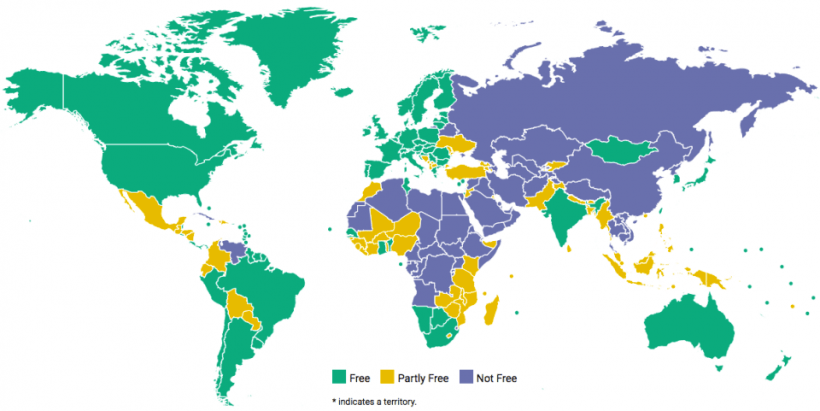
Since 1972, Freedom House, whose website sports a warm endorsement by none other than Francis Fukuyama, has produced an annual “Freedom in the World” global map (above), which divides the world into countries which are either “free”, “partly free”, or “not free”. The allegedly “free” countries are coloured green, the “partly free” ones a kind of muddy yellow, and the “not free” ones blue.
Its analysis of “freedom” covers “the electoral process, political pluralism and participation, the functioning of government, freedom of expression and belief, rights of association and organization, the rule of law, and personal autonomy and individual rights”. The word ‘democracy’ is not used in the ratings system, nor is it defined anywhere, but the 2018 analysis is headlined “Democracy in Crisis”.
According to Freedom House, in 2018 45% of the world (by country) or 39% (by population) was “free”, 30% (country) or 24% (population) was “partly free”, and 25%/37% “not free”. Countries are rated on a percentage points system. Sweden, which last year joined in the NATO ‘war games’ – despite not being a NATO member – is given a full 100 points, Canada 99, Uruguay 98, both Chile and the UK 94, France a completely undeserved 90, the USA 86 and Israel an unreal 79. By contrast, China scores 14, Iran 17, and Russia a mere 20, while Tibet and Syria are granted only 1 point each (no bias there). Almost incredibly, Ukraine scores 62 – allowing it to be rated as “partly free”! Very oddly, the FAQ section is available in only two languages – English and Ukrainian!
I suspect that the statement by Freedom House’s President, Michael J. Abramowitz, to the effect that: “A quarter-century ago, at the end of the Cold War, it appeared that totalitarianism had at last been vanquished and liberal democracy had won the great ideological battle of the 20th century”, must induce wry smiles – if not outright anger – in many Off-Guardian readers. Abramowitz predictably refers to “the rise of populist leaders who appeal to anti-immigrant sentiment and give short shrift to fundamental civil and political liberties” and describes “newcomer Emmanuel Macron” as a “centrist” who “handily” (interesting choice of words!) won the French presidency.
Depressingly predictable is his comment on China and Russia, which he labels “the world’s leading autocracies” and which he asserts “have seized the opportunity not only to step up internal repression but also to export their malign influence to other countries, which are increasingly copying their behaviour and adopting their disdain for democracy” (emphasis added; no mention of the massive ‘disdain for democracy’ in the USA, UK, and numerous members of the EU).
According to Abramowitz, “Democratic governments allow people to help set the rules to which all must adhere, and have a say in the direction of their lives and work!” If that were true, there would be lots of direct democracy in all those “free” countries. It’s true that there is some ‘direct democracy’, e.g. popular initiatives and referendums, in a few states of the USA and in a few European countries – with Switzerland far and away the best example, followed by Germany at the regional and local levels, thanks to the efforts over decades of its leading pro-democracy organisation “Mehr Demokratie”, which has been trying to have direct democratic rights established also at the national level, which would really allow the people to “help set the rules”. Germany’s “Basic Law” (it doesn’t have a proper constitution for reasons which I cannot go into here but which will be known to many) actually states: “All power derives from the people” (Article 20) and “State power is exercised by the people in elections and referendums” (emphasis added) – but successive governments have refused to enact the laws that would allow state-level referendums, presumably because they fear the “people power” that is the literal meaning of ‘democracy’.
Given subsequent developments, Kofi Annan’s 2001 Nobel Peace Prize acceptance speech now strikes a sour note:
“The obstacles to democracy have little to do with culture or religion, and much more to do with the desire of those in power to maintain their position at any cost. This is neither w new phenomenon nor one confined to any particular part of the world. People of all cultures value their freedom of choice and feel the need to have a say in the decisions affecting their lives”
In the 2002 UNDP World Development Report, Annan re-affirmed the true nature of democracy in these words:
“True democratization means more than elections. People’s dignity requires that they be free – and able – to participate in the formation and stewardship of the rules and institutions that govern them”.
According to Abramovitch’s definition, and that of Kofi Annan, there is zero genuine democracy in the U.K. (a purely representative system – especially one still using an outdated and wholly disreputable FPTP system, with rare referendums arranged by the government, which sets the question – is not a legitimate form of democracy).
We may also ask, in parenthesis as it were, who – if not the electorates – is “helping to set the rules”, for example in Europe specifically. As of July 2017, there were 11,327 registered lobby organisations in the EU, employing some 82,096 people – the equivalent of 50,326 full-time personnel – of which nearly 7,000 have access to the Parliament. In Germany there are around eight lobbyists – representing ‘outside’ interests – for every member of the national parliament – and the lobby registers are voluntary. Only seven countries (France, Ireland, Lithuania, Austria, Poland, Slovenia and the UK) have passed any laws on lobbying.
What is extremely interesting and telling is the general absence of references to ‘freedom and democracy’ by our so-called ‘leaders’. Those words have been replaced in the political lexicon by the now clearly favoured expression “the rules-based international order” – which doesn’t have quite the same ring, or the same connotations, as “freedom and democracy”.
One is forced to ask: whose order? whose rules? If Abramowitz is correct, and since we are privileged enough to live in a country which, if we are to believe its FH rating, is little short of perfect, we the people must have been involved in setting those rules. We should at least have been told what they mean! For example, what does ‘international’ mean in this context? It suggests a global compact – but when it is used it specifically excludes certain countries and regimes which we are led to believe are not part of, or indeed are allegedly trying to undermine, this new ‘order’.
Although the word ‘international’ is often taken to be a synonym for ‘global’ or ‘universal’, its literal meaning is ‘between nations’. The UN has of course long promulgated and endorsed all kinds of ‘universal’ rules (the ICC rules on aggression for instance) – many of which are routinely flouted by the countries which most loudly lay claim to being ‘democracies’ and loyal observers of the “rules-based international order”.
But we are now seeing a new type of literally ‘inter-national’ agreements being made in Europe, often merely between two governments at a time (with no democratic endorsement by either parliaments or people) and where the suspicion is that this is a new way of hiding from the general public what is really going on in Europe – specifically the step-by-step implementation of the “United States of Europe” project which dates from at least 1946.
There seems to be an undue haste to complete the creation of a unified military establishment that would not be answerable to the individual nation states which are contributing their forces (and infrastructure!) and which would also appear to include a much closer working relationship between military and police forces. Does the urgency have to do with the level of chaos in Europe and the threat – now materialised in the form of the “Yellow Vest” protests – of widespread civil unrest and potentially public revolt?
So Prime Minister Theresa May can pretend to the public that the ‘Brexit’ approved by a majority of voters will take place i.e. that Britain will “come out of” the EU, while at the same time, and largely in secret or behind closed doors in completely undemocratic meetings, the government is committing the entire UK military establishment, step by step, to the new ‘unified European defence establishment’. The UK enters into a special relationship with France (and thereby with the EU). France and Germany have just signed a new treaty – the Aachen Treaty – so does the UK automatically acquire the special relationship with Germany? And will this “two-step” approach eventually link all willing states (one could imagine Hungary, perhaps Italy and Greece also, not being so willing) in the ‘new European order’?
In struggling to understand the “rules-based international order” I found this definition by the RAND Corporation very helpful:
Since 1945, the United States has pursued its global interests through creating and maintaining international economic institutions, bilateral and regional security organizations, and liberal political norms; these ordering mechanisms are often collectively referred to as the international order.
In recent years, rising powers have begun to challenge aspects of this order. This report is part of a project, titled “Building a Sustainable International Order,” that aims to understand the existing international order, assess current challenges to the order, and recommend future US policies with respect to the order.
This report is the first of those and reflects the project team’s attempt to understand the existing international order, including how US decision makers have described and used the order in conducting foreign policy, as well as how academics have assessed the mechanisms by which the order affects state behaviour.
When discussing policy responses to a fraying international order, the first challenge is to understand what we mean by the term. Order has various meanings in the context of international politics, and specific orders can take many forms.1 For the purposes of this project, we conceive of order as the body of rules, norms, and institutions that govern relations among the key players in the international environment. An order is a stable, structured pattern of relationships among states that involves some combination of parts, including emergent norms, rulemaking institutions, and international political organizations or regimes, among others.
– RAND Corporation 2016, Understanding the Current International Order
This more recent observation was both insightful and amusing:
“The rules-based international order is being challenged, quite surprisingly, not by the usual suspects, but by its main architect and guarantor, the US,” Donald Tusk, the president of the European Council, said as the summit meeting got underway in Quebec’s picturesque resort town of La Malbaie on the banks of the St. Lawrence River.
The trans-Atlantic rift manifested itself in a behind-the-scenes debate about the wording of the traditional summit communiqué. The American side objected to including the phrase “rules-based international order,” even though it is boilerplate for such statements, according to two people briefed on the deliberations. The Europeans and Canadians were pushing back, but it remained unclear whether the Trump administration would ultimately sign the statement or be left on its own.
– NYT June 8, 2018 Michael D. Shear
So the ‘rules-based international order’ is, in reality, the expression of America’s “global interests”. Other parties – such as British and other governments – may be allowed to put on the mask of the Eagle, whilst claiming to be on the side of justice, truth, human rights … and yes, democracy. And since it’s a US construct, the US and its allies can feel free to ‘make it up as they go along’.
European firms ‘won’t dare’ use new EU payment system for trade with Iran out of fear of US
RT | February 1, 2019
A new mechanism to allow “legitimate trade” with Iran, which was set up by France, Germany, and the UK this week, doesn’t change anything for European companies, according to independent journalist Luc Rivet.
He told RT that European companies and others cannot feel confident that they could do business with Iran without being subject to US sanctions.
“I don’t know what companies will make use of that mechanism to sell to Iran,” he said, adding that it’s very dangerous for the companies if they are caught working in Iran.
Europe mentions that medical equipment could be sold through this way, says Rivet.
“Who produces this equipment? You think that Siemens will sell to Iran? Never, because they sell to America many other things as well… And Siemens is afraid of losing the American market.”
He explained that an “incredible number of companies” won’t have anything to do with Iran, including the banking sector, the oil and gas sector, and others.
Even small companies will hesitate to sell anything to Iran at risk of being caught, according to Rivet. They can do that through other channels, like via Turkey, he said.
The journalist added: “It’s much easier for Chinese and Russian companies to make deals with Iran. The Europeans are scared in an incredible way. The companies are afraid by ricochet of being in the eye of the storm with the Americans.”
“That’s very dangerous for European companies,” he repeated, adding: “I don’t know anybody who will dare to go with this Instex system.”
Moscow slams EU’s ‘arbitrary’ chemical-weapons sanctions, threatens to retaliate
RT | January 22, 2019
Russia has threatened to respond to “freshly invented” punitive measures imposed by the EU over the Skripal poisoning. Moscow says it’s an arbitrary punishment that disrespects established non-proliferation norms.
The accusations that gave rise to the sanctions “don’t stand up to criticism,” the Russian Foreign Ministry said in a statement. “We reserve the right to retaliatory measures in response to this unfriendly act.”
On Monday, Brussels used its new powers against four Russian nationals over the March 2018 poisoning of double agent Sergei Skripal and his daughter Yulia in the UK.
Alexander Petrov and Ruslan Boshirov (named in the sanctions ruling as Russian intelligence agents Alexander Mishkin and Anatoliy Chepiga) were subjected to a European asset freeze and a travel ban, along with Igor Kostyukov, the head of Russia’s main intelligence directorate (the GRU), and his deputy, Vladimir Alekseyev.
The EU also sanctioned five Syrians who it claims were involved in the Damascus government’s chemical-weapons program.
“It’s notable that among the first subjects to be added to the EU’s ‘chemical’ restrictions list are citizens of Russia and Syria – two countries that (unlike, for example, the US) have ensured the complete destruction of their chemical weapons arsenals under OPCW control,” said the Foreign Ministry.
Moscow has repeatedly denied any involvement in the Skripal poisoning and offered to help with the investigation. London has not provided any conclusive proof of Russian involvement.
The EU Council adopted a new regime of restrictive measures on October 15, 2018. Under the new regulations, the EU reserves the right to sanction persons and entities it deems to be involved in the development and use of chemical weapons, without seeking the opinion of the UN Security Council.
Soros, Fake News & Italian Media: Journalist Reveals Plot to Put Rome Under Austerity
Sputnik – January 20, 2019
Sputnik Italia contributor Alessio Trovato investigates the purpose of George Soros’ recent closed-door meeting with European Commission vice-president Frans Timmermans, and broader campaign to convince Brussels to put Italy under the supervision of the ‘troika’ (the European Central Bank, the EC and the International Monetary Fund).
George Soros, a sworn enemy of the present right-populist coalition government in Rome, has been on something of a mission to put Italy under austerity, with Italian media reporting on such efforts going back to at least 2011. Last October, in an explosive interview for Italian TV, former Prime Minister Mario Monti revealed that Soros had called him at the height of the European sovereign debt crisis eight years ago, urging Italy to accept ‘assistance’ from the IMF to dig out from under its debt problem. Monti refused at the time, saying following Soros’ advice would have turned Italy into another Greece.
On November 26, 2018, in a meeting in Brussels with Timmermans, along with a representative of EC President Jean-Claude Juncker, Soros was again assumed to have brought up the debt issue, with Italian media speculating heavily regarding the vague comments of an EC spokesperson, who said only that they “cannot confirm or deny whether Italy’s budget was discussed.”
Meanwhile, Sputnik Italia contributor Alessio Trovato writes, Soros’ Open Society Foundations has been cutting paychecks “to a considerable number of journalists and influencers whom (surprise) constantly refer to him as a ‘benefactor’ and ‘spontaneously’ support all of his campaigns, including his support for migration, mondialism, Russophobia and colour revolutions.”
A big part of the problem, according to Trovato, is that the mainstream media continues to completely ignore Soros’ activities, or to report on them only with reluctance, even as the billionaire seeks to interfere in democratic processes and the internal affairs of sovereign nations.
Soros’ Agents in Mainstream Media vs. Italy’s National Interest
“Even journalists who do not receive ‘favours’ from the magnate are either incapable of saying anything on this subject or prefer not to do so,” Trovato wrote. “Hence we come to the case of Ivo Caizzi, Luciano Fontana and Federico Fubini, who are likely to become a classic in the annals of Italian journalism, and show the battle for journalistic independence being waged inside the mainstream media.”
Late last year, Caizzi, the Brussels correspondent of Italy’s highly influential Corriere della Sera newspaper, leaked internal email communications accusing Fubini, the paper’s chief economics commentator, and Fontana, its executive director, of publishing ‘Fake News’ in November about ‘inevitable sanctions’ against Italy for its violation of EU budget legislation. In reality, Rome managed to avoid sanctions, reaching a compromise deal with Brussels in December. However, reports of imminent sanctions from a respectable mainstream newspaper are thought to have threatened the country’s economic stability.Last week, Caizzi wrote an open letter to his employers, asking them to respond to several serious questions in the interests of the newspaper, his fellow journalists, and readers. In the editorial, the journalist asked whether editor-in-chief Fontana’s behaviour has been corrected, and whether it would be appropriate for Fontana to limit himself to expressing his personal opinions to editorials, op-eds and comments. Caizzi asked whether reports of ‘imminent sanctions’ could have adversely affected the financial markets and played in the hands of speculators (who, incidentally, include Soros) betting on the Italy’s destabilization, the collapse of the country’s stock market, and the growth of yields on Italian government obligations.
“Can we hope that in 2019, Corriere will return to its motto of ‘providing independent and high-quality information and ensuring maximum reliability of the news from the first to the last page?” Caizzi asked.
Commenting on the editorial, Trovato suggested that “even the rebellious Caizzi” did not comment on two issues which “he is certainly aware of.”
Specifically, Trovato noted, “Soros met Frans Timmermans behind closed doors in Brussels [in November]. The 88-year-old Soros is not one to head off to Brussels for no reason. If he is talking to someone, it means he has something to ask, or offer. Mr. Timmermans is not just anybody, but the so-called ‘spitzenkandidad’, the lead candidate for the presidency of the European Commission in the event of victory for the socialists and the democrats in the upcoming elections to the European Parliament. What did they talk about? A trifle –Soros seems to have asked Timmermans to take measures so that the European Commission rejects the Italian tax maneuver to allow the troika to be brought to Italy. In effect, Soros essentially asked Juncker’s deputy… to turn Italy into the same kind of hostage to the EU as Greece. In this sense, [Corriere’s reporting] turned Italian media into a sort of fifth column, preparing the markets for the upcoming speculative moves from the inside.”
Secondly, the journalist noted, Federico Fubini is a member of the European Advisory Board of the Open Society Foundations, and, ironically, on the European Commission’s ‘expert group on Fake News’.
“The point is, how can one believe that Europe is struggling against Fake News when it also produces it? Can we believe in the impartially of information published thanks to the ‘donations of generous and disinterested benefactors’?” Trovato asked.
Ultimately, the Sputnik Italia contributor noted, “our only chance for survival lies in being aware of what’s going on and in our own analytical skills. Discuss, doubt and check everything – otherwise you will never understand who you’re up against. Maybe it’s a troll – an agent of the Kremlin, or perhaps someone funded by the Open Society, the Aspen Institute, the Bilderbergs, the Atlantic Council, the CIA, Mossad, the FSB, a proponent of the troika trojan horse, or just about anyone else. Never trust! Even those who tell you not to believe anyone!”
EU approval of glyphosate weed killer was based on ‘plagiarized’ Monsanto studies, report finds
RT | January 15, 2019
EU regulators based a decision to relicense the controversial glyphosate-based Monsanto weed-killer on an assessment which was heavily plagiarized from agri-chemical industry reports, a cross party group of MEPs has revealed.
The MEPs commissioned the investigation after the Guardian reported that Germany’s Federal Institute for Risk Assessment (BfR) had copy-and-pasted tracts from Monsanto studies into its safety assessment for the weed killer. The European Food Safety Authority (EFSA) then based its recommendation that glyphosate was safe based on that very report.
The results of the investigation were published just hours before a parliamentary vote on tightening scrutiny on the approval of pesticides. The cross-party report said that BfR had given the “deliberate pretence” of independent assessment, but in reality was “only echoing the industry applicants’ assessment.”
The scale of plagiarism was “extremely alarming” according to Green MEP Molly Scott Cato. The study found that more than 50 percent of the chapters were plagiarized, including whole pages of text.
Bayer, which bought Monsanto for $63 billion last year, is dealing with more than 9,300 lawsuits from people claiming that the company’s glyphosate-based weed killers caused their cancers. The World Health Organization has classified glyphosate as a probable human carcinogen.
Adding to the company’s woes, a French court on Tuesday decided to cancel the authorization to market RoundUp Pro 360, a Monsanto weed killer product which contains glyphosate. Filings showed that regional court in Lyon ruled to cancel the market authorization for the product, saying the approval, which had been granted by French environment agency ANSES in 2017, had not taken potential health risks into consideration.
The court said that “scientific studies and animal experiments” showed that RoundUp Pro 360 is a “potentially carcinogenic product for humans, suspected of being toxic for human reproduction and for aquatic organisms.” ANSES has not yet commented on the ruling. French President Emmanuel Macron had previously pledged to outlaw it completely in France by 2021.
Bayer has defended the product, however, citing other regulatory rulings which found glyphosate to be safe and the company is appealing a court decision in the US which awarded $78 million in damages to a plaintiff in California.
In 2018, two studies showed that the best-selling herbicide was showing up in food products for both humans and animals. Researchers at Cornell University found the substance in all 18 dog and cat food brands surveyed — including one product which was certified as GMO-free.
The other study found glyphosate in all oat-based cereals and foods tested. One variant of Quaker Oatmeal Squares, for example, contained nearly 18 times the levels of glyphosate considered acceptable.
Glyphosate is off-patent and also marketed by dozens of other companies around the world.
French Democracy Dead or Alive?
The Gilets Jaunes in 2019
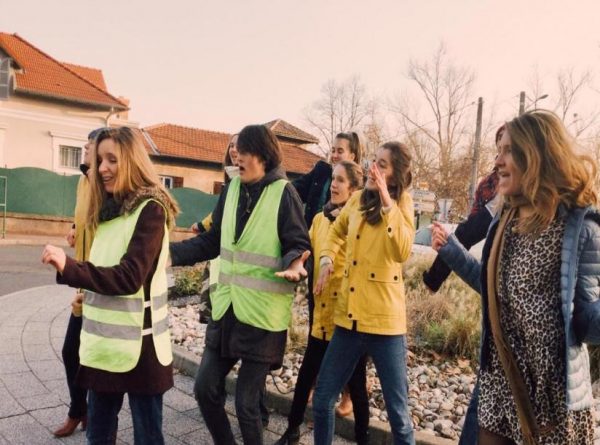
Gilets Jaunes song performed at French traffic circle: Les Gentils et les Méchants
By Diana Johnstone | Unz Review | January 11, 2019
Paris, France – French Democracy Dead or Alive? Or perhaps one should say, buried or revived? Because for the mass of ordinary people, far from the political, financial, media centers of power in Paris, democracy is already moribund, and their movement is an effort to save it. Ever since Margaret Thatcher decreed that “there is no alternative”, Western economic policy is made by technocrats for the benefit of financial markets, claiming that such benefits will trickle down to the populace. The trickle has largely dried up, and people are tired of having their needs and wishes totally ignored by an elite who “know best”.
President Emmanuel Macron’s New Year’s Eve address to the nation made it perfectly clear that after one unconvincing stab at throwing a few crumbs to the Gilets Jaunes (Yellow Vests) protest movement, he has determined to get tough.
France is entering a period of turmoil. The situation is very complex, but here are a few points to help grasp what this is all about.
- The METHODS
The Yellow Vests gather in conspicuous places where they can be seen: the Champs-Elysées in Paris, main squares in other cities towns, and the numerous traffic circles on the edge of small towns. Unlike traditional demonstrations, the Paris marches were very loose and spontaneous, people just walking around and talking to each other, with no leaders and no speeches.
The absence of leaders is inherent in the movement. All politicians, even friendly ones, are mistrusted and no one is looking for a new leader.
People are organizing their own meetings to develop their lists of grievances and demands.
In the village of Commercy, Lorraine, a half hour drive from Domrémy where Jeanne d’Arc was born, inhabitants gather to read their proclamation. Six of them read in turns, a paragraph each, making it quite clear that they want no leaders, no special spokesperson. They sometimes stumble over a word, they are not used to speaking in public like the TV talking heads. Their “Second appeal of the Gilets Jaunes de Commercy invites others to come to Commercy on January 26-27 for an “assembly of assemblies”.
- The DEMANDS
The people who first went out in the streets wearing Yellow Vests last November 17 were ostensibly protesting against a hike in gasoline and diesel taxes that would hit people in rural France the hardest. Obsessed with favoring “world cities”, the French government has taken one measure after another at the expense of small towns and villages and the people who live there. That was just the last straw. The movement rapidly moved on to the basic issue: the right of the people to have a say in measures taken that affect their lives. Democracy, in a word.
For decades, parties of the left and of the right, whatever their campaign speeches, once in office pursue policies dictated by “the markets”. For this reason, people have lost confidence in all parties and all politicians and are demanding new ways to get their wishes heard.
The fuel tax was soon forgotten as the list of demands grew longer. Critics of the movement note that achieving so many demands is quite impossible. It’s no use paying attention to popular demands, because the silly people ask for everything and its opposite.
That objection is answered by what has quickly emerged as the single overriding demand of the movement: the Citizens’ Initiative Referendum (CIR).
- The REFERENDUM
This demand illustrates the good sense of the movement. Rather than making a “must” list, the GJ merely ask that the people be allowed to choose, and the referendum is the way to choose. The demand is for a certain number of signatories – perhaps 700,000, perhaps more – to gain the right to call a referendum on an issue of their choice. The right to a CIR exists in Switzerland, Italy and California. The idea horrifies all those whose profession it is to know best. If the people vote, they will vote for all sorts of absurd things, the better-knowers observe with a shudder.
A modest teacher in a junior college in Marseilles, Etienne Chouard, has been developing for decades ideas on how to organize direct democracy, with the referendum at its center. His hour has come with the Yellow Vests. He insists that a referendum must always be held after a long debate and time for reflection, to avoid emotional spur-of-the-moment decisions. Such a referendum requires honest, independent media which are not all owned by special interests. It requires making sure that politicians who make the laws follow the popular will expressed in the referendum. All this suggests the need for a people’s constitutional convention.
The referendum is a bitter point in France, a powerful silent underlying cause of the whole Gilets Jaunes movement. In 2005, President Chirac (unwisely from his point of view) called for a popular referendum on ratification of the proposed Constitution of the European Union, certain it would be approved. The political class, with a few exceptions, went into full rhetoric, claiming a prosperous future as a new world power under the new Constitution and warning that otherwise Europe might be plunged back into World Wars I and II. However, ordinary citizens organized an extraordinary movement of popular self-education, as groups met to pour through the daunting legalistic documents, elucidating what they meant and what they implied. On May 29, 2005, with a turnout of 68%, the French voted 55% to reject the Constitution. Only Paris voted heavily in favor.
Three years later, the National Assembly – that is, politicians off all parties – voted to adopt virtually the same text, which in 2009 became the Treaty of Lisbon.
That blow to the clearly expressed popular will produced such disillusion that many backed helplessly away from politics. Now they are coming back.
- The VIOLENCE
From the start, the government has reacted with violence, in an apparent desire to provoke responding violence in order to condemn the movement as violent.
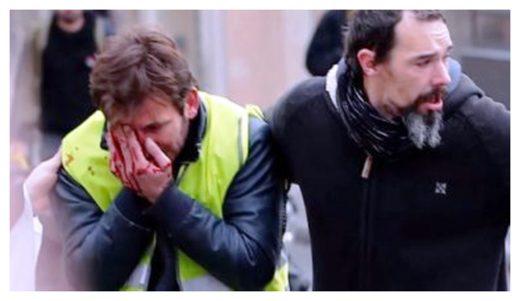
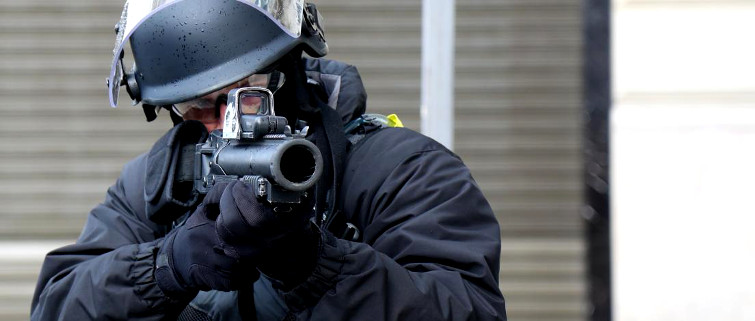
An army of police, dressed like robots, have surrounded and blocked groups of peaceful Yellow Vests, drowning them in clouds of teargas and firing flash balls directly at protesters, seriously wounding hundreds (no official figures). A number of people have lost an eye or a hand. The government has nothing to say about this.
On the third Saturday of protest, this army of police was unable to stop – or under orders to allow – a large number of hoodlums or Black Blocs (who knows?) to infiltrate the movement and smash property, vandalize shops, set fire to trash cans and parked cars, providing the world media with images proving that the Yellow Vests are dangerously violent.
Despite all this provocation, the Gilets Jaunes have remained remarkably calm and determined. But there are bound to be a few people who lose their tempers and try to fight back.
- The BOXER
On the 8th Saturday, January 5, a squad of plexiglass-protected police were violently attacking Gilets Jaunes on a bridge over the Seine when a big guy lost his temper, emerged from the crowd and went on the attack. With his fists, he beat down one policeman and caused the others to retreat. This amazing scene was filmed. You could see Yellow Vests trying to hold him back, but Rambo was unstoppable.
It turned out that this was Christophe Dettinger, a French Rom, former light heavyweight boxing champion of France. His nickname is “the Gypsy of Massy”. He got away from the scene, but made a video before turning himself in. “I reacted badly”, he said, when he saw police attacking women and other defenseless people. He urged the movement to go ahead peacefully.

Dettinger faces seven years in prison. Within a day, his defense fund had gathered 116,433 euros. The government shut it down – on what legal pretext I don’t know. Now a petition circulates on his behalf.
- The SLANDER
In his New Year’s Eve address, Macron patronizingly scolded his people telling them that “you can’t work less and earn more” – as if they all aspired to spending their lives lounging on a yacht and watching stock prices rise and fall.
Then he issued his declaration of war:
“These days I have seen unthinkable things and heard the unacceptable.” Apparently alluding to the few opposition politicians who dare sympathize with the protesters, he chastised those who pretend to “speak for the people”, but are only the “spokesmen for a hateful mob going after elected representatives, police, journalists, Jews, foreigners and homosexuals. It is simply the negation of France.”
The Gilets Jaunes haven’t been “going after” anybody. The police have been “going after” them. People have indeed spoken up vigorously against camera crews of channels that systematically distort the movement.
Not a word has been heard from the movement against foreigners or homosexuals.
The key word is Jews.
Qui veut noyer son chien l’accuse de la rage. (French proverb).
As the French saying goes, whoever wants to drown his dog claims he has rabies. Today whoever wants to ruin a career, take vengeance on a rival, disgrace an individual or destroy a movement accuses her, him, or it of antisemitism.
So, faced with a rising democratic movement, playing the “antisemitism” card was inevitable. It was almost a sure thing statistically. In almost any random batch of hundreds of thousands of people, you might find one or two who have something negative to say about a Jew. That’ll do it. The media hawks are on the outlook. The slightest incident can be used to suggest that the real motive of the movement is to revive the Holocaust.
This gently ironic little song, performed on one of France’s traffic circles, contrasts the “nice” establishment with the “bad” ordinary folk. It is a huge hit on YouTube. It gives the tone of the movement. Les Gentils et les Méchants.
It didn’t take long for this merry number to be accused of antisemitism. Why? Because it was ironically dedicated to two of the very most virulent critics of the Gilets Jaunes: May ’68 star Daniel Cohn-Bendit and old “new philosopher” Bernard-Henri Lévy. The new generation can’t stand them. But wait, they happen to be Jewish. Aha! Anti-Semitism!
- The REPRESSION
Faced with what government spokesman Benjamin Griveaux described as “agitators” and “insurrectionists” who want to “overthrow the government”, Prime Minister Edouard Philippe announced a new “law to better protect the right to demonstrate”. Its main measure: heavily punish organizers of a demonstration whose time and place have not had official approval.
In fact, the police had already arrested 33-year-old truck driver Eric Drouet for organizing a small candle ceremony in honor of the movement’s casualties. There have been many other arrests, with no information coming out about them. (Incidentally, over the holidays, hoodlums in the banlieues of several cities carried out their ritual burning of parked cars, with no particular publicity or crackdown. Those were cars of working class people who need them to go to work, not the precious cars in the rich section of Paris whose destruction caused such scandal.)
On January 7, Luc Ferry, a “philosopher” and former Minister of Youth, Education and Research, gave a radio interview on the very respectable Radio Classique in which he declared: “The police are not given the means to end this violence. It’s unbearable. Listen, frankly, when you see guys kick a poor policemen when he’s down, that’s enough! Let them use their arms once and for all, basta! […] As I recall, we have the world’s fourth army, capable of putting an end to this garbage.”
Ferry called on Macron to make a coalition with the Republicans in order to push through his “reforms”.
Last month, in a column against the Citizens’ Initiative Referendum, Ferry wrote that “the current disparaging of experts and criticism of elitism is the worst calamity of our times.”
- The ANTIFA
Wherever people gather, Antifa groups may pursue their indiscriminate search to root out “fascists”. In Bordeaux last Saturday, Yellow Vests had to fight off an attack by Antifa.
It is now completely clear (as indeed it always has been) that the self-styled “Antifascists” are the watch dogs of the status quo. In their tireless search for “fascists”, the Antifa attack anything that moves. In effect, they protect stagnation. And curiously enough, Antifa violence is tolerated by the same State and the same police who insult, attack and arrest more peaceful demonstrators. In short, the Antifa are the storm troopers of the current system.
- The MEDIA
Be skeptical. At least in France, mainstream media are solidly on the side of “order”, meaning Macron, and foreign media tend to echo what national media write and say. Also, as a general rule, when it comes to France, the Anglophone media often get it wrong.
- The END
It is not in sight. This may not be a revolution, but it is a revelation of the real nature of “the system”. Power lies with a technocracy in the service of “the Markets”, meaning the power of finance capital. This technocracy aspires to remake human society, our own societies and those all over the planet, in the interests of a certain capitalism. It uses economic sanctions, overwhelming propaganda and military force (NATO) in a “globalization” project that shapes people’s lives without their consent. Macron is the very embodiment of this system. He was chosen by that famous elite to carry through the measures dictated by “the Markets”, enforced by the European Union. He cannot give in. But now that people are awake to what is going on, they won’t stop either. For all the lamented decline in the school system, the French people today are as well-educated and reasonable as any population can be expected to be. If they are incapable of democracy, then democracy is impossible.
To be continued…
The War on Populism
CJ Hopkins | Consent Factory | January 10, 2018
Remember when the War on Terror ended and the War on Populism began? That’s OK, no one else does.
It happened in the Summer of 2016, also known as “the Summer of Fear.” The War on Terror was going splendidly. There had been a series of “terrorist attacks,” in Orlando, Nice, Würzberg, Munich, Reutlingen, Ansbach, and Saint-Étienne-du-Rouvray, each of them perpetrated by suddenly “self-radicalized” “lone wolf terrorists” (or “non-terrorist terrorists“) who had absolutely no connection to any type of organized terrorist groups prior to suddenly “self- radicalizing” themselves by consuming “terrorist content” on the Internet. It seemed we were entering a new and even more terrifying phase of the Global War on Terror, a phase in which anyone could be a “terrorist” and “terrorism” could mean almost anything.
This broadening of the already virtually meaningless definition of “terrorism” was transpiring just in time for Obama to hand off the reins to Hillary Clinton, who everyone knew was going to be the next president, and who was going to have to bomb the crap out of Syria in response to the non-terrorist terrorist threat. The War on Terror (or, rather, “the series of persistent targeted efforts to dismantle specific networks of violent extremists that threaten America,” as Obama rebranded it) was going to continue, probably forever. The Brexit referendum had just taken place, but no one had really digested that yet … and then Trump won the nomination.
Like that scene in Orwell’s 1984 where the Party switches official enemies right in the middle of the Hate Week rally, the War on Terror was officially canceled and replaced by the War on Populism. Or … all right, it wasn’t quite that abrupt. But seriously, go back and scan the news. Note how the “Islamic terrorist threat” we had been conditioned to live in fear of on a daily basis since 2001 seemed to just vanish into thin air. Suddenly, the “existential threat” we were facing was “neo-nationalism,” “illiberalism,” or the pejorative designator du jour, “populism.”
Here we are, two and a half years later, and “democracy” is under constant attack by a host of malevolent “populist” forces …. Russo-fascist Black vote suppressors, debaucherous eau de Novichok assassins, Bernie Sanders, the yellow-vested French, emboldened non-exploding mail bomb bombers, Jeremy Corbyn’s Nazi Death Cult, and brain-devouring Russian-Cubano crickets. The President of the United States is apparently both a Russian intelligence operative and literally the resurrection of Hitler. NBC and MSNBC have been officially merged with the CIA. The Guardian has dispensed with any pretense of journalism and is just making stories up out of whole cloth. Anyone who has ever visited Russia, or met with a Russian, or read a Russian novel, is on an “Enemies of Democracy” watch list (as is anyone refusing to vacation in Israel, which the Senate is now in the process of making mandatory for all U.S. citizens). Meanwhile, the “terrorists” are nowhere to be found, except for the terrorists we’ve been using to attempt to overthrow the government of Bashar al Assad, the sadistic nerve-gassing Monster of Syria, who illegally invaded and conquered his own country in defiance of the “international community.”
All this madness has something to do with “populism,” although it isn’t clear what. The leading theory is that the Russians are behind it. They’ve got some sort of hypno-technology (not to be confused with those brain-eating crickets) capable of manipulating the minds of … well, Black people, mostly, but not just Black people. Obviously, they are also controlling the French, who they have transformed into “racist, hate-filled liars” who are “attacking elected representatives, journalists, Jews, foreigners, and homosexuals,” according to French President Emmanuel Macron, the anointed “Golden Boy of Europe.” More terrifying still, Putin is now able to project words out of Trump’s mouth in real-time, literally using Trump’s head as a puppet, or like one of those Mission Impossible masks. (Rachel Maddow conclusively proved this by spending a couple of hours on Google comparing the words coming out of Trump’s mouth to words that had come out of Russian mouths, but had never come out of American mouths, which they turned out to be the exact same words, or pretty close to the exact same words!) Apparently, Putin’s master plan for Total Populist World Domination and Establishment of the Thousand Year Duginist Reich was to provoke the global capitalist ruling classes, the corporate media, and their credulous disciples into devolving into stark raving lunatics, or blithering idiots, or a combination of both.
But, seriously, all that actually happened back in the Summer of 2016 was the global capitalist ruling classes recognized that they had a problem. The problem that they recognized they had (and continue to have, and are now acutely aware of) is that no one is enjoying global capitalism … except the global capitalist ruling classes. The whole smiley-happy, supranational, neo-feudal corporate empire concept is not going over very well with the masses, or at least not with the unwashed masses. People started voting for right-wing parties, and Brexit, and other “populist” measures (not because they had suddenly transformed into Nazis, but because the Right was acknowledging and exploiting their anger with the advance of global neoliberalism, while liberals and the Identity Politics Left were slow jamming the TPP with Obama and babbling about transgender bathrooms, and such).
The global capitalist ruling classes needed to put a stop to that (i.e, the “populist” revolt, not the bathroom debate). So they suspended the Global War on Terror and launched the War on Populism. It was originally only meant to last until Hillary Clinton’s coronation, or the second Brexit referendum, then switch back to the War on Terror, but … well, weird things happen, and here we are.
We’ll get back to the War on Terror, eventually … as the War on Populism is essentially just a temporary rebranding of it. In the end, it’s all the same counter-insurgency. When a system is globally hegemonic, as our current model of capitalism is, every war is a counter-insurgency (i.e., a campaign waged against an internal enemy), as there are no external enemies to fight. The “character” of the internal enemies might change (e.g., “Islamic terrorism,” “extremism,” “fascism,” “populism,” “Trumpism,” “Corbynism,” et cetera) but they are all insurgencies against the hegemonic system … which, in our case, is global capitalism, not the United States of America.
The way I see it, the global capitalist ruling classes now have less than two years to put down this current “populist” insurgency. First and foremost, they need to get rid of Trump, who despite his bombastic nativist rhetoric is clearly no “hero of the common people,” nor any real threat to global capitalism, but who has become an anti-establishment symbol, like a walking, talking “fuck you” to both the American and global neoliberal elites. Then, they need to get a handle on Europe, which isn’t going to be particularly easy. What happens next in France will be telling, as will whatever becomes of Brexit … which I continue to believe will never actually happen, except perhaps in some purely nominal sense.
And then there’s the battle for hearts and minds, which they’ve been furiously waging for the last two years, and which is only going to intensify. If you think things are batshit crazy now (which, clearly, they are), strap yourself in. What is coming is going to make COINTELPRO look like the work of some amateur meme-freak. The neoliberal corporate media, psy-ops like Integrity Initiative, Internet-censoring apps like NewsGuard, ShareBlue and other David Brock outfits, and a legion of mass hysteria generators will be relentlessly barraging our brains with absurdity, disinformation, and just outright lies (as will their counterparts on the Right, of course, in case you thought that they were any alternative). It’s going to get extremely zany.
The good news is, by the time it’s all over and Trump has been dealt with, and normality restored, and the working classes put back in their places, we probably won’t remember that any of this happened. We’ll finally be able to sort out those bathrooms, and get back to paying the interest on our debts, and to living in more or less constant fear of an imminent devastating terrorist attack … and won’t that be an enormous relief?
#
Photo: Zakaria Abdelkafi – AFP
France Moves To Ban All Protests As PM Announces Major Crackdown On Yellow Vests
By Tyler Durden – Zero Hedge – 01/09/2019
France is signaling it’s making preparations for a massive new crackdown on the gilets jaunes or “yellow vests” anti-government protests that have gripped the country for seven weeks. A new law under consideration could make any demonstration illegal to begin with if not previously approved by authorities, in an initiative already being compared to the pre-Maiden so-called “dictatorship law” in Ukraine.
In the name of reigning in the violence that has recently included torching structures along the prestigious Boulevard Saint Germain in Paris, and smashing through the gates of government ministry buildings, the French government appears set to enact something close to a martial law scenario prohibiting almost any protest and curtailing freedom of speech.
Prime Minister Edouard Philippe presented the new initiative to curtail the violence and unrest while targeting “troublemakers” and banning anonymity through wearing masks on French TV channel TF1 on Monday. He said the law would give police authority crack down on “unauthorized demonstrations” at a moment when police are already arresting citizens for merely wearing a yellow vest, even if they are not directly engaged in protests in some cases.
PM Philippe said the government would support a “new law punishing those who do not respect the requirement to declare [protests], those who take part in unauthorized demonstrations and those who arrive at demonstrations wearing face masks”.
Philippe’s tone during the statements was one of the proverbial “the gloves are off” as he described the onus would be on “the troublemakers, and not taxpayers, to pay for the damage caused” to businesses and property.
“Those who question our institutions will not have the last word,” he added.
However, if anything the protests have grown fiercer in response to any police crackdown or violence against demonstrators. Should all protests be banned under the new law, it could be the start of more violent riots gaining steam, as what began Nov. 17 as anger over fuel tax hikes has now turned into rage at President Emmanuel Macron and policies that seem to favor the urban elite.
Other yellow vest inspired protests previously broke out across Europe, and in perhaps a sign of things to come a video from The Netherlands of a woman pushing her baby in a stroller being arrested by police apparently for merely wearing a yellow vest is going viral.
Shocking Video of police brutality in The #Netherlands of a Women being arrested yesterday, because she was wearing an Yellow Vest, and did not wanted to take it off. while walking with her baby in the streets. #YellowVests SHAME ON YOU DUTCH POLICE OFFICERS! RT this to the world pic.twitter.com/vL99D1ThW0
— Sotiri Dimpinoudis (@sotiridi) January 6, 2019
In the video, police confront the woman in what appears a quiet neighborhood far away from any visible protest. Police were photographed alongside the baby on the street as the mother was dragged away.

Image via journalist Sotiri Dimpinoudis
With the French prime minister now announcing coming draconian measures banning all protest, this is precisely the horrific scene that could begin to be repeated across France and the EU.
In total at least six people have died and over 1,400 people injured during the French protests, with thousands arrested weekly, according to international reports. Over the weekend some 50,000 protesters continued demonstrating in multiple cities, leading to significant clashes in Paris, Bordeaux and Rouen. A number of commentators have noted that though there appear fewer demonstrators compared to December, there appears a serious uptick in violent acts on the part of both demonstrators and police response.
Featured Video
New positive ivermectin evidence
or go to
Aletho News Archives – Video-Images
From the Archives
Fanatical Followers of the Covid Regime: A Jim Jones-Style Cult?
By Professor Roger Watson and Dr. Niall McCrae | The Daily Sceptic | November 15, 2021
As scholars at leading British universities over recent decades, we witnessed the replacement of critical thinking and debate by narrative: facts are discrimination and scientific method is imperialism; truth, instead, is derived from ‘progressive’ values. This educational trend may be a major contributory factor to the ease in which society has been inculcated to the Covid ‘new normal’ of masking, testing, and repeated doses of vaccines for a disease of similar risk to severe influenza.
One doesn’t need much critical reasoning to observe the flawed logic of some vaccination enthusiasts, such as people who respond to experiencing any side effects, however debilitating, by saying “at least I know it’s working”, or, after contracting the disease despite their promised inoculation (over 90% effective, according to initial drug company claims), “I’d have been worse off without the jab.” … continue
Blog Roll
 Aletho News
- EU Council Advances Chat Control 2.0 Scanning Proposal
- Ex-Greek MEP files complaint against Israeli spyware firm over alleged Pegasus surveillance
- Troubling ideas throughout the Torah, Talmud, Mishneh Torah and Tanya
- ‘Grave, alarming’: Iran mission on Trump’s UNGA ‘annihilation’ threats
- Najaf airport to reopen to Iranian flights within 24 hours: Ambassador
- From ‘How Will This End For Iran’ to ‘When America Walks Away’: A tale of two Economist covers
- Tehran blasts ‘baseless’ speculation linking Iran to alleged bomb plot at UK air base
- The Rise And… Rise Of ‘Color Revolutions’
- The Coming GOP Bloodbath?
- Arctic Scare Stories Melt Away
- If Americans Knew
- Netanyahu Asked UAE Leader to Deny Report on Oct. 7 Warning in Secret Visit, Sources Say
- CNN Chief Int’l Correspondent Clarissa Ward on Journalists in Gaza
- Democratic Party Consultants Surround Troy Jackson with Pro-Israel Donors
- Christian Leader Responds To Netanyahu’s Claims Regarding Palestinian Christians
- In Gaza, ‘Whoever Survives the Bombing Won’t Survive the Rubble’
- Israel kills more Palestinians, amid push to resettle Gaza – Daily Update
- Israel forces Gazans to live in constant peril – Daily Update
- Deconstructing Netanyahu’s pants-on-fire UN rant – Daily Update
- Trump betrayed voters with his campaign lies and prioritized a foreign country once he took office
- Netanyahu calls Israel’s war in Gaza ‘opposite of genocide’ in UN speech to near-empty hall
- No Tricks Zone
- New Study: Earth And Venus Surface Warmth Largely Explained By Convection And Lapse Rate, Not CO2 Or Radiation
- 2025 Nature Paper Claiming Worsening Global Drought Gets RETRACTED …Heavily Flawed
- New Study: ‘Global Drought Shows No Detectable Recent Acceleration Under Climate Warming’
- Economic Masterminds: German Socialists Suggest Taxing Productivity Gains Stemming From Using AI
- The South China Sea Has Not Been Cooperating With The Climate Change Narrative
- Energy Crisis: Germany Enters Heating Season With Historically Low Gas Reserve Fill Levels
- New Study: The Antarctic Ice Sheet Gained Mass From 2020-2024 Due To Staggering Snow And Ice Accumulation
- Study: Ocean Heating Rates From Thousands Of Years Ago ‘Dwarf’ Modern Ocean Heating Rates
- Climate Extremists Target, Attack Large-Scale Power Grid Infrastructure In Germany!
- New Study: Antarctic Ice Melt Has Contributed Less Than 1 Centimeter To Sea Level Rise In The Last 30 Years

