EU agrees sanctions against Iranian intelligence service over ‘assassination plot’ – Danish FM
RT | January 8, 2019
The European Union has agreed to enact sanctions against the Iranian intelligence service over its alleged “assassination plots on European soil,” the Danish foreign minister has tweeted.
Specific details in relation to potential new European sanctions against Iran are unclear; nor is it known whether they are close to being implemented. Foreign ministers of EU member states had reportedly agreed to consider sanctions in response to the supposed Iranian plot at a meeting in mid-November.
In late October, Danish security forces said they had arrested a man who was allegedly plotting to assassinate the leader of the Danish branch of an Iranian Arab separatist movement. Tehran denied the accusations as “hostile” and said they were in line with the “enemies’ plots” to undermine Iranian-European relations.
The European Commission, while backing Denmark’s accusation and condemning Tehran, has urged member states to not let it impact the JCPOA Iran nuclear deal of 2015. The US, which unilaterally pulled out of the agreement in May 2018, simply praised Denmark for arresting an “Iranian regime assassin.”
US President Donald Trump’s administration has been cracking down on Iran, accusing it of sponsoring terrorism and violating international obligations. It has repeatedly warned the EU against maintaining trade with Tehran, but Europe has so far been determined to keep JCPOA alive, and is working on a mechanism to bypass American sanctions.
The target of the alleged plot was a local leader of the Arab Struggle Movement for the Liberation of Ahvaz (ASMLA), the Danish Foreign Ministry said at the time. ASMLA, pushing for a separate Arab state within Iran, is classified as a terrorist organization by Tehran.
Tehran has blamed ASMLA for the September 28, 2018 attack on a military parade in Ahvaz, which left 30 people dead and 70 injured. ASMLA denied responsibility, blaming the attack instead on a splinter group within the movement.
India sequesters Iran ties from US predatory strike
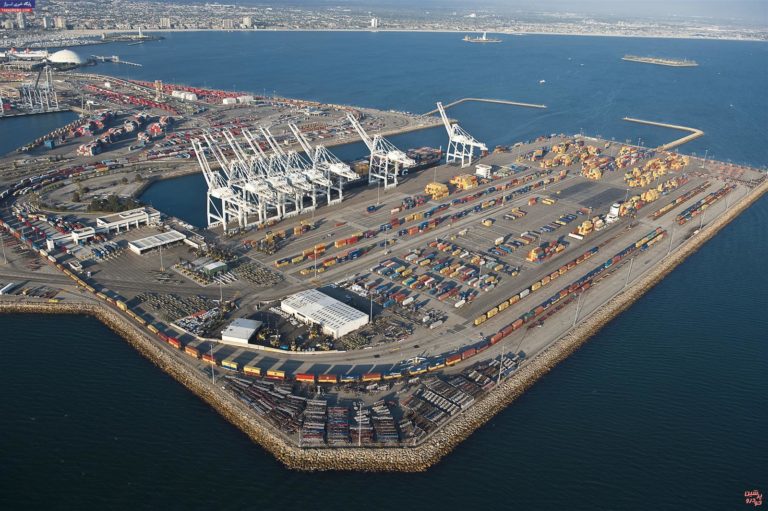
(Iran’s Chabahar Port)
By M. K. BHADRAKUMAR | Indian Punchline | January 2, 2019
India has done well to put in place the nuts and bolts of a payment mechanism for its trade and investment transactions with Iran against the backdrop of the US withdrawal from the Iran nuclear deal (known as the Joint Comprehensive Plan of Action) in May last year followed by the imposition of sanctions against Iran. The US had threatened to bring Iran’s oil trade to zero by the end of 2018 but ultimately pragmatism prevailed and major importing countries such as India were given 6-month ‘waivers’ in November.
Delhi has utilised this interregnum to sequester India-Iran economic relations as far as possible from the vagaries of the Trump administration’s Iran policies. How far Delhi sensitized Washington in advance about its Iran strategy we may never know, but the overall approach suggests a quiet determination to safeguard Indian economic (and political) interests from suffering collateral damage without, at the same time, displaying any strategic defiance of the US in the foreign-policy domain. The Indian diplomacy has been successful here so far.
Broadly, the Indian government has revisited the strategy adopted by the UPA leadership in similar circumstances of US sanctions against Iran and in the light of past experience, finessed a payment mechanism that dispenses with the use of American dollar in India-Iran economic transactions thereby bypasses the cutting edge of the US sanctions. Indeed, the impetus to do so is far more keenly felt today than under the UPA government because India-Iran economic relationship is transforming phenomenally and assuming strategic importance under the Modi government, especially with the operationalization of the Chabahar Port project.
Arguably, the Modi government is showing far greater grit in comparison with the timid attitude by the previous UPA government in asserting India’s strategic autonomy to advance the India-Iran partnership notwithstanding the hostile policies of Washington toward Iran, which are in the nature of forcing a ‘regime change’ in Tehran. Interestingly, the Indian approach is also impervious to the continued Israeli and Saudi intrigues against Iran, although the Modi government has significantly boosted India’s relations with these two Middle East countries.
The Indian policy toward relations with Iran under the deepening shadow of US sanctions has evolved in three carefully measured stages through the month of December. Needless to say, this wouldn’t have been possible without mutual trust and understanding in the relationship characterized by close consultations through diplomatic channels. In the first stage, it came to be known that in early November the two countries signed an agreement to the effect that India will import crude oil from Iran using a rupee-based payment mechanism and that 50 percent of those payments will be used for exporting items by India to Tehran.
Accordingly, India’s government-owned UCO Bank (which has no exposure to the US) was designated to handle this mechanism. In a third stage, in continuation of the above, the Ministry of Finance in Delhi issued an order in end-December exempting the National Iranian Company (NIOC) which exports crude to India from paying a steep ‘withholding tax’ to the Indian authorities. This order issued on December 28 will have retrospective effect from November 5 so that an amount of $1.5 billion that Indian refiners had accumulated as outstanding payments to NIOC could be released. Under Indian laws, the income of a foreign company that is deposited in an Indian bank account is subject to a withholding tax of 40 percent plus other levies, leading to a total take by the authorities of 42.5 percent.
Suffice to say, the door is open, Iran will now be able to use the rupee funds for a range of expenses–including imports from India, the cost of its missions in the country, direct investment in Indian projects, and its financing of Iranian students in India. It can also invest the funds in Indian government debt securities. The tax exemption order, though, only refers to crude oil. That means it does not apply to imports of other commodities, such as fertilizer, liquefied petroleum gas and wax. It appears that the scope of the use of funds will ensure balanced bilateral trade, which is traditionally in Iran’s favour.
On December 31, the two countries announced that their banking transactions mechanism is ready for operation.
Interestingly, India is leapfrogging many other countries that have been talking about similar payment mechanisms with Iran bypassing the US sanctions. The most glaring instance is of the European Union’s much-vaunted proposed mechanism of the Special Purpose Vehicle (SPV), which has not arrived yet. Brussels had vowed to establish the SPV “before the end of the year (2018) as a way to protect and promote legitimate business (of European companies) with Iran,” to quote the EU foreign policy chief Federica Mogherini.
Clearly, Delhi is not waiting to take the cue from other capitals that may harbor grave reservations over the US sanctions against Iran. Equally, Tehran’s willingness to accept for payments the Indian rupee (which is not traded on international markets) bears testimony to its great desire to sustain a beneficial relationship with India notwithstanding the US pressure on Delhi to severely cut back on economic ties with Iran.
All in all, Delhi seems to be preparing for the long haul. The fact of the matter is that politically, it is an increasingly tall order for the present Iranian leadership to continue with its adherence to its share of the 2015 Iran nuclear deal without any infringement or breach in the face of the failure on the part of the European leaders to deliver on their promise that in return Iran will be compensated through steps such as the EU maintaining and deepening economic relations with Iran, the continued sale of Iran’s oil and gas, effective banking transactions with Iran, the further provision of export credit and development of the SPVs in financial banking, insurance and trade areas and so on.
The ground reality is that the European leaders failed to deliver on their promises to Tehran and Iran has been left to fend for itself under the most savage and unlawful economic and political pressure by Washington. Simply put, while Europe claims that the Iran nuclear deal is of strategic importance, it is unwilling or reluctant to invest in its own strategic interests. The Iranian Foreign Minister Mohammad Zarif aptly summed up the European dilemma in a recent remark that you cannot swim without getting wet. Delhi may have shown that where there is a strong political will, there is always a way forward.
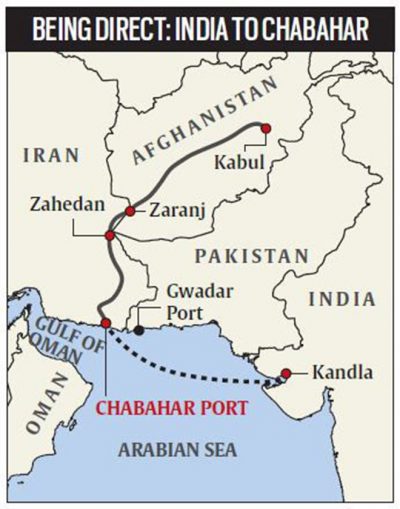
Without doubt, the operationalization of the Chabahar Port a week ago dramatically changes the India-Iran strategic calculus. Where words are not adequate to describe it, a look at the map showing India’s new Silk Road will do. Its geopolitical ramifications are profound. Ironically, Chabahar may eventually bring not only India and Iran but the US as well on the same page. Much lies in the womb of time.
Why France’s Yellow Vest Protests Have Been Ignored by “the Resistance” in the U.S.

By Max Parry • Unz Review • January 2, 2019
”The rich are only defeated when running for their lives.”— C.L.R. James, The Black Jacobins
In less than two months, the yellow vests (“gilets jaunes”) movement in France has reshaped the political landscape in Europe. For a seventh straight week, demonstrations continued across the country even after concessions from a cowed President Emmanuel Macron while inspiring a wave of similar gatherings in neighboring states like Belgium and the Netherlands. Just as el-Sisi’s dictatorship banned the sale of high-visibility vests to prevent copycat rallies in Egypt, corporate media has predictably worked overtime trying to demonize the spontaneous and mostly leaderless working class movement in the hopes it will not spread elsewhere.
The media oligopoly initially attempted to ignore the insurrection altogether, but when forced to reckon with the yellow vests they maligned the incendiary marchers using horseshoe theory to suggest a confluence between far left and far right supporters of Jean-Luc Mélenchon and Marine Le Pen. To the surprise of no one, mainstream pundits have also stoked fears of ‘Russian interference’ behind the unrest. We can assume that if the safety vests were ready-made off the assembly line of NGOs like the raised fist flags of Serbia’s OTPOR! movement, the presstitutes would be telling a different story.
It turned out that a crisis was not averted but merely postponed when Macron defeated his demagogue opponent Le Pen in the 2017 French election. While it is true that the gilets jaunes were partly impelled by an increase on fuel prices, contrary to the prevailing narrative their official demands are not limited to a carbon tax. They also consist of explicit ultimatums to increase the minimum wage, improve the standard of living, and an end to austerity, among other legitimate grievances. Since taking office, Macron has declared war on trade unions while pushing through enormous tax breaks for the wealthy (like himself) — it was just a matter of time until the French people had enough of the country’s privatization. It is only a shock to the oblivious establishment why the former Rothschild banker-turned-politician, who addressed the nation seated at a gold desk while Paris was ablaze, is suddenly in jeopardy of losing power. The status quo’s incognizance is reminiscent of Marie Antoinette who during the 18th century when told the peasants had no bread famously replied, “let them eat cake” as the masses starved under her husband Louis XIV.
While the media’s conspicuous blackout of coverage is partly to blame, the deafening silence from across the Atlantic in the United States is really because of the lack of class consciousness on its political left. With the exception of Occupy Wall Street, the American left has been so preoccupied with an endless race to the bottom in the two party ‘culture wars’ it is unable to comprehend an upheaval undivided by the contaminants of identity politics. A political opposition that isn’t fractured on social issues is simply unimaginable. Not to say the masses in France are exempt from the internal contradictions of the working class, but the fetishization of lifestyle politics in the U.S. has truly become its weakness. We will have to wait and see whether the yellow vests transform into a global movement or arrive in America, but for now the seeming lack of solidarity stateside equates to a complicity with Macron’s agenda.
It serves as a reminder of the historically revisionist understanding of French politics in the U.S. that is long-established. The middle class dominated left-wing in America ascribes to a historical reinterpretation of the French Revolution that is a large contributor of its aversion to transformative praxis in favor of incrementalism. The late Italian Marxist philosopher and historian Domenico Losurdo, who died in June of this year, offered the most thorough understanding of its misreading of history in seminal works such as War and Revolution: Rethinking the Twentieth Century. The liberal rereading of the French Revolution is the ideological basis for its rejection of the revolutionary tradition from the Jacobins to the Bolsheviks that has neutralized the modern left to this day.
According to its revised history, the inevitable outcome of comprehensive systemic change is Robespierre’s so-called ‘Reign of Terror’, or the ‘purges’ of the Stalin era in the Soviet Union. In its view, what began with the Locke and Montesquieu-influenced reforms of the constitutional monarchy was ‘hijacked’ by the radical Jacobin and sans-culotte factions. Losurdo explains that counter-revolutionaries eager to discredit the image of rebellion overemphasize its violence and bloodshed, and never properly contextualize it as self-defense against the real reign of terror by the ruling class. The idea behind this recasting of history is to conflate revolutionary politics with Nazi Germany whose racially-motivated genocide was truly the inheritor of the legacy of European colonialism, not the ancestry of the Jacobins or the Russian Revolution.
Maximilien Robespierre’s real crime in the eyes of bourgeois historians was attempting to fulfill the egalitarian ideals of republicanism by transferring political power from the aristocracy and nouveaux riche directly into the hands of the working class, just as the Paris Commune did nearly 80 years later. It is for this reason he subsequently became one of the most misunderstood and unfairly maligned figures in world history, perhaps one day to be absolved. The U.S. reaction to the yellow vests is a continuation of the denial and suppression of the class conflict inherent in the French Revolution which continues to seethe beneath the surfaces of capitalism today.
In today’s political climate, it is easy to forget that there have been periods where the American left was actually engaged with the crisis of global capitalism. In what seems like aeons ago, the anti-globalization movement in the wake of NAFTA culminated in huge protests in Seattle in 1999 which saw nearly 50,000 march against the World Trade Organization. Following the 2008 financial collapse, it briefly reemerged in the Occupy movement which was also swiftly put down by corporate-state repression. Currently, the political space once inhabited by the anti-globalization left has been supplanted by the ‘anti-globalist’ rhetoric mostly associated with right-wing populism.
Globalism and globalization may have qualitatively different meanings, but they nevertheless are interrelated. Although it is shortsighted, there are core accuracies in the former’s narrative that should be acknowledged. The idea of a shadowy world government isn’t exclusively adhered to by anti-establishment conservatives and it is right to suspect there is a worldwide cabal of secretive billionaire power brokers controlling events behind the scenes. There is indeed a ‘new world order’ with zero regard for the sovereignty of nation states, just as there is a ‘deep state.’ However, it is a ruling class not of paranoiac imagination but real life, and a right-wing billionaire like Robert Mercer is as much a globalist as George Soros.
Ever since capitalism emerged it has always been global. The current economic crisis is its latest cyclical downturn, impoverishing and alienating working people whose increasing hardship is what has led to the trending rejection of the EU. Imperialism has exported capital leading to the destruction of jobs in the home sectors of Western nations while outsourcing them to the third world. Over time, deep disgruntlement among the working class has grown toward an economic system that is clearly rigged against them, where the skewed distribution of capital gains and widespread tax evasion on the part of big business is camouflaged as buoyant economic growth. When it came crashing down in the last recession, the financial institutions responsible were bailed out using tax payer money instead of facing any consequences. Such grotesque unfairness has only been amplified by the austerity further transferring the burden from the 1% to the poor.
Before the gilets jaunes, the U.K.’s Brexit referendum in 2016 laid bare these deep class divisions within the European Union. One of the most significant events in the continent since WWII, it has ultimately threatened to reshape the Occident’s status in the post-war order as a whole. Brexit manifested out of divisions within Britain’s political parties, especially the Torys, which had been plagued for years by internal dispute over the EU. Those in power were blind to the warning signs of discontent toward a world economy in crisis and were shocked by the plebiscite in which the working class defied the powers that be against all odds with more than half voting to leave.
In general, well-to-do Brits were hard remainers while those suffering most severely from the destruction of industry, unemployment and austerity overwhelmingly chose to leave in what was described as a “peasants revolt” by the media. The value of the pound sterling quickly plunged and not long after the status of the United Kingdom as a whole came into question as Britain found itself at odds with Scotland’s unanimous decision to remain. Brexit tugged at the bonds holding the EU together and suddenly the collective standing clout of its member states is at stake in a potential breakup of the entire bloc.
Euroscepticism is also by no means a distinctly British phenomenon, as distrust has soared in countries hit the hardest by neoliberalism like Greece (80%), with Spain and France not far behind. In fact, before there was Brexit there was fear among the elite of a ‘Grexit.’ In response to its unprecedented debt crisis manufactured by the International Monetary Fund (IMF), the Greek people elected the Coalition of the Radical Left, SYRIZA, to a majority of legislative seats to the Hellenic Parliament during its 2015 bailout referendum. Unfortunately, the synthetic alliance turned out to be anything but radical and a trojan horse of the establishment. SYRIZA was elected on its promise to rescind the terms of Greek membership in the EU, but shortly after taking office it betrayed its constituency and agreed to the troika’s mass privatization. Even its former finance minister Yanis Varousfakis admitted that SYRIZA was a controlled opposition and auxiliary of the Soros Foundation.
Apart from suffering collective amnesia regarding the EU’s neoliberal policies, apparently the modern left is also in serious need of a history lesson regarding the federation’s fascist origins. It has been truly puzzling to see self-proclaimed progressives mourning Britain’s decision to withdraw from a continental union that was historically masterminded by former fifth columnists of Nazi Germany. It was in the aftermath of WWII’s devastation that the 1951 Treaty of Paris established the nucleus of the EU in the European Coal and Steel Community, a cooperative union formed by France, Italy, West Germany, and the three Benelux states (Belgium, Luxembourg and the Netherlands). The Europe Declaration charter stated:
“By the signature of this Treaty, the involved parties give proof of their determination to create the first supranational institution and that thus they are laying the true foundation of an organized Europe. This Europe remains open to all European countries that have freedom of choice. We profoundly hope that other countries will join us in our common endeavor.”
The idea of forming a “supranational” union was conceived by the French statesman Robert Schuman, who during the outbreak of WWII served as the Under-Secretary of State for Refugees in the Reynaud government. When Nazi Germany invaded France in 1940, Schuman by all accounts willingly voted to grant absolute dictatorial powers to Marshall Philippe Pétain to become Head of State of the newly formed Vichy government, the puppet regime that ruled Nazi-occupied France until the Allied invasion in 1944. By doing so, he retained his position in parliament, though he later chose to resign. Following the war, like all Vichy collaborators Schuman was initially charged with the offense of indignité nationale (“national unworthiness”) and stripped of his civil rights as a traitor.
More than 4,000 alleged quislings were summarily executed following Operation Overlord and the Normandy landings, but the future EU designer was fortunate enough to have friends in high places. Schuman’s clemency was granted by none other than General Charles de Gaulle himself, the leader of the resistance during the war and future French President. Instantly, Schuman’s turncoat reputation was rehabilitated and his wartime activity whitewashed. Even though he had knowingly voted full authority to Pétain, the retention of his post in the Vichy government was veneered to have occurred somehow without his knowledge or consent.
Schuman is officially regarded as one of the eleven men who were ‘founding fathers’ of what later became the EU. One of the other major figures that contributed to the federal integration of the continent was Konrad Adenauer, the first Chancellor of the Federal Republic of Germany. The Nuremberg Trials may have tried and executed most of the top leadership of the Nazi Party, but the post-war government that became West Germany was saturated with former Third Reich officials. Despite the purported post-war ‘denazification’ policy inscribed in the Potsdam agreement, many figures who had directly participated in the Holocaust were appointed to high positions in Adenauer’s administration and never prosecuted for their atrocities.
One such war criminal was the former Ministry of the Interior and drafter of the Nuremberg race statutes, Hans Globke, who became Adenauer’s right hand man as his Secretary of State and Chief of Staff. Adenauer also successfully lobbied the Allies to free most of the Wehrmacht war criminals in their custody, winning the support of then U.S. General and future President Dwight Eisenhower. By 1951, motivated by the desire to quickly rearm and integrate West Germany into NATO in the new Cold War, the policy of denazification was prematurely ended and countless offenders were allowed to reenter branches of government, military and public service. Their crimes against humanity took a backseat to the greater imperialist priority of rearmament against East Germany and the Soviets.
In the years following WWII, there was also concern among the elite of anti-Americanism growing in Western Europe. The annual Bilderberg Group conference was established in 1954 by Prince Bernard of the Netherlands, himself a former Reiter-SS Corps and Nazi Party member, to promote ‘Atlanticism’ and facilitate cooperation between American and European leaders. Invitations to the Bilderberg club meetings were extended to only the most exclusive paragons in politics, academia, the media, industry, and finance. In 2009, WikiLeaks revealed that it was at the infamous assembly where the hidden agenda of the European Coal and Steel Community, later the EU, was set:
“E. European Unity: The discussion on this subject revealed general support for the idea of European integration and unification among the participants from the six countries of the European Coal and Steel Community, and a recognition of the urgency of the problem. While members of the group held different views as to the method by which a common market could be set up, there was a general recognition of the dangers inherent in the present divided markets of Europe and the pressing need to bring the German people, together with the other peoples of Europe, into a common market. That the six countries of the Coal and Steel Community had definitely decided to establish a common market and that experts were now working this out was felt to be a most encouraging step forward and it was hoped that other countries would subsequently join it.”
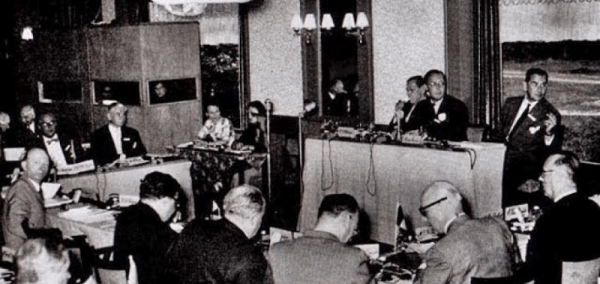
Prince Bernard presides over the first annual Bilderberg meeting in 1954.
At the 1955 conference, the rudimentary idea for a European currency or what became the Eurozone was even discussed, three years before the Treaty of Rome which established the European Economic Community, without the public’s knowledge:
“A European speaker expressed concern about the need to achieve a common currency, and indicated that in his view this necessarily implied the creation of a central political authority.”
The mysterious Bilderberg gatherings are still held to this day under notorious secrecy and are frequently the subject of wild speculation. One can imagine a topic behind the scenes at this year’s meeting would be how to address the growth of anti-EU ‘populism’ and uprisings like the gilet jaunes. Hitlerite expansionism had been carried out on the Führer’s vision for a European federation in the Third Reich — in many respects, the EU is a rebranded realization of his plans for empire-building. How ironic that liberals are clinging to a multinational political union founded by fascist colluders while the same economic bloc is being opposed by today’s far right after its new Islamophobic facelift.
While nationalism may have played an instrumental role in Brexit, there is a manufactured hysteria hatched by the establishment which successfully reduced the complex range of reasons for the Leave EU vote to racism and flag-waving. They are now repeating this pattern by overstating the presence of the far right among the yellow vests. Such delirium not only demonizes workers but coercively repositions the left into supporting something it otherwise shouldn’t — the EU and by default its laissez-faire policies — thereby driving the masses further into the arms of the same far right. Echoes of this can be seen in the U.S. with the vapid response to journalist Angela Nagle’s recent article about the immigration crisis on the southern border. The faux-left built a straw man in their attack on Nagle, who dared to acknowledge that the establishment only really wants ‘open borders’ for an endless supply of low-wage labor from regions in the global south destabilized by U.S. militarism and trade liberalization. Aligning itself with the hollow, symbolic gestures of centrists has only deteriorated the standards of the left participating in such vacuousness and dragged down to the level of liberals.
There is no doubt Brexit and Trump pushed the xenophobia button and could not have come about without it. However, such criticism means nothing when it comes from moral posturers who claim to “stand with refugees” while supporting the very ‘humanitarian’ interventionist policies displacing them. Nativism was not the sole reason the majority voted to leave the EU and many working class minorities also were Brexiters. Of course their fellow workers and migrants are not the true cause of their misery. After all, it was not just chattel slaves who came to the U.S. unwillingly but European immigrants fleeing continental wars and starvation as well — the crisis in the EU today is no different.
Fundamentally, migrants seek asylum on Europe’s doorstep because of NATO’s imperial expansion and the unexpected arrival of Brexit has threatened to weaken the EU’s military arm. Already desperate to reinvent itself and a new enemy in Russia despite its functional obsolescence, the shock of the referendum has inconveniently undermined NATO’s ability to pressure Moscow and Beijing, a step forward for mitigating world peace in the long run and a silver lining to its outcome. It is the task of the left to reject the EU’s neoliberal project while transmitting the message that capital, not refugees, is the cause of the plight of the masses. It is also necessary to have faith in the people, something cynical liberals lack. Racism may historically be the achilles heel of the working class but underlying Brexit, the election of Trump, and the yellow vests is the spirit of defiance in working people, albeit one of political confusion in need of guidance.
If the yellow vests are today’s sans-culottes, like those which became the revolutionary partisans in the French Revolution, they will eventually need a Jacobin Club. Relatively progressive but ultimately reformist figures like Mélenchon are no such spearhead and will only lead them down the same dead end of SYRIZA. The absence of any such vanguard has forced the working class to take matters into their own hands in the interim. If history is any guide, the gilets jaunes will be stamped out until a new cadre takes the reins whose objective is, as Lenin said,“not to champion the degrading of the revolutionary to the level of an amateur, but to raise the amateurs to the level of revolutionaries.” We also cannot fall into ideological fantasies that we live in permanent revolutionary circumstances or that a spontaneous uprising can become comprehensive simply because of ingenious leadership. Nevertheless, as Mao Tse-Tung wrote, “a single spark can start a prairie fire” and hopefully the yellow vests are that flame.
Max Parry is an independent journalist and geopolitical analyst. Max may be reached at maxrparry@live.com
Soros ‘person of the year’ indeed: In 2018 globalists pushed peoples’ patience to the edge

By Robert Bridge | RT | December 29, 2018
Since 2015, the proponents of neoliberalism have been pushing ahead with their plans for open borders and globalist agenda without the consent of the people. The last 365 days saw that destructive agenda greatly challenged.
In light of the epic events that shaped our world in 2018, it seems the Yellow Vests – the thousands of French citizens who took to the streets of Paris to protest austerity and the rise of inequality – would have been a nice choice for the Financial Times’ ‘person of the year’ award. Instead, that title was bestowed upon the billionaire globalist, George Soros, who has arguably done more meddling in the affairs of modern democratic states than any other person on the planet.
Perhaps FT’s controversial nomination was an attempt to rally the forces of neoliberalism at a time when populism and nascent nationalism is sweeping the planet. Indeed, the shocking images coming out of France provide a grim wake-up call as to where we may be heading if the globalists continue to undermine the power of the nation-state.
It is no secret that neoliberalism relentlessly pursues a globalized, borderless world where labor, products, and services obey the hidden hand of the free market. What is less often mentioned, however, is that this system is far more concerned with promoting the well-being of corporations and cowboy capitalists than assisting the average person on the street. Indeed, many of the world’s most powerful companies today have mutated into “stateless superpowers,” while consumers are forced to endure crippling austerity measures amid plummeting standards of living. The year 2018 could be seen as the tipping point when the grass-roots movement against these dire conditions took off.
Since 2015, when German Chancellor Angela Merkel allowed hundreds of thousands of undocumented migrants into Germany and the EU, a groundswell of animosity has been steadily building against the European Union, perhaps best exemplified by the Brexit movement. Quite simply, many people are growing weary of the globalist argument that Europe needs migrants and austerity measures to keep the wheels of the economy spinning. At the very least, luring migrants with cash incentives to move to Germany and elsewhere in the EU appears incredibly shortsighted.
Indeed, if the globalist George Soros wants to lend his Midas touch to ameliorating the migrant’s plight, why does he think that relocating them to European countries is the solution? As is becoming increasingly apparent in places like Sweden and France, efforts to assimilate people from vastly different cultures, religions and backgrounds is an extremely tricky venture, the success of which is far from guaranteed.
One worrying consequence of Europe’s season of open borders has been the rise of far-right political movements. In fact, some of the harshest criticism of the ‘Merkel plan’ originated in Hungary, where its gutsy president, Viktor Orban, hopes to build “an old-school Christian democracy, rooted in European traditions.” Orban is simply responding to the democratic will of his people, who are fiercely conservative, yet the EU parliament voted to punish him regardless. The move shows that Brussels, aside from being adverse to democratic principles, has very few tools for addressing the rise of far-right sentiment that its own misguided policies created.
Here it is necessary to mention once again that bugbear of the political right, Mr. Soros, who has received no political mandate from European voters, yet who campaigns relentlessly on behalf of globalist initiatives through his Open Society Foundations (OSF) (That campaign just got some serious clout after Soros injected $18bn dollars of his own money into OSF, making it one of the most influential NGOs in the world).
With no small amount of impudence, Soros has condemned EU countries – namely his native Hungary – for attempting to protect their territories by constructing border barriers and fences, which he believes violate the human rights of migrants (rarely if ever does the philanthropist speak about the “human rights” of the native population). In the words of the maestro of mayhem himself: “Beggar-thy-neighbor migration policies, such as building border fences, will not only further fragment the union; they also seriously damage European economies and subvert global human rights standards.”
Through a leaked network of compromised EU parliamentarians who do his bidding, Soros says the EU should spend $30 billion euros ($33bln) to accommodate “at least 300,000 refugees each year.” How will the EU pay for the resettling of migrants from the Middle East? Soros has an answer for that as well. He calls it “surge funding,” which entails “raising a substantial amount of debt backed by the EU’s relatively small budget.”
Any guesses who will be forced to pay down the debt on this high-risk venture? If you guessed George Soros, guess again. The already heavily taxed people of Europe will be forced to shoulder that heavy burden. “To finance it, new European taxes will have to be levied sooner or later,” Soros admits. That comment is very interesting in light of the recent French protests, which were triggered by Emmanuel Macron’s plan to impose a new fuel tax. Was the French leader, a former investment banker, attempting to get back some of the funds being used to support the influx of new arrivals into his country? The question seems like a valid one, and goes far at explaining the ongoing unrest.
At this point, it is worth remembering what triggered the exodus of migrants into Europe in the first place. A large part of the answer comes down to unlawful NATO operations on the ground of sovereign states. Since 2003, the 29-member military bloc, under the direct command of Washington, has conducted illicit military operations in various places around the globe, including in Iraq, Libya and Syria. These actions, which could be best described as globalism on steroids, have opened a Pandora’s Box of global scourges, including famine, terrorism and grinding poverty. Is this what the Western states mean by ‘humanitarian activism’? If the major EU countries really want to flout their humanitarian credentials, they could have started by demanding the cessation of regime-change operations throughout the Middle East and North Africa, which created such inhumane conditions for millions of innocent people.
This failure on the part of Western capitals to speak out against belligerent US foreign policy helps to explain why a number of other European governments are experiencing major shakeups. Sebastian Kurz, 32, won over the hearts of Austrian voters by promising to tackle unchecked immigration. In super-tolerant Sweden, which has accepted more migrants per capita than any other EU state, the anti-immigrant Sweden Democrats party garnered 17.6 percent of the vote in September elections – up from 12.9 percent in the previous election. And even Angela Merkel, who is seen by many people as the de facto leader of the European Union, is watching her political star crash and burn mostly due to her bungling of the migrant crisis. In October, after her Christian Democratic Union (CDU) suffered a stinging setback in Bavaria elections, which saw CDU voters abandon ship for the anti-immigrant AfD and the Greens, Merkel announced she would resign in 2021 after her current term expires.
Meanwhile, back in the US, the government of President Donald Trump has been shut down as the Democrats refuse to grant the American leader the funds to build a wall on the Mexican border – despite the fact that he essentially made it to the White House on precisely that promise. Personally, I find it very hard to believe that any political party that does not support a strong and viable border can continue to be taken seriously at the polls for very long. Yet that is the very strategy that the Democrats have chosen. But I digress.
The lesson that Western governments should have learned over the last year from these developments is that there exists a definite red line that the globalists cross at risk not only to the social order, but to their own political fortunes. Eventually the people will demand solutions to their problems – many of which were caused by reckless neoliberal programs and austerity measures. This collective sense of desperation may open the door to any number of right-wing politicians only too happy to meet the demand.
Better to provide fair working conditions for the people while maintaining strong borders than have to face the wrath of the street or some political charlatan later. Whether or not Western leaders will change their neoliberal ways as a populist storm front approaches remains to be seen, but I for one am not betting on it.
Angela Merkel: Nation States Must “Give Up Sovereignty” To New World Order

Photo Credit: Abdülhamid Hoşbaş – Anadolu Agency
Tapainfo.com – 11/22/2018
“Nation states must today be prepared to give up their sovereignty”, according to German Chancellor Angela Merkel, who told an audience in Berlin that sovereign nation states must not listen to the will of their citizens when it comes to questions of immigration, borders, or even sovereignty.
No this wasn’t something Adolf Hitler said many decades ago, this is what German Chancellor Angela Merkel told attendants at an event by the Konrad Adenauer Foundation in Berlin. Merkel has announced she won’t seek re-election in 2021 and it is clear she is attempting to push the globalist agenda to its disturbing conclusion before she stands down.
“In an orderly fashion of course,” Merkel joked, attempting to lighten the mood. But Merkel has always had a tin ear for comedy and she soon launched into a dark speech condemning those in her own party who think Germany should have listened to the will of its citizens and refused to sign the controversial UN migration pact:
“There were [politicians] who believed that they could decide when these agreements are no longer valid because they are representing The People”.
“[But] the people are individuals who are living in a country, they are not a group who define themselves as the [German] people,” she stressed.
Merkel has previously accused critics of the UN Global Compact for Safe and Orderly Migration of not being patriotic, saying “That is not patriotism, because patriotism is when you include others in German interests and accept win-win situations”.
Her words echo recent comments by the deeply unpopular French President Emmanuel Macron who stated in a Remembrance Day speech that “patriotism is the exact opposite of nationalism [because] nationalism is treason.”
The French president’s words were deeply unpopular with the French population and his approval rating nosedived even further after the comments.
Macron, whose lack of leadership is proving unable to deal with growing protests in France, told the Bundestag that France and Germany should be at the center of the emerging New World Order.
“The Franco-German couple [has]the obligation not to let the world slip into chaos and to guide it on the road to peace”.
“Europe must be stronger… and win more sovereignty,” he went on to demand, just like Merkel, that EU member states surrender national sovereignty to Brussels over “foreign affairs, migration, and development” as well as giving “an increasing part of our budgets and even fiscal resources”.
States that stood up for INF Treaty have now ‘de facto blessed’ US for scrapping it – Moscow
RT | December 22, 2018
The very same nations that blasted the White House for deciding to pull out of the landmark 1987 INF Treaty have now helped to defeat the UN resolution calling for its support, the Russian Foreign Ministry pointed out.
Russia expressed “disappointment” as a resolution in support of the Intermediate-Range Nuclear Forces Treaty was voted down by a narrow margin in the UN General Assembly on Friday.
Forty-three states, including China and South American countries, voted for the document drafted by Russia.
Forty-six voted against the resolution, with 78 abstaining. The US’ allies in NATO and the EU voted ‘No’ despite previously speaking in favor of keeping the arms agreement intact, the Russian Foreign Ministry noted.
These countries, especially the NATO members – contrary to their own statements about the importance of the INF Treaty – acted as its opponents.
Friday’s vote shows how the US’ allies “de facto blessed” Washington for violating the INF deal, the foreign ministry stressed.
Moscow’s envoy to the UN, Vasily Nebenzya told Rossiya 1 TV channel that prior to the vote his American counterpart, Nikki Haley, sent out a letter urging everyone to vote down the Russian draft.
As the US announced its willingness to ditch the landmark INF Treaty back in October, many European politicians defended the need to keep the existing agreement and hailed its role in nuclear disarmament. German Foreign Minister Heiko Maas called Washington’s decision “regrettable” as the treaty is “hugely important” to the European continent.
EU foreign affairs chief, Federica Mogherini referred to the embattled treaty as the “key” and “a fundamental pillar” to European security architecture and urged for it to be “preserved and fully implemented.”
The INF Treaty bans Moscow and Washington from developing and deploying ground-based missiles with ranges from 500 to 5,500 kilometers. Both sides accuse each other of violating its terms, and likewise deny any wrongdoing.
Two weeks ago, US Secretary of State Mike Pompeo threatened to pull the US from the deal in 60 days “unless Russia returns to compliance.”
Russia, in turn, warned that the US withdrawal from the INF Treaty will trigger an arms race across the globe.
DPRK Is Still Being Persecuted For “Violating Human Rights”
By Konstantin Asmolov – New Eastern Outlook – 20.12.2018
The ties between South and North Koreas are becoming closer and there are fewer tensions in the relationship between DPRK and the USA. That often makes us forget that, though it was rather the Democrats’ strategy to pick on North Korea for violating human rights, the pressure on Pyongyang for this reason has merely become less blatant.
For example, on 23 October 2018, the UN Special Rapporteur on the situation of human rights in DPRK, Tomás Ojea Quintana, announced that over the past year many changes had taken place on the Korean Peninsula, but the situation with human rights in DPRK remained the same. He referred to testimonies, made by defectors from North Korea, when he said that ordinary North Korean inhabitants were starving and had no access to medical services due to lack of money. During his speech he even showed a padlock, which had been given to him as a gift by a teenage defector from North Korea, and said that specifically the United Nations had the key to improving the human rights situation in DPRK.
On 15 November, the UN General Assembly Third Committee on human rights, humanitarian affairs and social matters unanimously (without a vote) approved yet another resolution, put forward by Japan and the European Union, condemning DPRK for violating human rights. The UN has been adopting such resolutions since 2005, and the latest resolution happens to be the 14th one. And just as the resolutions approved earlier, it condemns DPRK for constant, systematic, widespread and grave violations of human rights in the north of the Korean Peninsula. It demands, among other things, that all labor camps be immediately closed, all prisoners freed, and all parties, responsible for violating human rights, be held responsible. The authors of the document urge for the situation in DPRK to be resolved in the International Criminal Court; for the North Korean leader Kim Jong-un to be brought to justice, and for concrete measures to be taken on this issue, with due consideration to be given to the conclusions reached by the UN Commission of Inquiry (COI) to investigate violations of human rights in DPRK (as it turns out the notorious 2014 report was, for the most part, based on false testimonies).
In reality, no serious changes were made to the document, which, according to South Korean media sources, lends evidence to the idea that no progress has been made to resolve human rights issues in North Korea, and does not illustrate the fact that such resolutions are produced regardless of the reality on the ground in North Korea. Still, the UN Committee on humanitarian affairs “has welcomed” Pyongyang’s attempts to normalize diplomatic relations with the international community and to abide by the inter-Korean agreements on families split up by the conflict.
In response, North Korea’s Ambassador to the United Nations, Kim Song, stated that discussions about human rights violations in DPRK were out of the question, and that the international community was meddling in internal affairs of a sovereign nation. China, Russia, Syria, Myanmar and other countries also did not support the resolution, but they did not demand for its approval to be put to a vote. They did not do so because the international community cannot demand that Pyongyang abide by its conditions, and the pressure applied by the resolution on North Korea is not great enough to start a confrontation over it. DPRK media outlets also called the resolution a thinly veiled campaign to tarnish North Korea’s reputation, and stated that the step taken by the UN was aimed at halting the current trend towards better dialogue and peace.
In November 2018, Moon Jong In, a special advisor to the South Korean President on issues connected with diplomacy and unification, advised the DPRK leader to start focusing on human rights issues, and to better still close labor camps. In his opinion, any rhetoric voiced by Kim Jong-un on human rights issues can substantially help Pyongyang gain more trust from the international community. Quoting the statement made by Moon Jong In, Amnesty International estimated (it would be interesting to know how) that there are more than 130,000 political prisoners in North Korea. And on 31 October 2018, experts from the international organization Human Rights Watch published an 86-page report, entitled “You Cry at Night but Don’t Know Why: Sexual Violence against Women in North Korea”, which stated that North Korean officials used the lawless rape of women as a mechanism of repression. We will dedicate a separate article to the analysis of this report, as it is a good example of how broad interpretations of the meaning of the word “rape”, and inaccurate information selection help transform DPRK into an analogue of those African nations where mass rape is actually part of repression means, used by authorities.
On 26 November, the main DPRK newspaper commented on the Human Rights Watch report and the repeated allusions to this issue, by noting that the USA had been using these mind games in order to gain concessions from DPRK in negotiations and to destabilize the North Korean regime. The paper also reported that, currently in the US, it is being asserted that the stumbling block in the relationship between the USA and DPRK is the nuclear issue. But once this issue is resolved to the benefit of Washington, the US will use the human rights violation issue or another reason to apply pressure on DPRK to change its regime.
On 27 November, the international news agency France-Presse announced that Washington approached the UN Security Council with a request to hold a meeting on the human rights issues in North Korea on 10 December. Such meetings have taken place since 2014, and despite objections from Beijing, the request has already received support from 9 nation-participants, which is essential for its approval.
DPRK’s Ambassador to the United Nations once again expressed regret at the fact that the UN Security Council followed orders from Washington blindly, and highlighted that the decision would not have a favorable effect on the outcomes of diplomatic negotiations between the international community and Pyongyang.
Along with international sanctions, imposed in response to the violations, unilateral ones are also being used. Hence, on 29 November, in order to reinforce the fight against human trafficking, Donald Trump signed an executive order to ban provision of non-humanitarian and non-trade financial assistance to a number of countries in year 2019. Eighteen countries were placed in this banned list, which includes DPRK, China, Iran, South Sudan, Eritrea, Venezuela and even the Russian Federation. They were included, because their local authorities failed to make enough effort to combat human trafficking, and these restrictions will remain in place until the nations take decisive action. Trump appealed to the International Monetary Fund and development banks to not offer credit lines to the previously mentioned nations.
Every year, the USA publishes a report on human trafficking, and every time DPRK, for 16 years in a row now, is listed as a nation which actively engages in human trafficking. Since 2003, the country has received the lowest rating, which means that it is actively involved in human trafficking within its borders, and that local authorities take no measures to resolve this issue. In the case of DPRK, “slave trade” usually refers to the fate of North Korean defectors to China, who end up in inhumane conditions on account of the efforts made by the so-called “brokers” that are often protected by South Korean NGOs.
As the UN Special Rapporteur on the situation of human rights in DPRK, Tomás Ojea Quintana, stated, the United Nations would embrace closer ties between the two Koreas, but human rights violations were impossible to ignore. The author urges the readers to remember this statement and also recall it when answering the question “Will DPRK be left alone after it (let us say this is possible) fulfills the denuclearization requirements?” After all, in one possible scenario any mistake on North Korea’s part is presented as deplorable, but in another, as an unfortunate incident, which is easily forgotten. It is probably not worth explaining what the reaction of the international community would have been if the diplomatic mission where a dissident was dismembered had been a North Korean and not a Saudi one.
Konstantin Asmolov, PhD in History, Leading Research Fellow at the Center for Korean Studies of the Institute of Far Eastern Studies of the Russian Academy of Sciences.
Europeans refusing fuel to Iranian aircraft: Official
Press TV – December 18, 2018
Iran’s airspace remains open to all international flights, including US airliners, but most European countries refuse fuel to Iranian planes, an official says.
“Iran’s sky is open to all countries, except Israel,” head of the Iranian Civil Aviation Organization (CAO) Ali Abedzadeh said.
Currently, American airplanes are also passing through the Iranian sky and Iran has not imposed restrictions on any country, the official said. Likewise, no country has put any restrictions on the passage of Iranian planes.
However, “unfortunately, most European countries are refusing to supply fuel to Iranian aircraft and this creates problems for us, for which we have plans to overcome,” Abedzadeh said.
Fuel service providers in Europe and some other countries are citing new US sanctions in refusing to refuel Iranian aircraft.
“US goal is to cut off foreign flights of Iranian airlines,” Abedzadeh said.
Iran is already angry with the EU over its failure to stop European companies from leaving the Islamic Republic.
For months, the Europeans have been working on a virtual clearing house to process Iran-related transactions independent of the US.
The three main countries behind the initiative – Germany, France and the UK – say they have set up a special purpose vehicle (SPV) to facilitate non-dollar trade with Iran.
However, they appear to be passing the buck on who should take the responsibility for the system and house it.
Last month, Iran’s nuclear chief Ali Akbar Salehi said he had warned the Europeans that Iranian patience was wearing thin.
Salehi said while the European Union’s efforts were encouraging, “we have not yet seen any tangible results.”
Iran is disappointed with a mass exodus of major European companies which began even before the sanctions kicked in after President Donald Trump announced pulling the US out of the nuclear deal in May.
On Monday, national flag carrier Iran Air Chief Executive Farzaneh Sharafbafi called on the European Union to press US authorities to allow delivery of Airbus passenger aircraft purchased by Tehran.
European commercial aircraft manufacturer Airbus signed a contract to sell 100 passenger aircraft to Iran Air after a 2015 nuclear deal was reached with the Islamic Republic.
The US revoked licenses for Airbus as well as Boeing which had signed the delivery of 80 planes to Iran Air after Trump withdrew from the nuclear deal.
“We hope that the EU can get the OFAC (Office of Foreign Assets Control) licenses for delivery of purchased Airbus planes,” Sharafbafi said.
The official urged the EU to press US authorities, “as OFAC licenses were issued for ATR planes” built by the Franco-Italian turboprop maker which had signed to deliver 20 planes to Iran Air.
ATR delivered 13 aircraft, some of which came after OFAC had withdrawn the licenses, with the rest remaining on order.
Airbus delivered only three aircraft before the licenses were withdrawn. The Europeans say they have to get American permits for their deliveries because 10 percent of the components of the aircraft are US-made.
On Wednesday, a top official said Iran needs some 500 planes and would likely back buying the Sukhoi Superjet 100 if Russia is willing to sell them to its airlines.
Russian officials have been reported as saying Sukhoi is working on reducing the number of US parts in the hopes of winning an Iranian order for up to 100 aircraft.
“If the Iranian airlines want to use this aircraft (Superjet 100 ) and the seller is willing to sell it to Iran, the Civil Aviation Organization is ready to issue its final comment on this aircraft,” Abedzadeh said.
Are Academics Cowards?
The Grip of Grievance Studies and the Sunk Costs of Academic Pursuit
By James A. Lindsay | Areo Magazine | December 4, 2018
There is much that should be said about the ways in which the dominant Social Justice ideology has negative impacts upon the university, free expression, academic freedom and, especially, the sciences. Like all rigid ideologies, Social Justice is inimical to science—not because of what it claims or concludes but because of how it goes about reaching its conclusions. Social Justice, like all rigid ideologies, is only interested in science that supports its predetermined theoretical conclusions and holds all other science suspect.
Of course, the accusation that the sciences are susceptible to the forces of Social Justice and its endless politicking may come as some surprise to those in the sciences, because they are duly confident in their own rigor. They are right to realize that, even if the Social Justice educational reformers go too far or have a frightening amount of institutional control, they cannot really influence science directly because they don’t do science. The assumption held by many, which is plausible, is that scientists will keep doing science according to rigorous scientific methodologies and needn’t worry much about the influence of politics from the more ideological sectors of the academy—including the administration.
This attitude is both laudable and quaintly naive. It is likely to underestimate the degree to which the sciences, like all disciplines, are susceptible to the influences and whims of a dominant orthodoxy. We should note that this exact concern is also what we hear from proponents of Social Justice when they attempt to encroach upon science—it’s perhaps the chorus of the siren song of feminist studies of science and technology to insist that the sciences are already biased and that their activism is a necessary corrective. These criticisms of science insist that science is already prejudiced towards the ideological assumptions of white, Western men and therefore needs to be made more inclusive. This argument, however, goes against the core and essential nature of science, which is universality. Whatever is true about the world should be discoverable by the same methods, regardless of who or what does the experiment.
Another core part of the scientific process is skepticism. This means that science, as a process, is already geared to minimize and correct for potential biases and errors, be they ideological or otherwise. Input into ways to do this more efficiently are always welcome, but Social Justice approaches do not seek to further improve the objectivity of science. Instead, they aim to introduce opposing biases, which they see as effectively counteracting existing ones. Far from being a novel or useful insight, however, concerns about the lack of objectivity on the part of any given observer or theoretician aren’t lost on any serious scientist or philosopher of science and haven’t been in decades (and appropriating Thomas Kuhn’s work here doesn’t work on the Social Justice side).
For these reasons, scientists should be deeply concerned with the possibility that people with strongly ideological and political motives, many of which are ambivalent at best and hostile at worst to the core values of scientific inquiry, might establish themselves as the body of working scientists and arbiters of what science can and should be done and for what reasons. Rigorous epistemology and a certain willingness to let the cards fall where they may and to have one’s ideas proven wrong will suffice.
The thing is, it is extremely likely that a majority of working scientists, at least outside of the social sciences, are keenly aware of the ways in which Social Justice can corrupt science, its conflict with the core values of science and science education, and its potential costs and implications. Nevertheless, it appears that they are letting it happen. Why would they do this?
There’s no real mystery in this question. Most of the scientists who see the writing on the wall and wish they could do something about it will eagerly tell you precisely why they don’t speak and act against the creeping woke hegemony they know will eventually corrupt their disciplines, possibly for generations. They’re afraid. They’re afraid they’ll be fired. They’re afraid they’ll be blacklisted from jobs, tenure and research funding opportunities. They’re afraid they’ll become thorns in the sides of the administration, especially the Grand Wizards of their institutions’ Offices of Diversity and Inclusion, and targets of the newly minted campus inquisition Bias Response Teams, and never have another peaceful day to get real work done. They’re afraid they’ll be done like Tim Hunt was done.
Outside of the academy, this attitude often gets them branded cowards. In fact, the insistence that academics are cowardly, and that’s how we got into this mess in the first place, is one that seems to have a worrying level of support lately. It’s probably true that significant numbers of academics are cowards. In the main, however, it is only true in the sense in which a person is a coward for knowing that the first few to speak out in a revolt against any hegemonic regime are going to be its first martyrs. Speaking game theoretically, she who speaks out first should always be somebody else.
On those grounds, it’s probably not correct to say that academics are cowards. We hear exhortations that they should have the courage to risk their positions by speaking out because they have options. They have PhDs for God’s sake—surely they can get another job somewhere. This is a popular myth, but the opposite is nearer to the truth. Getting a PhD often locks a person into very few options other than to toe whatever line is needed to stay in academia. If we’re going to solve many of the institutional problems facing the academic working environment, not least the creep of Social Justice ideology into these institutions, the reality of the PhD job market is going to have to be taken into account.
To understand and find a workable path forward, we need to empathize.
Imagine yourself as a relatively new PhD. Chances are that you have spent anywhere between the last three and twelve years dedicated to higher education, and you have been following a path of increasing difficulty, paired with increasingly specific and narrow focus. By definition, supposing your committee and institution were up to the task and you’re not a rather extreme outlier, you should be for about eighteen months the world’s foremost authority on some exceptionally narrow topic within a subfield of whatever field you tell people that you got your doctorate in. You’re going to be competent in other aspects of that field, of course, but it’s important to remember that you’ve spent at least the last two or three years of your program (or the entire program, depending on the country where you studied) going right to the bottom of some fairly deep rabbit hole.
Why did you do this? Passion. Love. Interest. Enthusiasm. To pursue the simple dream of doing something you genuinely love doing.
It’s virtually impossible to push yourself through a PhD program unless you truly love the subject you’re studying and want to devote your working life to researching it and teaching it—which means getting an academic job. And earning a PhD isn’t exactly a picnic. (When I did my master’s degree, my reaction was that it was a bit surprising how easy it was to earn compared to my expectations going into the program. When I finished my Ph.D., the only thing I could say was, “they don’t give those away!”) In nearly every case, it takes a great deal of dedication, interest and passion to earn a PhD, to say nothing of luck and talent.
The phrase grad student is misleading. It seems to many kind of like Easy Street. But many PhD students and postdocs work obscene hours—often in excess of eighty hours a week—to keep up with their educational, research and job duties, especially if they want to do well enough to score a tenure-track job later. They usually get summers off from coursework so that they can work even harder on their research, so there’s no real break there. They also usually do this out of passion and grit because there’s hardly any money in graduate assistantship stipends in the wide majority of fields.
And don’t get this wrong. This isn’t a poor PhD candidate story: it’s a tale of investment. A PhD program isn’t just school (or college); it is just another kind of apprenticeship like that any master tradesperson has to go through, except that it takes about a decade of insanely hard work to get through the first stage of it. To earn a PhD requires an enormous investment of time, energy, talent and resources. And what do you get in return (besides your degree and a set of wizard’s robes, complete with a hooded cape and a goofy hat)? (Note: You have to buy the robes and hat, and they’re expensive. Further, you’ll never wear them again unless you go into academia professionally.)
Pause to consider this. Chances are, if you’re looking for academic jobs, especially in the sciences, you’re coming off a postdoc or two, so you’ve literally spent the last decade or more in training for the job you hope to get. You’ve made incredible sacrifices for it. You’ve invested more into getting past the first hurdle of a future career than almost anyone else. Just imagine training at double full time, paid less than minimum wage, for a decade for a job and then being able to think it’s worth risking the career you’re working for to make a political point, even a really important or necessary one.
It’s not easy to call that cowardice when you see what it’s really about.
But you got a PhD at the end of it, so you’ve got little to worry about now, right? Wrong. By the time you earn your PhD, you will have achieved a few things, all of which contribute to why your job prospects outside of the academy border upon the mythological.
One: you’ll be hyper-competent in something pretty narrow and specific, while being generally knowledgeable about the raft of information that supports that specific set of skills. This isn’t particularly great for you, unless you get to apply that specific focus or fall into something closely related. This isn’t really a problem within the academy because it’s where your passion for researching and teaching led you—and it’s the job you trained yourself for—but if you abandon academia, it is a big problem.
Two: you will become overqualified for the vast majority of positions in the working world. For a long time, I wasn’t able to understand how overqualification is a problem, but I do now. If you are overqualified, you aren’t just worth more than many employers might want to pay; you’re worth more for a specific and important reason that matters far more than your education. Employers know that overqualified employees aren’t likely to last a long time in their jobs. It’s altogether too likely that an overqualified employee will become bored with their current job or find one more fitting to their qualifications and leave. This is a real risk for an employer, especially one who may (or may not!) already be paying you a lot more for your time than they’d pay someone rightly qualified for the work. This limits your employment options to something for which you are genuinely qualified (mostly in academia), jobs that don’t care about high turnover rates or jobs obtained through nepotism.
Three: despite having proved your capacity to learn new things and get very, very good at them, you’re likely to be essentially useless at everything else. I know this is a tough pill to swallow for a lot of PhDs, but it’s exactly how they’re seen from the outside. Even making the jump from a coding-heavy science specialty to something like commercial data mining—which you probably have the skills to adjust to quickly—isn’t an easy sell.
The result of this is the following employability portfolio. Unless something pretty fortunate happens to you (or nepotism), you can either (a) get a job in your field, which will almost certainly be in academia for most PhDs; (b) attempt to build something on your own; or (c) work somewhere that has high enough employee turnover not to care about your overqualification, for example, as a stocker in a grocery store or a barista in a coffee shop. The myth here is that (b) is easy because you have a PhD. It is, in fact, by far the most difficult of the three options. And (c) is about two notches above throwing the hardest decade of your life in a dumpster and setting it on fire.
Essentially, shooting for that job in academia—which is probably your main ambition anyway—takes a ton of work but is worth competing for because building something successful on your own takes a lot of auxiliary skills, work, time and luck, and it’s still extremely high risk. Most people who try this path fail, and there’s nothing in staying in formal educational spheres until you’re almost thirty that increases your odds at making it in the real world.
Worse, you haven’t probably had the time or resources to lay any of the tracks to pull this off if you’ve been working in academia up until this point because those jobs are usually insanely busy, especially now. That also implies that you can’t really safety net yourself in an academic job while you start building something because working in academia (especially sub-tenure) will leave you with absolutely no time to build a goddamn thing.
Because there are so many people with PhDs now and so many more in the educational pipeline, the academic jobs you’re after (both for practical reasons and because, remember, it’s probably your dream) are insanely competitive—often against people who literally cannot understand why anyone wouldn’t want to work as hard as they can for every waking moment of their lives. Therefore, these extremely demanding jobs don’t come easily, and thus there’s a lot of justifiable fear of losing one. (The applications process for academic jobs is, itself, a fairly brutal full-time job—except it doesn’t pay a cent.) This is even without factoring in the insane investment that went into being qualified for them in the first place.
It’s grimmer than that, though. Because your skill set is likely to be highly specific in your research and limited to education outside of it, there’s pretty much nothing left for you in the overqualification gulf between these options and working the back room of a big box store. And you can’t safety net there, either.
The same forces also make for another type of hypercompetitive pressure on academic jobs—you go obsolete fast. Your skills are hyper-specific, and there’s an army of people coming up behind you, with similar hyper-specific skills, which are just that little bit more fresh. Remember how I mentioned that you’ll be the world’s expert in your dissertation topic for about eighteen months? Yeah, well, take that much time off, and you’re obsolete. There’s no bridge back, at least not to a tenure-track position at a research university. After that much time has passed out of active work in your field, it will be virtually impossible for you to convince anyone that you’re marketable against the glut of hungry candidates who haven’t stepped away for a minute.
So, if you’re going to go for that academic job, you’re going to have to chain yourself to it. Your alternatives are to abandon it entirely (along with your dreams and most of the point of your hard work up to that point) and either take the great risk of building something new, completely changing course in life (probably by taking up a trade), or working in the lowest sectors of the economy, just as you could have done without ever chasing your dreams first.
So take a minute to imagine working a double-full-time apprenticeship in something you’re passionate about and want to do more than anything else in your life, doing it for a decade, and then having to give that up to serve someone coffee because you had political opinions that bucked the institutional orthodoxy. Worse, tenure is (perceived to be) little protection against the considerable inroads made by the Social Justice ideology into the academic institution’s administrative ranks, so that the further one goes in an academic career, the more one has to lose by challenging it. To lose tenure is, in a best case scenario, to have to earn it again, and if PhDs don’t come easy, tenure is far worse. It’s a grim picture.
This set of options sucks so much ass that it’s perfectly reasonable—not cowardly in the least—for so many academics to choose chaining themselves to their careers to be able to keep doing the thing they loved enough to go to college for a decade to be able to do and teach. I mean, you could go back to teaching as an adjunct, but you’re quite literally better off bartending.
In short, we don’t see most academics risking their careers to speak out against the creep of Social Justice ideology or other institutional and administrative nightmares because the risks just aren’t worth the potential rewards in most cases. This isn’t cowardice. It’s a legitimate problem to be overcome.
The thing is, there won’t be change if a few faculty members speak up. On the contrary, by putting themselves in the firing line and being summarily executed, other academics are likely to be further deterred from speaking out. To make a difference will require a critical mass action. It will require honest communication between academics for them to realize how many of them there are who see the same problem and become emboldened enough to feel safe speaking up about the institutionalization of a Social Justice orthodoxy throughout the academy and beyond. What we need now is a way for academics to connect with each other, share their concerns, discuss ways in which they can support each other and then all speak out at once.
The question comes down to what working scientists and other academics who are concerned about Social Justice ideology can do about any of this. Here are a few suggestions. Do as much as you can feel safe doing. That may mean making anonymous posts on message boards, social media or elsewhere. It may mean signing your name to the same, if you think you can. It is probably helpful to feel out the situation with your colleagues and find out whom you can talk to or to seek out similar people online. The purpose of this is to realize that many other people are concerned that the educational reformers and Social Justice busybodies have gone too far. Recognize that what these groups are after is far more than the pleasant sounding diversity, inclusion and equity and look into what those terms really mean. You may find that a great deal of what they’re after is at direct odds with your core values, and this might rouse you to want to do more about it. Most importantly, realize that you’re not alone in this, and you probably have far more colleagues who agree with you than who do not.
The War Against Globalism
By Philip M. GIRALDI | Strategic Culture Foundation | 13.12.2018
We are the Little Folk—we!
Too little to love or to hate.
Leave us alone and you’ll see
How we can drag down the State!A Pict Song, Rudyard Kipling
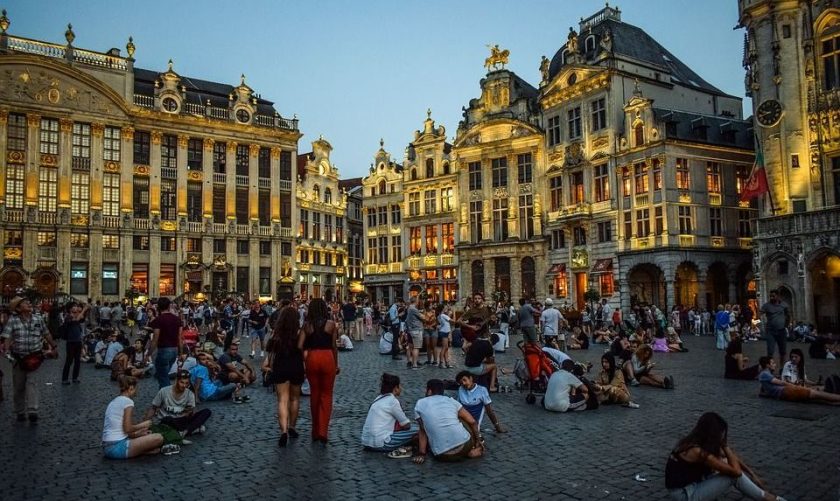
Belgium has joined the list of countries that are rebelling against their elected leadership. Over the weekend the Belgian government fell over Prime Minister Charles Michel’s trip to Morocco to sign the United Nations Migration Agreement. The agreement made no distinction between legal and illegal migrants and regarded immigration as a positive phenomenon. The Belgian people apparently did not agree. Facebook registered 1,200 Belgians agreeing that the Prime Minister was a traitor. Some users expressed concern for their children’s futures, noting that Belgian democracy is dead. Others said they would get yellow vests and join the protests.
The unrest witnessed in a number of places is focused on some specific demands but it represents much broader anger. The French yellow vests initially protested against proposed increases in fuel taxes that would have affected working people dependent on transportation disproportionately. But when that demand was met by the government of President Emmanuel Macron, the demonstrations continued and even grew, suggesting that the grievances with the government were far more extensive than the issue of a single new tax. Perhaps not surprisingly, the French government is seeking for a scapegoat and is investigating “Russian interference.” The US State Department inevitably agrees, claiming that Kremlin directed websites and social media are “amplifying the conflict.”
Some commentators looking somewhat more deeply at the riots in France have even suggested that the real issue just might be regime change, that the Macron government had become so disconnected with many of the voters through both its policies and the rhetoric justifying them that it had lost its legitimacy and there was no possibility of redemption. Any change would have to be an improvement, particularly as a new regime would be particularly sensitive to the sentiments of those being governed, at least initially. One might suggest that the prevailing sentiment that a radical change in government is needed, come what may, to shake up the system might well be called the “Trump phenomenon” as that is more-or-less what happened in the United States.
The idea that republican or democratic government will eventually deteriorate into some form of tyranny is not exactly new. Thomas Jefferson advocated a new revolution every generation to keep the spirit of government accountable to the people alive.
Call it what you will – neoliberalism, neoconservatism or globalism – the new world order, as recently deceased President George H.W. Bush once labeled it, characteristically embraces a world community in which there is free trade, free movement of workers and democracy. They all sound like good things but they are authoritarian in nature, destructive of existing communities and social systems while at the same time enriching those who promote the changes. They have also been the root cause of most of the wars fought since the Second World War, wars to “liberate” people who never asked to be invaded or bombed as part of the process.
And there are, of course, major differences between neoliberals and neoconservatives in terms of how one brings about the universal nirvana, with the liberals embracing some kind of process whereby the transformation takes place because it represents what they see, perhaps cynically, as the moral high ground and is recognized as being the right thing to do. The neocons, however, seek to enforce what they define as international standards because the United States has the power to do so in a process that makes it and its allies impossible to challenge. The latter view is promoted under the phony slogan that “Democracies do not fight other democracies.”
The fact that globalists of every type consider nationalism a threat to their broader ambitions has meant that parochial or domestic interests are often disregarded or even rejected. With that in mind, and focusing on two issues – wholesale unwelcome immigration and corrupt government run by oligarchs – one might reasonably argue that large numbers of ordinary citizens now believe themselves to be both effectively disenfranchised and demonstrably poorer as rewarding work becomes harder to find and communities are destroyed through waves of both legal and illegal immigration.
In the United States, for example, most citizens now believe that the political system does not work at all while almost none think that even when it does work it operates for the well-being of all the citizens. For the first time since the Great Depression, Americans no longer think of upward mobility. Projections by sociologists and economists suggest that the current generation growing up in the United States will likely be materially poorer than their parents. That angst and the desire to “do something” to make government more responsive to voters’ interests is why Donald Trump was elected president.
What has been occurring in Belgium, France, with Brexit in Britain, in the recent election in Italy, and also in the warnings coming from Eastern Europe about immigration and European Union community economic policies are driven by the same concerns that operated in America. Government itself is becoming the enemy. And let us not forget the countries that have already felt the lash and been subjected to the social engineering of Angela Merkel – Ireland, Spain, Portugal and Greece. All are weaker economies crushed by the one size fits all of the EURO, which eliminated the ability of some governments to manage their own economies. They and all their citizens are poorer for it.
There have been windows in history when the people have had enough abuse and so rise up in revolt. The American and French revolutions come to mind as does 1848. Perhaps we are experiencing something like that at the present time, a revolt against the pressure to conform to globalist values that have been embraced to their benefit by the elites and the establishment in much of the world. It could well become a hard fought and sometimes bloody conflict but its outcome will shape the next century. Will the people really have power in the increasingly globalized world or will it be the 1% with its government and media backing that emerges triumphant?
Tale of two uprisings: Ukraine’s Maidan got McCain & cookies, French Yellow Vests get shunned
By Robert Bridge | RT | December 13, 2018
Unlike the 2014 Ukraine uprising, which witnessed invasive meddling on the part of US politicians and diplomats, Western support for the French Yellow Vest protests has been conspicuously missing in action.
With the streets of Paris ablaze for a fourth weekend in a row, as a swarm of Yellow Vests assert themselves against a French government which, they argue, has become increasingly detached from the cares of ordinary citizens, support among Western capitals for the protesters is nowhere to be found.
This is a bit odd since the ‘gilets jaunes’ are not just protesting Macron’s (rescinded) plans for a fuel tax, but have released a list of 42 demands they want to see implemented. This includes an increase of the minimum wage, pensions and wages, as well as a halt to illegal immigration into the country. In other words, we are not talking about violent anarchists on the streets of France, but regular citizens. Thus far, the movement enjoys a high level of support among the French, with one poll showing 72 percent siding with the protesters.
The United States and its allies may have trouble explaining their tone-deafness in the face of these legitimate concerns on the part of millions of French citizens. At the very least, their icy silence will reveal a no small amount of double standards and outright hypocrisy since the West rarely misses an opportunity to interfere in the affairs of foreign states – mostly in the Middle East – when ‘democracy’ is purportedly on the line.
Consider Washington’s starkly different attitude to Ukraine’s 2014 Maidan revolution, which brought down the government of Viktor Yanukovich through the explicit support of the United States, as well as a number of influential NGOs operating in the country. Yanukovich committed the unforgivable mistake of thinking he would be allowed to pursue an independent course for his country, despite the fact that since 1992, the US had spent over $5 billion propping up ‘democracy-building programs’ in Ukraine.
Did Kiev really think that Washington would not eventually expect something in return for all those dollars, like maybe deciding who would eventually rule the Eastern European country on Russia’s border? And that is exactly what happened.
When Yanukovich signaled that he would not sign Ukraine up to an EU trade deal, he awoke a sleeping giant below his feet. Several weeks after the announcement, as his country was becoming increasingly divided over its options, the late US Senator John McCain appeared in central Kiev where he tossed dry wood on the smoldering fires by proclaiming at a rally on Independence Square, “Ukraine will make Europe better, and Europe will make Ukraine better… America is with you.”
What could have motivated Washington to pursue such blatant interference in the affairs of Ukraine, while ignoring the French ‘gilets jaunes’ that are now fanning out across France, protesting the neo-Liberal policies of President Emmanuel Macron? Could the answer have anything to do with something as simple as money? That certainly seems to be a large part of the equation.
After all, steering Kiev away from Russia, Western officials understood, would pay off handsome dividends for Western lending institutions, like the International Monetary Fund, which had already lent Kiev billions of dollars to stay afloat. The West was fiercely opposed to the idea of Russia and China becoming ‘lenders of last resort’, a financial and political function that the Western world covets more than any other, with the possible exception of military interventionism against sovereign states.
Fast forward one year after John McCain was agitating rallies in Kiev, and Victoria Nuland was handing out cookies to the protesters, and we find Ukraine, under the new leadership of the US-anointed President Petro Poroshenko, inking a $17.5bn (£11.5bn) loan deal with the IMF, together with the painful austerity measures that always accompany the bags of cash.
Presently, there are no such financial incentives in France that would convince Western capitals to ‘rally on behalf of democracy’ as it had done without delay in Ukraine.
This glaringly hypocritical position with regards to the French protesters reveals a deeply flawed, cart-before-the-horse Western axiom that commands: ‘whatever works to the advantage of Western institutions and its political elite is automatically good for democracy.’ This does not exclude social upheaval and revolution. If violence in the streets translates into the empowerment of Western institutions, not least of all the global financial institutions, then such actions will be rewarded with Western support without a moment’s thought.
Today, Emmanuel Macron, 40, the former Rothschild investment banker known as “president of the rich” by his countrymen, is facing the prospect of an early political demise, no less than Viktor Yanukovich faced in 2014.
Indeed, to say that Macron’s popularity among the French is in the toilet would be putting the situation mildly.
As one local English-language French magazine summed up his plight: Macron is “long-hated by the extreme-leftist groups because of his past as a banker… detested by the far-right because of his pro-European, globalist beliefs and now hated by many ordinary French people, who see him as arrogant, aloof and unsympathetic to their problems.”
Yet, not a single Western politician to date has appeared in the French capital, rallying the protesters and demanding Macron step aside; nor has any top-ranking US diplomat been spotted handing out cookies to the French rabble as Victoria Nuland did in Kiev at the height of Ukrainian tensions.
Incidentally, with such stark images in mind, it seems preposterous that the US can actually accuse Russia of meddling in its political affairs, and without a shred of evidence to back the claims. But I digress.
The simple reason that no Western country has come out to condemn Macron is because he toes the line on neo-liberalism and extreme free-market economics that has ravaged the French middle class to breaking point. The fuel hike was just the proverbial straw that broke the voters’ back.
It would be no exaggeration to say that all segments of French society have become caught up in the protests. Today we see hundreds of French schools, for example, shutting down as students take to the streets to protest Macron’s unpopular education reform. Pensioners are also counted among the protesters after Macron lectured them to stop “whining” about spending cuts, at the very same time he was slashing taxes for the wealthy.
Clearly, there is nothing about Macron that Western leaders can find not to their liking. He is carrying out painful liberal reforms with gusto, and only under pain of usurpation does he backpedal on his political program. Although the rudderless French president may fancy himself as a modern-age Napoleon, acting tough with his subjects to get what he wants, ultimately it will be the French street that decides his fate, which at the moment looks very bleak.
Such a brutal wake-up call may very well be in store for many more Western neo-liberal leaders, who fail to feel the pulse of their people when instituting their unpopular policies, in the weeks and months to come.
Featured Video

New positive ivermectin evidence
or go to
Aletho News Archives – Video-Images
From the Archives
Fanatical Followers of the Covid Regime: A Jim Jones-Style Cult?
By Professor Roger Watson and Dr. Niall McCrae | The Daily Sceptic | November 15, 2021
As scholars at leading British universities over recent decades, we witnessed the replacement of critical thinking and debate by narrative: facts are discrimination and scientific method is imperialism; truth, instead, is derived from ‘progressive’ values. This educational trend may be a major contributory factor to the ease in which society has been inculcated to the Covid ‘new normal’ of masking, testing, and repeated doses of vaccines for a disease of similar risk to severe influenza.
One doesn’t need much critical reasoning to observe the flawed logic of some vaccination enthusiasts, such as people who respond to experiencing any side effects, however debilitating, by saying “at least I know it’s working”, or, after contracting the disease despite their promised inoculation (over 90% effective, according to initial drug company claims), “I’d have been worse off without the jab.” … continue
Blog Roll
 Aletho News
- EU Council Advances Chat Control 2.0 Scanning Proposal
- Ex-Greek MEP files complaint against Israeli spyware firm over alleged Pegasus surveillance
- Troubling ideas throughout the Torah, Talmud, Mishneh Torah and Tanya
- ‘Grave, alarming’: Iran mission on Trump’s UNGA ‘annihilation’ threats
- Najaf airport to reopen to Iranian flights within 24 hours: Ambassador
- From ‘How Will This End For Iran’ to ‘When America Walks Away’: A tale of two Economist covers
- Tehran blasts ‘baseless’ speculation linking Iran to alleged bomb plot at UK air base
- The Rise And… Rise Of ‘Color Revolutions’
- The Coming GOP Bloodbath?
- Arctic Scare Stories Melt Away
- If Americans Knew
- Netanyahu Asked UAE Leader to Deny Report on Oct. 7 Warning in Secret Visit, Sources Say
- CNN Chief Int’l Correspondent Clarissa Ward on Journalists in Gaza
- Democratic Party Consultants Surround Troy Jackson with Pro-Israel Donors
- Christian Leader Responds To Netanyahu’s Claims Regarding Palestinian Christians
- In Gaza, ‘Whoever Survives the Bombing Won’t Survive the Rubble’
- Israel kills more Palestinians, amid push to resettle Gaza – Daily Update
- Israel forces Gazans to live in constant peril – Daily Update
- Deconstructing Netanyahu’s pants-on-fire UN rant – Daily Update
- Trump betrayed voters with his campaign lies and prioritized a foreign country once he took office
- Netanyahu calls Israel’s war in Gaza ‘opposite of genocide’ in UN speech to near-empty hall
- No Tricks Zone
- New Study: Earth And Venus Surface Warmth Largely Explained By Convection And Lapse Rate, Not CO2 Or Radiation
- 2025 Nature Paper Claiming Worsening Global Drought Gets RETRACTED …Heavily Flawed
- New Study: ‘Global Drought Shows No Detectable Recent Acceleration Under Climate Warming’
- Economic Masterminds: German Socialists Suggest Taxing Productivity Gains Stemming From Using AI
- The South China Sea Has Not Been Cooperating With The Climate Change Narrative
- Energy Crisis: Germany Enters Heating Season With Historically Low Gas Reserve Fill Levels
- New Study: The Antarctic Ice Sheet Gained Mass From 2020-2024 Due To Staggering Snow And Ice Accumulation
- Study: Ocean Heating Rates From Thousands Of Years Ago ‘Dwarf’ Modern Ocean Heating Rates
- Climate Extremists Target, Attack Large-Scale Power Grid Infrastructure In Germany!
- New Study: Antarctic Ice Melt Has Contributed Less Than 1 Centimeter To Sea Level Rise In The Last 30 Years

