The EU and the warning signs of Fascism
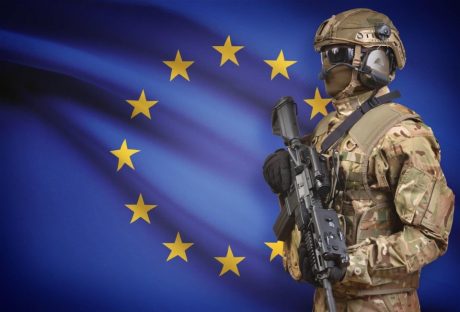
Image source – here
By Kit Knightly | OffGuardian | December 10, 2018
Things are spiralling out of control in Europe, faster than many predicted. Outside of Brexit, there is strong anti-EU feeling in Hungary, Spain, Italy, Greece and France. The EU is in danger of crumbling, and people afraid of losing power are prone to extreme acts of dictatorial control.
How long before the EU truly becomes the authoritarian force that people from both ends of the political spectrum have always feared?
The EU Defence Force
Earlier this year, the EU voted to “punish” one of its own members, Hungary, for the internal policies of its elected government. To be clear about this – whatever you think of Viktor Orban, he was elected by the people of Hungary. He is their legally recognised democratic leader. Hungary voted for him – in contrast, Hungary did NOT vote for any of the 448 MEPs who supported the motion, posed by Dutch MEP Judith Sargentini, that:
The Hungarian people deserve better… They deserve freedom of speech, non-discrimination, tolerance, justice and equality, all of which are enshrined in the European treaties.”
Note that “democracy” is not included on that list. “Tolerance”, “justice” and “equality”, but not democracy. A Freudian slip, perhaps.
The European Parliament vote was, itself, a corrupt nonsense – one in which abstentions were disregarded so the 2/3rds majority could be reached. Forcing through a bill that, essentially, calls for a change of regime in Hungary via:
“appropriate measures to restore inclusive democracy, the rule of law and respect for fundamental rights in Hungary”
One suggested punishment – “The Nuclear Option” – is a loss of voting rights. Hungary would still be a member of the EU, would still have to pay into the EU, would still have to obey all EU laws and regulations, but would no longer have a say in what those laws were.
This would, notionally, be in defence of “inclusive democracy”.
How long before disapproval and punishment of certain leaders turns into outright removal? Can we really say that would never happen?
This month, Paris (and other French cities) have seen the massive Gilets Jaunes protests against the fuel tax, austerity and income inequality. The violent repression of these protests has received no criticism from either individual member states of the EU, or the EU itself. However, an armored vehicle painted with the EU’s insignia was seen on the streets of Paris.
Both Macron and Merkel have talked, recently, of the need for an EU Army – will these protests in France be used as an excuse to implement those plans?
Let’s assume the EU Army is brought about – let us supply the European Union with its coveted “defence force”. 250,000 hypothetical men, drawn from all the member states. What is their purpose? What is their function?
For example, would they have been deployed to Catalonia last year to “keep the peace”? Would an EU army have moved against a peaceful vote to “defend” the integrity of the Union?
Would a possible step in dealing with Viktor Orban’s government be to deploy the EU Defence Force to Budapest and remove the man who is a threat to “equality”? Would that count as “appropriate measures to restore inclusive democracy”?
If Brexit is ruled a “threat to human rights” (or some other collection of buzzwords), would the EU army be rolling armoured vehicles along the streets of London to protect us from ourselves?
There have been, and could be, many situations in the EU’s recent past where military intervention was only avoided because it literally wasn’t an option. An EU Army would make it an option, do we trust Brussels not to avail themselves of it?
Some argue that an EU Army would be a good thing because it would decrease Europe’s reliance on NATO, and remove US influence. I don’t believe that to be the case, and as evidence, I supply the fact that the Carnegie Endowment for International Peace, a well-known US-backed NGO, is very much in favour of the plan.
The EU’s Ministry of Truth
Of course, the increasing possibility of an EU consensus imposed by force is only one part of the threat.
Outside of physical repression – both by the EU (of national sovereignty), and by the state (of the individual right to protest) – there are warning signs of intellectual repression. A coming crackdown on freedom of expression and opinion.
There is a scary article on The Guardian today: Russia ‘paved way for Ukraine ship seizures with fake news drive’ . It’s not scary because of the headline – it’s scary because of the motivations behind it, and the implications for the future of Europe.
The meat of the article is an unsourced, unlinked, evidence-free claim of Russian malfeasance, and as such, Hitchens’ Razor applies.
The first half of the article is riddled with lies, omissions and mistakes. It’s the Guardian, you expect that. Disregard the babble about cholera and nuclear bombs. Disregard the factual errors – many though they are. In this instance, none of it matters.
All that matters is the second half – the proposed “solution” to the “problem” to which this article is a “reaction”. Namely, online disinformation. Specifically, “Russian” online disinformation.
Julian King, former UK ambassador to France and now EU security commissioner, wants tech companies to take steps to prevent the spread of “fake news”. It’s a war against dissent, with three fronts.
One – establish the “truth”:
Last week the European Commission announced it would set up a rapid alert system to help EU member states recognise disinformation campaigns
Essentially, there will be an EU mandated list of acceptable “news”, and anything which deviates from that in the slightest way will be branded “disinformation”. This will allow people to dismiss, rather than engage with, views that differ from their own.
Two – eliminate dissent:
King said social media platforms needed to identify and close down fake accounts that were spreading disinformation.
By “fake accounts”, they mean accounts which spread “disinformation”. Being a “bot” is not about whether or not you are a real person, it’s about whether or not you have the right opinions. As has been demonstrated, they either do not know or do not care who is real and who is not. Perfectly real people have been labelled Russian bots in the media, when they are proven to be neither Russian nor bots. Whether this is incompetence or corruption does not matter, the point is governments have shown they cannot be trusted on this issue.
Three – control the narrative:
We need to see greater clarity around algorithms, information on how they prioritise what content to display, for example. If you search for anything EU-related on Google, content from Russian propaganda outlets like RT or Sputnik is invariably in the first few results…. All of this should be subject to independent oversight and audit.
The Google algorithm is allowing news that either disagrees with the EU, or is directly critical of it, to be shown in their results. This is unacceptable. What the EU security commissioner wants is for Google to “fix” their system, to make sure news that deviates from the EU’s agenda does not show up in their results.
Now, if you think that sounds like censorship, don’t worry because [our emphasis]:
What we are not trying to do is to censor the internet. There is no suggestion that we – or anyone else – should become the arbiter of what content users should or shouldn’t be consuming online. This is about transparency, not censorship.
The EU wants Google to remove certain websites from their algorithm, but it’s about transparency, not censorship. So that’s OK.
Conclusion
To sum up:
- The European Union’s two major figureheads are both in favour of an EU army.
- The European Union’s flag is painted on armoured vehicles repressing anti-government protests in France.
- The European Union is putting aside £4.6 millio (5 million Euros) to “help people recognise disinformation”.
- The European Union wants to pressure social media companies into “shutting down” accounts that spread “fake news”.
- The European Union wants Google to alter their algorithm, to promote news that praises the EU and demote sites critical of it.
- The European Union wants us to understand that this is about “transparency” and is definitely NOT censorship.
Does this sound like an organization of which we want to be a part? Are we supposed to like the proposed multi-national EU “defense force” putting down anti-EU marches on the streets of Barcelona or Rome? To cheer on the idea that the EU Army could be sent into non-cooperative member-states to remove “dangerous” elected leaders because they are a threat to “equality”?
We won’t even be able to get to the truth of those matters, because the EU will be supplying lists of “fake news” social media accounts to Twitter and Facebook, who will dutifully shut them down. While Google alters and re-alters their algorithm to make sure any news covering EU repression of democracy is pushed so far down the results pages it may as well not exist.
The British press, pundits and talking heads are constantly referring to the “Brexit crisis”, but that’s just hysteria and fear mongering. Re-negotiating your position in a trade bloc is NOT a crisis. A crisis is what happens when an unelected, bureaucratic power structure suddenly senses its grip on power is slipping, and acts accordingly.
And a crisis could well be on the horizon. The signs are there, if you want to see them.
Kit Knightly is co-editor of OffGuardian. The Guardian banned him from commenting. Twice. He used to write for fun, but now he’s forced to out of a near-permanent sense of outrage.
The Zionist Circular Maze
By Gilad Atzmon | December 7, 2018
On Thursday Israel cheered as the EU called on its member states that have not yet done so “to endorse the non-legally binding working definition of antisemitism employed by the International Holocaust Remembrance Alliance (IHRA).”
Israel called this move a “breakthrough,” the European Jewish Congress hailed the declaration as “unprecedented.” Both are correct: the Europeans ‘adoption of the IHRA definition of antisemitism is both a ‘breakthrough’ and ‘unprecedented.’ It confirms that Europe has explicitly abandoned its Athenian ethical ethos.
Rather than declaring its opposition to racism as a universal precept and denouncing all forms of discrimination and prejudice against any group or person of any X’ simply for being X’ (for example, a Jew for being a Jew, a Black person for being Black, a Gay person for being Gay, etc.), the EU has fallen into the most banal trap and subscribed to the primacy of Jewish suffering.
A lot has been written criticising the IHRA definition, how it stifles free speech and treats one particular group as exceptional but I think we have failed to address the most important question the IHRA raises. Why are Jewish institutions so enthusiastic about a definition that clearly extinguishes the Zionist promise to make ‘Jews people like all other people.’ The IHRA validates the vile antisemitic claim that Jews are somehow different than others, as no other people have advocated for nor benefit from an IHRA-like definition of prejudice directed solely against them. One should wonder why Jewish institutions see a need to impose such a definition on individuals, organisations, states and even continents.
The answer is circular. Jewish institutions need the IHRA definition simply because they have managed to impose such a definition — since the acceptance of the IHRA definition points at boundless political power, the IHRA definition serves to target and suppress any exploration, discourse or even discussion of such power.
This reflexive reasoning recalls the old rude joke; ‘why does a dog lick its testicles? Because it can.’ Why does the Lobby impose the IHRA definition on us? Because it can.
I wish the effects were merely so simple. The dog joke is amusing because it hints that if men could indulge in a similar gratifying act, the world would be somehow calmer and friendly like the happy dog. The joke is basically a comical illustration of Freud’s pleasure principle. But the IHRA definition is neither funny nor pleasing. It is hardly gratifying for those who have endorsed it, and in some cases its adoption has involved a chain of abuse and harassment (in the British Labour Party, for instance). While the dog is thrilled or titillated by his own act, it is not clear whether Europeans and Americans are at all happy to have to endorse a ‘non legally binding definition’ imposed on them by a powerful foreign lobby. It is reasonable ask why the EU Council has adopted a non universal definition of racism. It has done so because it doesn’t have another option.
This state of affairs is far from simple, harmonious or peaceful. It is in fact, pretty much a situation that incites instability, fear and anger.
No connection between Judaism and Al-Aqsa, suggests UN resolution
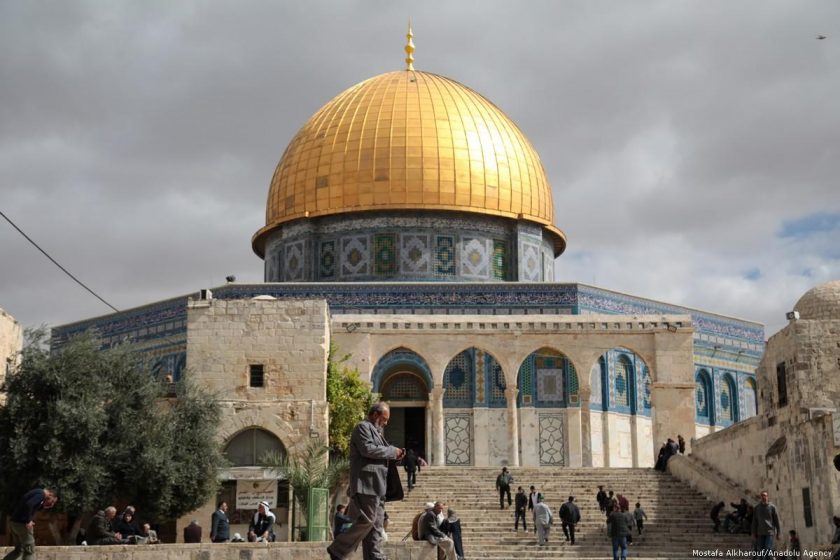
Muslims arrive at Al-Aqsa Mosque Compound to perform the Friday prayer in Jerusalem on 26 October 2018 [Mostafa Alkharouf/Anadolu Agency]
MEMO | December 3, 2018
The UN General Assembly has apparently rejected any connection between Judaism and the Noble Sanctuary of Al-Aqsa. In a vote held on Friday, the General Assembly passed six resolutions condemning Israeli violations against Palestinians. Among them was Resolution A/73/L.29 entitled “Jerusalem” which called for “respect for the historic status quo at the holy places of Jerusalem, including the Haram Al-Sharif.”
The use of the Arabic name for the sanctuary has been interpreted as a not-so-subtle rejection of the site’s alleged connection with Judaism. The Jewish name for the Noble Sanctuary, the Temple Mount, is not mentioned anywhere in the UN document.
The resolution received 148 votes in favour and just 11 against. It also stressed that the UN General Assembly,
“Reiterates its determination that any actions taken by Israel, the occupying Power, to impose its laws, jurisdiction and administration on the Holy City of Jerusalem are illegal and therefore null and void and have no validity whatsoever, and calls upon Israel to immediately cease all such illegal and unilateral measures.”
The Assembly passed several other resolutions on the question of Israel-Palestine this weekend. One — A/73/L.29 The Syrian Golan — rejected Israel’s occupation of the Golan Heights, “demand[ing] once more that Israel withdraw from all the occupied Syrian Golan to the line of 4 June 1967 in implementation of the relevant Security Council resolutions.”
The resolution also declared that “the Israeli decision of 14 December 1981 to impose its laws, jurisdiction and administration on the occupied Syrian Golan is null and void,” adding: “The continued [Israeli] occupation of the Syrian Golan and its de facto annexation constitute a stumbling block in the way of achieving a just, comprehensive and lasting peace in the region.”
The General Assembly resolutions were condemned vehemently in the Israeli media, with Breaking Israel News slamming them as evidence of the UN “[continuing] its streak of frequently condemning the Jewish state”. Other media cited NGO UN Watch — which is known for calling the UN anti-Israel or anti-Semitic – as saying that the “Jerusalem” resolution “implies that Israeli administration of Jerusalem hinders freedom of religion when in fact the opposite is true.” UN Watch also labelled the “Syrian Golan” resolution as being “oblivious to [the] genocidal massacres taking place now in Syria, and its security implications for Israel and the civilians of the Golan Heights.”
The resolutions, however, were hailed as a success by the Palestinian Authority, Wafa reported. “By voting in favour of the five resolutions,” said Palestine’s Permanent Observer to the UN, Riyad Mansour, “the international community affirms its support of our national cause, despite the efforts made by the US administration in international forums to resist this.”
In a rare move, following the General Assembly vote, the European Union publicly warned the Palestinians that they must drop their UN bid to use only Al-Haram Al-Sharif to refer to Jerusalem’s holiest site. In a statement, the EU “[stressed] the need for language on the holy sites of Jerusalem to reflect the importance and historical significance of the holy sites for the three monotheistic religions, and to respect religious and cultural sensitivities.” It added that the future choice of language “may affect the EU’s collective support for the resolutions.”
Commenting on the EU statement, the Jerusalem Post observed, “Until now, the EU has not taken a united stand on a drive by both the Arab states and the Palestinians to subtly change UN language with regard to the Temple Mount [Al-Haram Al-Sharif].” Its opposition or decision to abstain on any future resolutions of this nature “would mark a dramatic shift in its policy.”
READ ALSO:
Hamas hails Fatah’s criticism to US’ draft resolution condemning resistance at UN
EU Parliament to Consider Funding Russian NGOs, Bloggers – Draft Resolution
Sputnik – 01.12.2018
BRUSSELS – The European Parliament will consider a draft resolution on EU-Russian relations, which includes a proposal to increase EU financial assistance to non-governmental organizations (NGOs), human rights activists and bloggers in Russia, according to the draft.
“The European Parliament… stresses the importance of continued political and financial support for civil society activists, human rights defenders, bloggers, independent media, investigative journalists, outspoken academics and public figures, and NGOs; calls on the [European] Commission to programme more ambitious financial assistance to Russian civil society from the existing external financial instruments,” the draft document reads.
The draft was submitted to the European Parliament’s Committee on Foreign Affairs by Sandra Kalniete, a lawmaker from Latvia. The document will be discussed by the committee on Thursday.
In October, Christos Stylianides, the European Commissioner for Humanitarian Aid and Crisis Management, said at a hearing in the European Parliament that in 2017 the European Union had allocated emergency grants to human rights activists from Russia.
Russian officials and lawmakers have repeatedly said that Western states, whether individually or via inter-state institutions such as the European Union and NATO, increased their financing of the activity of organizations spreading pro-Western propaganda in Russia, including NGOs, media, and social networks. In June last year, the Russian parliament’s upper house established a commission on state sovereignty protection to monitor and address these attempts to influence the country’s internal politics.
Yellow Vests: No Coincidence Macron, Merkel and May are in Dire Straits – Journalist
By Ekaterina Blinova – Sputnik – November 30, 2018
The ‘yellow vest’ upheaval has exposed longstanding problems in France’s economy, Christine Bierre, French journalist and chief editor of Nouvelle Solidarité, has told Sputnik, adding that to heal these wounds, the French need to get rid of Brussels’ diktat and take back control of their financial system.
The ‘yellow vests’ protests are continuing to gain momentum in France, with about two thirds of the French supporting the unrest, according to the latest OpinionWay poll.
Speaking to Sputnik, Christine Bierre, French journalist and chief editor of Nouvelle Solidarité, shed the light on the nation-wide upheaval.
‘Over a year, diesel prices have increased by 23 per cent and those of gasoline, by 15 per cent. These hikes [in prices] hit those who live in rural areas and who need energy not only for their cars, but for tractors if they are farmers, boats if they are fishermen, trucks for transporters, fuel for construction workers and for heating’, the journalist said.
She noted that those who cannot afford living in big cities and who live in small towns and in the peripheries had also found themselves between a rock and a hard place, since they have to use their cars to get to megalopolises.’Concretely, expenses for energy have gone from 12 per cent per household in the 1960’s, to 30 per cent in 2018′, Bierre stressed. ‘For a couple with two kids using a diesel car and fuel to heat, taxes increased last year by 600 euros; the price of diesel for tractors went from 50 cents a litre to 87 cents, so a farmer using 20,000 litres per year, will pay 7,400 euros more in taxes on energy’.
She pointed out that in general, ‘the middle and the lower middle class and also part of what one calls the “working poor”‘ had fallen prey to the Macron cabinet’s measure.
According to the journalist, the rapid growth of the ‘yellow vests’ movement, which mobilized 300,000 people, ‘revealed, however, that energy prices were just the last straw that provoked the social explosion.’
TICPE and Its Consequences
However, President Emmanuel Macron and his policies are not the only reason for the impoverishment of the French middle class and the current crisis, ‘even though his favouring the richer against the poor has been the most indecent’, the journalist opined.
‘Along with the energy price increases on international spot markets, the real culprit behind the huge rise in energy prices is the tax on energy products, TICPE (Taxe Intérieure de Consommation sur les Produits Energétiques), created in 2000, and used by the state to heavily improve its tax revenues’, she elaborated.
Bierre explained that today this tax ‘represents 57 per cent of the price of diesel and more than 60 per cent of the price of gasoline, mainly because since 2014, the TICPE includes a tax to finance the costs of the energy transition.”This is a progressive tax that grows every year according to a supposed price of carbon per ton of CO2, which is to reach 100 euros in 2030!’ the journalist remarked. ‘In 2015 it was at 14.5 euros, in 2017 — 22 euros in 2017, in 2018 — 44.6 euros and so on.’
She stressed that Macron’s predecessors relied heavily on the taxation of their population to finance their programmes and lately the energy transition, but the incumbent French president ‘is, no doubt, the most outrageous.’
‘Since his coming to power he “granted” 5 billion euros in tax cuts to rich financiers, transforming the tax on large fortunes into a real estate tax only, and reducing the tax on financial profits to a 30 per cent flat tax’, Bierre outlined. ‘At the same time, he reduced state aid to the poor by the equivalent of 4 billion euros (cuts in aids to housing, public jobs and increase of general taxes).’
Yellow Vests: Neither Far-Right nor Far-Left
The question then arises as to what political forces have jumped on the bandwagon of the ‘yellow vests’ movement. According to Bierre, many politicians would like to capitalize on the upheaval, from the far right to the far left camp.
‘The “yellow vests”… have rejected the participation of all political forces as such, and kicked out far right and far left elements attempting to infiltrate them’, she highlighted, adding that the movement had emerged spontaneously protesting against the austerity policies which originate from the 2008 financial crisis and earlier economic strategy.
The journalist has drawn attention to the fact that Macron has refused to hear the plight of the French population so far.
‘[Prime Minister] Edouard Philippe even repeated [on 28 November] that he won’t eliminate the planned increases of energy costs for 2019 and won’t increase the minimum wage’, she remarked. ‘Will Philippe, a close aide to Alain Juppé, end up like his master in 1995, ousted following the strikes, because he was too rigid to change? Anything is possible.’
According to Bierre, these protests ‘have the potential of a revolutionary movement.’
‘Will the government resist all the pressure, due to the lack of organizational structures and experience [of the protesters]? Perhaps; but it has definitely become the first serious call to bring an end to the arrogance of the Paris elites of the post-De Gaulle era’, she said.
The Lesson of the 2008 Financial Crisis is Still Unlearned
The journalist believes that it is no coincidence that the leaders of major European powers — Germany, France and the UK — are currently facing economic and political difficulties triggering speculations about their possible resignations or early departures.
‘In fact Europe is suffering from the refusal of the Western world to deal with the consequences of the 2008 financial crisis, and with the inequalities created by the financial globalization of the last 30 years’, she opined. ‘Like in the US, in Europe, the middle classes became impoverished during this process, and the poor became even poorer.’
The situation is complicated by the diktat of Brussels, she underscored, adding that EU member-states’ financial systems are being controlled by the European Central Bank, which exerts its supranational authority on the nations.
‘The situation in Europe is worsened by the fact that by adopting the EU supranational treaty, all nations gave up their sovereignty in all matters and today are like bodies with no heads! As we see in the case of Italy, a non-elected EU Commission is trying to rule over a duly elected Italian government, to forbid them from carrying a policy of investment to create jobs’, Bierre said.
Seeking a Cure
So, what steps should be taken by the government to fix the current situation?
‘Dealing with the European question is not sufficient however, because to create jobs and rebuild our economies, we must take back control of our financial system’, the journalist responded.
She noted that the looming financial crisis that is being predicted by most financial media at this point ‘sets the obvious context for the financial reforms needed to rebuild our nations in response to the current revolts.’
According to Bierre, first, Europeans need ‘a real Glass-Steagall Act which separates speculative banking completely from commercial banking’; second, ‘the reestablishment of sovereign national banks in every country emitting “public credit” for reconstruction of industrial capacities of the devastated European economies based on the policies of the “30 glorious” [post-war boom] years in France’; third, Europe needs to adopt a ‘policy of cooperation with the great powers of this world, Russia, China, India and the United States, to expand and contribute to initiatives like China’s New Silk Road, the Russian Eurasian Economic Union, and the Shanghai Cooperation Organization.’
A European Army Obeying US Interests Will Only Incentivize More Imperialism and Military Corruption
By Federico PIERACCINI | Strategic Culture Foundation | 27.11.2018
The idea of creating a common army for the countries of the European Union has been repeatedly proposed by numerous advocates of the globalist elite for at least a decade. The latest example came from French President Macron, who took the opportunity during commemorations of the end of WWI in Paris to revive an idea that represents more a fantasy than a real possibility.
First the good news. Richard Shirreff, a retired senior British Army officer, stated: “I think we have got to be very careful about loose talk of a European army. An army is a legally constituted armed force operating under the authority of a sovereign Government. So, if you accept that definition, the notion of a European army is impossible until and unless there is a sovereign European Government, which is obviously not in existence. And I think it is some way off.”
The question then arises as to why Macron and Merkel are so interested in talking about something that seems unrealistic at the moment? The answer is simple and obvious. It is a strategy aimed at striking at Trump directly, as evidenced by the words of Merkel, who also voiced her support for the creation of a European army. The Chancellor has indeed stated that “[t]he times when we could rely on others are over”. By “others” she is clearly referring to the United States. Also, putting to one side the tense personal relationship between Macron and Trump, the Frenchman, like Merkel, is an exponent of globalism. The agreement between Berlin and Paris is intended to move Europe in a direction more agreeable to them, focussing on the need to attract more investment in European weapons, coupled with a desire to decrease dependence on US weapon systems. As Macron stated: “Europe must increase military spending, but the money should go to European, not American companies.”
The main issue, therefore, revolves around the economics of the import and export of arms in Europe and around the world, a business worth tens of billions of dollars a year. As SIPRI’s annual report reminds us, “The five largest West European suppliers – France, Germany, the UK, Spain and Italy – together accounted for 23 per cent of global arms transfers in 2013-17. The combined arms exports by European Union (EU) member states accounted for 27 per cent of the global total in 2013–17.”
Specifically, France and the UK increased their exports by 27% and 34% respectively, while Germany had a decline of 14% over the last 5 years. It should be remembered that the data is only up to 2017, and many agreements have since been concluded, especially between European countries, with France and Germany leading in exports. The SIPRI report presents us with a fairly clear picture of imports from countries like Greece and Italy,even as the US dominates market share, with 20 out of 40 importing countries having the US as their main supplier.
France, the fourth country to have increased exports from 2008-2017, has gone from 5.8% of world exports to 6.7%, increasing exports by 27%. The United Kingdom, the 18th largest importer in the world, imports about 80% from the US. Italy is the 22nd largest importer in the world, importing 55% from the US and about 28% from Germany. Italy is the European country that imports most arms from another European country (Germany), about 28%, about 55% from the US, and the remaining 8.4% from Israel. In terms of imports, Greece is the 28th in the world, importing 68% from Germany, 17% from the US, and 10% from France. Of the top 40 importers, the US is the leading supplier for 20 of the 40, followed by Russia with seven countries, China with three, and seven for the UK, France and Germany combined.
In addition to the creation of a conglomerate that would combine mainly French and Germany industries, Merkel emphasized that such a European army would not be for the purposes of ensuring greater sovereignty for the EU, but rather complement NATO, thereby strengthening the imperialist and ultra-neoliberal positions that have devastated the world in recent decades. As the German chancellor has emphasized, “This is not an army against NATO, it can be a good complement to NATO”, also pointing out the logistical difficulties Europe faces to integration, with more than 150 different weapons systems as opposed to the 50 to 60 of the US.
Such veiled wording indicates the desire of Merkel and Macron to further decrease the importation of arms from American companies, even if overall Germany and France import less than 100 million euros a year from the US. France and Germany will face a critical need to modernize their armed forces in the coming decade, given Europe’s relative backwardness when compared to recent strides made in Russia, China and even the United States. Macron stated that it is crucial to devote 2% of GDP to military spending within four to five years. The new French defense budget, Macron said, would allow for the acquisition of:
“1,700 armored vehicles for the Army as well as five frigates, four nuclear-powered attack submarines and nine offshore patrol vessels for the Navy… The Air Force would receive 12 in-flight refueling tankers, 28 Rafale fighter jets and 55 upgraded Mirage 2000 fighters … This year will see a €1.8 billion increase (US $2.1 billion) in the annual defense budget to €34.2 billion, of which €650 million is earmarked for overseas deployment of combat troops… The modernization strategy will not be just about numbers, as performance should be pursued and the equipment should meet the requirement for ‘balanced’ cooperation between the services and the Direction Générale de l’Armement procurement office.”
The idea of creating a European army also contributes towards budgetary planning, which will start mainly from 2022, as “a large part of the money would only be released in 2024 and 2025, after a budgetary review in 2021.”
This all represents the perfect excuse to increase defense budgets, aiming at a European army that will apparently establish some sort of independence from Donald Trump’s America while simultaneously warding off Vladimir Putin’s Russia. Both Trump and Putin are hated by the globalist elite, being seen as their absolute enemies, and are both used by Macron and Merkel as boogeymen threatening European security, as if Moscow were intent on invading the Baltic countries as NATO analysts constantly claim. Such analysts need to make such claims in order to justify the existence of NATO and their accompanying salaries, with the defense sector being among Europe’s main industries, accounting “for about half a million jobs directly (plus half that number indirectly), in more than 1,300 companies”. That pretty much sums up the reason behind an EU army.
The American and European military-industrial complexes are huge employers. This represents a pool of voters that Merkel and Macron need to keep onside, just as they need financial support from the CEOs of large arms manufacturers in exchange for billion-dollar contracts, something that would simply be called corruption if practiced in other parts of the world.
With the economic crisis of 2008, European spending on arms fell by 22%, But with the provocations in Ukraine in 2014, and then the aggression directed against the Donbass region, creating tensions between Russia and the EU, there was new justification for an increase in military spending, especially since 2017. For example, Poland, Romania and Sweden have each decided to acquire long-range air-defense systems from the US, and Lithuania ordered medium-range air-defense systems containing components coming from Norway and the US.
Thankfully the use of Trump and Putin as boogeymen to justify the creation of a European army is a bluff that will not lead to any concrete action. It all comes down to the money to be made in this multi-billion dollar market. Once again, SIPRI’s study reminds us that Washington is dominant in this field, especially in the private sector, with “[f]orty-four US-based companies accounted for over 60 percent of all arms sales listed by SIPRI. The 30 European companies on the list make up just under 30 percent. France and Germany lead the pack, followed by the United Kingdom.” This is while taking into account that EU member states “are not even legally obliged to declare what their companies sell. Their code has achieved neither transparency nor consistency.”
The question may arise as to how Europe is to be prevented from developing imperial ambitions. The simple if banal answer is that this is not possible so long as Europe remains dependent on the United States and her imperialist and ultra-capitalist ambitions. European countries would in the first instance need a sovereign central bank with their own currency, in addition to a national army that could defend European territory. European elites are in fact moving in the exact opposite direction, and this can be seen almost in the daily activities and statements by leaders like Merkel and Macron. The creation of a European army, instead of guaranteeing greater political freedom and distancing the EU from the US, would only actually serve to buttress the ideology of Washington as the only world superpower.
Contrary to what would in actual fact be needed – more military and economic sovereignty of EU member states – the EU leadership seems to be heading in the other direction. In a world that is becoming more multipolar, the abdication of any kind of political, economic and military sovereignty is a recipe for disaster. Macron and Merkel, instead of balancing Europe’s political weight with China, Russia and the US, are hoping and waiting for a new Obama after the 2020 presidential election, so as to subjugate the whole of Europe to Washington’s rule, with Paris and Berlin acting as local satraps, treating the remaining 25 states of the EU as provinces of the Franco-German sub-empire.
Rising Crimea tensions mar Trump-Putin meeting
By M. K. BHADRAKUMAR | Indian Punchline | November 26, 2018
The ‘frozen conflict’ in Ukraine has suddenly become active on Sunday with an encounter involving the naval vessels of Ukraine and Russia at Kerch Strait in Crimea, the entry point of the Sea of Azov from the Black Sea. The Russians have detained three Ukrainian ships that tried to enter the Sea of Azov (where Ukraine has two ports). Russian boats fired on the vessels for allegedly disregarding warnings and violating Russian territory. Three Ukrainian personnel received injuries.
The Sea of Azov was steadily becoming the focal point of tensions between Ukraine and Russia with Kiev asserting its right of navigation (under a 2003 treaty with Russia) and Moscow insisting on its sovereign prerogative to control the narrow Kerch Strait.
Of course, the tensions basically have their origin in Russia’s annexation of Crimea in 2014. Ukraine calls the annexation illegal. Moscow estimates that western powers are egging on Ukraine to strengthen its naval presence in the Sea of Azov, which would of course have serious security implications for Crimea.
To compound matters, Russia has lately built a 19-km bridge connecting Crimea with the Russian hinterland. Russia suspects that there could be covert operations to damage the Kerch Bridge, which provides the vital communication link to Crimea.
From available details, Ukraine precipitated the incident on Sunday. Now, why would it have made such a move? One interpretation could be that it is all related to Ukrainian politics. Ukraine is heading for presidential and parliamentary elections in March next year. The incumbent pro-US president Petro Poroshenko is keen on securing another term. But he is terribly unpopular and his rating stands at 8% currently. He is unlikely to get a fresh mandate.
Interestingly, Poroshenko has seized Sunday’s incident in Kerch Strait to declare martial law. The martial law regulations give the government the power to curb public demonstrations, regulate the media and suspend the upcoming elections. The probability is high that Poroshenko is moving in the direction of canceling the 2019 presidential and parliamentary elections. And, arguably, the West would also like its s.o.b in power in Kiev at any cost.
But then, Ukraine situation is also at the very core of the tensions between Russia and the Western powers. It is all but certain that Poroshenko pushed the envelope only with some degree of quiet encouragement from certain Western power centres that may want to poke the Russian bear to see what its reaction could be.
What complicates matters is that the anti-Russian constituency in Europe and NATO on the one hand and the ‘Deep State’ in the US on the other (especially the Pentagon) are kindred souls in opposing President Trump’s agenda to improve relations with Russia. Significantly, the incident in Kerch Strait comes just before the planned meeting between Trump and Vladimir Putin in Argentina in the weekend.
The Kremlin has signaled that the forthcoming meeting in Argentina is on course. But the anti-Russian transatlantic caucus will try to undermine the meeting, if not get it derailed altogether. Their fear is that Trump is more assertive today (after the US midterm elections) than ever before in his presidency and might simply brush aside opposition to his agenda to improve relations with Russia.
To be sure, the Western camp which rejects Trump’s approach to Russia has lost no time to condemn Moscow for Sunday’s incident in Kerch Strait. The European Union, NATO and France have taken a strident position demanding that Russia should forthwith release the Ukrainian ships and the detained personnel. Moscow, in turn, has called for an emergency meeting of the UN Security Council. Meanwhile, Sputnik reported that a Crete-based US spy plane entered the Black Sea area on Monday morning.
Of course, an open western military intervention can be ruled out. But the danger lies in the Ukrainian hardliners drawing encouragement from the Western support to stage more provocations against Russia that might lead to a conflict. A flare-up in Donbass between the Ukrainian army and the separatists (backed by Russia) also cannot be ruled out. Any such renewed tensions over Ukraine will help the Cold Warriors to demonize Russia as a revanchist power threatening European security. That, in turn, can provide the alibi for stepping up NATO’s backing for Ukraine and even to impose more sanctions against Russia.
In these circumstances, the upcoming meeting in Argentina between Trump and Putin is unlikely to be productive. Curiously, the transatlantic rift – over climate change, Iran, NATO budget, immigration, trade balance, etc. – has acquired a new dimension with Europe aligning with Trump’s adversaries in the US in a joint enterprise to thwart his best-laid plans to do business with Russia.
A Gamechanger In European Gas Markets
By Irina Slav – Oilprice.com – November 22, 2018
The Southern Gas Corridor on which the European Union is pinning most of its hopes for natural gas supply diversification away from Russia is coming along nicely and will not just be on schedule, but it will come with a price tag that is US$5-billion lower than the original budget, BP’s vice president in charge of the project told S&P Global Platts this week.
“Often these kinds of mega-projects fall behind schedule. But the way the projects have maintained the schedule has meant that your traditional overspend, or utilization of contingency, has not occurred,” Joseph Murphy said, adding that savings had been the top priority for the supermajor.
The Southern Gas Corridor will carry natural gas from the Azeri Shah Deniz 2 field in the Caspian Sea to Europe via a network of three pipelines: the Georgia South Caucasus Pipeline, which was recently expanded and can carry 23 billion cubic meters of gas; the TANAP pipeline via Turkey, with a peak capacity of 31 billion cubic meters annually; and the Trans-Adriatic Pipeline, or TAP, which will link with TANAP at the Turkish-Greek border and carry 10 billion cubic meters of gas annually to Italy.
TANAP was commissioned in July this year and the first phase of TAP is expected to be completed in two years, so Europe will hopefully have more non-Russian gas at the start of the new decade. But not that much, at least initially: TANAP will operate at an initial capacity of 16 billion cubic meters annually, of which 6 billion cubic meters will be supplied to Turkey and the remainder will go to Europe. In the context of total natural gas demand of 564 billion cubic meters in 2020, according to a forecast from the Oxford Institute for Energy Studies released earlier this year, this is not a lot.
Yet at some point the TANAP will reach its full capacity and hopefully by that time, TAP will be completed. Surprisingly, it was the branch to Italy that proved the most challenging, and BP’s Murphy acknowledged that. While Turkey built TANAP on time to the surprise of the project operator, TAP has been struggling because of legal issues and uncertainty after the new Italian government entered office earlier this year.
At the time, the government of Giuseppe Conte said the pipeline was pointless but, said Murphy, since then he has accepted the benefits the infrastructure would offer, such as transit fees. And yet local opposition in southern Italy remains strong but BP still sees first deliveries of gas through Italy in 2020.
The BP executive admitted that at first the Southern Gas Corridor wouldn’t make a splash. “The 10 Bcm/year into Europe is not a game-changer from a volume point of view, but it is a game-changer from a new source of product into mainland Europe perspective and it can be expanded.”
Meanwhile, however, Russia and Turkey are building another pipeline, Turkish Stream, that will supply gas to Turkey and Eastern Europe, as well as possibly Hungary. The two recently marked the completion of its subsea section. Turkish Stream will have two lines, each able to carry up to 15.75 billion cubic meters. One will supply the Turkish market and the other European countries. In this context, the Southern Gas Corridor seems to have more of a political rather than practical significance for the time being, giving Europe the confidence that it could at some future point import a lot more Caspian gas because the infrastructure is there.
EU Mulls Iran Sanctions in Light of Alleged Plots in France, Denmark – Reports
Sputnik – 20.11.2018
Until now the EU has been unwilling to join the US sanctions on Iran preferring to maintain close trade ties with the Islamic Republic.
In a most recent policy U-turn, European Union foreign ministers hinted on Monday that their countries could be prepared to impose new economic sanctions on Iran, Reuters reported.
The sudden shift of policy came after France and Denmark accused Tehran of being allegedly behind a series of plots to carry out attacks on their soil. During a meeting in Brussels French and Danish foreign ministers filled in their fellow EU counterparts on the details of the alleged Iranian plots, although no details or names were discussed, Reuters quoted diplomats as saying on Tuesday.
France has imposed sanctions on two Iranians and Iran’s intelligence service over what it says was a botched attempt to stage a bomb attack at a rally near Paris organised by an exiled Iranian opposition group.
In October, France said it was certain about the Iranian intelligence ministry’s role in the June plot to attack a demonstration by Iranian exiles near Paris.
Also in October, Denmark said it suspected an Iranian government intelligence service of plotting an assassination on its territory and is also ready to join possible EU-wide sanctions against the Islamic Republic.
Iran has denied any involvement in either alleged plot and warned that it could pull out of the nuclear deal if EU powers do not stand up for its trade and financial benefits.
The readiness to punish Tehran would be the first such move in years by the EU, which has been trying keep in place the 2015 nuclear accord with Iran. Brussels has been unwilling to consider sanctions, instead seeking talks with Tehran.
In March, a joint proposal by Britain, France and Germany to sanction Iran over its development of ballistic missiles and its role in the Syrian war failed to gather sufficient support across the EU, including from Italy which wants to maintain business ties with Iran.
During the meeting on Monday, the EU foreign ministers tried to balance the EU’s policy towards Iran by speeding up the creation of a special mechanism to trade with Tehran that could be under EU, not national, law.
Dubbed the Special Purpose Vehicle (SPV), this mechanism could be used to help match Iranian oil and gas exports against purchases of EU goods as part of a barter arrangement, thus circumventing US sanctions, which are based on global use of the dollar for oil sales.
Despite technical difficulties and delays, the EU hopes this arrangement could protect individual member states from being hit by the sanctions Washington has threatened to use against countries that continue doing business with Iran.
Featured Video
New positive ivermectin evidence
or go to
Aletho News Archives – Video-Images
From the Archives
Fanatical Followers of the Covid Regime: A Jim Jones-Style Cult?
By Professor Roger Watson and Dr. Niall McCrae | The Daily Sceptic | November 15, 2021
As scholars at leading British universities over recent decades, we witnessed the replacement of critical thinking and debate by narrative: facts are discrimination and scientific method is imperialism; truth, instead, is derived from ‘progressive’ values. This educational trend may be a major contributory factor to the ease in which society has been inculcated to the Covid ‘new normal’ of masking, testing, and repeated doses of vaccines for a disease of similar risk to severe influenza.
One doesn’t need much critical reasoning to observe the flawed logic of some vaccination enthusiasts, such as people who respond to experiencing any side effects, however debilitating, by saying “at least I know it’s working”, or, after contracting the disease despite their promised inoculation (over 90% effective, according to initial drug company claims), “I’d have been worse off without the jab.” … continue
Blog Roll
 Aletho News
- EU Council Advances Chat Control 2.0 Scanning Proposal
- Ex-Greek MEP files complaint against Israeli spyware firm over alleged Pegasus surveillance
- Troubling ideas throughout the Torah, Talmud, Mishneh Torah and Tanya
- ‘Grave, alarming’: Iran mission on Trump’s UNGA ‘annihilation’ threats
- Najaf airport to reopen to Iranian flights within 24 hours: Ambassador
- From ‘How Will This End For Iran’ to ‘When America Walks Away’: A tale of two Economist covers
- Tehran blasts ‘baseless’ speculation linking Iran to alleged bomb plot at UK air base
- The Rise And… Rise Of ‘Color Revolutions’
- The Coming GOP Bloodbath?
- Arctic Scare Stories Melt Away
- If Americans Knew
- An error has occurred; the feed is probably down. Try again later.
- No Tricks Zone
- New Study: Earth And Venus Surface Warmth Largely Explained By Convection And Lapse Rate, Not CO2 Or Radiation
- 2025 Nature Paper Claiming Worsening Global Drought Gets RETRACTED …Heavily Flawed
- New Study: ‘Global Drought Shows No Detectable Recent Acceleration Under Climate Warming’
- Economic Masterminds: German Socialists Suggest Taxing Productivity Gains Stemming From Using AI
- The South China Sea Has Not Been Cooperating With The Climate Change Narrative
- Energy Crisis: Germany Enters Heating Season With Historically Low Gas Reserve Fill Levels
- New Study: The Antarctic Ice Sheet Gained Mass From 2020-2024 Due To Staggering Snow And Ice Accumulation
- Study: Ocean Heating Rates From Thousands Of Years Ago ‘Dwarf’ Modern Ocean Heating Rates
- Climate Extremists Target, Attack Large-Scale Power Grid Infrastructure In Germany!
- New Study: Antarctic Ice Melt Has Contributed Less Than 1 Centimeter To Sea Level Rise In The Last 30 Years

