We Don’t Need EU Army, We Need a ‘European Home’ With Russia: Die Linke
Sputnik – November 17, 2018
Following years of floating within the bloc, the idea of Europe creating joint military forces is on the agenda after the French President and German Chancellor called on their EU allies to unite. While the EU leadership backed the initiative, it got a mixed response among European politicians.
Deputy Chair of left-wing Die Linke’s parliamentary group Heike Haensel has lambasted the idea of creating a European army, which was backed by French President Emmanuel Macron and German Chancellor Angela Merkel. In her article for the German outlet Der Tagesspiegel, the left-wing politician insists that European policy needs a radical new beginning.
“People in Germany and Europe do not need armoured roads, weapons and armies, but crisis-proof jobs, stable social systems and decent pensions. Instead of a “European army” we need a common “European home” with Russia. That would be a true vision of a peaceful union,” she wrote.
She stated that the EU and its members have more acute challenges to spend the taxpayers’ money resolving, which “will have catastrophic consequences, not only for Europeans.” The politician pointed at problems within the Union and its member states, including growing employment and utter futility, child poverty, housing shortages and welfare problems, which are successfully exploited. She lambasted the EU leadership for focusing on more deregulation, welfare cuts and militarization instead of solving these issues.
According to her, the militarization is prompting the EU states to increase their military spending. In addition to the NATO-prescribed target of 2 percent of GDP for military budgets, up to 5.5 billion euros of taxpayers’ money is to be spent annually by the “European Defence Fund” for arms technology.
“As if this was not enough, French President Emmanuel Macron, Chancellor Angela Merkel and German coalition politicians are pushing the creation of an EU army. According to Macron, the project is to withstand Russia, China and the United States. But it must be clear that military Eurochauvinism is not an alternative, or a reforming force in the existing world order. On the contrary, the upgrade of a “military-centred EU” around France and Germany wastes resources and increases the danger of conflict,” Haensel says.
She insists that billions of euros have flown into a senseless and dangerous arms race, and should be spent on social and ecological investments as well as fighting the causes of mass migration.
In early November, French President Emmanuel Macron called for creating a European army that would be independent of the US. The German Chancellor has backed his proposal, stressing recently that “Europe must take its fate in its own hands.” She also proposed the establishment of a “European security council” in order to coordinate the process. According to her, it could be a “good supplement to NATO.” Supported by the European Commission, the idea was branded “insulting” by Donald Trump.
However, the idea of a single EU army has been floated for at least several years. Since 2013, Berlin has overseen efforts towards closer EU defence integration through the Framework Nations Concept, which envisages that Germany should share its troops and capabilities with other European countries.
Brexit Means Fudge
By Rob Slane | The Blog Mire | November 16, 2018
I’m thinking of starting a new line of sweets called Brexit Fudge. It will of course be inedible and no-one in their right mind will buy it, but I’m convinced that there may be a market for it in Westminster and at the BBC. If only I can get the marketing right.
My interest in Brexit waned fairly soon after 23rd June 2016, partly on account of becoming tired listening to the Downing Street Parrot hoodwinking people into thinking she actually believed in removing the UK from the EU, by the repeated squawking of the phrase “Brexit means Brexit”. But even more so was I numbed to the whole thing, since I was quite convinced from the morning of 24th June that the powers that be had no intention of actually honouring the votes of the 17 million+ plebeians who dared to vote in a way that they apparently ought not to have done.
As I wrote back here on 29th June 2016:
“I don’t usually like to indulge in prophetic utterances, and I’m not sure I would describe this as such an attempt – more an informed hunch – but I believe that the 17,410,742 people who just expressed their opinion in a democratic vote to leave the European Union are about to find themselves involved in what can only be described as the mother of all stitch ups. Brexit just isn’t going to happen!!!”
And this:
“Curiously, Brexit doesn’t seem to have brought forth the same gushing praise from these people for the wonders of people exercising their democratic rights. Instead, the talk is about “walking back” the result. Should this happen, and the democratic result be overturned by technique, obfuscation, delaying tactics, propaganda and sheer manipulation, then this time we will have ourselves another coup. Only this time it will be a coup on behalf of the regime against the people. I hate to say it, but be prepared for the mother of all stitch ups. Better trust in God and keep your powder dry.”
And so it is. After two years of “Brexit means Brexit”, we find out that “Brexit means Fudge”. But actually it’s much worse than that. I mean, fudge is normally very good and who could possibly be against it? But the draft Withdrawal Agreement? Who could possibly be in favour of it, except the woman who is determined to hang onto power by her fingernails, Mrs Theresa May (or John Major in a power-suit as I like to think of her), and some sad individuals who are more worried about their place in Parliament than the future of their country.
For those who are interested, there is a good summary here of the major problems with the deal, including:
- Being locked into the European Court of Human Rights
- Being bound to a Customs Union, the rules of which would be set by the EU, but over which we would have no say
- Being left without control of our fisheries, and only able to comment on (but not affect change) of the management of the Common Fisheries Policy.
But the biggie is this:
“Article 132: Notwithstanding Article 126, the Joint Committee may, before 1 July 2020, adopt a single decision extending the transition period up to [31 December 20XX].”
“It’s what you might call the Odysseus Clause. It’s Article 132 – where the drafters can barely commit to finally fully leaving the EU this century …
The drafters have not even bothered to put in 202X to make a point that they expect transition to take a decade or so at most. So all the problems with the transitional deal, accepted because they are seen as transitional, could quite plausibly turn out to be permanent — or at least, long lasting enough to cause serious damage to our economy, to our democracy, and to our national credibility.”
This is clearly not what 17,410,742 people thought they were voting for on 23rd June 2016. But just as crucially, it’s not even what the 16,141,241 who voted Remain thought they were voting against. The former voted to become an independent, sovereign state once again. The later voted to remain part of the European Union. Mrs John Major’s Withdrawal Agreement formally takes us out of the EU, but essentially leaves us in, only without any say, without any end in sight, and unable to decide when that end should be. If it’s Fudge, it’s Impotent Fudge.
The situation is pretty much what Peter Hitchens predicted back here:
“It seems to me that when you have a country where the political establishment, the legal profession and most of the media, particularly the BBC, is in favour of staying, it’d be very difficult to actually leave. That’s what’s now happening. The Leave vote is being frustrated. We will formally leave the EU but we go from being half-in the EU, which we are now, to half-out the EU.”
The problem, as he correctly identified it, was always that we had a political decision taken by the majority of people, but no political party to implement that decision, not to mention an entire establishment that, by and large, was and is and will continue to be against that decision. The spectacle of a pro-Remain Prime Minister charged with implementing a decision which she didn’t support, is one of the wonders of our time, and is a bit like a builder being asked to build a house that he hates and doesn’t actually want to build.
What happens next? Very difficult to say. But I imagine there will be a General Election fairly soon. But the question is, what would you actually be voting for? You’d have two parties who actively loathe the idea of actually carrying out the result of the referendum, and another party the majority of whose MPs also loathe the idea, but who would be asking you to vote for them as they are “the only ones who can be trusted to fulfil the result of the referendum.” Except that they’ve just proven that they can’t be trusted.
It’s an almighty mess and there’s a huge constitutional crisis brewing. I assume that if Mrs May fails to get this agreement passed, at some point the establishment will simply say we need a second referendum (which in itself will teach us all we need to know about the laughable claims that we are a democracy). But what would the question be? Could you even have the same binary question as in 2016? It would be a bit of a joke, wouldn’t it?
“Should the United Kingdom remain a member of the European Union?”
Sorry, we answered that back in 2016, didn’t we, but then there was no-one amongst the elite willing or competent enough to honour it. So my answer remains the same, which was no, but do I believe that any of the current political establishment actually has the desire, the ability and the savvy to achieve this? Nay, nay and thrice nay. Needless to say, it doesn’t bode well for the future of the country when so many people find themselves entirely unrepresented.
Perhaps we do need another referendum, but with an entirely different question:
“Do you believe the current political establishment has proven that it is unfit for purpose and needs replacing?”
Both Leavers and Remainers ought to be able to agree on that.
European Parliament ‘Shocked’ at Amount of EU-Made Arms in Hands of Terrorists
Sputnik – 12.11.2018
This week, members of the European Parliament will gather in Strasbourg for the plenary session with a wide array of issues on the agenda, including arms exports.
A draft report on arms exports, which will be tabled at the European Parliament’s plenary session in Strasbourg later this week, suggests launching an investigation into how EU-made weapons end up in the possession of terrorists in the Middle East.
One provision of the document, presented by German MEP Sabine Lösing, says that the European Parliament is “shocked at the amount of EU-made weapons and ammunition found in the hands of Daesh in Syria and Iraq.”
The same draft highlights that some EU member-states, including Bulgaria and Romania, have failed to apply the Common Position in relation to weapons’ retransfers, which contravenes end-user certificates.
The document further proposes making it obligatory for EU member-states to “deny an export licence if there is a clear risk that the military technology or equipment to be exported might be diverted.”
The European Parliament “calls on all Member States to refuse similar transfers in the future, notably to the US and Saudi Arabia,” the draft reads.
Syrian media have on multiple occasions reported that the country’s army had discovered large stocks of arms, ammunition, vehicles and other military equipment, made in the US, Europe and Israel, while conducting mop-up operations in regions liberated from terrorists.
Germany, EU funding militants in Idlib: Report
Press TV – November 12, 2018
The German government and other EU members are funding militants still present in Idlib and involved in a conflict against the Syrian army, Germany’s Tagesspiegel newspaper has revealed.
According to the report cited by British daily the Telegraph on Sunday, “no less than 37.5 million euros” has been transferred to militant groups in Idlib by the German Ministry of Foreign Affairs.
In total, Berlin has paid nearly 49 million euros to militants fighting to topple the Syrian government and facilitated the transfer of similar funds by other EU members, it added.
Those funds included “11.3 million other sources, or 17 million euros from the European Union, for which Germany would have played an intermediary role.”
According to the report, the German government does not communicate the precise list of recipients of the funds for fear of angering Russia and other sides involved in the Syria war.
The information was revealed in an answer given by German Secretary of State for Foreign Affairs Walter Lindner to a question asked by Member of European Parliament Evrim Sommer, to which Tagesspiegel was able to have access.
The report comes after German Chancellor Angela Merkel met with Russian and Turkish leaders in Istanbul late last month to discuss a solution to the Syria conflict.
Ankara has long backed militants seeking to overthrow President Bashar al-Assad, while Moscow is a close ally of the Syrian government in its relentless fight against foreign-backed terrorists.
Merkel apparently rejected Russian President Vladimir Putin’s call to financially contribute to Syria’s reconstruction after they met outside Berlin in August.
Germany is a member of a US-led coalition which has been bombarding Syria since September 2014 without any authorization from the Syrian government or a UN mandate.
Just recently, Berlin said it was in talks with Washington and other allies about a possible involvement in airstrikes on Syria if it used chemical weapons.
Syria and Russia have warned of a “false flag” chemical attack by militants in order to give the US and its allies an excuse to target Syrian troops which have sought to evict terrorists from their last stronghold in Idlib.
Germany has reportedly deployed special forces to northern Syria to aid US-backed Kurdish militants. In September, Defense Minister Ursula von der Leyen said Germany would not reject a possible longer-term deployment of troops to the Middle East.
She made the remarks during a visit to the Azraq air base in Jordan where some 300 German troops are operating as part of the US-led coalition.
The US and its allies characterize their military presence in the region as part of their war on Daesh, but fiercely oppose a final push by Syrian troops against terrorists in Idlib.
Extremists from across Europe joined Daesh in droves in 2014, when the Takfiri terror group launched its campaign of bloodshed and destruction in Iraq and Syria.
Back then, many European leaders ignored repeated warnings that militants could return home one day and that they would pose a security challenge for years to come across the continent.
Last month, Germany said more than a hundred militants, who had been fighting in Iraq and Syria, had returned to the country, but among them only dozens were being investigated for possible terror links.
German Interior Ministry said in a statement that they knew of 124 people, who were part of at least 249 people who had traveled from Germany to Iraq and Syria.
Meanwhile, some 40 percent of at least 900 Britons who traveled to Syria to join Daesh had returned to the United Kingdom, but UK counter-terrorism chief Neil Basu said they were no longer considered a main threat.
AfD MP calls for an end to sanctions against Russia
Centre for Geopolitical Studies | November 10, 2018
Interview conducted by Dragana Trifkovic, Director of the Centre for Geopolitcal Studies with the MP of the German House of Representatives (Bundestag), Mr. Petr Bystron
Dear Mr. Bystron, recently we have met at the International Conference on the Development of Parliamentarism in Moscow recently. In front of representatives of Parliaments from all around the world, international experts and journalists you held a well-received speech, calling for an end to sanctions against Russia. Why?
I demanded an end to sanctions because they have not achieved anything except harming German business. There’s no point to maintaining these useless sanctions any longer.
The Russian-German relations are very complex. On the political agenda, they are burdened with the sanctions which the EU countries imposed to Russia, but on the other hand, Germany and Russia cooperate on a strategic project such as North Stream 2. How do you see the prospect of developing further relations between your country and Russia, and also how the United States relations towards the possibility of greater convergence between Germany and Russia?
Of course German companies are still trying to do business with Russia. The sanctions mainly hurt the meat and fruit exporters, as well as the machine tool industry. Exports dropped as much as 60% in the early days of sanctions in these sectors. Naturally, German businesses want to maintain their traditionally good contacts to Russia. North Stream 2 is just one example of this. But it’s no secret there is a lot of pressure from the United States to stop this project. There was a bipartisan initiative in the U.S. Senate in March supported by 39 Senators, urging the government to do everything it can it stop the pipeline. President Trump has come out against North Stream 2 as well.
I don’t think Germany should let itself be blackmailed by anyone, and should be free to get its energy supplies from wherever is best. Even during the Cold War, Russia was a reliable supplier of energy, and there’s no reason to think that will change.
At the Moscow conference, we discussed about the perspective of Eurointegration of Balkan countries that are not yet members of the EU. You represent the view that the EU has no perspective and that EU candidate countries do not have much to hope for. What are in your opinion the biggest problems in the EU, and are they solvable? What kind of future can expect the EU, and can the EU be reformed and become a functional community?
There are two problems here: First of all, the EU is in no state to accept new members right now, with all its problems. The EU is in a deep crisis and is fighting for its survival. The main example is Brexit, of course: The first nations are leaving the sinking ship. If the EU doesn’t undergo far-reaching and fundamental reform, it is doomed to failure. The Euro currency system is not sustainable in its present form.
These problems have been exacerbated by the migration crisis, which was caused by Angela Merkel’s completely unnecessary and undemocratic opening of the borders in 2015. In a precarious situation like this, it is completely irresponsible to think about expanding the EU even further, especially with candidates who are not able to meet the most basic standards for joining the Union.
We already saw what problems it causes to accept members who don’t meet the criteria or even cheated to get in, as in the case of Greece. The EU now faces huge problems with Greece, Romania and Bulgaria for this reason. These are countries which shouldn’t have been accepted to the EU in the first place. Accepting the West Balkan countries in these circumstances would be tantamount to suicide.
If there is any country from this region which would qualify for membership, both economically and culturally, it is Serbia. Countries like Albania and Macedonia have huge problems in regard to corruption and economic development. And then there’s the problem with Kosovo, which is not recognized as a country by several European nations, Russia or China, for example. That’s a very unstable situation.
The EU wants very much to expand their influence in the Balkans. However, given the current state of the EU, it’s not even advisable for Serbia to want to join the EU, when countries like the UK, Italy and Eastern Europe are moving away from the broken monstrosity in Brussels. Serbia should be glad it is not in the EU, and stand up squarely for its own national interests.
You are particularly interested in the problem of Kosovo and Metohija. The territory of the southern Serbian province since 1999 and the end of the NATO aggression on Yugoslavia is under occupation. The Western powers want to resolve the problem of Kosovo and Metohija outside the framework of international law and UN Security Council Resolution 1244. Negotiations on resolving this issue are underway in Brussels, although Serbia is not a member of the EU and this community has no basis to deal with this problem. How and where, in your opinion, should the issue of Kosovo and Metohija be solved?
Kosovo is a powder keg with no solution in sight. It will remain a problem for many years. I’m convinced the current situation can not be maintained. This territory was part of Serbia for centuries, and I am very sure it will belong to Serbia again in the long run. The EU protectorate in Kosovo will be short-lived.
How well in the German public do you know the facts about what is happening in Kosovo and Metohija and how the so-called democracy in this territory works? Are there known facts about violence against Serbs in the presence of international forces UMNIK, KFOR and EULEX? How well do you know the results of these international missions?
The problem began with the way the EU treated the UCK. We should not be supporting a terrorist organization aiming to break up a country. A group like this would be immediately outlawed if it were trying to break up Germany, for example, and they would all be locked up. In the case of Yugoslavia, the EU and Germany for some reason supported this terrorist group, which was a tragic mistake. We are very concerned about the current situation, the human rights violations and the ethnic cleansing of Serbs in Kosovo.
An entity like Kosovo – which I refuse to call a country – based on injustice and terror, is not viable in the long term, which is evidenced by the continued need for KFOR peacekeeping forces to keep this creation alive.
Recently has been an a discussion in the German Bundestag about the continuation of the mission of German soldiers in Kosovo. At KFOR, there are currently about 400 German soldiers in Kosovo. The Bundestag supported German soldiers remain in Kosovo, thanks to the votes of the ruling CDU / CSU and SPD and the Greens and Liberals (FDP). Alternative for Germany voted against it. How do you assess the mission of the German army in Kosovo and why did you vote against continuation of mission in Kosovo?
This is one of the paradoxes of German politics: That the first German combat mission since WW II was ordered by the formerly pacifist Green Party and their Foreign Minister Joschka Fischer under the Socialist Gerhard Schröder, and they continue to support the KFOR mission. The AfD does not believe in sending German troops to the Balkans, especially not to prop up an artificial entity like Kosovo.
The US supports the formation of the Kosovo Army, although this is contrary to Resolution 1244. German instructors train Albanians to become part of the official army. How is it possible to prevent the taking of illegal actions and violations of the international law by the Western countries?
This is a difficult question and will be a difficult process. But in countries like Germany and the USA, governments and policies can change, thank God. So Serbia needs to be very patient, continue to stand up for itself over the long haul, and reach out to allies and supporters who will see it the same way.
Have you personally, or a delegation from your party Alternative for Germany, visited Kosovo and Metohija? Is there an opportunity for you to do so in the coming period and to make sure of the state of democracy on the spot as well as to evaluate the results of the work of international missions, as well as the the German Bundeswehr?
That’s a good idea. We should definitely visit Serbia and Kosovo with an AfD delegation, to find out more about the situation on the ground. We have already been to Syria, for example, where the situation is completely different from the way it is portrayed in the Western mainstream media, so I’m sure visiting Kosovo would be very interesting.
Petr Bystron is the Speaker of the Alternative for Germany party (AfD)on the Foreign Policy Committee of the German Bundestag.He came to Germany in 1988 as a political refugee and joined the Euro-critical AfD in 2013. He was chair of the AfD for the State of Bavaria 2015-2018. Under his leadership the party reached the best tally of all states in West Germany in the federal elections 2017.
In 2018, he pushed to grant imprisoned British Islam critic Tommy Robinson political asylum in Germany, and filed criminal charges against migrant NGOs engaged in people-smuggling in the Mediterranean. He is a leading political publicist who has won several prizes for his writing and edited a book for University of Geneva with Polish Nobel Peace Prize winner Lech Wałęsa. He is currently one of the 10 most popular German politicians on social media.
Normalizing External Narratives in Palestine’s Spaces for Education
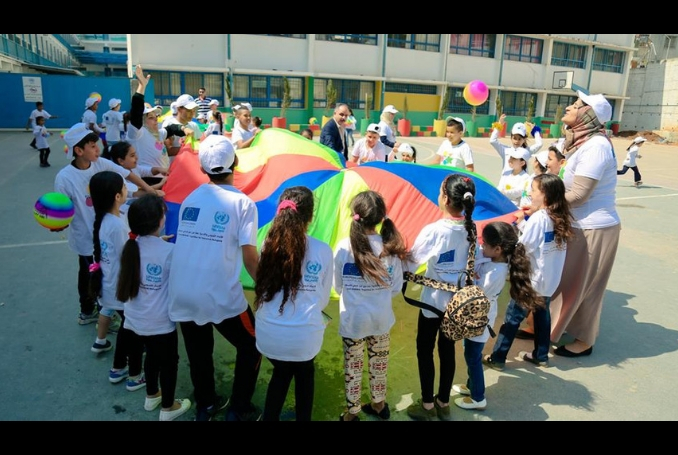
Palestinian students in a school of the UNRWA. (Photo: via Facebook)
By Ramona Wadi | MEMO | November 6, 2018
In collaboration with the Palestinian Ministry of Education, the EU launched a competition across schools in Gaza and the occupied West Bank called “Know Europe”. The aim, according to EU Deputy Representative Tomas Niklasson, is “to introduce ourselves again to students of Palestine: introduce our values, culture, history, and identity” and affirm the bloc’s purported commitment to supporting Palestinians.
This educational endeavor is tantamount to forcing gratitude for symbolic recognition, decades after colonial conquest and entrenchment. Yet the reasoning behind the competition, according to the press release, is that “the European Union has a lot in common with Palestine and the region”. Palestinians know there is no comparison, yet this misconception is now being normalized through education, despite the obvious differences between a bloc of countries and Palestine’s disappearance.
Is it for educational purposes that the EU is introducing a sliver of normalized and depoliticized education for Palestinians? Or is the aim to promote the international agenda of obstructing the colonized population’s right to learn of the international community, in this case, Europe, through its own experience?
The competition is not proof of Europe’s support for Palestine – it is a publicity stunt for the benefit of the EU itself that simply requires Palestinian students as participants. To hold this competition at a time when, more than ever, Palestinians require support for their own narratives to be disseminated internationally shows that international exploitation of Palestine and Palestinians knows no bounds.
In doing so, the colonized population is coerced into a type of learning that promotes a purportedly outward-looking framework, while Palestinians are contending with two violations which the EU has actively ignored: restrictions on freedom of movement, particularly in Gaza where this right has been annihilated, and the Palestinian Right of Return.
Furthermore, why does the EU assume that its founding principles are worthy of dissemination? The competition is labeled “interactive,” yet the interaction follows the traditional formula of a colonized population participating in a decided agenda.
There is no space for Palestinian narratives, yet it is possible to find space for the EU to share its identity with a population that finds its identity bludgeoned by the international community. Will the imparted values include the EU’s insistence on the two-state framework, its support of the Palestinian Authority and Israel’s purported right to defend itself?
Surely there is enough awareness that, at an international level, the colonial depiction of Palestine doesn’t aid Palestinian rights and self-determination. Given the leverage that the EU has over Palestine in terms of politics and diplomacy, this competition will make a spectacle out of participation and Palestinians will gain nothing in terms of their rights.
For an entity that claims to be supportive of the Palestinians, the competition only shows the bloc promoting its self-interests and appeasement of Israel. The EU would have served a better purpose if it had encouraged the celebration of Palestinian history, memory, and narratives. A population that has excelled in education, despite colonial violence and appropriation, deserves more recognition than for its youth to participate in a scheme which continues to deflect focus away from the realities of Palestinian displacement and loss of territory. The disappearance of Palestine necessitates more attention than the EU and its omniscient presence.
Suspect’s Iranian Origin an Excuse for New Sanctions Against Tehran – Scholars
Sputnik | November 4, 2018
Denmark and Iran are in conflict. While leading European countries are trying to preserve the nuclear deal with Iran, Denmark is engaged in a strong confrontation with Iran.
Danish police have announced that they have arrested a Norwegian citizen of Iranian origin linked to an alleged attack on the head of the Danish branch of the “Arab Struggle Movement for the Liberation of Ahvaz.”
According to the Danish Security and Intelligence Service, Iranian intelligence services supported the incident. In addition, the Danish Ministry of Foreign Affairs has recalled its ambassador from Tehran. The country’s foreign minister, Anders Samuelsen, has announced that Copenhagen would advocate for the EU imposing sanctions on Iran.
Commenting on the situation for Sputnik, Sergei Demidenko, an associate professor at the Institute of Social Sciences of the Russian Presidential Academy of National Economy and Public Administration, pointed out that the confrontation between Tehran and Copenhagen is very controversial but minor in terms of the political climate between the EU and Iran.
“There are many ways that the leaders of terrorist and separatist movements could use to get into the country. The primary one is presenting yourself as a member of some illegal political entity. In a country like Denmark, despite commonsense logic, this person will automatically receive the status of a ‘victim of political repression’, as well as the right to political asylum and welfare for a comfortable living.Generally speaking, Denmark doesn’t have a stance on the Iranian issue, unlike the US and the UK. That is why the Iranian case is very controversial. One may assume that these are political speculations and provocations, organized by some third party.”
The expert pointed out that Denmark’s position in the EU is not important enough to induce the union to impose new sanctions.
“Speaking about the EU, its position is not always identical with the US. The union always had an economic interest in Iran, not a political one. It’s hard to believe that the EU really needs to conduct an anti-Iranian campaign. This case is unlikely to affect the dynamics of the relationship between the EU and Iran. In some instances, the European Union may support the US against Iran, but not in all domains and not unanimously.”
Seyed Hadi Afghahi, an Iranian political scientist, leading expert on the Middle East, diplomat and a former official of the Iranian Embassy in Lebanon, shared the Russian expert’s point of view concerning the provocation against Iran possibly being organized by a third party. He added that there is an interested party to this diplomatic conflict. It is the United States.”The accusations against Iran that have been made recently as part of this conflict are not something new, especially since the new American sanctions package against Iran is to take effect soon. The US is actively preparing the ground for rationalizing new sanctions by trying to denigrate Iran in public opinion, pushing a narrative of us being sponsors of terrorism.
For this, Washington uses its allies. As you remember, there was the case of one of our diplomats being arrested in France for alleged support of terrorism against the leader of ‘Mojahedin-e Khalq’. However, the proof of these accusations hasn’t been provided. Now, let’s move on to the Danish case. The authorities of this country are accusing a citizen of Iranian origin of trying to organize a terrorist act against the leader of the local wing of the ‘Arab Struggle Movement for the Liberation of Ahvaz’.
The real question here is: why do the leaders of a separatist group that has conducted numerous terrorist attacks in Iran live in Denmark with political immunity? Don’t the Danish authorities know that just recently, during a military parade in Ahvaz, members of this group, in cooperation with Daesh, conducted a horrible terrorist attack against innocent Iranian civilians? It is a commonly known fact. In the meantime, Denmark, considering itself a civilized state, grants these terrorists political asylum and hides them on its territory, not revealing this fact to the public.
The second amazing fact about the campaign against Iran is the murder case of Jamal Khashoggi. Despite existing evidence, the authorities of Saudi Arabia are not being blamed by the US or the EU for assassinating the journalist.
The statement of the Danish authorities is a part of the anti-Iran plot prepared by the US to justify new sanctions. They found an innocent person connected to Iran, presented him as a murderer at an international level without having any evidence, and now they are threatening us with new sanctions. While the Saudi journalist case remains open, no European country has so far demonstrated a firm stance towards those responsible for his death and has not demanded to introduce sanctions against Saudi Arabia.It’s quite obvious that the Danish case is an attempt to avoid the responsibilities of the nuclear deal. In other words, the EU will justify its passivity in regards to preserving the JCPOA (Joint Comprehensive Plan of Action) and not helping Iran by saying that the Islamic Republic is a sponsor of terrorism and could organize attacks in European capitals.
It could be concluded that this is all an intrigue and conspiracy against Iran. We see no practical steps by the EU to preserve the nuclear deal. It looks like Europe, influenced by the US, is trying to take the anti-Iranian position.”
Israel in the Middle of the Scandal
Denmark doesn’t provide personal information of the “Arab Struggle Movement for the Liberation of Ahvaz” separatist wing leader and doesn’t say how many of the movement’s members are on its territory. Tehran rejects the allegation of involvement of its intelligence services in the case.
When Iranian Foreign Ministry spokesman Bahram Qassemi commented on the accusations made by Denmark, he said: “When Iran-Europe relations are normalizing, some parties are trying to create division between them.” He considered Denmark’s sanctions decision to be “unpredictable” and pointed out: “This action was planned by counter-revolutionaries and terrorists in Europe, in the Middle East and in the US. Its purpose is psychological warfare against Iran.”It should be noted that the Israeli Public Broadcasting company Kan reported that Denmark had received information from Mossad that the Iranian intelligence services were planning to liquidate an opposition politician on its territory.
Seyed Hadi Afghahi thinks that these actions are a part of the anti-Iranian plot. Tel Aviv’s information was falsified and shouldn’t be trusted.
“Israel always gives false information to European leaders and heads of Persian Gulf countries, claiming that Iran is going to establish hegemony, conquer several Arab countries, etc. Iran is represented as a dangerous player, a conqueror and a source of all evil. Arab diplomats told me that during his visit to Oman, Israel’s Prime Minister Benjamin Netanyahu gave Sultan Qaboos bin Said al Said provocative information that Iran was planning to take over Oman in two years.
Israel offered Oman to reinforce cooperation, stop rapprochement with Iran and guaranteed its support in the event of an Iranian invasion; although Iran has been keeping close, friendly ties with Oman for 40 years.
Israel’s statements that Iran is building nuclear bombs were ridiculous. The IAEA didn’t trust it, saying that Israel’s evidence doesn’t have value.
It is simply beneficial for Israel to give falsified information to denigrate Iran’s image. That is why Israel is always in the middle of the US’ attempts to unravel Europe and Iran.”
Israeli company wins contract to monitor Europe’s coasts
MEMO | November 1, 2018
The Israeli defence contractor Elbit Systems Ltd has won a contract worth up to $68 million to monitor much of Europe’s coastline.
Elbit Systems, an Israeli tech firm which specialises in defence, security and commercial systems, said today that the framework contract consists of the provision of maritime unmanned aircraft system (UAS) to the European Maritime Safety Agency (EMSA) in order to help monitor extensive coastlines and vast areas of sea to identify any potential hazards and suspicious activities.
In cooperation with CEiiA, the Centre of Engineering and product development in Portugal, Elbit will lease and operate its unmanned long-range surveillance system, the Hermes 900 Maritime Patrol system, as well as its ground control station. The contract is for a two-year period with the option of renewal for an additional two years.
“Having been selected by the European Union authorities is yet another vote of confidence in the Hermes 900 by following additional contract awards for this UAS in Europe, Asia Pacific, Latin America and Israel,” said Elad Aharonson, the general manager of Elbit Systems’ ISTAR Division.
In recent months, numerous Israeli companies and contractors have been winning contracts in various industries worldwide, ranging from defence to surveillance and technological advancement. In October, Israeli companies signed purchase agreements with the United Nations for the provision of water and security service to UN forces in Africa. Israel also won a $777 million contract for the supply of India’s missile defences, as well as being revealed as a lead exporter of tools for spying on civilians being used by dictatorships or authoritarian governments around the world.
Such deals and multi-million dollar contracts over a variety of regions are seen as not only a benefit to the Israeli economy but also the reliability of its services and the subsequent potential increase of its international credibility.
Read:
Israel has become a leading exporter of tools for spying on civilians
US wants to be world’s sole power & doesn’t need treaties like INF – Russian senator
RT | October 22, 2018
Washington is ready to drop a landmark missile treaty with Moscow because it wants to become the dominant power on the globe, and that move will put its European allies in a tough spot, a senior Russian politician told RT.
The US doesn’t want to commit itself to the restrictions imposed by the Intermediate-Range Nuclear Forces Treaty (INF) because it is “seeking unilateral military advantage,” Konstantin Kosachev stated.
According to the politician, who chairs the Foreign Affairs Committee in the Lower House of parliament, “they want to be the only power in the world. And for that they don’t need these types of agreements.”
Speaking to RT on Monday, Kosachev recalled how in 2002 the US, under then-President George W. Bush, unilaterally pulled out of the Anti-Ballistic Missile Treaty (ABM Treaty), signed 30 years prior. President Donald Trump is now acting in a similar fashion, he argued.
The Intermediate-Range Nuclear Forces Treaty (INF) was signed in 1987. It effectively banned Moscow and Washington from having and developing short and mid-range missiles and the means of their delivery. Trump has said that he will “terminate” the deal, citing Russia’s alleged violations of the agreement – something Moscow’s officials deny.
Mid-range missiles will pose a “substantial threat” to Russian security if the US deploys them in Europe, Kosachev said. The senior lawmaker warned that such a move will turn the whole of Europe into a “zone of highest possible risk” and will prompt a swift response from Moscow.
“European countries are hostages in this situation.”
The European Union, meanwhile, called on both sides to maintain “constructive dialogue” to “preserve” the existing nuclear arms deal. Brussels expects the US to consider the consequences of ditching the agreement “on its own security,” as well as “the security of its allies and of the whole world,” EU spokesperson for Foreign Affairs and Security Policy, Maja Kocijancic, said in a statement.
“The world doesn’t need a new arms race that would benefit no one and on the contrary would bring even more instability,” the statement concluded.
Danish Journalist Slams Bill Effectively ‘Criminalizing Attitudes Critical of NATO’
Sputnik – October 21, 2018
An influential Danish politician has proposed a bill which would allow the government to prosecute Facebook users for posting opinions suspected of being ‘hostile to NATO’ or too similar to those of Russia. Speaking to Sputnik, Lars Jorgensen, a veteran Danish sociologist, journalist and long-time NATO researcher, outlined the proposal’s perils.
Last week, Soren Pind, a Danish Left-Liberal Party politician and former minister of education and justice, pitched a bill threatening up to 12 years of prison time for Danes accused of collaborating with Russian intelligence services or making statements which conflict with the official position of authorities during election campaigns.
Silencing Critics
Speaking to Sputnik Germany about Mr. Pind’s proposal, which is now up for debate among lawmakers, Danish journalist and Homo Sociologicus contributor Lars Jorgensen said that unfortunately, the parliament probably won’t be an obstacle.
“The Danish government has the support of Western countries for [the bill’s] implementation,” Jorgensen explained. “The bill effectively allows for the criminalization of attitudes which are critical of NATO. Another important point is the one allowing the government to say that you are cooperating with foreign intelligence services. As a Danish citizen, as a critical sociologist, I must now fear being accused of collaborating with foreign intelligence services, even if this is something I do not do,” he stressed.
Jorgensen’s fears are not unsubstantiated, given the number of articles critical of the Western alliance which are available on his website and Facebook pages, which have already faced censorship. “My Facebook account was blocked for months,” the journalist complained. “Later it was deactivated. I had about 4,000 friends there, including academics from all over the world.” Facebook, Jorgensen said, never adequately responded to his concerns.”I am a researcher with a critical view of NATO,” Jorgensen said. “At present, we don’t have many critical voices regarding NATO [in Denmark]. I studied the history of the alliance in detail, and communicate with a large circle of experts and specialists.”
This research has provided him with insights “destroying” NATO’s positive image, Jorgensen said. “It shows that what we are being told about the war in Yugoslavia is an absolute lie. The same goes for Libya, and Syria. For NATO and the political and corporate forces standing behind them, it’s very important to silence critical voices like myself,” the independent journalist noted.
Unfortunately, Jorgensen complained, Pind’s controversial bill has seen little attention from the Danish press, and even less criticism. The mainstream Danish media’s attitudes are fully in line with those of NATO, the journalist said.
“All of Denmark’s newspapers are controlled by large media groups. They would never allow me to speak to them, like I am speaking to you for this interview,” Jorgenson noted. Denmark, he lamented, has a deficit of alternative media. “If you were to look at materials about Syria in the Danish mainstream media, you would find that they are even wilder and more embellished than in the US. They are complete fiction. On the other hand, if you look at the authentic reports from Syria, as I have done, and listen to ordinary people, they all ask the same question: why is the British government supporting terrorists in Syria?”
Another part of the problem lies in the weak state of left and anti-war politics in Denmark, Jorgenson said, pointing out that a tiny communist newspaper was the first to even report on Pind’s bill or the dangers it poses to free speech.
Defense Against ‘Russian Influence’?
In the bill’s official wording, it is stated that the proposal is about the criminalization of collaboration with foreign intelligence services, or providing foreign agents with an opportunity to influence public opinion. Citing Norwegian intelligence, the bill speaks of a growing likelihood of “Russian campaigns to exert influence posing a growing threat to Denmark,” with Copenhagen said to be “very likely” to become a “target of such campaigns by Russia.”
Last week, Berlingske newspaper columnist Flemming Rose attacked the bill, which targets television, radio, newspapers, and other media, as well as internet and social media-based publications, pointing to a lack of a minimum threshold on what can be legally sanctioned. Criticizing the bill’s absurdity, Rose argued that it could be stretched to the point where Danish journalists are targeted for ‘changing a burnt-out lightbulb’ if it is demonstrated that they did so following the advice of foreign intelligence.
Earlier this month, the US, the Netherlands, the UK and several other Western powers accused Russian intelligence services of carrying out cyberattacks against a host of governments and international organizations. Moscow dismissed the claims as paranoid “spy mania.” Denmark’s parliamentary committee for defense head Nasser Khader suggested that Denmark should attack organizations suspected of being affiliated to the Russian government in cyberspace.
See also:
Danish Bill Proposes 12 Years in Prison for ‘Pro-Russia’ Opinion
US to Impose Sanctions on Russia ‘Every Month or Two’ – Volker
Sputnik – 18.10.2018
Russia has faced several rounds of sanctions from the United States and the European Union over its alleged meddling in the 2016 US presidential elections, and alleged involvement in the poisoning of former Russian spy Sergei Skripal and his daughter Yulia in the UK city of Salisbury in early March.
US Special Representative for Ukraine Kurt Volker has stated that the Trump administration will impose sanctions on Russia “every month or two.”
“The second thing we’ve done is we’ve tried to increase the pressure we are putting on Russia in order to get them to negotiate toward a solution. That includes keeping sanctions in place in the United States and increasing those sanctions periodically over time, and that’s the track that we have been on during the course of the Trump administration, and we’ll continue to be on,” Volker said. “You’ll see additional sanctions come into play every month or two months or so as we’ve seen.”
Volker noted that the United States is “working very closely with European allies” on the issue of anti-Russian sanctions.
In August, a group of US senators introduced a bill envisaging the imposition of new sanctions against Moscow, including those targeting the country’s oil industry and transactions with Russian sovereign debt.
In recent years, Russia has repeatedly been accused of carrying out cyberattacks against other countries, including the United States, France, the United Kingdom and Germany, and attempting, in particular, to influence the results of elections.
Moscow has repeatedly denied all the accusations also emphasizing its desire to see convincing evidence of Russian nationals’ involvement in the incidents.
Ukraine Military Sales
US officials will meet with their Ukrainian counterparts to discuss potential foreign military sales since Washington has already approved a new package of security assistance for Ukraine, US Special Representative for Ukraine Negotiations Kurt Volker announced.
“We have, working through the Congress, a new package of foreign military financing, and we’ll be sitting down with Ukrainians to talk possibly about foreign military sales and what would make sense for them,” Volker said.
In September, President Donald Trump and the Congress boosted US military aid to Ukraine, allocating $250 million in security assistance to the country under the 2019 Department of Defense Appropriations Act.
Featured Video
New positive ivermectin evidence
or go to
Aletho News Archives – Video-Images
From the Archives
Fanatical Followers of the Covid Regime: A Jim Jones-Style Cult?
By Professor Roger Watson and Dr. Niall McCrae | The Daily Sceptic | November 15, 2021
As scholars at leading British universities over recent decades, we witnessed the replacement of critical thinking and debate by narrative: facts are discrimination and scientific method is imperialism; truth, instead, is derived from ‘progressive’ values. This educational trend may be a major contributory factor to the ease in which society has been inculcated to the Covid ‘new normal’ of masking, testing, and repeated doses of vaccines for a disease of similar risk to severe influenza.
One doesn’t need much critical reasoning to observe the flawed logic of some vaccination enthusiasts, such as people who respond to experiencing any side effects, however debilitating, by saying “at least I know it’s working”, or, after contracting the disease despite their promised inoculation (over 90% effective, according to initial drug company claims), “I’d have been worse off without the jab.” … continue
Blog Roll
 Aletho News
- EU Council Advances Chat Control 2.0 Scanning Proposal
- Ex-Greek MEP files complaint against Israeli spyware firm over alleged Pegasus surveillance
- Troubling ideas throughout the Torah, Talmud, Mishneh Torah and Tanya
- ‘Grave, alarming’: Iran mission on Trump’s UNGA ‘annihilation’ threats
- Najaf airport to reopen to Iranian flights within 24 hours: Ambassador
- From ‘How Will This End For Iran’ to ‘When America Walks Away’: A tale of two Economist covers
- Tehran blasts ‘baseless’ speculation linking Iran to alleged bomb plot at UK air base
- The Rise And… Rise Of ‘Color Revolutions’
- The Coming GOP Bloodbath?
- Arctic Scare Stories Melt Away
- If Americans Knew
- An error has occurred; the feed is probably down. Try again later.
- No Tricks Zone
- New Study: Earth And Venus Surface Warmth Largely Explained By Convection And Lapse Rate, Not CO2 Or Radiation
- 2025 Nature Paper Claiming Worsening Global Drought Gets RETRACTED …Heavily Flawed
- New Study: ‘Global Drought Shows No Detectable Recent Acceleration Under Climate Warming’
- Economic Masterminds: German Socialists Suggest Taxing Productivity Gains Stemming From Using AI
- The South China Sea Has Not Been Cooperating With The Climate Change Narrative
- Energy Crisis: Germany Enters Heating Season With Historically Low Gas Reserve Fill Levels
- New Study: The Antarctic Ice Sheet Gained Mass From 2020-2024 Due To Staggering Snow And Ice Accumulation
- Study: Ocean Heating Rates From Thousands Of Years Ago ‘Dwarf’ Modern Ocean Heating Rates
- Climate Extremists Target, Attack Large-Scale Power Grid Infrastructure In Germany!
- New Study: Antarctic Ice Melt Has Contributed Less Than 1 Centimeter To Sea Level Rise In The Last 30 Years

