Latvia’s pro-Russia Harmony Party has won the country’s general elections, and will have to negotiate with other parties to form a coalition government.
Harmony won the Saturday parliamentary elections with 19.91 percent of the votes, followed by KPV LV and New Conservative Party, with 14.06 percent with 13.6 percent, respectively.
Turnout in the elections was 54.59 percent, according to the election website.
The pro-European Union (EU), pro-NATO liberal For Development/For! Party came fourth with 12.04 percent.
The rightwing National Alliance gained 11.03 percent. The Greens and Farmers Union — which currently holds the posts of both president and prime minister — won 9.96 percent.
The New Unity took 6.67 percent as the last party crossing the five-percent threshold needed to enter parliament.
The current parliament will keep working until November while parties discuss a new coalition.
No Harmony — until now
Latvia’s political parties had until now always tried to form coalition governments without Harmony in the blend.
The party will now hold 24 seats in the 100-seat parliament. KPV LV and the New Conservatives will jointly hold 31 seats.
The top three parties can muster the 55 seats needed to form a coalition government.
“No coalition combination is possible without Harmony,” the party’s chairman Nils Ushakovs told local media.
October 7, 2018
Posted by aletho |
Aletho News | European Union, Latvia |
Leave a comment
The US could use its Navy to prevent Russia’s potential energy supplies to the Middle East, Internal Secretary Ryan Zinke said, Washington Examiner reports.
The blockade would actually mean an “act of war,” a Russian Senator fired back.
Zinke alleged that Russia’s engagement in Syria – notably, where it is operating at the invitation of the legitimate government – is a pretext to explore new energy markets.
“I believe the reason they are in the Middle East is they want to broker energy just like they do in eastern Europe, the southern belly of Europe,” he has reportedly said.
And, according to to the official, there are ways and means to tackle it. “The United States has that ability, with our Navy, to make sure the sea lanes are open, and, if necessary, to blockade … to make sure that their energy does not go to market,” he said.
Zinke was addressing the attendees of the event hosted by the Consumer Energy Alliance, a non-profit group which styles itself as the “voice of the energy consumer” in the US.
He went on to compare Washington’s approaches to dealing with Russia and Iran, noting that they are effectively the same.
“The economic option on Iran and Russia is, more or less, leveraging and replacing fuels,” he said, while referring to Russia as a “one trick pony” with an economy dependent on fossil fuels.
Zinke’s statements provoked an angry response from Moscow, which equated a potential maritime blockade to an “act of war,” while calling the interior secretary’s assumptions “nonsense.”
“A US blockade of Russia would be equal to a declaration of war under international law,” Russian Senator Aleksey Pushkov said, commenting on Zinke’s words. Russia does not currently export any energy to the Middle East, which itself is a major oil exporting region. The whole idea is an “absolute nonsense,” the Senator argued.
The comment from the US Interior Secretary come as the Trump administration has been on a mission to boost the export of its liquefied natural gas to Europe, replacing Russia, the far cheaper option for European consumers. To that effect, the Trump administration officials, including US President Donald Trump himself, try to persuade Germany to pull out of the “inappropriate” Nord Stream 2 pipeline project, which according to Trump, made Berlin Moscow’s “captive.”
Moscow has repeatedly stressed that the $11 billion Nord Stream 2 pipeline, which is set to double the existing pipeline capacity to 110 billion cubic meters, is a purely economic project. The Kremlin argues that Washington’s fervent opposition to the project is simply driven by economic reasons and is an example of unfair competition.
“I believe we share the view that energy cannot be a tool to exercise pressure and that consumers should be able to choose the suppliers,” Russian Energy Minister Aleksandr Novak said following a meeting with US Energy Secretary Rick Perry in Moscow in September.
The US stance has drawn a backlash from Germany, which has reaffirmed its commitment to the project.
Germany’s leading organization for industry, the Federation of German Industries (BDI), has called on the US to stay away from EU energy policy and the bilateral agreements between Berlin and Moscow.
“I have a big problem when a third state interferes in our energy supply,” Dieter Kempf, head of the Federation of German Industries (BDI) said following a recent meeting between German Chancellor Angela Merkel and Russian President Vladimir Putin.
September 30, 2018
Posted by aletho |
Economics, War Crimes | European Union, Middle East, Russia, United States |
Leave a comment
Swedish truckmaker Volvo has stopped assembling trucks in Iran because of Washington’s sanctions, spokesman for the company, Fredrik Ivarsson, told Reuters.
According to him, the group could no longer get paid for parts it shipped and had therefore decided not to operate in Iran.
“With all these sanctions and everything that the United States put (in place)… the bank system doesn’t work in Iran. We can’t get paid… So for now we don’t have any business (in Iran),” Ivarsson said.
Volvo was working with Saipa Diesel (part of Iran’s second-largest automaker Saipa) which was assembling the Swedish firm’s heavy-duty trucks from kits shipped to Iran. The company had plans to become Iran’s main export hub for the Gulf region and North Africa markets.
An unnamed commercial department manager at Saipa Diesel told the media that more than 3,500 Volvo trucks had been assembled in the year to May. However, none had been assembled in this financial year, he said. The original deal was for at least 5,000 trucks.
The manager confirmed that sanctions had prompted Volvo Trucks to terminate their partnership agreement.
“They have decided that due to the sanction on Iran, from (May) they couldn’t cooperate with us. We had some renovation planned in Iran for a new plant but they refused to work with us,” he said.
Volvo has joined a list of European companies such as Total, Adidas and Daimler, who have been forced to reconsider their investments in Iran. The firms said they will scale back or abandon all operations in Iran due to Washington’s sanctions.
Swedish truckmaker Scania, which is owned by Volkswagen (VW), said it had canceled all orders that it could not deliver by mid-August due to sanctions. French carmaker PSA Group began to suspend its joint venture activities in Iran in June.
Germany’s Daimler said it was closely monitoring any further developments, while Volkswagen rejected reports that it had decided against doing business in Iran. VW said its position had not changed.
September 24, 2018
Posted by aletho |
Economics, Wars for Israel | European Union, Iran, Sanctions against Iran, United States |
Leave a comment
At least 25 people were killed and 60 others injured in Ahvaz on Saturday, when terrorists opened fire on people from behind a viewing stand at a military parade held to mark the former Iraqi dictator Saddam Hussein’s invasion of Iran in the 1980s.
The Western and Saudi media have refrained from terming the deadly attack in the Iranian city of Ahvaz a terrorist act despite the large number of civilian casualties in the incident.
The Saudi-backed al-Ahvaziya terror group claimed responsibility for the assault.
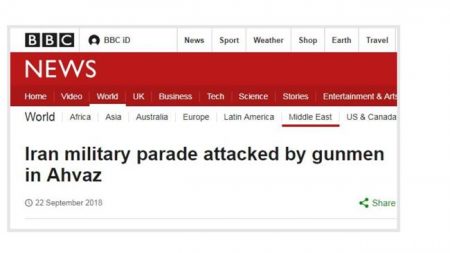
However, the British Broadcasting Corporation (BBC) only used the word “attack” for the terrorist act.
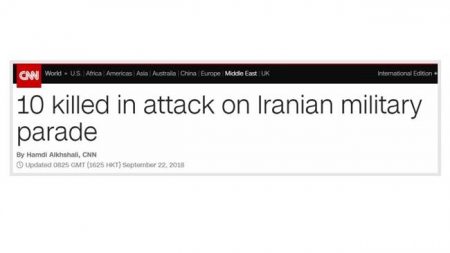
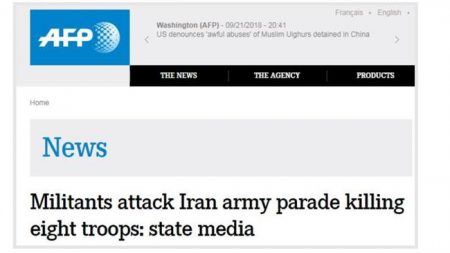
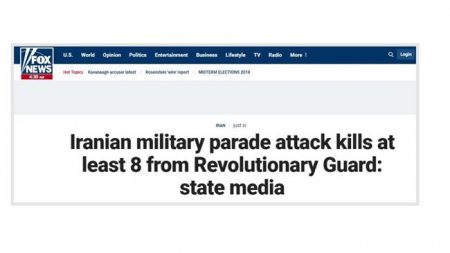
Similarly, Reuters and others described the incident as an “attack” instead of a terror one whereas they have been quick to use “terrorist attack” for similar incidents that took place in Europe over the past few years.
Russia offers condolences
Russian President Vladimir Putin offered condolences to his Iranian counterpart, Hassan Rouhani, after the brutal attack.
He also expressed Moscow’s readiness to boost joint efforts with Tehran in the fight against terrorism.
“This incident once again reminds us about the need to conduct an uncompromising war on terror in all its manifestations. I would like to confirm our readiness to further enhance cooperation with Iranian partners in countering this evil,” the Kremlin quoted Putin as saying.
Iraq deplores attack
Iraqi Interior Minister Qasim al-Araji condemned the incident, saying it once again demonstrated the hostility of terrorists and arrogant elements towards the Muslim nation of Iran.
He further stressed that such actions could not undermine the authority of the Iranian nation.
September 22, 2018
Posted by aletho |
Mainstream Media, Warmongering, War Crimes | European Union, UK, United States |
Leave a comment
Egypt yesterday signed an agreement with Cyprus to construct a maritime pipeline between the two countries, which will transfer of natural gas from Cyprus to Egypt for re-export to different markets, especially the European Union (EU) countries.
The agreement was signed in a meeting held in Cyprus between the Egyptian Minister of Petroleum and Mineral Resources, Tarek El-Molla, and the Cypriot minister of Energy, Industry, Tourism and Trades, Georgios Lakkotrypis.
The project, which was said to cost around $800 million, will involve building a pipeline to transfer natural gas from Cypriot Aphrodite field to Egypt’s liquefied natural gas (LNG) facilities.
El-Molla said that the agreement contributes “to boosting the economic relations between Egypt and Cyprus and is considered as an important step in maximising the benefit of the discoveries of the Cypriot gas fields.”
“The Egyptian-Cypriot agreement is not only about the implementation of a maritime pipeline, but it will contribute positively to securing gas supplies to the EU,” he added.
The deal, El-Molla reiterated, will encourage further research exploration activities in the region and will contribute to further support joint cooperation in the field of oil and gas between the two countries.
Referring to another memorandum of understanding, which was signed between Egypt and the EU in the field of energy last April, the Egyptian minister stressed that it “will open up important prospects for the role that Egypt can play in the industry.”
On his part, Lakkotrypis said that the deal was “an important milestone, not only for Cyprus but also the entire eastern Mediterranean region,” adding that “it’s [the joint agreement] the first of its kind in Cyprus and Egypt’s shared region.”
September 20, 2018
Posted by aletho |
Economics | Cyprus, Egypt, European Union, Middle East |
Leave a comment
MOSCOW – Moscow believes that the development of the Iranian missile program is Tehran’s sovereign right, and all the issues arising in this regard should be resolved without pressure, especially military, at the negotiating table, Russian Deputy Foreign Minister Sergey Ryabkov told Sputnik.
“We have always supported resolving any problems that arise in interstate relations and in the dialogue on acute issues through negotiations and through relevant agreements,” Ryabkov said on Wednesday.
The deputy foreign minister further stressed that the developments in the situation around the Iran nuclear deal and other issues that American counterparts put in the context of this deal, as well as Iran’s behavior, attracted Russia’s close attention.
Speaking to Sputnik reporter, Ryabkov also revealed that the meeting of the five mediators and Iran at the level of foreign ministers will take place on the sidelines of the high-level week of the UN General Assembly at the end of September.
“The meeting of the participants of the Joint Comprehensive Plan of Action (JCPOA) — those who stayed in the agreement — will be held at the ministerial level,” the official stated.
He also noted that the definite time is being coordinated, and the European External Action Service is expected to make a relevant announcement in the near future. However, Ryabkov assured that it was certain that the meeting would take place.
The JCPOA stipulates the gradual removal of the West’s sanctions against Iran in exchange for Tehran maintaining a peaceful nature of its nuclear program. However, US President Donald Trump announced in May the withdrawal of the United States from the JCPOA and the reinstating of the first round of sanctions in August.
September 19, 2018
Posted by aletho |
Wars for Israel | European Union, Iran, Russia, Sanctions against Iran, United States |
Leave a comment
Regime Change in Budapest?
CNN recently discovered a paradox. How was it possible, they asked, that in 1989, Viktor Orban, at the time a Western-acclaimed liberal opposition leader, was calling for Soviet troops to leave Hungary, and now that he is Prime Minister, he is cozying up to Vladimir Putin?
For the same reason, dummy.
Orban wanted his country to be independent then, and he wants it to be independent now.
In 1989, Hungary was a satellite of the Soviet Union. Whatever Hungarians wanted, they had to follow directives from Moscow and adhere to Soviet communist ideology.
Today, Hungary is ordered to follow directives from Brussels and adhere to the EU ideology, a k a “our common values”.
But what exactly are those “common values”?
Not so very, very long ago, “the West”, that is, both America and Europe, claimed devotion to “Christian values”. Those values were evoked in Western condemnation of the Soviet Union.
That is out. These days, indeed, one of the reasons why Viktor Orban is considered a threat to our European values is his reference to a Hungarian conception of “the Christian character of Europe, the role of nations and cultures”. The revival of Christianity in Hungary, as in Russia, is regarded in the West as deeply suspect.
So it’s understood, Christianity is no longer a “Western value”. What has taken its place? That should be obvious: today “our common values” essentially mean democracy and free elections.
Guess again. Orban was recently re-elected by a landslide. Leading EU liberal Guy Verhofstadt called this “an electoral mandate to roll back democracy in Hungary.”
Since elections can “roll back democracy”, they cannot be the essence of “our common values”. People can vote wrong; that is called “populism” and is a bad thing.
The real, functional common values of the European Union are spelled out in its treaties: the four freedoms. No, not freedom of speech, since many Member States have laws against “hate speech”, which can cover a lot of ground since its meaning is open to wide interpretation. No, the obligatory four freedoms of the EU are free movement of goods, services, persons and capital throughout the Union. Open borders. That is the essence of the European Union, the dogma of the Free Market.
The problem with the Open Border doctrine is that it doesn’t know where to stop. Or it doesn’t stop anywhere. When Angela Merkel announced that hundreds of thousands of refugees were welcome in Germany, the announcement was interpreted as an open invitation by immigrants of all sorts, who began to stream into Europe. This unilateral German decision automatically applied to the whole of the EU, with its lack of internal borders. Given German clout, Open Borders became the essential “European common value”, and welcoming immigrants the essence of human rights.
Very contrasting ideological and practical considerations contribute to the idealization of Open Borders. To name a few:
- Economic liberals maintain that because Europe is aging, it needs young immigrant workers to pay for the pensions of retired workers.
- Many Jewish activists feel threatened by national majorities and feel safer in a society made up of ethnic minorities.
- More discreetly, certain entrepreneurs favor mass immigration because growing competition in the labor market brings down wages.
- Many artistically inclined people consider ethnic diversity to be more creative and more fun.
- Certain anarchist or Trotskyist sects believe that uprooted immigrants are the “agent” of the revolution that the Western proletariat failed to produce.
- Many Europeans accept the idea that nation states are the cause of war, concluding that every way of destroying them is welcome.
- International financial investors naturally want to remove all obstacles to their investments and thus promote Open Borders as The Future.
- There are even a few powerful schemers who see “diversity” as the basis of divide and rule, by breaking solidarity into ethnic pieces.
- There are good people who want to help all humanity in distress.
This combination of contrasting, even opposing motivations does not add up to a majority in every country. Notably not in Hungary.
It should be noted that Hungary is a small Central European country of less than ten million inhabitants, which never had a colonial empire and thus has no historic relationship with peoples in Africa and Asia as do Britain, France, the Netherlands, and Belgium. As one of the losers in World War I, Hungary lost a large amount of territory to its neighbors, notably to Romania. The rare and difficult Hungarian language would be seriously challenged by mass immigration. It is probably safe to say that the majority of people in Hungary tend to be attached to their national identity and feel it would be threatened by massive immigration from radically different cultures. It may not be nice of them, and like everyone they can change. But for now, that is how they vote.
In particular, they recently voted massively to re-elect Victor Orban, obviously endorsing his refusal of uncontrolled immigration. This is what has spurred scrutiny of Orban’s leadership for signs of incumbent dictatorship. The EU is taking steps to strip Hungary of its political rights as a result. On September 14, Victor Orban made his position clear in a speech to the (largely rubber stamp) European Parliament in Strasbourg:
“Let’s be frank. They want to condemn Hungary and the Hungarians who have decided that our country will not be an immigration country. With all due respect, but as firmly as possible, I reject the threats of the pro-immigration forces, their blackmail of Hungary and the Hungarians, all based on lies. I inform you respectfully that however you decide, Hungary will stop illegal immigration, and defend its borders, against you if necessary.”
This was greeted with outrage.
Former Belgian prime minister Guy Verhofstadt, currently president of the Alliance of Liberals and Democrats for Europe Group in the European Parliament and an ardent European federalist, responded furiously that “we cannot let far right populist governments drag democratic European states into the orbit of Vladimir Putin!”
In a tweet to his EP colleagues, Verhofstadt warned: “We are in an existential battle for the survival of the European project. … For Europe’s sake, we need to stop him!”
CNN approvingly ran an opinion piece from Verhofstadt describing Hungary as a “threat to international order”.
“In the coming weeks and months, the international community — and the United States in particular — must heed our warning and act: Hungary’s government is a threat to the rules-based international order,” he wrote.
“European governments and the US have a moral obligation to intervene”, Verhofstadt continued. “We cannot stand aside and let populist, far-right governments drag democratic European states into Vladimir Putin’s orbit and undermine the postwar international norms.”
Next come sanctions: “Political and financial costs must be attached to governments pursuing an authoritarian path and support provided to civil society organizations…”
Verhofstadt concluded: “This is not in the interests of the people of America or Europe. We need to stop him — now.”
Verhofstadt’s appeal to America to “stop” the Hungarian prime minister sounds like nothing so much as appeals to Brezhnev by hard-line communists to send the tanks into reformist Czechoslovakia in 1968.
However, this appeal for intervention was not addressed to President Trump, who is in the same doghouse as Orban among the Atlanticists, but rather to the deep state forces which the Belgian fanatic assumes are still in power in Washington.
At the start of his CNN article, Verhofstadt paid tribute to “the late, great, John McCain, who once described Orban as ‘a fascist in bed with Putin’…” That is the McCain who went around the world as head of the Republican branch of the National Endowment for Democracy (NED) encouraging and financing dissident groups to rebel against their respective governments, in preparation for U.S. intervention. Oh Senator McCain, where are you now that we need you for a little regime change in Budapest?
Orban’s reputation in the West as dictator is unquestionably linked to his intense conflict with Hungarian-born financier George Soros, whose Open Society foundation finances all manner of initiatives to promote his dream of a borderless society, notably in Eastern Europe. Soros operations could be considered privatized U.S. foreign policy, along the same lines as McCain, and innocently “non-governmental”. One Soros initiative is the private Budapest-based Central European University whose rector is open society advocate Michael Ignatieff. Hungary recently imposed a 25% tax on money spent by nongovernmental organizations on programs that “directly or indirectly aim to promote immigration,” which affects the CEU. This is part of a recently adopted package of anti-immigration measures known as the “Stop Soros” bill.
Hungarian measures against Soros’ interference are of course denounced in the West as a grave violation of human rights, while in the United States, prosecutors search frantically for the slightest indication of Russian interference or Russian agents.
In another blow against the international rules-based order, the Hungarian prime minister’s office recently announced that the government will cease to fund university courses in gender studies, on the grounds that they “cannot be justified scientifically” and attract too few students to be worthwhile. Although privately funded and thus able to continue its own gender studies program, the CEU was “astonished” and called the measure “without any justification or antecedent.”
Like the Soviet Union, the European Union is not merely an undemocratic institutional framework promoting a specific economic system; it is also the vehicle of an ideology and a planetary project. Both are based on a dogma as to what is good for the world: communism for the first, “openness” for the second. Both in varying ways demand of people virtues they may not share: a forced equality, a forced generosity. All this can sound good, but such ideals become methods of manipulation. Forcing ideals on people eventually runs up against stubborn resistance.
There are differing reasons to be against immigration just as to be for it. The idea of democracy was to sort out and choose between ideals and practical interests by free discussion and in the end a show of hands: an informed vote. The liberal Authoritarian Center represented by Verhofstadt seeks to impose its values, aspirations, even its version of the facts on citizens who are denounced as “populists” if they disagree. Under communism, dissidents were called “enemies of the people”. For the liberal globalists, they are “populists” – that is, the people. If people are told constantly that the choice is between a left that advocates mass immigration and a right that rejects it, the swing to the right is unstoppable.
September 19, 2018
Posted by aletho |
Economics, Mainstream Media, Warmongering, Progressive Hypocrite, Timeless or most popular | Central European University, European Union, Hungary, United States |
Leave a comment
It’s been quite a week for Article 7 of the Lisbon Treaty. First Hungary and now Cyprus. And all because of some guy named Bill Browder?
Despite numerous warnings and obstacles, Cyprus continues to assist Russia in investigating the finances of Bill Browder. This has resulted in letters of warning to Cypriot President Nicos Anastasiades as well as lawsuits by Browder citing the investigation violates his human rights.
Like everything else in this world, just ask Browder.
Last fall Browder and 17 MEP’s launched a two-pronged assault on Cyprus to end their assisting Russia’s investigation into Browder. Browder with the lawsuit. The MEP’s with a letter of warning.
The lawsuit has failed, however. The Nicosia District Court handed down a ruling recently which allowed for Browder to sue for damages to his reputation but not putting an injunction on the investigation.
More than a month ago the Nicosia District Court said that the cooperation with Russia in its politically motivated probe would violate the human rights of Bill Browder and his associate Ivan Cherkasov and the two would have good prospects in claiming damages from the government. Still, the court rejected Browder’s application for an order preventing Cypriot authorities from cooperating with Russia in its proceedings against him on the grounds that any damage would not be irreparable.
And this is where this gets interesting.
Because now in light of this ruling the stakes have been raised. Four of those original 17 MEP’s, many of whom are on the infamous “Soros List” as being in the pay of Open Society Foundation, sent a more serious letter of warning to Anastasaides threatening Cyprus with censure via Article 7 of the Lisbon Treaty for not upholding the European Union’s standards on human rights.
Now this is a dangerous escalation in service of an investigation into someone who, agree or not, Russia has a legitimate interest in pursuing. Dismissing all of Russia’s concerns about Browder as ‘politically motivated’ is pure grandstanding. It carries no weight of law and stinks of a far deeper and more serious corruption.
Because if Browder was as pure as the driven snow as he presents himself to the world then he would have no issue whatsoever in Cyprus opening up his books to Russia and put his question of guilt to rest once and for all.
The ruling from the court stated that Cypriot officials are not barred from helping Russia get to the bottom of Browder’s web of offshore accounts, all of which, according to Russian lawyer Natalya Veselnitskaya, run through Cyprus.
From RT last year:
“He [Browder] is afraid of the Russian probe that has conclusive evidence of his financial crimes and proof that his theory of Magnitsky’s death is an absolute fake. That’s why Browder is ready to stage any provocation,” Veselnitskaya said. She went on to say that the investor’s decision to intervene was particularly “influenced by the fact that the entire network of offshore companies that make up his organized criminal group is located on the territory of Cyprus.”
The incident that Veselnitskaya was referring to took place in late October 2017. At that time, 17 members of the European Parliament appealed to Cypriot President Nikos Anastasiades in an open letter, in which they called on him to stop assisting Russia in its investigation against Browder.
Remember, Veselnitskaya was the woman who met with Donald Trump Jr. during the 2016 campaign. She was adamant she had information that was pertinent to them. The Mueller probe and the media tried to spin that meeting as her giving Trump access to Hillary Clinton’s e-mails.
But what she was really trying to give them was the low-down on Browder, the Magnitsky Act and the whole rotten, sordid history of him, Edmund Safra of Republic National Bank and the raping of Russia by them and others in the 1990’s.
And to show Trump that the Magnitsky Act was built on a lie and the sanctions against Russia should be lifted because of this.
Some of this I covered in an earlier article.
The Real Browder Story
And this is the whole point. Browder’s story is fiction.
Magnitsky was his accountant and not his lawyer, who knew all about his dealings and could convict Browder of a raft of crimes far greater than the ones Russia already has in absentia.
Putin had no interest in having Magnitsky executed or beaten to death in prison. If anyone had an incentive to keep Magnitsky alive it was Vladimir Putin. If anyone had incentive to have Magnitsky die in prison it was Browder. And so, the whole story that Browder has woven, the myth around himself is so insane that it bears repeating over and over.
Browder’s story is fiction.
Because when you stop and put all the pieces together you realize a number of things and none of them are good.
First, Browder was deeply enmeshed in the plot to frame Yeltsin for stealing $7 billion in IMF money which created the conditions for bringing Putin to power.
Second, he, Mihail Khordokovsky and others have systematically lobbied Congress and the European Parliament to peddle this false story of the brave freedom fighter Magnitsky against the evil Putin to get revenge, in Khordokovsky’s case, on Putin for deposing him from power in Russia and stealing back the wealth Khordokovsky stole during the Yelstin years, namely Yukos.
And for Browder it was the culmination of years of work to destroy Russia from within and stay one step ahead of the hangman’s noose. His 2015 book Red Notice is a work of near fiction as outlined by Alex Krainer in his book The Grand Deception: The Truth About Bill Browder, The Magnitsky Act and Anti-Russia Sanctions.
And the Magnitsky Act was the way everyone interested who can prove this could be silenced through sanctions.
But, it’s bigger than that.
This was policy.
The Magnitsky Act is a lynchpin of American and European foreign policy to destroy Russia and subjugate the world.
It was enacted alongside other legislation to take back control of the political narrative of the world; rein in free speech on the internet by tying any activity not approved of by The Davos Crowd to be subject to sanctions on the nebulous basis of ‘human rights violations.’
The Magnitsky Act has weaponized virtue-signaling and, in my mind it was intentionally done to open up another path to protect the most vile and venal people in the world to arrogate power to themselves without consequence.
Today we stand on the brink of an open hot war between the U.S. and Russia because of the lies which have been stacked on top of each other in service of this monstrous piece of legislation.
With each day it and its follow-up, last year’s Countering America’s Adversaries Through Sanctions Act (CAATSA), are used as immense hammers to bring untold misery to millions around the world.
People like Browder are nothing by petty thieves. It is obvious to me he started out as a willing pawn because he was young, hungry and vaguely psychopathic. The deeper he got in it the more erratic his behavior became.
Browder is being protected by powerful people in the U.S. and EU not because he’s so important but because exposing him exposes them.
This is why another country is being threatened with the stripping of what few rights sovereign nations have within the EU, Cyprus, over his books.
Poland stood up for Hungary the other day over ideological reasons. No one seems ready to stand up to the conspiracy surrounding Browder, Khordokovsky and the Magnitsky Act.
But, if someone in power finally does, it could change everything we think we know about geopolitics.
September 16, 2018
Posted by aletho |
Corruption, Deception, Full Spectrum Dominance | Bill Browder, CAATSA, Cyprus, European Union, Magnitsky Act |
Leave a comment

Controversies surrounding online fake news, having alarmed political activists in Britain and the US, are prompting social media companies to be more active in combating the alleged threat. For many people in opposition to the policies of US President Donald Trump and Britain’s exit from the EU, the internet is to blame for the situation because it illicitly influenced voters. As a result, increased policing of social networks to root out foreign spies and domestic dissidents seems necessary to them. One of the latest examples is Twitter’s permanent suspension of American conspiracy theorist entertainer Alex Jones.
The responsibility to police the social networks seems to have largely been placed, by pushy and concerned politicians, on the management of tech companies themselves. British MPs and US senators did this by summoning them to hearings and campaigning openly against the internet’s permissiveness on political content, making demands they should shut down dissident and foreign outlets because they have gone too far.
Although the most vocal of them are not actually in the incumbent government and therefore not responsible for national security responses, they are still lawmakers representing constituents and can threaten legislation to compel social media companies to change. Preferring instead to make the policing of social media posts look voluntary, they seem to have capably persuaded the management of the tech companies to enforce their views on national security.
Therefore, now, we are at an awkward point where transnational social networks must care about so-called national security – specifically the US’s national security, based on that country’s strange and self-obsessed drivel about being exceptional and better than others. What next?
Recently, we have seen police-like enforcement action against dissident users and outlets present on a variety of social media platforms and applications used by a probable majority of people in the UK and the US. This removal of controversial figures from online platforms is presented as not being censorship, but rather the enforcement of decent community guidelines by companies that have every right to withhold services. However, this argument is not very convincing. The political pressure has been immense. The results have not been targeted at bad social media behavior like spam and harassment, but against alternate political views on both the left and the right. If we look at the actions of the tech companies, they are not only encouraged by elements of the state but have made themselves into state-like actors by describing themselves as stopping foreign threats and extremism.
Brexit was the mistake of a misled public, perhaps. We are told so by influential media personalities – almost all of them – and the same narrative is presented when it comes to the election of Trump. We are encouraged to lean towards the same common solution to both of these mishaps, and it consists of mostly a crackdown online – especially on Twitter. We will be shutting down online accounts and channels belonging to the supporters of such causes as Trump and Brexit, after quickly and conveniently finding them guilty of being bots or possibly foreign. No attention is given to bad behavior as a whole.
For example, no enforcement action is used against pro-EU accounts or anti-Trump accounts, many of which self-identify as foreign or completely automated. Some even blatantly violate Twitter’s rules on inflated hashtag campaigns, doing things like using the hashtag #FBPE to get followers and retweets from pro-EU bots. Their own determination to trick users and violate the community guidelines is openly celebrated by them, so oblivious are these kinds of activists to their own hypocrisy.
So, in fact, what seems at first a principled argument against bad behavior is really a cliché so we can pretend there was some civilized reason for thuggishly silencing other points of view.
Much of the commentary by the Democratic Party, as with opponents of Brexit in the UK, focuses on national security and the need to silence or eliminate bad people and Russians. It is presented as war, using the language of military propaganda. Being in opposition, these democracy-loving people in the Democratic Party and other groups now presume it is the job of civil society – news networks like CNN and tech companies like Apple mainly – to not only take charge of national security themselves but also engage directly in censorship.
But censorship, the shutting down of opposing views and channels on grounds that they are treasonous, is not an exertion of soft power but hard power. It is a state-like activity, and the sole responsibility of states in all previous cases. By taking part in censorship without being part of the elected leadership of the state and the command structure it possesses to deal with national security threats, unelected elements in civil society are allowed to commit what would be a crime if they had been elected to do it. They engage in a coup-like activity, since, not being part of an elected government, they are nonetheless engaged in state-like activity and are trying to invasively police matters that only a heavily expanded state or dictatorship is ever expected to police.
What is presented above makes it justifiable to consider whether traditional models of state censorship would be more consistent with the rule of law and the importance of a democratic mandate than the current capricious enforcement by private companies. A party whose candidate failed to win power over the whole state, such as the Democrats, is not able to implement a program of state censorship at the moment they most want to. The reason this is the case is because of their very loss in the 2016 US election, which makes them not responsible for matters of national security and not tasked with securing the information space against threats, and yet they try. For them to seek routes around this failure, going to non-elected entities such as the tech companies in an attempt to dictate terms of censorship and actual national security policies via them, can be compared with a coup or a form of separatism. This is the creation of a second state, the seizure of infrastructure to interdict citizens. It is completely outside the bounds of normal political processes, which focus solely on democratic and valid elections as the only means of changing power.
Each point made in relation to the US Democrats here is equally true of influencers and leaders who seek to invalidate the results of the UK’s Brexit referendum, in large part because these are the same kind of civil society actors. In their attempts to portray the activity of the national government itself as treasonous and wrest control of the management of national security from the British government, entities with no democratic mandate are hopelessly creating a second state – one without elections – to take control over national security.
It is not political opposition but a second state because, for the first time ever, it wants not just persuasive soft power but hard power in the capability to suppress targets or eliminate their influence on command. Not only would this realization make these parties and their tech industry collaborators a state-like entity, but it could make such actors as the Democratic Party traitors at war with the electorate.
While this article doesn’t make such a claim, it is one Trump and his supporters have come close to making when the President accused unrelenting elements of the press of being “enemies of the people”, and could eventually create a national security crisis. The reason it would be a crisis is because both Trump and his critics will have a point. It is the role of activists and media to be adversarial, but if they are too aggressive and specifically driven to remove an elected head of state from power, their actions may be seen as the de facto overthrow of the republic to install themselves as political arbiters and impose a moral aristocracy.
Many leaders and followers in the political opposition in the US and UK are supportive of censorship, slithering around constitutional safeguards against state censorship. Whether in public hearings or behind closed doors, they have been going directly to tech companies and other parts of civil society to physically disrupt or silence speech they dislike. If they are such supporters of national security and censorship, and are really so concerned about traitors, they should not conspire. Rather, these people should approach the elected government with their concerns, to avoid being deemed traitors themselves.
They can achieve censorship by working to convince the elected government to change the law in relation to such practices and introduce programs of lawful censorship, as well as bodies to reliably and authoritatively identify traitors. This means national security can be pursued in a way at least consistent with electoral democracy, even if it erodes human rights further. Otherwise, we will continue to see electorally defeated parties and elements of civil society acting like terrorist hijackers determined to take power. They will be gaining state-like powers, harassing citizens who did not vote for them, carrying out targeted censorship, and enforcing their values over the corpse of the democratic state.
It should be concluded that none of the above is a desirable conversation to take part in and it is regrettable that it would need to be published. Ideally, neither state censorship nor corporate censorship should be tolerated. The internet should continue to be home to an anarchic culture at all costs, not a state-like one. However, as rhetoric becomes more warlike and paranoid and positions become irreconcilable, all spaces could become politically aligned and everyone’s freedom to communicate could catastrophically reduce. With constant political censorship, critical thinking will rewind a hundred years and the internet will talk like propaganda from 1914 when you try to search for the truth.
Harry Bentham is an independent author. His writing has been featured at Beliefnet, Press TV, the Center for a Stateless Society, h+ Magazine and the Institute for Ethics and Emerging Technologies. Having authored several titles available on Amazon, Harry wrote and independently published the technology and politics book Catalyst: A Techno-Liberation Thesis in 2013 and is a listed member of think tanks including the futurist Lifeboat Foundation. Keep track of Harry’s ideas via Twitter @hjbentham and @catalystthesis
September 16, 2018
Posted by aletho |
Civil Liberties, Full Spectrum Dominance | Democratic Party, European Union, Human rights, Twitter, UK, United States |
Leave a comment

HelloAsso, a French company that provides online payment services, has rejected pressure by Israel lobby groups to shut down the accounts of two French groups which support the BDS movement for Palestinian human rights. HelloAsso will continue to provide services to both Association France Palestine Solidarity (AFPS) and BDS-France.
HelloAsso publicized its decision in a tweet explaining that it supports the right of citizens to call for BDS as part of freedom of expression.
In 2016, the European Union stated:
“The EU stands firm in protecting freedom of expression and freedom of association in line with the Charter of Fundamental Rights of the European Union, which is applicable on EU Member States’ territory, including with regard to BDS actions carried out on this territory.”
Translation of HelloAsso tweet from French original:
[…] “HelloAsso is an apolitical platform that does not take any position regarding the claims of the BDS movement. HelloAsso nevertheless considers this movement as within the realm of free expression and not as discriminatory or antisemitic.
HelloAsso’s position is supported by the European Union, which has clearly stated it favours protecting freedom of expression and association, including the right to advocate for BDS .
Therefore, the HelloAsso account of AFPS (Association France Palestine Solidarity) will not be removed.
To all those who criticize us for hosting these organizations, we respond that the conflation that allows attacks on these organizations is dangerous because it conflates antisemitism, which we condemn without ambiguity, and criticism of the state of Israel, which is a political opinion. This freedom of expression is a fundamental right.
Since its creation, HelloAsso has striven to support freedom of association and to protect the right to freedom of speech because we are a platform that is committed to the model of [non-profit] association and at the same time apolitical, open and enriched by differences of opinion, a reflection of our society.”
The Palestinian BDS National Committee (BNC) is the largest coalition in Palestinian civil society. It leads and supports the global Boycott, Divestment and Sanctions movement for Palestinian rights.
September 12, 2018
Posted by aletho |
Civil Liberties, Ethnic Cleansing, Racism, Zionism, Full Spectrum Dominance | European Union, France, Human rights, Israel, Palestine, Zionism |
Leave a comment
So it’s OK to ignore the Law of the Seas?
Reports are coming in that Israel plans to sell off the four mercy boats it violently hijacked on the high seas a few weeks ago. The peaceful, unarmed vessels were sailing with desperately needed medical supplies to the besieged Gaza Strip which has been illegally blockade by Israel for 12 years.
The crews and passengers of these mercy boats were arrested by the Israeli military, beaten up, thrown in jail and had their money and personal belongings stolen while in custody. Among the passengers on the al-Awda, was British citizen Dr Swee Ang, a consultant at the famous Bart’s Hospital, who sustained two cracked ribs.
The boats were intended as a gift to the people of Gaza, probably the fishermen, but Israeli intelligence officials claimed they would end up in the hands of Hamas. So the Israeli Central Court has decided sell the boats – stolen property – and hand the proceeds to Israeli families illegally squatting on Palestinian land.
When diplomacy worked
Back in 2008 two humanitarian vessels actually got through to Gaza. In an article at the time, entitled ‘Keeping the Sea-Lane to Gaza Open‘, I wrote…
The success of the ‘Free Gaza’ boats in breaking the siege, and their safe arrival and departure, was due to the intervention and good offices of the British Foreign Office…
Before the peace activists set sail, the British government was asked about “action to ensure the freedom boats’ safe and uninterrupted passage to Gaza considering these are international waters and Palestinian territorial waters”. Any attempt to stop the boats would surely infringe the right to freedom of movement to and from Gaza, and seriously breach the International Covenant on Economic, Social and Cultural Rights, to which Israel is a party.
The minister in charge of Middle East affairs Kim Howells… has now revealed that “FCO officials spoke to Israeli officials in advance of the trip and Israel allowed the boats peacefully into Gaza.”
Nearly three years later, as Gaza Freedom Flotilla II prepared to sail, the Zionist conspiracy was determined not to let the boats reach their destination because safe arrival would drive a coach and horses through Israel’s control-freakery. Earlier that year the Mavi Marmara had been assaulted with lethal force in international waters, without a care for how many they killed.
This prompted the following statement by flotilla organizers to the UN Human Rights Council:
“We are determined to sail to Gaza. Our cause is just and our means are transparent. To underline the fact that we do not present an imminent threat to Israel nor do we aim to contribute to a war effort against Israel, thus eliminating any claim by Israel to self-defense, we invite the HRC or any other UN or international agency to come on board and inspect our vessels at their point of departure, on the high seas, or on their arrival in the Gaza port. We will – and must – continue to sail until the illegal siege of Gaza is ended and Palestinians have the same human and national rights those of us sailing enjoy.” – Steering Committee of the International Coalition for Gaza Freedom Flotilla II
One of the organizers in London told me that when the British boat’s final passenger list was confirmed, the Foreign Office in London would be contacted with details and asked to “act to ensure the safe passage of their citizens”.
In the end Flotilla II didn’t sail.
Caving in to Israel’s criminal intent
Israel is clearly acting illegally by interfering with the peaceful voyages. A UN fact-finding mission, investigating the assault on the Mavi Marmara, declared that “no case can be made for the legality of the interception and the Mission therefore finds that the interception was illegal…. and to constitute collective punishment of the people living in the Gaza Strip and thus to be illegal and contrary to Article 33 of the Fourth Geneva Convention”. It could not even be justified even under Article 51 of the Charter of the United Nations [the right of self-defence].
The Centre for Constitutional Rights also concluded that the Israeli blockade of the Gaza Strip was illegal under international law and amounted to collective punishment. “The flotilla did not seek to travel to Israel, let alone ‘attack’ Israel. Furthermore, the flotilla did not constitute an act which required an ‘urgent’ response, such that Israel had to launch a middle-of-the-night armed boarding… Israel could also have diplomatically engaged Turkey, arranged for a third party to verify there were no weapons onboard and then peacefully guided the vessel to Gaza.”
Craig Murray, an internationally recognized authority on these matters, was Head of the Maritime Section of the Foreign and Commonwealth Office and responsible for giving political and legal clearance to Royal Navy boarding operations in the Persian Gulf following the Iraqi invasion of Kuwait. He said that Israel had tried to justify previous fatal attacks on neutral civilian vessels on the High Seas in terms of enforcing an embargo under the legal cover given by the San Remo Manual of International Law Applicable to Armed Conflicts at Sea. “San Remo only applies to blockade in times of armed conflict. Israel is not currently engaged in an armed conflict, and presumably does not wish to be. San Remo does not confer any right to impose a permanent blockade outwith times of armed conflict, and in fact specifically excludes as illegal a general blockade on an entire population.”
At the same time Security Council resolution 1860 (2009) emphasized “the need to ensure sustained and regular flow of goods and people through the Gaza crossings” and called for “the unimpeded provision and distribution throughout Gaza of humanitarian assistance, including of food, fuel and medical treatment”.
But when MEP Kyriacos Triantaphyllides put a question to the EU Commission this was the reply:
Question:
One year after the military action by Israel against a convoy carrying humanitarian aid supplies to Gaza, during which at least ten civilians were killed, another humanitarian aid flotilla to Gaza is now being organised, the principal cargo being supplies of stationery for school pupils. Is the EU and in particular the Commission aware of the new mission that is being organised and what is its position on this matter?
Given the participation of EU Member State nationals and the presence of MEPs, will the EU take any measures to ensure that the personal safety of its nationals is not endangered?
Answer:
After the organisation of a flotilla heading to Gaza in May 2010, the Quartet, of which the EU is a member, stated that all those wishing to deliver goods to Gaza should do so through established channels, so that their cargo can be inspected and transferred via land crossings into Gaza. It also stated that there was no need for unnecessary confrontations and that all parties should act responsibly in meeting the needs of the people of Gaza….
The Commission stands by this line. A flotilla is not the appropriate response to the humanitarian situation in Gaza. At the same time, Israel must abide by international law when dealing with a possible flotilla. The EU continues to request the lifting of the blockade on Gaza, including the naval blockade.
EU Member States have the responsibility to protect their citizens abroad via their consular services. This responsibility covers assistance for their citizens who might participate in a possible flotilla….
It could have been scripted in Tel Aviv and not by anyone with Christian principles. The “established channel” for delivering goods to Gaza is of course the time-honoured route by sea, which is protected by maritime and international law and therefore entirely appropriate. There’s nothing “provocative” about unarmed vessels with humanitarian cargoes using it. The organizers had offered their cargoes for inspection and verification by a trusted third party to allay Israel’s fears about weapon supplies. They should not have to dirty their hands dealing with a belligerent regime that’s cruelly waging a starvation war on women and children. Anyone suggesting they must do so seeks to legitimize the blockade, which we all know to be illegal and a crime against humanity.
And where is the UN when their maritime Convention is trashed?
Fast-forward to 2018. Her Majesty’s Government has now abandoned all pretense of upholding the Law of the Seas or even pursuing its 2008 policy of intervening to obtain advance clearance from the Israeli authorities. The Foreign Office appears to have joined the Zionist conspiracy to legitimise the Gaza blockade and support Israel’s control-freakery.
Lord Ahmad for the Government, answering a written question in the House of Lords, said: “Embassy officials discussed the travelling flotilla with the Israeli authorities on 6 June. The Foreign and Commonwealth Office advises against all travel to Gaza including the waters off Gaza.”
The waters off Gaza are international waters where neutral civilian vessels are entitled to free passage under the UN Conventional on the Law of the Seas. Why shouldn’t unarmed aid boats be able sail there unmolested? Is the Law of the Seas now dead? Is Britain no longer committed to keeping the sea lanes open to innocent shipping? And why is the UN not upholding its own Convention?
In particular, what happened to the diplomacy of 2008? If our embassy was discussing the aid flotilla with Israel nearly 2 months before the 2018 hijacking, what were they talking about? Why didn’t they arrange advance clearance as before? Or were they, by any chance, colluding to thwart this mercy mission? Wouldn’t put it past them.
And in reply to a recent petition demanding a debate on Israel’s undue influence on British politics the Foreign Office says:
“The UK is a close friend of Israel and we enjoy an excellent bilateral relationship. This is built on decades of cooperation between our two countries across a range of fields such as education, hi-tech research, business, arts and culture. Trade between our countries is at record levels, and Israel is an important strategic partner for the UK. The Foreign and Commonwealth Office does not agree with the allegation of improper influence stated in the petition.
“In 2017 the Foreign and Commonwealth Office was made aware of comments made by a member of staff at the Israeli Embassy in 2017 [referring to the Shai Mosat affair] who was being secretly filmed. Following the publication of this video, the Israeli Ambassador apologised and was clear the comments made by this member of staff do not reflect the views of the Embassy or Government of Israel. The UK has a strong relationship with Israel and we consider the matter closed.”
Mosat was a senior political adviser to the Israeli ambassador. The ambassador is Mark Regev, Israel’s former propaganda chief and a notorious liar.
And in reply to a question from myself, Alister Burt, minister for the Middle East, says the FO advises against all travel to Gaza. “Delivery of aid should be co-ordinated with the UN and Israeli and Egyptian Governments. We expect Israel to show restraint and fully respect international law. If wrongdoing has taken place we expect those responsible to be held to account….
“We remain deeply concerned about restrictions on movement and access in Gaza, and the impact that this is having on the humanitarian situation. We have frequent discussions with the Israeli Government about the need to ease restrictions on Gaza. We call on Israel, the Palestinian Authority and Egypt to work together to ensure a durable solution for Gaza.”
Burt goes on to say that he recently visited Gaza and the UK Government has announced a new £38 million pogramme for economic development in Gaza and the West Bank and £38.5 million for UNRWA to help refugees plus £2 million for clean water and sanitation in Gaza.
I had made a point of saying I did not wish to receive the usual pro-forma Foreign Office response, but that is what I got.
- “Expects Israel to show restraint and fully respect international law“? When did that ever happen?
- “Expects those responsible to be held to account“? But who’s to do it when Israel is such a “close friend”?
We’ll tweak the whiskers of the Russian Bear and slap sanctions on Iran for no good reason. But we fall over backwards to reward Israel for its never-ending evil.
Isn’t it time Government ministers stopped embarrassing us, and themselves, by telling everyone that “we” are “close friends” with a racist endeavour run by a thuggish regime that is contemptuous of international law and the norms of decent behaviour? There’s a name for people who admire that sort of thing.
And by throwing even more British taxpayers’ money at the situation instead of taking punitive action (such as suspending the EU-Israel Association Agreement) we simply legitimize the blockade on Gaza and normalise the decades-long occupation of the West Bank and East Jerusalem. But that’s the whole idea, is it not Mr Burt? Or is Britain really so weak and so lacking in leverage that we cannot do a small favour for the beleaguered women and children of Gaza whose constant misery is largely due to our arrogance and stupidity?
September 10, 2018
Posted by aletho |
Timeless or most popular, War Crimes | European Union, Gaza, Human rights, Israel, Palestine, UK, Zionism |
Leave a comment
There are worse, more dangerous endeavours. Ride a tiger, steal cubs from she-bear, walk a high voltage wire. Doubting the Holocaust is slightly less perilous. The doubters found themselves invariably out of job, oftentimes in jail, rarely killed. This is the dogma-Mother-of-all-dogmas, and Jews, the priesthood of New World, are attending to its pristine inviolability.
Nowadays, one may openly doubt the Crucifixion and Resurrection or (maybe) challenge the founding myths of Israel. Yet the cult of the Holocaust retains a unique, court-enforced prohibition against any investigation that might cast a doubt on its sacred dogma. Dogmas have a way of attracting critical minds. And critical minds step forward, despite the inherent danger.
Ron Unz, this kamikaze of critical mind from California, has stepped on the third rail knowingly, in full awareness of the consequences. He did not stop at doubting the established mantra, he also published and made available to readers and internet users some more important books on the subject.
H dogma, discovered Unz, came into existence years after WWII, when people with first hand knowledge of the events were already dead or retired. While the memory was still fresh and pristine, the Jewish Holocaust was unknown, and the very word Holocaust was used in reference to the fiery death of Dresden and Hiroshima, the ultimate Anglo-American crimes.
Unz provides some historical meat to the fearless group of H deniers. Indeed, the H denial had been formed in France, under influence of a French communist and a survivor of Nazi camps Prof Paul Rassinier.
Some deniers were men of Right, some favoured Nazis, like Ernst Zundel and his spouse Ingrid Zundel, the great Prof Robert Faurisson was a Vichy sympathiser, but otherwise H denial had been formed by the Leftists.
This is a good time and place to mention the recently deceased Prof Serge Thion, whom I knew personally. Tall and handsome, a successful man with strong scientific and Leftist credentials, Thion supported the Vietnamese and the Algerians who fought against French colonialism; he occupied a prominent place in French academe and administration, but sacrificed it all and became a refugee and a fugitive from ‘justice’ for his strong position on H denial. He was always on the run from France to Italy to SE Asia, but while running, he also managed a site full of forbidden stuff.
My good friend and an important French and Spanish poet Mme Maria Poumier was/is a Communist, and she lived for some ten years in Cuba. She introduced me to Roger Garaudy, an old Communist, a friend of Arabs and Muslims, the man who tried to bring together Christianity and Communism, and embraced Islam in his endless religious search. Garaudy connected the Holocaust cult with Zionism in his book.
The great stand-up black artist, the funniest French comedian Dieudonne M’bala M’bala, a giant son of a Cameroonian and a Bretonese, has made fun of the Holocaust. A political maverick, he ran for Parliament for Marine Le Pen’s Front National, and formed its far-left-and-right wing together with Alain Soral.
The established French MSM prefers to call all these people “Nazis”, but actually they are the real still unbroken Left. Even I was called a Nazi and a H denier, though I never denied (or affirmed) its historical veracity. It is forbidden to deny H under fear of imprisonment, so it is not an option for a law-abiding citizen. And I was never interested in facts, just in their interpretation.
I do deny its religious salvific significance implied in the very term ‘Holocaust’; I do deny its metaphysical uniqueness, I do deny the morbid cult of Holocaust and I think every God-fearing man, a Jew, a Christian or a Muslim should reject it as Abraham rejected and smashed idols. I deny that it is good to remember or immortalise such traumatic events, and I wrote many articles against modern obsession with massacres, be it the Jewish holocaust of 1940s, the Armenian massacre of 1915, the Ukrainian “holodomor”, Polish Katyn, Khmer Rouge etc. This is not forbidden yet.
Unz wisely avoided discussion of gruesome details, for the calculation of bodies, stoves and bullets is too awful for a modern reader. It is a meta-narrative, dealing with discussion of the topic without entering the topic, and it was a clever and calculated choice. It is not necessary to overburden the reader with macabre specifics of the events. The details and facts are not really all that important. So many people were killed by their fellow-humans in the course of history, for a lot of reasons. Who cares?
The most important question Unz’s essay leads us to, is not ‘whether six million Jews were killed by Germans just because they were Jews’ but: Why the Holocaust cult became so popular, with its temples, perversely called “Holocaust museums” or “Places of Tolerance” sprung up everywhere from Nebraska to Fiji? There are differing and mutually-non-exclusive answers to this question.
The first and obvious answer is “It is good for rich and powerful Jews”. It solved the eternal problem of the rich and influential, warding off the envy and hate of the poor and exploited. It allowed Madoff and other Jewish swindlers to cheat and steal. It covers asses of the three Jews, the lawyer-fixer Cohen, the smut-dealing publisher Pecker and the numbers whiz Weisselberg who set up Donald Trump. The Jewish oligarchs of Russia and Ukraine use it whenever they are accused of stealing their countries’ wealth.
The second answer is “It is good for Israel”. It allowed the Israeli army to murder children and starve women with impunity. Ari Shavit of Haaretz said in 1996, when the Israeli Army killed over a hundred civilian refugees in Kana, Lebanon: “We may murder with impunity, because the Holocaust museum is on our side”. Now a Holocaust organisation cooked up a definition of antisemitism, explicitly forbidding any criticism of Israel, and forced the Labour Party to accept it, despite objections of the Party leader Jeremy Corbyn.
The third answer is “Because it is profitable”. Jewish organisations claiming to represent the H survivors, reap billions of dollars from Germany, Switzerland and other countries, even from Poland and Estonia; they pay themselves five- or six digit salaries, while giving out some peanuts for real survivors. Norman Finkelstein covered this angle in his book, mentioned by Ron Unz.
These three answers cover the Jewish position, but they do not fully explain the almost universal acceptance of the H dogma by the ruling classes all over the West. And here comes the fourth answer: “The H cult is good as a discursive tool of the Deep State against the majority”.
The H priests preach that the majority of Germans approved of Hitler and approved of the Holocaust, so one can’t accept democracy and shouldn’t trust the majority, unless the majority votes as ordered by those who know better. Now this idea is being enforced by the New York Times and its sisters against the Deplorables and against Trump who was elected by Deplorables but hasn’t been confirmed by the Deep State. In England, they use it to overturn the people’s vote for Brexit; and before that, they used it to re-run plebiscites until obtaining the desired result in the Netherlands and Sweden.
The fifth answer is “It is good for the US providing it with a licence to be the World Sheriff”.
The H priests teach that the US won the war and restored Germany to the free world, despite its population’s wishes. It means that the US is the force to check and control whatever people or even elites in other countries decide. This is the logic behind American interventions from Grenada and Panama to Afghanistan and Syria. If tomorrow they will invade Italy or Hungary, they will still refer to Auschwitz and Nuremberg.
This also helps to make American occupation of Germany a permanent fixture. Undermined by the H cult, Germans agree they can’t take their fate into their hands, and they have to be firmly guided by the US.
The sixth answer, “It is good for justifying unlimited migration and open borders”. Whenever a government in the US or in Italy tarries with receiving the endless flow of migrants, the Holocaust is immediately mentioned. Every Mexican agricultural worker or an African looking for a better life has to be accepted for the Jews were threatened with the Holocaust.
The seventh answer will lead us into deep waters, and you can skip it if it is too deep for you. “It is good to replace Christ”. The H dogma is a parody of Christian teaching, with Jews being brought as a sacrifice, with Auschwitz replacing Golgotha, and with creation of the State of Israel as a new Resurrection. Jews are essential Christ Deniers, and for them the H is an occasion to downgrade Christianity as “irrelevant after Auschwitz”. The alternative answer is that Auschwitz is irrelevant after the Resurrection, but there aren’t many (or any) Christian theologians daring to say that. Enemies of Christ (Gentile as well as Jewish) are likely to support H cult for its anti-Christian core.
The H cult is not the last word in Jewish fight against Christian faith; there is a the Noahide Project. It starts where the H cult ends. “The Noahides are a theological phenomenon of very recent vintage. It’s a form of Zionist mission, which seeks to create a world religion whose believers adore the Jewish people and the State of Israel – without belonging to either. The believers are required to accept the supremacy of Judaism but are not accepted into the Jewish people and are even barred from upholding such commandments as Sabbath observance. Anyone who wishes to be a Noahide is called upon mainly to recognize the Jewish people and its state.”
Chabad Rabbis hope there will be 7 billion of Noahide believers; adepts of H cult are well on their way to joining the Noahides for they already believe that the death of a Jew is more important than a Gentile death.
These are important points that call for discussion, and hopefully one day we should mount a round table discussing the cardinal question: why H is so popular, and what does it mean for us?
Unz’s essay is a new link in his American Pravda series, where Unz dismantles the web of old worn lies woven by the mainstream media, undermining the whole narrative modern America is based on. ‘The Slaughter of Sacred Cows’, he could call it. Every society needs a dash of revisionism in order to free its spirit from old tenets.
(In Israel, they were called New Historians, who slaughtered the sacred cows of “the Arabs voluntarily had left their homes in 1948” and “the Jews always sought peace, and the Arabs refused their offers”. Benny Morris and Tom Segev, Avi Shlaim and Ilan Pappe undid the myth of 1948, of ethically pure Israel fighting for its survival against the genocide-bent Arabs. The change they brought to the narrative allowed Yitzhak Rabin to sign peace treaty with Yasser Arafat; though this achievement had been erased by the following leaders after Rabin’s assassination.)
Moreover, our society is a result of Sacred Cows’ wholesale slaughter undertaken by previous generation. The cows of Family, Marriage, Normal life, of Boys and Girls, of Womanhood and Manhood, of Going to Church, of trying to keep fit, so many established truths had been slaughtered in the last fifty years. Upon their bones, new cows had been grown: of gender minorities, of toxic white male patriarchy, of bodyshaming, and indeed the Holocaust is one of the fattest cows.
It is a bout of poetic justice that these cows will be slaughtered too. H priests hoped that their narrative, that of Holocaust, will last forever, smoothly flowing into Noahide utopia. But nothing is forever, not even their dogma.
In order to defend their cows, they brought in ‘hate laws’. But the seven reasons we listed above do not include hate of any sorts. You do not have to hate anybody to disprove of crooks, to support Palestinians, to condemn officials milking countries for their personal gain in the name of dead victims, to love democracy, to respect majority, to withdraw soldiers from Germany, to stop mass migration, to reject “invite the world, invade the world” imperial paradigm, and to love Christ.
We come to unexpected conclusion: whether the Holocaust narrative is based on sterling facts or on exaggerations, it is good to reject it. Even if the ‘deniers’ are factually wrong (let us presume it for the sake of argument), they are still right with their conclusions. And Ron Unz had made an important contribution for the benefit of mankind by his publication.
There is a minor fault in his excellent piece, for this self-taught man knows little about Russia. While he has bravely demolished the myths of American and European history, Unz swallowed the Russia-related myths hook, line and sinker. He accepted wholesale every lie that was ever invented by the Western ideologists to regain their control over Russia and eventually over their own workers. This subject will be discussed in our following piece.
P.S. In my previous piece, I wrote about the first ever trial for Holocaust Denial in Russia. The accused was Prof Roman Yushkov of Perm. And now for good news. The Russian jury dismissed the charges against Yushkov and thus confirmed that H denial is not a crime in Russia. Nor in the US, I hasten to add. Neither USSR nor Russia had ever accepted the peculiar idea of uniqueness of Jewish deaths, perhaps because the Russians had lost so many people at the same war.
Shamir on the Holocaust Denial:
Vampire Killers 2001
For Whom The Bell Tolls 2006
September 10, 2018
Posted by aletho |
Ethnic Cleansing, Racism, Zionism, Full Spectrum Dominance, Timeless or most popular | European Union, France, Israel, Russia, United States, Zionism |
Leave a comment
 Aletho News
