Maduro re-elected Venezuelan president; rival candidate challenges results
Press TV – May 21, 2018
Nicolas Maduro has been re-elected for a second term in office as Venezuela’s president in an election rejected as “illegitimate” by his main rival, who has also demanded that a repeat vote be held later this year.
With more than 90 percent of the ballots cast in Sunday’s presidential election counted, the National Election Council announced that incumbent Maduro had won another six-year term after securing 67.7 percent of the vote.
Maduro’s main challenger Henri Falcon came in second with 21.2 percent, followed by the president’s other rival, Javier Bertucci, who gained some 10 percent, said the Council’s head, Tibisay Lucena.
With the country’s mainstream opposition having boycotted the vote, the turnout was 46.1 percent, according to the board, which means 8.6 million out of the 20.5 million eligible voters took part in the election.
The ballots were recorded electronically, making the voting quick and easy. The presence of government troops around polling stations also ensured the safety of voters.
Some 150 international observers from 30 countries and international organizations were present in the Latin American country to monitor the process.
Maduro hails ‘historic’ win
When the results were released, Maduro’s supporters gathered outside his Miraflores presidential palace in downtown Caracas, celebrating his re-election with fireworks.
Maduro, surrounded by thousands of his supporters, also hailed his “popular victory,” saying, “This was a historic day! The day of a heroic victory! The day of a beautiful victory – of a truly popular victory.”
“Never before has a presidential candidate taken 68 percent of the popular vote,” he told the cheering crowd.
“The whole of Venezuela has triumphed! Democracy has triumphed! Peace has triumphed! Constitutionality has triumphed [These were] elections that were constitutional, legitimate and legal,” he said. “We have a president of the people! A working president!”
The president also called on the defeated challengers to join him for negotiations about the future of the country.
He said “permanent dialog” is needed with the entire opposition so that Venezuela could set aside political disputes.
Vote ‘lacks legitimacy’
However, before the official results were announced, Falcon said he would not recognize the vote for what he called irregularities, including widespread vote buying in favor of Maduro.
“As far as we are concerned there has been no election. There must be new elections in Venezuela,” he told reporters. “The process undoubtedly lacks legitimacy and as such we do not recognize it.”
Falcon, who broke with an opposition boycott to run for the election, also called for a fresh election to be held in November or December.
Several of Venezuela’s Latin American neighbors as well as the European Union also joined voices with Maduro’s challenger and said they would not recognize the results of the election.
They alleged that the conditions did not exist for the election to be free and fair.
However, former Spanish prime minister Jose Luis Rodriguez Zapatero, who is in Venezuela as an international observer, said he has no “doubt about the voting process.”
“It is an advanced automatic voting system. I come here to keep peace, coordinate and promote dialogue so as to improve the democratic mechanism here. What I need to do here is to see whether people can cast their ballots at their own discretion. Now we all see how people vote, don’t we?” he added.
The US also said it would not recognize the election and would actively consider oil sanctions on the country.
Washington has already imposed sanctions against Venezuela and blamed, together with its allies in the region and elsewhere, Maduro’s government for the country’s acute economic crisis.
On Saturday, the US ramped up pressure on Caracas by imposing new sanctions against the government’s top officials.
Maduro’s government, however, said the US was using new sanctions to sabotage the election.
It called Washington’s move as part of “a systematic campaign of aggression” by President Donald Trump’s administration and said they had no legal base.
EU Blocking Statute Against Anti-Iran US Sanctions May Fail to Protect Companies
Sputnik – May 19, 2018
BRUSSELS – The reinforcement and modification by EU of its Blocking Statute, which protects EU companies from the effects of sanctions by a third country, in order to prohibit companies from complying with US anti-Iran sanctions will not protect companies from fines for cooperating with Iranian projects, experts told Sputnik.
Since US President Donald Trump announced his decision to pull out of the Iran nuclear deal and reimpose its sanctions against the Islamic Republic, efforts by EU leaders have been focused on preserving the status quo in relations with Iran and mitigating the effects of the US withdrawal.
On Thursday, European Commission President Jean-Claude Juncker announced that the union will amend its Blocking Statute in order to include the US sanction imposed against Iran in the regulation. As soon as the amendments are adopted, EU businesses will be allowed not to comply with the US restrictions or even demand compensation for losses caused by the US sanctions.
TO AVOID US PENALTIES FIRMS SHOULD ABANDON BUSINESS WITH US
“Reactivating and even modifying the 1996 Blocking Statute will not shield EU companies, banks, and even countries from the US Department of Treasury imposing penalties. An EU company, bank, or government would have to do no business directly or indirectly with US counterparts in order to not feel the impact of US responses,” Dr. Jamsheed K. Choksy, the chair of Department of Central Eurasian Studies at Indiana University, said.
Choksy indicated that the safeguards that the EU leadership and national governments might potentially provide to the EU companies will not be able to make up for the losses caused by not doing business with the United States, which is a target market for EU firms.
Choksy explained that EU firms, in fact, had to choose between business with US entities or Iranian ones and business with US companies was far more economically viable and lucrative than business with Iran.
The head of the Europe of Nations and Freedom group in the European Parliament, Nicolas Bay, agreed with Choksy, saying that the importance of the US and Iranian markets for EU businesses was non-comparable.
POLITICAL ASPIRATIONS VS. ECONOMIC INTERESTS
According to the politician, Brussels’ attempts to demonstrate its political independence and significance by preserving the Iran nuclear deal without the United States have nothing to do with purely economic motives of the EU businesses.
“In the current state of the crisis, Jean-Claude Juncker, Donald Tusk and the European Union are only into communication to hide their weakness, because Brussels will not be able to force the banks, the car manufacturers, and all the European companies that depend on the American market to continue to trade with Iran,” Bay said.
Drieu Godefridi, a writer and former Director of the Hayek Institute, said that EU firms would not abandon pragmatic interests to appease EU politicians trying to recover from Trump’s neglect of transatlantic partnership.
“Whatever Mr. Juncker says now and the sabre-rattling by some, large and small European companies will never jeopardize their North American business to please the Brussels politicians. Europe is divided; we may be the largest world market but Europe is a political dwarf,” Godefridi said.
EUROPE WILL HAVE TO ABIDE
“My analysis when Trump announced the re-establishment of sanctions was that Europeans would have to abide. There is no way Europe could take a different path: America is the backbone of European defense in NATO, America is the first market of Germany and the third of France. No European bank can live without access to the dollar zone,” Godefridi predicted.
Jacques Leroy, a French international consultant on deals in the Middle East, believes that in the current situation, taking into account the importance of the US market for European countries, national governments will try to obtain some exemptions for their firms on an individual basis.
“Every European leader will try to obtain ‘special treatment’ from Washington, which is exactly what Donald Trump counts on. Divide to control. Europe will have to bow to US sanctions in the end,” Leroy stressed.
IRAN’S SALVATION LIES IN PARTNERSHIP WITH RUSSIA, CHINA
Since the majority of experts were convinced that the EU dependence on the United States would not allow Brussels to preserve its cooperation with Iran, they suggested that the Islamic Republic should seek refuge in partnership with more independent Russia ad China.
“I do not think [EU politicians] have the stomach to stand up to Trump. The United States wants Iran, Russia, and China to fall on their knees. These three countries must move closer to each other,” Mohammad Marandi, a professor at the University of Tehran, recommended.
His views were fully shared by Godefridi, who assumed that Russia and China were independent enough from the US economy to go their own way and trade with Iran.
With Iran sanctions Trump made Europeans look like the fools they are
By John Laughland | RT | May 18, 2018
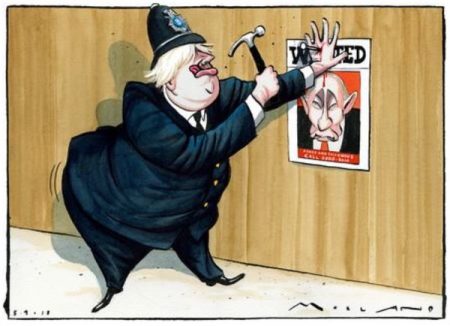
The attacks by European leaders against US President Donald Trump are getting sharper by the day.
On the day Trump announced that he was ripping up the Iran deal, and that the US would impose sanctions on European companies trading with that country, the French finance minister Bruno Le Maire said that European states refused to be treated like “vassals” of the US.
At Aachen on 11 May, Emmanuel Macron effectively accused the US of blackmail. On 17 May, the president of the European Council, Donald Tusk, asked, “With friends like that (i.e. Trump), who needs enemies?”
The temperature only rose further when the French energy giant Total announced that it would pull out of a multi-billion dollar gas deal with Iran unless European diplomacy succeeds in obtaining a specific waiver from US sanctions. Other European behemoths including Allianz and Siemens have also announced either that they will wind down operations in Iran or that they will not start any new ones.
These statements show that Trump’s decision is a slap in the face for the EU politically, economically and – perhaps above all – ideologically. Politically, because both Emmanuel Macron and Angela Merkel made special trips to Washington to plead with Trump, to no avail whatever. Moreover, the EU is itself a signatory to the Iran deal, which it regards as a major diplomatic triumph from which it draws credibility: its disavowal by Trump is a deep insult to the diplomatic status of the EU as such.
Economically, because of the gigantic contracts which European companies could lose. For years, following the nearly $9 billion fine imposed by the US on Paribas in 2015, European companies and banks have been terrified of engaging in any business activity likely to attract the ire of the Americans. Deals with Russia, for instance, are shunned. The effect of this latest decision could be like many Paribas situations at once.
Ideologically, because the EU draws its entire legitimacy from the belief that by pooling sovereignty and by merging its states into one entity, it has advanced beyond the age when international relations were decided by force. It believes that it embodies instead a new international system based on rules and agreements, and that any other system leads to war. It is impossible to exaggerate the importance of this belief for European leaders; yet Donald Trump has just driven a coach and horses through it.
The angry statements by European leaders might lead one to think that we are on the cusp of a major reappraisal of trans-Atlantic relations. However, the reality is that the EU and its leaders have painted themselves into a corner from which it will be very difficult, perhaps impossible, to extricate themselves.
First, the links between the EU and the US are not only very long-standing, they are also set in stone. NATO and the EU are in reality Siamese twins, two bodies born at the same time which are joined at the hip. The first European community was created with overt and covert US support in 1950 in order to militarize Western Europe and to prepare it to fight a land war against the Soviet Union; NATO acquired its integrated command structure a few months later and its Supreme Commander is always an American.
Today the two organizations are legally inseparable because the consolidated Treaty on European Union, in the form adopted at Lisbon in 2009, states that EU foreign policy “shall respect” the obligations of NATO member states and that it shall “be compatible” with NATO policy. In other words, the constitutional charter of the EU subordinates it to NATO, which the USA dominates legally and structurally. In such circumstances, European states can only liberate themselves from US hegemony, as Donald Tusk said they should, by leaving the EU. It is obvious that they are not prepared to do that.
Second, EU leaders have burned their own bridges with other potential partners, especially Russia. Angela Merkel traveled to Russia on Friday but only a few weeks ago more than half of the EU member states expelled scores of Russian diplomats and encouraged non-EU European states like Ukraine and Montenegro to do the same, in retaliation for the poisoning in Salisbury of Sergei and Julia Skripal.
How is Mrs Merkel going to convince Mr Putin to join her in keeping Iran’s nuclear program under control if she officially thinks that Mr Putin is guilty of secretly stockpiling and using chemical weapons for assassinations in the West? Only a few weeks later, in mid-April, Britain and France, together with the US, attacked Syria on the basis that its army had used chemical weapons at Douma with Russian backing. If they try to turn on the charm now in Sochi or in Moscow, do they really expect the Russians can take them seriously?
Third, how can EU leaders complain about US sanctions against their companies when they themselves have applied sanctions against Russian companies causing major economic disruptions in that country? EU states have also introduced punitive sanctions against Syria since 2011, one of the biggest programs of sanctions ever, whose effect and purpose is to disrupt the activities of the Syrian state including its ability to provide public goods like health.
Britain and France, who are, with Germany, the European signatories of the Iran deal, have been pursuing regime change in Syria for half a decade. By what right do they protest now that the US administration is taking decisions whose goal is to provoke regime change in Iran?
As if these external issues were not bad enough, the EU is currently riven by internal divisions too. Donald Tusk may say “Europe must be united economically, politically and also militarily like never before … either we are together or we are not at all” but Europe is indeed not “together” at all. The Brussels commission is hounding Poland and Hungary on what are clearly internal political matters beyond the Commission’s remit; the EU is about to lose one of its most important member states; and a new government is going to take power in Rome whose economic policies (a flat tax at 15%) will blow the eurozone’s borrowing rules out of the water and perhaps cause Italy to leave the euro.
The Italian 5-Star / League government also wants an end to the EU sanctions against Russia; these are voted by a unanimity which, although fragile, has held until now but which, if the new power in Rome keeps its word, will shortly collapse. In other words, what Trump has done is to make the Europeans look like the fools they are. In circumstances in which the EU has placed all its eggs in one basket, a basket which Trump has now overturned, it will be impossible for it to come together. On the contrary, it is falling apart.
John Laughland, who has a doctorate in philosophy from the University of Oxford and who has taught at universities in Paris and Rome, is a historian and specialist in international affairs.
EU will use ‘blocking statute’ to protect its firms from US sanctions for operating in Iran
RT | May 17, 2018
The European Union will activate legislation banning the bloc’s companies from complying with US sanctions against Iran as soon as Friday, according to European Commission President Jean-Claude Juncker.
The law also does not recognize any court rulings enforcing penalties, which could be potentially introduced by the White House against European corporations doing business in the Islamic Republic.
“As the European Commission we have the duty to protect European companies,” the Commission president said at a news conference after a meeting of EU leaders. “We now need to act and this is why we are launching the process of to activate the ‘blocking statute’ from 1996. We will do that tomorrow morning at 10:30.”
“We also decided to allow the European Investment Bank to facilitate European companies’ investment in Iran. The Commission itself will maintain its cooperation with Iran,” Juncker said.
The move followed Washington’s decision to withdraw from the Iran nuclear deal, clinched three years ago between Tehran and the P5+1 powers (China, France, Russia, UK, US, plus Germany) and to reintroduce sanctions that were lifted after signing the pact.
The US Treasury Department said it would give European businesses six months to wind up their investments in the country or risk US sanctions – forbidding them from signing new contracts.
Following a decades-long financial and economic blockade, the 2015 nuclear deal, known as the Joint Comprehensive Plan of Action (JCPOA), opened Iran as one of the biggest global markets to dozens of multinationals across the globe. The EU’s biggest companies rushed to sign multi-billion euro deals with Tehran shortly after the sanctions were lifted. As for Iran, the energy-rich republic got an opportunity to ramp up its presence in the global oil markets.
The EU has a lot of experience protecting its interests, Dawood Nazirizadeh, chairman of the Wiesbaden Academy for integration, told RT.
“In 1996 it defended itself against US secondary sanctions with the ‘blocking statute’. As a result, the US granted exemptions to European companies. However, under the current US administration, we are not optimistic about the future for such an agreement,” said Nazirizadeh.
The EU also agreed to stick to the Iran nuclear deal, aiming to protect the interests of European corporations dealing with Tehran against US sanctions, according to European Council President Donald Tusk.
“On Iran nuclear deal, we agreed unanimously that the EU will stay in the agreement as long as Iran remains fully committed to it. Additionally the Commission was given a green light to be ready to act whenever European interests are affected,” the top EU official said.
Europe drags feet on guaranteeing trade with Iran
Press TV – May 16, 2018
The European Union’s top policy chief has said that she cannot talk about giving Iran guarantees for the economic benefits of the 2015 agreement, but that she can give assurances that the EU will deepen the dialog with Iran and will immediately start work to arrive at practical solutions. Still a number of European firms have already started winding down business in Iran in an attempt to protect themselves from secondary US sanctions.
Iran’s Foreign Minister Mohammad Javad Zarif warned ahead of a meeting with his British, French and German counterparts in Brussels on Tuesday that there was not much time for them to deliver those assurances.
“Guarantees of benefits of the JCPOA should be given to Iran. We will have to see whether those remaining in the JCPOA can deliver those benefits to Iran,” he was quoted as saying upon arrival in the Belgian capital.
However, the Europeans only pledged to keep the Joint Comprehensive Plan of Action (JCPOA) alive without the United States by trying to keep Iran’s oil and investment flowing.
“We all agreed that we have a relative in intensive care and we all want to get him or her out of intensive care as quickly as possible,” EU foreign policy chief Federica Mogherini told reporters after the 90-minute meeting.
Mogherini emphasized that the lifting of nuclear-related sanctions and the normalization of trade and economic relations with Iran constitute an essential part of the nuclear deal.
She said Iran and the Europeans will be working over the coming weeks to find practical solutions which will include continuing to sell Iran’s oil and gas products, maintaining effective banking transactions and protecting European investments in Iran.
As for the assurances, Mogherini said, “I cannot talk about legal or economic guarantees but I can talk about serious, determined, immediate work from the European side.”
The US has given companies a 180-day wind-down period before the sanctions are reimposed on Iran. That has prompted some European companies to start planning their exit from Iran’s market in the absence of guarantees from their governments.
Danish shipping companies Maersk Tankers and Torm were reported on Tuesday to have stopped taking new orders in Iran.
Even before Trump’s withdrawal, Iran had repeatedly complained to the Europeans about their failure to persuade companies into dealing with Tehran because banks in Europe are generally unwilling to handle transactions with the Islamic Republic.
On Tuesday, German insurer Allianz said it was preparing to wind down Iran-related business due to possible US sanctions.
“We are analyzing our portfolio to identify Iran-related business,” Reuters quoted an Allianz spokesman as saying.
“This analysis is ongoing and we are developing wind-down plans for relevant business to ensure appropriate termination within the defined periods,” he said.
US, Sweden and Finland Boost Military Cooperation to Form New Alliance
By Alex GORKA | Strategic Culture Foundation | 14.05.2018
The US, Swedish, and Finnish defense ministers signed a trilateral Statement of Intent (SOI) to expand defense cooperation on all fronts. The signing ceremony took place in Washington on May 8. In 2016, the two Scandinavian nations finalized separate defense SOIs with America. Now they have signed a joint document to unify those previous agreements and enhance their interoperability.
The Scandinavian visitors claimed this was just a starting point for a more mature relationship. The agreement emphasizes the countries’ combined joint exercises and streamlines the procedures that have been established to manage them.
Other issues covered by the SOI include regular trilateral meetings at all levels, the exchange of information (including about weapons systems), increased practical interaction, cooperation in multinational operations, improved communications, and the promotion of the EU-NATO strategic partnership. The latter issue will transform the Scandinavians into a connecting link that will eliminate the chance of any European deterrent that could operate with any real independence from its North American “big brother.” Washington wants to make sure that the PESCO agreement will not protect Europe’s defense industry from US companies.
Sweden hosted the Aurora military exercise in September 2017, the largest such event on its soil. The US supplied most of the visiting troops. The American military has also taken part in a number of drills in Finland recently. That country will host a large-scale NATO exercise as early as 2020 or 2021. The US has already been invited. The militarization of the Scandinavian Peninsula is moving full speed ahead.
The recently signed SOI actually transforms the bilateral agreements into enhanced trilateral cooperation. For Stockholm and Helsinki, joining NATO is not an option for domestic political reasons. At least not for now. Instead, a new US-led defense alliance has emerged.
The increased tempo of exercises anticipates a larger US presence. It has far-reaching implications. With American military personnel rotating in and out of Sweden and Finland, any offensive action against one of those states would officially be an attack on a NATO member. It would trigger a response as envisaged by Article 5 of the Washington Treaty. Russia considers any American military presence there as provocative. The US is not a Scandinavian country. If an incident took place that resulted in a clash between Russian and US forces, the two Scandinavian nations would be pulled against their will into a conflict they may have nothing to do with. The American soldiers on their soil will never be under the control of their national commands. More US presence means less sovereignty and more risk.
Actually, since they are EU members they don’t even need Article 5, because Article 42.7 of the EU treaty also contains a binding mutual-assistance clause. France invoked it after the 2015 Paris terror attacks.
Last year Sweden and Finland joined the UK-led Joint Expeditionary Force (JEF). All other participants in the nine-nation formation are NATO members. It means that in an emergency their armed forces will operate under NATO command, becoming parties to a conflict they could avoid if they were really neutral. The two also cooperate with Washington through the Northern Group (NG), which consists of 12 countries, although Sweden and Finland are the only non-NATO participants. That organization holds its own dialog with the US. Another venue is the five-nation Nordic Countries group, that includes these two non-aligned members.
In reality, Sweden and Finland have already joined NATO through other groups and agreements. They did so informally, avoiding referendums and the relevant parliamentary procedures at home. This should be viewed as part of a broader picture. In early April, the first-ever US-Baltic States summit took place in Washington. It was an unprecedented event that somehow was kept out of the media spotlight.
The leaders of NATO’s “frontline states” called for a permanent US military presence in the region. They want that to be much larger than just American participation in multinational battalions. They are asking for a permanent presence on a much wider scale. Washington, which already has forces deployed in Norway and Poland, is considering rotating American troops through the Baltic nations as well. Poland and the Baltic states are a focus of NATO’S bellicose preparations. One might as well forget about the 1997 Russia-NATO Founding Act (1997), which states that no substantial forces should be deployed in the proximity of the borders. That document has already been breached by NATO.
The US guests have provided advice on how to promote American influence (they call it “democracy”) in Georgia, Moldova, and Ukraine, the members of a newly formed anti-Russian alliance. And it’s not just the defense sector. Last year, Lithuania began importing liquefied natural gas (LNG) from America. Poland has also built an LNG terminal to expand the shipments of American gas to Europe, which compete with Russia’s energy supplies.
The withdrawal from the Iran deal is not the only time a US position on an issue has been opposed by the leading European nations. There are many more points of disagreement. Old Europe is gradually creating an independent deterrent. A rift between the EU and the US is deepening. But as one can see, Washington is building another pro-American alliance on the continent. It does not mean it will replace the North Atlantic alliance. Certainly not. On the contrary, it will strengthen the US position in the bloc.
But aside from NATO, Washington also leads an informal alliance of “frontline states” that are intimidated by a nonexistent threat. The idea of the Russia bogeyman is being exploited by the US in order to reach its foreign-policy goals. Northern Europe is being turned into a hornet’s nest, with its good-neighbor policy gradually being replaced with confrontation that benefits the US but makes the region less secure.
America’s Jerusalem embassy for mass murder, occupation and wider war
By Finian Cunningham | RT | May 14, 2018
How obscenely ironic. Embassies traditionally symbolize diplomacy and peace. The opening of the US Embassy in Jerusalem was occasioned by a grotesque baptism of murder of Palestinians, heralding wider war in the Middle East.
Not only that, but on the very anniversary of one of the most shameful episodes of ethnic cleansing and dispossession over the past century – the 1948 Nakba or Catastrophe for Palestinians – the US government is brazenly siding with the heirs of that historic violence, the Israeli state.
Trump’s wholesale abandonment of any shame in endorsing Israeli violations against Arab historic rights is an incitement to regional conflagration.
It’s hard to express the horror. Israeli snipers shooting unarmed Palestinian protesters in Gaza, while some 100 kilometers away in Jerusalem, US dignitaries and evangelical pastors were blessing the opening of Washington’s new embassy as ‘God’s work’.
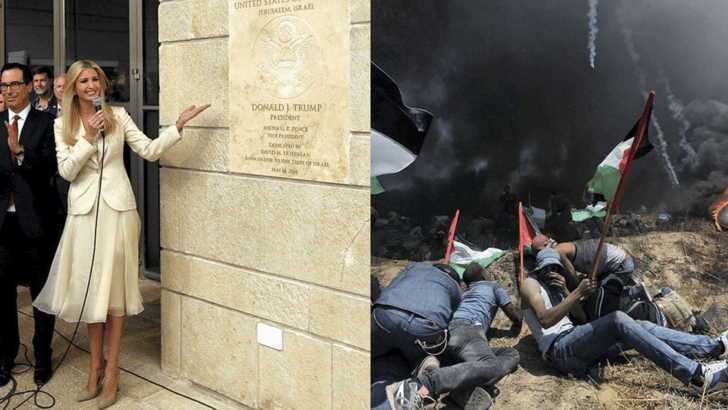
US President Donald Trump’s policy in the Middle East, if you could call it “policy”, has descended into absolute lunacy. No wonder, most European states stayed away from the US reception for unveiling its new diplomatic center.
Trump’s reckless disregard for Palestinian-Israeli peace is plunging the region into a blood bath. This week’s incendiary snub to Palestinians and the wider Arab region followed his tearing up of US obligations to the Iran nuclear accord. That violation of an international treaty has left diplomats from Europe, Russia, China and Iran scrambling to salvage a deal, which if it falls apart will unleash more instability and even war in the Middle East.
When Trump announced in December the moving of his country’s embassy from Tel Aviv to Jerusalem it was roundly rebuked at the United Nations. The move violates decades of international consensus that Jerusalem should be a shared capital between Palestinians and Israelis pending the outcome of peace negotiations.
Trump said his decision was merely a “reflection of reality”. Cynically, it marks US acquiescence to illegal Israeli occupation of Palestinian territory.
To be fair, Washington’s decision to relocate its embassy to Jerusalem was made over 20 years ago in 1995. Presidents Clinton, GW Bush and Obama opted to delay the actual move, claiming that such a move depended on progress in peace talks. Trump has now put into action legislation that was already on the books.
But what his declaration signifies is the jettisoning of any pretense by the US of being an “honest broker” between Israelis and Palestinians. Palestinian leaders now refuse to even engage with US officials, such is their disgust.
Paradoxically, Trump is helping to clarify the situation. The US is openly backing Israeli conquest of Palestinian territory and oppression of Palestinians. Washington is now transparently complicit in criminal Israeli policy rather than hiding behind a facade of mediation.
Israeli Prime Minister Benjamin Netanyahu hailed Trump this week for “making Israel great again”. With typical chutzpah, Netanyahu urged other nations to follow suit, absurdly claiming that by relocating their embassies from Tel Aviv to Jerusalem they would facilitate peace.
The perverse logic, as proven already by the US policy, is that any chance of peace between Palestinians and Israelis is being utterly destroyed.
The hellish conditions that Palestinians are subjected to under relentless Israeli occupation are driving them to the desperate act of lining up in their thousands under the fire of Israeli snipers.
Over the past six weeks since Gaza’s population began the “Great Return March” some 50 unarmed protesters have been murdered by Israeli live fire. On the day of the US Embassy opening, dozens of more civilians were shot dead, within hours of the Jerusalem ceremony.
Israeli commanders have openly admitted that a shoot-to-kill tactic is being used whereby soldiers are even targeting children who dare to approach a separation barrier on Gaza’s eastern border with Israeli-held territory.
The Gaza protests were organized by ordinary Palestinians to highlight their desperate plea against a barbaric occupation and prevention of residents returning to their historic homes, including in Jerusalem. Some 70 per cent of Gaza’s population are descended from refugees who were displaced by Israeli settlers in the 1948 pogroms and later in the 1967 War.
Under Israeli siege, which the UN has described as illegal, Gazans are prevented from moving out of the coastal strip. Some two million people – half of whom are under 18 years old – subsist in unlivable conditions. Over 90 per cent of Gaza’s water supply is contaminated, electricity is available for only a few hours per day, fisherman are prevented from going beyond a few miles from the shore where human sewage runs directly into the sea.
As American historian Norman Finkelstein points out, Gaza is being tormented by military occupation, an inhuman blockade, massacres conducted with impunity by Israeli military, and children being poisoned. It is this context of genocide in which the recent protests are taking place.
Those protests were organized to coincide with the 70th anniversary of Israel’s declared foundation on May 14, 1948. The next day, May 15, is what the Palestinians and many supporters around the world prefer to focus on – the Catastrophe.
Trump’s decision to open the US Embassy in Jerusalem this week could not be more provocative and criminally insane.
It truly is a shockingly callous display of US support for seven decades of barbaric oppression against Palestinians and the wider Arab region.
Jerusalem is seen as a holy site for Muslims and Christians. Washington’s acquiescing to Israel’s declaration of the city as “undivided capital” of the Jewish Israeli state is an outrageous blow to hundreds of millions of people from other faiths. As well as a vandalistic swipe at world opinion based on ordinary principles of justice, morality and compassion towards the long-suffering Palestinian people.
Europe bears a heavy responsibility for the plight of Palestinians. After Hamas won the parliamentary elections in 2006, the EU and the US both moved to sanction the new Hamas government owing to its refusal to recognize the state of Israel. The Israeli siege on Gaza has thus been perpetrated with the complicity of the EU and the US, albeit the latter appearing more brazenly complicit under Trump.
European governments may be discomfited by Trump’s strident contempt for Palestinian rights and international law. But they have contributed to the present deterioration in the Middle East by pandering towards Washington’s policies of sponsoring Israeli occupation, as well as sponsoring reactionary Arab client regimes like Saudi Arabia, and fomenting illegal wars and regime-change operations.
Trump’s impetuousness and ignorance – no doubt encouraged by multi-million-dollar donations from rich Jewish Americans like Sheldon Adelson – has set the US on a collision course with the Arab masses from his insolent indifference to their rights. As if that could not be any more combustible, Trump is pushing the same Israeli-Saudi despot agenda of hostility towards Iran, as evinced by the nuclear accord sabotage.
Europe has for too long tied itself to the shipwreck that is US policy in the Middle East. Surely, European governments must realize by now that if explosive violence and conflict is to be avoided in the Middle East, they must abandon the US shipwreck and begin asserting an independent foreign policy.
A genuine peace process advocating for long-neglected Palestinian rights, and repudiating US attempts to collapse the Iran nuclear accord are two immediate matters for the Europeans to claw back some sanity and respect – before it’s too late.
Read more:
Western Media Shorthand on Venezuela Conveys So Much
teleSUR | May 10, 2018
Over the years Western media have developed a journalistic shorthand of repetition, for conveying distortions and imperial hypocrisy about Venezuela.
A Reuters article (4/18/18) reports that the European Union “could impose further sanctions on Venezuela if it believes democracy is being undermined there.”
The line nicely illustrates the kind of journalistic shorthand Western media have developed, over years of repetition, for conveying distortions and whitewashing gross imperial hypocrisy about Venezuela. A passing remark can convey and conceal so much.
The EU’s sincerity in acting on what it “believes” about Venezuelan democracy is unquestioned by the London-based Reuters. Meanwhile Spain, an EU member, is pursuing the democratically elected president of Catalonia, Carles Puigdemont, for the crime of organizing an illegal independence referendum last year. Weeks ago, he was arrested in Germany at Spain’s request, and other elected representatives have been arrested in Catalonia, where Spain’s federal government deposed the elected regional government after the referendum.
In July 2017, a few months before the referendum in Catalonia, Venezuela’s opposition also organized an illegal referendum. One of the questions asked if the military should obey the opposition-controlled National Assembly, which was an extremely provocative question, given the opposition’s various efforts to overthrow the government by force since 2002. The referendum required an extremely high level of political expression, organization and participation. It allegedly involved 7 million voters.
The Venezuelan government disregarded the results—as Spain disregarded the Catalan referendum results—but unlike Spain, did not jail people for organizing it, or send police to brutally repress voters. In fact, two weeks later, Venezuelan voters (overwhelmingly government supporters, since the opposition boycotted and did not field candidates) were violently attacked by opposition militants when they elected a constituent assembly. The attacks resulted in several deaths.
Venezuelan President Nicolás Maduro has hardly failed to call attention to the hypocrisy of both the EU and Spain, but the Reuters article made no mention of it.
Reuters also reported that “the country’s two most popular opposition leaders have been banned from competing” from Venezuela’s presidential election on May 20. Reuters didn’t name the two supposedly “most popular opposition leaders,” but in the past (e.g., 4/12/18, 2/28/18, 2/19/18) the wire service has identified them as Leopoldo Lopez and Henrique Capriles. As it happens, according to the opposition-aligned pollster Datanalisis, whose results have been uncritically reported by Western media like Reuters for years, opposition presidential candidate Henri Falcón has been significantly more popular than Capriles in recent months, and barely less so than Lopez.
Mark Weisbrot (in an opinion piece for U.S. News, 3/3/18) broke the news that U.S. government officials had been secretly pressuring Falcón not to run, so that the election could be discredited as including no viable opposition candidate. Two weeks later, Reuters (3/19/18) discreetly reported Weisbrot’s scoop.
However, by far the most important thing Reuters neglects telling readers about the “two most popular opposition leaders” is that had they done in the EU what they’ve done in Venezuela since April 2002, Lopez and Capriles would both be serving long jail terms.
Capriles and Lopez together led the kidnapping of a government minister during a briefly successful U.S.-backed military coup in 2002 that ousted Venezuela’s democratically elected president, the late Hugo Chávez, for two days. Lopez boasted to local TV that the dictator installed by the coup (whom Lopez called “President Carmona”) was “updated” on the kidnapping.
Imagine what Carles Puigdemont’s predicament would be if, rather than organizing a peaceful referendum, he had participated in a foreign-backed, ultimately unsuccessful military coup against the Spanish government. Needless to say, running for public office would not be on the table. That would be the least of his worries.
In Venezuela, Capriles eventually served a few months in prison for participating in the coup, while Lopez avoided doing any time, thanks to a general amnesty granted by Chávez. Lopez was finally arrested in 2014 for leading another violent effort to overthrow the government.
I’ve reviewed before (teleSUR, 1/9/18) violent efforts to overthrow the government that Lopez, Capriles and other prominent opposition leaders have been involved with since the 2002 coup. I also described how Julio Borges and Henry Ramos (two other prominent opposition leaders) have openly sought to starve the Venezuelan government of foreign loans as it struggles with a severe economic crisis.
In August, Trump’s administration imposed sanctions on Venezuela’s entire economy that will cost Maduro’s government billions of dollars this year (FAIR.org, 3/22/18). It has threatened to go even further, brandishing an oil embargo or even a military attack. With sufficiently compliant media (and the collusion of big human rights NGOs like Amnesty International), such depravity becomes possible.
The Reuters article also says that Venezuela’s economic “collapse has driven an estimated 3 million people to flee the country.” No need to tell readers when the economic “collapse” began—2014—much less who made the estimates or if other sources contradict them. In fact, the U.N.’s 2017 population division numbers estimate Venezuela’s total expat population as of 2017 at about 650,000—only about 300,000 higher than it was when Chávez first took office in 1999. Even a group of fiercely anti-government Venezuelan academics estimated less than 1 million have left since the economic crisis began. (See FAIR.org, 2/18/18.)
Cherry-picked statistics aside, when Western powers want a democratically elected government overthrown, the approach is clear. Complete tolerance for violent foreign-backed subversion—which the powerful states and their allies would never be expected to tolerate—becomes the test for whether or not a state is a democracy. The targeted government fails the test, is depicted as a dictatorship, and all is permitted. Only the tactics required to bring it down need be debated.
Joe Emerberger is a writer based in Canada whose work has appeared in Telesur English, ZNet and Counterpunch.
The Skripals Will Most Likely Never be Allowed to Talk
The Saker • Unz Review • May 11, 2018
There have been major developments this week, all of them bad, including Putin re-nominating Medvedev as his Prime Minister, and Bibi Netanyahu invited to Moscow to the Victory Day Parade in spite of him bombing Syria, a Russian ally, just on the eve of his visit. Once in Moscow, Netanyahu compared Iran to, what else, Nazi Germany. How original and profound indeed! Then he proceeded to order the bombing of Syria for a second time, while still in Moscow. But then, what can we expect from a self-worshiping narcissist who finds it appropriate to serve food to the Japanese Prime Minister in a specially made shoe? The man is clearly batshit crazy (which in no way makes him less evil or dangerous). But it is the Russian reaction which is so totally disgusting: nothing, absolutely nothing. Unlike others, I have clearly said that it is not the Russian responsibility to “protect” Syria (or Iran) from the Israelis. But there is no doubt in my mind that Netanyahu has just publicly thumbed his nose at Putin and that Putin took it. For all my respect for Putin, this time he allowed Netanyahu to treat him just like Trump treated Macron. Except that in the case of Putin, he was so treated in his own capital. That makes it even worse.
[Interestingly, while whining about “Nazi Iran” Netanyahu did say something truly profound and true. He said “an important history lesson: when a murderous ideology emerges, one has to push back against it before it is too late”. That is indeed exactly what most people across the world feel about Israel and its Zionist ideology but, alas, their voice is completely ignored by those who rule over them. So yes, it sure looks to me like it is becoming “too late” and that the consequences for our collective cowardice – most of us are absolutely terrified from speaking the plain truth about our Zionist overlords – will cost us all a terrible price.]
Then, of course, there is Donald Trump pulling out of the so-called Joint Comprehensive Plan of Action (JCPOA) in spite of Iran’s full compliance and in spite of the fact that the US does not have the authority to unilaterally withdraw from this multilateral agreement. But being the megalomaniac that he is, and not to mention the spineless lackey of the Israel Lobby, Trump ignored all that and thereby created further tensions between the US and the rest of the world whom the US will now blackmail and bully to try to force it to support the US in its rabid subservience to Israel. As for the Israelis, their “sophisticated” “strategy” is primitive to the extreme: first get Trump to create maximal tensions with Iran, then attack the Iranians in Syria as visibly and arrogantly as possible, bait the Iranians into a retaliation, then bellow “OI VEY!!!” with your loudest voice, mention the Holocaust once or twice, toss in a “6 million people” figure, and get the US to attack Syria.
How anybody can respect, never mind admire, the Israelis is simply beyond comprehension. I sure can’t think of a more contemptible, nasty, psychopathic gang of megalomanical thugs (and cowards) than the Israelis. Can you?
Nonetheless, it appears undeniable that the Zionists have enough power to simultaneously force not one, but two (supposed) superpowers to cave into their demands. Not only that, they have the power to do that while also putting these two superpowers on a collision course against each other. At the very least, this shows two things: the United States has completely lost its sovereignty and is now an Israeli protectorate. As for Russia, well, she is doing comparatively better, but the full re-sovereignization the Russian people have voted for when they gave their overwhelming support to Putin will not happen. A comment I read on a Russian chat put it: “Путин кинул народ – мы не за Медведева голосовали” or “Putin betrayed the people – we did not vote for Medvedev”. I am not sure that “betrayed the people” is fair, but the fact that he has disappointed a lot of people is, I think, simply undeniable.
It is still way too early to reach any conclusions at this point, and there are still way too many unknown variables, but I will admit that I am very worried and that for the first time in 4 years I am having major doubts about a fundamental policy decision by Putin. I sure hope that I am wrong. We will find out relatively soon. I just hope that this will not be in the form of a major war.
In the meantime, I want to refocus on the Skripal case. There is one outright bizarre thing which I initially dismissed, but which really is becoming disturbing: the fact that the Brits are apparently holding Sergei and Iulia Skripal incommunicado. In other words, they have been kidnapped.
There was this one single telephone call between Iulia Skripal and her sister, Victoria, in which Iulia said that she was okay (she was clearly trying to reassure Victoria) but it was clear that she could not speak freely. Furthermore, when Victoria mentioned that she would want to visit Iulia, the latter reply ‘nobody will give you a visa’. After that – full silence. The Russian consulate has been making countless requests to have a visit, but all that the Brits have done since is have Scotland Yard post a letter which was evidently not written by Iulia and which said “I have access to friends and family, and I have been made aware of my specific contacts at the Russian Embassy who have kindly offered me their assistance in any way they can. At the moment I do not wish to avail myself of their services, but, if I change my mind I know how to contact them”. What friends?! What family?! Nonsense!
Her sister tried to contact her many times through various channels, including official ones, and then in total despair, she posted the following message on Facebook:
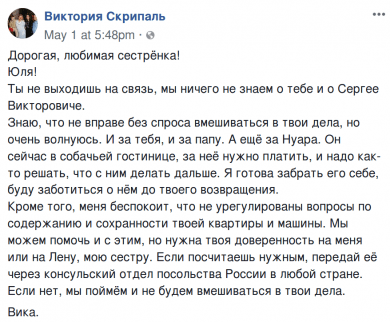
“My darling sister, Yulia! You are not communicating with us, and we don’t know anything about you and Sergey Victorivich. I know that I have no right to interfere in your affairs without asking your permission, but I worry too much. I worry about you and your dad. I also worry about Nuar. [Nuar is Yulia Skrial’s dog, whom she left to stay at a kennel center, while she was traveling to the UK.] He is now at the dog hotel, and they want to get paid. We have to decide something what to do with him. I am ready to take him and to take care of him until you come back home. Besides Nuar, I am concerned about your apartment and your car. Nothing has been decided about their safety and maintenance. We can help with all that, but I need your power of attorney in my or my sister Lena’s name. If you think that all of these is important, draw up a power of attorney form in a Russian consulate in any country. If you won’t do that, we will understand and won’t interfere in your affairs.
Vika“
No reply ever came.
I just entered the following query into Google: “Skripal”. April 10th has an entry saying that she was released from the hospital. That is the most recent one I have found. I looked on Wikipedia, the same thing, there is nothing at all.
I have to admit that when I first heard the Russian complaints I figured that this was no big deal. I thought “the Brits told the Skripals that Putin tried to poison them, they are probably afraid, and possibly still sick from whatever it is which made them sick, but the Brits would never outright kidnap two foreign citizens, and most definitely not in such a public way”.
I am not so sure anymore.
First, let’s get the obvious one out of the way: the fear for the security of the Skripals. That is utter nonsense. The Brits can organize a meeting between а Russian diplomat in the UK at a highly protected UK facility, with tanks, SAS Teams on the standby, helicopters in the air, bombers, etc. That Russian diplomat could speak to them through bullet-proof glass and a phone. And, since the Russians are all so dangerous, he can be searched for weapons. All which the Skripals need to do is to tell him/her “thank you, your services are not needed”. Conversation over. But the Brits refuse even that.
But let’s say that the Skripals are so totally terrified of the evil Russians, that they categorically refuse. Even by video-conference. It would be traumatic for them, right? Okay.
What about a press conference then?
Even more disturbing is that, at least to my knowledge, nobody in the western corporate media is asking for an interview with them. Snowden can safely speak from Russia and address even large conferences, but the Skripals can’t speak to anybody at all?
But here is the worst part of this: it has been two months already since the Skripals are held in total secrecy by the UK authorities. Two months, that is 60 days. Ask any specialist on interrogation or any psychologist what kind of effect 60 days of “specialized treatment” can do to a person.
I am not dismissing the Russian statements about “kidnapping” anymore. What I see is this: on substance, the Skripal false flag has crashed and burned, just like MH17 or the Douma chemical attack, but unlike MH17 or Douma, the Skripals are two witnesses whose testimony has the potential to result in a gigantic scandal, not just for the May government, but for all those spineless Europeans who showed “solidarity” with Britain. In other words, the Skripals will probably never be allowed to speak freely: they must either be killed or totally brainwashed or disappeared. Any other option would result in a scandal of planetary magnitude.
I can’t pretend like my heart goes out to Sergei Skripal: the man was an officer who gave an oath and who then betrayed his country to the British (he was a British agent, not a Russian one as the press writes). Those holding him today are his former bosses. But Iulia? She is completely innocent and as of April 5th (when she called her sister Victoria), she was clearly in good health and with a clear mind. Now she has been disappeared and I don’t know which is worse, the fact that she might never reappear or that she might one day reappear following months of British “counseling”. As for her father, he paid for his betrayal and he too deserves a better fate than being poisoned, used and then disappeared.
In the big scheme of things (the Zionists war against our entire planet), two individuals like Sergei and Iulia Skripal might not matter. But I think that the least we can do is to remember them and their plight.
This also begs the question of what kind of society we live in. I am not shocked by the fact that the British state would resort to such methods (they have always used them). I am shocked that in a so-called western “democracy” with freedom, pluralism and “European values” (whatever that means) the Brits could get away with this.
How about some “solidarity” with the Skripals – you, Europeans?!
Only IAEA can assess any claim on Iranian nuclear program: Mogherini
Press TV – May 1, 2018
The EU foreign policy chief says what the Israeli premier tried to present as documents on Iran’s “secret” nuclear work fails to question Tehran’s compliance with the 2015 nuclear deal, and that any such claims should solely be assessed by the UN nuclear watchdog.
“What I have seen from the first reports is that Prime Minister Netanyahu has not put into question Iran’s compliance with the JCPOA (Joint Comprehensive Plan of Action) commitments, meaning post-2015 nuclear commitments,” Federica Mogherini said Monday.
The remarks came hours after Netanyahu unveiled what he claimed to be “conclusive proof of the secret” Iranian nuclear program during a televised address from Israel’s ministry for military affairs.
Standing in front of a big screen and using large visual aids, the prime minister claimed that “Iran is brazenly lying” about its nuclear activities, presenting 55,000 pages of documents and 55,000 files on CDs as alleged evidence.
Netanyahu’s new anti-Iran show comes just ahead of a May 12 deadline for US President Donald Trump to decide whether Washington would keep its side of the multilateral deal with Iran. Trump has given the European parties to the JCPOA until that date to fix the so-called “flaws” in the accord or face a US exit.
The Israeli leader’s fresh claims contradict numerous reports by the International Atomic Energy Agency (IAEA) verifying Iran’s full commitment to its side of the bargain.
Mogherini further said the JCPOA “is not based on assumptions of good faith or trust – it is based on concrete commitments, verification mechanisms and a very strict monitoring of facts, done by the IAEA. The IAEA has published 10 reports, certifying that Iran has fully complied with its commitments.”
“And in any case, if any party and if any country has information of non-compliance, of any kind, it can and should address and channel this information to the proper, legitimate, recognized mechanisms, the IAEA and the Joint Commission [of the JCPOA] for the monitoring of the nuclear deal that I chair and that I convened just a couple of months ago. We have mechanisms in place to address eventual concerns,” she said.
“IAEA is the only impartial international organisation in charge of monitoring Iran’s nuclear commitments. If any country has information of non-compliance of any kind should address this information to the proper legitimate and recognised mechanism”
The top EU diplomat further reiterated that she had not seen from “Netanyahu arguments for the moment on non-compliance, meaning violation by Iran of its nuclear commitments under the deal.”
France says Netanyahu claims strengthen Iran deal
France’s Foreign Ministry said that the Israeli data underscored the need to ensure that the Iran nuclear deal and UN inspections remained.
“This information should be studied and evaluated in detail,” Foreign Ministry spokeswoman Agnes von der Muhll said in a statement.
“The new information presented by Israel could also confirm the need for longer-term assurances on the Iranian program, as the president has proposed,” the statement added.
The statement further said “it is essential that the IAEA can continue to verify Iran’s respect for JCPOA and the peaceful nature of its nuclear program.”
All sides must abide by JCPOA: Putin
Russian President Vladimir Putin spoke with the Israeli premier on the phone, reaffirming Moscow’s support for the Iran deal.
“Vladimir Putin reiterated Russia’s position that the JCPOA, which has a paramount importance in terms of international stability and security, must be strictly observed by all its signatories,” the Kremlin press service quoted the Russian president as saying.
UK, Germany defend Iran deal
A British government spokesman also defended the Iran nuclear pact, saying the IAEA inspection regime “is one of the most extensive and robust in the history of international nuclear accords.”
“It remains a vitally important way of independently verifying that Iran is adhering to the deal and that Iran’s nuclear program is exclusively peaceful,” he said in a statement.
Furthermore, a German government spokesman said Berlin will analyze the Israeli documents on Iran’s nuclear program, but independent inspections must be maintained.
He emphasized that “the nuclear accord was signed in 2015, including the implementation of an unprecedented, thorough and robust surveillance system by the International Atomic Energy Agency.”
Israeli data ‘mostly recycled material’
Meanwhile, a former deputy director for sanctions at the US State Department said he had not seen anything in Netanyahu’s presentation that would change the accord, BBC reported.
“I think, frankly, this was a political statement meant to try to influence President Trump’s decision on whether to pull out of the deal,” John Hughes said, noting, “I think it’s mostly recycled material.”
EU To Spend Quarter Of Budget On Climate Policies
Not A Lot Of People Know That | April 30, 2018
Bear in mind this is only the tip of the iceberg, as individual countries are already standing the major costs themselves of climate policy.
The EU Budget is about 150bn euro pa. If anything shows how fatuous the whole EU project is, this must be it:
Climate-Linked Spending Set to Rise to a Quarter of EU Budget
Bloomberg | April 30, 2018
- European Commission to present 2021-2027 budget proposal May 2
- Climate to be component of regional aid, transport spending
The European Union’s executive is poised to propose spending 25 percent of funds available in next EU multiannual budget on activities related to climate protection, making sure new economic and political challenges don’t weaken the bloc’s resolve to fight pollution.
The European Commission’s blueprint for the 2021-2027 budget, to be proposed on May 2, will boost the so-called climate mainstreaming from 20 percent in the current multiannual financial plan, according to a person with knowledge of the matter. The funds for reducing emissions and adapting to climate change will be earmarked under policies such as regional aid, transport, research and external relations, said the person, who asked not to be identified because talks on the draft budget are private.
Featured Video
The American Retreat from Vietnam
or go to
Aletho News Archives – Video-Images
From the Archives
Secret document reveals plans for civil war in Lebanon, Israeli false flags, and invasion
By Randi Nord | Geopolitics Alert | April 5, 2019
Beirut – During his visit with US Secretary of State, Mike Pompeo, Lebanese President Michael Aoun reportedly received a US-Israeli document detailing plans for creating a civil war in Lebanon with covert false flag operations and possible Israeli invasion.
Although the source of the document is Israeli and created in partnership with Washington, no one knows who presented it to Aoun. The Lebanese TV station, Al-Jadeed, initially reported the document on Lebanese TV and a video on its website. Geopolitics Alert translated the report for this article. … continue
Blog Roll
 Aletho News
- America’s Greenland deal has a radioactive backstory
- The RAF Fairford ‘terror plot’: Unpacking escalation in the UK echo-chamber
- EU Council Advances Chat Control 2.0 Scanning Proposal
- Ex-Greek MEP files complaint against Israeli spyware firm over alleged Pegasus surveillance
- Troubling ideas throughout the Torah, Talmud, Mishneh Torah and Tanya
- ‘Grave, alarming’: Iran mission on Trump’s UNGA ‘annihilation’ threats
- Najaf airport to reopen to Iranian flights within 24 hours: Ambassador
- From ‘How Will This End For Iran’ to ‘When America Walks Away’: A tale of two Economist covers
- Tehran blasts ‘baseless’ speculation linking Iran to alleged bomb plot at UK air base
- The Rise And… Rise Of ‘Color Revolutions’
- If Americans Knew
- Israel’s siege signals another cruel winter for 1.8 million Gazans – Daily Update
- Netanyahu Asked UAE Leader to Deny Report on Oct. 7 Warning in Secret Visit, Sources Say
- CNN Chief Int’l Correspondent Clarissa Ward on Journalists in Gaza
- Democratic Party Consultants Surround Troy Jackson with Pro-Israel Donors
- Christian Leader Responds To Netanyahu’s Claims Regarding Palestinian Christians
- In Gaza, ‘Whoever Survives the Bombing Won’t Survive the Rubble’
- Israel kills more Palestinians, amid push to resettle Gaza – Daily Update
- Israel forces Gazans to live in constant peril – Daily Update
- Deconstructing Netanyahu’s pants-on-fire UN rant – Daily Update
- Trump betrayed voters with his campaign lies and prioritized a foreign country once he took office
- No Tricks Zone
- New Study: Earth And Venus Surface Warmth Largely Explained By Convection And Lapse Rate, Not CO2 Or Radiation
- 2025 Nature Paper Claiming Worsening Global Drought Gets RETRACTED …Heavily Flawed
- New Study: ‘Global Drought Shows No Detectable Recent Acceleration Under Climate Warming’
- Economic Masterminds: German Socialists Suggest Taxing Productivity Gains Stemming From Using AI
- The South China Sea Has Not Been Cooperating With The Climate Change Narrative
- Energy Crisis: Germany Enters Heating Season With Historically Low Gas Reserve Fill Levels
- New Study: The Antarctic Ice Sheet Gained Mass From 2020-2024 Due To Staggering Snow And Ice Accumulation
- Study: Ocean Heating Rates From Thousands Of Years Ago ‘Dwarf’ Modern Ocean Heating Rates
- Climate Extremists Target, Attack Large-Scale Power Grid Infrastructure In Germany!
- New Study: Antarctic Ice Melt Has Contributed Less Than 1 Centimeter To Sea Level Rise In The Last 30 Years

