Lebanon Rejects UN, EU Joint Statement on Displaced Syrians’ Crisis
Al-Manar | April 26, 2018
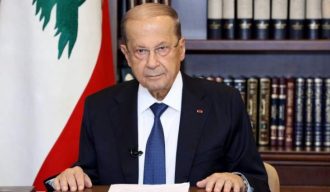 President of the Republic, Michel Aoun, on Thursday voiced rejection of the joint statement by the United Nations and the European Union issued yesterday at the Brussels conference on the displaced Syrians’ crisis.
“The content of the joint statement by the UN and the EU contradicts the state’s sovereignty and endangers Lebanon,” President Aoun said in a statement released by the Presidency of the Republic.
Aoun rejected the content of the joint statement including phrases ‘voluntary return,’ ‘temporary return,’ ‘will to stay,’ and ‘integration in the labor market’ and other terms which contradict the Lebanese state’s sovereignty and laws.
Aoun brought to attention that Lebanon has dealt with the Syrian displacement predicament on the basis of brotherly relations and humanitarian obligation, emphasizing that the only viable solution to the crisis was the safe and dignified return of the displaced Syrians “to the possible areas inside Syria… notably that many Syrian areas have become safe.”
Aoun stressed that Lebanon adheres to a political solution in Syria and the restoration of stability in a way that preserves Syria’s unity and ends the suffering of its people.
Syria Supports Hungary’s Policies on Migration, Middle East – MFA Source
Sputnik | April 26, 2018
Hungary’s decision to fund the construction of a hospital in Syria and its calls for the European Union (EU) to rebuild the war-torn country instead of encouraging migration have been met with support from the Syrian government, according to a governmental source in Damascus.
The Syrian government backs Budapest’s approach to handling and ending the migrant crisis, a source in the Syrian Ministry of Foreign Affairs (MFA) told Sputnik reporter and columnist Suliman Mulhem on Thursday.
“We fully support Hungary’s efforts and approach to helping Syrian migrants return home, instead of destabilizing Syria with sanctions and encouraging Syrians to flee to Europe, as the EU has done,” the source told Sputnik on the condition of anonymity.
He also called on the EU and the US to lift economic sanctions against Syria, which have exacerbated the economic turmoil the Arab state is facing and worsened living conditions in government-held territory.
When asked for his thoughts on Hungary’s anti-immigrant stance, he said they should be allowed to choose who can enter and settle in their country.
“Who they [the Hungarian government] let into Hungary is a domestic matter for them to independently decide on, as any other nation is entitled to do. Even in Syria, although we are continuing to house and allow some migrants to enter, from Sudan for example, we have rules and regulations, not a lawless border.”
Hungary’s pledge of US$5 million to finance the construction of a hospital in Syria was made by Minister of Foreign Affairs and Trade Péter Szijjártó on Wednesday, at a Syria donor conference in Brussels.
He suggested such financial aid offers a long-term solution to the migrant crisis.
“The situation in Syria and its resolution cannot be separated from the migration crisis that is affecting Europe in view of the fact that the conflicts in the region are one of the main causes of it,” he said during a press conference on April 25.
“European Union migration policy needs a fundamental change of direction. Instead of encouraging people to come to Europe, the EU should be concentrating on stopping the causes of migration and on taking assistance to where it is needed to enable people to remain at home or in the vicinity of their homes,” the minister insisted.
As the Syrian Army continues to dislodge terrorists from cities and towns across the country, the Syrian government is examining the herculean task of nationwide post-war reconstruction and creating the necessary conditions to allow Syrians to return home from Europe and countries neighboring Syria, particularly Jordan, Turkey and Lebanon.
The US and a number of EU member states have suggested that they would only lift economic sanctions and provide Syria with financial aid if President Bashar al-Assad leaves office.
President Assad has refused to allow external forces to dictate or influence Syrian politics, and said his future can only be decided by the “ballot box.”
READ MORE:
Syrian Army’s Progress Against Militants Boosts Investment Across Syria
Western Media Shorthand on Venezuela Conveys and Conceals So Much
By Joe Emersberger | FAIR | April 23, 2018
A Reuters article (4/18/18) reports that the European Union “could impose further sanctions on Venezuela if it believes democracy is being undermined there.”
The line nicely illustrates the kind of journalistic shorthand Western media have developed, over years of repetition, for conveying distortions and whitewashing gross imperial hypocrisy about Venezuela. A passing remark can convey and conceal so much.
The EU’s sincerity in acting on what it “believes” about Venezuelan democracy is unquestioned by the London-based Reuters. Meanwhile Spain, an EU member, is pursuing the democratically elected president of Catalonia, Carles Puigdemont, for the crime of organizing an illegal independence referendum last year. Weeks ago, he was arrested in Germany at Spain’s request, and other elected representatives have been arrested in Catalonia, where Spain’s federal government deposed the elected regional government after the referendum.
In July 2017, a few months before the referendum in Catalonia, Venezuela’s opposition also organized an illegal referendum. One of the questions asked if the military should obey the opposition-controlled National Assembly, which was an extremely provocative question, given the opposition’s various efforts to overthrow the government by force since 2002. The referendum required an extremely high level of political expression, organization and participation. It allegedly involved 7 million voters. The Venezuelan government disregarded the results—as Spain disregarded the Catalan referendum results—but unlike Spain, did not jail people for organizing it, or send police to brutally repress voters. In fact, two weeks later, Venezuelan voters (overwhelmingly government supporters, since the opposition boycotted and did not field candidates) were violently attacked by opposition militants when they elected a constituent assembly. The attacks resulted in several deaths.
Venezuelan President Nicolás Maduro has hardly failed to call attention to the hypocrisy of both the EU and Spain, but the Reuters article made no mention of it.
Reuters also reported that “the country’s two most popular opposition leaders have been banned from competing” from Venezuela’s presidential election on May 20. Reuters didn’t name the two supposedly “most popular opposition leaders,” but in the past (e.g., 4/12/18, 2/28/18, 2/19/18) the wire service has identified them as Leopoldo Lopez and Henrique Capriles. As it happens, according to the opposition-aligned pollster Datanalisis, whose results have been uncritically reported by Western media like Reuters for years, opposition presidential candidate Henri Falcón has been significantly more popular than Capriles in recent months, and barely less so than Lopez.

Mark Weisbrot (in an opinion piece for US News, 3/3/18) broke the news that US government officials had been secretly pressuring Falcón not to run, so that the election could be discredited as including no viable opposition candidate. Two weeks later, Reuters (3/19/18) discreetly reported Weisbrot’s scoop.
However, by far the most important thing Reuters neglects telling readers about the “two most popular opposition leaders” is that had they done in the EU what they’ve done in Venezuela since April 2002, Lopez and Capriles would both be serving long jail terms.
Capriles and Lopez together led the kidnapping of a government minister during a briefly successful US-backed military coup in 2002 that ousted Venezuela’s democratically elected president, the late Hugo Chávez, for two days. Lopez boasted to local TV that the dictator installed by the coup (whom Lopez called “President Carmona”) was “updated” on the kidnapping.
Imagine what Carles Puigdemont’s predicament would be if, rather than organizing a peaceful referendum, he had participated in a foreign-backed, ultimately unsuccessful military coup against the Spanish government. Needless to say, running for public office would not be on the table. That would be the least of his worries.
In Venezuela, Capriles eventually served a few months in prison for participating in the coup, while Lopez avoided doing any time, thanks to a general amnesty granted by Chávez. Lopez was finally arrested in 2014 for leading another violent effort to overthrow the government.
I’ve reviewed before (teleSUR, 1/9/18) violent efforts to overthrow the government that Lopez, Capriles and other prominent opposition leaders have been involved with since the 2002 coup. I also described how Julio Borges and Henry Ramos (two other prominent opposition leaders) have openly sought to starve the Venezuelan government of foreign loans as it struggles with a severe economic crisis.
In August, Trump’s administration imposed sanctions on Venezuela’s entire economy that will cost Maduro’s government billions of dollars this year (FAIR.org, 3/22/18). It has threatened to go even further, brandishing an oil embargo or even a military attack. With sufficiently compliant media (and the collusion of big human rights NGOs like Amnesty International), such depravity becomes possible.
The Reuters article also says that Venezuela’s economic “collapse has driven an estimated 3 million people to flee the country.” No need to tell readers when the economic “collapse” began—2014—much less who made the estimates or if other sources contradict them. In fact, the UN’s 2017 population division numbers estimate Venezuela’s total expat population as of 2017 at about 650,000—only about 300,000 higher than it was when Chávez first took office in 1999. Even a group of fiercely anti-government Venezuelan academics estimated less than 1 million have left since the economic crisis began. (See FAIR.org, 2/18/18.)
Cherry-picked statistics aside, when Western powers want a democratically elected government overthrown, the approach is clear. Complete tolerance for violent foreign-backed subversion—which the powerful states and their allies would never be expected to tolerate—becomes the test for whether or not a state is a democracy. The targeted government fails the test, is depicted as a dictatorship, and all is permitted. Only the tactics required to bring it down need be debated.
Messages to Reuters can be sent here (or via Twitter: @Reuters). Please remember that respectful communication is the most effective.
US, EU States Agree on Conditions to Preserve Iranian Nuclear Deal – Reports
Sputnik – 24.04.2018
The United States, Germany, France and the United Kingdom have agreed on the conditions under which Washington will remain committed to the Iran nuclear deal, also known as the Joint Comprehensive Plan of Action (JCPOA), media reported Tuesday.
Under the new agreements, the European and US sides decided that they needed to threaten Iran with new sanctions because of its missile tests and regional policy, but the JCPOA itself would not be altered, according to the Sueddeutsche Zeitung newspaper.
The media also noted citing diplomatic sources that the negotiations had not finished yet.
Trump has repeatedly criticized the JCPOA – negotiated by the previous US President Barack Obama’s administration – as being perhaps the worst deal in US history and threatened to withdraw Washington from the deal if it was not amended.
On July 14, 2015, the European Union, Iran and the P5+1 group of countries — Russia, China, France, the United Kingdom, the United States and Germany — signed the JCPOA to ensure the peaceful nature of Iran’s nuclear program. Under this agreement, Iran pledged to not seek to develop or acquire nuclear weapons in exchange for the lifting of sanctions imposed against Iran.
Spain to Deliver 5 Warships Worth $2.5Bln to Saudi Arabia – Defense Ministry
Sputnik – 13.04.2018
Spanish Defense Minister Maria Dolores Cospedal and Saudi Arabia’s Crown Prince Mohammed bin Salman on Thursday signed an agreement, under which Madrid will deliver five Avante 2200 corvette patrol vessels worth $2.47 billion to the Middle Eastern country, the Spanish Defense Ministry said.
The warships will be built by firm Navantia at its shipyard in San Fernando, Southern Spain, according to the ministry.
Salman arrived to Spain on Wednesday. Earlier on Thursday, the Saudi crown prince held talks with Spain’s King Felipe VI and Prime Minister Mariano Rajoy.
In the period between 2015 and mid-2017, Spain has exported military equipment and weapons worth $901 million to Saudi Arabia, according to data drawn by four non-governmental organizations — Amnesty International, Greenpeace, Oxfam, and FundiPau — from official sources.
In October, four NGOs demanded an independent investigation into the destination of arms acquired by Saudi Arabia, after increasing evidence suggested that Spanish weapons have been used in the conflict in Yemen.
Despite International ‘Attacks,’ Venezuela Elections Will Go Ahead as Planned
teleSUR | April 11, 2018
Venezuela’s Foreign Minister Jorge Arreaza says his country will go ahead with the presidential elections scheduled for May, despite foreign interference and the threat of further sanctions.
Speaking at a press conference in Brussels, Belgium, Arreaza said: “The only ones who have to recognize the results in Venezuela are the Venezuelan people and the National Electoral Council (CNE).
“We are not worried about if (U.S. President) Trump recognizes it; if (Spanish Prime Minister Mariano) Rajoy recognizes it or if the European Union does not recognize it.
“It’s OK if they go beyond their capacity to dabble in new realms of political aggression against Venezuela. That’s not what we want to see; it wouldn’t be the best thing diplomatically, but if it happens, all we can do is govern for our people.”
Arreaza said the government had invited the High Representative of the European Union for Foreign Affairs and Security Policy Federica Mogherini to “observe the Venezuelan electoral process. The observation means coming two days before, but if they want to come two weeks before, come; and if they want to leave two weeks after… because in the end, it is to be present to observe the auditing process.
“Venezuela has a robust and secure electoral system. We don’t need anyone to moderate it; in fact, there are a lot that could learn something from Venezuela’s electoral system.”
Recalling the threats Venezuela has faced courtesy of the U.S. government and other Western powers, Arreaza said: “(Former U.S. President) Obama issued a decree in 2015 qualifying Venezuela as an unusual and extraordinary threat.
“I sincerely believe that the unusual and extraordinary attacks continue to happen against Venezuela in every field you could imagine.”
Despite the challenges, Arreaza said: “The Venezuelan people will prevail in spite of all the blockage… now President Trump is talking about an embargo, an oil embargo against Venezuela.
“We will work with our allies. There is Russia, there is China, there is Turkey, and even some European countries that want to help us as well, so we are not afraid and nothing will stop us.
“No political extortion, no extortion will stop the Venezuelan people, the Venezuelan Bolivarian government to do what we have to do.”
Venezuela’s presidential elections are scheduled to take place on May 20.
New Italian Government to Trigger Crisis in EU
By Alex GORKA | Strategic Culture Foundation | 07.04.2018
The formal consultations on forming a new coalition government in Italy kicked off on April 4. The center-right coalition led by the anti-migrant League won 37% of the vote to control the most parliamentary seats while the populist 5-Star Movement won almost 33% to become the single party with the highest number of votes. Neither of them can govern alone. It does not make great difference who President Sergio Mattarella will entrust with the task to form a coalition government: the leader of the center-right League, Matteo Salvini, or Five Star’s Luigi De Mayo. The outcome will be the same – the EU will face a crisis over its Russia policy. By and large, the two are at one on the issue – they want the Russia sanctions lifted.
The Five Star is not simply Eurosceptic; it’s openly anti-EU. The movement has always been known as “part of a growing club of Kremlin sympathizers in the West”. It shares a pro-Moscow outlook with the League. “STOP absurd Russia sanctions” tweeted Matteo Salvini to make his position known. It coincides with the opinion of Ernesto Ferlenghi, the President of Confindustria Russia, a non-profit association, who asks for government’s support of Italian businesses operating in Russia. Both agree that the sanctions hurt Italian economy. Salvini lambasted his country’s decision to expel Russian diplomats over the so-called spy poisoning case. In March, he signed a cooperation agreement with United Russia party.
It’s almost certain that Italy, the 3rd-largest national economy in the eurozone, the 8th-largest by nominal GDP in the world, and the 12th-largest by GDP (PPP), will question the wisdom of sanctions war. No doubt, it will be backed by a number of countries, including Greece, Austria, Cyprus, Hungary etc. If not for pressure exercised by the EU and German leadership, the sanctions would have been eased, or even lifted, long ago, especially as Great Britain is on the way out of the bloc. The Skripal scandal can delay the discussions but not for a long time. It will die away. If there were a solid proof to bolster the accusations against Moscow, it would have been presented to public without procrastination to fuel the anti-Russia sentiments. It has not been done. The scandal is doomed to fade away gradually.
The expedience of diplomats’ expulsions has been questioned in almost all EU member states, including Germany. Its newly appointed Foreign Minister Heiko Maas insists that Europe needs Russia as an ally to solve regional conflicts. According to him, “We are open to dialogue and are counting on building confidence again bit by bit, if Russia is ready to do so.”
Austria and Greece have refused to join so far but if such a big country as Italy joins them, the EU will be in a tight spot. The sanctions are to be prolonged in early fall but Rome will block their automatic extension. Italy is too big and important to be easily made to kneel. This is an EU founding nation. The bloc is facing serious cracks and adding more bones of contention will put into question its very existence. Under the circumstances, gradual easing of sanctions to ultimately lift them is the best solution for the EU. That will put the US and Europe on a collision course, especially at a time the divisions over the Nord Stream-2 gas project go on deepening.
US Ambassador to the UN, Nikki Haley, has recently stated that Russia is no friend of the US. Moscow is well aware that Washington is not its friend either. It’s not about friendship but rather the need for a dialogue on equal terms to address burning issues of mutual interests.
As one can see, the US hostility toward Russia does not strengthen its standing in the world. Quite to the contrary, it makes the gap wider to alienate European allies. The relationship is complicated enough as it is. The pressure exercised by the US and the UK, its staunch European ally, to involve the EU into the anti-Russia campaign provokes stiff resistance. Its strong alliances, not disagreements with close partners that make great powers stronger.
The CAATSA law that allows punitive measures against European allies, the divisions over the Iran deal being probably decertified by the US in May, the European resistance to the US tariff policy and a lot of other things undermine the West’s alliance the US considers itself the leader of. Adding Russia to the list of European grievances hardly makes the US position in the world stronger. By ratcheting up anti-Moscow sentiments it hurts itself to make the “America First” policy much less effective than it could be, if outright hostility gave place to business-like dialogue.
Looks like those who wish Russia ill have lost an important ally. The more effort is applied to hurt Moscow, the more damage is done to West’s unity.
Russian diplomat expulsions signal crude side of Western intention
Global Times – 2018/3/27
On March 26, the US, Canada, and several European Union countries expelled Russian diplomats from their respective foreign embassies and consulates in retaliation against Russia’s alleged poisoning of former double agent Sergei Skripal and his daughter. As of this writing, 19 countries, including 15 EU member states, have shown their support to Great Britain by enforcing such measures.
On March 4, Skripal and his daughter Yulia were rushed to a hospital after they were found unconscious at a park in Salisbury. It was later reported the father and daughter had come into contact with an obscure nerve agent. UK government officials said the Skripals were attacked by “Novichok,” a powerful Soviet-era chemical nerve agent used by the military.
The British government did not provide evidence that linked Russia to the crime but was confident from the beginning there could be no other “reasonable explanation” for the attempted assassination. Great Britain was so convinced of their Russia theory, they wasted no time taking the lead in levying sanctions against the country by quickly expelling Russian diplomats from London. Shortly afterwards, UK capital officials reached out to NATO and their European allies who provided immediate support.
The accusations that Western countries have hurled at Russia are based on ulterior motives, similar to how the Chinese use the expression “perhaps it’s true” to seize upon the desired opportunity. From a third-person perspective, the principles and diplomatic logic behind such drastic efforts are flawed, not to mention that expelling Russian diplomats almost simultaneously is a crude form of behavior. Such actions make little impact other than increasing hostility and hatred between Russia and their Western counterparts.
The UK government should have an independent investigation conducted into the Skripal poisoning by representatives from the international community. An effort such as this would provide results strong enough for those following the case to make up their minds on who should or shouldn’t be accused of the crime. Now, the majority of those who support Britain’s one-sided conclusion happen to be members of NATO and the EU, while others stood behind the UK due to long-standing relations.
The fact that major Western powers can gang up and “sentence” a foreign country without following the same procedures other countries abide by and according to the basic tenets of international law is chilling. During the Cold War, not one Western nation would have dared to make such a provocation and yet today it is carried out with unrestrained ease. Such actions are nothing more than a form of Western bullying that threatens global peace and justice.
Over the past few years the international standard has been falsified and manipulated in ways never seen before. The fundamental reason behind reducing global standards is rooted in post-Cold War power disparities. The US, along with their allies, jammed their ambitions into the international standards so their actions, which were supposed to follow a set of standardized procedures and protocol, were really nothing more than profit-seizing opportunities designed only for themselves. These same Western nations activated in full-force public opinion-shaping platforms and media agencies to defend and justify such privileges.
As of late, more foreign countries have been victimized by Western rhetoric and nonsensical diplomatic measures. In the end, the leaders of these nations are forced to wear a hat featuring slogans and words that read “oppressing their own people,” “authoritarian,” or “ethnic cleansing,” regardless of their innocence.
It is beyond outrageous how the US and Europe have treated Russia. Their actions represent a frivolity and recklessness that has grown to characterize Western hegemony that only knows how to contaminate international relations. Right now is the perfect time for non-Western nations to strengthen unity and collaborative efforts among one another. These nations need to establish a level of independence outside the reach of Western influence while breaking the chains of monopolization declarations, predetermined adjudications, and come to value their own judgement abilities.
It’s already understood that to achieve such international collective efforts is easier said than done as they require foundational support before anything can happen. Until a new line of allies emerges, multi-national associations like BRICS, or even the Shanghai Cooperation Organization, need to provide value to those non-Western nations and actively create alliances with them.
What Russia is experiencing right now could serve as a reflection of how other non-Western nations can expect to be treated in the not-to-distant future. Expelling Russian diplomats simultaneously is hardly enough to deter Russia. Overall, it’s an intimidation tactic that has become emblematic of Western nations, and furthermore, such measures are not supported by international law and therefore unjustified. More importantly, the international community should have the tools and means to counterbalance such actions.
The West is only a small fraction of the world and is nowhere near the global representative it once thought it was. The silenced minorities within the international community need to realize this and prove just how deep their understanding is of such a realization by proving it to the world through action. With the Skripal case, the general public does not know the truth, and the British government has yet to provide a shred of evidence justifying their allegations against Russia.
It is firmly believed that accusations levied by one country to another that are not the end results of a thorough and professional investigation should not be encouraged. Simultaneously expelling diplomats is a form of uncivilized behavior that needs to be abolished immediately.
UK’s new defense strategy: Con-Fusion Doctrine
By John Wight | RT | March 30, 2018
The Fusion Doctrine – no, not the title of the next Bond movie, the name of the UK’s new security and defense strategy.
And, yes, you guessed it: a key threat cited within this security strategy, set out in a new UK government report, is Russia.
Described as a mechanism to “strengthen [Britain’s] collective approach to national security,” the Fusion Doctrine aims to combine and harness the UK’s economic, security, technological, and military capabilities with this objective in mind.
As mentioned, among the array of threats cited, Russia, predictably, has been placed front and center. This is on the basis that Moscow was allegedly responsible for, with regard to the poisoning of Sergei Skripal and his daughter, the “indiscriminate and reckless use of a military-grade nerve agent on British soil.”
It gets worse. The Skripal poisoning, we are told, “happened against a backdrop of a well-established pattern of Russian State aggression. Russia’s illegal annexation of Crimea was the first time since the Second World War that one sovereign nation has forcibly taken territory from another in Europe. Russia has fomented conflict in the Donbas and supported the Assad regime, including when the regime deliberately ignored its obligation to stop using chemical weapons. Russia has also violated the national airspace of European countries and mounted a sustained campaign of cyber espionage and disruption, including meddling in elections.”
The scale of the distortion incorporated in the aforementioned passage is simply breathtaking. It confirms that in Whitehall ideological blinkers are mandatory when it comes to surveying a world that London, in its capacity as a key pillar of the Pax Americana that ensued after the demise of the Soviet Union in the early 1990s, has played an egregious role in helping to destabilize.
This pattern of destabilization includes the dismemberment of the former Yugoslavia, culminating in the bombing of Serbia in 1999 (of which more later); the destruction of Iraq in 2003; the destruction of Libya in 2011, leading not to the birth of liberal democracy, as claimed, but instead to the country being transformed from a functioning state into a failed state, precipitating the worst refugee crisis since the Second World War. This pattern also includes an attempt to topple the legitimate Syrian government over the past seven years with support for an opposition dominated by sectarian extremists intent on turning Syria into a vast killing field of its minority communities.
As for Crimea, I deal with the fatuous claim of Russian aggression here. Suffice to say that in 2014 a democratically elected and internationally recognized government in Kiev was overthrown in a violent coup, actively supported and sponsored by Western governments, including London.
The coup – which went by the suitably benign name of Euromaidan, after Maidan Square in central Kiev, where peaceful protests turned into armed confrontation with Ukrainian police and security personnel after neo-Nazis and fascists took charge – was a brutal violation of the democratic rights of millions of Ukrainian citizens, including millions of ethnic Russians and Russian speakers in Crimea and eastern Ukraine, people whose physical well-being was placed in danger as a consequence.
The claim that Russia’s actions in the aftermath of these ugly events can be described as aggression is ludicrous. On the contrary, the intervention undertaken by Moscow compares favorably to NATO’s intervention in the internal affairs of internationally recognized governments, specifically the bombing of Serbia in 1999, which led to the establishment of Kosovo as an independent state in 2008.
The key differences between Kosovo and Crimea are: 1) unlike the former, not one bomb or missile was dropped and not one shot was fired during Russia’s intervention, and 2) unlike the people of Kosovo, the people of Crimea were afforded the right to decide their future in a democratic referendum thereafter.
Theresa May’s assertion that Russia was responsible for the poisoning of Sergei Skripal and his daughter Yulia in Salisbury is at the time of writing as baseless as the accusation of Russian state interference in the 2016 US presidential election, the Brexit referendum of the same year, or indeed the litany of national elections that have failed to turn up the desired and expected result in recent times.
Rather than base her assertion on concrete evidence, May has allowed her government to be led by a feral media, which has whipped up toxic Russophobic tropes redolent of the 19th rather than 21st century, into adopting a new Cold War paradigm.
The real motive for this paradigm is not concern over any threat Moscow may pose to Western democracy or security, as claimed. The real motive for this new Cold War paradigm is Russia’s refusal to bow to Western hegemony – the very same that has been responsible for unremitting chaos and carnage in the name of democracy.
Thus the UK’s new Fusion Doctrine should be renamed the Confusion Doctrine.
Former Catalan Education Minister Ponsati Going to Surrender to UK Authorities
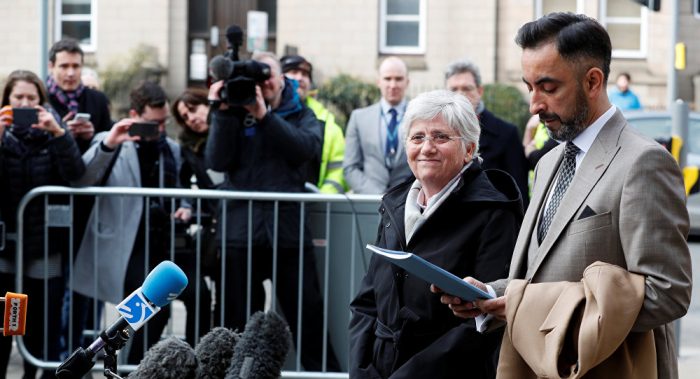
© REUTERS/ Russell Cheyne
Sputnik – March 28, 2018
Former Catalan Education Minister Clara Ponsati, who has been hiding from Spanish law enforcement in the United Kingdom, said Wednesday that she was going to surrender to UK authorities.
“Later on this morning I will attend police station with my lawyer @AamerAnwar & will b arrested & taken 2court as Spain tries 2extradite me, I need ur support,” Ponsati wrote on Twitter.
According to Spanish media, a UK judge will decide on the measure of restraint for her later in the day.
On Tuesday, the politician began raising funds online for her legal defense, saying that her goal was to get 40,000 pounds ($56,600). As of now, the campaign managed to raise almost 100,000 pounds.
Charges Against Ponsati
On October 1, Catalonia held an independence referendum, which the central authorities did not recognize. The results showed that the majority of Catalans supported secession, and the regional parliament unilaterally announced independence later in October. In response, Madrid imposed direct rule over the autonomous region, dissolved the Catalan parliament and called a snap election. Several pro-independence leaders were jailed, while others fled to Belgium.
Following the independence vote, Ponsati fled to Belgium with former Catalan leader Carles Puigdemont and three other regional politicians. In March, Ponsati moved back to Scotland and her position as a professor at St. Andrews University.On Friday, the Spanish Supreme Court activated a European arrest warrant for a number of Catalan politicians, including Puigdemont and Ponsati. Shortly after, Puigdemont was detained in Germany after he crossed the border with Denmark on his way from Finland to Belgium.
According to the Spanish Prosecutor’s Office, Ponsati was responsible for allowing polling places to stay open in schools during the referendum. She is charged with organizing an insurrection — which under Spanish law can mean a prison sentence of up to 30 years — as well as embezzlement of state funds.
READ MORE:
Featured Video
The American Retreat from Vietnam
or go to
Aletho News Archives – Video-Images
From the Archives
Secret document reveals plans for civil war in Lebanon, Israeli false flags, and invasion
By Randi Nord | Geopolitics Alert | April 5, 2019
Beirut – During his visit with US Secretary of State, Mike Pompeo, Lebanese President Michael Aoun reportedly received a US-Israeli document detailing plans for creating a civil war in Lebanon with covert false flag operations and possible Israeli invasion.
Although the source of the document is Israeli and created in partnership with Washington, no one knows who presented it to Aoun. The Lebanese TV station, Al-Jadeed, initially reported the document on Lebanese TV and a video on its website. Geopolitics Alert translated the report for this article. … continue
Blog Roll
 Aletho News
- ‘Distance yourselves from Israel’: IRGC urges US population to question govt policies
- America’s Greenland deal has a radioactive backstory
- The RAF Fairford ‘terror plot’: Unpacking escalation in the UK echo-chamber
- EU Council Advances Chat Control 2.0 Scanning Proposal
- Ex-Greek MEP files complaint against Israeli spyware firm over alleged Pegasus surveillance
- Troubling ideas throughout the Torah, Talmud, Mishneh Torah and Tanya
- ‘Grave, alarming’: Iran mission on Trump’s UNGA ‘annihilation’ threats
- Najaf airport to reopen to Iranian flights within 24 hours: Ambassador
- From ‘How Will This End For Iran’ to ‘When America Walks Away’: A tale of two Economist covers
- Tehran blasts ‘baseless’ speculation linking Iran to alleged bomb plot at UK air base
- If Americans Knew
- Revealed: German “Anti-Semitism Expert” Driving Crackdown on Palestine Solidarity is Former Israeli Spy
- Egypt’s Warning to Israel Before Oct 7
- Israel’s siege signals another cruel winter for 1.8 million Gazans – Daily Update
- Netanyahu Asked UAE Leader to Deny Report on Oct. 7 Warning in Secret Visit, Sources Say
- CNN Chief Int’l Correspondent Clarissa Ward on Journalists in Gaza
- Democratic Party Consultants Surround Troy Jackson with Pro-Israel Donors
- Christian Leader Responds To Netanyahu’s Claims Regarding Palestinian Christians
- In Gaza, ‘Whoever Survives the Bombing Won’t Survive the Rubble’
- Israel kills more Palestinians, amid push to resettle Gaza – Daily Update
- Israel forces Gazans to live in constant peril – Daily Update
- No Tricks Zone
- New Study: Earth And Venus Surface Warmth Largely Explained By Convection And Lapse Rate, Not CO2 Or Radiation
- 2025 Nature Paper Claiming Worsening Global Drought Gets RETRACTED …Heavily Flawed
- New Study: ‘Global Drought Shows No Detectable Recent Acceleration Under Climate Warming’
- Economic Masterminds: German Socialists Suggest Taxing Productivity Gains Stemming From Using AI
- The South China Sea Has Not Been Cooperating With The Climate Change Narrative
- Energy Crisis: Germany Enters Heating Season With Historically Low Gas Reserve Fill Levels
- New Study: The Antarctic Ice Sheet Gained Mass From 2020-2024 Due To Staggering Snow And Ice Accumulation
- Study: Ocean Heating Rates From Thousands Of Years Ago ‘Dwarf’ Modern Ocean Heating Rates
- Climate Extremists Target, Attack Large-Scale Power Grid Infrastructure In Germany!
- New Study: Antarctic Ice Melt Has Contributed Less Than 1 Centimeter To Sea Level Rise In The Last 30 Years

