West Wants Total Partition and Defeat of Russia – Analyst
© Sputnik/ Vitaliy Belousov
Sputnik – March 27, 2018
On Monday, a number of European countries, as well as the United States and Canada, announced they were expelling Russian diplomats over the Skripal case. Radio Sputnik discussed the significance of the diplomatic response by the Western powers with Srdja Trifkovic, a US journalist and writer on international affairs.
Sputnik: What is your overall assessment about what has happened with this diplomatic response by so many countries? How significant is it?
Srdja Trifkovic: The overall impression is that rational discourse has given way to collective hysteria and that it is indeed remarkable. The extent to which the bandwagon has successfully started rolling while we don’t even have elementary answers to the questions concerning the case itself.
The second important and discouraging aspect is that continental European countries have followed the Anglo-American lead in Russophobia and this represents a further trial of the Atlanticist domination over Europe. It is indeed remarkable when both Germany and France, the putative leaders of independent European foreign policy, have been reduced to the status of automatic followers of the lead supported by Washington especially when we bear in mind that the initial round of sanctions in 2014 against Russia was dictated by the United States which had nothing to lose in the proceedings and to the detriments of Europeans’ interests.
So overall I think that, one we have the hysterical phase of Russophobic discourse in the West which is not amenable to any rational arguments and two, we have a successful degradation of European diplomacy to the status of pliant satellites comparable to East Germany and Bulgaria vis-à-vis Brezhnev.
Sputnik: Do you think there was some classified evidence that was presented that proves beyond a shadow of doubt that Russia was involved or do you think that the fact that there are 11 countries who have not joined in the protest perhaps hints at the fact that this was not the case?
Srdja Trifkovic: Well, first of all, I would say that President Putin, Foreign Minister Lavrov and others would not have made such categorical denials of Russian involvement if there was any possibility of a smoking gun which could effectively show to the world that they were not telling the truth.
And secondly, it is always possible to present some equivocal evidence in the form that even if that indicates the modus operandi of intelligence agencies nevertheless does not disclose outright state secrets. In fact, we’ve seen that in the past and I don’t think that it would be possible for such confidential information to be disclosed to the diplomats and foreign ministers of EU countries as divergent as the 27 are, without risking these very sources.
So I really believe that if you look at the countries which have taken measures against Russia, they almost read like who is who of those who are prepared to follow the US lead and if you look at those reluctant to do so, including Austria, Hungary, Cyprus, Greece, we are looking at those who actually have a more independent foreign policy. So I don’t think it’s a reflection of the quality of possible intelligence, it is simply a reflection of the determination of decision-makers of those countries to preserve a modicum of independence.
Sputnik: What would you say about the level to which the actions that were actually taken by individual countries? What can you say about the numbers game that’s being played? What do you think determined the number of diplomats?
Srdja Trifkovic: Some of these countries are absolutely insignificant countries like the Former Yugoslav Republic of Macedonia, which also expelled one Russian and it’s just a pathetic non country. On the other hand in the United States obviously it is a matter of regret that President Trump’s initially stated intention to have detente with Russia has been subverted by the deep state, it is a long story but now we have really reached the end of the road with the appointment of Pompeo to State Department and Bolton as the national security adviser.
So we can really look at Trump as the would-be drainer of the swamp who has been swallowed by the swamp. And I think that we are in for a long haul. I was in Moscow two weeks ago and coming again next week and sometimes I am surprised that some of my Russian interlocutors are insufficiently aware of the animosity or end of the rule Russophobic sentiment that currently prevails among the Western elites, both political and academic and media. It’s almost pathetic when some Russians still use the term “our Western partners,” because for partnership you need to have a modicum of mutual respect and trust and these people really seriously want to destroy Russia.
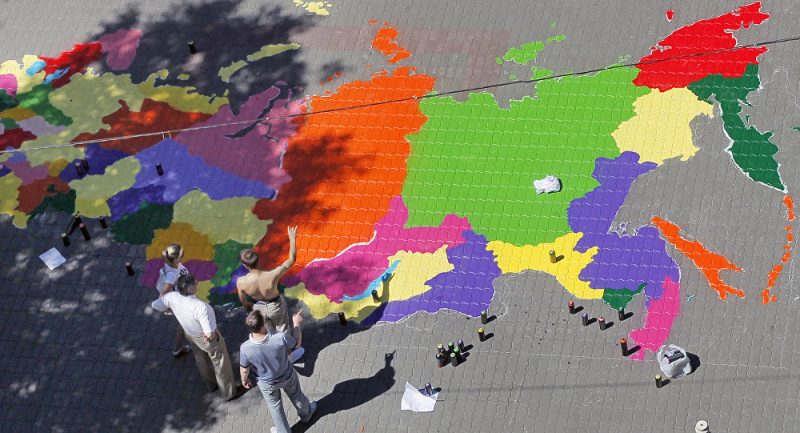
They want to delegitimize the Russian political system and process as we have seen with the public commentary on President Putin’s re-election and they want nothing short of regime change, which would then lead to a permanent and irreversible change of Russia’s national character and possibly the country’s partition along the lines allocated by Zbigniew Brzezinski. With these people partnership is impossible and Russia needs to be prepared for a long and sustained period of confrontation.
Maduro: Spain’s Persecution of Catalan Leaders ‘Shameful’
teleSUR | March 27, 2018
After five Catalan pro-independence leaders were arrested Saturday, Venezuela’s President Nicolas Maduro slammed the Spanish authorities over persecution of the Catalan leaders and people simply for independence aspirations.
“What’s happening in Spain is shameful, Catalan politicians jailed only for their ideas… whether or not you agree with these elected lawmakers’ ideas, their persecution is an embarrassment,” Maduro warned in a speech during an international meeting on African decendents rights in the region in Caracas Saturday.
Spanish Prime Minister Mariano Rajoy has criticized Venezuela’s government on several occasions, calling it a “dictatorship” and played an important role in the European Union’s decision to levy economic sanctions on Venezuela over what Brussels calls Maduro’s “brutal decisions.”
In an interview this January Rajoy even talked about political prisoners in Venezuela, saying all he wants is for them to be able to go to the streets all while his government is cracking down on Catalan leaders and politicions for purely political reasons.
The Venezuelan leader stressed that unlike the U.S., Spain and the EU, his government was not meddling in the internal affairs of Spain but “outraged that they persecute people just for their ideas.”
At least nine pro-independence politicians and members of Catalan’s civil society groups are currently in jail for rebellion, a crime punishable with up to 30 years in prison. In total 25 Catalans will be tried for rebellion, embezzlement or disobedience for their participation in the Oct.1, 2017 independence referendum.
Rebellion charges are controversial because the crime requires the use of violence; last year’s Catalan independence referendum was a peaceful civic action. The Spanish State Attorney’s office had argued violence was exercised by pro-independence activists and politicians on Sept. 20, 2017, when they surrounded several Catalan government buildings to prevent the Spanish Civil Guard from entering.
Pro-independence leaders like Jordi Turull, the new candidate for regional president, former ministers Josep Rull, Raul Romeva and Dolors Bassa and former parliament speaker Carme Forcadell, are the latest prisoners in Madrid’s crackdown against pro-independence forces in Catalonia since the referendum.
Pro-independence sentiments are widespread in Catalonia and have grown after Madrid brutally repressed Catalans who went to the polls to cast their vote last year. The election resulted in Catalonia’s declaration of independence. Spanish Prime Minister Mariano Rajoy responded by removing Puigdemont and calling for a snap election, which pro-independence parties and politicians won.
In this context the Venezuelan president called on social movements and humanity “to fight against political persecution and political prisoners in Spain, and to accompany the people of Catalonia in their right to democracy and freedom.”
Animosity between Catalonia and Madrid is rooted in Catalan republicanism and rejection of monarchic rule. The Spanish crown was restored by former dictator Francisco Franco (1936-1975) who banned Catalan language and led a brutal persecution against Catalan republicanism.
Today, in Spain writing a song against the crown or burning an image of the royal family can land a person in jail.
Expulsion of Russian diplomats portends troubled times
By M K Bhadrakumar | Indian Punchline | March 27, 2018
The mass expulsion of Russian diplomats by some countries of the European Union and North America on Monday is an unprecedented and intriguing development. First, the US alone accounts for some two-thirds of the expulsion – 60 diplomats. Curiously, even Britain, which is apparently the aggrieved party in the Skripal affair, expelled less than half that number – 23. Broadly, however, this is an Anglo-American move with which a number of EU countries and Canada display solidarity.
Second, President Trump is apparently more loyal to Her Majesty in the Buckingham Palace than Prime Minister Theresa May. This gives an intriguing twist to the tale. Why is there such an excessive interest on the part of Washington, especially at a time when the fervor of the Anglo-American kinship has significantly dampened during the Trump era? (President Trump is yet to visit the UK.)
Is it a massive diversionary tactic by the White House the day after porn star Stormy Daniels took Trump’s pants off in her TV interview on ’60 Minutes’? Or, is this yet another attempt by Trump to flaunt that he isn’t ‘soft’ on Russia? Or, is it the Deep State in action – as the closure of the Russian consulate in Seattle might well suggest? There are no easy answers.
Third, only less than half the 28 member countries of the EU have signaled support for the Anglo-American campaign over the spy incident. There is much reluctance or skepticism within the EU about what is going on. Surprisingly, though, Germany, which had voiced skepticism at an early stage, has now joined the pack. Which probably shows that there has been immense pressure from Washington and London.
Nonetheless, curiously, the EU countries by and large made only ‘token’ expulsions. As many as 7 EU countries simply moved on by expelling one Russian diplomat each. Having said that, the pressure campaign is continuing and the likelihood of more EU countries joining the expulsion cannot be ruled out. Austria has point-blank refused to join. (So has Turkey, which virtually rules out a NATO stance, which requires unanimous support from all member countries.)
What is truly extraordinary is that the circumstances surrounding the alleged poisoning of an MI6 double agent of Russian extraction are still shrouded in mystery. The British Labour Party leader Jeremy Corbyn openly cautioned against rushed judgment in a piece in the Guardian. By the way, even PM May claims only that it is “highly likely” that there was Russian involvement (not excluding rogue elements.) Yet, a cardinal principle in Anglo-Saxon jurisprudence is that no one is deemed guilty unless proven guilty.
Indeed, a range of explanations is possible as to what really might have happened in Salisbury. Read an excellent analysis by the respected British scholar on Russia Richard Sakwa, Professor of Russian and European Politics at the University of Kent and Associate Fellow of Chatham House, titled THE SKRIPAL AFFAIR.
Even in America, there are voices of scepticism. An enterprising columnist drew up 30 questions that beg an answer. (See the column by Bob Slane featured on the website of the Ron Paul Institute for Peace and Prosperity, titled 30 Questions That Journalists Should Be Asking About the Skripal Case.)
To my mind, this entire controversy snowballed into a litmus test of the Euro-Atlantic partnership – in particular, the US’ trans-Atlantic leadership – at a defining moment when Britain is giving up EU membership. This is one thing. But, more importantly, does the build-up portend something far more sinister than one would anticipate? One particular passage from Prof. Sakwa’s essay becomes a chilling reminder about what may be lying in the womb of time:
“The only question is whether the confrontation will dissipate, as it did over Agadir in 1911, or whether this is the Sarajevo slow-burning crisis that could explode into flame at some later point… Will it be another case of the sinking of the Maine in 1898, where the subsequent public hysteria provoked war against Spain only to be discovered later that the ship’s ammunition stores had accidentally exploded; or a Gulf of Tonkin incident in 1964, which was also a false flag operation but provoked the escalation of the Vietnam War. The West may be ‘uniting’ against Russia, as The Times put it on 16 March, but to what purpose.”
Russian gas pipeline gets green light from Germany as US tries to kill project
RT | March 27, 2018
Germany has issued a permit for the construction and operation of an offshore section of the Nord Stream 2 pipeline in the Exclusive Economic Zone (EEZ) of Germany in the Baltic Sea.
“The BSH [Federal Maritime and Hydrographic Agency of Germany] issued the permit for this approximately 30-kilometres-long route section in accordance with the Federal Mining Act,” the company in charge of the project, Nord Stream 2 AG, said on its website.
According to the company, all necessary permits have been obtained. In January, the Stralsund Mining Authority approved the construction and operation in German territorial waters and the landfall area.
“We are pleased that all necessary permits are now in place for the German route section, which has an overall length of 85 kilometers,” Permitting Manager Germany at Nord Stream 2 AG Jens Lange said.
Authorization from regulators in Russia, Finland, Sweden, and Denmark, through territories of which the pipeline is set to run as well, are due to be obtained in the coming month, according to the operator. Scheduled construction works will reportedly be carried out this year as planned.
The Nord Stream 2 pipeline is projected to run from Russia to Germany under the Baltic Sea. It will double the existing pipeline’s capacity of 55 billion cubic meters per year. According to the operator, the pipeline is the most efficient way, both economically and ecologically, to transport gas from the world’s largest reserves to European consumers.
The project has been strongly opposed by several members of the European Union, including Poland, Latvia, Lithuania, Romania and Hungary, as well as Ukraine. The latter vigorously opposes Nord Stream 2, as the future pipeline will bypass the country and deprive Ukraine’s budget of transit fees.
At the same time, the US has threatened to sanction companies that cooperate with Russia to implement the project. Earlier, the US announced plans to become a major energy exporter and has begun liquefied natural gas (LNG) deliveries to Europe.
Poll Shows More Britons Favoring Brexit Than Keeping Northern Ireland
Sputnik – March 27, 2018
Opinion surveys have shown British attitudes becoming increasingly fragmented and polarized, with radically different views about the country’s future.
A poll commissioned by the London-based LBC Radio station and published on March 26 has shown that a greater proportion of the British population support prioritizing the United Kingdom’s exit from the European Union than retaining Northern Ireland as part of the UK. The survey was conducted over two days from March 21 to 22.
36 percent of the 1,630 adults in Great Britain said Brexit was of chief importance to them, with 29 percent giving priority to the union with Northern Ireland and 22 percent said that neither was of any importance to them. Residents of Northern Ireland itself were not included in the poll.
Brexit negotiations between London and Brussels have brought an unprecedented level of concern over how to preserve the unity of the UK, as Ireland has threatened to veto an agreement that creates a hard border with the UK and the Democratic Unionist Party which shares power with Theresa May in London has refused to back any separate status for Northern Ireland that might weaken its links to the rest of the country.Northern Ireland, like Scotland and London, voted to remain in the EU in the June 2016 referendum, with at least 56 percent backing the Remain campaign. Despite also backing Remain, the DUP has since come to support the UK leaving the EU’s Customs Union and the Single Market, so as to keep the country bound to London.
Under the terms of the Good Friday Agreement, which ended the decades-long period of conflict known as The Troubles in 1998, the question of whether the country remains united with Britain or joins with the Republic of Ireland must be made solely by the people of Northern Ireland.
‘Against common sense and intl law’: Russia to retaliate over diplomats’ expulsion by UK allies
RT | March 26, 2018
Moscow won’t leave the provocative acts against Russian diplomats unanswered, the Foreign Ministry said, adding that several countries blindly copied the UK’s “hypocritical” stance on the Skripal case in the absence of evidence.
The decision of a number of NATO and other European countries to expel Russian diplomats over the poisoning of the former double-agent Sergei Skripal amounts to a “provocative act” and only harms international relations and the investigation of the incident, the Ministry said in a statement.
The countries which expelled Russian diplomats have only played into the hands of London, which “de-facto took a prejudiced, biased and hypocritical stance, producing indiscriminate accusations against the Russian Federation in the absence of explanations of what happened and refusing to engage in substantive cooperation,” the statement reads.
The “solidarity” expressed by the Western countries harmed the investigation of the Skripal incident and contradicted international law, the Ministry said. Russia is interested in finding the truth about the poisoning of Russian citizens on British soil, it stressed.
“The Russian side, despite our repeated requests to London, has no information over the case. There’s no objective and exhaustive data on it at the disposal of the Britain’s allies, who blindly follow the principles of the Euro-Atlantic unity harming common sense, principles of civilized dialogue between states and international law. Naturally, such a hostile move on part of this group of countries won’t go unanswered,” the Ministry said.
Moscow will expel at least 60 US diplomats in response to Washington’s move which it linked to double agent Skripal’s poisoning, Senator Vladimir Dzhabarov said. He called the move to expel 12 of the Russian UN staff illegal.
“It is clear that the measures will be tit-for-tat, they will affect the same number of employees, since the numbers of our diplomatic missions are equal,” Dzhabarov said. He also condemned the additional expulsion of 12 Russian UN staff as “contradicting international law.”
“The UN is an international organization, which does not fall under American jurisdiction,” the senator pointed out.
President Vladimir Putin will be the one to make a final decision on retaliatory measures against the US and European countries that are expelling Russian diplomats. For now, the Russian Foreign Ministry is studying the situation and drafting a list of possible actions, Kremlin spokesman Dmitry Peskov said. Moscow has nothing to do with the Skripal case, he added.
Washington’s actions will only serve to ruin the remaining US-Russian ties, Russian Ambassador to the US Anatoly Antonov said. The US understands nothing but force, the diplomat stated while commenting on the possible response measures.
Moscow expected such a move on part of the US, but still hoped that Washington would use common sense to help stop the UK’s hysteria, Antonov added.
On Monday, the US expelled 60 Russian diplomats over the double-agent Skripal’s poisoning in the UK. The move was coordinated with several European countries, which also expelled a number of Russian diplomats.
Trump orders expulsion of 60 Russian diplomats, closure of Seattle consulate
RT | March 26, 2018
President Donald Trump has ordered the expulsion of 60 Russian diplomats and the closure of the Russian consulate in Seattle. It comes in response to the poisoning of Sergei Skripal in Salisbury, which the UK has blamed on Russia.
The move follows major diplomatic pressure by the UK on its allies to follow their lead in expelling Russian diplomats. The Russian embassy in Washington had previously urged Trump not to heed the “fake news” on Skripal’s poisoning.
British Prime Minister Theresa May has accused Moscow of being behind the poisoning of the former spy Skripal and his daughter in the town of Salisbury in early March.
Of the 60 diplomats expelled, 12 formed part of the Russian mission to the United Nations. In a statement, US ambassador to the UN Nikki Haley said the 12 Russians in question had “abused their privilege of residence” in the US and had “engaged in espionage activities that are adverse to our national security.”
Haley said that the Russian diplomats had used the UN as “a safe haven for dangerous activities within our own borders.”
During a summit in Brussels last week, the 28 EU leaders agreed with Britain’s assertion that it is “highly likely” that Russia was responsible for the attack on Skripal.
Members of the EU numbering 14 have also decided to expel Russian diplomats following Britain’s lead.
Canada has also jumped on the bandwagon, announcing that it will expel four Russian diplomats “in solidarity” with the UK.
The timing of the expulsions by the US, EU and Canada appears to have been coordinated between Washington and Brussels. Eight EU countries confirmed within 15 minutes of each other on Monday afternoon that they would expel a number of Russian diplomats. Canada’s announcement followed shortly after.
Moscow has always denied playing any role in the attack, and offered to cooperate with the investigation into the incident. Britain has declined, however, to send samples of the chemical agent used on Skripal and his daughter to Moscow.
European Union Wages Cold War Against Russia – Marine Le Pen

© Sputnik/ Ramil Sitdikov
Sputnik – 23.03.2018
President of the National Front French political party Marine Le Pen has commented on the development of the situation around the poisoning of ex-Russia spy Sergei Skripal during a speech on the Franceinfo radio station.
“I think that something bigger is behind these actions — a strategy aimed at building a wall between the EU and Russia. Judging by my experience of working in the European Parliament, I know that the EU is waging a cold war against Russia, Le Pen, president of the National Front party, said.
Le Pen’s statement comes after a source told Sputnik that a number of European countries were considering expelling Russian diplomats or recalling their ambassadors from Moscow.
The move was prompted by UK Prime Minister Theresa May’s accusations against Russia of poisoning former intelligence officer Sergei Skripal and the expulsion of 23 Russian diplomats as a punitive measure.
Russia has strongly rejected the accusations and offered assistance in the investigation. However, Moscow’s request for samples of the chemical substance used to poison Skripal was denied. Moscow has also expelled UK diplomats and ordered the British Council to stop its activities in Russia in response to the UK expulsion of Russian diplomats.
Skripal and his daughter have been in hospital in a critical condition since March 4 and are being treated for exposure to what the UK experts believe to be the A234 nerve agent. The UK side claimed that this substance was related to the Novichok class nerve agents developed in the Soviet Union.
Pentagon chief calls on Saudi crown prince to cease Yemen aggression
Press TV – March 22, 2018
US Defense Secretary Jim Mattis has called upon Saudi Crown Prince Mohammed bin Salman to find an “urgent” political solution to the devastating three-year-old conflict in neighboring Yemen, which has claimed the lives of thousands of people and left the impoverished nation’s infrastructure in ruins.
Mattis and bin Salman met at the Pentagon on Thursday as the de facto ruler of the Arab kingdom is on a tour of the United States, which began earlier this week with a White House visit.
“As you discussed with President (Donald) Trump on Tuesday, we must also reinvigorate urgent efforts to seek a peaceful resolution to the civil war in Yemen and we support you in this regard,” the US defense secretary told his Saudi counterpart.
“We are going to end this war; that is the bottom line. And we are going to end it on positive terms for the people of Yemen but also security for the nations in the peninsula,” Mattis added.
The Saudi crown prince, speaking through a translator, told Mattis that cooperation between the Pentagon and Saudi Arabia has “improved tremendously” of late.
The remarks came only two days after the US Senate killed a bipartisan bid seeking to end US support for Saudi Arabia’s aerial bombardment campaign in Yemen.
Mattis had lobbied Congress to reject the bill, claiming that restrictions could increase civilian casualties in Yemen, jeopardize the so-called counter-terrorism cooperation between Washington and Riyadh, and “reduce” Washington’s “influence with the Saudis.”
About 14,000 people have been killed since the onset of Saudi Arabia’s military campaign against Yemen in March 2015. Much of the Arabian Peninsula country’s infrastructure, including hospitals, schools and factories, has been reduced to rubble due to the war.
The United Nations says a record 22.2 million people are in need of food aid, including 8.4 million threatened by severe hunger.
A high-ranking UN aid official recently warned against the “catastrophic” living conditions in Yemen, stating that there is a growing risk of famine and cholera there.
“After three years of conflict, conditions in Yemen are catastrophic,” John Ging, UN director of aid operations, told the UN Security Council on February 27.
He added, “People’s lives have continued unraveling. Conflict has escalated since November driving an estimated 100,000 people from their homes.”
Ging further noted that cholera has infected 1.1 million people in Yemen since last April, and a new outbreak of diphtheria has occurred in the war-ravaged Arab country since 1982.
US OKs $1bn in Saudi military deals
Meanwhile, the US State Department said in a statement it had approved military contracts with Saudi Arabia worth over $1 billion.
According to the State Department, 6,600 TOW 2B anti-tank missiles are to be supplied under the biggest contract, which is worth $670 million.
A $106 million deal for helicopter maintenance and another contract for ground vehicle parts worth $300 million were also approved on Thursday.
The State Department said it had notified the US Congress of the possible military equipment contracts.
“This proposed sale will support US foreign policy and national security objectives by improving the security of a friendly country which has been, and continues to be, an important force for political stability and economic growth in the Middle East,” the statement said.
The three contracts are highly expected to be approved by Congress in the wake of the Senate’s Tuesday rejection of the bill to end US support for the Saudi war.
A report by the Stockholm International Peace Research Institute (SIPRI) revealed earlier this month that the US has increased its arms sales by 25 percent over the past five years.
According to the SIPRI report, Saudi Arabia increased its arms purchases by 225 percent over the past five years, importing 98 percent of its weapons from the US and EU countries.
Has Russia Had Enough?
By Paul Craig Roberts | Institute For Political Economy | March 21, 2018
This morning I watched a briefing the Russian Foreign Ministry provided for the diplomatic community where international toxic substances experts presented information concerning the alleged nerve agent used in the alleged attack on Skripal and his daughter. This information has been known for some time, and none of it has been reported in the Western presstitute media.
In the briefing the Russians once again relied on facts and existing agreements that govern the investigation of such events and asked why the British were demanding explanations from Russia when the British refuse to comply with established procedures and refuse to produce any evidence of what the British allege to have occurred.
The response from the US and French embassy representatives was simply to state that they needed no evidence to stand in solidarity with their British friends, that Russia was guilty by accusation alone, and that they would hold Russia accountable.
The benefit of this absurd response, which the Russians declared to be shameful, is to make clear to the Russian government that it is a waste of time to try, yet again, to confront unsupported accusations from the West with facts and appeals to follow the specified legal processes. The West simply does not care. The issue is not the facts of the case. The agenda is to add another layer to the ongoing demonization of Russia.
Sooner or later the Russian government will realize that its dream of “working with its Western partners” is not to be and that the hostile actions and false accusations from the West indicate that the West is set on a course of conflict with Russia and is preparing the insouciant Western peoples to accept the consequences.
The Russian official hosting the briefing compared the Skirpal accusation with the Malaysian Airliner accusation and the many others that resulted in instant accusations against Russia and refusal to cooperate in investigations.
The Russian official also drew the parallel of the accusations against Russia with the US and UK false accusations against Serbia, which led to the bombing of Serbia, and to the false accusations against Iraq, for which Colin Powell and Tony Blair had to apologize, that resulted in the destruction of Iraq and the death and displacement of millions of Iraqis.
The Russian official also said, pointedly, that the days were gone when no one challenged statements by the US government. The world, he said, is no longer unipolar. Russia, he said, does not respond to unsupported allegations. He also said that the way the Americans, British, and French are proceeding suggests that the Skirpal affair is an orchestration created for the purpose of accusing Russia.
This conclusion is supported by the history of US and UK interventions. In recent times we have seen the West’s orchestrated interventions based on obvious and blatant lies in Serbia, Iraq, Libya, Somalia, Syria, Ukraine, Yemen, and the attempts to destabilize Iran and Venezuela. History provides almost endless examples of the lies used by the US and UK to implement their agendas.
Nothing Washington and London say can ever be believed. Is it possible for Russia or any country to work with “partners” who are shameless, short on integrity and honesty, and have proven themselves unworthy of trust?
Featured Video
The American Retreat from Vietnam
or go to
Aletho News Archives – Video-Images
From the Archives
Secret document reveals plans for civil war in Lebanon, Israeli false flags, and invasion
By Randi Nord | Geopolitics Alert | April 5, 2019
Beirut – During his visit with US Secretary of State, Mike Pompeo, Lebanese President Michael Aoun reportedly received a US-Israeli document detailing plans for creating a civil war in Lebanon with covert false flag operations and possible Israeli invasion.
Although the source of the document is Israeli and created in partnership with Washington, no one knows who presented it to Aoun. The Lebanese TV station, Al-Jadeed, initially reported the document on Lebanese TV and a video on its website. Geopolitics Alert translated the report for this article. … continue
Blog Roll
 Aletho News
- ‘Distance yourselves from Israel’: IRGC urges US population to question govt policies
- America’s Greenland deal has a radioactive backstory
- The RAF Fairford ‘terror plot’: Unpacking escalation in the UK echo-chamber
- EU Council Advances Chat Control 2.0 Scanning Proposal
- Ex-Greek MEP files complaint against Israeli spyware firm over alleged Pegasus surveillance
- Troubling ideas throughout the Torah, Talmud, Mishneh Torah and Tanya
- ‘Grave, alarming’: Iran mission on Trump’s UNGA ‘annihilation’ threats
- Najaf airport to reopen to Iranian flights within 24 hours: Ambassador
- From ‘How Will This End For Iran’ to ‘When America Walks Away’: A tale of two Economist covers
- Tehran blasts ‘baseless’ speculation linking Iran to alleged bomb plot at UK air base
- If Americans Knew
- Revealed: German “Anti-Semitism Expert” Driving Crackdown on Palestine Solidarity is Former Israeli Spy
- Egypt’s Warning to Israel Before Oct 7
- Israel’s siege signals another cruel winter for 1.8 million Gazans – Daily Update
- Netanyahu Asked UAE Leader to Deny Report on Oct. 7 Warning in Secret Visit, Sources Say
- CNN Chief Int’l Correspondent Clarissa Ward on Journalists in Gaza
- Democratic Party Consultants Surround Troy Jackson with Pro-Israel Donors
- Christian Leader Responds To Netanyahu’s Claims Regarding Palestinian Christians
- In Gaza, ‘Whoever Survives the Bombing Won’t Survive the Rubble’
- Israel kills more Palestinians, amid push to resettle Gaza – Daily Update
- Israel forces Gazans to live in constant peril – Daily Update
- No Tricks Zone
- New Study: Earth And Venus Surface Warmth Largely Explained By Convection And Lapse Rate, Not CO2 Or Radiation
- 2025 Nature Paper Claiming Worsening Global Drought Gets RETRACTED …Heavily Flawed
- New Study: ‘Global Drought Shows No Detectable Recent Acceleration Under Climate Warming’
- Economic Masterminds: German Socialists Suggest Taxing Productivity Gains Stemming From Using AI
- The South China Sea Has Not Been Cooperating With The Climate Change Narrative
- Energy Crisis: Germany Enters Heating Season With Historically Low Gas Reserve Fill Levels
- New Study: The Antarctic Ice Sheet Gained Mass From 2020-2024 Due To Staggering Snow And Ice Accumulation
- Study: Ocean Heating Rates From Thousands Of Years Ago ‘Dwarf’ Modern Ocean Heating Rates
- Climate Extremists Target, Attack Large-Scale Power Grid Infrastructure In Germany!
- New Study: Antarctic Ice Melt Has Contributed Less Than 1 Centimeter To Sea Level Rise In The Last 30 Years

