Nasrallah: EU giving “legal cover” for an Israeli war on Lebanon
Al-Akhbar | July 25, 2013
The European Union is paving the way for Israel to justify a war on Lebanon, Hezbollah’s general secretary said late Wednesday, two days after the 28 member states issued a decision to put Hezbollah’s military wing on its terror list.
“EU countries should know they are giving legal cover for Israel to launch any war on Lebanon because Israel can claim it is waging war on terrorists,” Sayyid Hassan Nasrallah said in a televised speech at the annual iftar ceremony held by the Women’s Committee of Islamic Resistance Support Association of Hezbollah.
“These countries make themselves undeniable allies during any Israeli aggression on Lebanon, on the resistance and on any target for the resistance [in the country],” Nasrallah added.
The EU 28-member bloc agreed Monday to blacklist Hezbollah’s military organization as a terrorist group following years of relentless US and Israeli pressure.
The EU cited accusations that the powerful Lebanese Shia movement was behind a bus bombing in Bulgaria last year which killed five Israelis and their driver, as well as the party’s involvement in the Syrian conflict.
Hezbollah has denied any involvement in the Bulgaria bombing.
Last month a new socialist-led Bulgarian government backed away from the claims of the previous administration, saying that the EU could not justify blacklisting Hezbollah solely based on the little evidence produced to implicate it in the crime.
“It is important that the (EU) decision be based not only on the bombing … because I think the evidence we have is not explicit,” Foreign Minister Kristian Vigenin had told national state radio BNR.
Nasrallah noted that the EU’s official statement will be issued within days and the party will see then what is to be discussed.
He also posed the question to the EU of why the union hadn’t considered placing Israel’s army on its terror list.
“[The EU] repeatedly admits that Israel occupies Arab land but hasn’t implemented international resolutions for ten years. The whole world has witnessed the Israeli massacres,” he said.
Nasrallah advised the member states to reconsider the decision, stating that it is doomed to fail and that “the decision wasn’t worth the ink it was written with.”
The EU’s blacklisting of Hezbollah’s military wing is merely the result of external pressure and interests, he said, instead of being based on values and principles. He added that the effect of the decision is nothing but psychological.
“In this country, resistance fighters fought the Israeli occupation, endured a lot of pressure and sacrificed martyrs. Then you come to those who are the sons of these people and say they are terrorists. This is abuse to fighters, to their people and to their successive governments,” Nasrallah stated.
“This decision aims at making us bow, at forcing us to step back and be afraid. But, I tell you that all you will get is failure and frustration,” he said, adding that anyone who thinks the resistance will be undermined by the decision is either “ignorant or delusional.”
The General Secretary hinted jokingly at having members of Hezbollah’s military wing in Lebanon’s new government, assuring viewers that the resistance has gained credibility among people in Lebanon and the Arab and Muslim world.
“The most important thing for the Lebanese resistance is to get the support of its people and to express their will, pride and view in defending their land and their sovereignty,” he said.
“The Resistance will remain and will be victorious by God’s will,” Nasrallah concluded.
The European Union: Where Corporate Fantasies Come True
By David Cronin | New Left Project | July 18, 2013
Edward Snowden has exposed more than a massive spying operation. The whistleblower has – perhaps unintentionally – drawn attention to just how obsequious Europe’s political leaders are towards the US.
Angela Merkel and François Hollande are reportedly furious over revelations that America has been reading their diplomats’ emails (though their fury can’t be that intense given that a rumour that Snowden was on a flight to Bolivia was sufficient for France to block the plane from its airspace). There were hints too that a planned trans-Atlantic trade agreement could be in jeopardy as a result of the controversy. Yet the talks have opened this month as planned. With many of the world’s most powerful corporations adamant that the talks take place, they were unlikely to be derailed by a spat over snooping.
In May this year, a ‘business alliance’ to support the planned trade deal was established. Many of the firms belonging to this coalition – BP, Coca-Cola, Deutsche Bank, British American Tobacco, Nestlé – have been involved in similar initiatives since the 1990s. Using a highly dubious methodology, the alliance estimates that a transatlantic trade and investment partnership (known by the ugly acronym TTIP) would bring benefits of €119 billion to the EU and €95 billion to the US per year. What they don’t spell out is that the price of any such benefits could be the destruction of democracy.
A leaked document detailing what EU officials wish to achieve in the negotiations says that an eventual agreement should include ‘state-of-the-art’ provisions on ‘dispute settlement’. Under this plan, special tribunals would be set up to allow corporations to sue governments over laws that hamper them from maximising their profits.
When clauses like those being envisaged have been inserted into previous investment treaties, corporations have invoked them in order to challenge health and environmental laws that were not to their liking. Australian rules that all cigarettes be sold in unattractive packaging and Germany’s decision to abandon nuclear power are among the measures that corporations have tried to torpedo in the name of ‘investor protection’.
What will the masters of the global economy take on next: minimum wage levels; restrictions on hazardous chemicals; food quality standards? All of these advances are the results of struggle by workers and campaigners. All of them could be at risk if European and American negotiators go ahead with their plan to set up a special court system that corporations alone may use.
Peter Mandelson must shoulder some of the blame for the extremist agenda now being pursued. In 2006, when he was EU trade commissioner, Mandelson published an official blueprint called Global Europe. It committed the Brussels bureaucracy to work in tandem with corporations to remove any obstacles they encountered throughout the world.
The blueprint closely resembled recommendations made by pressure groups like the European Services Forum (ESF). Bringing together Microsoft, BT, Veolia and – at the time – Goldman Sachs, the ESF has its origins in the 1999 conference of the World Trade Organisation, best remembered for the ‘Battle of Seattle’ – the large-scale protests against it.
In The Brussels Business, an excellent film about corporate lobbying, the ESF’s Pascal Kerneis waxes emotional as he recalls how some ‘high-VIPs’ were unable to attend important meetings in Seattle because of the demonstrations outside their hotel. Kerneis, however, did not allow this display of people power to weaken his determination to refashion the international economy in the way that his elitist pals wanted.
In his dealings with Mandelson’s team of advisers, Kerneis argued that if the EU is unable to have the wishes of corporations fulfilled at the WTO level, it should concentrate on twisting the arms of individual governments. The stilted phrasing of some ESF briefing papers though could not conceal that they were designed to turn some of the wildest capitalist fantasies into reality. One advocated that the EU should strive to remove all capital requirements for banks and caps on foreign ownership of companies in its key trading partners, as well as any pesky rules preventing corporations from sending profits abroad (to, say, a tax haven).
As they were drafted before the financial crisis that erupted in 2008, these papers have a carefree, almost naive feel to them. And yet the European Commission is still striving to attain the core goals identified in such documents. The Commission’s latest annual report on ‘trade and investment barriers’ says that all ‘relevant instruments and policies’ will be marshalled worldwide ‘to make sure the playing field is levelled’. On the surface, that may sound innocuous. In practice though, it means that corporations are accorded more rights than human beings.
If an Indian arrived in Heathrow Airport tomorrow and demanded to automatically have the same entitlements as a British citizen, he or she would probably be arrested. Yet the EU executive believes that big Western companies active in India should enjoy ‘national treatment’ – that is they should be treated exactly like Indian firms. Britain’s industrialisation was achieved at least partly because the textiles sector was shielded from foreign competition. Yet blinkered by neoliberal ideology, Brussels officials want to prevent poorer countries from applying the same tactics, which they now describe as ‘protectionist’ (a dirty word, according to these ideologues).
The willingness to allow corporate lobbyists to set the rules is not confined to trade policy. Financial regulation too has been heavily influenced by the world’s most powerful banks.
Charlie McCreevy, the EU’s single market commissioner from 2004 to 2010, displayed a deep aversion to oversight during his time in office. His hands-off approach can be attributed to the fact that the ‘experts’ he appointed to guide him held exorbitantly-paid posts at the investment banks Goldman Sachs and Morgan Stanley. A consultative group on hedge funds that the Irishman assembled was comprised entirely of insiders from the financial services industry.
When Michel Barnier was tasked with taking over McCreevy’s portfolio, Nicolas Sarkozy (remember him?) contended that giving this post to a Frenchman was a defeat for the Anglo-Saxon model of capitalism. Like many of Sarkozy’s proclamations, it was fanciful. Barnier has kept up the dishonourable tradition of relying primarily on advice from the private sector. An ‘expert group’ on banking reform set up at his behest last year had a token representative from the European Consumers’ Organisation (known by the French acronym BEUC) and a couple of academics. Most of its eleven members, however, were sitting or former bankers – or, worse still, weapons salesmen.
Financial service whizzkids are held in awe by EU policy-makers. This became much apparent during 2009. Boris Johnson hopped on the Eurostar to Brussels that year to champion the City of London and predictably grabbed the headlines. Away from the glare of publicity, however, an army of hedge fund managers succeeded in eviscerating a law designed to restrain their gambling. When the law went before the European Parliament, the hedge fund industry prepared a voluminous set of amendments. Sharon Bowles, a Liberal Democrat MEP who chairs the Parliament’s economics committee, admitted to me that she signed amendments drafted by the financial industry and then tabled them in her own name. This obviously begs the question of whether she is really working on behalf of her constituents or on behalf of banks.
The corporate lobby has proven adept at concocting myths. Whereas it was patently obvious that the economic crisis was caused by the reckless behaviour of banks, powerful groupings have spread the falsehood that extravagance in public spending was really to blame. The European Roundtable of Industrialists (ERT) – which includes the chief executives or chairmen of Shell, Volvo, Nestlé, Vodafone and Heineken – has been leading efforts to demolish the welfare state. Among its core demands are that healthcare should be privatised so that Europe more closely resembles the US. The ERT enjoys the kind of access to top-level politicians that defenders of the underprivileged are denied. Herman Van Rompuy, the EU’s unelected ‘president’, is known to have dined with ERT delegations in private clubs, without any details of these encounters being posted on his website. And in March this year, Merkel and Hollande, along with the European Commission’s head José Manuel Barroso, met ERT representatives in Berlin. The ERT is pushing the Union’s governments to agree on a ‘competitiveness pact’ over the next twelve months. Under this pact, each EU country would become obliged to drive down its wage levels and dilute its labour laws.
‘Competitiveness’ is a byword for crony capitalism. It should not be confused with competition: among the ERT’s demands are that the EU becomes less fussy about controlling mergers between large companies. Far from encouraging diversity, it wants to have wealth concentrated in increasingly fewer hands.
Repeated so often, the idea of ‘competitiveness’ has assumed an almost religious significance among the EU elite. Opposing it is regarded as heretical.
Despite Thatcher’s tetchy relationship with the EU institutions, the main tenets of Thatcherism have gone mainstream in Brussels. Attempts made in earlier decades to give the Union a social dimension – by, for example, championing gender equality – always amounted to fig-leafs for a project that was essentially right-wing and anti-democratic. In more recent years, these fig-leafs have become increasingly slender.
Barroso is among a new generation of leaders who are demonstrably in thrall to the ‘Iron Lady’. While he habitually describes the EU as a ‘social market’ economy, it is evident from his favoured policies that his real agenda is to bolster corporate power. One key objective of the European Commission is to promote ‘public-private partnerships’. This idea of handing over services financed by taxpayers to unaccountable companies can be traced back to Thatcher and her successor, John Major.
With few exceptions, the Union is cuddling up to big business and screwing the rest of us. Building a mass movement to confront corporate power has never been more urgent.
Netanyahu reminds EU that Israel is above the law
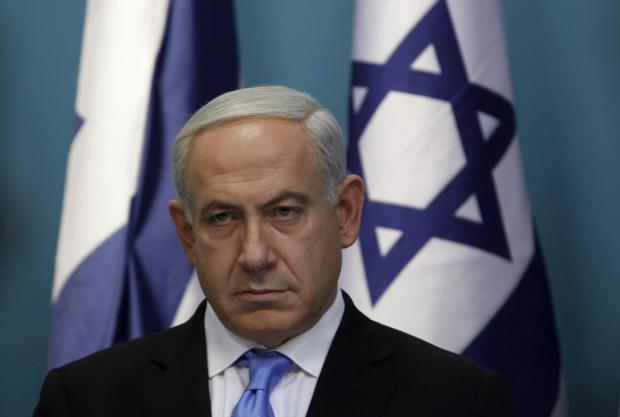
Al-Manar | July 17, 2013
Israeli Prime Minister Benjamin Netanyahu slammed a European Union directive requiring member states to boycott Israelis living in the West Bank and East al-Quds (Jerusalem).
In an emergency meeting on Tuesday, Netanyahu pledged: “We will not accept any outside diktat about our borders.”
“This issue will be decided only in direct negotiations between the sides,” he added.
The directive included conditions for future contacts between the EU and the Zionist entity.
Netanyahu said that EU was taking steps unilaterally, while paying less attention to urgent regional matters such as the Syrian conflict and Iran’s nuclear problem.
“I would expect those who truly want peace and stability in the region would discuss this issue after solving more urgent regional problems such as the civil war in Syria or Iran’s race to achieve nuclear weapons,” he said.
“As the Prime Minister of Israel, I will not allow the hundreds of thousands of Israelis who live in Judea and Samaria, on the Golan Heights and in Jerusalem, our united capital, to be harmed,” Netanyahu added.
The meeting was held at the Prime Minister’s office in al-Quds. Those in attendance included Justice Minister Tzipi Livni, Economy Minister Naftali Bennett and Deputy Foreign Minister Zeev Elkin.
Related articles
Luxembourg PM resigns over spying scandal
RT | July 11, 2013
Luxembourg’s long-serving Prime Minister Jean-Claude Juncker officially announced he would resign following a spying scandal involving illegal phone-taps and other illicit activities.
The announcement comes as Juncker’s junior coalition partner called for the dissolution of the house and early parliamentary elections.
Juncker’s departure follows allegations the country’s security services abused their power under his watch, including illegally bugging politicians, purchasing cars for private use, and taking payments and favors in return for access to local officials from 2003 to 2009.
A report commissioned by Luxembourg’s parliament into the matter determined that Juncker failed to rein in the agency despite it being under his auspices. The July 5 document further said that the outgoing PM was “politically responsible” for failing to inform the parliamentary committee of control or justice authorities about the Luxembourg State Intelligence Service’s (SREL) alleged illegalities.
The report was commissioned after a Luxembourg weekly newspaper published a secretly-taped conversation from 2008 between Juncker and the head of SREL at the time, Marco Mille.
On tape, Mille revealed that his staff had secretly recorded a conversation involving Luxembourg’s Grand Duke – the monarchial head of state – and that the sovereign was in regular contact with Britain’s Secret Intelligence Service.
The ensuing parliamentary inquiry revealed extensive illicit activity: the existence of 13,000 secret files on people and businesses, illegal wire-taps on business leaders, and a counter-terror operation which was in actually a front to help a Russian oligarch pay US$10 million to a Spanish spy, and even a shadowy private dealership in luxury cars, AFP reports.
In June, the PM survived Luxembourg’s first no confidence vote in 150 years after the opposition Liberals and Greens accused Finance Minister Luc Frieden of pressuring the state prosecutor to stop legal proceedings against a group implicated in a series of 1980s bombings.
However, the specter of a fresh no confidence vote once again hung over Juncker, who became prime minister in 1995 and is the European Union’s longest-serving head of government, following the report.
The PM delivered a defiant speech to lawmakers on Wednesday in which he attempted to refute allegations that he has used the SREL to bolster both him and his Christian Social People’s Party.
Juncker initially refused to step down, claiming the PM should not be expected to resign over the alleged wrongdoing of a few intelligence agents.
“The intelligence service was not my top priority,” Juncker told parliament. “Moreover, I hope Luxembourg will never have a prime minister who sees SREL as [his or her] priority.”
However, Junker’s junior partner, Luxembourg Socialist Workers’ Party (LSAP) President Alex Bodry, called on the PM to take” full political responsibility” for the scandal.
“We invite the prime minister to take full political responsibility in this context and ask the government to intervene with the head of state to clear the path for new elections,” Bodry said.
Juncker, who said it would be impossible to take personal responsibility for the allegations leveled at him, ultimately resigned to avoid a vote of no confidence.
“I will convene the government tomorrow morning at 10am (08:00 GMT) and will go to the Palace to suggest snap elections to the Grand Duke,” he told parliament on Wednesday.
As head of state, only the Grand Duke can officially dissolve parliament.
In line with Junker’s recommendation, the government will continue its work until early elections are held on October 20. It remains unclear whether the outgoing PM intends to run.
Political responsibility as last resort
Luxembourg, a tiny state nestled between Belgium, France and Germany, is viewed as a major European financial hub, where some 40 percent of the country’s 500,000 residents are foreigners working in banks and other European institutions.
Juncker’s departure over intelligence service malfeasance was a major wave in one of Europe’s most politically-stable states.
As the outgoing PM admitted the intelligence service scandal left him “no other choice than to hand in the government’s resignation,” other European leaders are increasingly being scrutinized for the alleged role in sweeping surveillance activities.
UK Foreign Secretary William Hague, who oversees the Government Communications Headquarters (GCHQ), has recently come under fire for the agency’s Tempora surveillance program, as well as its collusion with US National Security Agency’s (NSA) sweeping spying programs.
Last week the European Union began investigating whether Britain had broken EU law following reports it had tapped international phone traffic and shared vast amounts of personal data with the US, an EU source told Reuters.
Viviane Reding, the vice-president of the European Commission and EU commissioner for justice, wrote to Hague asking him to clarify the “scope of the [Tempora surveillance] program, its proportionality and the extent of judicial oversight that applies.”
In Germany, where the US a reportedly combs through half a billion German phone calls, emails and text messages on a daily basis, NSA whistleblower Edward Snowden recently accused the country’s political leadership of ‘being in bed’ with the NSA.
On Wednesday Chancellor Angela Merkel defended Germany’s cooperation with US intelligence, dismissing charges its methods resembled those deployed in the former German Democratic Republic.
“For decades, intelligence services have been working together under certain conditions that are tightly regulated in our country, and this serves our security,” Merkel told the German weekly Die Zeit.
“For me, there is no comparison at all between the state security [Stasi] of the GDR and the work of intelligence services in democratic states,” she continued.
“These are completely different things and such comparisons only lead to a trivialization of what the state security did to people in East Germany,” she said.
With elections slated for September 22, the center-left opposition has pounced on the issue, claiming Merkel, whose office coordinates and oversees Germany’s intelligence services, must have known more about NSA operations.
Related article
- Veteran Luxembourg PM Juncker resigns in spy scandal (vietnamnews.vn)
‘German government sells the privacy of German citizens to the US’
RT | July 08, 2013
The recent NSA spying scandal showed the German government behaves towards US like a puppet regime, involving all major political parties just before the September elections, German journalist Manuel Ochsenreiter told RT.
RT: Let’s just discuss it now with the journalist Manuel Ochsenreiter who is joining us from Berlin. Mr. Ochsenreiter, to what extent do you think Germany may have cooperated with the NSA?
Manuel Ochsenreiter: Well, I think it’s a matter of fact that we know that the German authorities, the German mainstream politicians, the German government they all cooperate in a very intense way with US intelligence. I feel a little bit weird to use the term “cooperation” for this because when we look exactly at what is going on that they were spying on German citizens we have to say that the German government behaves towards the US government in this question more or less like a US puppet regime. No claim of sovereignty. No claim of independence. Of course, no claim of privacy, for the right to privacy of their own citizens. So, the German citizens are not at all protected by their own government. The German government sells the privacy of German citizens to the US government. And this is the really, really serious case, it’s a big scandal.
RT: Snowden claims top politicians were insulated in case of a scandal – yet now they seem to be outraged. What you are saying is that they might be doing this because of the public outrage. What’s got them more angry then, if that’s the case that they did not know, or that they did not know about the scale of the operations that they would too be spied on?
MO: To be honest I believe that they are angry that it became public, that now all the facts are open and the citizens can see what’s going on because I wouldn’t believe any word right now of a government politician. By the way, I’m also not fond of opposition politicians in the German parliament. We have to know that the government before the Merkel government was built by the GPD opposition. And they cooperated as well with the Americans as today’s government is doing. And when we listen very well to the words of mainstream politicians in Germany we hear right now a lot of justifications of this. Yes, let us say cooperation as they call it. They say it’s for our security, they say that this is a partnership, that this is a friendship but, of course, it’s not. It’s pure spying. And we have to watch a little bit back in the past we had in the 1990s the ECHELON project. It was also a USA spy project especially on Germany. And this spying project was especially for economic espionage. The German companies, the German economy was monitored by the US secret service. So, what we see here is that Germany is behaving more or less like, well, let me say like a state fully under control of the US without any independence. And the scandal’s not that US are doing that. The real scandal’s that the German politicians are not doing something against it…
‘German politicians should expel the US American military bases’
RT: Snowden did say that this went beyond agreements between the countries in terms of what they can share, what they can… in terms of sharing information. So, how is this affecting the politicians knowing that. They have been spied on far more than the agreement they had. So, yes, so, we say “yes” they did know about this. But to the extent that they have been spied on, I mean, this is going beyond spying on just their own citizens. It goes it is spying within politicians as well. How are they reacting to that? Is it going to create tension between the US and its allies now? Are they not seeing this? Are we just reading too much into something which is been happening anyway?
MO: We are knowing a very interesting time Germany because we have in September the elections. And I think the spying scandal is really really disturbing the election campaigns of all the mainstream parties because they all are involved in the scandal. So, what they are doing now is that they all try to give the impression that on the one side they knew about so-called cooperation but that they are completely surprised about how far it went. And to be honest I wouldn’t believe any word because we had already the experience in the past about how far the US governments go and how they treat their so-called allies or their so-called partners. So, if the German politicians… Let me finish with one sentence. If they are really so upset and so surprised as they act now then we have to see the consequences. And there are many consequences we could do with. For example, that the US ambassador is summoned to the Chancellor and is so criticized that there is diplomatic protest, that, for example, we make it to initiate that we have until today US barracks and US army troops on Germans soil. And we know that those military bases are also used for the NSA projects. So we invite the Americans to our country or our politicians invite them in our country to establish their military and intelligence bases there. So, if the German politicians want to do something it’s very easy to them just expel the US American military bases. Don’t make Germany any more do the military aircraft carried out in Europe of the US Americans. It would be easy but they will not do it, because they believe in this partnership which is not a partnership.
RT: So, how does the spying on the EU leaders sit, with the intelligence community cooperating. I mean, is that a sign that the US doesn’t trust its allies? Or it’s just keeping a close eye on its allies?
MO: I think this shows a lot about the attitude that the American government has towards the allies because we are never talking about the partnership we are talking about hegemonic politics. They want to be able to control a partnership or something else. Partnership is when two countries make an agreement with each other. But what we see here is that the US have gained control of those countries. I’m not sure that it will really bring mistrust in the EU bureaucracy because these people are used to that and I’m not sure if they are really upset about this because they know about this. But the interesting question is how long will the population be so tolerant to bear those problems. This is the interesting question.
RT: Just one more from you. In terms of destroying itself, I mean, we now have been focusing a lot on Snowden instead of what he’s actually been leaking. Do you think we are just kind of missing why politicians in the EU are trying to cover all of this up, by focusing on him rather then what actually Snowden keeps on releasing?
MO: Why? I don’t know. Perhaps, it might be interesting what Snowden has on his four laptops he took with him and I’m pretty much sure the information we got until now is not really 100% percent of what he has with him. I think you know he is in Moscow. Now, I think, the Russians are very interested in the content and the Germans again (I’m from Germany) my politicians, my government, they should be really interested in the content of the full-scale, of these espionage practices if they really want to know this. But I don’t see that right now. But I think in the near future we will get may be a lot of surprises how intense the spying is really.
Related articles
- Snowden: West ‘in bed with NSA’… (spiegel.de)
- European anger growing over extent of alleged U.S. electronic surveillance (mcclatchydc.com)
NSA spies in bed with Germany, other Western states: Snowden
Press TV – July 7, 2013
U.S. intelligence leaker Edward Snowden said the National Security Agency (NSA) has massive spying partnerships with other Western states that are now grumbling about the agency’s surveillance programs.
He made the comments in an interview with U.S. cryptography expert Jacob Appelbaum and documentary filmmaker Laura Poitras before revealing the NSA’s internal and global surveillance programs last month.
NSA spies are “in bed together with the Germans and most other Western states,” Snowden said in remarks published by the German news weekly Der Spiegel on Sunday.
The fugitive leaker added that the NSA has a department called the Foreign Affairs Directorate which coordinates work with Western spying agencies.
Snowden said the NSA, for example, provides Germany’s BND foreign intelligence agency with “analysis tools” for data passing from regions like the Middle East through Germany.
The former NSA contractor has also revealed that the American agency spies on European Union offices in New York, Washington and Brussels, drawing ire from European leaders, especially Germany.
The NSA, according to top secret documents disclosed by Snowden, also collected around half a billion telephone calls, emails or mobile phone text messages and Internet chat entries in Germany per month.
Germany demanded an immediate explanation from the U.S. over the surveillance programs.
Justice minister, Sabine Leutheusser-Schnarrenberger, strongly condemned the U.S. spying, saying it was reminiscent of “the methods used by enemies during the Cold War.”
Snowden, 30, has reportedly holed up in the transit area of Moscow’s Sheremetyevo International Airport since arriving on a flight from Hong Kong on June 23. He is wanted in the US on espionage charges.
Related articles
Controversial EU Data Protection Regulation May Be Negotiated In Secret In Breach Of Parliamentary Process
By Glyn Moody | TechDirt | July 3, 2013
Today, the European Parliament held a three-hour long debate on PRISM, Tempora and what the EU response should be. Many wanted TAFTA/TTIP put on hold; others didn’t. But one theme cropped up again and again: the need for strong data protection laws that would offer at least some legal protection against massive and unregulated transfer of Europeans’ personal data to the US.
As Techdirt readers may recall, the EU’s Data Protection Regulation was already contentious even before Ed Snowden revealed the scale of US and UK spying on EU citizens. The new focus on passing it soon only intensifies the battle going on there between those who want to introduce meaningful constraints on what can be done with EU data, and those who seem happier to listen to lobbyists and allow personal information to flow across the Atlantic largely unchecked. But it looks like the politicians have come up with a way to avoid public debate on the matter, as Monica Horten at Iptegrity.com reports:
Secret trilogue negotiations between the European Parliament and the Council of Ministers are being proposed as a way to get around the impasse of 3000+ amendments on the Data Protection Regulation.
As Horten explains:
trilogues are held in secret, behind closed doors, and the only people allowed in are the rapporteur [the lead MEP representing the European Parliament] and his shadows, the Commissioner, the Presidency, and selected advisers from each institution. The trilogue discussions are not made public.
As well as being reprehensible — if anything needed to be conducted in public, this did — it may be against the EU’s own rules:
trilogues cannot start before the responsible committee has given a mandate. That’s what’s a little bit odd here. The mandate can only be given when the committee votes in October.
But the Brussels rumour mill is suggesting that there could be a move to begin trilogues on the Data Protection Regulation before October, without waiting for the committee mandate.
That might solve the problem of avoiding high-profile arguments over what should be in the Regulation, but it would also place anything that comes out of these secret negotiations on a questionable footing:
it would be a breach of Parliamentary process, and especially egregious given that this law deals with fundamental rights.
In any event, the rapporteur does not have to agree to trilogues. It is an option.
In other words, nobody really knows what will happen here. Call it the Snowden Effect: anything relating even indirectly to his case seems to become more complex and unpredictable….Follow me @glynmoody on Twitter or identi.ca, and on Google+
UK spying on Germany’s major data cable to US triggers media storm
RT | June 25, 2013
A wave of outraged comments have swept the German media after it was revealed Monday that British secret Government Communications Headquarters (GCHQ) wiretapped the dataflow of Germany’s major transatlantic cable.
The northern German public broadcaster NDR and Süddeutsche Zeitung newspaper reported late on Monday that Germany’s external intelligence service BND (Bundesnachrichtendienst) has been in the dark about GCHQ wiretapping Transatlantic Telephone Cable No. 14 (TAT-14) connecting Germany with the US via UK, in the framework of its Tempora data collection project.
The TAT-14 fiber optic cables entered service in 2001. It is operated by private consortium German Telekom and used by around 50 international communication companies for phone calls, internet connection, data transfer etc.
Countries like Denmark, France, the Netherlands, and the UK itself also use this cable for internet connection to North America.
The capacity of the 15,000km TAT-14 is enormous; it transfers hundreds of gigabytes of data per second in both directions. The report claimed British GCHQ has already had access to 21,600 terabytes of private and business German data transferred through the cable.
‘We haven’t asked NSA and GCHQ to protect us’
The initial reaction from official Berlin concerning Edward Snowden’s revelations about British intelligence straddling Germany’s major fiber optics cables without Berlin’s knowledge was rather moderate.
Senior German Interior Ministry official Ulrich Weinbrenner admitted to the Bundestag committee that it was known “in general form” that foreign tapping programs – like American PRISM and British Tempora – existed.
Having met American President Barack Obama last week, German Chancellor Angela Merkel cautiously commented that collecting information needs ‘proportionality’ and that “the free democratic order is based on people feeling safe.”
However, German government spokesman Steffen Seibert announced that Berlin wanted explanations from NATO allies “on what legal basis and to which extent” surveillance had been conducted.
The head of the Free Democratic Party parliamentary group, Rainer Brüderle, demanded an investigation.
“A comprehensive monitoring of citizens in the network cannot and will not be accepted ,” he told Passau Neue Presse.
“We need to step back here and say clearly: mass surveillance is not what we want,” said Jan Philipp Albrecht, a German Green member in charge of a planned overhaul of the European Union’s data protection laws.
“We urge the Federal Government and the EU Commission to initiate an infringement proceedings against the UK government,” which would have to deal with the matter, Albrecht said to Berliner Zeitung.
“The Federal Government and the Commission must take the issue of protecting fundamental rights seriously,” the rapporteur added in the Judiciary Committee.
Albrecht’ thoughts were echoed by CSU MEP Manfred Weber who told Berliner Zeitung that “If European law has been broken, such as in relation to the retention, the Commission must act.”
The harshest comment came from German Justice Minister Sabine Leutheusser-Schnarrenberger, who dubbed the total eavesdropping from a NATO ally a “Hollywood nightmare.”
Federal Commissioner for Data Protection Peter Schaar called on the federal government to proceed on an international level against data espionage from abroad.
“The federal government must insist that our emails will not be penetrated by foreign intelligence services,” he demanded according to Bild newspaper.
The methods used by the American NSA and British GCHQ agencies are “secret, but lawful” and “subject to proper UK statutory controls and safeguards,” stated UK Foreign Secretary William Hague.
But such statements have produced little effect on the public or within expert communities.
“How much and which data of German citizens and companies had been secretly accessed by the Anglo-American intelligence services NSA and GCHQ, for example by tapping glass fiber cables?” questioned Greens party parliamentarian Hans-Christian Ströbele, as quoted by Deutsche Welle (DW).
‘Not our laws’
“The shoulder-shrugging explanation by Washington and London that they have operated within the law is absurd. They are not our laws. We didn’t make them. We shouldn’t be subject to them,” Spiegel online columnist Jakob Augstein. “We have not asked the NSA and GCHQ to ‘protect’ us,” he said.
Gisela Pilz, a data protection expert with the parliamentary group of the liberal FDP, the junior partner in the governing coalition, agrees.
“We observe with a great deal of concern and dismay the amount of data that has been collected and stored,” she told DW.
Chancellor Angela Merkel’s coalition government was caught in the crossfire of criticism for not ensuring national digital security.
It is the responsibility of the German government to see that foreign agencies no longer process the data of German citizens and companies, Augstein stressed, because “a government that cannot make that assurance is failing in one of its fundamental obligations: to protect its own citizens from the grasp of foreign powers,” he concluded. “Germans should closely observe how Angela Merkel now behaves.”
The head of the Bundestag’s intelligence supervisory committee, opposition Social Democrats deputy Thomas Oppermann, called to speed up the elaboration of data privacy legislation currently being drafted in the EU.
Related articles
- ‘Brit brother’ taps Germany-US data cable (thelocal.de)
- A simple guide to GCHQ’s internet surveillance program Tempora (wired.co.uk)
- Germany blasts UK over cable trawl (realnewsnow.com)
Intelsat suspends satellite services to Iranian TV channels
Press TV – June 19, 2013
Communications satellite services provider Intelsat has announced the suspension of its services to the channels launched from Iran as the West’s campaign against free speech intensifies.
On Wednesday, the Luxembourg-based company said it will no longer provide services to Iranian channels including Press TV. The decision has been made under the pretext of the company’s abiding by illegal sanctions against the president of the Islamic Republic of Iran Broadcasting (IRIB) – that’s Iran’s national broadcasting corporation.
Intelsat noted that it has been ordered by the US government to avoid extending IRIB’s license, noting that it will stop providing services as of July 1st.
Press TV and other Iranian channels have come under an unprecedented wave of attacks by European governments and satellite companies since January 2012.
They have been taken off the air in several Western countries, including Britain, France, Germany and Spain.
European companies say they are abiding by anti-Iran sanctions. However, EU foreign policy chief’s spokesman, Michael Mann, has told Press TV that sanctions do not apply to media.
In the meantime, the French-Israeli CEO of Europe’s satellite giant, Eutelsat, has written letters to several satellite companies, asking them to stop cooperating with Iranian channels.
The Israeli lobby in the United States has also publicly supported European attempts to shut down Press TV.
Media activists call the attacks on Iranian channels a campaign against free speech launched by the same European governments that preach freedom of expression.
Related article
- Israel says no ‘compromise’ should be made with Iran (alethonews.wordpress.com)
Time to Raise Political Asylum Quotas for Americans?
US Should Top the List of the International Quota for Political Refugees
By Sybel Edmonds | Boiling Frogs Post | June 17, 2013
I don’t know how you feel about surveys, ranking or indexes, but whether you follow them or not, you must be aware of how we’ve been falling steadily as a nation. Those of you who follow lists-surveys and global indexes, let’s admit it- as a nation we have not been going up on most global ranking lists – in fact, just the opposite.
We have been going down on the list of the World’s Least Corruption Nations-way down. We have been dropping continuously when it comes to our ranking in the education arena. We have been dropping royally when it comes to Healthcare Systems. When it comes to World Press Freedom, we are embarrassingly low, behind Cape Verde, Cyprus, and even trailing Mali, Tanzania, El Salvador, Botswana and Comoros!! We didn’t even make it onto the ridiculous list of the top ten nations’ national happiness index.
All these competitive areas aside, there is one list we should be climbing steadily and rapidly. Even if you don’t care about all those other global lists you must care about this particular one; for your own good and even your survival. I am talking about a list pertaining to a nation’s status as to its need for acceptance of its political refugees by the global community.
 Please don’t laugh or shrug off this suggestion. Instead, pause and think about our whistleblowers in jail or those awaiting the results of their prosecutions. Remember the journalists and reporters being targeted and investigated by our national police. Recall our new laws recently put in place to secretly and indefinitely detain any American citizen (that is you and me)-without any warrant or even having to show any justification. Think about the still-growing national no-fly list. Remind yourself of torture as our government’s common practice; abroad and here at home. Take a look at your land line, cell, laptop, fax and I-Pad as tools used by our government to illegally-secretly-continuously spy on you.
Now you see what I am talking about.
If you still find the notion difficult to accept, then think of the dozens of Hollywood movie classics on the Stasi and KGB. Remember how people climbed the wall or crawled through tunnels to escape the constant surveillance and arbitrary detentions of their national police. Their national police cited national security and unity. Now consider how the NSA and dozens of mega-corporations have you under surveillance illegally; around the clock. Our national police have been citing national security.
How do you think our camps for our citizens to be detained under our new national law, NDAA, would be different than those set up by the Stasi, KGB and the like?
You remember how other western nations received the lucky escapees from the fascistic or communist regimes with open arms? Well, now they should be receiving us, our escapees; with open arms.
They have to. They must. Not doing it would be in violation of their laws and their international pledge:
Asylum is granted to people fleeing persecution or serious harm in their own country and therefore in need of international protection. Asylum is a fundamental right; granting it is an international obligation, first recognized in the 1951 Geneva Convention on the protection of refugees. In the EU, an area of open borders and freedom of movement, countries share the same fundamental values and States need to have a joint approach to guarantee high standards of protection for refugees. Procedures must at the same time be fair and effective throughout the EU and impervious to abuse. With this in mind, the EU States have committed to establishing a Common European Asylum System.
…
And here is the international law describing who qualifies for international protection-Based on UN Convention & Protocols[Emphasis Mine]:
Grounded in Article 14 of the Universal Declaration of human rights 1948, which recognizes the right of persons to seek asylum from persecution in other countries, the United Nations Convention relating to the Status of Refugees, adopted in 1951, is the centerpiece of international refugee protection today.(1)
A refugee, according to the Convention, is someone who is unable or unwilling to return to their country of origin owing to a well-founded fear of being persecuted for reasons of race, religion, nationality, membership of a particular social group, or political opinion.
…
Today, we, the citizens of the United States of America, face prosecution, persecution, torture, and possible assassination for engaging in certain journalistic or even Good Samaritan reporting of illegal-criminal-unconstitutional activities by those trusted with our nation’s health, wealth, and security.
Our government has been engaged in ongoing torture and human rights violations at home and abroad. Whether it is the globally recognized USA halls-of-shame in Guantanamo, Bagram and Abu Ghraib, or, secretly carried out atrocities in our government’s black cites around the globe, or, tortures inflicted on a citizen here at home who is guilty of exposing government criminalities, our government is now recognized and acknowledged as a Supreme Torturer.
This situation now is being extended to those of us who may have read or disseminated information originally gathered and distributed by others. Today our whistleblowers-truth tellers-Good Samaritans are thrown behind bars, while our criminals who engage in robbing our taxpayers of billions of dollars, or those who engage in torture and murder, are highly protected and handsomely awarded by our rulers.
We United States Citizens have been deprived of expressing collective dissent even through the most peaceful means and in the most pacifist manner. Our participation or membership in social groups or gatherings that challenge illegal wars or anti humanitarian practices land us on our government’s never-defined ‘enemy & terrorist’ list, with consequences ranging from being prohibited from traveling , to having our homes raided and families intimidated by armed government militia, to being persecuted and thrown before a federal grand jury to face possible incarceration for our beliefs.
We Americans, every single one of us, are treated as potential terrorists, are considered guilty with no way to prove otherwise. We all are subjected to round the clock warrantless-illegal surveillance , and degrading violation-probing-groping searches as mandatory requirements for our travel.
I believe, and you should as well, that we have more than enough cases of recorded atrocities, criminalities and violations inflicted upon us by our very own government to expect a substantial increase in our nation’s status-ranking for acceptance of our political refugees.
I know, and you do too, that there are many nations with governmental practices worse than ours. However, our bad government is much bigger than their bad governments, with much higher capabilities. When you have a huge government like ours, with incredible technological and weaponry capabilities as ours does, you risk far graver atrocities than with smaller bad governments with limited capabilities. That’s a fact. Our big bad government is far worse than their small bad government. And that should increase and elevate our nation’s ranking in the international community’s political refugee quota-status.
As for the so-called liberal nations: we urge you to remember the Stasi and the suffocating repression suffered by the East Germans, and then, go ahead and multiply that by a six-digit number of your choice. Any number will do, that is, as long as it has six digits. Our technology-enabled Stasis can tap, record, analyze and save billions of communications. Our rulers’ mega corporate collaborators can pull the plug on millions of us with no recourse available or even imaginable. Our mega military’s ferocious drones can pinpoint and turn us into ashes with a secret order issued on a simple letterhead.
We implore the international community to grant us, the Citizens of the United States of America, ‘High Priority Political Asylum’ status. At least consider a swapping arrangement whereby the international community’s highest-level criminals, con artists, professional swindlers, and or psychotic serial torturers are sent here where they can find an agreeable working-practicing environment and unlimited government protection and rewards, in exchange for those of us in search of peace, a reasonable degree of freedom and justice.
Sibel Edmonds is the Publisher & Editor of Boiling Frogs Post and the author of the Memoir Classified Woman: The Sibel Edmonds Story. She is the recipient of the 2006 PEN Newman’s Own First Amendment Award for her “commitment to preserving the free flow of information in the United States in a time of growing international isolation and increasing government secrecy”
Related article
Featured Video
No Vote, No Representation, No State: Democracy, Israeli Style
or go to
Aletho News Archives – Video-Images
From the Archives
Sanctions, War and the Policy of Dual Containment
By SASAN FAYAZMANESH | March 17, 2008
It is now nearly three decades since the Unites States adopted the policy of dual containment of Iran and Iraq. While much has been written about the containment of Iraq, there has been very little in-depth analysis of this policy when it comes to Iran. In a book that is going to be released on March 31, 2008, entitled The United States and Iran: Sanctions, Wars and the Policy of Dual Containment (Routledge), I attempt to address this shortcoming by investigating when and why the US policy of containment of Iran came about, how it evolved, and where it stands today.[1] To the extent that Israel has been involved in US policy making, the study will also include the role that Israel has played in the containment of Iran. Also, since the fate of Iran has been inextricably linked to that of Iraq, occasionally the investigation will overlap with the containment of Iraq.
The policy of dual containment of Iran and Iraq originated during the Carter Administration, but it was not until the Clinton Administration that the expression “dual containment” became popular. … continue
Blog Roll
 Aletho News
- No Vote, No Representation, No State: Democracy, Israeli Style
- Zionist Bought Senate Blocks Information About American Citizens Killed By Israel
- While Gaza dominates the UN, these are the people keeping it alive
- New Report: “Scholasticide and Genocide in Gaza: Assessment, Testimonies and Legal Analysis”
- ‘THAAD Delusion’: Iran war exposes US missile shield limits – The Atlantic
- Moscow issues warning to NATO over Russian exclave
- Yes, the Iran war has destroyed Trump’s presidency
- The fallacy of US delusions about Iran’s economic collapse
- Hezbollah denies Syria cell link, warns of Israeli plan to sow discord
- The legacy of US sanctions, war, and occupation in Iraq
- If Americans Knew
- Mamdani releases plan to combat antisemitism and hate crimes in New York City
- Iran’s Revolutionary Guards Publish Letter to the American People
- DMFI launches $1 million ad campaign supporting Virginia’s Elaine Luria
- US Senate blocks resolution seeking report on Americans killed by Israel
- Israeli Attacks Kill Ten Palestinians in Gaza
- Massacre at Minab: The School That Became a Grave
- Israeli media: The IDF Shows It Doesn’t Turn a Blind Eye; It Actively Emboldens Settler Havoc
- As settlers ravage West Bank, Israeli forces kill 10 in Gaza – Daily Update
- New Report: “Scholasticide and Genocide in Gaza: Assessment, Testimonies and Legal Analysis”
- Ex-Biden officials are desperate for a Gaza scapegoat
- No Tricks Zone
- Green Energy Debacle: German Expert Professor Fritz Vahrenholt Warns Of Severe Economic And Social Consequences
- Two More Paleo Reconstructions Affirm Meters-Higher Sea Levels Across Ireland, Brazil 7000-6000 Years Ago
- New Study: Earth And Venus Surface Warmth Largely Explained By Convection And Lapse Rate, Not CO2 Or Radiation
- 2025 Nature Paper Claiming Worsening Global Drought Gets RETRACTED …Heavily Flawed
- New Study: ‘Global Drought Shows No Detectable Recent Acceleration Under Climate Warming’
- Economic Masterminds: German Socialists Suggest Taxing Productivity Gains Stemming From Using AI
- The South China Sea Has Not Been Cooperating With The Climate Change Narrative
- Energy Crisis: Germany Enters Heating Season With Historically Low Gas Reserve Fill Levels
- New Study: The Antarctic Ice Sheet Gained Mass From 2020-2024 Due To Staggering Snow And Ice Accumulation
- Study: Ocean Heating Rates From Thousands Of Years Ago ‘Dwarf’ Modern Ocean Heating Rates

